Normal view

Maximizing Thermal Efficiency in Chip Design

2 June 2026 at 21:39

In a groundbreaking advancement poised to redefine the future of electronics cooling and energy efficiency, researchers have developed an innovative hybrid energy generator (HEG) that harnesses waste heat from electronic devices and converts it into usable electrical energy. This novel technology integrates a cellulose-based aerogel precursor with meticulously engineered electrode structures to offer a multifunctional platform for both thermal management and energy harvesting on a chip scale.

The innovation centers on the preparation of a cellulose microcrystal—carbon composite (CMC-C) aerogel precursor, which is fabricated through a carefully orchestrated multi-step process. Initially, the precursor combines CMC-C and multi-walled carbon nanotubes (MWCNTs) within a sodium hyaluronate aqueous solution to form a homogenous blend. A secondary solution comprises CMC-C and sodium alginate dissolved in dimethyl sulfoxide (DMSO). The two solutions are mixed, heated, and polymerized under controlled conditions, yielding a porous and mechanically robust aerogel network, optimized for thermal transport and electrical properties.

Key to this development is the physical architecture of the HEG device itself. Aluminum electrodes fabricated with a multi-fin configuration provide a high surface area interface, enabling efficient thermal exchange. The aerogel precursor is infiltrated into the interstitial spaces between the aluminum fins, while an additional central carbon cloth (CC) electrode is embedded within the gel matrix. This strategic design not only facilitates superior heat conduction but also maximizes the conversion of thermal gradients into electrical output through the thermoelectric effect.

Following assembly, the HEG modules undergo a rigorous freeze-drying process to solidify the aerogel structure and maintain porosity, critical for heat transfer performance. Subsequent treatments involve ionic crosslinking with calcium chloride (CaCl₂) and surface modification via magnesium precursor solutions. Such processes enhance mechanical stability and ionic conductivity, essential parameters that bolster the thermoelectric conversion efficiency while maintaining flexibility and integrity under operational stresses.

Crucially, the aerogel boasts an exceptionally high thermal conductivity of 7.11 W/(m·K), enabling it to effectively transport heat away from hot electronic components. The HEG module, composed of multiple finned units and designed to match typical chip dimensions, is attached to heat sources via thermal adhesive, ensuring close thermal contact and minimizing interfacial resistance. This integration allows the HEG to double as a passive cooling device and an active energy harvester – capturing and repurposing heat that would otherwise be lost.

To further understand and optimize the thermal and electrochemical properties of the system, comprehensive finite element simulations were conducted using COMSOL Multiphysics software. These simulations utilized solid and shell heat transfer modules calibrated to reflect actual material compositions and configurations. Extremely fine computational meshes captured transient temperature distributions, revealing the dynamic behavior of heat flow within the HEG-LED composite devices over time. This predictive modeling was essential for tailoring material properties and device architecture to achieve maximum performance.

Beyond empirical and numerical approaches, first-principles calculations offered atomistic insights into the material interactions underpinning the aerogel’s functionality. Using the DMol³ module within Materials Studio, researchers calculated molecular surface charge densities and binding energies, particularly focusing on the interaction between the aerogel matrix and water molecules. These simulations elucidated how molecular-scale interactions influence macroscopic properties like ionic mobility and thermal conductivity, reinforcing the design rationale at a fundamental level.

Molecular dynamics simulations augmented this analysis by simulating the molecular motion and fluctuations within the gel matrix over picosecond timescales. The results indicated favorable polymer-water interactions that stabilize the aerogel structure while promoting ionic transport—key factors for sustained thermoelectric efficiency. Fine-tuning these molecular parameters allowed researchers to optimize the gel’s electrochemical performance without compromising its thermal characteristics.

In testing scenarios involving LED devices, the HEG demonstrated remarkable efficacy in managing heat dissipation while simultaneously converting a portion of the thermal energy back into electrical energy. The LED’s input electrical power was partitioned into optical output and residual heat, with traditional devices wasting most heat. However, with the HEG composite, part of this heat was harnessed, yielding an enhanced overall energy utilization efficiency. This dual functionality not only prolongs device lifespan by reducing thermal stress but also contributes to energy savings.

Quantitative analysis described the relationships between electrical input, optical output, and thermal dissipation through a series of thermodynamic equations. The electro-optical conversion efficiency of the LED alone was carefully modeled, followed by the time-dependent efficiencies that capture the degradation of light output and heat generation during prolonged operation. Incorporating HEG into the system introduced an additional term accounting for the harvested electrical energy from thermal sources, thereby elevating the total conversion efficiency metrics.

This breakthrough is particularly promising for applications in microelectronics and optoelectronics, where thermal management is a critical bottleneck. The capability of such aerogel-based HEGs to function simultaneously as thermal conductors and energy harvesters presents a paradigm shift. This dual-function material system addresses the ever-growing demand for compact, efficient, and multifunctional components in next-generation devices.

The methodology described also extends implications beyond LEDs. The pursuit of advanced battery technologies, notably sulfur-ion batteries, was outlined with parallels in the precise preparation of electrodes, separators, and electrolytes. The techniques used to prepare battery components share a meticulous attention to materials science detail, promising future cross-disciplinary applications of aerogel and polymer composites in energy storage and conversion devices.

The integration of computational modeling, material chemistry, and device engineering exemplifies a holistic approach to tackling the heat-to-electricity conversion challenge. Such interdisciplinary research not only deepens understanding of complex material phenomena but also accelerates the translation of laboratory insights into practical technologies suitable for commercial and industrial adoption.

In conclusion, the development of the CMC-C aerogel-based hybrid energy generator constitutes a substantial leap forward in thermal technology. By capturing waste heat and converting it into electricity at a micro-scale, this system promises to enhance the sustainability and efficiency of electronics. Future work will likely explore scalability, durability, and integration with diverse electronic platforms, opening new avenues for thermal and energy management in an era increasingly defined by energy consciousness and miniaturization.

Subject of Research:
Article Title:
Article References:
Zhang, Y., Lai, B., Yu, F. et al. Thermal Utilization on Chip. Light Sci Appl 15, 261 (2026). https://doi.org/10.1038/s41377-026-02326-1
Image Credits: AI Generated
DOI: 02 June 2026
Keywords: Thermal management, energy harvesting, cellulose aerogel, hybrid energy generator, finite element simulation, first-principles calculations, thermoelectric devices

Why a Neo Geo port of Doom is functionally impossible

2 June 2026 at 17:19

Here at Ars, we've taken pleasure in reporting on versions of Doom that run on everything from wireless earbuds and printers to Windows' notepad.exe and even inside Doom itself. So when we hear that a piece of game-playing hardware from the '90s (or later) can't run Doom, our ears perk up.

That hardware is the Neo Geo, an early '90s game console that players of a certain age will remember for its eye-watering launch price and its relatively strong pixel-pushing power for the time. Despite that relative power, though, a fascinating new video from Modern Vintage Gamer argues that the Neo Geo's architecture makes it particularly ill-suited for a port of id's famously easy-to-port game.

At first glance, the Neo Geo seems like it should be up to the task of running Doom. The Motorola 68000 CPU inside the console is the same one powering the Commodore Amiga, which has seen quite a few homebrew Doom ports over the years.

Read full article

Comments

© Wikimedia

Why a Neo Geo port of Doom is functionally impossible

2 June 2026 at 17:19

Here at Ars, we've taken pleasure in reporting on versions of Doom that run on everything from wireless earbuds and printers to Windows' notepad.exe and even inside Doom itself. So when we hear that a piece of game-playing hardware from the '90s (or later) can't run Doom, our ears perk up.

That hardware is the Neo Geo, an early '90s game console that players of a certain age will remember for its eye-watering launch price and its relatively strong pixel-pushing power for the time. Despite that relative power, though, a fascinating new video from Modern Vintage Gamer argues that the Neo Geo's architecture makes it particularly ill-suited for a port of id's famously easy-to-port game.

At first glance, the Neo Geo seems like it should be up to the task of running Doom. The Motorola 68000 CPU inside the console is the same one powering the Commodore Amiga, which has seen quite a few homebrew Doom ports over the years.

Read full article

Comments

© Wikimedia

Axions | Hypothetical Dark-Matter Particles Proposed to Clean Up the Fine-Tuning Problem in Cosmology

3 June 2025 at 22:06
The anthropic principle posits that the universe’s physical constants are fine-tuned for life, which is a problem for big bang cosmology. On the Genesis Science Network we discuss the theoretical proposal of a test of the anthropic principle via a proposed ultralight axionic dark-matter particle.

Have Aliens Terraformed Other Planets? New Insights

12 February 2025 at 23:13
Extraterrestrial life has been searched for without success, and now a new method is suggested. I participated in an interview on the David Rives Genesis Science Report about this new search method, which examines similarities among clustered planets, suggesting terraforming has occurred.

Trump goes after green cards

2 June 2026 at 17:30
President Donald Trump wearing a Make America Great Again hat

On the Friday before Memorial Day, on the eve of a long weekend, the Trump administration announced that it was further gutting legal immigration. The Department of Homeland Security didn't use this language. "This policy allows our immigration system to function as the law intended instead of incentivizing loopholes," the agency said on X. "The era of abusing our nation's immigration system is over." A press release from US Citizenship and Immigration Services, the agency that handles legal immigration, provided few details. Following the Trump playbook, DHS seemingly intended to bury this news by announcing it at a time that hardly anyone …

Read the full story at The Verge.

Lego’s Smart Play Pokémon can train and battle, but don’t do the one thing I wish they could

2 June 2026 at 14:28
Photo of Lego Smart Play Pikachu with a Pikachu treehouse
Some of the sets’ props are drawn directly from the games, others are more… unexpected.

When Lego announced its tech-packed Smart Bricks at CES, we were impressed by the potential - enough to give it our Best in Show award. But when the first Star Wars sets actually launched in March, we were less enamored. All that promise of clever interaction and creative play ultimately boiled down to a few voice barks and flashing lights, with the smartest features we'd seen at CES nowhere to be found.

Today, Lego announced the second generation, with 12 new sets launching this summer, promising Pokémon play and some of the smarts we'd been missing. After a few hours training and battling with the new sets this morning, it's clear the Sm …

Read the full story at The Verge.

New Book Argues Youth Mental Health Crisis Demands Healing for Both Parents and Children

2 June 2026 at 01:59

A groundbreaking paradigm shift in youth mental healthcare urges a comprehensive approach that extends support beyond the individual child to include their parents and caregivers. Alix Hearn, a child psychotherapist affiliated with Cambridge University, presents a compelling argument in her forthcoming book, Places of Safety, for redefining how mental health services engage with children and young people. She emphasizes the importance of viewing children as integral parts of an ecological system—a complex network of family, community, and cultural relationships—that is often neglected in traditional clinical frameworks overwhelmed by demand.

Hearn’s thesis rests heavily on attachment theory, a psychological model that elucidates the foundational human need for secure, reliable relationships, primarily established during early childhood through parental caregiving. Her clinical insights suggest that mental health struggles in youth frequently reflect not only individual pathology but also intergenerational patterns of emotional processing and relational dynamics. Parents’ abilities to provide safety and support are, in themselves, shaped by their antecedent experiences, creating a cascade of concealed emotional legacies, or “ghostly attachments,” transmitted often without conscious awareness. This concept revives the notion that unresolved trauma and attachment disruption ripple forward across generations, influencing behavioral and emotional responses.

The current landscape of child mental health services tends to isolate the young person as a discrete entity requiring intervention. Hearn critiques this reductionist view, asserting that children often manifest symptoms that are less about their individual deficits and more about unprocessed relational tensions within the family unit. She advocates for a systemic clinical approach, wherein therapists engage with parents or caregivers concurrently, to uncover and address these deep-rooted emotional histories. This method challenges prevailing therapeutic models focused solely on the child and highlights the necessity of a dual-generation strategy in treatment protocols.

Clinical practice and referral patterns frequently reveal that youth exhibiting withdrawn or aggressive behaviors, or tendencies toward self-harm, may be reacting to deficits in emotional support stemming from attachment insecurities. Hearn’s research corroborates that such behaviors are often manifestations of unmet developmental needs as well as the intergenerational transmission of coping mechanisms influenced by the parents’ own upbringing. Her book delineates how these “unremembered hauntings” shape the psychobiological framework within which a child’s mental health trajectory unfolds.

A particularly poignant exploration in Places of Safety addresses the epigenetic and psychosocial ramifications of collective historical trauma. Hearn provides case studies where familial responses to atrocities like the Holocaust serve as paradigmatic examples of how mass trauma imprints, via both genetic and psychological channels, continue to influence descendants’ attachment patterns and emotional regulatory capacities. This intersection of psychodynamic and epigenetic research underscores how large-scale sociohistorical crises exert pervasive effects on family systems, affecting mental health outcomes in nuanced and enduring ways.

Research into epigenetics, the dynamic modulation of gene expression in response to environmental stressors, fortifies Hearn’s thesis about the biological embedding of trauma and anxiety within family lineages. The transgenerational transmission of stress-induced gene regulation changes presents new avenues for understanding the persistent impact of socio-political turmoil on child development. Hearn’s sensitivity to contemporary global conflicts, such as those in the Middle East and Ukraine, frames her argument within a broader context of ongoing crisis, where trauma is not merely historical but immediately relevant to populations exposed to violence and displacement.

Beyond individual and familial systems, Hearn situates the current youth mental health crisis within the wider framework of global environmental instability, proposing that ecological anxiety driven by climate change acts as a collective psychosocial stressor. Drawing on the findings of The Lancet Psychiatry Commission on Youth Mental Health, she asserts that the pervasive “polycrisis” of simultaneous global shocks erodes foundational feelings of safety and security. Adults, often unknowingly, transmit anxieties about the future to younger generations, exacerbating emotional dysregulation and mental health challenges in children and adolescents.

In a novel therapeutic proposition, Hearn introduces the concept of “green care,” advocating for an intentional reconnection with the natural environment as a source of emotional security and healing. The environment is conceived not merely as a backdrop but as an attachment figure with intrinsic therapeutic potential. Detachment from nature, she argues, compounds a fragmented sense of belonging and identity among youth, exacerbating feelings of alienation and division. This ecological perspective enriches traditional psychological models by integrating holistic considerations of place, community, and environment.

Hearn highlights the profound discrepancy between adult perceptions of resilience and the realities faced by contemporary youth. Generational misunderstandings, often encapsulated in sentiments like “in my day we just carried on,” fail to capture the context of collective anxiety catalyzed by uncertain futures and environmental degradation. She foregrounds a vital existential question: in a world perceived as “on fire,” what anchors remain for children to develop secure attachments and a robust sense of self?

Clinicians, educators, and policymakers stand at a crossroads, prompted to embrace an integrative system that simultaneously addresses children’s needs and the supporting emotional infrastructures of their families. Hearn’s clinical experience and numerous scholarly collaborations underline that effective mental health interventions must acknowledge and intervene in the relational ecology surrounding children. This perspective requires reevaluating service models, resource allocation, and therapeutic curricula to transcend child-centric interventions and encompass family systems and environmental contexts.

Places of Safety emerges as a timely and critically needed blueprint for reforming youth mental health care amidst a rapidly evolving socio-political and ecological landscape. Its fusion of attachment theory, clinical experience, epigenetics, and ecological psychology offers a multidimensional framework that could reshape how mental health professionals understand and treat young people’s emotional difficulties. As youth mental health referrals face unrelenting pressure, this systemic approach promises a more comprehensive, compassionate, and effective path forward.

The book’s London launch signals the beginning of what Hearn anticipates will be a broader conversation, catalyzing a “sea change” in the mental health field. By advocating for a nuanced recognition of the interconnectedness of child and adult mental health, familial legacy, and environmental factors, Hearn challenges entrenched paradigms and invites a collective reimagining of how society nurtures its youngest members in an unstable world.

Subject of Research: Youth mental health, attachment theory, intergenerational trauma, ecological psychology, epigenetics
Article Title: Revolutionary Insights on Youth Mental Health Call for Family-Centered Psychotherapy and Ecological Healing
News Publication Date: Not specified (book launch event on 2 June)
Web References:

This could be Windows’ M1 moment — but expect it to cost a ton

Nvidia CEO Jensen Huang holds up two RTX Spark laptops at Computex 2026

Nvidia's announcement that it's getting into the consumer laptop chip space with RTX Spark is huge. Apple has proved for years that Arm-based chips can perform incredibly well while also delivering great battery life - at least on the Mac. In the Windows world, performance hasn't fully matched up under Qualcomm chips, mostly in the graphics department. There's clearly still untapped potential, and Nvidia seems to be promising to deliver it.

This could be Windows' moment to blow us away with a new generation of supremely capable chips, much like Apple's back in 2020, with the introduction of the M1. But why does this launch feel simultaneous …

Read the full story at The Verge.

Gemini’s new AI agent is about as good as Google’s demo

1 June 2026 at 21:00

Google's new "24/7" AI agent, Gemini Spark, can be shockingly good at doing things on your behalf. But I'm not sure it's worth the financial cost and potential privacy tradeoffs.

The company gave me access to Spark last week. Google advertises Spark as an AI agent that can take on tasks and work on them in the background - even tasks that have multiple steps - allowing you to put your phone down or walk away from your computer. It also advertises at the very top of the Spark website that it's "always under your direction," that "you choose to turn it on," and that "it's designed to check with you before taking major actions." Given the moun …

Read the full story at The Verge.

Microsoft to unveil new AI models and Windows improvements at Build

1 June 2026 at 15:39
Text reads “BUILD” written in blocky, pixelated letters with Microsoft’s brand colors.

Microsoft is heading to San Francisco this week in a bid to win back developers at its Build conference. I've been attending Build since the days when Microsoft called it the Professional Developers Conference, and I can't remember a more pivotal moment. As Microsoft continues to reshuffle its entire business around AI, it's moving Build into a smaller, more intimate venue. Trust in Windows and GitHub is at an all-time low, and this is Microsoft's chance to reconnect with developers and outline the future.

Sources tell me that we'll hear about new AI models in Windows, a new reasoning model from Microsoft AI, and a Copilot "super app." But …

Read the full story at The Verge.

Xbox and PlayStation have a lot to prove

1 June 2026 at 15:00
The Xbox and PlayStation booths facing each other at E3

Things are bad out there.

Despite 2026 shaping up to be a great year when it comes to actual games, it couldn't really be worse for the people that make them or the industry as a whole. Hardware prices keep going up, layoffs have shown no signs of stopping, and even big-budget titles backed by large corporations can feel precarious.

That all makes it a somewhat awkward time for Summer Game Fest, a weeklong spectacle of events that kicks off on Tuesday. Splashy announcements won't do much to stem the negative sentiment around the industry. But given the challenging state of console gaming in particular, both Microsoft and Sony have an oppo …

Read the full story at The Verge.

Microsoft could be the next Big Tech antitrust target

1 June 2026 at 14:23
Microsoft headquarters with FTC seal

Over the past several years, Microsoft has largely managed to withstand populist calls to break up Big Tech while peers faced sweeping lawsuits. But a probe by the Federal Trade Commission suggests that grace period could be nearing an end.

Earlier this year, Bloomberg outlined the contents of civil investigative demands (CIDs) - similar to a subpoena - the FTC sent to at least half a dozen companies that compete with Microsoft. New details obtained by The Verge further reveal the FTC's interests, suggesting the agency is particularly concerned with potentially exclusionary behavior around Microsoft's Azure cloud services, as well as its ro …

Read the full story at The Verge.

Waymo Pulled Its Cars From the Freeway After One Fled Police With Horrified Couple on Board

30 May 2026 at 17:00

We’ve seen Waymo’s fleet of autonomous taxis cause plenty of mayhem on public streets. They like to ignore bike lanes, drive the wrong way down busy roads, and even rely on remote workers in the Philippines when they get stumped.

Riding them can also quickly turn into a terrifying near-death experience, as one couple in San Francisco found out firsthand. As CBS News reports, the couple was looking to get home in the Mission District only for their Waymo cab to veer off a highway and accelerate to terrifying speeds while driving down a construction lane.

All the while, police vehicles were trying to chase it down with sirens blaring.

“There were construction signs,” resident Elliot Slade told the broadcaster over the weekend. “There were lights going on. Police in the distance and it sped up. That’s when I looked at my fiancée, we’re done.”

“This is it,” he added. “We’re dead. We’re going to die right here in the Waymo.”

The terrifying incident underlines the very real dangers of relying on autonomous vehicles for ride shares, while they still suffer from nagging technical shortcomings that are putting people in danger. It could also further erode public trust in the tech.

In the last two months alone, Waymo’s vehicles have been observed driving through flooded streets and speeding through construction zones, as USA Today reports.

The latest incident also proved scary enough for Waymo to pull its cars from freeways in San Francisco, Los Angeles, Phoenix, and Miami altogether as it works to “integrate recent technical learnings into our software,” according to a statement to CBS.

The offending Waymo vehicle “started freaking out,” Slade recalled, because of a slew of merging lanes, causing cars to be “all over the place.” Smartphone footage Slade recorded shows the dramatic incident from his perspective.

“Holy s***, dude,” Slade can be heard saying in the clip.

After speeding up for around 20 seconds, the Waymo eventually pulled over, with a representative chiming in over the car’s audio system. Understandably, Slade and his partner were desperate to leave and never look back.

“She came on the line and said from what I could see, it seemed like a stressful experience,” Slade told CBS. “What do you want to do next? I was like we want to get out. They’re like do you want to continue the journey; I was like absolutely not.”

Waymo offered the rattled occupant $40 worth of free rides, but understandably, he’s now unsure about climbing back into one of its vehicles.

“It was one of those things, once you lost your autonomy in the car, I don’t want to feel that again,” Slade told CBS. “Like it was a really freaky moment.”

Meanwhile, a spokesperson told the broadcaster that the company expects to resume its freeway routes “soon.”

More on Waymo: Protesters Have Figured Out They Can Block Waymos and Berate Their Passengers While the Cars Are Paralyzed

The post Waymo Pulled Its Cars From the Freeway After One Fled Police With Horrified Couple on Board appeared first on Futurism.

Tesla Insiders Admit Self-Driving Is a Complete Disaster

29 May 2026 at 21:10

It turns out not even the people building Tesla’s self-driving tech trust Elon Musk’s extravagant claims about the company’s autonomous vehicles.

New reporting by Reuters interviewed nine former data labelers and a former self-driving engineer about their take on Tesla’s Full Self-Driving mode. The results were overwhelmingly negative, with seven of the data specialists admitting they wouldn’t ride in a Tesla in FSD.

“We have all seen it fail,” one Tesla insider told Reuters. “Definitely don’t trust Elon on this,” the self-driving engineer concurred, referencing Musks’ declaration that the the vehicles are ready for “safe unsupervised” rides.

One erstwhile worker told the publication they wouldn’t ride in a Tesla robotaxi “if you f**king paid me.”

At least five data labelers, whose job was to comb through hours of FSD footage to train the vehicle’s software to avoid past mistakes, told Reuters they routinely saw clips of Teslas driving above the speed limit, an issue which engineers and managers treated like a low-priority compared to edge-case issues.

Those glowing recommendations come amidst concerns that Tesla’s FSD mode may never be truly safe enough for public roads.

In recent months, Tesla operating on FSD move have driven riders into lakes, off bridges, and even into the path of oncoming trains — and those are just the incidents that get media exposure. Given these insiders’ direct access to terabytes’ worth of proprietary FSD footage, we’re inclined to take their word on it.

More on Tesla: Man Drives Cybertruck Into Lake to Test Elon Musk’s “Boat” Claims, and It Went About as Well as You’d Guess

The post Tesla Insiders Admit Self-Driving Is a Complete Disaster appeared first on Futurism.

Man Drives Cybertruck Into Lake to Test Elon Musk’s “Boat” Claims, and It Went About as Well as You’d Guess

23 May 2026 at 14:45

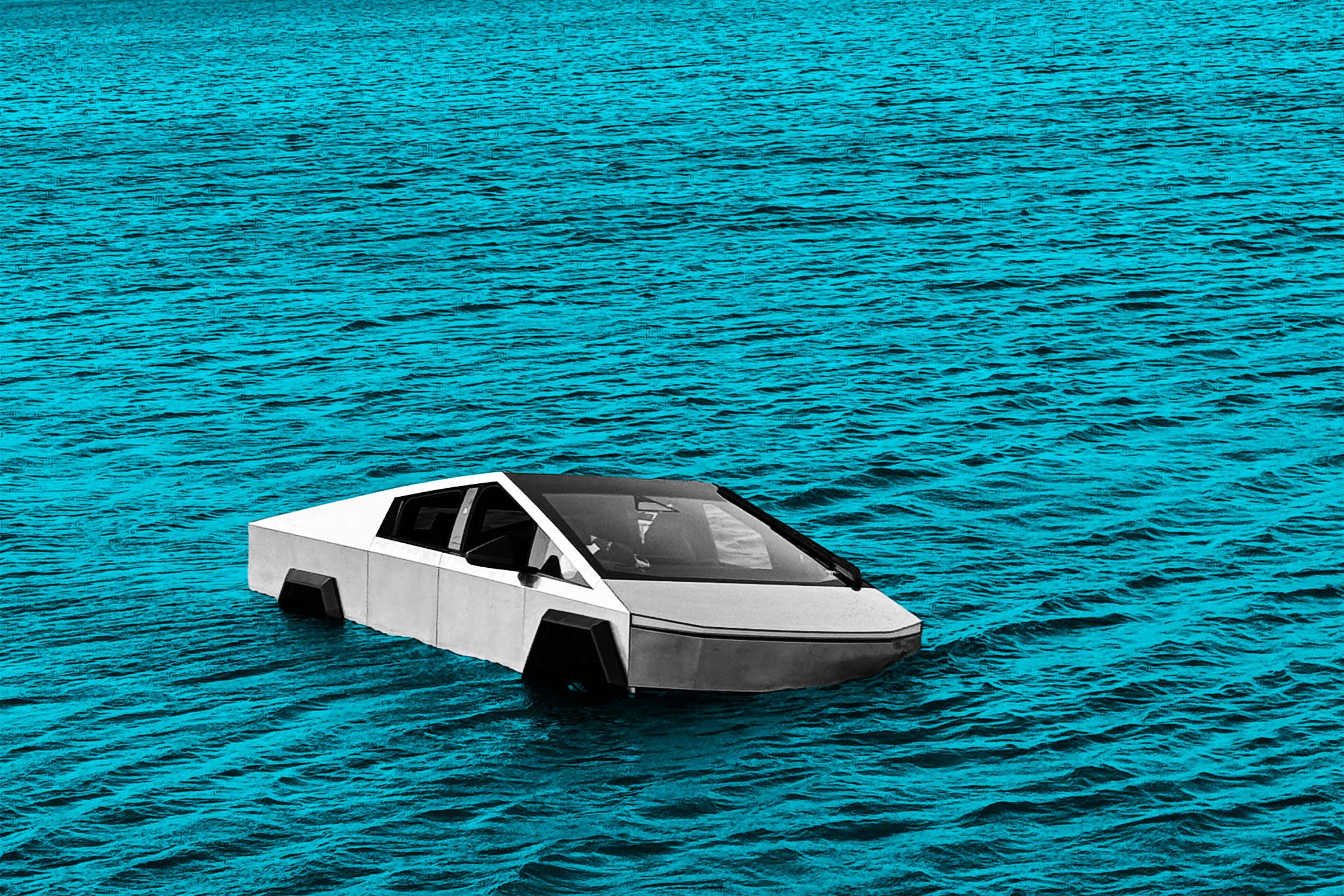
Longtime Cybertruck watchers might remember a peculiar day back before the brutalist pickup was even released, when Tesla CEO Elon Musk randomly tweeted that the vehicle would function as a rudimentary flotation device.

“It will even float for a while,” he wrote at the time.

It wasn’t a one-off claim. Musk later boasted that the vehicle would be able to “traverse at least 100m [330 feet] of water as a boat.”

“Mostly just need to upgrade cabin door seals,” he claimed, writing at another point that the “Cybertruck will be waterproof enough to serve briefly as a boat, so it can cross rivers, lakes and even seas that aren’t too choppy.”

The Cybertruck finally did make it to market, where it’s suffered a seemingly endless parade of recalls, embarrassing incidents, and dismal sales figures.

Unsurprisingly, all Musk’s bluster about the truck serving as a makeshift schooner turned out to be flimflam. In fact, it quickly emerged that just getting wet in a car wash could brick the thing.

To muddy the waters further, the company ended up adding what it calls “Wade Mode” to the vehicles, which sets the truck’s ride height to the highest level, ostensibly so it can ford creeks and streams.

All that mixed messaging clearly got jumbled for a Texas man, though, who activated Wade Mode and drove his Cybertruck into a lake. Unsurprisingly, things didn’t go well for him.

“Yesterday, [Grapevine Police Department] and [Grapevine Fire Department] were dispatched to Grapevine Lake, where a Tesla Cybertruck was stranded in the water,” police in Grapevine, Texas, wrote on X-formerly-Twitter. “The driver drove into the lake to use the ‘Wade Mode’ feature when the vehicle became disabled.”

Not only is the man’s vehicle swamped — as the cops showed in an amazing attached photo — but he’s in legal trouble as well.

“The passengers abandoned the vehicle and the driver was arrested,” they wrote.

More on the Cybertruck: Cybertruck Recalled to Keep Its Wheels From Flying Off While Driving

The post Man Drives Cybertruck Into Lake to Test Elon Musk’s “Boat” Claims, and It Went About as Well as You’d Guess appeared first on Futurism.

Rocket Report: A dark day for Blue Origin; Pentagon eyes new launch site

29 May 2026 at 14:03

Welcome to Edition 8.43 of the Rocket Report! A disclaimer: No one yet fully appreciates the ramifications of Blue Origin's New Glenn rocket explosion Thursday night on its launch pad at Cape Canaveral, Florida. What we know as of this writing is that much of Blue's sole orbital-class launch pad has been destroyed, and the New Glenn rocket will be grounded for an extended period of time. It is too soon for any hot takes, at least until the Sun rises at the Cape on Friday morning. One thing I am sure of is that we will be writing about this event for weeks, months, and years to come.

As always, we welcome reader submissions. If you don't want to miss an issue, please subscribe using the box below (the form will not appear on AMP-enabled versions of the site). Each report will include information on small-, medium-, and heavy-lift rockets, as well as a quick look ahead at the next three launches on the calendar.

Charting China's contribution to space junk. There's a problem with the drastic uptick in Chinese space launches over the last decade. China appears to be ignoring long-established norms about disposing of the upper stages of rockets, Ars reports. These are the parts of the vehicle that separate from the first stage of a rocket and push a satellite or spacecraft into orbit. In the early decades of spaceflight, launch operators routinely left upper stages in orbit after they released their payloads. But most launch companies today reserve enough propellant in their rockets to remove them from orbit to avoid the risk of spent upper stages becoming a source of space debris. But China is not following this trend. There has been striking growth in China’s rocket body mass. In the past five years, the mass of Chinese rocket bodies in long-lived orbits has risen from less than 100 metric tons to 252, according to a new analysis by Space Domain Awareness expert Jim Shell.

Read full article

Comments

© VCG/VCG via Getty Images

❌