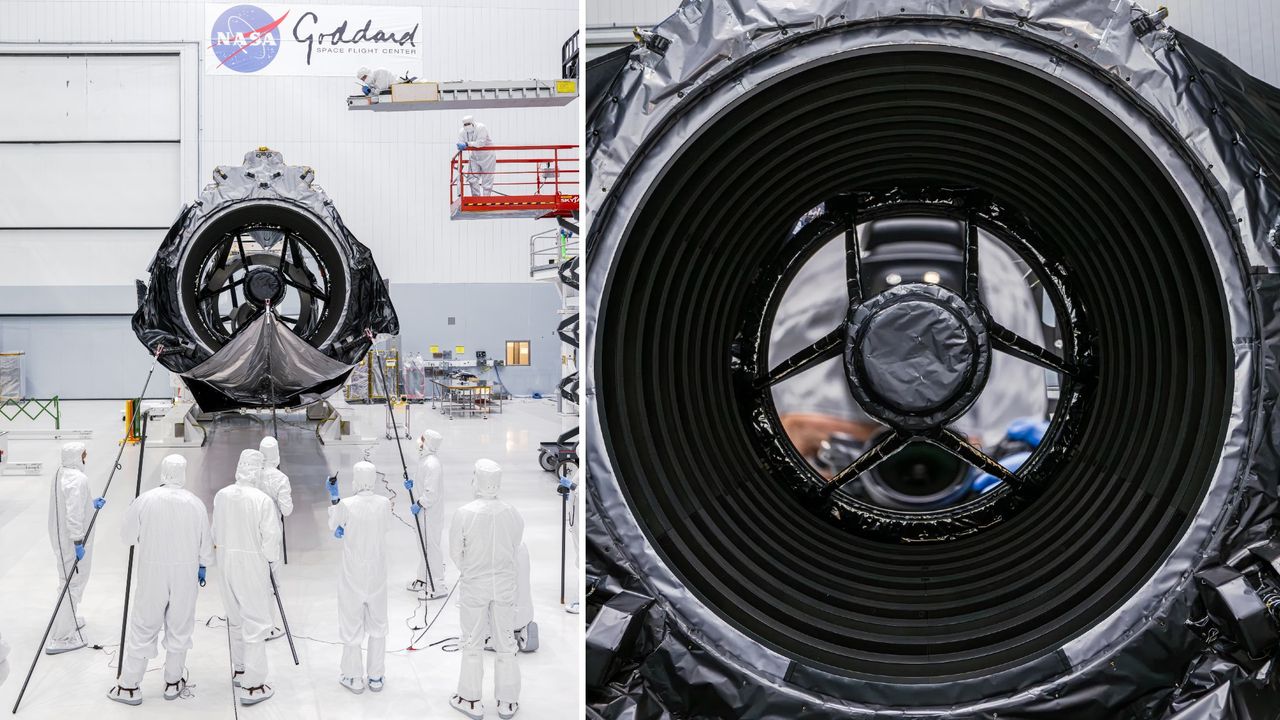
NASA engineers completed their final inspection of the Roman telescope's primary mirror and are now preparing to ship the telescope to its Florida launch site.
NASA engineers completed their final inspection of the Roman telescope's primary mirror and are now preparing to ship the telescope to its Florida launch site.
The largest magnetic map of the universe ever produced—five times larger than all previous efforts combined—marks the beginning of a new generation of research into intergalactic magnetism. Magnetic fields influence how galaxies grow, how matter moves through space, and how the universe has evolved over billions of years.
The Hobby-Eberly Telescope Dark Energy Experiment (HETDEX)—which recently completed the largest survey ever taken of the early universe—has released all of its immense, information-rich database to the public. Built from more than half a petabyte of raw and processed data, it will allow astronomers to study how the first galaxies formed and evolved, measure how gas and stars were distributed within these galaxies, map the large-scale structure of the cosmos, and investigate rare and unexpected objects not easily found in traditional surveys.
Everyone knows that finding the right sauce recipe can make or break a barbecue, but now astronomers are using BBQSORS (pronounced "barbecue sauce") as part of the recipe to explain quasars, some of the brightest objects in the universe. These results were made possible by data from a new instrument on the Subaru Telescope.
An international team of astronomers have employed one of the Large-Sized Telescopes (LSTs) at the Cherenkov Telescope Array Observatory (CTAO) to observe a distant blazar known as OP 313. Results of the observational campaign, published May 26 on the arXiv preprint server, shed more light on the behavior and nature of this object.
Scientists propose that a moon base could act as an isolated first line of biological defense against extraterrestrial samples that might be harmful to Earth's biosphere.
Scientists propose that a moon base could act as an isolated first line of biological defense against extraterrestrial samples that might be harmful to Earth's biosphere.
The brainchild of George Ellery Hale, the 200-inch Hale Telescope was dedicated June 3, 1948, at Palomar Observatory in California. In promoting and fundraising for the project, Hale had a firm science agenda for the scope, but also wrote more fancifully of “the lure of the uncharted seas of space”; though he died in 1938,Continue reading "June 3, 1948: Hale Telescope dedicated"
Galactic collisions are events of breathtaking proportions. The supermassive black holes (SMBHs) at their centers plunge into a chaotic orbital dance that eventually coalesce into a single remnant. On their way to that point, they could eventually get "kicked" out of the center of their galaxy—and finding these "recoiling" black holes has been a challenge of cosmology for decades. A new paper, made available on the arXiv preprint server by an international team, used a novel idea to track down these fast-moving behemoths.
An international team of astronomers has uncovered what they are calling the clearest evidence yet for dying white dwarf stars as the origin of a class of mysterious cosmic signals called long-period radio transients.
The research, led by University of Sydney PhD student Kovi Rose, potentially offers researchers a ‘Rosetta Stone’ capable of deciphering and categorizing other such signals.
“For the first time, we have pinpointed the origin of these signals, confirming the source to be a ‘cataclysmic variable’, or an accreting white dwarf star,” Rose explained in an email to The Debrief.
The team behind the discovery, including the astronomers at CSIRO’s ASKAP radio telescope, said that identifying the origin of these transient cosmic signals that come from a few remote regions of the Milky Way galaxy could also offer researchers a “natural laboratory” to study the extreme physics that occur in such environments.
Mysterious Cosmic Signals “Have Puzzled Astronomers for Years”
According to the same email, long-period radio transients were initially thought to be slow-spinning neutron stars, known as pulsars, emitting periodic energy bursts. However, the team notes that mathematical models suggest that slow-rotating neutron stars cannot generate enough energy to produce the mysterious cosmic signals.
“Long-period radio transients have puzzled astronomers for years,” Mr. Rose explained. “We’ve only found about a dozen, and their origins have been unclear.”
Hoping to solve the mystery, the University of Sydney-led team aimed their instruments at a region of space and discovered a small, dense star called a white dwarf. However, unlike our solitary Sun, this white dwarf is part of a binary star system, named ASKAP J1745−5051, with a much larger but less dense red dwarf as its companion.
Artists’ impression of a white dwarf binary system, ASKAP J1745-5051, that could serve as a cosmic ‘Rosetta Stone’ for studying long-period radio transients. Image Credit: Carl Knox/OzGrav/Swinburne & Joshua Preston Pritchard (CSIRO).
After several scans with ASKAP, the team discovered that the smaller white dwarf, about the size of Earth but with a mass closer to the Sun’s, was shedding or accreting material onto the larger but less dense red dwarf star. As the material heats up, it releases X-rays.
The team also detected periodic bursts of radio signals from the binary system. Although these regular emissions are tied to the system’s orbital motion, the researchers found that the bursts of X-rays and radio signals didn’t peak at the same time. According to Mr. Rose, this lack of synchronicity “tells us they’re being produced in different regions of the system.”
Analysis Reveals Long-Period Radio Transient Match
A closer analysis suggested that, due to the proximity of the two stars, which orbit each other in just one hour, their interacting magnetic fields were producing regular radio-wave bursts, which the team clocked at 1.4-hour intervals.
Professor Murphy, Head of School at the University of Sydney School of Physics and Chief Investigator at the ARC Centre of Excellence for Gravitational Wave Discovery (OzGrav), said that similar objects have previously been linked to binary star systems, “but this is the first one where we can clearly see both stars and the accretion process in action.”
When the team compared the emissions from the binary system with those of previously detected long-period radio transients, the data were a clear match. According to Rose, this comparison proved definitively that this elusive category of mysterious cosmic signals “comes from a white dwarf actively pulling material from a companion star.”
Natural Laboratories for Exploring Extreme Plasma Physics
Although the team’s findings do not rule out other causes of these mysterious cosmic signals, they said their discovery “strengthens an alternative explanation” that at least some are caused by binary star systems involving white dwarfs.
“The system is also only the second known long-period radio transient to emit regular X-rays – and the first where the cause of the regularity has been confirmed,” they explained.
When discussing the potential impact of their findings on future research, the team noted that ASKAP J1745-5051 could provide astronomers “a reference point” for understanding other long-period radio transients that have remained uncharacterized.
Mr. Rose said that the system could help researchers determine whether other long-period transients are more like pulsars or like white dwarf systems, “acting like a stellar Rosetta stone,” referencing the famous stone tablet that helped modern researchers decipher Egyptian hieroglyphs. He also noted that the system offers researchers a unique opportunity to study extreme plasma physics and magnetic-field interactions “under conditions that cannot be replicated on Earth.”
“These systems are natural laboratories,” Mr Rose said. “They allow us to test our understanding of how matter behaves in strong magnetic fields and under intense gravitational forces.”
In the future, the University of Sydney-led team said they are planning future observations of the system with a combination of optical, radio, and X-ray telescopes “to better understand how these emissions are generated” and to determine whether similar mechanisms found in this system can explain the full population of long-period radio transients spotted to date.
“Each new discovery is helping us piece together the bigger picture,” Mr Rose explained. “We’re only just beginning to understand this new class of cosmic events.”
Christopher Plain is a Science Fiction and Fantasy novelist and Head Science Writer at The Debrief. Follow and connect with him on X, learn about his books at plainfiction.com, or email him directly at christopher@thedebrief.org.
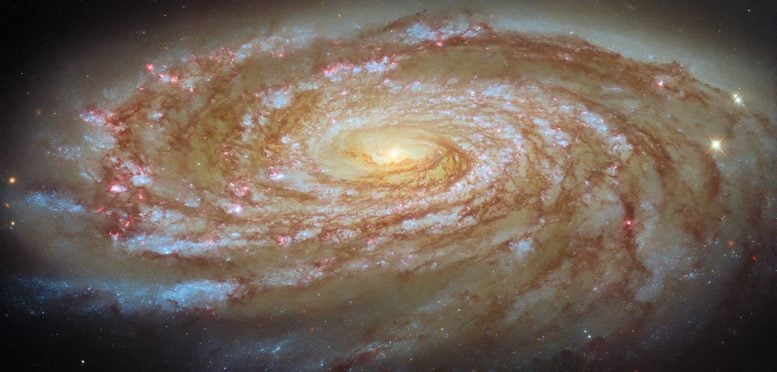
A spectacular spiral galaxy known as M88 is traveling toward the crowded heart of the Virgo Cluster, where powerful forces are already beginning to reshape its future. A striking new image from the NASA/ESA Hubble Space Telescope highlights Messier 88 (M88), a spiral galaxy that is in the midst of a cosmic journey spanning hundreds [...]
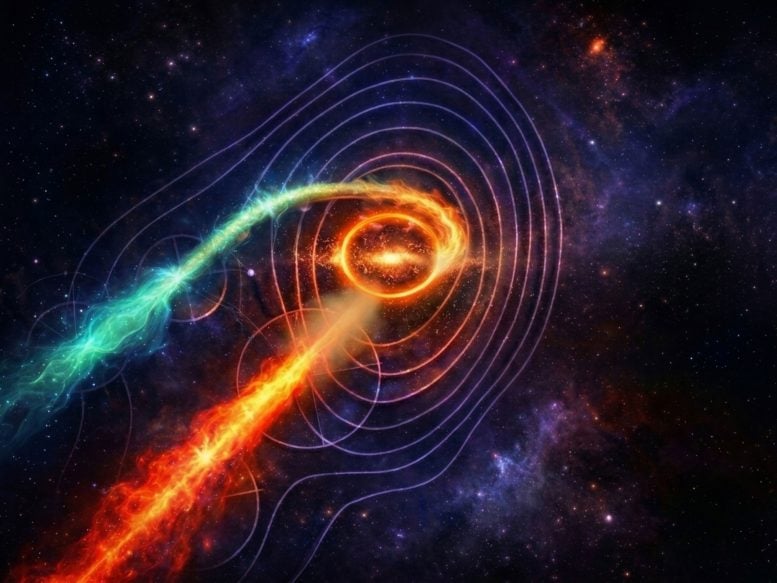
Researchers discovered a closely orbiting pair of supermassive black holes in Markarian 501 by tracking two jets of particles. The binary system could merge within 100 years and may produce detectable gravitational waves. Current evidence indicates that nearly every large galaxy contains a supermassive black hole at its center, with a mass ranging from millions [...]
NASA’s Fermi telescope may have finally uncovered the magnetic powerhouse behind the universe’s brightest supernovae. An international team of astronomers analyzing observations from NASA’s Fermi Gamma-ray Space Telescope has found what appears to be the first convincing detection of gamma rays from a rare type of extraordinarily bright stellar explosion known as a superluminous supernova. [...]

 Login
Login