Birgitta Schultze-Bernhardt and her team at the Institute of Experimental Physics at Graz University of Technology (TU Graz) have developed a new type of UV dual-comb spectrometer that detects gaseous air pollutants with unrivaled accuracy and sensitivity. Using ultraviolet double laser light, the device measures the concentration of harmful gases such as formaldehyde within half a second.
Whisky-inspired chemicals could help power a new generation of microscopic machines, according to researchers who have discovered a way to make tiny particles "swim" through liquid using compounds linked to the production of Scotland's national drink.
Researchers from the Swiss Federal Institute of Technology (EPFL) have announced the first ultrafast laser delivering 1.05 nanojoules of energy in extremely short pulses as short as 147 femtoseconds integrated onto a photonic chip.
The research team behind the accomplishment said that successfully scaling down ultrafast lasers of this magnitude from large tabletop models to microchip integration could enable extremely advanced sensing technologies, improve medical imaging, and potentially enable next-generation atomic clocks for yet-to-be-developed communication and navigation applications.
Ultrafast Lasers on a Microchip Scale Have Remained an Elusive Photonics ‘Holy Grail’
In a statement announcing the breakthrough, team leader and EPFL Professor Tobias J. Kippenberg explained that ultrafast lasers emit extremely short pulses of light energy lasting only a few hundred femtoseconds, which are quadrillionths of a second. Although the development of this category of lasers has enabled ultraprecise micromachining, atomic clocks, and advanced eye surgery, the team notes that the “bulky” technology has been limited to optical laser tables.
On the other end of the spectrum, engineers have built extremely small photonic chips that channel light in a similar way to how traditional microprocessors channel electricity to perform calculations. Some photonic chip designs are already widely used in the communications industry. However, integrating the ultrafast laser technology at the power levels demonstrated by the research team into a smaller chip has remained particularly elusive.
“For more than twenty years, a high-pulse-energy femtosecond laser on chip was widely regarded as a holy grail of integrated photonics,” Professor Kippenberg explained.
“Overlooked, Surprisingly Elegant Technology” Could Enable Futuristic Technologies
To find the nexus between size, speed, and power that could enable a true high-energy, ultrafast laser on a chip, the EPFL team opted to turn away from traditional laser designs and instead took advantage of what they termed a “largely overlooked” design: a Mamyshev oscillator.
Unlike some designs, this oscillator uses a nonlinear waveguide placed between the two optical filters in the laser cavity, each of which allows a different color of the spectrum to pass through. When a strong light pulse travels through the installed waveguide, the beam broadens into a wider range of colors.
EPFL’s chip-based ultrafast laser operating in the laboratory test setup. The device produces extremely short laser pulses directly on a photonic chip. Image Credit: Zheru Qiu/EPFL.
The team notes that this effect allows part of the light pulse to pass through both filters and remain in circulation. However, they also note that “weak light” does not broaden enough when impacting the waveguide and is ‘rejected.’
Zheru Qiu, a co-lead author of the paper, said that beyond speed and power, their chip has commercial potential due to its material simplicity.
“This design is especially attractive because it does not require any component that is difficult to make on this erbium-doped silicon nitride chip,” Qiu explained.
Another advantage to the team’s design is its resistance to nonlinear interaction. Put simply, when waveguides squeeze light into tiny spaces, that same light interacts strongly with itself.
The resulting nonlinear interactions can degrade the performance of traditional photonic chip designs. However, Qiu said that a laser with a Mamyshev oscillator is “well suited to the tight confinement of light in photonic chips.”
“Our result shows that it is not only possible, but that it can be achieved with a surprisingly elegant architecture that the integrated-photonics community had overlooked,” Qiu explained of their revolutionary architecture.
Integrated Chips Could Replace Large, Expensive Laboratory Lasers
When discussing the versatility of their ultrafast laser on a chip, the researchers noted that the prototype’s 42-cm-long laser cavity can be folded down to a size smaller than a matchhead. For comparison, they noted that 42 centimeters is “far smaller than optical fiber-based lasers.”
For potential commercial applications, the team said their chips can be manufactured “at-scale,” with an excess of 1,000 individual laser cavities per chip. Although currently in the demonstration phase, the team suggested that a fully realized commercial-grade ultrafast laser-on-a-chip could provide engineers with a critical microengineering tool they have lacked.
“With kilowatt-level peak powers, the chip can drive demanding applications that have long depended on large, expensive laboratory lasers,” says Qiu.
The researchers suggested their chip could impact several technologies, such as advanced sensing and medical imaging, and potentially pave the way for futuristic technologies based on ultraprecise atomic clocks.
Christopher Plain is a Science Fiction and Fantasy novelist and Head Science Writer at The Debrief. Follow and connect with him on X, learn about his books at plainfiction.com, or email him directly at christopher@thedebrief.org.
Scientists say that they’ve just detected a massive cloud of gas some 3 billion lightyears in diameter, floating in space roughly 7 billion light years away from us. This is pretty cool, but the problem is that our current models of the universe say that it (and other massive structures like it) just shouldn’t exist. Let’s take a look.
Scientists say that they’ve just detected a massive cloud of gas some 3 billion lightyears in diameter, floating in space roughly 7 billion light years away from us. This is pretty cool, but the problem is that our current models of the universe say that it (and other massive structures like it) just shouldn’t exist. Let’s take a look.
In 1973, John Archibald Wheeler described the relationship between space and matter in two sentences: “Space acts on matter, telling it how to move. In turn, matter reacts back on space, telling it how to curve.” Wheeler’s words serve as a pithy encapsulation of general relativity, Albert Einstein’s theory of gravity. Wheeler’s sentences also lay out a challenge that theorists face today: When…
While searching for new Higgs bosons the CMS experiment at the Large Hadron Collider (LHC) may have just found a surprise. They have observed an excess of events that look to be a new particle, and are reporting high statistical evidence for their claim. The only question is what exactly is this new particle?
The search was initially designed to look for new, heavier, versions of the Higgs boson decaying to a top quark and an anti-top quark. Its well known that the Higgs boson of the Standard Model, discovered jointly by ATLAS and CMS in 2012, underlies the mechanism which gives all fundamental particles their masses. The Higgs boson itself interacts with particles in proportion to their mass, preferring heavier particles over lighter ones. It therefore interacts the most strongly with the heaviest known fundamental particle, the top quark, which has a mass of ~173 GeV. The Higgs boson itself only has a bass of 125 GeV, meaning conservation of energy dictates it can’t decay into a top quark-antiquark pair.
However many theories of physics beyond the the Standard Model predict additional Higgs bosons, heavier cousins of the current one. If these new heavy Higgs bosons had a mass larger than 350 GeV, they would likely decay to a top quark-antiquark pair quite often. CMS therefore was analyzed its data searching for this signature, hoping to find signs of a new Higgs boson. To do so, they had scrutinize very carefully the known production of top quark-antiquark pairs, which are produced copiously at the LHC from other processes. If a new particle was being produced and decaying to top quarks, the mass of the new particle would give the top quarks a characteristic energy. One key sign of a new particle would therefore be an excess of top quark-antiquark events at a particular energy, corresponding to the mass of the new particle.
When CMS scrutinized their data looking for such an excess they found one. But curiously right ~350 GeV, the minimum energy required to produce the top quark-antiquark pair. It would be quite the coincidence for a new particle to show up right at this minimum threshold, which made CMS consider alternative possibilities.
A comparison of the observed CMS data and their estimate of backgrounds as a function of the invariant mass of the top quark antiquark system. CMS observes an excess of events at ~350 GeV, which is well fit with a toponium model (red line).
One unorthodox explanation that seems to fit the bill is ‘toponium’, a short lived bound state of the top quark-antiquark pair is being formed. Toponium would be the heaviest version of ‘quarkonia’ we have seen, bound states of quark antiquark pairs that form bound states similar to atoms. We have observed and measured quarkonia states of the other quarks for decades, however it was long thought that the top quark, whose large mass causes it to decay in just 10^(-25) seconds, would decay too quickly to create observable bound state effects at a hadron collider. Toponium production would happen most often if the top quarks were produced just at the energy threshold, such that they don’t any extra energy. These low energy top quarks would spend more time close to each other than normal, rather than immediately flying away, so they could have time to briefly form a toponium state before decaying. However, once small hints of intriguing excesses started appearing in LHC analyses, updated calculations in the last few years suggested that perhaps such an effect could be observable.
These calculations are approximate, and more work is still being done to refine them. But the preliminary predictions they give for the properties of toponium seem to match well with what CMS is seeing, both in terms of the rate of toponium production and the quantum properties of the toponium state (spin and parity).
Still CMS is being cautious before claiming a discovery of toponium. They claim observation of an ‘excess at the top quark pair production threshold’ which is consistent with toponium. However given the limited present data and incomplete theoretical models of toponium, they cannot rule out that the excess they are seeing is coming from a new Higgs-like particle.
CMS measurement tries to disentangle the quantum properties of the observed excess. The x-axis shows the estimated rate of production a ‘pseudoscalar’ particle producing the excess. The y-axis shows a similar estimate for a ‘scalar’ particle. The allowed region for the scalar still includes zero, while the zero pseudoscalar hypothesis is clearly excluded at larger than 5 standard deviations.
Further work will be needed to develop improved theoretical models of toponium, and detailed studies from CMS assessing the properties of their observed excess. The excess will also need confirmation from CMS’s rival LHC experiment, ATLAS, to ensure it has not merely made a mistake in its analysis.
However, the smart money would say this very likely looks like toponium. Which, while not signaling the long sought overthrow of the standard model, would be an unexpected and cool surprise from the LHC. Understanding the properties of this previously-thought-impossible quasiparticle will spawn much fruitful research in the years to come. Physicists love a surprise!
Discloure: The author is a member of the CMS collaboration but did not directly work on this analysis
Erratum 4/15/2025 : The article was updated to clarify that in the theory literature prior to the LHC toponium was thought possible to form, just that it was thought to be too small an effect to be observable. The article previously incorrectly stated it had been previously thought impossible to form
This is the second part of our coverage of the P5 report and its implications for particle physics. To read the first part, click here
One of the thorniest questions in particle physics is ‘What comes after the LHC?’. This was one of the areas people were most uncertain what the P5 report would say. Globally, the field is trying to decide what to do once the LHC winds down in ~2040 While the LHC is scheduled to get an upgrade in the latter half of the decade and run until the end of the 2030’s, the field must start planning now for what comes next. For better or worse, big smash-y things seem to capture a lot of public interest, so the debate over what large collider project to build has gotten heated. Even Elon Musk is tweeting (X-ing?) memes about it.
Famously, the US’s last large accelerator project, the Superconducting Super Collider (SSC), was cancelled in the ’90s partway through its construction. The LHC’s construction itself often faced perilous funding situations, and required a CERN to make the unprecedented move of taking a loan to pay for its construction. So no one takes for granted that future large collider projects will ultimately come to fruition.
Desert or Discovery?
When debating what comes next, dashed hopes of LHC discoveries are top of mind. The LHC experiments were primarily designed to search for the Higgs boson, which they successfully found in 2012. However, many had predicted (perhaps over-confidently) it would also discover a slew of other particles, like those from supersymmetry or those heralding extra-dimensions of spacetime. These predictions stemmed from a favored principle of nature called ‘naturalness’ which argued additional particles nearby in energy to the Higgs were needed to keep its mass at a reasonable value. While there is still much LHC data to analyze, many searches for these particles have been performed so far and no signs of these particles have been seen.
These null results led to some soul-searching within particle physics. The motivations behind the ‘naturalness’ principle that said the Higgs had to be accompanied by other particles has been questioned within the field, and in New York Times op-eds.
No one questions that deep mysteries like the origins of dark matter, matter anti-matter asymmetry, and neutrino masses, remain. But with the Higgs filling in the last piece of the Standard Model, some worry that answers to these questions in the form of new particles may only exist at energy scales entirely out of the reach of human technology. If true, future colliders would have no hope of
A diagram of the particles of the Standard Model laid out as a function of energy. The LHC and other experiments have probed up to around 10^3 GeV, and found all the particles of the Standard Model. Some worry new particles may only exist at the extremely high energies of the Planck or GUT energy scales. This would imply a large large ‘desert’ in energy, many orders of magnitude in which no new particles exist. Figure adapted from here
The situation being faced now is qualitatively different than the pre-LHC era. Prior to the LHC turning on, ‘no lose theorems’, based on the mathematical consistency of the Standard Model, meant that it had to discover the Higgs or some other new particle like it. This made the justification for its construction as bullet-proof as one can get in science; a guaranteed Nobel prize discovery. But now with the last piece of the Standard Model filled in, there are no more free wins; guarantees of the Standard Model’s breakdown don’t occur until energy scales we would need solar-system sized colliders to probe. Now, like all other fields of science, we cannot predict what discoveries we may find with future collider experiments.
Still, optimists hope, and have their reasons to believe, that nature may not be so unkind as to hide its secrets behind walls so far outside our ability to climb. There are compelling models of dark matter that live just outside the energy reach of the LHC, and predict rates too low for direct detection experiments, but would be definitely discovered or ruled out by high energy colliders. The nature of the ‘phase transition’ that occurred in the very early universe, which may explain the prevalence of matter over anti-matter, can also be answered. There are also a slew ofexperimental ‘hints‘, all of which have significant question marks, but could point to new particles within the reach of a future collider.
Many also just advocate for building a future machine to study nature itself, with less emphasis on discovering new particles. They argue that even if we only further confirm the Standard Model, it is a worthwhile endeavor. Though we calculate Standard Model predictions for high energies, unless they are tested in a future collider we will not ‘know’ how if nature actually works like this until we test it in those regimes. They argue this is a fundamental part of the scientific process, and should not be abandoned so easily. Chief among the untested predictions are those surrounding the Higgs boson. The Higgs is a central somewhat mysterious piece of the Standard Model but is difficult to measure precisely in the noisy environment of the LHC. Future colliders would allow us to study it with much better precision, and verify whether it behaves as the Standard Model predicts or not.
Projects
These theoretical debates directly inform what colliders are being proposed and what their scientific case is.
Many are advocating for a “Higgs factory”, a collider of based on clean electron-positron collisions that could be used to study the Higgs in much more detail than the messy proton collisions of the LHC. Such a machine would be sensitive to subtle deviations of Higgs behavior from Standard Model predictions. Such deviations could come from the quantum effects of heavy, yet-undiscovered particles interacting with the Higgs. However, to determine what particles are causing those deviations, its likely one would need a new ‘discovery’ machine which has high enough energy to produce them.
Among the Higgs factory options are the International Linear Collider, a proposed 20km linear machine which would be hosted in Japan. ILC designs have been ‘ready to go’ for the last 10 years but the Japanese government has repeated waffled on whether to approve the project. Sitting in limbo for this long has led to many being pessimistic about the projects future, but certainly many in the global community would be ecstatic to work on such a machine if it was approved.
Designs for the ILC have been ready for nearly a decade, but its unclear if it will receive the greenlight from the Japanese government. Image source
Alternatively, some in the US have proposed building a linear collider based on a ‘cool copper’ cavities (C3) rather than the standard super conducting ones. These copper cavities can achieve more acceleration per meter than the standard super conducting ones, meaning a linear Higgs factory could be constructed with a reduced 8km footprint. A more compact design can significantly cut down on infrastructure costs that governments usually don’t like to use their science funding on. Advocates had proposed it as a cost-effective Higgs factory option, whose small footprint means it could potentially hosted in the US.
The Future-Circular-Collider (FCC), CERN’s successor to the LHC, would kill both birds with one extremely long stone. Similar to the progression from LEP to the LHC, this new proposed 90km collider would run as Higgs factory using electron-positron collisions starting in 2045 before eventually switching to a ~90 TeV proton-proton collider starting in ~2075.
Designs for the massive 90km FCC ring surrounding Geneva
Such a machine would undoubtably answer many of the important questions in particle physics, however many have concerns about the huge infrastructure costs needed to dig such a massive tunnel and the extremely long timescale before direct discoveries could be made. Most of the current field would not be around 50 years from now to see what such a machine finds. The Future-Circular-Collider (FCC), CERN’s successor to the LHC, would kill both birds with one extremely long stone. Similar to the progression from LEP to the LHC, this new proposed 90km collider would run as Higgs factory using electron-positron collisions starting in 2045 before eventually switching to a ~90 TeV proton-proton collider starting in ~2075. Such a machine would undoubtably answer many of the important questions in particle physics, however many have concerns about the extremely long timescale before direct discoveries could be made. Most of the current field would not be around 50 years from now to see what such a machine finds. The FCC is also facing competition as Chinese physicists have proposed a very similar design (CEPC) which could potentially start construction much earlier.
During the snowmass process many in the US starting pushing for an ambitious alternative. They advocated a new type of machine that collides muons, the heavier cousin of electrons. A muon collider could reach the high energies of a discovery machine while also maintaining a clean environment that Higgs measurements can be performed in. However, muons are unstable, and collecting enough of them into formation to form a beam before they decay is a difficult task which has not been done before. The group of dedicated enthusiasts designed t-shirts and Twitter memes to capture the excitement of the community. While everyone agrees such a machine would be amazing, the key technologies necessary for such a collider are less developed than those of electron-positron and proton colliders. However, if the necessary technological hurdles could be overcome, such a machine could turn on decades before the planned proton-proton run of the FCC. It can also presents a much more compact design, at only 10km circumfrence, roughly three times smaller than the LHC. Advocates are particularly excited that this would allow it to be built within the site of Fermilab, the US’s flagship particle physics lab, which would represent a return to collider prominence for the US.
A proposed design for a muon collider. It relies on ambitious new technologies, but could potentially deliver similar physics to the FCC decades sooner and with a ten times smaller footprint. Source
Deliberation & Decision
This plethora of collider options, each coming with a very different vision of the field in 25 years time led to many contentious debates in the community. The extremely long timescales of these projects led to discussions of human lifespans, mortality and legacy being much more being much more prominent than usual scientific discourse.
Ultimately the P5 recommendation walked a fine line through these issues. Their most definitive decision was to recommend against a Higgs factor being hosted in the US, a significant blow to C3 advocates. The panel did recommend US support for any international Higgs factories which come to fruition, at a level ‘commensurate’ with US support for the LHC. What exactly ‘comensurate’ means in this context I’m sure will be debated in the coming years.
However, the big story to many was the panel’s endorsement of the muon collider’s vision. While recognizing the scientific hurdles that would need to be overcome, they called the possibility of muon collider hosted in the US a scientific ‘muon shot‘, that would reap huge gains. They therefore recommended funding for R&D towards they key technological hurdles that need to be addressed.
Because the situation is unclear on both the muon front and international Higgs factory plans, they recommended a follow up panel to convene later this decade when key aspects have clarified. While nothing was decided, many in the muon collider community took the report as a huge positive sign. While just a few years ago many dismissed talk of such a collider as fantastical, now a real path towards its construction has been laid down.
Hitoshi Murayama, chair of the P5 committee, cuts into a ‘Shoot for the Muon’ cake next to a smiling Lia Merminga, the director of Fermilab. Source
While the P5 report is only one step along the path to a future collider, it was an important one. Eyes will now turn towards reports from the different collider advocates. CERN’s FCC ‘feasibility study’, updates around the CEPC and, the International Muon Collider Collaboration detailed design report are all expected in the next few years. These reports will set up the showdown later this decade where concrete funding decisions will be made.
For those interested the full report as well as executive summaries of different areas can be found on the P5 website. Members of the US particle physics community are also encouraged to sign the petition endorsing the recommendations here.
Particle physics is the epitome of ‘big science’. To answer our most fundamental questions out about physics requires world class experiments that push the limits of whats technologically possible. Such incredible sophisticated experiments, like those at the LHC, require bigfacilities to make them possible, bigcollaborations to run them, big project planning to make dreams of new facilities a reality, and committees with big acronyms to decide what to build.
Enter the Particle Physics Project Prioritization Panel (aka P5) which is tasked with assessing the landscape of future projects and laying out a roadmap for the future of the field in the US. And because these large projects are inevitably an international endeavor, the report they released last week has a large impact on the global direction of the field. The report lays out a vision for the next decade of neutrino physics, cosmology, dark matter searches and future colliders.
P5 follows the community-wide brainstorming effort known as the Snowmass Process in which researchers from all areas of particle physics laid out a vision for the future. The Snowmass process led to a particle physics ‘wish list’, consisting of all the projects and research particle physicists would be excited to work on. The P5 process is the hard part, when this incredibly exciting and diverse research program has to be made to fit within realistic budget scenarios. Advocates for different projects and research areas had to make a case of what science their project could achieve and a detailed estimate of the costs. The panel then takes in all this input and makes a set of recommendations of how the budget should be allocated, what should projects be realized and what hopes are dashed. Though the panel only produces a set of recommendations, they are used quite extensively by the Department of Energy which actually allocates funding. If your favorite project is not endorsed by the report, its very unlikely to be funded.
The P5 report also created an awesome graphic that contains symbolism for the different aspects of the plan. The left side depicts oscillating neutrinos and the shape of the Higgs potential. The right side depicts dark matter and the large scale structure of the universe. The central ball of light is supposed to represent discoveries of the unknown. Source
Particle physics is an incredibly diverse field, covering sub-atomic to cosmic scales, so recommendations are divided up into several different areas. In this post I’ll cover the panel’s recommendations for neutrino physics and the cosmic frontier. Future colliders, perhaps the spiciest topic, will be covered in a follow up post.
The Future of Neutrino Physics
For those in the neutrino physics community all eyes were on the panels recommendations regarding the Deep Underground Neutrino Experiment (DUNE). DUNE is the US’s flagship particle physics experiment for the coming decade and aims to be the definitive worldwide neutrino experiment in the years to come. A high powered beam of neutrinos will be produced at Fermilab and sent 800 miles through the earth’s crust towards several large detectors placed in a mine in South Dakota. Its a much bigger project than previous neutrino experiments, unifying essentially the entire US community into a single collaboration.
DUNE is setup to produce world leading measurements of neutrino oscillations, the property by which neutrinos produced in one ‘flavor state’, (eg an electron-neutrino) gradually changes its state with sinusoidal probability (eg into a muon neutrino) as it propagates through space. This oscillation is made possible by a simple quantum mechanical weirdness: neutrino’s flavor state, whether it couples to electrons muons or taus, is not the same as its mass state. Neutrinos of a definite mass are therefore a mixture of the different flavors and visa versa.
Detailed measurements of this oscillation are the best way we know to determine several key neutrino properties. DUNE aims to finally pin down two crucial neutrino properties: their ‘mass ordering’, which will solidify how the different neutrino flavors and measured mass differences all fit together, and their ‘CP-violation’ which specifies whether neutrinos and their anti-matter counterparts behave the same or not. DUNE’s main competitor is the Hyper-Kamiokande experiment in Japan, another next-generation neutrino experiment with similar goals.
A depiction of the DUNE experiment. A high intensity proton beam at Fermilab is used to create a concentrated beam of neutrinos which are then sent through 800 miles of the Earth’s crust towards detectors placed deep underground South Dakota. Source
Construction of the DUNE experiment has been ongoing for several years and unfortunately has not been going quite as well as hoped. It has faced significant schedule delays and cost overruns. DUNE is now not expected to start taking data until 2031, significantly behind Hyper-Kamiokande’s projected 2027 start. These delays may lead to Hyper-K making these definitive neutrino measurements years before DUNE, which would be a significant blow to the experiment’s impact. This left many DUNE collaborators worried about its broad support from the community.
It came as a relief then when P5 report re-affirmed the strong science case for DUNE, calling it the “ultimate long baseline” neutrino experiment. The report strongly endorsed the completion of the first phase of DUNE. However, it recommended a pared-down version of its upgrade, advocating for an earlier beam upgrade in lieu of additional detectors. This re-imagined upgrade will still achieve the core physics goals of the original proposal with a significant cost savings. With this report, and news that the beleaguered underground cavern construction in South Dakota is now 90% complete, was certainly welcome holiday news to the neutrino community. This is also sets up a decade-long race between DUNE and Hyper-K to be the first to measure these key neutrino properties.
Cosmic Implications
While we normally think of particle physics as focused on the behavior of sub-atomic particles, its really about the study of fundamental forces and laws, no matter the method. This means that telescopes to study the oldest light in the universe, the Cosmic Microwave Background (CMB), fall into the same budget category as giant accelerators studying sub-atomic particles. Though the experiments in these two areas look very different, the questions they seek to answer are cross-cutting. Understanding how particles interact at very high energies helps us understand the earliest moments of the universe, when such particles were all interacting in a hot dense plasma. Likewise, by studying the these early moments of the universe and its large-scale evolution can tell us about what kinds of particles and forces are influencing its dynamics. When asking fundamental questions about the universe, one needs both the sharpest microscopes and the grandest panoramas possible.
The most prominent example of this blending of the smallest and largest scales in particle physics is dark matter. Some of our best evidence for dark matter comes analyzing the cosmic microwave background to determine how the primordial plasma behaved. These studies showed that some type of ‘cold’, matter that doesn’t interact with light, aka dark matter, was necessary to form the first clumps that eventually seeded the formation of galaxies. Without it, the universe would be much more soup-y and structureless than what we see to today.
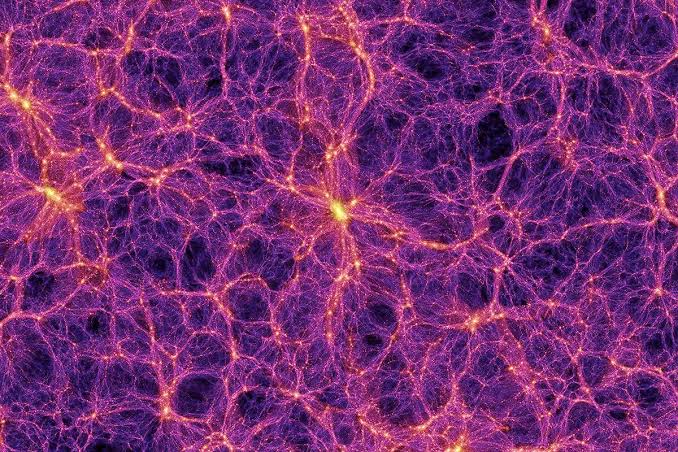
The “cosmic web” galaxy clusters from the Millenium simulation. Measuring and understanding this web can tell us a lot about the fundamental constituents of the universe. Source
To determine what dark matter is then requires an attack from two fronts: design experiments here on earth attempting directly detect it, and further study its cosmic implications to look for more clues as to its properties.
The panel recommended next generation telescopes to study the CMB as a top priority. The so called ‘Stage 4’ CMB experiment would deploy telescopes in both the south pole and Chile’s Atacama desert to better characterize sources of atmospheric noise. The CMB has been studied extensively before, but the increased precision of CMS-S4 could shed light on mysteries like dark energy, dark matter, inflation, and the recent Hubble Tension. Given the past fruitfulness of these efforts, I think few doubted the science case for such a next generation experiment.
A mockup of one of the CMS-S4 telescopes which will be based in the Chilean desert. Note the person for scale on the right (source)
The P5 report recommended a suite of new dark matter experiments in the next decade, including the ‘ultimate’ liquid Xenon based dark matter search. Such an experiment would follow in the footsteps of massive noble gas experiments like LZ and XENONnT which have been hunting for a favored type of dark matter called WIMP’s for the last few decades. These experiments essentially build giant vats of liquid Xenon, carefully shield from any sources of external radiation, and look for signs of dark matter particles bumping into any of the Xenon atoms. The larger the vat of Xenon, the higher chance a dark matter particle will bump into something. Current generation experiments have ~7 tons of Xenon, and the next generation experiment would be even larger. The next generation aims to reach the so called ‘neutrino floor’, the point as which the experiments would be sensitive enough to observe astrophysical neutrinos bumping into the Xenon. Such neutrino interactions would look extremely similar to those of dark matter, and thus represent an unavoidable background which would signal the ultimate sensitivity of this type of experiment. WIMP’s could still be hiding in a basement below this neutrino floor, but finding them would be exceedingly difficult.
A photo of the current XENONnT experiment. This pristine cavity is then filled with liquid Xenon and closely monitored for signs of dark matter particles bumping into one of the Xenon atoms. Credit: XENON Collaboration
WIMP’s are not the only dark matter candidates in town, and recent years have also seen an explosion of interest in the broad range of dark matter possibilities, with axions being a prominent example. Other kinds of dark matter could have very different properties than WIMPs and have had much fewer dedicated experiments to search for them. There is ‘low hanging fruit’ to pluck in the way of relatively cheap experiments which can achieve world-leading sensitivity. Previously, these ‘table top’ sized experiments had a notoriously difficult time obtaining funding, as they were often crowded out of the budgets by the massive flagship projects. However, small experiments can be crucial to ensuring our best chance of dark matter discovery, as they fill in the blinds pots missed by the big projects.
The panel therefore recommended creating a new pool of funding set aside for these smaller scale projects. Allowing these smaller scale projects to flourish is important for the vibrancy and scientific diversity of the field, as the centralization of ‘big science’ projects can sometimes lead to unhealthy side effects. This specific recommendation also mirrors a broader trend of the report: to attempt to rebalance the budget portfolio to be spread more evenly and less dominated by the large projects.
A pie chart comparing the budget porfolio in 2023 (left) versus the projected budget in 2033 (right). Currently most of the budget is being taken up by the accelerator upgrades and cavern construction of DUNE, with some amount for the LHC upgrades. But by 2033 the panel recommends a much more equitable balance between different research area.
What Didn’t Make It
Any report like this comes with some tough choices. Budget realities mean not all projects can be funded. Besides the pairing down of some of DUNE’s upgrades, one of the biggest areas that was recommended against were ‘accessory experiments at the LHC’. In particular, MATHUSULA and the Forward Physics Facility were two experiments that proposed to build additional detectors near already existing LHC collision points to look for particles that may be missed by the current experiments. By building new detectors hundreds of meters away from the collision point, shielded by concrete and the earth, they can obtained unique sensitivity to ‘long lived’ particles capable of traversing such distances. These experiments would follow in the footsteps of the current FASER experiment, which is already producing impressive results.
While FASER found success as a relatively ‘cheap’ experiment, reusing detector components from and situating itself in a beam tunnel, these new proposals were asking for quite a bit more. The scale of these detectors would have required new caverns to be built, significantly increasing the cost. Given the cost and specialized purpose of these detectors, the panel recommended against their construction. These collaborations may now try to find ways to pare down their proposal so they can apply to the new small project portfolio.
Another major decision by the panel was to recommend against hosting a new Higgs factor collider in the US. But that will discussed more in a future post.
Conclusions
The P5 panel was faced with a difficult task, the total cost of all projects they were presented with was three times the budget. But they were able to craft a plan that continues the work of the previous decade, addresses current shortcomings and lays out an inspiring vision for the future. So far the community seems to be strongly rallying behind it. At time of writing, over 2700 community members from undergraduates to senior researchers have signed a petition endorsing the panels recommendations. This strong show of support will be key for turning these recommendations into actual funding, and hopefully lobbying congress to even increase funding so that more of this vision can be realized.
For those interested the full report as well as executive summaries of different areas can be found on the P5 website. Members of the US particle physics community are also encouraged to sign the petition endorsing the recommendations here.
And stayed tuned for part 2 of our coverage which will discuss the implications of the report on future colliders!
Every year since 1966, particle physicists have gathered in the Alps to unveil and discuss their most important results of the year (and to ski). This year I had the privilege to attend the Moriond QCD session so I thought I would post a recap here. It was a packed agenda spanning 6 days of talks, and featured a lot of great results over many different areas of particle physics, so I’ll have to stick to the highlights here.
FASER Observes First Collider Neutrinos
Perhaps the most exciting result of Moriond came from the FASER experiment, a small detector recently installed in the LHC tunnel downstream from the ATLAS collision point. They announced the first ever observation of neutrinos produced in a collider. Neutrinos are produced all the time in LHC collisions, but because they very rarely interact, and current experiments were not designed to look for them, no one had ever actually observed them in a detector until now. Based on data collected during collisions from last year, FASER observed 153 candidate neutrino events, with a negligible amount of predicted backgrounds; an unmistakable observation.
A neutrino candidate in the FASER emulsion detector. Source
This first observation opens the door for studying the copious high energy neutrinos produced in colliders, which sit in an energy range currently unprobed by other neutrino experiments. The FASER experiment is still very new, so expect more exciting results from them as they continue to analyze their data. A first search for dark photons was also released which should continue to improve with more luminosity. On the neutrino side, they have yet to release full results based on data from their emulsion detector which will allow them to study electron and tau neutrinos in addition to the muon neutrinos this first result is based on.
New ATLAS and CMS Results
The biggest result from the general purpose LHC experiments was ATLAS and CMS bothannouncing that they have observed the simultaneous production of 4 top quarks. This is one of the rarest Standard Model processes ever observed, occurring a thousand times less frequently than a Higgs being produced. Now that it has been observed the two experiments will use Run-3 data to study the process in more detail in order to look for signs of new physics.
Candidate 4 top events from ATLAS (left) and CMS (right).
ATLAS also unveiled an updated measurement of the mass of the W boson. Since CDF announced its measurement last year, and found a value in tension with the Standard Model at ~7-sigma, further W mass measurements have become very important. This ATLAS result was actually a reanalysis of their previous measurement, with improved PDF’s and statistical methods. Though still not as precise as the CDF measurement, these improvements shrunk their errors slightly (from 19 to 16 MeV). The ATLAS measurement reports a value of the W mass in very good agreement with the Standard Model, and approximately 4-sigma in tension with the CDF value. These measurements are very complex, and work is going to be needed to clarify the situation.
CMS had an intriguing excess (2.8-sigma global) in a search for a Higgs-like particle decaying into an electron and muon. This kind of ‘flavor violating’ decay would be a clear indication of physics beyond the Standard Model. Unfortunately it does not seem like ATLAS has any similar excess in their data.
Status of Flavor Anomalies
At the end of 2022, LHCb announced that the golden channel of the flavor anomalies, the R(K) anomaly, had gone away upon further analysis. Many of the flavor physics talks at Moriond seemed to be dealing with this aftermath.
Of the remaining flavor anomalies, R(D), a ratio describing the decay rates of B mesons in final states with D mesons and taus versus D mesons plus muons or electrons, has still been attracting interest. LHCb unveiled a new measurement that focused on hadronically taus and found a value that agreed with the Standard Model prediction. However this new measurement had larger error bars than others so it only brought down the world average slightly. The deviation currently sits at around 3-sigma.
A summary plot showing all the measurements of R(D) and R(D*). The newest LHCb measurement is shown in the red band / error bar on the left. The world average still shows a 3-sigma deviation to the SM prediction
An interesting theory talk pointed out that essentially any new physics which would produce a deviation in R(D) should also produce a deviation in another lepton flavor ratio, R(Λc), because it features the same b->clv transition. However LHCb’s recent measurement of R(Λc) actually found a small deviation in the opposite direction as R(D). The two results are only incompatible at the ~1.5-sigma level for now, but it’s something to continue to keep an eye on if you are following the flavor anomaly saga.
It was nice to see that the newish Belle II experiment is now producing some very nice physics results. The highlight of which was a world-best measurement of the mass of the tau lepton. Look out for more nice Belle II results as they ramp up their luminosity, and hopefully they can weigh in on the R(D) anomaly soon.
A fit to the invariant mass the visible decay products of the tau lepton, used to determine its intrinsic mass. An impressive show of precision from Belle II
Theory Pushes for Precision
The focus of much of the theory talks was about trying to advance our precision in predictions of standard model physics. This ‘bread and butter’ physics is sometimes overlooked in scientific press, but is an absolutely crucial part of the particle physics ecosystem. As experiments reach better and better precision, improved theory calculations are required to accurately model backgrounds, predict signals, and have precise standard model predictions to compare to so that deviations can be spotted. Nice results in this area included evidence for an intrinsic amount of charm quarks inside the proton from the NNPDF collaboration, very precise extraction of CKM matrix elements by using lattice QCD, and twodifferent proposals for dealing with tricky aspects regarding the ‘flavor’ of QCD jets.
Final Thoughts
Those were all the results that stuck out to me. But this is of course a very biased sampling! I am not qualified enough to point out the highlights of the heavy ion sessions or much of the theory presentations. For a more comprehensive overview, I recommend checking out the slides for the excellent experimental and theoretical summary talks. Additionally there was the Moriond Electroweak conference that happened the week before the QCD one, which covers many of the same topics but includes neutrino physics results and dark matter direct detection. Overall it was a very enjoyable conference and really showcased the vibrancy of the field!
When students first learn quantum field theory, the mathematical language the underpins the behavior of elementary particles, they start with the simplest possible interaction you can write down : a particle with no spin and no charge scattering off another copy of itself. One then eventually moves on to the more complicated interactions that describe the behavior of fundamental particles of the Standard Model. They may quickly forget this simplified interaction as a unrealistic toy example, greatly simplified compared to the complexity the real world. Though most interactions that underpin particle physics are indeed quite a bit more complicated, nature does hold a special place for simplicity. This barebones interaction is predicted to occur in exactly one scenario : a Higgs boson scattering off itself. And one of the next big targets for particle physics is to try and observe it.
A Feynman diagram of the simplest possible interaction in quantum field theory, a spin-zero particle interacting with itself.
The Higgs is the only particle without spin in the Standard Model, and the only one that doesn’t carry any type of charge. So even though particles such as gluons can interact with other gluons, its never two of the same kind of gluons (the two interacting gluons will always carry different color charges). The Higgs is the only one that can have this ‘simplest’ form of self-interaction. Prominent theorist Nima Arkani-Hamed has said that the thought of observing this “simplest possible interaction in nature gives [him] goosebumps“.
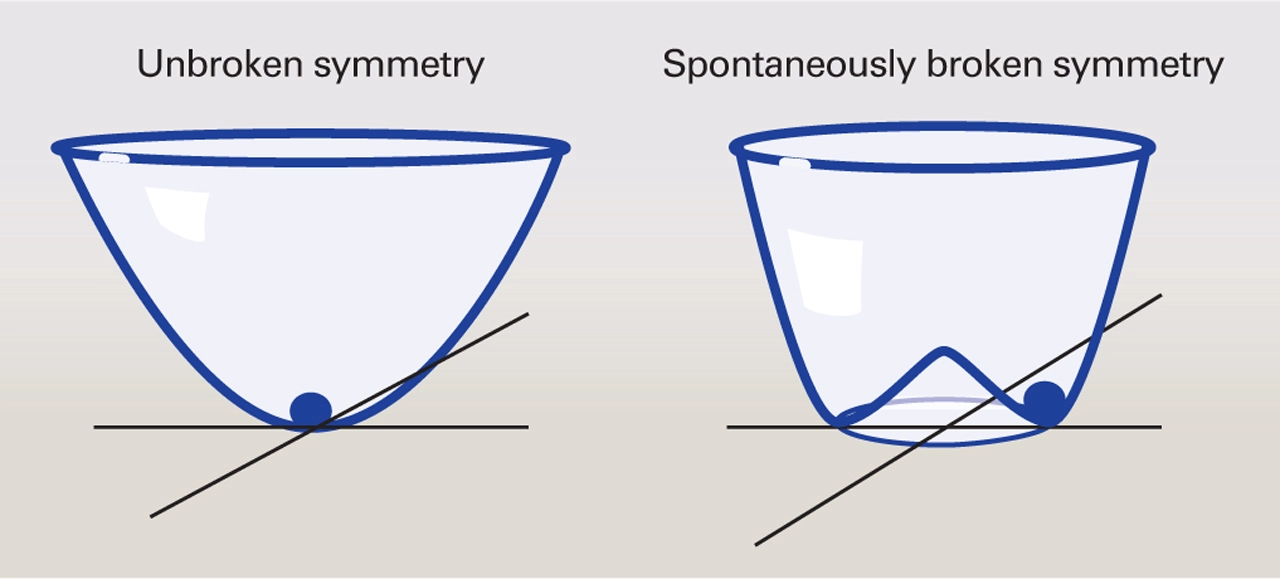
But more than being interesting for its simplicity, this self-interaction of the Higgs underlies a crucial piece of the Standard Model: the story of how particles got their mass. The Standard Model tells us that the reason all fundamental particles have mass is their interaction with the Higgs field. Every particle’s mass is proportional to the strength of the Higgs field. The fact that particles have any mass at all is tied to the fact that the lowest energy state of the Higgs field is at a non-zero value. According to the Standard Model, early in the universe’s history when the temperature were much higher, the Higgs potential had a different shape, with its lowest energy state at field value of zero. At this point all the particles we know about were massless. As the universe cooled the shape of the Higgs potential morphed into a ‘wine bottle’ shape, and the Higgs field moved into the new minimum at non-zero value where it sits today. The symmetry of the initial state, in which the Higgs was at the center of its potential, was ‘spontaneously broken’ as its new minimum, at a location away from the center, breaks the rotation symmetry of the potential. Spontaneous symmetry breaking is a very deep theoretical idea that shows up not just in particle physics but in exotic phases of matter as well (eg superconductors).
A diagram showing the ‘unbroken’ Higgs potential in the very early universe (left) and the ‘wine bottle’ shape it has today (right). When the Higgs at the center of its potential it has a rotational symmetry, there are no preferred directions. But once it finds it new minimum that symmetry is broken. The Higgs now sits at a particular field value away from the center and a preferred direction exists in the system.
This fantastical story of how particle’s gained their masses, one of the crown jewels of the Standard Model, has not yet been confirmed experimentally. So far we have studied the Higgs’s interactions with other particles, and started to confirm the story that it couples to particles in proportion to their mass. But to confirm this story of symmetry breaking we will to need to study the shape of the Higgs’s potential, which we can probe only through its self-interactions. Many theories of physics beyond the Standard Model, particularly those that attempt explain how the universe ended up with so much matter and very little anti-matter, predict modifications to the shape of this potential, further strengthening the importance of this measurement.
Unfortunately observing the Higgs interacting with itself and thus measuring the shape of its potential will be no easy feat. The key way to observe the Higgs’s self-interaction is to look for a single Higgs boson splitting into two. Unfortunately in the Standard Model additional processes that can produce two Higgs bosons quantum mechanically interfere with the Higgs self interaction process which produces two Higgs bosons, leading to a reduced production rate. It is expected that a Higgs boson scattering off itself occurs around 1000 times less often than the already rare processes which produce a single Higgs boson. A few years ago it was projected that by the end of the LHC’s run (with 20 times more data collected than is available today), we may barely be able to observe the Higgs’s self-interaction by combining data from both the major experiments at the LHC (ATLAS and CMS).
Fortunately, thanks to sophisticated new data analysis techniques, LHC experimentalists are currently significantly outpacing the projected sensitivity. In particular, powerful new machine learning methods have allowed physicists to cut away background events mimicking the di-Higgs signal much more than was previously thought possible. Because each of the two Higgs bosons can decay in a variety of ways, the best sensitivity will be obtained by combining multiple different ‘channels’ targeting different decay modes. It is therefore going to take a village of experimentalists each working hard to improve the sensitivity in various different channels to produce the final measurement. However with the current data set, the sensitivity is still a factor of a few away from the Standard Model prediction. Any signs of this process are only expected to come after the LHC gets an upgrade to its collision rate a few years from now.
Current experimental limits on the simultaneous production of two Higgs bosons, a process sensitive to the Higgs’s self-interaction, from ATLAS (left) and CMS (right). The predicted rate from the Standard Model is shown in red in each plot while the current sensitivity is shown with the black lines. This process is searched for in a variety of different decay modes of the Higgs (various rows on each plot). The combined sensitivity across all decay modes for each experiment allows them currently to rule out the production of two Higgs bosons at 3-4 times the rate predicted by the Standard Model. With more data collected both experiments will gain sensitivity to the range predicted by the Standard Model.
While experimentalists will work as hard as they can to study this process at the LHC, to perform a precision measurement of it, and really confirm the ‘wine bottle’ shape of the potential, its likely a new collider will be needed. Studying this process in detail is one of the main motivations to build a new high energy collider, with the current leading candidates being an even bigger proton-proton collider to succeed the LHC or a new type of high energy muon collider.
A depiction of our current uncertainty on the shape of the Higgs potential (center), our expected uncertainty at the end of the LHC (top right) and the projected uncertainty a new muon collider could achieve (bottom right). The Standard Model expectation is the tan line and the brown band shows the experimental uncertainty. Adapted from Nathaniel Craig’s talkhere
The quest to study nature’s simplest interaction will likely span several decades. But this long journey gives particle physicists a roadmap for the future, and a treasure worth traveling great lengths for.
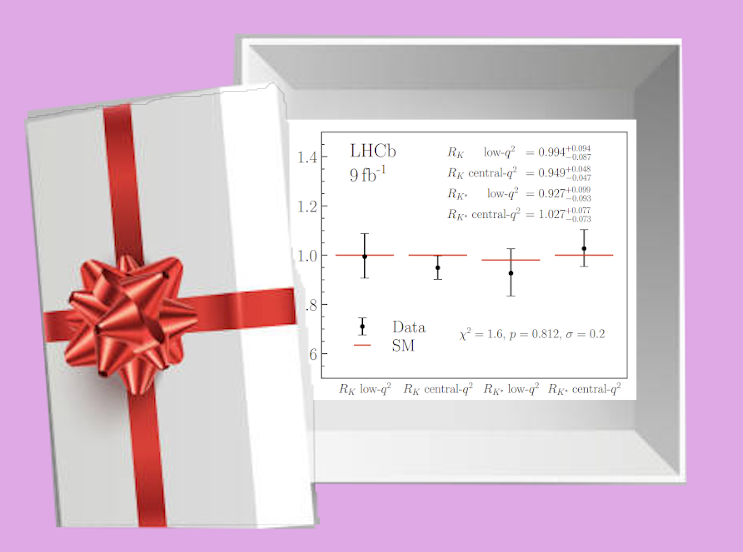
Just before the 2022 holiday season LHCb announced it was giving the particle physics community a highly anticipated holiday present : an updated measurement of the lepton flavor universality ratio R(K). Unfortunately when the wrapping paper was removed and the measurement revealed, the entire particle physics community let out a collective groan. It was not shiny new-physics-toy we had all hoped for, but another pair of standard-model-socks.
A disappointing present from LHCb, their recent measurement of R(K) (black points and error bars) showed very good agreement with the standard model prediction (red line).
The particle physics community is by now very used to standard-model-socks, receiving hundreds of pairs each year from various experiments all over the world. But this time there had be reasons to hope for more. Previous measurements of R(K) from LHCb had been showing evidence of a violation one of the standard model’s predictions (lepton flavor universality), making this triumph of the standard model sting much worse than most.
R(K) is the ratio of how often a B-meson (a bound state of a b-quark) decays into final states with a kaon (a bound state of an s-quark) plus two electrons vs final states with a kaon plus two muons. In the standard model there is a (somewhat mysterious) principle called lepton flavor universality which means that muons are just heavier versions of electrons. This principle implies B-mesons decays should produce electrons and muons equally and R(K) should be one.
But previous measurements from LHCb had found R(K) to be less than one, with around 3σ of statistical evidence. Other LHCb measurements of B-mesons decays had also been showing similar hints of lepton flavor universality violation. This consistent pattern of deviations had not yet reached the significance required to claim a discovery. But it had led a good amount of physicists to become #cautiouslyexcited that there may be a new particle around, possibly interacting preferentially with muons and b-quarks, that was causing the deviation. Several hundred papers were written outlining possibilities of what particles could cause these deviations, checking whether their existence was constrained by other measurements, and suggesting additional measurements and experiments that could rule out or discover the various possibilities.
Feynman diagrams showing the decay of a b quark into a strange quark and two leptons in the Standard Model (top). Two scenarios of new particles which could alter how often such an interaction occurs are shown in the bottom row: a new gauge boson (bottom left) and a leptoquark (bottom right).
This had all led to a considerable amount of anticipation for these updated results from LHCb. They were slated to be their final word on the anomaly using their full dataset collected during LHC’s 2nd running period of 2016-2018. Unfortunately what LHCb had discovered in this latest analysis was that they had made a mistake in their previous measurements.
There were additional backgrounds in their electron signal region which had not been previously accounted for. These backgrounds came from decays of B-mesons into pions or kaons which can be mistakenly identified as electrons. Backgrounds from mis-identification are always difficult to model with simulation, and because they are also coming from decays of B-mesons they produce similar peaks in their data as the sought after signal. Both these factors combined to make it hard to spot they were missing. Without accounting for these backgrounds it made it seem like there was more electron signal being produced than expected, leading to R(K) being below one. In this latest measurement LHCb found a way to estimate these backgrounds using other parts of their data. Once they were accounted for, the measurements of R(K) no longer showed any deviations, all agreed with one within uncertainties.
Plots showing two of the signal regions of for the electron channel measurements. The previously unaccounted for backgrounds are shown in lime green and the measured signal contribution is shown in red. These backgrounds have a peak overlapping with that of the signal, making it hard to spot that they were missing.
It is important to mention here that data analysis in particle physics is hard. As we attempt to test the limits of the standard model we are often stretching the limits of our experimental capabilities and mistakes do happen. It is commendable that the LHCb collaboration was able to find this issue and correct the record for the rest of the community. Still, some may be a tad frustrated that the checks which were used to find these missing backgrounds were not done earlier given the high profile nature of these measurements (their previous result claimed ‘evidence’ of new physics and was published in Nature).
Though the R(K) anomaly has faded away, the related set of anomalies that were thought to be part of a coherent picture (including another leptonic branching ratio R(D) and an angular analysis of the same B meson decay in to muons) still remain for now. Though most of these additional anomalies involve significantly larger uncertainties on the Standard Model predictions than R(K) did, and are therefore less ‘clean’ indications of new physics.
Besides these ‘flavor anomalies’ other hints of new physics remain, including measurements of the muon’s magnetic moment, the measured mass of the W boson and others. Though certainly none of these are slam dunk, as they each causes for skepticism.
So as we begin 2023, with a great deal of fresh LHC data expected to be delivered, particle physicists once again begin our seemingly Sisyphean task : to find evidence physics beyond the standard model. We know its out there, but nature is under no obligation to make it easy for us.
Paper: Test of lepton universality in b→sℓ+ℓ− decays (arXiv link)
In the vast cosmic arena where massive stars end their lives in spectacular explosions known as core-collapse supernovae (CCSNe), a new frontier in astrophysics is being unveiled through the study of elusive particles called neutrinos. These near-massless subatomic particles, produced in staggering quantities during a supernova event, play a crucial role in the dynamic processes that govern these cataclysmic explosions. Recent groundbreaking research led by Assistant Professor Ryuichiro Akaho from Waseda University, Japan, has shed light on the complex influence of a phenomenon known as neutrino fast flavor conversion (FFC) on the mechanisms driving CCSNe explosions, offering fresh insights that challenge prior theoretical models.
The lifecycle of massive stars concludes with an extraordinary release of energy and matter during a core-collapse supernova, marking one of the most luminous events observed in the cosmos. Neutrinos, generated in the intense core environment, transport energy and influence shock dynamics critical for the explosion’s success. However, understanding how neutrinos change their quantum states—or flavors—through collective oscillations during such events has remained an open question. Fast flavor conversion, a rapid and collective oscillation process driven by neutrino-neutrino interactions, poses significant theoretical and computational challenges. Previous studies predominantly employed simplified “truncated moment” approximations to estimate FFC effects, yet such methods fall short in accurately representing the nuanced angular distributions of neutrinos vital for pinpointing where and how FFC unfolds.
Departing from these limitations, Akaho and his collaborators implemented a sophisticated multiangle approach to neutrino transport, enabling a direct and comprehensive simulation of neutrino momentum-space angular distributions across the turbulent supernova environment. This approach captures the subtle directional dependencies essential for evaluating FFC occurrences with unprecedented fidelity. By integrating a quantum kinetic theory-based FFC framework with multidimensional Boltzmann neutrino radiation hydrodynamics simulations, the research team delivered a meticulous description of neutrino flavor evolution and its feedback on supernova dynamics, marking a pioneering step in computational astrophysics.
Their model utilizes the Bhatnagar-Gross-Krook (BGK) relaxation scheme to incorporate quantum kinetic effects and trace the complex neutrino flavor states. This physics-based subgrid approach permits seamless coupling between flavor conversion processes and neutrino radiation transport within the supernova core, a feat not previously achieved in comprehensive CCSN simulations. The research also builds on a foundation laid by earlier works, expanding the computational toolkit to realistically capture how fast flavor conversion influences neutrino heating and shock revival.
The simulation study spanned an array of progenitor star models with zero-age main sequence masses of 9, 12, 16, and 20 solar masses, alongside three nuclear equations of state (EOS), encapsulating diverse microphysical conditions: the variational method-based Furusawa-Togashi EOS, Dirac-Brückner-Hartree-Fock technique, and chiral effective field theory. This broad parameter space allowed for a thorough examination of how stellar structure and nuclear matter properties intertwine with neutrino physics to shape supernova outcomes.
One of the most compelling revelations from the simulations is the bifurcated—or dual—impact of fast flavor conversion on CCSN explosions, distinctly influenced by progenitor mass and accretion dynamics. For lower-mass progenitors (such as the 9 solar mass cases), FFC acts as a catalyst, promoting shock revival and enhancing the explosion energy by boosting neutrino-driven heating within the stalled shock region. In contrast, for higher-mass progenitors characterized by elevated mass accretion rates, FFC surprisingly exerts a suppressive effect. The reduction in neutrino luminosity due to flavor conversion outweighs any benefits from spectral hardening of electron-type neutrinos, culminating in diminished neutrino heating and significantly hampering the likelihood of successful explosions.
This nuanced dependency underscores mass accretion rate as a principal controlling factor in determining the net influence of FFC. High accretion funnels exerting intense pressure on the shock interface foster conditions where neutrino heating contributions from FFC turn negative, stalling the explosion. Conversely, under low accretion scenarios, FFC enhances energy deposition behind the shock through spectral changes and flavor transformations that favor electron neutrino interactions, facilitating revitalization of the shock wave.
Crucially, these findings expose the inherent limitations of approximative neutrino transport methods that fail to resolve angular distributions, which can either overlook the presence of fast flavor conversions or falsely signal their emergence. Through their multiangle neutrino transport approach, the authors highlight the necessity of detailed angular resolution to faithfully capture the complex interplay between neutrino flavor physics and hydrodynamic instabilities driving CCSNe.
This research not only deepens the theoretical understanding of the multifaceted role neutrinos play in the deaths of massive stars but also paves the way for refining supernova models that bridge microscopic quantum processes with macroscopic explosion phenomena. The ability to accurately predict FFC effects is critical for interpreting neutrino signals from potential future galactic supernovae, offering a direct window into the physics within collapsing stellar cores.
The study emerges at a pivotal time when giant neutrino observatories worldwide are poised to detect supernova neutrinos with unprecedented precision, potentially validating theoretical models experimentally. By aligning state-of-the-art computational astrophysics with the physics of neutrino fast flavor conversion, Akaho’s work builds a framework essential for extracting rich astrophysical information from forthcoming neutrino data, advancing the quest to unravel the enigmatic mechanisms underlying core-collapse supernovae.
Beyond its astrophysical implications, this research signifies an intersection of quantum kinetics, nuclear physics, and fluid dynamics on cosmic scales, exemplifying the interdisciplinary complexity required to tackle outstanding questions in modern physics. The utilization of multidimensional Boltzmann neutrino radiation hydrodynamics combined with quantum kinetic flavor transformation models represents a major milestone in computational modeling, empowering scientists to explore emergent phenomena that previous approximations could not resolve.
As the community moves forward, these insights will stimulate further investigation into the feedback mechanisms between neutrino physics and the turbulent, dynamic environment of collapsing stars. Comprehensive understanding of fast flavor conversion effects promises to enhance predictive models, inform detector design, and ultimately transform our comprehension of the universe’s most dramatic stellar explosions.
Subject of Research: Not applicable
Article Title: Bifurcated Impact of Neutrino Fast Flavor Conversion on Core-Collapse Supernovae Informed by Multiangle Neutrino Radiation Hydrodynamics
Black holes, regions in space where gravity is so strong that nothing can escape, have been widely studied over the past decades, due to their unique and intriguing properties. Einstein's theory of general relativity predicts that black holes obey a set of rules, known as the laws of black hole mechanics. These rules somewhat resemble the laws of thermodynamics, which delineate how energy, heat, and entropy behave in our universe.
NASA’s Fermi telescope may have finally uncovered the magnetic powerhouse behind the universe’s brightest supernovae. An international team of astronomers analyzing observations from NASA’s Fermi Gamma-ray Space Telescope has found what appears to be the first convincing detection of gamma rays from a rare type of extraordinarily bright stellar explosion known as a superluminous supernova. [...]
Rectification is the process of turning alternating current (AC) signals into direct current (DC), and it underpins technologies such as wireless power transfer, photodetection, terahertz sensing, and energy harvesting. To generate a one-directional current, a material normally needs a built-in directional preference for electron motion. This preference usually arises from broken inversion symmetry, meaning that the material is not identical under spatial inversion. For example, graphene has inversion symmetry, while materials with inequivalent sublattices, intrinsic electric dipoles, surfaces, or interfaces naturally break it. When inversion symmetry is broken, electrons can respond differently to opposite directions of an applied light field, allowing oscillating optical fields to generate a DC current.
In this work, the researchers show that this rule has an important exception. Even centrosymmetric bulk materials can rectify light through third-order nonlinear optical effects. Linear optical responses scale with the applied light field. Second-order responses depend on the square of the electric field and can mix frequencies or generate harmonics, but they are usually forbidden in centrosymmetric bulk materials. Third-order responses, however, are symmetry allowed and can generate DC photocurrents even when inversion symmetry is present. These currents are controlled by the shape of the Fermi surface, disorder, and the geometry of electronic bands. This means that materials once considered unsuitable for bulk optical rectification, including common metals, doped systems, and two-dimensional materials, can be engineered to convert oscillating light into DC electrical signals.
Quantum transport and theory group at IIT Kanpur, celebrating the discovery of third-order rectification (Courtesy: Amit Agarwal/Indian Institute of Technology Kanpur)
This research expands the material platform for optical rectification. Instead of relying only on noncentrosymmetric crystals, it shows that common centrosymmetric materials can also be used for light-to-DC conversion through third-order nonlinear response. This opens a route to energy-efficient photodetectors, terahertz technologies, and future energy-harvesting devices based on materials such as graphene.
In condensed matter physics, driving a material with an external stimulus can push it into new nonequilibrium states that reveal hidden properties or create entirely new, potentially useful behaviours. These stimuli can include optical driving, where strong oscillating light is applied to the material, or periodic forcing, which refers to any repetitive push such as acoustic waves, modulated electric fields, or oscillating magnetic fields.
In this work, the researchers wanted to understand how shining bright, oscillating light on a material can make it behave in unexpected ways, sometimes even resembling a superconductor. They used a theoretical model to study what happens when the system is periodically driven, allowed to exchange energy with a heat bath, and coupled to electromagnetic fields. When the drive is strong enough, the system can spontaneously organise into different kinds of ordered states: uniform order, spatially patterned order, or timeoscillating order.
Ordered phases can repel magnetic fields in the same way a superconductor does, through the Meissner effect, where the electromagnetic field behaves as if the photon has gained an effective mass and therefore cannot propagate inside the material. In some driven phases, however, not all of the magnetic field is expelled: part of it enters the material but only as a standing wave, forming a hybrid light-matter excitation known as a Meissner polariton. Additionally, strong fluctuations near the onset of ordering can make the material’s optical conductivity appear superconducting, causing experiments to detect superconductinglike signals even when no true superconducting phase is present, helping explain why light‑driven systems sometimes show ambiguous signs of superconductivity.
Overall, the researchers developed a unified theoretical picture showing how periodic driving can create or mimic superconducting behaviour, including predicting a new hybrid light-matter mode (the Meissner polariton), offering insight into puzzling experimental results in lightdriven materials.
Experimental attosecond science is built around the ability to generate and control light flashes lasting billionths of a billionth of a second. Such extreme pulses can be created through high harmonic generation (HHG), where an intense laser field drives electrons out of atoms or solids and then forces them back, releasing bursts of extreme ultraviolet radiation. Techniques like this have transformed our ability to observe electron motion on its natural timescale.
To extract information from such ultrafast processes, physicists often rely on attosecond interferometry. By combining a strong laser field with a weaker second colour, different electron trajectories are made to interfere, imprinting timing and phase information onto the emitted harmonics. Over recent years, these schemes have become standard tools for attosecond metrology and spectroscopy.
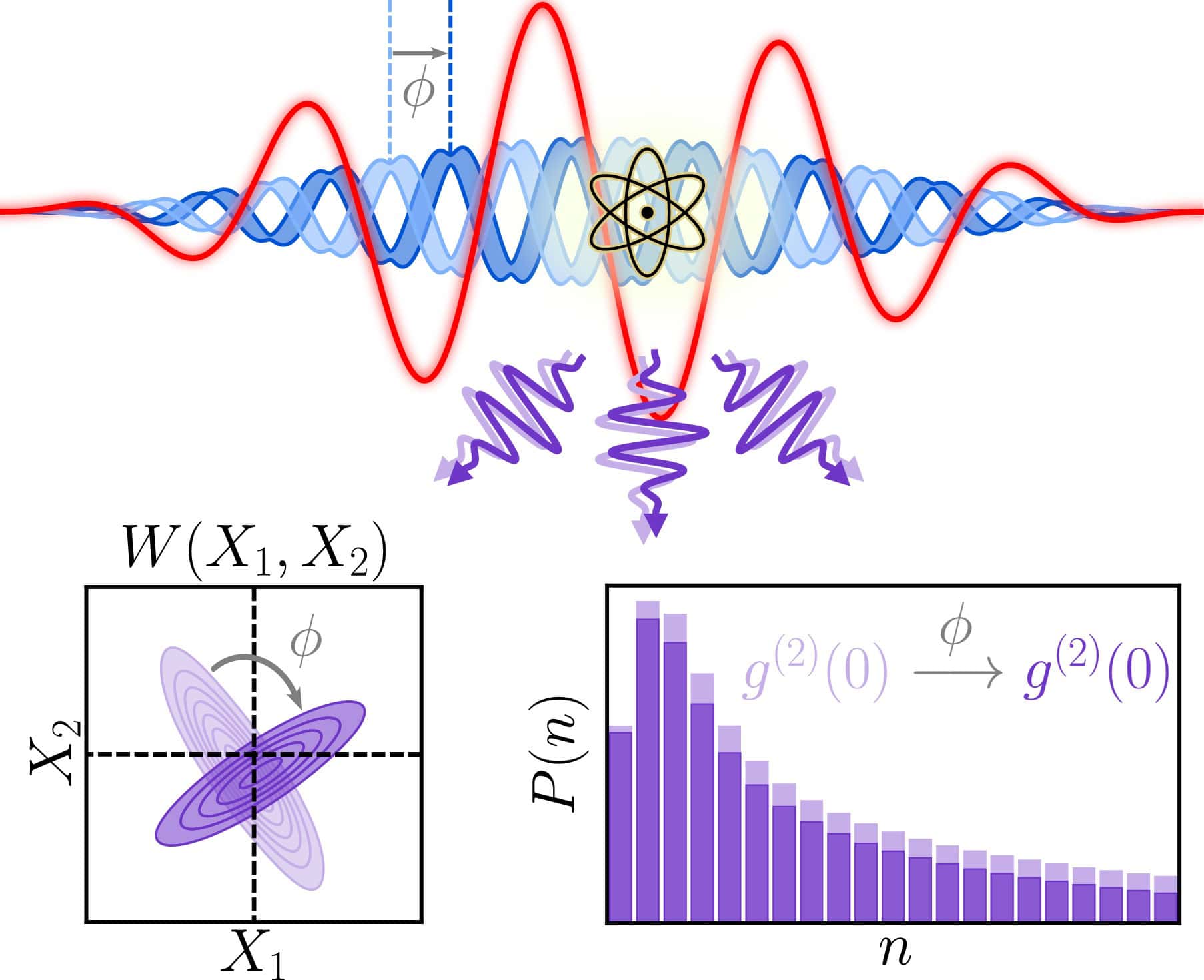
In a recent paper published in Reports on Progress in Physics, Javier Rivera Dean et al, revisited this idea from a quantum optical perspective. Treating both the driving fields and the emitted harmonics as quantum rather than classical objects, they analysed how attosecond interferometric control influences the photon statistics, correlations and phase space structure of the generated light. Their calculations show that even when harmonic radiation appears classical in its average properties, its underlying quantum state can carry rich and measurable structure.
The study also explores how interferometric phase control can be repurposed as a practical probe of quantum optical features in spectral regions where standard techniques, such as homodyne detection, are unavailable. This represents a new approach for measuring phase-space distributions through tomographic reconstruction: attosecond quantum tomography.
Illustrative image new of experimental scheme proposed in their paper (Credit: J. Rivera-Dean).
By combining quantum optics with common attosecond techniques, the work shows how ultrafast science is increasingly becoming a platform not just for watching electrons move, but also for studying light itself at the shortest timescales accessible in the laboratory.
When rockets fire into space, the insides of their engines become an extreme environment where temperatures soar and tiny particles are thrown around at hypersonic speeds. These particles behave in ways that break long-held assumptions, according to new research that could help improve the durability, safety and performance of future space and defense technologies.
The moon may look peaceful from Earth, but its surface is one of the harshest environments imaginable. It is covered by a layer of fine dust and crushed rock called lunar regolith. This material is not like the soil we have on Earth. It contains sharp particles of rock and glass that can damage equipment, […]

 Login
Login