Normal view

The P5 Report & The Future of Particle Physics (Part 1)

3 January 2024 at 20:21

Particle physics is the epitome of ‘big science’. To answer our most fundamental questions out about physics requires world class experiments that push the limits of whats technologically possible. Such incredible sophisticated experiments, like those at the LHC, require big facilities to make them possible,  big collaborations to run them, big project planning to make dreams of new facilities a reality, and committees with big acronyms to decide what to build.

Enter the Particle Physics Project Prioritization Panel (aka P5) which is tasked with assessing the landscape of future projects and laying out a roadmap for the future of the field in the US. And because these large projects are inevitably an international endeavor, the report they released last week has a large impact on the global direction of the field. The report lays out a vision for the next decade of neutrino physics, cosmology, dark matter searches and future colliders. 

P5 follows the community-wide brainstorming effort known as the Snowmass Process in which researchers from all areas of particle physics laid out a vision for the future. The Snowmass process led to a particle physics ‘wish list’, consisting of all the projects and research particle physicists would be excited to work on. The P5 process is the hard part, when this incredibly exciting and diverse research program has to be made to fit within realistic budget scenarios. Advocates for different projects and research areas had to make a case of what science their project could achieve and a detailed estimate of the costs. The panel then takes in all this input and makes a set of recommendations of how the budget should be allocated, what should projects be realized and what hopes are dashed. Though the panel only produces a set of recommendations, they are used quite extensively by the Department of Energy which actually allocates funding. If your favorite project is not endorsed by the report, its very unlikely to be funded. 

An computer generate graphic showing two sprays of particles being injected from a single center point
The P5 report also created an awesome graphic that contains symbolism for the different aspects of the plan. The left  side depicts oscillating neutrinos and the shape of the Higgs potential. The right side depicts dark matter and the large scale structure of the universe. The central ball of light is supposed to represent discoveries of the unknown. Source

Particle physics is an incredibly diverse field, covering sub-atomic to cosmic scales, so recommendations are divided up into several different areas. In this post I’ll cover the panel’s recommendations for neutrino physics and the cosmic frontier. Future colliders, perhaps the spiciest topic, will be covered in a follow up post.

The Future of Neutrino Physics

For those in the neutrino physics community all eyes were on the panels recommendations regarding the Deep Underground Neutrino Experiment (DUNE). DUNE is the US’s flagship particle physics experiment for the coming decade and aims to be the definitive worldwide neutrino experiment in the years to come. A high powered beam of neutrinos will be produced at Fermilab and sent 800 miles through the earth’s crust towards several large detectors placed in a mine in South Dakota. Its a much bigger project than previous neutrino experiments, unifying essentially the entire US community into a single collaboration.

DUNE is setup to produce world leading measurements of neutrino oscillations, the property by which neutrinos produced in one ‘flavor state’, (eg an electron-neutrino) gradually changes its state with sinusoidal probability (eg into a muon neutrino) as it propagates through space. This oscillation is made possible by a simple quantum mechanical weirdness: neutrino’s flavor state, whether it couples to electrons muons or taus, is not the same as its mass state. Neutrinos of a definite mass are therefore a mixture of the different flavors and visa versa.

Detailed measurements of this oscillation are the best way we know to determine several key neutrino properties. DUNE aims to finally pin down two crucial neutrino properties: their ‘mass ordering’, which will solidify how the different neutrino flavors and measured mass differences all fit together, and their ‘CP-violation’ which specifies whether neutrinos and their anti-matter counterparts behave the same or not. DUNE’s main competitor is the Hyper-Kamiokande experiment in Japan, another next-generation neutrino experiment with similar goals.

A depiction of the DUNE experiment. A high intensity proton beam at Fermilab is used to create a concentrated beam of neutrinos which are then sent through 800 miles of the Earth’s crust towards detectors placed deep underground South Dakota. Source

Construction of the DUNE experiment has been ongoing for several years and unfortunately has not been going quite as well as hoped. It has faced significant schedule delays and cost overruns. DUNE is now not expected to start taking data until 2031, significantly behind Hyper-Kamiokande’s projected 2027 start. These delays may lead to Hyper-K making these definitive neutrino measurements years before DUNE, which would be a significant blow to the experiment’s impact. This left many DUNE collaborators worried about its broad support from the community.

It came as a relief then when P5 report re-affirmed the strong science case for DUNE, calling it the “ultimate long baseline” neutrino experiment. The report strongly endorsed the completion of the first phase of DUNE. However, it recommended a pared-down version of its upgrade, advocating for an earlier beam upgrade in lieu of additional detectors. This re-imagined upgrade will still achieve the core physics goals of the original proposal with a significant cost savings. With this report, and news that the beleaguered underground cavern construction in South Dakota is now 90% complete, was certainly welcome holiday news to the neutrino community. This is also sets up a decade-long race between DUNE and Hyper-K to be the first to measure these key neutrino properties.

Cosmic Implications

While we normally think of particle physics as focused on the behavior of sub-atomic particles, its really about the study of fundamental forces and laws, no matter the method. This means that telescopes to study the oldest light in the universe, the Cosmic Microwave Background (CMB), fall into the same budget category as giant accelerators studying sub-atomic particles. Though the experiments in these two areas look very different, the questions they seek to answer are cross-cutting. Understanding how particles interact at very high energies helps us understand the earliest moments of the universe, when such particles were all interacting in a hot dense plasma. Likewise, by studying the these early moments of the universe and its large-scale evolution can tell us about what kinds of particles and forces are influencing its dynamics. When asking fundamental questions about the universe, one needs both the sharpest microscopes and the grandest panoramas possible.

The most prominent example of this blending of the smallest and largest scales in particle physics is dark matter. Some of our best evidence for dark matter comes analyzing the cosmic microwave background to determine how the primordial plasma behaved. These studies showed that some type of ‘cold’, matter that doesn’t interact with light, aka dark matter, was necessary to form the first clumps that eventually seeded the formation of galaxies. Without it, the universe would be much more soup-y and structureless than what we see to today.
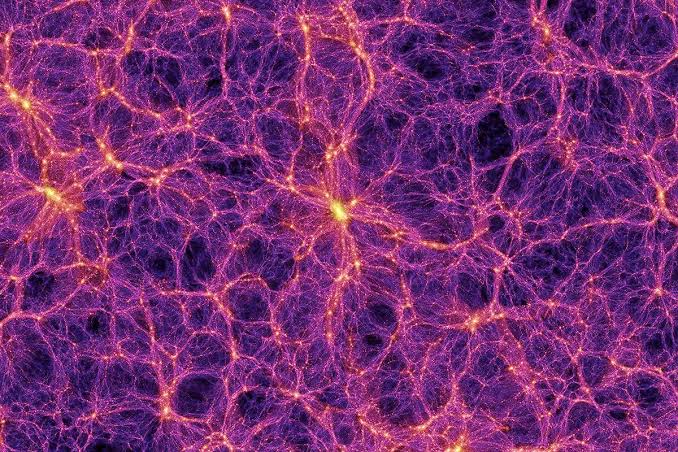
The “cosmic web” galaxy clusters from the Millenium simulation. Measuring and understanding this web can tell us a lot about the fundamental constituents of the universe. Source

To determine what dark matter is then requires an attack from two fronts: design experiments here on earth attempting directly detect it, and further study its cosmic implications to look for more clues as to its properties.

The panel recommended next generation telescopes to study the CMB as a top priority. The so called ‘Stage 4’ CMB experiment would deploy telescopes in both the south pole and Chile’s Atacama desert to better characterize sources of atmospheric noise. The CMB has been studied extensively before, but the increased precision of CMS-S4 could shed light on mysteries like dark energy, dark matter, inflation, and the recent Hubble Tension. Given the past fruitfulness of these efforts, I think few doubted the science case for such a next generation experiment.

A mockup of one of the CMS-S4 telescopes which will be based in the Chilean desert. Note the person for scale on the right (source)

The P5 report recommended a suite of new dark matter experiments in the next decade, including the ‘ultimate’ liquid Xenon based dark matter search. Such an experiment would follow in the footsteps of massive noble gas experiments like LZ and XENONnT which have been hunting for a favored type of dark matter called WIMP’s for the last few decades. These experiments essentially build giant vats of liquid Xenon, carefully shield from any sources of external radiation, and look for signs of dark matter particles bumping into any of the Xenon atoms. The larger the vat of Xenon, the higher chance a dark matter particle will bump into something. Current generation experiments have ~7 tons of Xenon, and the next generation experiment would be even larger. The next generation aims to reach the so called ‘neutrino floor’, the point as which the experiments would be sensitive enough to observe astrophysical neutrinos bumping into the Xenon. Such neutrino interactions would look extremely similar to those of dark matter, and thus represent an unavoidable background which would signal the ultimate sensitivity of this type of experiment. WIMP’s could still be hiding in a basement below this neutrino floor, but finding them would be exceedingly difficult.

A photo of the current XENONnT experiment. This pristine cavity is then filled with liquid Xenon and closely monitored for signs of dark matter particles bumping into one of the Xenon atoms. Credit: XENON Collaboration

WIMP’s are not the only dark matter candidates in town, and recent years have also seen an explosion of interest in the broad range of dark matter possibilities, with axions being a prominent example. Other kinds of dark matter could have very different properties than WIMPs and have had much fewer dedicated experiments to search for them. There is ‘low hanging fruit’ to pluck in the way of relatively cheap experiments which can achieve world-leading sensitivity. Previously, these ‘table top’ sized experiments had a notoriously difficult time obtaining funding, as they were often crowded out of the budgets by the massive flagship projects. However, small experiments can be crucial to ensuring our best chance of dark matter discovery, as they fill in the blinds pots missed by the big projects.

The panel therefore recommended creating a new pool of funding set aside for these smaller scale projects. Allowing these smaller scale projects to flourish is important for the vibrancy and scientific diversity of the field, as the centralization of ‘big science’ projects can sometimes lead to unhealthy side effects. This specific recommendation also mirrors a broader trend of the report: to attempt to rebalance the budget portfolio to be spread more evenly and less dominated by the large projects.

A pie chart comparing the budget porfolio in 2023 (left) versus the projected budget in 2033 (right). Currently most of the budget is being taken up by the accelerator upgrades and cavern construction of DUNE, with some amount for the LHC upgrades. But by 2033 the panel recommends a much more equitable balance between different research area.

What Didn’t Make It

Any report like this comes with some tough choices. Budget realities mean not all projects can be funded. Besides the pairing down of some of DUNE’s upgrades, one of the biggest areas that was recommended against were ‘accessory experiments at the LHC’. In particular, MATHUSULA and the Forward Physics Facility were two experiments that proposed to build additional detectors near already existing LHC collision points to look for particles that may be missed by the current experiments. By building new detectors hundreds of meters away from the collision point, shielded by concrete and the earth, they can obtained unique sensitivity to ‘long lived’ particles capable of traversing such distances. These experiments would follow in the footsteps of the current FASER experiment, which is already producing impressive results.

While FASER found success as a relatively ‘cheap’ experiment, reusing detector components from and situating itself in a beam tunnel, these new proposals were asking for quite a bit more. The scale of these detectors would have required new caverns to be built, significantly increasing the cost. Given the cost and specialized purpose of these detectors, the panel recommended against their construction. These collaborations may now try to find ways to pare down their proposal so they can apply to the new small project portfolio.

Another major decision by the panel was to recommend against hosting a new Higgs factor collider in the US. But that will discussed more in a future post.

Conclusions

The P5 panel was faced with a difficult task, the total cost of all projects they were presented with was three times the budget. But they were able to craft a plan that continues the work of the previous decade, addresses current shortcomings and lays out an inspiring vision for the future. So far the community seems to be strongly rallying behind it. At time of writing, over 2700 community members from undergraduates to senior researchers have signed a petition endorsing the panels recommendations. This strong show of support will be key for turning these recommendations into actual funding, and hopefully lobbying congress to even increase funding so that more of this vision can be realized.

For those interested the full report as well as executive summaries of different areas can be found on the P5 website. Members of the US particle physics community are also encouraged to sign the petition endorsing the recommendations here.

And stayed tuned for part 2 of our coverage which will discuss the implications of the report on future colliders!
Shining a light on central African physics

21 April 2026 at 13:07

We’ve congregated outside the main physics lab at the University of Dschang in Cameroon when a shouting match ensues about the two red cards issued in last night’s football match. It’s as dark as night inside and the lecture on LAMMPS-GUI, a molecular dynamics modelling software, hasn’t started yet because it’s been raining. The power is out and the prof, who has access to the generator, has delayed his trip to work so as not to get wet.

These are typical scenes in central Africa, where learning is a challenge. There is no WiFi in the university so we have come armed with routers to get online. Students can’t use the university toilets due to lack of running water and researcher professors have to provide their own batteries for the much-needed generators that run the projectors and overhead lights.

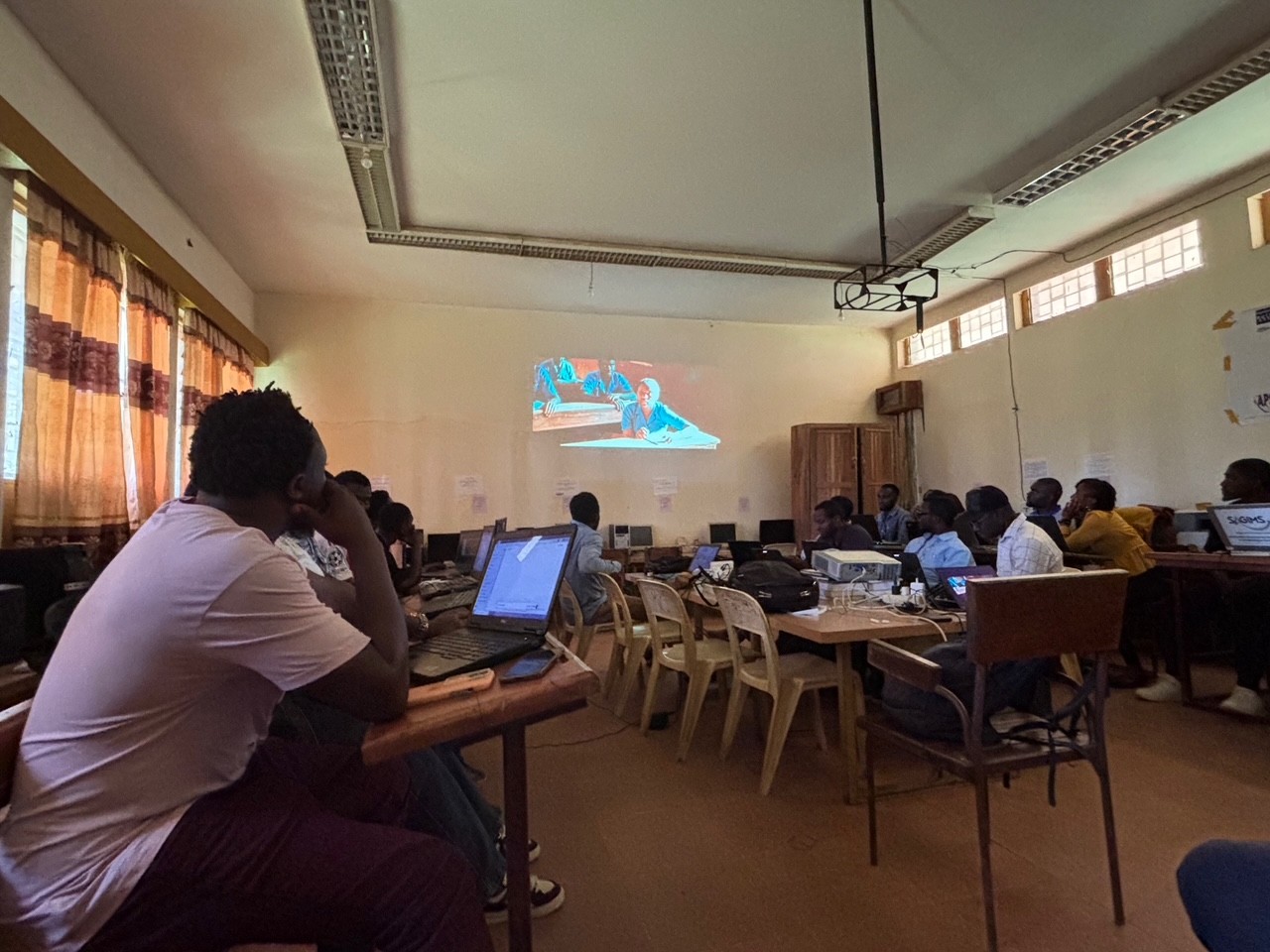
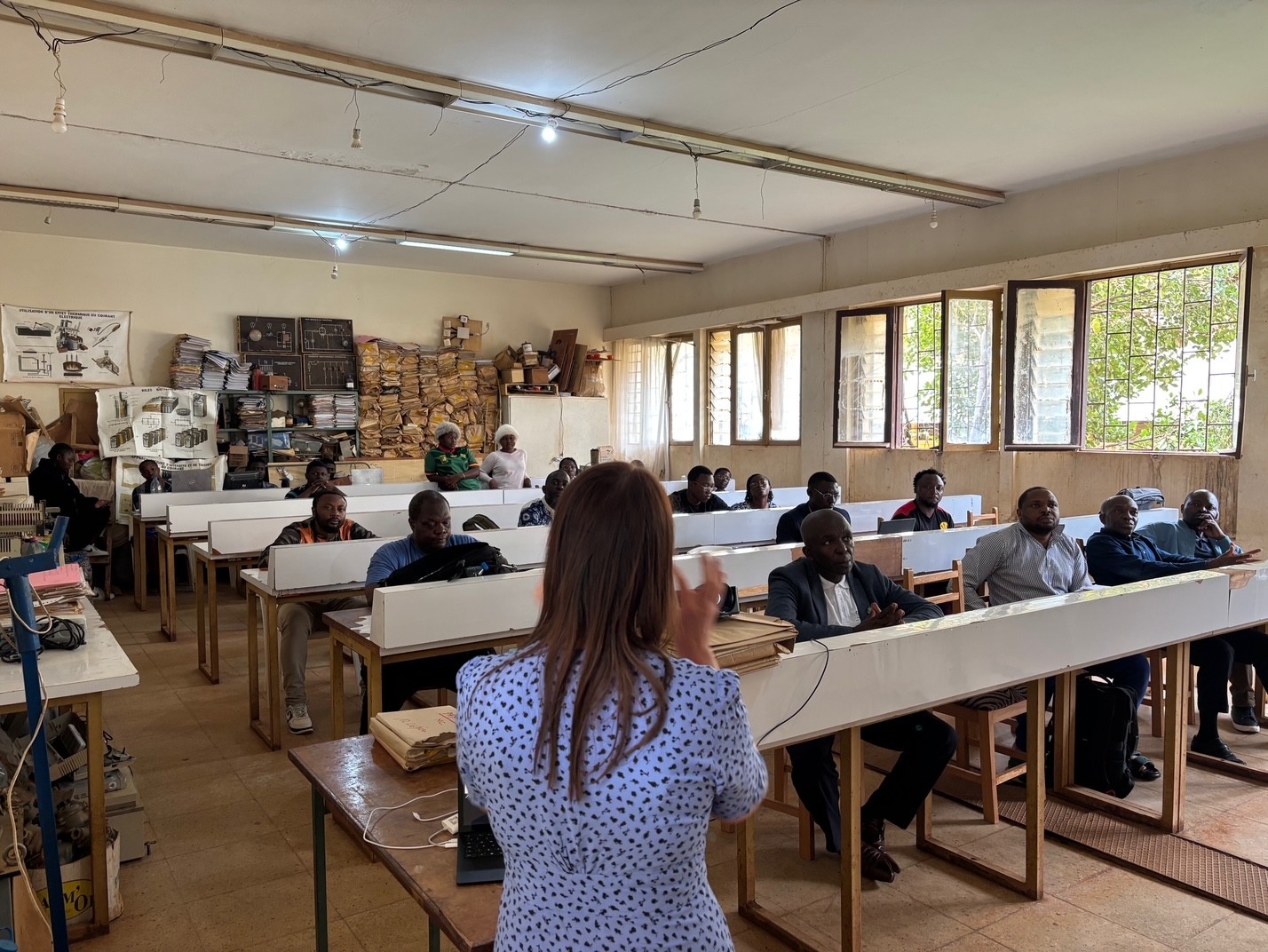
Students in a lecture room
Victoria Merriman outlines the principles of publishing. (Courtesy: Stephane Kenmoe)

I’m here to attend the seventh Central African School on Electronic Structure Methods and Applications, which is being held alongside one of 23 satellite events to the Global Physics Summit (GPS) in Denver, Colorado, US. Organized by the American Physical Society (APS), the GPS is the world’s biggest physics conference, with 14,000 delegates, but not everyone has the time, money or visa paperwork to attend in person.

That’s why it’s great that the APS, along with AIP Publishing and IOP Publishing – which together form the Purpose-led Publishing (PLP) coalition – are hosting satellite events across Africa, Asia, the Middle East and South America to expand participation in this year’s GPS.

I’ve made the journey on behalf of the PLP to hold an editorial school at the university, teaching a variety of topics from artificial intelligence publishing policies to how to review academic papers. In my session with senior-career researchers at the university, I’m swamped with questions every time I pause to take a breath. They range from philosophical queries about funding access in the region, to funny misunderstandings, including when my pronunciation of “ORCID” misaligns with theirs.

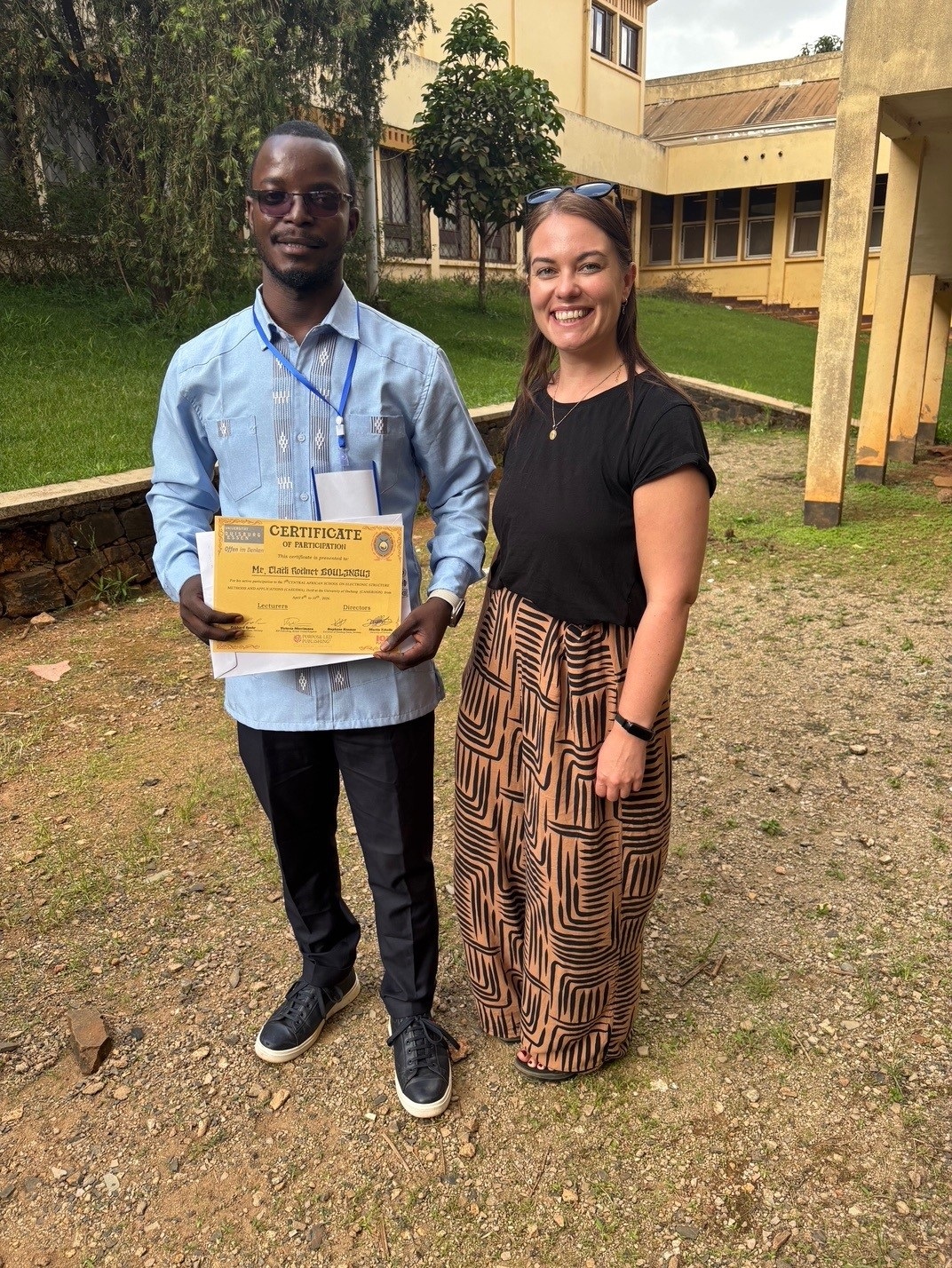
Photo of two people stood outside a university building
Victoria Merriman (right) with Cladi Rodnet Boulingui, who had spent three days travelling to Dschang by bus. (Courtesy: Victoria Merriman/IOP Publishing)

The conference has also attracted participants from neighbouring countries, including Stève-Jonathan Koyambo-Konzapa from Central African Republic, Gervi Moussavou Mouketo from Gabon, and Cladi Rodnet Boulingui who’s spent three days travelling by bus from Brazzaville in the Republic of Congo.

The University of Dschang is a highly regarded institution in central Africa, so for Boulingui, whose visit is  sponsored by the Universität Duisburg-Essen in Germany, it’s been worth it.“Dynamic simulations are highly relevant to my work, it’s worth the journey to access the specialist lecturer,” he tells me.

The organizing director, Stephane Kenmoe, has joined from Germany, where he is an associate professor at the faculty of chemistry at Duisburg-Essen. He regularly visits his alma mater, and current students benefit from connections he’s made around the world. He brings his entrepreneurial spirit with him: Kenmoe is an active promoter of the APS satellites in Africa, has made award-winning films about science, and is a champion of community engagement.

This collegiate spirit extends to the heads of department who have been called upon to write PhD curricula for neighbouring Francophone countries where scientific funding is lacking.

We end the week watching a film that Kenmoe has worked with the local film industry to produce, Seeds of Science. The film shines a light on the high percentage of child labour and child marriage in the region. The actress playing the young girl who is forced to marry instead of continue her studies has joined us from nearby Bafoussam to watch the showing.

Thankfully, Aisha is still studying, particularly enjoying economics, geography and English. There is a sombre mood in the room, only interrupted by laughter when the power fails. The power may be out but the joy and passion for learning continue to burn here in Dschang.

People watching a movie
Participants watching the movie Seeds of Science. (Courtesy: Victoria Merriman/IOP Publishing)

The post Shining a light on central African physics appeared first on Physics World.

How pictures can help school students learn quantum physics

13 April 2026 at 11:00
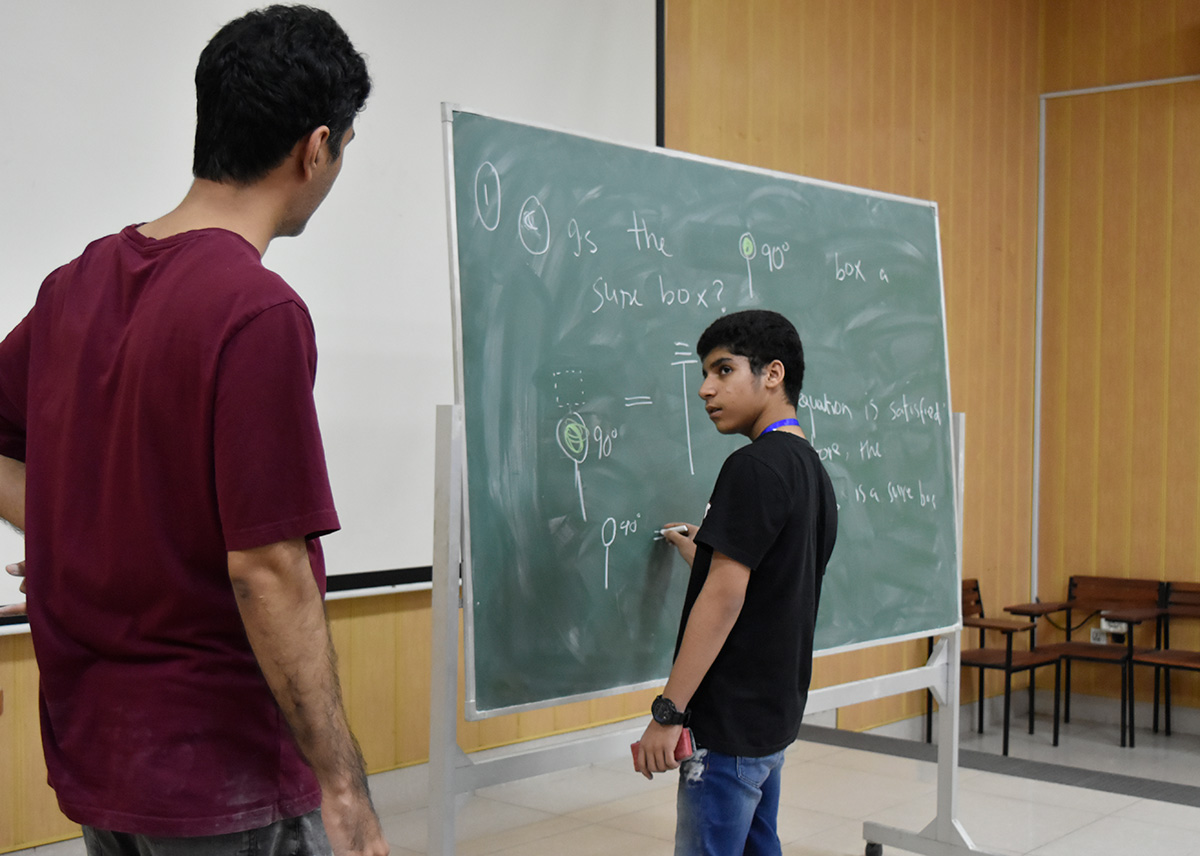
Teacher oversees a pupil drawing on a blackboard
Visual learning The Quantum in Pictures course involved using string diagrams to capture ideas about how quantum states transform. (Courtesy: KSS)

Humans perceive knowledge, make decisions and build the consciousness of knowing through vision and speech. This interplay between visual and nonvisual patterns collectively shapes how we learn complex concepts such as quantum physics. That is despite the subject’s reputation as being incomprehensible and difficult to reconcile with our everyday conceptions.

The issue when teaching quantum mechanics also lies in the shortcoming of using literary constructs to accurately describe what quantum mechanics really means. As the Hungarian-British philosopher Michael Polanyi once noted: “We always know more than we can tell.” It is hard to accurately capture in language the full meaning of quantum phenomena such as nonlocality, superposition, no-cloning, teleportation, counterfactual quantum computation, delayed choice or the many other uniquely quantum phenomena.

This also means that terms such as wave, particle, superposition and entanglement are not truly complete until followed by detailed calculations or elaboration of their consequences. The result is that introductory quantum mechanics courses often require prerequisite mathematical grounding in complex numbers, matrices, linear algebra and differential equations.

Yet I believe this tortuous preparation can be bypassed – in an accurate, comprehensive and consistent way – simply through “pictures”. With that in mind, we conducted an experiment last year at Government College University in Lahore, Pakistan – alma mater of the physics Nobel laureate Abdus Salam. The four-week-long summer school – Quantum in Pictures – was organized by the Khwarizmi Science Society, a not-for-profit grassroots science association that aims to make scientific education accessible especially for resource-deprived communities.

Some 50 school students attended lectures and demonstrations led by Muhammad Hamza Waseem from the UK firm Quantinuum, who works with Bob Coecke, one of the founders of a pictorial approach towards quantum physics and education.

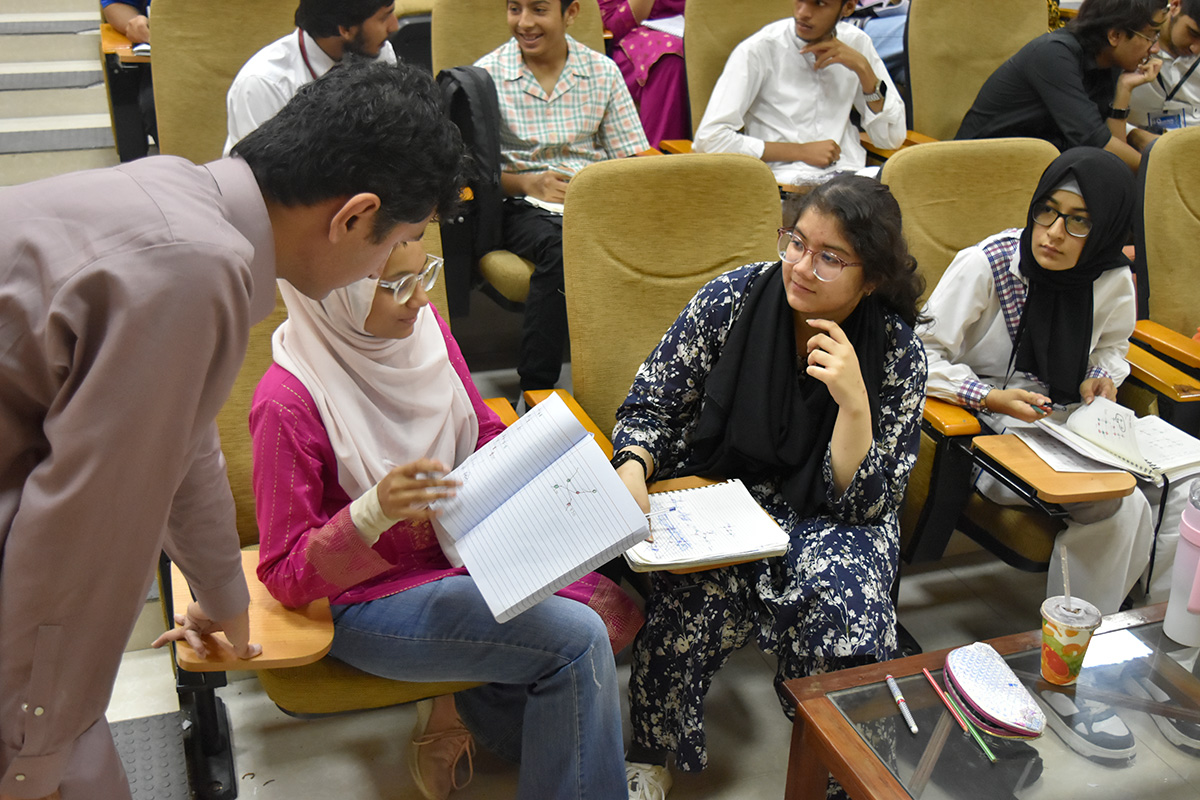
Most of the students, who had no prior knowledge of quantum mechanics, came from Lahore while the remainder were from nearby towns and villages where opportunities especially in advanced fields are generally minimal. On top of that classroom engagement is largely discouraged and an outdated model of examination fosters rote learning. Almost half of the participants who attended the school were girls, with 75% of participants aged between 14 and 18 – the youngest being a 13-year-old girl from a village called Syedanwala in Kasur.

Teacher and pupils discuss work over notebooks of diagrams
Getting together Some 50 school students, almost half of whom were girls, gathered last year for the four-week-long summer school Quantum in Pictures. (Courtesy: KSS)

To capture ideas about quantum mechanics, we used “string diagrams” as our basis. Such diagrams, simply put, are made using boxes that represent processes. Wires coming in at the top and at the bottom represent the input and output systems being processed by the box. Simulating quantum processes translates to connecting boxes with wires, chopping and straightening wires or sliding boxes along wires like beads on a string.

Even though this formalism is rigorous and derived from category theory, the manner in which it is presented is unhindered by burdensome abstractions. In terms of quantum mechanics, such diagrams are able to capture ideas about how quantum states transform, how quantum operations work as well as counterintuitive notions about measurement.

A new confidence

When I teach quantum mechanics to undergraduates, colleagues often discourage me from “spilling the beans” on quantum mechanics too early before we have covered the mathematical acrobatics of Hilbert spaces, unitary transforms, eigenvalues and Dirac’s bra-ket notation. Yet I believe school students should relish the counterintuitive repercussions of quantum mechanics much earlier than they currently do. I believe that introducing such aesthetic visuals – an overlooked concept for learning – can make the discipline more comprehensible and attractive to students.

A diagrammatic technique helps to avoid all this and democratizes the knowledge of our quantum world. After all, the future quantum workforce must be trained earlier than ever, given we do not want students missing out on the quantum revolution. In addition, quantum computing is not the purview of physicists alone. Many computer scientists and programmers, who will never be formally trained in physics, will need an initiation in quantum mechanics.

When it comes to making education accessible and within the direct grasp of millions of eager learners, demystifying traditional modes of learning and introducing new approaches helps students and teachers. Learners gain the confidence to ask questions, synthesize connections between bodies of knowledge and prepare themselves for a workforce that may require competency instead of a paper degree.

According to a survey of students who completed the course, 60% engaged in interactive discussions or used the chalkboard to solve problems while 80% asked or responded to questions. For most of these students, this level of engagement with the instructor was a first in their lives. This is the confidence that our liberated students walked away with as they completed their final exams in the Quantum in Pictures summer school.

The post How pictures can help school students learn quantum physics appeared first on Physics World.

From the blackboard to the backbenches: how physics teacher Dave Robertson became an MP

31 March 2026 at 10:00

Physicists who go into politics are a rare breed. Most famously there was Angela Merkel, who was chancellor of Germany for 16 years. Climate physicist Claudia Sheinbaum Pardo was elected Mexican president in a landslide win in 2024. Alok Sharma, meanwhile, was business secretary in the UK government and president of the COP-26 climate summit.

But Dave Robertson is even more unusual. Having originally studied physics at the University of Liverpool in the UK, he worked as a physics teacher in Birmingham for almost a decade. After spells in the trade-union movement and local politics, Robertson has been the Labour Member of Parliament (MP) for Lichfield, Burntwood and the Villages since 2024.

He’s not the only physicist currently serving as an MP. Others include Layla Moran – another former physics teacher – who’s been Liberal Democrat MP for Oxford West and Abingdon since 2017. There’s also shadow home secretary Chris Philp, who’s been Conservative MP for Croydon South since 2015.

But Robertson is the only physics-teacher-turned-MP in the current Labour government, which came to power at the 2024 general election. It won a 174-seat landslide majority, though Robertson’s own victory was wafer-thin. He squeaked home by just 810 votes over his Conservative rival Michael Fabricant, who had been Lichfield’s MP for more than 25 years.

In an interview with Physics World, Robertson admits he had little idea of what the job of MP would involve (see box). Describing the British parliament as “a truly bonkers and bizarre workplace”, he divides his time between Lichfield and London. “I try to do four days in my constituency a week and four days in parliament. That doesn’t add up, but if can split my Mondays, I can just about make it work.”

Dave Robertson MP: what happened after I got elected

Dave Robertson
(© House of Commons/Roger Harris)

Dave Robertson recalls the immediate aftermath of his victory in the UK general election on Thursday 4 July 2024.

When you win an election, they give you this envelope. I was expecting a proper, thick A4 envelope, but all they gave me was a single sheet of A4 paper folded in half. It was 4.30 in the morning, I’d had no sleep and I’d been on my feet since 7 a.m. or something stupid. And I thought “I’m not opening this now. I’m going to take it home.”

When I opened it in the morning, it basically said “Congratulations, phone this number.” So I rang and someone said “Oh, when are you coming down to parliament?” And my reaction was “I thought you’d tell me that!” In the end, I went down on the Sunday after the election and I remember walking into Westminster Hall for the first time with the person who was showing me round and she said, “So when was the last time you were in parliament?”

As I put my hand on the door, I had to admit I’d never been in the building before: it was literally the first time I’d ever been there. And it’s nothing like I expected. It is a truly bonkers and truly bizarre workplace. It’s unique and so different to everything else. That comes with its frustrations, but it is also an absolute privilege to be involved – and long may it continue.

Into the classroom

Brought up in Lichfield, Robertson began his physics degree at Liverpool in 2004. Saying he “loved every second” of his time there, Robertson particularly enjoyed nuclear physics. But it was a science-communication course, which Robertson admits he only took because he thought it would be easy marks, that made him realize how much he liked taking complicated concepts and explaining them to non-experts.

After graduating in 2007 and taking a year off, Robertson returned to the Midlands to do a teacher-training degree at the University of Birmingham. The course was largely practical, with Robertson spending most of his time getting hands-on teaching experience at various schools in Birmingham, including one – Great Barr School – that he ended up working at.

Roberston spent seven years as a physics teacher at Great Barr, which was then one of the largest secondary schools in the UK. With about 2500 pupils, it had as many as 16 classes in each year group, from age 11 to 16. Great Barr was also able to offer physics to 17 and 18 year olds who stayed on to do A-levels. “We’d always have one physics group or occasionally two in year 12.”

Rather than just focusing on the syllabus, Robertson would try to make his lessons “loud and engaging” to emphasize the excitement and sheer bizarreness of physics. Claiming he has good control of his voice, Robertson says he would also “put on accents and do silly voices” to keep pupils entertained.

He particularly enjoyed teaching a course called “Science in the news”, where pupils would look into the impact of a particular topic in the syllabus on the wider world. “That was wonderful,” Robertson recalls. “It was effectively a literature review, which let us teach a lot of the skills that we want to see kids developing when they’re learning sciences. It was fascinating.”

Not all pupils enjoyed physics. “For some kids, physics wasn’t their thing – it’s not what drove them,” he says. But he regarded it as “an absolute privilege” to teach students who were engaged with the subject, especially those who went on to study physics at university. One ex-pupil even contacted Robertson after he became an MP to say she’d just passed her PhD. “She’d dropped a note into her thesis thanking Mr Robertson for being an inspiring physics teacher.”

Political moves

Robertson’s time at Great Barr came to an end in 2016 when the school was making job cuts and he accepted voluntary redundancy. After doing supply teaching for about a year, he got wind of a post at the NASUWT teachers’ trade union, which he’d been school rep for at Great Barr. “It was one of those jobs I’d have regretted if I didn’t apply for it,” he says.

It was while working for the NASUWT that Robertson got involved in local politics. He joined the Labour Party and in 2019 was elected to Lichfield District Council, which was then run by the Conservative Party. He also stood in that year’s UK general election, but was beaten by Michael Fabricant, losing by more than 23,000 votes. “I don’t talk about that result,” Robertson jokes.

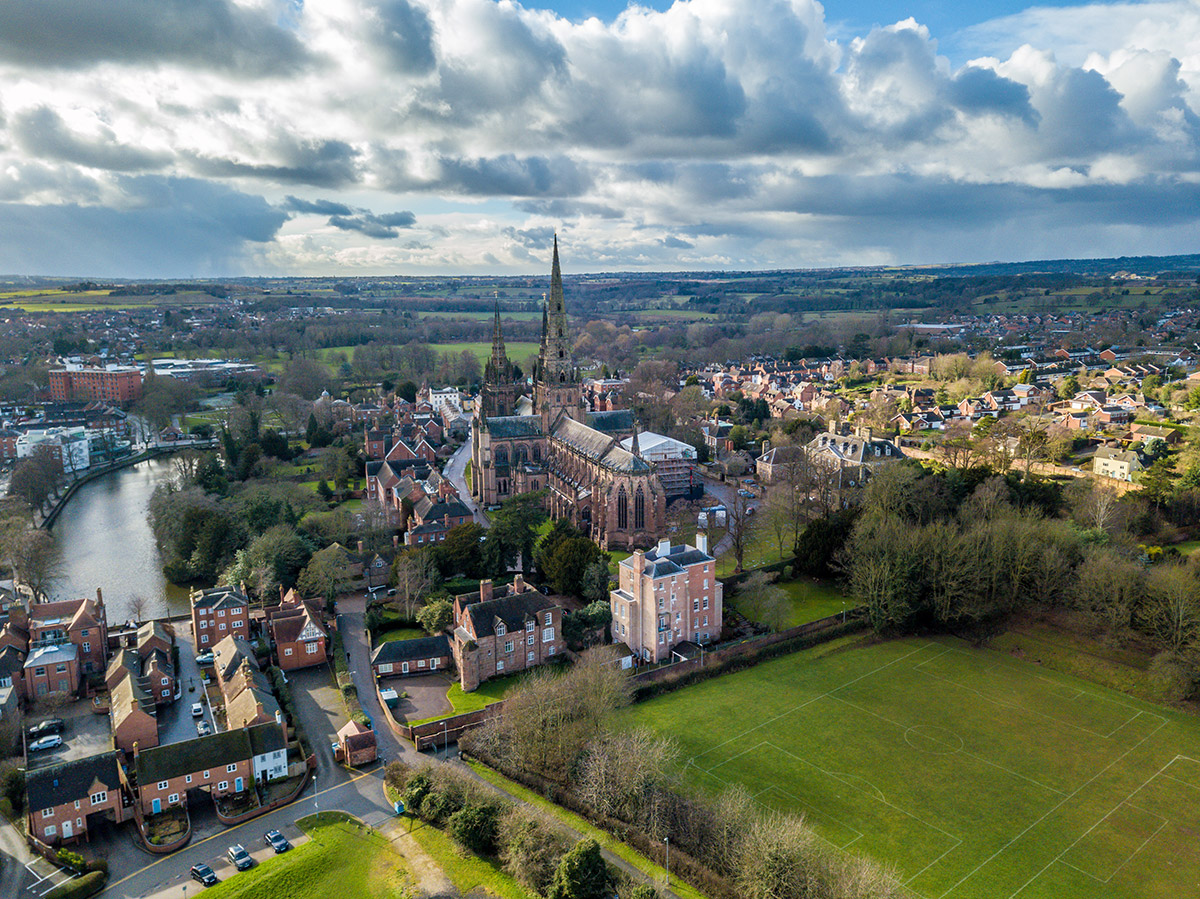
Lichfield, Staffordshire
Heart of the country Dave Robertson was elected as Labour Member of Parliament for the Staffordshire seat of Lichfield, Burntwood and the Villages at the 2024 UK general election, beating the sitting Conservative MP Michael Fabricant by just 810 votes. The former physics teacher serves a semi-rural constituency centred on the cathedral city of Lichfield (pictured). Lying about 30 km north of Birmingham, the constituency also includes farmland, villages and the town of Burntwood. (Courtesy: iStock/Nicholas E Jones)

Robertson is now one of more than 400 Labour MPs and spends most of his time on local Lichfield matters. “My number one focus is very much what’s going on in my constituency, and that will always be the case,” he says. “But I’m very fortunate to be one of a very small number of parliamentarians who’ve got a science background, let alone a physics background.”

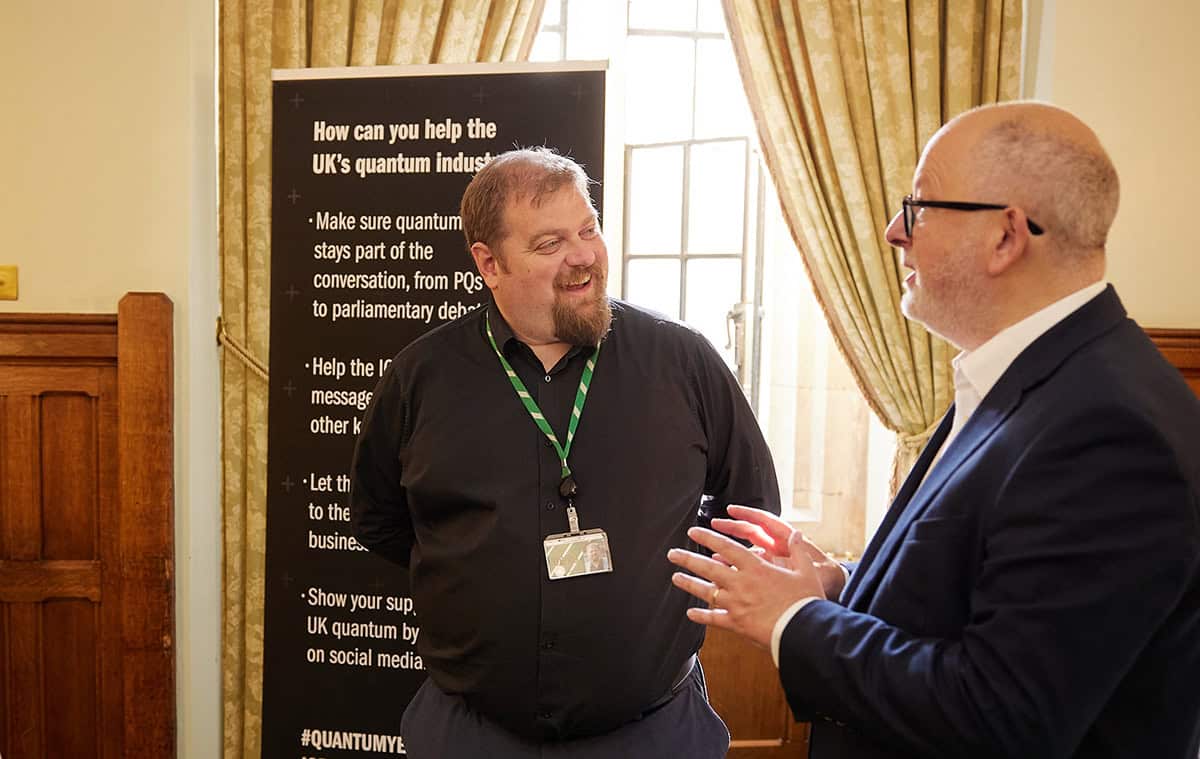
That interest saw Robertson host an exhibition in the Houses of Parliament, organized by the Institute of Physics (IOP), in June 2025 to support the International Year of Quantum Science and Technology (IYQ). “Every MP and member of the Lords would have been able to walk past and see that it was the IYQ,” he says. The exhibition was, for him, a great opportunity “to show decision-makers that the UK is one of the world leaders in quantum”.

That month Robertson also hosted a hands-on display of quantum technology for MPs and members of the House of Lords, again organized by the IOP. At the end of 2025 he sponsored another parliamentary reception, this time for physics-based companies that had won IOP Business Awards. “The event was absolutely wonderful,” says Robertson. “Seeing some of the cutting-edge science from companies on show was astonishing.”

Robertson’s focus on science extends to his membership of various cross-party parliamentary groups, including ones about nuclear energy and space. He is also chair of a new group he has set up devoted to quantum science and technology. As a backbench MP, Robertson cannot dictate or implement policy, but he says such groups “can help build up a critical mass of interest in parliament to drive an agenda forwards”.

Dave Robertson speaking with Steve Yemm in the UK parliament building
Spreading the word Dave Robertson (left) at an Institute of Physics event that he sponsored at the Palace of Westminster in June 2025 to inform parliamentarians, including fellow MP Steve Yemm (right), of the commercial applications of quantum science. The event formed part of the International Year of Quantum Science and Technology. (Courtesy: Barry Willis Photography)

With his background in teaching, Robertson is also keen to highlight the UK-wide shortage of physics teachers. While at Great Barr School – now rebranded as Fortis Academy – he was lucky. “I remember having a physics group meeting,” he says, “where there were six of us around the table and thinking ‘This is more [physics teachers] than most cities have’.”

As a 2025 IOP report pointed out, a quarter of state schools in England have no specialist physics teachers. In fact, more than half of physics lessons for 14–16 year olds are taught by teachers who never studied a physics-related subject beyond the age of 18. Despite some improvement, only 31% of the government’s target number of physics teachers have been recruited, while 44% of new physics teachers quit within five years.

It’s the responsibility of me and other MPs with a scientific background to spark an interest in physics

Dave Robertson MP

Robertson admits that getting the lack of physics teachers on the radar is an uphill battle. “There are 650 MPs but have they all thought about the importance of getting more physics teachers in the classroom? Probably not, if I’m honest. That’s why it’s the responsibility of me and other MPs with a scientific background to spark an interest in physics and unearth the next Paul Dirac or Isaac Newton.”

Robertson would also like to get on the influential science innovation and technology select committee to spread the message about the importance of physics. But he is wary of spending too much time in parliament with other MPs with a scientific background. “It’s more helpful if all of us have tentacles that spread out into other groups and parties and sections of parliament.”

Spreading the message

For the wider physics community, Robertson believes that physicists need to speak out more strongly about how they can tackle many of the world’s problems, notably climate change. “It’s the biggest issue at the moment and a lot of the solutions are going to come from physics,” he says. “Getting more physicists engaged with decision-makers will not only be good for the future of the economy but ultimately for the future of the planet.”

As for Robertson’s own future, he knows that a career in politics is precarious. Voters rarely hold politicians in high regard and will often boot them out on a whim. It’s therefore hard for any MP to have a predictable career path or plan too far ahead. Robertson himself admits to having “no big aspirations” to be a cabinet minister, which is perhaps just as well given that his majority at the last election was so thin.

With the next general election not due to take place until 2029, Robertson is for now focusing squarely on his role as a backbench constituency MP. “The job I have is just about the most wonderful in the world,” he says. “I want to keep doing it because there’s some wonderful things I can do for my community, whether it’s physics, quantum or football.” But if Robertson did get kicked out, at least he can go back into the classroom.

“Rumour has it, we could do with a few more physics teachers.”

The post From the blackboard to the backbenches: how physics teacher Dave Robertson became an MP appeared first on Physics World.

Why mentorship is vital for the future of physics

30 March 2026 at 12:00

A couple of months ago I wrote about whether it’s possible to teach the art of entrepreneurship or if it’s a skill that’s innate to individuals. My article led to some invaluable feedback, notably from one reader who said that, yes, of course it can be taught. Not, they said, from formal lectures but mainly through mentoring by people who’ve learned the art of entrepreneurship themselves.

That idea got me thinking about the wider benefit of “giving back” one’s experience to others who could gain from that wisdom. All professional scientists and engineers will have benefited at one time or another from the generous guidance of other people – be they teachers, lecturers, or work colleagues. So perhaps we should think about how we can do the same.

The value of a professional interaction, however small, should not be overlooked

It’s easy to imagine our lives are so inconsequential that we have nothing to teach – and even if we do have something to say, we certainly haven’t got the time to tell others about it. But the value of a professional interaction, however small, should not be overlooked. A timely moment at any career stage can make all the difference to an individual’s professional impact and future success. The scope of opportunity for giving back is broad.

Volunteering and internships

In my experience, local schools are always grateful for career guidance from professionals. Staff at my company, for example, often give career talks at their children’s schools. We take part in events such as assemblies, career evenings or careers weeks and we are currently keen to provide work experience for 16- and 17-year-olds in year 12. If we go ahead, I am sure pupils will be eager to snap opportunities up.

I have also seen the benefit of scientists and engineers developing videos, workbooks and other materials for primary-school children to learn about concepts in science and technology. It is important to make an impact at the earliest possible stage, which is where the talent pipeline starts. Once students are in their teens and have made their subject choices, it becomes hard – if not impossible – to influence them.

Internships are another great way of giving back. For the last eight years, I have been running a data-science internship programme at GE – and I just wish I’d started it sooner. Initially, we offered summer-long placements, but after a year we added year-long roles to the mix. I will be honest, colleagues were hugely sceptical about how much value these roles would bring, but their worry proved unfounded.

The vast majority of our interns have been extremely productive under our guidance and, after finishing, have gone on to secure graduate positions within GE or other tech firms. It’s vital, however, that interns are properly supported. As well as being given comprehensive induction and training, interns must be part of an established project team, whose members are always on hand to give guidance, answer questions, and provide the interns with clear tasks and goals.

It’s also important to set expectations of professionalism when at work. We are fortunate in GE that interns are taken on as regular employees and so have access to a wide range of employee and company benefits. Interns therefore find it easier to feel part of the company and adopt its ethos. Remember too, that the benefits work both ways. Interns bring you new perspectives and fresh ideas, while also keeping the rest of the team stimulated.

Professional societies and professorships

Being a member of a professional body is also a great way to give back to the community. The Institute of Physics (IOP), for example, has an active volunteer community, along with special interest groups and regional and national branches that are all run by member volunteers, with help from IOP staff. Becoming an IOP volunteer also gives you the chance to influence and help shape the physics community.

By meeting like-minded colleagues, you can build your network and give back to the community at the same time

You could, for example, get involved with running lectures, seminars, webinars and career outreach events. By meeting like-minded colleagues, you can build your network and give back to the community at the same time. There are some great examples, notably Deborah Phelps, a physicist in engineering who ended up launching the IOP’s girl-guiding badge.

For more experienced industrialists, another way to give back is to become a visiting professor. Being fortunate enough to hold such a position myself, they let you go back to university and share your knowledge and experience with current students. It’s invaluable for universities too, allowing students to learn what real-life careers look like and what skills they might need beyond the technical knowledge gained during a degree.

Visiting professorships tend to be awarded directly by universities. But competitive awards exist too. The Royal Academy of Engineering, for example, runs a scheme that brings engineers, entrepreneurs, consultants and other industry insiders into UK universities to boost undergraduate engineering education. Covering areas that would appeal to physicists, such as energy, materials and electronics, the scheme lets experts deliver face-to-face teaching, mentoring and curriculum development for three years.

The Royal Society, meanwhile, runs an entrepreneur-in-residence scheme that’s been taken up by people like Fiona Riddich, who originally studied maths and physics before joining the energy industry. She’s mentored students at the University of Edinburgh and developed a project called Energy@Edinburgh to raise awareness of researchers’ work, promote interdisciplinary exchange, grow staff understanding of the energy market, and encourage innovation and translation of research.

I have only scratched the surface of what can be done for the good of our scientific and engineering community, but there is plenty of opportunity and few, if any, barriers to entry. I can’t emphasize enough the importance of doing this, especially for growing our pipeline of technical breakthroughs and developing talented people for the future.

My challenge to you is to tell your colleagues what you’re already doing to “give back” – and why. And if you’re doing nothing to give back, now is the perfect time to get started.

The post Why mentorship is vital for the future of physics appeared first on Physics World.

❌