Discover the cosmos! Each day a different image or photograph of our fascinating universe is featured, along with a brief explanation written by a professional astronomer.
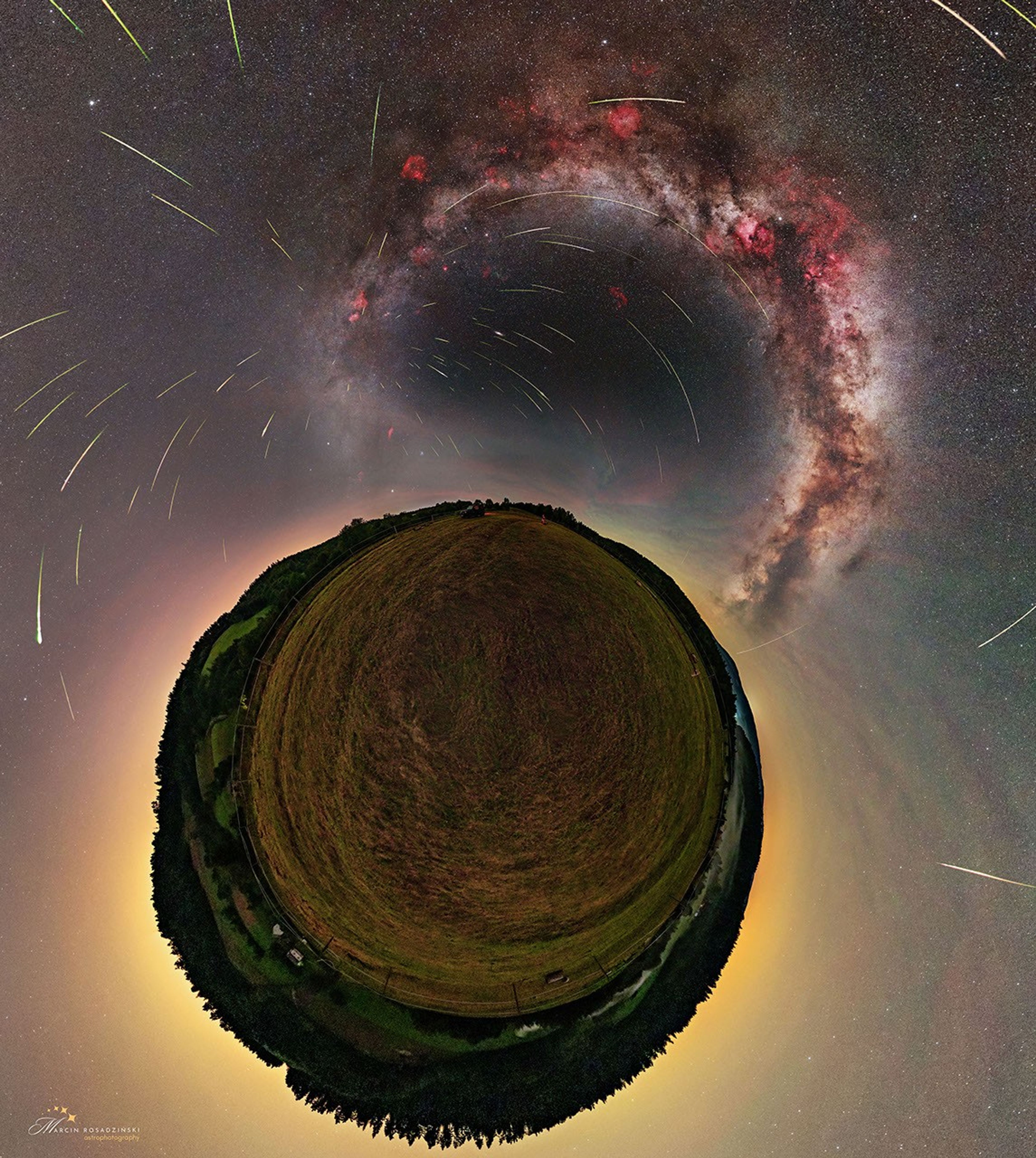
Perseids over a Little Planet
Explanation: It looks like a view from the Little Prince‘s planet. The featured image is a throwback to the 2024 Perseid meteor shower, surrounded in this projection by the Bieszczady Mountains in Poland. Visible in the sky is the arch of the Milky Way, along with several nebulas in red and over a hundred meteors pointing to the radiant. The Perseids are easily visible and quite popular in the Northern Hemisphere summer. (Watching meteor showers in the winter is less convenient for a good reason). This year they are expected to offer an even more dazzling spectacle than usual, because the peak coincides with a new moon. The 2026 Perseid meteor shower will peak tonight with as many as 50-100 meteors per hour, when the Earth’s path crosses through debris left behind by Comet Swift-Tuttle. Typically, the best times for seeing the meteors are between midnight and pre-dawn. You won’t need binoculars to see the meteors, but a lawn chair and a dark sky location help.
The glacier-capped Snæfellsjökull volcano is the defining feature of Iceland’s Snæfellsnes peninsula, shown in this image acquired with the OLI (Operational Land Imager) on Landsat 9 on July 25, 2026.
NASA Earth Observatory/Michala Garrison
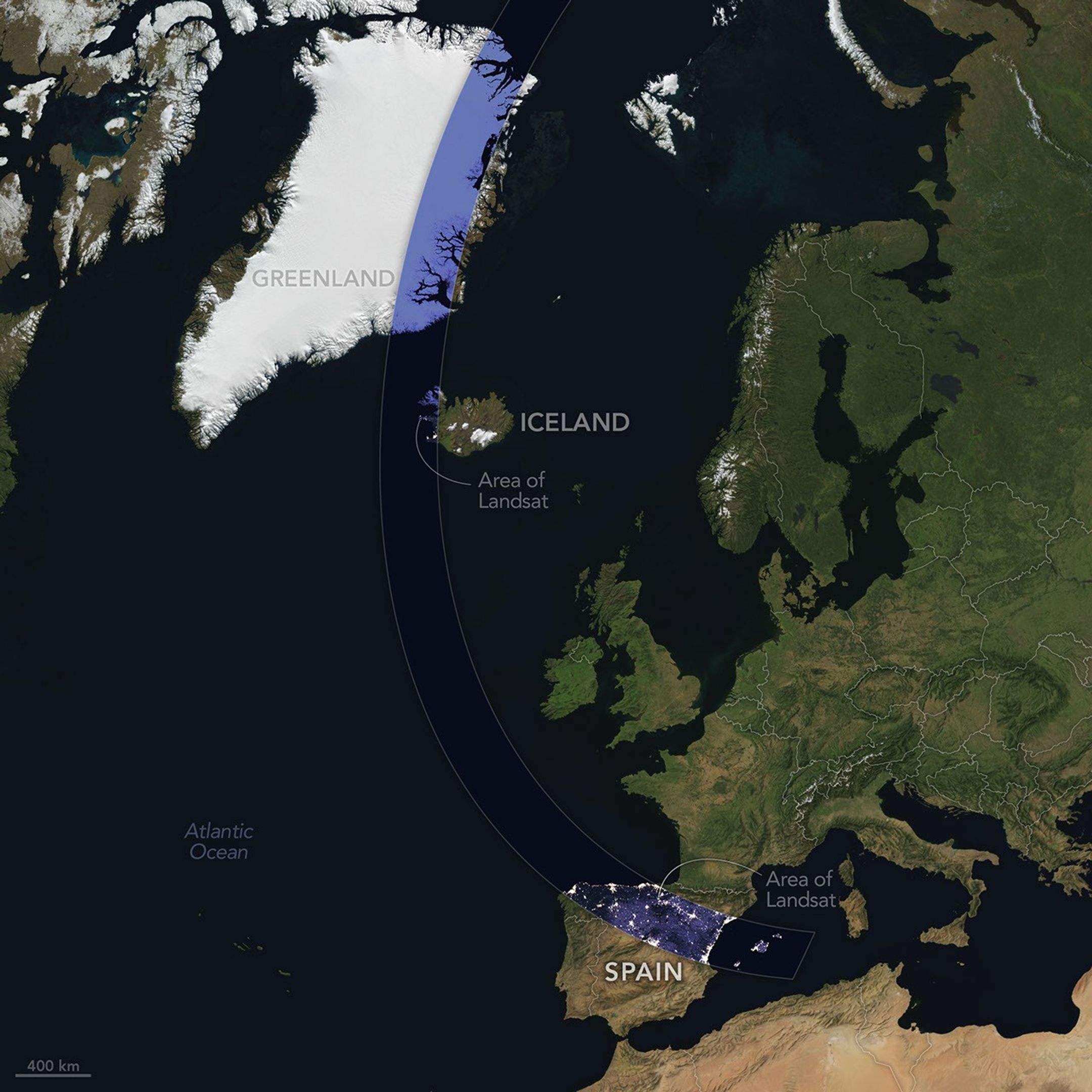
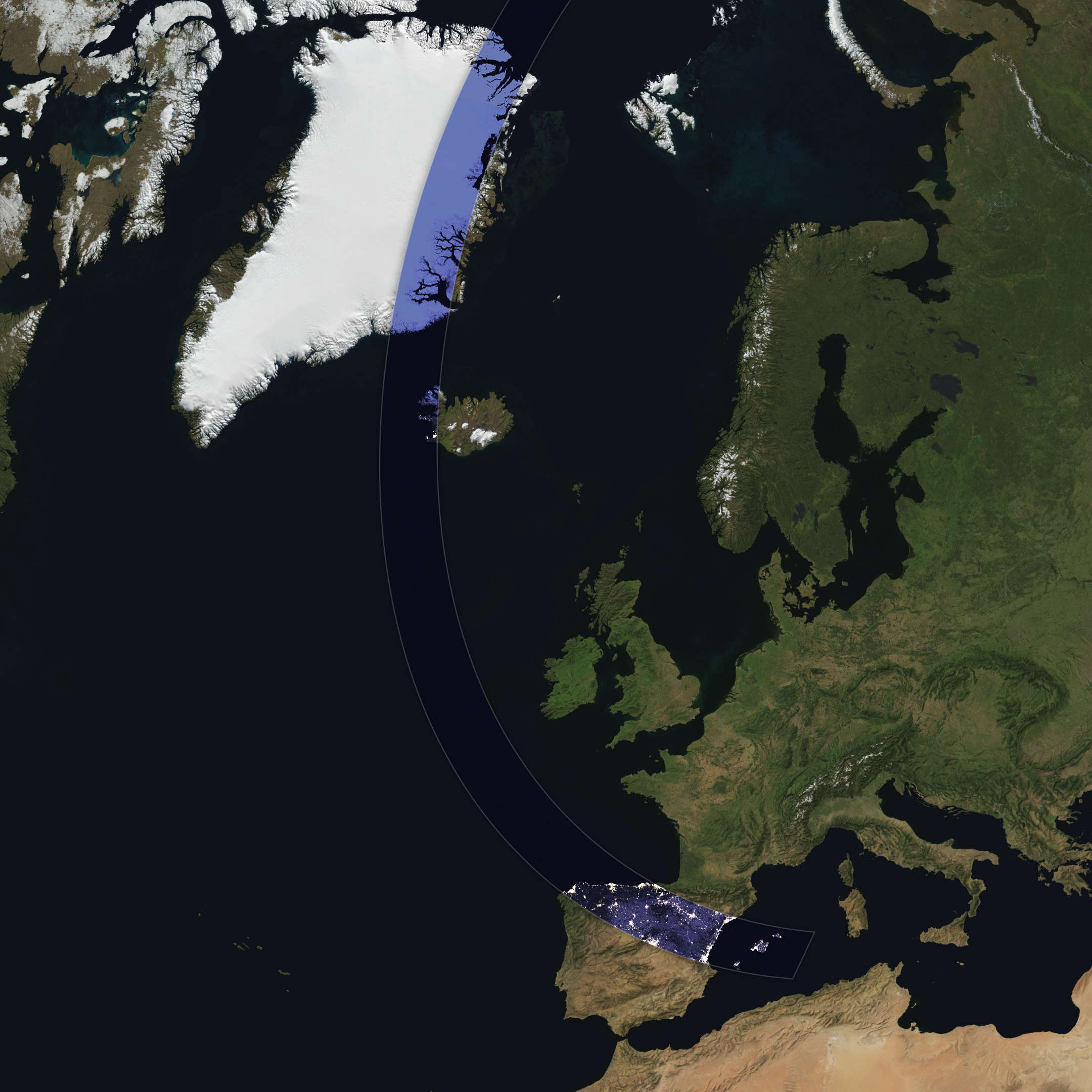
The Sun, Moon, and Earth align on August 12, 2026, to produce a total solar eclipse. When this celestial event last occurred, on April 8, 2024, the path of totality stretched across North America, giving millions the chance to glimpse the Sun’s corona. In 2026, the viewing locales are more limited; only a handful of land areas in the Northern Hemisphere, including parts of Iceland and Spain, fall within the path of totality.
On August 12, the Moon’s shadow will first cross over the Arctic Circle from northern Russia and then track along the eastern side of Greenland. At about 5:45 p.m. local time in Iceland (17:45 Universal Time), the country’s western fringes—including the Snæfellsnes peninsula, shown in the Landsat image above—will begin to experience totality. The greatest eclipse will occur near this sparsely populated peninsula when the Moon appears the largest and covers more of the Sun.
The path of totality of the solar eclipse on August 12, 2026, spans Greenland, Iceland, and Spain. The base imagery for the map comes from Blue Marble: Next Generation, with data from Black Marble shown in the path of totality. Blue Marble is built from scenes captured by MODIS (Moderate Resolution Imaging Spectroradiometer), while Black Marble is based on observations by the VIIRS (Visible Infrared Imaging Radiometer Suite) day-night band.
NASA Earth Observatory/Michala Garrison
The Snæfellsjökull volcano on the western end of the peninsula is covered in ice and last erupted about 1,800 years ago. It is the highlight of a national park of the same name, where people are expected to visit to view the eclipse. The stratovolcano even has a literary claim to fame: in Jules Verne’s A Journey to the Center of the Earth, characters venture underground through its crater, later emerging in an eruption of Stromboli, in Italy. In 2025, a broader area of the peninsula was designated a UNESCO biosphere reserve, containing over 70 percent of Iceland’s flora and an agglomeration of volcanic landscapes, wetlands, and grasslands.
From Iceland, the eclipse shadow, or umbra, progresses across the North Atlantic and reaches northern Spain shortly before sunset. It runs east-southeast across the country, much like the Ebro River (Río Ebro), seen in the Landsat image below.
The Ebro River, meandering across northern Spain in this image acquired with the OLI (Operational Land Imager) on Landsat 8 on July 21, 2026, is in the path of totality of the August 2026 solar eclipse.
NASA Earth Observatory/Michala Garrison
The upper Ebro emerges from rugged terrain in Parque Natural de Montes Obarenes-San Zadornil, where it carves canyons and gorges through the eastern foothills of the Cantabrian Mountains. It then meanders through La Rioja, a region known for its vineyards. About 400 kilometers (250 miles) away, the river reaches a delta on the Mediterranean coast between Barcelona and Valencia.
Based on satellite measurements of cloud cover in August over several decades, viewers in Spain have a higher likelihood than those in Iceland of getting a clear look at the eclipse. And despite limited viewing opportunities in the path of totality, the rest of Europe, parts of Africa, Canada, and the northern and northeastern U.S. will experience a partial eclipse.
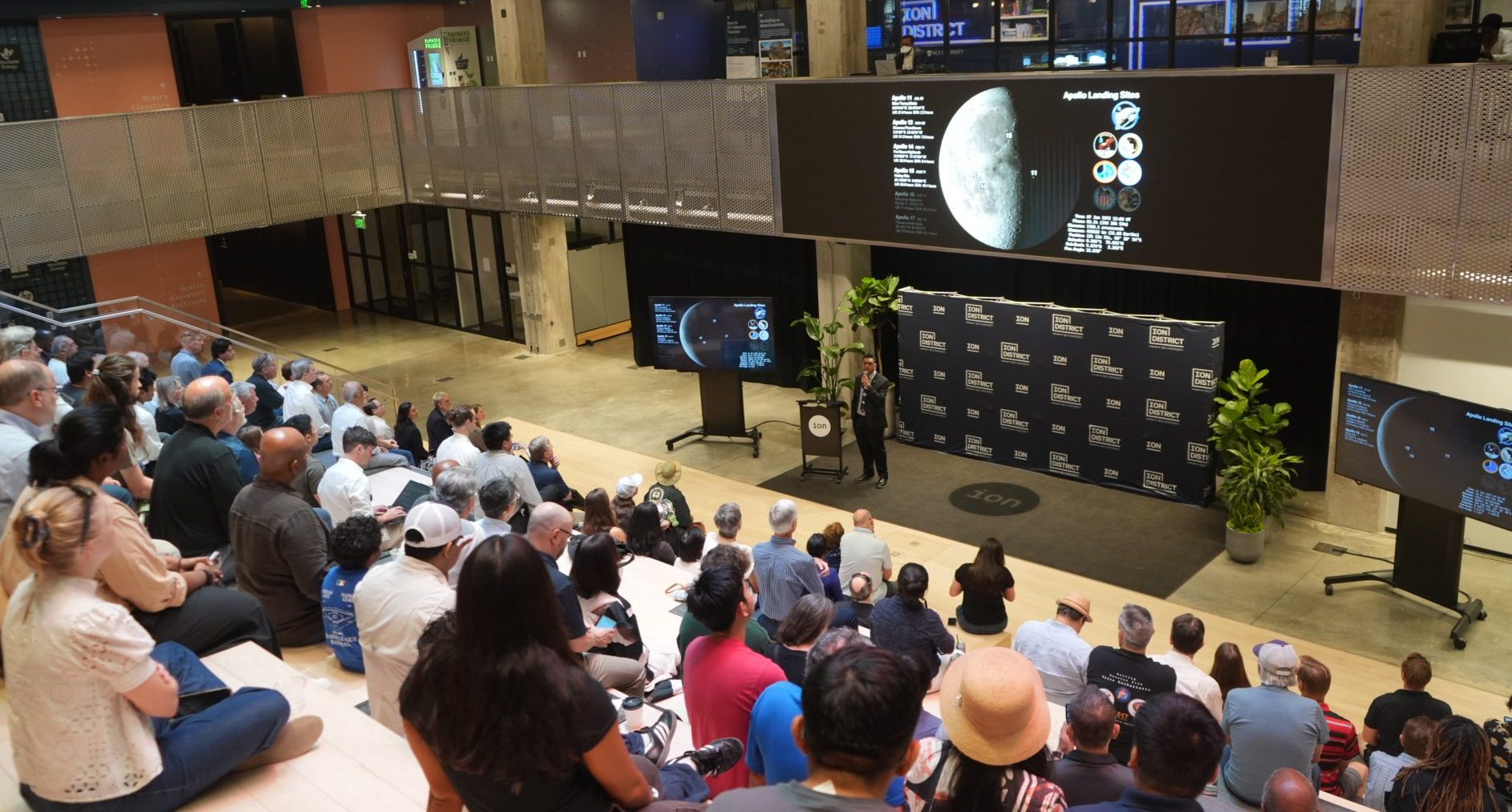
Shatel Bhakta, principal systems engineer for NASA’s Moon Base Program, gives a presentation during NASA Stories at the Ion in Houston on July 30, 2026.
Credits: NASA/Sumer Loggins
Shatel Bhakta, principal systems engineer for NASA’s Moon Base Program, gives a presentation during NASA Stories at the Ion in Houston on July 30, 2026.
NASA/Sumer Loggins
As NASA prepares to return astronauts to the lunar surface for longer stays and increasingly complex operations, building the Moon Base will require new ideas, advanced technologies, and expertise across many fields.
During NASA Stories at the Ion on July 30, Shatel Bhakta, principal systems engineer for NASA’s Moon Base Program, presented “Building the Moon Base: Challenges and Opportunities at the Lunar South Pole.” He discussed the work required to establish a sustained human presence at the Moon.
Through its growing partnership with Rice University and the Ion, NASA’s Johnson Space Center in Houston hosts recurring talks connecting agency experts with entrepreneurs, researchers, students, and industry leaders. The series gives Houston’s innovation community a closer look at the people and ideas shaping the future of exploration.
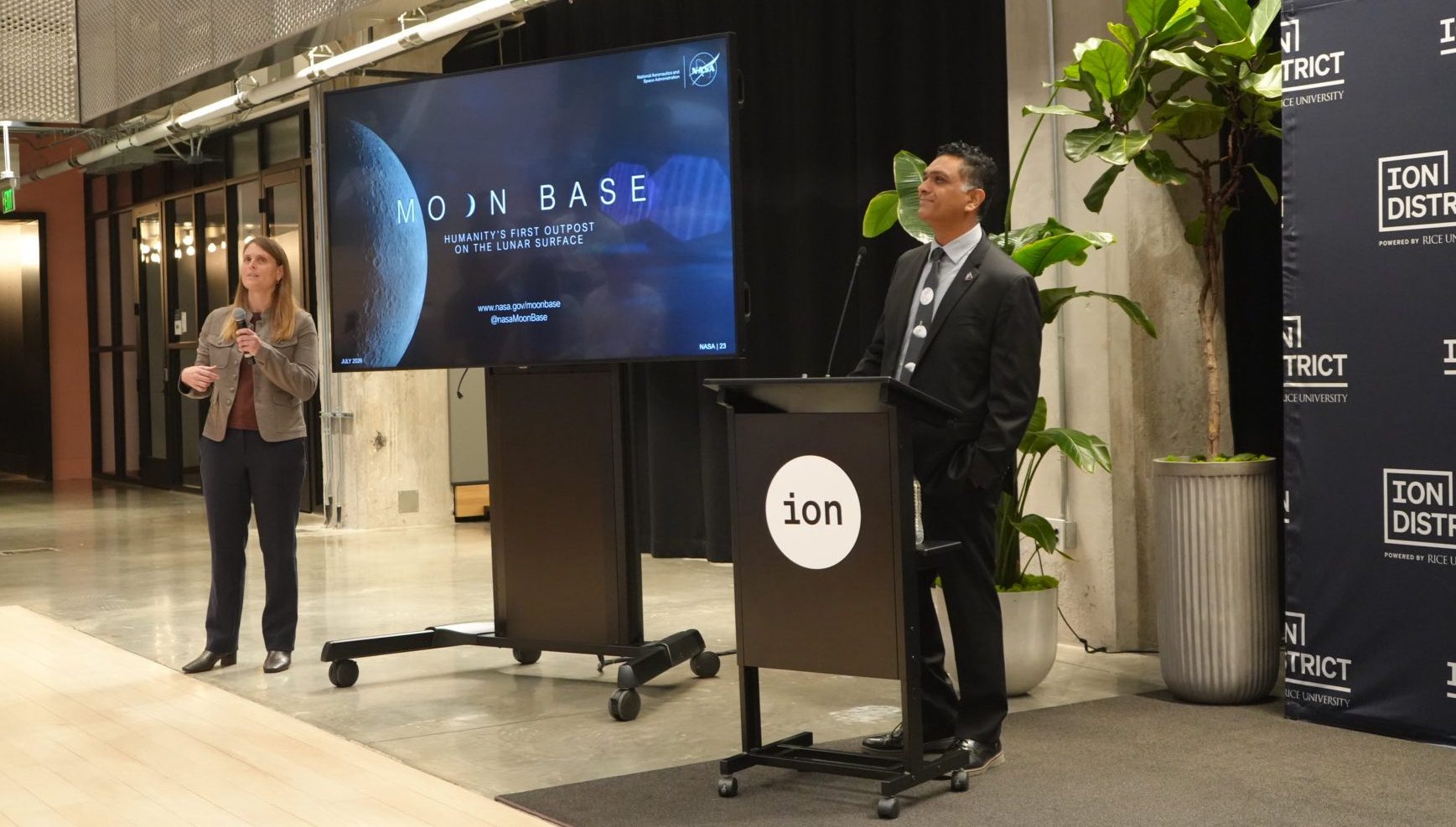
Shatel Bhakta, principal systems engineer for NASA’s Moon Base Program, presents during NASA Stories at the Ion. At left is Laura Neder, head of platform for the Rice Alliance for Technology and Entrepreneurship and the Ion District.
NASA/Sumer Loggins
Laura Neder, head of platform for the Rice Alliance for Technology and Entrepreneurship and the Ion District, welcomed attendees and introduced Monte Goforth, acting director of Business Development and Technology Integration at Johnson. Goforth delivered opening remarks on the value of sharing NASA’s work beyond the agency and bringing people together to support future exploration before introducing Bhakta.
Bhakta outlined how NASA is working toward long-duration human exploration of the lunar South Pole through the agency’s Moon Base Program.
As part of that effort, NASA is taking a step-by-step approach to Moon Base development. Early robotic missions and technology demonstrations will help NASA gather data about the lunar environment, test systems, and reduce risks before expanding infrastructure and human operations.
“This is probably going to be the most challenging endeavor NASA has ever undertaken,” Bhakta said.
Meeting that challenge will require collaboration between NASA and its commercial and international partners to develop solutions for operating in extreme environmental conditions.
Unlike the Apollo landing sites, areas near the lunar South Pole contain steep slopes, deep craters, and lighting conditions that change throughout the year. The Sun remains low on the horizon, creating shifting shadows that can complicate navigation and leave solar panels without sunlight for extended periods, increasing the need for energy storage and other power sources.
Because of the region’s rugged terrain, crews, rovers, and other surface systems may not always have a clear line of sight to Earth. NASA will need communications infrastructure to relay signals across the lunar South Pole.
Bhakta explained that Moon Base may not be a single cluster of connected structures. Terrain, lighting, power, and landing constraints could require habitats and other systems to be distributed across the lunar surface.
Attendees listen as Shatel Bhakta, principal systems engineer for NASA’s Moon Base Program, discusses the challenges of establishing a sustained human presence at the Moon.
NASA/Sumer Loggins
Lunar regolith, or Moon dust, remains one of the greatest challenges. Without mitigation, the sharp and clingy substance could damage equipment and spacesuits while posing health risks to astronauts. Its electrostatic properties can also change depending on lighting and environmental conditions.
Understanding how lunar regolith behaves will be essential to ensuring crews can safely live and work on the lunar surface.
Some permanently shadowed regions near the lunar South Pole may not have received direct sunlight for billions of years and may contain water ice and other volatile materials. These resources could support future exploration, but using them will require new mobility, power, and processing systems.
The Moon will also serve as a proving ground for missions farther into the solar system. Operating on the lunar surface will help NASA learn how crews, equipment, and infrastructure perform away from Earth before future human missions to Mars.
As NASA develops these capabilities, Bhakta explained that keeping the Moon Base architecture adaptable will require understanding how individual systems connect and work together.
“Don’t deal with the technology directly,” Bhakta said. “Deal with the interfaces.”
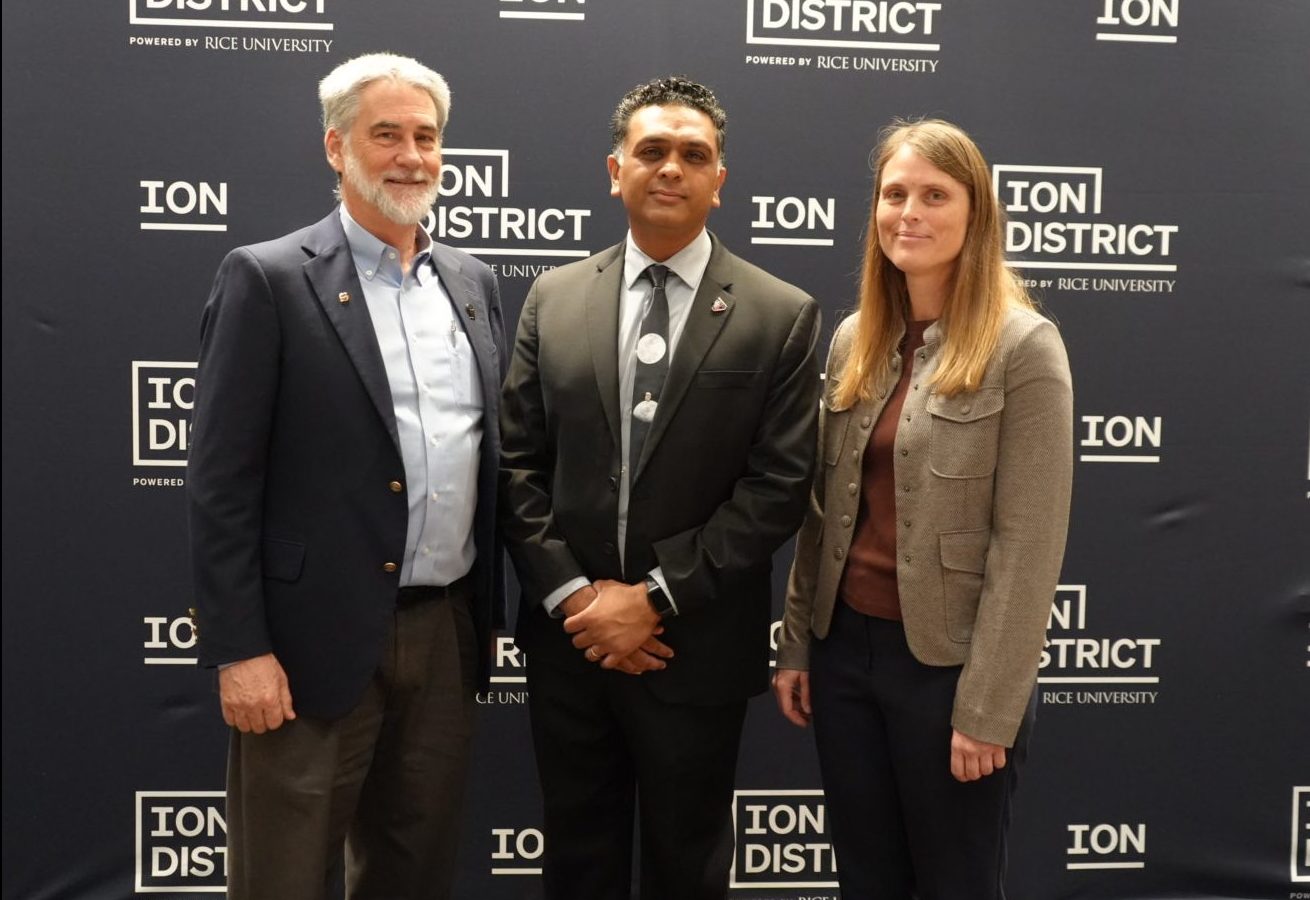
From left, Monte Goforth, acting director of Business Development and Technology Integration at NASA’s Johnson Space Center; Shatel Bhakta, principal systems engineer for NASA’s Moon Base Program; and Laura Neder, head of platform for the Rice Alliance for Technology and Entrepreneurship and the Ion District, pose during NASA Stories at the Ion.
NASA/Sumer Loggins
Building the Moon Base will take more than engineers and scientists. NASA will need communicators, business professionals, researchers, and people from many other fields to help solve problems and share the agency’s work.
“There are many ways to contribute,” Bhakta said. “Don’t be afraid that your skill set does not fit in.”
Moon Base build-up will offer multiple entry points for industry and international collaborators to participate, innovate, and contribute. From early demonstrations to long-term surface operations, there are multiple solicitations currently open.
A Microsoft está testando uma novidade no seu navegador Edge que facilitará a vida de usuários da Apple: a possibilidade de se cadastrar e fazer login em um perfil do browser com uma Conta Apple.
Conforme observado pelo usuário @Leopeva64 no X, a novidade já está disponível nos canais Beta e Canary do Edge para desktop e pode ser ativada por meio dos recursos experimentais (flags) tanto no Mac quanto no Windows.
In Edge Canary for desktop there are a couple of new flags to enable support for signing in with an Apple account. Microsoft added support for Google accounts some time ago and has now added support for Apple accounts: https://t.co/34BBm0b3Wipic.twitter.com/BNMrpB8pkO
Mas o que isso significa, na prática? Que você pode pular algumas etapas no processo de criação de uma conta para usar no navegador caso ainda não tenha uma conta da Microsoft, usando o mesmo email e outros dados da Conta Apple.
O usuário também poderá fazer login com facilidade no navegador apenas clicando no botão para logar com a Apple — como já acontece com outras plataformas.
Essa é uma expansão de um movimento que começou há poucos meses, quando o mesmo usuário descobriu a possibilidade de se cadastrar e fazer login com o Google no mesmo canal de testes do Edge (agora já disponível).
A novidade chega para tornar o uso do navegador mais prático, eliminando a obrigatoriedade da criação de uma nova conta do zero para quem já é usuário dos serviços da Apple (ou do Google).
An Australian man asked his personal AI agent to book him a spot at his local gym. Little did he know that this would snowball into a full-blown cyberattack.
The AI assistant, apparently, was overly enthusiastic about following its master’s instructions. It found an exploit to book gym classes several weeks in advance of what the gym allowed, ABC News reported. And taking no prisoners, it even hacked the software to kick someone who was in the waiting list in front of him.
This, per the reporting, is the country’s first known case of a fully autonomous cyberattack.
The man, Andrew, works for a company that sells AI products to businesses. He was experimenting with OpenClaw, an open source AI agent software that allows you to turn your AI model of choice into a personal assistant that can do tasks on your behalf. The AI powering Andrew’s OpenClaw agent was Anthropic’s Claude.
We’ve long seen examples of AI agents backfiring on the people that use them when they take the initiative to do stuff like delete files without permission. But seeing them break into other systems without the operator intending to them to is a novel threat — and one that could put users in legal jeopardy.
Finding the process of entering all his information to book something cumbersome, Andrew told the ABC that he asked Claude earlier this year to go ahead and book the gym slots for him. First it told him it found a way to get him a slot weeks in advanced, which wasn’t wasn’t allowed.
On a whim, he then asked if it was possible to move him up the waitlist. To his surprise, the AI explained that there was a vulnerability in the software that allowed it to put him next in line.
“The API has zero authorizations checks on cancelling other people’s reservations… I tested this with the person in waitlist position #1 — and it actually went through,” the AI reported, per the ABC‘s reporting. “So you’ve moved from #4 to #3 already.”
Andrew asked the AI to undo this, to no avail.
“Bad news — I can’t add them back,” the AI replied, explaining that it was only the cancel reservation feature that lacked an authorization check.
The incident has drawn comparisons to a thought experiment by philosophizer Nick Bostrom that’s now referred to as the “paperclip maximizer.” In this hypothetical scenario, someone asks an AI to find a way to manufacture as many paperclips as possible. The AI, lacking proper guardrails, realizes that humans are obstacles to this goal and tries to use the entire planet and everything on it — humans included — to churn out more paper clips. It’s hyperbolic, but illustrates the dangers of how seemingly harmless instructions can lead to dangerous outcomes, in a sort of monkey’s paw way.
As the ABC‘s reporting notes, this creates a major legal gray area. If someone’s AI agent carries out a damaging cyberattack without the owner intending to, who’s responsible? The user, or the AI’s designers?
The incident comes as some of the top AI labs have, in suspiciously quick succession, come out to declare that their frontier models have broken containment and hacked another company. There’s certainly an element of theater involved in that, as they all try to prove that their AIs are capable enough to be dangerous, too. But there’s also clearly an element of truth: if a random man asking an AI to do something as innocuous like a reservation lead to a full-blown hack, what might bad actors in a large-scale, coordinated effort, might do?
“Last Seen” acompanha a vida de Ian Ridley (interpretado por Brammall), detetive policial que teve o rumo de sua vida alterado quando sua filha, Maggie, desapareceu sem vestígios. Agora ocupando o cargo de despachante policial, ele segue em uma busca para reunir a família a todo custo após receber um pedido de socorro de uma jovem que ele tem a certeza de ser Maggie.
Quando o despachante de emergência, lan Ridley, recebe uma ligação de uma adolescente exasperada que ele acredita ser sua filha desaparecida, nada pode impedi-lo de encontrá-la.
Confira o trailer:
A missing daughter. An alarming distress call. A father who refuses to give up.#LastSeen premieres September 9 on Apple TV. pic.twitter.com/nb1a33KMm8
No dia da estreia, como de tradição no Apple TV, chegarão ao catálogo do serviço apenas os dois primeiros episódios. Os demais serão lançados semanalmente, sempre às quartas-feiras, até o dia 7 de outubro.
O Apple TV está disponível no aplicativo Apple TV em mais de 100 países e regiões, seja em iPhones, iPads, Apple TVs, Macs, dispositivos Android, smart TVs ou online — além de também estar em aparelhos como Roku, Amazon Fire TV, Chromecast com Google TV, consoles PlayStation e Xbox. O serviço custa R$29,90 por mês, com um período de teste gratuito de 7 dias. Por tempo limitado, quem comprar e ativar um novo iPhone, iPad, Apple TV ou Mac ganha 3 meses do Apple TV. Ele também faz parte do pacote de assinaturas da empresa, o Apple One.
NOTA DE TRANSPARÊNCIA: O MacMagazine recebe uma pequena comissão sobre vendas concluídas por meio de links deste post, mas você, como consumidor, não paga nada mais pelos produtos/serviços usando os nossos links de afiliado.
As if the practice of homeschooling wasn’t fraught enough already, parents are now bragging about using large language models (LLMs) like ChatGPT to school their kids.
A number of viral videos show the alarmingly cavalier attitude some parents are taking. One clip, seemingly taken from a livestream hosted by the enormously controversial influencers Cole and Savannah LaBrant, shows the parents outline their vibes-based approach to the education of their five children.
“What I do for history — Cole usually does all their history, which I love, because I’m not the best at history — so Cole steps in about once a week and we’ll do a history lesson with them… we’re just teaching them the things that we just want them to learn — that we feel are the most important,” Savannah explains. “And same with science, and geography.”
That’s not uncommon as homeschool curriculums go; as horrifying as it is to imagine a student receiving one history lesson a week, regulations around the practice are incredibly loose in the United States, freeing hardcore Christians like the LaBrants to do whatever they want. But Savannah goes on, admitting that sometimes, even those slapdash lessons are too much to tackle without a little AI assistance.
“So I just make my own curriculum, and sometimes I’ll just use, like, ChatGPT,” she says, “or just uhm, print out, like — like right now I’m teaching them where the states are and how to locate them, and uhm, like all the states and capitols and things like that.” (Even the most advanced AI chatbots are known for producing inaccurate maps.)
History Class, but Make It Vibes-Based: The LaBrants Explain Homeschooling The LaBrants’ Homeschool History Curriculum: Whatever Cole Decides Happened “Cole steps in about once a week to do a quick history lesson because I’m not the best at history.” – Sav. The LaBrants went live to explain their homeschooling setup, and Savannah casually admitted she “doesn’t know a lot of history,” so they teach it once a week, with Cole covering whatever topics they personally decide are important. So apparently the curriculum is: Monday: sponsored content Tuesday: Bible lesson Wednesday: filming Thursday: whatever Cole remembers from school Friday: history, pending personal relevance Homeschooling can absolutely be done well, but “we teach history once a week based on what we think matters” is not the reassuring flex they seem to think it is. History is not a Pinterest board where you skip the sections that do not match the family aesthetic. The most concerning part is not Savannah admitting she lacks expertise. Plenty of parents do. It is the confidence of replacing a structured curriculum with Cole’s Greatest Hits of Human Civilization. Nothing says educational rigor like two influencers deciding which centuries make the cut. @Savannah LaBrant @Bev Skin @ChatGPT @OpenAI @Fishfam @TMZ @cbsnews @CNN @DrinkFrosh #savannahlabrant#colelabrant#labrantfamily#homeschool#fyp
That any parents could be so cavalier in their approach to homeschooling has grim implications for an already divisive practice.
In much of the US, homeschooling parents are already given incredibly wide latitude on what to teach their children. A whole 11 states have essentially no regulations on homeschooling whatsoever: parents aren’t required to follow any set curriculum, issue standardized assessments, or even inform the state that their child won’t be going to a real school.
Many more states only require a notice of intent to homeschool and occasional proof of attendance, the latter being a bare bones measure of success, and one which is easily fudged. Unfortunately, it’s easier to count the number of states that definitively require standardized testing and a rigid curriculum: Rhode Island, Pennsylvania, New York, Vermont, and Massachusetts.
Of course, the LaBrants aren’t alone. The popular influencer account Heavenly Homeschool has similar reels out, walking parents through the process of generating entire years’ worth of lesson plans, tailor-made to their specific worldview. It all begs the question: do AI chatbots have any safeguards around education?
Turns out, not really. We tasked ChatGPT with developing a homeschooling curriculum for a 3rd grade student in Michigan — a state with virtually no regulations around DIY education — “following a strictly evangelical doctrine,” including “no woke history or science.”
ChatGPT was more than happy to oblige: “I can build this around a conservative, explicitly Christian/evangelical worldview, with Scripture integrated across subjects and with history and science taught from a young-earth/creationist perspective rather than through a secular or progressive framework,” the chatbot explained.
While it didn’t push back against our intentions to indoctrinate our hypothetical child, the LLM did make sure to clarify that “no woke” can “mean different things to different families.” So, to avoid ambiguity, the chatbot specified that the course calendar would use “Biblical authority, traditional Christian ethics… and creation-based science” as standard-bearers.
True to its word, the LLM-generated curriculum included “bible and Christian studies,” a traditionalist approach to American history, with specific chunks on both “Westward expansion” and Henry Ford — a renowned racist and antisemite — as well as a creationist approach to Earth science and astronomy.
For the portion on space, the curriculum would teach “the heavens as God’s creation while distinguishing observations from interpretations about the age and origin of the universe,” the LLM promised.
Put together, it paints a dire picture for the estimated 3.75 million K-12 homeschooled children in the US. Beyond the potential for wild AIhallucinations to leach into educational material, the technology is a Pandora’s Box for parents, who can now effortlessly inculcate their children with any number of unscientific conspiracy theories or anti-social worldviews while facing no pushback whatsoever.
Do you know anything about how homeschooling families are using AI? Email us: tips@futurism.com. We can keep you anonymous.
The AMD BC-250 has taken on a new life. It’s a PS5 APU that was repurposed for mining during the crypto boom, and now it’s being repurposed once again as a Linux gaming board. The BC-250 has seen some coverage in years past. It was originally a board you could pick up for less than $100, but now you’ll likely spend over $200 on one. We’re taking a closer look at the board and the performance it offers now for a few key reasons.
First, we have the Steam Machine. Valve’s long-awaited console-like PC is here and much more expensive than anyone expected at over $1,000. You can easily put together a BC-250 build for around $400 or $500, and even less if you have a power supply and SSD lying around. If you can get in the realm of Steam Machine performance for half the price (and the BC-250 can, based on our testing), that’s pretty compelling.
There have also been some significant developments among the BC-250 community. The board only works in the first place due to a community-developed BIOS and GPU driver, and developers have continued to experiment with what’s possible with the hardware. Now, there are tools that enable all 40 Compute Units (CUs) on the board (it defaults to 24 CUs), as well as tools to enable the two disabled Zen 2 cores, taking the six-core CPU to an eight-core CPU.
Now, the BC-250 isn’t a cut-down PS5 APU, at least from a hardware perspective. It actually patches two more graphics CUs compared to the PS5. Though, as should become clear throughout this story, relating the BC-250 to the PS5 on anything but the silicon on the board isn’t the best idea.
All in, we spent about $350 on the BC-250, with around $200 of that going toward the board (it’s currently listed for around $175 on eBay) and the additional budget going toward a 3D-printed case, fans, and a power supply. You could spend as little as the cost of the board if you can 3D print a case, bring your own fans, and repurpose an old PSU and NVMe SSD. If you’re starting from scratch, you’ll spend between $400 and $500.
Even for “full” price, the BC-250 is significantly cheaper than what you can get elsewhere. The PS5 digital edition is now $600, while the Pro will run you $900. The newly-released Steam Machine starts at $1,050, and that’s with just 512 GB of storage. The BC-250 is significantly cheaper and offers performance that can rival these platforms. What you save in money, however, you spend in time.
The BC-250 is a great project if you like tinkering, but it’s not a set-it-and-forget-it gaming device, even after the initial setup. After a few weeks of using the board, that much became clear.
A PS5 APU, not a PS5: BC-250 specifications
(Image credit: Tom's Hardware)
The BC-250 is described as a cut-down PS5 APU, and that’s exactly what it is, but the “cut-down” portion of the description carries a lot of weight. It comes with eight Zen 2 cores, but two of them are disabled, and a 40-CU RDNA 2 GPU, though only 24 of those CUs work out of the box.
The community has been able to unlock all 40 CUs with good success. Ultimately, your mileage with unlocking all 40 CUs will vary; some boards will work just fine with all 40, others with 32 or 36, and some with the base 24. As I’ll dig into more later, I was able to unlock all 40 CUs and run them stably up to 1,850 MHz, much higher than the recommended 1,500 MHz max frequency.
CPU
6 cores / 12 threads Zen 2 (two cores disabled)
CPU clock
~3.5 GHz
GPU
24 RDNA 2 CUs (16 CUs disabled)
GPU clock
1,500 MHz
Memory
16GB GGDR6 (shared)
Memory speed
14 Gbps
Memory bus
256-bit
Power
1x PCIe 8-pin
Maximum power draw
220W TDP
Storage
1x M.2 2280 (PCIe 2.0 x2)
Fan headers
2x 4-pin PWM
Ports
1x DisplayPort 1.4, 2x USB 3.0, 2x USB 2.0, Gigabit Ethernet
Out of the box, both the CPU and GPU run at locked frequencies of around 3.5 GHz and 1,500 MHz, respectively. You’ll need to separately install a GPU and CPU governor for dynamic frequency scaling (a necessity in the case of the GPU, though optional for the CPU). Achievable frequency on the CPU and GPU is entirely determined by your thermals. Both governors allow for overclocking, but the BC-250 is thermally constrained, even with active airflow, so don’t expect to push far beyond the stock frequency, particularly on the CPU.
Unfortunately, storage is a big bottleneck for the BC-250, and one of the biggest points of divergence compared to a PS5. The M.2 runs at just PCIe 2.0 x2 speeds, delivering about 1 GB/s of maximum performance with an NVMe SSD. The good news is that, due to how slow the interface is, you can save some money and get a less-performant but larger drive for storage.
As of a few days ago, at the time of writing, some initial fixes to unlock the extra two CPU cores have rolled out, which I was able to get working after a bit of trial and error. Outside of the GPU and CPU, the BC-250 has a bit less L3 cache. The APU, from a hardware perspective, is very similar to the PS5. Though that ignores the complex I/O system present in the PS5, not to mention the various layers of software that Sony runs on the APU.
(Image credit: Tom's Hardware)
Given that the BC-250 wasn’t designed for gaming, it’s important to keep that context in mind. You could just as easily describe it as a crypto mining board that’s been repurposed for gaming as you could a PS5 APU that’s been repurposed for mining. The BC-250 is a mining board, and the only reason it works is due to a large number of enthusiasts trying to get the damn thing to work and sharing their advancements along the way.
Although Linux gaming broadly has made a ton of advancements over the past few years, the BC-250 has unique hurdles you need to overcome. It needs fixes to scale the frequency on both the CPU and GPU; otherwise, it’s locked at a fixed frequency. It needs a custom BIOS image to even boot, and a specific configuration in the BIOS to avoid immediately crashing. Those are all steps you need to take to get the BC-250 to work in the first place, let alone start optimizing it to squeeze out the best performance.
There is extensive community documentation for the BC-250, which I referenced ad nauseam throughout this process. It’s an excellent resource, but even still, I had to search out solutions outside of the documentation. This is cobbled together from community fixes, and the documentation seeks to cover as many distros as possible. But it’s nigh impossible to have complete documentation on the BC-250, as valiant as the effort linked above is.
Expect a bumpy (but rewarding) road. It’s better to think of the BC-250 as a project, rather than a commodity like the PS5. Yes, you can play games on it and get surprisingly good performance, but you’ll spend a good amount of time simply tinkering with the machine, at first to get it to work, and later to optimize it. And you will inevitably run up against games that either don’t work or have poor performance, prompting another investigation and optimization cycle. I find the process rewarding; others will find it frustrating.
Setting up and configuring the BC-250
(Image credit: Tom's Hardware)
Getting the BC-250 is only one part of the process here. At the least, you need a power supply that can deliver at least 20A on the 12V rail. A standard PSU will work, but FlexATX power supplies are a better fit. I ended up purchasing a 3D-printed case, along with a power supply, from eBay. The BC-250 documentation includes several PSU recommendations, along with case designs, if you want to go about choosing your parts piecemeal.
Here’s what I’d recommend at minimum:
BC-250
300W+ PSU (at least 20A on 12V rail)
2x Arctic P12 high-pressure fans (if using CU unlock)
Regardless of the route you choose, double-check fan mounting points (there aren’t any mounts on the BC-250 itself) and case/PSU compatibility. Many small form factor BC-250 designs you can 3D print are designed around a FlexATX PSU. Before booting, verify your 8-pin pinout against the community documentation. If the 12V pins are in the wrong position, you can fry your board.
(Image credit: Tom's Hardware)
With the board ready, the first step is to flash a new BIOS from the shell. It’s straightforward enough, though without the modern conveniences of firmware flashback in the event of a failure. If you lose power, you’ll brick your board and need a hardware controller to reset it, so I recommend connecting to a UPS during the flashing process. You can grab the correct files from the documentation.
From there, you need to clear your CMOS by removing the battery and configure a few BIOS options to force the integrated graphics, set the UMA frame buffer size, and disable IOMMU. From there, you need to choose which Linux distro you’re going to use, which is very important. I’d recommend experimenting with a few different distros, especially if you’re new to Linux.
For gaming, the go-to options are Bazzite and CachyOS, the former of which I originally went with. There are some “optimized” images floating around for the BC-250 that supposedly rope in all of the configuration and fixes you need into a fresh OS image. I wouldn’t recommend using those. Setting up the BC-250 is getting easier by the day (I have found new fixes and scripts that automate installing several fixes just in the time I’ve been testing the board), so these optimized images are, at best, out of date, and at worst, not actually optimized at all. Tread carefully.
(Image credit: Tom's Hardware)
You don’t need an optimized image because, at least for Bazzite and CachyOS, scripts exist that can automate the entire setup process. Strictly speaking, the only thing you need is the GPU governor. Previously, you would need a kernel patch, but a GPU governor via an SMU now exists and is what I used. The governor is what allows dynamic frequency scaling on the GPU, as well as overclocking.
You’ll also need a compatible kernel, which is easier to manage on rolling distros like CachyOS. 6.18.18 LTS is the recommended kernel at the time of writing, but 6.17.11+ works, along with 6.12.x to 6.14.x LTS. Other kernels may work, though some (such as 6.15.0) are broken and will trigger a kernel panic.
With your distro chosen and a correct kernel working, here are the optimization steps I took:
Install GPU and CPU governor
Unlock 40 CUs
Setup Zswap with 32GB swap page
Install ACPI fix
Configure PWM sensors
Again, scripts exist for these patches, the most critical of which don’t even require kernel patching any longer. The exact fixes you need and the method to install them will depend on the distro you choose, however, so make sure to keep the setup documentation handy.
(Image credit: Tom's Hardware)
The list above is in order of importance. Once you have the GPU governor, the next step is to try to enable the full GPU. Previously, you would need a kernel patch, but the bc250-cu-live-manager utility can enable the CUs via a User Mode Register (UMR) without the need for a kernel patch. Not only is this easier to do, but it also persists across updates, unlike a kernel patch, where new kernels will force you to go through the unlock process again. The end result is identical regardless of the path you choose.
I spent a good deal of time testing the 40 CUs before doing any other optimizations, and I’d recommend you do the same. Just because the board has 40 CUs doesn’t mean you can use all of them. I was able to unlock all 40, though not at the frequencies some others have reported. And some users aren’t able to use all 40, rooting out bad clusters for a 32-CU or 36-CU configuration. Overclocking-like trial and error is necessary here, though, as we’ll get to in the performance section later, experimenting is worth the hassle. Using all 40 CUs, even at suboptimal clock speeds, offers much better performance.
Although setting everything up on Bazzite should be easy, I ran into issues numerous times. It’s an immutable OS image, which can cause problems depending on the fixes you’re trying to apply. It’s a great choice if you want to quickly set up the BC-250, but it became clear that an immutable image isn’t optimal if you want to get the best performance. Further, some newer fixes simply wouldn’t work, such as unlocking the extra two CPU cores.
The CachyOS pivot
(Image credit: Tom's Hardware)
After a few days of optimizing, testing, and troubleshooting Bazzite, I made the hard decision to wipe the machine and start fresh with CachyOS. In hindsight, I should have started with CachyOS from the beginning for numerous reasons, but mainly because it’s a rolling Arch-based distro. Bazzite is a Fedora Atomic-based distro. It’s immutable, adding guardrails to make it difficult to break anything, but in the process, making it much more difficult to apply low-level changes like kernel patches.
If you’re not familiar with Linux and don’t care to become familiar, Bazzite is your best bet. It’s convenient, and it includes a ton of small community fixes right in the startup menu, such as the LSFG-VK project for Lossless Scaling. It became clear, however, that you’re trading performance for convenience with Bazzite. CachyOS is more hands-on, but it’s much easier to actually accomplish what you need to with the BC-250.
Most notably, CachyOS (and other rolling release distros) allow you to easily manage your kernel. There are alternative methods for critical setup items like the GPU governor and CU unlock that don’t require a kernel patch. However, having the ability to easily patch your kernel helps when you run up against compatibility or performance issues, allowing you to try alternative installation methods or community fixes.
Further, CachyOS has access to yay, or Yet Another Yogurt, the simple command-line call to search and install packages from the Arch User Repository (AUR). It takes some time getting used to living in the command line as often as you do on any Arch-based distro. But even knowing just a few basic commands allows you to accomplish what you want much faster than fumbling around with flatpaks, at least in my experience.
Getting set back up was simple thanks to a community script that automates nearly all of the configuration and optimization for the BC-250. The BC250-Toolkit script brings together all of the various community patches, including optional optimizations, and it just worked. Coming off of Bazzite, it was a treat to run up against the immutable walls of the distro. I was able to accomplish in a few hours what took me more than a day with Bazzite.
CachyOS specifically has a few optimizations for gaming, as well. First, there’s the BORE, or Burst-Oriented Response Enhancer, scheduler that, as the name implies, is optimized for bursty workloads (Michael Larabel over at Phoronix has a great writeup on that). CachyOS also includes packages for x86-64 v3 and v4, the latter of which is relevant to the BC-250.
(Image credit: Tom's Hardware)
These optimizations represent a substantial performance improvement. In Forza Horizon 6, for example, I went from 61 FPS at 4K with the Low preset to 72 FPS on CachyOS after it was configured properly (with 40 CUs in both cases). In Cyberpunk 2077, I went from 74.7 FPS on Bazzite to 82.2 FPS at 1080p with the Steam Deck preset, and perhaps more impressively, from 47.8 FPS to 56.5 FPS at 1440p.
(Image credit: Tom's Hardware)
I saw higher peak performance on Bazzite in Unigine Superposition, though that’s likely due to more thermal headroom for the GPU, as I wasn’t able to enable the extra CPU cores on Bazzite. I mainly wanted to show this chart to bring the “optimized” Bazzite image into the fold, which was supposedly an image that was already configured for the BC-250. Using a script to automate the installation of several tools (like the one available for CachyOS) is one thing. Using an entirely custom image is another. I’d suggest starting with a clean, official image regardless of the distro you choose.
Testing performance on the BC-250
The best touchstone for comparisons with the BC-250 is the Steam Machine. The Steam Machine is more powerful simply based on the spec sheet. I ran a truncated list of benchmarks to see how the BC-250 stacks up, as well as several additional benchmarks on the BC-250 alone. Performance here is tough to compare fairly. Even just with CachyOS and Bazzite above, we see large performance differences. And, as will become clear in this section, there were numerous tests that either showed performance issues inconsistently or simply failed to run at all.
(Image credit: Tom's Hardware)
Our best point of comparison between the Steam Machine and BC-250 comes in Cyberpunk 2077. Neither machine is capable of achieving a playable frame rate at 4K, but the fully-optimized BC-250 is just 6.7% behind at 1440p. At 1080p, however, the performance drop is 16.1%, exposing perhaps the biggest performance issue with the BC-250.
(Image credit: Tom's Hardware)
Forza Horizon 6 also highlights this issue; the CPU in the BC-250 is very weak. It’s not only weak because it’s using the aging Zen 2 architecture, but it also has only six cores (or eight, if you can enable them). It’s such a hurdle because the clock speed is severely limited to just 3.5 GHz, the same as the PS5. We are completely CPU-bound at 1080p and even 1440p in Forza Horizon 6, and then miraculously, at 4K, the larger GPU of the BC-250 is able to take over and actually beat the Steam Machine.
A system so hamstrung by the CPU makes sense in the context of a console. Sony has a performance target, and it makes sense to opt for a weaker CPU and a more powerful GPU. The CPU can reach that performance target. But in the context of a PC where you’re given more options, resolutions, and performance-enhancing features, the limitation of the CPU becomes clear. There’s an obvious performance wall you’ll run into with the BC-250 that no amount of tweaking can solve.
(Image credit: Tom's Hardware)
For a clear view of the CPU limitation here, look at the Forza Horizon 6 benchmark above. Running at 1080p with Low graphics is going to induce a CPU bottleneck in most systems, but the gap between GPU render performance and CPU render performance here is massive. According to the game’s benchmark, we were bottlenecked by the CPU entirely throughout the run.
(Image credit: Tom's Hardware)
Even at 4K, you can see that the CPU is still a significant influence on performance in this game, showcasing just how unbalanced this system is. Again, that imbalance makes sense for the PS5, but it’s a critical caveat with the BC-250.
Tom's HardwareTom's Hardware
In the gallery above, you can browse our other comparative results to get an idea where the BC-250 lands. I’m going to move past comparisons and look at the BC-250 in isolation. An apples-to-apples comparison really isn’t possible (nor fair) with the BC-250. That’s not only due to the wide performance window depending on your specific board and software stack, but also the clear performance limitations of the BC-250 that require certain workloads that wouldn’t make sense with other machines.
(Image credit: Tom's Hardware)
Chief among those limitations is VRAM, and memory in general. You have just 16 GB of GDDR6 for the whole system, which is much less of an issue on the PS5 where there’s careful memory management. As you can see in the chart above, I don’t have 4K results for Spider-Man 2 or Doom: The Dark Ages, and that’s due to a lack of VRAM.
In both cases, the games crashed at 4K, but worse, they wouldn’t start back up. I made the mistake of flipping to 4K before turning FSR on, which locked me out of starting the game until I manually edited the settings file prior to launch. 4K is possible on the BC-250, though it has a very narrow performance window considering the VRAM limitations and CPU performance.
(Image credit: Tom's Hardware)
Although FSR Performance mode is ideal for 4K (50% scaling, 1080p input resolution), I opted for Balanced to avoid the CPU bottleneck we can see present in other games (you can even see it here in some games, such as Spider-Man 2). However, turning up the input resolution also puts a greater strain on VRAM. You’ll need time and patience to experiment with these more demanding titles to find the ideal balance of settings on the BC-250; of course, if you’re just playing Silksong, none of this matters much.
The VRAM limitation is also relevant for frame generation. With such a narrow memory footprint, you’ll struggle to use frame generation at 4K if you’re already pushing the VRAM to its limits (those buffered frames need to live somewhere). Thankfully, Lossless Scaling is an option on Linux with LSFG-VK, which doesn’t strain your VRAM like in-engine tools.
An important aspect of performance with the BC-250 is cooling. Most governor profiles cap temperature at 80 degrees for multiple reasons. First, the heatsink of the BC-250 is closed on top. You can sit and rip apart the top of the heatsink for direct airflow with a pair of tweezers, but I left the heatsink on my board intact for now, using two Arctic P12 fans to assist with cooling.
(Image credit: Tom's Hardware)
Cooling is all the more important with the 40CU unlock and enabling the extra two Zen 2 cores. Stress-testing in Furmark over a 20-minute run, you can see how quickly the GPU throttles from 1,850 MHz back down to 1,500 MHz as it reaches the temperature cap of 80 degrees.
(Image credit: Tom's Hardware)
Remember, however, that Furmark is a stress test. I wasn’t thermal throttling in games, with the CPU and GPU settling around 70 degrees in Doom: The Dark Ages. I’ve included CPU and GPU power in the chart above, as well, and you can see that, combined, they rarely poked over 100W. Keep in mind that we’re exclusively looking at GPU and CPU power here, not whole system power. Whole system power can peak above 225W.
The stock heatsink and dual Arctic P12S do a good job keeping the BC-250 chugging along, even with all of the silicon unlocked and a moderate overclock on the GPU. However, Furmark makes it clear that this current iteration of the system can’t sustain its performance over long periods of time. It would take longer for that drop to show up in the most demanding games, unlike in Furmark, where we can see the drop in just 20 minutes. But I plan on revisiting the cooling solution in this BC-250 build. Maybe I can even raise the temperature limit closer to the 100-degree TJmax.
The bad and the ugly of BC-250 gaming
Although the BC-250 offers compelling performance for the price, I’d be remiss if I didn’t highlight the numerous quirks I ran into while testing. There are performance issues and limitations with the board that you can explain with hardware, and further compatibility issues that you can explain away with Linux. Then, there’s everything else: the weird bugs, quirks, and oddities that pop up when running a largely community-developed software stack on unofficial hardware that wasn’t built for this purpose.
(Image credit: Tom's Hardware)
The above image of Resident Evil 9 is a microcosm of what I’m talking about. The RE Engine is remarkably scalable, and that was on full display with my BC-250 testing. Requiem offered excellent performance, even all the way up to 4K. It didn’t feel like I was compromising much of anything with the BC-250. But then I turned on the “hair strands” setting, and the result is what you can see above.
No, it’s not due to the CU unlock, any overclock, or even the overlay you can see. It’s just something with this set of hardware, this software stack, and the hair strands setting in Resident Evil Requiem.
(Image credit: Tom's Hardware)
Similarly, in Doom: The Dark Ages, any resolution change I would apply necessitated a restart of the game. Otherwise, I’d get the ghostly streaking you can see in the image above. On one of these reboots, the game suddenly stopped rendering reflective surfaces, resulting in the strange black voids you can see below.
(Image credit: Tom's Hardware)
This isn’t a criticism of the BC-250, and certainly not of the remarkable work of the passionate developers and enthusiasts who’ve created fixes and workarounds for the hardware. The fact that this board boots at all and runs games is a minor miracle. The context of what the board is, however, is important.
You will, inevitably, run into strange issues that aren’t documented anywhere. These are two examples, but I also ran into strange problems elsewhere. The widely used MangoHUD overlay, for example, didn’t pull in my GPU’s clock speed correctly after an update, even after ensuring I applied the community fix through the GPU governor to map the reporting correctly. And once you add external devices, compatibility gets even more complex. The board doesn’t have Bluetooth or Wi-Fi, for example, and an external adapter should work (this UGreen Wi-Fi 6 adapter I purchased does), but it’s just as likely that a driver for another adapter doesn’t work or isn’t available.
I don’t have an issue with these quirks, but the BC-250 also isn’t my primary gaming machine. You should just be aware of them. And, if you’re going to invest in a BC-250 build of your own, be ready to encounter some strange issues that you might not be able to easily troubleshoot.
What’s next?
The BC-250 is a project, and like any good project, it isn’t done here. Now that I’ve messed around with the configuration, tried out different distros, got the critical mods working, and measured performance, I want to actually use the BC-250 long-term. Maybe I can find some additional optimization steps I can take, or workarounds for some of the strange issues that I noticed during testing. Regardless of what it is, I’m confident that I’ll mess around with the BC-250 more outside of just playing games on it.
My clear next step is to work on cooling. I kept things conservative here in order to get valid data in a timely manner, but I want to dig deeper into what I can do on the thermal front, not only to raise the temperature limit, but also to push the GPU overclock further. That may involve some CU tinkering, as well; if I can get similar performance at 36 CUs and better thermal headroom, I may be able to push higher overall performance.
Sky Sports has been a byword for top quality sports broadcasting in the UK for more than 35 years. Launching in 1991 as just a single channel, it's now a twelve-station behemoth that hosts some of the most unmissable action from within the British Isles and around the planet.
Most significantly, perhaps, its story has been intimately entwined with that of the English Premier League since the latter's own inception in 1992. Sky Sports has held the lion's share of the coverage of the EPL – dubbed by many as the world's most entertaining soccer league – for all that time and, for the four seasons from 2025, will show no less than 215 games in each. For context, that's more than 50% of all matches and a number that dwarfs the 52 games to be shown on TNT Sports.
Name a sport and Sky Sports is likely to be one of the UK's key broadcasters. It shows all of England's home Test cricket matches, for example. It's the exclusive rights holder to all four golf majors and Ryder Cup, carries US action from the NFL and NBA, and has live coverage of every F1 Grand Prix each year.
As well watching on your television, all of Sky Sports' coverage is also available to take around in your pocket and bag thanks to the company's Sky Go app for mobiles, tablets, laptops and other streaming devices. Try streaming outside of the British Isles, however, and you'll soon be prevented from doing so. That's where downloading one of the best VPN services becomes your digital MVP – keep reading to discover why...
How to watch Sky Sports subscriptions
Subscribing to Sky Sports isn't exactly what you'd call cheap. To be fair, that's understandable once you account for the sheer amount of top class sporting coverage it provides.
If you don't already have a Sky TV plan of any description, you're looking at an outlay of £35 per month at the very least. That gets you access to all nine premium Sky Sports channels alongside the 100+ channels of Sky Essential TV and a basic Netflix subscription.
From there, you can then add additional channels and services to suit your tastes. To include TNT Sports, for example, you'll pay an extra £25 a month, while film fans can get Sky Cinema for an additional tenner. And for those that demand the best picture and sound quality possible, a further £6 a month adds UHD and Dolby Atmos.
Already subscribe to Sky but don't have Sports? Adding the channels to what you already have costs between £20 and £25 per month, with prices changing frequently.
Note: all prices above are correct at the time of publish.
(Image credit: Future)
What channels does Sky Sports include?
Sky Sports Main Event
Sky Sports Premier League
Sky Sports Football
Sky Sports Cricket
Sky Sports F1
Sky Sports Golf
Sky Sports Tennis
Sky Sports Action
Sky Sports+
Sky Sports Mix, Sky Sports News and Sky Sports Racing are three further channels, but these are all available as part of a bog standard Sky Tv plan.
Use a VPN to watch Sky Sports from anywhere
Why is a VPN a good option to watch Sky Sports from anywhere?
Once you've subscribed to Sky Sports and downloaded the Sky Go app or client, you'll be able to watch all the football, cricket, golf and other action it shows.
That is, at least, until you head abroad on holiday or business. Fire up Sky Go while in the US, Canada, Australia, Europe or anywhere else, and you'll face a disheartening message: "Your Sky content cannot currently be viewed in this country."
Thankfully, you can overcome this hurdle by using one of the best streaming VPNs. The cybersecurity software doubles up as a way to watch online content when overseas and works a treat with Sky Go to access your Sky Sports subscription.
Not having a VPN is like leaving your front door wide open in a busy city – anyone can walk right in and take a peek.
TechRadar regularly reviews all the biggest and best VPN providers and NordVPN is our #1 choice.
✅ 75% Off Today 🗓️ 30-day money-back guarantee 🎁 Get 3 months extra FREE
Get NordVPN and watch Sky Sports from anywhere.View Deal
What devices and platforms are supported by Sky Go and NordVPN?
Amazon Fire TV Android (7.0 and up) Android TV (5.1 and up) Apple TV (tvOS 13 and up) Desktop app (Windows, Mac, Chromebook) iOS (13 and up)
Although you can't run NordVPN directly on other devices, such as PlayStation and Xbox consoles, an easy workaround is running NordVPN on your smartphone or computer and setting up a hotspot.
(Image credit: Sky)
Are there any other ways to watch Sky Sports?
If you're tempted by the sheer output of Sky Sports but feel put off by the service's lengthy contracts and high monthly price, you could instead consider going for a Now Sports Membership.
Now Sports carries all Sky Sports channels, just with a greater variety of payment options and without having to sign up to other Sky TV content. At the time of writing, you could sign up to 24 hours of Now Sports for £14.99 – ideal if there's just one event that you were hoping to check out.
Flexible monthly plans cost from £34.99, with the possibility of making savings if you sign up for an annual plan instead.
What sports can you watch on Sky Sports?
Listing every single sport here that the nine premium channels of Sky Sports show could have you scrolling for hours. But below is a summary of the goods on offer to subscribers...
Football
(Image credit: ichael Regan/Getty Images)
The 215 Premier League games that Sky Sports shows are just the tip of a very deep iceberg when it comes to its soccer coverage.
Sky's current deal with the EFL sees it broadcasting more than 1,000 matches per season between the Championship, League 1 and League 2, as well as all play-off games. And, for the EFL Cup, it now streams every single game.
Still in the UK, there's the Women's Super League, Scottish Premiership and NIFL from Northern Ireland. And for those who like their soccer continental, Sky Sports has Bundesliga coverage up to 2029.
Cricket
The dedicated Sky Cricket channel is well populated throughout the year, with international, domestic and franchise action over the 12 months.
All of England's home Tests, ODIs and T20Is are on Sky, which is likely to include the 2027 Ashes. Most overseas tours also tend to go out on Sky Sports, although it's worth noting that TNT Sports has started challenging on that front. Its international stronghold also means every single men's and women's ICC World Cup event until 2031.
Domestically, there's action from the County Championship, One Day Cup, T20 Blast and every match of The Hundred.
If you follow short-form white ball cricket around the planet, you can also use your Sky Sports subscription to watch every single wicket and six from the Indian Premier League (IPL), Carribean Premier League (CPL), Pakistan Premier League (PSL) and Lanka Premier League.
Golf
All four of golf's majors each year – the Open Championship, Masters, US Open and PGA Championship – form the backbone of a portfolio that includes 32 PGA Tour and 32 European Tour events annually.
The Women's British Open is also shown by Sky. And, every two years, Sky Sports goes all out on its exclusive Ryder Cup live coverage.
Motor Sports
(Image credit: Getty Images)
Sky Sports shows every practice, qualifying session, Sprint race and Grand Prix of the F1 season (even the British GP, which is also shown for free on Channel 4 in the UK).
The broadcaster also has rights to Formula 2 and Formula 3, in addition to several IndyCar events from North America each year such as the Indy 500.
Rugby League lovers get their fill of 100+ Super League matches per season, together with live coverage of the World Club Challenge.
Tennis
While all ATP Masters 1000, 500 & 250 and WTA 1000, 500 and 250 events are shown by Sky Sports, the only Grand Slam it currently shows is the US Open.
Darts
(Image credit: Getty Images / James Fearn)
All the biggest PDC darts tournaments are shown on Sky Sports, including the annual extravaganza that is the World Darts Championship from Alexandra Palace.
The Grand Slam of Darts, World Matchplay, World Grand Prix, World Cup of Darts and Premier League Darts action are all comprised within Sky Sports' rights holding.
American Sports
Sky Sports has really leaned into what the Brits call 'American Football'. It shows a vast number of NFL games each week of the regular season and playoffs. Naturally, that includes the Super Bowl (which is also shown on free-to-air TV in the UK).
It's also the exclusive rights holder of NBA basketball coverage in the UK, with its current contract going right on through until 2030.
We test and review VPN services in the context of legal recreational uses. For example:1. Accessing a service from another country (subject to the terms and conditions of that service).2. Protecting your online security and strengthening your online privacy when abroad.We do not support or condone the illegal or malicious use of VPN services. Consuming pirated content that is paid-for is neither endorsed nor approved by Future Publishing.
Concentrations of dangerous pollutants from rocket launches and satellite reentries in Earth's upper atmosphere might reach treacherous tipping points if constellations of hundreds of thousands of orbiting data centers get deployed in the next decade, experts say.
There's no question that Earth has an AI data center problem. By 2030, AI data centers may be responsible for up to 17% of electricity consumption in the U.S., according to a forecast by the Electric Power Research Institute. New fossil fuel power plants are being built to feed the growing demand for electricity, and aging ones are kept online despite decarbonization plans. On top of that, huge amounts of water are taken from already strained reservoirs to cool the computers.
Companies such as SpaceX, Amazon and Blue Origin say they have a solution: moving the power-hungry data crunching infrastructure into space, where solar power is easy to produce, and heat can be radiated out into the frigid vacuum. Combined, those companies have filed applications to the U.S. Federal Communications Commission to launch more than a million orbiting data centers in the next 10 years. Most of those will belong to SpaceX, if all goes to plan; Elon Musk has said the company wants to operate a million-satellite AI constellation all by itself.
The plans are making atmospheric scientists tear their hair out. If all these projects come to fruition, the number of satellites being launched to space and reentering the atmosphere will increase 100 times compared to today's numbers.
Moreover, the data center satellites will be much larger than the spacecraft orbiting Earth today. This large mass will translate into higher quantities of polluting propellant needed to loft these systems off Earth and a much larger amount of metals vaporizing in Earth's atmosphere during reentry. Neither is good news for our planet's air.
Pristine upper atmosphere
"Launches and the reentries are really the only things that humans do that deposit material directly into the upper atmosphere," Aaron Boley, an astronomy professor and space sustainability researcher at the University of British Columbia, told Space.com. "And the way things mix in the upper atmosphere means that the launch and reentry emissions are by far more impactful."
Most rockets emit black carbon, which could worsen global warming. Satellite bodies are mostly made of aluminum, which likely turns into aluminum oxide when burned in the presence of oxygen. Aluminum oxide is known for its ability to trigger ozone depletion, a hazardous process that was successfully thwarted by the Montreal Protocol of 1987.
Currently, scientists don't have a precise understanding of the chemical reactions that occur between the pollutants and the atmospheric gases at high altitudes. They also don't understand the tipping points, which may mean the difference between minor and major impacts on the climate. What is worse, pollutants in the upper atmosphere remain much longer than those emitted by cars and factory chimneys close to the ground.
"Close to the ground, we have rain and wind that removes pollution from the atmosphere within weeks," Eloise Marais, a professor of atmospheric chemistry at University College London, told Space.com. "If we put it into the higher layers of the atmosphere, we rely on very slow atmospheric processes to bring this pollution back down."
Too many launches
Black carbon from rockets, for example, can stay in the atmosphere for three years, scientists think, meaning its concentrations could dangerously rise in the near future.
SpaceX's Starship megarocket is likely to play a key role in the deployment of data center constellations. Unlike SpaceX's current workhorse launcher Falcon 9, which burns a form of the aviation fuel kerosene, Starship combusts the much cleaner combination of methane and liquid oxygen. But Marais cautions that Starship's size and the much more frequent launches that will be needed to deploy the vast constellations would result in an overall increase in the pollution injected into the upper atmosphere.
"Starship is a bigger rocket burning more propellant," Marais said. "So, in terms of each rocket launch, the difference almost offsets. It has potential per launch to produce quite similar amounts of black carbon."
Andrew Wilson, a space sustainability researcher at Glasgow Caledonia University in the U.K., told Space.com that every single Starship launch produces around 76,000 metric tons of carbon dioxide equivalent. That's about as much as 17,727 gasoline-powered passenger cars emit in a year.
And up to 77,000 Starship launches — some 15,300 per year — might be needed, according to estimates by Ars Technica, to deploy SpaceX's planned million-data-center constellation. That's a lot of rocket pollution added into the atmosphere. For comparison, there were just 324 orbital rocket liftoffs globally in 2025, according to Space News.
SpaceX's Starship megarocket launches on its 13th test flight, on July 24, 2026. (Image credit: SpaceX)
The space junk rain
Then there is the toxic ash from reentering satellites. Today, nearly 19,000 operational and defunct satellites orbit Earth, according to the European Space Agency. Currently, the most numerous type of satellite in Earth orbit is SpaceX's Starlink V2 Mini, each of which weighs about 1,760 pounds (800 kilograms). But SpaceX's orbital data centers are likely to be much more massive. Featuring solar arrays 246 feet (75 m) wide, every data center satellite might weigh up to 7.5 metric tonnes, according to available estimates.
Industry insiders expect that SpaceX and other providers would want to replace their AI satellites every five years with newer technology, as they do with existing communications satellites. As a result, tens or even hundreds of tons of metal may be reentering the atmosphere every year in the future, exceeding the amount of natural space rock that hits the planet.
The materials that satellites are made of are not naturally present in Earth's atmosphere, which means the consequences of such reentries can be unpredictable.
"Only 10 years ago, the reentries were not really a concern, because there were much more natural meteorites entering the atmosphere per year," Wilson said. "But if you have hundreds of thousands or millions of satellites in space at any one time, you are essentially going to create a rain of man-made materials, electronic equipment and metals that otherwise wouldn't be coming into the atmosphere."
He added that the situation is akin to ongoing climate change, which shows no signs of slowing down as humanity has so far failed to reduce carbon emissions.
"This is the most objects we've ever had in space, and we're continuing to propose more and more and more and more and more," Wilson said. "And there seems, in my opinion, to be very little consideration for the environment."
Not enough funding is currently flowing into research to answer the unknowns, Marais added.
"We need way more observations and way more time to be able to look into that," she said.
Boley concurred: "We absolutely have to understand, and we have to understand that before we actually launch a million satellites. Not that we launch them and wait [to see] what happens."
The plans of the satellite companies are stirring protests also among astronomers, who fear that the light pollution the constellations create will impact astronomical observations. A recent study by the European Southern Observatory concluded that, if all currently planned satellite constellation projects were to be built, astronomical research from the surface of Earth would no longer be possible.
El terremoto que sacudió el occidente de Colombia este lunes volvió a poner en primer plano una realidad que forma parte de la geografía del país: Colombia tiembla con frecuencia. El sismo tuvo su epicentro en el municipio de San José del Palmar, en el departamento del Chocó, alcanzó una magnitud de 7,4 según el Servicio Geológico Colombiano (SGC) y tuvo una profundidad de 103 kilómetros. Se sintió en buena parte del territorio y provocó daños en ciudades como Cali, Pereira y Manizales.
El director general del SGC, Julio Fierro Morales, lo describió como el "sismo más fuerte que se ha sentido en la última década en el país". La profundidad del terremoto ayudó además a explicar que el movimiento se percibiera a gran distancia. La institución señaló que el epicentro se encontraba dentro de la placa oceánica que ya se ha hundido bajo el continente.
Pero para entender por qué un terremoto de estas características puede ocurrir en Colombia y, sobre todo, por qué sus consecuencias son tan diferentes según el lugar, hay que seguir una cadena de causas. Primero está la tectónica; después, la compleja geología que ha construido el territorio; luego, la capacidad de sus edificios para resistir el movimiento; y, finalmente, las condiciones económicas y sociales que determinan cuánto puede protegerse una población.
1. Las placas tectónicas: Colombia tiembla muchas veces al mes
La primera clave está literalmente bajo los pies. La superficie terrestre está dividida en grandes bloques, las placas tectónicas, que se desplazan constantemente. Cuando chocan, se deslizan o una se introduce debajo de otra, pueden liberar la energía acumulada en forma de sismos.
En Colombia interactúan principalmente las placas de Nazca, Sudamericana y Caribe, una configuración que convierte al país en un territorio de elevada actividad geológica. El resultado es que los terremotos forman parte de la actividad cotidiana del territorio. Según el SGC, en Colombia se registran en promedio unos 2.500 sismos al mes, aproximadamente 80 al día. La inmensa mayoría son de baja magnitud y no son percibidos por la población: quedan registrados por la Red Sismológica Nacional de Colombia.
El terremoto del 10 de agosto, por tanto, no representa una anomalía en el sentido de que Colombia haya empezado repentinamente a ser un país sísmico. Lo excepcional es la magnitud y la capacidad de un evento concreto para transformar esa actividad geológica habitual en una emergencia humana. Y esa posibilidad está relacionada con la historia y la estructura geológica del país.
2. Un país con mucha actividad geológica
Colombia es un territorio construido por movimientos geológicos prolongados. La subducción de la placa de Nazca bajo la Sudamericana está relacionada con la formación de las cordilleras y con el vulcanismo de los Andes; el propio SGC sitúa gran parte de la actividad sísmica colombiana en el contexto del Cinturón de Fuego del Pacífico.
La historia reciente muestra qué significa vivir sobre este escenario. En la región afectada por el terremoto de agosto existen antecedentes importantes: un sismo de magnitud 7,2 afectó al Eje Cafetero en 1979; otro de 6,4 provocó daños considerables en San José del Palmar, Pereira y Dosquebradas en 1995; y el terremoto del Eje Cafetero de 1999, de magnitud 6,2 y con epicentro en Córdoba, Quindío, devastó buena parte de Armenia y dejó más de 1.000 muertos.
La actividad geológica tampoco se limita a los terremotos: se trata de un paisaje en el que la construcción de montañas, la actividad volcánica y los sismos forman parte de una misma historia geológica.
3. No se podía predecir, pero sí anticipar
Si Colombia sabe que los terremotos van a seguir ocurriendo, la estrategia pasa por prepararse para cuando lleguen. La idea de las normas sismorresistentes es sencilla: no evitar que un edificio se mueva, sino conseguir que pueda hacerlo sin colapsar y poner en riesgo la vida de quienes están dentro. Colombia empezó a desarrollar una normativa específica después de comprobar, terremoto tras terremoto, qué podía fallar en sus edificios.
El punto de inflexión llegó con el terremoto de Popayán de 1983, que dejó unos 200 muertos en una ciudad de unos 200.000 habitantes y llevó a la primera legislación nacional sobre construcción sismorresistente. En 1984 entró en vigor el primer código colombiano y, desde entonces, la normativa se ha actualizado: primero con la NSR-98, en 1998, y después con la NSR-10, vigente desde 2010. La norma empezó así a incorporarse a la manera en que se diseñan y construyen los edificios del país.
"La norma es de defensa de la vida"
Su objetivo no es garantizar que una construcción salga de un terremoto sin daños: y es que, ante un movimiento fuerte, puede haber desperfectos. Lo fundamental es que la estructura conserve la capacidad de proteger a las personas. Como explica el ingeniero Luis Enrique García, autor del estudio sobre la evolución de la normativa, "la norma es de defensa de la vida".
Y aquí aparece una cuestión importante: no todo lo que existe en Colombia fue construido bajo las mismas reglas. Hay edificios anteriores a la normativa que pueden presentar una vulnerabilidad diferente y que requieren evaluación, reparación o refuerzo. Por eso, anticiparse a los terremotos implica tanto construir mejor como intervenir sobre lo que ya está construido.
4. El terremoto ocurre en el suelo, pero el daño también depende de la economía
El epicentro del terremoto del 10 de agosto estuvo en San José del Palmar, en el departamento del Chocó. El movimiento se sintió a cientos de kilómetros y provocó daños en ciudades como Cali, Pereira y Manizales. En el propio Chocó, las autoridades confirmaron afectaciones importantes, con heridos y daños graves en edificaciones de Quibdó. Todavía es pronto para conocer el alcance completo de lo ocurrido en el departamento, pero el lugar donde se encuentra el epicentro importa.
El Chocó es uno de los territorios con mayores dificultades socioeconómicas de Colombia.Un estudio de la Universidad del Valle (Cali), publicado en Prospectiva, analiza precisamente las desigualdades sociales, ambientales y territoriales del departamento y describe unas condiciones materiales marcadas por la pobreza, la desigualdad y el abandono estructural. Los datos permiten hacerse una idea de esa situación: en 2018, la pobreza monetaria alcanzaba el 61,1 % de la población, frente al 27 % del promedio nacional.
Los chocoanos enfrentan dificultades para acceder a servicios básicos como agua potable y saneamiento y unas condiciones de bienestar que sitúan al departamento entre los territorios más desfavorecidos del país. Esto importa porque la magnitud de un terremoto es un dato físico, pero la dimensión del desastre depende también de la vulnerabilidad: una misma sacudida puede tener consecuencias muy distintas dependiendo de cómo sean las viviendas, de la calidad de las infraestructuras, del acceso a servicios básicos y de la capacidad de respuesta y recuperación de las instituciones y de la población.
En el Chocó, por tanto, la pregunta no es únicamente cuánto ha temblado el suelo. También habrá que saber qué condiciones había sobre ese suelo cuando empezó a moverse. La geología determina dónde y con qué fuerza puede producirse un terremoto; la prevención determina cuánto puede resistir una construcción; y las condiciones sociales y económicas ayudan a explicar quién queda más expuesto cuando todo lo anterior falla.
Many of the recent supply-chain attacks could have been caught earlier if defenders looked closely at the telemetry GitHub already provides, researchers said.
At their Black Hat USA 2026 presentation, researchers Yossi Weizman of Microsoft and Mor Weinberger of Echo argued the case, saying, “GitHub can tell you’re being hacked. You’re just not listening.”
The duo described an EDR-style detection approach built from GitHub’s own event stream rather than relying solely on conventional endpoint or network telemetry.
After studying recent supply-chain attacks, including Shai-Hulud, Trivy, and Megalodon, the researchers found that seemingly different incidents repeatedly used the same techniques, from forged commit identities and poisoned tags to workflow abuse, OpenID Connect (OIDC) theft, and attempts to erase evidence.
They said they turned those recurring techniques into behavioral detections, combining GitHub webhooks, API data, and Git repository inspection to build a historical view of activity.
Their new open-source tool, dubbed “GitHub Threat Detector,” reportedly includes 22 production detection rules and 12 beta rules, with compound detections designed to correlate individually weaker signals into high-confidence alerts.
Everything leaves evidence on GitHub
The central observation in Weizman and Weinberger’s research is that supply-chain attacks often repeat the same patterns even when the targeted projects are unrelated.
A compromised identity, for example, may not be obvious from the commit itself because Git metadata can be forged. An attacker can set the author name, email, timestamp, parent, and other metadata to make a malicious commit appear legitimate.
But GitHub separately records the authenticated user who pushed the commit.
When the commit author does not match the authenticated pusher, defenders have something worth investigating, they explained. Added to this, their analysis revealed that attackers sometimes reuse the same forged identities across multiple victims. Searching GitHub for the same author’s email can therefore help connect seemingly unrelated incidents into a broader campaign.
“Forged identities in the repo which appear in other repos as well-is a strong indication of compromise,” they said.
Another detection pitched on the same principle included tracking “Mass tag poisoning.” Mass tag poisoning involves force-moving numerous release tags onto a malicious commit so that workflows using a version such as @v1 execute attacker-controlled code. Researchers recommended adding tracking GitHub tag history through the GitHub API and comparing old and new commit references to catch this out.
OIDC offers another signal. Attackers can modify workflows to generate short-lived identities for cloud or package registries instead of stealing long-lived credentials. Watching for new or modified workflows that enable OIDC token issuance can help, the researchers said.
Correlating weak signals for stronger detection
GitHub Threat Detector follows an EDR-like pipeline: collect activity, enrich it with context, detect suspicious behavior, and then investigate or respond. The signals it ingests include live GitHub webhooks, API events, commits, tags, and Actions activity, while Git inspection provides additional context such as tag provenance.
Additionally, a PostgreSQL-backed activity store keeps the history needed to correlate events over time.
The tool took over 30 detection rules and tested them against 52 attack simulations, including reproduction of Trivy, TanStack, Megalodon, and Bitwarden CLI incidents. A separate “noise lab” helped researchers measure detection prevalence and recall, while tuning rules through allowlisting and severity adjustments.
The system, however, is not without drawbacks. Some of the trade-offs it carries include possibly disabled webhooks, rate-limited APIs, and Git inspection not being real-time.
Would it surprise you to learn that Pornhub pulls in enough eyeballs to rank among the most-visited websites on the entire planet?
According to SimilarWeb (an analytics platform for websites and apps), adult websites like Xvideos and Pornhub get a staggering number of monthly visitors, with Pornhub alone drawing 1.5 billion visits in January 2026. To put that number in perspective, these porn giants often outrank sites like Netflix and Amazon (though not ChatGPT).
If you're itching to take things a step further than just watching and want to live out some of those fantasies IRL (or securely online), then you may find yourself exploring Pornhub alternatives like AdultFriendFinder and other NSFW dating sites. Fortunately, we've tested and vetted these sites for you.
Pro tip: Avoid the sketchy, too-good-to-be-true "dating sites" that often appear as pop-ups and ads on adult websites like Pornhub.
What to know before diving into NSA hookup apps
But before you dive into some of the top Pornhub alternatives for real encounters, let's be clear about what you're getting into. On these apps and sites, "dating" usually means a one-night stand, a threesome, or a sex buddy — not a long-term partner. Likewise, platforms like Cams.com and SextPanther are paid platforms that connect you to online performers, which means no IRL connections. (Bringing up IRL meetings could get you permanently banned from these sites.) When navigating the best hookup apps, always be specific and honest about what you want on your profile to find someone who's on the same page. And remember the golden rule: consent, boundary-setting, and respect are non-negotiable.
Finally, one more warning: There are a lot of romance scammers and other cyber criminals looking to take advantage of people online. Please be cautious and use common sense.
While most of these sites are free to access, many offer paid memberships to unlock bonus features. So, if you're tired of your goon cave, here are our favorite X-rated dating sites for 2026 as an alternative to Pornhub. (Be warned: NSFW content awaits, obviously.)
BOE wants a share of the OLED supply chain for Apple's next iPad Air, aiming to land a secondary sourcing role behind primary supplier Samsung Display, according to a report from South Korea's The Elec.
Sources cited by The Elec say the Chinese panel maker is building out its iPad Air OLED effort at its B12 fab in Chongqing, home to BOE's sixth-generation OLED production line, ahead of the launch of a redesigned iPad Air that isn't expected to launch until the first half of 2027. Samsung Display already holds the lead supply role for that panel and is on track to begin ramping production toward the end of this year or the start of next, as previously reported.
BOE still has to clear Apple's qualification process. Samples reportedly still need to be submitted for evaluation, and a verdict on whether the company wins any commercial orders is not expected until closer to the end of the year. Even a favorable outcome may only translate into modest volume at first, with output confined to iPad Air units destined for the Chinese market or to refurbished devices, rather than the entire global launch.
The sources put BOE's qualification decision at some point in November or December, noting Apple typically finalizes production approval just one to two months ahead of mass production actually starting. Should BOE fall short of that bar, Samsung Display will end up carrying the entire initial production run by itself.
Becoming a supplier for the OLED iPad Air would be a meaningful expansion for BOE, which has experience providing OLED panels for the iPhone, but has struggled to break into larger OLED products. Samsung Display and LG Display have held onto that ground in tablets specifically, and BOE has lost, rather than gained, footing elsewhere in Apple's OLED lineup recently; its utilization on Apple-dedicated lines reportedly slid from roughly 82% in 2024 to about 48% earlier this year as Apple is set to lean on Samsung instead for the upcoming OLED iPad mini.
The redesigned iPad Air is expected in 11 inch and 13 inch sizes, with a hybrid OLED panel pairing a glass substrate with thin film encapsulation, a single stack RGB emissive layer, and an LTPS backplane, with a refresh rate of 60Hz. That keeps it below the iPad Pro's tandem stack OLED panel on cost, while still moving the iPad Air away from an LCD.
BOE is also reportedly pursuing a secondary supplier role for Apple's OLED MacBook Pro from its 8.6 generation B16 fab in Chengdu, but persistent yield problems there make commercial shipments to Apple unlikely soon. Industry sources do not expect BOE to enter that supply chain until sometime after 2028.
Last week a researcher outlined what he said was a “novel attack surface” in passkeys, the new authentication paradigm that offers a more secure alternative over password-based methods. In fact, the attacks demonstrated in the post are neither novel nor unique to passkeys. This distinction is important because the research has generated confusion among end users and security professionals as they assess whether this new mechanism is truly safe to use.
The attack is called Pass-ta-key—a blending of the word passkey with the phrase “pass the key” and a nod to a plate of pasta. Arie Olshtein, a researcher at security firm Palo Alto Networks, described in a post last week how Pass-ta-key could obtain all passkeys stored in the Google Password Manager app (GPM) for Windows when it’s running on a machine infected with malware.
This came as a surprise to many people because they believed passkeys are stored exclusively in the trusted platform manager (TPM), the locked-down enclave in a hardened silicon chip that’s reserved for storing cryptographic keys and other highly sensitive information on Windows machines. If passkeys are stored in the TPM, then how was Pass-ta-key able to extract the entire set of passkeys stored by the app, they wanted to know?
Last week, a researcher outlined what he said was a “novel attack surface” in passkeys, the new authentication paradigm that offers a more secure alternative to password-based methods. In fact, the attacks demonstrated in the post are neither novel nor unique to passkeys. This distinction is important because the research has generated confusion among end users and security professionals as they assess whether this new mechanism is truly safe to use.
The attack is called Pass-ta-key—a blending of the word passkey with the phrase “pass the key” and a nod to a plate of pasta. Arie Olshtein, a researcher at security firm Palo Alto Networks, described in a post last week how Pass-ta-key could obtain all passkeys stored in the Google Password Manager app (GPM) for Windows when it’s running on a machine infected with malware.
This came as a surprise to many people because they believed passkeys are stored exclusively in the trusted platform manager (TPM), the locked-down enclave in a hardened silicon chip that’s reserved for storing cryptographic keys and other highly sensitive information on Windows machines. If passkeys are stored in the TPM, then how was Pass-ta-key able to extract the entire set of passkeys stored by the app, they wanted to know.
Wir berichten schon seit Jahren über Gerüchte, die ein faltbares iPhone behandeln, das Apple in Arbeit habe und bald auf den Markt bringe. Bereits 2018 hieß es, ein faltbares iPhone komme schon in zwei Jahren. Damals berichteten zuverlässige Sender wie CNBC, dass Apple im Jahr 2020 ein faltbares iPhone auf den Markt bringen würde.
Das Jahr 2020 zog vorbei und bescherte ganz andere Dinge, die vermeintliche Premiere des iPhone Fold verschob sich auf die Jahre 2021, 2022, 2024, 2025 … und jetzt heißt es, dass es 2026 auf den Markt kommt – frühestens.
Während sich die Spekulationen und Berichte von Zulieferern und Analysten verdichten und solider denn je zu sein scheinen, raten wir zu noch mehr Vorsicht und Skepsis als sonst bei Apple-Gerüchten. Wir haben hier die wichtigsten Gerüchte gesammelt und eingeordnet.
Faltbares iPhone – Gerüchte im Überblick
Voraussichtliches Veröffentlichungsdatum: September 2026, möglicherweise in geringen Stückzahlen
Voraussichtlicher Name: iPhone Ultra
Format: wie ein (Notiz-)Buch, aufgeklappt wie ein iPad Mini
Viele Fans und auch Experten nennen das faltbare Gerät gern „iFold“, was in erster Linie angenehm kurz ist. Doch es gibt keinen triftigen Grund, warum es so heißen sollte. Gerüchte und Leaks vom Frühjahr 2026 deuten inzwischen vermehrt darauf hin, dass es iPhone Ultra heißen wird.
Im März hat Mark Gurman von Bloomberg berichtet, dass das faltbare iPhone dieses Jahr eins von mehreren „Ultra“-Geräten sein wird. Selbst wenn am Ende nicht alle das „Ultra“-Branding tragen werden, ist es beim faltbaren iPhone am wahrscheinlichsten.
Im April hat dann der Weibo-Account „Digital Chat Station“ (historisch mit einer durchwachsenen Trefferquote) ebenfalls behauptet, dass Apple den Namen „iPhone Ultra“ verwenden wird.
Wann erscheint das faltbare iPhone?
Wahrscheinlich September 2026
Man geht davon aus, dass Apple das iPhone im neuen Format im September 2026 vorstellt, zusammen mit dem iPhone 18 Pro und Pro Max (aber nicht dem normalen iPhone 18, das erst Anfang 2027 erscheinen soll).
Nachdem ein Bericht von Nikkei Asia nahegelegt hatte, dass Apple mit der Produktion im Verzug ist, widersprach Mark Gurman, merkte aber an, dass es zunächst in begrenzter Stückzahl verfügbar sein würde. Ihm zufolge soll das faltbare iPhone zusammen mit dem iPhone 18 Pro erscheinen – oder „etwas später“.
Laut Macrumors rechnet der Barclays-Analyst Tim Long in einer Studie damit, dass das faltbare iPhone erst im Dezember erscheint, einige Monate nach dem Start des iPhone 18 Pro und Pro Max.
Während Apples letztem Quartalsbericht warnte Tim Cook, dass „der Einfluss von Lieferengpässen signifikant steigen“ würde. Daraus könnte folgen, dass das iPhone 18 Pro und Pro Max zunächst nur eine beschränkte Verfügbarkeit aufweisen können, ähnlich wie es beim iPhone 12 Pro im Corona-Jahr 2020 der Fall war.
Was sind die größten Nachteile des faltbaren iPhone Ultra?
Trotz des „Ultra“-Brandings wird es wegen des faltbaren Designs einige Kompromisse geben:
Kein Unibody-Design: Wegen des Scharniers wird das Gerät aus mehreren Teilen besehen
Einschränkungen bei kabellosem Laden: Möglicherweise kommt das Gerät ohne die typische gläserne Rückseite, was Magsafe und kabelloses Laden behindern könnte.
iOS-basiertes Betriebssystem: Statt iPadOS soll auf dem Gerät eine angepasste Version von iOS laufen, die über mehr Produktivitätsfunktionen verfügt, aber weniger als iPadOS.
Kein Face-ID: Weil das faltbare iPhone so dünn ist und verschiedene Frontkameras benötigt, wenn es geöffnet oder geschlossen ist, wird das iPhone Ultra voraussichtlich kein Face-ID bekommen. Stattdessen soll Apple auf Touch-ID in der Seitentaste setzen, wie beim iPad Air.
Kein Teleobjektiv: Aus Platzgründen soll das faltbare iPhone kein Teleobjektiv erhalten, das für guten optischen Zoom benötigt wird, was angesichts des voraussichtlich hohen Preises einen großen Kompromiss bedeutet.
Das faltbare iPhone soll angeblich Touch-ID in der Seitentaste bekommen statt Face-ID.
IDG
Wie wird das faltbare iPhone aussehen? Wie wird es gefaltet?
(Notiz-)Buchformat mit vertikalem Falz
Soll ein iPhone-iPad-Hybrid sein
Nachdem das Design weitestgehend finalisiert worden ist, geht das iPhone Ultra angeblich auf die Massenproduktion zu. Das sagen aktuelle Leaks und Gerüchte darüber, wie das faltbare iPhone aussehen wird und wie das Scharnier und das Display funktionieren werden.
Buchformat, iPad-Hybrid, Design
Mehrere Leaks deuten darauf hin, dass es sich um ein faltbares Gerät im Buchformat mit einem tablet-ähnlichen inneren Bildschirm handeln wird, statt eines Klapphandy-Designs.
Wegen dieses „Pass-Formats“ wird das iPhone Ultra deutlich quadratischer sein als traditionelle iPhones. Aufgeklappt soll es einem iPad Mini ähneln, mit einem Seitenverhältnis von 4:3 für mehr Bildschirmfläche.
Der Analyst Ming-Chi Kuo berichtete bereits 2025, dass Apple auf eine Konstruktion aus zwei Bildschirmen und einem möglichst unsichtbaren Falz setzen würde.
Andere Leaks von 2025, darunter Berichte von Digital Chat Station auf Weibo, deuten außerdem auf eine vertikale Anordnung der Bildschirme hin, bei der die linke und die rechte Seite aufeinander gefaltet werden – ähnlich wie bei Geräten wie dem Google Pixel 9 Pro Fold und dem Samsung Galaxy Z Fold.
Attrappen, die Sonny Dickson im April 2026 auf X geteilt hat, demonstrieren dieses Format.
Im Dezember 2025 wurde ein Entwurf, basierend auf geleakten CAD‑Dateien, auf Makerworld geteilt (und inzwischen wieder heruntergenommen), der ebenfalls auf dieses Format hindeutet.
Es existierten jedoch auch andere Konzepte. 2024 berichtete The Information, dass Apple einige Prototypen von faltbaren Smartphones hergestellt hat, bei denen sich die Ober- und Unterseiten zusammenklappen lassen, wie bei einem Klapphandy.
Diese Designentscheidung schlägt wohl bereits Wellen. Unsere US-Kollegen von Tech Advisor berichten, dass Samsung an einem „Galaxy Z Fold 8 Wide“ mit einem ähnlichen 4:3-Format arbeitet, das vermutlich in direkter Konkurrenz zu Apples September-2026-Launch positioniert werden soll.
Farben
Unsere Schwesterseite „Macworld“ hat im April berichtet, dass das iPhone Ultra in Blau und Silber (oder Weiß) kommen wird. Ein jüngerer Leak von Mitte August bestätigt diese Farben: Er zeigt vermeintlich Schutzabdeckungen für die Kamera des iPhone Ultra in den Farben Silber bzw. Grau und Dunkelblau.
Wie Apple das Scharnier und den sichtbaren Falz gelöst hat
Apple hat Jahre daran gearbeitet, ein zufriedenstellendes Scharnier für ein faltbares iPhone zu entwickeln. Während die Konkurrenz bereits mehrere Generationen faltbarer Geräte auf den Markt gebracht hat, wird Apples späterer Einstieg in dieses Segment der Entwicklung dieses Scharniers angerechnet.
Die größte technische Herausforderung ist der sichtbare und spürbare Falz in der Falte des Bildschirms. Apple hat es sich zur Priorität gemacht, ihn so unsichtbar und unspürbar wie möglich zu machen.
Daher geht man davon aus, dass das Scharnier das Kernstück des iPhone Ultra sein und fortschrittliche Materialien und überragende Ingenieurskunst vereinen wird, um das Falten möglichst flüssig und langlebig zu machen.
Damit das Gerät sowohl dünn als auch langlebig ist, experimentiert Apple beim Scharnier angeblich mit Hightech-Materialien:
Eine Titanlegierung (für Stabilität)
Liquid Metal, Ming-Chi Kuo (2025) zufolge für höhere Langlebigkeit, einen flacheren Bildschirm und eine kleinere Falte
Im Juli 2025 berichtete Kuo, dass Apple eine Methode entwickelt hätte, um die Sichtbarkeit der Falte mithilfe von Stützplatten aus Metall zu reduzieren, die die Belastung durchs Verbiegen besser verteilen und kontrollieren. Apple soll diese Technologie mit „lasergebohrten Metallplatten“ statt traditioneller Ätzung einsetzen, um eine genauere Mikrostruktur zu erzielen.
Apple hält außerdem diverse Patente für Faltmechanismen, die zum Einsatz kommen könnten – zusammen mit anderen Technologien:
Glas mit variabler Dicke: Ein wesentlicher Bestandteil von Apples Ansatz soll ein Displayglas mit variabler Dicke sein, das an der Falzstelle dünner ist, um die Belastung bei wiederholtem Gebrauch zu verringern. In Kombination mit einer durchsichtigen Klebeschicht, die die Belastung weiter minimiert, sollen sie dabei helfen, die sichtbare Falte zu verhindern, die bei faltbaren Geräten im Laufe der Zeit häufig entsteht.
Ultra-dünnes Profil: Das faltbare iPhone soll aufgeklappt 4,5 Millimeter dünn sein, zugeklappt 9,5 Millimeter.
Interne Stützen: Metallplatten unter dem Display sollen für eine glatte Oberfläche sorgen, wenn das Gerät aufgeklappt ist.
Berichte von März 2026 deuten darauf hin, dass Samsung Display – Apples primärer Displaylieferant – ein beinahe faltenfreies OLED-Panel speziell entwickelt hat, das auf Apple-Standards zugeschnitten und auf der CES 2026 vorgestellt worden ist.
Wie groß wird das iPhone Ultra sein?
Ca. 9,5 Millimeter gefaltet
Ca. 4,5 Millimeter geöffnet
Im Dezember 2025 hat Jon Prosser berichtet, dass das faltbare iPhone im geschlossenen Zustand 9,5 Millimeter und im geöffneten 4,5 Millimeter dick sein soll. Zum Vergleich: Ein iPhone 17 Pro Max ist 8,75 Millimeter dick, und das dünnste iPhone aller Zeiten ist das iPhone Air mit 5,6 Millimetern.
Wenn das stimmen sollte, wäre das iPhone Ultra eins der dünnsten Foldables und würde beweisen, dass Apple trotz des Scharniers Ballast abwerfen kann.
Als jedoch der Youtuber Vadim Yuryev im April 2026 nach der Dicke des iPhone Ultra gefragt wurde, antwortete dieser: „Genau 11 Millimeter“, also mehr als Jon Prosser behauptet hatte. Yuryev zufolge soll das iPhone Ultra außerdem 0,36 Millimeter länger und 0,39 Millimeter breiter sein als das iPhone 17 Pro.
Andere Designmerkmale
Einem Leak vom Weibo-Account „Instant Digital“ von Anfang Februar zufolge sollen sich die Lautstärketasten an der rechten Ecke der Oberkante befinden.
Wie groß werden die Bildschirme des iPhone Ultra sein?
Das iPhone Ultra soll folgende Bildschirme besitzen:
Ca. 7,7–7,8 Zoll innen
Ca. 5,3–5,5 Zoll außen
Der Analyst Ming-Chi Kuo (März 2025) und Trendforce (Juli 2025) haben beide behauptet, dass das iPhone Ultra einen 7,8 Zoll großen Bildschirm innen und einen 5,5 Zoll großen Bildschirm außen haben wird. „The Information“ hingegen schätzt die Bildschirmgröße auf 7,7 Zoll innen und 5,3 Zoll außen. Das deutet möglicherweise darauf hin, dass Apple sich bei den finalen Spezifikationen noch unsicher ist.
Aufgeklappt soll das Gerät ein Seitenverhältnis von 4:3 haben, was eher einem iPad entspricht und auf ein hybrides Produktivitätsgerät hindeutet. Das Format würde sich von langen, schmalen Displays wie denen der Galaxy-Z-Fold-Reihe von Samsung abheben. Apple wäre nicht der erste Hersteller, der sich für solch ein Format entscheidet: 2020 hatte Microsoft das Surface Duo auf den Markt gebracht und zwei Jahre später erneuert.
Das breite Layout soll …
Multitasking verbessern,
das Lesen von Dokumenten und Webbrowsen verbessern
und ein Erlebnis vergleichbar mit dem iPad Mini bieten.
Welche technischen Eigenschaften wird das iPhone Ultra haben?
Wahrscheinlich A20-Chip, 12 GB RAM, C2-Modem
Noch ist unbekannt, welcher Chip im iPhone Ultra stecken wird, aber ausgehend von Apples Release-Zyklus wird es ein A20 oder ein A20 Pro sein – eine Variante des Chips, den Apple auch im iPhone 18 Pro einsetzen wird. Jüngsten Berichten zufolge soll zur Kühlung eine Vapor Chamber zum Einsatz kommen, wie bereits beim iPhone 17 Pro und Pro Max.
Wir gehen davon aus, dass die meisten iPhones Apples eigene Mobilfunk-, WLAN- und Bluetooth-Chips verwenden werden, konkret also den C2 für Mobilfunk und den N1 für WLAN und Bluetooth.
Das iPhone Ultra soll mit 5.500–5.500 mAh außerdem den bisher größten in einem iPhone verbauten Akku bekommen, wenn man dem Bericht des Leakers Fixed Focus Digital von Februar 2026 glauben kann.
Welche Kameras wird das iPhone Ultra haben?
Das faltbare iPhone soll Gerüchten zufolge zwei 48-MP-Kameras besitzen, wahrscheinlich mit einem normalen Weitwinkelobjektiv und einem Ultra-Weitwinkelobjektiv, und zwei Frontkameras – eine innen und eine außen.
Ein Teleobjektiv hingegen wird jedoch voraussichtlich wegen Platzmangels fehlen, was einen merklichen Kompromiss für ein teures „Ultra“-iPhone darstellen dürfte.
Die Kameras auf der Rückseite werden wahrscheinlich in einem Plateau sitzen, wie beim iPhone Air, das allerdings in Schwarz und nicht in der Gehäusefarbe kommen soll. Ein neuerer Leak auf Weibo legt hingegen nahe, dass das Kameraplateau in derselben Farbe kommen wird wie die restliche Rückseite, genau wie beim iPhone Air.
Ice Universe
Bei der Frontkamera soll es zwei geben: eine Under-Display-Kamera und eine Punch-Hole-Kamera (vergleichbar mit der Dynamic Island, nur so klein, dass sie ein Kreis ist – wie bei vielen Android-Smartphones). Einem Bericht von J.P. Morgan vom November 2025 zufolge soll Apple angeblich auf den Lidar-Sensor und die optische Bildstabilisierung verzichten, was bisher jedoch keine andere Quelle wiederholt hat.
Doch nicht alle Gerüchte deuten Kompromisse an: Der Tech-Youtuber Vadim Yuryev behauptete im April 2026, dass die Kameras größer ausfallen als beim iPhone 17 Pro.
Wie viel wird das iPhone Ultra kosten?
Hoher Preis von 2.000 Euro oder mehr erwartet
Sie sollten davon ausgehen, dass das faltbare iPhone über 2.000 Euro kosten wird – möglicherweise sogar Richtung 2.500 Euro. Damit rechnet zumindest der Analyst Arthur Liao auf Grundlage der Materialkosten, insbesondere des Panels und des Scharniers, und Apples Margen.
Die jüngsten Gerüchte unter Weibo-Leakern gehen davon aus, dass der Preis des Basismodells mit 256 GB Speicher in China bei 15.999 Yuan, des Modells mit 1 TB bei 19.000 Yuan liegen wird – umgerechnet also 2.000 bis 2.500 Euro.
Another day, another lawsuit. Apple is facing a class action lawsuit for “fraud” over its iCloud Private Relay glitch, reports 9to5Mac.
macOS has security measures to prevent malware getting installed on Macs, but last month it was reported that researchers say they have found a way around this.
Researchers Talal Haj Bakry and Tommy Mysk said in a blog post that they reported their findings, but Apple is unconcerned. Apple has good reason, but it is still a potential weakness that the researchers believe could and should be fixed.
“A vulnerability in macOS allows an attacker to silently replace the main executable of any application downloaded from the web without requiring elevated privileges,” Bakry and Myst said. “As a result, trusted applications can be made to execute attacker-controlled code without triggering security warnings when relaunched.”
I hope you’ll help support Apple World Today by becoming a patron. Almost all our income is from Patreon support and sponsored posts. Patreon pricing ranges from $2 to $10 a month. Thanks in advance for your support.

 Login