NASA’s Freedom 250 F-5 team, including NASA Administrator Jared Isaacman, performs a flyover during the national anthem at an NFL game between the Cleveland Browns and the Carolina Panthers at Huntington Bank Field, Sept. 27, 2026, in Cleveland.
Credit: NASA/Jordan Cochran
As part of the agency’s Inspiration Tour flyover, NASA Administrator Jared Isaacman will pilot one of three F-5 fighter jets to kick off the New York Jets vs. Cleveland Browns game in East Rutherford, New Jersey, on Sunday, Oct. 11.
NASA team members will engage with fans at the agency’s Experience Zone, located at the Jets Tailgate Zone outside the stadium, from 10 a.m. to 1 p.m. EDT before the game. Fans can learn more about NASA’s return to the Moon under the agency’s Artemis dome, enjoy interactive games, and capture photos with a large, inflatable SLS (Space Launch System) rocket.
Isaacman will be available for limited media interviews during the game. To arrange interviews, please contact Camille Gallo at: camille.m.gallo@nasa.gov or 202-531-8057.
With stops across the nation, NASA’s Inspiration Tour convenes academic, industry, and public sector stakeholders to connect the agency with the people, technologies, and organizations that drive American leadership in space.
The tour will culminate in MAX POWER, a public exposition of American air and space innovation, Saturday, Nov. 7, and Sunday, Nov. 8, on and near the agency’s Kennedy Space Center in Florida. Held in honor of America’s historic 250th anniversary, the multi-day, family-friendly event will showcase the next-generation aircraft, spacecraft, autonomous vehicles, and technologies that will help define the future of transportation in air and space.
For more information about MAX POWER and the agency’s missions, visit:
Preparations for Next Moonwalk Simulations Underway (and Underwater)
A KREPE-3 capsule floats inside the Northrup Grumman Cygnus XL 24 cargo spacecraft on October 7. Inside the capsule is a 3-D printed heat shield designed by researchers at NASA’s Johnson Space Center in Houston.
NASA
NASA is testing heat shields that can keep astronauts safe as they return from missions to the Moon and Mars in an unusual way: by taking out the trash.
When Northrop Grumman 24th cargo resupply mission for NASA undocked from the International Space Station, it carried a fleet of 12 small, experimental capsules designed to test the next generation of thermal protection materials that could serve as the foundation for future heat shields.
The experiment, called the Kentucky Reentry Probe Experiment (KREPE-3), is the third in a series of low-cost, high-impact missions that use the final moments of the cargo spacecraft’s lifespan to gather valuable data.
The experiment is a collaboration among the University of Kentucky, the state of Kentucky, NASA’s Established Program to Stimulate Competitive Research (EPSCoR), several NASA centers, and other federal and commercial partners.
“KREPE-3 is a great example of the goals of NASA’s EPSCoR program,” said David Berger, EPSCoR program manager at NASA’s Headquarters in Washington. “We are supporting the next generation of scientists and engineers as they develop unique projects that benefit their education and NASA’s mission goals.”
Trash to treasure
Before the mission’s Cygnus XL spacecraft departed the station, astronauts packed it with waste and activated the 12 small capsules carried inside. Designed by University of Kentucky students, the capsules include sensors that will measure temperature, pressure, motion, magnetic field, and light during re-entry.
As the vehicle harmlessly breaks apart in Earth’s atmosphere on its planned route, the capsules will eject and begin collecting data on how each set of experimental heat shield materials performs. Satellite signals will transfer live data to researchers, offering insights into how larger heat shields could protect future cargo or crew.
“It’s a smart way to get flight data on materials that are still in development,” said Keith Peterson, a materials engineer at NASA’s Ames Research Center in California’s Silicon Valley. “We’re essentially hitching a ride on a vehicle that’s already coming back to Earth.”
Close up of an Ames-produced thermal protection system (TPS) (heat shield) for the Kentucky Re-Entry Probe Experiment (KREPE) in the Sensors & TPS Advanced Research Laboratories (STAR Labs) N242.
NASA/Brandon Torres-Navarrete
Heating up innovation
The capsules will carry a variety of thermal protective components, including proven technology such as the ceramic tile material used on the space shuttle. Others will test new options, such as a 3D-printed heat shield from the Additive Manufacturing of Thermal Protective Systems project developed at NASA Johnson and Oak Ridge National Laboratory.
Researchers at NASA Ames are contributing several materials to KREPE-3, including two capsules that will fly a next-generation family of protective coverings known as Materials Engineered for Re-entry using Innovative Needling Operations (MERINO). Made from layers of carbon and phenolic fibers stitched together like felt, the materials are more flexible, faster to produce, and less expensive than traditional protective substances – making them promising candidates for Mars missions. Thanks to Mars’ thinner atmosphere, missions to land on the Red Planet involve lower heat loads and allow for lighter protection.
A third capsule will combine those protective coverings with other elements. The Kentucky Instrumented Conical Hypersonic Experiment will utilize a dual-cone shape. It combines a tungsten tip attached to a cone layered with carbon and hear-resistant plastic fibers, and an aft cone wrapped in MERINO. This unique design will validate computer models against real-world data.
Another capsule is shaped like the protective aeroshell that will protect NASA’s upcoming mission, Dragonfly, as it arrives at Saturn’s moon, Titan, and will test the dynamic stability of the design. It is covered in Phenolic Impregnated Carbon Ablator, a material developed at NASA Ames that has applications for commercial vehicles and flew on NASA’s Stardust, Mars Science Laboratory, and Mars 2020 missions.
One capsule will test a deployable heat shield called Adaptable Deployable Entry and Placement Technology, which is shaped like an umbrella to increase surface area and slow descent. At full scale, Adaptable Deployable Entry design could be folded, making it ideal for deploying payloads that are larger than the rockets that launch them into flight.
While some capsules are testing new materials to carry missions to Mars, others are testing new shapes and designs that will further research and understanding of computer modeling and sensor design — technologies that could open doors to another generation of re-entry design innovation.
Additional capsules developed by domestic and international partners will test a variety of known and new materials, including a heat flux sensor developed at the University of Stuttgart in Germany, that will help researchers measure how heat moves across a surface during re-entry.
“We’re pushing the boundaries of what heat shields can do,” said Peterson. “And we’re testing them in a way that’s fast, affordable, and incredibly effective.”
On Sept. 10, 2026, NASA commemorated the completed repairs of the Guam Remote Station’s central antenna with a ribbon-cutting ceremony.
Members of NASA, the Governor’s Office of Guam, military personnel, and family members gathered to celebrate the Guam Remote Station’s return to operations.
NASA
The ribbon-cutting event was held in front of the repaired central antenna. As of 2026, the newly hardened station has withstood two super typhoons more powerful than Mawar with minimal damage.
SCaN Deputy Manager for Network Operations Jena Garrahy addresses members of the Guam Remote Station ribbon-cutting event.
NASA
Guam Remote Station Site Manager Kristopher Copple was among those recognized during the ceremony.
Jena Garrahy (right), SCaN Deputy Manager for Network Operations, presents a certificate of recognition to Guam Remote Station Site Manager Kristopher Copple (left).
NASA
NASA’s Guam Remote Station is key to the Tracking and Data Relay Satellite (TDRS) constellation maintaining continuous communications with the International Space Station.
An artist’s concept of the International Space Station using NASA’s Tracking and Data Relay Satellite (TDRS) fleet to transmit data to Earth.
NASA
A 2023 aerial photo of the Guam Remote Station prior to Super Typhoon Mawar landing on the island.
Satellite image of NASA remote ground terminal located in Dededo area, Guam, released by U.S. commercial satellite company MAXAR.
MAXAR
An aerial photo of the Guam Remote Station immediately after Super Typhoon Mawar struck the station. of the station’s three ground antennas were demolished.
Satellite image of NASA remote ground terminal located in Dededo area, Guam, released by U.S. commercial satellite company MAXAR.
MAXAR
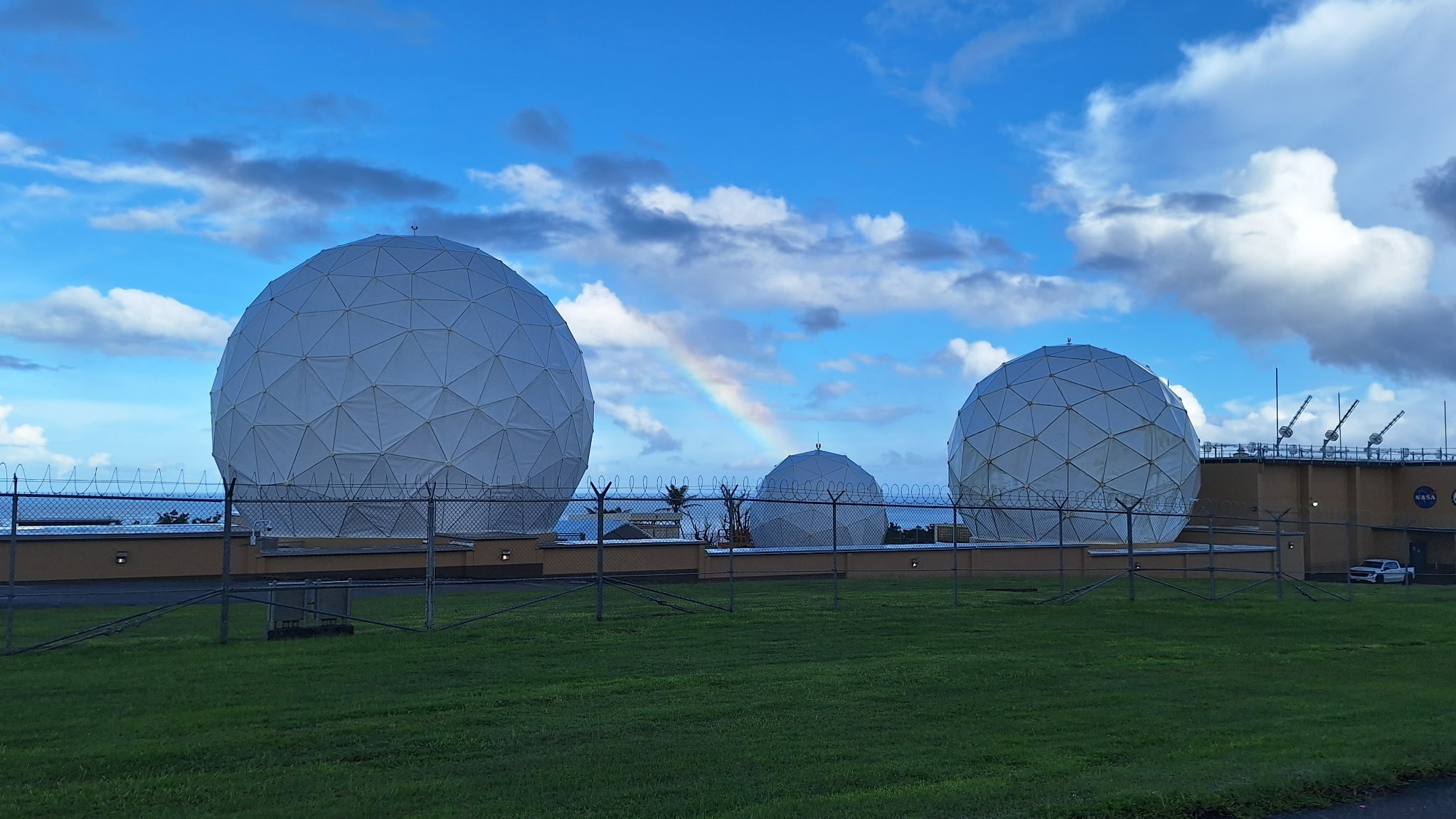
NASA celebrated the full restoration of its Guam Remote Station with a ribbon-cutting on Sept. 10, closing out more than three years of recovery after Super Typhoon Mawar devastated the site in 2023. Engineers from across the agency completed the final and most complex step of the rebuild on July 1, when they returned the station’s central antenna to service.
A rainbow arcs over the newly repaired Guam Remote Station antennas.
NASA
For nearly three decades, the Guam Remote Station has been one of three ground stations supporting NASA’s Tracking and Data Relay Satellites, or TDRS, a critical part of the Near Space Network. From 22,000 miles above Earth, the relays link spacecraft in low Earth orbit with the ground, allowing flight controllers to communicate with astronauts, command spacecraft, and receive mission data. The Guam station alone closes the “Zone of Exclusion,” a stretch of orbit beyond the relays’ line of sight. Without it, the International Space Station can lose contact with Earth for up to 20 minutes of every 90-minute orbit, an unacceptable risk for crewed missions.
On May 24, 2023, the Category 4 super typhoon struck Guam with 185 mph winds and more than 28 inches of rain, destroying two 16.5-meter antennas and damaging an 11-meter north antenna and the Inter Facility Link building at NASA’s station. The Zone of Exclusion reopened for the first time since 1998, cutting TDRS coverage to about 85% of a spacecraft’s orbit.
NASA made emergency repairs to the least-damaged antenna and borrowed two mobile terminals from the U.S. Army to expand coverage. The patchwork restored partial service within months, in time for a November 2023 spacewalk.
In early 2025, Congress dedicated disaster-relief funding to rebuild the ground station and harden the network against future storms. Construction began that summer and finished in summer 2026, when the rebuilt central antenna rejoined TDRS operations and the Zone of Exclusion closed once more. The same appropriation funded critical upgrades at three additional Near Space Network ground stations.
The return to service of the Guam Remote Station’s central antenna represents far more than the restoration of a critical piece of infrastructure — it is a testament to the dedication, resilience, and ingenuity of the people who made it possible.
Jena Garrahy
SCaN Deputy Program Manager for Network Operations
At the ribbon-cutting, representatives from NASA’s SCaN (Space Communications and Navigation) Division joined the station’s workforce and local leaders to mark the central antenna’s return to service. The Guam team, which led debris removal, site security, and on-island recovery, was recognized for its work to keep NASA connected to its missions through the outage and rebuild. A companion ceremony at NASA’s White Sands Complex in Las Cruces, New Mexico, honored the engineers and specialists across SCaN who supported the recovery off island.
“The return to service of the Guam Remote Station’s central antenna represents far more than the restoration of a critical piece of infrastructure — it is a testament to the dedication, resilience, and ingenuity of the people who made it possible,” said Jena Garrahy, Deputy Program Manager for Network Operations. “Through long days, challenging conditions, and unexpected obstacles, this team remained focused on the missions that depend on these critical assets every day.”
The Near Space Network is funded by SCaN, a division of NASA’s Research and Technology Mission Directorate, at the agency’s Headquarters in Washington. The network is operated out of NASA’s Goddard Space Flight Center in Greenbelt, Maryland. Repairs of the Guam Remote Station were managed out of NASA’s Glenn Research Center in Cleveland.
About the Author
Korine Powers
Lead Writer and Communications Strategist
Korine Powers, Ph.D. is a writer for NASA's SCaN (Space Communications and Navigation) Program office and covers emerging technologies, commercialization efforts, exploration activities, and more.
Preparations for Next Moonwalk Simulations Underway (and Underwater)
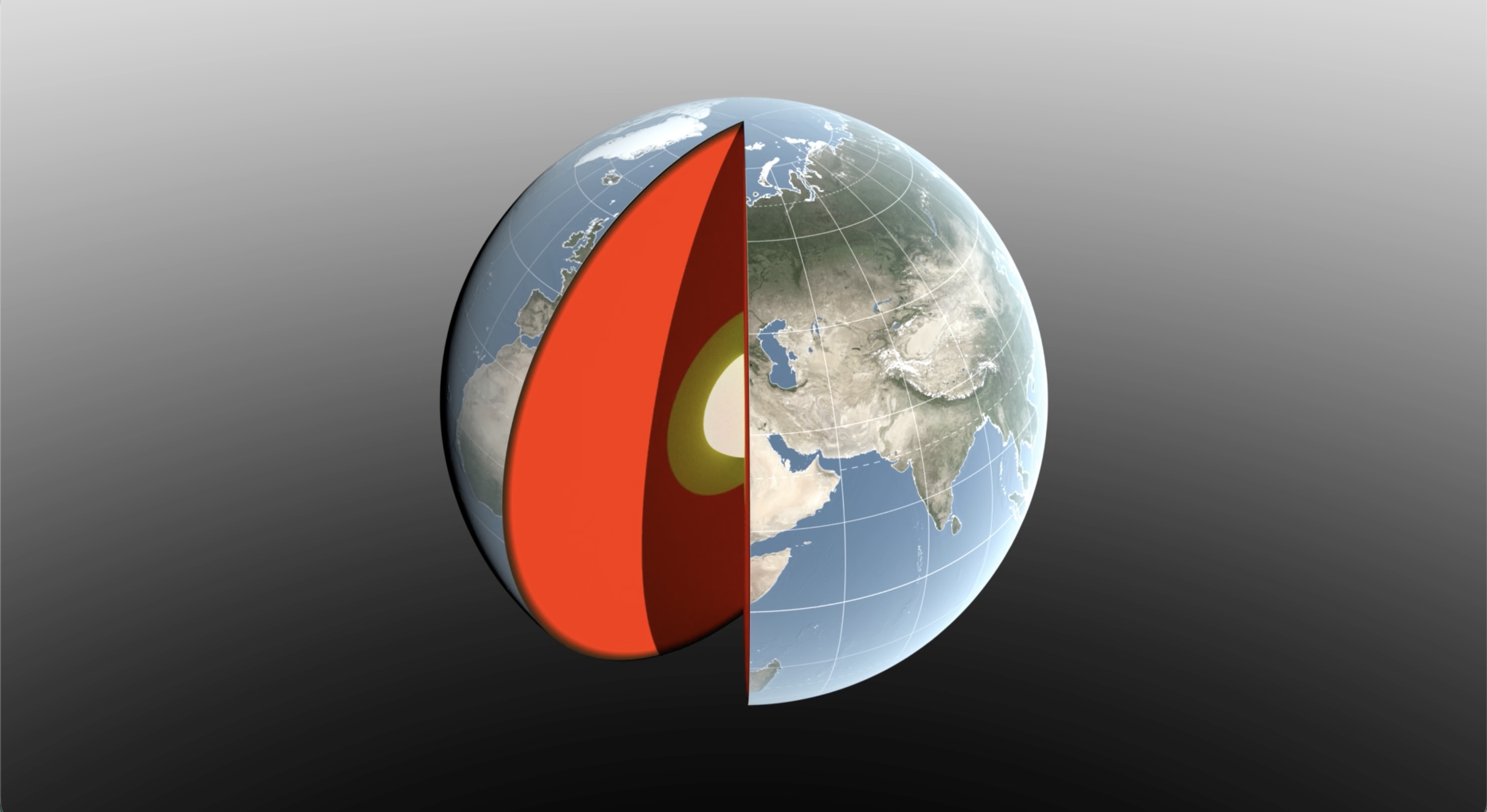
Water sloshing between the land and oceans shifts Earth’s center of mass relative to its geometric center. NASA scientists have developed a new technique using ultraprecise satellite tracking to estimate the displacement to within fractions of inches.
NASA’s Scientific Visualization Studio
Seasonal changes redistribute enough water around Earth to shift the planet’s center of mass back and forth by fractions of an inch relative to its geometric center. NASA scientists are on the case, tracking the oscillations because Earth’s center of mass is a crucial reference point for satellite navigation and elevation measurements.
A team, led by NASA’s Jet Propulsion Laboratory in Southern California, has proposed a way to calculate the seasonal swings with extreme precision. The technique and findings are detailed in a new study published in Geophysical Journal International. The authors paint a vivid picture of springtime thaws, churning oceans, and dense winter air shifting massive surface loads from season to season.
The study isn’t the first attempt to pin down Earth’s center of mass. Scientists over the decades have pioneered several space-based techniques to define and locate it. But it’s a moving goalpost. If Earth were a hard blue marble, its center of mass would simply overlap its geometric center. In reality, the planet is sloshing and sagging under the weight of water, ice, and air. Because of this, Earth’s center of mass continually swivels around its geometric center by as much as several millimeters.
NASA’s Space Geodesy Project currently uses a variety of space- and land-based techniques to track Earth’s center of mass (also called the geocenter) moving up and down and side to side. This animation traces the millimeter-scale motion from 1993 to 2017.
NASA’s Scientific Visualization Studio
How accurate are existing methods to measure the size of the swivel? The last two international estimates, made in 2017 and 2023, differ by 0.27 inches (7 millimeters), about the height of three stacked nickels. The difference is almost as large as the motion itself.
To reduce uncertainty, JPL geoscientist Donald Argus led the development of a new technique based on ultraprecise satellite tracking.
Driven by gravity, satellites naturally orbit Earth’s center of mass, as if bound by invisible tethers. Tiny changes in the distance between satellites and ground stations reflect Earth’s shifting center of mass.
Using satellites to locate Earth’s center of mass is not a new idea. In fact, dense metal satellites, launched in 1976 and 1992, are dedicated exclusively to this purpose. Resembling 900-pound (408-kilogram) disco balls, both Laser Geodynamics Satellites (LAGEOS 1 and 2) are studded with reflective prisms and tracked with laser precision via ground stations globally distributed across more than 20 countries.
However, one limitation of satellite laser ranging is the uneven distribution of ground stations around Earth. The new technique improves accuracy in two ways: It adds GPS tracking into the mix along with orbital data from several satellites in low Earth orbit to provide a diverse array of targets. And it considers how the weight of water and ice deforms Earth’s crust, taking ground stations along for the ride.
The technique was developed by Argus along with researchers from JPL’s satellite orbit determination team, the University of Nevada, University of Montana, and the Helmholtz Centre for Geosciences in Germany.
“We’re now estimating the size of the movement of Earth’s mass center back and forth each year to be about half of what we believed it to be eight years ago,” said Argus. “Our findings suggest that the mass of Earth’s water and air moving between the hemisphere is smaller than previously thought.”
Felix Landerer, one of the study’s coauthors at JPL, noted that “while these movements might appear tiny, our modern world relies on extremely accurate positioning measurements. By unraveling and understanding the mechanisms that change reference systems, we can build better reference systems that ultimately benefit mapping and navigation — from global shipping logistics to precision agriculture.”
What they found
The study authors tracked Earth’s center of mass oscillating seasonally and attributed the cause to three categories: oceans, atmosphere, and continental water (made up of land ice, snow, lake and river water, soil moisture, and groundwater).
They found that snow accumulation in North America and Eurasia reaches a maximum in March and shifts Earth’s center of mass about 3 millimeters toward the North Pole. A month later, in April, rainwater in the Amazon River basin peaks at 2,400 gigatons, swinging Earth’s center of mass 2.2 millimeters toward South America. Monsoon water in southeast Asia attains a maximum of 600 gigatons six months later in November, adding slightly to the annual oscillation.
Between August and October, the oceans swell with meltwater and rain, and Earth’s center of mass shifts toward the South Pacific Ocean. The Pacific Ocean is so large that mass changes there overshadow the loss or gain in other oceans, though seasonal dynamics in the Mediterranean, Red, North, Baltic, and Barents seas all help shift Earth’s center of mass in their own small way.
The researchers used a model developed by the European Centre for Medium-Range Weather Forecasts to estimate how atmospheric changes affect Earth’s center of mass throughout the seasons. They found that cold, dense, winter air helps tip the scales over Arabia, Asia, and northern Africa around Dec. 21 each year, and over South America and South Africa around June 21.
The mass calculations in the study are consistent with observations made by the Gravity Recovery and Climate Experiment Follow-On (GRACE-FO) mission. Launched in 2018, the mission is made up of twin satellites that map monthly fluctuations in Earth’s gravitational pull due primarily to the mass movement of water above and below ground. The two satellites fly in precise formation, and when the lead satellite passes over a dense body, like a swollen river basin, the extra gravitational tug changes the distance between its twin by a small but measurable amount.
The GRACE-FO mission is a joint partnership between NASA and the German Research Centre for Geosciences (GFZ). The next-generation GRACE-Continuity (GRACE-C) mission is targeting a launch in late 2028 to extend the nearly 25-year GRACE-series data record.
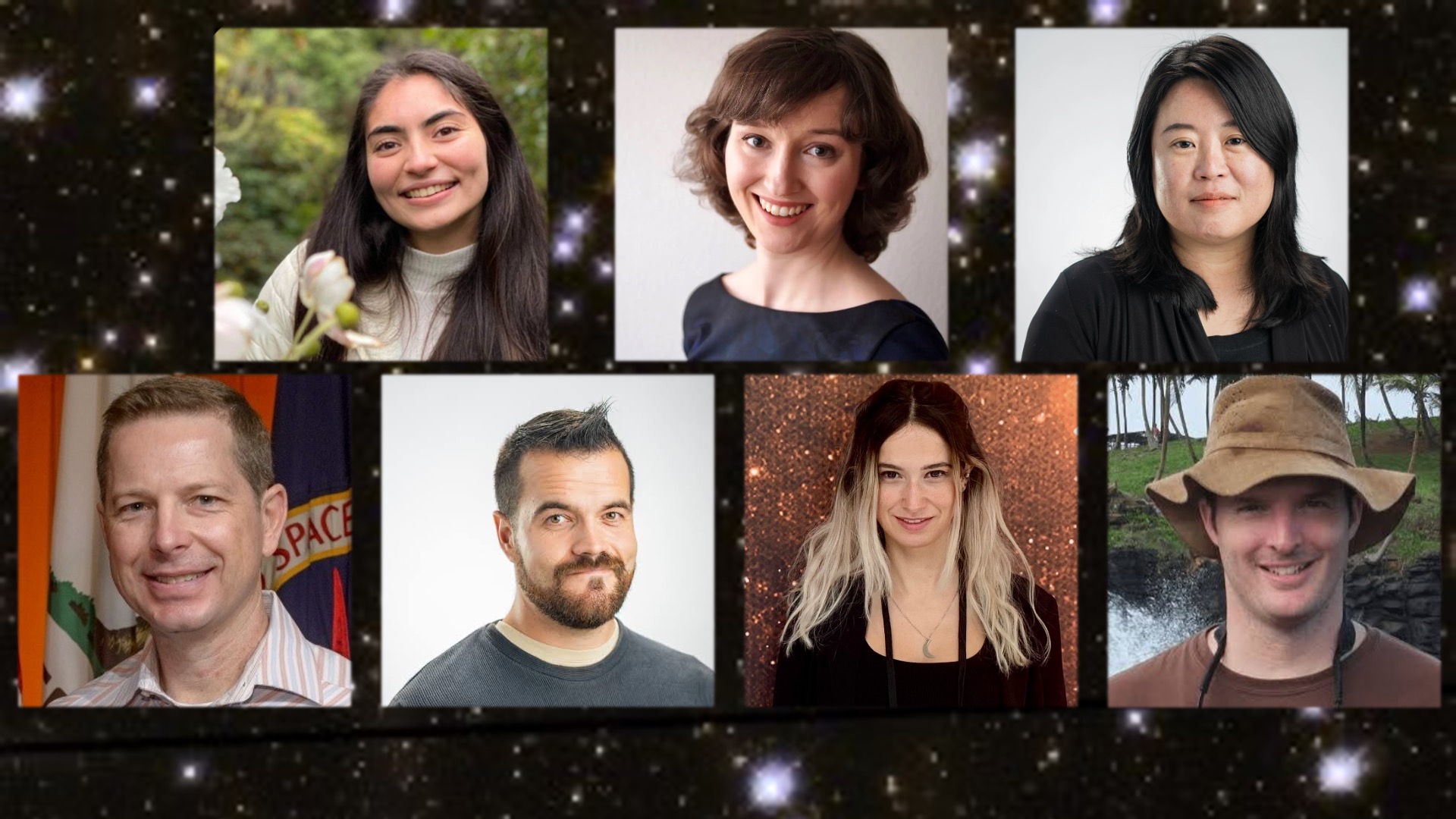
The NASA Ames Science Directorate recognizes the outstanding contributions of (pictured left to right) Steve Ormsby, Aphrodite Kostakis, Alejando Borlaff, Sarah Nickerson, Martina Caussi, Keiko Nomura, and Stephen Broccardo. Their commitment to the NASA mission represents the entrepreneurial spirit, technical expertise, and collaborative disposition needed to explore this world and beyond.
Space Biosciences Star: Steve Ormsby
Steve Ormsby is a project engineer for the Space Biosciences Division with Amentum in the Center Operations Directorate. He is recognized for his perseverance, dedication and initiative in overseeing the safety of division facilities and infrastructure maintenance, as well as exceptional diligence as a property custodian.
Space Biosciences Star: Aphrodite Kostakis
Aphrodite Kostakis is the Facility Service Manager with Amentum for building N239 in the Space Biosciences Division. She is acknowledged for her exemplary work ethic in maintaining building safety, preparing for and leading VPP inspections with diligence and attention, and suggesting infrastructure improvements and ensuring they get implemented for everyone’s benefit.
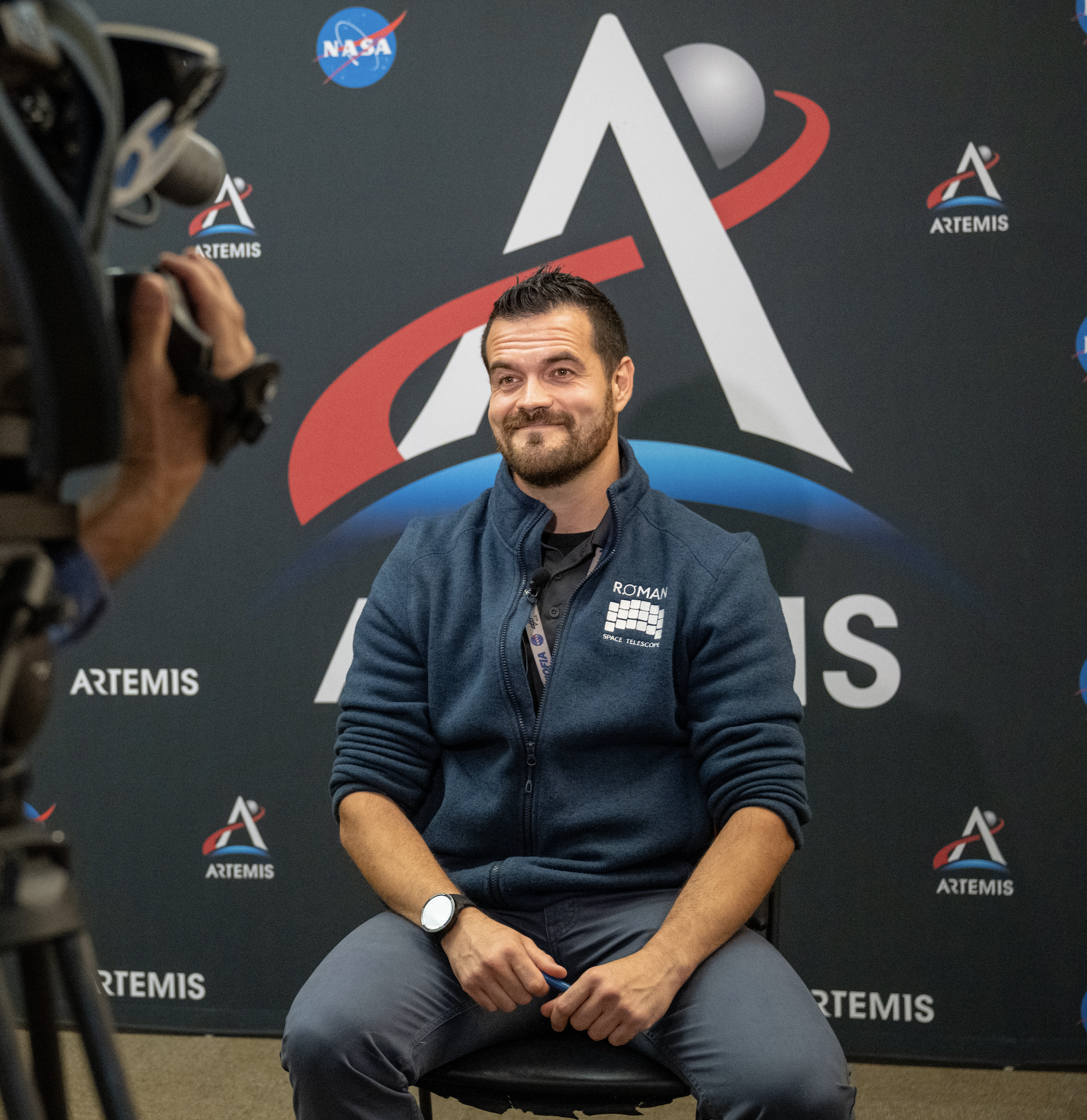
Astrophysics Star: Alejandro Borlaff
Alejandro (Alex) Borlaff, a research scientist in the Astrophysics Division with the Bay Area Environmental Research Institute, is recognized for his leadership in pioneering and developing image reduction pipelines for the Hubble Space Telescope (HST) and the Roman Space Telescope’s Wide Field Instrument (WFI). These algorithms significantly advance the detection of ultra-low surface brightness features through rigorous modeling of background contamination, including scattered and zodiacal light, better maximizing the science derived from NASA flagship astrophysics missions.
Astrophysics Star: Sarah Nickerson
Sarah Nickerson, a research scientist in the Astrophysics Division with the Bay Area Environmental Research Institute, is recognized for exceptional work on the analysis and curation of data taken from the EXES instrument on NASA’s Stratospheric Observatory for Infrared Astronomy (SOFIA) observatory. This provides high-level data products to the global astrophysics community for continued discovery and synergy with other NASA missions.
Planetary Science and Exobiology Star: Martina Caussi
Martina Caussi is a NASA Postdoctoral Program Fellow in the Planetary Science and Exobiology Division. Martina is recognized for her outstanding work using finite element simulations to determine that topographic relaxation has played a significant role in shaping Tegid, an unusually shaped impact crater on Europa. This work represents valuable precursory science in anticipation of the Europa Clipper mission, which will refine our understanding of this ocean world.
Earth Science Star: Keiko Nomura
Keiko Nomura is a research scientist for the NASA Earth Exchange (NEX) in the Earth Science Division with the Bay Area Environmental Research Institute. She is acknowledged for timely efforts in leadership, stakeholder engagement, coordination with NASA HQ management, and team building for the recently funded NEX-GeoAI project. This project is now being recognized as a key step forward to establishing NASA as the ground-truthing agency for federal and private sector GeoAI modeling activities for decision making.
Earth Science Star: Stephen Broccardo
Stephen Broccardo is a research scientist in the Earth Science Division with the Bay Area Environmental Research Institute. He is recognized for exceptional initiative and technical leadership in sustaining and advancing Ames’ atmospheric remote-sensing capabilities. Stephen has maintained critical observational capabilities and developed thoughtful technical milestones for future satellite-validation and science activities.
Now, finally, everyone can see the truth of German Chancellor Friedrich Merz, says Eugyppius: he is not a political genius, but a stubborn and inept politician who can achieve nothing beyond the demise of his own party.
President Donald Trump presents an executive order establishing the United States Space Academy during an event to award the Congressional Space Medal of Honor to the Artemis II crew as Michael Kratsios, director of the Office of Science and Technology Policy, left; Kevin Hassett, director of the National Economic Council, third from left; and NASA Administrator Jared Isaacman, right, applaud, Friday, Aug. 28, 2026, at NASA’s Johnson Space Center in Houston.
Credit: NASA/John Kraus
Less than two weeks after an Executive Order was signed to create the first United States Space Academy, NASA-led work is in full swing to make the academy a reality and shape the future of America’s aerospace workforce and leadership.
NASA Administrator Jared Isaacman chaired the first Presidential Commission on the United States Space Academy meeting on Sept. 9. Following that meeting, NASA published a Request for Information Thursday seeking input from governors or their designees interested in hosting and sponsoring the up-and-coming academy in their state.
“Our first Commission meeting made clear how much talent and commitment we have behind President Trump’s vision for the U.S. Space Academy,” said NASA Administrator Jared Isaacman. “I’m grateful to our partners across government for getting right to work. Now, with the RFI underway, states across the country have an opportunity to help us shape a legacy institution built for America’s future in space.”
Isaacman and Deputy Administrator Matt Anderson welcomed key commission members from multiple agencies and organizations to NASA Headquarters in Washington for a collaborative Commission discussion. Participants included U.S. Secretary of War Pete Hegseth, Director of the National Economic Council Kevin Hassett, Secretary of the United States Air Force Troy Meink, and U.S. Chief Technology Officer Ethan Klein, representing Director of Office and Technology Policy Michael Kratsios, along with representatives from the U.S. Office of Management and Budget, the National Security Council, and the White House.
During the meeting, commission members began working through the structure and priorities of the proposed U.S. Space Academy, including its governance, curriculum, service commitments, partnerships, and implementation.
“The location of the U.S. Space Academy is foundational to its success,” said Anderson. “We’re asking states to bring their strongest vision — the infrastructure, the partnerships, and the community that can compete with the elite options this caliber of student will have and match the boundless ambition of our future space leaders.”
The commission’s 120-day mandate to develop recommendations for President Trump on how to establish the academy and build the technical talent and leadership pipeline needed to support America’s long-term goals in space began when the President signed the Executive Order on Aug. 28.
Responses to the RFI will help inform the commission’s path forward to selecting a location for the institution and are due by 6 p.m. EDT on Monday, Oct. 26. An ambitious timeline is outlined in the request, calling for a groundbreaking no later than 2027, temporarily hosting the first 300 students in 2028, and a permanent location in operation by 2031.
Each state is allowed one submission to the Announcement via its governor’s designee. In addition to details about resources available to support the academy, input sought on the potential campus includes:
Location information
Site readiness
Environmental and regulatory considerations
Proximity and supporting ecosystems
A fact sheet on the U.S. Space Academy is available on The White House website.
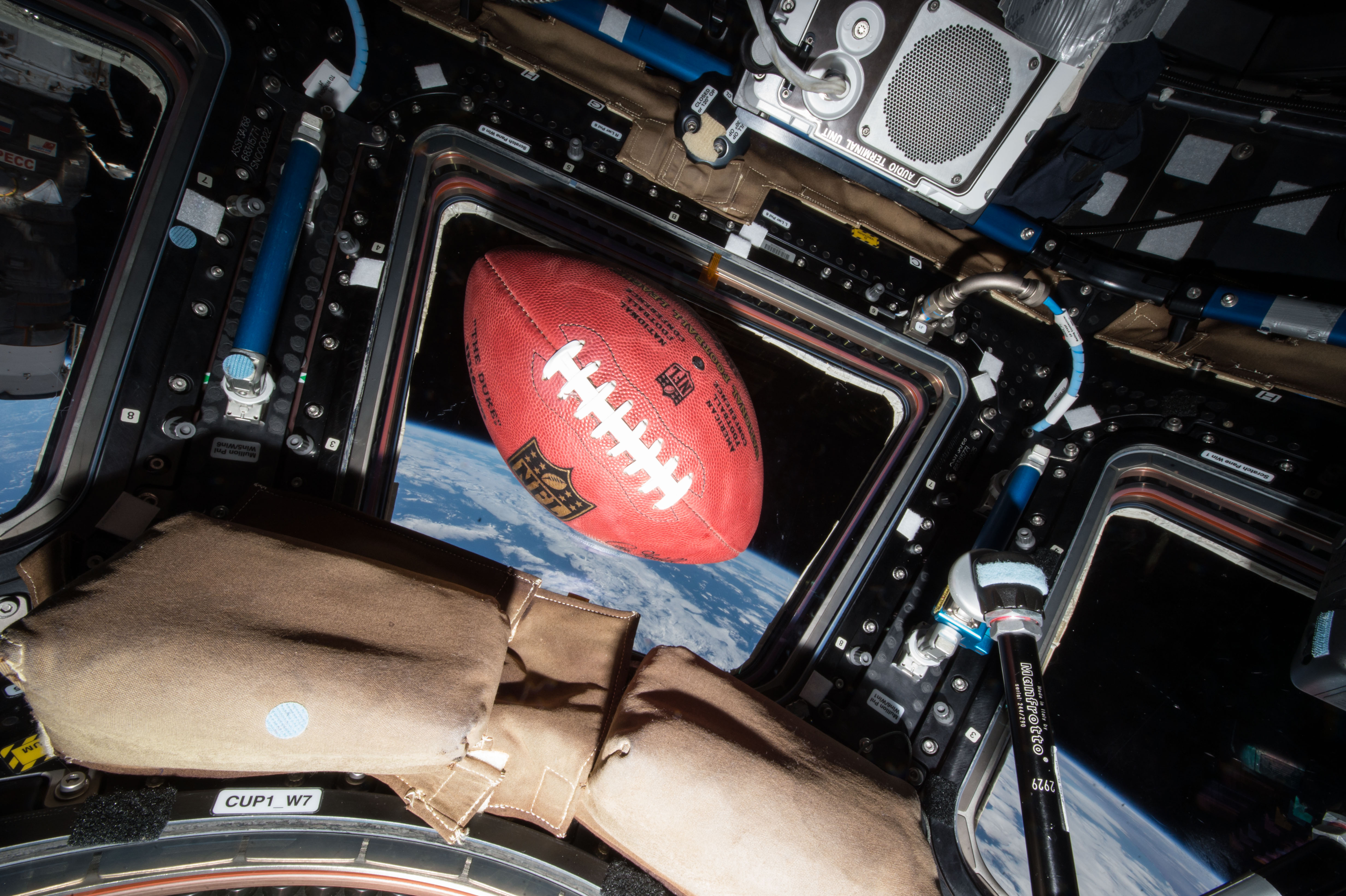
A football floats in microgravity aboard the International Space Station, high above the Earth.
Credit: NASA
Through a new collaboration between NASA and the National Football League (NFL), the agency will soon bring America’s strengths in space exploration and aeronautics innovation to the football field.
NASA will conduct flyovers, astronaut appearances, and fan engagement at NFL games across the United States as part of its new Inspiration Tour.
“This is the first season NASA is taking part in flyovers at NFL games, bringing the excitement of America’s space program directly to fans across the country,” said NASA Administrator Jared Isaacman. “We’re returning to the Moon, building a Moon Base, advancing fission-powered spacecraft, and pushing the boundaries in aeronautics, science, and discovery. Achieving those ambitions will take the very best of America, and partnering with the NFL gives us an incredible platform to inspire the next generation to look up and imagine the possibilities.”
NASA participation is targeted for the following games. Additional details will be released prior to each game, and more dates may be added:
1 p.m., Sunday, Sept. 13: Pittsburgh Steelers vs. Atlanta Falcons in Pittsburgh
1 p.m., Sunday, Sept. 20: Baltimore Ravens vs. New Orleans Saints in Baltimore
1 p.m., Sunday, Oct. 4: Philadelphia Eagles vs. Los Angeles Rams in Philadelphia
1 p.m., Sunday, Oct. 11: New York Jets vs. Cleveland Browns in East Rutherford, New Jersey
Flyovers scheduled at some of the games will showcase NASA’s fleet of aircraft, which are used for high-speed testing, high-altitude research, astronaut training, and more. Regularly flying the aircraft maintains the health of the fleet and publicly demonstrates new technologies that may be applied to future commercial air travel.
With stops across the nation and led by Isaacman, NASA’s Inspiration Tour convenes academic, industry, and public sector stakeholders to connect the agency with the people, technologies, and organizations that drive American leadership in space.
The tour will culminate in MAX POWER, a public exposition of American air and space innovation, Nov. 7 and Nov. 8, on and near the agency’s Kennedy Space Center in Florida. Held in honor of America’s historic 250th anniversary, the multi-day, family-friendly event will showcase the next-generation aircraft, spacecraft, autonomous vehicles, and technologies that will help define the future of transportation in air and space.
For more information about MAX POWER and the agency’s missions, visit:
Jaden Caradine knew he wanted to be an engineer at eight years old. He just took a winding road to get there.
Before he enrolled at Embry-Riddle Aeronautical University, before he discovered the field that would become his focus, and before he landed a Pathways internship at NASA’s Langley Research Center in Hampton, Virginia, Caradine spent five years as a mechanic in the United States Marine Corps, four of them stationed in Japan. It was a deliberate detour, one that shaped how he approaches everything since.
“I’ve kind of always known I wanted to be an engineer,” he says. “I just had to figure out what kind.”
NASA Pathways intern Jaden Caradine
Credit: NASA
Finding the Overlap
Caradine grew up in the Salt Lake City area, raised by a mother who put him on a snowboard at four and on a rock face not long after. He was the kind of kid who learned to love science not for its own sake, but for what it could do. “Math is an enabling skill,” he says. “It’s not about doing the math. Math has a purpose and it’s useful.”
By the time someone asked young Jaden what he wanted to be, the answer was immediate. “I was building Legos,” he says, “and I just thought — I want to build stuff. I can’t really see myself being anything other than an engineer.”
Right out of high school, Caradine enlisted in the Marines, trained as a mechanic, and shipped out to Japan. During those five years, between the technical work and the distance from home, he started reading books on decision-making, career planning, and long-term thinking. He found a framework he keeps coming back to: ikigai, a Japanese concept that maps the intersection of what you’re good at, what you enjoy, what the world needs, and what you’re paid to do.
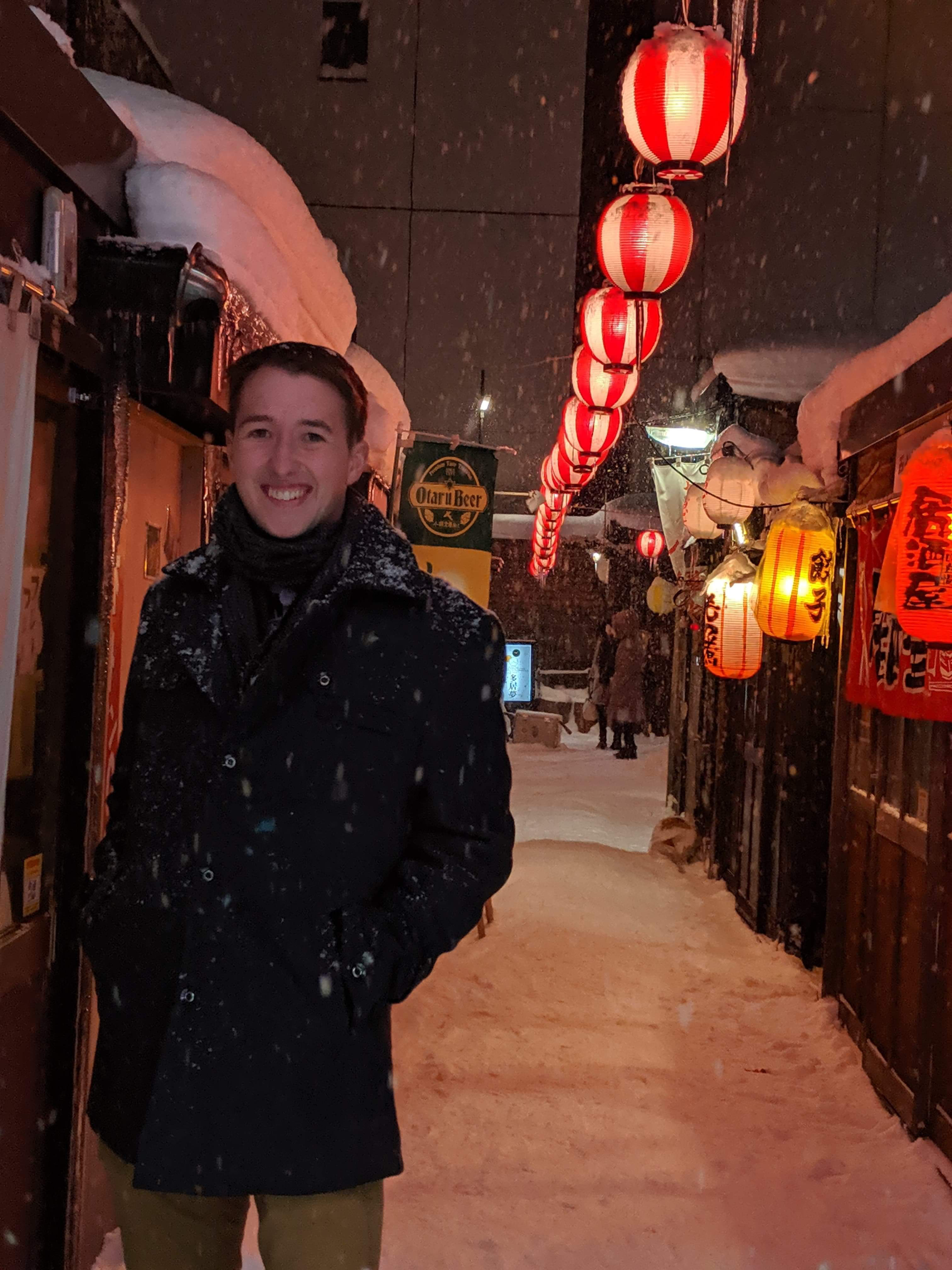
Caradine at the Sapporo Snow Festival in Hokkaido, Japan, while serving as a U.S. Marine Credit: Jaden Caradine
“Your ikigai is the thing where all of those overlap,” he says. Engineering was already in the picture. The question was what kind.
Chasing the Signal
The answer arrived through research and a company Caradine stumbled on while scanning the landscape of emerging aerospace technology. They were using magnets to spin a launch system to 14,000 or 15,000 RPM and release small satellites into orbit, recovering the energy on the way down through the same magnetic system. “I thought that was awesome,” he recalls. “So, I started looking into aerospace engineering, and it was a good fit.”
Once he had the field, the destination wasn’t hard to find. Caradine transferred to Embry-Riddle Aeronautical University’s Daytona Beach campus to study aerospace engineering and immediately started showing up everywhere he could — satellite conferences at Kennedy Space Center, industry events in Orlando, small satellite gatherings back in Salt Lake City. “I went to all the career fairs, even though I wasn’t looking for a job yet,” he says. “I just wanted to learn as much as I could, as fast as I could.”
At every NASA booth, he asked questions. He learned about Pathways, the program that places undergraduate and graduate students at NASA centers with the potential to convert to full-time civil service positions, but he waited a year to apply. “I hadn’t really done the things I wanted to do in order to write a strong application yet,” he says. He wrote the next application with the intention of using it as a practice run. He got in.
His reason for choosing NASA over industry was simple and firm. “NASA doesn’t work for profit,” he says. “We’re here to remove barriers so that industry can eventually do the things they weren’t able to do before.”
“Human beings are far more capable than we give ourselves credit for. A journey of a thousand miles starts with a single step and can only be taken one step at a time.”
Work Worth Doing
At NASA Langley, Caradine is part of the Systems Analysis and Concepts Directorate, where “we help agency leaders figure out why they should make certain decisions, especially those that have lots of moving parts,” he explains. Specifically, he works with the in-space servicing, assembly, and manufacturing (ISAM) team, a group focused on the emerging field of building and maintaining infrastructure in space, rather than simply launching and discarding it.
A major part of his summer was curating the State of Play, a comprehensive document that consolidates everything happening in the ISAM sector across government, academia, and industry into a single, navigable resource.
“Jaden joined the team and immediately contributed to this year’s State of Play update,” says Dale Arney, aerospace engineer and Caradine’s mentor. “He also created an automated tool that will help the team create future updates more quickly.”
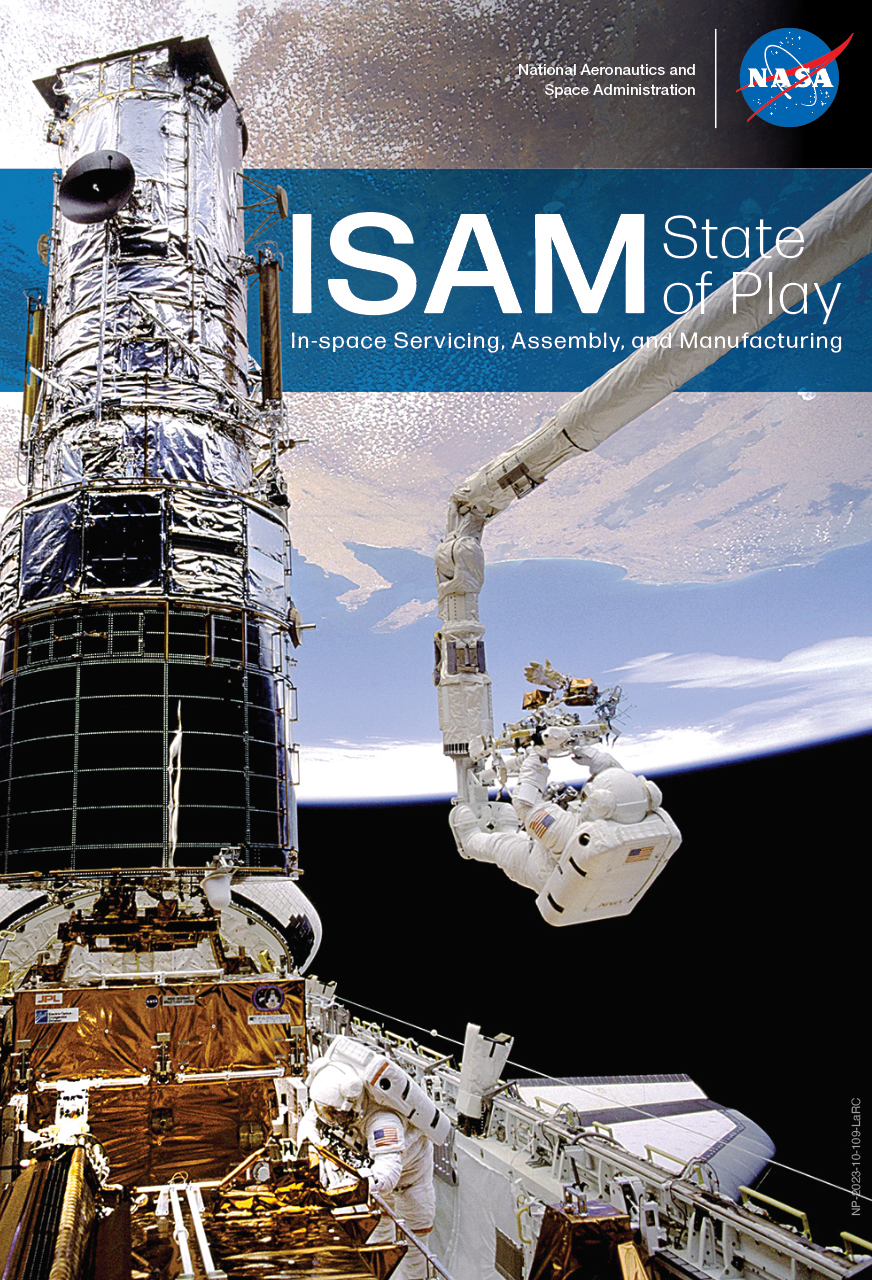
The ISAM State of Play document is a survey of past, present, and near-future ISAM capabilities across industry, academia, and government agencies.
Credit: NASA
That tool scrapes aerospace news from across the web, compiles relevant updates into organized tables, and produces a readable summary on a regular cadence. “It kind of replaced the need for everyone on the team to spend 30 or 40 minutes every day scrolling through news to keep up,” he says.
“Jaden was constantly looking for ways to improve himself, the team, and our products,” Arney adds. “He was eager to take the lead in trying a number of new processes and ideas to try to make them work for us.”
No Silos
The thing that surprised Caradine most about NASA Langley had nothing to do with the technical work. He had expected some departmental siloing that could develop in large organizations, where people become experts in narrow areas with limited cross-pollination among teams.
“That’s not something I’ve experienced here,” he says. “We all talk to each other, across all teams. We share resources. We collaborate quite extensively.” He describes a culture that expects everyone to engage with the whole problem, not just their corner of it. “Everyone kind of bounces around on different teams to learn the whole aspect of the problem and support each other.”
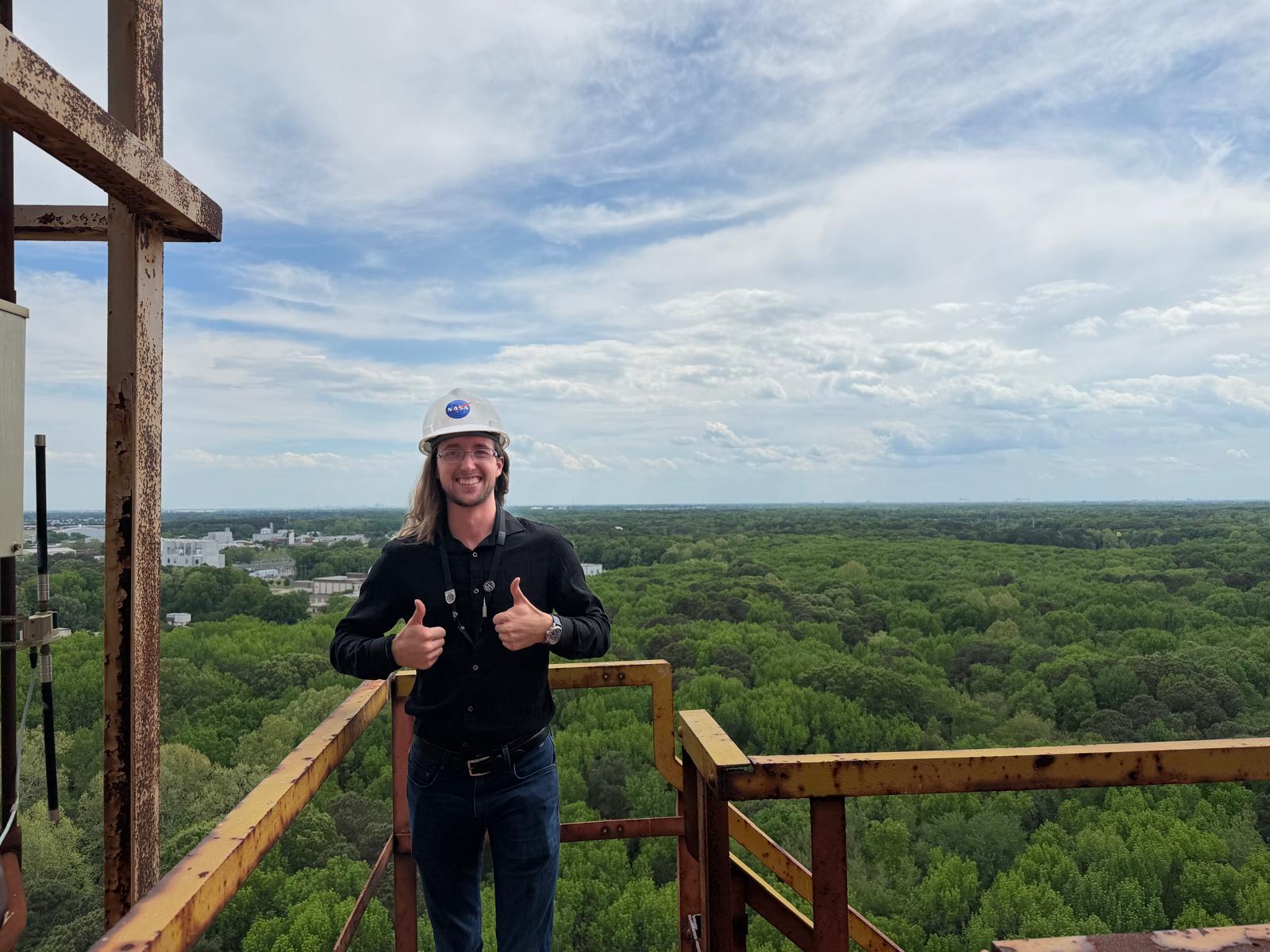
Caradine at NASA Langley’s Impact Dynamics Facility, enjoying the view at the top of the gantry
Credit: NASA
For anyone considering the Pathways program, his advice is direct. “Do it,” he says. “Human beings are far more capable than we give ourselves credit for. If it seems like too much, break it down. A journey of a thousand miles starts with a single step and can only be taken one step at a time.”
Caradine heads back to Embry-Riddle as a junior this fall, with plans to return to Langley next summer. Grad school is on the horizon, and he’s exploring programs that nurture important analysis skills for SMAB, including decision, strategic, and systems analysis.
“Before coming here, I was trying to do everything and cast a wide net,” he says. “Now I know what I need to know how to do. That’ll give me the opportunity to focus my efforts on the high-value skill sets.”
On Caradine’s Sci-Fi Shelf
The Sirens of Titan by Kurt Vonnegut
Dungeon Crawler Carl by Matt Dinniman
Caradine’s instinct runs more toward fantasy than science fiction, but this one, he says, hits something real.
“I enjoy the leveling aspect — constantly improving, constantly getting better. In books it might be physical strength, but in reality, strength takes on many different forms. Constant improvement is quite rewarding in real life, as it is in books.”
The audiobook production, he adds, is its own experience: full sound design, character actors, the works. “It’s like listening to a movie.”
The team also recently convinced him to start Dune, by Frank Herbert. He’s about halfway through.
Shatel Bhakta, principal systems engineer for NASA’s Moon Base Program, gives a presentation during NASA Stories at the Ion in Houston on July 30, 2026.
Credits: NASA/Sumer Loggins
Shatel Bhakta, principal systems engineer for NASA’s Moon Base Program, gives a presentation during NASA Stories at the Ion in Houston on July 30, 2026.
NASA/Sumer Loggins
As NASA prepares to return astronauts to the lunar surface for longer stays and increasingly complex operations, building the Moon Base will require new ideas, advanced technologies, and expertise across many fields.
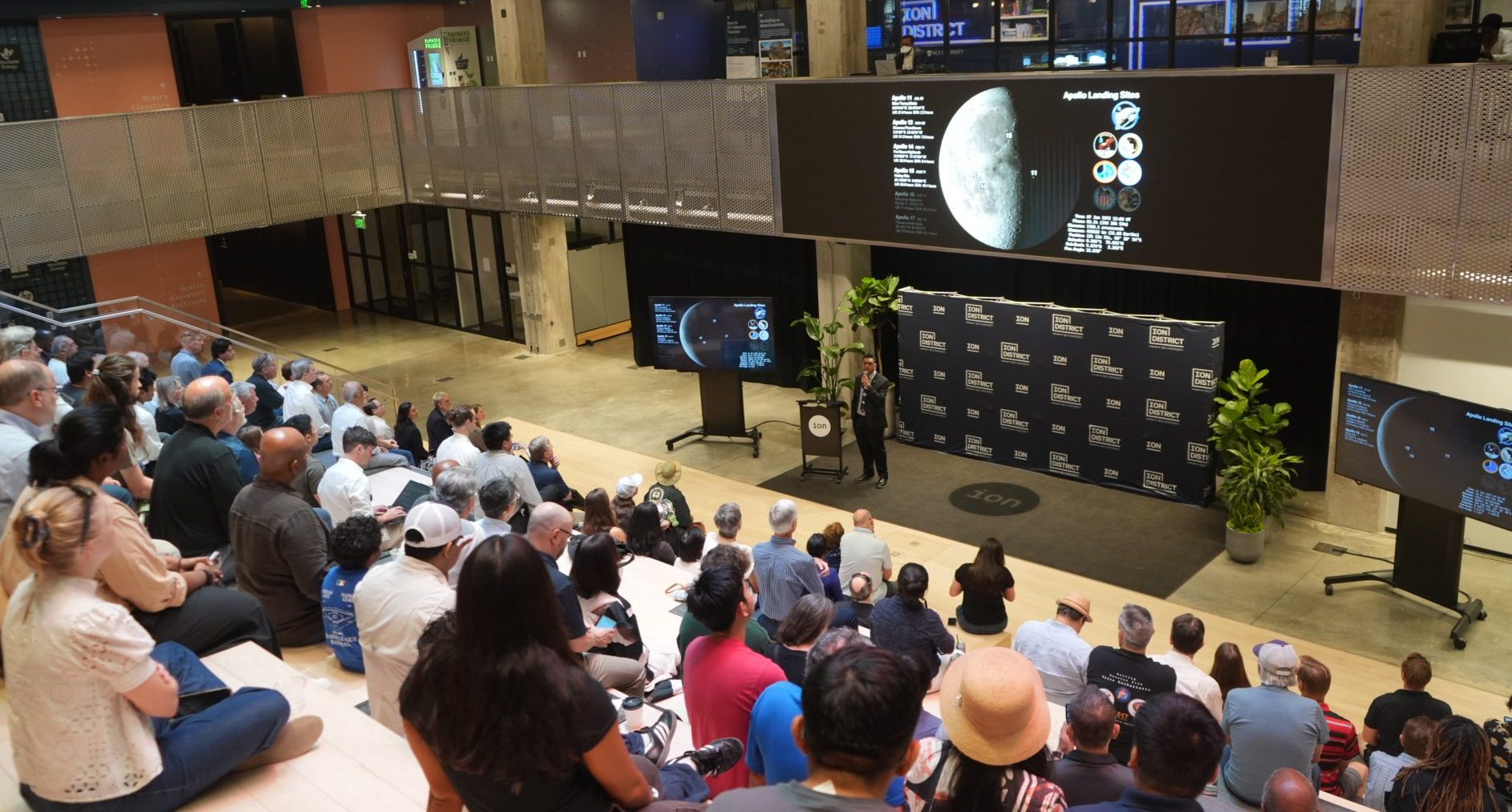
During NASA Stories at the Ion on July 30, Shatel Bhakta, principal systems engineer for NASA’s Moon Base Program, presented “Building the Moon Base: Challenges and Opportunities at the Lunar South Pole.” He discussed the work required to establish a sustained human presence at the Moon.
Through its growing partnership with Rice University and the Ion, NASA’s Johnson Space Center in Houston hosts recurring talks connecting agency experts with entrepreneurs, researchers, students, and industry leaders. The series gives Houston’s innovation community a closer look at the people and ideas shaping the future of exploration.
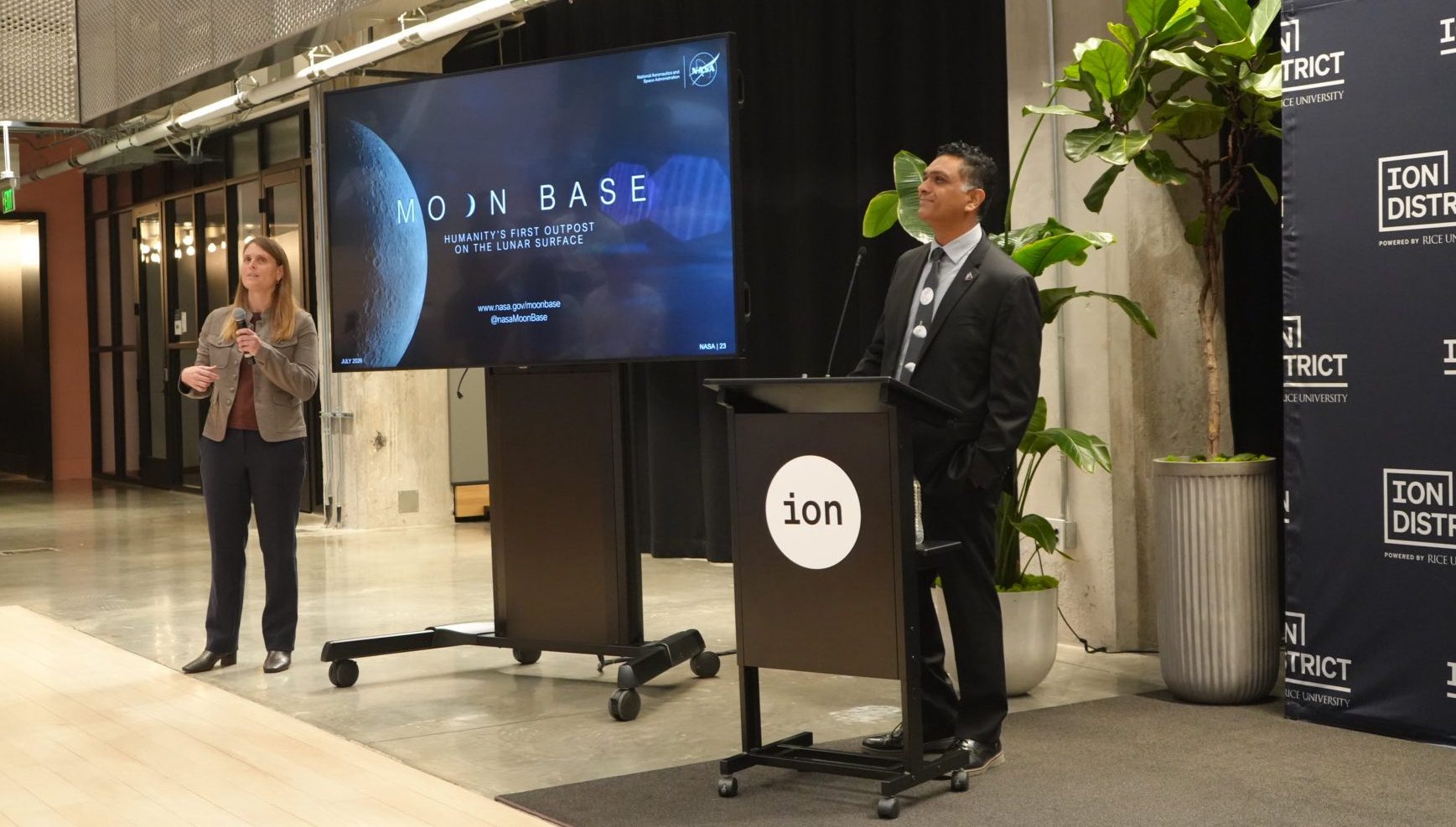
Shatel Bhakta, principal systems engineer for NASA’s Moon Base Program, presents during NASA Stories at the Ion. At left is Laura Neder, head of platform for the Rice Alliance for Technology and Entrepreneurship and the Ion District.
NASA/Sumer Loggins
Laura Neder, head of platform for the Rice Alliance for Technology and Entrepreneurship and the Ion District, welcomed attendees and introduced Monte Goforth, acting director of Business Development and Technology Integration at Johnson. Goforth delivered opening remarks on the value of sharing NASA’s work beyond the agency and bringing people together to support future exploration before introducing Bhakta.
Bhakta outlined how NASA is working toward long-duration human exploration of the lunar South Pole through the agency’s Moon Base Program.
As part of that effort, NASA is taking a step-by-step approach to Moon Base development. Early robotic missions and technology demonstrations will help NASA gather data about the lunar environment, test systems, and reduce risks before expanding infrastructure and human operations.
“This is probably going to be the most challenging endeavor NASA has ever undertaken,” Bhakta said.
Meeting that challenge will require collaboration between NASA and its commercial and international partners to develop solutions for operating in extreme environmental conditions.
Unlike the Apollo landing sites, areas near the lunar South Pole contain steep slopes, deep craters, and lighting conditions that change throughout the year. The Sun remains low on the horizon, creating shifting shadows that can complicate navigation and leave solar panels without sunlight for extended periods, increasing the need for energy storage and other power sources.
Because of the region’s rugged terrain, crews, rovers, and other surface systems may not always have a clear line of sight to Earth. NASA will need communications infrastructure to relay signals across the lunar South Pole.
Bhakta explained that Moon Base may not be a single cluster of connected structures. Terrain, lighting, power, and landing constraints could require habitats and other systems to be distributed across the lunar surface.
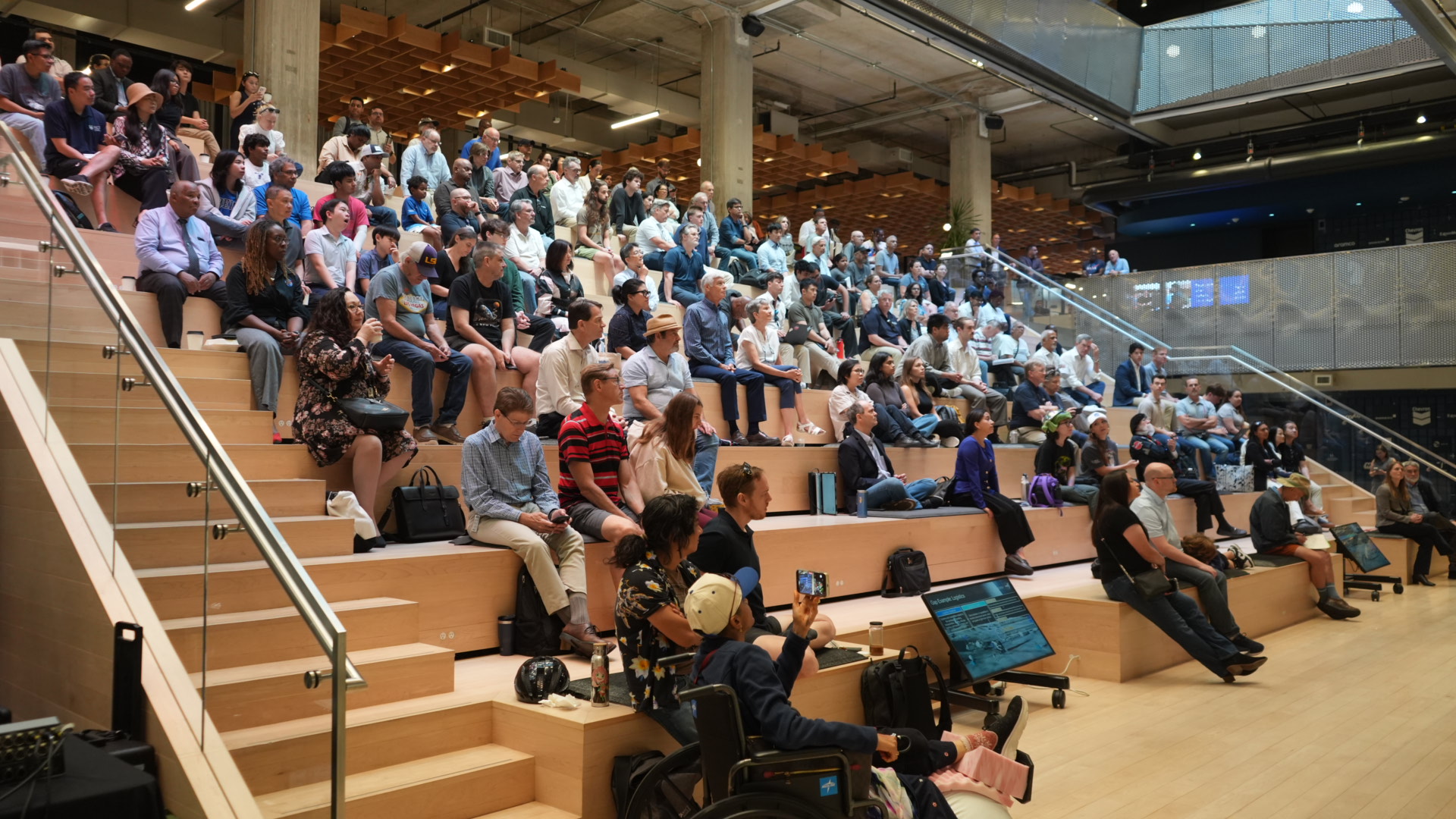
Attendees listen as Shatel Bhakta, principal systems engineer for NASA’s Moon Base Program, discusses the challenges of establishing a sustained human presence at the Moon.
NASA/Sumer Loggins
Lunar regolith, or Moon dust, remains one of the greatest challenges. Without mitigation, the sharp and clingy substance could damage equipment and spacesuits while posing health risks to astronauts. Its electrostatic properties can also change depending on lighting and environmental conditions.
Understanding how lunar regolith behaves will be essential to ensuring crews can safely live and work on the lunar surface.
Some permanently shadowed regions near the lunar South Pole may not have received direct sunlight for billions of years and may contain water ice and other volatile materials. These resources could support future exploration, but using them will require new mobility, power, and processing systems.
The Moon will also serve as a proving ground for missions farther into the solar system. Operating on the lunar surface will help NASA learn how crews, equipment, and infrastructure perform away from Earth before future human missions to Mars.
As NASA develops these capabilities, Bhakta explained that keeping the Moon Base architecture adaptable will require understanding how individual systems connect and work together.
“Don’t deal with the technology directly,” Bhakta said. “Deal with the interfaces.”
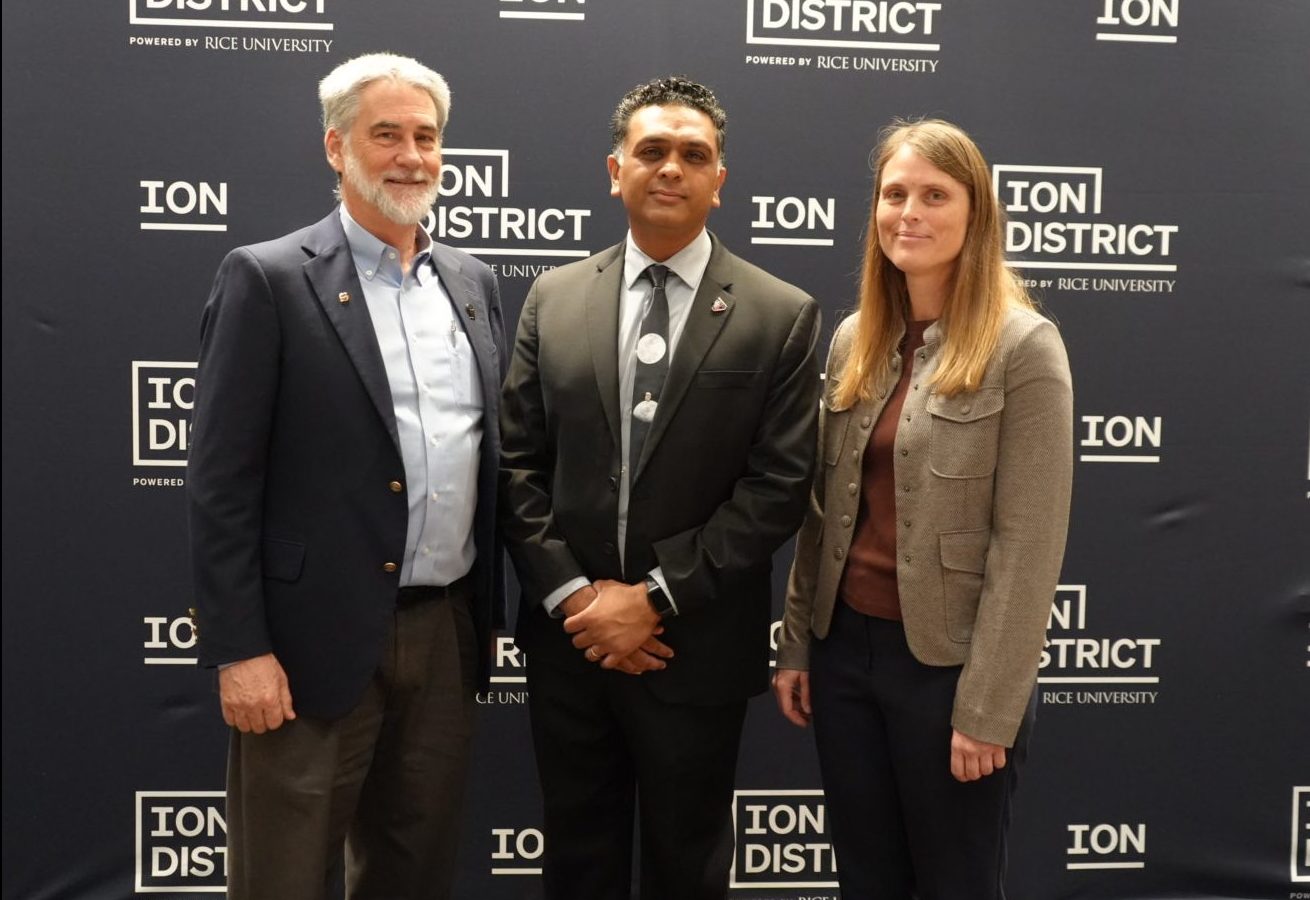
From left, Monte Goforth, acting director of Business Development and Technology Integration at NASA’s Johnson Space Center; Shatel Bhakta, principal systems engineer for NASA’s Moon Base Program; and Laura Neder, head of platform for the Rice Alliance for Technology and Entrepreneurship and the Ion District, pose during NASA Stories at the Ion.
NASA/Sumer Loggins
Building the Moon Base will take more than engineers and scientists. NASA will need communicators, business professionals, researchers, and people from many other fields to help solve problems and share the agency’s work.
“There are many ways to contribute,” Bhakta said. “Don’t be afraid that your skill set does not fit in.”
Moon Base build-up will offer multiple entry points for industry and international collaborators to participate, innovate, and contribute. From early demonstrations to long-term surface operations, there are multiple solicitations currently open.
Una constelación mundial de detectores de neutrinos está ofreciendo una visión inédita de los elementos radiactivos que alimentan el motor térmico de la tectónica terrestre.
Un artículo de James Dinneen. Historia original reimpresa con permiso de Quanta Magazine, una publicación editorialmente independiente respaldada por la Fundación Simons.
Se espera que el experimento JUNO, ubicado en las afueras de la ciudad de Guangzhou en China, reporte sus primeras detecciones de geoneutrinos este año. Fuente: JUNO Collaboration
En un laboratorio a 2 kilómetros bajo tierra, una grúa baja a Matt Depatie, tecnólogo de detectores, a través de una escotilla hasta una caverna de paredes blancas llena de unas 7.000 toneladas de agua ultrapura que brilla con un azul tan intenso como el del líquido limpiaparabrisas bajo la luz. «Splashdown», dice Depatie por radio al pisar una balsa inflable que lo espera abajo.
Normalmente, la caverna es uno de los lugares más oscuros de la Tierra, pero hoy está iluminada para realizar tareas de mantenimiento, lo que ofrece una rara oportunidad de ver su interior. Miro a través de la escotilla a Depatie mientras rema hasta el experimento sumergido para examinarlo. Está inspeccionando un detector del tamaño de una casa construido para captar algunas de las partículas más esquivas que conoce la física: los neutrinos.
Este es el experimento de neutrinos SNO+, enterrado en las profundidades de la mina Creighton, en Snolab, un laboratorio de física subterráneo en Sudbury, Canadá. SNO+ consiste en una esfera de acrílico revestida con casi 10.000 detectores sensibles a la luz y llena de 780 toneladas de líquido centelleador oleoso, que emite destellos cuando lo atraviesan partículas energéticas. El agua que rodea el dispositivo y la roca que lo cubre protegen el detector del resplandor de la radiación cósmica, permitiendo que se hagan visibles los destellos de interacciones menos frecuentes entre partículas.
Todo el descenso ha formado parte de la cruzada por mantener una oscuridad absoluta, incluso más allá del espectro visible de la luz. Al bajar por el pozo principal y caminar por un túnel rocoso hasta el laboratorio, nuestros cuerpos y nuestra ropa recogieron pequeñas cantidades de polvo radiactivo de radón. Antes de entrar en el espacio principal del laboratorio, nos quitamos la ropa de mina, nos duchamos y nos pusimos monos azul eléctrico y redes para el pelo para minimizar la contaminación que llevábamos con nosotros. «Las duchas no son para vosotros», dice Depatie mientras nos cambiamos, «son para la ciencia».
Matt Depatie (izquierda) ayuda a mantener el detector SNO+, que reutiliza componentes del experimento SNO que se llevó a cabo entre 1999 y 2006. Foto: James Dinneen
Estos extremos son necesarios cuando se trata de atrapar fantasmas, en este caso, fantasmas que pueden ayudar a revelar los secretos de regiones inaccesibles en las profundidades de la Tierra.
Un planeta radiactivo
Los neutrinos son las partículas dotadas de masa más abundantes. Pero esa masa es minúscula: apenas una millonésima de la masa de un electrón. Con tan poca masa y sin carga electromagnética, estas partículas apenas interaccionan con la materia. Billones de neutrinos, en su mayoría producidos en el Sol, atraviesan nuestros cuerpos cada segundo; sin embargo, tras años de buscarlos con detectores como SNO+, los investigadores solo han capturado unos pocos cientos de miles de sus preciosos destellos.
Aún más esquivos, tanto que, tras décadas de búsqueda, los científicos solo han detectado unos pocos cientos, son los geoneutrinos.
Los geoneutrinos se producen en procesos que calientan el interior del planeta. Este calor desempeña un papel importante en el movimiento de las rocas del manto, que da forma a todo, desde la tectónica de placas hasta el campo magnético terrestre. Procede de dos fuentes principales: el calor residual de la formación del planeta y el calor producido por la desintegración del uranio, el torio y el potasio en las rocas del manto y la corteza. Sin esta segunda fuente, la Tierra se habría enfriado hace mucho y se habría convertido en un planeta tectónicamente muerto.
El experimento SNO+ se ubica a gran profundidad bajo tierra, protegido de los rayos cósmicos bajo dos kilómetros de roca. Cortesía de Leo Duquette/SNOLAB
Al contar geoneutrinos, los físicos pueden obtener una medida directa de los elementos de la Tierra que producen calor. «Es lo único que hacemos que se centra en la Tierra», afirma Ryan Bayes, astrofísico de partículas de Queen’s University, en Ontario, que trabaja en SNO+. «Todo lo demás se centra más en lo que recibimos de otros lugares del universo».
La primera detección de geoneutrinos, realizada por un instrumento en Japón llamado KamLAND, se comunicó en 2005. En 2009, el detector Borexino, en Italia, informó de la detección de varias docenas más. En noviembre de 2025, SNO+ comunicó su primera detección, elevando en unos 50 el número de geoneutrinos observados.
Ilustración: Mark Belan/Quanta Magazine
Lo que hace especiales las detecciones de SNO+ es la ubicación del experimento: son los primeros geoneutrinos medidos en el hemisferio occidental, lo que ofrece una nueva perspectiva del interior radiactivo de la Tierra.
Persisten importantes incertidumbres en la interpretación de los resultados de estos experimentos, pero las mejores estimaciones de los investigadores sugieren que cada emplazamiento mide un flujo diferente. «Podría ser el primer indicio de que el manto no es uniforme», comenta Mark Chen, astrofísico de partículas de Queen’s University y director de la colaboración SNO+.
Los geoquímicos han supuesto tradicionalmente que los elementos radiactivos se distribuyen de manera uniforme por el manto, porque la roca en movimiento debería mezclarlo todo. Pero las mediciones de geoneutrinos en distintos lugares podrían indicar que no es así.
Las regiones que parecen producir más geoneutrinos se sitúan aproximadamente por encima de masas de material anómalamente caliente y denso del tamaño de un continente, conocidas como grandes provincias de baja velocidad de cizalla (large low-shear-velocity provinces, o LLSVP), que los sismólogos han cartografiado a ambos lados del núcleo. Una se encuentra bajo África y la otra bajo el océano Pacífico. «Puede haber estructuras profundas en el manto que no se entienden», dice Chen. «Podría ser que [ellas] concentren ciertos tipos de elementos».
Los neutrinos podrían ofrecer algún día una nueva perspectiva sobre el origen, aún misterioso, de estas estructuras profundas y, de forma más amplia, sobre los patrones del manto que subyacen a muchos aspectos del sistema Tierra. «Realmente sería una forma de elaborar un mapa químico del interior de la Tierra», afirma William McDonough, geoquímico de la Academia China de Ciencias que lleva mucho tiempo siendo una voz destacada en la búsqueda de geoneutrinos.
Captación de geoneutrinos
La cuestión pendiente es si las mediciones de geoneutrinos revelan diferencias entre las zonas del manto situadas bajo cada experimento, o si el desequilibrio se origina en la forma en que los distintos experimentos cuentan sus geoneutrinos. Los investigadores coinciden en que aún hay tanta incertidumbre que es imposible afirmarlo.
«Si lo tomamos al pie de la letra, podríamos decir que quizá el hemisferio occidental tiene mucho más material radiactivo que el oriental», comenta McDonough. Pero hay motivos para desconfiar de estas estimaciones. «¿Tienen razón los italianos? ¿Tienen razón los japoneses? ¿La tienen ambos? ¿O hay algo que no cuadra?», pregunta.
El experimento Borexino, ubicado en el Laboratorio Nacional de Gran Sasso (Italia), fue diseñado principalmente para estudiar los neutrinos provenientes del Sol. Foto: Volker Steger/LNGS-INFN
Las incertidumbres asociadas a los resultados de cada detector provienen del proceso de clasificación que realizan los físicos para identificar los geoneutrinos, explica Bayes. «No aparecen y dicen: “Hola, soy un geoneutrino”».
Los científicos deben eliminar las señales de partículas con demasiada energía, de partículas con un valor incorrecto de una propiedad llamada helicidad y de partículas que esperan detectar procedentes de reactores nucleares. También deben eliminar los geoneutrinos procedentes de la corteza terrestre, cuya mayor contribución procede de la zona situada a unos pocos cientos de kilómetros del detector. Cuando se restan esas otras detecciones del recuento total, debería quedar solo la señal de geoneutrinos procedente del manto.
En términos generales, el flujo de geoneutrinos del manto parece ser muy alto en Borexino y muy bajo en KamLAND, aunque las incertidumbres son grandes. Una interpretación geológica detallada de los resultados de SNO+ aún está en preparación, indica Chen, pero hasta ahora los científicos ven un manto «bastante intermedio» bajo Canadá.
Un reto particular para los científicos de SNO+ es comprender los neutrinos procedentes del entorno del detector, incluida una cuenca formada hace 1.800 millones de años por un gran cuerpo impactor. «Hay muchas incógnitas en esta zona geológica», explica Virginia Strati, investigadora de la Universidad de Ferrara (Italia) que ayudó a desarrollar un modelo local de radiactividad para Snolab.
El detector JUNO, de 20 kilotones, comenzó a operar en agosto de 2025. Además de detectar geoneutrinos, estudia las partículas que emanan de las centrales nucleares de Taishan y Yangjiang. Fuente: JUNO Collaboration
La incertidumbre también proviene de las estimaciones de la cantidad total de material radiactivo que calienta el manto. El flujo de geoneutrinos sugiere que estos elementos podrían contribuir desde un pequeño porcentaje del calor del manto hasta la mitad de este, una discrepancia equivalente a la producción de decenas de miles de centrales nucleares.
Ambas fuentes de incertidumbre dificultan aún más detectar cualquier diferencia en la composición química de secciones concretas del manto. La diferencia en el flujo de geoneutrinos esperado a partir de distintas distribuciones de elementos radiactivos «es muy pequeña y queda oculta en estas incertidumbres», afirma Strati.
Flujos futuros
La detección en SNO+ llega en un momento emocionante para la investigación de geoneutrinos: JUNO, otro enorme experimento de neutrinos que está recogiendo datos en China, se espera que comunique su primer flujo de geoneutrinos a finales de este año, añadiendo una cuarta perspectiva, notablemente más rica. Con más de 20.000 toneladas de centelleador, el experimento, enterrado bajo una montaña a las afueras de la ciudad de Guangzhou, es tan grande que se espera que detecte más geoneutrinos en su primer año que la producción combinada de KamLAND, Borexino y SNO+ a lo largo de décadas.
Estimaciones más claras del flujo de geoneutrinos en cada experimento podrían provenir de datos geológicos más detallados, así como de nuevos recuentos de geoneutrinos en cada emplazamiento. Sin embargo, McDonough afirma que lo mejor sería construir un detector de neutrinos en el fondo del océano. Es una idea que McDonough ha defendido durante décadas.
Tal detector estaría lejos de las rocas continentales, ricas en elementos radiactivos; la corteza oceánica es también más delgada y uniforme. Las incertidumbres relacionadas con la corteza disminuyen tanto que «se está en territorio solo de manto», dice.
La idea de un detector en el fondo oceánico, cuyo coste se estima en cientos de millones de dólares, ha tenido poca acogida hasta la fecha por parte de los financiadores gubernamentales. Pero McDonough espera poder lograr algo en China, que ha dado luz verde a otros grandes proyectos de geociencias. «Es muy posible», afirma. Hasta entonces, los físicos seguirán remando en busca de respuestas en las profundidades subterráneas.
Algunas estrellas parecerán estar donde no deberían durante el eclipse total del 12 de agosto. La diferencia será minúscula, pero detrás de ese desplazamiento se esconde una de las ideas más revolucionarias de la física.
NASA’s Lunar Development and Test Facility Prepares Artemis Hardware for Moon
The Handheld Lunar Electrostatic Dust Mitigation tool is tested inside the Lunar Development and Test Facility at NASA’s Johnson Space Center in Houston.
Credits: NASA/Josh Valcarcel
Before astronauts return to the Moon’s surface through NASA’s Artemis program, the hardware they depend on must first prove it can survive the unforgiving lunar environment. At NASA’s Johnson Space Center in Houston, engineers at the Lunar Development and Test Facility are tackling one of exploration’s biggest challenges: Moon dust.
Unlike sand on Earth, lunar dust is sharp, abrasive, and clings to nearly everything. Without mitigation, lunar dust could damage equipment and spacesuits while posing health risks to astronauts. Understanding and mitigating the effects of lunar dust is essential as astronauts prepare to live and work on the surface of the Moon.
The Handheld Lunar Electrostatic Dust Mitigation tool is tested inside the Lunar Development and Test Facility at NASA’s Johnson Space Center in Houston.
NASA/Josh Valcarcel
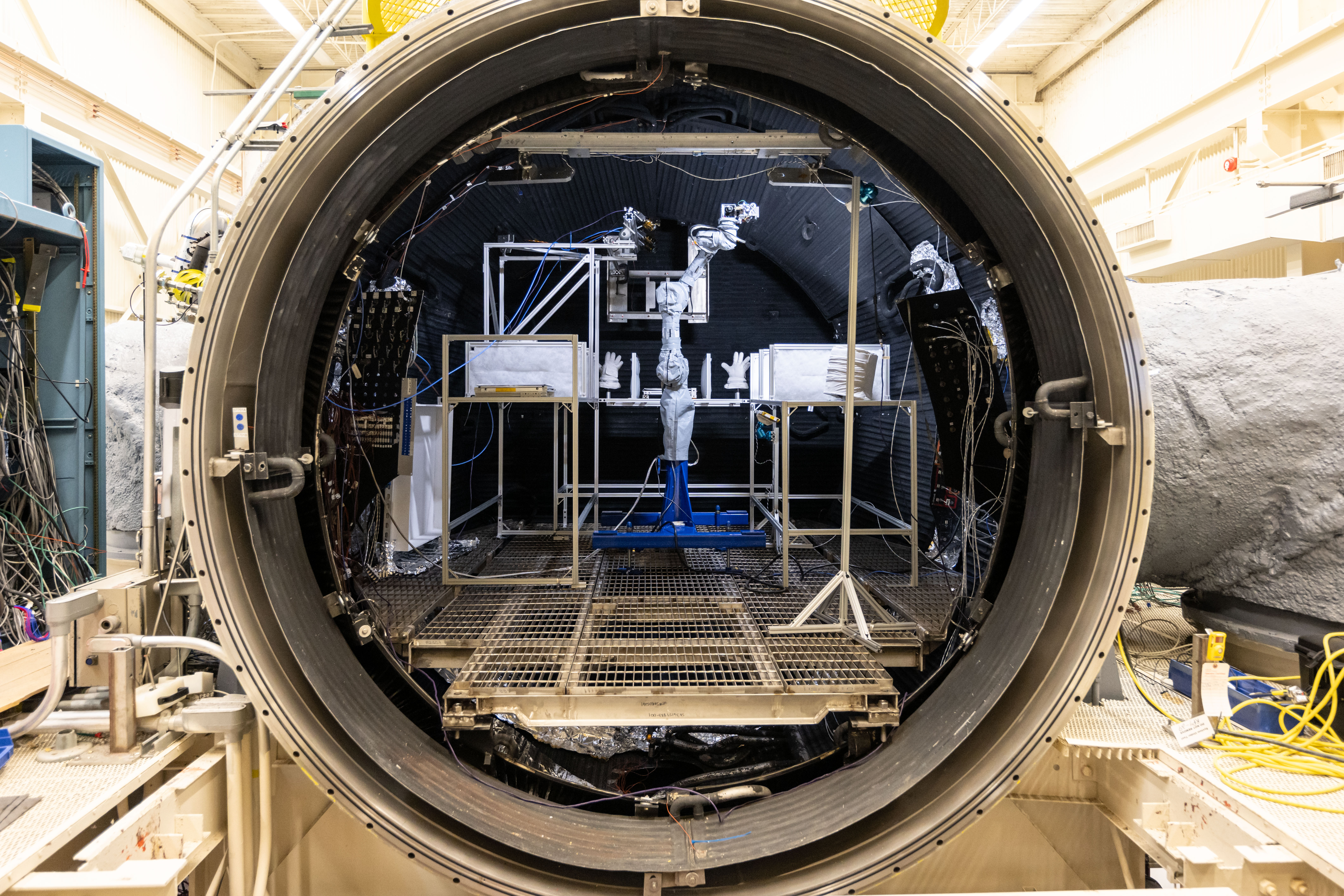
Located within the Energy Systems Test Area and managed by NASA engineers, the Lunar Development and Test Facility supports the development and testing of hardware in simulated lunar conditions. Engineers evaluate systems and subsystems inside vacuum chambers using lunar regolith simulant to better understand how spacesuits, spacecraft components, and mechanisms with moving parts and joints will perform during future Artemis missions.
Lunar spacewalking tools undergo a dust mitigation test inside Johnson’s thermal vacuum chamber.
NASA/Bill Stafford
NASA Johnson’s Propulsion and Power Division developed specialized systems that make the facility’s lunar simulations possible. The facility includes a dust containment and preparation laboratory for ambient testing, a 3-foot cube vacuum chamber, and a 15-foot thermal vacuum chamber.
Inside the chamber, engineers test hardware under realistic lunar conditions using lunar regolith simulant. The chamber uses a closed-loop nitrogen system to recreate the harsh lunar environment.
“The facility helps develop and test technologies needed for long-duration lunar exploration,” said Mike Salinas, Propulsion and Power Division branch deputy chief. “Engineers are advancing techniques to extract resources from lunar regolith, which can be turned into oxygen for astronauts and liquid oxygen for rocket propellant.”
The spirit of exploration extends beyond the facility’s walls. Its exterior features a large-scale mural depicting astronauts exploring the lunar surface beneath a view of the cosmos. Completed in 2024 by artist Sebastian Boileau, the artwork celebrates the innovation, ingenuity, and discovery happening inside the building every day.
Artist Sebastien Boileau, left, and Margaret Braun pose in front of Johnson’s Lunar Development and Test Facility after the mural’s completion on Feb. 7, 2024.
NASA/Josh Valcarcel
Now, anyone can step inside the facility from anywhere. Explore NASA’s new 3D virtual tour of the Lunar Development and Test Facility to see where engineers are helping prepare the technologies that support this Golden Age of exploration and innovation.
There's one very stinky reason why Labour's ambitious housebuilding targets are doomed to fail, says Mike Wells: Britain's creaking sewers and drainage systems simply can't cope with all the demands of new homes.
What happens to Reform if, for one reason or another, Nigel Farage exits stage right? In his latest Political Betting column, Mark Littlewood looks at who's waiting in the wings to replace him.
Preparations for Next Moonwalk Simulations Underway (and Underwater)
This historic image — the first from the surface of Mars — confirmed that NASA’s Viking 1 lander had become the first spacecraft to touch down on the Red Planet on July 20, 1976.
NASA/JPL-Caltech
Fifty years ago, NASA’s Viking 1 and 2 landers made the first successful landings on Mars, opening a new era in planetary exploration. Behind that achievement was a team at NASA’s Langley Research Center in Hampton, Virginia, whose steady leadership and technical expertise helped turn an ambitious idea into a mission that reshaped how we explore other worlds.
Building the Blueprint for Mars
NASA selected Langley in 1968 to lead the massive Viking project, the first U.S. mission designed to land safely on Mars and search for signs of life. Project Manager James S. Martin Jr. set the tone from the start. He wanted clear priorities, tough engineering reviews, and the discipline to test every system until the team was confident it would perform on Mars.
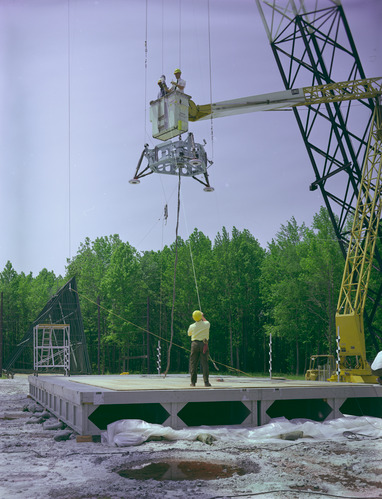
A full-scale Viking model is suspended in the air at NASA Langley’s Landing and Impact Research Facility.
NASA
Entry, Descent, and Landing
Langley engineers faced a challenge unlike anything attempted before: slowing a spacecraft plunging into the Martian atmosphere at more than 10,000 miles per hour. So they leaned into their expertise in atmospheric entry aerodynamics, heat shielding, and parachute technology. Their work produced the protective aeroshell and heat shield, as well as the supersonic parachute. These systems didn’t come from theory alone — they were shaped by years of wind‑tunnel tests, analysis, and problem‑solving. Langley still excels at entry, descent, and landing systems today.
Science and Safety, Hand in Hand
Langley also helped create a new approach to finding safe landing sites. Teams combined images from Viking’s orbiters with radar data from Earth‑based observatories to identify regions that balanced scientific value with engineering safety — a method now standard for Mars missions.
Viking also changed how mission teams operated. Engineers and scientists adopted the sol — a Martian day slightly longer than 24 hours — to keep daily work aligned with local time on Mars, a practice still used for surface missions.
From left to right, Dr. Thomas Mutch, Brown University, James Martin, Viking Project manager; and Dr. Gerald Soffen, Viking Project scientist talk at a Viking Science Review.
NASA
A Mission Reborn: From Voyager to Viking
Viking grew out of a pivotal program shift. The earlier Voyager Mars lander concept was canceled because it was too costly and risky, relying on two large landers stacked on a single Saturn V rocket. Langley helped chart a more realistic path forward, pairing each lander with its own orbiter and using Titan IIIE‑Centaur rockets instead. The new design preserved scientific ambition while making the mission achievable.
A Legacy That Endures
Viking provided an early model for how NASA could explore the solar system: scout with orbiters, certify landing sites with real data, and land only with systems tested well beyond their limits. That “planetary playbook,” shaped heavily by Langley, provided a guide for future Mars missions like Curiosity and Perseverance.
The two landers returned thousands of images and groundbreaking data, revealing Mars as a world with weather, geologic history, and complexity that scientists are still studying today. And while no human has ever set foot on the Martian surface, Viking proved that reaching another planet — and working on it — was within reach.
As the 50th anniversary of those landings arrives, Langley’s influence is unmistakable. The center continues to advance new entry, descent, and landing technologies, and explore concepts that will support future human explorers. The same spirit that guided Viking still drives the work happening in Hampton today — steady, curious, and always looking toward the next horizon.
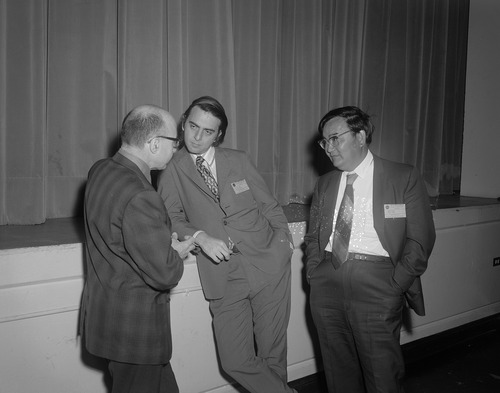
Famous scientist Dr. Carl Sagan, center, speaks with two other men at a Viking Science Symposium Biology Conference at NASA Langley.
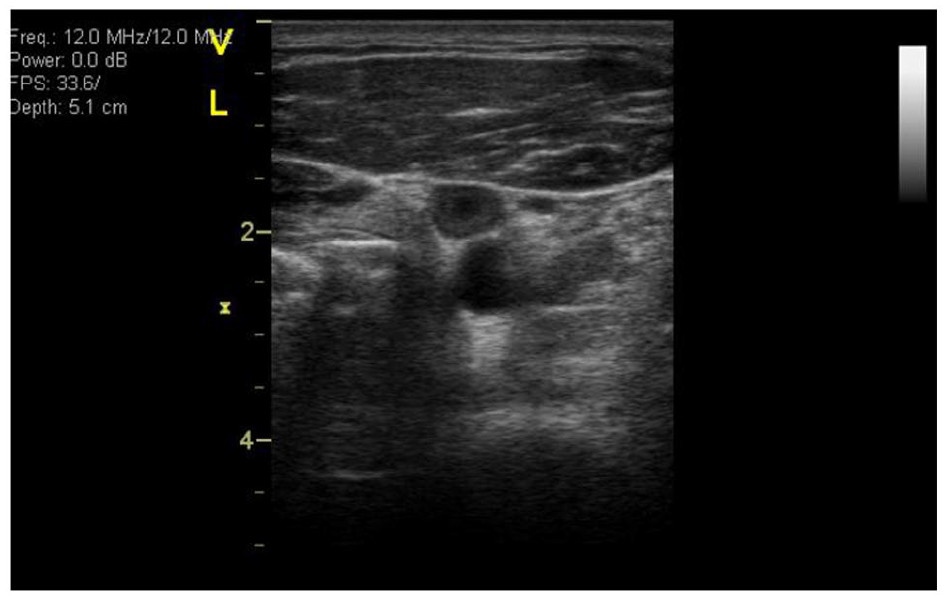
In April 2026, NASA’s Office of the Chief Health and Medical Officer (OCHMO) initiated a working group to review updated VTE case information, additional data gathered revealing altered blood flow status within a cohort of astronauts, and discuss progress of research and clinical activities intended to mitigate the risk of VTE during spaceflight with new evidence-based clinical practice recommendations.
Recommendations
The following is a summary of the working group’s recommendations:
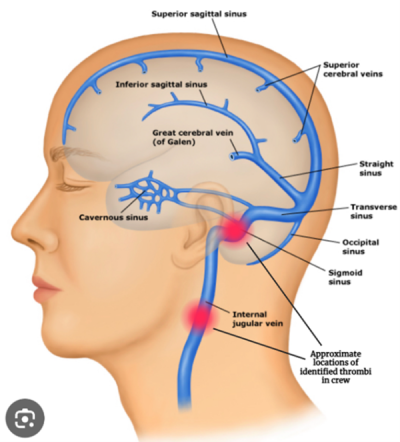
The working group’s conclusions emphasized that stasis in the left internal jugular vein (IJV) is consistently viewed as a dominant risk factor for VTE in microgravity, though there is active debate regarding the relative contributions of slow qualitative flow, endothelial factors and/or retrograde flow.
Limitations of current in-flight ultrasound capabilities to accurately measure stasis/slow flow was cited as a concern, especially if using only stasis as a factor for indicating the need for prophylaxis.
Additional review of assessing stasis with ultrasound in-flight was recommended.
After reviewing the risk factors, additional discussions following the working group led to the majority of the panel agreeing that stasis and retrograde flow warranted use of prophylaxis.
The working group also recommended assessing all other risk factors other than stasis to also determine when prophylaxis is warranted.
Based on a literature review and summary of the panel contributions, a VTE Risk Score for Astronauts Algorithm was developed, which includes providing anticoagulation prophylaxis for stasis alone, or a combination of other thrombosis risk factors that are weighted by terrestrial literature.
Risk of Venous Thromboembolism During Spaceflight
NASA initially formed a working group in October 2024 after diagnosing venous thromboembolisms (VTEs) in astronauts during ISS missions. Experts reviewed case data, updated Clinical Practice Guidelines, and examined possible causes.

 Login