Normal view

Predicting Space Weather Is Possible—Could We Also Stop It?

3 June 2026 at 19:53

The weather on Earth can get pretty messy sometimes. But in space, it can be wild—and the effects can be far-reaching.

Solar flares, giant explosions on the sun, can send out streams of energy that block radio communications and fry satellite electronics. Geomagnetic storms, caused by variations in solar wind, can mess with GPS signals and spark current surges on Earth that overload power grids.

The impact of space weather isn’t limited to temporarily losing electricity or digging out dusty paper maps for directions when satellite navigation systems fail. Every electronic financial transaction in the world, for instance, relies on time stamps sent by satellite systems. And, in May 2024, a solar storm threw out GPS systems used to accurately guide tractors in planting and harvesting crops, hobbling food production for days and costing US farmers $500 million.

Although satellites can be built with tougher shields or have their orbits adjusted, those are just Band-Aids; there’s currently little we can do to protect ourselves from space storms.

Boston University researcher Brian Walsh has an idea for how to change that. He’s been testing the theoretical feasibility of a system of spacecraft that could fire chemical elements to the edge of Earth’s magnetic field, temporarily fortifying our defenses and deflecting potentially damaging space weather. In simulations, Walsh and researchers from the University of Michigan found the system could cut the intensity of a major geomagnetic storm in half. The findings were published in the journal Space Weather.

“Since humans have been in space, we’ve been trying to predict what’s going to happen in the space environment,” says Walsh, a BU College of Engineering associate professor of mechanical engineering. “But we came up with a model that could flip the paradigm. It’s like people in a village who see a river flooding—maybe they can predict when that will happen, but probably what’s even better is if they could build a storm wall. That’s what we’re proposing here.”

Bouncing Storms Past the Earth

Walsh says his idea for a weather wall in space was inspired by a natural phenomenon: material peeling off the Earth’s atmosphere and floating to the edge of our planet’s protective bubble, the magnetosphere, to bolster it. “I thought, maybe you could turn [that process] up, increase the intensity of it,” he says.

His proposed system, named StormWall, would start with the launch of six spacecraft into a geosynchronous orbit matching the Earth’s own rotation. Each craft would be fitted with a canister loaded with what the researchers call a mass-loading material. When released, the material—an alkaline chemical element like barium or lithium—would photoionize, a process that induces an electrical charge, seeding the atmosphere with plasma.

In their simulations, Walsh and his colleagues found that this plasma would disrupt the flow of energy between any solar storm and the magnetosphere—and that would be enough to bounce the space weather around and past our planet.

Not Science Fiction

Walsh admits a weather wall in space sounds a little like science fiction, but says it’s within our reach.

“When you apply some really serious physics to it, it does work. And the amount of mass we need, the launch capacities—it’s all within our capabilities,” he says. “People have always thought, ‘space is huge, the sun is massive, we just have to sit here and take whatever it gives us.’ But what we found is that we can impact it.”

One of the biggest barriers to implementation is cost. Launching six spacecraft, together carrying the equivalent of about a dozen oil trucks–worth of material, wouldn’t be cheap. And once the payload is fired out and photoionizes, the system would be dead and couldn’t be replenished—it’s one and done. But with private companies investing billions in space infrastructure—and even contemplating data centers in orbit—Walsh says the math on cost-benefit ratios could soon favor his proposed approach. In their paper, Walsh and his colleagues point out that a massive once-in-a-century geomagnetic storm—the last one was in 1859—would cause devastating damage in space and on Earth, with power grid costs alone topping $2.4 trillion.

He’s confident the team can bring down the StormWall costs too. Next on their agenda is studying ways to half the material used, simulating a pulsed release of materials to extend the system’s lifespan, and examining potentially more efficient orbits. They also want to dig deeper into the chemistry involved to nail down the best elements to use.

And although space junk is a major issue in Earth’s lower atmosphere, Walsh says any materials they pump into its higher reaches would quickly be carried out of the system after they’ve done their job. “The material drifts out on these natural highways, it leaves the system—the magnetosphere flushes the material out within six or so hours.”

Geoengineering Space

As the head of BU’s Space Physics & Technology Lab, much of Walsh’s broader research is focused on observing and better understanding the space environment around Earth; he and his team were recently part of a mission that sent a telescope to the moon to image our magnetic shield. Although the StormWall project is loosely connected to that wider work, Walsh says it’s a bit of an outlier. “This is quite different than what anyone is doing right now—I don’t know of anyone proposing to geoengineer space.”

Should the idea literally take off, he says that, unlike some space missions that might reap rewards for the few, this one would benefit us all.

“If you built it, if it was deployed, it would help all people on the planet,” says Walsh. “You couldn’t make it in a way that helped only one country, one group of satellites.”


Journal

Space Weather

Method of Research

Computational simulation/modeling

Subject of Research

Not applicable

Article Title

Terrestrial Space Weather Protection Through Human-Produced Mass-Loading

Article Publication Date

2-Jun-2026

COI Statement

The authors declare no conflicts of interest relevant to this study.

Media Contact

Jennifer Rosenberg

Boston University

jennr@bu.edu

Journal
Space Weather
Funder
U.S. National Science Foundation
DOI
10.1029/2025SW004846

bu içeriği en az 2000 kelime olacak şekilde ve alt başlıklar ve madde içermiyecek şekilde ünlü bir science magazine için İngilizce olarak yeniden yaz. Teknik açıklamalar içersin ve viral olacak şekilde İngilizce yaz. Haber dışında başka bir şey içermesin. Haber içerisinde en az 12 paragraf ve her bir paragrafta da en az 50 kelime olsun. Cevapta sadece haber olsun. Ayrıca haberi yazdıktan sonra içerikten yararlanarak aşağıdaki başlıkların bilgisi var ise haberin altında doldur. Eğer yoksa bilgisi ilgili kısmı yazma.:
Subject of Research:
Article Title:
News Publication Date:
Web References:
References:
Image Credits:

Keywords

Trump Administration to Dismantle Ocean Monitoring System

By: BeauHD
3 June 2026 at 08:00
The Trump administration is moving to dismantle the National Science Foundation's $368 million Ocean Observatories Initiative, a network of more than 900 deep-sea instruments used to monitor ocean currents, marine ecosystems, carbon absorption, heat waves, fisheries, coastal flooding, and climate change. The NSF said it would send ships in June to begin the removal of the instruments anchored off Oregon, Washington, Alaska, North Carolina, and an area between Greenland and Iceland known as the Irminger Sea. The New York Times reports: The ocean observation system began operating in 2016 and was expected to continue for 25 years. Jim Edson, a marine meteorologist who led the Ocean Observatories Initiative, called it "the world's most advanced continuously operating ocean observing systems." When it was first proposed, the science foundation said it was important to have a long-term presence at scientifically important sites in the Atlantic and Pacific oceans. Removing the instruments could take 15 months. Seismic instruments positioned around an active underwater volcano off Oregon will continue operating until 2028. Each observation station consists of several moorings that secure long arrays of devices connected to wires. The devices measure ocean currents as well as chemical and biological conditions from the water's surface down thousands of feet. The instruments were hardened to resist the pressure of the deep ocean, corrosive seawater as well as marine plants and animals that can foul electronics. Remotely controlled robotic vehicles and gliders around the moorings collect and transmit data to research laboratories. It cost $48 million annually to operate the network. The Trump administration repeatedly tried to shutter it, proposing to cut its funding by 80 percent in both 2025 and again in 2026. Congress pushed back, restoring the money. To try to reduce costs, managers turned off some of the instruments and collected less data, according to a December 2025 presentation about the observatories at the annual meeting of the American Geophysical Union, a nonprofit organization of scientists. Still, the science foundation moved ahead to decommission the observatory network.

Read more of this story at Slashdot.

How early Earth’s unlikely chemical hero appeared

3 June 2026 at 01:32

In early Earth’s chemical soup, toxic hydrogen cyanide (HCN) was the unlikely hero ingredient. Though a killer to all but a few lifeforms, HCN is at the base of a host of prebiotic chemical reactions. Without it, life may never arisen on our planet. Though it’s just a simple molecule with three atoms, its importance […]

The post How early Earth’s unlikely chemical hero appeared appeared first on Knowridge Science Report.

Satan’s Lies Are More Believed Now Than Ever Before

14 March 2026 at 22:15
The COVID-19 pandemic and “safe and effective” vaccines are lies propagated by governments and “experts”. Many widely accepted scientific beliefs are false narratives based on Satan’s lies. Spiritual deception underlies many societal misconceptions. We must return to the foundation of biblical truths from creation to what is real science.

World Population from Creation to the Flood to the Present and Beyond

9 March 2026 at 03:22
An historical investigation of global population growth, from Creation to the present, using secular and biblical texts. Significant changes in growth rates occurred after the global Flood, the Tower of Babel and pivotal developments from 1600 onward. A future population collapse may be seen again as resulting from God's judgments on the wicked.

Understanding the Age of the Earth from a Young Earth Perspective

7 March 2026 at 04:02
Young Earth Creation means the Earth is less than 10,000 years old. The biblical genealogies and historical records support this belief. I now advocate for the Septuagint's chronology as more reliable than the Masoretic Text, which has been corrupted. It follows then that the age of the Earth is about 7,580 years.

How I Survived the Godless Australian Education System

21 February 2026 at 04:05
I reflect on my educational journey, highlighting challenges such as family separation and multiple school changes. I excelled in science and mathematics yet was indoctrinated on Godless cosmology and rejected the Creator. Later Jesus Christ saved me from atheism and renewed my mind to His truth.

Jude 1 | A Message for These Last Days

5 February 2026 at 00:52
The letter of apostle Jude warns against false teachings and ungodliness, urging believers to contend for their faith. Jude emphasizes that eternal judgment awaits those who reject God, likening them to the rebels of the past. His message serves as a reminder to uphold the true gospel of Jesus Christ amidst modern corruption.

Are We Really Observing the Universe in Real Time?

16 December 2025 at 02:11
When we look out into space, even with the most powerful telescopes, are we seeing the universe in real time? Are we observing events as they happen, that is, at the time measured on our local clocks?

Was the 1969 Moon Landing Faked?

9 December 2025 at 21:48
There are various conspiracy theories claiming the Apollo Moon landing was faked, some citing a spoof video as evidence. I reference my personal experiences and testimonies from Apollo astronauts, emphasizing the authenticity of the Moon landing. I highlight the significance of eye witness statements in discerning historical truth.

Ancient Human Longevity and Its Rapid Decline

7 December 2025 at 21:42
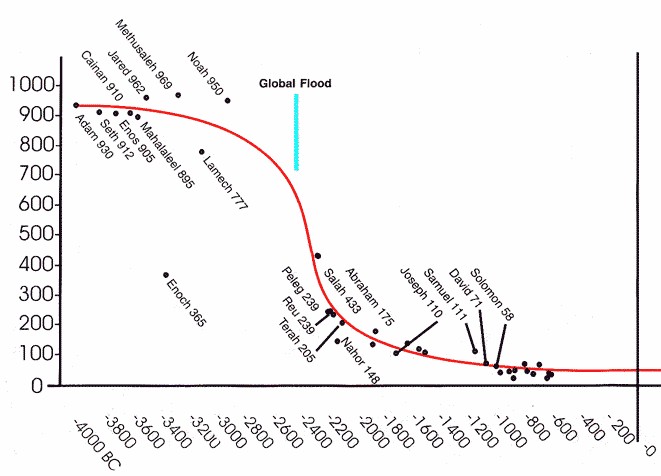
I model the decrease in human lifespans after the Flood due to a combination of factors beginning at the Curse, including divine sustainment, loss of physiological resilience and changes in Earth's environment. Current research indicates a hard limit on human lifespan due to physiological resilience limitations.

What Happened After the Flood? Why Did Lifespans Decrease Rapidly?

5 December 2025 at 04:45
In this presentation I discuss the drastic reduction in human lifespans after the global flood, from 910-970 years to about 70 years. I link these changes to factors such as biological decay, genetic entropy, Earth’s altered magnetic field and loss of physiological resilience. Eternal lifespans can only be restored through Jesus Christ.

Two Free Books On Offer for Premium Members

17 November 2025 at 00:58
Two of my latest books are on offer for free PDF download exclusively to Premium members, which costs $30/year or $5/month. Premium members gain early access to posts and exclusive content. The books focus on biblical themes, covering Genesis and Revelation.

There is No “Free Lunch” | All Claims of “Free Energy” are Fraudulent

15 November 2025 at 00:35
Maxwell Chikumbutso's claim of a "free energy" vehicle powered by radio frequency energy, contradicts established physics, particularly the laws of thermodynamics. All forms of energy involve costs. Chikumbutso provides no evidence to support his "free energy" from radio-waves claim. It is foolish to believe in unverified revolutionary energy solutions.

Human Lifespans | What Can the Ages of the Patriarchs Tells Us?

7 October 2025 at 08:19
An examination of the ages of patriarchs from the Masoretic Text (MT) and Septuagint Text (LXX), highlights a significant decrease in human lifespans post-Flood. A correlation between Earth's axial tilt changes and lifespan variations forecasts that, without medical advancements, human lifespans will continue declining.

What Happened to Earth’s Rings?

18 August 2025 at 04:15
The existence of evidence for Earth’s past equatorial ring, shown by impact craters, raises questions about its loss. Modeling its effects on Earth's rotation presents challenges. However, current findings indicate minor impacts on day length, with significant stability in the Earth-Moon system over 10,000 years.

Time and the Measurement of Time

15 July 2025 at 11:01
The exploration of time measurement emphasizes the Earth's rotation as a historical clock, defining the 24-hour day. The development of mechanical clocks, notably John Harrison's marine chronometers, advanced navigation. Time's definition evolved from an Earth-centric model to atomic standards, although fundamental concepts of time remain abstract and intrinsic to the universe's creation.

❌