The Northwest Africa (NWA) 12774, an angrite meteorite discovered in the Sahara Desert, likely in Mauritania, appears to be a fragment of a vanished protoplanet, offering the strongest evidence yet that a large planetary body formed and was later destroyed during the Solar System’s chaotic infancy.
By tracking fierce winds racing through the atmospheres of seven ultra-hot Jupiters, astronomers have uncovered the strongest evidence yet that magnetic fields shape weather on worlds beyond our Solar System.
The Earth's sphericity negates any privileged location and signifies equality among all people. A divine pathway through Jesus Christ offers salvation to all nations, regardless of birthplace. This revelation, previously hinted at in prophets' teachings, is now openly accessible to the world.
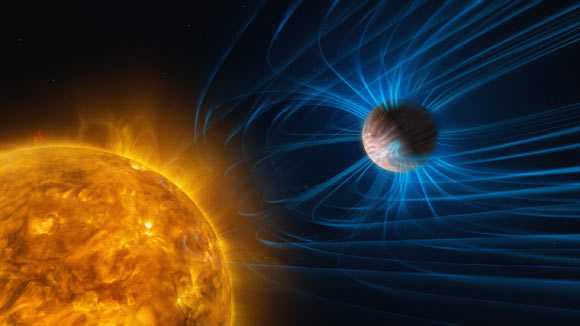
The best evidence for exoplanetmagnetic fields ever discovered has emerged from new European research, which measured wind speeds on seven ultra-hot Jupiters using the European Southern Observatory’s Very Large Telescope (ESO’s VLT) and the Gemini North telescope.
In a recent paper published in Nature Astronomy, the team suggests that magnetic fields are most likely driving the winds, enabling the first measurements of exoplanet magnetism.
Ultra-hot Jupiters are a class of exoplanets similar in size and composition to Jupiter in our solar system, yet orbiting much closer to their host stars, resulting in surface temperatures above 2000°K.
“This breakthrough opens a completely new window on exoplanet research,” said lead author Julia Seidel, an astronomer at the Laboratoire Lagrange, Observatoire de la Côte d’Azur, France.
“It’s the first time we can compare the magnetic environments of other worlds,” Seidel added, calling it “a key step toward ultimately understanding which planets can stay alive, keep their water, and perhaps even, one day, host life as we know it.”
Exoplanet Magnetic Fields
On Earth, magnetism is one of the primary influences on our atmosphere and is essential to maintaining habitability. Other planets in our solar system, like Jupiter and Saturn, have strong magnetic fields, while Mars has only small, weak pockets of magnetism rather than a powerful global field.
“Radio astronomy has been trying to find the direct signals of exoplanet magnetic fields for the past 15 years, but due to technical and geometrical limitations, they have not yet been successful,” Seidel told The Debrief, noting past works by Phillip Zarka and collaborators, who she said have “led a gargantuan effort in that direction.”
“But thus far, the tentative claims could not be confirmed,” Seidel added.
“In our work, we use an indirect method, via the wind speed measurement, to infer the characteristics of the magnetic field,” Seidel continued. “So it’s not a direct method, so not as robust, but it’s the first clear indication that planets outside of the solar system have a magnetic field at all!”
Strange Exoplanet Winds
Like some of science’s most spectacular advancements, the team set out looking for something else entirely: exoplanet wind speeds. The exoplanets observed in the team’s work are all tidally locked, meaning that one side always faces toward their star, while the other faces away.
Each ultra-hot Jupiter that the team observed orbits on a different side, yet all have tremendous dayside temperatures and frigid nightsides.
Exoplanets with such extreme temperature differences between hemispheres generate weather patterns that differ greatly from those seen on Earth. When air pockets with very different temperatures meet, they produce winds. These radical differences between the two sides produce a range of wind speeds from 7200 to 25000 kilometers per hour, compared to the relatively slow 1500 kilometers per hour of our local Jupiter.
“In the beginning, we set out to check if the atmospheric winds behaved the same way for all hot planets,” Seidel said.
A strange pattern emerged from the data, as the team identified that the hottest parts of the planet had slower winds, defying expectations.
“This is totally counterintuitive because, all things being equal, hot planets have more energy to accelerate the winds! Something must happen that slows down the wind speeds for hotter objects,” said co-author Vivien Parmentier, a professor at the Laboratoire Lagrange.
Using spectrographs, astronomers can measure the temperature and wind speed on exoplanets. A trend of decreasing wind speed with increasing temperature can betray the presence of magnetic fields on these planets. Credit: ESO/M. Kornmesser, L. Calçada
A Magnetic Explanation
To explain these anomalies, the researchers proposed that powerful global magnetic fields were serving as a brake on the charged particles that make up the winds. They were able to extrapolate each exoplanet’s magnetic field strength from the wind speed data.
Results of the work indicate these magnetic fields are relatively close to what has been found in our solar system, roughly half the strength of Jupiter’s and four times that of Saturn. An unusual added effect of these magnetic fields is that they likely produce much more dramatic auroras than those seen on Earth, moving the gases that produce such vivid lights.
“I like to imagine that some of these worlds have a sky filled not only with stars, but with vast curtains of colourful light dancing across a planet that’s half in perpetual day and half in endless night,” explained co-author Bibiana Prinoth, a former PhD student at Lund University, Sweden, now an astronomer at ESO in Garching, Germany.
The team has already identified the direction of their follow-up research.
“The next step is clear: Until what planetary temperature do magnetic fields dominate how atmospheres flow and at which temperature do these winds behave more similar than in the solar system?,” Seidel said.
“For that, we are planning an observational survey to look at less hot planets and see when the trend depending on the ionisation of the atmosphere (and therefore the magnetic field) breaks.”
Ryan Whalen covers science and technology for The Debrief. He holds an MA in History and a Master of Library and Information Science with a certificate in Data Science. He can be contacted at ryan@thedebrief.org, and follow him on Twitter @mdntwvlf.
The dusty rings of newborn planets may hold the key to uncovering their mass, according to a team of researchers from the University of Warwick, MIT, and McMaster University, who are finally characterizing these previously obscured celestial objects.
In a recent paper published in The Astrophysical Journal, the team reveals their novel method for extrapolating a newborn planet’s mass from measurements of the dusty rings surrounding its host star, which prevent direct observation of the planet.
These rings, known as protoplanetary disks, serve as breeding grounds for worlds, with their material eventually coalescing from dust into entire planets.
Observing Protoplanetary Disks
Advancements in observational technologies, such as the Atacama Large Millimeter/submillimeter Array (ALMA) in Chile, have allowed astronomers to take a closer look at protoplanetary disks, the rings of dust and gas that make up a host star’s planet-forming region. In those more detailed observations, astronomers have identified that these large disks are comprised of distinct ring structures.
Researchers have suspected that these separate rings reveal something about the newborn planets already orbiting within the protoplanetary disk, yet have been unable to devise a method to interpret what they are seeing.
“These bright rings are not just beautiful structures – they are essentially planetary fingerprints,” said lead author Amena Faruqi, PhD student, Astronomy and Astrophysics Group, University of Warwick. “We’ve long understood that the rings could be created from concentrated dust that piles up just beyond the orbit of young, embedded planets, but we’ve been so far unable to link features of these rings to planet masses.”
“By reading ‘between the rings,’ we have now found a way to reconstruct the masses of the planets that create the rings, even when those planets are too faint or too embedded to observe directly,” Faruqi added.
Modeling Newborn Planets
The international team developed intricate computer simulations to model how varying planetary masses would influence the shape of dust rings within the protoplanetary disk. Analysis of the model revealed three essential clues in the rings for characterizing the planet that shaped it: the width, the amount of dust, and the brightest point.
In particular, the brightest point in the ring held special significance, directly related to the planet’s mass and unaffected by external factors such as dust grain size or observational wavelength. According to the team, with just this one factor, researchers can identify the mass of a newborn planet obscured by a dusty disk, even without knowledge of the disk’s specific conditions.
As a control, the team looked to one of the only systems whose planets have been directly imaged within their disk, PDS 70. Using their new technique based on the brightest point of five disks, the researchers arrived at a mass figure extremely close to those achieved in other mass estimates.
“One of the strengths of this work is that it doesn’t stay in the realm of theory—we’ve been able to take these simulation results and apply them directly to real observed systems,” said co-author Dr. Jessica Speedie, 51 Pegasi b Postdoctoral Fellow, Massachusetts Institute of Technology. “Using the PDS 70 system as an observational laboratory in particular enabled a real verification of the approach, giving us confidence that these methods are genuinely ready to be applied widely as soon as possible.”
What Hides in Protoplanetary Disks
The team says their research lays the groundwork for identifying planets within disks in the future, either confirming suspected ones or revealing entirely new surprises, potentially even offering new insights into how our own Solar System formed.
“Another striking result of the simulations is that, in typical discs, more massive forming planets can trap as much as 20 times the mass of Earth of dust within these rings,” said senior co-author Professor Emeritus Ralph Pudritz, Department of Physics and Astronomy, McMaster University. “This confirms ALMA observations – but raises the question of why new planets have not been detected in the trapped dust and pebbles of the ring.”
Since these rings contain sufficient dust to initiate planet formation, the absence of any such formation within them will be an important focus of observations and astronomical theories moving forward.
“This work gives observers a new practical toolkit for connecting what we see in dust rings directly to the masses of the planets creating them,” concluded senior co-author Dr. Farzana Meru, Reader, Department of Physics, University of Warwick. “What excites me most is the timing. With ALMA delivering increasingly detailed disk images, and future facilities on the horizon, there has never been a better moment to develop these methods.”
Ryan Whalen covers science and technology for The Debrief. He holds an MA in History and a Master of Library and Information Science with a certificate in Data Science. He can be contacted at ryan@thedebrief.org, and follow him on Twitter @mdntwvlf.
Scientists have identified supermagnetic macrophages in the livers of homing pigeons (Columba livia domestica) that appear essential for navigation when the Sun is not visible, pointing to an entirely new mechanism for animal magnetoreception.
Using spectral data from the Near-Infrared Spectrograph (NIRSpec) onboard the NASA/ESA/CSA James Webb Space Telescope, astronomers analyzed the atmosphere of TOI-199b, a distant Saturn-mass world that is neither frozen nor scorching hot.

 Login
Login