Normal view

Scientists Crack Major Ammonia Problem With a Platinum Catalyst Breakthrough

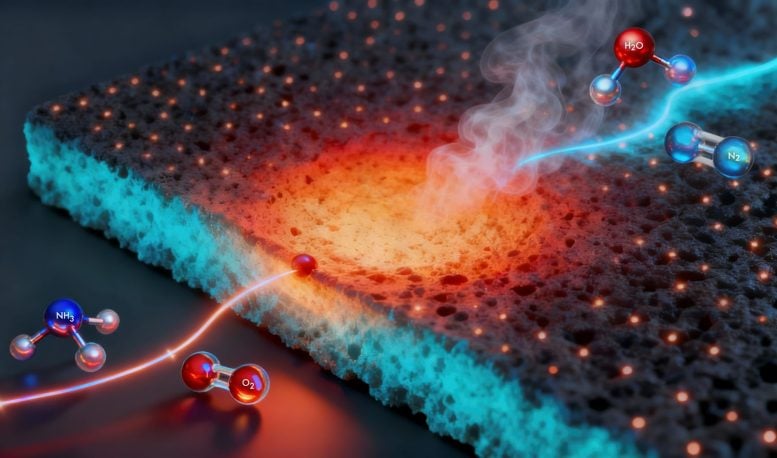
Platinum Catalyst Lights AmmoniaA newly engineered catalyst overcomes key obstacles that have long limited ammonia as a clean fuel for heavy industry. A newly developed single-atom platinum catalyst can ignite ammonia at about 200°C (392°F) and sustain stable combustion at 1,100°C (2,012°F) while producing very little NOx. The breakthrough could provide carbon-free, high-grade heat for industries such as [...]

Massive Iron Ore Discovery and Global Warming

14 June 2025 at 00:10
A recent high-grade iron ore discovery in Western Australia, valued at $6 trillion, raises questions about environmental policies. The processing of iron ore to make steel requires coal, leading to significant CO2 emissions, highlighting the stark contradiction with the Climate Cult agenda.

A Brief History of the Earth’s Magnetic Field

Carl Friedrich Gauss initiated a scientific journey into the properties of the Earth's magnetic field. I describe its history from a Young Earth creationist perspective, suggesting a history of less than 8,000 years, and exploring correlations in the data regarding axial tilt and magnetic changes since creation.

Can Earth’s Magnetic Field Survive for Billions of Years?

16 March 2025 at 06:54
I discuss evidence supporting the Earth's magnetic field as a divine shield for life, highlighting its decay since Gauss's measurements. I link this decay to a young Earth, highlighting that Carbon-14 presence in minerals aligns with a creation timeline under 8,000 years.

The Physics of Creation | Day 3

13 January 2025 at 22:00
Day 3 of creation, God formed dry land and initiated life with green plants, establishing essential conditions for future sentient life forms. This day also included the formation of Earth's physical structures. All creations were designed perfectly, paving the way for environmental balance and the development of biodiversity.

Explosion d’un météore au-dessus des États-Unis : la Nasa révèle la puissance spectaculaire du phénomène

Une boule de feu en plein jour, une détonation digne d’une petite bombe, des bâtiments qui tremblent… et pourtant, un objet minuscule à l’échelle cosmique. Faut-il vraiment craindre ces visiteurs venus de l’espace ?

$11 billion reasons Apple’s App Store tax is worth paying

Apple publishes its App Store fraud prevention report every year,. And when it does, the company presses the point that its curated system brings much value to developers and customers, including highly effective protection against fraud. It says it prevented more than $2.2 billion in potentially fraudulent transactions in 2025 alone.

A tax worth paying

The company said it has prevented $11.2 billion in such fraud in the last six years. That’s a lot of value for the 15% or lower commission that all but the biggest-selling developers are required to pay on their store sales.

Don’t believe the hype, as most developers are not generating the $1 million a year required before the 30% payment kicks in.

You might reflect that if there is an Apple Tax, it’s a progressive tax in which those with the broadest shoulders help support the wider developer community, which is probably why some tech billionaires don’t like it. 

But I’m not here to write about taxation; I’m here to highlight the value the App Store brings. Apple diligently works to protect customers and developers against the ever-growing threat of cybercrime at a scale few other companies could hope to match. That matters in an environment dominated by ever more sophisticated attacks, including scenarios in which a developer submits a benign app for review and then modifies it once the app is online to commit financial fraud.

More than fraud prevention

It’s not just fraud Apple protects App Store customers from. It also attempts to protect privacy. Look, we know that tech firms now exist for whom privacy is a roadblock to profit; they want to take all your information for free to sell it for money, or worse. Apple stands against this and has done so for years, which is why it is under steady attack by entities that want privacy destroyed to boost their bottom line. Nation states and nation-state-adjacent attacks don’t help in the battle for your private digital life, throwing huge resources at undermining personal protections.

Apple’s report gives you a solid glimpse at the anti-privacy environment. App Store rejected 443,000 app submissions for privacy violations; it also rejected 22,000 apps for holding undocumented anti-privacy features. 

The upshot is that while Apple’s protections aren’t 100% perfect, they’re still industry leading. Where incidents do take place, they are resolved swiftly, and the bait-and-switch approach (in which an app pretends to be benign but carries malware) remains the biggest threat. That’s why customers should always verify they trust a developer before downloading apps.

The threats coming over the hill

The thing is, all of these threats are evolving, and Apple is equipped to evolve in parallel with them. In part, that’s because it has scale, in part because it has that huge 2.2-billion-device ecosystem, in part because the company entered the app store race with deep understanding of how online transactions were evolving in the first place. It didn’t run iTunes for years only to learn nothing.

Coming up over the hill we can see new-breed quantum-based threats. Along with artificial intelligence, that combination will likely spawn a mass attack of AI-generated, malware-infested apps being built and submitted at a record pace. 

We will also likely see increased attacks made against developers in order to extract their Developer ID to help in the submission of such apps. And we will see increasingly sophisticated algorithmic hacks to attack security, identity, and even app ownership. Protecting against those consequential evolutions will be neither easy nor cheap. Doing so will require near state-level protection, a degree of security no small entity can meet. We have no idea if smaller app stores can even visualize such protection — and the EU doesn’t know, either.

In time, hopefully, new businesses will emerge offering quantum-safe security to protect online purchases. But for now, we’ll mostly need to look to large entities such as Apple, or payment services providers, to make the grade. 

Near state-level protection

Will Apple put protection at scale in place to protect against these incoming threats against its App Store? It seems likely, given it is already investing in OS-level mitigations to protect encryption on its services, including around encrypted communications. 

It is also in Apple’s interest to future-proof protection around payment services, ergo also the App Store. At the same time, as Apple’s latest fraud report confirms, the threat landscape remains highly volatile. Time will show that the store’s degree of protection is well worth the cost of Apple’s progressive App Store tax. 

You can follow me on social media! Join me on BlueSky,  LinkedIn, and Mastodon.

We're starting to see some PC makers respond to Apple's MacBook Neo

26 May 2026 at 21:47

It seems fair to say that Apple's MacBook Neo took the rest of the PC industry by surprise. Companies are used to competing on price and features with $1,000-and-up Apple laptops like the MacBook Air and MacBook Pro, but their $600 and $700 models usually come with cut corners and compromises that are more noticeable than the Neo's. The CEO of Asus admitted to being surprised by the laptop's price (while simultaneously trying to downplay the Neo's value); a Microsoft-backed study comparing PCs to the MacBook Neo included several laptops that can't compete with the Neo's price unless they're deeply discounted.

In the last couple of weeks, we've started to see a more intentional and targeted response to the MacBook Neo from PC makers. These mostly seem to revolve around Intel's low-end Core Series 3 processors, codenamed Wildcat Lake; while Intel's last few generations of low-end chips have mostly been rebrands of older and less power-efficient parts, Wildcat Lake is a new purpose-built budget chip that benefits from Intel's latest CPU and GPU architectures and its 18A manufacturing process. This should help these chips compete better with the Apple A18 Pro in the MacBook Neo.

Many early Wildcat Lake systems have already been announced, though not all have included a price tag, and several have only been announced for the Chinese market as of this writing. Lenovo is planning to launch some IdeaPad Slim models with the new processors, with some optional spec upgrades including 16GB of RAM and a 120 Hz high-refresh-rate display. Asus and HP have also announced some early products.

Read full article

Comments

© Intel

Researchers develop a new process to get lithium out of rocks

28 May 2026 at 20:30

While we make batteries based on many different chemistries, nothing has approached the massive scale at which we can produce lithium batteries. That scale makes the economics of lithium-ion batteries hard to compete with. Even if we develop a superior battery technology, it's unclear whether we can get manufacturing costs down quickly enough to compete with the efficiency of the lithium supply chain and manufacturing.

The one thing that could change the dynamics is a supply crunch. While lithium is extremely widespread, lithium that can be extracted economically is a different matter. It's cheapest to extract it from brines, and lithium-rich brines are largely limited to South America. We do obtain some lithium from other sources, but it's considerably more expensive.

In today's issue of Science, however, a research team has identified an energy-efficient means of extracting lithium from rocks. The process they've designed uses far less energy than existing ones, regenerates all its starting chemicals, and produces byproducts that could also be sold.

Read full article

Comments

© Cavan Images

Researchers develop a new process to get lithium out of rocks

28 May 2026 at 20:30

While we make batteries based on many different chemistries, nothing has approached the massive scale at which we can produce lithium batteries. That scale makes the economics of lithium-ion batteries hard to compete with. Even if we develop a superior battery technology, it's unclear whether we can get manufacturing costs down quickly enough to compete with the efficiency of the lithium supply chain and manufacturing.

The one thing that could change the dynamics is a supply crunch. While lithium is extremely widespread, lithium that can be extracted economically is a different matter. It's cheapest to extract it from brines, and lithium-rich brines are largely limited to South America. We do obtain some lithium from other sources, but it's considerably more expensive.

In today's issue of Science, however, a research team has identified an energy-efficient means of extracting lithium from rocks. The process they've designed uses far less energy than existing ones, regenerates all its starting chemicals, and produces byproducts that could also be sold.

Read full article

Comments

© Cavan Images

Bioluminescent Deep-Sea Fish Use Crystal ‘Prisms’ to Recycle Their Own Glow

27 May 2026 at 20:37
Sigmops gracilis. Image credit: Wu Quancheng / Fisheries Research Institute, Council of Agriculture, Taiwan.

A marine biologist studying the photophores of a bioluminescent fish species found needle-shaped guanine crystals that scatter and redirect light instead of merely reflecting it, a discovery that could inspire more efficient biomedical and optical devices.

The post Bioluminescent Deep-Sea Fish Use Crystal ‘Prisms’ to Recycle Their Own Glow appeared first on Sci.News: Breaking Science News.

We're starting to see some PC makers respond to Apple's MacBook Neo

26 May 2026 at 21:47

It seems fair to say that Apple's MacBook Neo took the rest of the PC industry by surprise. Companies are used to competing on price and features with $1,000-and-up Apple laptops like the MacBook Air and MacBook Pro, but their $600 and $700 models usually come with cut corners and compromises that are more noticeable than the Neo's. The CEO of Asus admitted to being surprised by the laptop's price (while simultaneously trying to downplay the Neo's value); a Microsoft-backed study comparing PCs to the MacBook Neo included several laptops that can't compete with the Neo's price unless they're deeply discounted.

In the last couple of weeks, we've started to see a more intentional and targeted response to the MacBook Neo from PC makers. These mostly seem to revolve around Intel's low-end Core Series 3 processors, codenamed Wildcat Lake; while Intel's last few generations of low-end chips have mostly been rebrands of older and less power-efficient parts, Wildcat Lake is a new purpose-built budget chip that benefits from Intel's latest CPU and GPU architectures and its 18A manufacturing process. This should help these chips compete better with the Apple A18 Pro in the MacBook Neo.

Many early Wildcat Lake systems have already been announced, though not all have included a price tag, and several have only been announced for the Chinese market as of this writing. Lenovo is planning to launch some IdeaPad Slim models with the new processors, with some optional spec upgrades including 16GB of RAM and a 120 Hz high-refresh-rate display. Asus and HP have also announced some early products.

Read full article

Comments

© Intel

❌