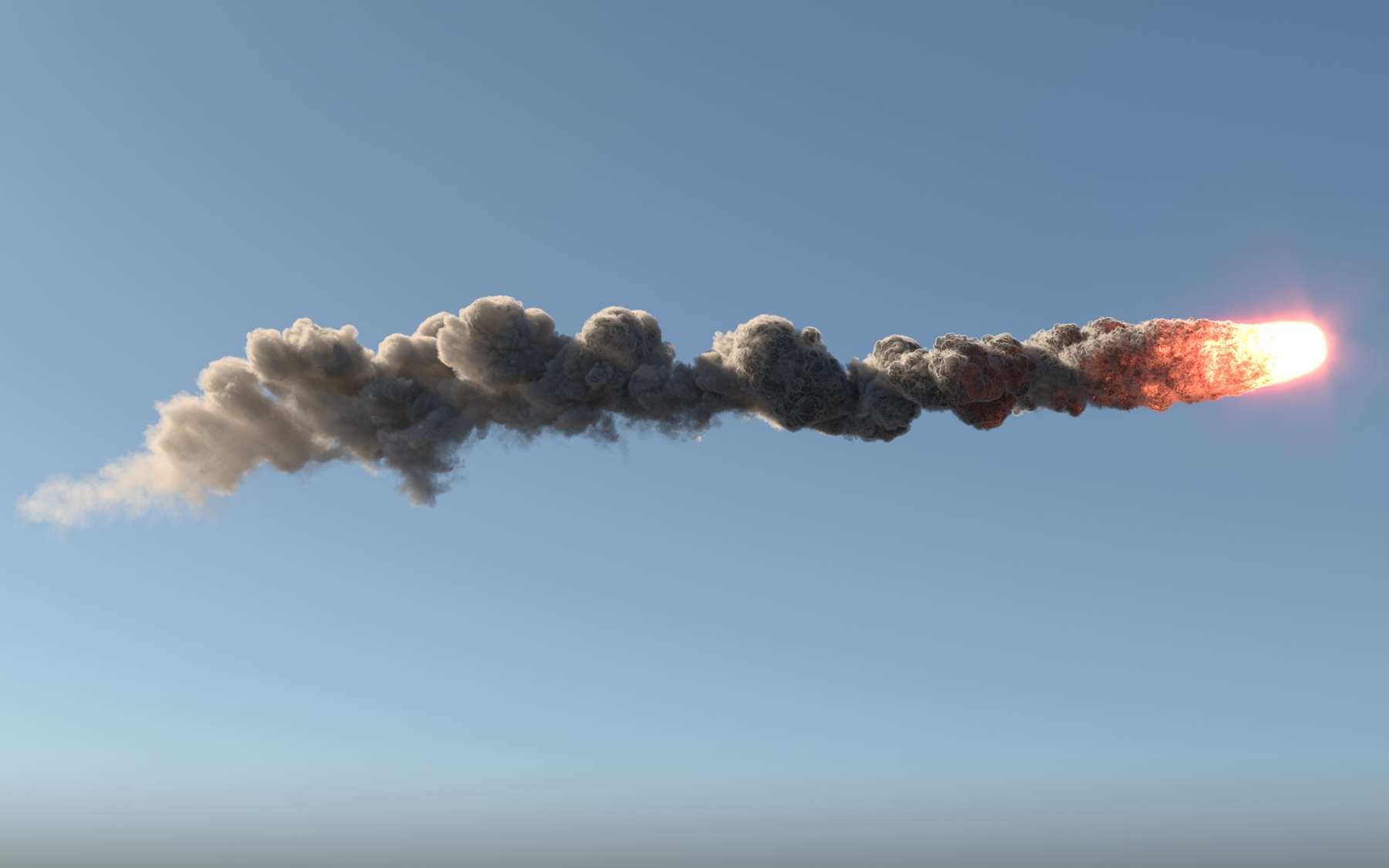
Une boule de feu en plein jour, une détonation digne d’une petite bombe, des bâtiments qui tremblent… et pourtant, un objet minuscule à l’échelle cosmique. Faut-il vraiment craindre ces visiteurs venus de l’espace ?
Scientists from the Università di Firenze studying a crystal formed during the 1945 Trinity nuclear test detonation in the New Mexico desert have identified a form of trinitite-encased clathrate structure that had not been observed before.
The research team behind the discovery said that the extreme heat and pressure conditions released during the early atomic weapons test created the unique glass, including rare “mineral and metallic” specimens trapped within its crystalline structure, which are not commonly seen outside the laboratory.
“The Trinity nuclear test of July 16, 1945, generated extreme transient conditions that produced trinitite, a silicate glass containing rare metallic phases,” the researchers explained in a recent study.
A Peek Inside a ‘Mystery’ Crystal from a Nuclear Explosion
According to a statement announcing the study and its findings, the first author and team leader, Luca Bindi, and colleagues began by examining and structurally classifying a “previously unknown chemical structure within a copper-rich metal droplet” encased in the trinitite sample.
Initial analysis revealed that the structure was rich in silicon. Tests showed that it contained calcium and copper, but in lesser amounts. The team ultimately determined that the mystery specimen was in the clathrate class of chemical structures.
Credit: Trinitite formed during a nuclear explosion in 1945 at the New Mexico Trinity testing grounds (Image credit: Proceedings of the National Academy of Sciences, 2026. DOI: 10.1073/pnas.2604165123).
“We report the discovery of a previously unknown Ca–Cu–Si type-I clathrate formed during the 1945 Trinity nuclear test,” the study authors explained.
To take a deeper look at the mystery specimen’s chemical structure, the team performed an X-ray diffraction analysis. According to their statement, that analysis revealed that the cubic clathrate hidden within a sample of trinitite “is the first identified clathrate formed by a nuclear explosion.”
Although the team was not involved in the original collection of the trinitite sample, the authors note that it formed near a “previously described” area composed of a silicon-rich quasicrystal. Because scientists know that quasicrystal forms from the same conditions as clathrate and shares a similar elemental composition, the team investigated the possibility that the nearby quasicrystal was formed from the clathrate.
IMAGE CREDIT: Incident light images of the red trinitite sample used in this study (front and back of the sample). Credit: Proceedings of the National Academy of Sciences (2026). DOI: 10.1073/pnas.2604165123
Due to the complexities of recreating the quasicrystal and clathrate formations in the laboratory, the team used mathematical models to explore potential connections. According to the researchers, those models showed that “quasicrystal formation from clathrates is possible but unlikely at the high copper concentrations found in the trinitite quasicrystal.”
Nuclear Explosions & Lightning Strikes Can Produce ‘Unexpected Crystalline Configurations’
When discussing the implications of their findings, the researchers noted that the extreme conditions produced by high-energy events such as lightning strikes or nuclear explosions, “can produce unexpected crystalline configurations.”
They also note that the unexpected structures produced during some of these events revealed constraints on mineral formation “beyond those found in conventional geological or laboratory processes.”
“Extreme, transient conditions produced by nuclear detonations can generate solid-state phases inaccessible to conventional synthesis,” they write.
The researchers also highlighted the “contextual association” with previously reported silicon-rich quasicrystals formed during the same nuclear explosion in 1945.
“Both phases formed under identical extreme conditions, occur within similar Cu-rich droplets, and share an unusually Si-rich Ca–Cu–Si–(Fe) chemistry, motivating an evaluation of whether the quasicrystal could be structurally derived from a clathrate framework,” they explained.
From an overall scientific value perspective, the researchers point out that this newly identified crystalline phase expands the known family of clathrate crystals, and “provides a reference for interpreting other rare Si-rich phases formed in the same event, including an icosahedral quasicrystal.”
“By combining crystallographic characterization with first-principles calculations, this work informs materials science, condensed-matter physics, and nuclear forensics, illustrating how extreme environments can shape crystalline matter far from equilibrium,” they conclude.
Christopher Plain is a Science Fiction and Fantasy novelist and Head Science Writer at The Debrief. Follow and connect with him on X, learn about his books at plainfiction.com, or email him directly at christopher@thedebrief.org.
On Thursday evening, Blue Origin attempted to test fire its massive New Glenn rocket at its Florida launch site, but something went very wrong after engine ignition. The super heavy lift rocket exploded in spectacular and disastrous fashion.
The static fire test was being filmed by NASASpaceflight.com on its Space Coast Live feed, which captured video of the conflagration that followed the destruction of the booster. The first stage of New Glenn, fueled with methane, produced a massive fireball above the launch site along the Florida coast, LC-36A. It is possibly the most dramatic and powerful rocket explosion since the Soviet Union's N1 rocket was destroyed during a launch attempt in 1969.
On Thursday evening, Blue Origin attempted to test fire its massive New Glenn rocket at its Florida launch site, but something went very wrong after engine ignition. The super heavy lift rocket exploded in spectacular and disastrous fashion.
The static fire test was being filmed by NASASpaceflight.com on its Space Coast Live feed, which captured video of the conflagration that followed the destruction of the booster. The first stage of New Glenn, fueled with methane, produced a massive fireball above the launch site along the Florida coast, LC-36A. It is possibly the most dramatic and powerful rocket explosion since the Soviet Union's N1 rocket was destroyed during a launch attempt in 1969.
On Thursday evening, Blue Origin attempted to test fire its massive New Glenn rocket at its Florida launch site, but something went very wrong after engine ignition. The super heavy lift rocket exploded in spectacular and disastrous fashion.
The static fire test was being filmed by NASASpaceflight.com on its Space Coast Live feed, which captured video of the conflagration that followed the destruction of the booster. The first stage of New Glenn, fueled with methane, produced a massive fireball above the launch site along the Florida coast, LC-36A. It is possibly the most dramatic and powerful rocket explosion since the Soviet Union's N1 rocket was destroyed during a launch attempt in 1969.

 Login
Login