When a Cornell University scientist made an unusual discovery in 2022, she didn’t realize it would reveal one of the largest and oldest of its kind ever documented.
That’s because when entymologist Rachel Fordyce was passing through East Lawn Cemetery while walking to work at the university, and noticed an abundance of bees in the spring air, she couldn’t have guessed that one of the largest networks of these ground-nesting bees ever seen had been hiding quietly beneath her feet, undetected for more than a century.
Fordyce collected a few of the pollinating insects in a jar and brought them back to the university’s entomology lab, where they were soon identified as specimens of Andrena regularis, better known as the “regular mining bee.” As their name entails, these little stinging insects make their homes below ground.
Now, based on Fordyce’s unique discovery, she and her colleagues have learned that one of the oldest and most extensive colonies of these ground-nesting bees ever seen has been thriving for decades under the cemetery. Based on current estimates, there may be more than 5 million of the bees present at the location, which spans around an acre and a half.
By comparison, an aggregation of bees this large exceeds the entire human population of Manhattan Island by more than three times.
A Massive Discovery
Steve Hoge, the lead author of a recent study detailing the discovery, said what Fordyce found is undeniably one of the largest bee networks known to science.
“I’m sure there are other large bee aggregations that exist around the world that we just haven’t identified,” Hoge said, “but in terms of what is in the literature, this is one of the largest.”
An example of A. regularis, also known as the regular mining bee, emerging from the ground (Image Credit: Bryan Danforth).
That isn’t to say that there hadn’t been knowledge of this species in the area already. Based on historical information the researchers uncovered, evidence of the presence of regular mining bees in East Lawn Cemetery had been documented at least as early as the beginning of the 1900s.
Although we normally associate cemeteries with death, they can actually serve as important life support systems by providing habitats for several species.
Older cemeteries—especially those in large cities—can also provide a potentially crucial refuge for not just insects, but also plants, birds, and even mammals. Among the reasons for this are that the land apportioned for cemeteries sees little disturbance over time, and in the case of insects like bees, it is free of the kinds of pesticides that can endanger them.
New Clues to the Mysteries of Bees
Although bees and other ground-dwelling insects are ubiquitous, Hoge was surprised to find how little information was available in the literature about A. regularis.
Based on one of the most detailed scientific references he found, which dates to the late 1970s, females of the species are largely credited with burrowing their nests, where eggs are deposited in chambers alongside pollen and nectar.
Their appearance in large numbers in the spring, as Fordyce noticed in 2022, is partly because the species overwinters as adults, which Hoge says “is relatively rare” for pollinators.
Another key factor regarding East Lawn Cemetery’s massive population is its proximity to Cornell Orchards, which is located less than half a mile away.
The study was carried out using small mesh emergence traps, which researchers can use to funnel insects into glass containers as they leave their underground nests. From late March until mid-May 2023, ten of these traps were used throughout the cemetery to collect more than 3,200 insects. Other species the research team captured along with A. regularis were beetles and varieties of flies, although they say bees “dominated” the samples they obtained.
The total estimated bee population the team calculated indicated an average of 5.5 million bees, although as many as 8 million of the pollinators could be hidden below the cemetery.
Citizen Scientists Becoming Involved
Other aspects of the bees’ lives, which include differences in the emergence patterns between males and females, and the phenomenon known as brood parasitism, where nomad bees (Nomada imbricata) occasionally enter the nests of A. regularis colonies and lay their own eggs inside their brood cells. Upon hatching, these larval interlopers kill the host larvae and plunder the pollen and nectar stores within the mining bee nests.
As a means of locating and protecting these beneficial pollinators and their aggregations, the research team has now appealed to citizen scientists for help with locating and reporting similar nesting sites.
“These populations are huge, and they need protection,” says Bryan Danforth, professor of entomology in Cornell’s College of Agriculture and Life Sciences.
“If we don’t preserve nest sites, and someone paves over them, we could lose in an instant 5.5 million bees that are important pollinators,” Danforth says.
Danforth and the team’s recent study, “Emergence dynamics and host-parasite associations in a large aggregation of Andrena regularis (Hymenoptera: Apoidea: Andrenidae),” appeared in the journal Apidologie.
Micah Hanks is the Editor-in-Chief and Co-Founder of The Debrief. A longtime reporter on science, defense, and technology with a focus on space and astronomy, he can be reached atmicah@thedebrief.org. Follow him on X @MicahHanks, and at micahhanks.com.
Residents of New England were startled over the weekend as a loud quaking boom shook the northeast, while many observers spotted a bright fireball streaking through the skies over the U.S. and Canada.
Now, NASA has confirmed that the energy released as a meteor exploded in the northeastern skies on May 30, 2026, was roughly equivalent to 230 tons of TNT. The resulting blast was also so bright that it registered in satellite imagery normally used to detect powerful lightning bolts.
Shortly after the incident, NASA took to social media, reporting that the GOES-19 satellite had detected a bright fireball at 2:06 p.m. EDT that coincided with reports of loud booms.
“The meteor appears to have fragmented at an altitude of 40 miles over northeast MA and southeast NH,” the NASA statement read, adding that at the time, the energy released as the object tore apart while streaking through the atmosphere was approximately the “equivalent to about 300 tons of TNT, which accounts for the loud noise.”
In the video above, provided by NOAA, imagery from the GOES East (GOES-19) satellite revealed the meteor, which the satellite’s sensors registered as a lightning bolt. The meteor appears approximately one second into the looped imagery above, seen as a bluish-white flash to the right of the center of the frame.
In a subsequent update issued on Monday, NASA officials have now revealed new details about the incident, confirming the object’s size, mass, and the approximate speed as it passed above the Earth.
“The meteor was about 5 feet (1.6 meters) in diameter with a mass of 5.6 metric tons and entered Earth’s atmosphere at roughly 42,000 mph,” NASA officials wrote in Monday’s statement. “The meteor traveled through the atmosphere from northwest to southeast for 26 miles before breaking up at an altitude of 31 miles and producing a meteorite fall into Cape Cod Bay.”
The NASA update also slightly downgraded the power of the blast that the exploding object produced.
“Based on the latest data, the energy released at breakup is estimated to be equivalent to about 230 tons of TNT,” NASA’s statement on Monday noted.
Fortunately, there were no injuries or damage to property or infrastructure resulting from the May 30 incident. However, some area residents who were present at the time of the explosion reported feeling buildings shaking on Saturday afternoon.
In a statement provided by the agency from its NASA Space Alerts account on X, which periodically issues notifications on “cosmic activity in near-Earth space including solar events, asteroids, comets, and meteors,” the agency noted that objects like the one observed over the northeast, while capable of producing loud noise, are generally not viewed as being potentially dangerous.
“NASA’s planetary defense network watches the skies for objects of all sizes – and specifically is tasked with finding objects 140 meters and larger which can cause widespread damage,” the notification read.
“Meteoroids, like this one over New England, are much much smaller,” the statement added, calling them “almost impossible to track in space” and adding that “they do not survive passage through our atmosphere intact and do not pose a hazard.”
Fortunately, larger and potentially more dangerous space objects aren’t as “impossible” for NASA to track. Presently, the American space agency and its international partners are tracking more than 40,000 larger near-Earth objects (NEOs) and are frequently discovering new ones as part of their broader planetary defense objectives.
The explosion heard over the northeast on Saturday marked only the latest in a series of similar incidents that have occurred in the early part of 2026.
NASA provides additional information about meteor reentries and their effects at its Fireballs FAQ page, which can be found here.
Micah Hanks is the Editor-in-Chief and Co-Founder of The Debrief. A longtime reporter on science, defense, and technology with a focus on space and astronomy, he can be reached atmicah@thedebrief.org. Follow him on X @MicahHanks, and at micahhanks.com.
The best evidence for exoplanetmagnetic fields ever discovered has emerged from new European research, which measured wind speeds on seven ultra-hot Jupiters using the European Southern Observatory’s Very Large Telescope (ESO’s VLT) and the Gemini North telescope.
In a recent paper published in Nature Astronomy, the team suggests that magnetic fields are most likely driving the winds, enabling the first measurements of exoplanet magnetism.
Ultra-hot Jupiters are a class of exoplanets similar in size and composition to Jupiter in our solar system, yet orbiting much closer to their host stars, resulting in surface temperatures above 2000°K.
“This breakthrough opens a completely new window on exoplanet research,” said lead author Julia Seidel, an astronomer at the Laboratoire Lagrange, Observatoire de la Côte d’Azur, France.
“It’s the first time we can compare the magnetic environments of other worlds,” Seidel added, calling it “a key step toward ultimately understanding which planets can stay alive, keep their water, and perhaps even, one day, host life as we know it.”
Exoplanet Magnetic Fields
On Earth, magnetism is one of the primary influences on our atmosphere and is essential to maintaining habitability. Other planets in our solar system, like Jupiter and Saturn, have strong magnetic fields, while Mars has only small, weak pockets of magnetism rather than a powerful global field.
“Radio astronomy has been trying to find the direct signals of exoplanet magnetic fields for the past 15 years, but due to technical and geometrical limitations, they have not yet been successful,” Seidel told The Debrief, noting past works by Phillip Zarka and collaborators, who she said have “led a gargantuan effort in that direction.”
“But thus far, the tentative claims could not be confirmed,” Seidel added.
“In our work, we use an indirect method, via the wind speed measurement, to infer the characteristics of the magnetic field,” Seidel continued. “So it’s not a direct method, so not as robust, but it’s the first clear indication that planets outside of the solar system have a magnetic field at all!”
Strange Exoplanet Winds
Like some of science’s most spectacular advancements, the team set out looking for something else entirely: exoplanet wind speeds. The exoplanets observed in the team’s work are all tidally locked, meaning that one side always faces toward their star, while the other faces away.
Each ultra-hot Jupiter that the team observed orbits on a different side, yet all have tremendous dayside temperatures and frigid nightsides.
Exoplanets with such extreme temperature differences between hemispheres generate weather patterns that differ greatly from those seen on Earth. When air pockets with very different temperatures meet, they produce winds. These radical differences between the two sides produce a range of wind speeds from 7200 to 25000 kilometers per hour, compared to the relatively slow 1500 kilometers per hour of our local Jupiter.
“In the beginning, we set out to check if the atmospheric winds behaved the same way for all hot planets,” Seidel said.
A strange pattern emerged from the data, as the team identified that the hottest parts of the planet had slower winds, defying expectations.
“This is totally counterintuitive because, all things being equal, hot planets have more energy to accelerate the winds! Something must happen that slows down the wind speeds for hotter objects,” said co-author Vivien Parmentier, a professor at the Laboratoire Lagrange.
Using spectrographs, astronomers can measure the temperature and wind speed on exoplanets. A trend of decreasing wind speed with increasing temperature can betray the presence of magnetic fields on these planets. Credit: ESO/M. Kornmesser, L. Calçada
A Magnetic Explanation
To explain these anomalies, the researchers proposed that powerful global magnetic fields were serving as a brake on the charged particles that make up the winds. They were able to extrapolate each exoplanet’s magnetic field strength from the wind speed data.
Results of the work indicate these magnetic fields are relatively close to what has been found in our solar system, roughly half the strength of Jupiter’s and four times that of Saturn. An unusual added effect of these magnetic fields is that they likely produce much more dramatic auroras than those seen on Earth, moving the gases that produce such vivid lights.
“I like to imagine that some of these worlds have a sky filled not only with stars, but with vast curtains of colourful light dancing across a planet that’s half in perpetual day and half in endless night,” explained co-author Bibiana Prinoth, a former PhD student at Lund University, Sweden, now an astronomer at ESO in Garching, Germany.
The team has already identified the direction of their follow-up research.
“The next step is clear: Until what planetary temperature do magnetic fields dominate how atmospheres flow and at which temperature do these winds behave more similar than in the solar system?,” Seidel said.
“For that, we are planning an observational survey to look at less hot planets and see when the trend depending on the ionisation of the atmosphere (and therefore the magnetic field) breaks.”
Ryan Whalen covers science and technology for The Debrief. He holds an MA in History and a Master of Library and Information Science with a certificate in Data Science. He can be contacted at ryan@thedebrief.org, and follow him on Twitter @mdntwvlf.
Brown University researchers have revealed a new video processing method called PackUV, which they are describing as a “key step” towards realistic, storable, 3D volumetric video that can be viewed from all angles and is compatible with the video codecs that currently power most video on the internet, making it streamable.
The team behind the new volumetric video processing approach said their technique could enable practical 3D video streaming on everyday devices like smartphones, computers, and smart TVs without requiring new display technologies, ushering in a new era of realistic 3D video entertainment.
3D Volumetric Video Offers Unprecedented Versatility and Challenges
According to Brown computer science graduate student and study leader Aashish Rai, volumetric video involves capturing actions with multiple synchronized cameras encircling the target scene. After the scene is recorded, specialized algorithms rebuild the location in three dimensions. Notably, the newly constructed volumetric video can be viewed from any perspective within the recording space.
“With volumetric video, you can basically explore a scene from any vantage point you want,” Rai explained, adding that capturing three dimensions plus a time dimension actually makes the resulting recording “a 4D video.”
Capturing video in this manner allows directors to show scenes from perspectives unattainable by conventional filming techniques. In theory, such a video could be combined with a user interface that lets viewers navigate through a scene, including options such as viewing a sports play from on the field or a concert from the stage.
Still, the Brown researchers note, several challenges have kept volumetric 3D video from wider adoption. This includes compressing the video enough to make streaming 3D volumetric content viable with current internet infrastructure and protocols.
“Volumetric video is incredibly hard to store and stream,” Rai explained, adding that a 30-minute clip “can balloon to terabytes of data, and the formats it comes in are completely alien to the infrastructure the internet already runs on — your computer, your streaming service, your video codec.”
Rendering 3D Video Onto a 2D ‘Surface’ Creates Internet-Capable Files
To overcome the obstacles preventing the wider adoption of the technology, the Brown team started with the 3D scene rendering method currently in use, called 3D Gaussian Splatting. According to the team’s statement, this approach renders 3D images using “fuzzy blobs that encode the color, opacity, and shape of points in space,” called Gaussians.
In the new approach, the team found a way of mapping a 3D scene and its millions of Gaussians into a more manageable 2D image. According to Rai, the approach is similar to how a mapmaker projects a 3D globe onto a flat, 2D surface, resulting in “a structured, multi-scale image” that encodes all the information contained in the original dynamic 3D scene.
Image Credit: The Interactive 3D Vision and Learning Lab at Brown University.
Next, the team’s process involves stacking the 3D-encoded images together. The result is a video with a much more manageable file size than traditional 3D volumetric videos, which the team notes “is compatible with stalwart video codecs that run Netflix, YouTube and most of the rest of the internet.”
“We basically convert this entire 4D scene into a normal video that you can stream over the internet and share with friends,” Rai explained.
Renders Scenes Up to 30 Minutes Without Breaking Down
In addition to overcoming file-size and streaming limitations that have plagued current 3D volumetric video strategies, the Brown team said their work addresses the tendency of current methods to “break down” over time, thereby limiting the length of potential videos.
The primary challenge is tracking objects when they go out of camera view, such as a ball temporarily “disappearing” behind a competitor. The team said the existing technology also has trouble handling “novel movement,” such as a person entering a room midway through another sequence of events.
According to Rai, their approach solves this limitation by splitting a longer video file “into small chunks.” Once separated, their system checks the start of each video segment to determine whether something has entered or left the scene. Once PackUV makes that determination, Rai said it instructs the software to “model accordingly.”
“By restarting the tracking process more frequently, the new technique is better able to reacquire objects that have been temporarily blocked and deal appropriately with new movements,” the research team explained, adding that their approach can seamlessly render complex 3D volumetric video scenes up to 30 minutes in length without failure, “far longer than other Gaussian Splatting approaches.”
3D Volumetric Video Could Impact Entertainment, Manufacturing, and “Other Areas”
To validate their approach, the Brown team put together what they described as potentially “the largest dataset of multi-view video ever assembled” and made it publicly available to other researchers. This includes video of all kinds of activities, including cooking, woodworking, and various sports.
Critically, the assembled dataset was all captured with arrays of 50 to 90 synchronized cameras. Rai’s team said these included actions captured in laboratory settings, specially equipped with cameras, as well as mobile camera arrays capturing action “in the real world.”
Although this work is just a first step toward streamable, 3D volumetric video at the viewer’s fingertips, Rai said that their work helps advance a technology with a wealth of potential future applications, in which building a ‘digital twin’ of the real world is critical to seamless streaming.
“There are real-world applications in entertainment and sports, for example, but also other use cases — manufacturing and other areas — where you need to create digital twins of the real world,” Sridhar said. “Fundamentally, that’s what this work is about.”
Christopher Plain is a Science Fiction and Fantasy novelist and Head Science Writer at The Debrief. Follow and connect with him on X, learn about his books at plainfiction.com, or email him directly at christopher@thedebrief.org.
47 years after the first of a series of mystery quakes shook Utah area residents, scientists have determined that these Earth-shaking events originate deep in the mantle rather than in the crust, where typical earthquakes originate.
Although the research team behind the published study outlining their mystery quake origin theory suggests a potential cause of these continental mantle earthquakes (CMEs), they said that there remain inherent challenges in studying these transient events, which occur in isolation without foreshocks or aftershocks, helping explain the decades-long mystery surrounding them.
“It’s sort of a mystery in terms of fundamental physics,” said the study’s leader, geology professor Keith Koper, “How in the world can these things happen?”
How a 1979 Mystery Quake Shook up Science for Decades
According to a statement announcing the new mystery quake findings, the enigma began on February 24th, 1979, when the University of Utah’s seismographic instruments detected an earthquake beneath the town of Randolph, near the Montana-Wyoming border. Although the relatively sophisticated instruments indicated it was a respectable 3.8 on the Richter scale, there was a surprising lack of public reports of shaking and rumbling that typically accompany such events.
When the young researcher decided to try to pinpoint the origin of the mystery quake that appeared suddenly without a foreshock, civilian reports, or a local fault line, his calculations didn’t make sense. According to Zandt, his data revealed that the mystery quake had originated 90 kilometers (about 56 miles) beneath the surface.
Because earthquakes originating below the so-called ‘Moho’ (Mohorovičić) region separating the Earth’s upper crust and lower mantle were considered impossible, the researcher was initially perplexed at the stubbornly consistent data. Still, he noted, the depth would help explain why people hadn’t felt the event, despite its relatively robust energy signature.
After some further analysis, Zandt, who has enjoyed a long career on the University of Arizona’s geology faculty since the initial mystery quakes investigation that he performed as a postdoctoral candidate and came out of retirement to co-author this new study, said the results “convinced me of the reality of the deep depth.” However, he added, “It was hard to convince others of the highly anomalous mantle earthquake occurring in a region where none should exist.”
New Analysis Finds Eight Additional CME’s and a Possible Cause
After submitting an abstract about the mystery quake for the journal Earthquake Notes, the young researcher’s findings of a mantle-originating event remained largely unnoticed. Then, in 2025, a new generation of university geologists took a fresh look at the data. According to the team’s published study, this included reexamining the waveform data from the original mystery quake and from eight other events that had occurred since then in the same general region.
After a thorough analysis and some input from Zandt, Professor Koper’s team confirmed that all nine events originated below the crust, resulting in the creation of the new CME category. Before the team published their findings, another CME was detected on September 10th, 2025. Measured at a magnitude of 4.1, the event originated approximately 68 kilometers beneath the surface, or over 20 km below the Moho line.
Above: A map of the Wyoming Craton region, where yellow stars are continental mantle earthquakes (CMEs) from 1979 to 2023. The orange stars are six recently identified CMEs that occurred between 2007 and 2010. The white stars are four suspected CMEs located by the U of U Seismograph Stations in 2025, and the red star is the location of the 2025 Maeser earthquake. The black thick line indicates the approximate lithospheric keel boundary of the Wyoming Craton (Image Credit: University of Utah Seismograph Stations).
According to Koper, the ‘archetypical continental mantle event’ was an example of an earthquake “nucleating in very unusual conditions.”
“The high temperature, the high pressure, and almost all the material at that depth is going to flow,” the professor explained, adding that the stretched deep Earth material is more like “taffy on long time scales, millions of years.”
“Nevertheless, you can still see it in rocks that have made their way back up to the surface; you can see how they were stretched,” he added.
‘Little Icebergs’ of Earth’s Lithosphere Direct the Mantle’s Flow, Like a Ship’s Rudder
Although the University of Utah team is confident in their identification of a new type of earthquake that originates beneath the crust in the mantle, they note that the newly identified CME’s still present a few mysteries. For example, the nine events characterized in their study occurred without any foreshocks or aftershocks. Koper said that another point that makes the study’s findings “a big deal” is that researchers have no idea how big a CME can be.
“With crustal earthquakes, we can measure what we think their maximum size is going to be,” the professor explained. “We measure the faults that we can map out near the surface. We can measure the length of a fault segment, and that clues us into how big it can be, which helps us estimate seismic hazard.”
More research will be needed to further understand the mystery quakes that randomly shake the relatively isolated region, but the study authors said they already have a working theory to explain these little-understood, transient events.
Resting within the Earth’s mantle are ancient blocks of the planet’s lithosphere, structures that the team compared to icebergs. According to the team’s theory, the area where the quakes are occurring has a geological composition and history that make it susceptible to the events leading up to a CME.
“On the scale of millions of years, the mantle is hitting the craton and then flowing around it,” Koper explained. “It’s that interaction where that mantle flow is being diverted around this hard cratonic root that’s causing the increased strain rate, the increased deformation, and it’s also creating extra stresses.”
“We think it’s that interaction between the keel of the iceberg and the medium around it that’s leading to these earthquakes,” the professor added.
Christopher Plain is a Science Fiction and Fantasy novelist and Head Science Writer at The Debrief. Follow and connect with him on X, learn about his books at plainfiction.com, or email him directly at christopher@thedebrief.org.
The dusty rings of newborn planets may hold the key to uncovering their mass, according to a team of researchers from the University of Warwick, MIT, and McMaster University, who are finally characterizing these previously obscured celestial objects.
In a recent paper published in The Astrophysical Journal, the team reveals their novel method for extrapolating a newborn planet’s mass from measurements of the dusty rings surrounding its host star, which prevent direct observation of the planet.
These rings, known as protoplanetary disks, serve as breeding grounds for worlds, with their material eventually coalescing from dust into entire planets.
Observing Protoplanetary Disks
Advancements in observational technologies, such as the Atacama Large Millimeter/submillimeter Array (ALMA) in Chile, have allowed astronomers to take a closer look at protoplanetary disks, the rings of dust and gas that make up a host star’s planet-forming region. In those more detailed observations, astronomers have identified that these large disks are comprised of distinct ring structures.
Researchers have suspected that these separate rings reveal something about the newborn planets already orbiting within the protoplanetary disk, yet have been unable to devise a method to interpret what they are seeing.
“These bright rings are not just beautiful structures – they are essentially planetary fingerprints,” said lead author Amena Faruqi, PhD student, Astronomy and Astrophysics Group, University of Warwick. “We’ve long understood that the rings could be created from concentrated dust that piles up just beyond the orbit of young, embedded planets, but we’ve been so far unable to link features of these rings to planet masses.”
“By reading ‘between the rings,’ we have now found a way to reconstruct the masses of the planets that create the rings, even when those planets are too faint or too embedded to observe directly,” Faruqi added.
Modeling Newborn Planets
The international team developed intricate computer simulations to model how varying planetary masses would influence the shape of dust rings within the protoplanetary disk. Analysis of the model revealed three essential clues in the rings for characterizing the planet that shaped it: the width, the amount of dust, and the brightest point.
In particular, the brightest point in the ring held special significance, directly related to the planet’s mass and unaffected by external factors such as dust grain size or observational wavelength. According to the team, with just this one factor, researchers can identify the mass of a newborn planet obscured by a dusty disk, even without knowledge of the disk’s specific conditions.
As a control, the team looked to one of the only systems whose planets have been directly imaged within their disk, PDS 70. Using their new technique based on the brightest point of five disks, the researchers arrived at a mass figure extremely close to those achieved in other mass estimates.
“One of the strengths of this work is that it doesn’t stay in the realm of theory—we’ve been able to take these simulation results and apply them directly to real observed systems,” said co-author Dr. Jessica Speedie, 51 Pegasi b Postdoctoral Fellow, Massachusetts Institute of Technology. “Using the PDS 70 system as an observational laboratory in particular enabled a real verification of the approach, giving us confidence that these methods are genuinely ready to be applied widely as soon as possible.”
What Hides in Protoplanetary Disks
The team says their research lays the groundwork for identifying planets within disks in the future, either confirming suspected ones or revealing entirely new surprises, potentially even offering new insights into how our own Solar System formed.
“Another striking result of the simulations is that, in typical discs, more massive forming planets can trap as much as 20 times the mass of Earth of dust within these rings,” said senior co-author Professor Emeritus Ralph Pudritz, Department of Physics and Astronomy, McMaster University. “This confirms ALMA observations – but raises the question of why new planets have not been detected in the trapped dust and pebbles of the ring.”
Since these rings contain sufficient dust to initiate planet formation, the absence of any such formation within them will be an important focus of observations and astronomical theories moving forward.
“This work gives observers a new practical toolkit for connecting what we see in dust rings directly to the masses of the planets creating them,” concluded senior co-author Dr. Farzana Meru, Reader, Department of Physics, University of Warwick. “What excites me most is the timing. With ALMA delivering increasingly detailed disk images, and future facilities on the horizon, there has never been a better moment to develop these methods.”
Ryan Whalen covers science and technology for The Debrief. He holds an MA in History and a Master of Library and Information Science with a certificate in Data Science. He can be contacted at ryan@thedebrief.org, and follow him on Twitter @mdntwvlf.
For much of the past century, fossils from East Africa have shaped our understanding of apeevolution. Now, a jawbone found in the Egyptiandesert adds a new dimension to that story.
A team from Mansoura University and the University of Southern California has described a new species, Masripithecus moghraensis, in a study that appeared in the journal Science. The fossil of a lower jaw found at the Wadi Moghra site in northern Egypt, the researchers say, is the first clear evidence of an ape fossil in North Africa. Dating to 17 to 18 million years ago, it predates the known dispersal of early apes into Europe and Asia by at least a million years. This may indicate that early ape evolution extended further north than previously thought.
“We spent five years searching for this kind of fossil because, when we look closely at the early ape family tree, it becomes clear that something is missing — and North Africa holds that missing piece,” said Hesham Sallam, paleontologist at Mansoura University and senior author of the study.
A Jaw That Changes the Map
The fossil is of a lower jaw with several distinctive features. Masripithecus had large canine and premolar teeth, as well as molars with rounded, textured surfaces and a robust jaw. No other ape from the same time period shows this combination of features. According to the researchers, these traits indicate a flexible diet based mainly on fruit, with some harder foods like nuts and seeds. This adaptability would have been important in northern Africa, with increasing seasonal variation in the climate.
Masripithecus stands out among East African apes of similar age by its anatomy. Its place in the ape family tree is even more significant. By combining fossil features and geological data with DNA from living apes, the team found that Masripithecus appears closer to the lineage that eventually gave rise to modern apes than any previously known Early Miocene species.
“It is well known that the fossil record of hominoids in Africa is geographically very biased,” said David Alba, a paleontologist at the University of Barcelona, in an interview with National Geographic. “It is also known that they were present in Saudi Arabia sometime later, so finding them in northern Africa by this time is important, but not totally unexpected.”
A Corridor Between Worlds
This discovery is important for both geography and anatomy. During the Early Miocene, the African and Arabian plates were moving closer to Asia. At times, lower sea levels reduced marine barriers and opened a corridor through northern Africa and the Middle East. The team’s analysis supports the idea that this region played an important role in the early evolution of living apes. This shifts the focus of ape evolution. East Africa, once seen as the main center of ape origins, may have been more of a peripheral branch.
Erik Seiffert, co-author and paleontologist at the University of Southern California, said the discovery changed his own thinking. “For my entire career, I considered it probable that the common ancestor of all living apes lived in or around East Africa. But this new discovery, and our new and novel analyses of hominoid phylogeny and biogeography, now strongly challenge that idea.”
The genus name Masripithecus combines the Arabic word Masr (for Egypt) with the Greek píthēkos, meaning ‘ape’. The species name is a reference to Wadi Moghra, where the remains were found. The researchers expect that more fossils will be found as fieldwork continues in the region. For now, this discovery shows that important parts of evolutionary history may still be hidden in areas yet to be fully explored.
Austin Burgess is a writer and researcher with a background in sales, marketing, and data analytics. He holds an MBA, a Bachelor of Science in Business Administration, and a data analytics certification. His work focuses on breaking scientific developments, with an emphasis on emerging biology, cognitive neuroscience, and archaeological discoveries.
Breaking the tiny bounds of quantum mechanics, researchers at the Southern University of Science and Technology and the Quantum Science Center of the Guangdong–Hong Kong–Macao Greater Bay Area have created a massive Schrödinger cat particle under ultracold conditions, reaching nearly absolute zero.
In quantum mechanics, particles can exist in a superposition of uncertainty, only existing in a certain position once they are measured, most famously illustrated by Schrödinger’s cat, an example in which the condition of a cat inside a box cannot be known until opening it.
Now, in a recent paper published in Nature Physics, the team revealed how they developed a seven-atom cluster that, when passing through a barrier higher than its own kinetic energy, entered a superposition state on a new scale.
Quantum Superposition
When an object enters a quantum superposition, it theoretically occupies multiple points of space at once, with its precise location unsure until measurement occurs. Typically, this is relegated to extremely tiny sub-atomic systems. Yet in their new research, the Hong Kong and Chinese team produced quantum tunneling in a larger system, which could be a major boon to the development of quantum sensors at a larger scale.
In addition to spatial quantum superposition, the team identified quantum tunneling as the other core concept in their recent work. A particle’s ability to quantum tunnel, which references its ability to cross a solid or energy barrier that would typically be impenetrable based on classical physics, declines with mass.
The researchers wondered whether there was a way around this, allowing macroscopic objects to undergo quantum tunneling. Typically, quantum tunneling occurs at the subatomic scale, perhaps a single atom at most, yet the team sought to move several atoms joined together through a quantum tunnel in their new work.
Quantum Activity at Large Scale
For their large-scale quantum tunneler, the team built a mass system on an optical lattice by cooling the atoms to near absolute zero and trapping them with laser beams. Many quantum technologies, such as quantum computers, require extremely low temperatures, as cooling atoms to this degree enhances their quantum properties.
While the added mass complicates quantum tunneling due to inefficiency, creating a superposition in such a relatively large object could have fascinating repercussions for fundamental physics, especially in the poorly understood relationship of quantum mechanics and gravity.
The key to the team’s success was using a relatively weak bond between atoms rather than the tighter bonds typically used, allowing them to exploit the object to achieve a tunneling strength closer to that of a single atom.
With this new method, the team has developed a highly scalable process that is theoretically capable of achieving the same results with about 100 atoms. Further work to confirm their results could lead to the generation and detection of even larger spatial quantum superpositions.
Future Applications
The work may enable future researchers to investigate quantum effects at even larger scales and facilitate the development of quantum sensors and measurement devices. Additionally, atomic interferometry, which measures motion, gravity, time, and more based on the atom’s wave-like behaviors, could benefit from the technique by pushing it past the normal quantum limit.
This could be especially useful in investigating the weak relationship between gravity and mass, which is hard to detect at very small scales.
In the near future, the researchers have identified specific elements of their work that they will continue to pursue. Their success with the experiment also enabled the team to observe peculiar quantum phenomena, such as long-lived, strongly interacting states and many-body interactions, which they hope to investigate further.
Moving forward, they also aim to push beyond the current theoretical limit of 100 atoms in their work to several hundred atoms.
Ryan Whalen covers science and technology for The Debrief. He holds an MA in History and a Master of Library and Information Science with a certificate in Data Science. He can be contacted at ryan@thedebrief.org, and follow him on Twitter @mdntwvlf.
Mosquitoes may have surprisingly overcome one of humanity’s best defenses against them, coming to associate the smell of DEET with a nearby meal, an international team of researchers says.
In a recent paper published in the Journal of Experimental Biology, the researchers identified that repeated exposure reduced DEET’s repellent effect on mosquitoes. However, their findings don’t end there; the team also discovered that under certain conditions, DEET may actually begin to attractmosquitoes rather than repel them, offering a strange glimpse into nature’s adaptive qualities.
DEET and Mosquitoes
DEET, the common name for diethyltoluamide, is a clear or slightly yellow liquid used to ward off insects, such as ticks, fleas, and mosquitoes. It has been used by the US military since 1949 and by civilians since 1957.
Claudio Lazzari of France’s University of Tours and Clément Vinauger of Virginia Tech led the international study, rooted in Ivan Pavlov’s famous 1890 study of conditioning, in which he noted that any indication that a dog was about to be fed, such as the ringing of a bell, would cause it to salivate, even without the sight of food.
Yellow fever mosquitoes (Aedes aegypti) were the subjects of the team’s research. This particular species is known to infect millions of humans with deadly diseases such as dengue fever, Zika, yellow fever, and chikungunya every year.
Feeding Them Blood
Since the insects feed on blood, the team first tested their attraction by placing a bag of warm blood on the other side of a fabric mesh restraining the mosquitoes, to observe how much effort the creatures would expend attempting to stab through to the meal. They found that insects were extremely enthusiastic, yet backed off when the smell of DEET was introduced.
They next devised an experiment to see if that could produce Pavlovian conditioning in the mosquitoes, getting them to associate the smell of DEET with feeding time. In a remarkably short time, the researchers observed a positive result. They began the experiment with 30-second feeding periods, during which the last 10 seconds introduced DEET. After a mere four repetitions of this tactic, the team found that 60% of the mosquitoes attempted to feed solely in response to the smell of DEET.
Lending further confirmation to the finding, the team offered one of their colleagues, Ayelén Nally, from the University of Buenos Aires, Argentina, a free meal to the insects. One of Nally’s hands was sprayed with DEET, while the other was clean. Surprisingly, the mosquitoes showed a strong preference for the DEET-covered hand over the clean one, once they had been conditioned to associate the scent with food.
DEET Remains Useful
The team repeated the process, next training the mosquitoes to associate DEET with receiving a sugary treat, producing the same effect. The team says their findings indicate that, in the right scenario, DEET may shift from a repellent to an attractant for pests.
“If a mosquito bites someone who applied DEET to their skin several hours earlier and the concentration of the repellent is too low to repel the mosquito,” Lazzari said, “but still strong enough for the insect to smell it, the mosquito may be more likely to bite people who smell of DEET.”
The researchers say that their work is only the beginning of efforts to better understand how insect repellents work, demonstrating that learned behavior may play a role. Despite their findings, they note that DEET generally works and saves lives by reducing insect-borne illnesses.
“If someone applies DEET and the concentration fades over time, but a mosquito still manages to feed, the insect may begin associating that smell with a reward,” Vinauger concluded. “That’s a possibility we should take seriously when we think about how repellents are used in the real world.”
Ryan Whalen covers science and technology for The Debrief. He holds an MA in History and a Master of Library and Information Science with a certificate in Data Science. He can be contacted at ryan@thedebrief.org, and follow him on Twitter @mdntwvlf.
While that image makes for compelling science fiction, a new study shows that it does not match the actual physics behind this concept. Recent research suggests that the original bridge theory was not a wormhole but a mathematical feature of how time is structured. This new realization could help solve a persistent problem in physics.
The study, led by Professor Enrique Gaztañaga from the University of Portsmouth, along with K. Sravan Kumar and João Marto, was published in Classical and Quantum Gravity. The researchers suggest that the bridge functions as a mathematical link between two directions of time, one going forward and the other going backward.
Einstein and Rosen’s Original Concept
Albert Einstein and Nathan Rosen never directly proposed a shortcut through space in their original 1935 theory. Instead, they were studying how quantum fields behave under conditions of extreme gravity. To keep their equations consistent, they described a link between two copies of spacetime that are mirror images of each other.
The interpretation of a wormhole came much later. The bridge in the original concept collapses too quickly for anything to travel through it, making it unusable as a passage. Despite this, the idea of a literal tunnel still became popular.
Gaztañaga and his team reexamined the original idea. They do not view the bridge as a path through space, but as a mechanism of how quantum mechanics works in curved spacetime. Their findings suggest that to fully describe what happens near black holes, we need to consider both directions of time, not just the forward-moving one that we experience.
Solving the Information Paradox
This discovery is significant for one of physics’ biggest puzzles, known as the black hole information paradox. In 1974, Stephen Hawking demonstrated that black holes slowly radiate heat and can eventually evaporate, apparently destroying all information about the matter that fell into them. This directly goes against the belief in quantum mechanics that information cannot be destroyed.
The researchers say the paradox arises only when we think of black holes in terms of a single direction of time. When we include both directions in the quantum picture, information persists at the event horizon rather than disappearing. It continues evolving in the time-reversed component of the quantum state. We cannot see this from our perspective, but the information is still there.
Before the Big Bang
The implications for this extend beyond black holes. If time has two mirrored directions at the quantum level, the Big Bang might not be the absolute beginning. It could instead represent a quantum change from a shrinking universe to a growing one, each with its own direction of time. In this case, our universe could be inside a black hole that formed in an even larger cosmos.
The researchers point to a possible clue from observations. The cosmic microwave background displays a persistent imbalance that standard models struggle to explain. Models with mirrored quantum components fit the observational data better, but the researchers are careful to note that they still do not confirm the theory.
Gaztañaga’s team does not intend for the study to replace Einstein’s theory of relativity or standard quantum mechanics. They instead propose that both ideas gain strength when we take the full, time-balanced structure of quantum mechanics seriously. What the Einstein-Rosen bridge may really describe is not a shortcut between galaxies but a window into the hidden structure of time itself.
Austin Burgess is a writer and researcher with a background in sales, marketing, and data analytics. He holds an MBA, a Bachelor of Science in Business Administration, and a data analytics certification. His work focuses on breaking scientific developments, with an emphasis on emerging biology, cognitive neuroscience, and archaeological discoveries.
A twist on gravity measurement, hidden in a mysterious envelope, may point to a subtle flaw in our understanding of the universe, raising new questions about its underlying forces.
That envelope held the key to an experiment led by National Institute of Standards and Technology (NIST) physicist Stephan Schlamminger, which attempted to confirm a measurement of the universal gravitational constant made by a French team in 2007.
Working based on the previous team’s processes, Schlamminger made an important discovery that deepens our understanding of the fundamental force of gravity, as revealed in a recent paper published in Metrologia.
The Universal Gravitational Constant
Of the four forces that govern the universe, gravity, electromagnetism, the weak nuclear force, and the strong nuclear force, gravity has remained the most elusive to clearly understand. The problem is that it is incredibly weak compared to the other three, making precise measurements difficult.
An easy example of this disparity is that even a small magnet, small enough to fit in the hand, can overcome the gravitational pull of the entire mass of the Earth, despite the extreme disparity in size. Despite its weakness, gravity is the force that binds our universe together, forming galaxies and holding moons in their orbits around planets, and those planets in orbit around their host stars.
A challenge scientists have pursued for over two centuries is measuring the universal gravitational constant, also known as big G, the fundamental strength of gravity throughout the universe. Schlamminger dedicated a decade to his pursuit of the universal gravity constant problem.
Gravity in the Lab
While we can obviously notice the effect of gravity at the scale of our planet’s effect on our bodies, when considering objects small enough to be manipulated and measured inside a laboratory, the strength of gravity is so faint as to be almost imperceptible.
Scientists have devised various methods using extremely precise equipment to measure the universal gravitational constant, but their results have failed to align. The most intriguing part is that the differences extend beyond the expected room for error in the precision instruments employed, suggesting that physicists’ basic understanding of gravity may be in error.
To investigate these errors, Schlamminger spent a decade leading an effort to recreate a 2007 experiment conducted by the International Bureau of Weights and Measures (BIPM) in France. If Schlamminger could confirm that finding, it would suggest that physicists may finally have a handle on gravity; otherwise, it could indicate some serious fundamental issue in their understanding.
Ensuring Objectivity
The primary concern for Schlamminger was maintaining the work’s integrity, even in the face of any subconscious bias he may hold. To do so, he had a colleague subtract a number from the data and record it in an envelope to be opened later. Only at the end of the project, with all of the work completed, would the figures be adjusted by the mystery number, ensuring that the data would not be forced to fit the previous outcome.
In 2022, Schlamminger came very close to opening the envelope before suddenly identifying one factor that had gone unaccounted for in his experiment, and adding another two years to the work. Finally, in 2024, he spent the envelope and was pleasantly surprised to see a large negative number, something in the ballpark of what would put his work in agreement with the 2007 findings after the adjustments were made.
However, after the adjustments were made, the mystery number was slightly too large, resulting in a 0.0235% difference from the French measurement.
“At face value, we learned that the new measurement at NIST and the previous measurement at BIPM do not agree with each other,” Schlamminger told The Debrief. “That gives us some idea on the reproducibility of the experiment(s). Since this was the very first time that a big G experiment was repeated, that is significant and new information.”
Continuing to Explore Gravity
“While at NIST, we found a brand-new effect that was never described in the literature before. It is a spurious torque that is mediated by a tiny temperature gradient and the residual gas in the vacuum chamber. It is unclear how much that effect may have biased the BIPM result, because we know little about the temperature gradients in that lab or their vacuum pressure,” Schlaminger continued. “Based on some estimates that I made, it seems unlikely that it accounts for the complete difference. But this effect is definitely something that was not accounted for in their uncertainty budget.”
In conversation with The Debrief, Schlamminger noted the bittersweet nature of repeating an existing experiment and ruminated on how he would advise the next generation to pursue the problem. While pointing out that repeating an experiment can be a learning experience, it remains beholden to ideas that may be outdated.
He specifically called attention to the cumbersome coordinate measurement machine used in the work, saying that a pendulum design created by University of Washington researchers in the early 2000s would have been much more practical. His primary advice to future scientists is to scour the literature for anything that may be useful, but also to think outside the box to push the envelope even further.
“Lincoln famously said: Give me six hours to chop down a tree, and I will spend the first four sharpening the axe,” Schlaminger concludes. “So analogous: Give me six years to measure G, and I will spend the first four thinking about the best way.”
Ryan Whalen covers science and technology for The Debrief. He holds an MA in History and a Master of Library and Information Science with a certificate in Data Science. He can be contacted at ryan@thedebrief.org, and follow him on Twitter @mdntwvlf.
A newly described fossil from Ghost Ranch, New Mexico, belongs to the crocodile family tree, but unlike most crocodile-line archosaurs, it walked on two legs, had small arms, and a toothless beak.
The Triassic period, which took place about 252 to 201 million years ago, was a time of accelerated evolutionary change. Many major animal lineages began to vary during this period, leading to a range of unusual forms. Along with shuvosaurs, this period saw the rise of lagerpetids, bipedal relatives of dinosaurs whose lineage eventually gave rise to pterosaurs, and Drepanosaurus, a tree-dwelling reptile with a sloth-like claw and a tail that could grasp surroundings. Labrujasuchus lived among this diverse group of animals.
“We see a lot of the successful strategies for modern animals and non-avian dinosaurs first arise in the Triassic, and shuvosaurs are a great example of that convergent evolution,” said Dr. Alan Turner, lead author on the paper. “Bipedalism is certainly a unique path for crocodile relatives to take, but it’s a path well-trod by dinosaurs and later birds. It obviously worked for these animals.”
The Expected Discovery
The name Labrujasuchus expectatus reflects both the location and the circumstances of its discovery. The genus name comes from ‘Ranchos de los Brujos,’ the old Spanish name for Ghost Ranch, combined with the Greek word suchus for ‘crocodile.’ The species name expectatus is Latin for ‘expected,’ referring to the expectation that this specimen would be found in this area.
Previous discoveries at Ghost Ranch included similar species from both earlier and later Triassic periods. The presence of an evolutionary link between them was expected, and L. expectatus helps fill a gap in the fossil record.
“Finding one shuvosaur from earlier in the Triassic and one from later meant that we paleontologists knew there were probably more from in-between waiting to be discovered and described,” said Dr. Nate Smith, Gretchen Augustyn Director and Curator of the NHMLAC Dinosaur Institute. “We wanted to highlight how the fossil record works.”
Smith also explained the “haunted” history behind the site’s name. Local legend holds that ranchers called the land ‘Ranch of the Witches’ to discourage visitors and protect the cattle operations of the Archuleta brothers. The researchers chose to honor this aspect of regional history with the name they chose.
20 Years at Ghost Ranch
This discovery marks a milestone for the ongoing excavation project at Ghost Ranch, which enters its twentieth year this summer. The site, known internationally through Georgia O’Keeffe’s paintings of its red and ochre badlands, contains four active quarries and has produced some of the most well-preserved Triassic fossils. In 1947, paleontologist Edwin H. Colbert documented more than a thousand well-preserved skeletons of a small Triassic dinosaur known as Coelophysis at this location.
The excavation at Hayden Quarry, where L. expectatus was found, is part of this ongoing project. Each summer, teams of paleontologists and volunteers excavate the site, and each season brings new discoveries, sometimes confirming what researchers already anticipated. The researchers note that long gaps in the species fossil record indicate much of the group’s evolutionary history is still unknown. More “Witch Crocs” may still be out there.
Austin Burgess is a writer and researcher with a background in sales, marketing, and data analytics. He holds an MBA, a Bachelor of Science in Business Administration, and a data analytics certification. His work focuses on breaking scientific developments, with an emphasis on emerging biology, cognitive neuroscience, and archaeological discoveries.
For just an hour in late 2019, a cosmic mystery revealed itself to astronomers in an unprecedented way: by bending the light of a star as it passed between Earth and a distant galaxy.
The odd event unfolded on the evening of December 18, 2019, as a star in the Large Magellanic Cloud suddenly—and only for a short time—appeared to become brighter. But what could cause an ordinary star to randomly illuminate in this way, becoming a cosmic beacon for only an hour?
Astronomers considered a few possibilities, the most likely being that some kind of object—and one possessing a significant amount of mass—passed in front of the star, warping its light toward Earth through gravitational microlensing.
Now, the curious object that captured the star’s light for an hour in 2019 has been given a name: Phoebe. Unraveling the mystery as to what it actually was constitutes an intriguing question for astronomers, one which has now been tackled in a recent paper.
Gravitational Microlensing
One of the most fascinating phenomena in modern astrophysics is an effect predicted by Einstein, where gravity itself can act like a lens. The result can often produce beautiful and mysterious cosmic features, which include what astronomers call “Einstein rings” as light from a distant object is warped around a nearer, extremely massive object, taking on a circular or ring-like shape.
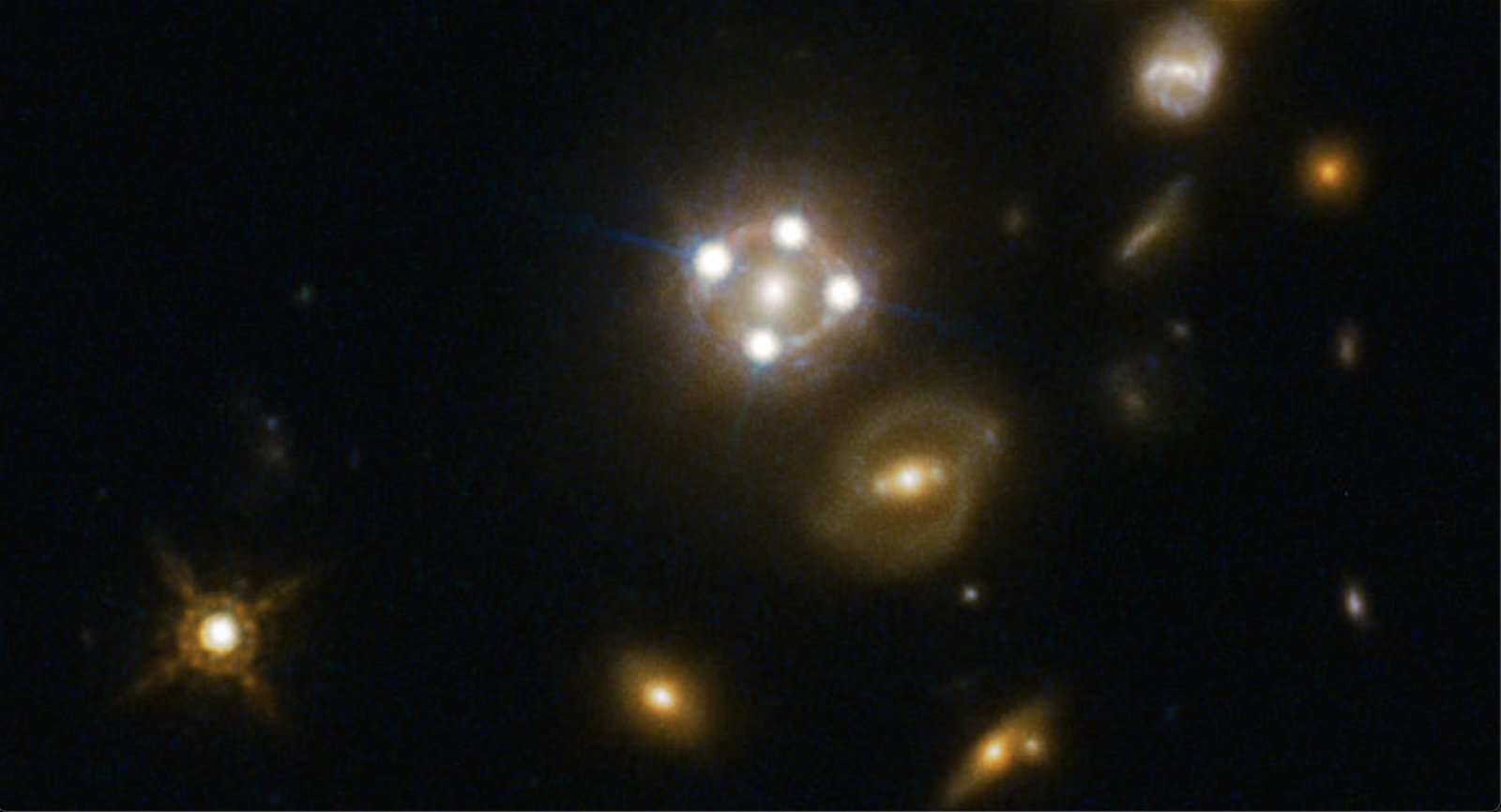
A similar effect, known as an “Einstein cross,” produced the even more unusual appearance of multiple objects surrounding a nearer, massive source of lensing.
An example of an Einstein cross produced by gravitational lensing (Image Credit: ESA/Hubble, NASA, Suyu et al.)
Under most conditions, these objects remain static and can be observed indefinitely. However, in 2019, something very different happened. The light from the star observed in the Large Magellanic Cloud was apparently only subjected to lensing for a short amount of time, meaning that whatever the massive “Phoebe” object was that caused the effect had been in transit.
Possible Explanations
The discovery was revealed as astronomers from Swinburne University in Melbourne spotted Phoebe in the data for a high cadence survey being conducted of the satellite galaxy in question. Now, in a new paper, they propose three possibilities for the mystery object.
One involves a free-floating planet somewhere within the Milky Way, something astronomers also occasionally call “rogue planets.” These cosmic loners come to exist when a planet is ejected from its host system, leaving them to drift through space as lonely planetary wanderers.
Another possibility the team proposes is that the same thing could be going on within the Large Magellanic Cloud itself: a rogue planet originating from that galaxy might have passed in front of the star. If this were ever confirmed, it would mark a notable first, as it would confirm the only extragalactic microlensing planet ever observed by astronomers.
However, a third possibility involves something more unusual: the presence of a primordial black hole, whose origins could go all the way back to the moments immediately after the Big Bang.
Searching for Clues
A major clue to solving the mystery involves the fact that the event took place over just one hour. Given the short duration, it seems most likely that the object was relatively small and therefore able to complete its transit in a short amount of time.
Such a short duration presents challenges for astronomers, since it rests at the threshold of detectability, although the team was able to extract enough information that they could calculate the rough mass of the object, which they believe to have been roughly four times the mass of the moon.
So whatever the object was, it was probably also too small to have been a planet, and also far too small for a normal black hole—the kind produced as a result of stellar collapse—to qualify.
The same couldn’t be said for a primordial black hole, however. Based on additional calculations, the team was also able to demonstrate that Phoebe most likely represents a dark matter object, by around five orders of magnitude greater than other possibilities they looked at.
Overall, this reveals that Phoebe could potentially be one of the oldest objects astronomers have ever spotted, since if its identity as a primordial black hole holds, that would mean its origins go all the way back to the genesis of our universe as we know it.
So based on the team’s work, a star’s mysterious brightening for just one hour in late 2019 might have been even more than an unusual astronomical one-off event: it may have offered us a glimpse at one of the oldest objects in the universe.
Micah Hanks is the Editor-in-Chief and Co-Founder of The Debrief. A longtime reporter on science, defense, and technology with a focus on space and astronomy, he can be reached atmicah@thedebrief.org. Follow him on X @MicahHanks, and at micahhanks.com.
The Sun is experiencing long-term changes, as revealed by an international team of researchers led by the University of Birmingham, who have identified a major squeeze in the four most recent solar activity cycles.
A recent paper in the Monthly Notices of the Royal Astronomical Society by the University of Birmingham-led team reveals that Solar magnetic activity is now being forced into a shallow layer of the Sun, just beneath the solar surface, marking a major change to our host star’s active biorhythm.
The Sun’s 11-year cycles of activity range from a low ebb to robust periods, producing explosive events such as highly charged particle ejections and coronal mass ejections, which are major drivers of dangerous space weather.
Inside the Sun
Below the solar surface, processes generate the Sun’s magnetic field, which drives the solar cycles, which in turn drive space weather. Space weather can be extremely hazardous to the electronic and communications infrastructure we rely on, both in space and on Earth’s surface, including GPS systems and the power grid. Therefore, as our reliance on that infrastructure grows, accurately predicting space weather has become an increasingly important concern.
Scientists have primarily used external markers, such as sunspots, to track solar activity, but, like in any system, much of what drives the Sun occurs beneath the surface. To pierce the solar veil, the researchers have adopted a technique called helioseismology, which allows them to listen to small sound waves from inside the Sun. These waves reveal minute changes beneath the surface, providing a very different understanding of the most recent solar cycles than what could be observed from external markers.
A History of the Sun
The research relied on nearly four decades of helioseismic data collected by the Birmingham Solar Oscillations Network (BiSON) of six telescopes located around the globe. Finally, researchers had sufficient historical data on the Sun’s inner workings to conduct a lengthy study of how these workings have changed over time.
In their analysis of that data, the international team identified a slow but growing change in the structure of the Sun’s interior, occurring across multiple cycles.
“The Sun has its own ‘active biorhythm’ creating rising and falling magnetic activity that shapes space weather,” said lead author Professor Bill Chaplin, from the University of Birmingham. “However, traditional surface measures don’t capture the full story – that the Sun may be entering a different mode of behavior unfolding over decades.”
“We have uncovered evidence of systematic changes in the solar activity cycle,” Chaplin added. “Crucially, magnetic activity is becoming more tightly confined near the surface with each cycle. This is the first such discovery and would have been impossible without the long BiSON observations.”
A Deeper Look
From 1987 through 2025, during cycles 22-25, shifts in p-mode oscillations driven by magnetic activity revealed internal changes in the Sun. The team identified three different groups of oscillations, marked by the low, medium, and high-frequency bands, each penetrating the solar surface to a different depth. Compared with traditional external markers, the data revealed three unique elements.
Since cycle 23, oscillation frequencies and external markers have begun telling very different stories, indicating major changes in the Sun’s internal workings. As time goes on, more and more of the changes are occurring near the surface, at depths of less than 1,000 kilometers. In the most recent cycle, 25, helioseismic data are giving off much stronger indications of this activity than surface markers.
According to the researchers, weakening magnetic fields cannot account for the changes observed, suggesting a major structural reorganization beneath the Sun’s surface.
The team says that continuing exploitation of the BiSON data into cycle 26 will be essential to determining whether this indicates a sustained change in solar activity.
Ryan Whalen covers science and technology for The Debrief. He holds an MA in History and a Master of Library and Information Science with a certificate in Data Science. He can be contacted at ryan@thedebrief.org, and follow him on Twitter @mdntwvlf.
Their findings were published in Communications Earth & Environment, and the discovery suggests that asteroid impacts, often linked to mass extinctions, may also have supported the development of early oxygen-producing life.
The Importance of Stromatolites
Stromatolites are layered rocks made by microorganisms, such as cyanobacteria, which produce oxygen through photosynthesis. Fossilized stromatolites are at least 3.5 billion years old and are some of the earliest evidence of life on Earth.
Scientists think these microbes were central to the Great Oxidation Event, which occurred about 2.4 billion years ago and led to a lasting increase in atmospheric oxygen levels. Learning where and how early stromatolites lived could help explain how Earth became habitable.
The KIGAM team discovered several stromatolites in the northwestern part of the Hapcheon crater, each measuring about 10 to 20 centimeters across. This is the first time that these types of formations have been found at this location.
Life from the Crater
The team suggests that the stromatolites developed in a hydrothermal lake that formed after the asteroid impact. The impact generated enough heat to melt surrounding rock and keep the water warm and rich in minerals for an extended period. These conditions would have supported the growth of early microbial communities.
Geochemical analysis supports this explanation. The stromatolites contain material from both the asteroid and local rock, in addition to signs of changes caused by heat and water. The inner layers show the most evidence of hydrothermal activity, suggesting they formed when the lake was hottest and continued to grow as it cooled. The combination of heat, minerals, and chemical energy found in hydrothermal environments is favorable for microbial life.
Radiocarbon dating of charcoal in the impact breccia shows that the Hapcheon impact occurred about 42,300 years ago. This is much more recent than the geological events usually linked to early life. The researchers frame the crater as a local example of a post-impact environment that was likely common during Earth’s early history.
“This is the first comprehensive evidence suggesting that stromatolites could form in hydrothermal lakes created by asteroid impacts,” said lead author of the study Dr. Jaesoo Lim. “Such environments may have provided favorable conditions for early microbial ecosystems.”
Oxygen Oases Before Atmospheric Oxygen
The implications may extend far beyond a single crater. During Earth’s early history, asteroid impacts occurred far more frequently. If each impact produced a warm, mineral-rich lake where oxygen-producing microbes could flourish, then these craters may have served as isolated ‘oxygen oases’ long before the atmosphere as a whole became oxygen-rich.
The researchers suggest these localized pockets of biological activity could have contributed to the gradual buildup that eventually triggered the Great Oxidation Event.
Implications for Martian Life
This new research builds on a 2021 study in Gondwana Research, where KIGAM scientists first confirmed that the Hapcheon crater was formed by an impact. This new study adds a biological perspective, linking the physical effects of the asteroid impact to the development of life.
The research may also apply to life on Mars. The early Martian environment contained water-filled impact craters similar to those on ancient Earth. The researchers suggest that Martian craters could be good places to search for signs of past microbial life. This study now provides a model for what this type of evidence might look like.
Austin Burgess is a writer and researcher with a background in sales, marketing, and data analytics. He holds an MBA, a Bachelor of Science in Business Administration, and a data analytics certification. His work focuses on breaking scientific developments, with an emphasis on emerging biology, cognitive neuroscience, and archaeological discoveries.
When George Mason University scientists ran thousands of virtual simulations looking for the best ways to optimize group dynamics in future Moon bases, including NASA’s planned ARTEMIS mission base facility, they found that smaller crew sizes and longer mission durations adversely affected task completion, whereas shorter missions and frequent astronaut replacement mitigated challenges.
The Moon base simulations also found that extreme events such as moonquakes and radiation exposure increased group stress, resulting in what they described as an “emotional penalty that is applied multiplicatively” to the likelihood that the entire crew would execute the task.
Although the team behind the model reported no scenarios that resulted in a complete Lord of the Flies-level breakdown of crew cooperation, they said that their simulations explored the internal human and external environmental factors “that are more likely to lead to sustainable versus catastrophic scenarios on the Moon in the next couple of decades,” including planned NASA missions to the Moon and Mars as well as the burgeoning commercial space market.
Virtual Astronauts Evaluated on Task Performance
In a published paper detailing the study’s results, the George Mason University team behind the Lunar Base simulations noted that recent technological advancements and the emergence of the burgeoning commercial space industry “have led to substantial leaps in planning for future space missions.”
“The largest planned upcoming mission is the Artemis program, supported by NASA and the international Artemis Accords, which aims to create the first permanent human presence on the Moon and in deep space (the Moon to Mars architecture),” the study authors explain.
While engineers will test and plan for potential equipment failures, the authors also note that the success of any future base on the Moon, Mars, in orbit, or elsewhere in deep space will depend on how well the astronauts interact with each other in an extremely challenging environment. This gap led researcher Raymond Vera and colleagues at George Mason University in Virginia, USA, to develop their agent-based module (ABM) simulation tool for the Lunar Base.
According to the study authors, the model’s main objective is to “simulate a theoretical lunar mission environment” including the primary surface habitat (Moon Base) and the orbiting Gateway station, “for astronauts to perform relevant space mission tasks.”
“The successful completion of the mission is measured by task performance, which is significantly influenced by cognitive skills, psychological state, and interpersonal relationships, in addition to the exogenous factors of the extreme environment,” they explain.
Different Personality Types and Skillsets Improve Simulation Accuracy
To make their simulated astronauts as realistic as possible, the George Mason team said they randomly assigned each one with “DISC personality types” such as dominant, influential, steady, or conscientious. The virtual astronauts were also given different professional skills, physical health parameters, and what the researchers termed “other characteristics.”
With their virtual astronauts programmed and ready, Vera’s team had to create the perfect simulated Moon base, complete with task assignments, base operations requirements, and environmental factors gleaned from previous isolated, extreme environment missions and simulations.
Lunar Base ABM input-output flow diagram. This diagram illustrates the mapping between exogenous parameters (left, in blue), endogenous astronaut and task-related parameters (top and bottom, in red), and the model output indicators (right, in green). The flow of information represents how simulation inputs are processed to generate key performance metrics such as TLX score, coping capacity, tension, and task completion. Image Credit: Vera et al., 2026, PLOS One, CC0 (https://creativecommons.org/publicdomain/zero/1.0/)
“Drawing from the literature on proxy environments (extreme environments on Earth (i.e., Antarctica), space analogs, and past space missions), and on theories of small group complex systems and team science, we created a highly probable representation or simulation of expected social interactions between astronauts, and astronauts with the lunar environment for the Artemis program (i.e., Artemis IV (Lunar Gateway) and Artemis V (Lunar South Pole Base)),” the study authors explained.
Like real humans, the virtual astronauts learned to adapt over time in response to interpersonal dynamics and environmental conditions, becoming more efficient at performing routine tasks. These improvements resulted in the virtual astronauts advancing in skill level over time.
Because the Moon, Mars, and space itself are all challenging environments for humans, Vera’s team periodically introduced ‘extreme’ events into the virtual astronauts’ daily routine. In more basic scenarios, the astronauts had to work together to overcome broken equipment or a malfunctioning rover. During more challenging conditions, the virtual astronauts inhabiting the simulated Lunar Base were exposed to moonquakes and “intense radiation events.”
Thousands of Simulations Including Moonquakes and Radiation Events
First, the researchers noted that “Monte Carlo simulations consisting of tens of thousands of iterations show trade-offs in productivity and psychological well-being.” For example, a subset of the thousands of Moon base simulations involving more mundane tasks was mostly successful, with compatible personality and skill types working together to complete tasks accurately and in a timely fashion.
However, as mission duration became extended, incidents of task failure and virtual astronaut stress increased. To address this issue, a statement announcing the findings noted that “increasing crew size helped to optimize advancement in professional skill levels and boosted chances of teamwork-enhancing personality compatibility.” In short, adding more virtual astronauts with more diverse skills and personality types to the existing group of overworked or overtasked astronauts helped to stabilize the base’s operations.
To evaluate psychological health, the model evaluated coping capacity (the astronaut’s internal emotional state), and group tension defined by the researchers as “interpersonal strain.”
“These factors change over time based on personality interactions, environmental stressors, and unexpected activities,” the researchers explained.
For example, while increased crew size and improved virtual astronaut skills “boosted chances of teamwork-enhancing personality compatibility,” the team found that factors such as “longer mission duration and lack of astronaut replacements” introduced unnecessary psychological stress that “decreased performance on mission tasks” across the entire crew.
When the virtual astronauts experienced more extreme events, such as simulated radiation or moonquakes, they showed increased signs of stress, including reduced coping capacity and higher tension levels. The researchers said this convergence of stresses and reduced coping capacity can add up over time, resulting in an “emotional penalty that is applied multiplicatively to the task execution likelihood.”
“Scenario analysis shows that increasing crew size results in optimizing skill specialization and increasing the chance of teamwork personality compatibility,” the team explained in their findings. “In contrast, prolonged mission durations, higher learning rates, and the absence of astronaut replacements introduces additional psychological stress resulting in a decrease of task performance.”
Human Factors Increasingly Important in the Commercial 21st Century Space Age
The researchers suggested that future efforts could include examining the physiological effects of extended space missions and communication delays with Earth, which can reach several minutes depending on the base’s distance.
When discussing the implications of their work, the team said that using simulations like theirs “demonstrates how agent-based modeling can help mission planners evaluate operational resilience, team structures, and workload dynamics in support of future lunar exploration.”
“As humanity prepares to establish a permanent presence on the Moon, understanding human behavior becomes just as important as understanding engineering systems,” the study authors conclude. “Although human psychology and team science have been crucial for the success of past space missions, from the Apollo program and Skylab to the Space Shuttle (STS) and the International Space Station (ISS), human factors and social behavior will become even more ubiquitous and essential for space missions in the new era of commercial space.”
Christopher Plain is a Science Fiction and Fantasy novelist and Head Science Writer at The Debrief. Follow and connect with him on X, learn about his books at plainfiction.com, or email him directly at christopher@thedebrief.org.
Welcome to this week’s Intelligence Brief… this week, a new report argues that U.S. federal officials are warning about possible concerns over forms of anti-tech extremism in America. In our analysis, we’ll be looking at 1) why some U.S. officials are looking at the potential rise of radical views on technology as a potential security threat, 2) current attitudes toward the regulation of AI by the U.S. administration, 3) the U.S. government’s evolving definitions of domestic terrorism, and 4) some possible real-world examples officials have cited behind their growing concerns.
Quote of the Week
“The chaotic atmosphere that may result from emergent AI technology in the next five years may fuel large-scale protests that devolve into civil unrest and anti-tech violent extremist activity.”
– New York Intelligence and Counterterrorism Bureau Report
If you enjoy the news and perspectives offered by The Debrief, make sure that you aren’t missing our stories by making us one of your “preferred sources” on Google News. You can simply follow this link to add The Debrief to your list of favorites, and you can read more about Google’s preferred sources in our article here.
Get all the latest stories from The Debrief, with more breaking stories at the end of this week’s newsletter.
Is Anti-Tech Extremism on the Rise?
This week, a concerning new report based on Freedom of Information Act Requests and other data has revealed new concerns about what U.S. officials characterize as “anti-technology extremists.”
The concerns were reportedly detailed in more than 1,000 pages of documents originating from the FBI, the U.S. Department of Homeland Security (DHS), and other federal sources, as well as fusion centers—hubs for the sharing of intelligence between federal and state law enforcement agencies—located across the country.
The apparent shift among U.S. officials regarding this alleged concern was first reported by Wired this week, according to records it obtained, marking a growing concern over the potential unforeseen consequences of the proliferation of machine intelligence across various sectors of industry and society.
Military Techno-Industrial Complexities
U.S. federal law enforcement agencies have reportedly expressed concerns about the possibility of anti-AI extremism and potential threats to national security, according to the investigation published by Wired this week.
Citing one report attributed to the New York Intelligence and Counterterrorism Bureau, “The chaotic atmosphere that may result from emergent AI technology in the next five years may fuel large-scale protests that devolve into civil unrest and anti-tech violent extremist activity, especially in large urban areas such as New York City.”
At the heart of much of the issue is the rise of AI implementation under the current U.S. administration, where new efforts to implement machine intelligence in America’s military, as well as within the business sector, are being urged by President Trump.
Experts fear that such factors could become flashpoints amid political tensions, which could help to foment public opposition to AI and its use in government.
For now, the U.S. administration has engaged in little regulation of the technology, and late last year, one Trump executive order specifically focused on removing AI regulations imposed by some states related to security concerns. Trump similarly postponed signing an order that allowed the U.S. federal government early access to new AI models for a period of 90 days before their public release.
Domestic Troubles
Another key factor related to the renewed concerns among U.S. officials involves the recent National Security Presidential Memorandum 7, which outlines new categories associated with threats from groups the administration identifies as holding “anti-Americanism” and/or “anti-capitalist” views.
Such views were reflected in the public version of a new U.S. counterterrorism strategy released earlier this month, which also identifies violent left-wing extremists and anti-fascist groups amid narco-terrorists and terrorists linked to religious extremism.
Amid such shifts regarding ideologies and groups the U.S. identifies as potential security concerns, the notion that anti-AI extremism might be similarly viewed as a focus of law enforcement agencies holds real potential, especially with growing resistance to AI already apparent in various areas of society.
Such concerns stem from a range of issues, including fears related to workforce displacement as more jobs are handled by AI systems, as well as worries about the misuse of AI, or even the potential that it could one day represent an unintended threat to humanity.
Real World Examples?
According to the Wired investigation revealed this week, real-world examples may already be appearing. One involves how the New York Intelligence and Counterterrorism Bureau points to the arrest and trial of Ziz LaSota, a cult group leader who allegedly has radical views regarding AI.
Other examples include fusion centers throughout the nation that are reportedly monitoring various public meetings and events where individuals have expressed skepticism or concern over the proliferation of AI data centers.
The original report by Wired has been made freely available due to its basis on information obtained using FOIA requests, and can be read here.
A major biological surprise has emerged from the heart of the mysterious Himalayas, according to scientists who made the unexpected discovery.
The vast mountain system in southern Asia is renowned for more than just its height—it is also one of our planet’s most under-explored regions in terms of its biological diversity. Currently, scientists estimate that there may be as many as several thousand unknown species awaiting discovery, with an average of more than 30 being discovered each year.
However, a remarkable recent discovery by scientists has revealed not one, but five different previously unknown Himalayan species—all of which were hiding in plain sight.
One of the most venomous snakes known to the region, the Himalayan pit viper, has now been revealed to be an entire species group, rather than just a single species previously recognized in two varieties.
The addition of three previously unknown species to the group now reveals a major biological surprise that has remained unknown to herpetologists—scientists who specialize in the study of snakes—for more than 160 years.
Five Times the Venomous Viper
Although the Himalayan mountains are probably the last place one would expect one of Asia’s most venomous snakes to reside, the Himalayan pit viper has been known to scientists since 1864. Since its discovery, scientists had long assumed it was a single species of snake that was fairly ubiquitous throughout the mountainous region.
Gloydius hindukushensis from northwestern Pakistan, also known as the Himalayan pit viper (Image Credit: Dr. Daniel Jablonski and Dr. Frank Tillack),
The surprise discovery that this species actually represents five distinct varieties of snake, revealed in a recent study that appeared in the open-access journal ZooKeys, upends that presumption.
The study relied on skeletal studies of existing specimens, supplemented by modern genetic analysis. These combined approaches, along with a fresh analysis of the physical traits of the venomous Himalayan reptiles in their natural environment, now reveal a much deeper and more distinctive evolutionary story about these dangerous Asian reptiles.
Hidden in Plain Sight
The recent findings now confirm three species that are entirely new to science, which primarily reside in portions of the mountain range in Pakistan and Nepal, each possessing slightly different skeletal and physical features.
Daniel Jablonski, a researcher with Comenius University Bratislava and an expert who has been studying species in this region for years, says it was no surprise that new species would have been found in the Himalayas.
“These mountain systems still harbor overlooked vertebrate diversity and hold important clues to the biogeography of Asia,” Jablonski said in a statement. What was surprising, however, was that three of these species had been hiding in plain sight, remaining misidentified as known varieties of Himalayan pit vipers.
“By combining modern field sampling with data from historical museum specimens, we uncovered evolutionary lineages that had remained hidden for more than a century after the original description of the Himalayan pit viper,” Jablonski adds.
Museum Discoveries
Based on specimens already being kept in museums—some of them more than a century old—Jablonski and his colleagues were able to reveal the deeper genetic diversity of these snakes, thanks to reexaminations that included the original type specimen of the species collected in the 19th century.
Sylvia Hofmann, a researcher with the Museum Koenig as part of the Leibniz Institute for the Analysis of Biodiversity Change, says that discoveries that significantly advance our knowledge of the natural world often begin with specimens that already exist in museums.
“Museum specimens are not just records of the past. They are active research tools and essential infrastructure for future science,” she says.
Hofman has spent the past two decades working in the Himalayas and the Tibetan Plateau, and is well aware of the kinds of discoveries this rugged part of the world features.
“Some of the key evidence had been sitting in museum collections for more than a hundred years. We just didn’t have the tools to recognize it,” Hofman said in a recent statement. “As analytical methods continue to improve, the scientific value of these collections will only grow and reveal biodiversity we didn’t even know was there.”
More Surprises Could Await
According to the research team behind the discovery, many more discoveries await scientists who are willing to go seeking the evidence.
“Pakistan’s high mountains are still full of biological surprises,” Rafaqat Masroor, a leading herpetologist with the Pakistan Museum of Natural History, said in a statement.
“This finding highlights how little we still know about a region long shaped by socio-political instability,” Masroor added.
Fundamentally, the discovery is significant not just in terms of expanding our knowledge of the natural world, but also because it has implications for conservation efforts in the region.
“Each of the newly recognized species seems to occupy a relatively restricted range in fragile mountain environments, highlighting new ecological and evolutionary questions,” Jablonski said.
The team’s paper, “Integrative taxonomy reveals previously undescribed diversity within the Gloydius himalayanus complex (Squamata, Viperidae, Crotalinae) from the Himalaya and Hindu Kush,” appeared in the journal ZooKeys.
Micah Hanks is the Editor-in-Chief and Co-Founder of The Debrief. A longtime reporter on science, defense, and technology with a focus on space and astronomy, he can be reached atmicah@thedebrief.org. Follow him on X @MicahHanks, and at micahhanks.com.
Physicists with the ATLAS Collaboration report the first observation of an exotic new particle, which could help deepen our understanding of the mysteries surrounding one of the four fundamental forces in physics.
The achievement was revealed recently at the Large Hadron Collider Physics conference, where researchers said the new particle appeared to display properties strongly suggestive of the Bc*+ meson.
This unique particle is theorized to be a variation of the Bc+ meson, albeit in a more excited form. The observation now brings the total number of new particle discoveries by CERN’s Large Hadron Collider (LHC) to 82.
A New Particle Emerges
Both the newly discovered Bc*+ meson is part of the broader family of Bc+ meson particles, which consist of an antiquark at their bottom and an up (B⁺. ), down (B⁰. ), strange (B⁰. ₛ) or charm quark (B⁺. c) in their top position.
Such particles were once relegated only to theory since the top quark’s short lifetime would seemingly prevent their physical existence. However, confirmation of the Bc*+ meson, which possesses a charm quark and a bottom antiquark, could help move physicists closer to understanding the mysterious strong force, which, along with the weak force, electromagnetism, and gravity, constitutes the four fundamental forces of the Standard Model of particle physics.
Even after many decades, physicists remain in the dark about certain characteristics of the strong force, such as how it can bind quarks together.
Particles that consist of heavy quarks offer physicists a promising means of testing a range of theories about how the strong force functions, and Bc+ mesons are of special significance in such efforts since they provide a pathway for physicists to unravel clues to what, precisely, holds these particles together.
The Newest Member of the Bc+ Family
According to a recent CERN news release, the new particle was generated during extremely high-energy proton-proton collisions at the LHC.
Before decaying into a Bc+ meson and a photon, the new particle was successfully observed, albeit briefly. According to CERN researchers, a detection of the photon coinciding with the properties of decay associated with the Bc+ meson could offer a long-sought “smoking gun” that would demonstrate the Bc*+ meson.
A key issue physicists currently face involves the particle’s mass: it is anticipated that the mass of this particle would clock in at only a tiny bit larger than the Bc+ meson. Because of this, the photon that should emanate from the decay at the time of the particle’s generation would possess so small an amount of energy that it would likely be indiscernible using any conventional methods.
To overcome this, researchers tried a different approach: They decided to look within the ATLAS tracking detector for the photon converting into an electron-positron pair. In theory, the ephemeral, closely spaced charged particle “tracks” would be produced as a result of the primary proton-proton collision.
“These tracks can have transverse momenta as low as 100 MeV – significantly lower than those typically studied in ATLAS analyses,” according to the recent statement. “This required researchers to deploy a dedicated track-reconstruction procedure to be able to successfully reconstruct the photons and thus identify the Bc*+ meson.”
Toward a Better Understanding of the Strong Nuclear Force
According to researchers, the differences measured between the masses of the Bc*+ meson and the Bc+ meson are 64.5 ± 1.4 MeV, which falls well within the expected ranges based on current theoretical models.
While falling within expected ranges, ATLAS Collaboration researchers did note that the observed differences differed slightly from current high-precision calculations for these values. Still, the discovery offers more than enough data to assist in broadening current theories and eventually allow physicists to glean new insights into the mysterious strong force.
“This result provides valuable new input for theoretical models describing the masses of particles containing the heavier quarks and will help to improve the understanding of the strong nuclear force,” the researchers said.
Micah Hanks is the Editor-in-Chief and Co-Founder of The Debrief. A longtime reporter on science, defense, and technology with a focus on space and astronomy, he can be reached atmicah@thedebrief.org. Follow him on X @MicahHanks, and at micahhanks.com.

 Login
Login