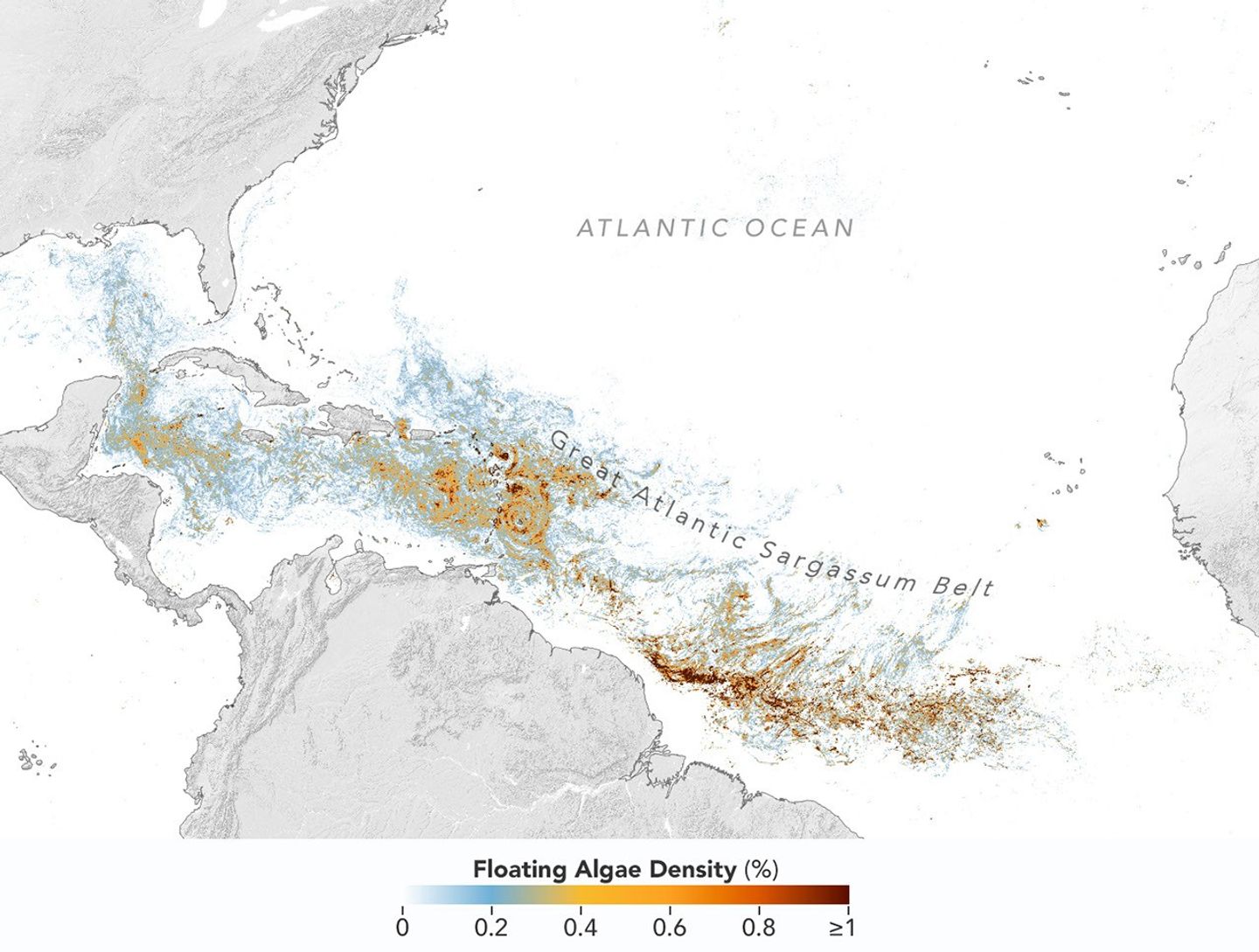
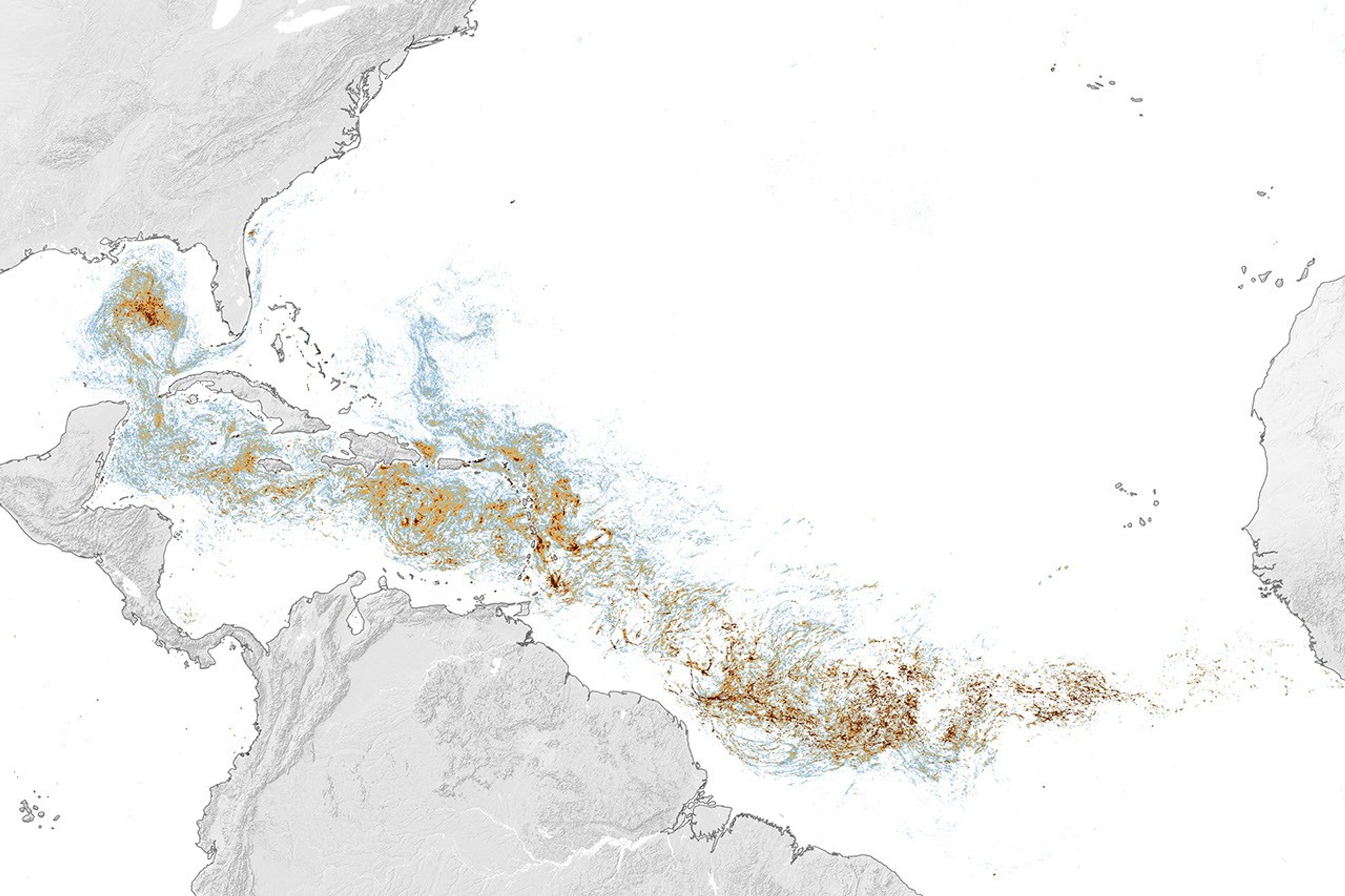
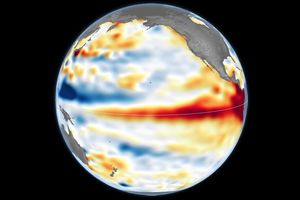
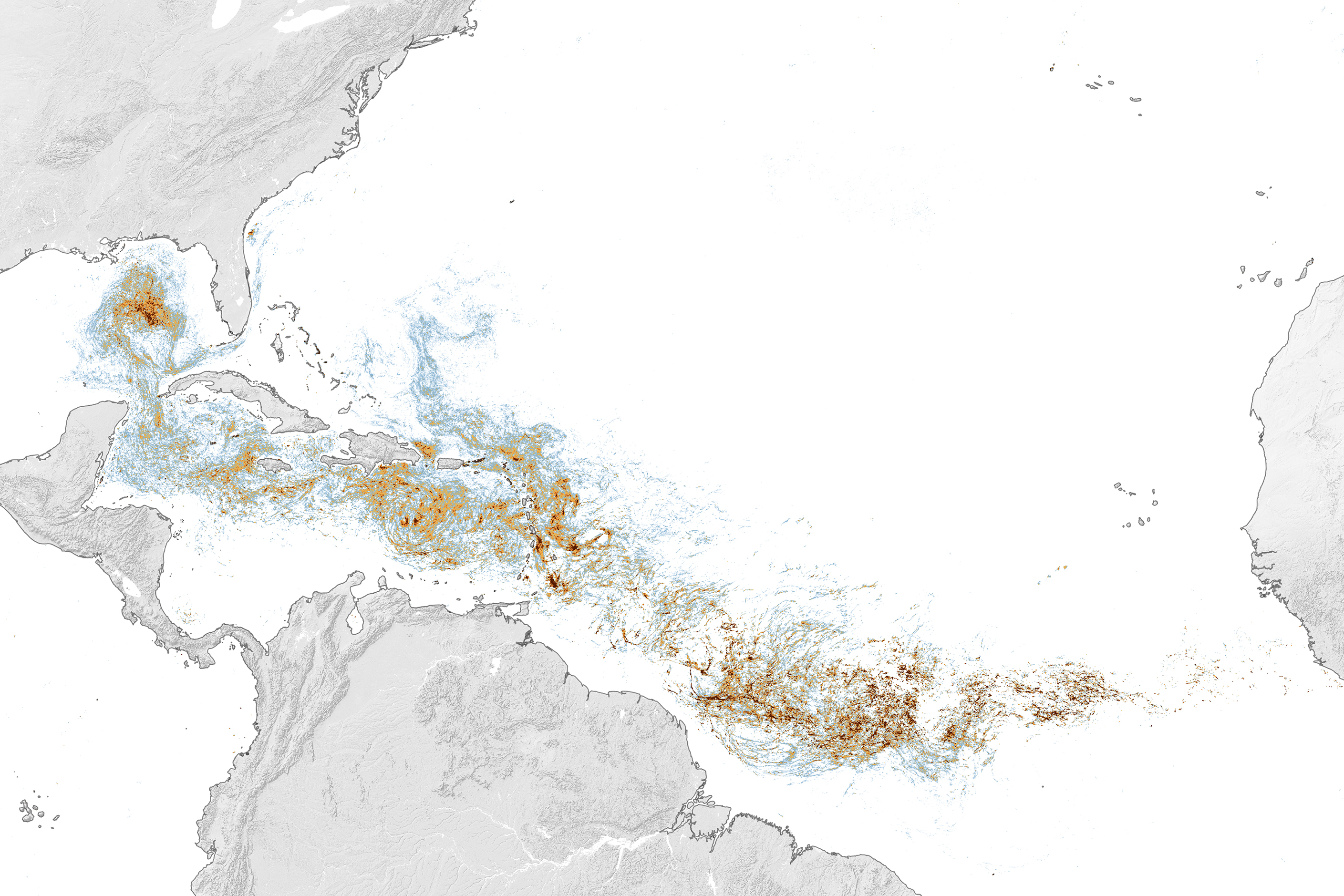
This map, based on data from the OCI (Ocean Color Instrument) on NASA’s PACE (Plankton, Aerosol, Cloud, ocean Ecosystem) satellite, shows Sargassum highly concentrated in the tropical Atlantic in June 2026.
NASA Earth Observatory/Lauren Dauphin
Sargassum, a type of brown floating algae, has shifted its range in recent decades, thinning out in the North Atlantic’s Sargasso Sea while proliferating in the tropical Atlantic. That trend, underway since 2011, continued in 2026 as the algae, commonly known as a type of seaweed, reached its annual peak in June across a stretch of ocean known as the Great Atlantic Sargassum Belt.
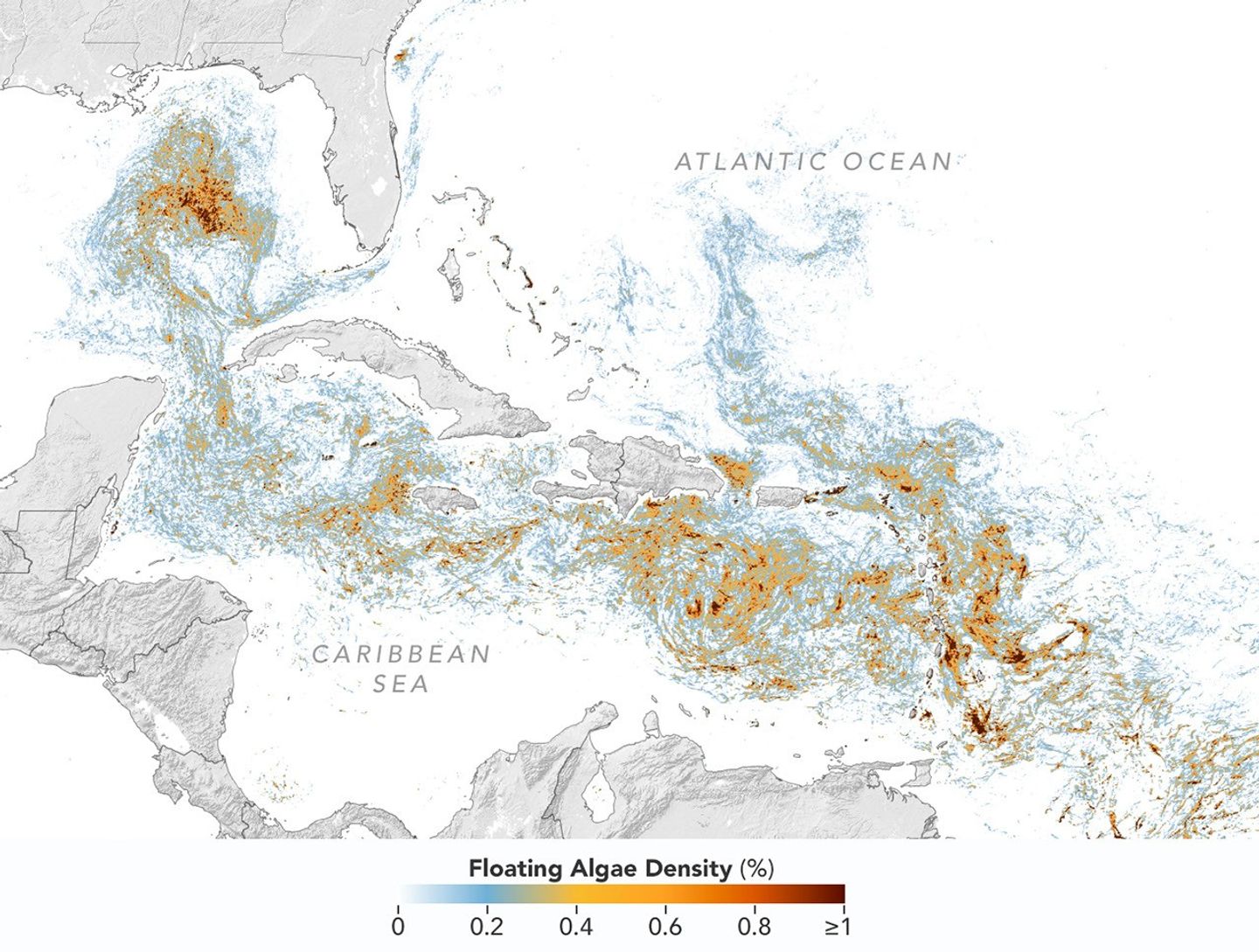
The belt’s Sargassum abundance in June 2026 made it the second-highest Sargassum year in the satellite record, slightly behind 2025, according to scientists at the University of South Florida (USF) College of Marine Science. Regionally, the Caribbean Sea and the Gulf of America (Gulf of Mexico) both hit record highs, according to USF’s June 2026Sargassum outlook. The western and eastern Caribbean saw 3.6 and 9 million metric tons, respectively, while the Gulf saw 5 million metric tons—nearly double its previous record, also set in 2025.
“The belt is a basin-scale phenomenon that can have devastating local-scale impacts throughout the Caribbean and Gulf, and satellite observations are the only method that captures both scales on a daily basis,” said Brian Barnes, a marine scientist at the Optical Oceanography Laboratory at USF. “The tracking done by our lab helps communities know the current extent of Sargassum and prepare for what’s to come.”
In moderate amounts in the open ocean, Sargassum provides habitat for turtles, invertebrates, fish, and birds, and adds oxygen to the water through photosynthesis. But too much of it near shore can tangle and suffocate marine life, and mats that sink can smother corals and seagrasses. On beaches, decomposing Sargassum releases hydrogen sulfide, a rotten-egg-smelling gas that’s a potential problem for both ecosystems and tourism.
The map above shows Sargassum density in the tropical Atlantic Ocean in June 2026. Red and orange areas are where Sargassum densities were the highest. Note that although the “belt” appears continuous, discrete Sargassum mats are scattered across the ocean surface. The map is based on satellite measurements of how much of the ocean surface was covered by the seaweed, averaged per pixel across all observations made in June by the OCI (Ocean Color Instrument) on NASA’s PACE (Plankton, Aerosol, Cloud, ocean Ecosystem) satellite.
This detailed view of the same PACEOCI map highlights Sargassum concentrations across the Caribbean Sea and Gulf of America, both of which saw record-high amounts of the floating algae in June 2026.
NASA Earth Observatory/Lauren Dauphin
Ocean currents and winds shape the Sargassum belt, which, despite the patchiness, stretches nearly continuously from West Africa to the Gulf and holds a fairly steady “width” from the western tropical Atlantic westward, explained Chuanmin Hu, also an optical oceanographer at USF. The ocean currents have also spared Florida’s west coast from inundation this summer, while delivering large amounts of seaweed to the Florida Keys and the state’s east coast. The bulk of the Sargassum, however, is visible in the Caribbean Sea, shown in detail above, where problems associated with inundation have been more severe, Hu said.
Data for the maps were provided by Lin Qi, an oceanographer at NOAA’s Center for Satellite Applications and Research, who has been working to generate Sargassum maps based on data from PACE, which was launched in February 2024. The work extends that of Qi and colleagues at USF’s Optical Oceanography Laboratory. This team first developed Sargassum detection techniques using MODIS (Moderate Resolution Imaging Spectroradiometer) on NASA’s long-running Terra and Aqua satellites and VIIRS (Visible Infrared Imaging Radiometer Suite) on the NOAA-20 satellite—data that have been a key component of USF’s Sargassum Watch System and of research into the seaweed’s longer-term trends.
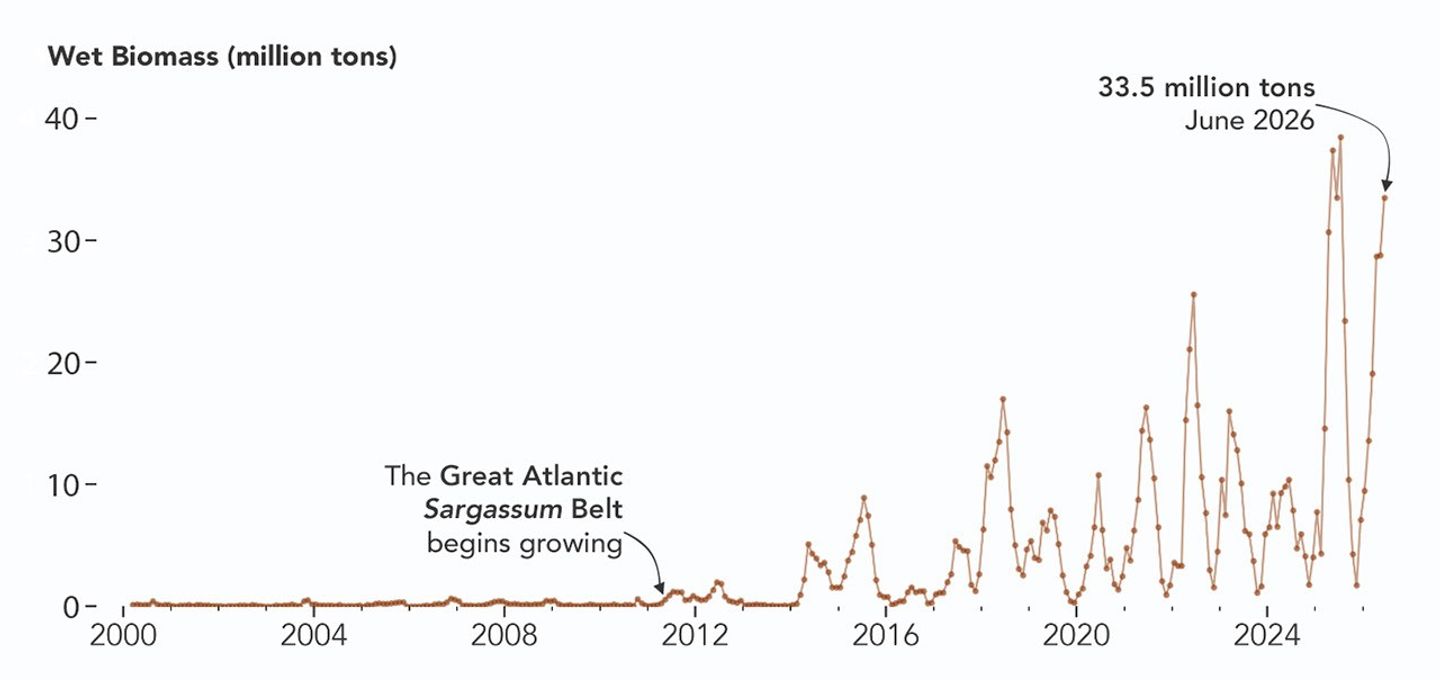
Satellites detect Sargassum by its signals in reflected sunlight. Because of its plant structure and chlorophyll pigments, Sargassum reflects more near-infrared light than water. Scientists flag pixels where the reflectance spikes above the levels produced by plain seawater, and then they use the strength of this spike to estimate Sargassum density, which refers to the fraction of ocean surface covered by the seaweed in each pixel. Density estimates can then be converted into biomass, or the total weight of Sargassum present within a pixel, which is how the longer-term trends in the chart below are tracked.
NASA Earth Observatory/Lauren Dauphin
The chart above uses the continuous MODIS record since March 2000 to show how Sargassum biomass across the Great Atlantic Sargassum Belt has changed through June 2026. Notice the uptick beginning around 2011, when the belt was first developing, and the seasonal dips in winter and peaks in spring and summer. The record high in July 2025 stands out, followed by the quick rise in early 2026—especially in the first four months of the year—that culminated in the year’s peak in June. More recent observations, not yet reflected in the chart, indicate Sargassum biomass declined through the following month of July.
“Since the initial appearance of the Great Atlantic Sargassum Belt in 2011, the total Sargassum amount in the Atlantic Ocean has increased substantially, more than doubling every five years,” Hu said. He added that the exact mechanism is still being investigated, but it’s possibly related to ocean warming, multiple nutrient sources, and the fact that large Sargassum mats attract other organisms—such as nitrogen-fixing bacteria—that can supply additional nutrients to sustain further growth.
Alongside data from MODIS and VIIRS, OCI data from PACE now feeds into the Sargassum Watch System’s near-real-time daily and weekly composite maps. A recent study of the central-west Atlantic led by Qi, spanning May through August 2024, found that OCI offers several advantages over its predecessors, observing more of the ocean and detecting Sargassum with greater sensitivity.
Hu noted that the added pixels from OCI can improve near-real-time monitoring and analyses of short-term fluctuations. And its higher sensitivity, he said, will also lead to improved maps during winter months, “thus helping understand Sargassum changes over time.”
Additionally, the study’s authors found that OCI’s hyperspectral capability makes it the only sensor able to spectrally discriminate Sargassum pixels across the Atlantic Ocean “without ambiguity,” adding confidence to the interpretation of detected image features—especially in parts of the Atlantic where another type of floating algae, Trichodesmium, has been reported.
“I think I can speak for all project members, past and present, in sharing how rewarding it is to see the promise of PACE’s advancements come to life,” said Jeremy Werdell, PACE project scientist at NASA’s Goddard Space Flight Center. “OCI has started a true renaissance in aquatic ecosystem monitoring from space.”
NASA Earth Observatory maps and chart by Lauren Dauphin, using PACE and MODIS data courtesy of Lin Qi (NOAA), and Brian Barnes and Chuanmin Hu (University of South Florida, Optical Oceanography Laboratory). Story by Kathryn Hansen.
Your free account is confirmed. You now have access to advanced-packaging analysis, teardown highlights, and Insightful Chat.
The shift to chiplets, HBM, 2.5D and 3D stacking is changing how the industry builds compute. Inside the Platform, you can explore the packaging technologies behind today’s leading AI accelerators, HPC designs, and flagship SoCs.
See how China's RF front-end industry is advancing acoustic wave filter capabilities and what TechInsights' analysis reveals about OnMicro's capabilities.
TechInsights analyzes the Apple M5 Pro APL1X15 package, revealing TSMC SoIC-X F2F hybrid bonding, CPU and GPU chiplets, silicon interposer routing, and verified die costs.
Fabs Unpacked | Advanced Packaging, Chiplets, HBM & 3D StackingJWinters
Advanced packaging, unpacked
Fabs Unpacked
AI's compute demand broke the monolithic die. Register for the TechInsights Platform for analysis on chiplets, HBM, and 3D stacking — and ask Insightful Chat your own questions.
The chips behind AI aren't shrinking. They're stacking. AI broke the monolithic die. Advanced packaging is putting compute back together.
Free sign-in is required. Your question carries into the Platform.
On the surface
AI needs more compute.
The industry is no longer solving performance with a single larger die.
The real story
Performance moved into the package.
Chiplets, 2.5D and 3D stacking, hybrid bonding, and HBM are now the architecture decisions shaping AI and HPC silicon.
Why this matters
How advanced packaging is powering the AI and HPC era
Compute demand has outrun the single die. Register for the TechInsights Platform to get analysis on how chiplets, 3D stacking, and high-bandwidth memory are re-architecting the industry's flagship silicon, or ask Insightful Chat your own question right now.
Chiplets
How leading designs partition compute across chiplets, and the trade-offs in cost, yield, and performance.
Memory
Why HBM sits at the center of the AI memory wall, and how it reshapes the package.
Integration
2.5D, 3D stacking, and hybrid bonding: the techniques moving from roadmap to production.
Deep Dive Teardowns
The latest flagship silicon reveals where packaging is headed: AI accelerators and the newest PC and mobile SoCs.
Insightful Chat
Have a question? Ask it now.
Insightful Chat is the TechInsights Platform's AI assistant, grounded in our semiconductor analysis. Pick a question to open it in the Platform and get an answer straight away.
Clicking a question opens Insightful Chat in the TechInsights Platform. Free sign-in is required to use Insightful Chat, please register using the form below or sign in before continuing.
By submitting this form, you consent and agree to the creation of a TechInsights Platform account and agree to the terms of the End User License Agreement and Privacy Policy. You will also receive communications related to your account and the related report recommendations.
See how China's RF front-end industry is advancing acoustic wave filter capabilities and what TechInsights' analysis reveals about OnMicro's capabilities.
TechInsights analyzes the Apple M5 Pro APL1X15 package, revealing TSMC SoIC-X F2F hybrid bonding, CPU and GPU chiplets, silicon interposer routing, and verified die costs.
Smoke pours from dozens of large fires in Oregon in this image captured by MODIS (Moderate Resolution Imaging Spectroradiometer) on NASA’s Aqua satellite on July 26, 2026.
NASA Earth Observatory/Michala Garrison
Dry thunderstorms that popped up over the Cascade Range on the evening of July 15, 2026, peppered Oregon and Washington with thousands of lightning strikes as they moved east across the states. By the following day, NASA satellites had begun to detect large numbers of wildland fires burning throughout central and eastern Oregon.
Though initially small, these blazes strengthened as they were fanned by gusty winds and raced through landscapes parched by extreme drought and baking in summer heat. When NASA’s Aqua satellite captured the image shown above on the afternoon of July 26, smoke poured northeast from dozens of large fires that had collectively charred hundreds of square miles. The fires produced a blanket of haze, prompting state officials to issue air quality advisories for eastern Oregon.
Many communities faced evacuation orders as more than 10,000 firefighters battled wildfires throughout the state. On the day the image was captured, the largest active fires were the Hay Creek Complex, Brewer, Big Grass, Akawa Butte, and Powder River fires. Several of these blazes were less than 5 percent contained, according to the National Interagency Fire Center. State officials invoked Oregon’s Emergency Conflagration Act to protect communities as they responded to particularly threatening fires such as the Shingle, Bench, Beachcomb, and Second Flat fires.
Government satellite data are part of a global system of observations used to track fire behavior and analyze emerging trends. Among the real-time wildfire monitoring tools that NASA makes available are FIRMS (Fire Information for Resource Management System), the Worldview browser, and the Fire Event Explorer.
As of July 27, 2026, fires in Oregon had burned more than one million acres, according to news outlets. Meanwhile, the National Interagency Fire Center reported that fires had burned more than 4 million acres across the United States. The 10-year average (2016-2025) for this point in the season is 3.4 million acres.
NASA Earth Observatory image by Michala Garrison, using MODIS data from NASA EOSDIS LANCE and GIBS/Worldview.Story by Adam Voiland.
NASA Science Soars During August Total Solar Eclipse
Each time the Moon covers the Sun during a total solar eclipse — darkening daytime skies and briefly revealing the Sun’s ethereal outer atmosphere, the corona — it presents new opportunities to better understand our star and its influence on Earth.
On Wednesday, Aug. 12, as the next total solar eclipse sweeps over Greenland, Iceland, and Spain, NASA-funded science teams will be chasing the Moon’s shadow with a high-altitude jet and scientific balloons to investigate the Sun’s dynamics and how the temporary darkening of our skies affects our atmosphere.
“From our unique perspective on Earth during a total solar eclipse, scientists can study the Sun’s corona in a way we can’t from anywhere else in the solar system,” said Kelly Korreck, eclipse program manager at NASA Headquarters in Washington. “The Sun impacts our daily life, satellites, and astronauts in space, and we can take advantage of this moment to advance our understanding of that influence.”
High-flying jet to record solar dynamics
Soaring in the nose cone of NASA’s WB-57 high-altitude research aircraft is a suite of four cameras to take high-resolution images of the corona in several different wavelengths of visible and infrared light. Part of an instrument developed by the NASA Scientifically Calibrated In-Flight Imagery (SCIFLI) team at NASA’s Langley Research Center in Hampton, Virginia, the cameras will capture at least 20 images per second, recording structures, outflows, and rapid changes in the corona during the total solar eclipse.
With these images, scientists hope to learn more about the formation of prominences (solar material that gets suspended above the Sun’s surface), better understand the corona and how it gets heated to nearly a million degrees, and investigate how material in the corona and the solar wind are related, which flows out from the Sun across the solar system.
These images of the corona and solar prominences were taken in different wavelengths of visible and infrared light by imagers aboard a NASA’s WB-57 jet during the April 8, 2024, total solar eclipse. The same cameras will fly on a NASA WB-57 jet again during the Aug. 12 eclipse.
NASA / SwRI / William Ashfield
By chasing the Moon’s shadow, the jet will extend how long the cameras can observe the corona. On the ground, the longest anyone will be able to see the corona is two minutes and 18 seconds. But flying along the eclipse path at 460 miles per hour, the jet’s view of the corona will last nearly three minutes.
NASA’s WB-57 will fly at 50,000 feet, above any clouds that might obscure the view of the corona from the ground. The altitude also allows the cameras to observe some infrared wavelengths that get absorbed by the lower atmosphere before reaching the ground, and the corona only has been observed in those wavelengths a few times before.
One of NASA’s WB-57 high-altitude jets will carry a suite of cameras up to 50,000 feet to capture images of the solar corona during the Aug. 12 total solar eclipse.
NASA
The instrument, called SCIFLI Multispectral Airborne Imager, or SAMI, also flew on a WB-57 during the total solar eclipse on April 8, 2024, providing valuable imagery and information about the corona. However, the study’s principal investigator, Amir Caspi of the Southwest Research Institute in Boulder, Colorado, says each total solar eclipse provides new opportunities to learn more about the corona.
“The Sun is always changing,” Caspi said. “Every eclipse is different. So we could see things we didn’t see before. And we learn from each eclipse how to better observe the next one.”
Caspi’s team also is making some enhancements for the 2026 campaign based on lessons learned in 2024. For example, the team will adjust exposure times to better capture bright features that were overexposed in 2024 imagery. They will also leverage software developed since 2024 to process and analyze the data sooner than before.
The experiment is funded by NASA’s Heliophysics Low Cost Access to Space Program.
As a total solar eclipse crosses Russia, Greenland, Iceland, Spain, and Portugal on Aug. 12, 2026, some of the best views will come from 50,000 feet up, aboard NASA’s WB-57 jet. Credit: NASA’s Goddard Space Flight Center
Balloons to watch atmospheric changes
When a total solar eclipse suddenly turns daytime skies dark, our atmosphere changes in ways we don’t yet fully understand.
The NASA-supported Nationwide Eclipse Ballooning Project, led by Angela Des Jardins at Montana State University, is sending students from several U.S. universities to Iceland and Spain to launch scientific balloons before, during, and after the eclipse to better understand those changes.
A student team from the University of Kentucky prepares to launch a ballon from Bloomington, Indiana, to take atmospheric measurements on April 8, 2024, during the 2024 Nationwide Eclipse Ballooning Project campaign.
Sean Bailey (University of Kentucky)
In Iceland, two teams will launch a total of 80 balloons starting 18 hours before the eclipse until eight hours afterward to study how the eclipse affects Earth’s “boundary layer,” the part of the atmosphere that touches the ground. The thickness of the boundary layer changes depending on factors such as surface temperature and moisture in the air.
Previous balloon flights during solar eclipses in October 2023 and April 2024 showed that the boundary layer collapsed, or decreased in thickness, in locations with clear skies but not where there were cloudy skies. Scientists wonder whether that will be different in Iceland in 2026. Changes in the boundary layer are driven by the day-night cycle. However, in Iceland in August, the days are long and nights are short, so the nighttime influences might not be as strong as in 2023 or 2024.
“Will this eclipse be able to collapse the boundary layer?” said Matthew Bernards, a chemical engineering professor at the University of Idaho, who leads one of the Iceland teams.
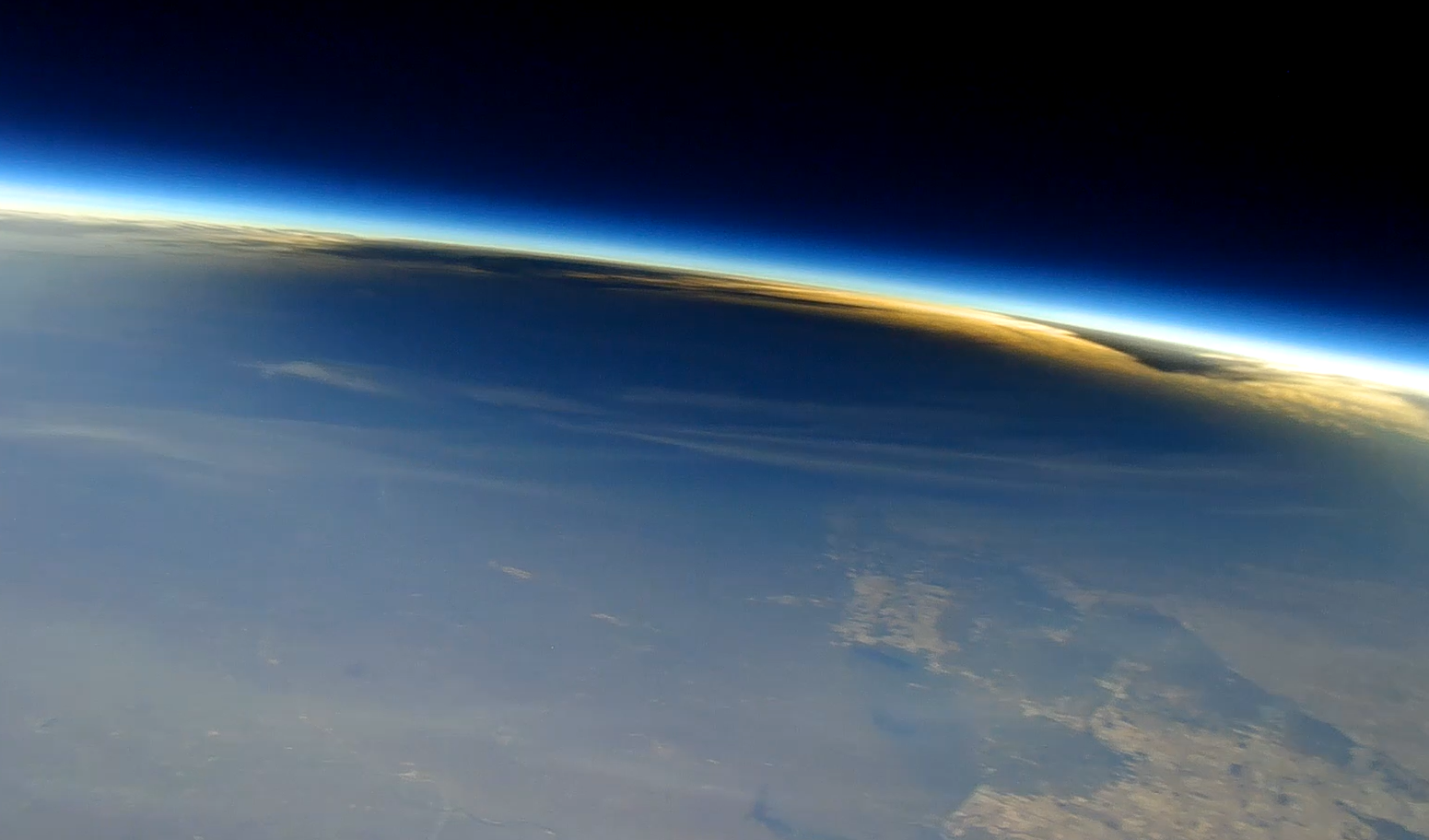
This image shows the Moon’s shadow on Earth during the total solar eclipse on April 8, 2024, as seen from about 90,000 feet from a camera carried by a scientific balloon. Cameras carried by balloons launched from Spain will capture similar images during the Aug. 12 total solar eclipse.
In Spain, three balloon teams will launch a total of six balloons with 360-degree cameras to image the eclipse shadow from above. These balloons also will include instruments designed to measure levels of ozone in the atmosphere, which requires sunlight to form. Similar balloon experiments showed that ozone decreased during totality in April 2024. Scientists wonder whether there will be differences with this eclipse, particularly since it happens at a later time of day and during a different season.
The NASA-funded Nationwide Eclipse Ballooning Project will allow teams of students from across the U.S. to get a unique view of the August total solar eclipse with scientific balloons. Credit: NASA’s Goddard Space Flight Center
Follow along
While the total solar eclipse won’t be visible in the U.S., some parts of the country will be able to see a partial solar eclipse. Learn more about where to see the eclipse and how to view it safely.
by Vanessa Thomas NASA’s Goddard Space Flight Center, Greenbelt, Md.
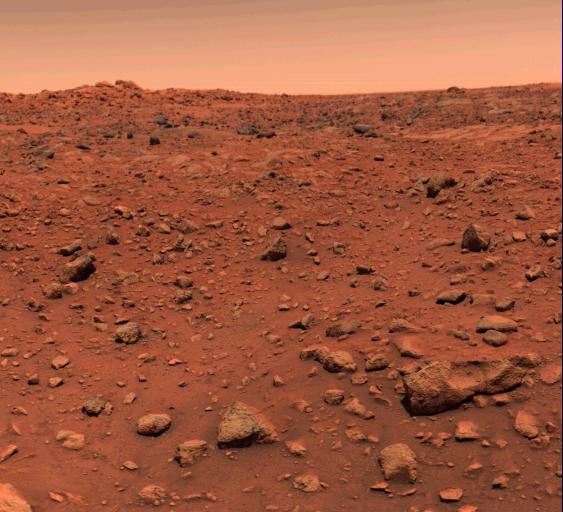
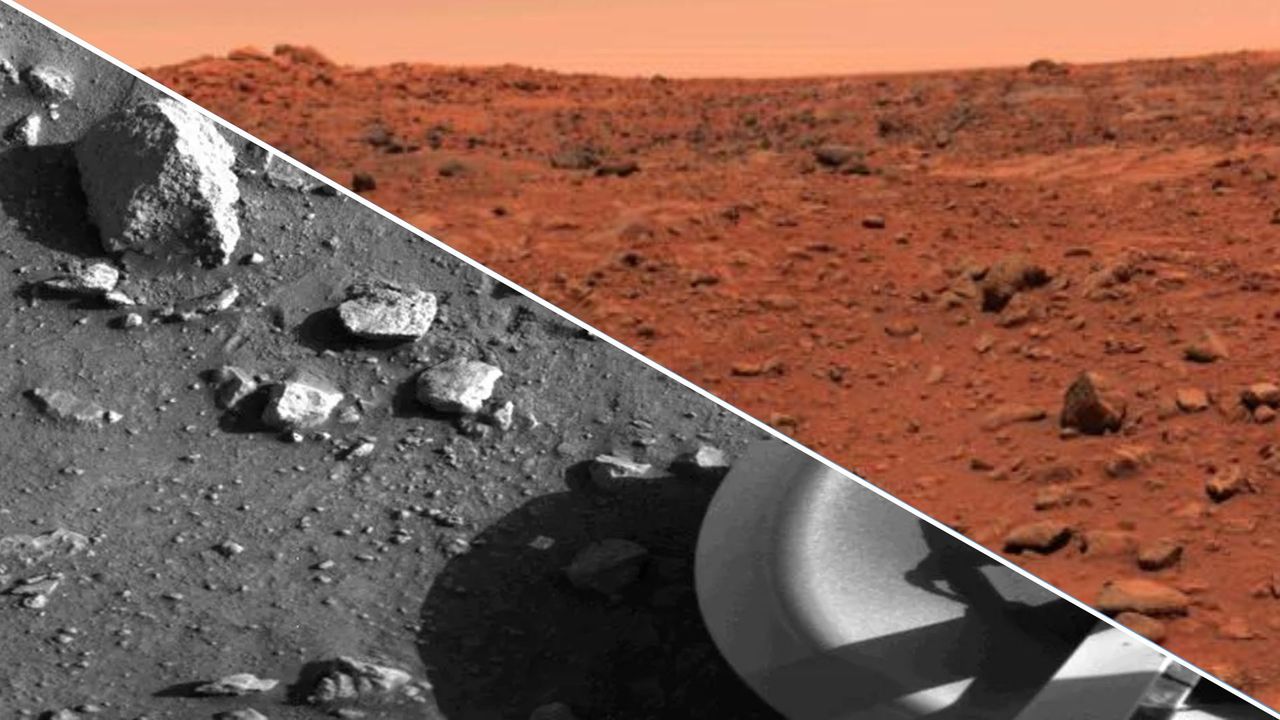
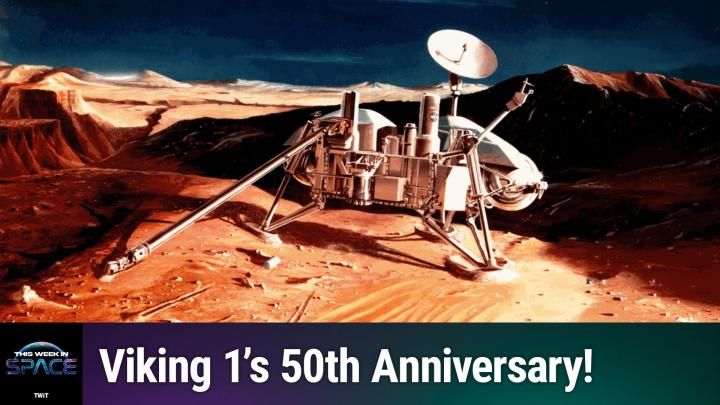
About 40 minutes after it landed on Mars on July 20, 1976, NASA's Viking 1 lander sent this first photo from the surface of the Red Planet. (Image credit: NASA/JPL)
Quick facts
What it is: The surface of Mars
Where it is: 189 million miles (305 million kilometers) from Earth
When it was shared: July 20, 2026.
For thousands of years, humans looked at Mars and wondered what lay on its surface. Fifty years ago this week, we finally found out when NASA's Viking 1 became the first spacecraft ever to land on the Red Planet and transmit images from its surface. It was humanity's first view from the surface of another planet.
Viking 1 had been programmed to take its first image just 25 seconds after touchdown, according to NASA. It occurred at 7:53 a.m. EDT on July 20, 1976 — exactly seven years after Apollo 11 landed on the moon. It was supposed to coincide with the U.S. Bicentennial on July 4, 1976, but the landing was delayed by the search for a flat landing zone.
Although the spacecraft landed safely at Chryse Planitia, north of the equator, mission controllers still had to wait another 19 minutes for the radio signal confirming success to cross the 212 million miles (340 km) between Mars and Earth.
Forty minutes after touchdown, the confirming image began appearing on monitors at NASA's Jet Propulsion Laboratory, slowly building line by line from left to right. Dr. Thomas Mutch, leader of the Viking lander imaging team, never forgot the moment.
"I studied the black screen, waiting for that narrow strip that will signal the first few lines of the first picture," he said. "Rocks and sand are visible and — finally at the far right — one of the spacecraft foot pads, a symbolic artifact that stamps our accomplishment with the sign of reality … Time and time again I repeat, 'It's incredible.'"
The image revealed a solid, slightly rocky surface, with dust and pebbles thrown up by the landing already settling back onto the spacecraft. Viking’s first color image came the next day, with a panorama following a few days later.
The first color image taken by the Viking I Lander in 1976. (Image credit: NASA)
The Viking mission consisted of four spacecraft: two orbiters and two landers. Viking 1 was joined six weeks later on the surface by Viking 2, which landed in Utopia Planitia, also in the northern hemisphere. Meanwhile, the two orbiters mapped Mars and relayed data — including more than 52,000 orbital images and 4,500 photographs from the surface — back to Earth.
Viking transformed our understanding of Mars, but its most intriguing scientific result remains unresolved. The landers carried the first experiments designed to detect life directly in Martian soil. Although the mission's official conclusion was that no convincing evidence of life had been found, some scientists have continued to argue that one of the experiments produced a genuine biological signal; others argue that Viking’s experiments destroyed the very evidence of life that they sought to prove. Discoveries by later missions — including organic molecules detected by Curiosity and perchlorate salts found by Phoenix — have prompted some researchers to revisit the Viking data.
Viking 1 fell silent in 1982, two years after Viking 2, following a software error during an update. The intrepid spacecraft showed us the surface of another planet for the first time, but whether Viking 1 also found the first hints of life off-Earth remains one of planetary science's most enduring mysteries.
What do you know about the Red Planet? Test your knowledge with our Mars quiz!
O Apple TV divulgou hoje o aguardado trailer da quarta temporada de “Ted Lasso”, cujo primeiro episódio estreará no dia 5 de agosto (quarta-feira da semana que vem).
Com um total de dez episódios, os nove capítulos remanescentes chegarão ao catálogo do streaming da Maçã às quartas-feiras, até o dia 7 de outubro.
Eis o trailer:
E também a versão dublada em português do Brasil:
Tim Cook, CEO 1Chief executive officer, ou diretor executivo. da Apple, também compartilhou o trailer no X:
Welcome home, Ted! Can’t wait to cheer on the Lady Greyhounds in the new season! https://t.co/g3w8xk0tFF
Bem-vindo de volta, Ted! Mal posso esperar para torcer pelas Lady Greyhounds na nova temporada! – É bom estar de volta. #TedLasso retorna em 5 de agosto.
Estrelada por Jason Sudeikis, a nova temporada segue com o foco em Ted, que retorna a Richmond para enfrentar o seu maior desafio até aqui: comandar um time feminino da segunda divisão do futebol inglês. Com o desenrolar da história, ele e a equipe aprendem a arriscar antes de terem todas as respostas, encarando desafios que até então pareciam inimagináveis.
O roteiro é assinado por Sarah Walker e Phoebe Walsh (que também são creditadas como produtoras), ao lado de Goldstein (que também é produtor), Julia Lindon e Dylan Marron (que exerce também a função de editor de roteiro). Além de Walker, Goldstein, Hunt e Walsh, a produção executiva é assinada por Joe Kelly, Jane Becker, Jamie Lee e Bill Wrubel. O vencedor do Emmy Jack Burditt também chega para a nova temporada.
O Apple TV está disponível no aplicativo Apple TV em mais de 100 países e regiões, seja em iPhones, iPads, Apple TVs, Macs, dispositivos Android, smart TVs ou online — além de também estar em aparelhos como Roku, Amazon Fire TV, Chromecast com Google TV, consoles PlayStation e Xbox. O serviço custa R$29,90 por mês, com um período de teste gratuito de 7 dias. Por tempo limitado, quem comprar e ativar um novo iPhone, iPad, Apple TV ou Mac ganha 3 meses do Apple TV. Ele também faz parte do pacote de assinaturas da empresa, o Apple One.
NOTA DE TRANSPARÊNCIA: O MacMagazine recebe uma pequena comissão sobre vendas concluídas por meio de links deste post, mas você, como consumidor, não paga nada mais pelos produtos/serviços usando os nossos links de afiliado.
I am writing from Argentina as a researcher working within the country’s national scientific system. While discussions about science funding are often framed in terms of budgets and economic indicators, the reality is experienced in laboratories, offices and research facilities where scientific knowledge is produced.
Today, many of us in Argentina are witnessing a progressive deterioration of Argentine science, both in terms of infrastructure and human capital.
The impact became tangible when my colleague Paula Alderete, an experienced electron microscope specialist, lost her position. Alderete, who has published two papers with me, was responsible not only for operating a highly specialized instrument, but also for maintaining it and supporting dozens of research projects.
Without Paula Alderete’s expertise, our lab’s electron microscope has become largely unusable. It is a quiet reminder that scientific infrastructure depends as much on people as on expensive equipment.
Faramarz S Gard
Without her expertise, the microscope has become largely unusable. Every morning I pass her empty desk on my way to the laboratory. It has become a quiet reminder that scientific infrastructure depends as much on people as on expensive equipment.
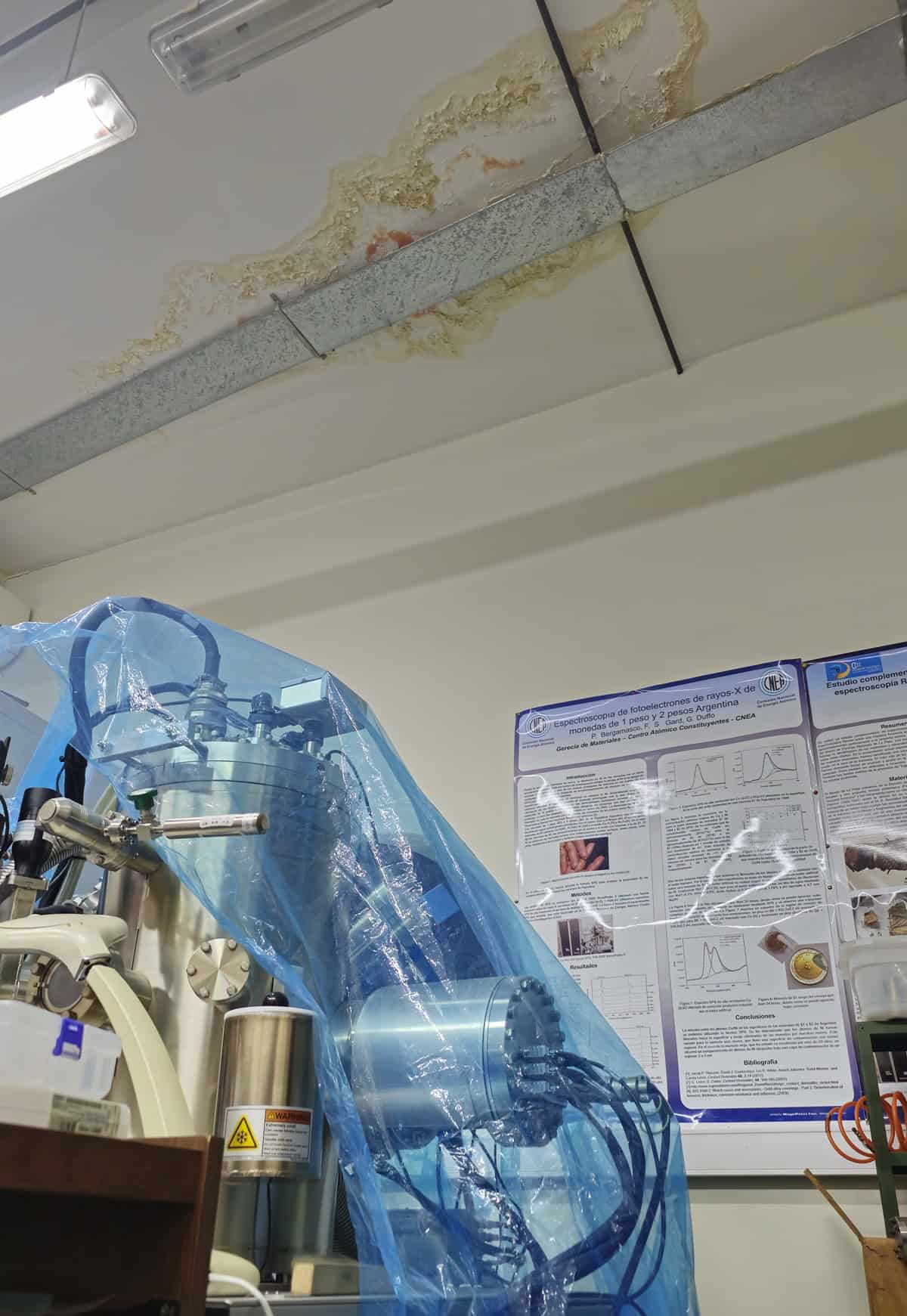
The deterioration extends beyond personnel. In my laboratory, an X-ray photoelectron spectroscopy (XPS) instrument worth more than $1m must sometimes be protected with plastic sheets because rainwater leaks through the roof.
Equipment designed to operate under tightly controlled environmental conditions is now exposed to circumstances that threaten its long-term reliability. Similar situations are becoming increasingly common across Argentina’s universities and research institutes as maintenance budgets shrink and infrastructure ages.
Argentina has a scientific tradition that reaches far beyond its borders. The country has produced five Nobel laureates, including three in the sciences, and has made internationally recognized contributions to nuclear technology, medicine, agriculture, astronomy and materials science. Institutions such as CNEA, CONICET (Argentina’s national research council) and the national universities have trained generations of researchers whose work has strengthened international collaborations and advanced scientific knowledge worldwide.
Scientific systems rarely collapse through a single dramatic event. They decline incrementally: one technician dismissed, one laboratory left unrepaired, one instrument taken out of service, one young scientist deciding to build a career elsewhere. These individual losses accumulate into a weakening of scientific capacity that may take decades to rebuild.
When a country loses the expertise required to operate advanced laboratories or maintain unique scientific infrastructure, the consequences extend beyond national borders.
Faramarz S Gard
This should concern more than Argentina. Modern science depends on international networks of researchers, shared facilities and long-term collaboration. When a country loses the expertise required to operate advanced laboratories or maintain unique scientific infrastructure, the consequences extend beyond national borders.
Damaged goods This X-ray photoelectron spectrometer at the author’s lab has to be protected from water leaking through the ceiling. (Courtesy: Faramarz S Gard)
Knowledge is lost, collaborations weaken, and opportunities for discovery diminish.scientific infrastructure is more than buildings and instruments; it is the people whose expertise gives those resources value. Once that expertise disappears, replacing it is far more difficult than preserving it.
The empty desk of a single scientist may seem insignificant, but multiplied across laboratories and institutions, it becomes a warning of how a research system is quietly dismantled. Argentina’s experience is therefore not only a national concern but also a reminder that scientific capacity, wherever it exists, is a global resource that is remarkably difficult to rebuild once lost.
I write this letter not only to describe a difficult situation but also to call attention to the broader consequences of sustained disinvestment in science. The international scientific community should recognize that the erosion of research systems in countries such as Argentina represents a loss not only for those nations but for global science itself.
Science is built by people, sustained by institutions, and enabled by infrastructure. Today, all three are under increasing strain in Argentina.
The New York Times recently published a 124-page special issue of its Style Magazine entitled “How to be cultured”. According to the cover of this glossy, ad-driven supplement, the contents were “idiosyncratic” but amounted to a “compendium of what you need to know right now”. The material had been “chosen by experts” for the purpose of “teaching readers how to be more cultured”.
Curious as to what would be included, my hopes were raised by the magazine’s lead editorial. It said that the issue “celebrates expertise, a quality ever less valued in our culture today, where learnedness and firsthand research can be overshadowed by slick presentation and dumb certainty”.
Now, I’m not naïve. I know that the New York Times Style Magazine caters to advertisers, who in turn cater to wealthy readers who feel the need to spend gobs of money to get culture. It didn’t therefore surprise me to have to leaf through 40 pages of adverts for jewellery, champagne, watches and home furnishings before finally coming across the table of contents.
I saw headings for film, food, music, theatre, fashion and the visual arts. Shakespeare showed up several times: over half a dozen plays, sonnet #94 and one of his monologues. There were entries for 1930s movies, animated videos and films from Brazil. One page on food and drink covered porridge from Norway, meat from Mexico, lemonade from Vietnam and wine from Austria.
There was no mention of science in “How to be cultured”, nothing at all
Novels from the US, UK, France, Japan, India and Brazil made the list, as did selections of music from medieval times to opera and hip-hop. Samples of theatre, puppetry and architecture made it in too. But there was no mention of science, nothing at all. The closest I found were architectural materials such as plaster, glass, steel and textiles.
Snow’s lament
The absence of anything scientific should not have shocked me; in fact, it reminded me of the British scientist and novelist C P Snow’s 1959 essay The Two Cultures and the Scientific Revolution. Even back then, Snow lamented that humanists and scientists were living in two separate cultures divided by a “gulf of mutual incomprehension”.
In the essay’s most famous passage, Snow wrote that “a good many times I have been present at gatherings of people who, by the standards of the traditional culture, are thought highly educated and who have with considerable gusto been expressing their incredulity at the illiteracy of scientists”.
“Once or twice,” he went on, “I have been provoked and have asked the company how many of them could describe the Second Law of Thermodynamics. The response was cold: it was also negative. Yet I was asking something which is about the scientific equivalent of ‘Have you read a work of Shakespeare’s?’”
Snow did not stop there. “I now believe,” he continued, “that if I had asked an even simpler question – such as, ‘What do you mean by mass, or acceleration’, which is the scientific equivalent of saying, Can you read? – not more than one in ten of the highly educated would have felt that I was speaking the same language.”
“So the great edifice of modern physics goes up,” he concluded, “and the majority of the cleverest people in the western world have about as much insight into it as their neolithic ancestors would have had.”
Culture club
Snow’s tone was snobby and arrogant, but he was on to something. Can someone who knows nothing about, say, Einstein’s equation E = mc2 or about Heisenberg’s uncertainty principle really be called cultured? Sure, cultured individuals don’t need to know much about these topics. But they ought at least to realize that those equations concern how mass and energy work and the inherent limitations to what humans can know.
I’d say those are principles fundamental to the formation, maintenance and fate of the universe – and ones that a cultured person ought to know something about. Indeed, references to them are routinely found in arts and popular culture. Einstein’s equation has made the cover of Time magazine, while the uncertainty principle has been taken up by novelists, theologians and comedians.
Shouldn’t a cultured person be acquainted in some way with the existential threats facing the world?
Further, shouldn’t a cultured person be acquainted in some way with the existential threats facing the world? Wouldn’t such a person have to have an inkling of the way a carbon molecule absorbs and emits heat, of how vaccines work, and of safe and unsafe levels of substances toxic in high doses? How cultivated can an ostrich be?
Of course, there was nothing about the second law in “How to be cultured”, or about any other science of the sort Snow had in mind.
Nothing about scientific equations, experiments, theories or facts that a cultured person ought to know.
No discussion of dark matter, dark energy or of quantum physics, genes or vaccines. Nor about the Pythagorean Theorem or the double-slit experiment.
The critical point
Culture refers to the influences and values that are embedded in the way we live. Judging such influences and values – deciding which influences and values ought to be so embedded – is a tempting but arrogant game.
So let’s play. Imagine that you are among the experts charged with compiling a “compendium of what you need to know right now”. What would you include of science – and why? Send me your contributions, and tell me why they are what we need to know, and I’ll write about them in a future column.
One topic covered in the briefing is the world of quantum sensors. Over the years, physicists have developed some amazing quantum sensors, but many of the technologies have stayed in the lab because of the challenges of miniaturizing key components. With ultrahigh vacuum (UHV) playing an important role in quantum sensors based on cold atoms, Florence Concepcion of the UK-based firm Aquark talks about her mission to reduce the size and energy consumption of UHV systems.
Elsewhere in the issue, we look at how manipulating individual living cells plays an important role in biology and medicine. Trouble is, cells tend to stick together when grown in vitro and separating them often involves using harsh chemicals that can damage cells or modify their properties. In a special interview, Luke Cox, who co-founded the UK-based firm Impulsonics, discusses its system that uses ultrasound to gently separate living cells.
Another entrepreneur featured in this briefing is Brian Pogue, co-founder of DoseOptics. The US-based company has developed a system that detects the extremely faint Cherenkov light that is emitted when a radiotherapy beam strikes a patient’s skin. This allows the radiotherapy to be monitored in real time, ensuring that the beam passes through the target tissue and avoids healthy areas of the body.
Finally, you can explore some of the curiosities of the International System of Units (SI), which is the bedrock of metrology. Although SI and its predecessors have been honed and re-defined over the centuries, it still has some surprising quirks. Ben Stein from the US National Institute of Standards and Technology explores some of these oddities including how the candela was derived from the brightness of a candle made from whale fat and beeswax – and the ongoing debate about using the dimensionless radian as the SI derived unit for planar angle.
Private fusion companies have raised almost $4.5bn in funding over the past year – a 70% increase year-on-year. That is according to a report on the state of the fusion industry, which was published yesterday by the Fusion Industry Association (FIA). The report – The Global Fusion Industry in 2026 – also finds that private fusion endeavours now employ over 16,000 people worldwide.
Magnetic confinement, in which magnetic fields are used to contain a high-temperature plasma, is the most popular fusion technique, being used by 48% of firms according to the report. Inertial confinement, which uses rapid compression, usually by lasers, to create a confined plasma for a short period of time, is employed by 21% of firms – with other techniques such as magneto-inertial making up the remainder.
While electricity generation is a main target for private fusion companies, many also see the technology being applied to space propulsion, with other markets including marine propulsion, hydrogen fuel and industrial heat.
The funding boost for this year’s figures has come from major funding rounds, with CFS raising $863m in August 2025 while Inertia Enterprises, Helion Energy and Proxima Fusion have raised about $1.5bn in total this year.
Ambitious goals
The first FIA report on the fusion industry was published in 2021, where it found that private fusion endeavours had received over $1.8bn of funding since the 1990s.
The 2021 report discovered that over two-thirds of the 35 companies surveyed thought that electricity generated from fusion would enter the grid in the 2030s, with a further 20% thinking it would more likely come in later decades.
That confidence, however, has grown – with this year’s report finding that 71% expect the first fusion plant to deliver commercial electricity by the 2030s.
Indeed, FIA chief executive Andrew Holland says he is “confident” that commercial fusion will be delivered in the 2030s.
“Alongside private investment, fusion companies still need the support of governments to address common challenges including the availability of resilient materials and the fusion fuel cycle,” he says. “The governments that update their programmes and funding priorities to meet the sector’s needs today will be the ones to capitalize on this vital emerging industry.”
The report comes as General Fusion has become the first fusion company to be publicly listed. It joined the Nasdaq exchange with $150m in fresh funding, which is expected to go towards the firm’s Lawson tokamak programme that is expected to be complete in 2028.
In The Hitchhiker’s Guide to the Galaxy, Douglas Adams imagined a supercomputer called Deep Thought, built by a race of hyper-intelligent beings to calculate the Answer to the Ultimate Question of Life, the Universe and Everything. After a mere seven and a half million years of computation, the machine finally revealed its answer: 42.
There was just one problem. Despite their hyper-intelligence, none of those beings understood what the question had been. The joke was that any answer – no matter how precise – is meaningless without a thorough understanding of both the question and the route taken to obtain the answer.
Yet what was once purely science fiction is beginning to sound unexpectedly relevant to modern research. From structural biology to particle physics, artificial intelligence (AI) systems are increasingly involved in research, providing results of remarkable power and accuracy. They are being used to identify hidden patterns in vast datasets, to generate hypotheses, to accelerate simulations and to guide experiments.
As AI becomes increasingly embedded in the scientific process, could we be entering an era of discoveries without understanding?
But in some cases, even the creators of those AI systems are struggling to explain exactly how the AI arrives at its conclusions. All of which raises an uncomfortable possibility. As AI becomes increasingly embedded in the scientific process, could we be entering an era of discoveries without understanding? And if so, what happens when science starts producing its own versions of the answer “42”?
AI terms and conditions
Artificial intelligence (AI)
Intelligent behaviour exhibited by machines. But the definition of intelligence is controversial so a more general description of AI that would satisfy most is: the behaviour of a system that adapts its actions in response to its environment and prior experience.
Machine learning
As a group of approaches to endow a machine with artificial intelligence, machine learning is itself a broad category. In essence, it is the process by which a system learns from a training set so that it can deliver autonomously an appropriate response to new data.
Artificial neural networks
A subset of machine learning in which the learning mechanism is modelled on the behaviour of a biological brain. Input signals are modified as they pass through networked layers of neurons before emerging as an output. Experience is encoded by varying the strength of interactions between neurons in the network.
Training data
A set of real or simulated data used to train a machine-learning algorithm to recognize patterns in data indicative of signal or background.
Generative AI
A type of machine-learning algorithm that creates new content, such as images or text, based on the data the algorithm was trained on.
Computer vision
A branch of AI that analyses, interprets and extracts meaningful data from images to identify and classify objects and patterns.
Natural language processing
A branch of AI that analyses, interprets and generates human language.
AI and accelerated particle searches
For particle physicists, this question is no longer hypothetical. At CERN, the home of the Large Hadron Collider (LHC), AI is already woven into day-to-day research, subtly reshaping how physics research is carried out. Indeed, machine learning (ML) – one of the main pathways through which AI is achieved – has long played a role at the LHC.
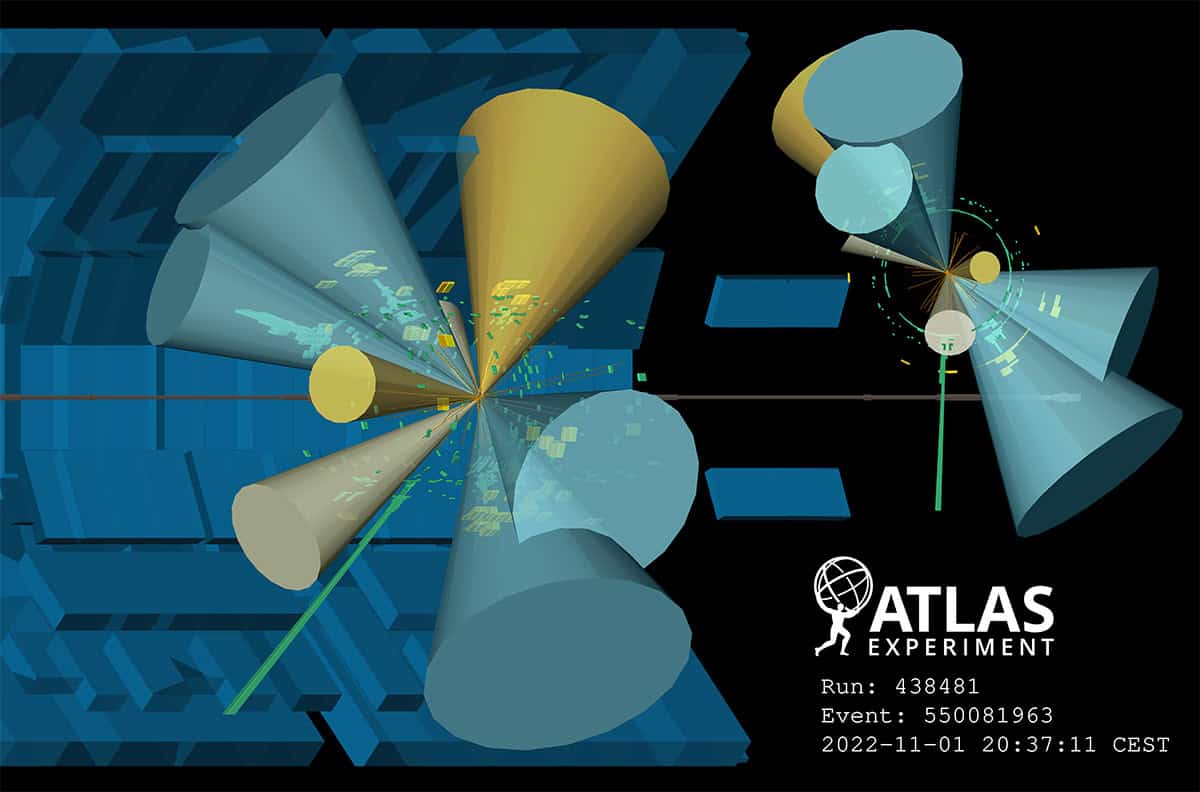
Back in the early 2010s physicists working at the CMS and ATLAS experiments, routinely used ML in their search for the Higgs boson. The ML algorithms separated rare signals – a Higgs boson decaying either into two photons or into four leptons via Z bosons – from far more common Standard Model processes that produced similar signatures in the detector.
Machine learning did not discover the Higgs boson by itself, but it accelerated the search by making analyses more sensitive. In fact, achieving the same sensitivity without ML would have required between 15% and 125% more data, according to a review of Higgs-decay measurements (Nature560 41). Some measurements would even have needed more than double the data.
But the scope of AI in particle physics has been expanding rapidly since then. Neural networks are now used to compress enormous datasets, accelerate simulations, and identify unusual events hidden among billions of particle collisions. By learning directly from examples, neural networks can uncover complex correlations in detector data that would be difficult for physicists to unravel using conventional analysis techniques.
Caterina Doglioni, an experimental particle physicist from the University of Manchester, UK, who uses ML for data compression as part of the ATLAS collaboration, says that deployment of AI is becoming difficult to separate from particle-physics research itself. “It’s pretty much everywhere,” she says, especially when it comes to experimental high-energy physics. “It’s critical at the LHC where far more data is created than can realistically be stored.”
When it comes to compressing detector data, for example, one option is to use neural networks to force information through a computational “bottleneck” that preserves the most important features while dramatically reducing the storage required. The original data can then be reconstructed from this compressed summary, either exactly or approximately depending on the application (Rep. Prog. Phys.84 124201).
This is different from the ML techniques used during the Higgs search. Whereas Higgs analyses relied on supervised algorithms that had been trained to distinguish known signals from background noise, these data-compression methods typically use “self-supervised” learning. They identify and preserve important patterns – without requiring labelled examples.
Algorithms learn what ordinary collisions look like and then flag events that deviate from those expectations
More recently, researchers have begun applying ML to a very different challenge. In the Higgs search, algorithms were trained to recognize signatures predicted by theory and distinguish them from background processes. But now, instead of having algorithms that search for a specific predicted signal, those algorithms learn what ordinary collisions look like and then flag events that deviate from those expectations.
In what is essentially a clever form of anomaly detection, the hope is that new physics might reveal itself as something unusual, even if physicists do not yet know exactly what form it will take. In a nutshell, ML used to be applied to problems where physicists knew what they were looking for; now it is applied to problems where we don’t know what we’re looking for just yet.
While no new particles have yet been spotted with these anomaly-detection techniques, they have progressed from theoretical proposals to real experimental searches. In 2024, for example, the ATLAS collaboration reported the results of an unsupervised anomaly-detection search using Run 2 data. No significant deviation from Standard Model expectations was observed, but the study proved that such methods can be deployed successfully on real collider data (Phys. Rev. Lett.132 081801).
The black box problem
Yet the very feature that makes these systems so powerful – their ability to rapidly identify patterns humans may miss – also raises one of the most persistent concerns surrounding AI in research: the black box problem. Modern ML systems can uncover complex relationships in data, but researchers may struggle to understand exactly how a model arrived at a particular result. In particle physics, where extraordinary claims require extraordinary evidence, that lack of transparency can create unease.
For David Sutherland, a theoretical physicist at the University of Glasgow, the greater concern is not necessarily whether researchers can interpret every internal feature of a model – but whether they can trust and reproduce its outputs. “I would certainly say reproducibility [is more important] than interpretability,” he says.
That distinction matters. Science has always relied on the principle that results should survive scrutiny, be independently verified, and withstand repeated testing. A model does not need to reveal every detail of its inner workings – but researchers must be able to demonstrate that it behaves robustly across datasets and conditions.
Particle physics, in particular, has built extensive safeguards around that process. “We have very large review committees that check basically everything that goes on,” Doglioni says, with those structures providing an additional layer of protection against over-reliance on opaque systems.
Reliability and reproducibility
Yet as AI systems become increasingly embedded in research workflows, ensuring that reliability may become more difficult. Reproducing results may require not only access to data and code, but also to model architectures, training conditions and computational environments.
Unlike many commercial AI systems, the ML tools used in particle physics are often developed by particle physicists and shared openly with the scientific community. Even so, reproducing results may require access not only to data and code, but also to model architectures, training conditions and computational environments, all of which can influence an AI system’s behaviour.
The growing use of AI could also begin to change how physicists work and even how scientific value is measured. Christoph Weniger, a physicist at the University of Amsterdam who applies ML and AI techniques to particle physics and cosmology, argues that AI systems are likely to take on an increasingly active role in navigating complex analyses. Researchers, he believes, will shift into “a supervisory role in steering these different agents”, fundamentally changing how scientists interact with data.
AI and materials science
Closed loop The autonomous AI system at Argonne National Laboratory can speed up materials discovery. The AI proposes candidate materials, which can then be created and tested by robotic laboratories, with the results fed back into the system to guide the next round of experiments. (Courtesy: iStock/K-Kwanchai)
Particle physics is far from the only field exploring how AI might reshape scientific discovery. Researchers at Argonne National Laboratory in Illinois, US, recently developed what they describe as an AI adviser for designing advanced electronic materials.
Normally, materials discovery proceeds through a slow cycle of trial and error. Scientists propose a candidate material, synthesize it in the laboratory, test its properties and then refine the design. Each iteration can take days or weeks.
The Argonne system closes that loop. AI proposes candidate materials, robotic laboratories create and test them, and the results are fed back into the system to guide the next round of experiments.
Rather than analysing data after experiments are complete, AI becomes involved in deciding which experiments to perform in the first place, an early glimpse of what future “AI scientist” systems might look like.
The approach has already demonstrated its potential. In 2023 researchers at Argonne and collaborators reported that their autonomous A-Lab platform conducted 355 experiments in just 17 days and successfully synthesized 41 novel materials (Nature 624 86). The work provided one of the clearest demonstrations that AI systems can help guide experimental discovery rather than simply analyse data after the fact.
Creative impact
Such changes could extend beyond day-to-day workflows. Traditionally, the currency of academic research has been publications. But Weniger suggests that AI may shift the emphasis away from productivity alone and towards something harder to quantify: originality.
Scientific value may increasingly depend not on how many papers a researcher produces, but on the creativity and impact of the questions they ask
As routine technical barriers to experiments and theoretical work become easier to overcome, he argues that scientific value may increasingly depend not on how many papers a researcher produces, but on the creativity and impact of the questions they ask.
The effects may also extend to how scientific knowledge is communicated. The scientific literature has long been criticized for being difficult to navigate, not simply because of its volume, but also because of the way researchers write. Nichol Furey, a mathematical physicist at Humboldt University of Berlin whose work explores whether there is an underlying algebraic logic to the structure of the Standard Model, believes AI could help bridge that gap.
“Authors in maths and physics often write in ways that are overly opaque,” she says. “AI systems write with their audience in mind, whereas human authors often don’t.” Yet that possibility creates a tension. The same tools that can make research more accessible can also make scientific text dramatically easier to produce.
Communities are already beginning to grapple with the unintended consequences of widespread AI adoption. Recently, arXiv, one of the world’s largest repositories for physics and mathematics preprints, announced a crackdown on unchecked AI-generated submissions. It said it was introducing one-year bans for authors who upload papers containing obvious signs of unverified AI content, such as hallucinated references or leftover chatbot instructions.
The move reflects growing concern about the quality of AI-assisted scientific writing. Although arXiv’s new policy is too recent for its impact to be fully assessed, the threat of a one-year ban marks one of the strongest responses yet by a major scientific repository to unchecked AI-generated content.
The concern is not simply that AI can generate poor research. Now that producing scientific text is an almost frictionless exercise, the burden of judgement shifts increasingly onto readers, reviewers and future researchers trying to separate genuine insight from noise.
Training future physicists
Another potential problem with AI’s infiltration in many areas of research is training the next generation of physicists. This is generally a long process, where expertise is built gradually through years of practice and failure. If AI automates many of those steps, researchers may eventually face an uncomfortable question: how do you train future experts if the work that once trained them disappears?
This challenge extends far beyond physics. Across the education sector, schools and universities are already grappling with the ease with which generative AI can produce essays, solve problem sheets and complete programming assignments in seconds.
Education gap How do you reliably train the next generation of physicists when generative AI can produce essays, solve problem sheets and complete programming assignments in seconds? The problem is compounded if AI takes over the repetitive routine tasks historically given to students and postgrads to hone their skills. (Courtesy: iStock/Thai Liang Lim)
In fact, Wrishik Naskar, a particle theory postdoc at the DESY laboratory in Germany, wonders if research habits are also beginning to change. “When I get stuck, I go to my supervisor,” he says, “[but] many people, the first thing they ask is ChatGPT.” That approach might speed things up, but does it really help a researcher learn and grow? As Naskar puts it: “Focus on the learning. Results will follow if you have skills.”
Despite the many concerns, not everyone sees the transition to AI as a threat, and framing AI as a competitor to researchers may miss the point entirely. For example, Admir Greljo, a particle theorist at the University of Basel, believes the real shift is not replacement but collaboration. “It’s not that they will compete against AI. Entering into theoretical physics is still going to be very interesting and very important. AI is not competition, it’s a new tool.”
That perspective echoes a broader historical pattern. Physicists once calculated by hand, then with slide rules, then with computers. Each technological leap changed how research was done and prompted fears about what skills might be lost along the way. Yet rather than eliminating physicists, those tools expanded what physicists could ask.
Towards an AI scientist?
AI may simply be the next step in that progression. But it also presents something new. Unlike previous tools, AI can suggest ideas, identify patterns and increasingly participate in parts of the scientific process that once seemed uniquely human. So might that participation one day become independence? Could AI move beyond assisting physicists and begin carrying out the entire research process itself?
For Sutherland, a future in which AI systems perform the entire research cycle, from generating hypotheses to collecting data and even writing papers, is not difficult to imagine. But he still envisages a human “steering it” and acting as a “sanity check”, much like the relationship between a senior researcher and a PhD student.
Others go further. Greljo believes that fully autonomous scientific systems may not arrive in the near future, but sees no fundamental reason why they could not emerge eventually. Because science ultimately depends on reproducible results, he argues, humans could simply repeat calculations and test predictions to verify whether the AI had reached the right answer. Such a future, he says, is “not something that is impossible”.
We may be entering a world where machines help us uncover truths about the universe faster than we can fully understand them
We may be entering a world where machines help us uncover truths about the universe faster than we can fully understand them. But that need not signal the end of scientific inquiry. It is important to remember that AI models, much like many of the models used throughout scientific research, are imperfect and may always remain so. But perhaps they do not need to be perfect.
Science has always involved navigating uncertainty, constructing incomplete models and refining them over time. AI may help us discover things faster than ever before. It may reshape how future generations of physicists learn, work and think. But science has never simply been about generating results. It has also been about explanation, curiosity and deciding which questions are worth asking in the first place.
We should not treat AI as an oracle that bypasses the scientific method. Instead, we should view it as another tool in the physicist’s arsenal – a powerful one, certainly, but still a tool, helping researchers explore possibilities, test ideas and refine their models of reality.
After all, the problem with Deep Thought was never that it gave the wrong answer. It was that nobody knew what question they had asked.
The challenge for the next generation of physicists may not be deciding whether AI can discover new truths about nature. It may be making sure we still know which questions are worth asking.
How do you think AI is changing the face of physics? What are the threats and opportunities it poses – and what happens if AI produces answers we cannot understand?
In 2008 the US author Neal Stephenson published a speculative fiction novel called Anathem. Set on the fictional planet of Arbre, the story follows an order of monks, mostly isolated from the rest of the world, who every so often open up their doors to receive information on the state of the outside world.
In the book, Stephenson explores a Dark Age of the Internet, in which companies flood the network with plausible-sounding-but-false information in a ploy to force consumers to buy the firms’ own tools for distinguishing truth from falsehood.
Initially, this “crap”, as Stephenson calls it, had to be made by humans, but eventually the process is run by a so-called “Artificial Inanity”, which is able to create hundreds or thousands of bogus versions, or “bogons”, for every legitimate document.
Today, we face our own version of Stephenson’s Dark Age as our information landscape increasingly fills with AI slop, now going beyond AI-generated videos of uncanny kittens or images depicting politicians and celebrities in outlandish situations.
With the rise of chatbots powered by large language models (LLMs), our search results, social-media feeds and even scientific journals are getting polluted with data that, at first glance, appears relevant and plausible but contains no value beneath its gilded veneer.
As LLM-generated slop infects our previously trusted knowledge base, we face an information landscape that is quickly rotting beneath us.
As scientists, we must position our work in relation to other recent research. Yet that task gets harder when we have to sort out the real from the hallucinated. As LLM-generated slop infects our previously trusted knowledge base, we face an information landscape that is quickly rotting beneath us.
Where we could once track an idea to a paper with human authors (who bore consequences for acts of fraud), we face a future where we have to question whether an article’s authors, institutions or experiments ever existed, on top of evaluating its scientific merits.
This is not a hypothetical danger. In 2024 a team led by medical researcher Almira Osmanovic Thunström at the University of Gothenburg invented a fictitious medical condition called “bixonimania” and publicized it through posts on Medium and two pre-printpapers.
Their goal was to test whether AI chatbots would pick up and propagate word of the fake disease, which they duly did. The researchers even tried to insert information that made the work obviously fake. This included acknowledging a colleague from Starfleet Academy, thanking the University of Fellowship of the Ring for funding, and even writing early on in the article that “this entire paper is made up”.
Trapped in a bog
As physicists, we are not immune to the dangers of information rot. A flood of LLM-generated articles prompted arXiv in May to announce consequences for authors whose submissions have “incontrovertible evidence that the authors did not check the results of LLM generation”, including having “hallucinated references”. Those consequences include a one-year ban from arXiv and the requirement, thereafter, that any submitted paper must already be accepted at a “reputable peer-reviewed venue”.
I initially welcomed the news. Harsh consequences are one way to discourage LLM usage, especially for sloppy shortcuts. But the more I reflect on it, the more I realize that arXiv’s consequences could eventually fall even on those who are not using LLMs to write their papers.
Relying on shortcuts is easy. Say you’re writing a literature review and paper A, which you’ve read and trust, has a fact you want to cite – but you notice that paper A cites paper B for this fact. It’s simple to scroll down to the reference section and copy paper B’s citation into your own citations (I would be lying if I said I’ve never done this myself).
But as the information landscape rots, this shortcut could run you afoul of policies like arXiv’s. What appears to be a valid citation – maybe even containing the names of authors you know personally – can be hallucinated.
We must double down on the skills that make us experts – our scientific judgement, information literacy, communication skills and careful scholarship.
Or it could be entirely fake, as a team of researchers who cited one of the “bixonimania” pre-prints in a peer-reviewed article discovered. Their paper was justifiably retracted by the journal editor, over their objections. By simply copying a reference without double-checking it, you can unintentionally join ranks alongside LLM users. Worse, you open yourself and all of your co-authors to being banned from arXiv.
I am not suggesting that arXiv’s policy is flawed. Rather, I argue that those who intend their writing to be AI-free must be vigilant. We must double down on the skills that make us experts – our scientific judgement, information literacy, communication skills and careful scholarship. We should lean into practising these skills – and teaching them – even though they are precisely the skills that AI companies claim LLMs can replace.
In Anathem, a character simply hand-waves away their Internet full of bogons, but we have no such solution. Instead, as our information landscape rots, we find ourselves trapped in a bog. To get out, we must plan each step carefully and take none for granted. What appears to be solid ground may well prove treacherous. Moving safely is a slow process, full of checking and double-checking as we painstakingly build out paths and tools we can trust.
Simply choosing not to use an LLM when writing is no longer enough. We have only our own scholarly skills to sort the bogons from the ground truth. We will all have to slow down if we want out of the bog.
It was fantastic to see the men’s marathon world record being broken in London at the end of April when Kenya’s Sabastian Sawe became the first person to officially complete the run in under two hours. It’s an achievement that a whole generation of world-class runners had had their eyes on, with Sawe completing the race in a headline-grabbing 1:59:30.
Perhaps less attention was given to another achievement a week earlier, which saw a humanoid robot run the Beijing E-Town half-marathon in 50:26, breaking the human record by almost seven minutes. What’s particularly impressive is that at the inaugural event in 2025, the robot winner took 2:40:42 to complete the race, with many robot entrants failing even to reach the finishing line.
In just one year, in other words, the robot half-marathon record has been slashed by more than two-thirds, an unthinkable feat in human terms. What’s more, the rules between the first and second robotic competitions were tightened. They now favour robots that can run on their own (rather than via remote control) and penalize those that need to be taken off course to have their batteries changed.
Giant steps
My mind began spinning, trying to work out what must have happened over the past year to realize such advancements. How did we go from remote-controlled, slow and clunky robots to autonomous, agile and sleek devices? It turns out that these increases in speed and endurance have been driven by a combination of better hardware, specialized designs and advanced algorithms.
Robots now benefit from powerful actuators enabling higher torque and faster movement of its hips and knees. Anatomical designs have also been optimizied to mirror biological efficiencies by, for example, using lightweight limbs and lower torso components to minimize the energy lost when a robot’s foot strikes the ground.
Other changes include the use of liquid cooling technologies to stop a robot from getting too hot during prolonged activity and finding ways to mimic highly efficient natural bipeds, such as an emu or ostrich. Improved AI and control software have also allowed robots to navigate varied terrain and stay stable autonomously, rather than relying on remote operation.
AI answers
Of all these developments, I believe the most significant is the expanding use of AI. To me, it seems that AI will be the enabler for robots to become more “human”. In China, humanoid robots are already being developed to automate what is dubbed the hardest task in the car industry – the final assembly stage.
This work typically consists of real people carrying out highly labour-intensive tasks such as installing wiring harnesses, fitting a vehicle’s interior trim and instruments, or bringing its engine and chassis together. Being super-precise tasks that require manual dexterity, this work has previously been thought too complex for robots.
However, through a combination of imitation learning, simulation and real-time human guidance, it’s now becoming conceivable for robotic devices to do this kind of work. Underpinning this aspiration are what are known as Vision-Language-Action (VLA) models, which process camera images together with natural language or text descriptions and translate these into physical actions.
Having emerged relatively recently from work at AI firm Google DeepMind, VLA models differ from traditional, task-specific programming robotics by offering generalization and the ability to handle novelty. They are seen as the next big thing in AI because they bridge the gap between understanding the world (vision and language) and interacting with it (action) – potentially letting robots do tasks they have not been explicitly trained on.
VLAs typically rely on existing Vision-Language-Models (VLMs), which provide a combined knowledge of text (large language models) and images (computer vision models). The VLA model is then fine-tuned on task-specific data to learn a mapping of visual observations and text instructions to create the desired robot action.
One challenge in training VLAs is getting enough data with appropriate visual and contextual information. It may be gleaned from real robots (imitation) but it can also be generated by human guidance or teleoperation – a manual process involving humans “showing” robots how to do a specific task. The task is time-consuming, having to be performed deliberately and repeatedly using equipment that captures appropriate levels of data quantity and quality.
A third option is to build virtual simulation environments to train the models and optimize robotic movements. As VLAs inherently learn to associate higher-level cognition with lower-level physical actions, the trend will be to move from fixed, pre-programmed scripts towards AI and large-scale simulation training. The result: robots that become more autonomous and versatile in real-world situations.
We are all getting used to AI becoming an increasing part of our everyday life – think how much GenerativeAI models have improved since they first appeared a few years ago. But I wonder what will be next for robots as they become capable of moving independently and spontaneously, having the ability to operate with full autonomy within dynamic human environments, such as homes and factories.
When we – eventually – experience the full physical embodiment of Artificial General Intelligence, will it be like living on the filmset of I, Robot or Blade Runner, with humans and humanoids coexisting and, in some cases indiscernible? Several years ago, this was something I did not expect to see in my lifetime. But in April it just got one giant leap – or at least one half-marathon – closer.
Some animals could sense Earth’s magnetic field by using the superparamagnetic properties of white blood cells in their livers, a new interdisciplinary study has revealed. Led by Clivia Lisowski at the University of Bonn, the team’s insights into homing pigeon navigation could help scientists resolve the decades-old mystery of how animals can sense magnetic fields. The research also shines new light on the inner workings of the immune system.
Animals ranging from sharks to bats appear to use Earth’s magnetic field to navigate during long migratory voyages. However, the nature of this magnetoreception is poorly understood.
“How they sense Earth´s magnetic field has been a mystery,” Lisowski explains. “Several hypotheses were suggested, but these have often resulted from laboratory experiments. They were hardly ever done in the field, and so couldn’t explain how migration would work at night or in dark environments.”
In their study, Lisowski’s team investigated the origins of magnetoreception in homing pigeons. These birds are famous for finding their way back home after being released in unfamiliar locations. “We combined expertise from research fields that usually are not intersected, namely immunology, physics and animal behaviour,” Lisowski explains. “[This gave] us a truly interdisciplinary approach to solve the mystery of magnetoreception in homing pigeons.”
Searching for magnetism
As part of this approach, the researchers searched for magnetism in several different tissues of the bird – including the liver, spleen, muscle, and beak. They used vibrating-sample magnetometry (VSM), whereby samples are placed in a constant magnetic field and vibrated up and down. If the sample is magnetic, it will induce an electric field that is proportional to its magnetization.
The team also did field studies of homing pigeon flight patterns and studied the birds’ anatomy. The latter involved using dyes to visualize microscopic structures embedded in tissues along with genomic assays of the tissues.
This combined analysis revealed the presence of superparamagnetic macrophages in homing pigeon livers. Macrophages are specialized white blood cells whose primary function is to engulf and digest pathogens. They are a cornerstone of the immune system. Superparamagnetic means that the macrophages are very easily magnetized.
“The macrophages are superparamagnetic due to their physiological function of degrading old and damaged red blood cells,” Lisowski explains. “They sequester and store the iron from red blood cells as oxide nanoparticles in ferritin proteins.”
Connecting to the brain
Within homing pigeon livers, the researchers found that these macrophages were often in the vicinity of – and sometimes even in direct contact with – nerve fibres in liver tissue. This could allow magnetic information to be passed from macrophages to the brain.
At the atomic level, Lisowski’s team proposes that the effect emerges from unpaired electrons in ferritin proteins, which interact with each other through magnetic dipole–dipole coupling to enhance their magnetic susceptibility. This subatomic effect could in turn explain the distinctive circling behaviour observed in pigeons after they take off. This circling could allow these unpaired electrons to be imprinted with magnetic information, before the birds settle into a more uniform flight.
The research could also improve our understand of the immune system. The team suspects that the sensing abilities imparted by their superparamagnetic properties could enable macrophages to better gauge their surrounding environments: distinguishing between what to fight, and what to tolerate.
“Our finding that the immune system can also sense the Earth´s magnetic field is a completely new layer in this concept of ‘immuno-sensation’, and opens the door to new research,” Lisowski says.
News that large language models (LLM) have made major advances in solving Erdős problems – a set of problems formulated by the renowned 20th-century mathematician Paul Erdős – has created an amalgamation of uproar and interest among mathematicians. The past month alone has seen two significant LLM-generated solutions. The first relates to prime sets, a generalization of prime numbers, and was solved after Liam Price, an amateur mathematician from the US, fed the problem statement into GPT-5.4 Pro without other information. The second came last week when the company behind ChatGPT, OpenAI, announced that it had used artificial intelligence to disprove Erdős’ planar unit distance conjecture.
LLMs have solved Erdős problems before, but the one Price chose wasn’t just any Erdős problem. It was one that human mathematicians had worked on for 60 years without success. The nature of the solution was also unusual. While previous LLM mathematical proofs used standard techniques, this one took an entirely different approach. Rather than starting from Erdős’ original probability-theory-based framing of the problem, as human mathematicians had, the LLM found an alternative route – one that led naturally, in less than a page, to a correct proof.
“Paul Erdős had a concept of ‘Proofs from The Book’, meaning that the argument is so compact and elegant that this is the proof God would’ve written down in ‘The Book’,” Jared Lichtman, a mathematician at Stanford University in the US, wrote on the social media site X after the proof was announced. “After reading the GPT5.4 proof of Erdős #1196, I would say this is a Book Proof of the result.”
The planar unit distance conjecture, meanwhile, concerns a deceptively simple question: if you have n points in a plane, how many pairs of points can be exactly one distance unit apart? Erdős thought the limit was n1+C/log log(n) where C is a positive constant, but OpenAI’s model identified a higher bound. What’s more, the company claims it did so by coming up with a counter example, and in doing so, a whole family of objects that mathematicians had so far not considered. This counter example was generated using sophisticated ideas from algebraic number theory.
Some members of the mathematics community have greeted these proofs, and the advent of AI in mathematics in general, with enthusiasm. OpenAI’s announcement quotes Arul Shankar, a number theorist at the University of Toronto, Canada, as saying that the new proof “demonstrates that current AI models go beyond just helpers to human mathematicians – they are capable of having original ingenious ideas, and then carrying them out to fruition”.
Others, however, are more cautious. David Bessis, a mathematician-turned-science writer who previously worked on algebra, geometry and topology, claims that the programme of trying to automate mathematics stems from a misconception of mathematics as a logically direct process of churning out theorems, given some rules. Writing in his Substack newsletter, Bessis argues that the method used to verify AI-generated proofs, which involves a computer program called Lean, may reduce the benefit the mathematics community gains from proofs. Notably, proofs that are verifiable in Lean are not always parse-able by humans, which detracts from (and in certain cases removes) the insights researchers typically get from new proofs.
How AI is being used in mathematics…
To evaluate the merits of these arguments, it’s useful to understand how AI is currently used within mathematics research. The first strategy is the one Price used to solve Erdős #1196: directly prompting an LLM. “Large language models have proven their worth at literature search: finding similar instances of a problem, or a proof, in past literature,” notes François Charton, an AI engineer at the California-based start-up AxiomMath, which is using AI to accelerate mathematics research.
The second strategy is to use AI models trained on other types of data. According to Charton, these models are especially good at spotting “weak signals and correlations” and thereby uncovering patterns in data that might be too laborious or convoluted for humans to identify.
Both methods have shown promise for generating new results, but they are not universal – at least, not yet. “It [AI] seems to do a lot better at certain types of maths than others,” says Thomas Bloom, a mathematician at the University of Manchester, UK, who maintains a webpage that tracks solutions to Erdős problems. In particular, Bloom says that to the best of his knowledge, AI “hasn’t done anything interesting in category theory” – a field whose reputation for abstraction is only matched by its track record of bridging supposedly distinct areas of mathematics.
Monumental thinker: The grave of Paul Erdős (Erdős Pál) in Budapest, Hungary. (Courtesy: Varga József, CC-BY-SA 3.0)
Another challenge is that with AI systems churning out new proofs at scale, there are simply not enough people with the skills needed to check them. A process called autoformalization could solve this problem by turning human proofs into what Bessis calls “bulletproof, machine-verifiable logical derivations” expressed in Lean or other specialized languages. At that point, AI-generated proofs could be checked automatically. The question is, could humans lose out on some knowledge in the process?
For doubters like Bessis, who refers to AI-driven autoformalization (at least as practiced by certain firms) as “AI slop”, the answer is very little. But within the AI camp, there is considerable interest in what AI brings to autoformalization. “I see autoformalization as the bridge in both directions, as important as proving itself,” Charton argues. “We can use Lean to translate between these two languages so that a Lean proof can be reverse-translated into a sketch, lemmas or natural language a human mathematician can engage with. That bidirectional translation preserves and extends mathematical knowledge at scale.”
…and how it isn’t
In the 18th century, when Leonhard Euler began arranging the logical thought processes of mathematics into theorems, definitions and proofs, mathematicians were primarily interested in solving problems with underpinnings in the physical world: questions of volume and distance, and, more generally, geometry and counting. Since then, though, mathematics has become a discipline that is at least as concerned with coming up with interesting problems as it is with solving them.
Two aspects of this change seem relevant to debates over AI’s utility. The first is that posing problems requires a broader skillset than solving them. The second is that solving posed problems sometimes requires mathematicians to invent new structures, tools or objects. Fermat’s Last Theorem, which posits that there are no three positive integers a, b, and c that satisfy the equation an + bn = cn for any integer value of n greater than 2, is a good example. At face value, this nearly 400-year-old theorem seems simple. However, proving it was the life’s work of a modern mathematician, Andrew Wiles, who won the Abel Prize in 2016 for developing the numerous new tools required, as well as for the proof itself.
Coming up with such tools – or indeed whole new frameworks – is a challenging and hugely creative endeavour. There are no rules as to the kinds of objects you are allowed to create, and unlike a proof (which is either correct or incorrect), there is no finality, either. If the new framework is a good one, it will crop up frequently and naturally in various branches of mathematics, and other mathematicians will incorporate it into their own work. If it isn’t, they won’t.
Currently, not even AI enthusiasts like Charton think machines are capable of such leaps. “Theory building is completely out of reach right now,” he tells Physics World. “Models, especially generative models, can provide a mathematician with interesting examples, or discover surprising relations that may bring a theoretical breakthrough, but the breakthrough still depends on the mathematician. I believe this will remain the case for some time.”
A new tool for scientists and mathematicians alike
In many areas of science, AI works in a way that is entirely distinct from human thinking. In physics, for example, machine learning algorithms are trained to analyse large amounts of data, find patterns and use them to infer underlying laws. This strategy could advance our understanding of some of the most fundamental questions in physics, but it is very different from how a human scientist would do it, and therefore perhaps more likely to be seen as a welcome new tool.
On the theorem-proving side of mathematics, the distinction between methods a human might use and those an algorithm might use is more blurred. Yet in some ways, Bloom thinks incorporating AI into mathematics could bring the field closer to other sciences. In particle physics, for example, “you don’t go in and take these individual recordings [of data]. It’s all automated,” he tells Physics World. “Until now, there has been no equivalent for maths. It takes time and attention to prove theorems, and maybe this had been a bottleneck.”
AxiomMath’s Charton agrees. “Every new math tool in history has automated something that used to be the work of a human mathematician – from the abacus all the way to symbolic algebra,” he says. “With each new tool, the role of the mathematician evolved rather than disappeared. Tasks got automated, and problems that felt impossible became trivial – but mathematicians just keep moving up the stack to the next set of questions. I see AI as the latest shift rather than a categorical break from history.”
On Episode 220 of This Week In Space, Rod Pyle and Tariq Malik are joined by Dr. Pascal Lee and astrobiologist Dr. Penny Boston to mark the 50th anniversary of Viking 1's landing on Mars.
This week, we cover how Starship Flight 13 finally prepares to launch amid a legal battle over SpaceX's proposed land swap at Starbase, plus a Chinese Long March 3B rocket gets struck by lightning during liftoff, yet still delivers its satellite safely.
Then, we revisit the Viking 1 mission's groundbreaking life-detection experiments and the decades-long controversy over what they actually found. The conversation traces Mars exploration from the earliest Mariner flybys through Viking's ambiguous, still-debated results — later explained by perchlorates in the Martian soil — and the fierce scientific rivalry the findings sparked. Join us!
This Week in Space covers the new space age. Every Friday we take a deep dive into a fascinating topic. What's happening with the new race to the moon and other planets? When will SpaceX really send people to Mars?
Join Rod Pyle and Tariq Malik from Space.com as they tackle those questions and more each week on Friday afternoons. You can subscribe today on your favorite podcatcher.
The Great Pyramid of Giza is built from something like 2.3 million stone blocks, averaging about 2.5 tons each, and it took roughly 20 years to build. Divide one number by the other and the pace reads like a typo. A block set, then the next, then the next, every few minutes, for two decades without stopping.
It isn’t a curiosity about one heavy rock. It’s a claim about a whole human system holding a steady tempo, day after day, for longer than most modern building projects, with no engine anywhere in the chain.
The math is almost embarrassingly simple, which is part of what makes it land. A 2025 paper in npj Heritage Science lays out the standard figures: about 2.3 million blocks of around 2.5 tons each, and a required pace of roughly one block every one to three minutes across a 20-year build of long working days. Squeeze the schedule and it gets worse. The same paper notes that a 10-year build would need a block set every 30 to 90 seconds.
The blocks weren’t uniform, either. The lowest rows carry stones reaching around 10 tons or more, so “some weighing several tonnes” isn’t rhetorical. All told, laborers moved into position six and a half million tons of stone.
What that pace really describes isn’t a single feat of strength. It’s a feat of scheduling, repeated a couple of million times.
A block every few minutes only works if you stop picturing one crew doing it all. Nobody was setting a stone, catching their breath, and setting the next. The pace is an average across a whole site working at once, with many teams quarrying, hauling, shaping, and placing in parallel, so the finished total climbs at that headline speed even though no single person is moving that fast.
That reframing is what modern Egyptology has spent decades building. The old image of whip-driven slaves has been replaced with evidence of an organized, housed, and fed workforce. Egyptologists Mark Lehner and Zahi Hawass estimate the peak labor force at 20,000 to 30,000 people. Not all of them were lifting stone. Vaclav Smil’s energy-based calculation for IEEE Spectrum puts the core stone-raising and placing crew at only about 3,300 workers, far from the 100,000 men the ancient historian Herodotus reported working in three-month shifts.
Perhaps the most intriguing evidence for how the tempo held came out of the ground fairly recently. In 2013, the French Egyptologist Pierre Tallet dug up a set of papyri at Wadi al-Jarf, the oldest known papyri in the world. Among them was the journal of an official named Merer, who led a crew of some 200 men and recorded ferrying fine limestone by boat to the Great Pyramid. It’s a logistics record, dated to the 27th year of Khufu’s reign, describing the movement of stone in plain administrative terms.
The build itself was probably more clever than brute. Most modern scholars think the blocks were moved with ramps and sledges rather than any single heroic lift, and the recent npj Heritage Science paper argues the internal passages themselves may have doubled as sliding ramps for counterweights. Whatever the exact method, the common thread is doing many things at once so the average holds.
What we still don’t know
The rate calculation, honestly, is the easy part. You can do it on the back of an envelope, and every serious source lands in roughly the same range.
What none of the math answers is the harder question underneath it: how a single human organization, with no machinery and no written management theory we’d recognize, held that cadence for the better part of a generation.
Consider what the pace assumes. Quarries feeding the site without running dry. Boats arriving on schedule. Ramps maintained. Thousands of workers fed, housed, rotated, and replaced as they tired or died, all without the whole tempo collapsing when any one link failed for a season. Merer’s journal gives a single thread of that operation for a few months of one year. The rest is guesswork. I find it hard to believe we’ll ever fully reconstruct the day-to-day of it, and the papyri, for all they reveal, mostly sharpen the question rather than answer it.
So the number that stops you cold turns out to be the part we understand best. Set a block every few minutes for twenty years, and the strain isn’t on any one back. It’s on the organization that had to keep that rhythm going, on schedule, in the sun, for two decades, while the thing it was building slowly blotted out the horizon.
La selección sexual servía a Darwin para explicar los rasgos más vistosos de los machos de alguans especies, como puede ser el canto, los colores vivos o la cornamenta. Características que servían para indicar a las hembras que eran ellos, y no otros, los más adecuados para garantizar el éxito de la progenie.
Es el caso de los pájaros pergoleros, su éxito no depende tanto del canto o de sus atributos, sino de su competencia en artes decorativas. A diferencia de otras aves, los machos de esta especie no ayudan a las hembras a construir el nido, ni a incubar los huevos ni a criar a los pollos. Solo les aportan sus genes. Por eso ellas son extraordinariamente exigentes a la hora de seleccionar a su pareja.
Sin embargo, en su caso, atraer a las hembras no implica solo tener un plumaje colorido o emitir un canto espectacular. La mayoría de las especies de pergolero construyen unas estructuras que recuerdan una glorieta o un cenador, unas estructuras equipadas con una plataforma artísticamente decorada. Y si quieren tener éxito, están obligados a que sean las mejores del vecindario.
El biólogo evolutivo Jared Diamond dijo en su día que estos pájaros son “las aves más curiosamente humanas” que existen. Razón no le falta, pues son capaces de construir unas chamizas diganas del mejor decorador de exteriores: algunas de ellas con arreglos artísticos de último diseño construidos con flores, hojas, setas… o cualquier objeto que caiga en su pico: ya puede ser un ganchillo sujeta papeles, una bolsa de patatas fritas... y hasta un billete de 50 dólares.
Todo vale para agasajar a la hembra, y cuanto más brillante, mejor. No importa que no se trate de objetos naturales, sino que sean restos de basura desechados por una especie llamada Homo sapiens que ha expandido sus entornos urbanos e alterado el espacio natural… para algunos machos de pájaro perolero, no hay mal que por bien no venga.
Así lo han determinado unos investigadores de la Universidad de Exeter que ha estudiado las preferencias de estas aves en varias localizaciones del norte de Qeensland, en Australia, durante la temporada de reproducción de 2023.
Descubrieron que la urbanización de esta región costera está modificando el comportamiento reproductivo de estas aves tan peculiares, especialmente en lo relativo al diseño de sus cabañas. Los machos que viven cerca de los entornos urbanos están construyendo unas glorietas más grandes, con decoraciones más vistosas y de mayor variación cromática que sus congéneres rurales, principalmente porque utilizan materiales antropogénicos, como vidrio, plástico o alambre.
Esta fue la principal conclusión después de analizar repartidas entre un establecimiento urbano (Townsville City) y un asentamiento rural: la estación ganadera de Dreghorn, ambos en Queensland, durante la temporada de reproducción de 2023.
Desde unas esposas hasta un billete de 50 dólares
“¡Me sorprendió mucho lo ingeniosas que pueden ser las aves a la hora de buscar elementos decorativos!”, explica a National Geographic España Caitlin Evans, coautora de este estudio, publicado en Royal Society. Uno de los objetos más sorprendentes que encontraron fue un billete de 50 dólares, o unas esposas que algún ave había recogido del vecindario. “Una señora me contó que tiene que mantener sus plantas en el interior, ya que, de lo contrario, los pájaros le roban los frutos de los árboles. Además, tiene que vigilar sus pinzas de la ropa, pues a los pergoleros les encanta robarlas como objetos de decoración.
cuanto más brillo, mejor
“Creo que este comportamiento se explica por la preferencia de los machos por los objetos brillantes, llamativos y variados, características presentes en los objetos fabricados por los humanos. Piezas, además, que no se degradan tan fácilmente como los materiales naturales, por lo que es posible que los machos prefieran recolectarlos, ya que así no tienen que gastar tanta energía en sustituir los adornos cuando empiezan a deteriorarse", dice la experta.
Lo interesante de la investigación es que no indica que las ave urbanas hubiesen cambiado sus preferencias a raíz de su mudanza desde entornos rurales, sino que parece que las aves rurales también prefieren este material de construcción y decoración, que puede parecerles más moderno, más atractivo para las hembras. Sin embargo, las aves situadas cerca de núcleos urbanos tienen mayor disponibilidad de suministros. Como si hubiera más ‘centros comerciales’ en los que adquirirlos.
¿qué impacto tiene este hábito en el éxito reproductivo de la especie?
Y ello nos lleva a una nueva pregunta ¿Tienen estas decoraciones más suntuosas alguna consecuencia en el éxito reproductivo? “Sospechamos que las hembras podrían preferir a los machos cuando estos exhiben estos objetos, basándonos en el entusiasmo que muestran estos por incluir estas piezas artificiales en su exhibición” asegura Evans, quien afirma asimismo que en la ampliación de esta investigación pretenden dilucidar si este cambio en el comportamiento podría tener alguna consecuencia en el éxito reproductivo de estas aves. “Será interesante estudiar la respuesta conductual de las hembras cuando los machos presenten estas decoraciones artificiales durante el cortejo”, concluye.
En resumen, estos resultados demuestran que la urbanización está transformando el cortejo del pájaro pergolero grande (Chlamydera nuchalis): los machos que residen en zonas urbanas están construyendo glorietas mucho más grandes y decoradas que sus vecinos rurales.
No es un cambio de preferencia, sino una consecuencia de un mayor acceso a los materiales de construcción. El estudio, sin embargo, plantea una pregunta aún por resolver: ¿son las hembras más receptivas a estas glorietas mejor decoradas? Todavía no lo sabemos, pero los científicos han concluido hasta qué punto la actividad humana puede modificar, aunque sea de un modo muy sutil, un concepto tan determinante en el mundo natural como es la selección sexual.
Artificial intelligence may not deliver on its promise of vast economic opportunity at a price that humanity is willing to pay
In March, Anthropic, the cutting-edge artificial intelligence business that gave us the chatbot Claude, published an analysis on the impact of AI on employment, to help us assess the claim that intelligent robots were about to redefine human existence, ending demand for human labor.
Last year in May, Anthropic’s co-founder, Dario Amodei, claimed AI could wipe out half of all entry-level jobs in one to five years. Last January, he told us AI would probably become a “general labor substitute for humans”. In June he said we risk “a world where the economic trade-off dial is stuck on the hypergrowth, hyper-inequality setting”.

 Login