So you’re at a family gathering and a distant, well-educated relative comes over to talk about physics. Despite being a non-scientist, this person knows quite a lot about your field. You must be disappointed, the relative says, because dark matter, your life’s work, is proven not to exist. Furthermore, you’re told your field is crammed with dishonest people who are only in it for the money.
This is what happened to Dan Hooper, a physicist and cosmologist at the University of Wisconsin, Madison, who specializes in dark matter himself. It was the first time he’d encountered what Hooper calls a “new narrative” about physics, though other colleagues told him that they also had heard it. Some believers in this narrative, Hooper found, were so angry about the state of physics that they threatened him and his colleagues with violence.
So who exactly are the critics? Hooper mentions several podcasters and YouTubers who use their “wealth and fame” to make “sensationalist” claims about modern physics that, he says, amount to “little more than noise”.
Other critics have no scientific credentials at all. There is, for example, the actor Terrance Howard who villainizes the scientific community, promotes his own loopy theory called “Terryology”, and even thinks 1 × 1 = 2.
Still others have “scientific credentials”, such as Sabine Hossenfelder. A former academic theoretical physicist, she’s now a YouTuber who accuses scientists working in supersymmetry as guilty of scientific malpractice and who makes other claims about that field that “have little to do with reality”.
Another of Hooper’s targets is the venture capitalist Eric Weinstein. Weinstein does have a PhD in mathematics but uses his popular tabloid podcasts to attack contemporary theoretical physics and promote an evidence-free “theory of everything” that he calls “Geometric Unity”.
These and other influencers, according to Hooper, claim that theoretical physics is stagnant and riven with “many blind spots, biases, and misaligned incentives” created by “the dishonesty and opportunistic behaviour of the scientists pursuing this research”.
The attacks, Hooper goes on to say, are amplified by “social media, videos, and podcasts” and amount to “carefully orchestrated and highly effective campaigns of science populism” reaching increasingly large audiences. Most of Hossenfelder’s videos on YouTube, for instance, have hundreds of thousands of views.
What’s new about these attacks on science, Hooper writes, is that they are directed not against specific theories but against “the scientists and institutions of science” that develop these theories. Hooper labels it “populist physics” and calls it a global threat not only to physics but to expertise and rational behaviour.
So is populist physics being peddled by only a few contrarians? Or is there really a growing, culture-wide anti-science movement? You can’t really tell from Hooper’s book. What is most interesting about the book, in my view, is how Hooper respondsto the critics.
I can imagine three types of response. One is to ignore or laugh. That, I think, is the attitude of most physicists. I knew a physicist at Brookhaven National Laboratory who, when asked by a neighbour if the lab was studying a crashed UFO, responded, “I wouldn’t be surprised”. It was just easiest, he told me, and he didn’t want to get into a fight with a neighbour.
Physicists aren’t trained to deal with gullible people, so why bother? However, ignoring people with exaggerated and wrongheaded opinions encourages them and can be read as implicitly admitting guilt. Ignoring the attacks, too, tolerates and may even promote scientific illiteracy in ways that can ultimately affect political support and thus the field itself.
A second response is to engage the opponents on their own epistemological and rhetorical turf, becoming as aggressive and polemical as they are. If you haven’t yet seen the British broadcaster Piers Morgan’s podcast in which the theoretical physicist Sean Carroll brawls with Weinstein, you must. The encounter lives up to its billing as a “fight club”. It evokes the advice that one should never wrestle with pigs: you get dirty, you never win, and the pig likes it.
But it’s inspiring to see Carroll willing to get into the pen and stand his ground. It makes us wish that we, too, had the guts and demeanour to be as wicked and witty while at the same time calm, cool and collected. Most of us are not, unfortunately, and if you lose in that pen you lose big.
A third response is to sigh and give an earnest account of what you are doing and why, as well as what you’ve accomplished and didn’t. This aims to counter criticism by emphasizing the integrity of the profession. Hooper’s book takes this route.
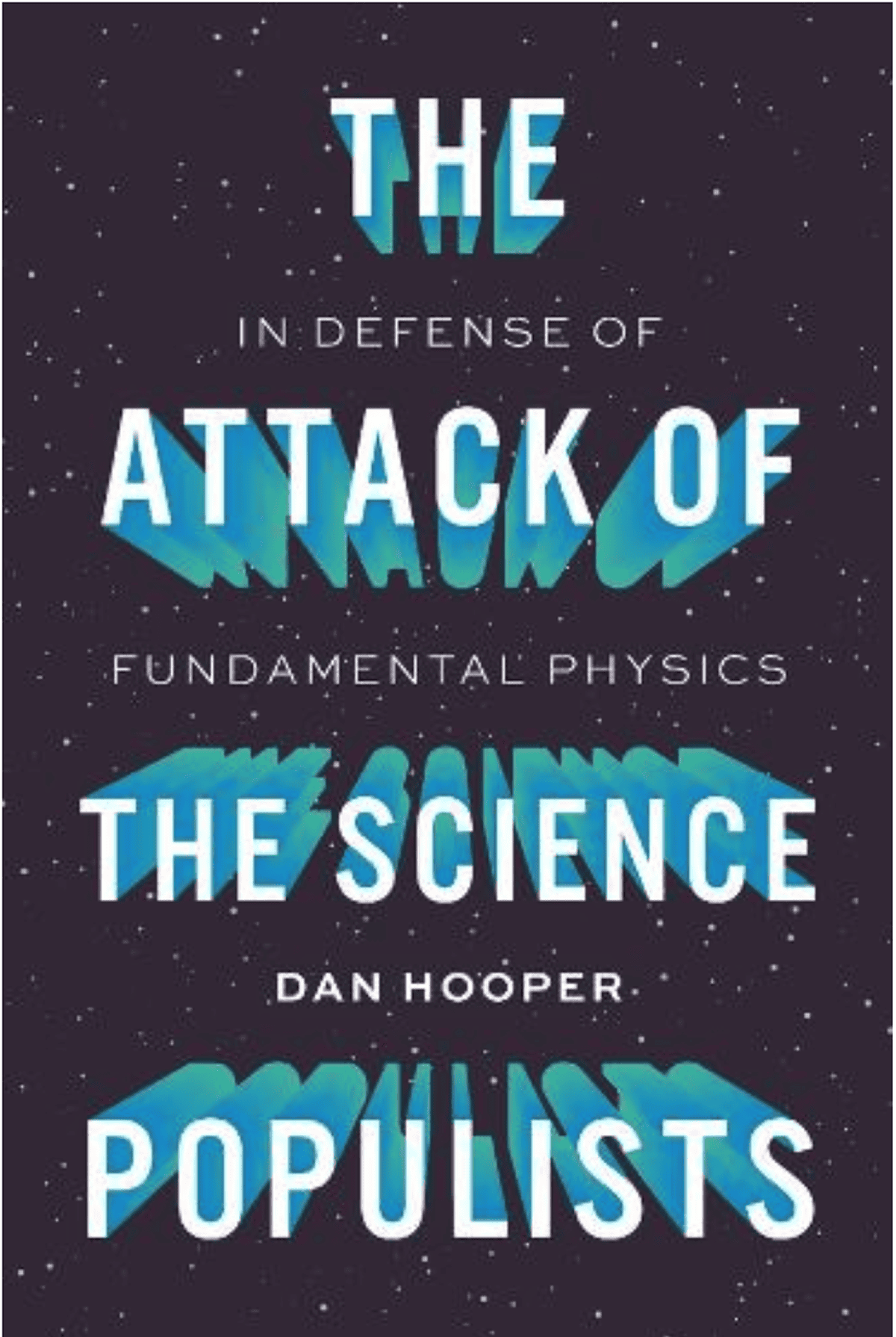
Action, reaction Dan Hooper’s book, due out in early 2027, is a staunch defence of science. (Courtesy: Harvard University Press)
Despite its title, The Attack of the Science Populists is in fact a popular-science book and a very good one at that. It distinguishes itself from other popular-science books by not only explaining contemporary physics but also emphasizing its failures.
Physicists hoped for great things from the Large Hadron Collider (LHC), Hooper writes (he’s aiming his book at readers who don’t know what the LHC is). But while it has made amazing discoveries, such as the Higgs particle, Hooper also describes the fundamental things that it was expected to find but didn’t, such as supersymmetry particles that might have explained why the Higgs has the mass it does.
In another chapter he writes that string theory seemed like a good bet because it is able to handle quantum gravity, but that “this bet has not paid off”. Hooper explains in clear language the aims and disappointments of the LIGO gravitational-wave detector, Modified Newtonian Dynamics (MOND), the Standard Model of particle physics, supersymmetry, the multiverse and other theories. But he also makes clear how their flaws relate to the boldness of their ambitions.
If your friends ask for popular books summarizing the current state of theoretical physics, include Hooper’s on the list.
The critical point
I think “populism” is the wrong word here. To me, the term suggests widespread and genuine if incompletely articulated grievances, whether it’s about the need for cheaper homes, more jobs or better healthcare. But is Hooper really talking about the masses? What does Terryology have in common with Geometric Unity? In the Venn diagram of Howard, Hossenfelder and Weinstein, how big is the audience overlap?
Many of the field’s assailants seem not to be motivated by widely shared grievances but more like individual self-aggrandizing types who say, “Pay attention to my theory!” Even Hooper calls them “fringe” and “outsider mavericks” who make for a good story. It’s not populism or conspiracy when a bunch of glam narcissists stand out only because of their large social media following.
So what would genuine “populist physics” be? It would, I think, be a shared concern and insistence by non-scientists that the billions of dollars spent on physics, on the hundreds of thousands of professional physicists, and on all their labs are used in ways that return something to the people who are paying for it.
Such a return doesn’t necessarily have to result in improving our material ways of life, but might involve providing answers to questions that we all have at one time or another about the origin, nature and future of the universe. Populist physics therefore would arise in opposition to wealthy influencers who dominate social media to promote merely sensationalist and self-interested claims.
In this sense, what Hooper is doing with his new book is seeking to reassure readers that populist physics is what his field has been up to all along.
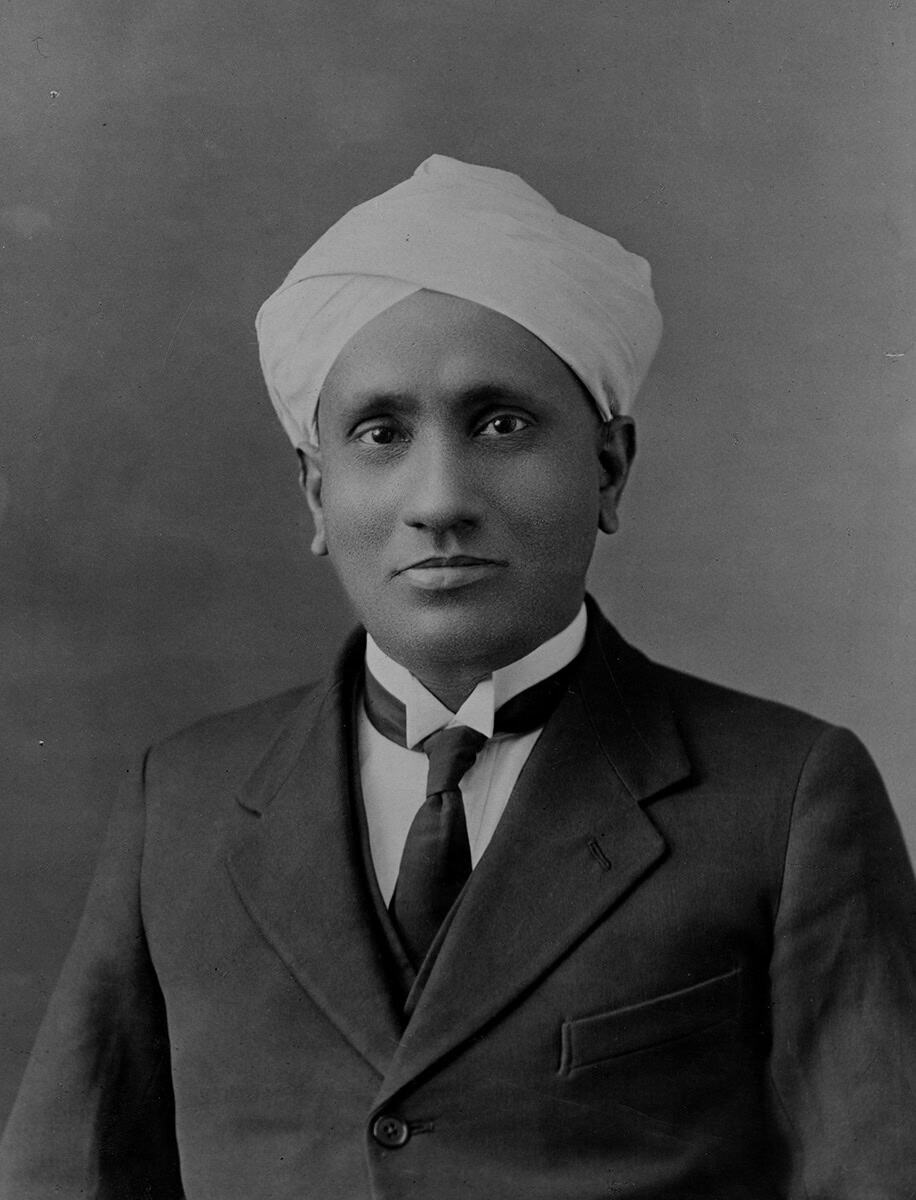
Cocksure and confident C V Raman sailed to Stockholm in 1930 convinced he’d win that year’s Nobel Prize in Physics. (Photograph by A Bortzells Tryckeri, courtesy of AIP Emilio Segrè Visual Archives, W F Meggers Gallery of Nobel Laureates Collection)
How confident, or perhaps delusional, do you have to be to travel to Stockholm because you’re so certain you’ll be awarded a Nobel prize? Most of us wouldn’t have the time, money or self-belief to go to Sweden and hang out at the Royal Swedish Academy of Sciences on the off-chance that we might win. But one person who did just that was the Indian physicist Chandrasekhara Venkata (C V) Raman in 1930.
Back in those days, travelling from India to Sweden wasn’t a case of jumping on a jet plane, but involved a long, two-month journey by sea. So if he wanted to arrive in Stockholm in time for the award ceremony on 10 December 1930, Raman knew he couldn’t wait until the prize was formally announced in mid-November to set sail. In July 1930 he therefore booked passage for himself and his wife, the couple arriving in Stockholm on 9 December of that year.
Raman’s audacity, belief and the arduous journey paid off. He was duly awarded the 1930 Nobel Prize in Physics “for his work on the scattering of light and for the discovery of the effect named after him”, namely Raman scattering. In doing so, Raman became the first person from India to win a scientific Nobel prize – the poet, playwright and musician Rabindranath Tagore having previously won the 1913 Nobel Prize in Literature.
Obsessive nature
Born on 7 November 1888 in the city of Thiruchchirappalli in Tamil Nadu, Raman was a child prodigy, who at 16 came top in physics at the University of Madras and published his first research paper aged just 18. Appointed a professor of physics at the University of Calcutta in 1913, Raman had a long obsession with winning a Nobel prize. In 1924, upon being elected a fellow of the Royal Society, he was asked during the award ceremony what was next in line for him. “The Nobel prize of course!” he replied.
The discovery that bagged Raman the coveted prize in fact began on another sea voyage
The discovery that bagged him the coveted prize in fact began on another sea voyage. In 1921 Raman was travelling back from Southampton to Bombay (now Mumbai) on the SS Narkunda, having taken part in the Second Congress of the Universities of the Empire in Oxford. Rather than lounging on the sun deck or drinking in the bar, Raman spent the 15-day journey examining and analysing the deep blue colours of the Mediterranean, Red and Arabian seas with his pocket Nicol prisms, a small telescope and a diffraction grating.
In fact, Raman did more than just take data. While on board, he wrote up his findings in a short letter that he mailed to the journal Nature while the ship was docked at Aden in Yemen. Published on 20 October 1921, it gives Raman’s address as “SS Narkunda, near Aden” (Nature108 242). He then wrote another paper to Nature (108 367) titled “The colour of the sea”, this time with the byline “SS Narkunda, Bombay Harbour”.
The spectrum of blue colours of the vast sea fascinated Raman and made him question the previous belief, primarily from the work by Lord Rayleigh, that the colour is simply due to the reflection of the sky – and has nothing to do with the colour of the water itself. Raman challenged this notion in his follow-up Nature paper, which was published on 17 November 1921.
Natural fascination C V Raman was awarded the 1930 Nobel Prize in Physics for discovering that light can change colour when passing through a material because some photons scatter inelastically off it. Now known as “Raman scattering”, he came up with the idea while sailing from the UK to India in 1921 and taking measurements of the deep blue colour of the sea. (Courtesy: iStock/Ciuvelic Razvan)
“It was abundantly clear from the observations,” he writes, “that the blue colour of the deep sea is a distinct phenomenon in itself.” Raman believed that light diffracts as it passes through the water and concluded: “An interesting possibility that should be considered is that the diffracting particles may, at least in part, be the molecules of the water themselves.”
This curiosity led him to a series of experiments over the next few years, primarily carried out by his students at Calcutta University, culminating in the discovery that light changes its wavelength and energy when it passes through any material. The change in wavelength and energy, in fact, is a fingerprint of the material itself.
His discovery of what became known as the Raman effect is what eventually won him his most cherished recognition – the 1930 Nobel Prize in Physics. One of the many applications of Raman’s discovery is Raman spectroscopy, which uses the scattering of laser light to establish the chemical make-up of a material and forms the basis of airport security scanners.
Indian impact
Raman’s Nobel prize was significant not just for the scientific advancements that his discovery enabled, but also for the far-reaching impact it engendered in India, where opposition to the British Raj was gathering speed. In fact, he won the award less than a year after the declaration of Purna Swaraj – complete independence – on 26 January 1930 in a session of the Indian National Congress in Lahore.
For a country reeling under colonial rule and fighting for its identity, Raman’s Nobel prize could not have come at a better time to instil hope and aspirations to millions of people around the country. In fact, he holds the honour of being the first physicist outside western Europe or the US to win the Nobel Prize in Physics.
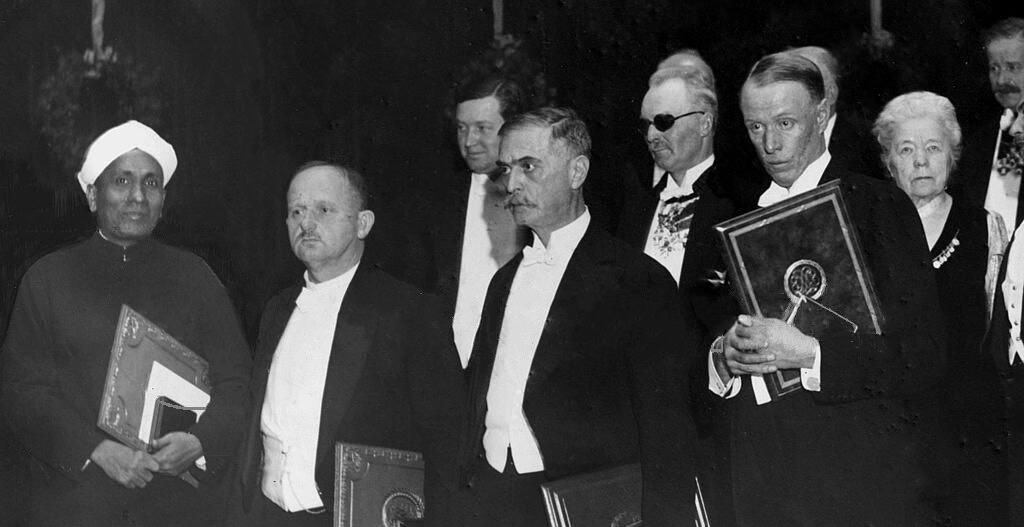
Dream trip C V Raman (far left) picking up the 1930 Nobel Prize in Physics in Stockholm alongside (from left to right) fellow winners Hans Fischer (chemistry), Karl Landsteiner (medicine) and Sinclair Lewis (literature). (No known copyright restrictions, photographer unknown. Source: Wikimedia Commons)
Raman was fully aware of the impact that the prize would have in India, where research was far less developed than that enjoyed by his counterparts in, say, Cambridge, Göttingen or Copenhagen. In 1929 he therefore hesitantly wrote a letter to the Danish Nobel-prize-winner Niels Bohr, asking for his “influential support” for the 1930 Nobel prize. The request of such “personal character”, he explained, was only because he believed that Bohr would “sympathize with the scientific aspirations of India”.
Unbeknownst to Raman, Bohr had already nominated him for a Nobel prize in 1929 – that year’s prize going to Louis de Broglie for wave–particle duality – and he did so again in 1930. We now know a total of 10 different people nominated Raman for that year’s prize, including de Broglie as well as Ernest Rutherford and Charles Wilson.
Raman’s research and notoriety led to many students being attracted to Calcutta, with the physics department becoming a centre of world-class research
Raman’s research and notoriety led to many students being attracted to Calcutta (now Kolkata), with the physics department becoming a centre of world-class research despite its small size and the lack of an established scientific culture and infrastructure in India. Other leading physicists to have worked there include the astrophysicist Meghnad Saha and the theorist Satyendra Nath Bose in what some have touted as a “golden era” for Indian science.
Sadly, it ended prematurely a few years after Raman’s Nobel prize due to conflicts between these three leading scientists. This was partly due to parochialism and partly, as his biographer, the condensed-matter physicist Ganeshan Venkataraman famously put it, Raman’s “Himalayan ego and sharp tongue”.
Moving on
In 1933 Raman left Calcutta, becoming the first Indian director of the Indian Institute of Science (IISc, earlier the Tata Institute of Science) in Bangalore (now Bengaluru). Rutherford, when asked by the institute’s council as to who should replace the outgoing director Martin Forster, had made it clear there was no need to seek directors in Britain when India had a “distinguished candidate in the shape of Raman”.
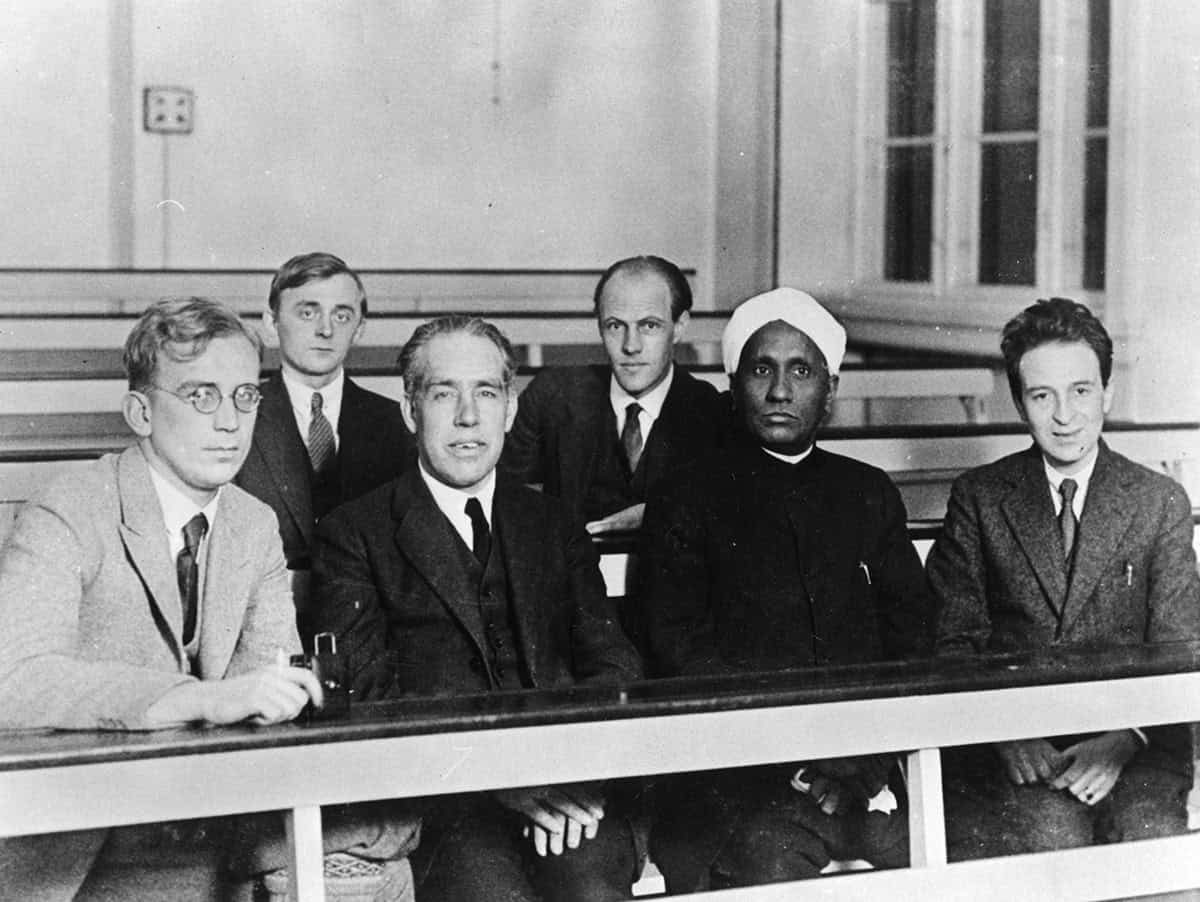
Mixing of minds C V Raman (second right) personally wrote to Niels Bohr (second left) for his support for the 1930 Nobel prize. The pair are shown here at the Niels Bohr Institute, Copenhagen, alongside George Gamow (far left) and Oskar Klein (far right) and Charles (back row, left) and Ebbe Rasmussen (back row, right). (Courtesy: AIP Emilio Segrè Visual Archives, Margrethe Bohr Collection)
In 1934 he went on to found the Indian Academy of Science, which was significant in that it provided a way for researchers across the country to communicate and discuss research findings. Just as important, however, was the fact that membership of the academy was reserved exclusively for Indian scientists, effectively signalling an act of rebellion against the British.
Raman’s time at the IISc was controversial. On one occasion, he turned down the application for a research fellowship by a female student – the biochemist Kamala Sohonie – because he believed women were not competent to conduct research. Raman reversed his decision, albeit with humiliating conditions, after Sohonie staged a Gandhian-style protest (Satyagraha) outside his office.
Within three years, Raman was forced to resign from the directorship following a fallout with the council, primarily for allegations of bias towards physics research and overshadowing other areas of research of the institute. He remained a professor at the IISc until retiring in 1948. Later that year, he founded the Raman Research Institute with which he was actively involved until his death in 1970 at the age of 82.
Raman’s legacy
Despite his controversial past, Raman is still the flag-bearer of Indian physics, owing to the Nobel prize and the global recognition he enjoyed. India holds a National Science Day every year on 28 February to mark the occasion in 1928 when Raman and his associate Kariamanickam Srinivasa Krishnan announced their discovery of Raman scattering to the media. The work was reported in newspapers on 29 February and was formally published on 31 March 1928 in a paper entitled “A new type of secondary radiation” (Nature121 502 ).
Almost a century on from his success, however, India has not yet produced another home-grown Nobel-prize-winning physicist. Raman’s nephew Subrahmanyan Chandrasekhar did share the 1983 Nobel Prize in Physics with William Fowler for his work on the evolution of stars, but he was based in the UK and then the US when the work for which he was recognized was carried out.
Raman’s divisive personality and sharp opinions turned more people against him than his ingenuity and scientific legacy ever won over
Sadly, Raman’s divisive personality and sharp opinions turned more people against him than his ingenuity and scientific legacy ever won over. His obsession with global recognition can be sensed from his reaction upon first receiving news of his Nobel prize, which came while he was en route to Stockholm. Learning of the award from his Calcutta collaborator Suri Bhagavantam, Raman’s first reaction was to ask if he was the sole awardee or whether he was to “share the bed with other strangers”.
Given his “Himalayan ego”, it should perhaps come as no surprise that Raman decided to travel to Stockholm on a whim. We do not have any documentation about what he thought or did on that two-month voyage. But for him, at least, it was a journey that was not wasted.
Find out more from Preetish Kakoty about C V Raman’s life on the Physics World Weekly podcast.
SmarAct proudly supports Physics World‘s Nobel Prize coverage, advancing breakthroughs in science and technology through high-precision positioning, metrology and automation. Discover how SmarAct shapes the future of innovation at smaract.com.
Next Tuesday the winner(s) of the Nobel Prize in Physics will be announced. To celebrate that most famous of prizes this episode of the Physics World Weekly podcast looks at a few fun aspects of past awards.
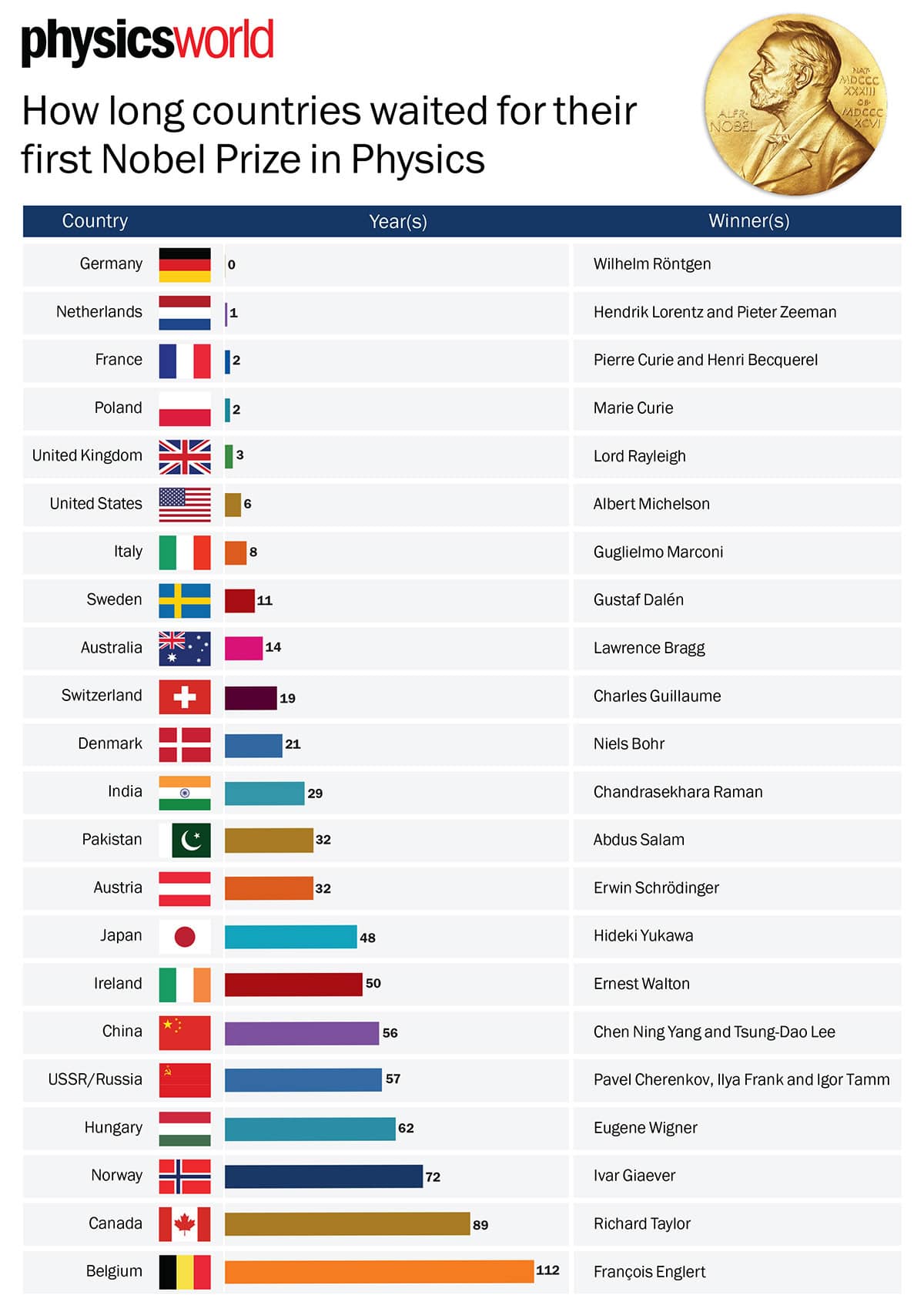
I’m joined by my Physics World colleague Matin Durrani to make a few predictions for next week. We also talk about our latest Nobel infographic – which looks at the time it took for countries to claim their first Nobel laureate.
Then I am joined by the Indian engineer Preetish Kakoty to talk about CV Raman, who was India’s first physics laureate. We chat about two ocean voyages that Raman took – journeys that reveal much about his devotion to science and his strong self-belief.
This podcast is supported by American Elements, the world’s leading manufacturer of engineered and advanced materials. The company’s ability to scale laboratory breakthroughs to industrial production has contributed to many of the most significant technological advancements since 1990 – including LED lighting, smartphones, and electric vehicles.
Waiting game Germany was the first nation to win a Nobel Prize in Physics, with Belgium the most recent. Click the image to expand. (Courtesy: Alison Tovey/IOPP)
How long did it take for your country to claim a physics Nobel laureate? Or perhaps you live in one of the 170 or so countries that has yet to produce a Nobel prize winner?
The aim of our latest infographic (see figure) is to answer that question by exploring the geographical evolution of laureates. Creating it, however, quickly became an exercise in the history of the past two centuries.
Map-changing wars in Europe, the demise of colonialism, and immigration made it surprising difficult to ascribe some laureates to specific countries and led to at least one debate amongst Physics World colleagues. I will get into some of these idiosyncrasies after I take a general look at the infographic.
What is obvious is the early Nobel physics laureates come from what many call the west. Germany is considered by many to be the birthplace of modern physics, so it is not surprising that the country had the shortest wait – with Wilhelm Röntgen bagging the first prize (in 1901) for his discovery of X-rays.
Until 1930, when the Indian physicist CV Raman won the prize for his eponymous scattering effect, the prize was only awarded to people from western countries. Indeed, of the 22 countries that can claim laureates (by our measures), only five are not in the west. These are India, Pakistan, Japan, Soviet Union/Russia and China. So far, there have been no laureates from Africa, Latin America or much of Asia and Oceania.
While much of this is down to better access to education and research resources in the west, increasing global mobility means that students and researchers from all over the world are working in the west – and wealthy countries like China, South Korea and Japan. So why aren’t they bagging Nobel firsts for their home countries?
Indeed, only three laureates in the infographic who took that route are China’s Chen Ning Yang and Tsung-Dao Lee – who did their prize-winning work in the US – and Abdus Salam, who did much of his prize-winning work in the UK and Italy. Hopefully, this year’s crop of winners will include someone who is not from one of those 22 countries. While it’s likely that they will be working in the west, wouldn’t it be great if they won for work done in their home country.
Established nations
So how did we decide where a laureate is from? To work this out we considered where that person was born, where that place is today and – in some cases – what we know about a laureate’s view on their own nationality.
A case in point is Ernest Walton, who we consider to be the first Irish laureate. He was born in 1903 in Dungarvan, which is on the south-east coast of the Republic of Ireland. At the time of his birth, however, his birthplace was in the United Kingdom of Great Britain and Ireland – as all of Ireland was then a constituent nation of the UK. So Walton was born a British subject.
However, we consider him Irish for several reasons. First, although Ireland was not a sovereign country in 1903, it was a well-established national entity that was on the road to independence before Walton reached adulthood. Second, although Walton did his award-winning research in England, he spent most of his life in Ireland. Third, there is no evidence that he was a unionist – someone who opposes Irish independence and considers themselves British.
The above might upset readers in Scotland and Wales because both of those nations have spawned physics laureates who don’t appear in our infographic. But unlike in international football, rugby and cricket, Scotland and Wales will have to wait for independence from the UK before they get their own laureate teams in our infographic.
Similarly, Marie Curie was born in Poland when it was a part of the Russian Empire. But Poland was identifiable as a country in 1867 and it gained independence during Curie’s lifetime. Indeed, Curie was clearly a proud Pole, because she named the element polonium after her homeland in the hope that Poland would become unified and independent.
We have included Lawrence Bragg as the first Australian to win a Nobel prize. He was born in Adelaide in 1890, when the Australian colonies began the journey to independence from the UK. While Bragg is often considered British, we have decided he is Australian because he left the country for the UK in 1908 – seven years after Federation created the Commonwealth of Australia, which was independent from the UK for domestic issues.
Dealing with decolonization
I mentioned that there are no laureates from Africa in our infographic, but three physics Nobel prize winners were born on the continent. These are Claude Cohen-Tannoudji (born in Algeria), Serge Haroche (born in Morocco) and Pierre Agostini (born in Tunisia). However, all were born when these countries were French colonies and they all left for France when they gained independence.
Some readers might be scratching their heads over how we have dealt with the time Pakistan had to wait for its first Nobel prize. Salam bagged that prize in 1979 – so a 78-year wait from 1901, when the first prize was awarded. So why have we calculated the wait as just 32 years?
The reason is that unlike Ireland, Poland or Australia, the concept of Pakistan didn’t exist when Salam was born in Lahore in the British Raj in 1926. The word Pakistan is thought to have originated in 1933 and the call for a Muslim homeland crystalized in 1940 with the Lahore Resolution. So, we have decided to start the clock for Salam in 1947.
Other laureates who merited scrutiny include Albert Michelson, who was born in Poland but arrived in the US age two. As a result, we consider him to be the first American laureate. Indeed, Michelson wouldn’t appear in the infographic if we considered him a Pole because he was pipped at the post by Marie Curie.
Similarly, Gabriel Lippmann was born Luxembourg to French parents and moved to France age three, so we consider him French and not the first laureate from Luxembourg. However, we are a big fan of Lippmann here at Physics World because of the nature of his award – which was for a still-obscure colour-photography technique.
Indeed, my colleague Margaret Harris bagged an award of her own from Association of British Science Writers for her feature article that explores Lippmann’s prize, and that of Gustaf Dalén – the first Swede to win a physics Nobel prize. That article is called “The physics Nobel prizes you’ve never heard of”.
SmarAct proudly supports Physics World‘s Nobel Prize coverage, advancing breakthroughs in science and technology through high-precision positioning, metrology and automation. Discover how SmarAct shapes the future of innovation at smaract.com.
Here at Physics World we have had some luck with predicting who is going to win a Nobel Prize in Physics. One successful strategy is to identify top physicists and just keep predicting that they will win – and eventually they do!
For example, we picked Anton Zeilinger for the 2009, 2013, 2014, 2015 and 2019 prizes – and he won in 2022. Clearly, it was a mistake to give up on him in 2020.
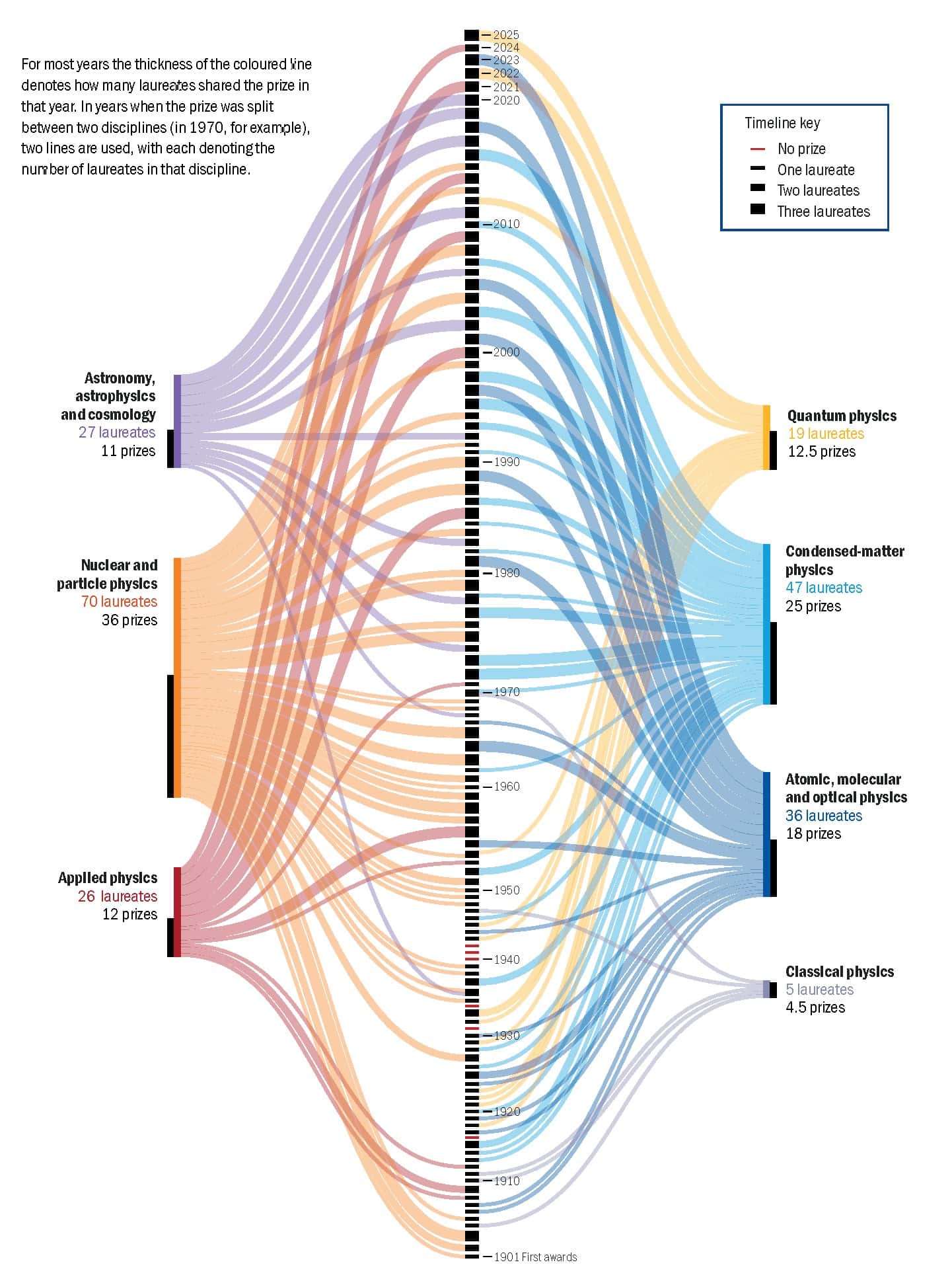
In making our predictions we sometimes rely on an infographic that we have been updating for a decade or so. It shows the chronological progression of Nobel prizes in terms of fields of endeavour – such as condensed matter, particle and nuclear, quantum and more (see figure).
By staring at the infographic for far too long, we have convinced ourselves that there is a regular pattern of gaps between prizes in specific fields. Looking at the latest version of the infographic it appears that both condensed-matter physics, and particle and nuclear physics are due a prize.
I have really struggled to think of a particle and nuclear breakthrough that could bag the 2026 Nobel – but I believe I have come up with one or two contenders. One is a prize for physicists working on CERN’s ATHENA and ALPHA collaborations, who were the first to trap cold antihydrogen atoms and then study them in detail. One laureate would surely be the Denmark-based American physicist Jeffrey Hangst, who is a founder of both collaborations. Making extremely precise comparisons of the properties of antihydrogen and hydrogen could reveal why there appears to be much more matter than antimatter in the universe – an important mystery in physics.
But alas, these and other antimatter experiments have yet to find any significant deviations from the Standard Model description of antihydrogen, so that might preclude a Nobel prize for Hansgt and one or two of his colleagues. And another caveat is one could easily argue that many of the innovations at ATHENA and ALPHA are in the field of atomic and molecular physics, not particle and nuclear physics – so there would be much debate here at Physics World if we had to update our infographic with an antihydrogen prize.
Another potential prize in particle and nuclear physics is for the the creation of the quark–gluon plasma (QGP). This is a state of matter that occurs very briefly when large nuclei (such as lead or gold) are collided at high energies. The result is a soup of quarks and gluons that is thought to resemble the early universe shortly after the Big Bang. Studying the QGP is a fascinating and important area of physics, but because the experimental work has been done by large collaborations at both CERN in Switzerland and at Brookhaven National Laboratory in the US it would be difficult to select just three people as Nobel winners. The fact that scientific breakthroughs in particle and nuclear physics are often made by large collaborations has led some to call for the three-person limit on prize winners to be lifted.
The field of condensed matter is much more fruitful when it comes to potential Nobel prizes. The analytics company Clarivate has released its “Citation laureates 2026 in physics”, which predicts Nobel winners based on the citation impact of their published research. Clarivate (and its predecessor Thomson Reuters) has a reasonably good record of picking winners and this year all three of its predictions are in condensed matter physics.
Organic LEDs
One prediction is a prize to Chihaya Adachi, Stephen Forrest and Mark Thompson for work leading to the development of ultrahigh-efficiency organic light-emitting diodes. The second is to Nicola Spaldin for her theoretical work on room-temperature magnetoelectric multiferroics, which Clarivate says are enabling new energy-efficient device paradigms. The third prediction is to Qikun Xue “for experimental observation of the quantum anomalous Hall Effect”. What all three of these awards have in common is a relatively immediate connection of the development of new technologies.
Spaldin was profiled in Physics World back in 2023 and she talks about the joy that she gets from her research, which combines blue-sky research with the design of real materials.
Other prestigious awards are also a good place to look for potential Nobel winners. The 2026 Kavli Prize in Nanoscience went to the physicists Eva Andrei, Pablo Jarillo-Herrero and Allan MacDonald for their pioneering work on twistronics. This is a burgeoning field that involves rotating the relative angle between two sheets of 2D material such as graphene. Rotations create moiré superlattices with a wide range of electronic properties including superconductivity.
I am also keen on an award for the applied physicist Federico Capasso. As well as developing a wide range of semiconductor technologies – including the quantum cascade laser – Capasso has done seminal work on optical metamaterials. An award for such metamaterials could be shared with John Pendry (a 2024 Kavli nanoscience laureate), who has developed a mathematical framework for designing optical metamaterials. These days prizes are usually awarded to trios, so potential partners for Capasso and Pendry are David Smith – a pioneer in creating metamaterials that operate at microwave frequencies – and Andrea Alù who is a prolific researcher in photonic metamaterials. Other possible winners in this field are Ulf Leohardt, Nader Engheta, George Eleftheriades and Vladimir Shalaev.
Wavelet theory
Finally, a potential prize that I find intriguing is inspired by “Clarivate’s Citation laureates 2025 in physics”. This proposes Ingrid Daubechies, Stéphane Mallat and Yves Meyer “for advancing wavelet theory, a revolution in mathematics and physics with practical applications including image processing”. Such an award would be difficult to shoehorn into a category in our infographic. I think applied physics would be the best fit.
The 2026 Nobel Prize in Physics will be announced on Tuesday 6 October at 10:45 a.m. BST at the earliest.
SmarAct proudly supports Physics World‘s Nobel Prize coverage, advancing breakthroughs in science and technology through high-precision positioning, metrology and automation. Discover how SmarAct shapes the future of innovation at smaract.com.
As audiences poured out of London’s Old Vic theatre on a crisp night in January, one theatregoer and their companion were overheard chatting about the second law of thermodynamics. “I wish I knew more about what they were discussing,” one remarked, referring to the characters in Tom Stoppard’s Arcadia. “It’s an unusual play,” the other responded.
Was this curiosity about thermodynamics a sign of confusion, that the production had failed to communicate its ideas clearly for a lay audience? Or had the evening in the theatre inspired a desire for these audience members to dig deeper and learn more about physics through the shared experience of watching a play?
Written in 1993, Arcadia is an early example of an ever-growing number of plays that have at their heart scientific ideas or scientists themselves. Newtonian determinism, chaos and iterated algorithms all crop up in Stoppard’s masterpiece, but Arcadia is a play about much more than just physics or mathematics.
With scenes alternating between a country house in the early 19th century and the present day, Arcadia is also a literary mystery about the poetry of Byron set against academic rivalry. Like all of Stoppard’s work, it’s an agile, clever and entertaining tour de force of ideas, led by characters who are just as concerned with traditional dramatic themes including love, jealousy and flawed ambition.
The Old Vic’s Arcadia was sufficiently popular with audiences that it received a transfer to London’s West End for an extended run in summer 2026. But it was not the only major revival of a classic “science play” in London this year, with Hampstead Theatre staging a new production of Michael Frayn’s Copenhagen.
Arguably no other play about physics has been as popular and successful as Copenhagen since it was first produced at the National Theatre in London 1998. It imagines what might have been discussed when Werner Heisenberg visited Niels Bohr at his home in the Danish capital during the Second World War. It also explores the implications of the meeting for the development of nuclear weapons.
Plays depicting physics or physicists fall into three main types. Some are straightforward biographical representations of physicists – from Lise Meitner to Stephen Hawking. Others focus on the process of “doing” physics. A third kind uses scientific concepts to structure the play itself. Copenhagen is perhaps unique in achieving all these feats at once.
Curtains up
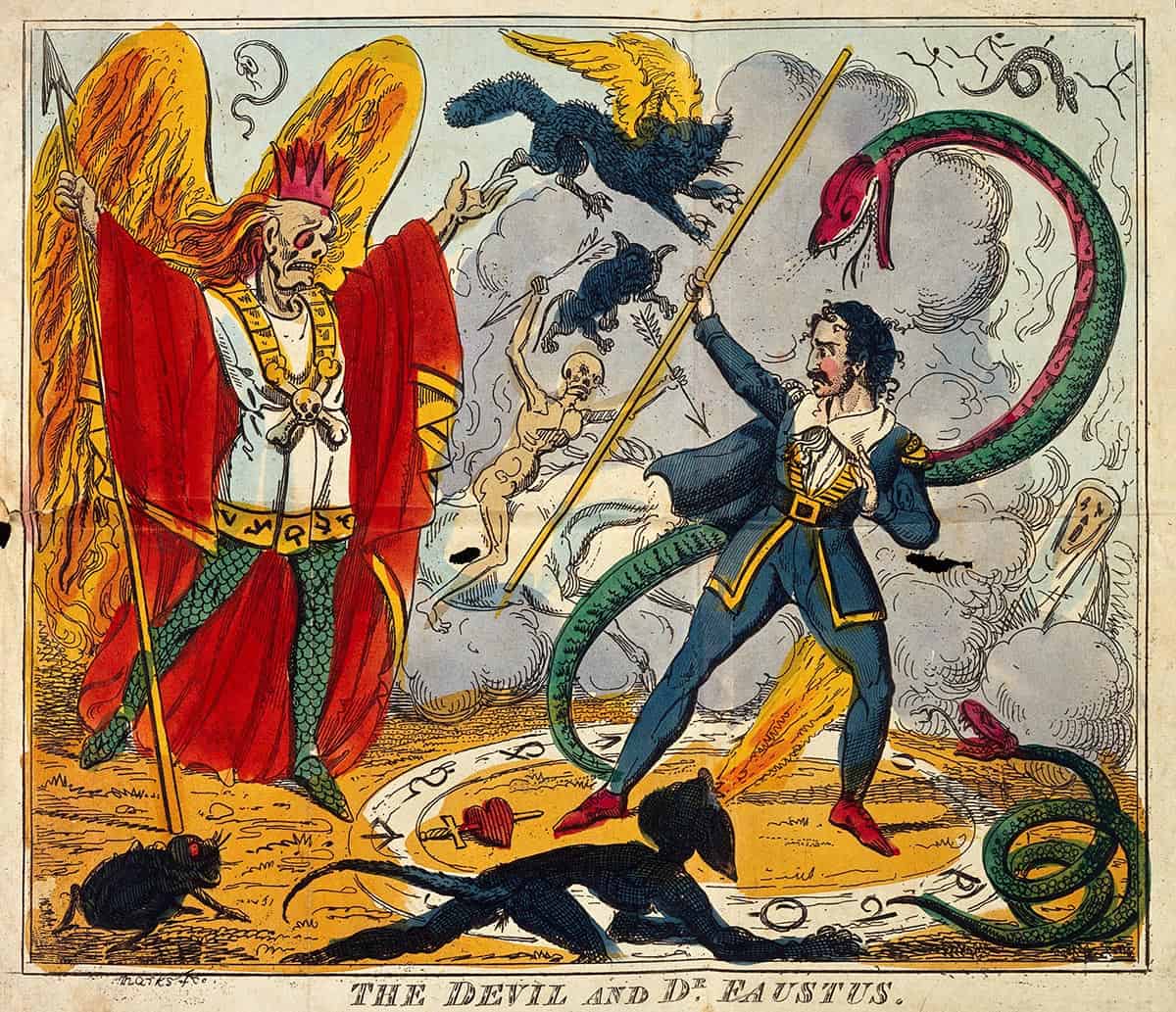
The representation of scientists on stage is not a new phenomenon. The ambitious alchemist and natural philosopher Doctor Faustus, who sold his soul to the devil in Christopher Marlowe’s 16th-century play of the same name, is one early example of a learned character who could be considered a scientist seeking worldly knowledge at a cost.
Strange encounter The Devil and Doctor Faustus Meet is an 1825 illustration of the play Doctor Faustus by Christopher Marlowe, which was one of the earliest stage shows to feature scientific ideas. (Source: Wellcome Collection)
Later, in 1823, there was a highly popular stage adaption of Mary Shelley’s novel Frankenstein. Performed at the English Opera House in London, Presumption; or, the Fate of Frankenstein by Richard Brinsley Peake was what first brought Shelley’s book to public prominence, reigniting suspicions of the motivations of scientists as a potential force for good or evil.
While Frankenstein led the way in the genre of science fiction, which I will not cover here, the notion of the “physics play”, where physics or physicists feature deeply, can be more readily traced to the 20th century. Bertolt Brecht’s A Life of Galileo, written in 1938, is perhaps one of the first clear examples to represent the life and work of a real scientist on stage.
First performed in German in Zurich in 1943, ALife of Galileo presents the audience with an account of a scientist whose life is well documented in the historical record. It depicts scenes from Galileo’s life including his prosecution for heresy by the church for promoting the heliocentric universe.
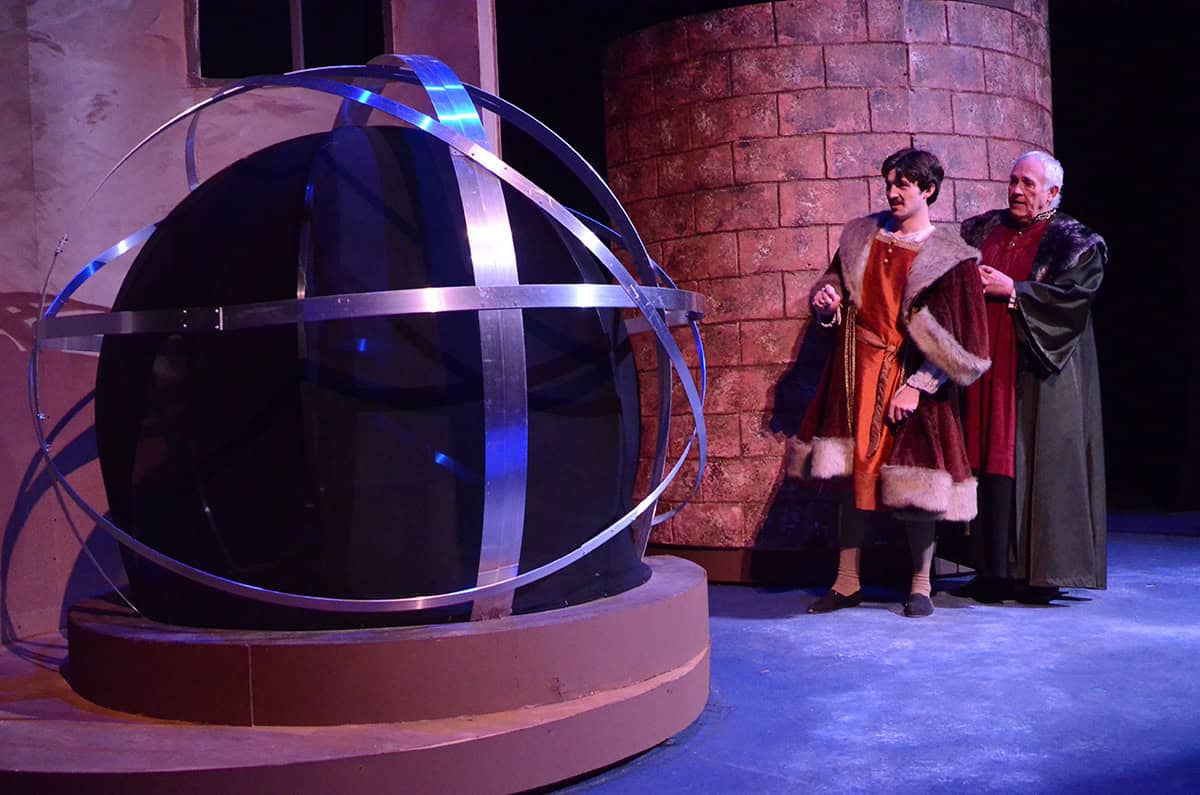
Astronomy in action Dava Sobel’s play And the Sun Stood Still was produced in 2014 by Boulder Ensemble Theatre Company, starring Benjamin Bonenfant (left) as mathematician Georg Rheticus and Jim Hunt (right) as Nicolaus Copernicus. (Photograph by Michael Ensminger. Used with permission)
Since then we’ve seen plenty of other plays about real-life physicists. Also dealing with the heliocentric solar system is acclaimed science writer Dava Sobel’s short 2011 play And the Sun Stood Still (first published in her book A More Perfect Heaven). It concerns an episode in the life of Nicolaus Copernicus, depicting his discussions with mathematician Georg Rheticus when he visited Poland in 1539.
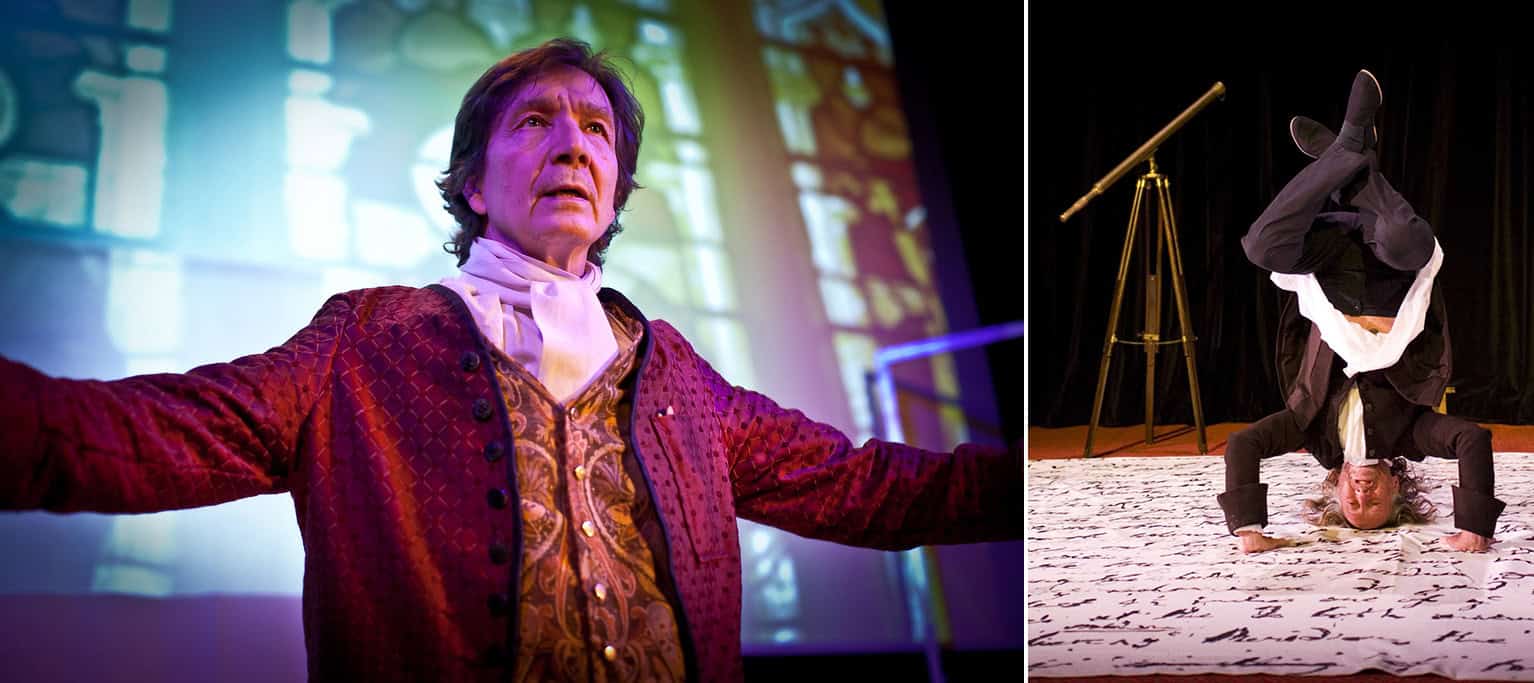
The period of scientific advancement that followed in the 17th century is represented in a number of plays depicting the life of Isaac Newton. A notable example is Craig Baxter’s Let Newton Be!, a verbatim play based on Newton’s own words that was written to celebrate the University of Cambridge’s 800th anniversary in 2009.
It was performed by Menagerie Theatre Company for the first time in 2009 at Trinity College, Cambridge, where Newton had once been a fellow. Three actors simultaneously portray Newton at different points in his life, from boyhood to establishment figure, continually interacting with each other on stage. Baxter aims to give a less conventional perspective on Newton’s life than the usual image of a scientist beneath an apple tree.
Historical heroes Left: Let Newton Be! by Craig Baxter was toured from 2009 to 2011 by Menagerie Theatre Company with a cast that included David Meyer as Isaac Newton in later life. (Courtesy: Menagerie Theatre Company/Jaimie Gramston). Right: Siobhán Nicholas’ play Hanging Hooke, toured by Take the Space from 2008 onwards, starred Chris Barnes as Newton’s scientific rival Robert Hooke. (Photographer Ken Goodson, copyright Take the Space Theatre Company Ltd)
Newton’s contemporary and arch enemy Robert Hooke was also memorably represented by the actor Chris Barnes in Siobhán Nicholas’ 2008 one-man play Hanging Hooke. It was toured by Take the Space theatre company, which Barnes co-founded, to venues across the UK, including a performance at the Royal Society itself.
In a follow-up to Hanging Hooke, Take the Space also represented the contributions to astronomy of Caroline Herschel in the 18th and 19th centuries. Her work, which is arguably less well known than that of her brother William Herschel, appeared in STELLA: a Story of Women, Their Men and Astronomy, also written by Nicholas.
Centre stage
Some episodes in the history of physics are more thoroughly documented then others, lending rich source material for drama. Such is the case in Katherine Moar’s play Farm Hall about the German physicists who were famously held captive in a country house in Cambridgeshire, UK, at the end of the Second World War.
The play features six characters, all of them real scientists, including Heisenberg, Kurt Diebner and the pioneering radiochemist Otto Hahn. Their words were secretly recorded by their British military captors in 1945 in an attempt to find out how close, if at all, the German scientists were to developing a nuclear bomb.
Ethical matter Physicists’ involvement in nuclear weapons has been a rich source of material on the stage, including this 2023 production of Farm Hall by Katherine Moar, at the Jermyn Street Theatre in London. It included Archie Backhouse (left) as Erich Bagge, Forbes Masson (centre) as Otto Hahn and Alan Cox (right) as Werner Heisenberg, who were among six German physicists held captive by the British military after the Second World War to uncover their role, if any, in Germany’s attempt to build nuclear weapons. (Photograph by Alex Brenner. Used with permission)
Moar’s play is one of several that use the Farm Hall transcripts as the basis of a play text, another being Operation Epsilon by US playwright Alan Brody. Originally written in 2013, it received its British premier at the Southwark Playhouse in London in 2023, and examines the ethics of those involved in nuclear weapons programmes.
That theme was also tackled in Christopher Nolan’s blockbuster movie Oppenheimer, which was one of the biggest film successes of recent years. However, J Robert Oppenheimer has been represented on stage too, not least in Tom Morton-Smith’s 2015 play Oppenheimer, in which key figures in the Manhattan nuclear-bomb project were re-enacted in a large-scale production at the Royal Shakespeare Company (RSC). Morton-Smith’s play aimed to capture the scale and scope of a so-called Shakespearean “history play”, with a significant but flawed character at its heart, although this is arguably a tough feat to achieve.
Dramatis personae
In each of the examples above, the physicists portrayed are real people, whose names and work will be familiar from textbooks and the historical record. Other physicists to have been the subject of plays include Jocelyn Bell Burnell, Ludwig Boltzman and Wolfgang Pauli, while Nicole Kidman played DNA-structure pioneer Rosalind Franklin in Anna Ziegler’s Photograph 51.
Physicists as fictional characters and the act of doing physics are also increasingly being represented on stage, with collaboration in big-science projects becoming central
However, physicists as fictional characters and the act of doing physics are also increasingly being represented on stage, with collaboration in big-science projects becoming central. Especially fruitful as source material have been activities at CERN and particularly the Large Hadron Collider (LHC), which gained growing public awareness during the hunt for the Higgs boson in the first two decades of the 21st century.
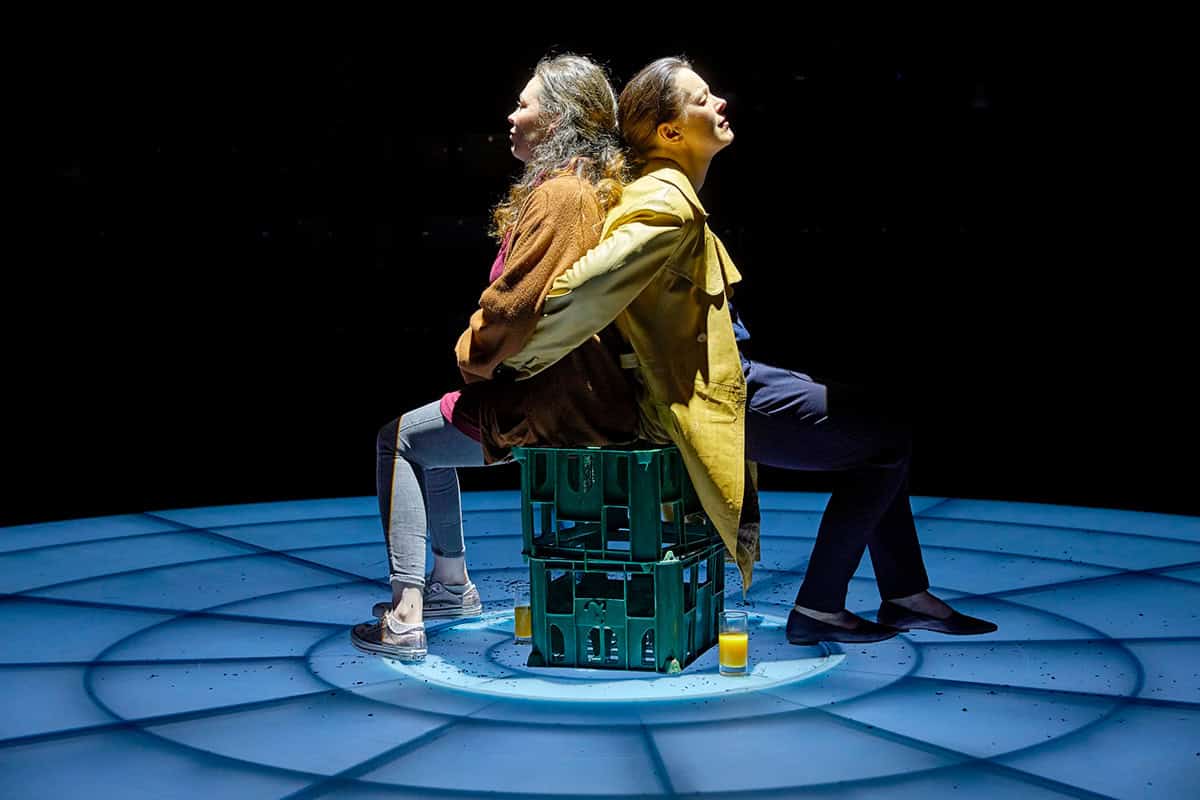
Playwright Lucy Kirkwood had already published a play with nuclear scientists as characters in The Children in 2016 (currently playing at Lyric Hammersmith). But it was her play Mosquitoes, produced at the National Theatre in 2017, that centred on scientific themes. Many scenes are set at the LHC and its central character, Alice, is a research physicist based in Geneva who has a complex relationship with her sister, Jenny.
Colliding characters Mosquitoes by Lucy Kirkwood, performed at the National Theatre in 2017, starred Olivia Williams (right) as a physicist working at CERN, and Olivia Colman (left) as her sister. (Courtesy: Brinkhoff & Mogenburg)
The play’s depiction of the two sisters centralizes the process of collaboration that is key to large-scale science research. Olivia Colman and Olivia Williams played the main characters in Mosquitoes in the National Theatre production, which benefited from some funding from the Institute of Physics, which publishes Physics World.
On a smaller scale to Mosquitoes, but also set in the periphery of CERN, is Morton-Smith’s one act play The Earthworks. Set on the eve of the switch on of the LHC, it features two strangers – a journalist and a physicist – who meet in a hotel bar in Geneva and talk about their loves and fears.
The anticipation and magnitude of the imminent new experiment gives the two characters cause to reevaluate their own lives and relationships. Although not widely produced, The Earthworks is an engaging short drama that again normalizes the process of big science in the wider cultural context through theatre.
Structured text
Featuring a physicist as a main character is also key to Constellations by Nick Payne, a playwright who has often included scientific ideas in his work. First performed in 2012 at the Royal Court Theatre, it features a physicist and beekeeper who meet at a picnic and begin a series of scenes replayed over and over again.
Unlike straightforward biographical-style plays, Constellations is a great example of a play that uses a scientific principle as a metaphorical device to help shape the play itself. Its structure is essentially inspired by the “multiverse” interpretation of physics, which implies there may be a potentially infinite number of copies of ourselves in different worlds.
The many iterations of similar scenes in Constellations make it a challenging production for actors – although not necessarily for audiences, provided the acting is good. And having only two characters on stage proved handy during the COVID-19 pandemic, when strict social-distancing rules meant it was helpful to have such a small cast.
In fact, when Constellations was revived in 2021 at the Vaudeville Theatre in London, different pairs of celebrity actors were used in different performances. Pairings included Peter Capaldi with Zoë Wanamaker, and Omari Douglas with Russell Tovey.
Two’s company Constellations by Nick Payne is a two-hander with multiverse themes. In 2021 it was produced at the Vaudeville Theatre with several different casts. Clockwise from top left: Chris O’Dowd and Anna Maxwell Martin; Peter Capaldi and Zoë Wanamaker; Omari Douglas and Russell Tovey; Sheila Atim and Ivanno Jeremiah. (Photographs by Marc Brenner. Used with permission)
“I loved staging Constellations,” says the theatre director Michael Longhurst, who originally worked with Payne on the play. “When a writer does that work to understand the science for us lay audience members and then puts them into a human context in a dramatic setting, then I think there is a real gift.”
Incorporating physics into the structure of a play has also been tackled more than once by Tom Stoppard, who died last year. In Hapgood, his attempt at a spy thriller, quantum physics plays a role in structuring the play by experimenting with quantum uncertainty as a plot device. First performed in 1988, the complexity of the plot proved confusing for audiences and, although revived subsequently, it was one of Stoppard’s less successful plays.
The bewildering twists and turns of Hapgood are in strong contrast to Arcadia, which has proved a far more popular science-themed play from the great playwright. It toys with ideas of determinism and iterated algorithms in a rich drama.
Like many Stoppard plays, audiences appreciate the playfulness of ideas but can at times feel alienated by the complexity of the discourse. Nonetheless, Arcadia is a hugely significant play when it comes to science in theatre and its recent success at the Old Vic and subsequent West End transfer over 33 years later is evidence of its endurance.
It’s worth noting, however, the existence of several plays that appear to have a strong physics connection – but in fact have very little at all. Notable examples include Friedrich Dürrenmatt’s 1962 play The Physicists (which was more of a satire) and Simon Stephens’ 2015 play Heisenberg: the Uncertainty Principle. Stephens was perhaps capitalizing on a growing public awareness of “uncertainty”.
Copenhagen: the definitive physics play
Conversely, you could be forgiven for thinking that a play called Copenhagen would be largely about the Danish city. But Frayn’s drama is one of the most significant examples of a play about and featuring physicists. With just three actors on stage and minimal set or plot, it is perhaps a surprise that Copenhagen could capture the attention of theatre goers for over two hours.
However, the text is a richly researched and thought-provoking drama that successfully achieves several things at once. First, it is a faithful account of the lives and work of Bohr and Heisenberg, insofar as we can know these two Nobel-prize-winning physicists, provoking historically meaningful questions.
Second, it gives an audience a sense of the excitement, frustration and invigoration of the act of doing science through the reminiscences and insights of its characters reflecting on the heyday of the development of quantum theory.
Stars of the stage Michael Frayn’s Copenhagen, which is perhaps the archetypal physics play, was revived in 2026 at Hampstead Theatre. It starred Richard Schiff (left) as Niels Bohr, Damion Molony (centre) as Werner Heisenberg and Alex Kingston as Margrethe Bohr. (Photograph by Marc Brenner. Used with permission)
Third, it successfully embeds concepts of uncertainty and complementarity within the text and structure of the play itself – in a way that other writers have fallen short of achieving. Copenhagen perhaps stands out among all other plays that deal with physics as achieving all three of these things at once, accounting for some of its enduring appeal, not least to physicists.
In a conversation with Physics World earlier this year, Frayn admitted that physicists hadn’t held back in pointing out mistakes. “Some of the physicists who have seen Copenhagen have taken the trouble to write to me and to point out errors I had made in the science, in spite of all my efforts,” he says. “I have as a result made a number of corrections in succeeding productions over the years. I am very grateful to them.”
Copenhagen tackles the historical and moral dimensions of nuclear weapons in a way that is as relevant today as when it was written
The care with which Frayn researched and adapted Copenhagen enables it to tackle the historical and moral dimensions of the development of nuclear weapons in a way that has made it as relevant today as when it was written. The production at Hampstead Theatre in spring 2026 was the latest in a long line of revivals of the play around the world since its first critical and popular success in 1998. In addition to Howard Davies’ 2002 film version, Emma Harding adapted Copenhagen for radio in 2013, featuring Simon Russell Beale, Benedict Cumberbatch and Greta Scacchi.
Curtains down
So were the Old Vic theatregoers wandering down the street after seeing Arcadia enthused or confused by their encounter with thermodynamics in the theatre? Should we celebrate or be sceptical of plays that put physics at their core? There is arguably no reason why physics should have a place in theatre any more or less than any other aspect of human endeavour.
However, as the importance of science becomes more embedded as an essential part of our culture in general, the role for physics in the theatre continues to grow. Current writers such as Moar and Kirkwood will continue to build on the achievements of the old guard such as Frayn and Stoppard, whether that be representing the history of physics, portraying physicists as characters or using science within the structure of a play.
In the rarest of cases all three can be achieved at once and it is intriguing to wonder how long it will be until another play comes along to match the might of Copenhagen as the definitive physics play.
What do you think? What makes a good physics play and what’s your favourite production? Let us know by e-mailing pwld@ioppublishing.org
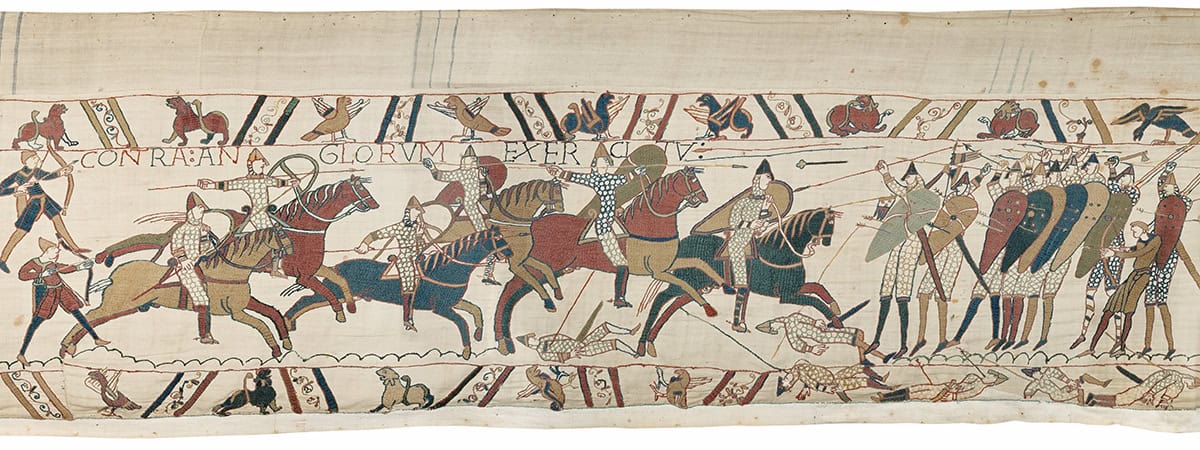
A few years ago, I was lucky enough to see the Bayeux Tapestry – the famous embroidered cloth depicting the Norman invasion of England in 1066. More than 900 years old, this historic piece of art is only 50 cm wide but more than 68 m long. It’s also extremely fragile, which why I was astonished when I heard that the Bayeux Tapestry was going to leave its home in Normandy and be transported across the English Channel to the UK.
I’m fascinated by how non-invasive optical techniques have been crucial in advancing our understanding of the tapestry
So what’s all this got to with physics? Well, I’m fascinated by how physics – and specifically, non-invasive optical techniques – have been crucial in advancing our understanding of the tapestry and its historical significance. Thanks to physics-based equipment developed by hi-tech manufacturers, we’ve learned about how the Bayeux Tapestry was initially made, what damage it subsequently suffered, how it was repaired, and the nature of its current condition.
Such information is vital not only for increasing our historical awareness, but also for current conservators who want to understand the tapestry’s underlying condition and find out how to preserve it for future generations. And before the pedants write in, yes I know that while it’s known as the Bayeux Tapestry, technically it’s an embroidery. That means it was created by stitching woollen threads onto a linen backing, which is helpful to know when reviewing the physics involved.
Optical sleuthing
The beauty of using optical methods to study the Bayeux Tapestry is that they are non-destructive and non-intrusive – and so can typically be applied in situ. In 2017 a three-year project was started, in which conservationists used high-resolution 2D imaging, photogrammetry, multimodal scanning and advanced image reconstruction techniques to determine the tapestry’s condition and conservation needs. The project revealed considerable information about how this artwork was created and modified over time.
Thanks to these high-resolution images, we now have a single digital map of the entire tapestry, making it possible to zoom in and look at individual threads. It’s yielded information such as the width of stitches and the positions where the wool threads cross the original linen background. As a result, historians now believe the tapestry was made by a single group of embroiderers, who – knowing the skills that existed at the time – were probably based in Canterbury, UK.
Techniques such as infrared spectroscopy and fluorescent and reflection ultraviolet imaging have revealed information about what’s underneath the surface of the tapestry
From the size and direction of the stitches, we also think the outlines of the figures were stitched first, with the shapes filled in afterwards using coloured wools in a strict, specific order. Meanwhile, techniques such as infrared spectroscopy and fluorescent and reflection ultraviolet imaging have revealed information about what’s underneath the surface of the tapestry. In particular, they’ve located the presence of stains such as glue, wax (dripped from candles that lit the tapestry) and even oil from the hands of people who touched it.
Infrared light passing through the dark-coloured wools have also revealed original sketch lines that were drawn on the linen base before the wool stitching started. It reveals the original artist’s draft, likely to be someone familiar with manuscript drawing – perhaps an illuminator of religious books.
Researchers in France, led by Stéphane Le Mouélic from Nantes University, who originally did a PhD in astrophysics, have also used computer software to combine more than 440 overlapping 2D photos taken from multiple angles to create a detailed 3D model of the Bayeux Tapestry (J. Cult. Heritage71 211).
It digitally “irons out” all the sags and wrinkles in the line fabric, recreating the original, “flat” tapestry and allowing the original physical shape of the artwork to be revealed for the first time. The 3D model can be viewed for free at the Bayeux Museum website, allowing historians, researchers and members of the public to study it without having to handle the delicate material.
Physics-based techniques have also allowed us to deal with the fact that parts of the fabric have been repaired over the last 900 plus years. Some of those repairs used non-authentic dyes and colours, while others covered up the original stitching. But using computer vision and image processing, threads that were added later can be subtracted digitally, providing a clearer, corrected view of what the original tapestry looked like.
Finally, optical tools can help keep the tapestry safe for future generations. Museum curators need to know if the cloth is sagging, tearing, or changing shape over time. Instead of putting heavy tools on the cloth, lasers can scan the cloth to accurately map of the contours of its surface. By repeating this exercise every few years, conservationists can spot if any part of the cloth has stretched or sagged, enabling minor problems to be rectified before they end up causing significant damage.
Without the huge amount of investigative and restorative work carried out, the Bayeux Tapestry would never have been allowed to make the journey to London
In 2025 Le Monde newspaper reported that experts had, over the previous five years, meticulously documented 24,204 stains, 9646 holes and 30 tears in the artwork. Without the huge amount of investigative and restorative work carried out, the Bayeux Tapestry would never have been allowed to make this year’s journey to London. Advanced and detailed optical measurement has “de-risked” the tapestry’s trip.
The New York Times recently published a 124-page special issue of its Style Magazine entitled “How to be cultured”. According to the cover of this glossy, ad-driven supplement, the contents were “idiosyncratic” but amounted to a “compendium of what you need to know right now”. The material had been “chosen by experts” for the purpose of “teaching readers how to be more cultured”.
Curious as to what would be included, my hopes were raised by the magazine’s lead editorial. It said that the issue “celebrates expertise, a quality ever less valued in our culture today, where learnedness and firsthand research can be overshadowed by slick presentation and dumb certainty”.
Now, I’m not naïve. I know that the New York Times Style Magazine caters to advertisers, who in turn cater to wealthy readers who feel the need to spend gobs of money to get culture. It didn’t therefore surprise me to have to leaf through 40 pages of adverts for jewellery, champagne, watches and home furnishings before finally coming across the table of contents.
I saw headings for film, food, music, theatre, fashion and the visual arts. Shakespeare showed up several times: over half a dozen plays, sonnet #94 and one of his monologues. There were entries for 1930s movies, animated videos and films from Brazil. One page on food and drink covered porridge from Norway, meat from Mexico, lemonade from Vietnam and wine from Austria.
There was no mention of science in “How to be cultured”, nothing at all
Novels from the US, UK, France, Japan, India and Brazil made the list, as did selections of music from medieval times to opera and hip-hop. Samples of theatre, puppetry and architecture made it in too. But there was no mention of science, nothing at all. The closest I found were architectural materials such as plaster, glass, steel and textiles.
Snow’s lament
The absence of anything scientific should not have shocked me; in fact, it reminded me of the British scientist and novelist C P Snow’s 1959 essay The Two Cultures and the Scientific Revolution. Even back then, Snow lamented that humanists and scientists were living in two separate cultures divided by a “gulf of mutual incomprehension”.
In the essay’s most famous passage, Snow wrote that “a good many times I have been present at gatherings of people who, by the standards of the traditional culture, are thought highly educated and who have with considerable gusto been expressing their incredulity at the illiteracy of scientists”.
“Once or twice,” he went on, “I have been provoked and have asked the company how many of them could describe the Second Law of Thermodynamics. The response was cold: it was also negative. Yet I was asking something which is about the scientific equivalent of ‘Have you read a work of Shakespeare’s?’”
Snow did not stop there. “I now believe,” he continued, “that if I had asked an even simpler question – such as, ‘What do you mean by mass, or acceleration’, which is the scientific equivalent of saying, Can you read? – not more than one in ten of the highly educated would have felt that I was speaking the same language.”
“So the great edifice of modern physics goes up,” he concluded, “and the majority of the cleverest people in the western world have about as much insight into it as their neolithic ancestors would have had.”
Culture club
Snow’s tone was snobby and arrogant, but he was on to something. Can someone who knows nothing about, say, Einstein’s equation E = mc2 or about Heisenberg’s uncertainty principle really be called cultured? Sure, cultured individuals don’t need to know much about these topics. But they ought at least to realize that those equations concern how mass and energy work and the inherent limitations to what humans can know.
I’d say those are principles fundamental to the formation, maintenance and fate of the universe – and ones that a cultured person ought to know something about. Indeed, references to them are routinely found in arts and popular culture. Einstein’s equation has made the cover of Time magazine, while the uncertainty principle has been taken up by novelists, theologians and comedians.
Shouldn’t a cultured person be acquainted in some way with the existential threats facing the world?
Further, shouldn’t a cultured person be acquainted in some way with the existential threats facing the world? Wouldn’t such a person have to have an inkling of the way a carbon molecule absorbs and emits heat, of how vaccines work, and of safe and unsafe levels of substances toxic in high doses? How cultivated can an ostrich be?
Of course, there was nothing about the second law in “How to be cultured”, or about any other science of the sort Snow had in mind.
Nothing about scientific equations, experiments, theories or facts that a cultured person ought to know.
No discussion of dark matter, dark energy or of quantum physics, genes or vaccines. Nor about the Pythagorean Theorem or the double-slit experiment.
The critical point
Culture refers to the influences and values that are embedded in the way we live. Judging such influences and values – deciding which influences and values ought to be so embedded – is a tempting but arrogant game.
So let’s play. Imagine that you are among the experts charged with compiling a “compendium of what you need to know right now”. What would you include of science – and why? Send me your contributions, and tell me why they are what we need to know, and I’ll write about them in a future column.
Meet the family Demons come in four types: one-off, law-governed, instructional and place-holder. (Courtesy: iStock/ringo sono)
Demons might be mythical, but for hundreds of years these imaginary creatures have been fantastically useful for thinking about science and the humanities. For physicists, the most famous demon was dreamed up by James Clerk Maxwell in 1867. His creature appeared to violate the second law of thermodynamics by letting hot molecules in a box of gas go in one direction through a trap door, leaving cold molecules behind.
Inspired by the rich history of demons, my Stony Brook University colleague Elyse Graham and I created what we believe is the first university course that both studies demons and teaches students to code them. We taught the course, entitled “Demons to think with”, for the first time in spring 2025 and again in spring 2026, each time to almost 100 students. The course proved to be a great way of getting students in the humanities and sciences to talk to, work with, and learn from each other.
We surveyed demons from ancient times to the present and discussed their presence throughout art, literature and religion, where they prey on human vulnerabilities to steal souls. We also taught students about what computer engineers call “daemons”, whose malicious members prey on human vulnerabilities via clickbait and other temptations to steal passwords and social-security numbers. But what struck Graham and me most was the sheer number, variety and ambition of scientifically informed demons.
Fictional and frictional
One species was what we might call one-off demons, which explain puzzles about a specific phenomenon. Back in the early 1950s, explanations that rely on this kind of demon were parodied by the American psychologist Wendell Johnson in his 1946 book People in Quandaries: the Semantics of Personal Adjustment.
Once upon a time, Johnson wrote, people were puzzled by the fact that they could rarely find a lead pencil when they needed one – and when they did, its sharpener was sure to be filled with pencil shavings. A committee was appointed to develop a theory to explain this conundrum.
According to this made-up theory, there are lots of little people called plogglies who live underground. “At night, when people are asleep,” Johnson wrote, “the plogglies come into their houses. They scurry around and gather up all the lead pencils, and then they scamper over to the pencil sharpener and grind them all up. And then they go back into the ground.”
Even though it was impossible to know when, where and on what the plogglies will act, Johnson pointed out, this was a brilliant theory as it accounted for two mysteries at once.
Another species of demon comprises law-governed demons. The Princeton University physicist Eric Rogers gave an example in his 1960 book Physics for the Inquiring Mind. Demons cause friction, in this explanation, because they “stand in front of things and push to stop them from moving”. These demons are transparent and too small to see, and the more demons there are, the greater the friction.
Oil reduces friction because it drowns the demons, while heavy objects crush their bones. The laws of friction spring from the fact that the demons have strict habits in the way they rush out of the pores of a surface and get crushed or drowned, and multiply and return to duty at a steady rate.
Law-governed demons play what I think of as a metaphysical role, for they explain the agency behind the regularities of a phenomenon in a way that can be divorced from the regularities themselves. Scientists can study and apply the laws of friction, for example, independently of the demons that cause it. The laws can be studied in what philosophers call the “immanent frame”, apart from whatever transcendent features are involved in putting them in that frame. That lets philosophers and scientists go their separate ways.
Stand-ins and tutors
A third category of demons are what we might call placeholder demons. In 1959 the US physicist David Pines proposed the existence of a massless, chargeless quasiparticle that is an out-of-phase collective excitation of electrons. With a nod to Maxwell, he named it Pines’ demon, reinforcing the term with an improvised acronym (Distinct Electron Motion + on).
Back in 2023 a team of researchers at the University of Illinois Urbana-Champaign discovered the particle – a kind of plasmon – using specialized electron spectroscopy in strontium ruthenate. Pines’ creature was a placeholder demon because it simply gave a name for something that we know is lurking in the immanent frame and only have to find it.
The emergence of quantum physics at the start of the 20th century spawned a new generation of instructional demons
Physicists, finally, use instructional demons. Its most famous member is Maxwell’s demon, mentioned at the beginning of this article. Even a century and a half later it still teaches theorists about the intersection of energy, entropy and information. But the emergence of quantum physics at the start of the 20th century spawned a new generation of instructional demons, including two from Nobel-prize-winning physicists.
In 1911 Marie Curie wondered about a demon that could manipulate quantized packets of energy, while in 1935 Arthur Compton imagined a demon that could open a door for “good” photons and slam the door on “bad” photons that might trigger a stick of dynamite. Working out how far these demons could get – whether law-abiding, law-breaking or law-bending – teaches physicists much about the intersection of information, entropy and quantum mechanics. Instructional demons teach theorists not so much about pieces of the immanent frame as about the structure of the frame itself.
The critical point
As the science historian Jimena Canales showed in her 2020 book Bedeviled: A Shadow History of Demons in Science, demons inhabit even the most methodical and evidence-based thinking. Scientific demons are like other kinds of demons in that they are wily supernatural creatures with superhuman powers. They are unlike other kinds of demons, however, in that they don’t try to take advantage of human vulnerabilities to change us but try to take advantage of nature’s vulnerabilities to change it.
Postulating demons with supernatural powers is a way that scientists have used to explore nature. Studying scientific demons therefore not only tells us about nature but scientific thinking itself.
Displayed in a sealed case at the National Archives Museum in Washington DC, the US Declaration of Independence is – alongside the Constitution, the Emancipation Proclamation and the Gettysburg Address – one of America’s most sacred documents. Just a single sheet of parchment, it was signed on 4 July 1776 by 56 representatives of 13 colonies, declaring themselves free of British rule. Even though years of fighting followed and Britain did not officially recognize the colonies’ independence until 1783, America dates its birth to that signing.
For many American citizens, the Declaration of Independence is greatly revered. I remember my grandfather had a copy mounted in the entryway to his home, and when I was 10 years old offered me $1 if I memorized it. I had no trouble with the start, for the document’s first sentence is arresting. “When in the Course of human events, it becomes necessary for one people to dissolve the political bands which have connected them with another”, decency requires that “they should declare the causes which impel them to the separation”.
The second sentence is equally exhilarating and unforgettable: “We hold these truths to be self-evident, that all men are created equal…”. I didn’t discover until years later that this evidently didn’t include women, slaves, or the people referred to as “merciless Indian Savages”. Four truths later, the signatories zoomed in. When a government destroys “life, liberty and the pursuit of happiness” it is the “Right of the People to alter or abolish it”.
King George III was doing just that, they claimed, and the signatories followed with a laundry list of appalling grievances that amounted to tyranny. These included: obstructing justice, bending judges to his will, sending agents to harass and murder people, giving amnesty to those agents, transporting people overseas, cutting off trade with the rest of the world, making the military responsive to himself alone, and on and on.
Current US president Donald Trump claims that the Declaration of Independence led to “the greatest political journey in human history”. The document, he adds, set an example for the world. “The Story of America Makes Everyone Free,” he writes on an official website that has been counting down the days, hours, minutes and seconds to the 250th anniversary of the signing.
Destroyers of Earth
The enormous attention that the US administration is paying to this anniversary has made me wonder, however, whether a government today could destroy life, liberty and the pursuit of happiness badly enough to make it necessary to alter or abolish it. The answer was staring me in the face. What if it destroyed science enough to make citizens vulnerable to natural threats?
I’ve therefore been trying to imagine a revised declaration. Among the self-evident truths, I think, is that human beings are endowed with the right to protection against nature, that the purpose of science is to understand nature and its threats, and that a sovereign’s duty is therefore to foster science and act appropriately on its findings. A no-brainer, right?
These truths are more important than ever in the 21st century, I envision the document saying. Until recently in human history, nature could be treated as an inert stage for human activity. But human activity can now interact with nature in a destructive way to threaten human life, liberty and the pursuit of happiness.
We experience such destruction in the degradation of the Earth’s atmosphere, in rising sea levels, in the spread of infectious diseases, in the increasing pollution of land, sea and air, and in coastal floods and water shortages. The current US administration, I’d continue, is not only doing nothing to prevent this destruction, but also actively campaigning against people who are fighting it and trying to make the world safer.
Human freedom and independence require developing science to understand and cope with nature’s threats. When science is ignored, nature rules
The administration claims that stopping these attempts increases the freedom of US citizens. It does not, however, and instead enslaves us to nature. Human freedom and independence require developing science to understand and cope with nature’s threats. When science is ignored, nature rules.
Yet the current US sovereign, a wannabe King, has made unprecedented attacks on science. His ignorance, denials and repudiations have unleashed untold damage and destruction to the health, welfare and safety of citizens. His actions threaten not only our lives but human lives elsewhere. His actions even threaten the global conditions that make human life possible at all.
Our grievances
My revised declaration would follow with a long and easily verifiable list of modern-day grievances. These would include the fact that Trump has declared that threats whose existence is scientifically well-established are hoaxes, scams and have “no basis in fact”. He has prevented agencies from investigating these threats and from developing technologies to use against them.
He has fired people who study these threats and installed political appointees to oversee funding of research. Despite publicly denying and ridiculing findings about climate change and rising seas, he has admitted their truth when it comes to protecting his own golf course.
The US administration has also declared, contrary to scientific findings, that claims of outbreaks of disease have been “fabricated” and that vaccines do not work. It has cancelled grants to develop vaccines, attacked vaccine makers, revoked recommendations that children be vaccinated, fired experts in vaccines, and damaged the process of vaccine development.
The US administration has sought to gut or close the most important US science agencies. He has withdrawn the US from international agencies that track and address the most important threats to human life and health. He has invented false facts about nature and forced US agencies to agree with him. And he has damaged and extorted America’s top universities by trying to dictate their research, hiring, admissions, courses and curricula.
The critical point
My document would reach a rousing conclusion.
A people, it would say, are only truly free and independent when they and their offspring are able to live in a safe environment, not stalked by disease, and educated freely without government interference. A sovereign who ignores and damages science is unfit to be a ruler by exposing the people to the enslavement of nature. Citizens in a democracy have the right to a leader who does not enslave them to nature.
The final sentence of the document would be: “Let us take those rights back.”
Like the Declaration of Independence 250 years ago, my imagined one may seem revolutionary but only expresses what Thomas Jefferson, the author of the original, called “the common sense of the subject.”

 Login