❌

Normal view

Featured Image: Massive Young Star Clusters, Revealed

1 June 2026 at 17:00

The Antennae galaxies are a nearby pair of interacting galaxies, shown in optical light from the Hubble Space Telescope (left) and in infrared light from JWST (right) in the image above. Between the two galaxies’ bright nuclei, there is a vast and dusty molecular cloud complex that harbors a large number of massive young star clusters — and in a recent article led by Rupali Chandar (University of Toledo), researchers have worked to pin down exactly how many clusters are embedded within the dusty whorls of the Antennae galaxies. The team used JWST to search for emission from star clusters too thickly blanketed with dust to be visible in previous observations by Hubble. They ultimately identified 45 sources, 40 of which were seen for the first time in this study. These star clusters mostly inhabit the overlap region between the two galaxies, are less than 2.5 million years old, and each contain roughly 104–106 solar masses. To learn more about how JWST’s infrared capabilities unveiled young star clusters in these interacting galaxies, be sure to check out the full article linked below.

Citation

“Nowhere Left to Hide: Uncovering All of the Massive Young Embedded Star Clusters in the Antennae with JWST,” Rupali Chandar et al 2026 ApJ 1002 64. doi:10.3847/1538-4357/ae56e8

The post Featured Image: Massive Young Star Clusters, Revealed appeared first on AAS Nova.

Featured Image: Chasing Weywot’s Shadow

18 May 2026 at 17:00

graphics showing the predicted and actual paths of Weywot's stellar occultations

The outer solar system is inhabited by swarms of small objects that are challenging to observe and characterize. When one of these objects travels in front of a star, from our perspective, the passage provides a brief chance to study these distant, icy denizens of our solar system. In a recent article, Estela Fernández-Valenzuela (University of Central Florida) and coauthors described how they predicted and observed stellar crossings by Weywot, the largest moon of the dwarf planet Quaoar, which lies roughly 44 au from the Sun. In the image above, the black dashed lines indicate the areas where Weywot was predicted to briefly blot out the light from a star, and the blue lines show the updated regions based on Hubble Space Telescope observations. In each panel, the green squares and red circles show where the occultation was and was not detected, respectively. There were five successful detections of Weywot’s passage across a star, allowing the team to constrain Weywot’s diameter to 116–172 km. The team also found that Weywot is much darker than the body it orbits, which has important implications for how the system formed. To learn more about the planning process for and results of these observations, be sure to check out the full research article linked below.

Citation

“Weywot, an Unusually Low-Albedo Satellite in the Trans-Neptunian Region,” Estela Fernández-Valenzuela et al 2026 ApJL 1002 L37. doi:10.3847/2041-8213/ae6076

The post Featured Image: Chasing Weywot’s Shadow appeared first on AAS Nova.

Featured Image: Galaxies Caught in Transition

4 May 2026 at 17:00

images of six galaxies

How does environment shape a galaxy’s growth and evolution? This is the question explored in a recent study led by Gissel Montaguth (University of São Paulo). Montaguth’s team examined nearly 4,000 galaxies in low-mass, high-mass, and compact galaxy groups, as well as galaxies adrift in the field without belonging to a group. The sampled galaxies were classified as early-type, late-type, transition (generally disk galaxies with quenched star formation), or other (generally elliptical but with lingering star formation). The image above shows six transition galaxies from the sample, three of which show signs of past disturbances (top row). The team found that early-type and “other” galaxies were resilient to changes in environment, but late-type and transition galaxies could be affected by life in close groups. Late-type galaxies in compact groups tended to be somewhat smaller than their loosely grouped or field galaxy counterparts, while transition galaxies showed a significantly steeper stellar mass–size relation in group environments and smaller sizes in groups than in the field. This suggests that transition galaxies are strongly influenced by interactions, mergers, and processes like disk truncation. To learn more about the impact of environment on galaxy properties, be sure to check out the full article linked below.

Citation

“Galaxies Caught in Transition: The Role of Group Environment in Shaping the Mass–Size Relation in the Local Universe,” Gissel P. Montaguth et al 2026 ApJ 999 160. doi:10.3847/1538-4357/ae42ca

The post Featured Image: Galaxies Caught in Transition appeared first on AAS Nova.

Featured Image: Disequilibrium on Display

20 April 2026 at 17:00

eight images from the Hubble Arp Galaxy Survey

Notice anything unusual about these galaxies? Each of the scenes above is crafted from observations from the Hubble Arp Galaxy Survey, which turned the talents of the Hubble Space Telescope toward 216 targets in the Arp and Arp–Madore catalogs. These catalogs contain galaxies that are visibly out of equilibrium, either caught in the middle of an interaction with another galaxy, sporting strange structures, or illuminated by brilliant starbursts. Julianne Dalcanton (Flatiron Institute; University of Washington), Meredith Durbin (University of Washington; University of California, Berkeley), and Benjamin Williams (University of Washington) designed the survey to create an archive of previously unobserved sources in these catalogs of peculiar galaxies. In addition to providing a new high-resolution view of these sources, the team hopes that the survey will serve as a launchpad for new investigations and complementary observations from facilities like JWST and the Atacama Large Millimeter/submillimeter Array. To learn more about the Hubble Arp Galaxy Survey and see more of the new images, be sure to check out the full article linked below.

Citation

“The Hubble Arp Galaxy Survey,” Julianne J. Dalcanton et al 2026 ApJS 283 25. doi:10.3847/1538-4365/adfc67

The post Featured Image: Disequilibrium on Display appeared first on AAS Nova.

Featured Image: Massive Stars in the Making

10 April 2026 at 17:00

W51A star forming region

W51A study region

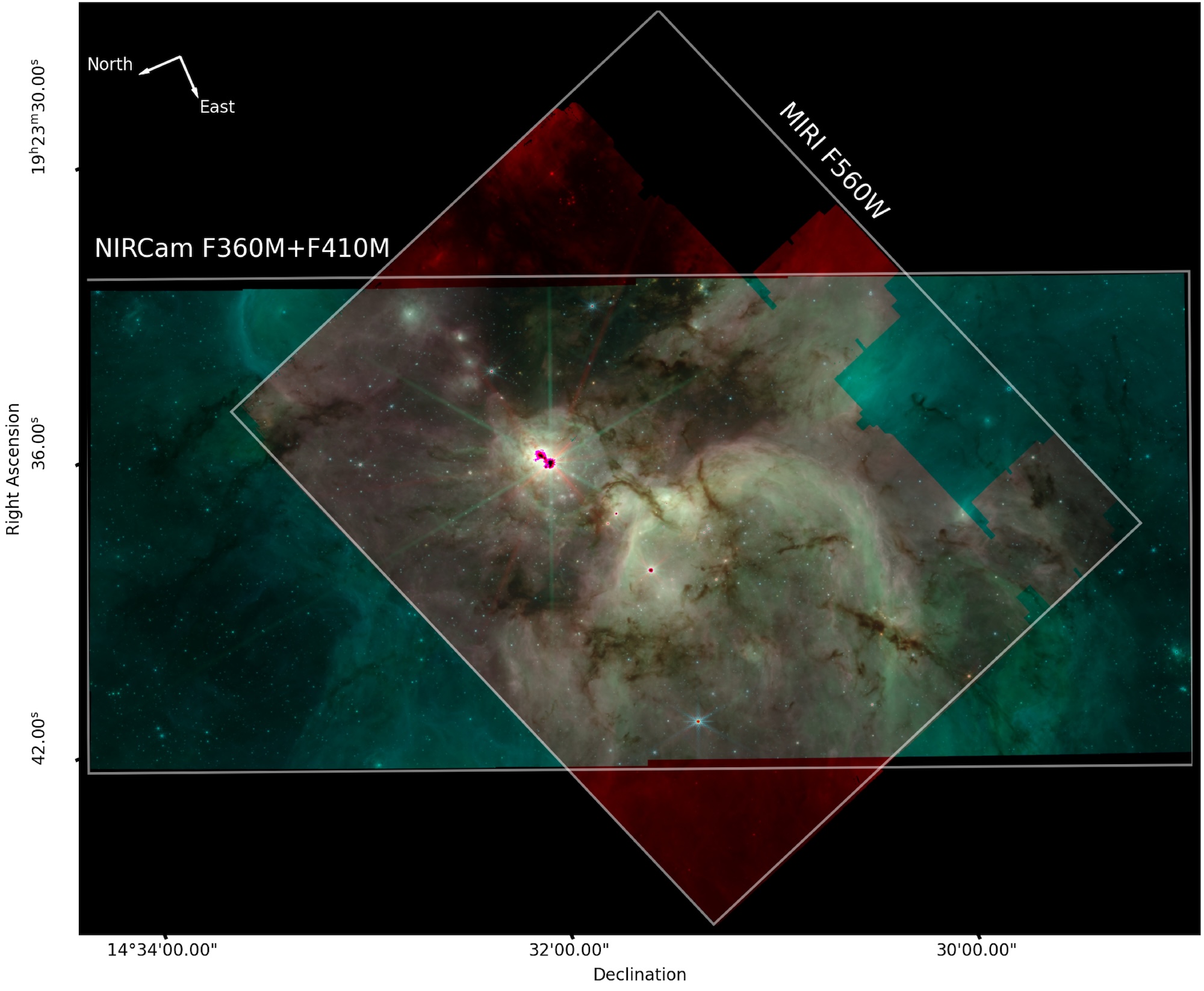
The full view of the study region, showing the NIRCam and MIRI footprints. [Yoo et al. 2026]

This image shows one W51A, of the most active star-forming regions in our galaxy. A research team led by Taehwa Yoo (University of Florida) recently observed this region with JWST, using the telescope’s Near-Infrared Camera (NIRCam) and Mid-Infrared Instrument (MIRI) to record fine structures in the swirling, dusty gas and reveal deeply embedded protostars. The JWST data enabled the team to study two protoclusters that are busily sculpting roughly 10,000 solar masses of gas — each! — into new stars. One protocluster, W51-IRS2 (containing the brightest source in the image above), has excavated a bubble around itself through intense stellar feedback, while the other, W51-E (down and to the right of W51-IRS2, where multiple dust lanes converge), is still being fed by dusty tendrils. For more details on this star-forming region, be sure to check out the full research article linked below.

Citation

“A JWST NIRCam/MIRI View of the W51A High-Mass Star-Forming Region,” Taehwa Yoo et al 2026 AJ 171 208. doi:10.3847/1538-3881/ae40b7

The post Featured Image: Massive Stars in the Making appeared first on AAS Nova.

Featured Image: An Active Galaxy Cluster Merger at Cosmic Noon

23 March 2026 at 16:00

This image from JWST shows the galaxy cluster XLSSU J021744.1-034536. The cluster is at a redshift of z = 1.98, placing it at cosmic noon, when the universe’s star formation was at its peak. To study the formation and evolution of this cluster, Zachary Scofield (Yonsei University) and collaborators collected wide-ranging clues, including signs of weak gravitational lensing, the glow of gas in between the galaxies of the cluster, and an analysis of the cluster members. The image above (click for the full view) indicates the galaxies that are members of the cluster. The brightest galaxy in the cluster is marked with a yellow square, and the remaining cluster members are circled, with the color indicating whether the galaxy’s cluster membership was assigned photometrically (magenta) or spectroscopically (green). Combining all available lines of evidence, Scofield’s team found that XLSSU J021744.1-034536 is undergoing a merger, giving a rare glimpse into this stage of cluster formation. To learn more about this work and what it tells us about galaxy clusters at cosmic noon, be sure to check out the full article linked below.

Citation

“An Active Galaxy Cluster Merger at Cosmic Noon Revealed by JWST Weak Lensing and Multiwavelength Probes,” Zachary P. Scofield et al 2026 ApJL 999 L1. doi:10.3847/2041-8213/ae447a

The post Featured Image: An Active Galaxy Cluster Merger at Cosmic Noon appeared first on AAS Nova.

Featured Image: A Treasure Trove of Strong Lenses

9 March 2026 at 16:00

Hubble and DESI images of four gravitationally lensed sources

The seemingly warped and stretched galaxies in the image above show the work of gravitational lensing, in which the powerful gravitational pull of galaxies or galaxy clusters bends the light from background objects. Xiaosheng Huang (University of San Francisco and Lawrence Berkeley National Laboratory) and coauthors have used a neural network to amass a sample of 3,500 gravitational lensing candidates in data from the Dark Energy Spectroscopic Instrument (DESI) Legacy Surveys. Now, the team has used the Hubble Space Telescope to confirm some of the most promising candidates. Four of the newly confirmed systems are presented in the image above, with the DESI data shown in color and the higher-resolution Hubble data in black and white. Huang and collaborators also demonstrated the ability of their forward-modeling pipeline, GIGA-Lens, to constrain lens properties rapidly, even for large images like those from Hubble. Ultimately, Huang and coauthors hope to identify lensing systems that can be used to search for low-mass dark matter halos and test our theories of cosmology, as well as those that can be monitored for signs of lensed supernovae — providing a way to measure the expansion rate of the universe. To learn more about this sample of gravitational lenses and what the team plans to do next, be sure to check out the full research article linked below.

Citation

“DESI Strong Lens Foundry. I. HST Observations and Modeling with GIGA-Lens,” Xiaosheng Huang et al 2026 ApJ 998 69. doi:10.3847/1538-4357/ae22d2

The post Featured Image: A Treasure Trove of Strong Lenses appeared first on AAS Nova.

Featured Image: Rare Giant Galaxies

23 February 2026 at 17:00

low-surface-brightness galaxies

Giant low-surface-brightness galaxies are rare and unusual members of the galactic menagerie. They host the largest galactic disks currently known, have baryonic masses of order 100 billion solar masses, and sport narrow, tightly wound spiral structures. The origins of these vast galaxies — they can be up to 10 times larger than the Milky Way — are unknown, though various theories involving mergers, accretion, and strange dark matter halos exist. Research also suggests that there may be a connection between these galaxies and compact ellipticals, which are small, dense, and contain old stars. In a recent article, a team led by Anna Saburova (Sternberg Astronomical Institute) investigated two giant low-surface-brightness galaxies with compact elliptical companions. In the image above, the colored circles represent the oxygen abundance at each location in AGC 192040 (left) and UGC 1382 (right). The red arrows point to the compact elliptical companions. Using the chemical abundance information to investigate possible formation mechanisms, Saburova and collaborators found that the two galaxies likely formed in different ways. UGC 1382 appears to be the result of multiple mergers, while AGC 192040 may have accreted gas from its halo or a galactic filament before undergoing a merger of its own. To learn more about this study of two rare galaxies, be sure to check out the full research article linked below!

Citation

“MUSE Study of Two Giant Low-Surface-Brightness Galaxies with Compact Satellites,” Anna S. Saburova et al 2026 ApJ 998 19. doi:10.3847/1538-4357/ae3139

The post Featured Image: Rare Giant Galaxies appeared first on AAS Nova.

Featured Image: Hubble Revisits the Crab Nebula

9 February 2026 at 17:00

Hubble Space Telescope image of the Crab Nebula

In 1999–2000, the Hubble Space Telescope captured what was then the most detailed image ever taken of the Crab Nebula. In the quarter-century since the release of that image, the nebula — the remnant of a star observed to explode as a supernova in July 1054 — has been slowly unfurling and changing as the ejected stellar material expands into space. Now, as reported in a research article by William Blair (Johns Hopkins University) and collaborators, astronomers have turned Hubble’s inquisitive eye toward the Crab Nebula once again. One of the new images is shown above (click for the full view!). By comparing the new and old Hubble images, Blair’s team uncovered dramatic changes in the nebula’s intricate filamentary structure. These changes are due to the nebula’s three-dimensional expansion as well as evolution in the density of its knots and filaments. To learn more about the new Hubble portrait of the Crab Nebula, be sure to check out the full article linked below.

Citation

“The Crab Nebula Revisited Using HST/WFC3,” William P. Blair et al 2026 ApJ 997 81. doi:10.3847/1538-4357/ae2adc

The post Featured Image: Hubble Revisits the Crab Nebula appeared first on AAS Nova.

Featured Image: Hubble Samples a Dusty Cosmic Sandwich

26 January 2026 at 17:00

protoplanetary disk IRAS23077+6707

Dracula's Chivito

Hubble Space Telescope image of Dracula’s Chivito. [Monsch et al 2026]

The disks of gas and dust that collect around young stars — protoplanetary disks — hold the secrets to how planets form. When a protoplanetary disk is tilted edge-on from our perspective, the disk’s dense, dusty midplane blocks the light from the star at the center, revealing structures like winds and jets wafting off of the disk. Pictured above and to the right is the spectacular edge-on protoplanetary disk IRAS23077+6707, which is also known as Dracula’s Chivito. (Delightfully, the name combines references to the backgrounds of two of the astronomers who identified the object as a protoplanetary disk: one hailing from Transylvania and another from Uruguay, where a sandwich called a chivito is the national dish.) Though the distance to this disk is not known, estimates place it around 1,000 light-years away, which would make the disk about 4,200 au across — larger than any other known protoplanetary disk. Recently, a team led by Kristina Monsch (Center for Astrophysics ∣ Harvard & Smithsonian) published their Hubble Space Telescope observations of Dracula’s Chivito. These observations show in great detail the structure within the disk, including large-scale asymmetries, wispy tendrils, and potential signs of dust grains settling toward the midplane. To learn more about this exceptional protoplanetary disk, be sure to check out the full research article linked below.

Citation

“Hubble Reveals Complex Multiscale Structure in the Edge-On Protoplanetary Disk IRAS23077+6707,” Kristina Monsch et al 2026 ApJ 996 45. doi:10.3847/1538-4357/ae247f

The post Featured Image: Hubble Samples a Dusty Cosmic Sandwich appeared first on AAS Nova.

Featured Image: Galaxy Cluster in Technicolor

12 January 2026 at 17:00

galaxy cluster MACS0416

The expansive collection of galaxies pictured here is MACS J0416, a galaxy cluster located about 4.3 billion light-years away. (Click the image for the full view!) MACS J0416 is one of five clusters targeted by the Canadian NIRISS Unbiased Cluster Survey (CANUCS). This survey takes advantage of the spacetime-bending abilities of massive galaxy clusters and uses JWST’s Near-Infrared Imager and Slitless Spectrograph (NIRISS) and Near-Infrared Camera (NIRCam) to paint a detailed multi-wavelength portrait of galaxies in the early universe. Three of the CANUCS galaxy clusters, including MACS J0416, were investigated even more closely in the follow-up JWST in Technicolor program, which added precise spectroscopic redshifts and broadened the wavelength coverage of parallel fields of view. In a recent publication led by Ghassan Sarrouh (York University), the CANUCS team outlined the design of these programs and their data products, which enabled the study of roughly 53,000 galaxies within the galaxy cluster fields and an additional 44,000 galaxies in adjacent fields. To learn more about the CANUCS and JWST in Technicolor programs, be sure to check out the full research article linked below.

Citation

“CANUCS/Technicolor Data Release 1: Imaging, Photometry, Slit Spectroscopy, and Stellar Population Parameters,” Ghassan T. E. Sarrouh et al 2026 ApJS 282 3. doi:10.3847/1538-4365/ae1611

The post Featured Image: Galaxy Cluster in Technicolor appeared first on AAS Nova.

Featured Image: Studying the Space Weather of Young Suns

8 December 2025 at 17:00

radio antennae in front of a mountain background

This image shows the Owens Valley Radio Observatory Long Wavelength Array (OVRO-LWA), a recently upgraded collection of 352 antennas spanning 2.4 kilometers east of the Sierra Nevada mountain range in California. A research team led by Ivey Davis (California Institute of Technology) recently outlined their survey that uses OVRO-LWA to study space weather on young Sun-like stars. The Study of Space Weather Around Young Suns (SWAYS) uses both OVRO-LWA and a 0.5-meter optical telescope to observe white-light stellar flares and any accompanying low-frequency radio emission from five stars with temperatures of 5000–6000K and ages of 100–800 million years. Though detections of stellar flares are common, the bursts of radio emission associated with flares and coronal mass ejections have yet to be identified conclusively on other stars. Previous studies have focused on M-dwarf stars, whose strong magnetic fields and plasma environments might limit the production of radio bursts, and have lacked the dedicated monitoring needed to detect transient bursts — problems that SWAYS has solved. To learn more about the instrumentation and design behind SWAYS, be sure to check out the research article linked below.

Citation

“A Dedicated System for Coordinated Radio and Optical Monitoring of the Space Weather of Young, Solar-Type Stars,” Ivey Davis et al 2025 ApJ 993 82. doi:10.3847/1538-4357/adfbe9

The post Featured Image: Studying the Space Weather of Young Suns appeared first on AAS Nova.

Featured Image: Fractals and Flocculence

10 November 2025 at 17:00

eight images of spiral galaxies

Displayed above are eight galaxies imaged by the Sloan Digital Sky Survey. Although all of these galaxies are spiral galaxies, there are large differences between them: the top row shows grand-design spirals, which feature well-defined arms, and the bottom row shows flocculent spirals, which have feathery or patchy arms. Recently, a team led by Biju Saha (Indian Institute of Science, Education and Research) explored whether grand-design and flocculent spirals could be classified by their fractal dimension. With intricate structures on scales large and small, spiral galaxies are fractal-like, and fractal dimension is a way of quantifying the complexity of their structure. Saha and collaborators found a statistically significant difference in the median fractal dimension of their samples of grand-design and flocculent spirals, suggesting that this mathematical method can help distinguish between the two types of spirals. To learn more about how fractal dimension is calculated from galaxy images, and what these results might mean for how spiral arms form, be sure to check out the full research article linked below.

Citation

“Can Fractal Dimension Distinguish Between Grand-Design and Flocculent Spiral Arms?” Biju Saha et al 2025 ApJ 991 63. doi:10.3847/1538-4357/adf840

The post Featured Image: Fractals and Flocculence appeared first on AAS Nova.

Featured Image: JWST Expands the Search for Extragalactic Supernova Remnants

29 September 2025 at 17:00

Out to what distance can we resolve the structure of a supernova remnant in the infrared? Until recently, it was only possible to do so for remnants in the Milky Way and the Magellanic Clouds, but JWST has now extended that capability to other nearby galaxies. In a recent research article, Sumit Sarbadhicary (The Ohio State University) and collaborators used JWST to study supernova remnants in the Triangulum Galaxy (Messier 33), a small spiral galaxy that is 2.7 million light-years away. The study area contained 40 supernova remnants that were previously identified at other wavelengths. The image above shows a portion of the galaxy’s southern spiral arm, where each white circle indicates a known supernova remnant. Infrared observations of supernova remnants are critical for understanding the physics of the interstellar medium and the composition, formation, and destruction of dust. To learn more about how JWST has pushed the limits of our search for extragalactic supernova remnants, and for details on each of the remnants detected by JWST in the Triangulum Galaxy, be sure to check out the full research article linked below.

Citation

“A First Look at Spatially Resolved Infrared Supernova Remnants in M33 with JWST,” Sumit K. Sarbadhicary et al 2025 ApJ 989 138. doi:10.3847/1538-4357/adec7a

The post Featured Image: JWST Expands the Search for Extragalactic Supernova Remnants appeared first on AAS Nova.

Featured Image: Hunting for Missing Supernova Remnants with EMU and POSSUM

15 September 2025 at 17:00

Researchers estimate that there are at least 1,000 supernova remnants in our galaxy that should be visible at radio wavelengths today — but so far, only a few hundred have been confirmed. Embarking on a search for the missing supernova remnants, Brianna Ball (University of Alberta) and collaborators used radio observations from the Evolutionary Map of the Universe (EMU) and Polarization Sky Survey of the Universe’s Magnetism (POSSUM) surveys. The image above presents a portion of that search, overlaying the positions of various objects of interest atop a background of radio continuum emission from EMU. Several types of objects are indicated: previously known supernova remnants (red), previously identified candidate remnants (orange), new candidates (white), known H II regions (cyan), and young pulsars (green stars). So far, the team has newly confirmed 14 supernova remnants, six of which were identified for the first time thanks to EMU and POSSUM, and 37 new candidate remnants. As the EMU and POSSUM surveys continue, the authors expect that as many as 400 candidate supernova remnants may be spotted. If these candidates are confirmed, it would nearly close the gap between expected and observed numbers of supernova remnants in the regions covered by these surveys. To learn more about this search for supernova remnants, be sure to check out the full research article linked below.

Citation

“A Catalog of Galactic Supernova Remnants and Supernova Remnant Candidates from the EMU/POSSUM Radio Sky Surveys. I.,” B. D. Ball et al 2025 ApJ 988 75. doi:10.3847/1538-4357/addc63

The post Featured Image: Hunting for Missing Supernova Remnants with EMU and POSSUM appeared first on AAS Nova.

Featured Image: Mother’s Day Superstorms

28 July 2025 at 17:00

closeup of a solar active region

solar active regions

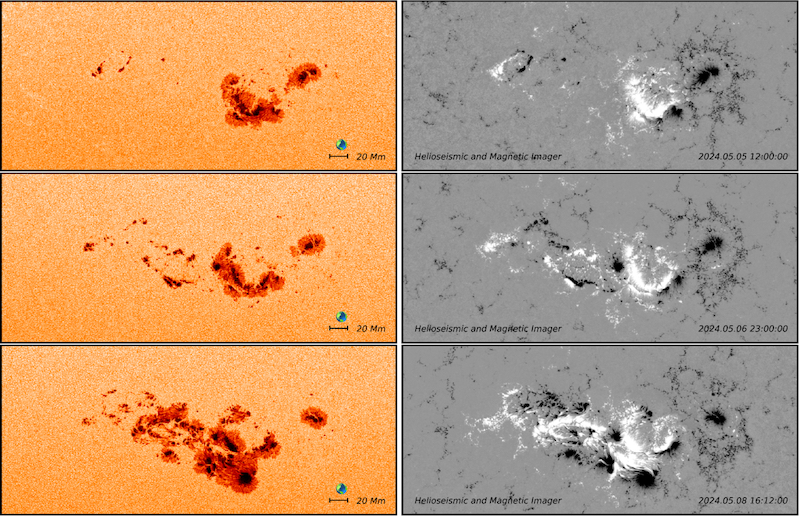
Evolution of a cluster of active regions as seen in continuum emission (left column) and radial magnetic field (right column). Click to enlarge. [Dikpati et al. 2025]

Around Mother’s Day (12 May) last year, the Sun put on a spectacular display of solar activity. A clash between solar active regions incited 14 coronal mass ejections, launched multiple high-energy X-class solar flares, and sent shimmering aurorae as far south as Florida. The images above and to the right show the source of all this excitement: the active regions AR 13664 and AR 13668. In a recent research article, Mausumi Dikpati (High Altitude Observatory) and coauthors examined the origins of this cluster of active regions and why they were such a powerful source of solar storms. Their investigation showed that there are certain regions on the Sun where solar storms are more likely to arise. These regions occur where the Sun’s undulating bands of magnetic activity draw farthest apart, preventing oppositely directed magnetic fields from canceling one another out. In the case of the Mother’s Day superstorms, active regions 13664 and 13668 developed on the heels of a decaying active region, further contributing to their magnetic complexity. Ultimately, this analysis suggested that it may be possible to forecast damaging solar activity weeks in advance by predicting the locations of magnetically complex active regions and following their evolution. To learn more about the active regions that gave rise to the Mother’s Day superstorms, be sure to check out the full article linked below.

Citation

“Mother’s Day Superstorms: Pre- and Post-Storm Evolutionary Patterns of ARs 13664/8,” Mausumi Dikpati et al 2025 ApJ 988 108. doi:10.3847/1538-4357/addd09

The post Featured Image: Mother’s Day Superstorms appeared first on AAS Nova.

Featured Image: Low-Mass Brown Dwarfs in a Class of Their Own?

14 July 2025 at 17:00

IC 348

The glowing green nebula in this JWST image surrounds the star cluster IC 348, which is the subject of a recent study by Kevin Luhman (Penn State University) and Catarina Alves de Oliveira (European Space Agency). Using JWST’s Near-Infrared Camera, Luhman and Alves de Oliveira searched the cluster’s young stellar population for free-floating brown dwarfs — objects that are less massive than stars but more massive than most planets — and discovered multiple candidates with masses down to just twice the mass of Jupiter. Follow-up JWST spectroscopy confirmed the masses of these objects, making them the lowest-mass brown dwarfs known to date. In addition to their mass, these newly discovered brown dwarfs are remarkable because their spectra show evidence of hydrocarbon molecules, the exact identities of which are not yet known. Luhman and Alves de Oliveira proposed that low-mass brown dwarfs bearing this chemical signature be inducted into a new spectral class called “H” for “hydrocarbon.” To add to the intrigue of these objects, the authors also discovered signs of circumstellar disks around two of them, suggesting that they may be capable of forming and harboring planets. To learn more about the low-mass brown dwarfs in IC 348, be sure to check out the full research article linked below.

Citation

“A New Spectral Class of Brown Dwarfs at the Bottom of the IMF in IC 348,” K. L. Luhman and C. Alves de Oliveira 2025 ApJL 986 L14. doi:10.3847/2041-8213/addc55

The post Featured Image: Low-Mass Brown Dwarfs in a Class of Their Own? appeared first on AAS Nova.

Featured Image: Hubble and JWST Check Up on the BOAT Gamma-Ray Burst

30 June 2025 at 17:00

combined Hubble and JWST image of GRB 221009A

The bright spot visible within its fuzzy host galaxy in the image above is the optical and infrared light from a superlative gamma-ray burst. Discovered in October 2022, GRB 221009A was the brightest gamma-ray burst ever observed by humans, and likely a once-in-ten-millennia event, earning it the nickname “the Brightest of All Time” or BOAT gamma-ray burst. This image shows the afterglow of this burst nearly a year after it exploded onto the scene. In a recent article, Huei Sears (Rutgers University) and collaborators analyzed Hubble and JWST observations made 185–345 days after the discovery of the burst. These observations captured the burst’s fading light and showed a distinct shift in the rate at which the light dimmed at around 50 days. This shift is evidence of powerful jets from the source of the burst. Sears’s team also discovered a blue component to the afterglow emission. This blue component may be due to the burst’s afterglow echoing off of dust in the host galaxy — if confirmed, this will mark the first time this feature has been detected. To learn more about what astronomers have discovered in the years since GRB 221009A was first spotted, be sure to check out the full research article linked below!

Citation

“Late-Time HST and JWST Observations of GRB 221009A: Evidence for a Break in the Light Curve at 50 Days,” Huei Sears et al 2025 ApJ 984 196. doi:10.3847/1538-4357/adc306

The post Featured Image: Hubble and JWST Check Up on the BOAT Gamma-Ray Burst appeared first on AAS Nova.

Featured Image: Following Photons Through Curved Spacetimes

16 June 2025 at 17:00

Today’s featured image is a beautiful representation of how simulated images of active black holes are made. In a recent research article, a team led by Aniket Sharma (Indian Institute of Science Education and Research Mohali) introduced Mahakala, a new ray-tracing algorithm that expertly tracks photons as they navigate the warped spacetimes surrounding black holes. Mahakala is named for the Egyptian deity who, as Sharma and collaborators describe, is “believed to be the depiction of absolute black, and the one who has the power to dissolve time and space into himself.” The image above shows a simulated accreting black hole at a wavelength of 1.3 millimeters, which is the same wavelength used by the Event Horizon Telescope to view the supermassive black holes at the center of the Milky Way and the galaxy Messier 87. The dotted lines streaming off to the right represent the paths that photons took on their way to the viewer as they curved around the black hole, which is visible among the forest of lines. In this representation, the color of each dot shows the synchrotron emission generated at that point in three-dimensional space. The team hopes that Mahakala, which can be run quickly and easily from a Python Jupyter notebook, helps make the complex world of general relativistic magnetohydrodynamics simulations more accessible. You can try it for yourself or learn more from the article linked below.

Citation

“Mahakala: A Python-Based Modular Ray-Tracing and Radiative Transfer Algorithm for Curved Spacetimes,” Aniket Sharma et al 2025 ApJ 985 40. doi:10.3847/1538-4357/adc104

The post Featured Image: Following Photons Through Curved Spacetimes appeared first on AAS Nova.

❌