❌

Normal view

Could a White Dwarf–Black Hole Pair Explain the Longest Gamma-Ray Burst Ever Seen?

9 June 2026 at 23:36

illustration of GRB 250702B

What’s the story behind the longest gamma-ray burst ever observed? Researchers explore how repeated interactions between a white dwarf and an intermediate-mass black hole could explain GRB 250702B’s unusual properties.

An Exceptional Gamma-Ray Burst

GRB 250702 host galaxy

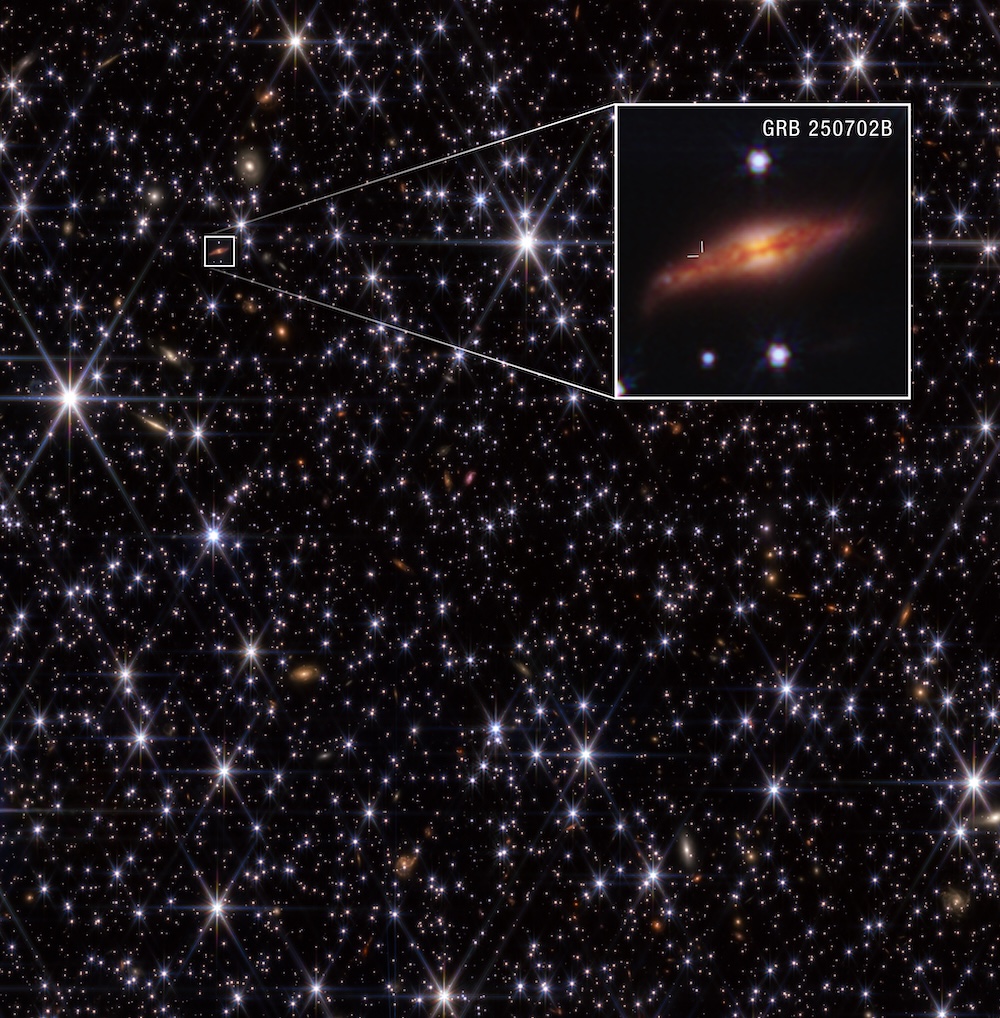
An image of GRB 250702B’s location within its host galaxy. [NASA, ESA, CSA, H. Sears (Rutgers). Image Processing: A. Pagan (STScI)]

In 2025, the Fermi Gamma-ray Space Telescope spotted an intense flash of gamma rays from a distant, dusty galaxy, and a fleet of spacefaring and earthbound telescopes soon revealed the remarkable characteristics of the event. GRB 250702B featured multiple bursts spanning several hours, individual flares lasting roughly 100 seconds, and X-ray emission in the 24 hours leading up to the gamma-ray activity — something never seen before in a gamma-ray burst.

These characteristics have been challenging to explain with typical models of long gamma-ray burst formation, such as collapsing massive stars, but researchers have developed numerous promising alternatives. In a new research article, astronomers have shown how GRB 250702B’s behavior might be explained by repeated close encounters between a white dwarf and an intermediate-mass black hole.

Eccentric Close Encounters

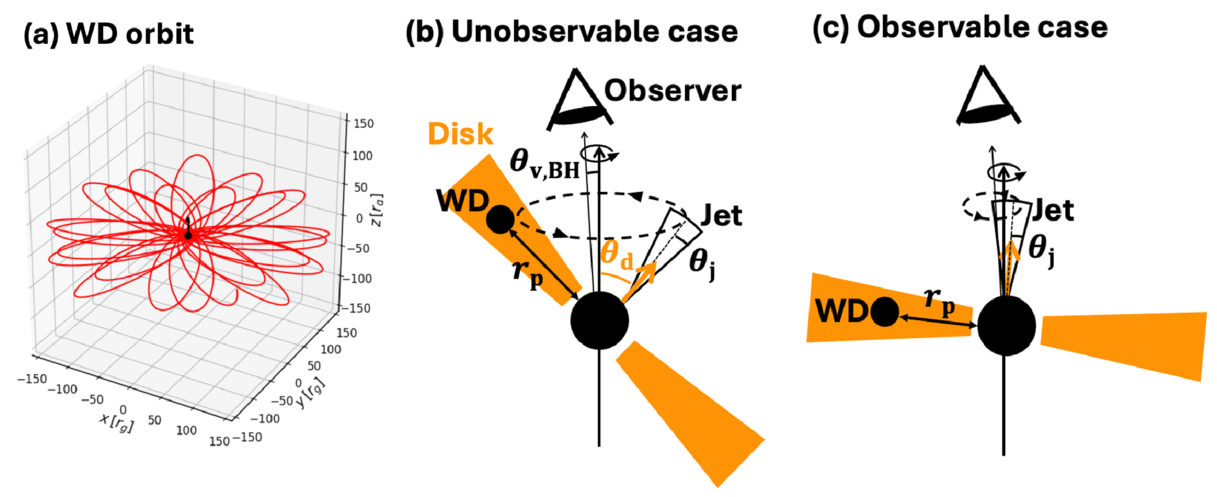
Yuri Sato (Tohoku University) and collaborators modeled the source of GRB 250702B as a white dwarf that has been captured into orbit around an intermediate-mass black hole. In their model, the white dwarf travels on an extremely eccentric orbit, drawing close to the black hole roughly once an hour. Each time the white dwarf ventures close, the black hole’s tidal forces strip away part of the star until, after about 40 such encounters, the white dwarf is completely destroyed.

geometry of the GRB 250702B system

Schematics showing the orbit of the white dwarf (WD; left) and the geometries that produce observable and unobservable jets. Click to enlarge. [Sato et al. 2026]

When the black hole peels material away from the white dwarf, some material swirls into an accretion disk, and some is cast off into space. Accretion from the disk powers a narrow relativistic jet: the source of the event’s powerful gamma-ray flares. This should mean that there is one jet produced each time the white dwarf is partially disrupted — 40 times — yet astronomers detected only a handful of flares from GRB 250702B.

Jet Precession and Model Predictions

The discrepancy can be resolved if the angle between the jet and the black hole’s spin axis precesses over time so that only some of the jets are pointed toward us. This can occur if the accretion disk is misaligned relative to the black hole’s spin. As an alternative, disk instabilities or other processes could keep all but a few of the expected jets from being launched.

radio afterglow predictions for GRB 250702B

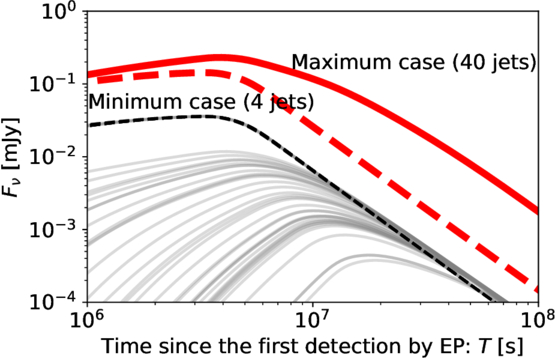
Predicted strength of the radio afterglow for the jet precession case (maximum case) and the case in which only four jets were launched due to disk instabilities or jet choking (minimum case). The x-axis shows the time since the burst was detected in X-rays by the Einstein Probe (EP). [Sato et al. 2026]

Sato and coauthors found that these two scenarios have different long-term outcomes, providing a potential way to ascertain what’s going on at the source; in the jet precession scenario, the jets that are launched away from our line of sight produce an order of magnitude more radio emission at late times.

This work by Sato and collaborators demonstrates how the repeated partial tidal disruption of a white dwarf by an intermediate-mass black hole can match the properties of one of the most remarkable recent transient sources — one that has pushed astronomers to consider new ways of producing gamma-ray bursts.

Citation

“Successive Partial Disruptions with Orbital Precession in a White Dwarf–Black Hole System for Repeating GRB 250702B,” Yuri Sato et al 2026 ApJL 1003 L44. doi:10.3847/2041-8213/ae6a8f

The post Could a White Dwarf–Black Hole Pair Explain the Longest Gamma-Ray Burst Ever Seen? appeared first on AAS Nova.

JWST Follows Up on a Rare Gamma-Ray Burst

21 January 2026 at 17:00

illustration of a gamma-ray burst

Discovered in July 2025, GRB 250702B is unlike any other gamma-ray burst astronomers have seen. New follow-up observations of the burst’s location have underscored the strangeness of this event.

Not Like Other GRBs

Gamma-ray bursts (GRBs) are intense flashes of gamma rays lasting anywhere from milliseconds to hours. The shortest of these bursts are thought to come from colliding neutron stars, while bursts lasting longer than a few seconds tend to come from collapsing massive stars, though notable exceptions have been discovered.

Even with known GRBs spanning such a broad range of timescales and arising from different sources, some bursts are truly exceptional. Such is the case for GRB 250702B, which was discovered on 2 July 2025 by the Fermi Gamma-Ray Burst Monitor. This event featured three separate bursts spread across several hours, as well as never-before-seen X-ray emission in the day leading up to the gamma-ray emission.

JWST on the Case

rest-frame spectrum of GRB 250702B

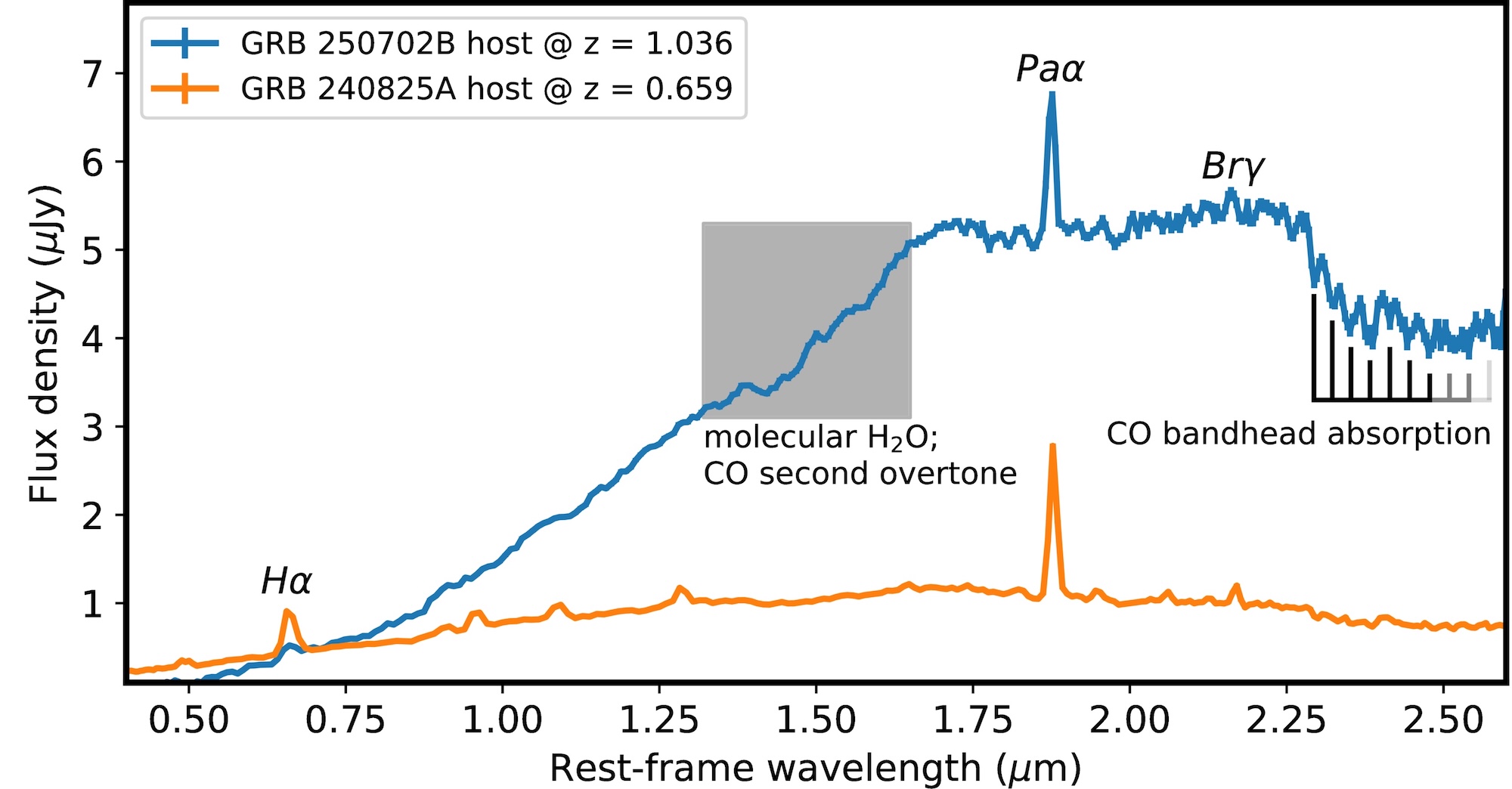
Rest-frame spectrum of GRB 250702B (blue) with the host galaxy spectrum of another burst, GRB 240825A, for comparison (orange). Click to enlarge. [Adapted from Gompertz et al. 2026]

Benjamin Gompertz (University of Birmingham) and collaborators used JWST to investigate GRB 250702B’s birthplace roughly 51 days after the burst was first detected. JWST spectroscopy revealed that GRB 250702B emerged from a galaxy at a redshift of z = 1.036, when the universe was roughly 6 billion years old.

This precisely measured redshift allowed the team to estimate the burst’s energy; in gamma rays alone, the event released at least 2.2 × 1054 ergs. This places GRB 250702B in the top 20 most energetic GRBs known, and the team estimates that events of this kind are 1,000 times less common than other long-duration GRBs and more than 100,000 times less common than typical core-collapse supernovae.

The burst’s host galaxy is also unusual. It’s larger, brighter, and dustier than other galaxies of similar redshift, and it’s unusually massive among GRB host galaxies. In the wavelength range studied here, it also appears to be the most luminous galaxy known to host a GRB.

What Caused GRB 250702B?

Now, to the cause of this unusual burst: is GRB 250702B just a very strange example of a long-duration burst arising from the collapse of a massive star into a black hole, or could it have an entirely different cause, like a star being ripped apart by a black hole?

plot of host galaxy subtracted spectra of GRB 250702B

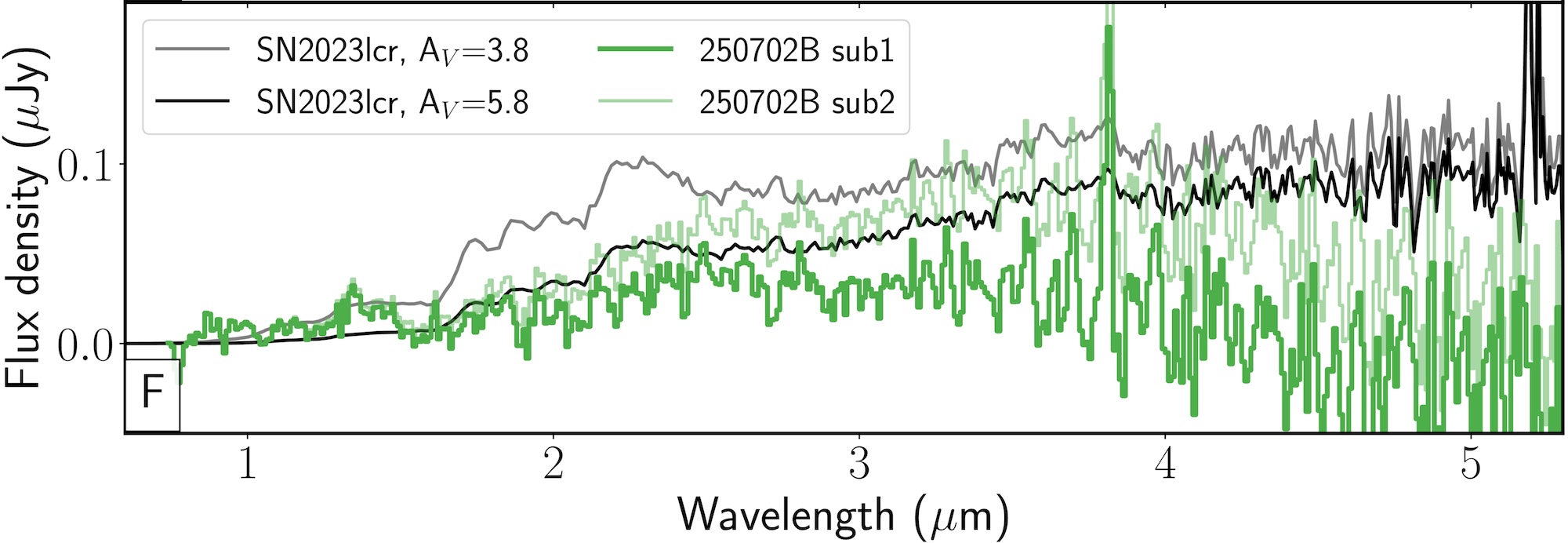
The team placed limits on the supernova emission by subtracting a spectrum of the host galaxy from the event. The green lines show this subtracted spectrum under two different normalization conditions. The black lines show for comparison the emission from the bright supernova SN 2023lcr using two possible extinction values. Click to enlarge. [Adapted from Gompertz et al. 2026]

In the collapsing-massive-star scenario, the GRB would be accompanied by a supernova. Gompertz’s team was able to rule out bright supernova emission, but uncertainties in the level of dust within the host galaxy prevented them from excluding the possibility of a significantly fainter supernova hiding within the dust.

The observations also place constraints on a tidal disruption event scenario, in which a star is ripped apart by a black hole. The data strongly favor a jetted, relativistic tidal disruption event, which makes it difficult to pin down the mass of the black hole involved. The timescales are consistent with a white dwarf spiraling around an intermediate-mass black hole, and other factors suggest that the black hole could be no more than a million solar masses, placing it firmly in the intermediate-mass regime, should this explanation prevail.

With GRB 250702B’s source still unsettled, astronomers will continue to study the burst and its unusual host galaxy. Gompertz and collaborators anticipate that follow-up spectroscopy will provide more clues in this case.

Citation

“JWST Spectroscopy of GRB 250702B: An Extremely Rare and Exceptionally Energetic Burst in a Dusty, Massive Galaxy at z = 1.036,” Benjamin P. Gompertz et al 2026 ApJL 997 L4. doi:10.3847/2041-8213/ae2ed9

The post JWST Follows Up on a Rare Gamma-Ray Burst appeared first on AAS Nova.

Featured Image: Hubble and JWST Check Up on the BOAT Gamma-Ray Burst

30 June 2025 at 17:00

combined Hubble and JWST image of GRB 221009A

The bright spot visible within its fuzzy host galaxy in the image above is the optical and infrared light from a superlative gamma-ray burst. Discovered in October 2022, GRB 221009A was the brightest gamma-ray burst ever observed by humans, and likely a once-in-ten-millennia event, earning it the nickname “the Brightest of All Time” or BOAT gamma-ray burst. This image shows the afterglow of this burst nearly a year after it exploded onto the scene. In a recent article, Huei Sears (Rutgers University) and collaborators analyzed Hubble and JWST observations made 185–345 days after the discovery of the burst. These observations captured the burst’s fading light and showed a distinct shift in the rate at which the light dimmed at around 50 days. This shift is evidence of powerful jets from the source of the burst. Sears’s team also discovered a blue component to the afterglow emission. This blue component may be due to the burst’s afterglow echoing off of dust in the host galaxy — if confirmed, this will mark the first time this feature has been detected. To learn more about what astronomers have discovered in the years since GRB 221009A was first spotted, be sure to check out the full research article linked below!

Citation

“Late-Time HST and JWST Observations of GRB 221009A: Evidence for a Break in the Light Curve at 50 Days,” Huei Sears et al 2025 ApJ 984 196. doi:10.3847/1538-4357/adc306

The post Featured Image: Hubble and JWST Check Up on the BOAT Gamma-Ray Burst appeared first on AAS Nova.

Did That Supermassive Black Hole Rip Apart a Star, or Is It Eating Lunch Like Normal?

13 May 2025 at 17:00

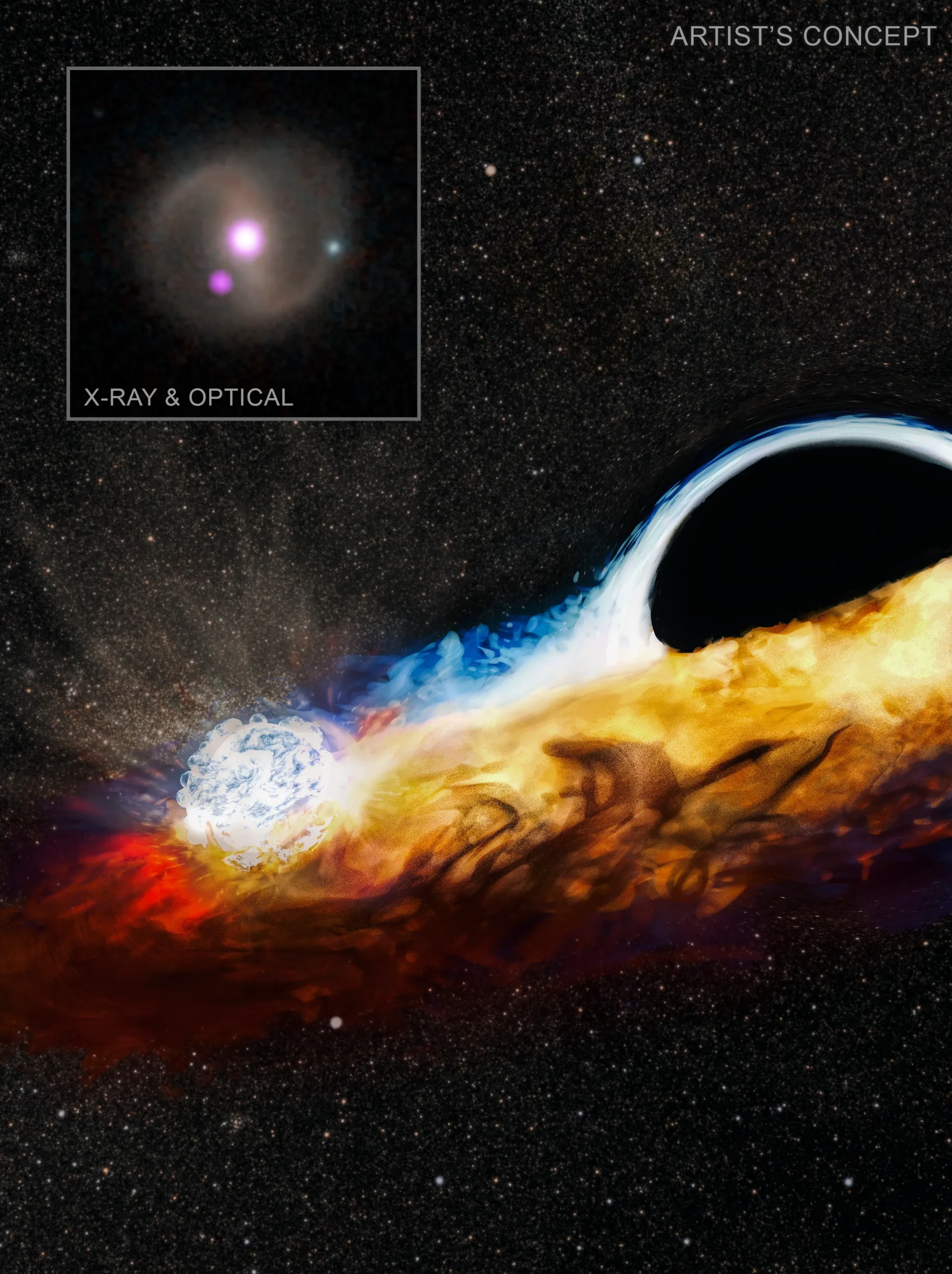
artist's impression of a tidal disruption event

Editor’s Note: Astrobites is a graduate-student-run organization that digests astrophysical literature for undergraduate students. As part of the partnership between the AAS and astrobites, we occasionally repost astrobites content here at AAS Nova. We hope you enjoy this post from astrobites; the original can be viewed at astrobites.org.

Title: An Untargeted Search for Radio-Emitting Tidal Disruption Events in the VAST Pilot Survey
Authors: Hannah Dykaar et al.
First Author’s Institution: University of Toronto
Status:
Published in ApJ

The supermassive black holes in the centers of most galaxies are notoriously, and predictably, violent actors in the universe. While some, classified as active galactic nuclei, act like a drain on their host galaxies, swallowing anything and everything that falls into them, even dormant black holes will react destructively when provoked. Orbit too closely, and any galactic nucleus will break you apart like a first-year chemistry student bumping an unsuspecting beaker off the lab bench.

If an ill-fated star falls into a black hole, the system will briefly glow across the electromagnetic spectrum. When and where these mishaps, known as tidal disruption events (TDEs, shown in Figure 1), occur, as well as the exact physical processes causing the brief glow, are not well understood. TDEs have been detected overwhelmingly in galaxies that do not have active galactic nuclei and are calming down after an era of intense star formation, and current models of the TDE occurrence rate disagree with observations. We expect to see more types of galaxies, such as those with active galactic nuclei, that host TDEs at similar rates, but we don’t — however, we might just be looking in the wrong places, or rather, with the wrong set of eyes.

Traditionally, TDEs have been identified by their optical, ultraviolet, or X-ray emission, but active galactic nuclei are surrounded by dust, which absorbs light at these wavelengths on its way to us. However, at radio wavelengths, the issue of dust obscuration fades, allowing us to uncover the TDEs that may be hiding. While radio emission has been observed from known TDEs, identifying TDEs in the radio comes with a major hurdle, presented by the pesky active galactic nuclei themselves; they are famously variable in radio emission, and they can serve as pretty convincing TDE imposters.

Searching for TDEs at Radio Wavelengths

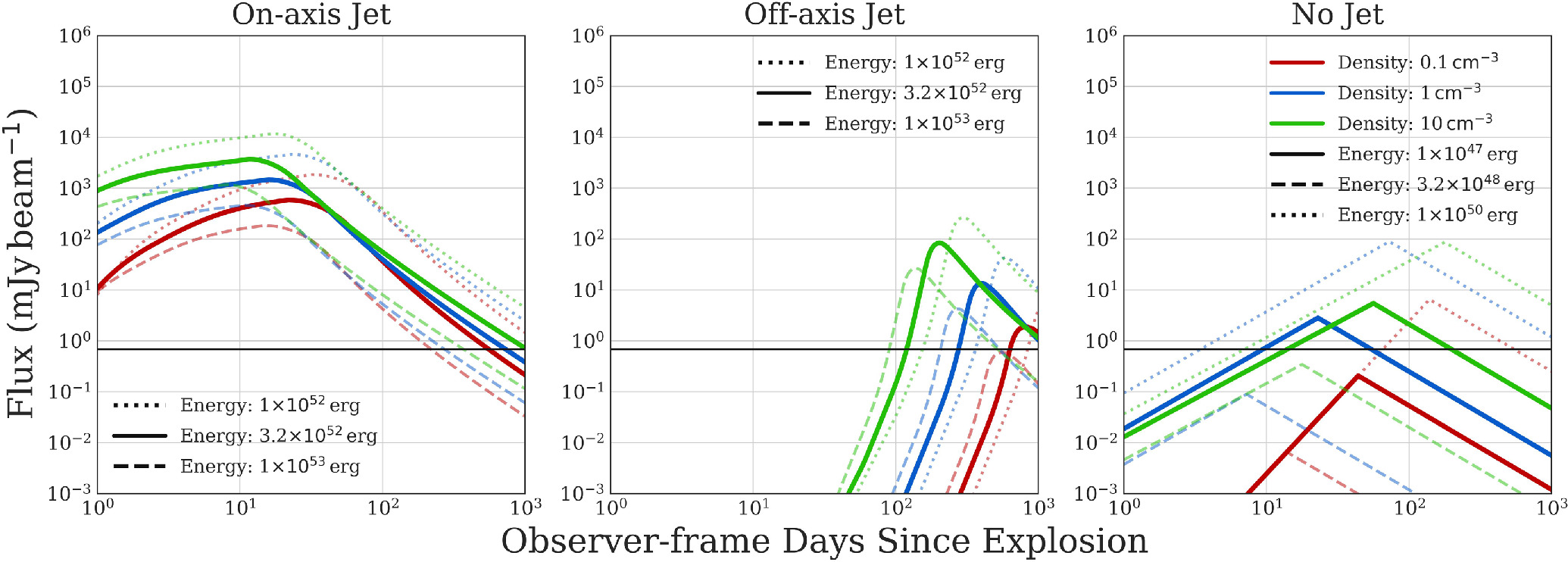
Today’s authors decide to take on this challenge, armed with data from the Variable and Slow Transients (VAST) pilot survey, which observes large swaths of the sky at regular intervals to track variability on the order of days to months. VAST is optimized for observing TDEs, but unfortunately, it is also excellent at finding active galactic nuclei. How do we know what to look for, and how can we distinguish a TDE from an active galactic nucleus? Easy, we can just identify characteristics common to all the known radio-emitting TDEs in the VAST field of view — all one of them, that is. Surely, that won’t do. Instead, our authors simulate the evolution of TDEs as seen by VAST, which can only catch discrete snapshots of light at a specific radio wavelength. Their models of TDE radio emission assume one of three cases: either the TDE produces a relativistic jet directed at us (on-axis), directed away from us (off-axis), or none at all. The presence or absence of a jet, and its direction, determine the shape of the light curve, as shown in Figure 2.

Light curves of simulated TDEs

Figure 2: This figure shows the change in radio brightness over time we expect to see from a galaxy during a TDE given different models. The shape of the radio flare depends strongly on whether the TDE results in a relativistic jet, and if so, whether the jet points toward us (on-axis) or not (off-axis). These simulated light curves were used to establish criteria for TDE candidacy, and compared with observations from the final sample to constrain the incidence rate of TDEs and likelihood of different jet geometries. [Dykaar et al. 2024]

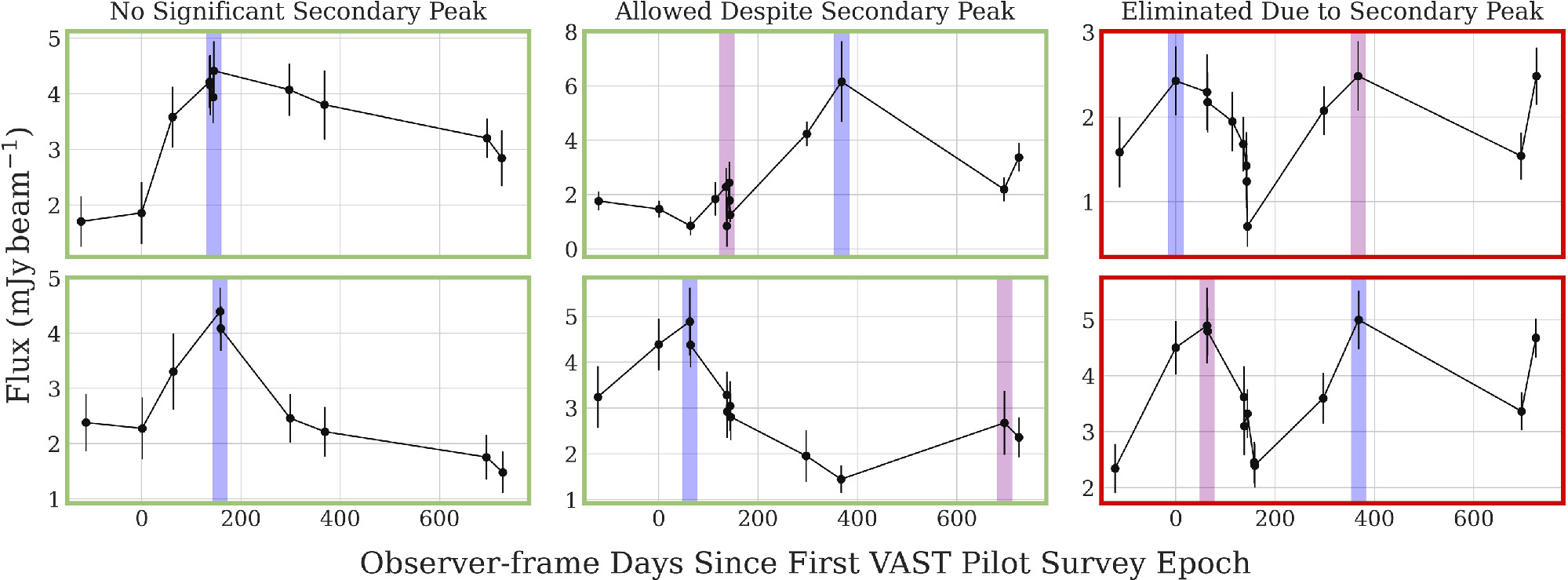
From these simulations, the authors identify three overarching characteristics that wannabe TDEs must exhibit: first, they must be variable, signaling the flare of activity as the star crashes into the black hole; second, the flare should be sufficiently bright compared to the galaxy’s normal brightness; and third, the flare must last for more than one observation, to ensure it is not a spurious detection. Additionally, the authors find that the peak brightness of the TDE must be double the typical galaxy brightness to effectively rule out active galactic nucleus imposters, which do not tend to vary this drastically, as shown in Figure 3. Lastly, the TDE must actually occur near the center of a galaxy (the black hole locale), as confirmed by optical or infrared survey catalogs. In the VAST pilot survey, 12 sources meet these criteria.
Three types of light curves, two of which are considered TDE candidates.

Figure 3: To distinguish TDEs from active galactic nucleus imposters, the authors kept only sources that exhibited one dominant peak in their radio flux, shown by the blue windows. Sources with secondary peaks (shown by the purple windows) that were much smaller than the primary peak were allowed, as the secondary peak could reasonably be due to ambient active galactic nucleus activity. However, multiple comparable peaks are indicative of only intrinsic active galactic nucleus fluctuations, not a TDE. [Dykaar et al. 2024]

Following Up on TDE Candidates at Other Wavelengths

The authors next subject these TDE candidates to thorough multi-wavelength scrutiny using archival survey data. First, they investigated whether the candidates are associated with gamma-ray bursts, which are extremely luminous and energetic events that may accompany TDEs. Unfortunately, gamma rays are easily absorbed, making them notoriously difficult to trace back to their sources. (After all, the journey of a gamma ray through light-years of dust and gas to Earth is not unlike Odysseus’s return to Ithaca, and we all know how many made that journey unscathed.)

The authors found that all 12 sources were coincident with a gamma-ray burst, but all 12 sources were also coincident with multiple gamma-ray bursts (which is unlikely to be physical), as were randomized, TDE-free regions of the VAST sky. In other words, the gamma-ray burst association is inconclusive. Contemporary optical and infrared observations of the candidates revealed no corresponding flares, which leads to more questions. Are the sources simply too far away for their optical and infrared flares to be discernible, or could dust absorption be at play? Additionally, nearly all candidates maintained an increased radio flux after the TDE flare. This may indicate that the TDE occurred within an active galactic nucleus as it was transitioning to a higher radio flux state, that the TDE was followed by intense star formation, or both.

By comparing their candidates to the expected observational manifestations of their TDE models, the authors conclude that the candidate sources are consistent with TDEs that have relativistic jets. They also independently constrain the TDE incidence rate, which agrees with current theory. As our window into the variable radio universe expands with future observations, such as with the ongoing VAST survey, we will have a growing population of such radio-detected TDEs to study, and the ability to distinguish them from regular active galactic nuclei will be ever more valuable in our quest to understand them.

About the author, Chloe Klare:

I’m a PhD student in Astronomy and Astrophysics at Penn State, with a physics doctoral minor. In my research, I’m looking for newly evolving synchrotron jets in active galactic nuclei (in the radio!).

The post Did That Supermassive Black Hole Rip Apart a Star, or Is It Eating Lunch Like Normal? appeared first on AAS Nova.

❌