❌

Normal view

Black Holes Reveal Their Seeds

23 June 2026 at 17:00

Illustration of an active galactic nucleus

Editor’s Note: Astrobites is a graduate-student-run organization that digests astrophysical literature for undergraduate students. As part of the partnership between the AAS and astrobites, we occasionally repost astrobites content here at AAS Nova. We hope you enjoy this post from astrobites; the original can be viewed at astrobites.org.

Title: A GLIMPSE of Intermediate Mass Black Holes in the Epoch of Reionization: Witnessing the Descendants of Direct Collapse?
Authors: Qinyue Fei et al.
First Author’s Institution: University of Toronto
Status: Published in ApJ

In the late 2010s, astronomers were getting hints of something strange going on in the early universe. Using the most powerful telescopes on the ground, we were able to find black holes in the centers of some of the most distant galaxies. The light from these active galactic nuclei (AGNs) was emitted over 12 billion years ago, revealing conditions close to the beginning of cosmic time.

To an astronomer, that’s the mundane part. I’m only half joking — thousands of AGNs had already been identified in the previous half century. However, the most distant of these sources were startling because their central black holes appeared much more massive than expected. To be specific, we know how much mass black holes can start with, and we can write down equations to predict how quickly they should grow. The AGNs we observed seemed to violate these predictions. This raised some serious questions and was highlighted as a major point of inquiry to focus on going into the 2020s.

Then JWST launched, and the mystery grew deeper. No matter where we looked, enormous black holes kept cropping up in astonishing numbers. Astronomers who model the universe with equations and computer simulations have tried to explain these results, but this has been a serious challenge. Some researchers have broken the emergency glass and reached for a highly theoretical tool: the direct-collapse black hole. Unlike the normal pathway for forming black holes (the deaths of massive stars), this model suggests that an enormous cloud of gas could directly collapse into a black hole without forming a star at all. The resulting black holes could have as much mass as a hundred thousand Suns put together — orders of magnitude more than a “normal” black hole. Although this pathway can explain the presence of huge black holes so early in the universe’s history, we’ve never directly seen this happen, so for now it remains just a theoretical possibility.

However, if direct-collapse black holes were widespread at early times, there is one indirect signature we might be able to detect: a large population of intermediate-mass black holes with masses between a hundred thousand and a million times that of the Sun. If we can find such a population, we’ll have strong evidence for the direct-collapse model. Let’s go looking!

Intermediate Mass, Impossible Difficulty

Identifying intermediate-mass black holes requires a tricky combination of spectral resolution and sensitivity. Light from an object must be examined very finely in order to detect the telltale features of an intermediate-mass black hole. However, these sources are already quite faint, so spreading their emission this thin means that any potential signal is very likely to get lost in the noise.

The authors of today’s article use an unprecedented set of observations to leap over this hurdle and directly probe intermediate-mass black holes. They not only use the most sensitive spectroscopic instrument (NIRSpec) on the most powerful space telescope (JWST), but they take advantage of a phenomenon known as gravitational lensing.

According to Einstein’s general theory of relativity, gravity is the result of matter curving spacetime. Areas with more concentrated matter will experience stronger curvature. When an object traveling in a completely straight line moves through curved space, its path appears bent. This same effect happens to light. Intriguingly, a large concentration of matter can redirect diverging rays of light to a focus, acting like an enormous magnifying glass.

Astronomers take advantage of gravitational lensing by pointing telescopes at massive clusters of galaxies. The intense gravity of these regions can magnify sources in the background by tens or even hundreds of times. Galaxies that would be impossibly faint to see under normal conditions can thus be observed if they are strongly lensed, making this a powerful technique to examine otherwise hidden objects.

Putting Faint AGNs Under a Lens

The Galactic Legacy Infrared Mid-Plane Survey Extraordinaire (GLIMPSE) program took extremely powerful observations of a galaxy cluster called Abell S1063 using JWST. The long exposure time, combined with the lensing power of the cluster, allows extremely faint sources in the background to be seen in unprecedented detail. The researchers scoured the data to search for signs of active black hole growth in the observed galaxies. Specifically, they carefully studied the emission lines in the spectrum of each object.

Normally, emission lines appear narrow. However, gas surrounding a massive black hole circulates at rapid speeds. A phenomenon known as the Doppler effect then comes into play. This is the same effect responsible for the characteristic rise and fall in the pitch of a siren from an emergency vehicle passing by. Emission from gas moving toward our line of sight appears bluer than it otherwise would, and gas moving away from us appears redshifted. The net effect is that a single emission line is widened, and we see characteristic “broad wings.” The width of the emission line can be used to estimate the mass of the central black hole, where broader wings imply a more massive black hole.

The researchers uncover 10 AGNs that display broadened Balmer series lines. Strikingly, they estimate that these galaxies have central black holes with masses as low as 400,000 times that of the Sun. While that might sound like a lot, it’s practically nothing compared to the monstrous 100-million-solar-mass black holes that JWST consistently turns up in other studies. Detecting such lightweight black holes, pushing into the realm of intermediate-mass black holes, is only possible due to the incredible sensitivity of these observations.

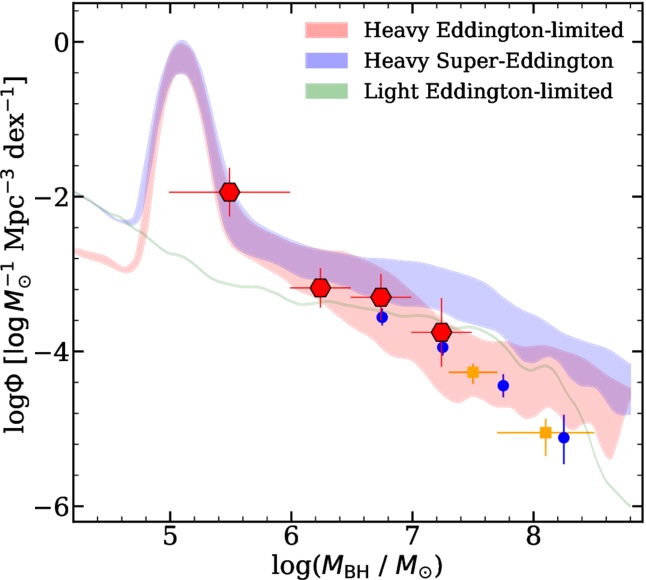
The researchers also compute what’s known as the black hole mass function. This is a measure of how many black holes exist at each mass. In other words, the black hole mass function measures how common lightweight black holes are compared to heavy ones. The mass function computed in this work and several other points of comparison are shown in Figure 1.
comparison of black hole mass functions

Figure 1: A comparison of black hole mass functions from various previous works and today’s article. The red hexagons are data points computed using the AGNs observed in this work, while blue circles and yellow squares are measurements computed using AGNs observed in previous articles. The red, green, and blue shaded areas represent the expected black hole mass function from various theoretical models. [Adapted from Fei et al. 2026]

Because the AGNs analyzed in today’s article host central black holes with much lower masses than any that have been observed in the past (at this early time in the universe), the authors are able to probe a completely new region of the black hole mass function. As seen in Figure 1, the leftmost red hexagon (lowest-mass data point) deviates from the roughly straight line traced by the other data points. This suggests that there are substantially more black holes with a few hundred thousand solar masses than previously expected.

Amazingly, this is exactly the measurement you would get if direct-collapse black holes (the hypothetical kind of massive black holes mentioned earlier in this article) were common in the early universe. If you scatter huge seeds across a large field, then you shouldn’t be surprised to see a sea of barely larger plants a few months later. Likewise, since these black holes start off so massive, they only need to grow a tiny bit to reach the threshold of that first red hexagon.

So is this proof that the early universe was filled with direct-collapse black holes, with this study probing the tip of an astonishing iceberg? It’s too early to tell for sure. While this is certainly an exciting result that sheds light on a previously unexplored population of objects, one can only do so much with a sample size of 10. More follow-up observations will be needed to measure the black hole mass function more precisely. Still, it’s amazing to think how much has changed in just a few years. JWST continues to provide unprecedented insight into some of the most breathtaking questions in all of astronomy.

Original astrobite edited by Tori Bonidie.

About the author, Ansh Gupta:

I’m an astronomy graduate student at the University of Texas at Austin working with Steven Finkelstein. I use data from JWST to study the formation and growth of the first galaxies and black holes in the universe. In my spare time, I enjoy playing piano, reading, and making YouTube videos.

The post Black Holes Reveal Their Seeds appeared first on AAS Nova.
Could a White Dwarf–Black Hole Pair Explain the Longest Gamma-Ray Burst Ever Seen?

9 June 2026 at 23:36

illustration of GRB 250702B

What’s the story behind the longest gamma-ray burst ever observed? Researchers explore how repeated interactions between a white dwarf and an intermediate-mass black hole could explain GRB 250702B’s unusual properties.

An Exceptional Gamma-Ray Burst

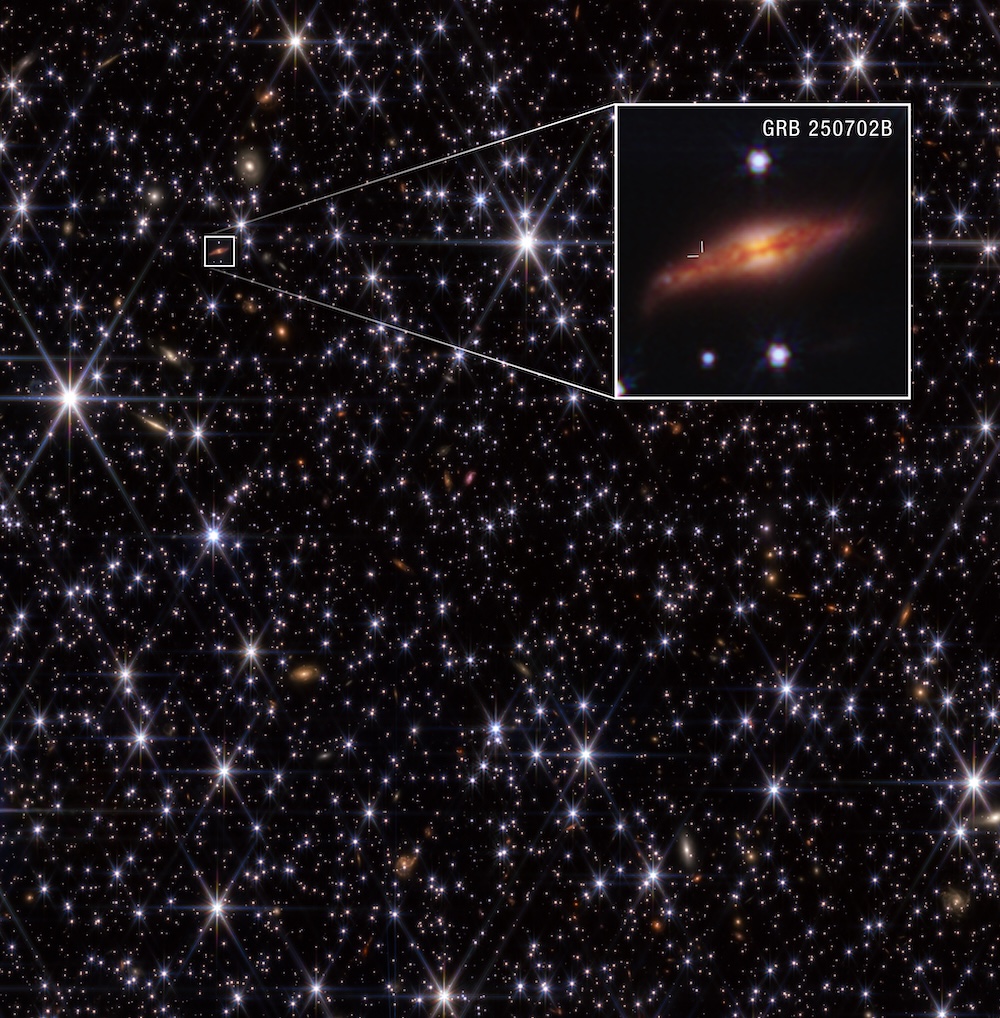
GRB 250702 host galaxy

An image of GRB 250702B’s location within its host galaxy. [NASA, ESA, CSA, H. Sears (Rutgers). Image Processing: A. Pagan (STScI)]

In 2025, the Fermi Gamma-ray Space Telescope spotted an intense flash of gamma rays from a distant, dusty galaxy, and a fleet of spacefaring and earthbound telescopes soon revealed the remarkable characteristics of the event. GRB 250702B featured multiple bursts spanning several hours, individual flares lasting roughly 100 seconds, and X-ray emission in the 24 hours leading up to the gamma-ray activity — something never seen before in a gamma-ray burst.

These characteristics have been challenging to explain with typical models of long gamma-ray burst formation, such as collapsing massive stars, but researchers have developed numerous promising alternatives. In a new research article, astronomers have shown how GRB 250702B’s behavior might be explained by repeated close encounters between a white dwarf and an intermediate-mass black hole.

Eccentric Close Encounters

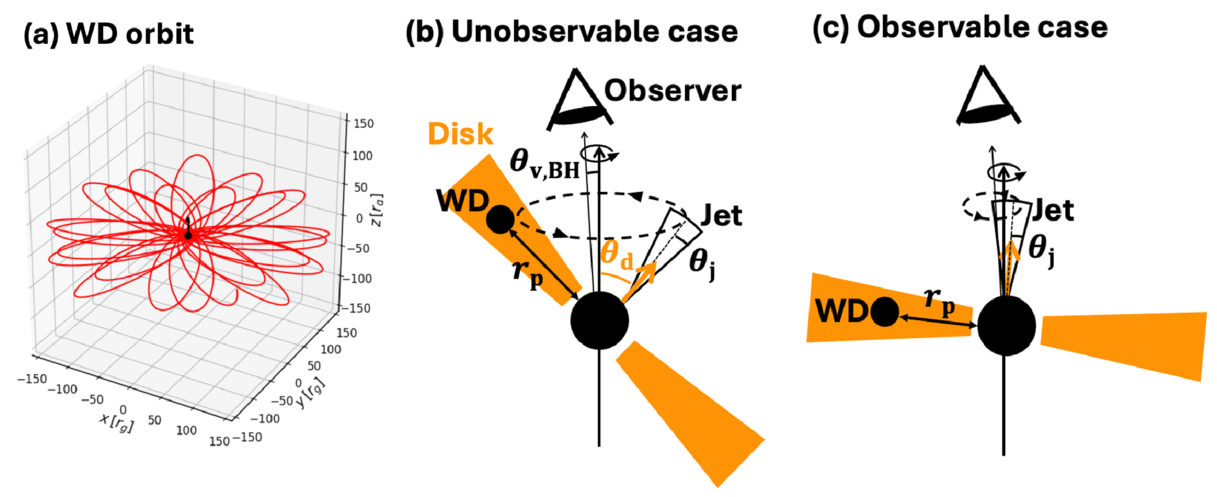
Yuri Sato (Tohoku University) and collaborators modeled the source of GRB 250702B as a white dwarf that has been captured into orbit around an intermediate-mass black hole. In their model, the white dwarf travels on an extremely eccentric orbit, drawing close to the black hole roughly once an hour. Each time the white dwarf ventures close, the black hole’s tidal forces strip away part of the star until, after about 40 such encounters, the white dwarf is completely destroyed.

geometry of the GRB 250702B system

Schematics showing the orbit of the white dwarf (WD; left) and the geometries that produce observable and unobservable jets. Click to enlarge. [Sato et al. 2026]

When the black hole peels material away from the white dwarf, some material swirls into an accretion disk, and some is cast off into space. Accretion from the disk powers a narrow relativistic jet: the source of the event’s powerful gamma-ray flares. This should mean that there is one jet produced each time the white dwarf is partially disrupted — 40 times — yet astronomers detected only a handful of flares from GRB 250702B.

Jet Precession and Model Predictions

The discrepancy can be resolved if the angle between the jet and the black hole’s spin axis precesses over time so that only some of the jets are pointed toward us. This can occur if the accretion disk is misaligned relative to the black hole’s spin. As an alternative, disk instabilities or other processes could keep all but a few of the expected jets from being launched.

radio afterglow predictions for GRB 250702B

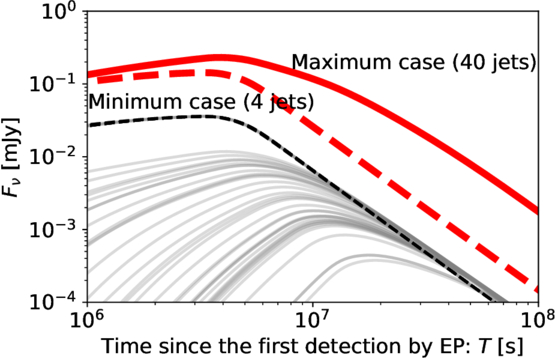
Predicted strength of the radio afterglow for the jet precession case (maximum case) and the case in which only four jets were launched due to disk instabilities or jet choking (minimum case). The x-axis shows the time since the burst was detected in X-rays by the Einstein Probe (EP). [Sato et al. 2026]

Sato and coauthors found that these two scenarios have different long-term outcomes, providing a potential way to ascertain what’s going on at the source; in the jet precession scenario, the jets that are launched away from our line of sight produce an order of magnitude more radio emission at late times.

This work by Sato and collaborators demonstrates how the repeated partial tidal disruption of a white dwarf by an intermediate-mass black hole can match the properties of one of the most remarkable recent transient sources — one that has pushed astronomers to consider new ways of producing gamma-ray bursts.

Citation

“Successive Partial Disruptions with Orbital Precession in a White Dwarf–Black Hole System for Repeating GRB 250702B,” Yuri Sato et al 2026 ApJL 1003 L44. doi:10.3847/2041-8213/ae6a8f

The post Could a White Dwarf–Black Hole Pair Explain the Longest Gamma-Ray Burst Ever Seen? appeared first on AAS Nova.

The Black Hole Meetup: EMRIs and IMRIs in the Same Active Galactic Nucleus Disk

27 January 2026 at 17:00

Illustration of stellar-mass black holes embedded within the accretion disk of a supermassive black hole

Editor’s Note: Astrobites is a graduate-student-run organization that digests astrophysical literature for undergraduate students. As part of the partnership between the AAS and astrobites, we occasionally repost astrobites content here at AAS Nova. We hope you enjoy this post from astrobites; the original can be viewed at astrobites.org.

Title: The Fate of EMRI-IMRI Pairs in Active Galactic Nucleus Accretion Disks: Hydrodynamical and Three-body Simulations
Authors: Peng Peng et al.
First Author’s Institution: Peking University
Status: Published in ApJ

Active galactic nuclei (AGNs) are the extremely luminous central regions of some galaxies, powered by gas accreting onto their supermassive black holes and often outshining the entire galaxy in which they reside. One reason they are so studied in astronomy is that they connect many pieces of physics and astronomy in one cosmic place. This is especially true for AGNs as potential gravitational wave sources. Gravitational waves are observed when two compact objects, usually black holes, orbit each other. Black holes span a massive range of masses, but they are typically categorized into one of three categories: stellar-mass black holes, or sBHs (tens to hundreds of times the mass of the Sun), intermediate-mass black holes or IMBHs (hundreds to thousands of times the mass of the Sun), and supermassive black holes or SMBHs (millions to billions of times the mass of the Sun). AGNs are special because they are among the very few places where black holes across this entire mass spectrum might be found in the same place at the same time. Not only do they host SMBHs at their centers, but their gas disks are ideal nurseries for capturing and growing sBHs and IMBHs.

Current-generation gravitational wave detectors like the LIGO–Virgo–KAGRA (LVK) network can observe stellar-mass to lite-IMBH black hole mergers. Future detectors like the Laser Interferometer Space Antenna (LISA) will be able to observe black holes in the intermediate-mass to supermassive mass range. In addition to the mass range a detector can detect, it is also valuable to know the mass ratio (usually denoted by q) that a detector might detect. Unequal-mass-ratio mergers can tell us a lot about general relativity that more equal-mass mergers cannot because the smaller object orbits the more massive one many times right before the merger, essentially providing a gravitational wave measurement of spacetime around the larger black hole. (See this video for an example of black hole orbits with a large mass ratio, and imagine the spacetime observations around the larger black hole that could be possible with orbits like that.)

One of the most promising advances in gravitational wave detection with LISA will come with the observation of extreme-mass-ratio inspirals (EMRIs), usually defined as involving a smaller black hole that is at least 10,000 times less massive than the massive black hole it orbits (though the exact mass ratio defining an EMRI is a matter of convention and may vary somewhat). In addition, LISA will be able to observe intermediate-mass-ratio inspirals (IMRIs), usually defined as when the smaller black hole is 100–10,000 times less massive than the larger one.

This article uses multiple techniques to address the question of what happens when an AGN disk hosts both an IMBH and an sBH at the same time. The authors began with a hydrodynamic simulation of an AGN gas disk around a 106-solar-mass SMBH. They add a 103-solar-mass IMBH into the gas disk. Because the IMBH orbits within a gas disk, the gas exerts a force on it, causing its orbit to shrink toward the SMBH (a process called migration). Additionally, the IMBH carves out a path through the gas. Once the IMBH carves out enough of a path in the gas, the authors add an sBH of 20 solar masses into the simulation near the IMBH.

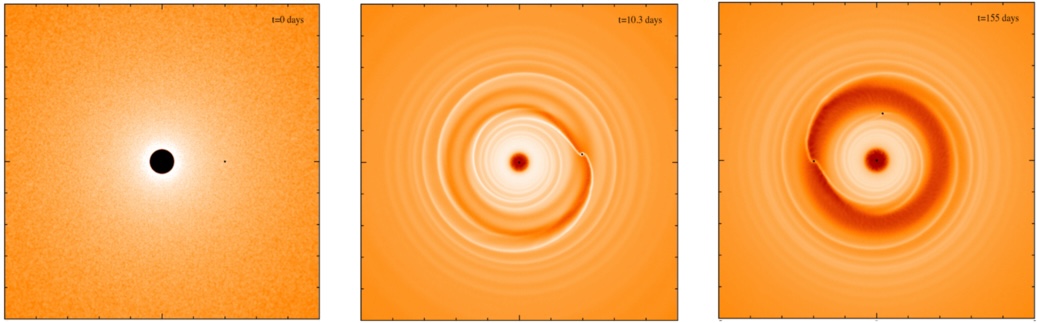
The authors test the sBH outcome for two initial conditions of the gas disk. The first, which I will refer to as “InnerDisk,” is when gas already exists inside the IMBH’s orbit (see Figure 1). The other, which I will refer to as “NoInnerDisk,” is when the simulation begins with gas only outside the IMBHs orbit, with no gas initially between the IMBH and SMBH. In this case, gas crosses the IMBH’s gap after the simulation starts. In the InnerDisk case, the sBH initially gets pushed inward from the presence of the inner gas, but that gas steadily drains into the SMBH and is only partly refilled, so the gas’s push on the sBH weakens over time. In the NoInnerDisk case, the IMBH’s direct pull on the sBH becomes more important. The amount of gas that leaks across the IMBH orbit into the inner disk gradually settles into a steady state that is less dense than the InnerDisk case. With a weaker gas push, the sBH stays closely tied to the IMBH and migrates inward at nearly the same rate. In both setups, the IMBH carves a gap in the gas and keeps moving inward, but the presence and evolution of inner gas chiefly determine how closely the sBH can keep up.

Simulated gas disk around an SMBH with an implanted IMBH

Figure 1: Simulated gas disk around an SMBH with an implanted IMBH at 0 days (left), 10.3 days (middle), and 155 days (right). Brighter orange indicates higher gas density, and darker orange/red indicates lower gas density. An sBH was added at 100 days and is seen in the right panel. These three panels represent the “InnerDisk” scenario. [Adapted from Peng et al. 2025]

Once the sBH and IMBH migrate close enough to the SMBH, gravitational waves are responsible for more and more of the energy loss and orbital decay of the system compared to the gas. To account for that, once the sBH and IMBH migrate close enough to the SMBH, instead of using a hydrodynamic simulation of a gas disk, the authors switch over to a “three-body problem” solver. Because these are black holes emitting gravitational waves, regular old Newtonian mechanics is insufficient, so they add post-Newtonian terms to correct for this. Additionally, though they no longer model the gas hydrodynamically, they do include terms for a gas “force” acting on the black holes to mimic the gas disk.

Once the IMBH and sBH were in the gravitational regime, their outcomes became much more chaotic. As seen in Figure 2, a slight change in the initial phase angle of the sBH can lead to drastically different consequences for the system. In some cases, the sBH is ejected entirely. In other instances, it merges with the IMBH soon after the simulation begins. Yet in others, it first merges with the SMBH. This leads to one overall message of this article: the orbits of the IMBH and sBH tend to be regular with some gentle variation when they are farther out in the gas disk, but they become highly chaotic once they shrink into the gravitational wave regime closer to the central SMBH.

Figure showing the outcomes of 100 different simulations

Figure 2: Post-Newtonian simulation outcomes for different values of sBH initial phase angle from 0 to 2π in increments of 0.02π, while all other initial conditions were kept fixed. Green (binary formation) represents a merger of the IMBH and sBH before reaching the SMBH; red (EMRI after ejection) represents the sBH being ejected from the system, but not before some of its orbits can be observed as an EMRI event; EMRI-IMRI (orange) represents the sBH merging with the SMBH, followed by the merger of the IMBH with the SMBH; and blue (ejection) represents the sBH being ejected from the system entirely before entering a gravitational wave EMRI regime. [Peng et al. 2025]

AGN disks may provide a natural setting for interactions among stellar-mass, intermediate-mass, and supermassive black holes. The authors of this article demonstrated that gas can keep an IMBH and an inner sBH migrating together until gravitational waves dominate, after which slight differences in their orbital phases can lead to a wide range of outcomes. While uncertainties remain, this study provides more evidence that LISA could identify. Until LISA flies, continued simulations like this one will help refine the spectrum of EMRIs and IMRIs we can expect to see.

Original astrobite edited by Maggie Verrico.

About the author, William Smith:

Bill is a graduate student in the astrophysics program at Vanderbilt University. He studies gravitational wave populations with a focus on how these populations can help inform cosmology as part of the LIGO Scientific Collaboration. Outside of astrophysics, he also enjoys swimming semi-competitively, music and dancing, cooking, and making the academy a better place for people to live and work.

The post The Black Hole Meetup: EMRIs and IMRIs in the Same Active Galactic Nucleus Disk appeared first on AAS Nova.

From Globs to Gravitational Waves: A Simulated Cosmic Choreography

25 August 2025 at 17:00

Messier 13

Editor’s Note: Astrobites is a graduate-student-run organization that digests astrophysical literature for undergraduate students. As part of the partnership between the AAS and astrobites, we occasionally repost astrobites content here at AAS Nova. We hope you enjoy this post from astrobites; the original can be viewed at astrobites.org.

Title: Formation and Evolution of Compact Binaries Containing Intermediate-Mass Black Holes in Dense Star Clusters
Authors: Seungjae Lee et al.
First Author’s Institution: Seoul National University
Status: Published in ApJ

A delicate dance goes on in astronomy between theory and observation. Most astronomy research, by and large, fits into one of two categories. In one category, you start with a theory, model, or simulation, and attempt to figure out what observations you might expect given those initial assumptions. The other approach begins with raw data and attempts to determine what kinds of theories, models, and fundamental astrophysical assumptions might give rise to it. Accepted knowledge usually happens when these two approaches agree and reinforce each other, but a lot of the actual science occurs when one side dances ahead of the other — either we have theories and models that make predictions that cannot yet be observationally tested, or we have data that defy attempts at fitting underlying models.

Another dynamical dance goes on in globular clusters between binary black holes. Today’s article investigates intermediate-mass black holes, or IMBHs, a pristine example of an astronomical topic in which theory has danced ahead of observations. IMBHs fill the gap between stellar mass and supermassive black holes. We can observe black holes in multiple ways, usually from the electromagnetic radiation of the gas disks surrounding some black holes (either stellar or supermassive), or the gravitational waves of two orbiting or merging black holes. Unfortunately, each method requires some extra component — either gas to accrete or a companion to orbit — and IMBHs are far more challenging to observe through these methods. Hence, we have a lot of ideas about how they might form, and scarce observational evidence for their existence.

That hasn’t stopped many researchers from trying to make better models and predictions. One of the most commonly proposed mechanisms for forming IMBHs is in dense globular or nuclear star clusters (up to a million times denser than our region of the Milky Way). In these dense environments, stars and the black holes they produce might have a chance to find and run into each other often enough to reach the masses of the IMBH regime through mergers. Today’s authors use a series of N-body simulations to study these dense stellar clusters, into which they embed IMBHs. Their study investigates the detectability of gravitational waves from intermediate-mass-ratio inspirals (IMRIs). Because so many mergers occur in dense clusters, it allows for more mergers between objects with greater mass differences. The mass ratio between the two objects (usually denoted as ‘q’) is one of the most important parameters for characterizing a merger, and a high q value creates a gravitational wave signature that is different from a low q, even if the total mass of the system is the same.

To investigate the formation and detectability of IMRIs, the authors conducted a suite of direct N-body simulations of star clusters with total masses between 5×10⁴ and 105 solar masses, containing ~105 particles. They include initial conditions for how densely packed the particles should be, given how far they are from the cluster’s center (called a Plummer profile). They also include a rule for how the initial masses of the stars are distributed (called a Kroupa initial mass function). Then, they use a code called Stellar EVolution for N-body (SEVN) to follow the evolution of the stars in the system for 100 million years.

In that time, massive stars in the simulation can evolve into neutron stars and stellar-mass black holes. In addition to simulating the clusters’ stars, the authors embed an IMBH of 300–5,000 solar masses into the clusters. The key to this article is that some of the stellar-mass binary black holes will interact with the IMBH, creating an IMRI, which gives off gravitational waves. This article’s primary goal is to characterize these IMRIs and to test how well current and future gravitational wave detectors will measure them.

In the simulation, when a stellar-mass binary black hole and an IMBH come close, the authors must create a “merger criterion” — essentially, how it is decided whether the two objects merge, and what the subsequent “gravitational wave” would look like. Once they model the wave itself, they turn to five current or future detectors to see how well they will measure those waves if they were at particular astronomical distances from Earth.

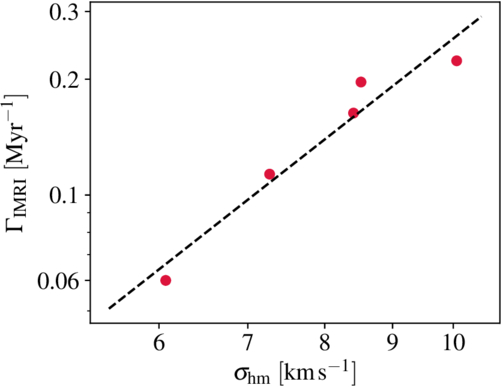
One of the primary relationships the authors look at in the cluster is the half-mass radius velocity dispersion of the cluster and the number of IMRI encounters between the IMBH and stellar-mass objects. One can think of the velocity dispersion as a more complicated “average velocity” of the stars in the cluster (a high velocity dispersion means, on average, the stars are moving faster, the half-mass radius is the distance from center that separates the inner half of the stars and outer half of the stars, and we use it because it is more representative of stellar motion in the overall cluster than the packed center or the mellow edge). Figure 1 shows the relationship between the number of IMRI events (y-axis) vs. the velocity dispersion (x-axis) of the cluster where the IMBH sits. Note that the y-axis is logarithmic, so a small increase in velocity dispersion actually results in a large increase in the number of IMRIs. This tells us that the number of events is much more dependent on the properties of the larger cluster than the IMBH itself.

plot of IMRI event rate as a function of cluster half-mass velocity dispersio

Figure 1: IMRI event rate as a function of cluster half-mass velocity dispersion (σhm) for 1,000-solar-mass IMBHs in the simulations. The IMRI merger rate is highly sensitive to the velocity dispersion of the cluster as a whole, making it a key observable of how efficiently IMRIs can form and merge in a given cluster. [Lee et al. 2025]

In addition to analyzing the dynamics of the clusters and the mergers within them, the authors go further and attempt to characterize what specific detectors will see. They chose five detectors. The first is advanced LIGO (aLIGO), the current incarnation of the LIGO detector network. Next is the Einstein Telescope (ET), a future proposed European ground-based detector. Following that is the Laser Interferometer Space Antenna (LISA), a space-based detector set to launch in the 2030s that is designed to observe supermassive black hole mergers. Next are two detectors that are less established, the advanced Superconducting Omni-directional Gravitational Radiation Observatory (aSOGRO) and the Deci-hertz Interferometer Gravitational Wave Observatory (DECIGO). aSOGRO is a proposed Earth-based detector that could theoretically measure gravitational waves at lower frequencies than the current LIGO-Virgo-KAGRA (LVK) detectors, and DECIGO is a proposed space-based detector designed to observe gravitational waves in the frequency range between the LVK network and LISA.

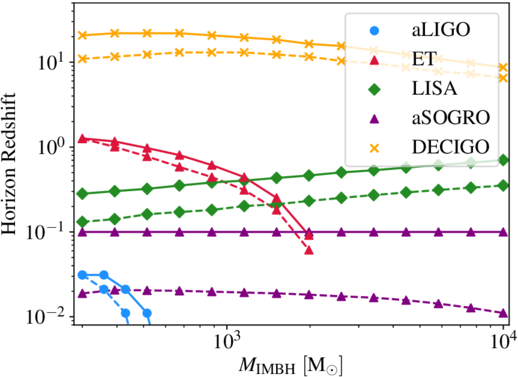
How do the authors translate the gravitational wave signal from the IMRI into what might be observed on Earth? First, they must pick a signal-to-noise ratio threshold, which is the ratio of the gravitational wave signal to the background noise in the detector. In this case, they chose a signal-to-noise ratio of 8, a commonly chosen threshold in the gravitational wave literature. From the signal-to-noise ratio, the authors can calculate a horizon distance. The horizon distance is the distance that a detector can measure a specific gravitational wave event with a given set of properties at or above the threshold chosen. Figure 2 shows the horizon distances (y-axis) for each detector for sets of gravitational wave sources with different properties vs. the mass of the IMBH generating the gravitational wave (x-axis). The solid and dotted lines represent two chosen masses of the IMBH’s stellar-mass companion. The figure shows that aLIGO (blue circles) can detect only low-mass IMBHs (≲ 300 solar masses) at a redshift of z ≲ 0.05. ET (red triangles) is sensitive to lower-mass IMBHs, and LISA (green diamonds) excels at detecting higher-mass IMBHs. aSORGO (purple triangles) covers a broad mass range but at lower redshifts. DECIGO (yellow Xs) offers the broadest mass range at the highest redshift.

plot of horizon redshift versus intermediate-mass black hole mass

Figure 2: Horizon redshift vs. IMBH mass for several gravitational wave observatories (aLIGo represented by blue circles, ET by red triangles, LISA by green diamonds, aSOGRO by purple triangles, and DECIGO by yellow x‘s). Solid vs. dotted lines represent the mass of the stellar-mass black hole interacting with the IMBH, with the dashed line representing a 10-solar-mass companion and the solid lines representing a 60-solar-mass companion. [Lee et al. 2025]

Today’s authors offer a glimpse into globular clusters as dynamic environments where we might see IMRIs. They also predict how those signals might be received by our current, future, and proposed gravitational wave detectors. As next-generation observatories prepare to listen for these cosmic mergers, this work helps chart a path for where and how we might first detect the elusive IMBH.

Original astrobite edited by Kasper Zoellner.

About the author, William Smith:

Bill is a graduate student in the astrophysics program at Vanderbilt University. He studies gravitational wave populations with a focus on how these populations can help inform cosmology as part of the LIGO Scientific Collaboration. Outside of astrophysics, he also enjoys swimming semi-competitively, music and dancing, cooking, and making the academy a better place for people to live and work.

The post From Globs to Gravitational Waves: A Simulated Cosmic Choreography appeared first on AAS Nova.

Giving Justice to Intermediate-Mass Black Hole Mergers

1 July 2025 at 17:00

Artist's depiction of two black holes nearing a merger.

Editor’s Note: Astrobites is a graduate-student-run organization that digests astrophysical literature for undergraduate students. As part of the partnership between the AAS and astrobites, we occasionally repost astrobites content here at AAS Nova. We hope you enjoy this post from astrobites; the original can be viewed at astrobites.org.

Title: Intermediate Mass Ratio Inspirals in Milky Way Galaxies
Authors: Jillian Bellovary et al.
First Author’s Institution: Queensborough Community College
Status: Published in ApJ

Galaxies like our Milky Way are not just serene places hosting stars, gas, and dark matter. They also undergo a host of violent activities. Evidence strongly suggests that our Milky Way interacts with nearby dwarf galaxies, pulling them in entirely or tearing them apart through tidal forces. Dwarf galaxies, though small, often host black holes with masses between 103 and 105 solar masses (intermediate-mass black holes). When these dwarfs fall into the Milky Way’s gravitational pull, tidal forces strip them of stars and gas, leaving their black holes to roam the galaxy halo. Some of these “wandering” black holes spiral toward the central supermassive black hole. This leads to an event called inspiral, where black holes slowly spiral together before merging.

Mergers between an intermediate-mass black hole and a supermassive black hole are called intermediate mass ratio inspirals or IMRIs. They represent an intermediate case between major mergers involving equal-mass black holes and extreme mass ratio inspirals (EMRIs), where a stellar-mass black hole merges with a supermassive black hole. IMRIs are expected to generate gravitational waves that are detectable by the next-generation space-based gravitational wave detector, the Laser Interferometer Space Antenna (LISA). However, their waveforms remain challenging to model as the origins and development of these IMRIs are not fully understood.

Tracking IMRIs with Simulations

In today’s article, the authors use high-resolution simulations to study how IMRIs form and evolve, offering critical insights for the upcoming LISA mission. They used the DC Justice League simulation suite (the individual simulations are all named after women who have served on the US Supreme Court: Sandra, Ruth, Sonia, and Elena!) to model four Milky Way–like galaxies at high resolution to trace the origins of IMRIs. These simulations track the formation and evolution of massive black holes in dwarf galaxies that eventually merge into larger galactic systems.

What Did the Simulations Reveal?

The study uncovered key features of IMRIs in Milky Way–like galaxies:

    • Prevalence: About half of all massive black hole mergers were IMRIs, emphasizing their importance in galaxy evolution.
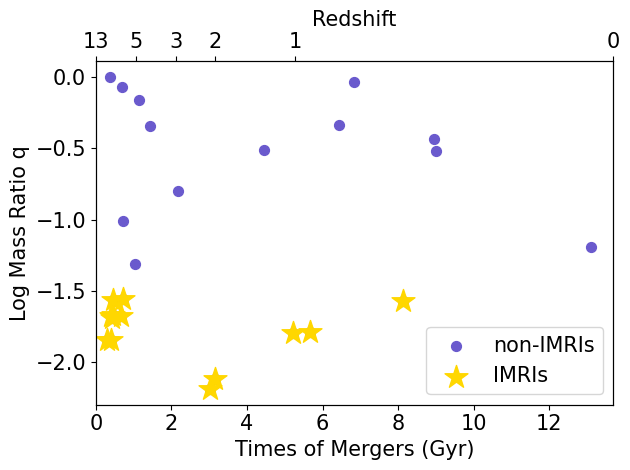
    • Timing of mergers: Most IMRI events occur early in the universe, approximately 3 billion years after the Big Bang, when galaxy mergers and interactions were more frequent (Figure 1).
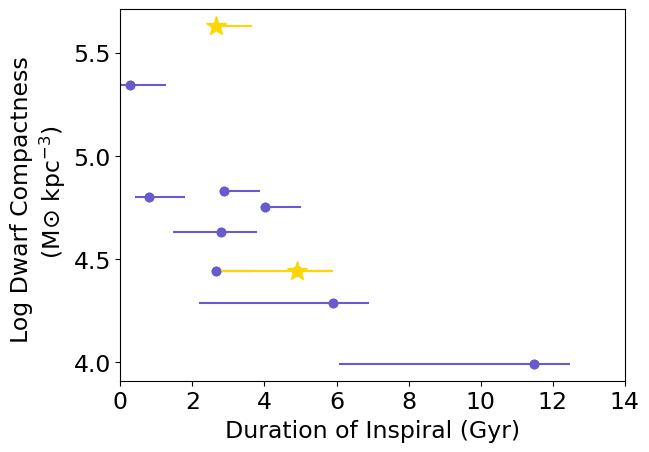
    • Inspiral timescales: The duration of the inspiral process depends heavily on the compactness of the dwarf galaxy. Dense, compact dwarfs have faster inspiral times, whereas diffuse dwarfs slow down the process. A more compact galaxy can plunge deeper into the galaxy before being disrupted, resulting in a massive black hole that is closer to the center and will inspiral more quickly (Figure 2).
    • Orbital evolution: While some IMRIs become more circular over time, others maintain eccentric orbits until the merger.
merger mass ratio versus merger time

Figure 1: The yellow stars represent the merger times for IMRIs, while the purple circles show other types of black hole mergers, such as EMRIs and major mergers. Most IMRIs occurred in the early universe when black holes were smaller and mergers between galaxies were more frequent. [Bellovary et al. 2025]

dwarf galaxy compactness versus inspiral time

Figure 2: The correlation between the compactness of the dwarf galaxy (y-axis) and the inspiral time (x-axis). More compact dwarf galaxies (indicated by larger values on the y-axis) have shorter inspiral times. Here, the IMRIs are indicated by the yellow stars. [Bellovary et al. 2025]


Why Does This Matter?

IMRIs offer a unique opportunity to study black hole demographics and galaxy assembly. The mass ratios and orbital eccentricities of these events are sensitive to the early conditions of black hole formation and the dynamics of galaxy mergers. However, IMRIs present challenges for gravitational wave detection. Unlike major mergers or EMRIs, their waveforms cannot be easily modeled using existing methods. The authors stress the need for a hybrid approach that combines post-Newtonian (commonly used for major mergers) and perturbative techniques (widely used for EMRIs) to simulate IMRI signals effectively.

The study also highlights the importance of preparing for LISA, slated to launch in the 2030s. As a space-based gravitational wave observatory, LISA will be sensitive to low-frequency waves produced by IMRIs at unprecedented distances. Accurate waveform models are essential for detecting these signals and extracting their astrophysical information. LISA’s detections of IMRIs could constrain the masses of black holes in dwarf galaxies, shed light on supermassive black hole seed formation mechanisms, and enhance our understanding of galaxy evolution across cosmic time.

Looking Ahead

While the authors of today’s article provide a detailed glimpse into the dynamics of IMRIs, they also highlight limitations. The small sample size and simplified black hole merger models call for broader studies using more comprehensive simulations. Future work must refine the physics of inspirals and develop robust waveform libraries to maximize LISA’s scientific return.

IMRIs are not just a niche class of black hole mergers; they are a treasure trove of information about the cosmic past. With LISA on the horizon, our ability to unlock these secrets is closer than ever!

Original astrobite edited by Tori Bonidie.

About the author, Archana Aravindan:

I am a PhD candidate at the University of California, Riverside, where I study black hole activity in small galaxies. When I am not looking through some incredible telescopes, you can usually find me reading, thinking about policy, or learning a cool language!

The post Giving Justice to Intermediate-Mass Black Hole Mergers appeared first on AAS Nova.

A New Theory for Little Red Dots: Shredded Stars Feeding Growing Black Holes

21 May 2025 at 17:00

disk of hot gas swirling around a black hole

When JWST peered back into the early universe, its keen eyes revealed an unexpected population of galaxies nicknamed “little red dots” for their compact size and bright red hue. A new research article proposes that tidal disruption events could be responsible for the surprising appearance of these galaxies.

Galactic Surprises

galaxies known as little red dots

Six “little red dot” galaxies seen by JWST. [NASA, ESA, CSA, STScI, Dale Kocevski (Colby College)]

Using JWST, researchers have discovered more than 300 little red dots. Most of these galaxies are concentrated around when the universe was 600 million years old, though they’ve been spotted out to about 1.6 billion years after the Big Bang. But why do these galaxies look the way they do? Do they host enormous, active black holes, as many researchers suspect? Do they get their characteristic red color from a population of old, evolved stars? Or could rapid, dust-shrouded star formation be the cause?

A successful theory of little red dot identity must account for several observed properties: “V”-shaped spectra, broad H-alpha lines, and little or no emission at X-ray wavelengths. In a recent research article, Jillian Bellovary (Queensborough Community College; CUNY Graduate Center; American Museum of Natural History) has theorized that little red dots get their curious characteristics from stars being torn apart by a young and growing black hole.

A New Hypothesis

In this scenario, little red dots arise in the extremely dense star clusters created in the early universe. Because of their extraordinary density, these star clusters are vulnerable to gravitational collapse, causing the packed-together stars to crash into one another. The colliding stars combine to form a supermassive star that collapses, leaving behind an intermediate-mass black hole — a seed that could someday grow into a supermassive black hole.

Situated at the center of a dense star cluster, an intermediate-mass black hole would be poised to ensnare stars in its gravitational web, pulling the stars apart with its powerful tidal forces and stealing their mass. These star-shredding events are known as tidal disruption events.

predicted number density of intermediate-mass black holes and observed density of little red dots

Predicted number density of intermediate-mass black holes (blue and orange lines). The symbols show the observed number densities of little red dots as a function of redshift. [Bellovary 2025]

Simulations predict that in the era during which little red dots have been observed, a cubic megaparsec should contain about 0.3–1 intermediate-mass black holes. (These intermediate-mass black holes could arise through the cluster collapse scenario outlined above, or through other pathways like the collapse of the first stars in the universe.) Observations show roughly 10,000 fewer little red dots in this same volume.

Because tidal disruption events tend to remain bright for about a year, this implies that a tidal disruption event rate of one per 10,000 years is necessary for tidal disruption events to explain little red dots.

Matching Predictions

predicted tidal disruption event rates

Modeled tidal disruption event (TDE) rates for two different models and various values of velocity dispersion, σ, and stellar density, nstar. [Adapted from Bellovary 2025]

Using analytic and numerical models, Bellovary showed that this tidal disruption event rate is reasonable for intermediate-mass black holes with masses between 1,000 and 100,000 solar masses. But would tidal disruption events provide a match for other little red dot characteristics? Tidal disruption events tend to be faint at X-ray wavelengths and sport broad H-alpha lines, much like little red dots. Another plus is that unlike in the active black hole scenario, the H-alpha emission from a tidal disruption event doesn’t scale with the mass of the black hole; this means that black holes categorized as over-massive based on the strength of their H-alpha emission may not be over-massive after all. One drawback of the tidal disruption event scenario is that it doesn’t necessarily predict the characteristic red color of a little red dot; this color might come from the galaxy’s stars instead.

As Bellovary notes, little red dots could have multiple causes. Some might be due to tidal disruption events, while others could contain active black holes, ancient populations of red stars, or dusty starburst galaxies, as others have suggested.

To verify the tidal disruption event hypothesis, astronomers would need to find evidence for time variability at rest-frame ultraviolet wavelengths, as well as a characteristic decrease in brightness over time. These changes are expected to unfold over the course of years or decades, meaning that while observations may settle this question in due time, there will be plenty of time to ponder the mysteries of little red dots while we wait.

Citation

“Little Red Dots Are Tidal Disruption Events in Runaway-Collapsing Clusters,” Jillian Bellovary 2025 ApJL 984 L55. doi:10.3847/2041-8213/adce6c

The post A New Theory for Little Red Dots: Shredded Stars Feeding Growing Black Holes appeared first on AAS Nova.

❌