❌

Normal view

Meet the Star Cluster That Defies Conventions

9 October 2026 at 09:00

The stellar gathering known as Garro 04 belongs to a growing number of enigmatic groupings that combine traits of young open clusters ancient globulars.

The post Meet the Star Cluster That Defies Conventions appeared first on Sky & Telescope.

Featured Image: A Rare Pair of Galaxies Lacking Dark Matter

20 July 2026 at 17:00

This image, which combines a background view from the Dark Energy Camera Legacy Survey with two inset images from the Very Large Telescope, shows an unusual pair of galaxies in the Fornax Cluster. The galaxies FCC 224 and FCC 240 are under scrutiny because they may have formed via a high-velocity collision between dwarf galaxies — the so-called “bullet-dwarf” model. Using new spectroscopy from the Very Large Telescope, Maria Luísa Buzzo (Yale University) and collaborators analyzed the ages and kinematics of the galaxies’ stars as well as the unusually bright globular clusters swirling around each galaxy. These data suggest that both galaxies are deficient in dark matter, and their stellar populations and globular clusters are all roughly 10 billion years old. The lack of dark matter and the uniform stellar ages are both consistent with the bullet-dwarf model, in which the collision strips away dark matter and ignites a burst of star formation. Since this type of collision can create more than two remnants, the team suggests searching along the trajectory defined by FCC 224 and FCC 240 for more fragments from the collision, some of which may contain the galaxies’ lost dark matter. To learn more about these galaxies and what they might mean for the bullet-dwarf mechanism, be sure to check out the full research article linked below.

Citation

“Dark-Matter-Deficient Twins: FCC 224 and FCC 240 as Possible Analogs of NGC 1052-DF2 and DF4,” Maria Luísa Buzzo et al 2026 ApJ 1005 15. doi:10.3847/1538-4357/ae7349

The post Featured Image: A Rare Pair of Galaxies Lacking Dark Matter appeared first on AAS Nova.

Two More Thoughts on Little Red Dots

1 July 2026 at 03:54

little red dots seen with JWST

One of the biggest discoveries from JWST’s tenure is a population of compact reddish objects nicknamed “little red dots.” Numerous theories have been proposed to explain the small sizes, high luminosities, and characteristic “V”-shaped spectra of these objects, and today we’ll examine two recent research articles that have explored the identity of the universe’s most mysterious inhabitants.

Red Dot, Blue Dot

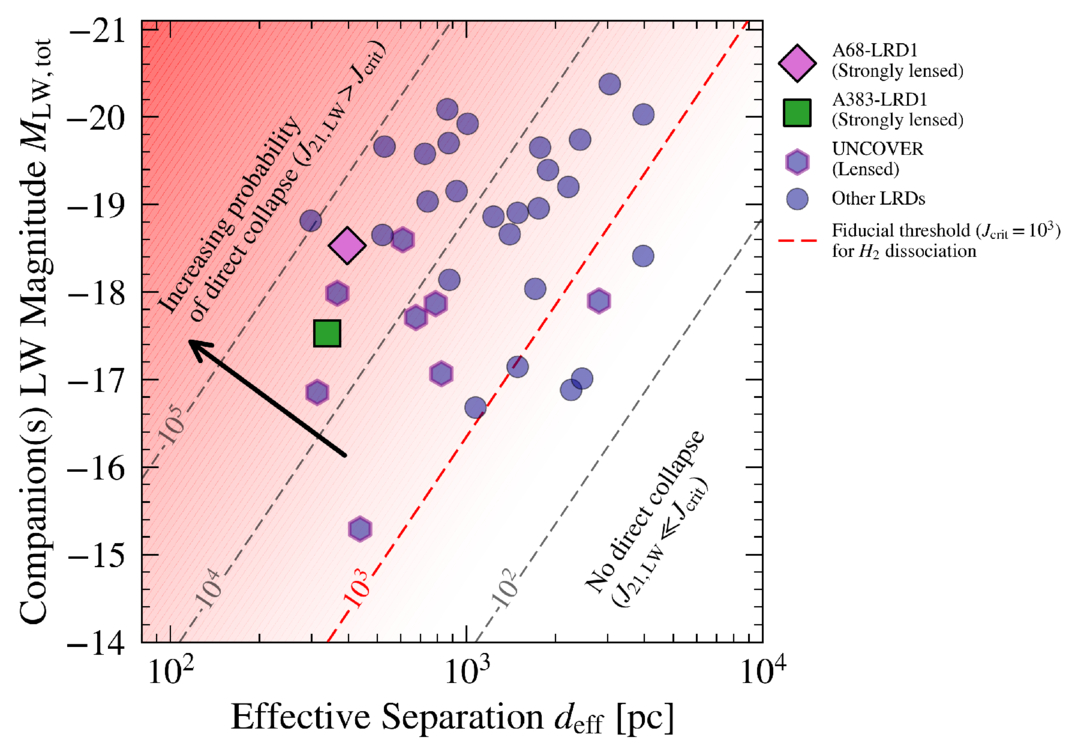
You can tell a lot about a person by looking at their friends — and the same might be true for little red dots. A team led by Josephine Baggen (Yale University) examined a sample of 83 little red dots imaged with JWST. They found that 43% of the little red dots in this sample had a little blue companion: an ultraviolet-bright object within a projected separation of 1,630–16,300 light-years. The brightest little red dots were even more likely to have a blue companion; 80% of the brightest objects in the sample were paired up.

Baggen’s team set out to test the hypothesis that these red–blue pairs are fundamentally linked rather than coincidental. Under this hypothesis, the ultraviolet-bright blue companions were assembled first. The ultraviolet radiation from these objects suppressed the cooling of molecular hydrogen in pristine gas clouds in the early universe, causing the gas to skip the usual star-forming process and instead form a massive compact object such as a black hole star, supermassive star, or quasi-star — which we see as a little red dot.

plot of Lyman-Werner radiation versus projected separation

The companion’s mean flux density from 91.2 to 111 nm versus projected separation between the blue companion and the little red dot. The red dashed line shows the estimated values necessary for gas clouds to collapse. Click to enlarge. [Baggen et al. 2026]

Baggen and coauthors investigated whether the ultraviolet radiation from the blue companions is strong enough to have triggered this transformation. The team used spectral energy distribution modeling to determine the luminosities of the blue companions from 91.2 to 111 nanometers. This analysis showed that the radiation from the blue companions is equal to or greater than the threshold necessary to encourage the direct collapse of a gas cloud into a massive compact object.

If little red dots form thanks to their little blue companions, that would imply that every little red dot has or had such a companion. Though little blue companions weren’t so universal in the sample used in this work, the team noted that their analysis techniques, combined with observational limitations and other factors, likely yielded a smaller number of blue companions than are actually present. Further simulations exploring the collapse of pristine gas clouds into massive compact objects and high-resolution spectroscopic observations of little red dots can illuminate the potential link between these objects.

globular cluster NGC 1851

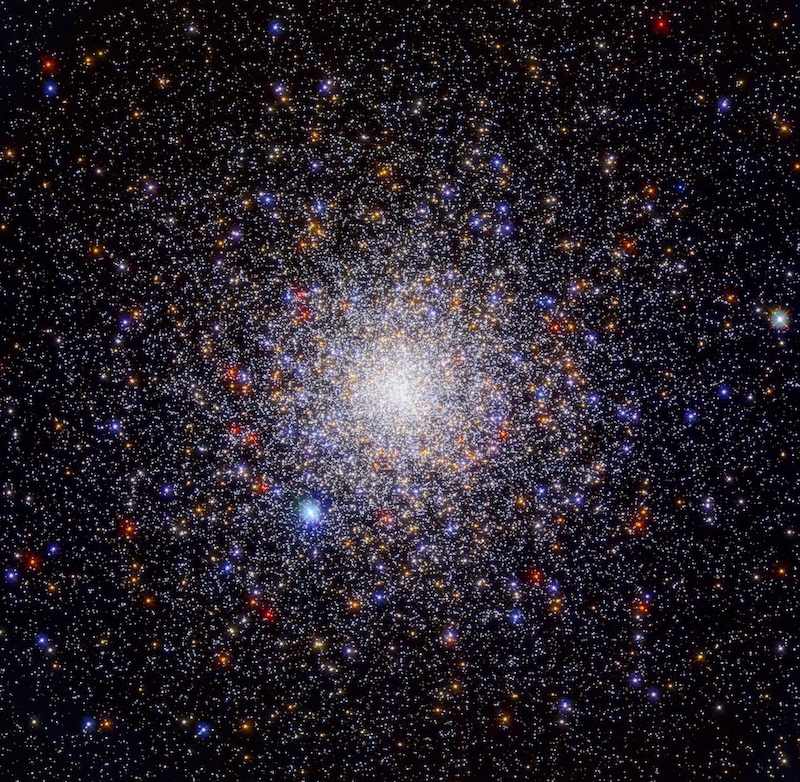
The densely packed globular cluster NGC 1851, as seen by the Hubble Space Telescope. [NASA, ESA, and G. Piotto (Università degli Studi di Padova); Processing: Gladys Kober (NASA/Catholic University of America)]

Little Red Dots as Young Globular Clusters

John Chisholm (The University of Texas at Austin) and collaborators hypothesized that little red dots represent a brief phase in the formation of globular clusters. In this hypothesis, the rest-frame ultraviolet emission of little red dots comes from the hot young stars of the newborn cluster, while the rest-frame optical emission comes from a single supermassive star at the cluster’s heart. Thus, in this framework, the little red dot phase lasts only as long as the fleeting lifespan of the supermassive star.

Chisholm’s team first showed that the spectrum of a young globular cluster with a supermassive star at its center is similar to the observed spectrum of a little red dot. But showing that the emission properties of globular clusters in formation and little red dots are similar is not enough — it’s also necessary to investigate whether the numbers and masses of these objects line up.

mass functions of little red dots and globular clusters

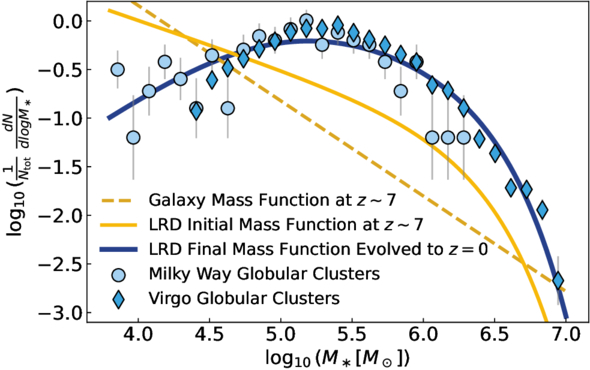
Comparison of the mass functions of little red dots evolved forward to the present day (blue line) and globular clusters in the Milky Way and Virgo (blue symbols). The results for both populations have been normalized to emphasize the shape of the distributions. Click to enlarge. [Chisholm et al. 2026]

To do this, the team propagated the observed mass function of little red dots at a redshift of z = 7 forward in time to z = 0. This process accounted for the rapid evolution of the supermassive star into a black hole, as well as the evolution of and feedback from the massive stars in the cluster. Comparing the resulting mass function to the population of present-day globular clusters, the team found that the mass functions had very similar shapes, and the number densities of little red dots and globular clusters in the present day are estimated to be of the same order of magnitude: 0.1–0.3 Mpc-3 and 0.8 Mpc-3, respectively.

In addition to describing how the properties of globular clusters in formation match those of little red dots, Chisholm’s team outlined some testable predictions for this scenario, including formation timescales and chemical abundance patterns. If this hypothesis withstands further scrutiny, little red dots may provide a valuable look at the early years of some of our universe’s oldest star clusters.

Citation

“Connecting the Dots: UV-Bright Companions of Little Red Dots as Lyman–Werner Sources Enabling Direct-Collapse Black Hole Formation,” Josephine F. W. Baggen et al 2026 ApJL 1002 L4. doi:10.3847/2041-8213/ae58a5

“Little Red Dots as Globular Clusters in Formation,” John Chisholm et al 2026 ApJL 1004 L4. doi:10.3847/2041-8213/ae6dae

The post Two More Thoughts on Little Red Dots appeared first on AAS Nova.

Stacking Up the Discovery of Six Millisecond Pulsars

29 May 2026 at 17:00

Millisecond pulsar and companion artist's impression

The fastest spinning pulsars in the universe are often quite difficult to detect. Leveraging multiple observations from the largest single-dish telescope in the world, researchers have discovered six previously undetected pulsars.

Millisecond Pulsars in Globular Clusters

Globular clusters, compact collections of tens of thousands to millions of stars, are highly dense and rife with dynamical interactions. These active environments are ideal factories for the formation of millisecond pulsars — the extremely fast-spinning cores of once-massive stars, shining beams of radio emission from their poles. One way millisecond pulsars are thought to form is when a pulsar in a binary system steals mass from its companion star, transferring angular momentum and causing the pulsar to spin up. The densely packed environment in a globular cluster provides ample opportunity for a pulsar to acquire a companion to siphon.

However, millisecond pulsars in distant globular clusters are notoriously difficult to detect. Traditional pulsar searches that rely on a single observation tend to miss millisecond pulsars, many of which have signals too faint to be distinguished from noise or radio interference. Instead, researchers must rely on a different method to find these fast-spinning pulsars.

FAST

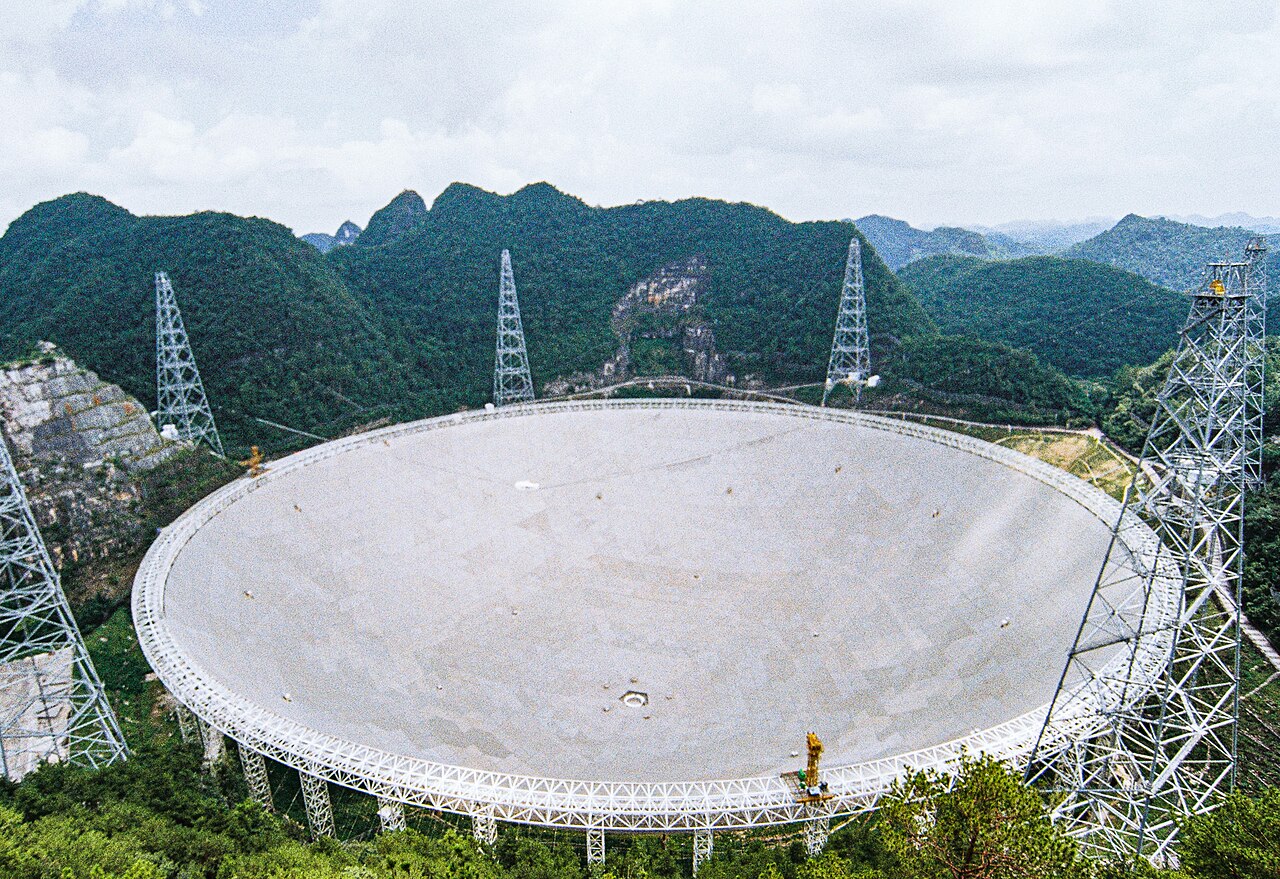
FAST, the 500-meter single-dish radio telescope located in southwestern China. [Wikipedia user SCJiang; CC BY 4.0]

Stack Search Success

To find faint millisecond pulsars, researchers have developed the stack search method, in which multiple radio observations are combined to tease out faint signals and decrease noise. Reliably stacking observations across epochs requires stability; isolated millisecond pulsars, now no longer spinning up after losing their companion, have very stable rotation periods, making them ideal targets for the stack search method. To date, the stack search method has successfully identified nine isolated globular cluster millisecond pulsars using data from the Arecibo, Parkes, and Green Bank radio telescopes.

Stack Spectra

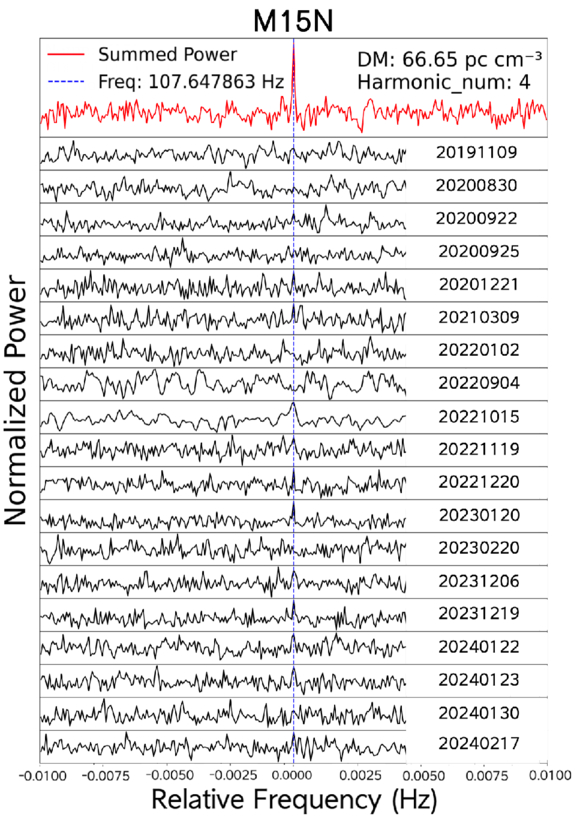
Power spectra from a discovered millisecond pulsar M15N. The black solid lines show the 19 individual observations of the pulsar, and the red solid line in the top panel shows the stacked spectrum. The stack search method pulls out a clear pulsar signal. [Dai et al. 2026]

In hopes of recovering more of these faint fast-spinning pulsars, Yinfeng Dai (Beijing Normal University) and collaborators used archival data obtained with the Five-hundred-meter Aperture Spherical radio Telescope (FAST), the world’s largest single-dish telescope. Targeting two specific globular clusters, NGC 6517 and M15, the team applied the stack search method to 23 and 19 observations of the globular clusters, respectively. From their search, the authors discovered six previously unidentified isolated millisecond pulsars: four in NGC 6517 and two in M15.

While previous studies identified brighter pulsars in the targeted globular clusters, the authors confirmed that all six newly discovered pulsars are too weak to be reliably recovered from single-epoch searches, underscoring the importance of the stack search method. In particular, this search increased the known pulsar populations of NGC 6517 and M15 by 27% and 18%, respectively, suggesting that a meaningful fraction of globular cluster pulsars are easily missed in traditional pulsar searches. Future studies employing this stack search method will continue to detect faint millisecond pulsars, unlocking this elusive population for further exploration.

Citation

“The Stack Search Tests on FAST Data: Discovery of Six Faint Isolated Millisecond Pulsars in NGC 6517 and NGC 7078 (M15),” Yinfeng Dai et al 2026 ApJL 1002 L31. doi:10.3847/2041-8213/ae5dbb

The post Stacking Up the Discovery of Six Millisecond Pulsars appeared first on AAS Nova.

From Globs to Gravitational Waves: A Simulated Cosmic Choreography

25 August 2025 at 17:00

Messier 13

Editor’s Note: Astrobites is a graduate-student-run organization that digests astrophysical literature for undergraduate students. As part of the partnership between the AAS and astrobites, we occasionally repost astrobites content here at AAS Nova. We hope you enjoy this post from astrobites; the original can be viewed at astrobites.org.

Title: Formation and Evolution of Compact Binaries Containing Intermediate-Mass Black Holes in Dense Star Clusters
Authors: Seungjae Lee et al.
First Author’s Institution: Seoul National University
Status: Published in ApJ

A delicate dance goes on in astronomy between theory and observation. Most astronomy research, by and large, fits into one of two categories. In one category, you start with a theory, model, or simulation, and attempt to figure out what observations you might expect given those initial assumptions. The other approach begins with raw data and attempts to determine what kinds of theories, models, and fundamental astrophysical assumptions might give rise to it. Accepted knowledge usually happens when these two approaches agree and reinforce each other, but a lot of the actual science occurs when one side dances ahead of the other — either we have theories and models that make predictions that cannot yet be observationally tested, or we have data that defy attempts at fitting underlying models.

Another dynamical dance goes on in globular clusters between binary black holes. Today’s article investigates intermediate-mass black holes, or IMBHs, a pristine example of an astronomical topic in which theory has danced ahead of observations. IMBHs fill the gap between stellar mass and supermassive black holes. We can observe black holes in multiple ways, usually from the electromagnetic radiation of the gas disks surrounding some black holes (either stellar or supermassive), or the gravitational waves of two orbiting or merging black holes. Unfortunately, each method requires some extra component — either gas to accrete or a companion to orbit — and IMBHs are far more challenging to observe through these methods. Hence, we have a lot of ideas about how they might form, and scarce observational evidence for their existence.

That hasn’t stopped many researchers from trying to make better models and predictions. One of the most commonly proposed mechanisms for forming IMBHs is in dense globular or nuclear star clusters (up to a million times denser than our region of the Milky Way). In these dense environments, stars and the black holes they produce might have a chance to find and run into each other often enough to reach the masses of the IMBH regime through mergers. Today’s authors use a series of N-body simulations to study these dense stellar clusters, into which they embed IMBHs. Their study investigates the detectability of gravitational waves from intermediate-mass-ratio inspirals (IMRIs). Because so many mergers occur in dense clusters, it allows for more mergers between objects with greater mass differences. The mass ratio between the two objects (usually denoted as ‘q’) is one of the most important parameters for characterizing a merger, and a high q value creates a gravitational wave signature that is different from a low q, even if the total mass of the system is the same.

To investigate the formation and detectability of IMRIs, the authors conducted a suite of direct N-body simulations of star clusters with total masses between 5×10⁴ and 105 solar masses, containing ~105 particles. They include initial conditions for how densely packed the particles should be, given how far they are from the cluster’s center (called a Plummer profile). They also include a rule for how the initial masses of the stars are distributed (called a Kroupa initial mass function). Then, they use a code called Stellar EVolution for N-body (SEVN) to follow the evolution of the stars in the system for 100 million years.

In that time, massive stars in the simulation can evolve into neutron stars and stellar-mass black holes. In addition to simulating the clusters’ stars, the authors embed an IMBH of 300–5,000 solar masses into the clusters. The key to this article is that some of the stellar-mass binary black holes will interact with the IMBH, creating an IMRI, which gives off gravitational waves. This article’s primary goal is to characterize these IMRIs and to test how well current and future gravitational wave detectors will measure them.

In the simulation, when a stellar-mass binary black hole and an IMBH come close, the authors must create a “merger criterion” — essentially, how it is decided whether the two objects merge, and what the subsequent “gravitational wave” would look like. Once they model the wave itself, they turn to five current or future detectors to see how well they will measure those waves if they were at particular astronomical distances from Earth.

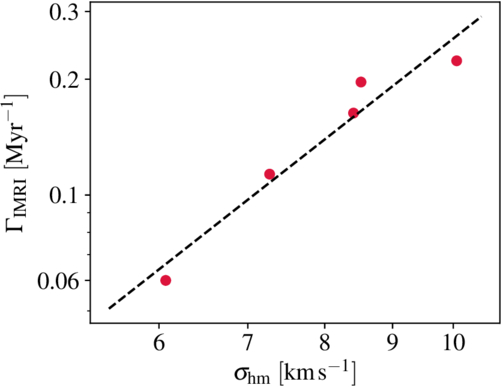
One of the primary relationships the authors look at in the cluster is the half-mass radius velocity dispersion of the cluster and the number of IMRI encounters between the IMBH and stellar-mass objects. One can think of the velocity dispersion as a more complicated “average velocity” of the stars in the cluster (a high velocity dispersion means, on average, the stars are moving faster, the half-mass radius is the distance from center that separates the inner half of the stars and outer half of the stars, and we use it because it is more representative of stellar motion in the overall cluster than the packed center or the mellow edge). Figure 1 shows the relationship between the number of IMRI events (y-axis) vs. the velocity dispersion (x-axis) of the cluster where the IMBH sits. Note that the y-axis is logarithmic, so a small increase in velocity dispersion actually results in a large increase in the number of IMRIs. This tells us that the number of events is much more dependent on the properties of the larger cluster than the IMBH itself.

plot of IMRI event rate as a function of cluster half-mass velocity dispersio

Figure 1: IMRI event rate as a function of cluster half-mass velocity dispersion (σhm) for 1,000-solar-mass IMBHs in the simulations. The IMRI merger rate is highly sensitive to the velocity dispersion of the cluster as a whole, making it a key observable of how efficiently IMRIs can form and merge in a given cluster. [Lee et al. 2025]

In addition to analyzing the dynamics of the clusters and the mergers within them, the authors go further and attempt to characterize what specific detectors will see. They chose five detectors. The first is advanced LIGO (aLIGO), the current incarnation of the LIGO detector network. Next is the Einstein Telescope (ET), a future proposed European ground-based detector. Following that is the Laser Interferometer Space Antenna (LISA), a space-based detector set to launch in the 2030s that is designed to observe supermassive black hole mergers. Next are two detectors that are less established, the advanced Superconducting Omni-directional Gravitational Radiation Observatory (aSOGRO) and the Deci-hertz Interferometer Gravitational Wave Observatory (DECIGO). aSOGRO is a proposed Earth-based detector that could theoretically measure gravitational waves at lower frequencies than the current LIGO-Virgo-KAGRA (LVK) detectors, and DECIGO is a proposed space-based detector designed to observe gravitational waves in the frequency range between the LVK network and LISA.

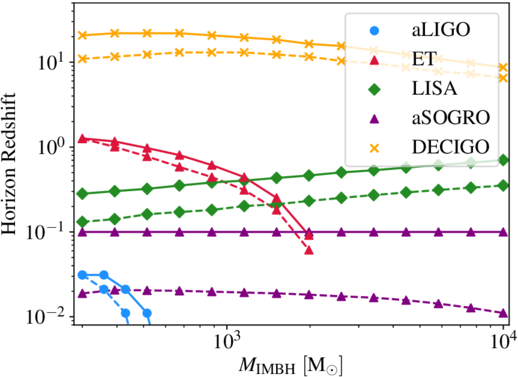
How do the authors translate the gravitational wave signal from the IMRI into what might be observed on Earth? First, they must pick a signal-to-noise ratio threshold, which is the ratio of the gravitational wave signal to the background noise in the detector. In this case, they chose a signal-to-noise ratio of 8, a commonly chosen threshold in the gravitational wave literature. From the signal-to-noise ratio, the authors can calculate a horizon distance. The horizon distance is the distance that a detector can measure a specific gravitational wave event with a given set of properties at or above the threshold chosen. Figure 2 shows the horizon distances (y-axis) for each detector for sets of gravitational wave sources with different properties vs. the mass of the IMBH generating the gravitational wave (x-axis). The solid and dotted lines represent two chosen masses of the IMBH’s stellar-mass companion. The figure shows that aLIGO (blue circles) can detect only low-mass IMBHs (≲ 300 solar masses) at a redshift of z ≲ 0.05. ET (red triangles) is sensitive to lower-mass IMBHs, and LISA (green diamonds) excels at detecting higher-mass IMBHs. aSORGO (purple triangles) covers a broad mass range but at lower redshifts. DECIGO (yellow Xs) offers the broadest mass range at the highest redshift.

plot of horizon redshift versus intermediate-mass black hole mass

Figure 2: Horizon redshift vs. IMBH mass for several gravitational wave observatories (aLIGo represented by blue circles, ET by red triangles, LISA by green diamonds, aSOGRO by purple triangles, and DECIGO by yellow x‘s). Solid vs. dotted lines represent the mass of the stellar-mass black hole interacting with the IMBH, with the dashed line representing a 10-solar-mass companion and the solid lines representing a 60-solar-mass companion. [Lee et al. 2025]

Today’s authors offer a glimpse into globular clusters as dynamic environments where we might see IMRIs. They also predict how those signals might be received by our current, future, and proposed gravitational wave detectors. As next-generation observatories prepare to listen for these cosmic mergers, this work helps chart a path for where and how we might first detect the elusive IMBH.

Original astrobite edited by Kasper Zoellner.

About the author, William Smith:

Bill is a graduate student in the astrophysics program at Vanderbilt University. He studies gravitational wave populations with a focus on how these populations can help inform cosmology as part of the LIGO Scientific Collaboration. Outside of astrophysics, he also enjoys swimming semi-competitively, music and dancing, cooking, and making the academy a better place for people to live and work.

The post From Globs to Gravitational Waves: A Simulated Cosmic Choreography appeared first on AAS Nova.

Finding Galaxies in the Dark: Using Globular Clusters to Identify Ultra-Diffuse Galaxies

27 June 2025 at 17:00

While classic spiral and elliptical galaxies shine brightly, another class of galaxy flies under the radar. A recent study uses a new technique to search for galaxies so faint they are nearly completely dark.

Ultra-Diffuse Galaxies

Hard to see and harder to understand, ultra-diffuse galaxies are a galaxy class with extremely low surface brightness. With low luminosities but large physical extents, these galaxies appear as barely visible smudges, making them difficult to detect. Historically, astronomers have searched for ultra-diffuse galaxies using methods that search for diffuse stellar light; however, this method only catches those bright enough to spot — if even darker galaxies exist, they will not be found this way. Is there another way to discover these elusive galaxies?

Recent studies have shown that ultra-diffuse galaxies tend to have more globular clusters on average than typical galaxies. While this raises questions surrounding their formation and evolution, the abundance of globular clusters provides another way to search for ultra-diffuse galaxies. In general, globular clusters do not clump together in space unless there is additional mass, like dark matter, pulling them together. Thus, searching for overdensities of globular clusters could reveal a hidden population of ultra-diffuse galaxies.

Candidate Confirmation

Discovered as an overdensity of three globular clusters, Candidate Dark Galaxy-2 (CDG-2) was found in data from a Hubble Space Telescope (HST) program aimed at imaging the Perseus galaxy cluster. With an updated globular cluster catalog and improved statistical method for detecting overdensities, Dayi (David) Li (University of Toronto) and collaborators perform a follow-up search and analysis to confirm CDG-2 as a galaxy. Their method searches for clustering of globular clusters that do not appear to belong to any bright galaxy and are unlikely to be randomly grouped so closely in the intergalactic medium.

CDG-2

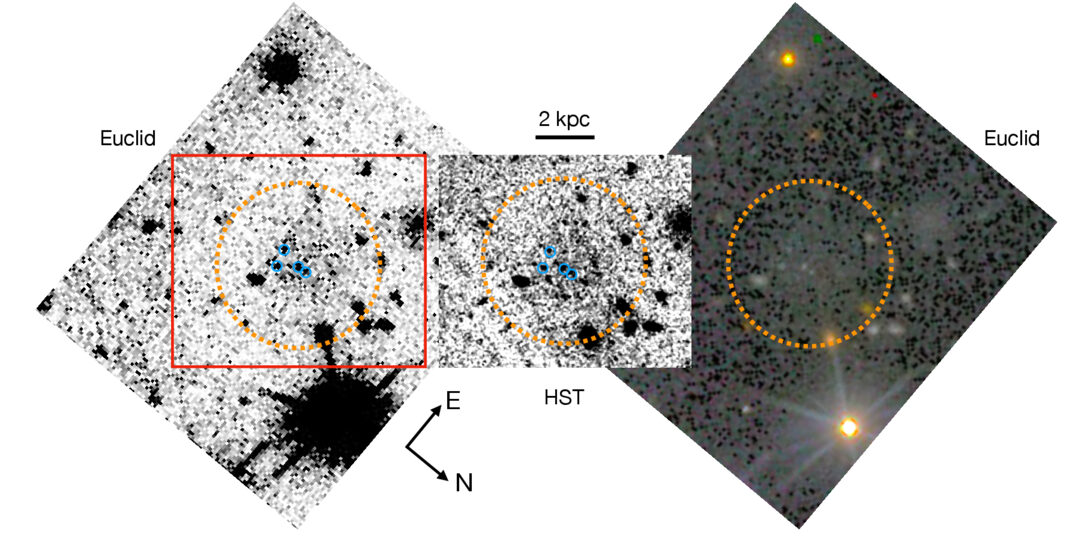
Euclid images of CDG-2 showing the four identified globular clusters (blue circles) and the faint diffuse emission (orange circles) associated with the galaxy. Click to enlarge. [Modified from Li et al 2025]

From their analysis, the authors find an additional globular cluster that belongs to CDG-2, making the object even more statistically likely to be a galaxy as opposed to four randomly clumped globular clusters. Further pointing to CDG-2’s galactic nature, two stacked HST images reveal a very faint light surrounding these globular clusters. To confirm that this diffuse emission is truly associated with CDG-2, the authors use data from Euclid, a space telescope that is optimized for detecting diffuse structures. The Euclid data confirm a low-surface-brightness fuzzy emission that coincides with the emission seen with HST and corresponds to the location of the four globular clusters — strong evidence that CDG-2 is indeed a galaxy.

Globular Cluster and Dark Matter Dominated

plot

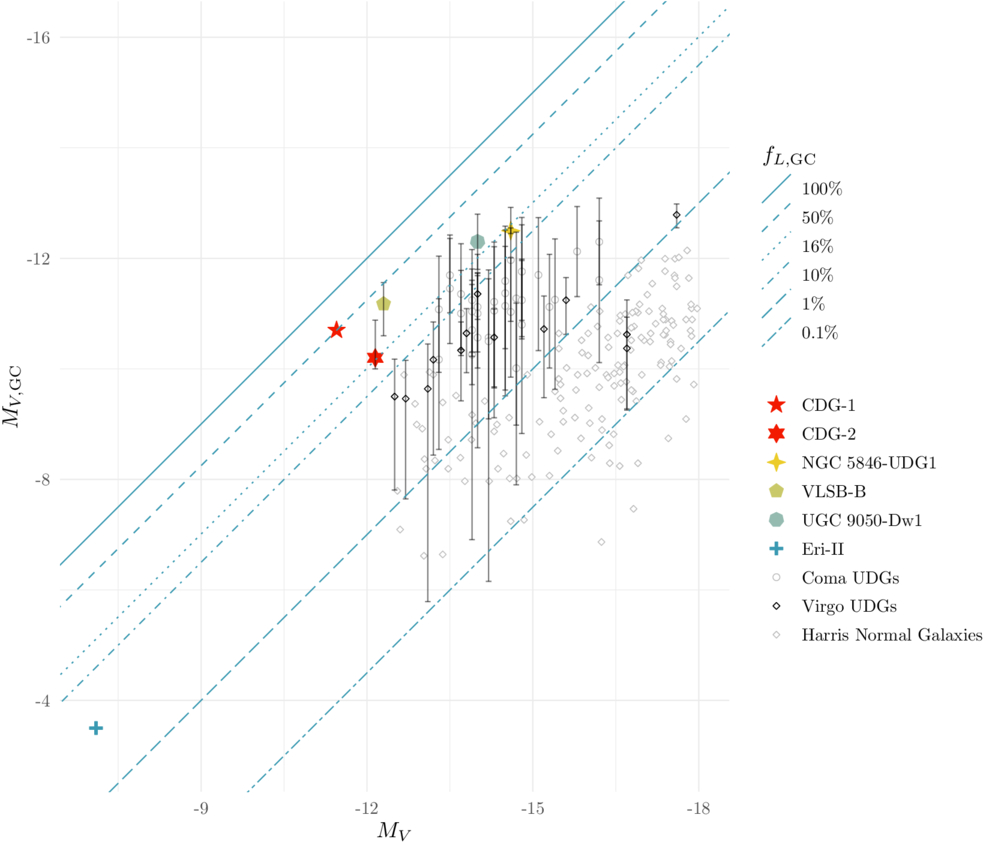
Plot showing globular cluster total luminosity versus total galaxy luminosity for multiple galaxies. CDG-2 falls along the line corresponding to 16% of the total galaxy light coming from globular clusters. Click to enlarge. [Li et al 2025]

Further analysis of CDG-2 reveals that at least ~16.6% of its total light is contained within its globular clusters. However, if CDG-2 follows the typical distribution of globular clusters in galaxies and some are still undetected, this fraction could be as high as 33%, which would make CDG-2 have the highest globular cluster-to-stellar mass ratio of any galaxy to date. With additional analysis of the mass contained within the observed globular clusters, the authors estimate that CDG-2 is highly dark-matter dominated with 99.94%–99.98% of its total mass contained within dark matter. The dark-matter fraction could be even higher if CDG-2 contains more undetected globular clusters. Future observations of CDG-2 with deeper imaging and spectroscopy will more confidently determine the galaxy’s extreme and unique structure.

Through this study, the authors have confirmed the first galaxy ever detected solely through its globular cluster population. This technique opens a promising avenue to discovering more galaxies hiding out in the dark.

Citation

“Candidate Dark Galaxy-2: Validation and Analysis of an Almost Dark Galaxy in the Perseus Cluster,” Dayi (David) Li et al 2025 ApJL 986 L18. doi:10.3847/2041-8213/adddab

The post Finding Galaxies in the Dark: Using Globular Clusters to Identify Ultra-Diffuse Galaxies appeared first on AAS Nova.

Star-Crossed Clusters: When Ages Are at Odds

4 June 2025 at 17:00

NGC 6791

There’s more than one way to measure the age of a star in a cluster. But do different age-assigning methods agree?

Assessing Ages

stellar isochrones

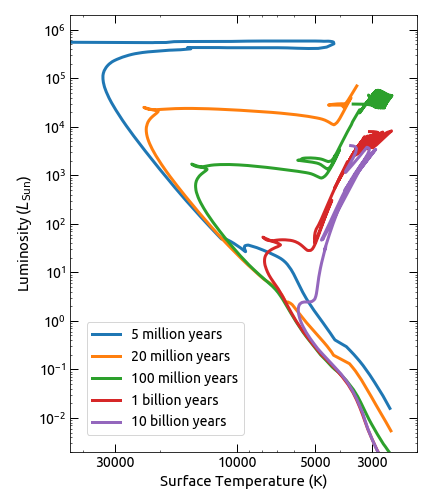
Examples of isochrones for star clusters of various ages. [Ivan Ramirez; CC BY 4.0]

The ages of stars are critical components for many fields of astronomy, from the study of stars themselves to the planets that orbit them and the galaxies they make up. But measuring stellar ages is tricky. It’s considered relatively “easy” to measure the ages of stars in clusters; assuming all stars in a cluster are born from the same material at the same time, the age of the cluster’s stars can be determined using isochrones — theoretical curves describing the temperatures and luminosities of a group of stars of the same age.

However, most stars do not reside in clusters, and to measure the ages of stars that roam the galaxy solo or in small groups, astronomers must use other methods. One method is asteroseismology, in which researchers measure the changes in a star’s brightness or the motion of its surface due to sound waves bouncing around in its interior. Asteroseismology can reveal critical information about a star’s interior structure, composition, and age, but it’s not yet clear how asteroseismic age estimates compare to well-established isochrone-fitting methods for star clusters.

Measurement Matchup

To investigate how these methods compare, Jamie Tayar (University of Florida) and Meridith Joyce (University of Wyoming) compared the age estimates from asteroseismology and isochrone-fitting methods for seven well-studied open and globular clusters. The team scoured the literature for asteroseismic measurements of red giant stars, which are commonly used to calibrate studies of the Milky Way’s history and evolution, and selected a representative age for each cluster from isochrone-fitting methods from the literature.

comparison of asteroseismic and cluster ages for several star clusters

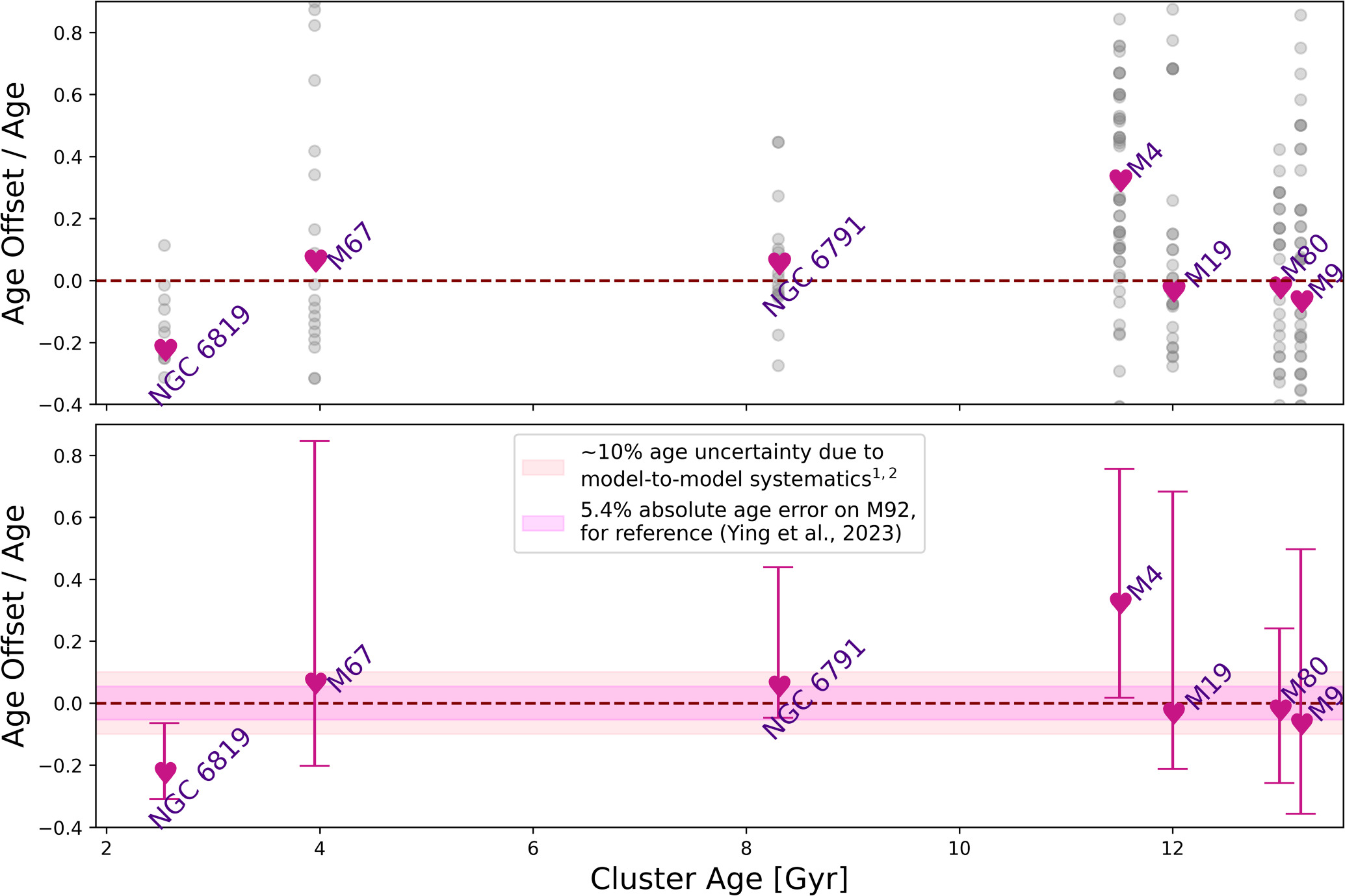
Offsets between asteroseismic ages and cluster ages for seven well-studied clusters. Asteroseismic measurements of individual stars are shown as gray circles, with the median values indicated by the pink hearts. The bottom panel shows the asymmetric dispersion of the asteroseismic data. [Tayar & Joyce 2025]

While the median ages derived from asteroseismic methods fell close to the cluster age for many of the clusters, the team found an enormous amount of spread in the asteroseismic ages of stars within a single cluster. The spread is far greater than expected from the uncertainty in a given asteroseismic measurement, or from the uncertainty arising from the use of different models.

In addition, two of the seven samples had median ages far from the isochrone-fitting cluster age. For these two clusters, especially the well-constrained open cluster NGC 6819, it’s possible that the asteroseismic ages and cluster age are systematically offset from one another — a possibility that would require a dedicated asteroseismic search with a single observatory and a single analysis pipeline to investigate further.

Ages at Odds

Asteroseismic stellar ages are increasingly used to probe the history of the Milky Way and calibrate other age determination methods — so what does it mean for the asteroseismic results to be so varied and potentially offset from the cluster fitting method?

It may mean that asteroseismic measurements require further investigation and calibration before they can achieve the accuracy necessary for galactic archaeology. Part of this endeavor may involve an investigation of binary processes such as accretion or mergers that could alter the masses of individual stars, affecting their inferred ages. These efforts could potentially unlock hundreds of thousands of stellar age measurements from past, present, and future datasets, aiding studies that explore everything from individual stars and their planets to the histories of entire galaxies.

Citation

“Star-Crossed Clusters: Asteroseismic Ages for Individual Stars Are in Tension with the Ages of Their Host Clusters,” Jamie Tayar and Meridith Joyce 2025 ApJL 984 L56. doi:10.3847/2041-8213/adcd6f

The post Star-Crossed Clusters: When Ages Are at Odds appeared first on AAS Nova.

From Gas to Cluster: Simulating Star Formation in the Early Universe

16 May 2025 at 17:00

globular cluster

JWST observations have begun uncovering some of the oldest star clusters in the universe, but their formation mechanisms are still uncertain. A recent study uses high-resolution simulations to understand early star formation and how local globular clusters may have originated. 

Supersonically Induced Gas Objects

Our leading cosmological model of the universe suggests that stars and galaxies coalesce within dark matter halos, eventually forming the larger structures we see today. However, some of the oldest astronomical objects in the universe — massive collections of stars called globular clusters — contain little to no dark matter, making their formation mechanisms somewhat mysterious. How do large clusters with thousands of stars form outside of dark matter halos?

supersonically induced gas objects

Visualizations of the gas density in the simulated star-forming regions in this study. Click to enlarge. [Lake et al 2025]

Recent studies have suggested that as the dark matter and baryons (i.e., normal matter) in the early universe began to clump together and form slightly denser areas, the pristine gas and dark matter began to move relative to one another. Baryons, still tightly coupled to photons, did not have the same freedom to collect in dense regions that the dark matter did, creating supersonic (about five times the speed of sound) relative motions that separated gas clumps and early dark matter halos. These separate, dark-matter-free gas clumps formed baryon-enriched structures known as supersonically induced gas objects.

Over the past decade, simulations and theory have shown that supersonically induced gas objects can form star clusters, which may be the origin story of many of the local globular clusters seen today. However, these simulations have been limited by their resolution. Unable to resolve individual star formation and not including key aspects like feedback, these simulations have left open questions about these dark-matter-free objects.  

High-Resolution Simulations

Seeking to more deeply understand supersonically induced gas objects, William Lake (University of California, Los Angeles; Dartmouth College) and collaborators perform high-resolution simulations that include detailed physics and can track the formation of individual stars. The simulations varied the metallicity and presence of protostellar jets, properties that are both known to impact the star formation process in gas clouds.

imf

Mass distribution for the stars formed in the simulated supersonically induced gas objects. The simulated clusters form more high-mass stars than what is seen in local star-forming regions. Click to enlarge. [Lake et al 2025]

From the simulations, the authors find that star formation occurs naturally in these early systems. Both feedback from jets and the metallicity of the gas affect star-formation outcomes — jets tend to have a minor impact on the star formation efficiency in low-metallicity clouds, but disruption from the jets can cause low-mass stars to form in metal-enriched systems. However, in general, the authors conclude that supersonically induced gas clouds tend to form higher-mass stars than local star clusters, which agrees with what is expected for the universe’s first stellar population. 

Given that these objects likely form very high-mass stars, these primordial star clusters will have extremely high stellar mass surface densities and brightnesses compared to what is observed locally. With such enhanced brightness, these objects may be bright enough for JWST to observe them. Further high-redshift observations of star clusters will allow for further constraints on the formation of the universe’s first stars and will yield more information about the possible origins of the globular clusters we see in the local universe.

Citation

“The Stellar Initial Mass Function of Early Dark Matter–Free Gas Objects,” William Lake et al 2025 ApJL 985 L6. doi:10.3847/2041-8213/add347

The post From Gas to Cluster: Simulating Star Formation in the Early Universe appeared first on AAS Nova.

❌