❌

Normal view

Featured Image: A Rare Pair of Galaxies Lacking Dark Matter

20 July 2026 at 17:00

This image, which combines a background view from the Dark Energy Camera Legacy Survey with two inset images from the Very Large Telescope, shows an unusual pair of galaxies in the Fornax Cluster. The galaxies FCC 224 and FCC 240 are under scrutiny because they may have formed via a high-velocity collision between dwarf galaxies — the so-called “bullet-dwarf” model. Using new spectroscopy from the Very Large Telescope, Maria Luísa Buzzo (Yale University) and collaborators analyzed the ages and kinematics of the galaxies’ stars as well as the unusually bright globular clusters swirling around each galaxy. These data suggest that both galaxies are deficient in dark matter, and their stellar populations and globular clusters are all roughly 10 billion years old. The lack of dark matter and the uniform stellar ages are both consistent with the bullet-dwarf model, in which the collision strips away dark matter and ignites a burst of star formation. Since this type of collision can create more than two remnants, the team suggests searching along the trajectory defined by FCC 224 and FCC 240 for more fragments from the collision, some of which may contain the galaxies’ lost dark matter. To learn more about these galaxies and what they might mean for the bullet-dwarf mechanism, be sure to check out the full research article linked below.

Citation

“Dark-Matter-Deficient Twins: FCC 224 and FCC 240 as Possible Analogs of NGC 1052-DF2 and DF4,” Maria Luísa Buzzo et al 2026 ApJ 1005 15. doi:10.3847/1538-4357/ae7349

The post Featured Image: A Rare Pair of Galaxies Lacking Dark Matter appeared first on AAS Nova.

Disrupted Dwarf Galaxy: Investigating the History of the Small Magellanic Cloud

16 March 2026 at 16:00

Small Magellanic Cloud

Researchers show that the highly disrupted state of the Small Magellanic Cloud can be attributed to a long history of interactions with its neighbor, the Large Magellanic Cloud.

A Disrupted Dwarf Galaxy?

The Small Magellanic Cloud (SMC) is one of the largest and nearest satellites of the Milky Way. At a distance of just 200,000 light-years, the SMC has long been used as an accessible analog for low-metallicity star-forming galaxies in the early universe.

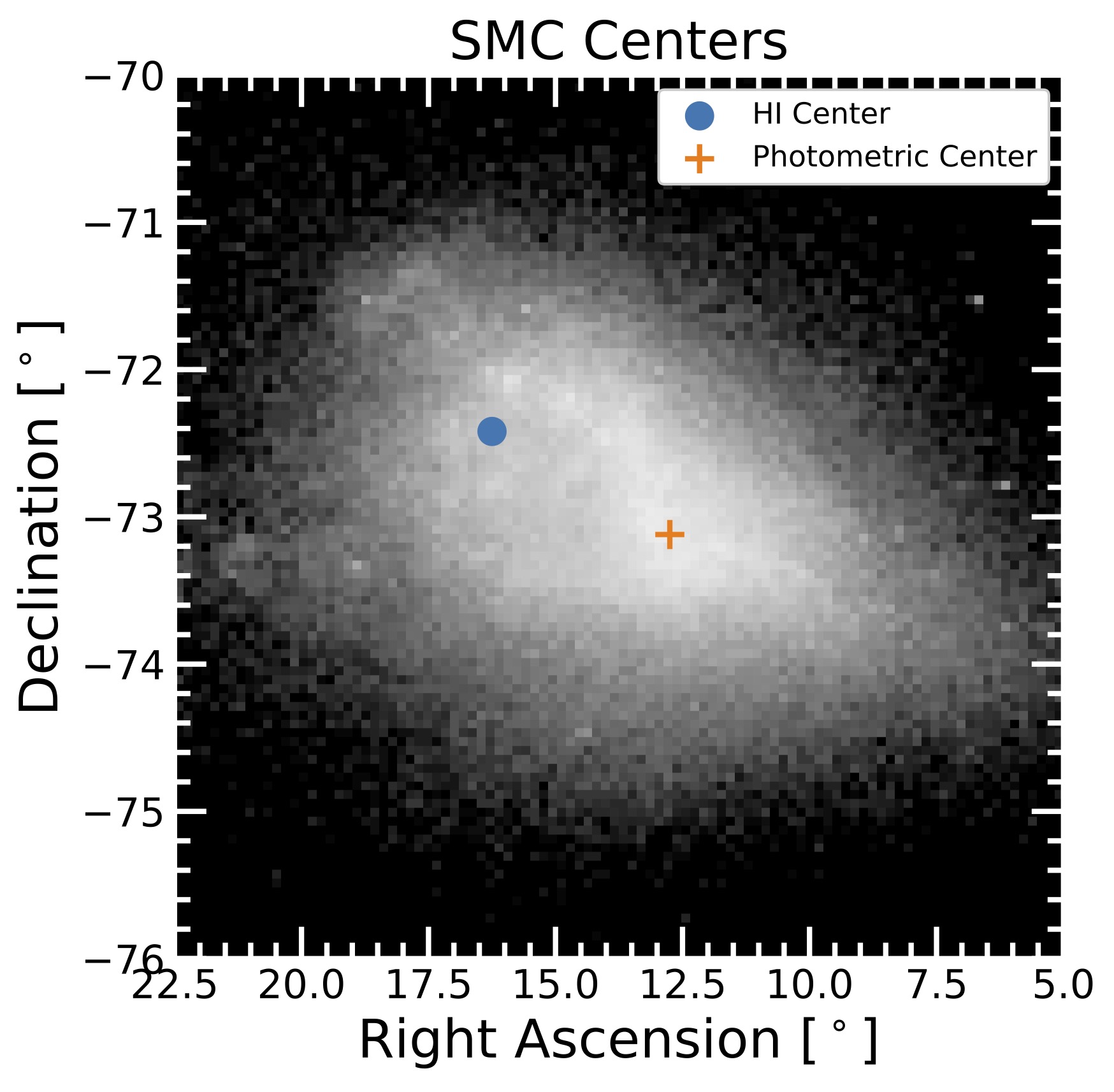
Small Magellanic Cloud photometric and HI kinematic centers

Locations of the SMC’s photometric center and hydrogen gas kinematic center. The two locations are separated by several thousand light-years. [Adapted from Rathore et al. 2026]

However, observations increasingly suggest that the SMC may not be an ideal analog for high-redshift galaxies. The SMC appears to have been disrupted: its gas seems to rotate while its stars do not, it has an unusually large line-of-sight depth compared to its extent on the sky, and its gas distribution has two peaks.

The source of this disequilibrium might be the Milky Way’s largest satellite, the Large Magellanic Cloud (LMC). As the SMC inches along its orbit around the Milky Way, it also engages in a gravitational dance with the LMC. These galaxies may be clumsy dance partners, with data suggesting a potential direct collision between the SMC and LMC within the past 200 million years.

Modeling the Magellanic Clouds

To understand how a potential collision between the Magellanic Clouds might have impacted the present-day properties of the SMC, Himansh Rathore (University of Arizona) and collaborators used hydrodynamical simulations to explore the interconnected histories of the SMC, the LMC, and the Milky Way.

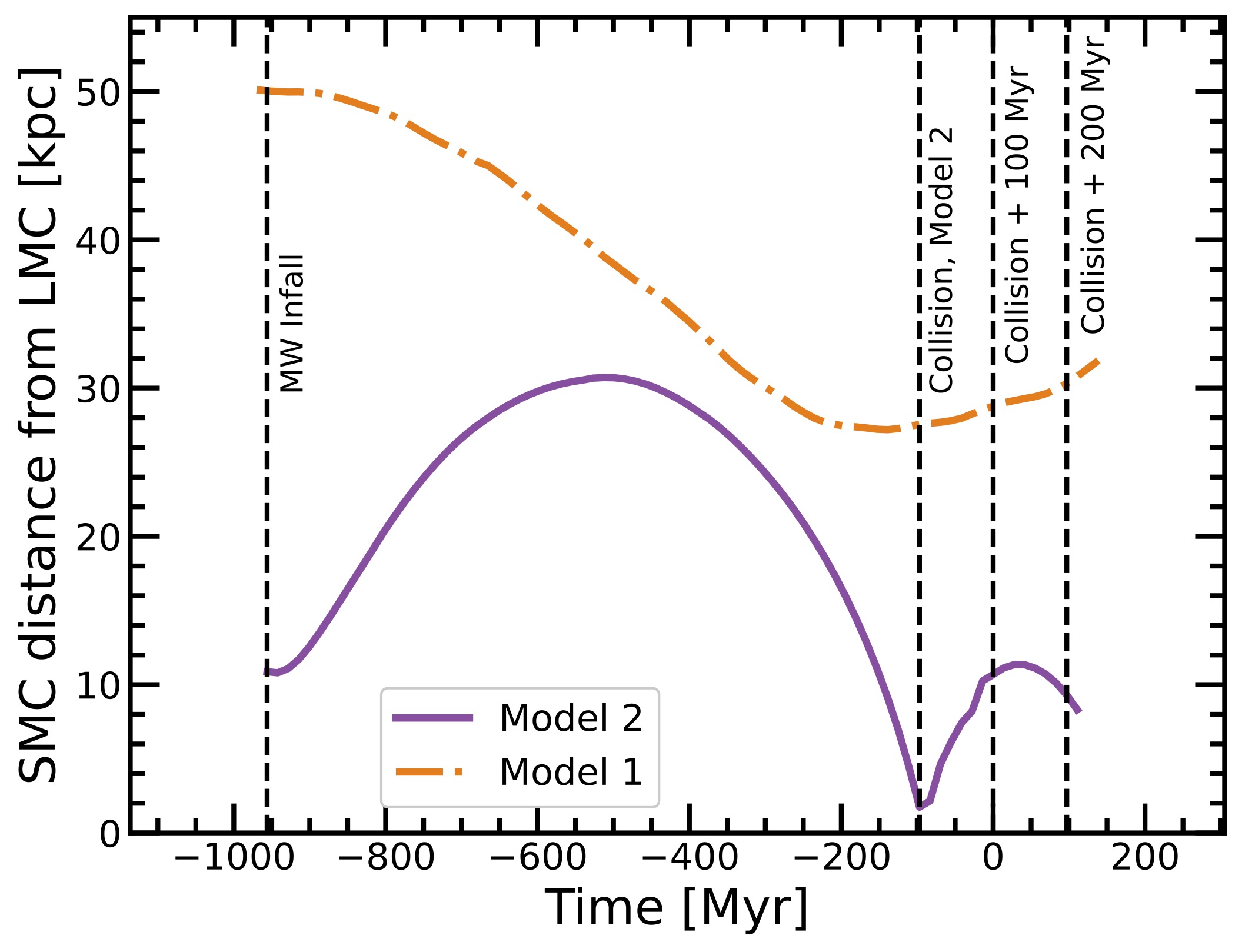
SMC–LMC separation in the authors' models

SMC–LMC separation over time in the control model (orange dot-dashed line) and the collision model (purple solid line). Click to enlarge. [Rathore et al. 2026]

At the beginning of the simulations, the SMC is in equilibrium, with its stellar and gaseous components neatly rotating in unison. From there, its fate diverged: in a control simulation, the SMC and LMC maintained a respectful distance, never getting less than about 100,000 light-years from one another. In the collision simulation, the galaxies collided 100 million years ago.

Both of these model scenarios reproduced certain features of the SMC–LMC system, such as the bridge of gas that spans the distance between them. Only the collision scenario, though, can explain the apparent discrepancy between the SMC’s stars and gas.

An Impactful Collision

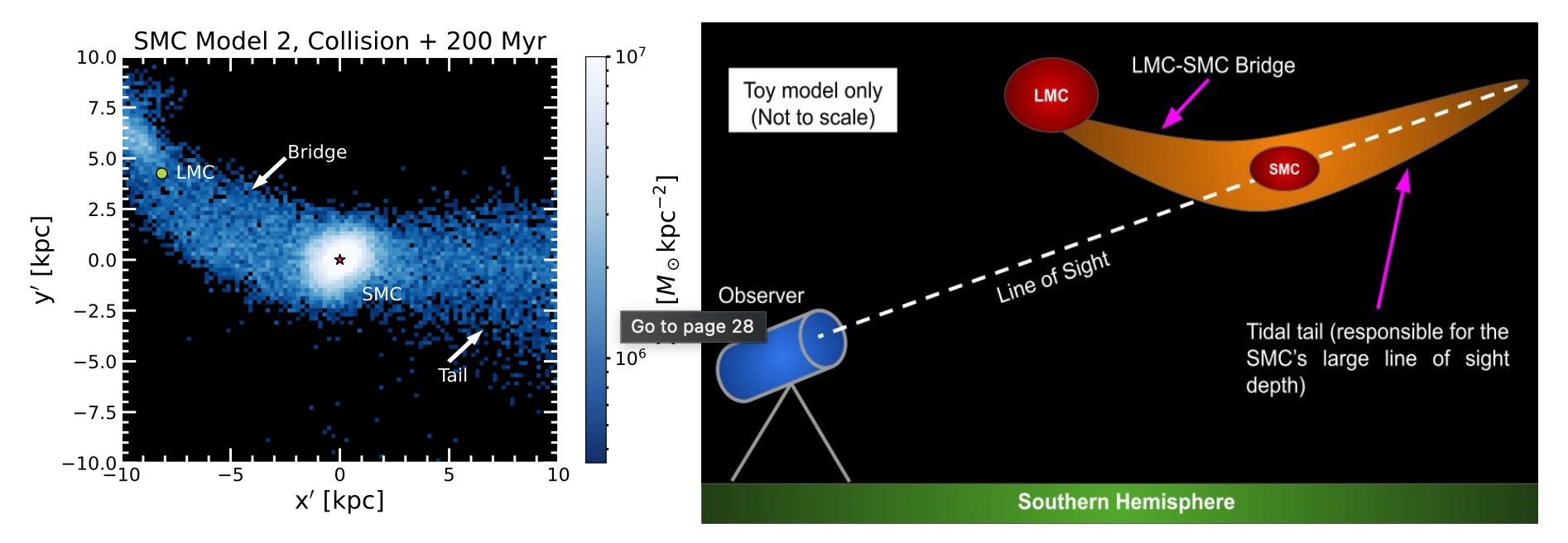
SMC stellar density and viewing schematic

Left: Simulated stellar density 200 million years post-collision. Right: A schematic of our likely perspective on the post-collision SMC–LMC system. Click to enlarge. [Rathore et al. 2026]

Post-collision, the SMC’s stellar population is significantly elongated and features a tidal tail. If this tidal tail is oriented along our line of sight, it would explain why the galaxy’s depth in that direction is unexpectedly large. The presence of a gas tidal tail may also help to explain the two peaks in the galaxy’s gas density.

In terms of the galaxy’s rotation, only the stars nearest the SMC’s center rotate, while the rest move radially outward, swayed by the tidal pull of the LMC. This radial motion is also present in the galaxy’s gas. While previous work has interpreted the observed velocity dispersion of the SMC’s gas as a sign of rotation, Rathore’s team showed that radial expansion, viewed from an inclined angle, can mimic a rotational signature. 

The team also showed that the gas is far more disturbed than the stars, reflecting the pressure exerted by the LMC’s gas when the two galaxies collided. This type of interaction can transform an irregular dwarf galaxy into an ellipsoidal or spheroidal dwarf galaxy — a transition that Rathore’s team argues is underway for the SMC.

Ultimately, these simulations demonstrate that the SMC is a profoundly disrupted galaxy, likely still reeling from a recent collision with its larger neighbor. Viewing the SMC through this lens is critical to understanding its role as an analog to early universe galaxies.

Citation

“A Galactic Transformation — Understanding the SMC’s Structural and Kinematic Disequilibrium,” Himansh Rathore et al 2026 ApJ 1000 50. doi:10.3847/1538-4357/ae4507 

The post Disrupted Dwarf Galaxy: Investigating the History of the Small Magellanic Cloud appeared first on AAS Nova.

Ursa Major III/UNIONS 1: Dwarf Galaxy or Star Cluster?

2 March 2026 at 17:00

Ursa Major III/UNIONS 1

The smallest satellite of the Milky Way, Ursa Major III/UNIONS 1, has posed a mystery since its discovery. Is this smattering of stars a dwarf galaxy or a star cluster?

The Milky Way’s Mysterious Companion

In 2024, researchers discovered a small group of stars orbiting the Milky Way at a distance of about 33,000 light-years in data from the Ultraviolet Near Infrared Optical Northern Survey (UNIONS). This collection of stars amounts to just 16 solar masses and shines with only 11 times the Sun’s luminosity, making it 4–5 times less massive than the next faintest Milky Way satellite.

Considering its small stellar population and small size (its half-light radius is 10 light-years, which is typical for a globular cluster), this satellite appeared at first glance to be an ordinary star cluster. But early data also suggested that the stars had an unusually high velocity dispersion, which could mean that they are nestled within a dense and massive dark matter halo — making the satellite not a star cluster but a dwarf galaxy.

Reflecting this uncertainty, the satellite has two names: Ursa Major III (its dwarf galaxy designation) and UNIONS 1 (its star cluster classification). Can new data clear up the confusion?

New Dispersion Data

In a recent research article, William Cerny (Yale University) and collaborators described new observations of 16 stars in Ursa Major III/UNIONS 1 with the Keck II telescope.

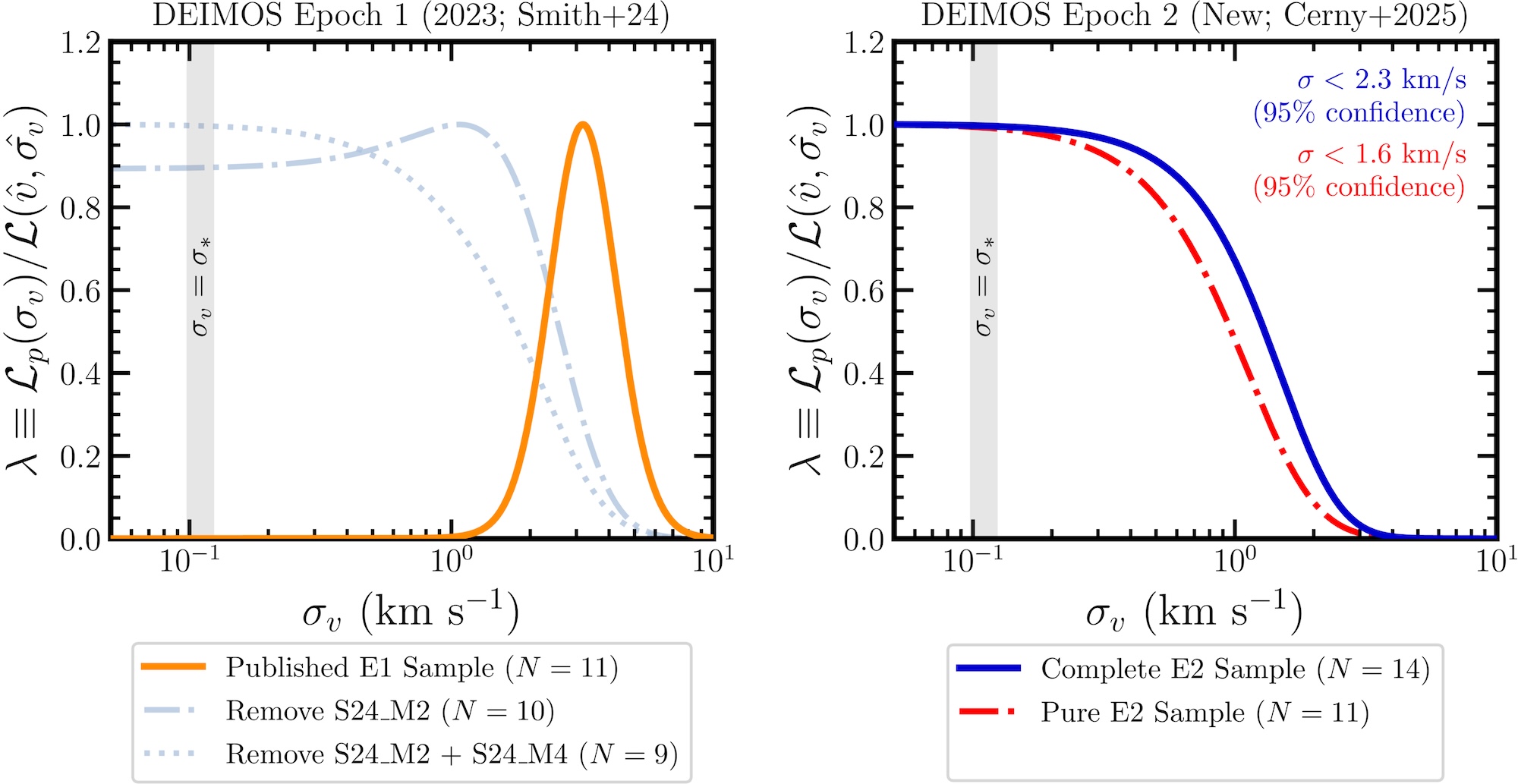
plots of velocity dispersion

Normalized likelihoods for the velocity dispersion based on the initial data (left) and the new data (right). The initial velocity dispersion measurement of 3.7 km/s is ruled out by the new measurements. Click to enlarge. [Cerny et al. 2026]

Crucially, these measurements enabled a new estimation of the system’s velocity dispersion. In contrast to earlier work that found a high velocity dispersion of 3.7 km/s, the new data favor a value of just 0.1 km/s and rule out values above 2.3 km/s. While these results do not unequivocally preclude the possibility of dark matter, they strongly favor little to no dark matter. This goes against the initial evidence in favor of the dwarf galaxy hypothesis.

These observations also helped to confirm one candidate binary pair and identify three new binary candidates. (This large binary fraction, though interesting, isn’t diagnostic, as both star clusters and dwarf galaxies are known to host high proportions of binary stars.)

Further Evidence

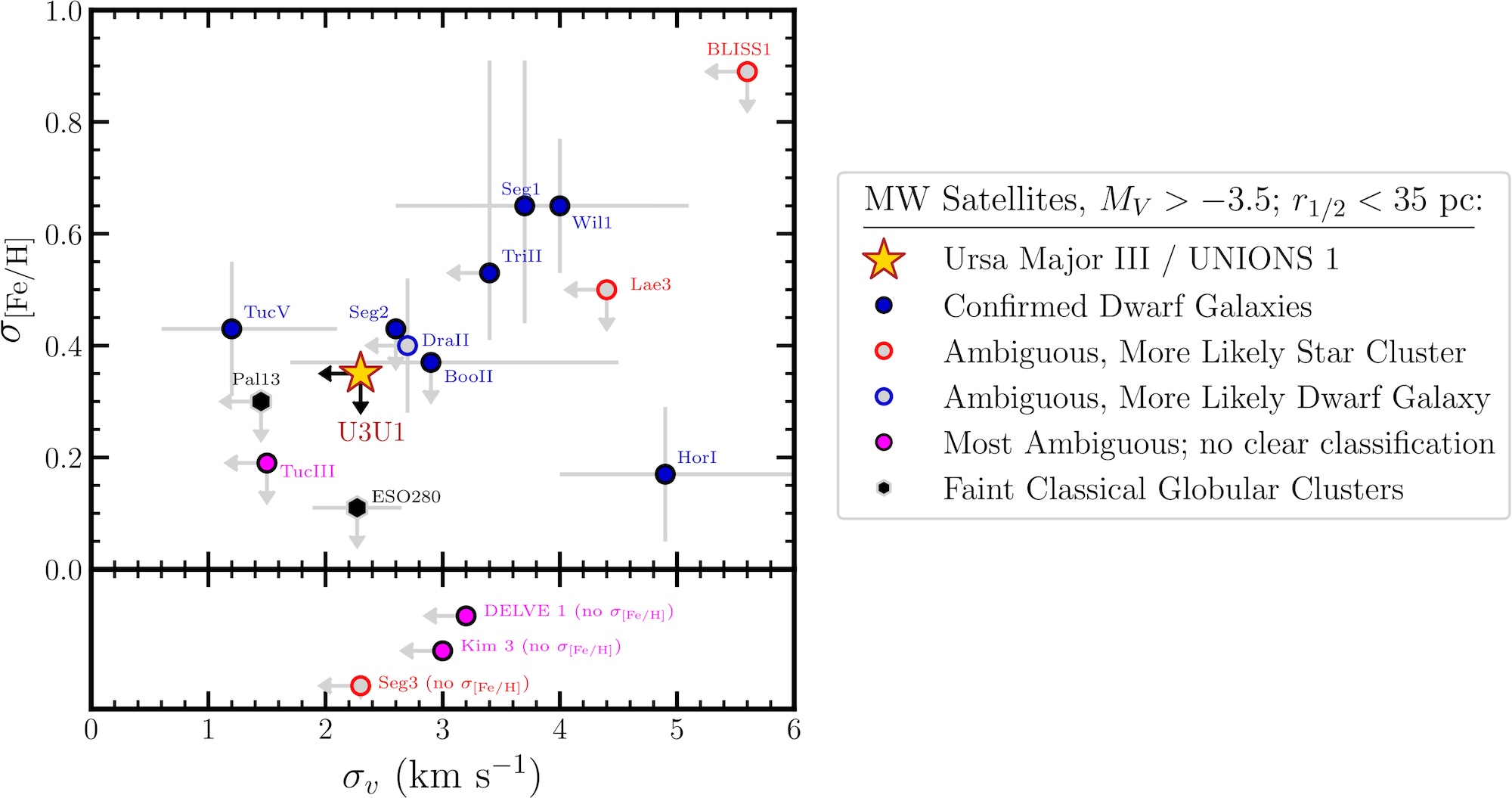
Cerny’s team conducted a further test of the Ursa Major III/UNIONS 1’s identity by measuring the metallicities of its 12 brightest stars. They found that the stars are metal poor and have little metallicity dispersion. This finding again points to a star cluster, in which stars form in a single epoch, rather than a dwarf galaxy, which may feature multiple generations of stars with different degrees of chemical enrichment.

metallicity dispersion vs velocity dispersion for faint Milky Way satellites

Upper limits on velocity dispersion and metallicity dispersion for Ursa Major III/UNIONS 1 compared to other faint Milky Way satellites. There are no confirmed dwarf galaxies for which the metallicity dispersion and velocity dispersion are both lower than for Ursa Major III/UNIONS 1. Click to enlarge. [Cerny et al. 2026]

Based on the newly collected evidence, Cerny and collaborators concluded that Ursa Major III/UNIONS 1 is likely a star cluster, though the possibility that it’s instead a dwarf galaxy could not be ruled out. If the star cluster classification holds, Ursa Major III/UNIONS 1 would be the least luminous metal-poor star cluster known. This classification may also imply the presence of a large number of compact objects — white dwarfs, neutron stars, or black holes — to keep the cluster intact, filling the role that dark matter would have played.

Going forward, further chemical abundance measurements of Ursa Major III/UNIONS 1 may still sway the argument one way or another. And as facilities like the Vera C. Rubin Observatory and the Euclid space telescope continue to collect data, other extreme Milky Way satellites may come to light.

Citation

“No Observational Evidence for Dark Matter Nor a Large Metallicity Spread in the Extreme Milky Way Satellite Ursa Major III/UNIONS 1,” William Cerny et al 2026 ApJL 999 L8. doi:10.3847/2041-8213/ae29b8

The post Ursa Major III/UNIONS 1: Dwarf Galaxy or Star Cluster? appeared first on AAS Nova.

Satellite Surplus Around Dwarf Galaxy DDO 161

20 February 2026 at 17:00

LMC

Small galaxies are expected to have even smaller companion galaxies, according to current cosmological models. A recent study takes a look at one dwarf galaxy and finds more tiny companions than anticipated. 

Cosmology Predicts Satellite Galaxies

Critical to our understanding of dark matter and galaxy formation, satellite galaxies are small, faint galaxies surrounding a larger host galaxy. The leading cosmological model, known as lambda cold dark matter (ΛCDM), predicts dark matter halos of all masses to host smaller dark matter subhalos whose luminous counterparts make up satellite galaxies. 

While the satellite systems of Milky Way-like galaxies are well characterized, the companions of dwarf galaxies are less well studied. Despite being significantly smaller, dwarf galaxies should also host even smaller satellites galaxies around them. These satellites push the limits of observations — extremely faint and hard to distinguish from background sources, dwarf galaxy satellites require innovative imaging techniques to discover. 

In recent years, new surveys have identified a number of satellites around dwarf galaxies that appear broadly consistent with ΛCDM predictions, though the sample size is still small. Continuing the search for little galaxies’ little galaxies is critical to testing the ΛCDM framework and will further our understanding of galaxy formation on the smallest scales. 

DDO 161 satellite map

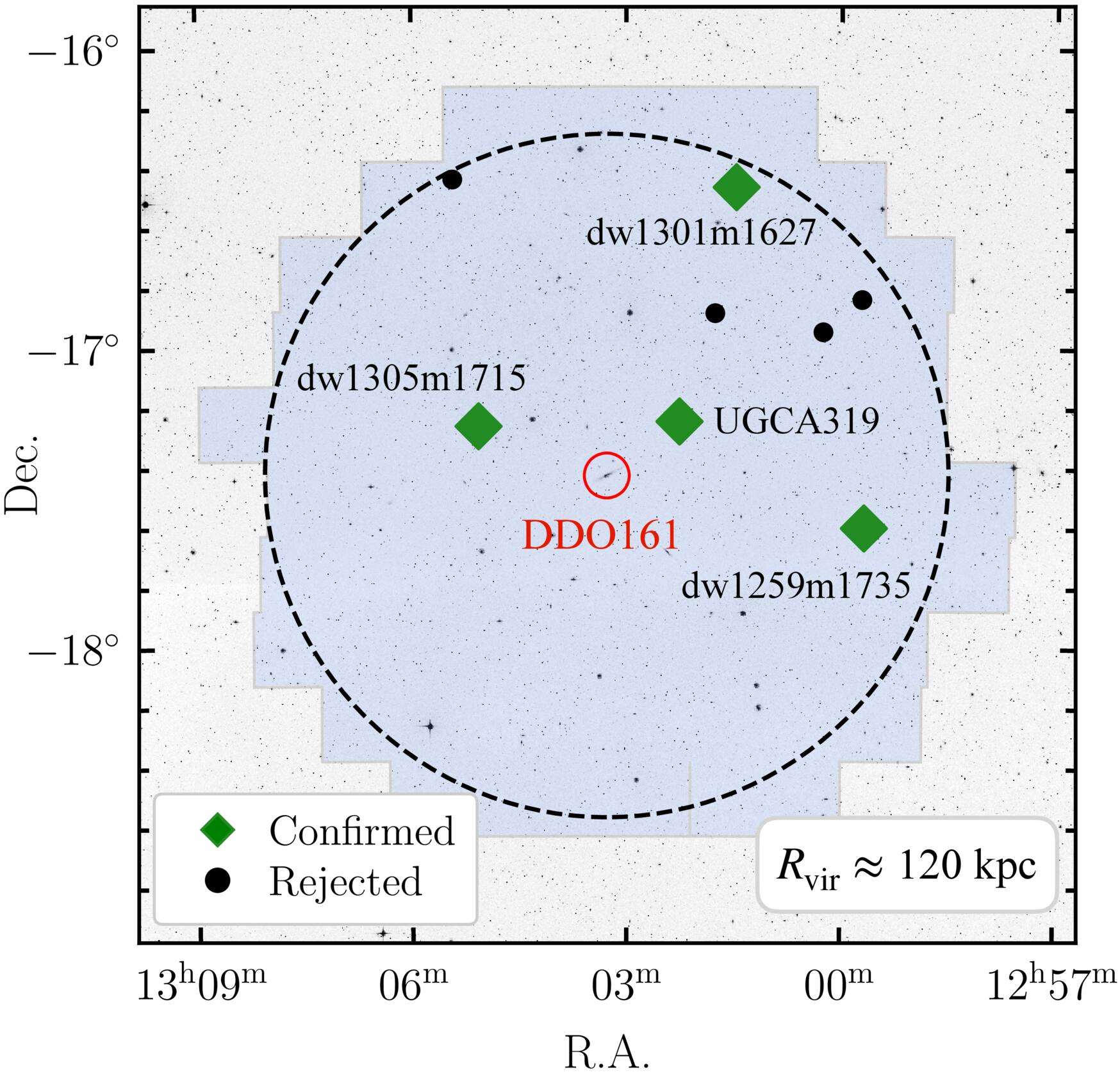
Satellite candidates around DDO 161 as they appear on the sky. Click to enlarge. [Li et al 2026]

Searching for Satellites Around DDO 161

Diving into a specific system, a team led by Jiaxuan Li (李嘉轩) from Princeton University began an in-depth search for satellites around the dwarf galaxy DDO 161. Prior to this study, DDO 161 was known to have one companion, UGCA 319, that is about 10 times smaller than its host. 

The authors used data from the Legacy Surveys to search for satellites within about 400,000 light-years of DDO 161 — the expected reach of DDO 161’s gravitational influence. After removing bright sources and smoothing the image to bring out very faint objects, they found eight satellite galaxy candidates including UGCA 319.

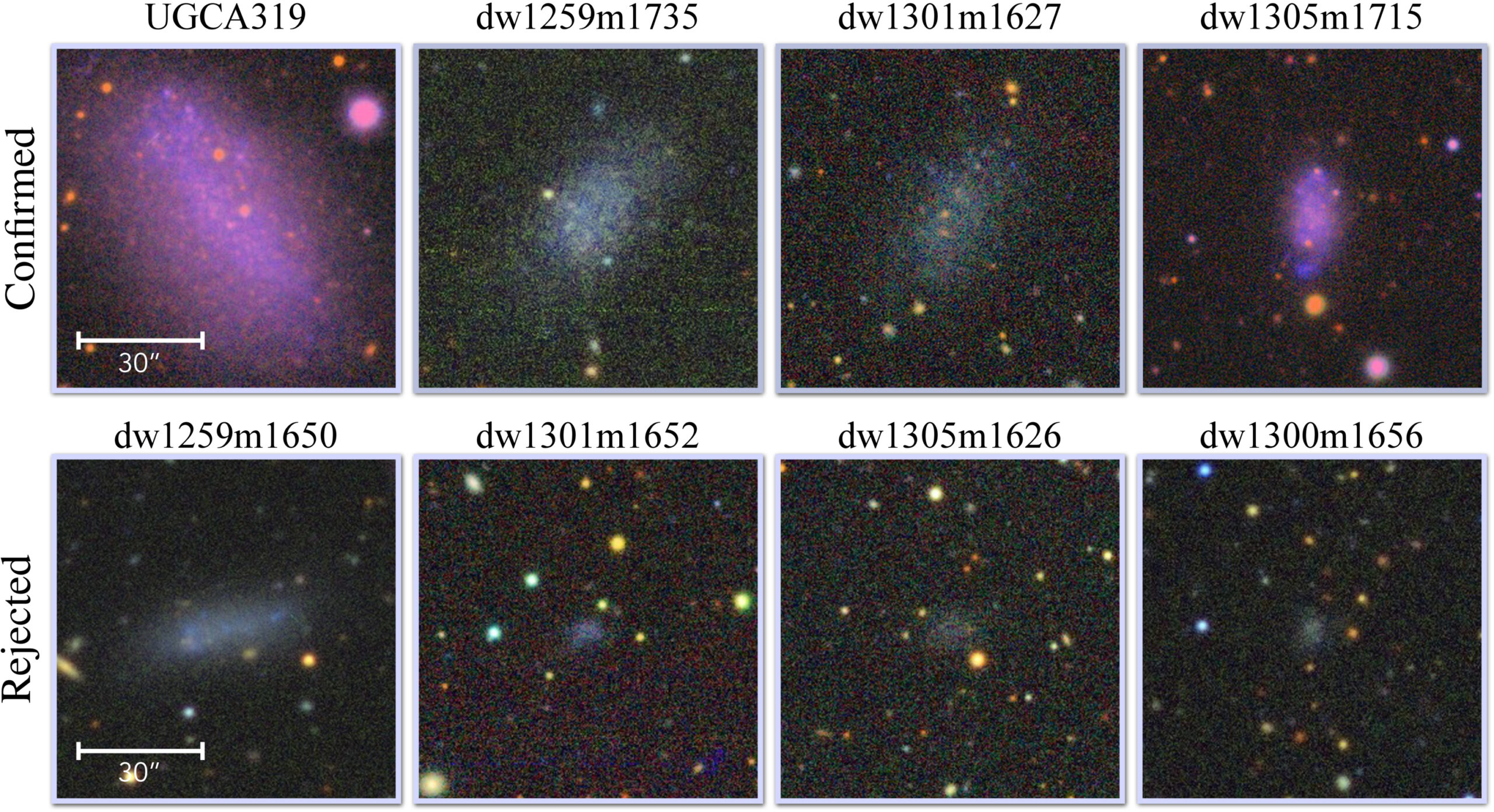
Images of the satellite candidates of DDO 161 from the Legacy Surveys. The top row shows the confirmed satellites, and the bottom row shows the rejected satellites. Click to enlarge. [Li et al 2026]

To confirm if these candidates were actual satellites of DDO 161, the team performed follow-up observations of the seven unconfirmed sources with the Magellan 6.2-meter telescope. Using the surface brightness fluctuation technique — measuring how a galaxy’s light fluctuates from pixel to pixel to determine its distance — the authors confirmed that three of the candidates are located at a similar distance to DDO 161 and are likely satellites. With the previously confirmed companion UGCA 319, DDO 161 has four satellite galaxies with stellar masses above 250,000 solar masses, making it the most satellite-rich dwarf galaxy known to date. 

Too Many Satellites

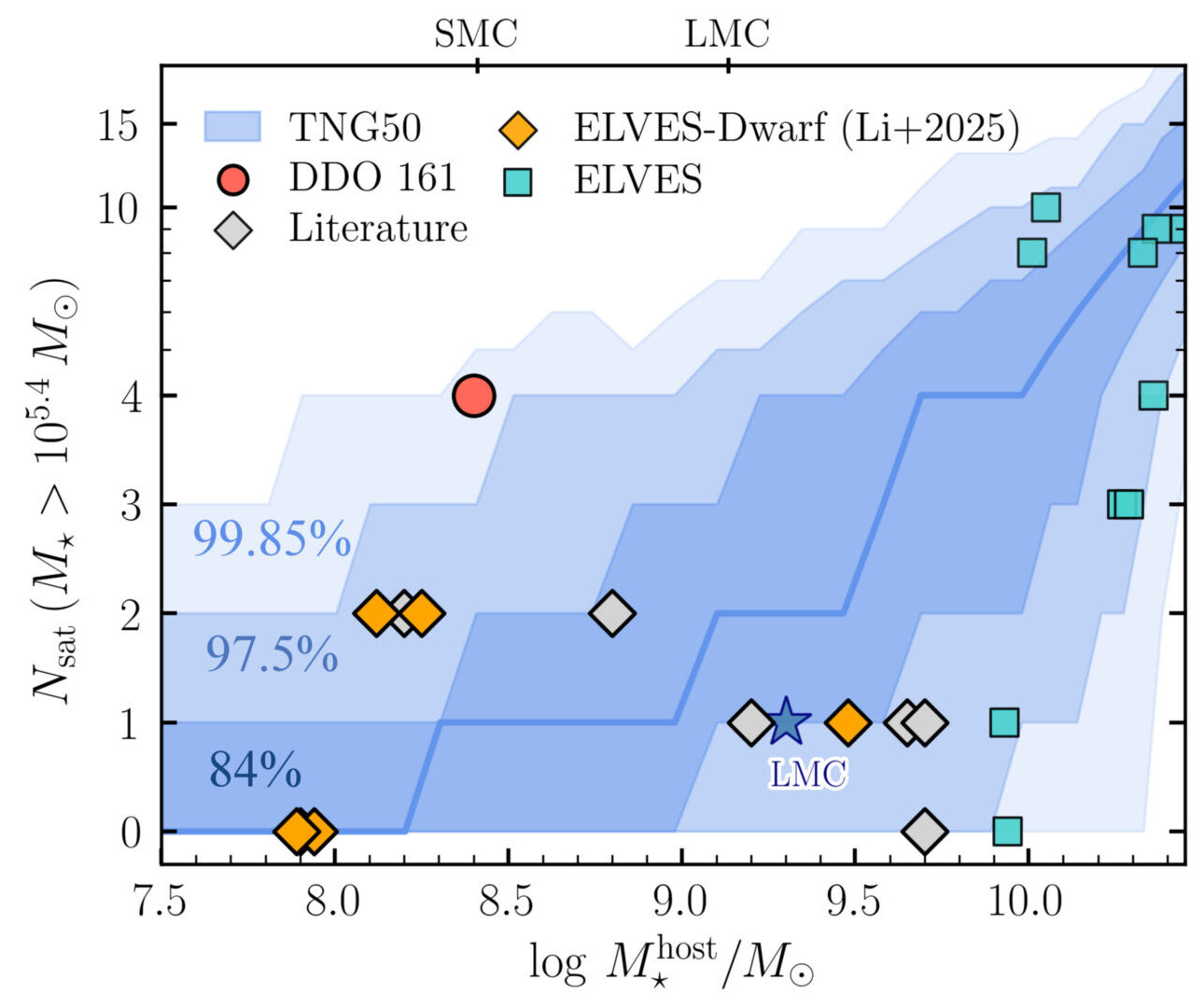
How does DDO 161 compare to theoretical predictions for galaxies of its size? The authors ran cosmological simulations to quantify the expected satellite populations around galaxies of similar size to DDO 161. Just as it is an outlier observationally, DDO 161 is also an outlier when compared to the simulation results that predicted fewer satellite galaxies in similarly massive host systems. 

DDO 161 Satellite Population Comparison

Number of satellites versus host galaxy stellar mass for DDO 161 (red circle) compared to other observed low-mass galaxy satellite systems (data points) and predicted ranges from simulations (blue regions). DDO 161 is a clear outlier, having a high number of satellites for the host galaxy’s stellar mass. Click to enlarge. [Modified from Li et al 2026]

Making sure to cover all bases, the authors considered their observational uncertainties, limitations of the simulations, different relationships between stellar and dark matter halo mass, and possible environmental effects. None of these checks could, at this point, sufficiently explain the satellite overabundance in DDO 161, introducing a possible “too-many-satellites” problem for this galaxy. A larger sample of satellites around dwarf galaxies is necessary to better understand this discrepancy, test our current cosmological framework, and give new insight into galaxy formation on small scales. 

Citation

“A Possible ‘Too-many-satellites’ Problem in the Isolated Dwarf Galaxy DDO 161,” Jiaxuan Li et al 2026 ApJL 998 L24. doi:10.3847/2041-8213/ae3ddd

The post Satellite Surplus Around Dwarf Galaxy DDO 161 appeared first on AAS Nova.

Do You Have This Andromeda Galaxy in Extra-Extra-Extra Small?

12 November 2025 at 17:00

Andromeda Galaxy

Editor’s Note: Astrobites is a graduate-student-run organization that digests astrophysical literature for undergraduate students. As part of the partnership between the AAS and astrobites, we occasionally repost astrobites content here at AAS Nova. We hope you enjoy this post from astrobites; the original can be viewed at astrobites.org.

Title: Deep in the Fields of the Andromeda Halo: Discovery of the Pegasus VII Dwarf Galaxy in UNIONS
Authors: Simon E. T. Smith et al.
First Author’s Institution: University of Victoria
Status: Published in ApJ

Picture a galaxy. It’s big, right? Unfathomably big, huge even! But galaxies aren’t all extremely massive; they come in a variety of sizes and luminosities, and some galaxies are so small and so dim that astronomers may not even know they’re there, even when they’re basically in our backyard. The hunt for the smallest galaxies is an important one, as these systems give us extreme environments where we can test theories of dark matter and galaxy evolution. The authors of this article present a newly discovered ultra-faint dwarf galaxy dubbed Pegasus VII (Peg VII), found next to our nearest major galactic neighbour: Andromeda.

How Do You Find a Dwarf Galaxy?

Finding ultra-faint dwarf galaxies requires deep, long-exposure imaging across wide swaths of the night sky, something that is only possible through observational surveys. Some telescopes, like JWST, require astronomers to submit an application to point the telescope at a specific, known target and, if approved, will have some amount of “telescope time” to do their imaging. Others, like the Euclid space telescope, are part of large surveys in which an area of the sky is selected and systematically imaged over several years, regardless of if there are known objects there or not. Because of this, surveys are our best bet to discover faint systems like ultra-faint dwarf galaxies.

The survey these authors used is UNIONS (Ultraviolet Near Infrared Optical Northern Survey), which covers the same area of the sky as the Euclid space telescope but is done with three ground-based telescopes: the Canada-France-Hawaii Telescope, Pan-STARRS, and Subaru, all located on Maunakea in Hawaiʻi. The authors were originally focused on finding satellite galaxies in the outskirts of Andromeda’s gravitational influence and during their search were able to identify an overdensity of bright stars. They then applied for and were awarded telescope time with both the Canada-France-Hawaii Telescope and the Gemini Observatory to perform deeper follow-up imaging of the system to figure out what exactly it was.

Optical Illusion or Optical Observation?

With this deeper follow-up imaging they could confirm if these stars were really one coherent system or if they just appeared to be clumped together on the sky. When they plotted the stars on a colour–magnitude diagram (Figure 1) they were able to identify a main sequence, horizontal branch, and red giant branch, as would be expected if these stars all formed at roughly the same time and were allowed to evolve over billions of years. Congratulations, it’s a dwarf galaxy!

color–magnitude diagrams for stars identified as being within or outside of Peg VII

Figure 1: Left: The colour–magnitude diagram for all stars within 2 half-light radii of Peg VII. Those inside the orange dashed lines are identified members of Peg VII, and the red lines are the best-fit isochrones. The vertical red line is the main sequence, the curve at the top is the red giant branch, and the horizontal line is the horizontal branch. Below the black dashed lines are stars that are too dim to be reliably used in the analysis. Right: The colour–magnitude diagram for stars that appear to be around Peg VII that are not actually members. These stars don’t follow the main sequence at all. [Adapted from Smith et al. 2025]

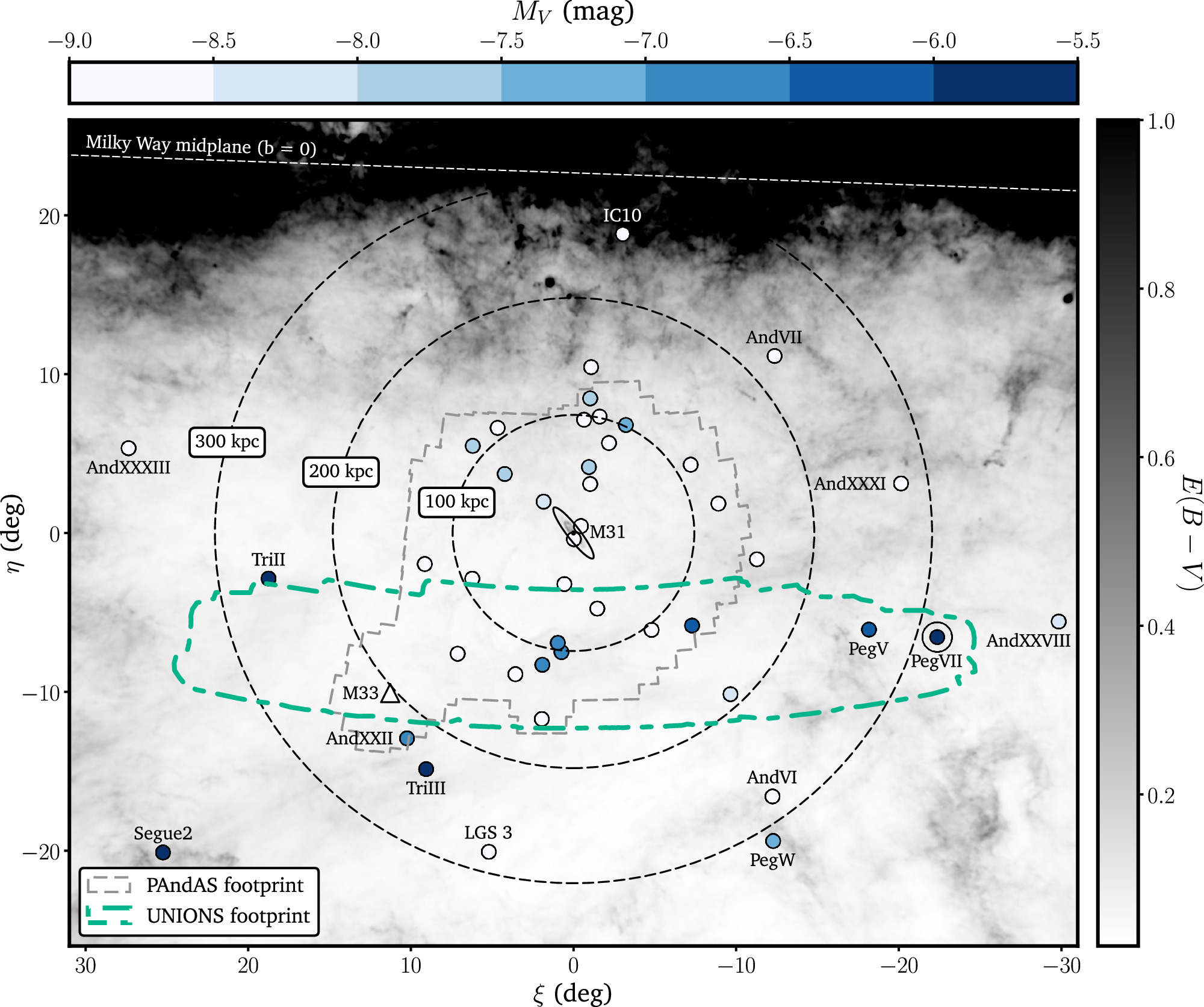
All together, Peg VII only hosts around 82 stars and is physically 129 times smaller than Andromeda. This results in an absolute magnitude of −5.7 (in astronomy, the more negative the absolute magnitude, the greater the object’s intrinsic brightness). For context, Andromeda hosts more than 1 trillion stars resulting in an absolute magnitude of −21.5, making Peg VII 2 million times dimmer than its massive neighbour. This definitively makes Peg VII the dimmest known Andromeda satellite galaxy. See Figure 2 for more about Andromeda’s satellites.
locations of Andromeda Galaxy satellites and survey footprints

Figure 2: The spatial distribution of the Andromeda (M31) satellite galaxy system. Galaxies are coloured based on how bright they are (darker means dimmer). The dashed grey line denotes the area covered by PAndAS, a survey focused on Andromeda satellites that are more centrally concentrated. The dashed green line denotes the area covered by the UNIONS survey, with Peg VII on the right-hand side, more than 978,000 light-years from Andromeda. [Smith et al. 2025]

With their colour–magnitude diagram, the authors could also fit isochrone models to estimate other properties of the system. Essentially, they performed simulations of systems with a variety of ages and metallicities and determined what the colour–magnitude diagrams of these system would look like and compared them to Peg VII’s. They estimate Peg VII to be around 10 billion years old and very metal-poor, which is expected for a small galaxy like this.

How Are Baby Dwarf Galaxies Made?

The big question surrounding Peg VII is how exactly it got like this. Did it originally form with so few stars, or was it originally bigger and has since had stars stripped away due to tidal forces exerted on it by Andromeda? It’s difficult to answer this right now because the imaging the authors obtained doesn’t allow them to determine Peg VII’s orbital path and speed around Andromeda. But, they can look for indicators of tidal disruption, like spatial elongation of the stars’ distribution, or how “stretched out” the galaxy is.

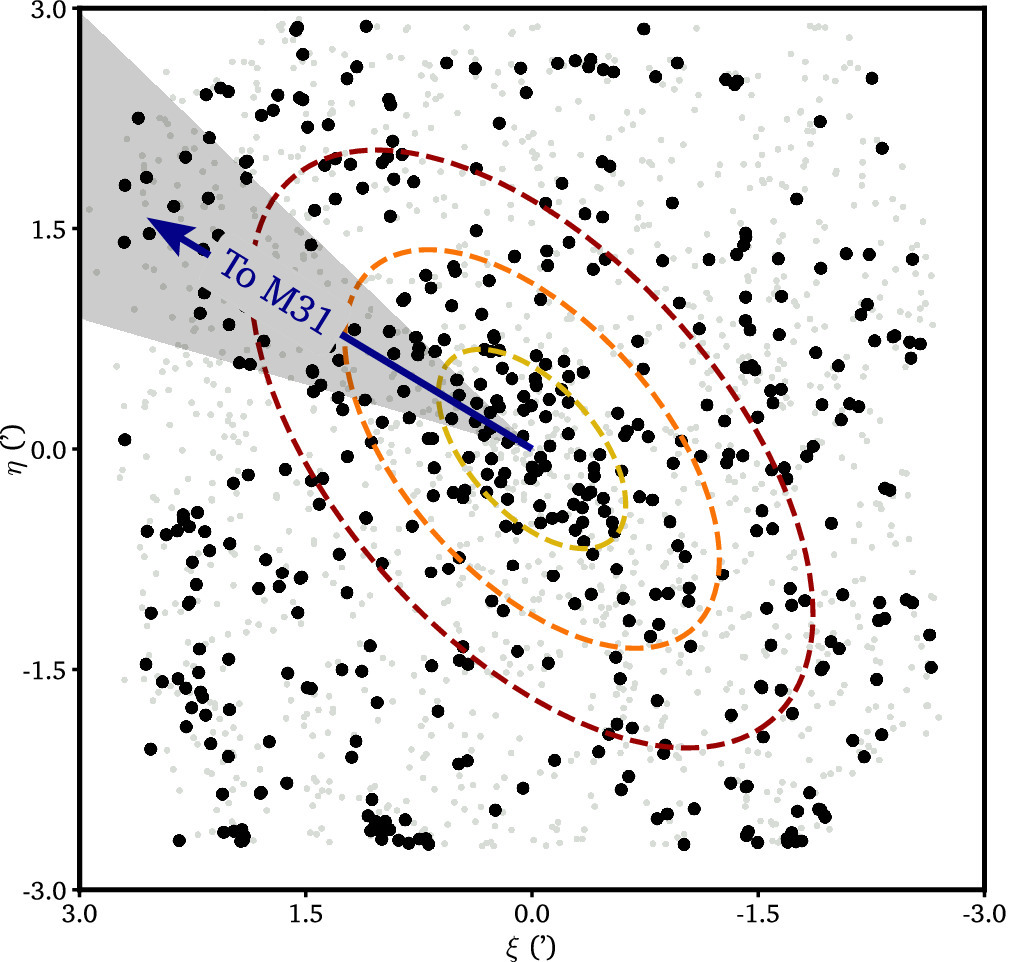
They found that Peg VII is quite elliptical (oval-like) and its major axis is roughly pointed at Andromeda (Figure 3). This could indicate that Peg VII has interacted with Andromeda in the past, and this could have affected its mass and size. However, there are lots of other possibilities for Peg VII’s shape that wouldn’t involve Andromeda at all. Peg VII could have naturally formed like this in isolation and has only just recently been brought into Andromeda’s orbit. It’s also possible Peg VII is the byproduct of a merger between two even smaller dwarf galaxies, which has been shown to result in elliptical distributions.

spatial distribution of Peg VII member stars

Figure 3: The spatial distribution of Peg VII member stars (dark black dots). The dashed lines show where 1, 2, and 3 half-light radii are, showing how elliptical Peg VII is. The blue arrow shows the direction Andromeda is in, which roughly lines up with Peg VII’s major axis. [Adapted from Smith et al. 2025]

To answer all of these questions, more follow-up observations are needed. By combining different wavelengths of light, it will be possible to determine Peg VII’s velocities, its star-formation history, and its hydrogen gas content and distribution. Even without an answer about Peg VII’s evolution, its discovery alone is noteworthy for the Andromeda system. Our theories of galaxy formation predict that Andromeda should have way more small satellite galaxies like Peg VII that we haven’t observed yet, as many as 60! This study of Peg VII highlights the need for large, deep surveys to extend this search for satellites to further distances from Andromeda and perhaps down to dimmer magnitudes.

In the meantime, keep your eye on the sky for more news about Peg VII and its other ultra-faint dwarf galaxy buddies. As big surveys designed for finding faint systems like these start to ramp up, like the Euclid space telescope and the Vera C. Rubin Observatory, we may be hearing more big things about these little galaxies.

Original astrobite edited by Caroline Von Raesfeld.

About the author, Veronika Dornan:

Veronika is a postdoctoral research associate at the University of Edinburgh. Her research is in observations of globular star clusters and how they can be used to study the evolution of their host galaxies.

The post Do You Have This Andromeda Galaxy in Extra-Extra-Extra Small? appeared first on AAS Nova.

Supermassive Black Hole in a Super Tiny Galaxy Found with JWST

26 September 2025 at 17:00

ultracompact dwarf galaxy

With very small stellar masses and tiny radii, ultracompact dwarf galaxies raise questions about the dividing line between the highest-mass star clusters and the lowest-mass galaxies. A recently published article leverages JWST’s high resolution to target one tiny galaxy and investigate its origins.

UCD 736

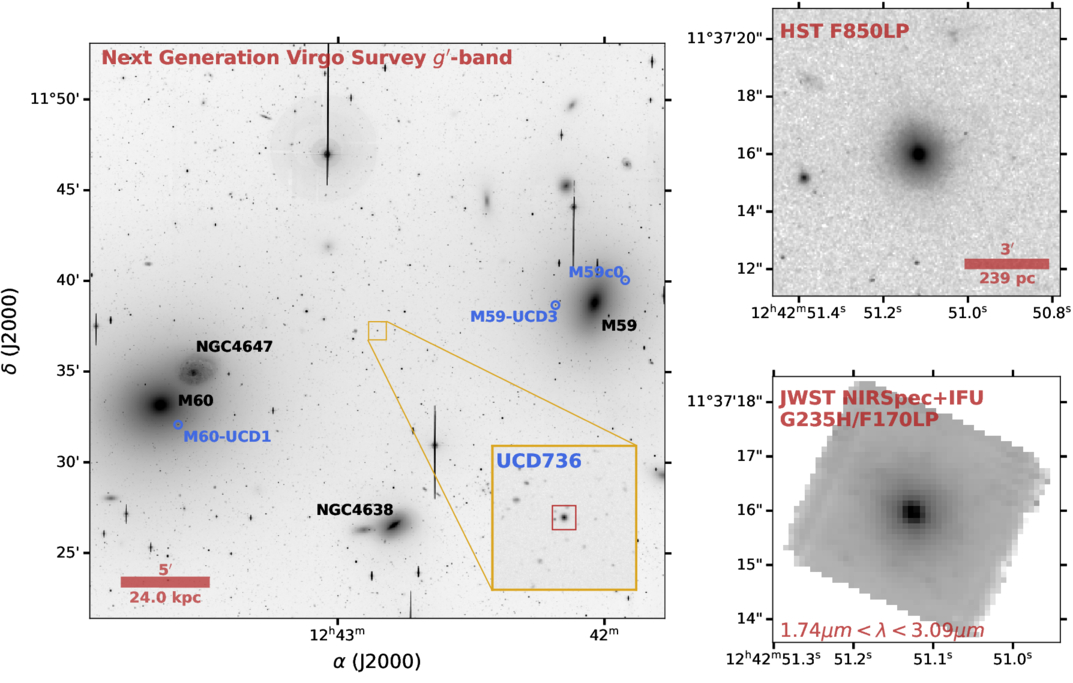
Location of UCD 736 in the Virgo Cluster with the other ultracompact dwarf galaxies with supermassive black hole detections labeled. Click to enlarge. [Taylor et al 2025]

Origins of Ultracompact Dwarf Galaxies

How tiny can a galaxy get? Discovered 20 years ago among the dense environments of the Virgo and Fornax clusters, ultracompact dwarf galaxies walk the line between the largest globular clusters and the smallest galaxies. Determining if these dwarfs are stellar in nature or actually of galactic origin is complex, but one sure way to get at this question is to determine if an ultracompact dwarf galaxy houses a supermassive central black hole. 

While astronomers have identified hundreds of these tiny dense galaxies, supermassive black holes have been detected in only five. Hoping to extend this sample, Matthew Taylor (University of Calgary) and collaborators targeted UCD 736, an ultracompact dwarf galaxy located in the Virgo galaxy cluster. If a massive black hole is found in this galaxy, it will be the smallest and least luminous ultracompact dwarf to have such a detection. Exploring galaxies at such small sizes will allow researchers to determine what fraction of ultracompact dwarfs have galactic or star cluster origins, which can provide insights into massive black hole seeding mechanisms in the early universe.

Modeling Black Hole Mass

Model results

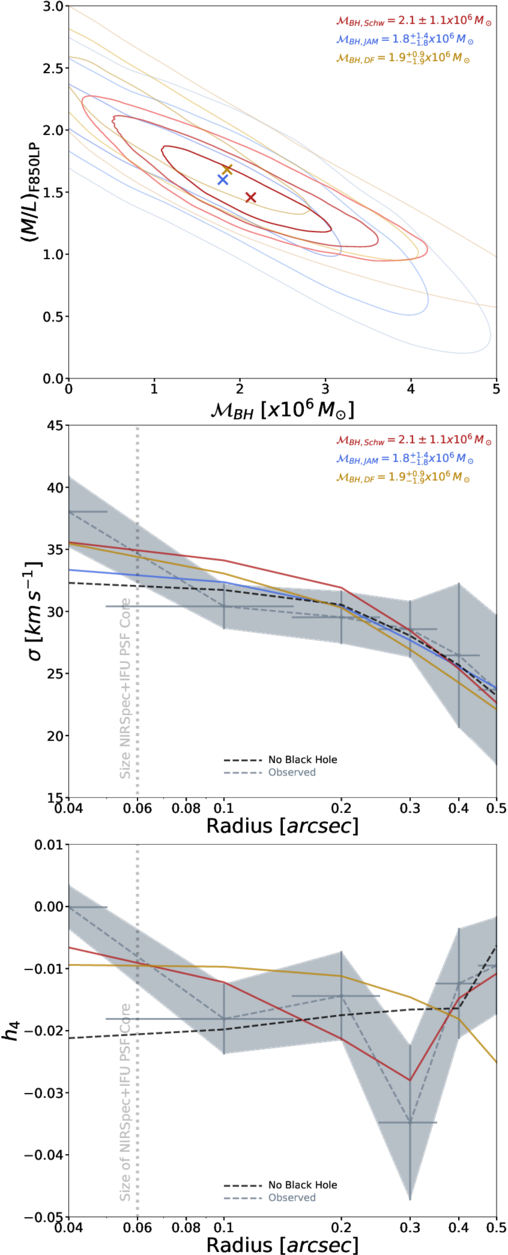
Summary of results for the three black hole modeling methods for UCD 736, indicating the quality of the models and how the observed velocity dispersion and spatial distribution of the galaxy fit with the models. Click to enlarge. [Taylor et al 2025]

In order to search for a central black hole in UCD 736, Taylor and team obtained high-resolution spectroscopy from JWST and supplemental imaging from the Hubble Space Telescope. The authors used the stellar kinematics and light profile of the galaxy to estimate the mass of its central black hole with three independent modeling methods. Based on the expected impacts of a massive black hole on galaxy dynamics and the estimated stellar population of the galaxy, the authors found that UCD 736 likely hosts a central supermassive black hole with mass ~2.1 million times the mass of the Sun. 

However, the authors noted that the three models do not provide equivalent confidence levels in this estimate — while one model confidently rules out the possibility of no central black hole at 3σ significance, the other two models were less constraining, ruling out the possibility of there not being a black hole to only 1σ. Despite these differences, all three models agree on the central black hole mass within the first confidence interval, indicating a positive detection of a black hole in UCD 736.

Progenitor of UCD 736

From their observations and modeling, the authors presented the fifth positive detection of an ultracompact dwarf galaxy with a central supermassive black hole within the Virgo Cluster. Given the presence of this black hole, UCD 736 likely originated as a more massive galaxy that was tidally stripped as it interacted with other nearby cluster galaxies. Interestingly, though, other ultracompact dwarf galaxies with black hole detections in the Virgo Cluster are much closer to the massive galaxy that likely stripped them. UCD 736 sits about 160,000 light-years outside of the nearest giant galaxy Messier 59’s tidal radius, which does not rule out interactions but could indicate that Messier 59 is particularly good at stripping material from smaller galaxies. 

Continued searches for black holes in ultracompact dwarfs will further probe the differences between the highest-mass globular clusters and the lowest-mass galaxies. Revealing more within this parameter space will allow astronomers to test black hole seeding and galaxy formation theories.

Citation

“A Supermassive Black Hole in a Diminutive Ultracompact Dwarf Galaxy Discovered with JWST/NIRSpec+IFU,” Matthew A. Taylor et al 2025 ApJ 991 L24. doi:10.3847/2041-8213/ae028e

The post Supermassive Black Hole in a Super Tiny Galaxy Found with JWST appeared first on AAS Nova.

Looking for a Single Stellar Ancestor: Mono-Enriched Stars in Zoom-In Simulations

17 September 2025 at 17:00

supernova remnant N49

Editor’s Note: Astrobites is a graduate-student-run organization that digests astrophysical literature for undergraduate students. As part of the partnership between the AAS and astrobites, we occasionally repost astrobites content here at AAS Nova. We hope you enjoy this post from astrobites; the original can be viewed at astrobites.org.

Title: SIRIUS: Identifying Metal-Poor Stars Enriched by a Single Supernova in a Dwarf Galaxy Cosmological Zoom-In Simulation Resolving Individual Massive Stars
Authors: Yutaka Hirai et al.
First Author’s Institution: Tohoku University
Status: Published in ApJL

All of the elements in stars come from, well, other stars. Each star has its own unique makeup of elements, kind of like our own DNA. Just like genes passing down generation after generation, elements in stars can be passed down to newly forming stars after the previous generation has died. So, if you’re looking at the chemical makeup of a particular star, what you’re really seeing is all the elements that were created after another star in the region exploded (went supernova) and enriched the gas (that the new star formed from) around it with elements like oxygen, nitrogen, iron, and more.

Like genealogy for stars, astronomers can use stellar enrichment to work their way back from a star they observe to its potential predecessors. It’s a bit trickier for stars that have a lot of elements, dubbed “metal-rich” stars, because there’s no way to tell which star contributed what mixture of elements at what point in time. However, scientists have recently been observing “extremely metal-poor” stars, which are stars with only small amounts of elements like oxygen, nitrogen, or carbon. Because there are so few of these elements, it’s safe to assume that these stars formed out of gas that didn’t have many predecessor stars enriching it — in fact, astronomers are hoping to find stars that only ever had one ancestor, calling them “mono-enriched” stars. Finding a mono-enriched star would tell us exactly what elements were produced in the supernova — aka in supernova nucleosynthesis.

However, how many of these metal-poor stars are mono-enriched is unknown. Estimating this fraction could help researchers identify more of them. The authors of this study tackle this problem by examining how many might exist in dwarf galaxies and what kind of chemical signatures they could produce.

Simulating Mono-Enriched Stars

To do this, they simulate a dwarf galaxy with the hydrodynamic code ASURA and model the gas physics in the galaxy with CLOUDY. In this method, stars form once the density of hydrogen gas in a region exceeds a certain threshold at a temperature that is cool enough for the gas to clump together. Pockets of this simulated region are then randomly assigned a stellar mass from the initial mass function, and eventually explode, diffusing elements into the gas particles around it.

Finding Mono-Enriched Stars in the Simulated Stellar Haystack

plot showing stellar metallicity, carbon enhancement, and mass of simulated stars in a dwarf galaxy

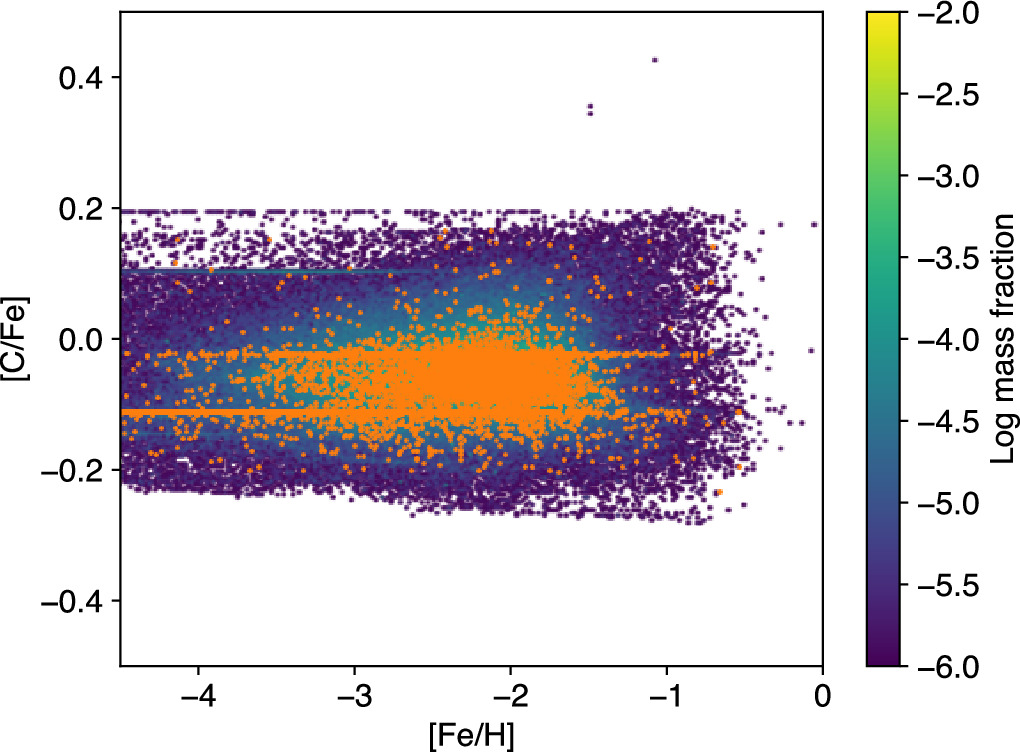
Figure 1: Every simulated star in the dwarf galaxy, shown as a function of their stellar metallicity, [Fe/H], carbon enhancement, [C/Fe], and their mass. Orange points are identified as mono-enriched stars. Click to enlarge. [Hirai et al. 2025]

The authors define a mono-enriched star as one with a carbon-to-iron ratio (denoted [C/Fe]) similar to that expected of a core-collapse supernova in their model. They identify a portion of the stars created as being mono-enriched, shown in orange in Figure 1. In total, this makes up about 1.5% of stars in this simulated dwarf galaxy.

Once these data points are collected, the authors investigate the fraction of mono-enriched stars at different metallicities. The authors essentially ask, are mono-enriched stars more likely to occur at lower metallicities? They find that, indeed, stars that are lower metallicity (and thus have lower [Fe/H]) are more likely to be mono-enriched (Figure 2). For stars with exceedingly low metallicities, [Fe/H] < −5, about 11% of them in this simulated dwarf galaxy have formed out of gas enriched by only one supernova.

Fraction of mono-enriched stars in the stellar population depending on the stellar metallicity

Figure 2: Fraction of mono-enriched stars in the stellar population depending on the stellar metallicity ([Fe/H]) of the population. Stars with much lower metallicities ([Fe/H] < 2.5) are more likely to be mono-enriched. [Hirai et al. 2025]

Finding Mono-Enriched Stars in the Observed Stellar Haystack

These theoretical predictions help observers prepare what to look for when they want to find a mono-enriched star. These predictions seem to suggest that astronomers should keep looking for these extremely metal-poor stars if we want to find these unique stars that tell us about what elements are made in core-collapse supernovae. There is currently a decently large database of extremely metal-poor stars found with photometry, and if observers could follow up with the most ideal candidates spectroscopically we could really test what kind of elements are in these stars. Further, the upcoming Subaru Prime Focus Spectrograph will take many spectroscopic observations of close-by dwarf galaxies, which may contain more extremely metal-poor stars.

The authors note there is more work to be done in simulations, as they are interested in testing how extremely metal-poor stars, specifically ones with enhanced carbon, form. All of this will hopefully lead to a better understanding of how elements are made when stars explode, perhaps leading us to how some of the earliest elements formed in the early universe.

Original astrobite edited by Diana Solano-Oropeza.

About the author, Caroline von Raesfeld:

I’m a third-year PhD student at Northwestern University. My research explores how we can better understand high-redshift galaxy spectra using observations and modeling. In my free time, I love to read, write, and learn about history.

The post Looking for a Single Stellar Ancestor: Mono-Enriched Stars in Zoom-In Simulations appeared first on AAS Nova.

A Long, Hard Look at (Potentially) Nothing to See

29 April 2025 at 17:00

cloud-9 neutral hydrogen contour map

Editor’s Note: Astrobites is a graduate-student-run organization that digests astrophysical literature for undergraduate students. As part of the partnership between the AAS and astrobites, we occasionally repost astrobites content here at AAS Nova. We hope you enjoy this post from astrobites; the original can be viewed at astrobites.org.

Title: Examining the Nature of the Starless Dark Matter Halo Candidate Cloud-9 with Very Large Array Observations
Authors: Alejandro Benítez-Llambay et al.
First Author’s Institution: University of Milano-Bicocca
Status: Published in ApJ

Astronomy, in many ways, is the study of light — in every wavelength that exists — coming at us from light-years away. But most of the mass in our universe is made of dark matter, a material that neither emits nor reflects any light. So, how exactly are we supposed to find this dark matter? Well, the dominant theory of what our universe is made of, Lambda cold dark matter (ΛCDM), predicts that this dark matter can form small halos — regions of gravitationally bound matter — that host reservoirs of cold gas but no stars. While we cannot directly observe dark matter, this cold gas can reflect light at radio wavelengths. Finding these dark halos, referred to as reionization-limited neutral atomic hydrogen clouds (RELHICs), is therefore rather important to confirm ΛCDM. The authors of this article are attempting to do just that by taking a close look at Cloud-9, a potential RELHIC.

How to “See” in the Dark

Cloud-9 was first discovered in 2023 when a team of astronomers noticed an excess of neutral hydrogen (HI) gas with no bright stars around it, near the spiral galaxy Messier 94 (M94). This discovery was made with the Five-hundred-meter Aperture Spherical radio Telescope (FAST), which doesn’t have the best resolution. For reference, this article found Cloud-9’s diameter to be roughly 3 arcminutes in the sky, while FAST’s resolution is 2.9 arcminutes. So, the authors of this article decided to look at Cloud-9 again, this time with the Very Large Array (VLA), an array of radio telescopes that can pick out more of the structure of this system.

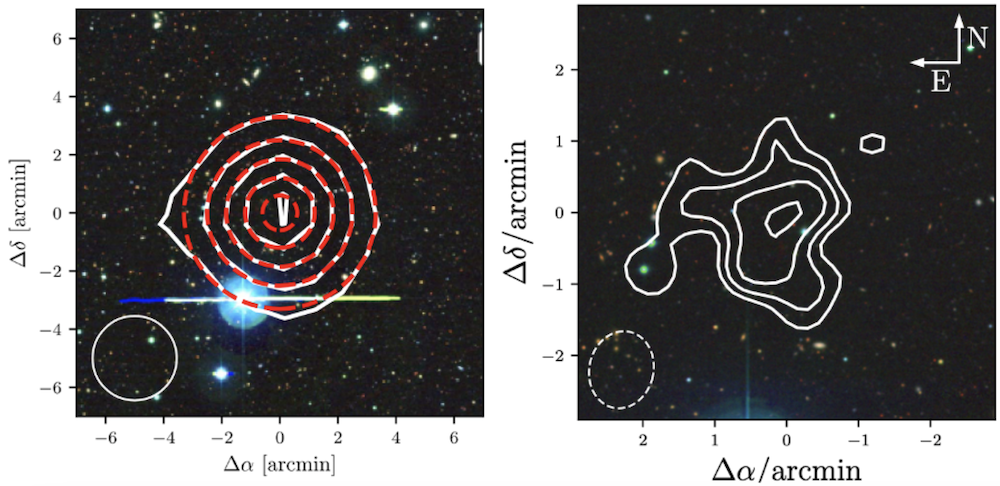
With this upgraded resolution, the authors were able to get a clearer picture of the shape of Cloud-9 and compare it to the previous study (see Figure 1). They found that Cloud-9 was slightly smaller and much more lopsided than previously thought. This funky shape is likely due to gravitational interactions with the larger nearby galaxy M94, causing the gas in Cloud-9 to squish and stretch.

neutral hydrogen density contours for Cloud-9

Figure 1: Left: The HI gas column density from the previous FAST observations. [Benítez-Llambay & Navarro 2023] Right: The HI gas column density from the VLA observation in this article. [Benítez-Llambay et al. 2024] Corner circles represent the resolution of each telescope and the x and y axes are the position on the sky. Note the scale of the axes in each plot; the right plot is a zoomed-in version of the left.

RELHIC or Just RELHIC-tively Dim?

To determine if Cloud-9 really is a RELHIC, the authors needed to compare its HI radial density profile to the profiles of simulated RELHICs. Density profiles are a good tool to use here since although we don’t fully understand what dark matter is, we do know how it will affect things around it gravitationally. If the only matter hosted by Cloud-9 is HI gas and dark matter, then that gas will have a specific distribution that we can observe. If other baryonic matter is hosted by Cloud-9 that we just aren’t picking up right now, it will affect that density profile.

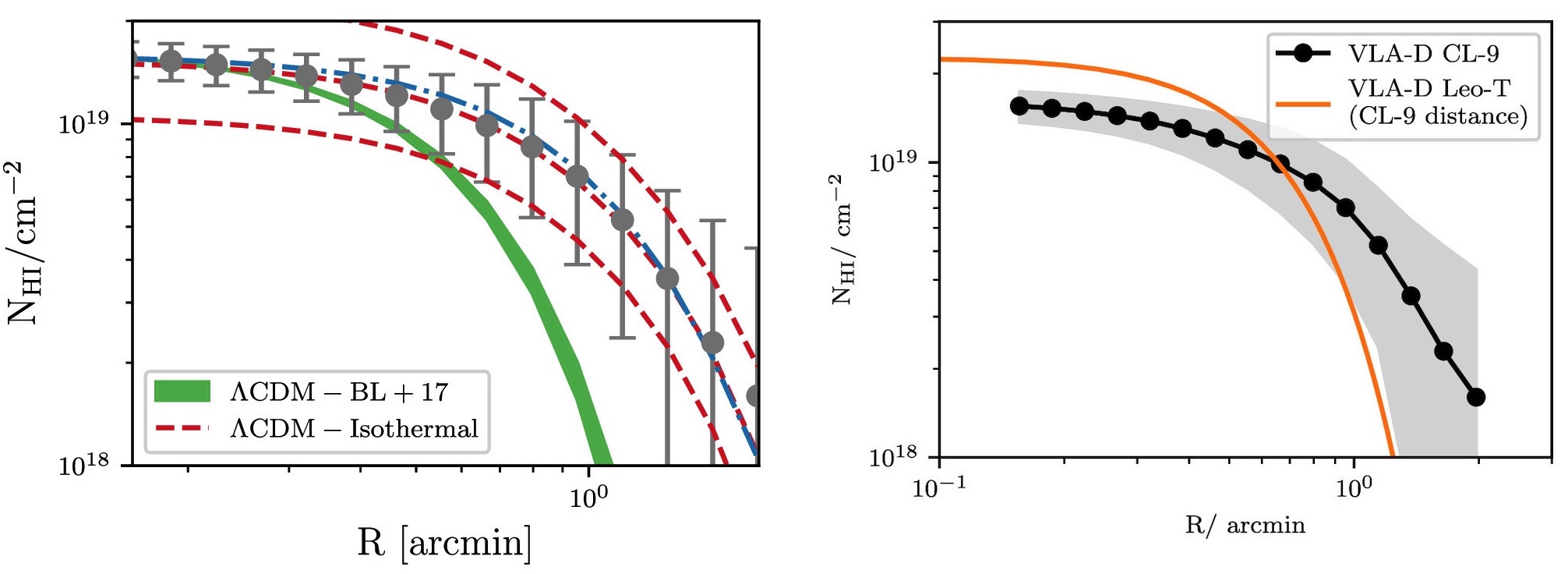
The authors found that for a detailed, general simulation the profiles did not match well, specifically in the outer regions. But when they compared it to a sphere of gas with a constant, specific temperature, they were able to get the fits to line up (see Figure 2). However, the authors point out that these simulations are isolated, meaning there is no big galaxy next to them affecting their shape, unlike Cloud-9.

observed and modeled neutral hydrogen density

Figure 2: Left: Comparison of Cloud-9’s HI profile (grey dots) to a general simulated RELHIC’s profile (green line) and a simulated RELHIC at a specific temperature (red line). Right: Comparison of Cloud-9’s profile (black dots) to Leo T’s profile (orange line). Although the positions are shifted, the slopes of the profiles match. [Benítez-Llambay et al. 2024]

The authors also tried to test another explanation for Cloud-9’s apparent lack of stars: the stars are there but just too dim for us to see right now. The Milky Way sits near many ultra-faint dwarf galaxies, which are small and have quite dim stellar populations. We’ve only just developed telescopes in the last few years that can take in enough light to see these galaxies, and we might not be able to detect stars in an ultra-faint dwarf galaxy as far away from us as Cloud-9. The authors compare the HI density profile of Cloud-9 to that of Leo T, a nearby ultra-faint dwarf galaxy. They find that these profiles match up better than for the general RELHIC simulations, particularly in the innermost regions of Cloud-9 and Leo T.

What Are the Next Steps?

The authors conclude that, as of right now, they can’t definitively say whether Cloud-9 is or is not a RELHIC, but there are a few things astronomers can do to clear things up. First, theorists can re-run the RELHIC simulations with halos that have been affected by gravity like Cloud-9. This will allow them to better compare their observations to the simulations.

Second, observers can image Cloud-9 with an optical telescope that is powerful enough to detect any stars that could be there. They suggest the Hubble Space Telescope since it would be able to detect the brightest handful of stars in the potential dim population. JWST would be an even better choice, with its even deeper imaging capabilities, but it is very difficult to get observing time on it. (JWST recently received the most proposals in one year for any telescope ever!)

We will likely have to wait a bit for a definitive answer on the nature of Cloud-9, but either way the authors are excited by this gas cloud. Either it is the first starless dark matter halo, a confirmation of one of the predictions of ΛCDM, or it is the most distant ultra-faint dwarf galaxy ever detected! Although Cloud-9 is not much to look at right now, you should still definitely keep your eye on it.

Original astrobite edited by Maggie Verrico and Cole Meldorf.

About the author, Veronika Dornan:

Veronika is a final-year PhD candidate at McMaster University. Her research is in observations of extragalactic globular star clusters and what they can tell us about galaxy evolution and dark matter distribution in the universe.

The post A Long, Hard Look at (Potentially) Nothing to See appeared first on AAS Nova.

❌