❌

Normal view

Manta rays inspire a smarter algorithm for cleaner, cheaper power grids

11 October 2026 at 09:14

Every time a power grid operator decides how much electricity each generator should produce, a quiet balancing act takes place. Burning less fuel saves money, but it often means allowing more pollution, and cutting emissions usually drives costs up. Engineers have long searched for a way to satisfy both goals at once, a challenge known as combined economic emission dispatch, or CEED. Now, a team of researchers has turned to one of the ocean’s most graceful feeders, the manta ray, for inspiration, and the result is an optimization algorithm that outperforms a crowded field of competitors on both cost and cleanliness.

The study, published in the journal Results in Engineering by Yu-Feng Sun, Jie-Sheng Wang and colleagues, describes an enhanced version of the Manta Ray Foraging Optimization algorithm, or MRFO. The original algorithm, first introduced a few years ago, mimics the cooperative hunting strategies that manta rays use to harvest plankton. Because plankton drifts unpredictably with seasons and weather, manta rays have evolved three distinct foraging behaviors: chain foraging, in which animals line up in arcs so that each one catches food missed by the one ahead; spiral foraging, where the group coils around a dense patch of food; and somersaulting, in which individuals flip back and forth around a promising spot. Translated into mathematics, these behaviors become rules that move a population of candidate solutions around a search space, gradually converging on the best answer.

What makes the CEED problem so stubborn is its mathematical character. The relationship between a generator’s output and its fuel consumption follows a cubic curve, and the emissions of carbon dioxide, nitrogen oxides and sulfur dioxide each follow their own cubic functions. The combined objective is nonlinear, nonconvex and discontinuous, riddled with local minima that can trap classical techniques such as lambda iteration or gradient-based methods. To make matters harder, the problem is genuinely multi-objective, so the researchers converted it into a single objective by applying price penalty factors that fold the cost of each pollutant into one total figure in dollars per hour.

Constraint handling is where many algorithms stumble. Traditional approaches add a fixed penalty whenever a solution violates the power balance requirement, the equation demanding that total generation minus transmission losses equals demand. But a fixed penalty is a blunt instrument. Set it too low and the algorithm happily returns infeasible schedules; set it too high and the search becomes so restricted that it cannot explore properly. Finding the right value through trial and simulation is time-consuming and inefficient. The team’s answer was to make the penalty itself dynamic, drawing on five different mathematical functions: sinusoidal, hyperbolic tangent, arctangent, linear and hyperbolic secant. Each function is raised to an order that changes during the run, so the penalty strength adapts to both the size of the violation and the stage of the optimization. Early on, mild penalties preserve exploration; later, penalties tighten to push solutions toward feasibility.

The second major innovation targets the heart of the MRFO algorithm. In the original design, a parameter called C governs the switch between exploration, casting the net wide across the search space, and exploitation, homing in on the best solution found so far. This parameter rises monotonically from zero to one, a predictable march that can leave the algorithm poorly balanced at certain stages. The researchers replaced it with a chaotic switching factor, drawn from nine well-known chaotic maps including Chebyshev, logistic, tent, sine, Gauss and singer maps, combined with an exponential adjustment function. The result is a parameter that still trends upward but oscillates along the way, periodically reopening the search space and preventing the population from settling prematurely into a local optimum.

To find out which chaotic map worked best, the team ran all nine enhanced variants, named C1MRFO through C9MRFO, through the CEC-2022 benchmark suite of twelve test functions, using a population of thirty and five hundred iterations averaged over thirty independent runs. The Chebyshev-based variant, C1MRFO, emerged as the overall winner, ranking first among the nine and beating the original MRFO, which finished last. Wilcoxon rank-sum tests confirmed that most of the improvements were statistically significant, with p-values below the conventional 0.05 threshold. When C1MRFO was pitted against a roster of state-of-the-art metaheuristics, including the dhole optimization algorithm, evolutionary mating algorithm, dung beetle optimizer, snow geese algorithm, particle swarm optimization, grey wolf optimizer, sparrow search algorithm and marine predators algorithm, it achieved the best final rank, taking first place on many of the test functions while keeping computational times competitive.

The real test, however, came when the algorithm was applied to actual dispatch problems. The researchers simulated a six-unit power system under four load demands of 150, 175, 200 and 225 megawatts. Across all four scenarios, C1MRFO produced the lowest comprehensive total cost, which combines fuel cost with the weighted penalties for carbon dioxide, nitrogen oxide and sulfur dioxide emissions. At 150 megawatts, for example, it reached a total cost of about 10,137 dollars per hour, edging out the grey wolf optimizer and clearly beating algorithms such as the arithmetic optimization algorithm, Harris hawks optimization, whale optimization algorithm, sine cosine algorithm, particle swarm optimization and the lambda iteration method. The pattern held at every load level, with the margin over the weakest classical method growing to thousands of dollars per hour at 225 megawatts.

The dynamic penalty functions delivered a further, striking gain. When the sinusoidal penalty function was applied with the parameter order set to dy5, the total cost at 150 megawatts dropped from roughly 10,137 to 9,065.71 dollars per hour, and similar reductions appeared at the higher loads, reaching 14,621.45 dollars per hour at 225 megawatts. Comparing the five penalty shapes, the sinusoidal function consistently produced the lowest minimum costs, beating the hyperbolic tangent, arctangent, linear and hyperbolic secant alternatives by margins ranging from hundreds to nearly two thousand dollars per hour depending on the load. Notably, when the penalty order was fixed rather than dynamic, performance was worst across the board, confirming that the adaptivity of the penalty, not merely its presence, is what matters.

To verify that each improvement contributes on its own, the team conducted an ablation study on a much larger twenty-unit system with a total demand of 2,500 megawatts. The results formed a clear hierarchy: the original MRFO achieved 61,835.16 dollars per hour, the chaos-enhanced C1MRFO reached 61,826.11, and the fully improved version combining chaos with the optimal sinusoidal dynamic penalty, sin(dy5)MRFO, achieved the best figure of 61,807.36 dollars per hour. All three outperformed the phasor particle swarm optimization benchmark, which came in at 61,895.57 dollars per hour. The stepwise improvement demonstrates that the two enhancements are not redundant but superimpose their benefits, and that the framework scales to systems far larger than the six-unit case.

The authors are careful to note where the work goes next. The current approach converts the multi-objective problem into a single objective through price penalty factors, but future versions could adopt Pareto-based multi-objective optimization to generate full sets of non-dominated trade-off solutions. The test cases also assume deterministic demand, so extending the algorithm to stochastic dispatch with wind and solar integration is another goal, as is combining the dynamic penalty with feasibility-first constraint-handling strategies. For now, the study offers a compelling demonstration that borrowing the foraging logic of a filter-feeding fish, perturbing it with chaos, and teaching it to calibrate its own punishments can squeeze meaningful savings and emission reductions out of one of power engineering’s hardest scheduling problems.

Subject of Research: An improved manta ray foraging optimization algorithm with chaotic switching factors and dynamic penalty functions for solving the combined economic emission dispatch problem in power systems.

Article Title: Manta ray foraging optimization algorithm with dynamic penalty function and chaos switching factor to solve combined economic emission dispatch problem

Article References: Sun, Y.-F., Wang, J.-S., Zhang, X.-Y., Li, Y.-X., Guan, X.-Y., & Liu, X. (2026). Manta ray foraging optimization algorithm with dynamic penalty function and chaos switching factor to solve combined economic emission dispatch problem. Results in Engineering, 32, Article 113383. https://doi.org/10.1016/j.rineng.2026.113383

Image Credits: AI Generated

DOI: Not provided

Keywords: manta ray foraging optimization, combined economic emission dispatch, metaheuristic algorithms, chaotic maps, dynamic penalty function, power system optimization, emission reduction, fuel cost minimization, CEC-2022 benchmarks, swarm intelligence, constraint handling, Results in Engineering


Quantum computers outperform classical ones, with results you can trust

30 July 2026 at 16:59

There are many algorithms for which it has been mathematically proven that a quantum computer can generate results that would take a classical computer an unreasonable amount of time to generate. Unfortunately, today's quantum computers either can't run those algorithms or can only run simplified versions that classical computers can also handle. This has left the field facing a challenging question: Can we demonstrate the promise of quantum computers on today's noisy, limited hardware?

That's a more difficult question than it may first appear. If you generate a result that's out of reach of today's regular computers, it may not be possible to verify that you got the right result. And given that today's quantum computers are somewhat error-prone, getting the wrong result is a distinct possibility. Further, in the absence of a mathematical proof of the capabilities of quantum hardware, it's possible that a better classical algorithm could outperform the quantum hardware.

These issues inspired IBM to launch a quantum advantage tracker. On Thursday, the company announced three new entries that it says clearly show a quantum advantage, each using a different approach to overcoming errors and validating quantum results. "Trusted computing when you can do classical simulations is irrelevant," IBM's Jay Gambetta told Ars. "Trusted computing when you can't do classical simulations is a big deal."

Read full article

Comments

© IBM

PGS Browser: Personalized Polygenic Score Analysis Platform

21 June 2026 at 01:25

In the ever-evolving field of genomics, a significant leap has been achieved with the introduction of the PGS Browser, a novel public platform designed to transform the way researchers, clinicians, and individuals interact with polygenic scores. Polygenic scores (PGS) are quantitative measures that capture the cumulative effect of numerous genetic variants across the genome, predicting an individual’s predisposition to complex traits and diseases. This new platform promises not just accessibility but also interpretative power, enabling a personalized approach to genomic data that could reshape personalized medicine and risk assessment paradigms worldwide.

At the heart of this transformative tool lies a sophisticated integration of vast genomic datasets, advanced computational algorithms, and user-friendly interfaces. The PGS Browser aggregates polygenic scores derived from an array of large-scale genome-wide association studies (GWAS), providing an unprecedented resource where users can explore the genetic architecture of diverse traits. One of the platform’s most compelling features is its capacity to personalize polygenic risk predictions by incorporating individual genetic data with contextual healthcare analytics, bridging the longstanding gap between raw genetic information and actionable clinical insights.

Traditionally, polygenic scores have been calculated using fixed sets of genetic variants, often constrained by limited population samples or specific ancestral backgrounds. This poses significant challenges regarding the portability and generalizability of these scores across diverse populations. The PGS Browser addresses this limitation head-on by incorporating multi-ancestry datasets and advanced statistical models that recalibrate polygenic scores for diverse genetic ancestries. This opens new horizons in achieving equity in genomic medicine, ensuring individuals from underrepresented populations have access to precise, contextually relevant risk evaluations.

The technical backbone of the PGS Browser involves complex methodologies that include linkage disequilibrium (LD) adjustment, penalized regression frameworks, and machine learning techniques, all optimized for high-throughput and scalable analysis. These computational advances optimize the balance between predictive accuracy and overfitting, a persistent challenge in polygenic score modeling. By dynamically adjusting for confounding genomic features and population stratification, the platform produces risk scores that are both statistically robust and biologically interpretable.

One of the critical innovations within the platform is its interpretability module, designed to unpack the black-box nature of polygenic predictions. Users are not only presented with their personalized polygenic scores but also receive detailed visualizations and annotations explaining the contribution of key genetic loci, biological pathways involved, and potential gene-environment interactions. This level of detail empowers clinicians to make informed decisions and patients to understand the genetic basis of their risks, paving the way for targeted preventative strategies and lifestyle modifications.

From a healthcare perspective, the implications of the PGS Browser extend far beyond academic research. The platform is a strategic tool for genetic counseling, allowing healthcare providers to identify individuals at elevated risk for complex diseases such as cardiovascular disease, diabetes, and certain cancers before clinical symptoms manifest. Early identification through polygenic risk enables preemptive interventions, personalized monitoring, and tailored therapeutic approaches, underscoring a shift from reactive to proactive medicine.

Moreover, the PGS Browser operates with a commitment to transparency and reproducibility, addressing critical concerns in genetic epidemiology. All computational workflows are openly accessible, enabling peer verification and fostering collaborative improvement. The platform also integrates with existing biobank data through standardized protocols, facilitating validation studies and meta-analyses that enhance the reliability of polygenic scores across global cohorts.

A particularly noteworthy aspect of the platform is its potential role in pharmacogenomics. By correlating polygenic scores with drug response phenotypes, the browser could assist in identifying individuals who might benefit from specific medications or require dosage adjustments. This integration with personalized medicine elevates the clinical utility of polygenic scores from risk stratification to therapeutic optimization, highlighting the multi-dimensional impact of genomic data in patient care.

The PGS Browser also bridges the gap between research and public engagement. Designed with intuitive navigation and educational resources, it invites an increasingly genomically literate public to explore their genetic predispositions within a responsible and secure framework. This democratization of genetic information fosters greater awareness and empowerment while maintaining stringent privacy standards, an essential consideration in the era of big data.

In operational terms, the platform boasts scalability features capable of handling millions of individuals’ data concurrently, a necessity given the rapid expansion of genomic databases worldwide. The utilization of cloud-based infrastructures, coupled with containerized computational environments, ensures flexible deployment across various institutional settings while preserving data security and compliance with regulatory frameworks such as GDPR.

From a scientific perspective, the availability of such a public platform catalyzes the discovery of novel gene-trait associations by allowing researchers to perform systematic, large-scale analyses that correlate polygenic scores with phenotypic data. This accelerates the identification of biological mechanisms underlying complex traits, informing subsequent functional studies and therapeutic development pipelines.

Ethical considerations permeate the development and deployment of the PGS Browser. The platform incorporates informed consent modules, guidelines on interpretation limitations, and warnings against deterministic views of genetic risk. By fostering responsible use and interpretation, the platform promotes ethical standards within a field where genetic data can easily be misunderstood or misapplied.

Furthermore, the PGS Browser represents a leap forward in standardizing polygenic score methodologies. Historically, disparate scoring algorithms and variable reporting conventions have hindered comparability across studies. This unified platform offers a harmonized framework that promotes methodological consistency, enabling the scientific community to consolidate findings and build upon a shared foundation.

The cross-disciplinary collaboration manifested in the creation of the PGS Browser highlights the convergence of genetics, bioinformatics, data science, and clinical medicine. This integrative approach is crucial to addressing the complexities of polygenic risk and translating genomic insights into tangible health benefits, marking a pivotal moment in the genomics era.

Looking forward, the PGS Browser sets the stage for continuous evolution. Planned enhancements include integration with longitudinal health records, expansion of trait coverage particularly in psychiatric and neurological domains, and real-time updating as new GWAS data emerge. Such adaptability ensures the platform remains at the forefront of personalized genomics research and application.

In conclusion, the PGS Browser embodies a landmark achievement in the democratization and personalization of polygenic score analysis. By merging rigorous computational techniques with accessible design and ethical mindfulness, it empowers a broad spectrum of users to harness the predictive power of genomic data. This innovation holds transformative potential for healthcare, research, and public understanding, catalyzing a new era in precision medicine where genetic insights are personalized, interpretable, and actionable like never before.


Subject of Research: Development and deployment of a public platform for personalized polygenic score analysis and interpretation.

Article Title: PGS Browser: A Public Platform for Personalized Polygenic Score Analysis and Interpretation.

Article References:
Kolosov, N., Reeve, M.P., Briotta Parolo, P.D. et al. PGS Browser: a public platform for personalized polygenic score analysis and interpretation. Nat Commun (2026). https://doi.org/10.1038/s41467-026-74461-7

Image Credits: AI Generated

KAIST Enhances Humanoid Robot Vision Using Minimal Memory

17 June 2026 at 00:53

In a groundbreaking development that promises to revolutionize the way artificial intelligence perceives the world, a collaborative research team from KAIST, MIT, and Microsoft has unveiled a novel technology named “Upsample Anything.” This pioneering innovation substantially enhances the visual acuity of AI systems while drastically reducing the memory demand on hardware, specifically GPU memory. The new method achieves up to a sixteenfold increase in memory efficiency, addressing one of the most critical bottlenecks in real-time AI vision applications for mobile and embedded devices.

The cornerstone of this advancement lies in overcoming the traditional compromise faced by AI-driven image processing systems. Historically, achieving higher resolution visual input required extensive GPU memory and computational power, creating a significant barrier to real-time implementation on resource-constrained devices such as smartphones and humanoid robots. Conversely, compressing images into low-resolution features, which is a common practice to conserve resources, often leads to the loss of crucial visual details like small objects and fine structural elements. This trade-off has long hindered the deployment of precise AI vision in dynamic and mobile environments.

The “Upsample Anything” technology ingeniously sidesteps this issue by introducing a training-free upsampling mechanism capable of reconstructing high-resolution features from low-resolution inputs without additional data training. Unlike conventional methods that necessitate retraining or complex optimization when exposed to new data or environmental conditions, this approach adapts instantly by leveraging the edge and structural information inherent within a single input image. This capability drastically simplifies deployment and customization across diverse AI vision applications.

At the heart of the method is a sophisticated process called test-time optimization (TTO), which refines pixel-wise anisotropic kernel parameters based on the specific low-resolution image. These learned kernels are then applied to foundational feature maps to generate high-resolution representations. The final phase involves pixel-wise anisotropic Joint Bilateral Upsampling, a technique that preserves edge details and texture fidelity while reconstructing the image in high resolution. This multi-stage pipeline ensures that essential visual information is restored with remarkable accuracy and efficiency.

Highlighted through an illustrative example, the research team demonstrated the restoration of a 224×224 pixel image— a common resolution in AI research— to a clarity nearly identical to the original, within approximately 0.4 seconds of computation. This substantial leap in processing speed and memory efficiency heralds a new era for real-time AI vision, where systems can now maintain high precision without the prohibitive cost of extensive hardware resources. The direct implication is that AI can better understand and interact with its environment, making it invaluable for applications requiring fine object detection and manipulation.

The utility of “Upsample Anything” stretches far beyond humanoid robots. Autonomous driving systems stand to benefit immensely, as they depend heavily on the rapid and accurate interpretation of complex visual scenes. With this technology, vehicles can process crucial visual cues in a more resource-efficient manner, enhancing safety and navigation capabilities. Additionally, on-device AI for smartphones and other portable gadgets can achieve superior visual comprehension while minimizing battery drain and thermal load— critical factors for consumer electronics.

The research team’s achievement was officially recognized at CVPR 2026, the most prestigious conference dedicated to computer vision and artificial intelligence. The work earned the “CVPR Compute Gold Star” award, a distinction granted to research that excels in computational efficiency. Furthermore, it was named the “Transparency Champion” for leading in research process transparency and reproducibility, emphasizing the team’s commitment to responsible and open scientific practices. This dual recognition highlights not only the technological ingenuity but also the ethical and procedural rigor of the research.

One of the most remarkable attributes of this technology is its universality and plug-and-play nature. Its training-free design means that no additional datasets or retraining cycles are required when deploying it in different settings. This contrasts sharply with existing upsampling methods that often demand labor-intensive tuning or environment-specific learning. Consequently, “Upsample Anything” can seamlessly integrate into a wide array of AI frameworks, simplifying engineering workflows and accelerating the timeline from development to deployment.

Professor Changick Kim, the project lead from KAIST’s School of Electrical Engineering, emphasized the transformative potential of this technology. He noted that by boosting visual precision with minimal resource demands, the algorithm can catalyze the commercial viability of complex AI entities like humanoid robots and enable more powerful on-device AI applications. The convergence of computational efficiency and high visual fidelity, he added, represents a critical step forward in the quest to bring sophisticated AI capabilities to everyday devices.

This advancement is particularly significant in the context of emerging AI models based on world models— frameworks that aim to understand and predict changes in physical environments. Effective deployment of such models often requires processing a large volume of visual data accurately and expediently. By enabling high-resolution feature upsampling without overwhelming hardware limitations, “Upsample Anything” paves the way for smarter, faster, and more adaptive AI models that truly comprehend their surroundings in detail.

The first author of the study, Minseok Seo, a doctoral student at KAIST, alongside co-authors from MIT and Microsoft, detailed their findings in a paper titled “Upsample Anything: A Simple and Hard to Beat Baseline for Feature Upsampling.” The work is publicly accessible via the arXiv repository (DOI: 10.48550/arXiv.2511.16301), facilitating further exploration and innovation by the wider research community. Their approach exemplifies a blend of elegance and practicality, challenging the assumption that high computational cost is a prerequisite for high-quality visual reconstruction in AI.

In conclusion, the “Upsample Anything” technology marks a significant leap in AI visual processing by resolving a longstanding dilemma between image resolution and hardware resource constraints. Its immediate applicability across various AI-driven fields— ranging from robotics to autonomous systems and portable devices— underscores its impact and longevity. As AI continues to entwine itself with daily human interaction and technological progress, innovations like this will form the backbone of smarter, more capable, and accessible intelligent systems.


Subject of Research: Not applicable

Article Title: Upsample Anything: A Simple and Hard to Beat Baseline for Feature Upsampling

News Publication Date: 17-June-2026

Web References: https://dx.doi.org/10.48550/arXiv.2511.16301

References: Upsample Anything: A Simple and Hard to Beat Baseline for Feature Upsampling, DOI:10.48550/arXiv.2511.16301 (Seo et al., 2026)

Image Credits: KAIST

Keywords

AI vision, upsampling technology, GPU memory efficiency, real-time image processing, test-time optimization, pixel-wise anisotropic kernels, Joint Bilateral Upsampling, on-device AI, humanoid robots, autonomous driving, world models, computer vision, computational efficiency

Enhancing the Sharpest Images

15 April 2026 at 17:00

The Submillimeter Array at the summit of Maunakea in Hawaiʻi.

The Event Horizon Telescope (EHT), the facility that delivered humanity’s first-ever picture of a black hole, can produce some of the sharpest images in all of astronomy. But turning the EHT’s raw data into images is a complex process involving messy statistics and powerful algorithms. Recent work presents a potential upgrade to that process: for the first time in long-baseline interferometry, it may be possible to model everything everywhere all at once.

The Hardest Eye Test

The EHT has some of the sharpest eyes in all of astronomy. With its effective resolution of just 20 microarcseconds, in principle you could use it to read a newspaper in New York while sitting at a cafe in Paris. But this planet-spanning instrument (it relies on data from radio telescopes on four continents) doesn’t snap pictures like an ordinary camera. Instead, each pair of telescopes measures something called an “interferometric visibility,” which is related to a single Fourier component of the actual underlying image.

A photograph of an orange ring surrounding a dark center.

The first image of a black hole, constructed from Event Horizon Telescope data taken in 2017. [EHT Collaboration; CC BY 4.0]

Combining these components into an image is a process fraught with assumptions and modeling choices. Since the EHT doesn’t have an infinite number of telescopes, each measurement can be mapped to infinitely many images. This forces researchers to choose how to “regularize” this space of images to select one best picture. Making things harder, they also must contend with all the typical issues of real-world data collection. Each telescope has slight calibration errors, and every data point is affected by weather and temperature-dependent processes.

Typically researchers break the problem down into several stages: first calibrate the data, then regularize and construct the best-fitting image, then analyze that image to constrain the actual physics you care about like the width of the ring surrounding a black hole. This is how the original EHT publications went about their groundbreaking work on the now-iconic glowing ring around the supermassive black hole in the galaxy Messier 87 (M87*).

A New Approach

Recent work led by Paul Tiede (Black Hole Initiative at Harvard University) suggests an alternative process. Instead of separating the stages of analysis as described above, the team demonstrated that one could fit everything simultaneously in a framework they call hierarchical interferometric Bayesian imaging, or HIBI.

A multi-panel plot of images of an orange blob with a tail. All images are very similar.

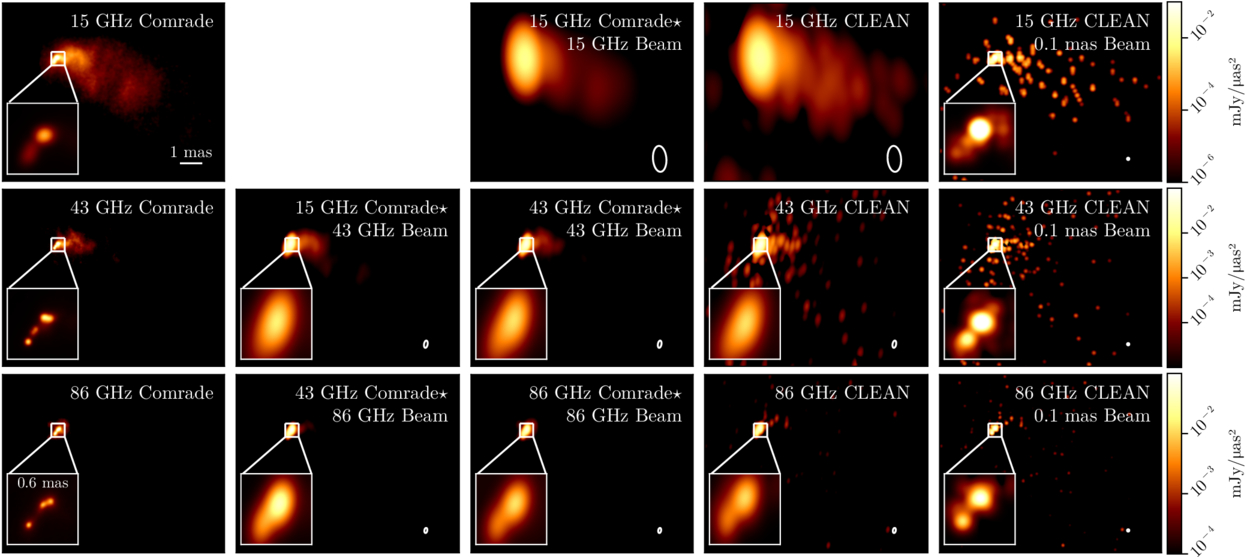
A comparison of the new HIBI technique (referred to as “Comrade” here) and a traditional algorithm called CLEAN. Click to enlarge. [Tiede et al. 2026]

By fitting all parameters that go into an image together, the method doesn’t select one “best” image. Instead, by allowing the pixel-by-pixel intensities, calibration parameters, and underlying physics to inform one another during inference, HIBI explores the full range of images consistent with the data. This prevents the degeneracies that plague the traditional approach, where image and calibration estimates can trade off against each other in misleading ways. The team validated HIBI on synthetic data mimicking the EHT’s 2017 setup, showing that it reliably recovered a range of source shapes with well-calibrated uncertainty estimates.

Even more exciting, the team demonstrated that it’s possible to skip the image construction step altogether and go straight to the science. By fitting parameters describing the physics underlying a scene, the team was able to constrain the width of the ring around M87* without any reference to a picture. They predict that this technique could be crucial for extracting information when future instruments like the Next Generation Event Horizon Telescope observe more distant black holes that are only marginally resolved. Though we’ll likely have to wait years for these next-generation telescopes, work like this ensures that astronomers will be able to squeeze as much science from them as possible once these new facilities are ready.

Citation

“Hierarchical Interferometric Bayesian Imaging,” Paul Tiede et al 2026 ApJ 997 262. doi:10.3847/1538-4357/ae2749

The post Enhancing the Sharpest Images appeared first on AAS Nova.

Selections from 2025: A New Way to Combine Ground-Based Images

19 December 2025 at 17:00

side-by-side images of galaxies

Editor’s Note: For the remainder of 2025, we’ll be looking at a few selections that we haven’t yet discussed on AAS Nova from among the most-downloaded articles published in AAS journals this year. The usual posting schedule will resume January 2nd.

ImageMM: Joint Multi-Frame Image Restoration and Super-Resolution

Published September 2025

Main takeaway:

A team led by Yashil Sukurdeep (Johns Hopkins University) developed a new method for processing and combining ground-based astronomical images. The authors’ algorithm, called ImageMM because it leverages a method called majorization–minimization, yielded greater detail in bright sources and distinguished more faint sources from the background than existing methods.

Why it’s interesting:

As ground-based telescopes grow larger and their cameras grow more sensitive, they must still contend with one unfortunate fact: they are trapped beneath Earth’s atmosphere, which blurs fine details in astronomical images. To extract as much information as possible from beneath Earth’s blurry, ever-shifting atmosphere, researchers have developed numerous strategies for cleaning, combining, and sharpening astronomical images. From simple averaging of multiple exposures to complex statistical techniques, each of these methods has unique strengths and weaknesses. ImageMM succeeds in quieting background noise and sharpening images of both extended and point-like sources while avoiding many of the pitfalls of statistical methods.

How they tested the new method:

satellite-trail removal by ImageMM

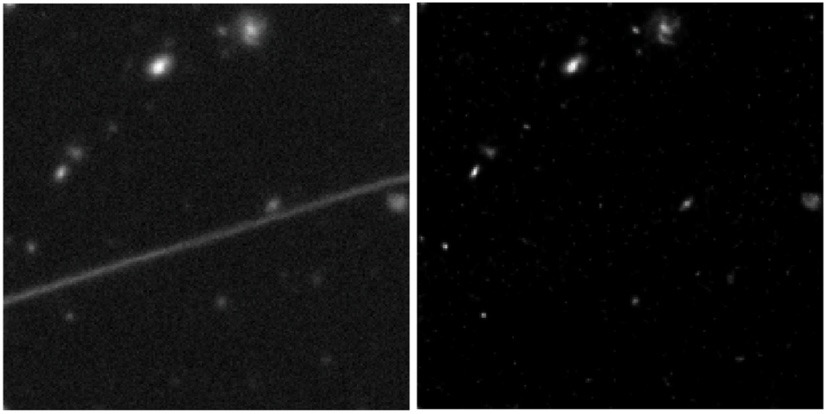
An example of satellite-trail removal by ImageMM. Click to enlarge. [Adapted from Sukurdeep et al. 2025]

Sukurdeep and collaborators tested ImageMM on data from the Hyper Suprime-Cam on the 8.2-meter Subaru Telescope as well as on simulated images. These tests demonstrated not only that ImageMM can enhance the scientific value of noisy datasets, it can also handle interlopers like satellite trails and cosmic rays — and it processes data nearly in real time as it comes down the pipeline. This ability to rapidly and faithfully process high-resolution astronomical images will be critical for upcoming surveys, like the Vera C. Rubin Observatory’s 10-year Legacy Survey of Space and Time, which will generate immense amounts of data ready for processing.

Citation

Yashil Sukurdeep et al 2025 AJ 170 233. doi:10.3847/1538-3881/adfb72

The post Selections from 2025: A New Way to Combine Ground-Based Images appeared first on AAS Nova.

Featured Image: Following Photons Through Curved Spacetimes

16 June 2025 at 17:00

Today’s featured image is a beautiful representation of how simulated images of active black holes are made. In a recent research article, a team led by Aniket Sharma (Indian Institute of Science Education and Research Mohali) introduced Mahakala, a new ray-tracing algorithm that expertly tracks photons as they navigate the warped spacetimes surrounding black holes. Mahakala is named for the Egyptian deity who, as Sharma and collaborators describe, is “believed to be the depiction of absolute black, and the one who has the power to dissolve time and space into himself.” The image above shows a simulated accreting black hole at a wavelength of 1.3 millimeters, which is the same wavelength used by the Event Horizon Telescope to view the supermassive black holes at the center of the Milky Way and the galaxy Messier 87. The dotted lines streaming off to the right represent the paths that photons took on their way to the viewer as they curved around the black hole, which is visible among the forest of lines. In this representation, the color of each dot shows the synchrotron emission generated at that point in three-dimensional space. The team hopes that Mahakala, which can be run quickly and easily from a Python Jupyter notebook, helps make the complex world of general relativistic magnetohydrodynamics simulations more accessible. You can try it for yourself or learn more from the article linked below.

Citation

“Mahakala: A Python-Based Modular Ray-Tracing and Radiative Transfer Algorithm for Curved Spacetimes,” Aniket Sharma et al 2025 ApJ 985 40. doi:10.3847/1538-4357/adc104

The post Featured Image: Following Photons Through Curved Spacetimes appeared first on AAS Nova.

US scrambles to stop Internet users re-creating dead pilots’ voices

22 May 2026 at 20:39

Pilots’ voices from the last seconds of a fatal cargo plane crash have been re-created by Internet sleuths using software and AI tools. The spread of reconstructed audio recordings has prompted a US government agency to suspend all public access to its database of civil transportation accidents—because federal law prohibits investigators from publicly releasing audio from cockpit voice recorders.

The US National Transportation Safety Board (NTSB) usually shares factual reports and evidence gathered from investigations of aircraft crashes and other civil transportation incidents. But on May 21, the NTSB announced that the online docket system containing such information was “temporarily unavailable” as it reviewed the publicly available materials that had enabled people to re-create cockpit audio recordings from aircraft disasters.

“​​The NTSB is aware that advances in image recognition and computational methods have enabled individuals to reconstruct approximations of cockpit voice recorder audio from sound spectrum imagery released as part of NTSB investigations, including the ongoing investigation of the crash last year of UPS flight 2976 in Louisville, Kentucky,” according to an NTSB statement. “The NTSB does not release cockpit audio recordings.”

Read full article

Comments

© National Transportation Safety Board

❌