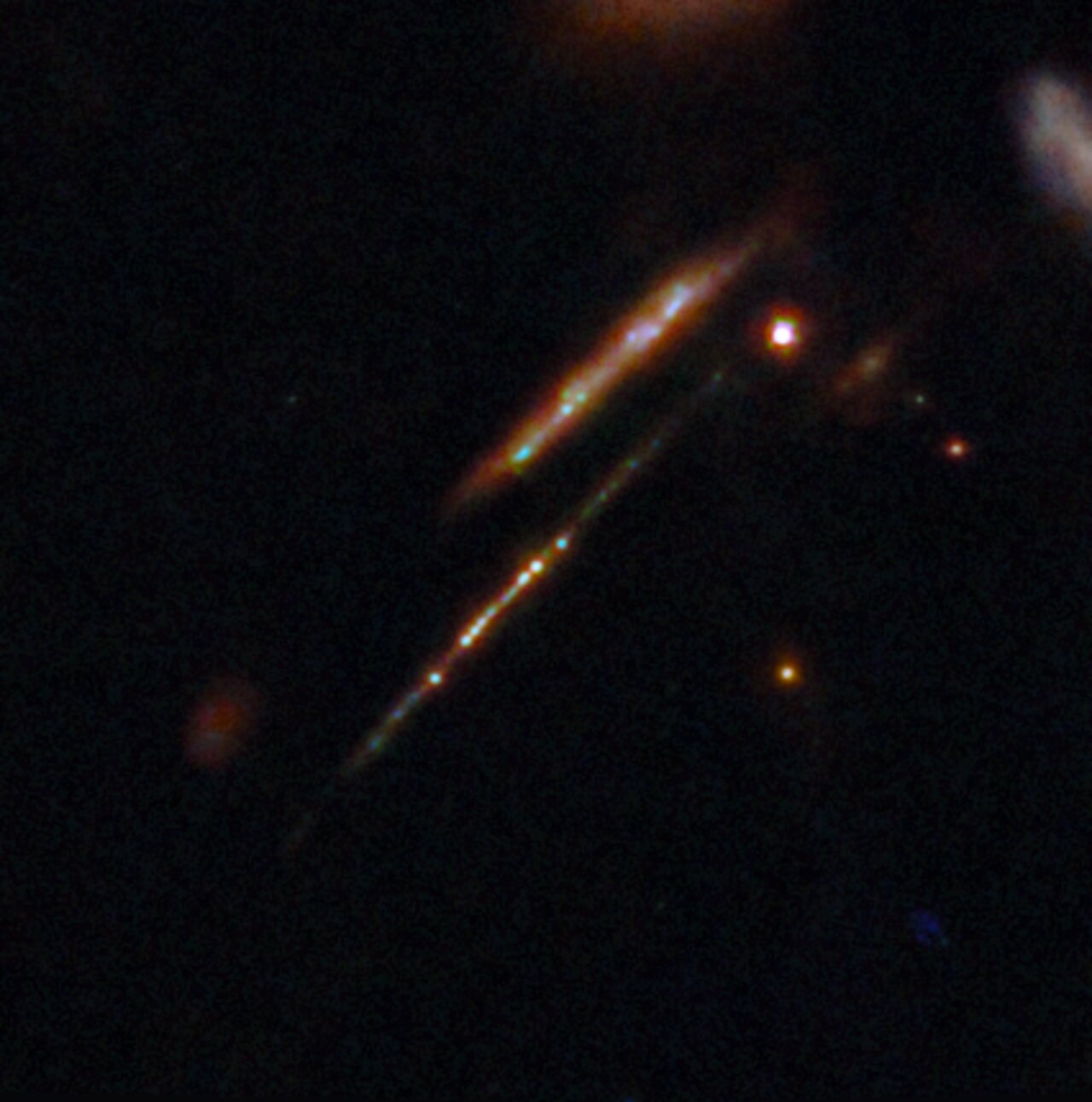
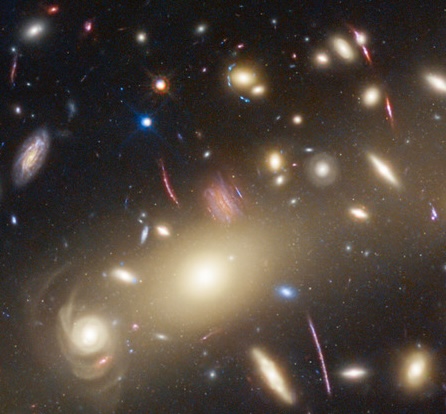
What’s the nature of the distant source Earendel, which appears as a point of light in a dramatically gravitationally lensed galaxy?
Record-Breaking Discovery
In 2022, astronomers using the Hubble Space Telescope reported the discovery of the most distant single star candidate ever seen, now pinpointed to have a redshift of
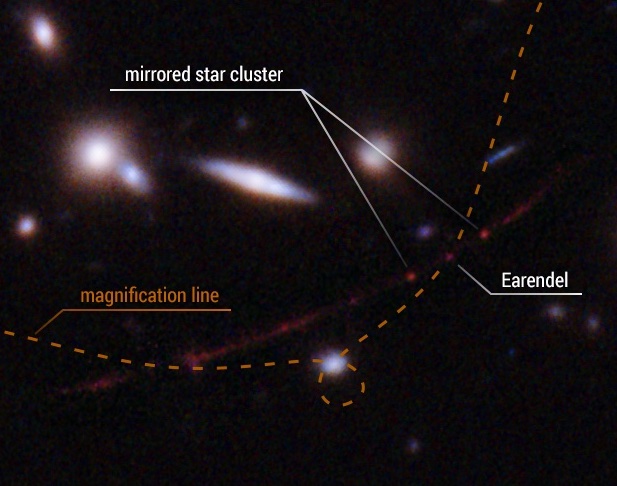
z = 5.926. The star, named Earendel, is an incredible beacon from the first billion years of the universe, standing out brilliantly from the red smear of its host galaxy, the Sunrise Arc.
But there’s a catch — at the distances involved, distinguishing between one star and many isn’t easy, and Earendel might not actually be just one star. New research uses stellar population modeling to explore the possibility that what has been touted as a single star is really a cluster.
The Light of Earendel, Our Most Beloved Star… Cluster?
The question sounds simple: does the light from Earendel resemble that of one star, or does it more closely align with the emission from a collection of many stars? What complicates matters is that Earendel’s light has been warped and magnified by an intervening galaxy cluster in a process called gravitational lensing. Because the degree of magnification isn’t known precisely, it’s not clear exactly how large the source is — leaving wiggle room for Earendel to be one or many stars.
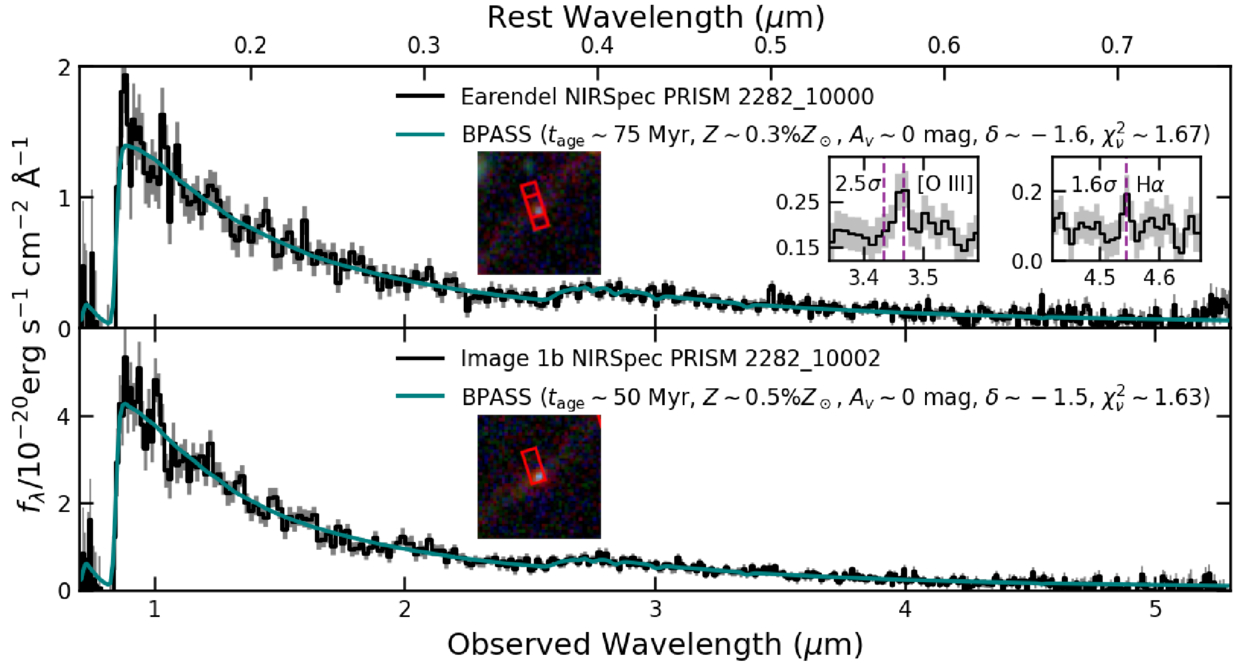
JWST spectra of Earendel (top) and 1b (bottom), along with the best-fitting models. Click to enlarge. [Pascale et al. 2025]
To investigate Earendel’s identity, Massimo Pascale (University of California, Berkeley) and collaborators fit a simple stellar population model to JWST Near-Infrared Spectrograph (NIRSpec) spectra of both Earendel and another source in the Sunrise Arc called 1
b, which is widely accepted to be a star cluster. The model varied the age of the cluster, its metallicity, the amount of dust it contains, and other factors. To make the modeling more rigorous, the team also used three different stellar population model libraries.
Both Earendel and 1b were well fit by all three stellar population models, supporting the hypothesis that Earendel is a cluster. Earendel and 1b share certain similarities, such as metallicity (less than 10% of the Sun’s), stellar surface density (high, rivaling the maximum density seen in the local universe), and age (more than 30 million years old).
Cluster Comparison
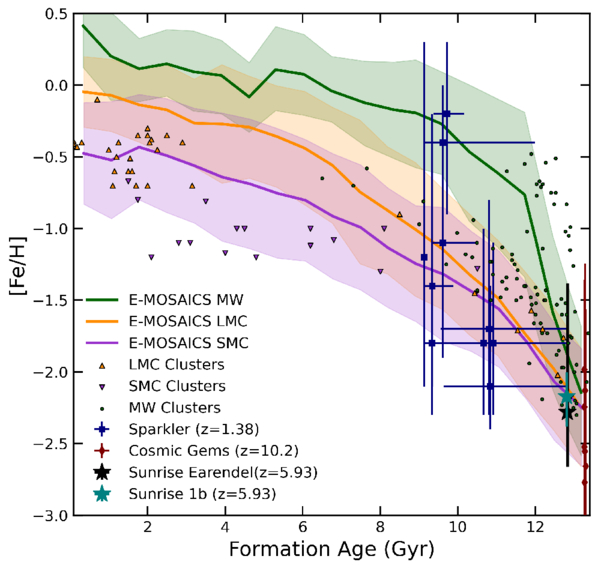
Metallicity and formation age of star clusters in the local universe, in the Milky Way and Magellanic Clouds, and at high redshifts. Click to enlarge. [Pascale et al. 2025]
Given the potential ages and metallicities of the two sources, it’s possible that both Earendel and 1
b are the precursors to today’s globular clusters. These clusters may fit into an evolutionary sequence that connects other lensed star clusters, such as the redshift
z = 10.2 Cosmic Gems clusters and the
z = 1.4 Sparkler clusters.
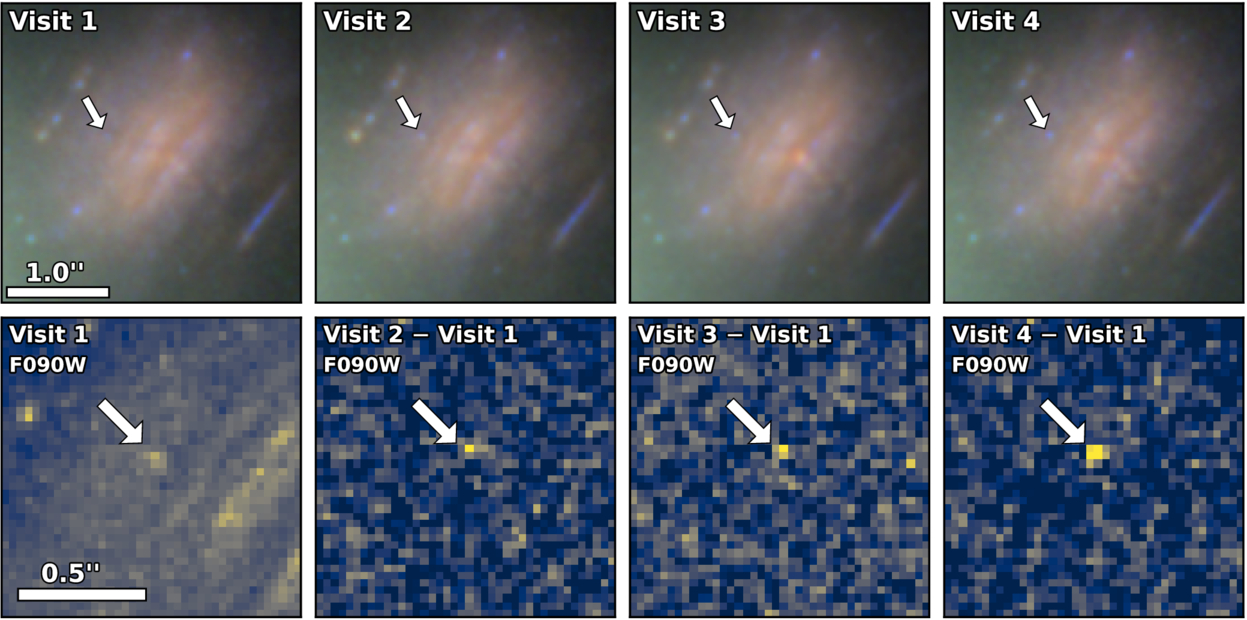
While this work demonstrates that Earendel could be a cluster, it doesn’t prove that it is. Doing so is challenging, especially since certain features predicted to exist for a single star might be beyond our observational capabilities, or they could be reproduced by clusters with certain properties. The authors pointed to one smoking-gun signal for Earendel being a single, massive star: brightness fluctuations due to microlensing by stellar winds. So far, no such variability has been found, and the cluster hypothesis remains viable.
Citation
“Is Earendel a Star Cluster?: Metal-Poor Globular Cluster Progenitors at z ∼ 6,” Massimo Pascale et al 2025 ApJL 988 L76. doi:10.3847/2041-8213/aded93
The post Examining Earendel: Is the Most Distant Lensed Star Actually a Cluster? appeared first on AAS Nova.

 Login