Normal view
- The Debrief
- This Deep-Sea Predator Can Live for CenturiesβNow Geneticists Are Close to Hacking the Secrets of Its Longevity
This Deep-Sea Predator Can Live for CenturiesβNow Geneticists Are Close to Hacking the Secrets of Its Longevity
The mystery of the Greenland sharkβs incredible longevity may finally be unraveling, as a team of international researchers has completed the first comprehensive genome map of the creature.
Native to the cold waters between Greenland, Iceland, and Canada, Greenland sharks boast one of the longest vertebrate lifespans on Earth, approaching 400 years. In a recent paper published in the Proceedings of the National Academy of Sciences, researchers led by Shigeharu Kinoshita of the University of Tokyo have identified some of the genetic basis of that extraordinary lifespan, which they say future researchers may exploit to treat cancer and age-related illnesses.
Greenland Sharks Longevity
As genetic sequencing technology has improved and costs have fallen, there has been a major increase in the number of sequences from long-lived species for comparative analysis. Discoveries have included identifying increases in genes related to the immune system and growth hormone receptors in rockfish and bat species noted for their longevity.
With an entire lifecycle in slow motion, Greenland sharksβ longevity can be traced to their prolonged development: they take 150 years to reach sexual maturity, growing only 1 centimeter per year. Despite being one of the slowest swimmers in the ocean, the species undertakes large-scale migrations spanning over 1,000 kilometers.
Genome Mapping
Large genome sizes, like those of the Greenland shark, pose enormous mapping challenges, full of many repetitive sequences. Despite their importance for management and conservation, few whale and shark species have been sequenced due to the difficulty involved. To fill data gaps in the genetic causes of longevity, aquatic species evolution, and the risks of biodiversity loss, the team chose the Greenland shark as their subject.
The University of Tokyo-led team mapped roughly 5.9 billion DNA base pairs, accounting for 96.7% of the sharkβs genome. Among the discoveries were the identification of specific genetic features likely related to the Greenland sharkβs longevity.Β
In their paper, they wrote of discovering βgenetic traits associated with cancer, immune response function, genome stability, and cardiac function, deep-sea adaptations, and population size dynamics,β in the new research.
Longevity Results
One of the most crucial of these traits is how the shark appears to mitigate the genetic strain that contributes to aging by stabilizing the building blocks of chromosomes. Chromatin is a structure consisting of DNA, RNA, and proteins, which makes up chromosomes.
In the Greenland shark, the histone H1.0 protein, which binds DNA in chromatin, undergoes an amino acid substitution that may enhance stability and reduce the effects of aging.
Another genetic tool aiding the sharkβs longevity is the presence of 59 copies of the FTH1b gene, which researchers discovered on pseudochromosome 33, far above the number seen in other shark or fish species. This helps regulate ferroptosis, a form of programmed cell death, thereby mitigating cell damage. Since the gene controls iron storage and ferroptosis is iron-dependent, the researchers say this multiplication of FTH1b could prevent oxidative cell damage.
Beyond those specific expressions, researchers also found expansion of entire gene families associated with DNA repair, immune functions, and cancer resistance.
Although limited to a single species, the research does advance general understanding of the genetic factors involved in extended lifespans. However, it will be up to future researchers to identify how this new information can be applied to human concerns.
The paper, βThe Greenland Shark Genome: Insights into Lifespan Extremes and Population Dynamics,β appeared in Earth and Planetary Science Letters on May 19, 2026.
Ryan Whalen covers science and technology for The Debrief. He holds an MA in History and a Master of Library and Information Science with a certificate in Data Science. He can be contacted at ryan@thedebrief.org, and follow him on Twitter @mdntwvlf.
Researchers Spot a Rare Glowing, Growing Planet
![]()
Have you ever eaten a meal so quickly that you started to glow? Although this behavior likely isnβt relatable for most humans, astronomers are beginning to find more and more baby planets doing just that.
Planetary Glow Up
Planets are, famously, quite large. But astronomers know that they donβt start out that way, and that instead, stars and planetary systems start as wispy collections of dust and gas. This raw material eventually compresses itself into stars and planets and life capable of contemplating such things, but how exactly that happens is not perfectly understood.
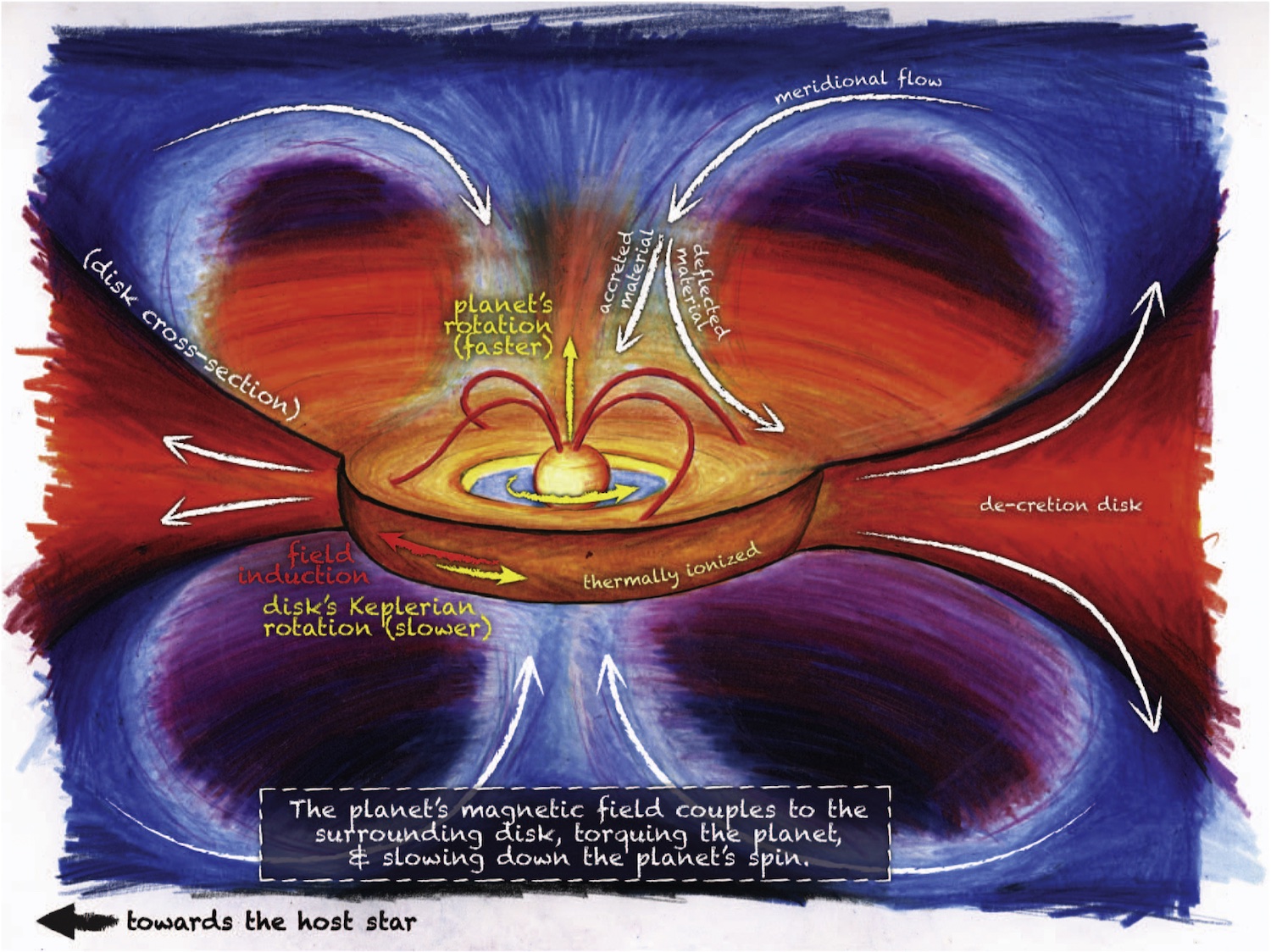
A schematic of some of the processes involved during giant planet formation. Click to enlarge. [Batygin 2018]
A number of different mechanisms predict that during this process, the protoplanet should emit light at a certain frequency associated with electrons jumping between energy levels in hydrogen atoms β what astronomers call HΞ± emission. In other words, they should glow at that specific wavelength only when they are accreting, though how strongly and consistently will depend on exactly what is happening around the planet.
These ideas existed only on paper until 2019, when a team first observed two glowing, growing planets around the star PDS 70. Recently, however, a powerful new instrument has begun collecting data, and astronomers just announced it has found another similar protoplanet: WISPIT-2b.
A New Discovery
A team of researchers led by Laird Close (University of Arizona) announced the discovery of this new world after analyzing images taken with the powerful new MagAO-X instrument on one of the 6.5-meter Magellan telescopes in Chile. The team outfitted the camera with a narrow filter that only admitted the HΞ± emission associated with accretion, then collected thousands of images over about two hours in April 2025. After stacking and post-processing their data, a faint dot jumped out beside the central star, right in the gap between two bright rings in the starβs disk.
This protoplanet, which the authors name WISPIT-2b in honor of their Wide Separation Planets in Time (WISPIT) survey, is likely about five times the mass of Jupiter and only 5 million years old, making it a baby on astronomical timescales. Based on how strongly itβs glowing, the team estimates that itβs accreting the equivalent of about 100 times the mass of Phobos, Marsβs largest moon, each year. This process wonβt continue forever, as eventually the remains of the starβs disk will disperse and the planet will have to go hungry.This remarkable find is only the third protoplanet unambiguously found to be embedded within a disk, and the first to be found in the gap between rings in a disk. With MagAO-X collecting data and the WISPIT survey underway, weβre likely in store for many other discoveries in the coming years. With enough observations and examples of these growing worlds, astronomers will fill in their models of how exactly giant planets as we know them are formed.
Citation
βWide Separation Planets in Time (WISPIT): Discovery of a Gap HΞ± Protoplanet WISPIT 2b with MagAO-X,β Laird M. Close et al 2025 ApJL 990 L9. doi:10.3847/2041-8213/adf7a5
The post Researchers Spot a Rare Glowing, Growing Planet appeared first on AAS Nova.
- AAS Nova
- Weather Forecast for the Habitable Worlds Observatory: Cloudy with a Chance of Biosignatures
Weather Forecast for the Habitable Worlds Observatory: Cloudy with a Chance of Biosignatures
![]()
Editorβs Note: Astrobites is a graduate-student-run organization that digests astrophysical literature for undergraduate students. As part of the partnership between the AAS and astrobites, we occasionally repost astrobites content here at AAS Nova. We hope you enjoy this post from astrobites; the original can be viewed at astrobites.org.
Title: Clouds Can Enhance Direct-Imaging Detection of O2 and O3 on Terrestrial Exoplanets
Authors: Huanzhou Yang, Michelle Hu, and Dorian S. Abbot
First Authorβs Institution: University of Chicago
Status: Published in ApJ
In the hunt for life beyond Earth, studying exoplanet atmospheres is one of our most powerful tools. The atmosphere of an exoplanet acts as a window into its environment and allows astronomers to take a guess at what processes are shaping the planetβs climate, chemistry, and thus, its potential for habitability. The gases present in the planetβs atmosphere impart a unique spectral fingerprint on the light that passes through the atmosphere and allows us to identify what gases might be present and look for possible signs of life.
JWST is already hard at work looking at distant worlds and gathering spectroscopic data for us to analyse. It has already observed several exoplanets and recorded the light that passed through their atmospheres. This has not only sparked a debate over what could be interpreted as the first possible signs of biological activity, but has also given us a glimpse of worlds that are remarkably different from our own.
However, JWST is mostly limited to observing the atmospheres of transiting exoplanets. That means planets that orbit close to their host star and are more or less directly edge-on, as viewed from us, so that they transit across the face of the star. The only planets that the telescope is able to observe directly are big, young, and hot planets farther from their host star, at distances more resembling those of the outer planets in our solar system, like Saturn or Uranus. If only we had a telescope powerful enough to image a potentially habitable planet directly and analyse the light reflected from it.
The Habitable Worlds Observatory
This is where the Habitable Worlds Observatory (HWO) will come in. Now, I know what you are thinking. Why must astronomers always look towards greener pastures bigger telescopes when we already have perfectly functional space telescopes in orbit or practically on the launch pad? Well, it is true that the next flagship space telescope from NASA, the Nancy Grace Roman Space Telescope, is designed to directly image exoplanets and analyse their atmospheres. But space telescopes can take decades to plan and are often built on lessons learned from previous missions. Roman, with its 2.4-meter primary mirror and coronagraph, will be able to observe planets similar in size and orbital distance to Jupiter and will get us some of the way, for sure, but not all the way. At three times the mirror size, HWO, NASAβs proposed successor to Roman that is planned for the 2040s, will carry the torch even further and be able to directly image Earth-like planets in the habitable zone, where liquid water can exist on the planetβs surface.
But It Might Be Cloudy Tomorrow
This brings us to todayβs article. If the HWO is going to potentially observe Earth analogues, we might expect it to run into the same issue that plagues everyone living in the UK for most of the year β clouds. Clouds in the atmosphere of an exoplanet can sometimes cause trouble when trying to analyse the light. Cloud particles scatter different wavelengths of light differently, and cloud variability creates dynamic changes in the observed brightness that can make it hard to know what exactly you are looking at. Clouds can also mean varying levels of opacity to look through depending on cloud composition, and they can hide underlying atmospheric properties such as water content beneath a thick cloud layer. For transmission spectroscopy, even a thin layer of clouds can disrupt the measurements as the light has to travel a long distance through the atmosphere. However, for direct imaging, the effect of clouds is perhaps more nuanced. While a thick cloud deck will block the signal from whatever gas lies beneath it, it will also increase the overall albedo of the planet and make it easier to detect the gas above. This means that cloud height and type are both critical variables in understanding atmospheric properties of exoplanets, which is what the authors of todayβs article set out to investigate.
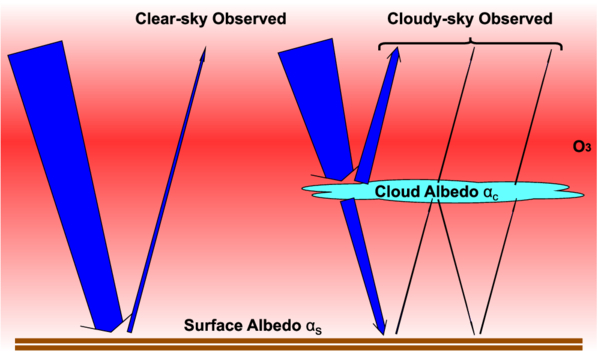
To understand how clouds affect the ability to detect signs of life on distant Earth-like planets, the authors used computer simulations. They focused on two gases, molecular oxygen (O2) and ozone (O3). Both gases are often regarded as biosignatures, although their astrobiological significance has been debated. The authors first used a tool that simulates how a telescope like the HWO might observe an Earth-like planet around a star 15 parsecs away. This tool predicts how light bounces off a planetβs surface and atmosphere, and whether the two gases would show up clearly in the reflected light. Next, they created realistic cloud conditions using a cloud microphysics model. This model calculates how clouds might form and behave depending on factors like surface pressure or how much sunlight the planet gets. With this they were able to change things like cloud height and particle size. They then combined the two tools by adding the simulated clouds into the observations model and building a mathematical model to help explain what they saw in the simulations. The sketch for their model can be seen in Figure 1.
Figure 1: Clouds can affect the amount of reflected light (albedo) from the imaged planet. Depending on the cloud height and particle size, this can have a big impact on the observability of different species of gas in the atmosphere. Here the blue arrows indicate the amount of light entering the atmosphere and being reflected. The arrows get thinner from tail to head, representing absorption in the atmosphere. Depending on the presence of clouds, a varying amount is reflected back. The red colour indicates the assumed distribution of ozone, O3, which is concentrated at a high altitude. [Yang et al. 2025]
A Cloudy Sky Can Actually Be a Good Thing
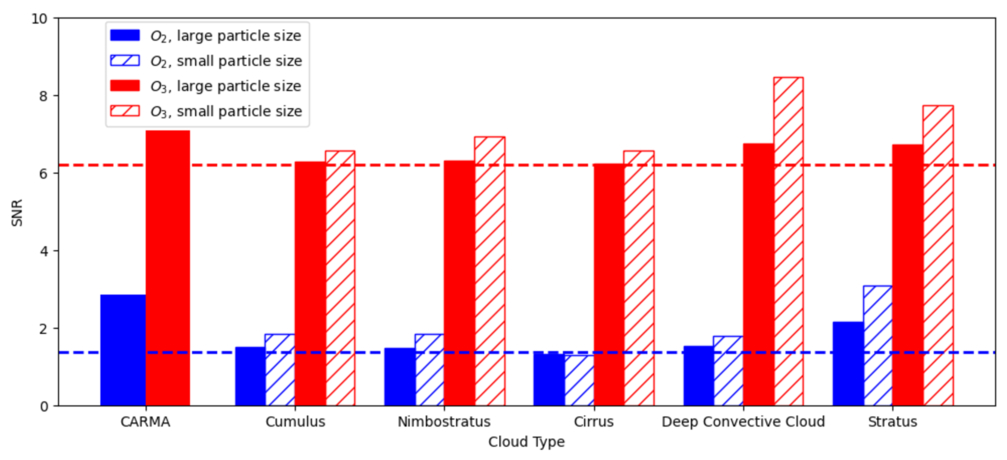
The researchers discovered that low clouds can actually make gases like oxygen and ozone easier to detect, because these clouds reflect more light without blocking the gases above them. On the other hand, high clouds can make it harder since they can hide the gases from view. They tested different cloud types using real data from Earth as seen in Figure 2. They looked at five common cloud types, like stratus (flat and low), cirrus (high and wispy), and deep convective clouds (tall, thunderstorm-like), and compared them to their model clouds (labelled as CARMA in the figure).
Figure 2: The figure shows how different types of clouds affect our ability to detect oxygen (blue) and ozone (red) on an Earth-like planet. The dashed lines show the results without clouds, while the bars show what happens when clouds are present. Solid bars represent larger cloud droplets, and striped bars represent smaller ones, which reflect more light. The figure shows that most cloud types β especially low clouds like stratus and thick storm clouds β actually make it easier to detect these gases, particularly when droplets are small. Only high, thin clouds (cirrus) slightly reduce oxygen detection, and even then, the effect is small. This is the articleβs main finding: while clouds can block light in some observation methods, for direct imaging of reflected light, they often help us see signs of life better. The cloud types are based on real Earth data while the authorsβ simulated cloud model is labelled as CARMA. [Yang et al. 2025]
Original astrobite edited by Maria Vincent.
About the author, Kasper Zoellner:
I have a Master of Science in astronomy and I am currently working towards a PhD in physics and educational science. My greatest passion is the search for exoplanets and how stellar variability may influence the possibility of life. I am also interested in science outreach, education, and discussing what sci-fi novel to read next!
The post Weather Forecast for the Habitable Worlds Observatory: Cloudy with a Chance of Biosignatures appeared first on AAS Nova.
A Dusty Disk Points to a Potential Planet
![]()
JWST observations of a nearby starβs debris disk recently revealed what may be one of the lowest-mass planets ever imaged.
How to Find a Small Planet
Though it remains a formidable technical challenge, astronomers have gotten fairly good at taking images of planets around other stars by carefully blocking the light of the host and searching for the small points of light that remain. However, though this technique is well-suited for discovering large, bright, high-mass planets, their lower-mass cousins below the size of Jupiter remain challenging to detect. To get pictures of these smaller worlds, astronomers must resort to detective work and search for signs of their presence through indirect means.
One promising approach is to look not for the planet itself, but rather its effect on the dusty disk of material around the star. These structures, called debris disks, are constantly replenished by planetesimals colliding and grinding one another to dust. If a planet happens to orbit within this disk, it will βstirβ the dust into distinctive patterns including rings and spiral arms. If astronomers observe that a star has a debris disk with gaps or spirals, they can analyze those substructures and deduce where a planet might be hiding.
The Star of this Show: TWA 7
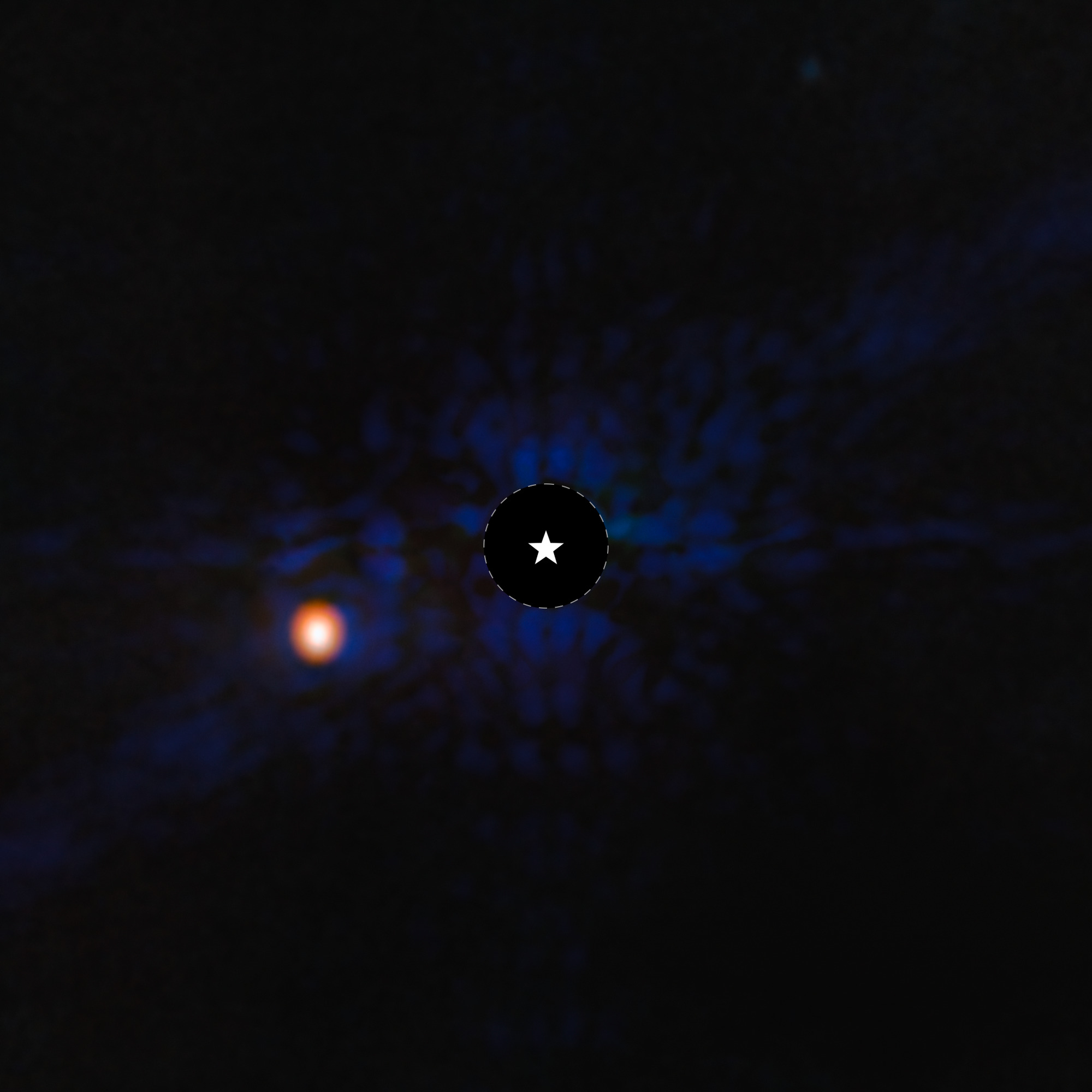
A mid-infrared image of TWA 7βs debris disk and candidate planet. [ESA/Webb, NASA, CSA, A.M. Lagrange, M. Zamani (ESA/Webb); CC BY 4.0]
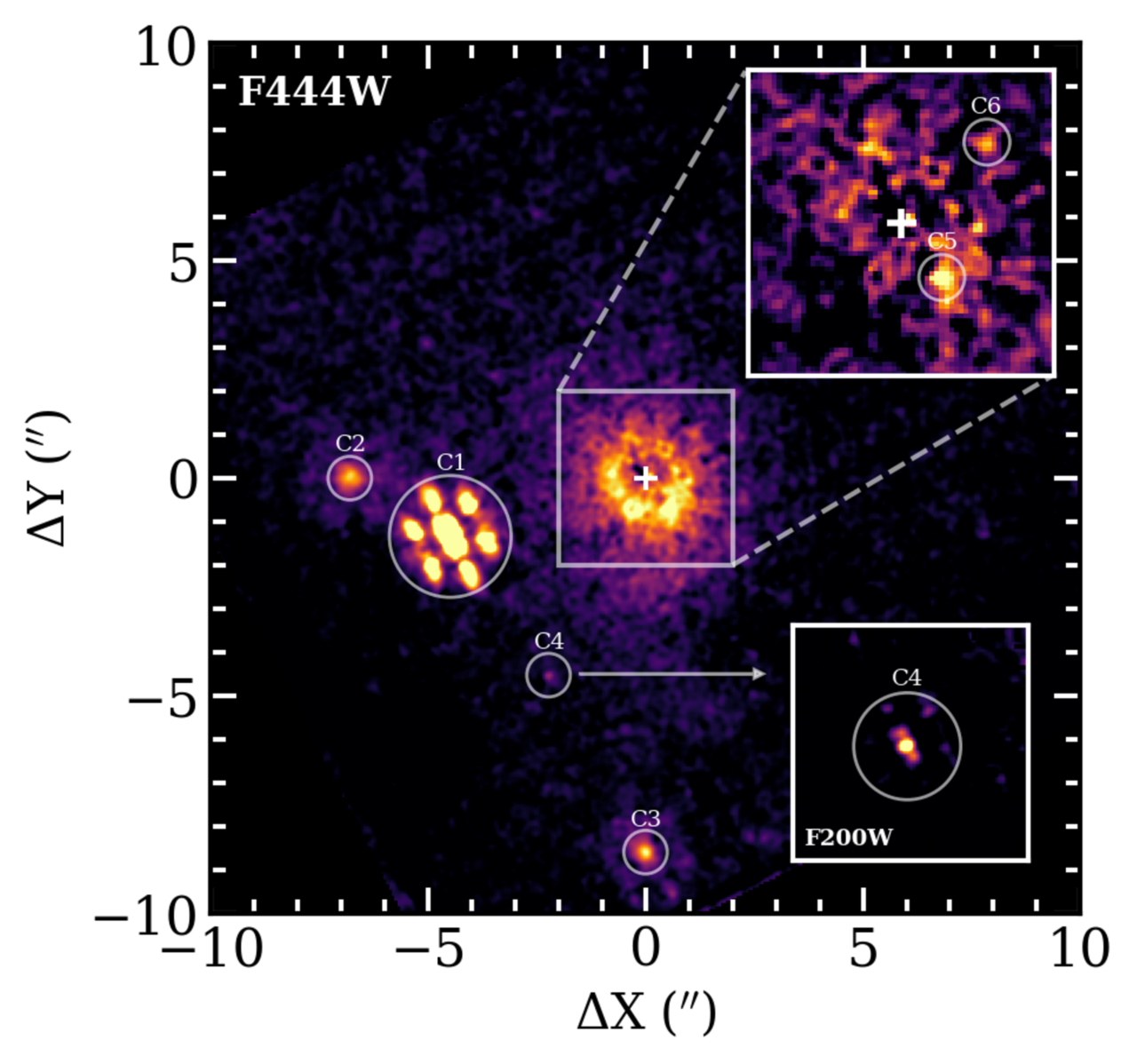
This prediction led to a search with JWST last summer. Initial observations taken at mid-infrared wavelengths revealed a bright dot sitting near the predicted location of the planet. However, with just these observations, it was hard to confidently say that this source wasnβt just a distant background galaxy that happened to appear there by chance. To help settle the matter, JWST took another look in two different near-infrared wavelength bands a few weeks later.
New JWST observations of TWA 7. The sources labeled C5 and C6 are planet candidates. C6 is located at the same place as the planet candidate identified in mid-infrared observations, making it a strong candidate. C5 requires further observations to understand if it is real or an artifact. Click to enlarge. [Crotts et al. 2025]
Revisiting TWA 7
A team led by Katie Crotts (Space Telescope Science Institute) recently published these later observations. These new data show a dot in the exact same place as before, and with a color thatβs much more planet-like than galaxy-like.
While this adds plenty of evidence to the planetary interpretation, the team cautions that one more set of follow-up observations is needed to be confident that this is, in fact, a planet. Assuming future observations back up these first hints, however, this would be the lowest-mass planet ever imaged, and a happy conclusion to a detective story that started with dust.
Citation
βFollow-Up Exploration of the TWA 7 PlanetβDisk System with JWST NIRCam,β Katie Crotts et al 2025 ApJL 987 L41. doi:10.3847/2041-8213/ade798
The post A Dusty Disk Points to a Potential Planet appeared first on AAS Nova.
Potential Discovery of a World Next Door
![]()
By pushing JWST to its limits, astronomers may have just spotted a planet around the nearest Sun-like star, Alpha Centauri A. Though another look at the star is needed next year to confirm the finding, if the detection holds up, this discovery easily earns several superlatives: the planet would be the nearest, oldest, coldest, and lowest-mass world ever directly imaged beyond our solar system.
Hi, Neighbor!
The scale of our Milky Way galaxy is hard to comprehend with our Earth-bound minds that are more attuned to measuring distances in miles than in light-years. However, even though our suburban stellar neighborhood is tens of thousands of light-years from the galactic downtown, it is not empty: there are a handful of nearby systems that offer unique opportunities to study stars and their potential planet children βup close.β
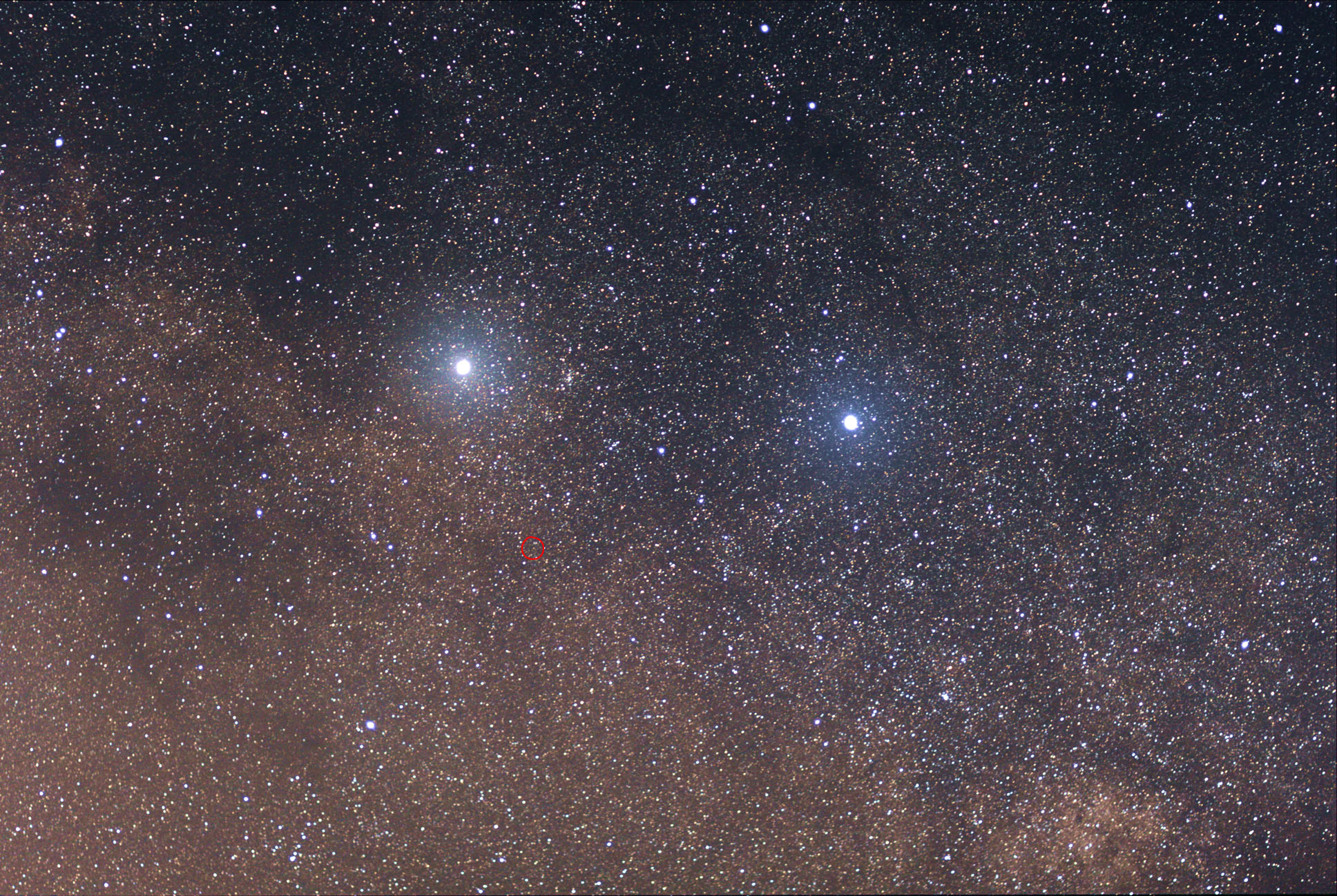
Alpha Centauri A and B (bright stars), along with Proxima Centauri, circled in red. [Wikipedia; CC BY-SA 3.0]
Though Proxima Centauri is the most famous of the trio, since itβs technically the closest star to the Sun, its larger siblings are arguably better targets for searching for planets. Since these stars are more massive, their habitable zones are large enough that astronomers can block out the star itself and search the surrounding area for planets using a tool called a coronagraph.
Challenging Observations
Back in 2019, a team of astronomers using a coronagraph on the Very Large Telescope uncovered tantalizing evidence of a giant planet orbiting Alpha Centauri A. However, confirming or rejecting this initial peek using telescopes on Earthβs surface was challenging. When JWST finally launched in 2021, following up on this hint was a top priority. Astronomers first attempted to point JWST toward the Alpha Centauri system in 2023, but unfortunately, the observations from that attempt were unusable.
Though one might think aiming a telescope at a nearby star is easier than taking a look at something more distant, this is unfortunately not the case. For one thing, the stars of the Alpha Centauri system are bright enough to overwhelm JWSTβs sensitive detectors without careful calibration. For another, keeping the telescope locked on target and the star behind the coronagraph requires continuous tweaks to account for the Sunβs motion relative to Alpha Centauri, JWSTβs motion relative to the Sun, and Alpha Centauri Aβs motion relative to Alpha Centauri B. The team regrouped, tested a new observing strategy in mid-2024, then took three long observations in August 2024, February 2025, and April 2025.
A Planet Candidate
JWST coronagraph image of the Alpha Centauri system. Alpha Centauri B is the bright labeled star at the top, while Alpha Centauri A is labeled but hidden behind the coronagraph. The inset shows the region around Alpha Centauri A during the three different observations. The planet candidate, labeled S1, is only visible in the August 2024 observation. Click to enlarge. [Beichman & Sanghi et al. 2025]
The authors estimated that the source is a 1β1.1 Jupiter radius planet with a mass of 90β150 Earth masses (0.28β0.47 Jupiter mass) on a 2β3-year orbit. The team stressed that with just one detection, this should still be regarded as a planet candidate, not a confirmed discovery. If the planet is eventually verified, however, it stands out among its peers as the first mature, cold planet ever imaged within its starβs habitable zone. Future detectors may be able to collect spectra of the planet itself, unlocking new insights into giant planet evolution and composition in multiple-star systems with nested orbits, like the Alpha Centauri system.
Now that JWST has a proven strategy for observing this challenging system, it should be possible to take follow-up images. If the planet is real and traveling on its expected orbit, it should reappear beside Alpha Centauri A in August 2026. Hopefully, JWST will be looking when it does, and we can finally confirm that we have a planetary neighbor next door.
Citation
βWorlds Next Door: A Candidate Giant Planet Imaged in the Habitable Zone of Ξ± Cen A. I. Observations, Orbital and Physical Properties, and Exozodi Upper Limits,β Charles Beichman et al 2025 ApJL 989 L22. doi:10.3847/2041-8213/adf53f
βWorlds Next Door: A Candidate Giant Planet Imaged in the Habitable Zone of Ξ± Cen A. II. Binary Star Modeling, Planet and Exozodi Search, and Sensitivity Analysis,β Aniket Sanghi et al 2025 ApJL 989 L23. doi:10.3847/2041-8213/adf53e
The post Potential Discovery of a World Next Door appeared first on AAS Nova.

Exo-Saturns and Exo-Jupiters Are Within JWSTβs Reach
![]()
Of the nearly 6,000 currently known exoplanets, few closely resemble any of the planets in our solar system. New research suggests that JWST is capable of directly imaging exoplanets with temperatures and orbital distances similar to Jupiter and Saturn, placing truly familiar exoplanets within our observational grasp.
Increasingly Cold Discoveries
A JWST image of the exoplanet Epsilon Indi Ab, one of the coldest exoplanets to be directly imaged. The planetβs temperature is estimated to be just 275K (35β/2β). [NASA, ESA, CSA, STScI, Elisabeth Matthews (MPIA)]
Answering this question requires a deep dive into the abilities of JWSTβs instruments. The current go-to method for directly imaging planets with JWST is coronagraphy with its Near-Infrared Camera (NIRCam). In this observing mode, the instrument blocks the light from the star, allowing the fainter thermal glow of the planet to shine through.
But as Rachel Bowens-Rubin (University of Michigan and Eureka Scientific) and collaborators note in a recent research article, this may not be the best way to detect cold giant planets. Models suggest that these planets have cloudy atmospheres, which means that they wouldnβt be bright at NIRCamβs preferred near-infrared wavelengths, and would instead be detected more easily in the mid-infrared, where JWSTβs Mid-Infrared Instrument (MIRI) reigns.
Combining Data and Models
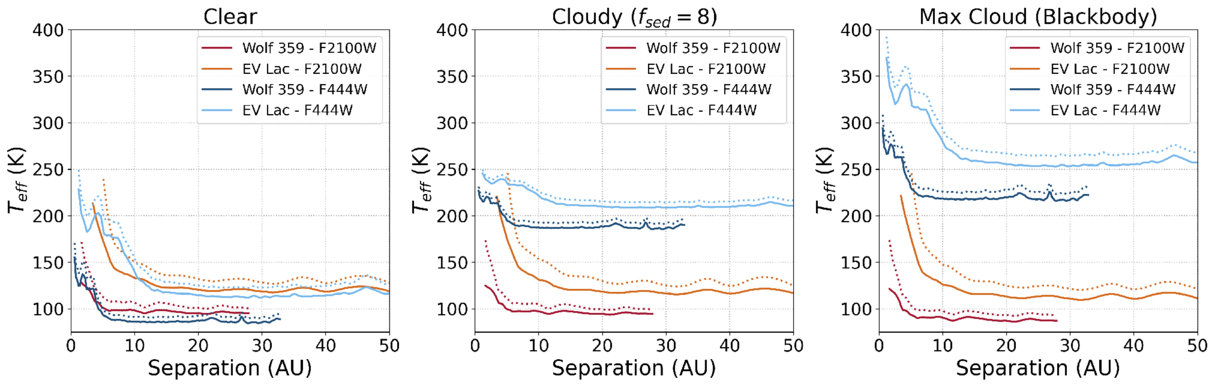
To examine the capabilities of both of these instruments, Bowens-Rubinβs team analyzed JWST observations from the Cool Kids on the Block program, which targets cold, low-mass giant planets around nearby low-mass stars with NIRCam coronagraphy and MIRI imaging. The team used observations of nearby M-dwarf stars Wolf 359 and EV Lac to construct constrast curves:Β the level of planetβstar flux contrast that is detectable by each instrument as a function of distance from each star. These curves depend on the flux of the star and the planet as well as the limitations of the instrument β the detector noise and background noise.
Temperatures of coldest detectable planets as a function of separation from the host star for Wolf 350 and EV Lac. Results are shown for MIRI F2100W imaging and NIRCam F444W coronagraphy. Click to enlarge. [Bowens-Rubin et al. 2025]
NIRCam vs. MIRI
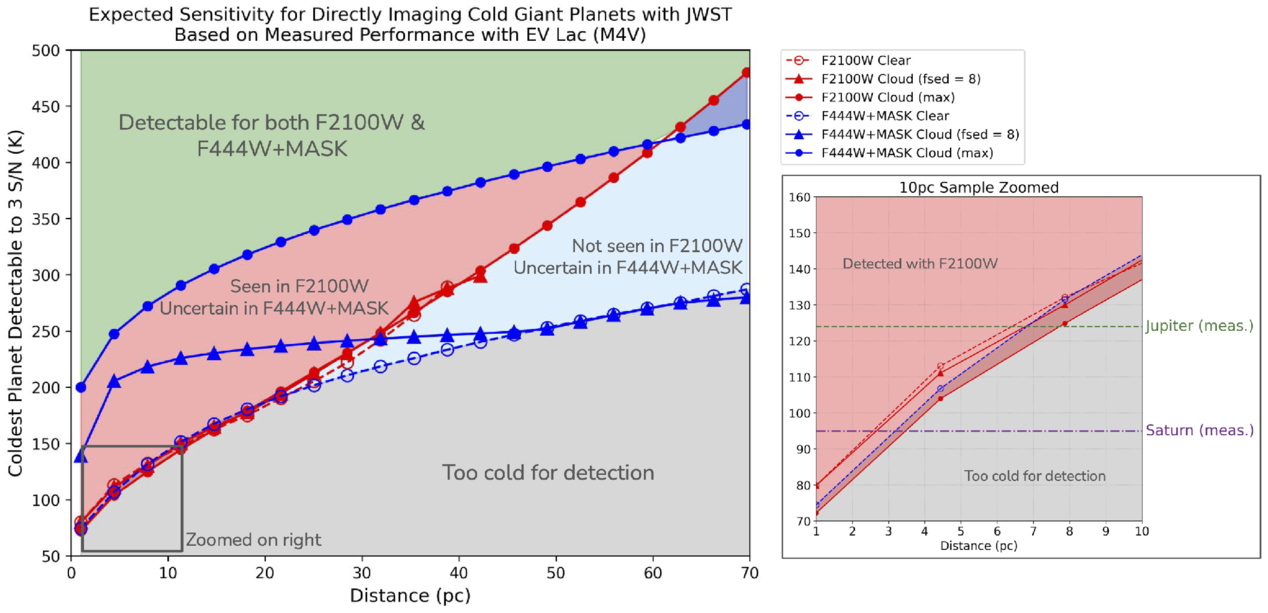
This analysis showed that MIRI is the best choice for directly imaging cold planets around nearby stars (within 65 light-years). MIRI should be able to detect giant planets with temperatures down to 94K around Wolf 359 and 114K around EV Lac β about the temperature of Saturn and slightly colder than Jupiter, respectively. For Wolf 359, sub-100K planets are detectable at orbital distances of at least 4.8 au, meaning these planets could also have similar orbital separations to Jupiter and Saturn.
Temperatures of planets detectable to a signal-to-noise ratio of 3 as a function of distance from Earth. Detection limits for MIRI and NIRCam are shown as red and blue lines, respectively. Click to enlarge. [Bowens-Rubin et al. 2025]
As impressive as these results are already, Bowens-Rubin and coauthors noted that future work, such as developing strategies to mitigate MIRIβs βbrighter-fatter effectβ that limits sensitivity at small angular separations from the host star, could enhance the search for exo-Saturns and exo-Jupiters even further.
Citation
βNIRCam Yells at Cloud: JWST MIRI Imaging Can Directly Detect Exoplanets of the Same Temperature, Mass, Age, and Orbital Separation as Saturn and Jupiter,β Rachel Bowens-Rubin et al 2025 ApJL 986 L26. doi:10.3847/2041-8213/addbde
The post Exo-Saturns and Exo-Jupiters Are Within JWSTβs Reach appeared first on AAS Nova.
- SciTechDaily
- Scientists Discover Key Alzheimerβs βTipping Pointβ That May Decide Who Gets Dementia
Scientists Discover Key Alzheimerβs βTipping Pointβ That May Decide Who Gets Dementia
A Newly Found Cellular Shift May Explain Why Aging Leads to Disease
Popular Weight-Loss Drug Found To Slow Biological Aging in Landmark Human Trial
Scientists Discover a Hidden Cause of Cellular Aging That Can Be Reversed
Scientists Discover a Simple Writing Test That May Detect Cognitive Impairment
Scientists Made Older Mice Biologically Younger Using Gut Microbes
Stanfordβs Revolutionary New Microscope Reveals Living Cells in Stunning Detail
Scientists Discover Some βZombie Cellsβ May Actually Help You Live Longer
What Scientists Found Inside a 117-Year-Old Woman Reveals New Clues to Long Life
- Live Science
- Tests that measure 'biological age' aren't helpful for tracking your health, scientists say
Tests that measure 'biological age' aren't helpful for tracking your health, scientists say
Chickens without eggs? De-extinction company creates artificial egg.
On Tuesday, biotech startup Colossal announced its newest development on the road to its announced goal: reversing the extinction of species, in this case, avian species. The development itself is essentially an artificial eggshell, one that allows almost the entire developmental process to occur without the shell. The company transferred the contents of eggs to their specially designed container within a day or two of laying and were able to have normal chicks walk away from it.
Beyond its potential utility for Colossal's intended efforts, the work is personally interesting to me because it may solve a problem I faced in my research days. I'm going to start by describing the research problem that Colossal may have solved, before coming back to what it hopes to use its technology to doβand why the company still has a few key hurdles left to overcome.
Watching development
For part of my career, I studied the development of vertebrates using chickens. While they're less closely related to us than something like mice, the basics of their development are largely the same. And, unlike mice, they develop outside of their mother's body. If you're careful, you can chip away a hole in the egg, perform manipulations on the developing embryo, and then seal it back up with some tape. The chicken embryo will keep developing, allowing you to see the impact of what you've done on normal development.


Β© Colossal