❌

Normal view

Investigating a Polluted White Dwarf

18 February 2026 at 17:00

GD 362 and its debris disk

Roughly 25–50% of the white dwarfs in the solar neighborhood are “polluted,” showing signs of accretion of metal-rich planetary material. New JWST observations reveal the contents of the debris disk surrounding one of the most polluted white dwarfs in the solar neighborhood.

Heavy-Metal Pollution

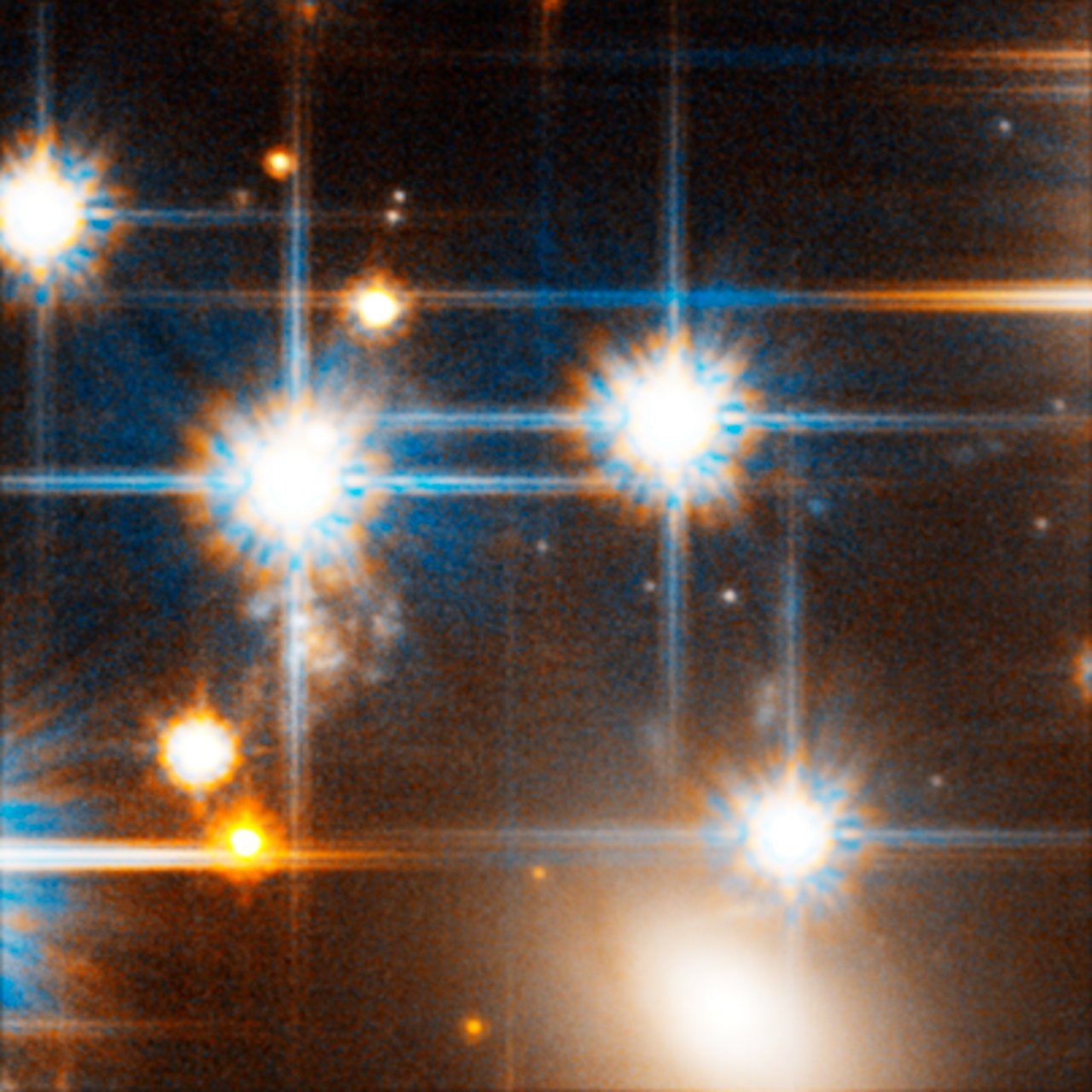
Hubble Space Telescope images of stars and a white dwarf

A white dwarf is faintly visible at the center of this Hubble Space Telescope image, tucked between the two brightest stars. [NASA, ESA and H. Richer (University of British Columbia); CC BY 4.0]

White dwarfs are the remnants of low- to intermediate-mass stars that have ceased core fusion and evolved off the main sequence. The presence of metals in white dwarf atmospheres shows that it’s common for white dwarfs to accrete rocky materials from tidally disrupted bodies in their surroundings, allowing for a post-mortem investigation of the composition of rocky worlds in far-off planetary systems.

One of the most impressively metal-polluted white dwarfs known is GD 362, which is surrounded by a dusty debris disk and shows evidence for at least 16 accreted elements. GD 362 is a helium-atmosphere white dwarf, but previous observations have also shown that it has an unusually large amount of hydrogen in its atmosphere — a possible sign that the star has consumed one or more bodies containing water or ice.

Disk Investigation

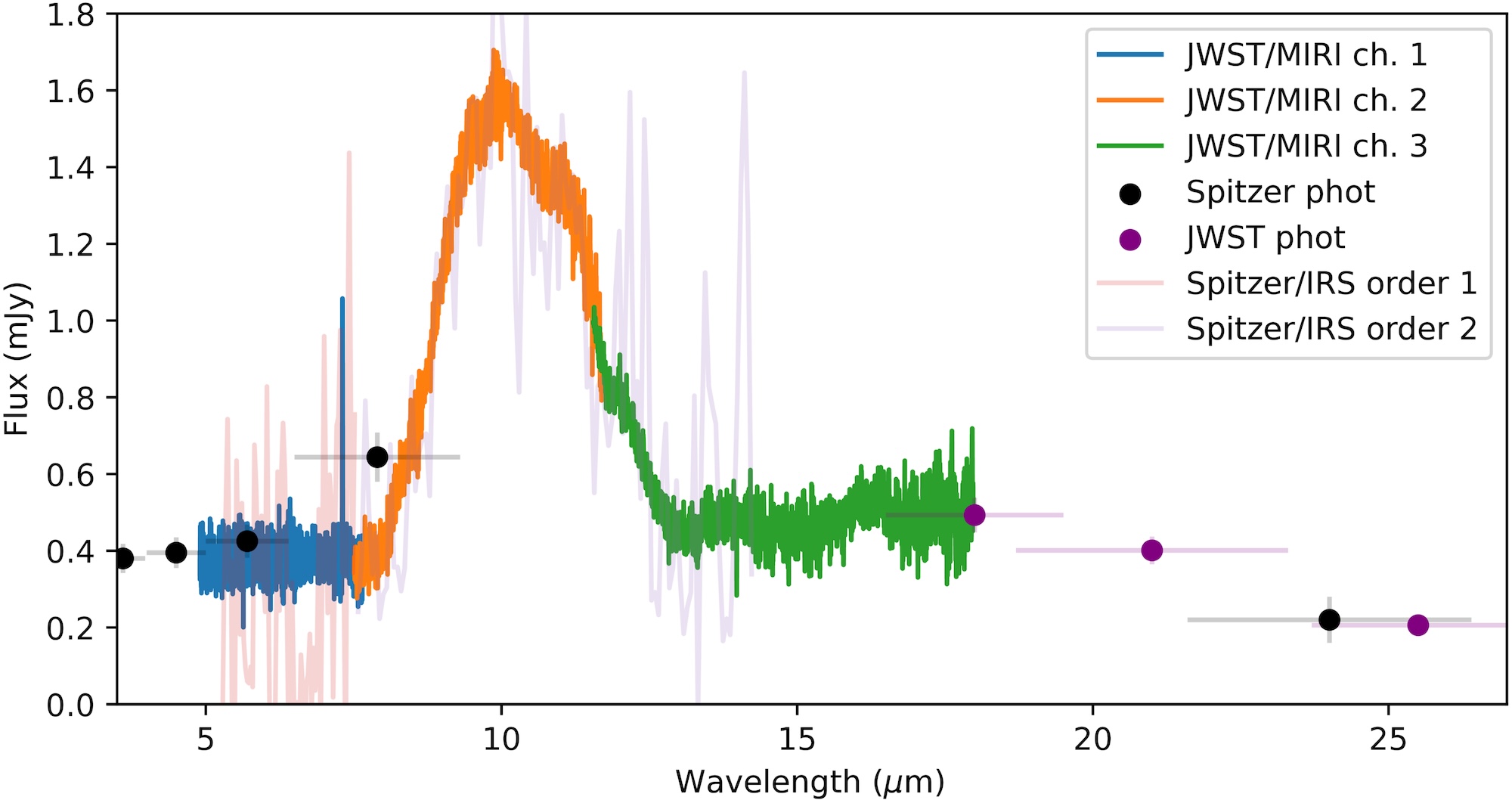
spectrum of GD 362

Mid-infrared JWST spectrum and photometry of GD 362, with additional spectral and photometric data from the Spitzer Space Telescope. Click to enlarge. [Reach et al. 2025]

Now, a team led by William Reach (Space Science Institute) has obtained JWST spectra of GD 362 to examine the material in its disk directly. Using both the Near-Infrared Camera (NIRCam) and the Mid-Infrared Instrument (MIRI), the team collected spectra of the white dwarf from 0.6 to 17 microns, with additional photometric measurements at 18, 21, and 25.5 microns. The JWST spectra show bright emission from the white dwarf at wavelengths shorter than 2.5 microns, with a clear signature of disk material at longer wavelengths, including a strong emission feature at 9–11 microns.

Reach’s team modeled the JWST spectra to constrain the mineralogy of the disk and its physical attributes. They found that the disk likely stretches from 140 to 1,400 times the white dwarf’s radius and contains both silicates and carbon, with the prominent emission feature pointing to olivine and pyroxene silicate minerals. The elements seen in the white dwarf’s atmosphere are generally similar to those observed in the disk, strengthening the connection between accretion from the disk and the metals present in the white dwarf’s spectrum.

Hydrogen Mismatch

The new JWST data furthered the investigation of GD 362’s atmospheric hydrogen and the possibility that it’s accreting water- or ice-rich material. Though water molecules have spectral features in the range studied, none of these features appeared in the JWST spectra of GD 362. This isn’t necessarily a surprise; the team showed that water molecules in the disk would quickly be split apart by GD 362’s high-energy radiation.

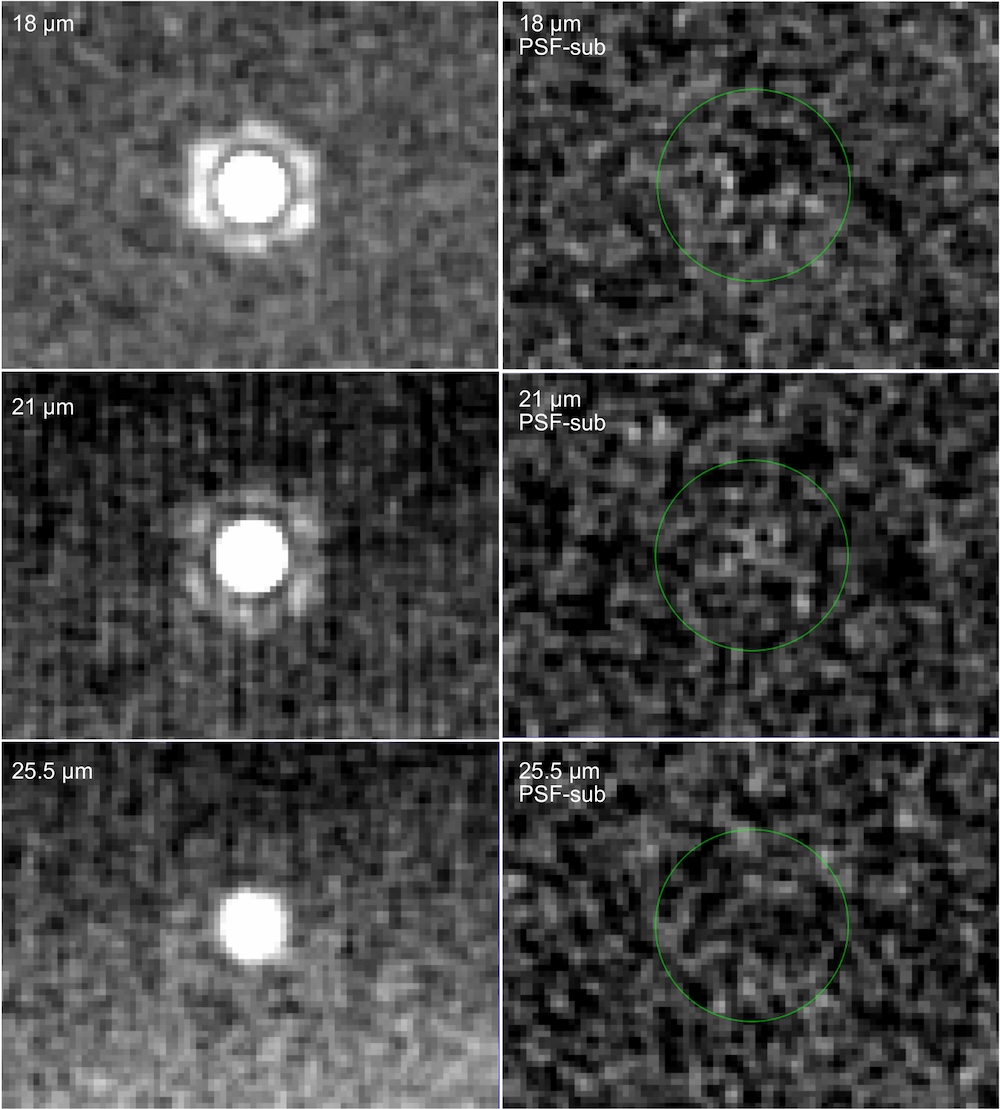
JWST images of GD 362

Left column: Three JWST images of GD 362. Right: The same images with the white dwarf’s point spread function subtracted. [Reach et al. 2025]

Curiously, though, Reach’s team found little evidence for hydrogen-rich material within the disk that could be the source of the white dwarf’s atmospheric hydrogen. Because accreted hydrogen would remain in the star’s atmosphere indefinitely, the presence of atmospheric hydrogen could be evidence that the white dwarf accreted water-rich material from its debris disk in the past, though the materials currently present in the disk are dry.

In addition to investigating GD 362’s disk, Reach and collaborators searched for planets orbiting the white dwarf. Though they found none, they were able to rule out the presence of companions with masses greater than 25 times the mass of Jupiter.

Citation

“Composition of Planetary Debris Around the White Dwarf GD 362,” William T. Reach et al 2025 ApJ 994 195. doi:10.3847/1538-4357/ae11a9

The post Investigating a Polluted White Dwarf appeared first on AAS Nova.

We Have Visitors: Interstellar Material from Nearby Debris Disks

6 February 2026 at 17:00

'Oumuamua

Traversing the galaxy from places yet known, a few interstellar objects have taken a quick dip into our solar system. These objects have inspired a frenzy of questions regarding their origins and paths that led them here. A recent study took to nearby planet-forming stellar systems as possible launching posts.

Interstellar Object Origins

As 3I/ATLAS was first spotted entering the solar system in July 2025, all eyes turned to the curious interstellar visitor. Just the third interstellar object astronomers have observed, 3I/ATLAS joins 1I/ʻOumuamua (2017) and 2I/Borisov (2019) in capturing our attention and igniting many questions regarding their origins and journeys to our corner of the Milky Way. While astronomers have characterized these objects’ compositions, sizes, and paths through the solar system, the mechanisms by which these objects leave their origin systems and travel the galaxy before arriving here are not well constrained. 

These three large bodies are just part of the interstellar material visiting the solar system — spacecraft have detected an influx of small interstellar dust particles, and while not yet directly confirmed, interstellar meteoroids burning up in Earth’s atmosphere are possible. This loose material likely originates in dusty, planet-forming disks (debris disks) around stars — rubble kicked out into interstellar space, sending chemicals, organic compounds, and perhaps even the precursors of life to other nearby systems. Understanding the origins and trajectories of such material will allow us to investigate planet formation and how developing systems may impact their environments.

Deliveries from Debris Disks

Debris disks offer ideal testbeds for tracing small bodies and dusty material through the galaxy. Interactions with large planets in debris disks can launch loose material like planetesimals and dust into interstellar space. To explore how debris disks may drive interstellar visitors to our solar system, Cole R. Gregg and Paul A. Wiegert (The University of Western Ontario) simulated how much material the 20 nearest debris disks would contribute to the interstellar object population of our solar system.

sky projection for particle arrival directions

Arrival direction on the sky for particles that reach the solar system from the 20 debris disks studied here. The arrival locations for 1I/ʻOumuamua, 2I/Borisov, and 3I/ATLAS are shown for comparison. Click to enlarge. [Gregg and Wiegert 2025]

The authors modeled the trajectories of ejected material from each debris disk within a simulated Milky Way, running the simulations backward and forward in time to trace the ejecta over 100 million years. These simulations show that material from each of the 20 systems is currently expected to be within our solar system. For interstellar objects (≥100 meters), the simulations predict that about two objects from these debris disks are currently within the inner solar system.

Trickier to spot, smaller meteoroids (≥200 microns) that would appear as meteors in Earth’s atmosphere are also expected. The only way to observationally confirm interstellar origins for meteors is based on how fast they are moving relative to the material in our solar system, or their excess velocities. Based on the simulations, many of these smaller particles have low excess velocities, making them observationally difficult to distinguish from bound solar system objects.

Observational Connections and Expectations

'oumuamua zoom in plot

Zoomed-in view focusing on the direction where 1I/ʻOumuamua entered the solar system. The interstellar object falls near the arrival directions of particles from HD 38858 and HD 166. Click to enlarge. [Gregg and Wiegert 2025]

How do these simulations compare to observations? From their analysis, the authors identified where the interstellar material from each debris disk would first enter the solar system. Comparing these to the entry locations of 1I/ʻOumuamua, 2I/Borisov, and 3I/ATLAS, ʻOumuamua appears near the entry locations for debris from HD 166 and HD 38858. (2I/Borisov and 3I/ATLAS had no such match up in this sample of debris disks.) However, tracing ʻOumuamua’s travel backward, its closest approaches to these systems are about 32 and 18 light-years away, respectively — likely too far to have originated from either system but still a clear proof of concept that we can place interstellar objects near potential systems of origin. 

Where are the expected interstellar meteoroids? Current meteor detectors including the Canadian Meteor Orbit Radar (CMOR) and the Global Meteor Network (GMN) search the sky for incoming material. While the simulations predict hundreds of meteoroid-sized particles from each debris disk currently in the inner solar system, the small collecting area of CMOR and the limiting size of grains detectable by GMN statistically require decades of observations to detect even a single interstellar meteoroid. Thus, the lack of detections thus far is not surprising, but with advanced instrumentation, discoveries of more interstellar particles and objects are imminent.

Citation

“A Catalogue of Interstellar Material Delivery from Nearby Debris Disks,” Cole R. Gregg and Paul A. Wiegert 2025 PSJ 6 309. doi:10.3847/PSJ/ae284f

The post We Have Visitors: Interstellar Material from Nearby Debris Disks appeared first on AAS Nova.

Michelangelo in Space: A Planet Carving the Fomalhaut Debris Disk?

9 December 2025 at 17:00

Fomalhaut debris disk

Editor’s Note: Astrobites is a graduate-student-run organization that digests astrophysical literature for undergraduate students. As part of the partnership between the AAS and astrobites, we occasionally repost astrobites content here at AAS Nova. We hope you enjoy this post from astrobites; the original can be viewed at astrobites.org.

Title: ALMA Reveals an Eccentricity Gradient in the Fomalhaut Debris Disk
Authors: Joshua B. Lovell et al.
First Author’s Institution: Center for Astrophysics | Harvard & Smithsonian
Status: Published in ApJ

Step 1: Understanding How to Carve Your Debris Disk

Let’s start with our solar system: the Kuiper belt, a large ring of icy asteroids, is believed to have been sculpted into its current shape by Neptune. Neptune may have previously scattered objects in the Kuiper Belt through gravitational interactions, but some of them (like Pluto) remain in an orbital resonance with Neptune. In the same way that Neptune shapes the Kuiper Belt, today’s authors believe a planet could be shaping an exo-Kuiper Belt around the star Fomalhaut.

What on Neptune is an orbital resonance, though? A planet orbiting a star has an orbital period, and the gravitational forces between nearby (astronomically speaking) objects can push these objects into a state where their orbital periods are multiples of each other. For example, Pluto and Neptune have a 2:3 orbital resonance, meaning Pluto completes two orbits for every three that Neptune does. The same can happen for the asteroids and planetesimals in the Kuiper Belt, so the same should happen in other star systems!

Step 2: Make Your Observations

If we understand how debris disks carved by exoplanets look — and we think we do — then we should be able to infer the existence of exoplanets! Today’s authors have used observations from the Atacama Large Millimeter/submillimeter Array (ALMA) of the debris disk around Fomalhaut and made some very clever calculations. We’ve known about this disk for a while, which is why today’s authors have studied it with a new analysis technique they developed.

Planeteismals — basically big rocks from a few to hundreds of kilometers across — that orbit in this disk do so with a certain eccentricity, and typically things in the same orbit would have the same eccentricity. But today’s authors were clever — they checked if there was an eccentricity gradient, meaning the planetesimals’ eccentricities depend on their semi-major axis (i.e., the mean orbit radius); we would typically not expect any eccentricity gradient for bodies orbiting a star unperturbed. The authors discovered that the gradient for planetesimals around Fomalhaut is negative, which implies the presence of a planet when you look at the maths behind gravitational interactions between planets and planetesimals.

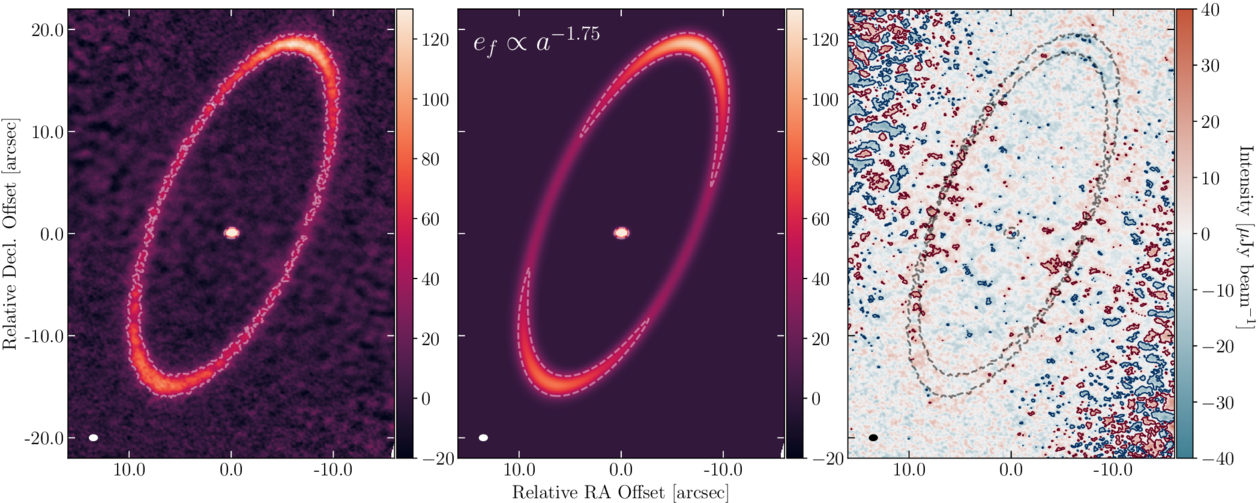
A negative eccentricity gradient means the planetesimals gather up at the point on the orbit farthest from the star (the apocenter), and since there are more planetesimals in that region, they appear brighter in the ALMA data (see Fig. 1 left); the ring also appears slightly wider. If the eccentricity gradient were positive, the same thing would happen at the point on the orbit closest to the star (the pericenter). The authors term this phenomenon the “eccentric velocity divergence.”

observed and modeled brightness of the Fomalhaut debris disk

Figure 1: Left: The observed intensity of the Fomalhaut debris disk with ALMA. Middle: the authors’ model that fits the ALMA data the best. Right: The residual (data – model) between model and data. White means there is a close match to the data (which is better). [Lovell et al. 2025]

When the authors ran their eccentric velocity divergence calculations for the Fomalhaut disk model, they compared it to observations using a Markov Chain Monte Carlo algorithm. Figure 1 shows their best-fitting model, which fits remarkably well, based on the residual (i.e., the difference between model and data) you can see on the right — including the slightly wider ring at the apocenter!

The authors tested other scenarios with different gradients and allowed for the planetesimals to oscillate their eccentricity around their orbit, but they didn’t find a better-fitting scenario.

Step 3: Find a Carving Planet

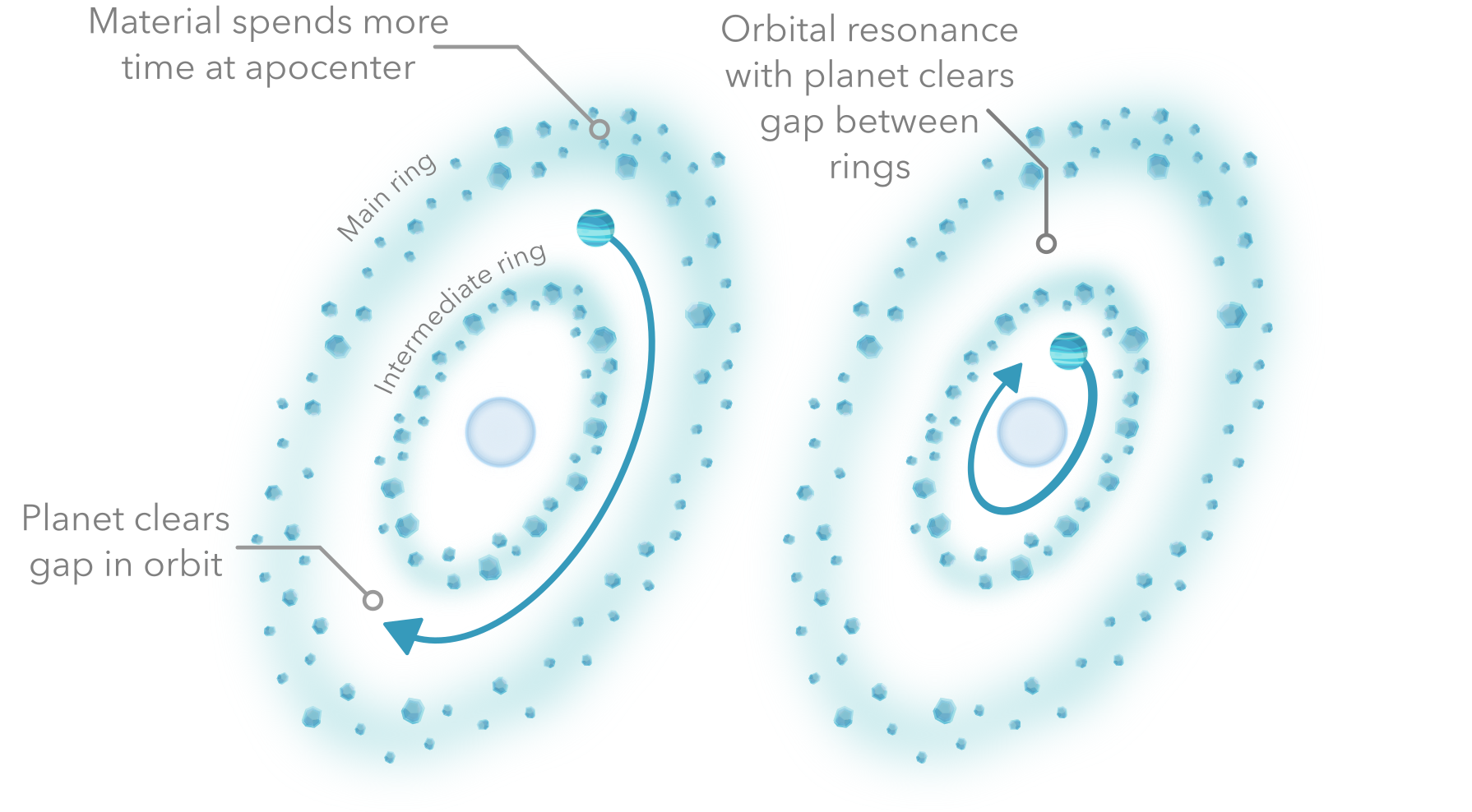
Okay, so those were the details. The authors investigated a few scenarios to see what could be causing the observed debris disk and its negative eccentricity gradient, as well as an intermediate ring sitting between the main disk and the star that recently was seen with JWST. The authors tested two scenarios: one where a planet sits between the rings and evacuates the nearby region, and another where a planet is interior to the inner ring and clears the gap through orbital resonances (kind of like Neptune!). An illustration can be seen in Figure 2.

Illustration of possible planet-based scenarios that could create the observed debris disk around Fomalhaut

Figure 2: Illustration of possible planet-based scenarios that could create the observed debris disk around Fomalhaut. One features a planet between the observed debris disk rings, and another is where the planet is interior to both and carves the gap with orbital resonances. [J. Williams]

A planet was previously thought to exist around Fomalhaut, but it is now accepted there is not one we can currently observe. The authors point out that the possible planet sculpting this debris disk could be the same planet we thought existed previously, but at a lower mass (1–16 Earth masses; almost a Neptune mass). We can’t observe a planet with these parameters yet, but maybe with future observing facilities!

Finally, the authors stress, however, that it might not be a planet causing the observed structure — it could instead be the gravity of the planetesimals in the disk. Unfortunately, existing models are not equipped to explore this scenario, which is why the authors are planning to develop tools to investigate this next.

Original astrobite edited by Sandy Chiu.

About the author, Joe Williams:

I’m a third-year PhD student at the University of Exeter in the UK, and I study protoplanetary discs — mainly the tiny dust grains and their ices! In my spare time, I’m a climber, crocheter, and reader of sci-fi and fantasy books. My favourite sci-fi series is The Expanse!

The post Michelangelo in Space: A Planet Carving the Fomalhaut Debris Disk? appeared first on AAS Nova.

A Dusty Disk Points to a Potential Planet

27 August 2025 at 17:00

Beta Pictoris debris disk

JWST observations of a nearby star’s debris disk recently revealed what may be one of the lowest-mass planets ever imaged.

How to Find a Small Planet

Though it remains a formidable technical challenge, astronomers have gotten fairly good at taking images of planets around other stars by carefully blocking the light of the host and searching for the small points of light that remain. However, though this technique is well-suited for discovering large, bright, high-mass planets, their lower-mass cousins below the size of Jupiter remain challenging to detect. To get pictures of these smaller worlds, astronomers must resort to detective work and search for signs of their presence through indirect means.

One promising approach is to look not for the planet itself, but rather its effect on the dusty disk of material around the star. These structures, called debris disks, are constantly replenished by planetesimals colliding and grinding one another to dust. If a planet happens to orbit within this disk, it will “stir” the dust into distinctive patterns including rings and spiral arms. If astronomers observe that a star has a debris disk with gaps or spirals, they can analyze those substructures and deduce where a planet might be hiding.

The Star of this Show: TWA 7

TWA 7 debris disk and candidate planet

A mid-infrared image of TWA 7’s debris disk and candidate planet. [ESA/Webb, NASA, CSA, A.M. Lagrange, M. Zamani (ESA/Webb); CC BY 4.0]

TWA 7 is a tiny M-dwarf star just over 100 light-years from Earth. Data from the Spitzer Space Telescope revealed that TWA 7 was unusually bright when observed at infrared wavelengths, which hinted that there might be a warm, dusty disk surrounding the star. Follow-up observations with the Hubble Space Telescope and several major ground-based facilities confirmed that this star successfully met all the conditions listed above: TWA 7 is surrounded by a face-on debris disk with rings and a faint spiral arm. Using all of this information, astronomers predicted that a Saturn-mass planet might lie in a low-density pocket of the disk just beside the star.

This prediction led to a search with JWST last summer. Initial observations taken at mid-infrared wavelengths revealed a bright dot sitting near the predicted location of the planet. However, with just these observations, it was hard to confidently say that this source wasn’t just a distant background galaxy that happened to appear there by chance. To help settle the matter, JWST took another look in two different near-infrared wavelength bands a few weeks later.

JWST observations of TWA 7

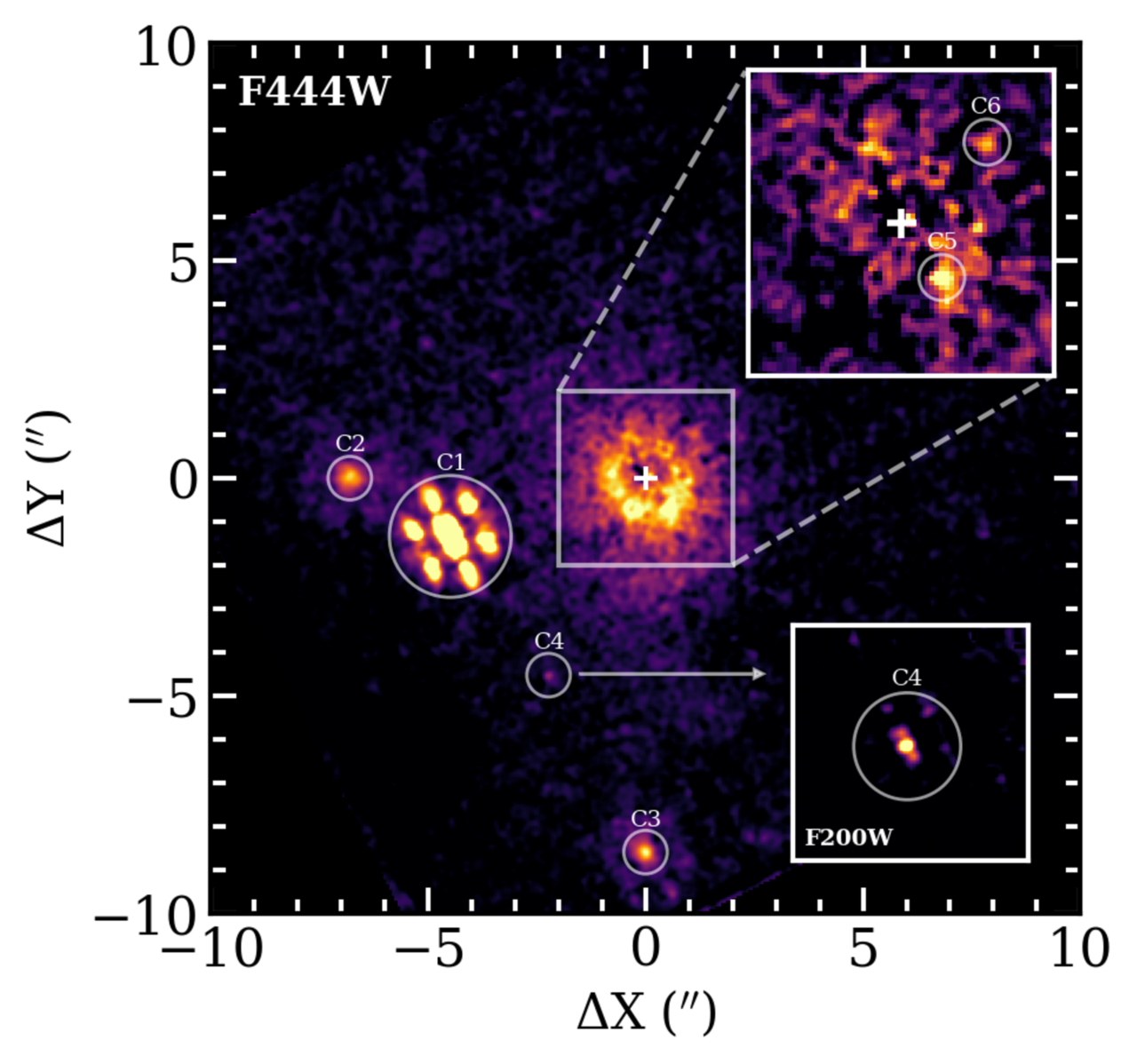
New JWST observations of TWA 7. The sources labeled C5 and C6 are planet candidates. C6 is located at the same place as the planet candidate identified in mid-infrared observations, making it a strong candidate. C5 requires further observations to understand if it is real or an artifact. Click to enlarge. [Crotts et al. 2025]

Revisiting TWA 7

A team led by Katie Crotts (Space Telescope Science Institute) recently published these later observations. These new data show a dot in the exact same place as before, and with a color that’s much more planet-like than galaxy-like.

While this adds plenty of evidence to the planetary interpretation, the team cautions that one more set of follow-up observations is needed to be confident that this is, in fact, a planet. Assuming future observations back up these first hints, however, this would be the lowest-mass planet ever imaged, and a happy conclusion to a detective story that started with dust.

Citation

“Follow-Up Exploration of the TWA 7 Planet–Disk System with JWST NIRCam,” Katie Crotts et al 2025 ApJL 987 L41. doi:10.3847/2041-8213/ade798

The post A Dusty Disk Points to a Potential Planet appeared first on AAS Nova.

❌