❌

Normal view

Can Arid Planets Keep Their Cool?

14 July 2026 at 17:00

side-by-side images of Venus's surface today and an imagining of what its surface might have looked like in the past

Editor’s Note: Astrobites is a graduate-student-run organization that digests astrophysical literature for undergraduate students. As part of the partnership between the AAS and astrobites, we occasionally repost astrobites content here at AAS Nova. We hope you enjoy this post from astrobites; the original can be viewed at astrobites.org.

Title: Carbon Cycle Imbalances on Arid Terrestrial Planets with Implications for Venus
Authors: Haskelle T. White-Gianella and Joshua Krissansen-Totton
Authors’ Institution: University of Washington
Status: Published in PSJ

The Carbon-Cycle Thermostat

When discussing the habitability of planets, we usually focus on the habitable zone, the region around a star where a planet can host a temperature suitable for supporting liquid water on its surface. Yet, being in the right place doesn’t necessarily guarantee that a planet will be habitable.

A planet also needs the right atmospheric composition to sustain the necessary temperatures for hosting liquid water. A key mechanism found on Earth for maintaining this composition is the geologic carbon cycle, which acts as a built-in climate control system. This cycle begins with volcanic eruptions releasing carbon dioxide (CO2), which then dissolves in rainwater and forms a weak acid that weathers rocks on continents. The weathering products wash into oceans, where they form carbonate rocks, locking carbon away. Eventually, plate tectonics recycles some of that carbon back to volcanoes. The weathering process works faster when the planet is warmer, thus regulating the amount of CO2 and stabilizing the climate over long periods of time (but it should be noted that it can take up to a few hundred thousand years to rebalance this slow carbon cycle through the weathering process).

An important caveat is that the weathering process requires sufficient liquid water on the planet’s surface, so what happens in the case for planets with shallower oceans? Low-mass M dwarfs, the most common type of star found in the galaxy, are expected to host less-massive disks and therefore lower water inventories for forming planets. If more “dry” planets are indeed a more likely outcome of planet formation, we’d want to know how their arid conditions influence their long-term evolution and habitability.

Creating Carbon-Tracking Models

The authors built a model that tracks how water and CO2 move between a planet’s interior, oceans, and atmosphere over 4.5 billion years. The model notably includes the following:

  • A sophisticated weathering model that accounts for how runoff can limit rock weathering, improving upon previous models that only included a temperature dependence on weathering
  • Wind-driven evaporation limits that influence the amount of water evaporation in addition to sunlight-driven evaporation
  • Multiple deep water cycle parameterizations that explore how water moves between the interior and the surface

The model tests for four initial surface water inventories (0.1%, 1%, 10%, and 100% of Earth’s oceans) and then simulates how the surface water, atmosphere, and climate evolve over time.

A Critical Water Threshold

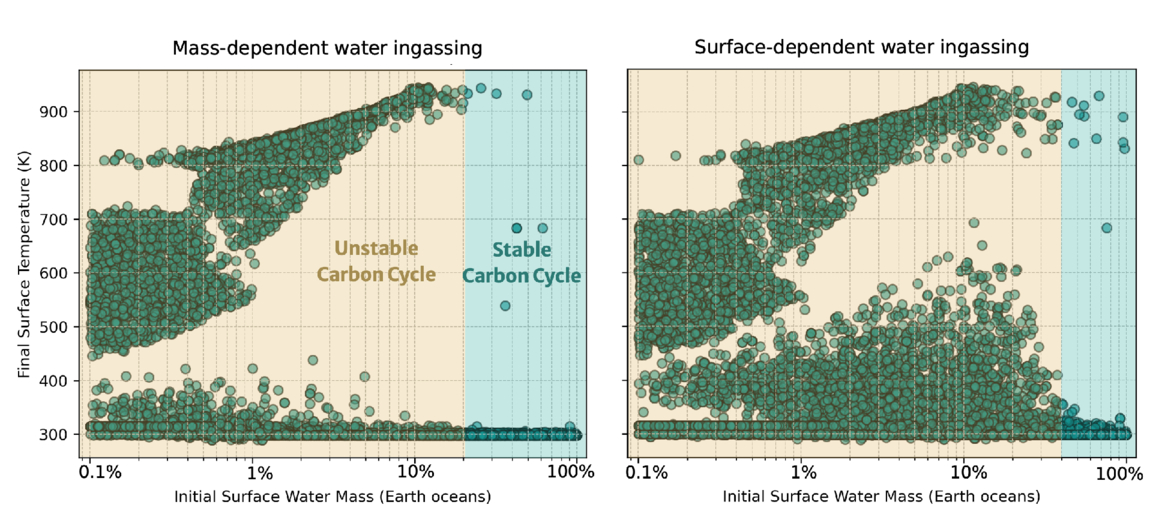
The models reveal that planets require at least 20–50% of Earth’s ocean mass to maintain a balanced carbon cycle. Below this threshold, the carbon cycle becomes unbalanced, leading to devastating consequences for habitability (Figure 1).

two plots of final surface temperature as a function of initial surface water mass

Figure 1: Final surface temperature after simulating 4.5 billion years of evolution as a function of initial water inventory for Earth-like planets. Each dot represents a model run with different assumptions (total carbon inventory, temperature dependence of weathering, soil age, etc.). The yellow region shows where most simulations result in uninhabitable surface temperatures from an unbalanced carbon cycle, and the cyan region shows where most simulations result in habitable surface temperatures and a balanced carbon cycle. The left and right plots show the results for two different parameterizations of the deep water cycle implemented in the model. [White-Gianella & Krissansen-Totton 2026]

For the more arid planets, models reveal a concerning runaway process. Limited surface water reduces precipitation and slows rock weathering. Weathering cannot keep up with volcanic CO2 release, causing CO2 buildup and warming of the atmosphere. The cycle repeats, driving runaway warming until all water evaporates.

Important Implications (Within and Outside Our Solar System)

Looking within the solar system, the results offer an explanation for how a potentially habitable Venus could have transitioned into its current inhospitable state. If Venus had formed with an initial water inventory below this critical threshold of 20–50% of Earth’s ocean mass, then its carbon cycle would have become unbalanced, creating the CO2 inferno seen on Venus today.

In future exoplanet studies, telescopes like the Habitable Worlds Observatory might detect ocean glint (specular reflection from liquid water) or measure land fraction from light curves. Finding a planet in the habitable zone but with limited ocean coverage would likely be bad news, as the planet could be quietly losing its grip on habitability. Astronomers may want to be more careful when looking at seemingly promising planets within their habitable zones.

Original astrobite edited by Natalie Price.

About the author, Jared Bull:

I am a 2nd-year PhD student at Johns Hopkins University. I study brown-dwarf variability and am interested in using time-series observations to uncover dynamic processes within their atmospheres. In my free time I like to read, cook, and do astrophotography.

The post Can Arid Planets Keep Their Cool? appeared first on AAS Nova.

This Strange Exoplanet Has Revealed “the Clearest Evidence To Date” of Something Many Astronomers Suspected

1 July 2026 at 13:59

An exoplanet is exerting a magnetic influence on its host star in a manner opposite to what astronomers normally observe, according to researchers at the Institute of Astrophysics of Andalusia (IAA-CSIC).

In a recent paper published in Science, IAA-CSIC researchers revealed how the exoplanet GJ 436 b is affecting its host star’s behavior in a never-before-seen way. In their work, the team developed a novel method to estimate an exoplanet‘s magnetic field strength, an important factor in determining habitability.

“Until recently it was thought that it was mainly the star that influenced the planet,” said Rafael Luque, an IAA-CSIC researcher and one of the new study’s co-authors.

Luque adds that his team’s results now offer “the clearest evidence to date of something that had already been suspected: that the opposite can also happen and that a nearby planet can alter the environment of its star.”

Life and Magnetic Fields

While the most obvious ingredients for a habitable planet are water and a breathable atmosphere, other elements are less apparent to us based on our human experience. Our planet’s invisible magnetic field protects us from the solar wind and holds the atmosphere together.

While Earth’s magnetic field guided the evolution of its atmosphere, Mars provides an example of what the loss of a magnetic field can do to an otherwise potentially habitable planet. When the Martian magnetic field disappeared four billion years ago as the planet’s core rapidly cooled, the atmosphere dissipated, followed by the loss of surface water.

As shown by the fates of two cosmic neighbors like Earth and Mars, a stable magnetic field is a key element of habitability.

exoplanet star
With its proximity and its host star’s low mass, GJ 436 b exhibits considerable influence in the inverse of the normal planet-star relationship. Credits: IAA-CSIC/LampScience

Observing Exoplanet Magnetic Fields

Detecting magnetic fields on distant exoplanets has proven more challenging for astronomers than other observations, such as atmospheric composition. In their new paper, the IAA-CSIC team provides the first conclusive evidence of an exoplanet’s magnetic field, observed through its impact on the host star.

“In particular, we have observed that GJ 436 b, an exoplanet similar to Neptune that orbits very close to its star, causes regular changes in the brightness and energy emitted by the star at certain wavelengths,” explained lead author Daniel Revilla, an IAA-CSIC researcher who led the study as part of his doctoral thesis.

GJ 436 b provided the team with measurable signals that allowed them to infer that the exoplanet had a magnetic field and estimate its strength. The IAA-CSIC team analyzed sixteen years of spectroscopic observations of the GJ-436 system for their research, collected by the CARMENES instrument at the Calar Alto Observatory.

“Despite its smaller size, GJ 436 b would have a magnetic field between 2.33 and 27 times more intense than that of Jupiter,” said co-author Pedro J. Beloved, a researcher at the IAA-CSIC.

A Strange Interaction

In the paper, the researchers demonstrate how, in a very close orbit, a planet can flip the normal planet-star relationship, with the planet controlling the influence of gravity, radiation, and magnetic fields between the two. As the exoplanet interacts with its host star, it injects energy into the star’s chromosphere to produce a phenomenon like a stellar aurora.

This strange interaction has only been measured periodically, occurring in eight-year cycles, with observations in 2008, 2016, and 2024. Intriguingly, these years correlate to phases of the host star’s magnetic cycle, which the researchers believe affects the intensity.

“Until now, measuring the magnetic field of an exoplanet was extremely difficult,” Devilla concluded. “This property is key to knowing if a planet can protect its atmosphere and, ultimately, if it could harbor life.”

The paper, “Constraining an Exoplanet’s Magnetic Field Using Star-Planet Interactions,” appeared in Science on June 25, 2026.

Ryan Whalen covers science and technology for The Debrief. He holds an MA in History and a Master of Library and Information Science with a certificate in Data Science. He can be contacted at ryan@thedebrief.org, and follow him on Twitter @mdntwvlf.

Weather Forecast for the Habitable Worlds Observatory: Cloudy with a Chance of Biosignatures

3 September 2025 at 17:00

Earth's clouds seen from space

Editor’s Note: Astrobites is a graduate-student-run organization that digests astrophysical literature for undergraduate students. As part of the partnership between the AAS and astrobites, we occasionally repost astrobites content here at AAS Nova. We hope you enjoy this post from astrobites; the original can be viewed at astrobites.org.

Title: Clouds Can Enhance Direct-Imaging Detection of O2 and O3 on Terrestrial Exoplanets
Authors: Huanzhou Yang, Michelle Hu, and Dorian S. Abbot
First Author’s Institution: University of Chicago
Status: Published in ApJ

In the hunt for life beyond Earth, studying exoplanet atmospheres is one of our most powerful tools. The atmosphere of an exoplanet acts as a window into its environment and allows astronomers to take a guess at what processes are shaping the planet’s climate, chemistry, and thus, its potential for habitability. The gases present in the planet’s atmosphere impart a unique spectral fingerprint on the light that passes through the atmosphere and allows us to identify what gases might be present and look for possible signs of life.

JWST is already hard at work looking at distant worlds and gathering spectroscopic data for us to analyse. It has already observed several exoplanets and recorded the light that passed through their atmospheres. This has not only sparked a debate over what could be interpreted as the first possible signs of biological activity, but has also given us a glimpse of worlds that are remarkably different from our own.

However, JWST is mostly limited to observing the atmospheres of transiting exoplanets. That means planets that orbit close to their host star and are more or less directly edge-on, as viewed from us, so that they transit across the face of the star. The only planets that the telescope is able to observe directly are big, young, and hot planets farther from their host star, at distances more resembling those of the outer planets in our solar system, like Saturn or Uranus. If only we had a telescope powerful enough to image a potentially habitable planet directly and analyse the light reflected from it.

The Habitable Worlds Observatory

This is where the Habitable Worlds Observatory (HWO) will come in. Now, I know what you are thinking. Why must astronomers always look towards greener pastures bigger telescopes when we already have perfectly functional space telescopes in orbit or practically on the launch pad? Well, it is true that the next flagship space telescope from NASA, the Nancy Grace Roman Space Telescope, is designed to directly image exoplanets and analyse their atmospheres. But space telescopes can take decades to plan and are often built on lessons learned from previous missions. Roman, with its 2.4-meter primary mirror and coronagraph, will be able to observe planets similar in size and orbital distance to Jupiter and will get us some of the way, for sure, but not all the way. At three times the mirror size, HWO, NASA’s proposed successor to Roman that is planned for the 2040s, will carry the torch even further and be able to directly image Earth-like planets in the habitable zone, where liquid water can exist on the planet’s surface.

But It Might Be Cloudy Tomorrow

This brings us to today’s article. If the HWO is going to potentially observe Earth analogues, we might expect it to run into the same issue that plagues everyone living in the UK for most of the year — clouds. Clouds in the atmosphere of an exoplanet can sometimes cause trouble when trying to analyse the light. Cloud particles scatter different wavelengths of light differently, and cloud variability creates dynamic changes in the observed brightness that can make it hard to know what exactly you are looking at. Clouds can also mean varying levels of opacity to look through depending on cloud composition, and they can hide underlying atmospheric properties such as water content beneath a thick cloud layer. For transmission spectroscopy, even a thin layer of clouds can disrupt the measurements as the light has to travel a long distance through the atmosphere. However, for direct imaging, the effect of clouds is perhaps more nuanced. While a thick cloud deck will block the signal from whatever gas lies beneath it, it will also increase the overall albedo of the planet and make it easier to detect the gas above. This means that cloud height and type are both critical variables in understanding atmospheric properties of exoplanets, which is what the authors of today’s article set out to investigate.

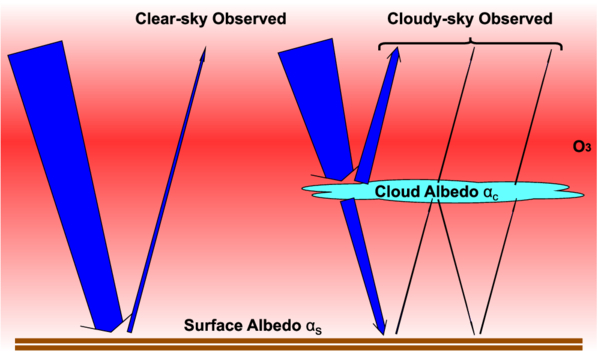
To understand how clouds affect the ability to detect signs of life on distant Earth-like planets, the authors used computer simulations. They focused on two gases, molecular oxygen (O2) and ozone (O3). Both gases are often regarded as biosignatures, although their astrobiological significance has been debated. The authors first used a tool that simulates how a telescope like the HWO might observe an Earth-like planet around a star 15 parsecs away. This tool predicts how light bounces off a planet’s surface and atmosphere, and whether the two gases would show up clearly in the reflected light. Next, they created realistic cloud conditions using a cloud microphysics model. This model calculates how clouds might form and behave depending on factors like surface pressure or how much sunlight the planet gets. With this they were able to change things like cloud height and particle size. They then combined the two tools by adding the simulated clouds into the observations model and building a mathematical model to help explain what they saw in the simulations. The sketch for their model can be seen in Figure 1.

diagram showing how clouds affect the amount of reflected light from an exoplanet

Figure 1: Clouds can affect the amount of reflected light (albedo) from the imaged planet. Depending on the cloud height and particle size, this can have a big impact on the observability of different species of gas in the atmosphere. Here the blue arrows indicate the amount of light entering the atmosphere and being reflected. The arrows get thinner from tail to head, representing absorption in the atmosphere. Depending on the presence of clouds, a varying amount is reflected back. The red colour indicates the assumed distribution of ozone, O3, which is concentrated at a high altitude. [Yang et al. 2025]

A Cloudy Sky Can Actually Be a Good Thing

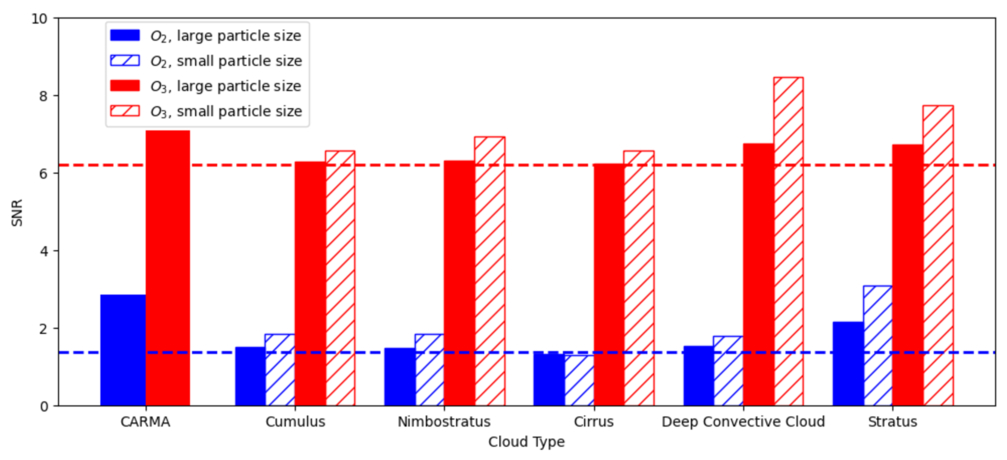
The researchers discovered that low clouds can actually make gases like oxygen and ozone easier to detect, because these clouds reflect more light without blocking the gases above them. On the other hand, high clouds can make it harder since they can hide the gases from view. They tested different cloud types using real data from Earth as seen in Figure 2. They looked at five common cloud types, like stratus (flat and low), cirrus (high and wispy), and deep convective clouds (tall, thunderstorm-like), and compared them to their model clouds (labelled as CARMA in the figure).

plot demonstrating how different types of clouds affect our ability to detect oxygen and ozone on an Earth-like exoplanet

Figure 2: The figure shows how different types of clouds affect our ability to detect oxygen (blue) and ozone (red) on an Earth-like planet. The dashed lines show the results without clouds, while the bars show what happens when clouds are present. Solid bars represent larger cloud droplets, and striped bars represent smaller ones, which reflect more light. The figure shows that most cloud types — especially low clouds like stratus and thick storm clouds — actually make it easier to detect these gases, particularly when droplets are small. Only high, thin clouds (cirrus) slightly reduce oxygen detection, and even then, the effect is small. This is the article’s main finding: while clouds can block light in some observation methods, for direct imaging of reflected light, they often help us see signs of life better. The cloud types are based on real Earth data while the authors’ simulated cloud model is labelled as CARMA. [Yang et al. 2025]

They found that most clouds improved detection, especially if the cloud droplets were small (as they reflect more light). Stratus clouds and deep convective clouds gave the strongest boost to detection, because they have a lot of water and are either low (stratus) or extend through many layers (deep convective). Ozone saw the biggest bump in detectability as it is concentrated higher in the atmosphere, which means that it is in the region above most clouds where the increased reflection from the cloud layer below makes it easier to spot. This means that unlike the case for transit spectroscopy where clouds interfere with the detection of gases, for direct observations of the reflected light, clouds may actually be a good thing. This insight into the role of clouds in exoplanet atmospheres not only refines our current understanding but also helps guide the design of future telescopes, like the HWO, and our search for life on these remote worlds.

Original astrobite edited by Maria Vincent.

About the author, Kasper Zoellner:

I have a Master of Science in astronomy and I am currently working towards a PhD in physics and educational science. My greatest passion is the search for exoplanets and how stellar variability may influence the possibility of life. I am also interested in science outreach, education, and discussing what sci-fi novel to read next!

The post Weather Forecast for the Habitable Worlds Observatory: Cloudy with a Chance of Biosignatures appeared first on AAS Nova.

Planets Around Small Stars Even Less Likely to Have Atmospheres Than Previously Thought

23 June 2025 at 17:00

Illustration of a planet around a red dwarf star

Which of the nearly 6,000 known exoplanets have atmospheres? New research suggests that small, rocky planets around the smallest and coolest stars are even less likely to hang on to their atmospheres than suggested by previous research. This result will help to guide the selection of target exoplanets for atmospheric characterization.

Approaching a Milestone

plot of the masses, orbital periods, and detection methods for currently confirmed exoplanets

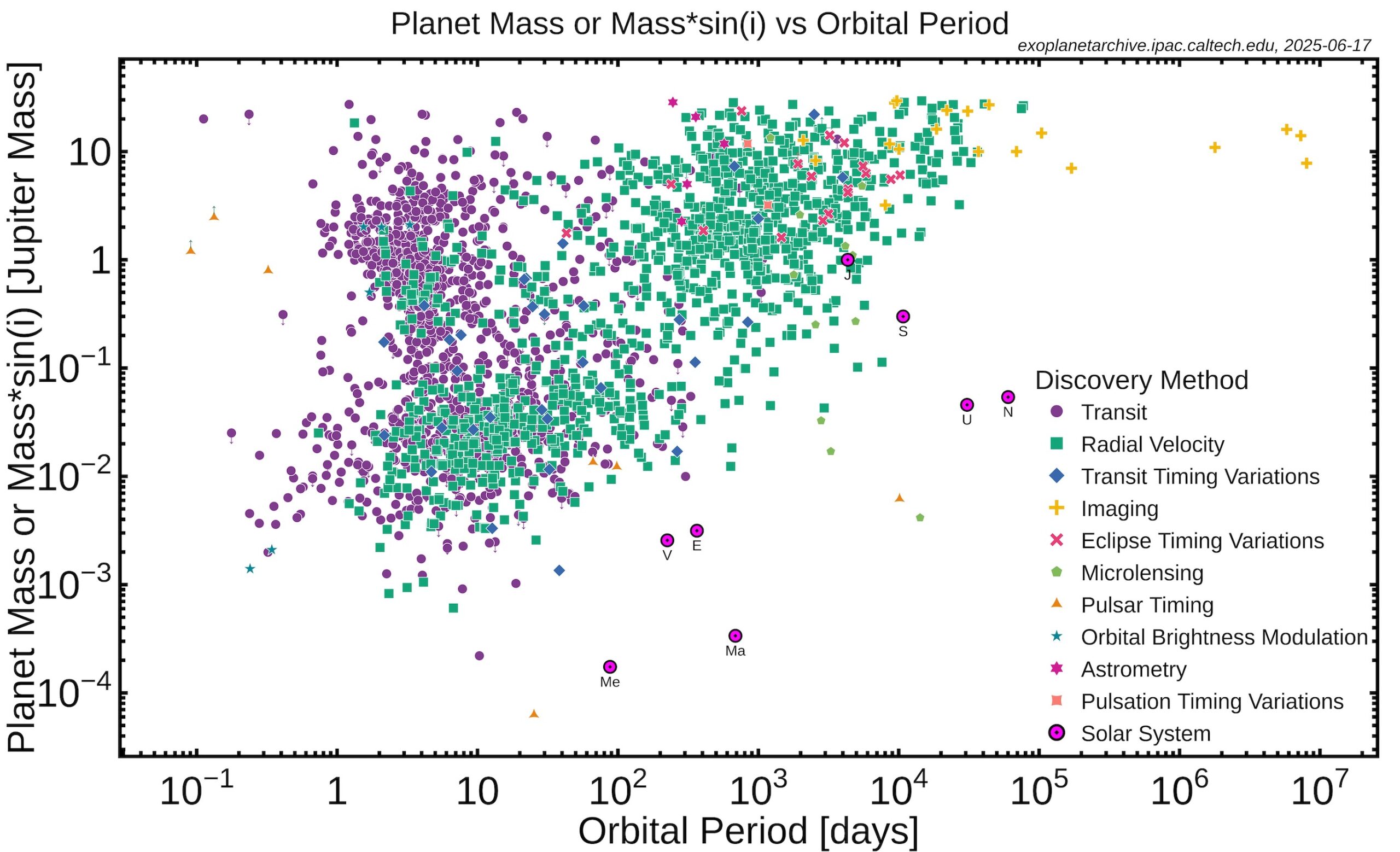
Mass, period, and detection method for confirmed exoplanets as of 17 June 2025. Click to enlarge. [Exoplanet Archive/Caltech/NASA]

Today, the Exoplanet Archive reports that humanity has discovered 5,921 exoplanets, bringing us only a handful of detections away from the remarkable milestone of 6,000 known exoplanets. Though just a small fraction of the hundreds of billions to trillions of worlds estimated to occupy our galaxy, this planet sample is ripe for the search for atmospheres, habitable surfaces, and even life. But where to look?

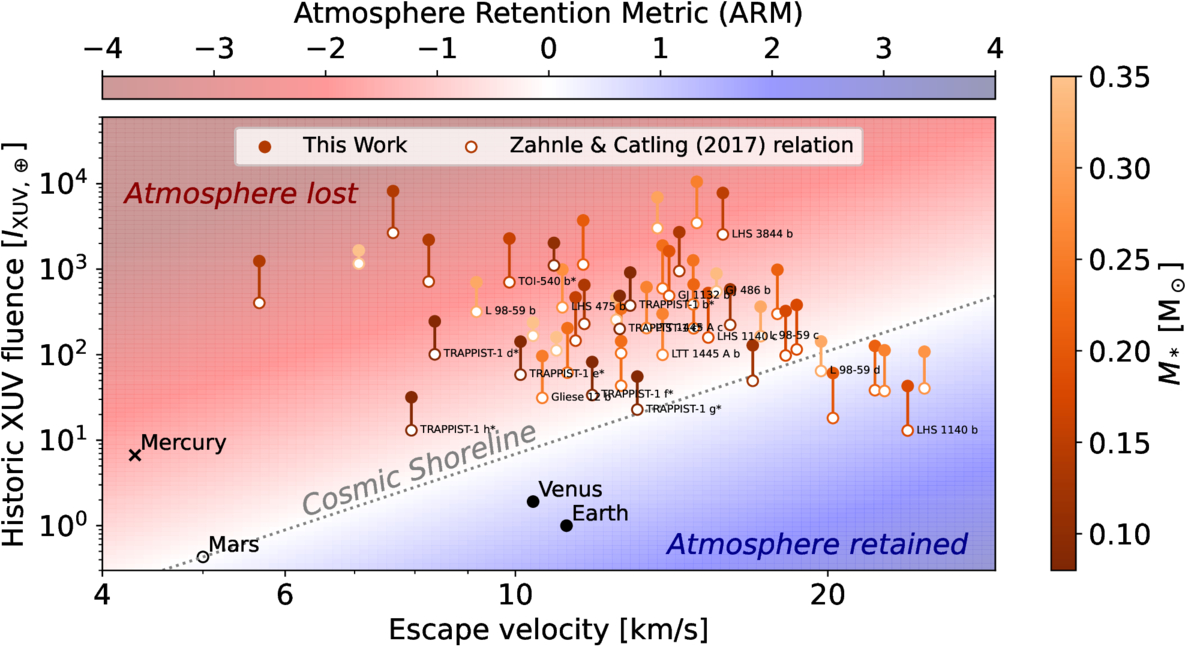
When seeking planets with atmospheres, researchers must consider how a planet has fared in its lifelong battle between gravity and radiation. Massive planets orbiting calm stars are more likely to have atmospheres than lightweight planets around active stars. Astronomers define the cosmic shoreline as the dividing line between planets with atmospheres and planets without, in terms of escape velocity and the extreme-ultraviolet flux of the star.

Charting the Cosmic Shoreline

To predict on which side of the cosmic shoreline a particular planet lies, it’s not enough to know the current extreme-ultraviolet flux of its host star. A star’s extreme-ultraviolet flux changes over time, and integrating these changes over the lifetime of a planet yields its position along the shoreline. In a new research article, Emily Pass (Massachusetts Institute of Technology) and collaborators have suggested that this integration hasn’t been performed correctly for certain planets.

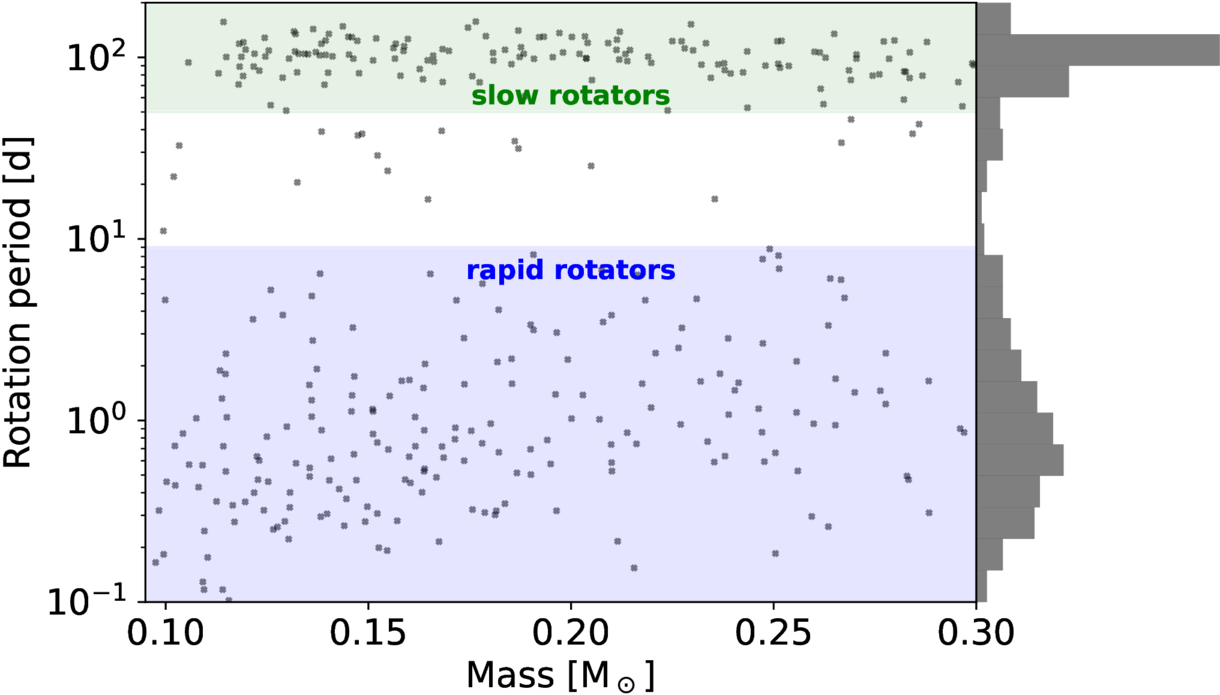
plot showing the rotation periods of M dwarf stars as a function of mass

Rotation periods of M dwarfs with masses less than 0.3 solar mass. The lack of M dwarfs with rotation periods between 9 and 50 days suggests a rapid transition between the two regimes. Click to enlarge. [Pass et al. 2025]

As stars age, they spin more slowly, and this slowdown is accompanied by a decrease in atmosphere-stealing stellar activity. For all stars down through early type M dwarfs, the slowdown is uniform, but research has shown that for mid-to-late M dwarfs, the transition from fast to slow rotation is sudden. Pass and coauthors suspected that this difference could impact how much radiation the planets of mid-to-late M dwarfs receive over their lifetimes.

Crossing the Line

Pass’s team estimated the flux of mid-to-late M dwarfs during two phases of their lives: the “saturated” phase, during which the stars rotate rapidly and their high-energy flux does not scale with their rotation rate, and the “unsaturated” phase, during which the high-energy flux declines as the rotation rate slows. The team consulted the literature to find the X-ray flux of M dwarfs during the two phases, then used a statistical approach to estimate how long the stars spend in each of these phases. The team also considered the impact of stellar flares as well as the stars’ lengthy pre-main-sequence phase, during which their overall luminosity is higher than it is once the star has fully contracted and begun its main-sequence lifetime.

positions of exoplanets relative to the cosmic shoreline

Previous and new positions of known exoplanets orbiting mid-to-late M dwarfs relative to the cosmic shoreline. Click to enlarge. [Pass et al. 2025]

Ultimately, these factors mean that it’s more challenging than previously predicted for planets around mid-to-late M dwarfs to hold on to their atmospheres. This recalculation even pushed some planets from one side of the cosmic shoreline to the other. The team also noted that certain planets still tagged as potentially having atmospheres may in reality be gaseous rather than terrestrial, highlighting the need for more work to characterize these worlds and guide the selection of target exoplanets for JWST and other sensitive telescopes.

Citation

“The Receding Cosmic Shoreline of Mid-to-Late M Dwarfs: Measurements of Active Lifetimes Worsen Challenges for Atmosphere Retention by Rocky Exoplanets,” Emily K. Pass et al 2025 ApJL 986 L3. doi:10.3847/2041-8213/adda39

The post Planets Around Small Stars Even Less Likely to Have Atmospheres Than Previously Thought appeared first on AAS Nova.

❌