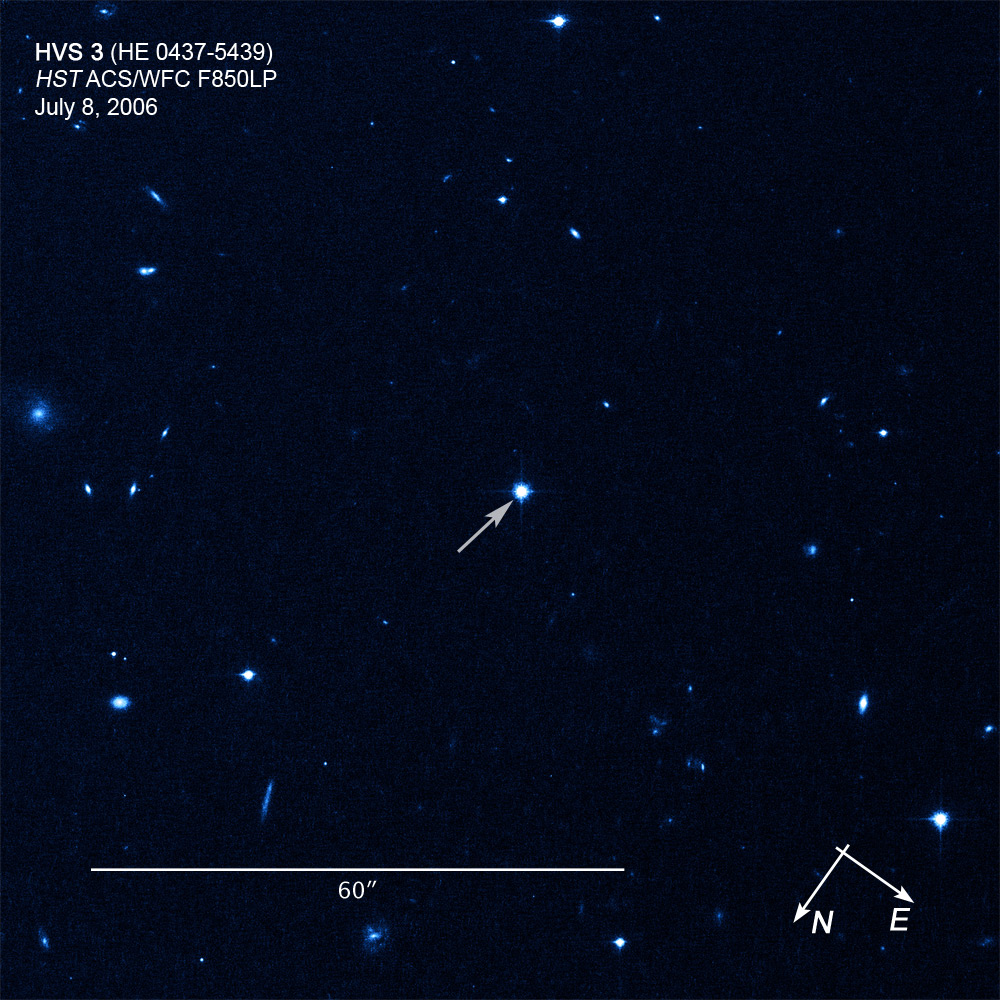
Zooming through the galaxy faster than they should, hypervelocity stars are a curious population of stars whose origins are often difficult to determine. A recent study presents the first evidence of an old, low-mass hypervelocity star launched from the Milky Way’s center, providing clues into this elusive set of fast-moving stars.
Astronomers have caught a number of hypervelocity stars zipping through the Milky Way since their first discovery in 2005. With speeds fast enough to escape the galaxy, hypervelocity stars were launched off course by some strong dynamical interaction. One such method, known as the Hills mechanism, predicts that when a binary star system approaches the Milky Way’s central supermassive black hole, one binary member is captured by the black hole and the other is flung away with high velocity.
However, constraining a hypervelocity star’s origin to the galactic center is limited by uncertainties in distances and proper motions, muddling how well researchers have been able to trace their orbits backward. Among a number of candidate galactic center–origin hypervelocity stars, only one has been confidently identified as having been kicked from the galaxy’s center. Intriguingly, this hypervelocity star and most galactic center–origin candidates are young, massive stars — old, low-mass hypervelocity stars from the galactic center have yet to be identified.
What does this dearth of old, low-mass zooming stars mean? Either stars in the galactic center are preferentially young and massive, with fewer than expected old and small stars, or low-mass hypervelocity stars are missed by selection effects, challenging to detect in current surveys. Searching for hypervelocity stars with higher precision and sensitivity may allow astronomers to tease out this missing population and trace back more zooming stars to a Hills mechanism origin.
Discovering An Old Hypervelocity Star
Leveraging high-quality spectra from the Dark Energy Spectroscopic Instrument (DESI) survey and precise astrometry from Gaia, Shunhong Deng (University of Chinese Academy of Sciences; China West Normal University) and collaborators reported the discovery of the hypervelocity star DESI-HVS1. From the spectroscopic and astrometric analyses, the authors determined that DESI-HSV1 is a ~14-billion-year-old low-metallicity star with a mass about 80% that of the Sun’s, moving through the galaxy at 523 km/s.
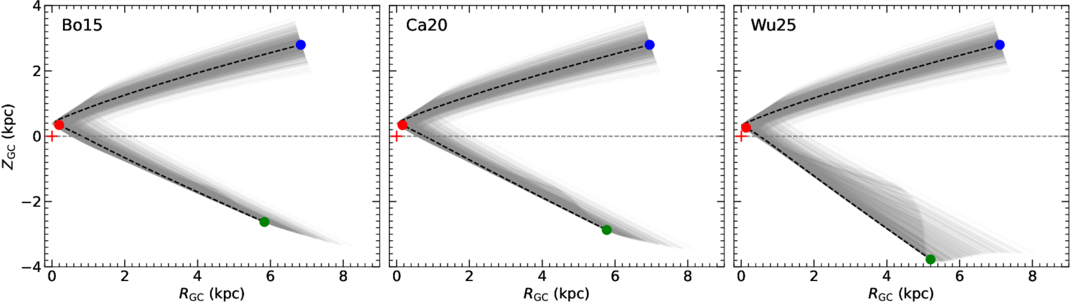
Backward-integrated orbits of DESI-HVS1 for three different galactic potential models. The blue, red, and green points show the star’s current position, closest approach to the galactic center, and position 50 million years ago, respectively. Click to enlarge. [Deng et al 2026]
Exploring the possible origins of this hypervelocity star, the authors integrated the star’s orbit backward in time for one billion years. The backward orbit integrations show the star approaching the galactic center where it then turns around, traveling away faster than the local escape velocity of the galaxy. Even when varying the galactic potential and constants, all orbit integrations suggest DESI-HVS1’s motion through the galaxy is most naturally explained by the Hills mechanism.
While more refined galaxy models and comparison to other candidate galactic center–origin hypervelocity stars are necessary to fully confirm its origins, DESI-HVS1 provides the first compelling evidence for an old, low-mass hypervelocity star candidate consistent with a galactic center launch. This suggests that the observed lack of such stars is likely not a reflection of the Milky Way’s central stellar population, but rather a consequence of observational constraints making such small hypervelocity stars particularly difficult to detect. As large spectroscopic and astrometric surveys continue to advance, the sample of galactic-center hypervelocity star candidates will grow, enabling further exploration of the stellar environment and dynamical processes at the Milky Way’s core.
Citation
“An Old, Low-mass, Metal-poor Hypervelocity Star Candidate Consistent with Galactic Center Origin,” Shunhong Deng et al 2026 ApJL 1003 L9. doi:10.3847/2041-8213/ae6505
NASA Webb Finds Strongest Evidence Yet for ‘Black Hole Stars’
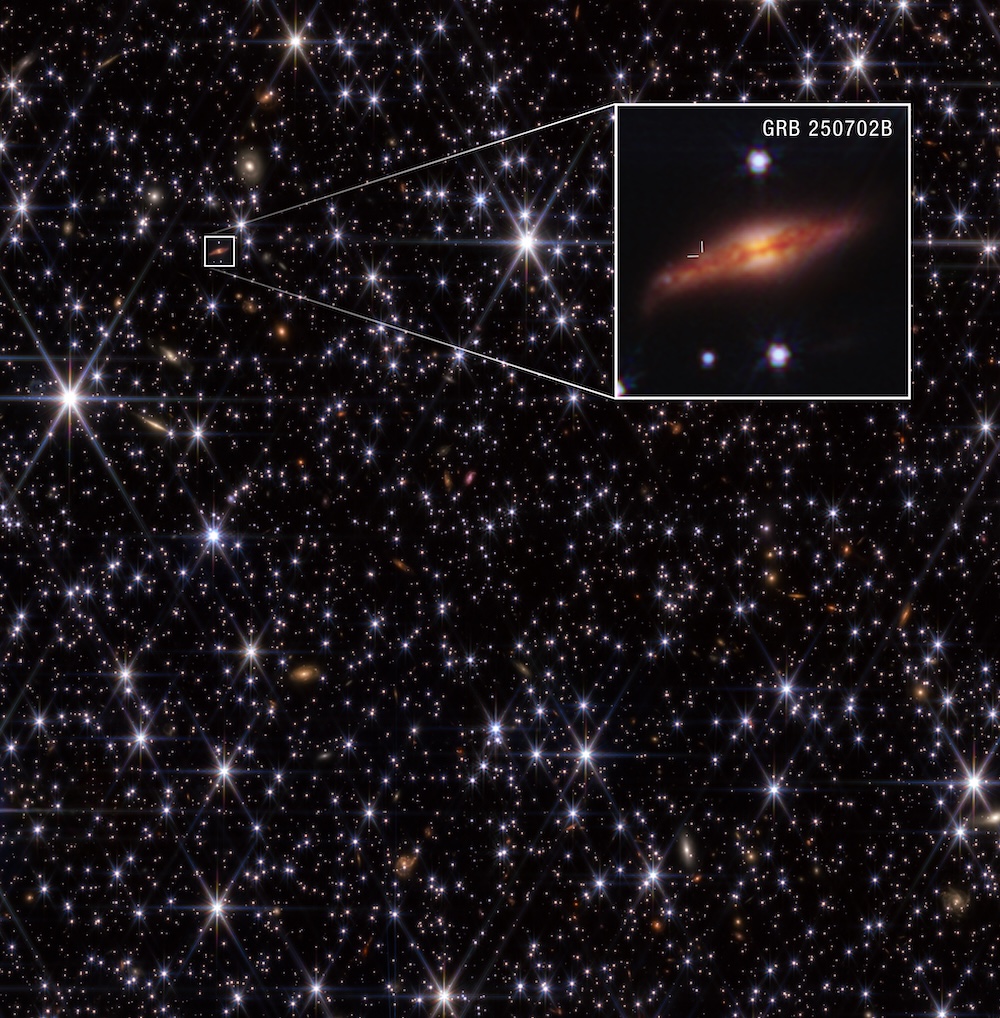
While the primary purpose of NASA’s James Webb Space Telescope’s observations of galaxy cluster Abell S1063 was to look for a certain population of stars, scientists obtained a detailed spectrum of GLIMPSE-17775 from the dataset. This little red dot is located behind Abell S1063.
Credits: Image: NASA, ESA, CSA, Vasily Kokorev (UT Austin); Image Processing: Alyssa Pagan (STScI)
The complex puzzle known as little red dots has become more complete since their initial discovery by NASA’s James Webb Space Telescope in 2022. Now a particular little red dot’s spectrum is helping connect many of the pieces.
A team of astronomers led by Vasily Kokorev at the University of Texas at Austin identified the lucky dot in question: GLIMPSE-17775. By carefully analyzing the dot’s spectrum captured by Webb — the deepest spectrum to date of a little red dot — the research team has identified multiple lines of evidence, all of which support the interpretation that GLIMPSE-17775 is a supermassive black hole enveloped in a dense cocoon of partially ionized gas, a model referred to as the BH* (black hole star) scenario. A paper describing the results was published today in The Astrophysical Journal.
“I think part of the scientific community is converging on a singular picture — that little red dots can be explained by black hole star models. But none of the previous little red dots have all of the pieces of evidence in the same place,” said Kokorev, lead author of the study. “With GLIMPSE-17775 we can test these models because of how deep and amazing this source’s spectrum is.”
Image: Abell S1063 with Pullout of GLIMPSE-17775 (NIRCam Image)
While the primary purpose of NASA’s James Webb Space Telescope’s observations of galaxy cluster Abell S1063 was to look for a certain population of stars, scientists obtained a detailed spectrum of GLIMPSE-17775 from the dataset. This little red dot is located behind Abell S1063.
Image: NASA, ESA, CSA, Vasily Kokorev (UT Austin); Image Processing: Alyssa Pagan (STScI)
Connecting puzzle pieces
Soon after Webb first began science operations, it discovered a new, mysterious type of object in the very early universe – abundant red objects that emerged about 600 million years after the big bang. Scientists have explored multiple explanations for these little red dots, including the black hole star scenario.
A set of fortunate circumstances brought about this new, elaborate spectrum of a little red dot. The little red dot that would come to be known as GLIMPSE-17775 was fortunately included in Webb’s imaging and spectroscopy efforts for a project that sought to look for Population III stars and faint galaxies in galaxy cluster Abell S1063. This little red dot is more distant than the galaxy cluster and magnified by gravitational lensing. (GLIMPSE-17775 has a cosmological redshift of 3.5, meaning it existed about 1.8 billion years after the big bang.)
While Webb provided a 30-hour spectrum of the little red dot, the effect of gravitational lensing made it equivalent to 80 hours of telescope time. This combination of Webb’s infrared sensitivity and nature’s own “magnifying glass” amplified the amount of detail that could be gleaned from GLIMPSE-17775. The result was more than 40 spectral lines from this small, red source, which is the most detailed little red dot spectrum to date.
“When we saw the spectrum for the first time, it was like having all the pieces of a puzzle scattered on the floor,” said Kokorev. “We picked up each piece of the puzzle, measured the lines, and started combining the different pieces into a mosaic. Maybe a few pieces looked like nothing at first, but then a couple of them came together, and we realized that there was something there.”
The spectroscopic data collected by Webb contains multiple lines of evidence that support the interpretation that little red dot GLIMPSE-17775 is a black hole star: a rapidly accreting, or growing, black hole enveloped in a dense gas cocoon, which is reprocessing the light emitted from near the black hole and producing the features seen in the spectrum.
Image: Evidence of a ‘Black Hole Star’
NASA’s James Webb Space Telescope captured the deepest spectrum to date of a little red dot. More than 40 spectral lines have been discerned from the data, many of which independently support the theory that GLIMPSE-17775 is a black hole enshrouded by a hot, dense gas cocoon.
Illustration: NASA, ESA, CSA, Vasily Kokorev (UT Austin); Designer: Leah Hustak (STScI)
Lines of evidence
Among the 40-plus lines that the team detected in GLIMPSE-17775’s spectrum were various independent indicators that all align with the BH* scenario. For example, the team found that many of the spectral lines, such as hydrogen, oxygen, and helium, do not fit a simple model of a rotating gas cloud. Instead, the best fit model includes a broadening effect known as electron scattering, a telltale sign that a dense, layered gas cocoon is enshrouding this source.
The strength and ratios of certain lines to each other, most notably the 16 iron lines that compose what the team has dubbed an “iron forest” and certain oxygen lines, require a high-energy source to produce them, like a rapidly accreting black hole. Additionally, astronomers noted the fluorescence and absorption of helium in the spectrum, both of which individually suggest that there is a dense medium enveloping a powerful source.
The BH* scenario not only fits GLIMPSE-17775; it also accounts for why most little red dots are faint in X-rays, since any such emission is likely absorbed by the dense gas cocoon.
One missing element of the GLIMPSE-17775 puzzle piece is the part of the spectrum that would reveal what’s known as a Balmer break, or a strong dip in the emitted light that’s a signature characteristic of little red dots. To build a more comprehensive understanding of this little red dot, the team incorporated ancillary data from two observing programs that used NASA’s Hubble Space Telescope: the Frontier Fields and BUFFALO (Beyond Ultra-deep Frontier Fields And Legacy Observations) programs.
The Webb and Hubble data together help explain why the Balmer break is weaker than what typically is found in other little red dots: A giant host galaxy is surrounding GLIMPSE-17775. Although a little red dot’s host galaxy is not something that has been usually seen at such scale before, it isn’t inconsistent with the dense gas cocoon model. The black hole star model of little red dots attributes excess blue light to stars in the host galaxy.
When Webb first discovered little red dots, some researchers thought these objects had “broken cosmology,” unsure how galaxies could have grown so big so quickly in the early universe to account for all this light coming from their stars. However, the team believes the GLIMPSE-17775 puzzle piece fits nicely in the existing framework of the universe’s evolutionary history, because black hole masses don’t need to be as high in order to explain the broad emission lines.
“Everything fits, nothing is broken, and I think that makes the puzzle that is our universe even better,” said Kokorev. “Looking ahead, I’m eager to dive deeper and learn about what is powering the central engines of little red dots. While we think it’s a black hole, there are some other interesting theories being proposed, which is exciting. Maybe in a year or two, we’ll have the final answer to what powers these sources.”
The James Webb Space Telescope is the world’s premier space science observatory. Webb is solving mysteries in our solar system, looking beyond to distant worlds around other stars, and probing the mysterious structures and origins of our universe and our place in it. Webb is an international program led by NASA with its partners, ESA (European Space Agency) and CSA (Canadian Space Agency).
The following sections contain links to download this article’s images and videos in all available resolutions followed by related information links, media contacts, and if available, research paper and Spanish translation links.
Related Images & Videos
Abell S1063 with Pullout of GLIMPSE-17775 (NIRCam Image)
While the primary purpose of NASA’s James Webb Space Telescope’s observations of galaxy cluster Abell S1063 was to look for a certain population of stars, scientists obtained a detailed spectrum of GLIMPSE-17775 from the dataset. This little red dot is located behind Abell S1063.
Evidence of a ‘Black Hole Star’
NASA’s James Webb Space Telescope captured the deepest spectrum to date of a little red dot. More than 40 spectral lines have been discerned from the data, many of which independently support the theory that GLIMPSE-17775 is a black hole enshrouded by a hot, dense gas cocoon.
What’s the story behind the longest gamma-ray burst ever observed? Researchers explore how repeated interactions between a white dwarf and an intermediate-mass black hole could explain GRB 250702B’s unusual properties.
In 2025, the Fermi Gamma-ray Space Telescope spotted an intense flash of gamma rays from a distant, dusty galaxy, and a fleet of spacefaring and earthbound telescopes soon revealed the remarkable characteristics of the event. GRB 250702B featured multiple bursts spanning several hours, individual flares lasting roughly 100 seconds, and X-ray emission in the 24 hours leading up to the gamma-ray activity — something never seen before in a gamma-ray burst.
These characteristics have been challenging to explain with typical models of long gamma-ray burst formation, such as collapsing massive stars, but researchers have developed numerous promising alternatives. In a new research article, astronomers have shown how GRB 250702B’s behavior might be explained by repeated close encounters between a white dwarf and an intermediate-mass black hole.
Eccentric Close Encounters
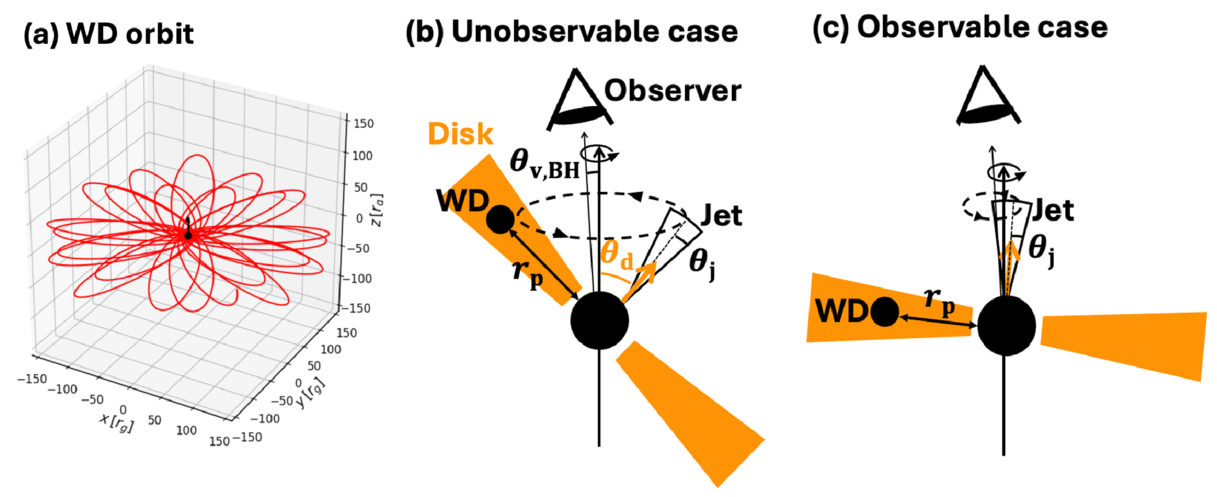
Yuri Sato (Tohoku University) and collaborators modeled the source of GRB 250702B as a white dwarf that has been captured into orbit around an intermediate-mass black hole. In their model, the white dwarf travels on an extremely eccentric orbit, drawing close to the black hole roughly once an hour. Each time the white dwarf ventures close, the black hole’s tidal forces strip away part of the star until, after about 40 such encounters, the white dwarf is completely destroyed.
Schematics showing the orbit of the white dwarf (WD; left) and the geometries that produce observable and unobservable jets. Click to enlarge. [Sato et al. 2026]
When the black hole peels material away from the white dwarf, some material swirls into an accretion disk, and some is cast off into space. Accretion from the disk powers a narrow relativistic jet: the source of the event’s powerful gamma-ray flares. This should mean that there is one jet produced each time the white dwarf is partially disrupted — 40 times — yet astronomers detected only a handful of flares from GRB 250702B.
Jet Precession and Model Predictions
The discrepancy can be resolved if the angle between the jet and the black hole’s spin axis precesses over time so that only some of the jets are pointed toward us. This can occur if the accretion disk is misaligned relative to the black hole’s spin. As an alternative, disk instabilities or other processes could keep all but a few of the expected jets from being launched.
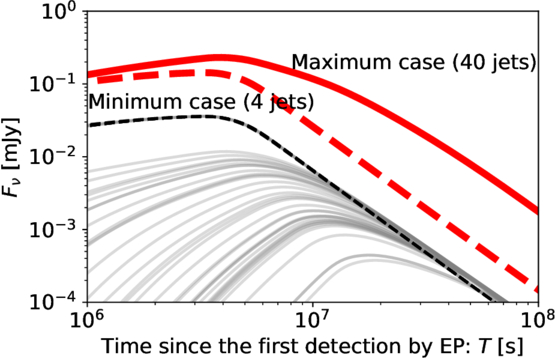
Predicted strength of the radio afterglow for the jet precession case (maximum case) and the case in which only four jets were launched due to disk instabilities or jet choking (minimum case). The x-axis shows the time since the burst was detected in X-rays by the Einstein Probe (EP). [Sato et al. 2026]
Sato and coauthors found that these two scenarios have different long-term outcomes, providing a potential way to ascertain what’s going on at the source; in the jet precession scenario, the jets that are launched away from our line of sight produce an order of magnitude more radio emission at late times.
This work by Sato and collaborators demonstrates how the repeated partial tidal disruption of a white dwarf by an intermediate-mass black hole can match the properties of one of the most remarkable recent transient sources — one that has pushed astronomers to consider new ways of producing gamma-ray bursts.
Citation
“Successive Partial Disruptions with Orbital Precession in a White Dwarf–Black Hole System for Repeating GRB 250702B,” Yuri Sato et al 2026 ApJL1003 L44. doi:10.3847/2041-8213/ae6a8f
Astronomers have discovered a distant quasar powered by a feeding supermassive black hole blasting out winds at record-breaking speeds for such an outflow seen in ultraviolet light, traveling at 30% the speed of light.
By taking general relativity into higher dimensions, a trio of physicists has proven that a mathematical pattern of ripples in space-time geometry could give rise to naked singularities and microscopic black holes.
Where do black hole mergers happen? Recent research finds evidence that most black hole mergers occur in triple systems containing a close inner binary and a more distant third party.
Assembling Merging Black Holes
Thanks to the combined efforts of the LIGO, Virgo, and KAGRA gravitational wave detectors, we’ve now collected the subtle signals from several hundred pairs of merging stellar-mass black holes. As this collection of spacetime ripples continues to grow, researchers are seeking to understand how these merging black hole pairs were assembled.
In the simplest scenario, pairs of high-mass stars independently evolve into black holes, lose momentum by emitting gravitational waves, and meld into one another. But the population of merging black holes likely contains contributions from multiple sources, including multiple-star systems, the disks surrounding accreting supermassive black holes, and black holes that have already experienced a merger. Which of these merging populations is reflected in our catalog of gravitational wave events?
Modeling Challenges
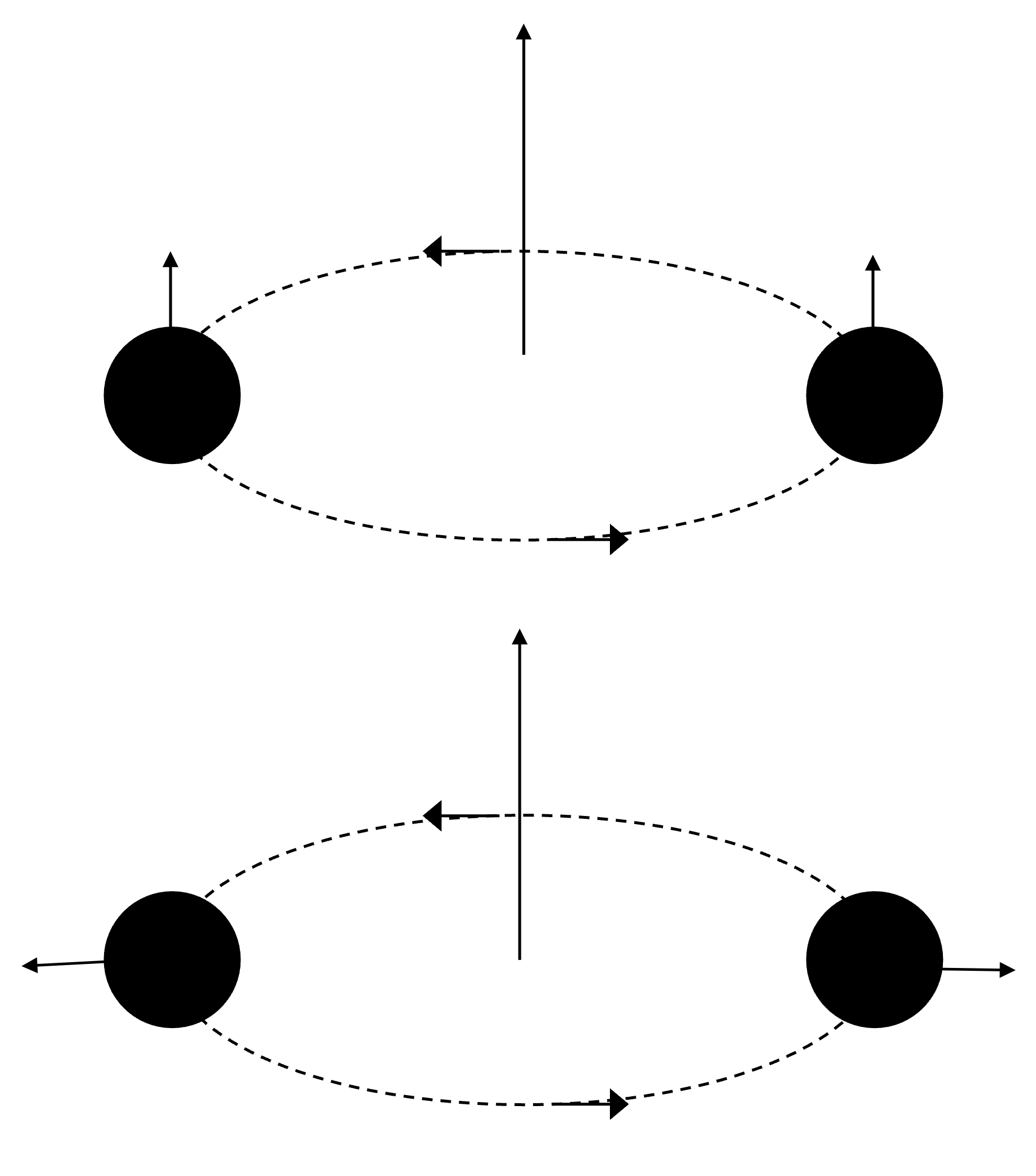
A black hole binary system with aligned spins and orbit (top) and a binary with spins tilted by 90 degrees (bottom). [AAS Nova/Kerry Hensley]
In theory, this question can be answered by extracting the properties of merging black holes — mass, spin, and the like — from gravitational wave observations and comparing these properties against model predictions from different formation pathways. In reality, this is exceedingly difficult, as certain merger pathways can produce a wide variety of results, depending on assumptions or fine tuning.
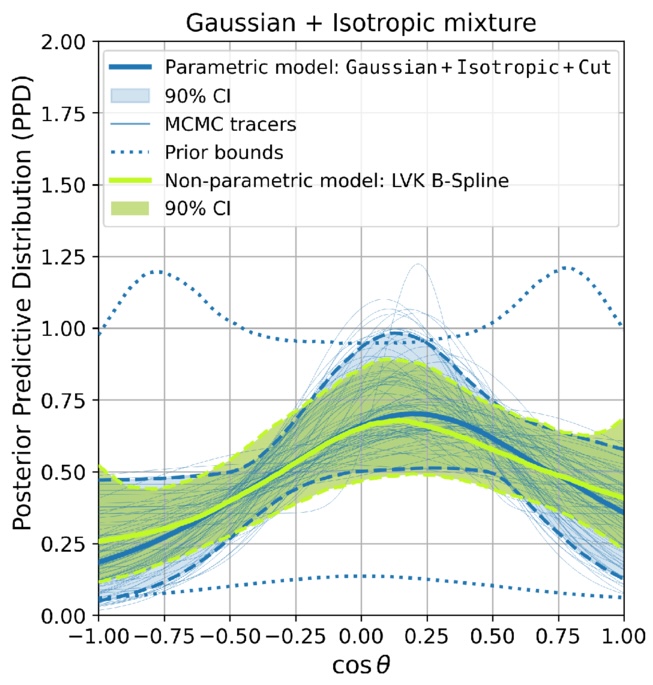
So far, the increasingly large pool of gravitational wave detections tentatively points to a feature that could illuminate the sites of black hole mergers: a peak in the spin–orbit tilt distribution around 90 degrees. This feature has been most confidently extracted from nonparametric analyses, which do not make assumptions about the population of merging black holes, but it has also been hinted at in parametric analyses, which do make population-level assumptions.
Triple-System Feature
To investigate this feature further, a team led by Jakob Stegmann (Max Planck Institute for Astrophysics) performed a new, astrophysically motivated parametric analysis of the most recent catalog of gravitational wave detections from LIGO, Virgo, and KAGRA.
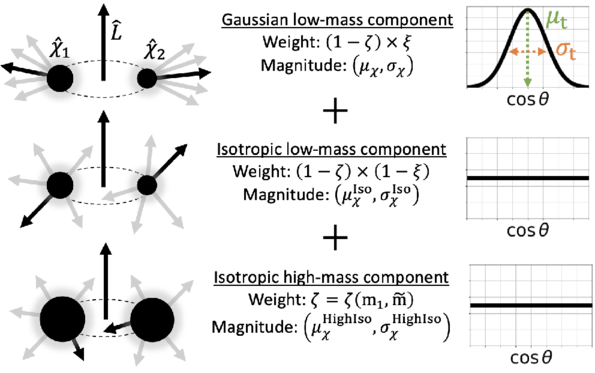
The three populations in the team’s modeling. [Stegmann et al. 2026]
Their modeling tests combinations of multiple populations, including mergers in isolated binary systems, triple-star systems, and dense environments like star clusters. They also include a potential contribution from higher-mass mergers involving black holes that have merged previously. Using this framework, Stegmann’s team found that the observed spin–orbit tilt distribution is best matched by a model dominated by mergers in triple-star systems, with some contribution from other sources.
Posterior predictive distribution of black hole spin–orbit tilts. Both the authors’ modeling (solid blue line) and the nonparametric modeling performed by the LIGO–Virgo–KAGRA collaboration (solid green line) find evidence for a peak in the spin–orbit tilt distribution near cosθ = 0. [Adapted from Stegmann et al. 2026]
Specifically, this finding suggests that most mergers occur in hierarchical triple systems, which naturally predict an excess of 90-degree spin–orbit tilts without any fine tuning. Hierarchical triples contain an inner close binary with a distant outer companion; in these systems, relativistic spin precession, gravitational wave emission, and oscillations in eccentricity and inclination work to tilt the black holes in the inner binary by 90 degrees.
Stegmann and collaborators pointed out that the triple-system scenario aligns well with other properties of the observed population of black hole mergers, such as the mass and effective spin distributions. This scenario may also be necessary to explain certain merging pairs that might have had slightly eccentric orbits at the moment of merging. If future gravitational wave observations strengthen the evidence for a peak in the spin–orbit tilt distribution near 90 degrees, it will have profound implications for how and where black holes merge in our universe.
Citation
“Gravitational-Wave Observations Suggest Most Black Hole Mergers Form in Triples,” Jakob Stegmann et al 2026 ApJL1000 L59. doi:10.3847/2041-8213/ae52ec
Editor’s Note:Astrobites is a graduate-student-run organization that digests astrophysical literature for undergraduate students. As part of the partnership between the AAS and astrobites, we occasionally repost astrobites content here at AAS Nova. We hope you enjoy this post from astrobites; the original can be viewed at astrobites.org.
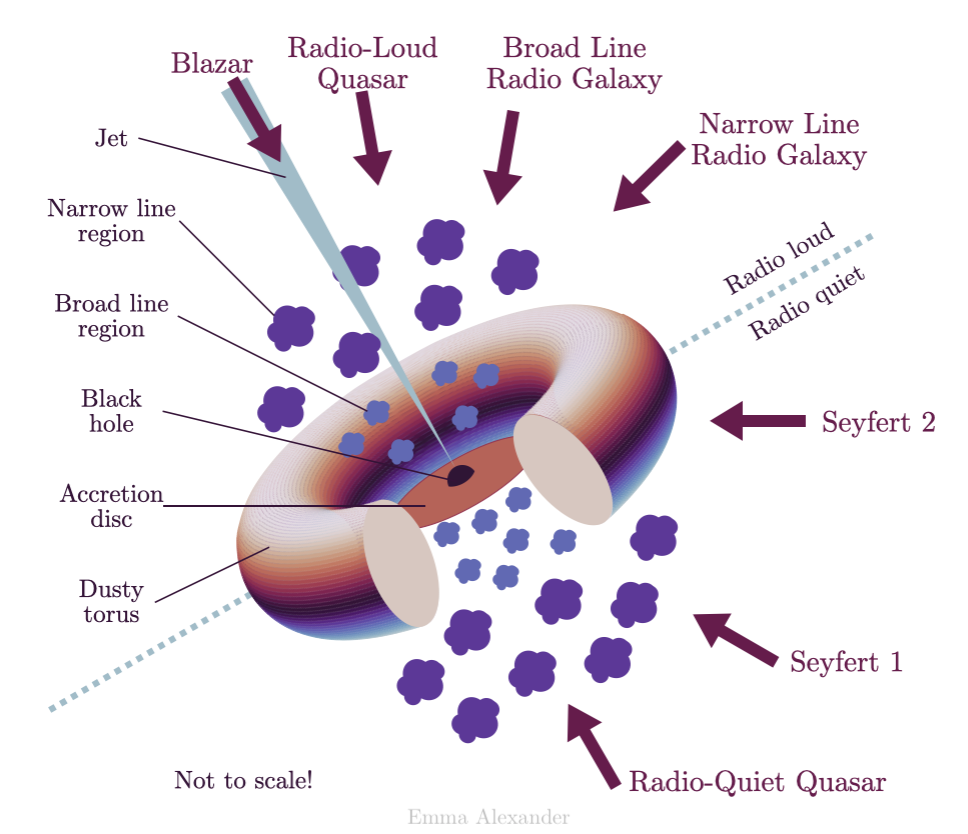
At the centre of nearly every galaxy lies a supermassive black hole that dominates this innermost region. Not only is there this millions-of-solar-masses dark beast, but usually too a whole bunch of stuff — stars, gas, dust, and more — which is often quite bright! When there is plenty of this material quite close to the black hole, we believe physics takes control to flatten it into a family of disk and toroidal structures in what we call the unified model of active galactic nuclei (AGNs; see Figure 1).
Figure 1: The unified model of AGNs asserts that there is an inner accretion disk, surrounded by a dusty torus that cohabitates with clouds moving at different velocities (the so-called broad and narrow line regions), and sometimes even relativistic jets extending from the accretion disk to galactic scales; you can read more about AGN structure in this Astrobites guide. [Emma Alexander; CC BY 4.0]
When astronomers look at different active galaxies (read: galaxies with active supermassive black holes at their core), we see a range of phenomenologies related to their brightness, spectra, morphologies, and more. The unified model of AGNs seeks to explain these different AGN appearances simultaneously by positing that they all have the same physical structure, and we are just viewing them from different angles, hence seeing different features.
The cores of AGNs are often imaged at the smallest scales (e.g., their accretion disks, viewed with interferometers like the Very Large Telescope Interferometer) and the largest scales (e.g., their relativistic jets, viewed with radio interferometers), but comparatively less effort has gone to directly observing the predicted dusty tori in the mid-infrared. That is exactly what today’s authors set out to do using the Large Binocular Telescope Interferometer (LBTI) — a pair of 8.4-metre-aperture mirrors separated by just over 14 metres and combined to simulate a telescope effectively 29 metres wide. This lets astronomers take direct images at a much higher resolution than a smaller-aperture telescope, and hence directly peer into the region around AGNs where this dusty torus should lie.
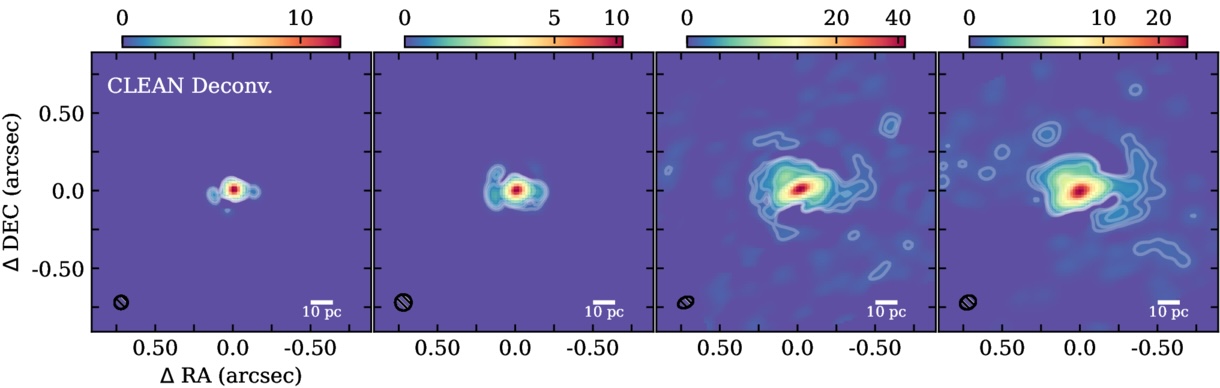
Today’s authors turn the LBTI towards NGC 4151, a medium-luminosity AGN. With the large effective aperture of the LBTI, they were able to resolve scales in the AGN region as small as 4.4–9.1 pc, about 14–30 light-years depending on the wavelength (see Figure 2), in the mid-infrared. These observations revealed warm dust emission in a complex structure around the central supermassive black hole. The authors note a central bar at all wavelengths, with a significant extension of cool dust arcing to the west (right in the image) and warmer dust localised to the centre (as evident by 3.7- and 4.8-micron emission only nearest to the supermassive black hole and its accretion disk).
Figure 2: The deconvolved images of the AGN core of NGC 4151 show a very bright central source (the innermost region around the supermassive black hole), as well as some complex surrounding structure particularly at long wavelengths. The interpreted morphology is described in Figure 3. These images are deconvolved, meaning that known optical effects are corrected for on the raw data to produce a sharper image. [Adapted from Isbell et al. 2026]
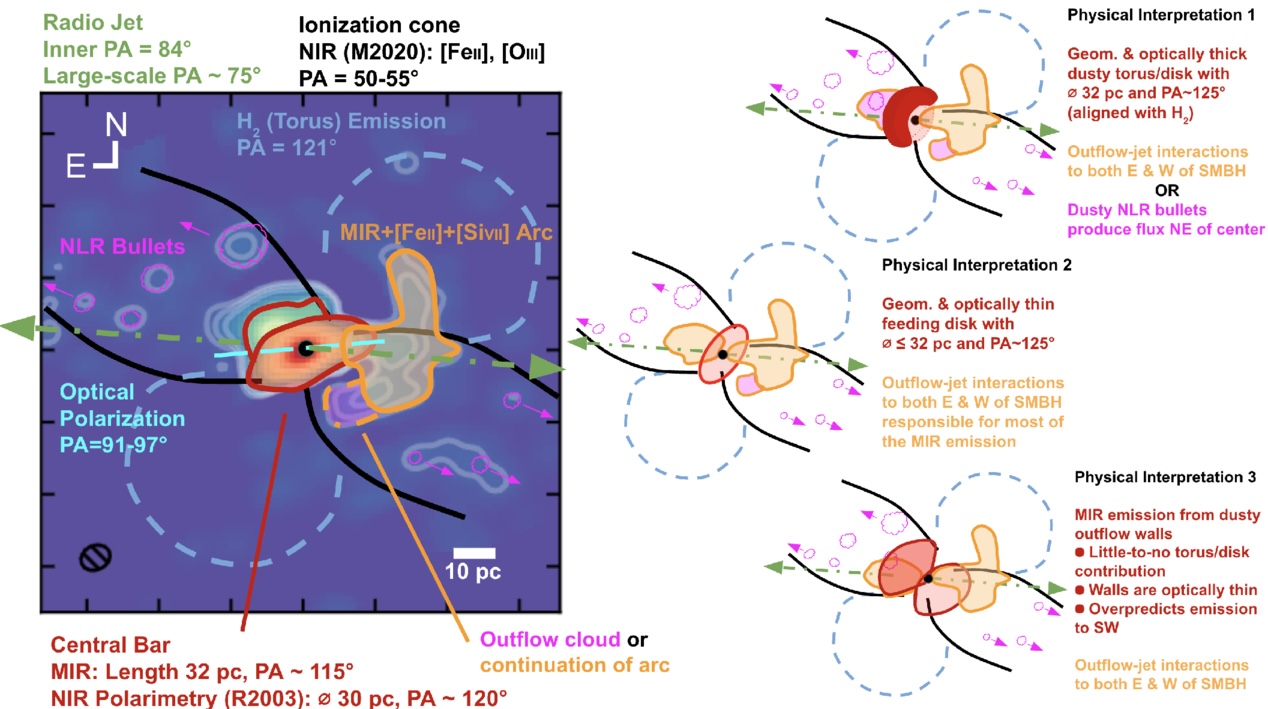
To explain the observed morphology in Figure 1, the authors compare three different interpretations based on this new high-resolution imagery together with the results of previous studies looking at other scales and the spectrum of the AGN core. Each interpretation is illustrated and briefed in Figure 3.
Figure 3: Three interpretations of the observed morphology are presented by the authors. The left panel illustrates the different regions surrounding the supermassive black hole (together with the results of other studies cited in the article). The right panel shows the suggested interpretations explaining the morphology. [Isbell et al. 2026]
The first interpretation is in keeping with the unified model of AGNs: a geometrically and optically thick torus of dust surrounds the inner region. In this interpretation, the surface of the dusty torus re-radiates light from the accretion disk to produce most of the mid-infrared emission. Additional mid-infrared emission could come from localised concentrations of gas or interactions between the outflow and the jet. The authors immediately disfavour this explanation, as other studies have shown bright ionised emission at the location of the would-be torus, which is not expected if an optically thick torus were to be present. Hence, these new observations somewhat challenge the one “flavour” of the unified model of AGNs.
The second interpretation aligns with a different version of the unified model: one in which a geometrically thin disk replaces a thick torus around the AGN core. Provided the disk is optically thin too, the authors favour this approach as it is consistent with the geometry of ionised emission that worked against the first interpretation. While other studies suggest that this thin disk should be optically thick, this morphology is at least better aligned with what we see in other AGNs.
The third interpretation suggests that the emission comes from only the radiation pressure–driven wind emanating from the AGN core. The authors disfavour this explanation, citing previous radiative transfer simulations that show that the flux should fall off with distance from the core too quickly to be consistent with the observations.
No matter the interpretation, these LBTI observations are an important glimpse into the future of mid-infrared AGN studies that will be done with 30-metre-class telescopes (such as the European Southern Observatory’s Extremely Large Telescope). This article, together with the group’s similar study on NGC 1068, is challenging and refining an accepted view of AGN morphology — the consequences of which apply to galaxies near and far — and poses new questions perfect for sophisticated hydrodynamic and radiative simulations.
Original astrobite edited by Margaret Verrico.
About the author, Ryan White:
I am a first-year PhD student at Macquarie University in Australia, working mainly on binary/multiple systems with massive stars (Wolf–Rayets in particular!). Outside of study, I’m probably drinking coffee, baking, reading, or going for a run. You can also find me procrastinating on Bluesky @astroryan.bsky.social.
The core of the brightest galaxy in the cluster Abell 402 contains a curious void. New observations suggest that an ultra-massive black hole could have excavated this feature.
At the Center of the Center of a Cluster
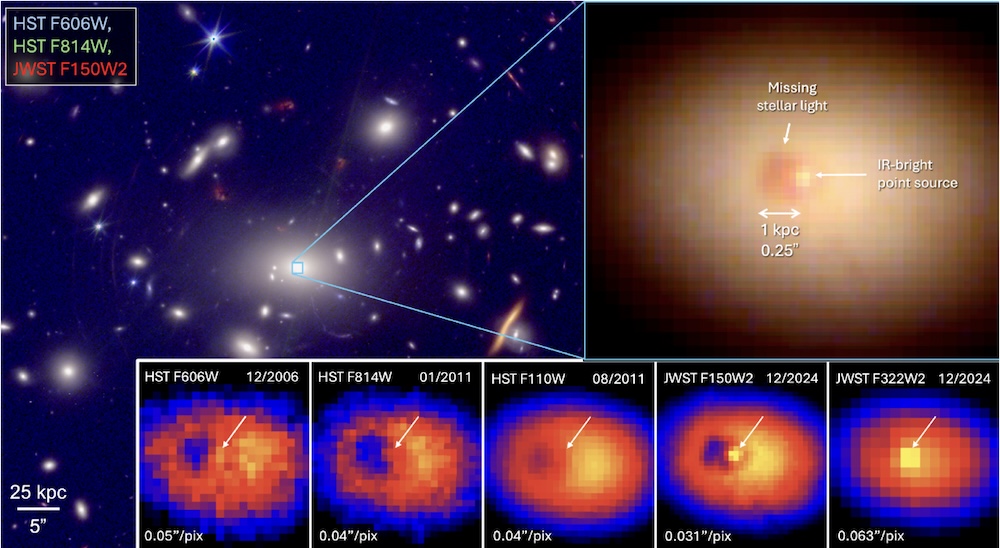
JWST and Hubble observations of A402-BCG. In addition to the dark cavity previously seen by Hubble, the galaxy’s center hosts an infrared-bright source. Click to enlarge. [McDonald et al. 2026]
Abell 402 is a galaxy cluster located roughly 4 billion light-years away, and at its center is a giant elliptical galaxy called A402-BCG. Zooming in on the heart of this galaxy, astronomers using the Hubble Space Telescope discovered a dark region that they suspected was due to a cloud of dust blocking the starlight from the galaxy’s center.
In a recent research article, a team led by Michael McDonald (Massachusetts Institute of Technology) investigated this dark region to test the dust-cloud hypothesis and explore other explanations.
McDonald’s team compiled new JWST Near-Infrared Camera data, archival Hubble imaging, and spectroscopy from the Multi Unit Spectroscopic Explorer (MUSE) on the Very Large Telescope. The new JWST images show a prominent dark feature at the center of A402-BCG, plus a bright source directly beside it.
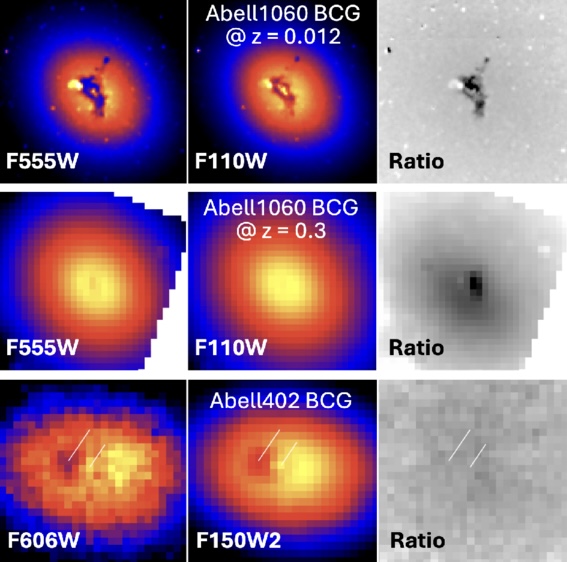
Comparison of the cavity in A402-BCG (bottom row) to the dust ring in Abell 1060’s central galaxy (top row). In the middle row, simulated observations show Abell 1060’s central galaxy at A402-BCG’s redshift. The appearance of the dust ring is wavelength dependent, but the appearance of A402-BCG’s cavity is not. [Adapted from McDonald et al. 2026]
Not Hidden, but Missing
If the dark feature at the center of A402-BCG is a dust cloud, the cloud would be less obscuring at the near-infrared wavelengths captured by JWST than at the optical wavelengths sampled by Hubble. However, the feature was equally dark in the JWST images, leading the team to rule out the dust-cloud hypothesis.
Instead, they favor a scenario in which the dark feature is due to an absence of stars rather than the presence of obscuring dust. The team estimated that 2 billion solar masses of stars are missing — equivalent to 1% of the stellar mass of the galaxy. What’s more, the cavity is situated in a larger region of constant surface brightness called a core, in which there are fewer stars than expected.
The Dynamical History of A402-BCG
McDonald and coauthors suggested that the missing stars in A402-BCG’s core and cavity were ejected by at least one supermassive black hole binary. They estimated that the core region, which is roughly 6,500 light-years across, was excavated by a 50 billion solar mass black hole. This epic black hole may be the result of a past merger and is likely located at the infrared-bright spot on the border of the cavity, as this source’s spectral energy distribution resembles that of an actively accreting black hole.
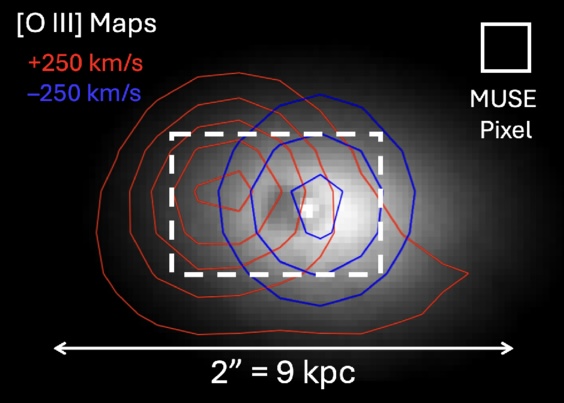
MUSE observations of highly ionized gas in A402-BCG. The blueshifted source on the right coincides with the infrared-bright source, while the redshifted source on the left appears to be embedded within a larger ionized envelope. [Adapted from McDonald et al. 2026]
MUSE spectroscopy provided evidence for a second black hole. These data revealed two pockets of ionized gas — one coincident with the infrared-bright source, the other on the opposite side of the cavity — as well as two distinct sets of emission lines consistent with a black hole binary totaling 60 ± 20 billion solar masses. (The team noted that alternate explanations for the second source, like a compact starburst, were less likely but couldn’t be ruled out.)
The team favors a scenario in which these black holes are slowly spiraling toward one another, ejecting stars from the galaxy’s center as they move and carving out a deep deficit of stars. This stellar cavity sits within a larger region of stellar scarcity that was scooped out by a past supermassive black hole merger that created the ultra-massive black hole present in the galaxy today. Simulations suggest that only about 0.5% of massive galaxies are in this phase of evolution at a time, so we may have caught A402-BCG in a fascinating moment — one that provides new clues about how to search for ongoing black hole mergers in other galaxies.
Citation
“A Kiloparsec-Scale Stellar Cavity in the Center of A402-BCG May Be Caused by Dynamic Interactions with an Ultramassive Black Hole,” Michael McDonald et al 2026 ApJL1002 L19. doi:10.3847/2041-8213/ae5bbe
In 2019, a supermassive black hole in a galaxy 300 million light-years away woke up. Now, it’s puzzling astronomers with an unexpected slowdown in its X-ray bursts.
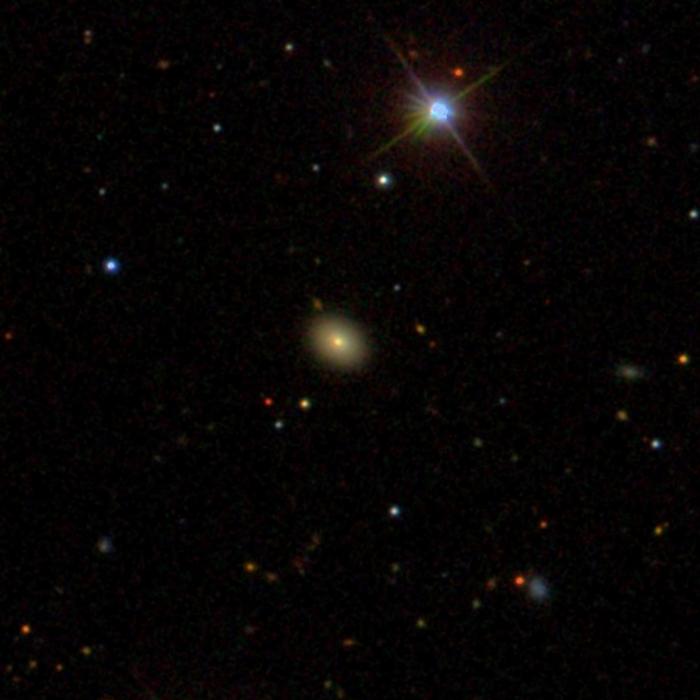
The fuzzy yellow galaxy at the center of this image is home to ZTF19acnskyy. [Sloan Digital Sky Survey]
Ansky Awakens
Nearly seven years ago, the Zwicky Transient Facility saw the galaxy SDSS J133519.91+072807.4 suddenly brighten at optical wavelengths, with the source given the moniker ZTF19acnskyy or “Ansky.” Within the next few years, Ansky brightened at other wavelengths, possibly signaling the first recorded case of a slumbering supermassive black hole grumbling to alertness.
In 2024, Ansky entered a new phase of behavior, exhibiting a series of semi-regular X-ray flares called quasi-periodic eruptions. The leading explanations for these flares, which have been detected from several nearby galaxies, involve a star-sized object spiraling toward a supermassive black hole. The repeating X-ray flares arise when the object crashes through an accretion disk around the black hole, or when the object loses mass each time it passes closest to the black hole. In either scenario, the time between flares is expected to decrease over time — but as new work shows, Ansky is behaving in ways that fail to fit existing theories of quasi-periodic eruptions.
An Unexpected Slowdown
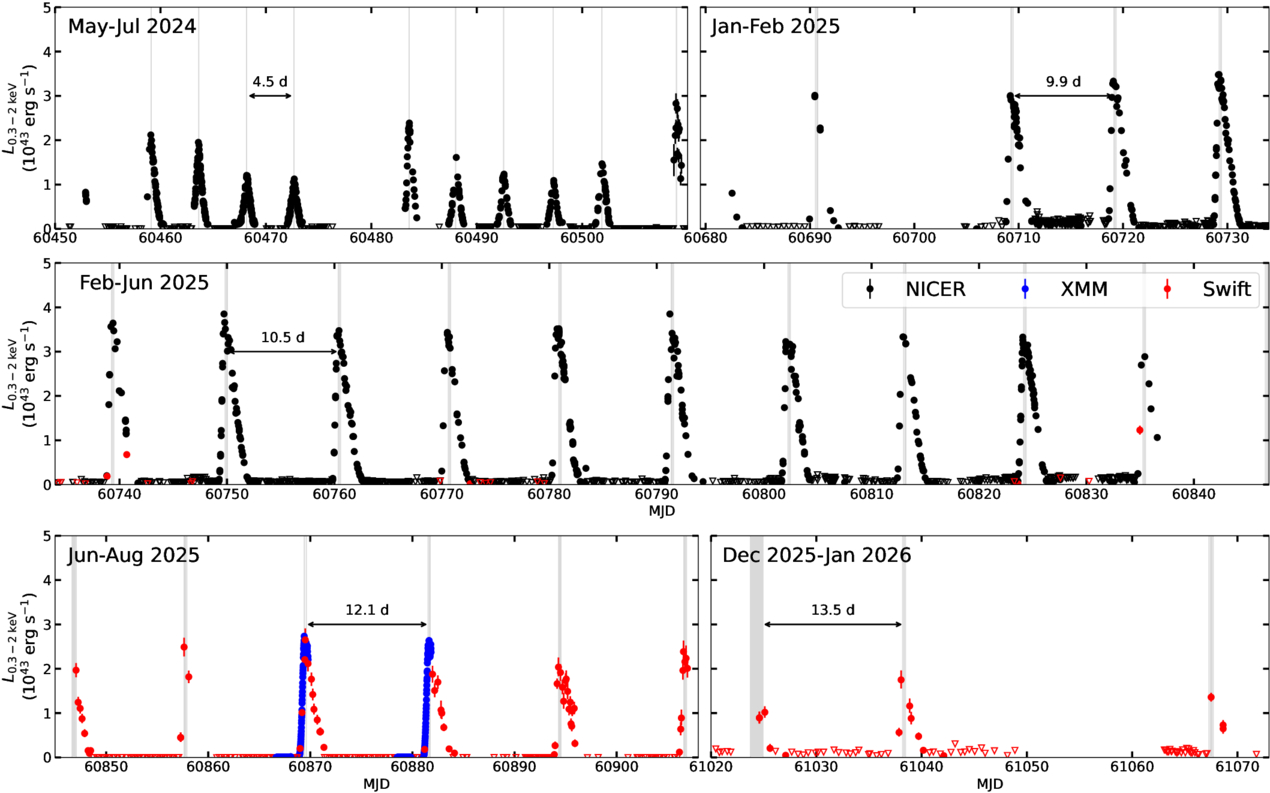
Soft X-ray observations of Ansky’s bursts from 2024 to 2026. These plots clearly show that in 2025 and 2026, the peak luminosities of the bursts have remained roughly constant while the time between bursts has increased. Click to enlarge. [Chakraborty et al. 2026]
Astronomers first reported on Ansky’s strange behavior in 2025, finding evidence that the time between eruptions was increasing rather than decreasing as expected. To investigate this emerging trend, Joheen Chakraborty (Massachusetts Institute of Technology) and collaborators analyzed data from the Neil Gehrels Swift Observatory’s X-ray Telescope, XMM-Newton, and the Neutron star Interior Composition Explorer (NICER).
This X-ray monitoring campaign spanned from January 2025 to January 2026 and captured 23 bursts, including 19 consecutive bursts — the most seen from a quasi-periodic eruption source to date. The bursts each lasted about three days, and the burst luminosity and total energy remained roughly constant, but the time between bursts increased smoothly from 9.9 days in January 2025 to 13.5 days in January 2026.
Possible Explanations
What physical process can produce X-ray bursts that are roughly consistent in energy and peak luminosity, last for approximately three days, and become more spaced out over time? The team considered five possibilities:
A star orbiting a black hole could transfer a bit of mass to the black hole each time it draws close… but it’s not clear whether the energy of each burst would remain the same as the star loses mass, nor is it clear how a three-day eruption duration could be achieved.
A star partially disrupted by a black hole could be kicked progressively farther from the black hole due to asymmetric mass loss or the reformation of its core… but this scenario cannot explain the bursts’ consistent energies and luminosities.
An object orbiting a black hole with an accretion disk could be experiencing general relativistic precession… but no combination of known sources of precession can reproduce Ansky’s behavior.
A second supermassive black hole could cause reflex motion of the inner black hole, changing how far the signal must travel… but even though this scenario can increase the time between bursts, the rate of increase is three orders of magnitude too small.
Instabilities in the black hole’s accretion disk could trigger recurrent bursts of accretion… but it’s not yet clear how an instability scenario could produce such predictable behavior.
While none of these models can fully solve the mystery of Ansky’s slackening X-ray flares, this work provides new avenues for exploration. In the meantime, we may get new clues simply from waiting to see what this source does next!
Citation
“A Positive Period Derivative in the Quasiperiodic Eruptions of ZTF19acnskyy,” Joheen Chakraborty et al 2026 ApJL1001 L6. doi:10.3847/2041-8213/ae548b
What factors impact how long it takes for a supermassive black hole binary to merge? New research investigates the influence of orbital inclination on the population of merging black holes in our universe.
When galaxies merge, the supermassive black holes at their centers are thought to link up in a binary system and eventually merge as well. Evidence for these supermassive black hole pairs and their collisions is piling up: researchers have identified a small but growing number of galaxies containing two accreting supermassive black holes, and the compelling evidence for the gravitational wave background points to the existence of an immense population of supermassive black hole binaries.
With observational evidence for supermassive black hole mergers taking shape, theorists are exploring the details of these mergers. One aspect of this process that hasn’t yet been examined fully is how the relative inclination of the merging galaxies impacts the time it takes for their central black holes to merge — a factor that has the potential to shape the demographics of merging supermassive black holes across our universe.
Ready, Set, Spiral
Sena Ghobadi (Georgia Institute of Technology) and collaborators used 3D dynamical models to explore how the angle at which galaxies collide — and therefore how the black holes’ orbits are tilted relative to one another — impacts the time it takes the supermassive black holes at their centers to merge.
In the simulations, Ghobadi’s team placed a 106–108-solar-mass black hole at the center of a disk galaxy. Then, they sent a second, smaller black hole spiraling toward it from a distance of 1 kiloparsec (3,300 light-years).
The team varied the inclination of the incoming black hole’s orbit relative to the disk of the target galaxy from 0 to 75 degrees. They also explored the impact of changing the black hole masses and the galaxy’s central gas density, disk rotation speed, and gas mass fraction. For each simulation, they recorded how long it took for the incoming smaller black hole to get within 10 parsecs of the larger black hole.
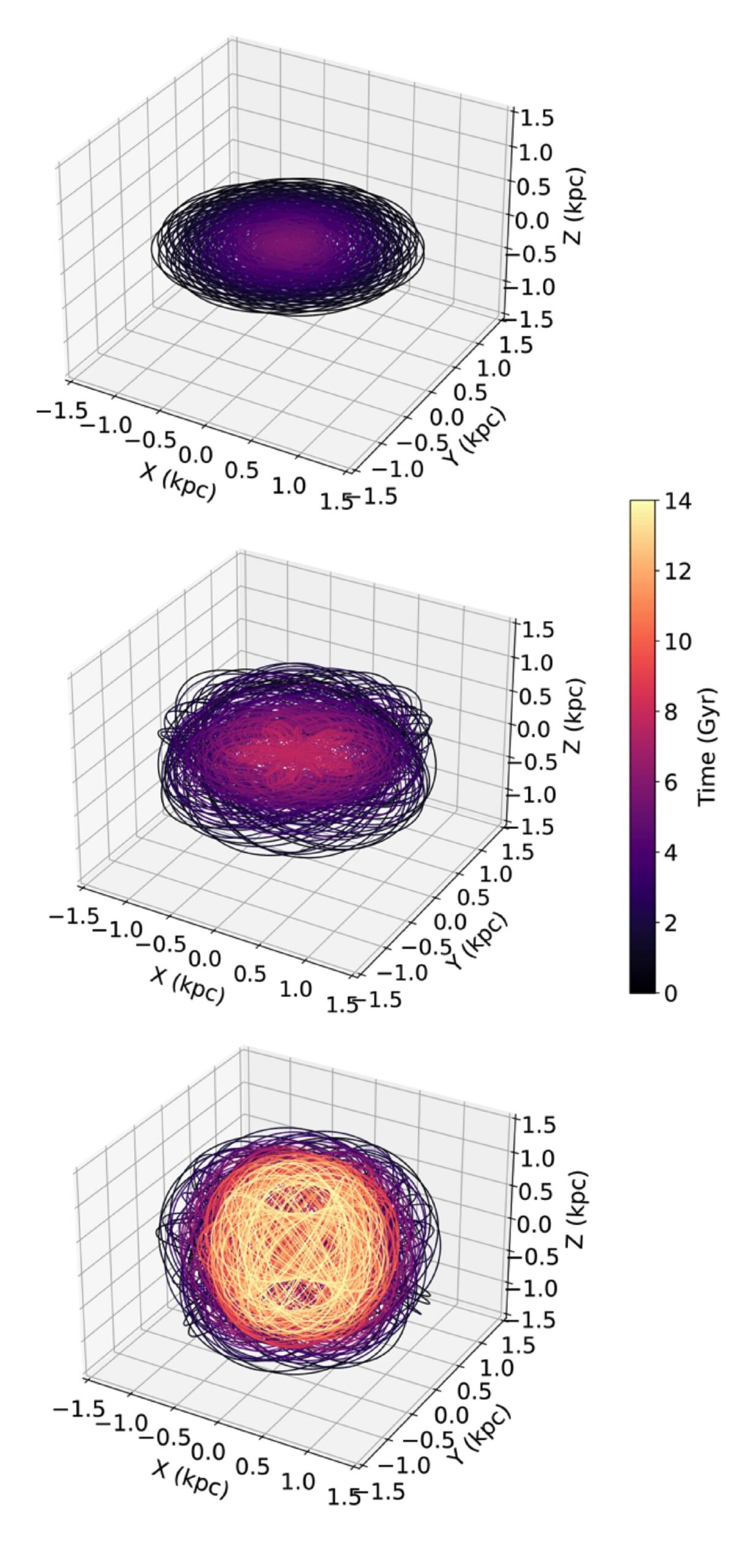
Simulated orbits of black holes with initial inclinations of 0 (top), 25 (center), and 45 (bottom) degrees. For the 0-degree simulation, the black holes merge in 5.75 billion years. For the 25-degree simulation, the merger occurs at 7.90 billion years. The 45-degree simulation fails to merge within the lifetime of the universe. [Adapted from Ghobadi et al. 2026]
(Dis)inclined to Merge
The simulations showed a clear trend with changing inclination: a black hole with an orbital inclination greater than 20 degrees took longer to merge than those with inclinations of 0–20 degrees. For black holes approaching the merger on slightly inclined orbits, dynamical friction between the black hole and the stars and gas of the galaxy worked to drag the black hole down into the disk, decreasing its inclination over time and guiding it toward a merger. Aside from the influence of inclination, the team also found that higher-mass supermassive black holes and more rapidly rotating galactic disks tended to lead to faster mergers.
For inclinations greater than roughly 45 degrees, a dramatic transition took place, with the orbits of the incoming black holes becoming more inclined over time rather than settling down into the disk. These simulated black holes failed to merge in the allotted time of 14 billion years.
With highly inclined binaries failing to merge within the lifetime of the universe, this suggests that the dual active galactic nuclei and the supermassive black hole binaries that produce gravitational waves in the universe today are the result of binaries with initial inclinations of 20 degrees or less.
Citation
“Evolution of Supermassive Black Hole Pairs on Inclined Orbits in Postmerger Galaxies,” Sena Ghobadi et al 2026 ApJ999 131. doi:10.3847/1538-4357/ae40bc
The Event Horizon Telescope (EHT), the facility that delivered humanity’s first-ever picture of a black hole, can produce some of the sharpest images in all of astronomy. But turning the EHT’s raw data into images is a complex process involving messy statistics and powerful algorithms. Recent work presents a potential upgrade to that process: for the first time in long-baseline interferometry, it may be possible to model everything everywhere all at once.
The Hardest Eye Test
The EHT has some of the sharpest eyes in all of astronomy. With its effective resolution of just 20 microarcseconds, in principle you could use it to read a newspaper in New York while sitting at a cafe in Paris. But this planet-spanning instrument (it relies on data from radio telescopes on four continents) doesn’t snap pictures like an ordinary camera. Instead, each pair of telescopes measures something called an “interferometric visibility,” which is related to a single Fourier component of the actual underlying image.
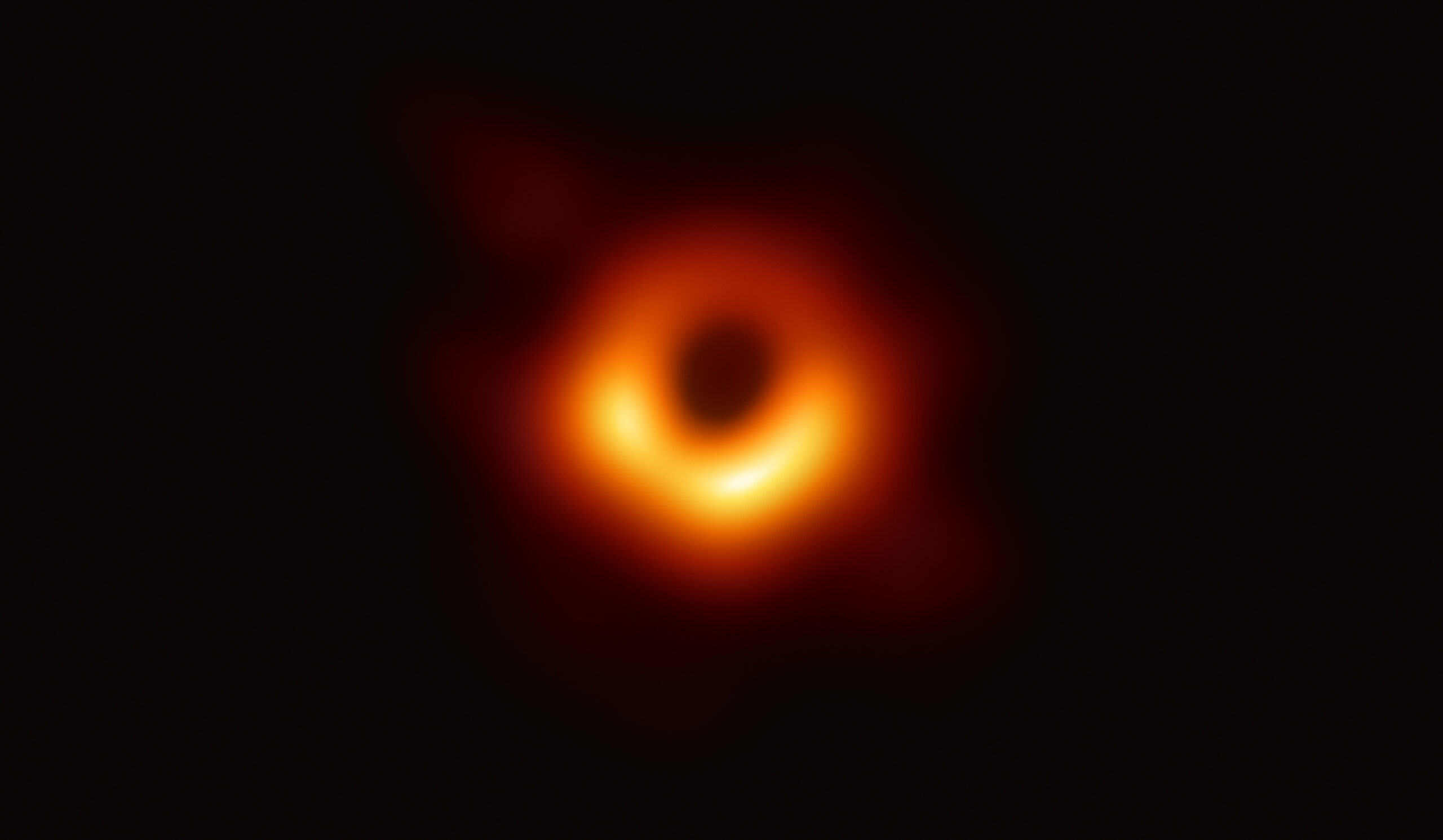
The first image of a black hole, constructed from Event Horizon Telescope data taken in 2017. [EHT Collaboration; CC BY 4.0]
Combining these components into an image is a process fraught with assumptions and modeling choices. Since the EHT doesn’t have an infinite number of telescopes, each measurement can be mapped to infinitely many images. This forces researchers to choose how to “regularize” this space of images to select one best picture. Making things harder, they also must contend with all the typical issues of real-world data collection. Each telescope has slight calibration errors, and every data point is affected by weather and temperature-dependent processes.
Typically researchers break the problem down into several stages: first calibrate the data, then regularize and construct the best-fitting image, then analyze that image to constrain the actual physics you care about like the width of the ring surrounding a black hole. This is how the original EHT publications went about their groundbreaking work on the now-iconic glowing ring around the supermassive black hole in the galaxy Messier 87 (M87*).
A New Approach
Recent work led by Paul Tiede (Black Hole Initiative at Harvard University) suggests an alternative process. Instead of separating the stages of analysis as described above, the team demonstrated that one could fit everything simultaneously in a framework they call hierarchical interferometric Bayesian imaging, or HIBI.
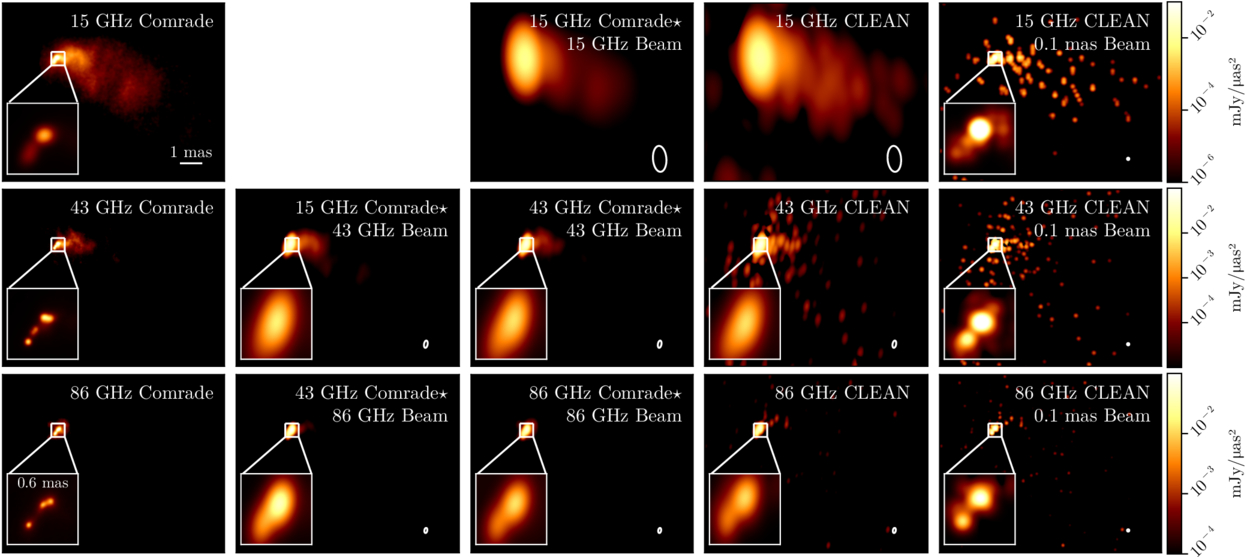
A comparison of the new HIBI technique (referred to as “Comrade” here) and a traditional algorithm called CLEAN. Click to enlarge. [Tiede et al. 2026]
By fitting all parameters that go into an image together, the method doesn’t select one “best” image. Instead, by allowing the pixel-by-pixel intensities, calibration parameters, and underlying physics to inform one another during inference, HIBI explores the full range of images consistent with the data. This prevents the degeneracies that plague the traditional approach, where image and calibration estimates can trade off against each other in misleading ways. The team validated HIBI on synthetic data mimicking the EHT’s 2017 setup, showing that it reliably recovered a range of source shapes with well-calibrated uncertainty estimates.
Even more exciting, the team demonstrated that it’s possible to skip the image construction step altogether and go straight to the science. By fitting parameters describing the physics underlying a scene, the team was able to constrain the width of the ring around M87* without any reference to a picture. They predict that this technique could be crucial for extracting information when future instruments like the Next Generation Event Horizon Telescope observe more distant black holes that are only marginally resolved. Though we’ll likely have to wait years for these next-generation telescopes, work like this ensures that astronomers will be able to squeeze as much science from them as possible once these new facilities are ready.
The galaxy NGC 4486B appears calm and collected, but its center may have been roiled by a recent merger of supermassive black holes. New modeling explores the stellar dynamics that support this hypothesis.
Strange Center
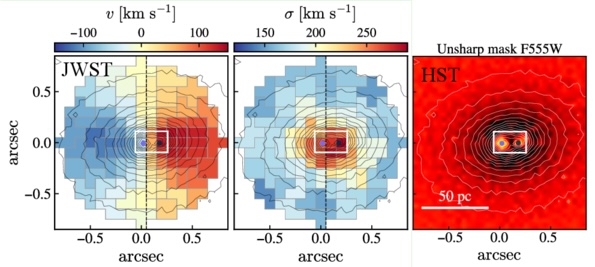
Kinematic maps of NGC 4486B showing the locations of the two peaks of its double nucleus. Click to enlarge. [Adapted from Tahmasebzadeh et al. 2026]
Astronomers have known for 30 years that NGC 4486B, a compact elliptical galaxy near the center of the Virgo cluster, has a double nucleus. More recently, JWST observations revealed that the galaxy houses a black hole of 360 million solar masses, which is unusually large compared to the galaxy’s stellar mass of 9 billion solar masses. The two nuclei are roughly 40 light-years from the apparent center of the galaxy, and the black hole also appears to be offset from the galactic center by 20 light-years.
Now, a team led by Behzad Tahmasebzadeh (University of Michigan; Villanova University) has investigated the possibility that NGC 4486B’s double nucleus and off-center black hole can be traced to the aftermath of a supermassive black hole merger.
Simulating Kinematics
In this scenario, the black hole is displaced from the galaxy’s center because of a “kick” it received when it underwent a merger. The double nucleus is a sign of an eccentric nuclear disk: a central disk of stars on aligned elliptical orbits created when merging supermassive black holes disturb an initially orderly disk of stars.
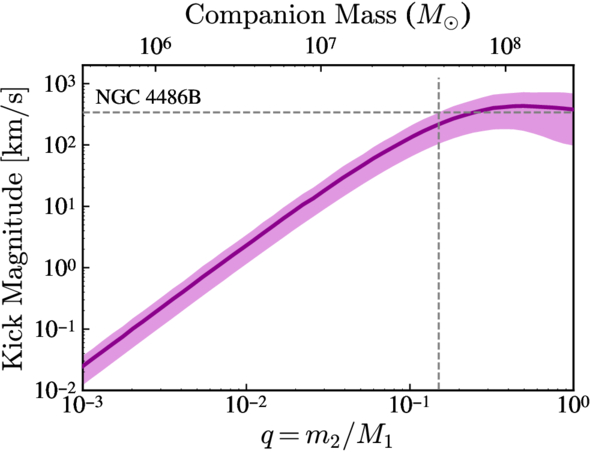
Estimated black hole kick magnitude as a function of the initial mass ratio of the black hole binary. Click to enlarge. [Tahmasebzadeh et al. 2026]
Tahmasebzadeh and collaborators performed dynamical modeling to test this hypothesis and understand what types of stellar orbits would be necessary to reproduce the kinematic signature of NGC 4486B’s center seen with JWST. The simulation results called for a blend of prograde and retrograde stellar orbits that closely resembled what is expected for an eccentric nuclear disk. From the properties of the simulated stellar disk, the team estimated that the mass ratio of the merging black holes was >0.15.
To explore this scenario further, the team carried out N-body simulations of the post-merger black hole’s behavior. These simulations showed that after being booted from the galactic center by the post-merger kick, the black hole returns to the center quickly — within 10–80 million years, depending on the kick strength. Because NGC 4486B’s supermassive black hole is notably off center, this suggests that the merger occurred recently.
Galaxy Merger Versus Black Hole Merger
Tahmasebzadeh’s team tested two other theories that could explain the appearance of NGC 4486B’s nucleus: dynamical buoyancy and a pre-merger supermassive black hole binary. Neither of these scenarios could reproduce the offsets seen in the center of the galaxy.
The team noted that NGC 4486B appears to be in equilibrium, with no sign of a recent merger that could have plunked a second supermassive black hole into the galaxy. How can this fact be reconciled with the evidence for a recent black hole merger? Turning again to simulations, the team found that if the black hole binary’s orbit was aligned with the galaxy’s rotation, the binary could have become trapped in a resonance that greatly delayed the merger of the black holes. This makes it possible that NGC 4486B underwent a galaxy merger in the distant past, but its central black hole merged only recently, leaving signs of a long-ago merger that has otherwise faded from view.
Citation
“JWST Observations of the Double Nucleus in NGC 4486B: Possible Evidence for a Recent Binary SMBH Merger and Recoil,” Behzad Tahmasebzadeh et al 2026 ApJL1001 L14. doi:10.3847/2041-8213/ae52ef
Researchers have undertaken a new search for a supermassive black hole binary, placing limits on its properties and exploring a promising technique for simultaneously analyzing electromagnetic and gravitational wave data.
Narrowing the Search for Supermassive Black Hole Binaries
In 2023, astronomers announced the discovery of compelling evidence for the gravitational wave background: the collective murmurs and rumblings of distant supermassive black hole binaries. The time may now be ripe for the natural next phase of discovery: the detection of gravitational waves from an individual supermassive black hole binary.
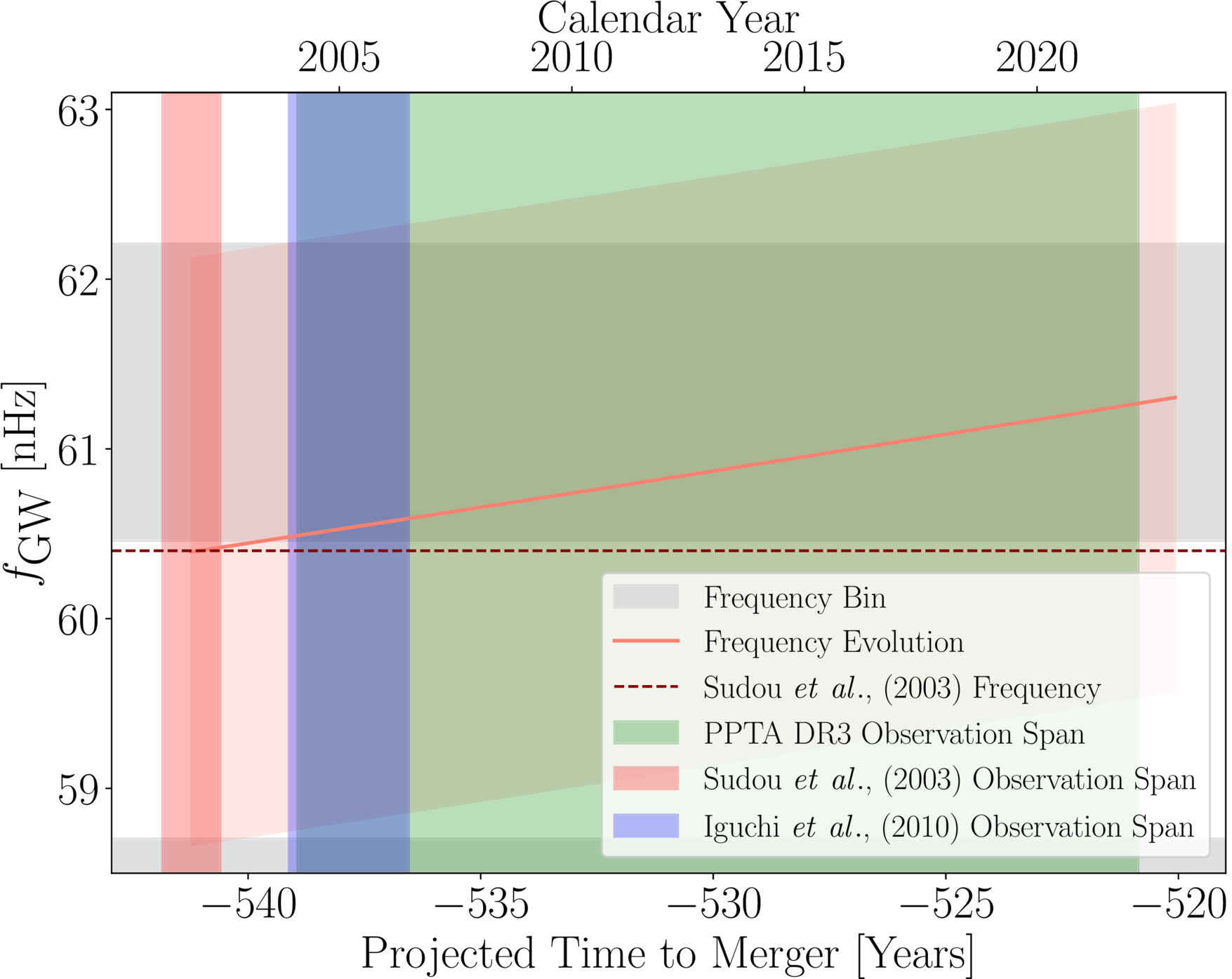
The predicted frequency evolution of gravitational waves from the black hole binary candidate in 3C 66B. Click to enlarge. [Cardinal Tremblay et al. 2026]
One of the most promising candidates for this search is 3C 66B, a poetically named elliptical galaxy roughly 300 million light-years away. More than 20 years ago, researchers discovered that the radio source at the heart of this galaxy wobbles to and fro in a way that’s consistent with the elliptical paths of supermassive black holes in a close binary. Further work predicted that the gravitational waves produced by this binary would have a frequency of about 60 nanohertz and potentially be within the observational reach of current methods.
Pulsar Timing Array
Jacob Cardinal Tremblay (Max Planck Institute for Gravitational Physics and Leibniz University Hannover) and collaborators conducted a search for gravitational waves from the candidate supermassive black hole binary in 3C 66B using the Parkes Pulsar Timing Array (PPTA).
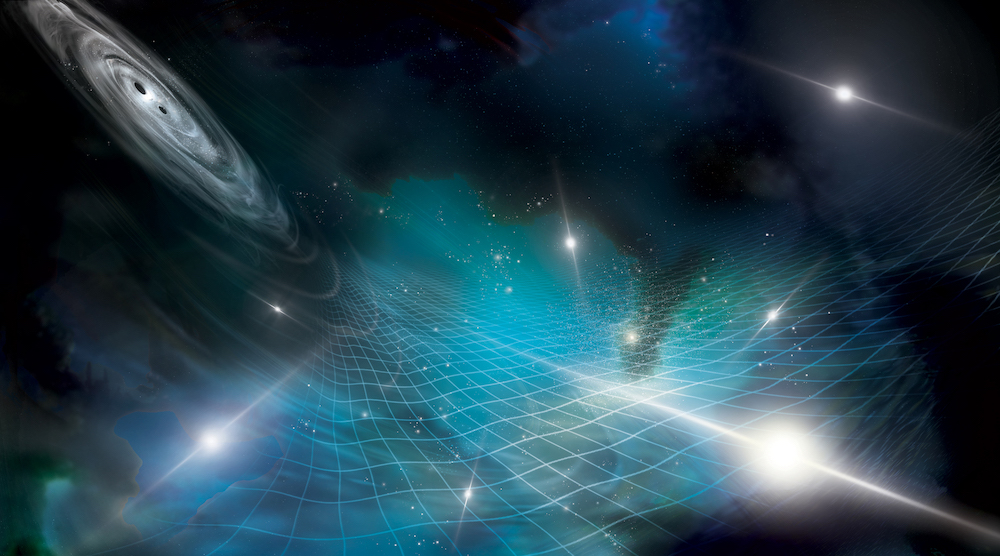
Artist’s impression of a supermassive black hole binary generating gravitational waves that sweep across an array of pulsars. [Aurore Simonnet / NANOGrav; CC BY 4.0]
A pulsar timing array is a collection of pulsars monitored for signs of passing gravitational waves. Pulsars are the condensed, rapidly spinning cores of high-mass stars that exploded as supernovae. Named for their characteristics radio pulses, these extreme stars spin with exceptional regularity, and the passage of a gravitational wave can shrink or expand spacetime enough to speed up or delay the arrival of a pulsar’s pulses. By searching for coordinated changes in pulse arrival times from a collection of pulsars, researchers hope to detect low-frequency gravitational waves that are inaccessible to observatories like LIGO.
Researchers have previously searched for gravitational waves from 3C 66B in data from other pulsar timing arrays, such as the North American Nanohertz Observatory for Gravitational Waves, and no black hole binary has been detected. This is the first search of the third PPTA data release, which contains measurements of 32 pulsars over 18 years, providing a long baseline to search for the slow undulations of low-frequency gravitational waves.
Placing Limits
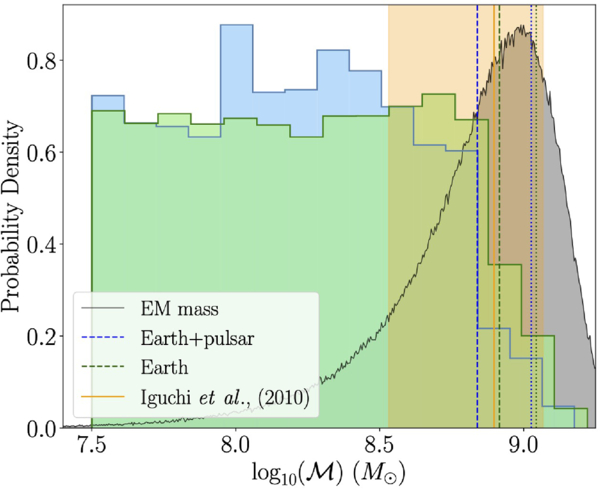
Constraints placed on the chirp mass by this work (blue and green histograms) compared to constraints from electromagnetic observations (gray and peach shaded areas). Click to enlarge. [Cardinal Tremblay et al. 2026]
Using Bayesian statistical methods to analyze their pulsar timing data, the team was unable to confirm or rule out the presence of a supermassive black hole binary in 3C 66B. However, they were able to place limits on its properties, such as the chirp mass and the amplitude of the signal, and certain limits were more stringent than those placed by existing electromagnetic data.
While this analysis didn’t result in the first-ever detection of gravitational waves from a single supermassive black hole binary, it did allow the team to test a new method that could someday play a role in precision cosmology. This method simultaneously analyzes electromagnetic and gravitational wave data from known supermassive black hole binaries, establishing these sources as “standard sirens” that can complement standard candles like Type Ia supernovae for measurements of the expansion rate of the universe.
Citation
“A Multimessenger Search for the Supermassive Black Hole Binary in 3C 66B with the Parkes Pulsar Timing Array,” Jacob Cardinal Tremblay et al 2026 ApJL998 L42. doi:10.3847/2041-8213/ae3c98
Editor’s Note:Astrobites is a graduate-student-run organization that digests astrophysical literature for undergraduate students. As part of the partnership between the AAS and astrobites, we occasionally repost astrobites content here at AAS Nova. We hope you enjoy this post from astrobites; the original can be viewed at astrobites.org.
The first galaxies in the universe emerged out of an archaic age of darkness. Like luminous factories, they started rapidly churning out stars, spilling light into the cosmos. This process of star formation continues to the present day. In some galaxies, it occurred at astonishing rates, with the equivalent of thousands of times the mass of the Sun being assembled into stars in a single year. At other times, it came to a slow crawl, with all fresh reserves of star-building gas seemingly exhausted. Yet when the gears of star formation ground to a halt, certain events were able to send them spinning again.
One of the most spectacular of these is a merger, a train-wreck collision between two galaxies. Images of these events are often breathtaking, showing arms of light twisting together and vast stellar streams being violently cast away. Mergers directly increase the stellar mass (the mass of all stars) of galaxies by combining two into one. The intense gravitational interactions between the galaxies involved can also disrupt stagnant pools of gas, igniting a new burst of star formation. Thus, interactions between galaxies can be a significant driver of their growth.
Sometimes, a reservoir of matter is driven toward the center of a galaxy due to a “secular” process (one that occurs without external intervention) or from a merger. At the galactic nucleus, the infalling streams of matter encounter a supermassive black hole. The matter falls into a swirling accretion disk, heating to extreme temperatures and furiously glowing. If the black hole is massive enough and the gas falls in quickly enough, the accretion disk can outshine all of the stars in the galaxy, and we call such a source a quasar. The intense radiation produced by a quasar can impact the entire rest of the galaxy, either suppressing the formation of new stars or sometimes igniting it.
Thus, a galaxy has an important role in the growth of its central supermassive black hole, and vice versa. This connection manifests in complicated ways. Most strikingly, it is thought to be the cause of the correlation between a galaxy’s stellar mass and its central black hole mass. In the nearby universe, galaxies have stellar masses around a thousand times greater than their black hole masses. JWST, our most powerful tool for investigating early galaxies, has given us unprecedented insight into whether this holds up in the distant universe. Though the jury is still out, many researchers are convinced that the answer is a resounding no. We’ve found distant black holes that appear to be nearly equal in mass to their host galaxies, something that’s unfathomable in the local universe.
However, this raises a key question. Black holes and their galaxies grow together, and they started on nearly equal footing. So why do all of the galaxies in the nearby universe appear so much more massive than their black holes? Today’s article underscores this puzzle, pushing it to the breaking point. The authors examine a well-studied quasar, ULAS J1120+0641 (hereafter J1120), which we see as it appeared just 750 million years after the Big Bang. This source has a supermassive black hole containing an astounding 20% the mass of its host galaxy. The shocking part is that, even after carefully accounting for all of the ways this galaxy could grow in the future, there appears to be no way for J1120 ever to reach “normal” proportions.
Through the Looking Glass, ULAS J1120
First, the authors analyze the key observations of J1120 obtained to date. In addition to observations from JWST, this source has been targeted by some of the most powerful astronomical facilities, including the Hubble Space Telescope (optical and near-ultraviolet), the Chandra and XMM-Newton observatories (X-rays), the Atacama Large Millimeter/submillimeter Array (radio/millimeter), and numerous other ground-based telescopes. This incredible dataset provides a detailed picture of J1120 across the electromagnetic spectrum, spanning X-rays to radio emission.
The authors compare various measurements of the black hole’s mass and find that multiple methods yield a similar result of about a billion and a half times the mass of the Sun. Turning to the host galaxy, they estimate the mass of the visible stars, which is more complicated than it sounds — you can’t exactly count them, since the enormous distance between us and J1120 causes it to appear as just a fuzzy blob. They combine this mass with the mass of newly forming stars that are buried in dust and obscured from our view. The mass of a nearby galaxy that’s actively merging with J1120 is added to this sum. Finally, the authors compute how many stars could form in the future from all of the gas left in the galaxy, and they throw this into the total.
Even with all of these components, the host galaxy would only be 10 times more massive than the black hole at the center. This ratio is a far cry from the factor of a thousand we expect for normal galaxies in the local universe!
A Train Wreck of Train Wrecks
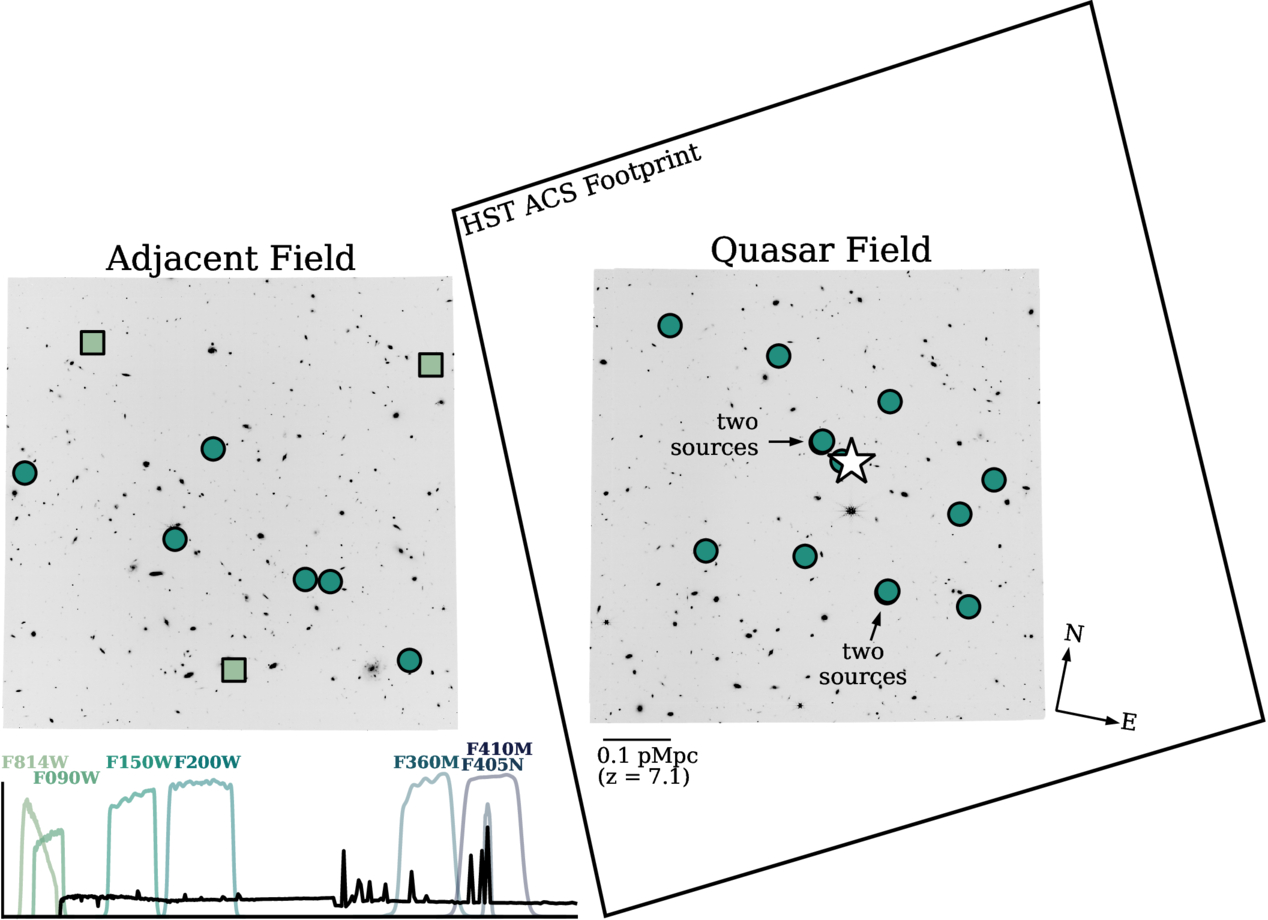
Well, if one merging galaxy won’t do it, what if J1120 merges with literally every single other nearby galaxy? The authors use new JWST data to count all sources near the quasar (Figure 1) and measure their stellar masses. Going further, they estimate how many galaxies their technique may have missed and add all of these to the pile. Not done yet, they finally conclude by making a rough approximation of how much loose gas is in these nearby galaxies, and compute how much extra mass could exist in stars born from this fresh material. Assuming that J1120 survives the full-frontal assault, being battered by mergers from each of its neighbors in turn, its total stellar mass would grow by quite a large factor.
Figure 1: All of the galaxies found by JWST that are close enough to J1120 to potentially merge with it in the future. The circles mark confident detections, whereas the squares represent galaxies for which the exact distances couldn’t be measured confidently. What would happen if all of these galaxies crashed into J1120? [Stone et al. 2025]
What’s the final result? Shockingly, even after all of this growth, the stellar mass of J1120 would still only be about 40 times that of the central black hole. That’s 25 times less than we’d expect from a nearby galaxy! Even if the black hole never grows again, it appears that this galaxy will never reach “normal” proportions. So why is it that, when we look around at the local universe, there’s nothing like J1120? The authors point out that galaxies near J1120 would be missed by their methods if they are obscured by thick shrouds of gas and dust. Such sources would increase the estimated mass that could be contributed by mergers. On the other hand, maybe J1120 will adopt the strategy of the blue whale, filter feeding on the extremely sparse matter between galaxies, yet growing to enormous proportions.
A fascinating final possibility is that galaxies like this one do exist in the nearby universe. With their black hole switched off, all we would be able to see is a relatively small package of stars. Place such an object far enough away, and we might miss it entirely! Whether galaxies like J1120 achieved normal proportions through unknown mechanisms or are lurking in the far fringes of the local universe, studies like this one shine light on the amazing connection between black holes and their host galaxies. In the future, they will be one key piece in the puzzle of the endlessly complicated past of our own galaxy and the universe at large.
Original astrobite edited by Will Golay.
About the author, Ansh Gupta:
I’m an astronomy graduate student at the University of Texas at Austin working with Steven Finkelstein. I use data from JWST to study the formation and growth of the first galaxies and black holes in the universe. In my spare time, I enjoy playing piano, reading, and making YouTube videos.
Where do the mysterious cosmic messengers called neutrinos come from? Researchers search for a connection between neutrinos and accretion flares from black holes.
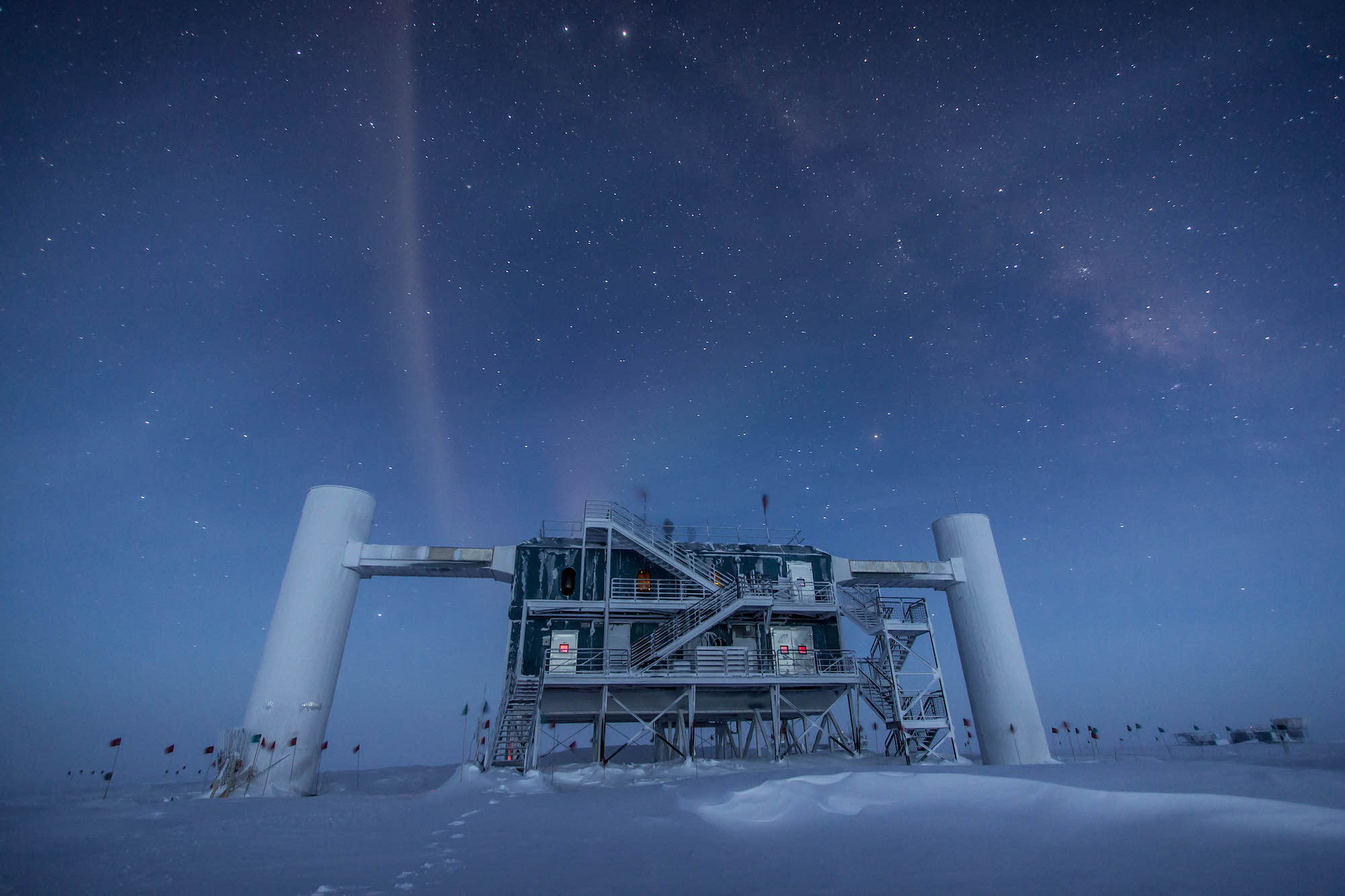
Neutrinos — neutral, nearly massless elementary particles — are generated by natural particle accelerators across the universe. Facilities like the IceCube Neutrino Observatory, which employs detectors buried a mile deep in Antarctic ice, spot neutrinos from distant astrophysical sources, but matching these neutrinos to their sources is no easy task.
Thus far, researchers have discovered a compelling connection between neutrinos and distant active galactic nuclei, which are powered by the accretion of gas onto supermassive black holes. The active galactic nucleus phase of a black hole tends to be long lived, with activity lasting hundreds of thousands of years or more, making these nuclei lasting sources of neutrinos.
Sampling Flares
Recently, researchers have found tentative evidence for coincident neutrinos from short-lived accretion events like tidal disruption events, in which a star is torn apart and accreted by a black hole. These studies have uncovered a potential connection between neutrinos and tidal disruption events with mid-infrared echoes, signaling the presence of obscuring dust.
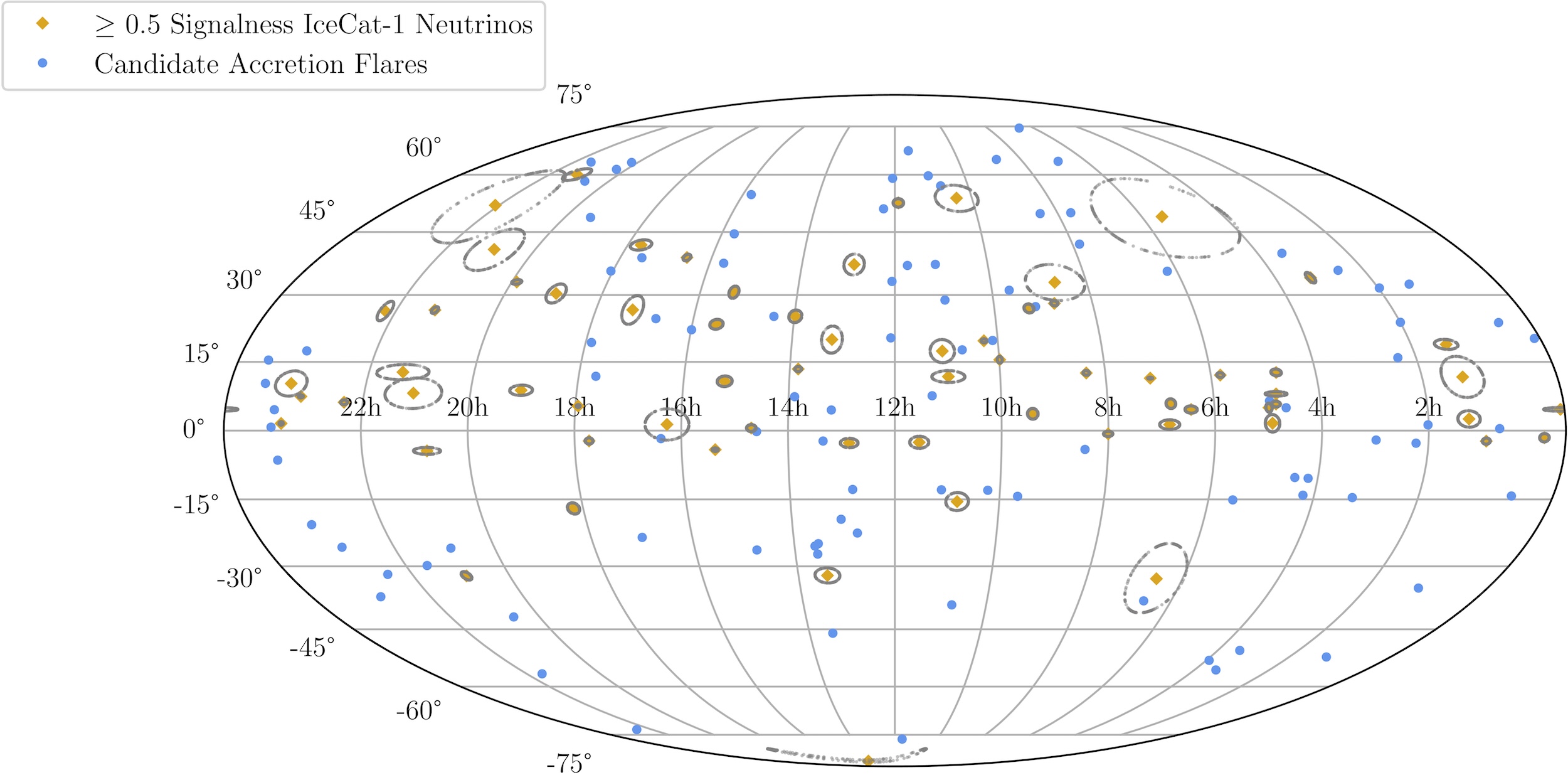
A map of the locations of the neutrinos (yellow diamonds) and black hole flares (blue circles) on the sky. Click to enlarge. [Wang et al. 2026]
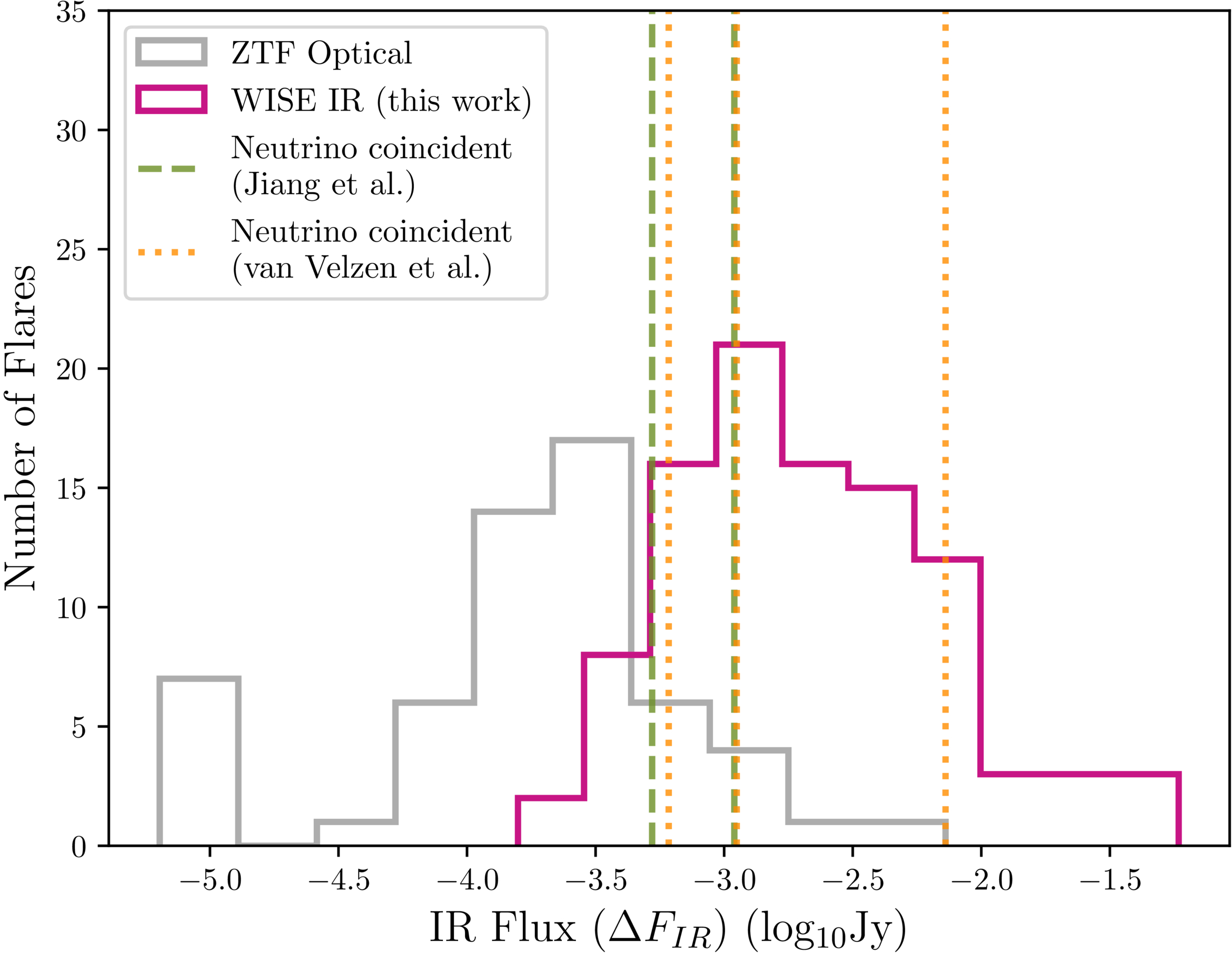
To investigate whether there is any connection between neutrinos and short-lived accretion events, Megan Wang (Massachusetts Institute of Technology) and collaborators first compiled a sample of 99 black hole flares observed by NEOWISE. These flares were selected for their strong mid-infrared emission, location in the nuclei of galaxies, and a fast rise and slow decline. The team applied additional selection criteria to remove other bright transients, such as supernovae, and retain only tidal disruption events and active galactic nucleus accretion flares.
For the neutrino side of the equation, Wang’s team turned to IceCube’s most recent catalog of neutrino events from astrophysical sources. In total, they compiled a sample of 68 events for which the odds of the source being astrophysical was greater than 50%, and for which the directional uncertainty was below 50.
No Coincidences
For a flare and a neutrino to be considered spatially and temporally coincident, the neutrino must arrive within one year of the flare, and the flare must fall within the 90% certainty contours of the neutrino. Ultimately, Wang’s team found no neutrinos that fulfilled both criteria and only one that was spatially but not temporally coincident with a black hole flare.
This result appears to be at odds with previous studies that found several neutrinos that were coincident with tidal disruption events. Wang and collaborators noted that while this work finds no association between neutrinos and black hole flares, it’s possible that the team is studying a different population of accretion events.
Infrared fluxes of the flares sampled in this study (magenta), optically identified flares (gray), and the tidal disruption events thought to have coincided with neutrino detections (green and gold dashed lines). [Wang et al. 2026]
For example, while the previous neutrino-associated flares were flagged for having strong mid-infrared emission, they differ from the current sample in that they were detected at optical wavelengths. The flares sampled in this work were detected in the mid-infrared and have little to no optical emission, potentially highlighting intrinsic differences compared to previous samples.
Future work, including studies that leverage upcoming datasets from the Vera C. Rubin Observatory, the Roman Space Telescope, and the NEO Surveyor, can address this question further and search for connections with specific populations of black hole flares.
Citation
“Testing the Association of Supermassive Black Hole Infrared Flares and High-Energy Neutrinos,” Megan Wang et al 2026 ApJL998 L29. doi:10.3847/2041-8213/ae3f90
Editor’s Note:Astrobites is a graduate-student-run organization that digests astrophysical literature for undergraduate students. As part of the partnership between the AAS and astrobites, we occasionally repost astrobites content here at AAS Nova. We hope you enjoy this post from astrobites; the original can be viewed at astrobites.org.
Quasars are some of the most extreme objects in the entire universe. Despite being as far as tens of billions of light-years away, they nonetheless can appear as bright as some stars in our own Milky Way. To put their brightness in perspective, one just has to consider the Sun. Compared to puny human scales, our star is a truly gargantuan object. It’s a fully functional fusion reactor, churning hydrogen into helium in its core and outputting an unfathomable amount of energy in the process. This glowing furnace is so bright that it can cook us with the heat of an oven during the day, even at a distance of more than 90 million miles (about 8 light-minutes). That distance dramatically dilutes the radiation of the Sun by the time it reaches us, as we only receive a small sliver of its total output, and yet we can still feel its heat pounding down on us when we stand beneath a clear summer sky.
However, if one were to move the Sun about 30 light-years away, it would appear completely unremarkable. You’d need to be under relatively dark skies to even spot it! The vastness of space would simply crush the output of our solar engine; however, if you place a luminous quasar at that same 30 light-year distance, its searing radiation would seem to effortlessly cross the cosmic gulf looming between the stars, scorching us relentlessly with the same heat as the Sun does today. The power of a quasar simply puts our star to shame.
Still, even quasars have limits. The source of power for these objects is a supermassive black hole. The supermassive black hole that lives at the center of our Milky Way is currently dormant. However, many supermassive black holes (especially in the early universe) actively gulp down matter, releasing tremendous energy that escapes in the form of radiation across the electromagnetic spectrum. The escaping photons bump into particles on their way out, exerting an outward pressure. If enough light is unleashed by the quasar, this pressure will actually balance against the pull of gravity, cutting off the food supply for the black hole. This negative feedback loop means that a given quasar has an upper limit to its brightness, called the Eddington luminosity, and to the speed at which it accretes matter, called the Eddington rate. The authors of today’s bite examine a particularly misbehaved quasar that seems to violate even these extreme limits.
It’s a Bird! It’s a Plane! It’s a Jet?
The authors observed the quasar RACS J032021.44−352104.1 (RACS J0320−35 for short) with several radio observatories, including the Giant Metrewave Radio Telescope, the Australia Telescope Compact Array, and the Australian Large Baseline Array. Combining this data with publicly available observations, they find that the source is “radio-loud,” or bright at very long wavelengths. Typically, this kind of emission is expected to be generated by powerful jets that are ejected from the poles of a quasar. For example, the authors compare this radio-loud quasar to similar sources, which show significant variability in the X-ray part of the spectrum. This is a tell-tale sign that the X-ray emission is also generated by these jets (which might come out in fits and spurts and thus cause fluctuations in brightness over time).
However, when the authors examine X-ray data of RACS J0320−35 taken by the Chandra X-ray Observatory, they find surprising results. The quasar is extremely luminous in X-rays, making it one of the brightest in the early universe. But despite the fact that it pumps out a huge number of these energetic photons, it seems to preferentially emit only the lower-energy band of X-rays and completely lacks the highest-energy emission that characterizes similar sources. In technical terms, the X-ray spectrum of RACS J0320−35 is incredibly “soft.” Moreover, this X-ray emission seems to be constant on the timescale of months, though further observations will be required to test if it varies on longer timescales. Still, the softness of the spectrum and weak variability of this system mean that its X-ray emission is unlikely to be produced by a jet.
The authors carefully consider a particular variety of jet — one that is sharply angled towards us. Since quasar jets often travel at incredible speeds, the special theory of relativity kicks in and causes strange behaviors. In particular, an effect called relativistic beaming can cause a source to appear much brighter if traveling towards the observer at extremely high speeds. However, they find that although relativistic beaming can explain the mysterious X-ray properties of RACS J0320−35, such a scenario is incompatible with its observed radio emission. Moreover, a lack of gamma-ray emission and weak variability are further pieces of evidence against the jet origin of the X-ray emission.
Limits Are Meant to Be Broken
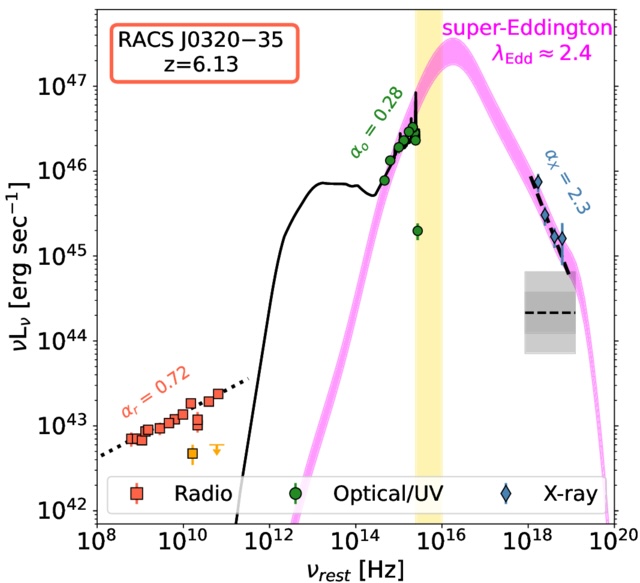
The article presents one more fascinating possibility for the origin of the X-rays in this source. Some theoretical work and simulations show that if a black hole breaks the Eddington limit and starts accreting matter at “super-Eddington rates,” the X-ray spectrum that results can be incredibly soft. The authors find excellent agreement between the observations and the predictions from a particular model that simulates a very slowly spinning black hole (see Figure 1). This scenario seems to be a promising explanation for the X-ray emission in RACS J0320−35, which is extremely exciting for several reasons.
Figure 1: A plot showing the observed energy spectrum of RACS J0320−35 and the theoretical spectra predicted by several models. In particular, the green circles (visible light and ultraviolet (UV) emission), blue diamonds (X-ray emission), and red squares (radio emission) represent the real observations. The shaded pink region represents the predictions of a model that simulates a black hole spinning very slowly and accreting at super-Eddington rates. The model seems to match the observed X-ray and visible/UV emission excellently. However, explaining the observed radio emission might require conditions that violate the assumptions behind this scenario. [Adapted from Ighina et al. 2025]
Many astronomers are considering super-Eddington accretion to explain the masses of early quasars and their fainter counterparts, called active galactic nuclei. Because supermassive black holes are supposed to have a cap on their accretion rate (the Eddington limit), the earliest black holes in the universe should only have been able to reach large sizes after sufficient time had passed. Astonishingly, observations from JWST are finding massive active galactic nuclei everywhere in the early universe, which seems to violate this — these black holes appear astonishingly massive despite existing for only a fraction of the universe’s current age. However, if early black holes could grow faster than expected by undergoing super-Eddington accretion, this tension might be resolved.
Despite the promising initial results of this model, there are a few caveats to the results presented in today’s article. For example, the radio jets observed from this source require a rapidly spinning black hole, which conflicts with the model assumptions. The authors note that a radio jet can be very far from a black hole, tracing its past activity. In fact, this jet may have actually spun down the central supermassive black hole by extracting energy from it, a fascinating possibility that will require both further observations and simulations to explore. Today’s bite shines a brilliant light on this possibility by analyzing RACS J0320−35, a fascinating quasar in the early universe and a stunning example that cosmic limits are meant to be broken.
Original astrobite edited by Veronika Dornan.
About the author, Ansh Gupta:
I’m an astronomy graduate student at the University of Texas at Austin working with Steven Finkelstein. I use data from JWST to study the formation and growth of the first galaxies and black holes in the universe. In my spare time, I enjoy playing piano, reading, and making YouTube videos.
New research suggests that the mysterious “little red dots” spotted in the early universe could be supermassive black holes birthed in the collapse of dark matter halos.
Many theories exist for the origins of little red dots: compact, reddish objects spotted mainly in the first billion years after the Big Bang. The leading theory states that that little red dots are growing black holes encased in dense gas. The black holes at the centers of these little red dots appear to be tens or even hundreds of millions of times the mass of the Sun, raising questions about how they grew so massive so quickly. One possibility is that they started out quite massive, arising from black holes born from the collapse of massive gas clouds in the early universe.
A recent research article explores that theory, with a twist: that the black holes at the heart of little red dots were born not out of regular, baryonic matter, but out of dark matter.
A Dark (Matter) Past
In the early days of the universe, tiny fluctuations in the density of dark matter began to grow, eventually collapsing into vast spheroidal structures called dark matter halos. In the leading theory of cosmology, ΛCDM, dark matter interacts with itself and normal matter only through gravity. This leads to the creation of stable dark matter halos that act as the invisible scaffolding within which the first stars and galaxies grow.
In today’s article, Fangzhou Jiang (Peking University) and collaborators investigated the evolution of halos containing self-interacting dark matter. Particles of self-interacting dark matter, as the name suggests, can interact with one another through collisions and exchange heat. This small adjustment, sometimes invoked in alternatives to ΛCDM to explain the properties of dwarf galaxies, can lead to the collapse of dark matter halos into black holes.
Seeding Black Holes
Jiang and coauthors examined whether this process could explain the observed population of little red dots. First, the team examined whether the timescales are feasible: is it possible for dark matter to assemble itself into massive halos and collapse into black holes, all within the first billion years of the universe?
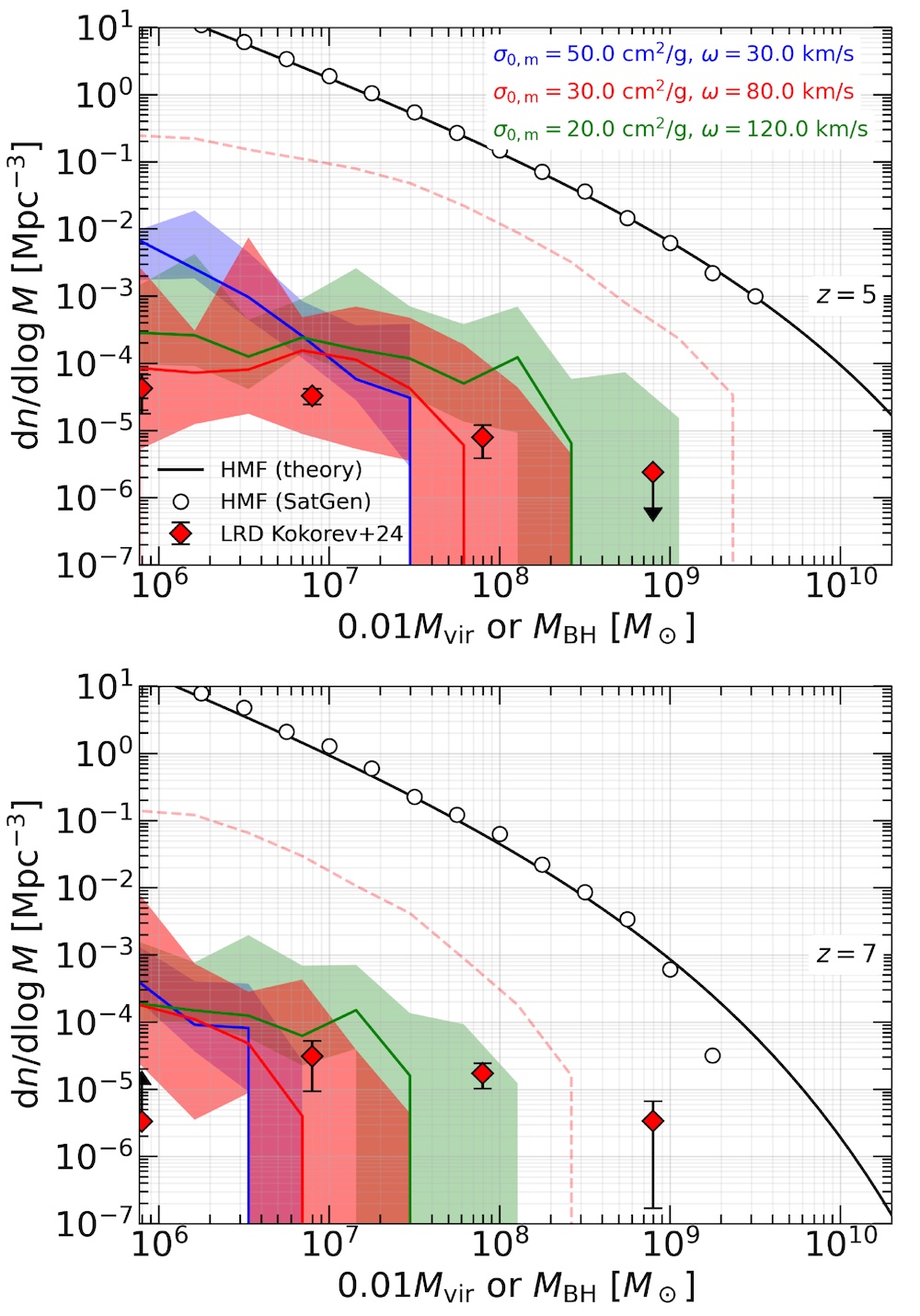
The answer appears to be yes — in this framework, dark matter halos with masses between 106.5 and 108.5 solar masses were able to form black holes between 104.5 and 106.5 solar masses by a redshift of z = 8.5, when the universe was just 600 million years old.
Comparison of the inferred black hole population in little red dots (red diamonds) to models of black holes formed in dark matter halo collapse (shaded areas) at two redshifts. The red area shows the fiducial model, while the blue and green areas show the effects of changing the dark matter self-interaction cross-section. The dashed red lines show an extreme case in which the presence of baryons accelerates halo collapse. Click to enlarge. [Jiang et al. 2026]
Jiang’s team then performed semianalytic modeling to explore how these “seed” black holes grow and evolve through accretion and mergers. This analysis generated a distribution of black hole masses consistent with what has been observed in little red dots. The team cautioned that their results are sensitive to the interaction cross-section of the dark matter particles, as well as various other parameters like the black hole accretion duty cycle. Their modeling also assumes that the halo collapse takes place before any baryonic matter collects within it. Intriguingly, the authors found that the presence of baryons accelerates the collapse of the dark matter halo, speeding the seeding process.
To close, Jiang and collaborators noted that this process is not mutually exclusive with other black hole seeding mechanisms, and as studies of self-interacting dark matter continue, its ability to create black holes in the early universe should be examined further.
Citation
“Formation of the Little Red Dots from the Core Collapse of Self-Interacting Dark Matter Halos,” Fangzhou Jiang et al 2026 ApJL996 L19. doi:10.3847/2041-8213/ae247a

 Login