Chemical traces preserved in ancient rocks indicate that marine environments were deteriorating long before the catastrophe that wiped out vast numbers of species at the end of the Triassic period, around 201 million years ago.
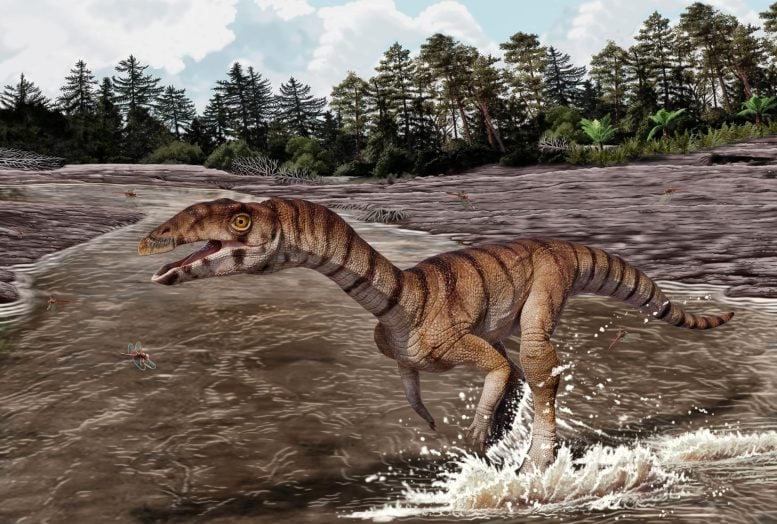
A newly discovered crocodile relative from the Triassic had a beak, tiny arms, and walked on two legs, making it look more like an ostrich-like dinosaur than a crocodile. During the Triassic Period, the ancestors of many modern animal groups were branching into an astonishing variety of shapes and lifestyles. Evolution was experimenting with body [...]
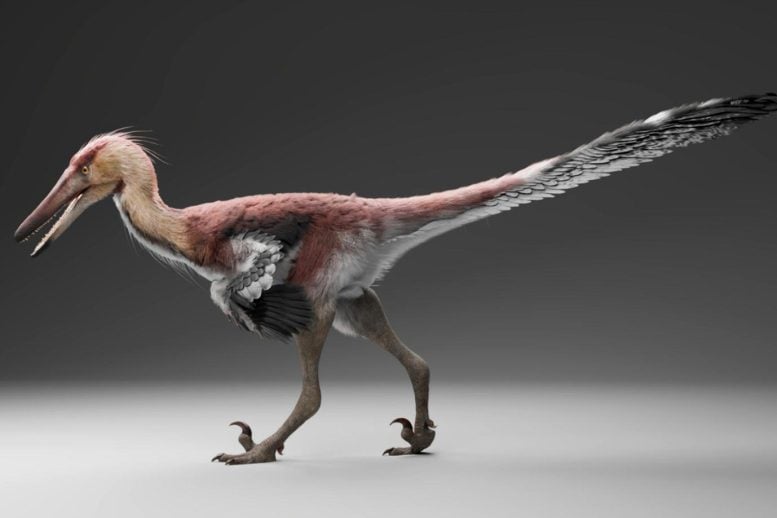
Scientists have uncovered a fish-hunting raptor from Patagonia that may have stalked prey like a giant prehistoric heron. A newly identified dinosaur from Patagonia is giving scientists fresh insight into how some raptor relatives lived during the final chapter of the age of dinosaurs. The species, named Kank australis, appears to have spent much of [...]
Carbon-14 dating consistently reveals that dinosaur remains date to less than 40,000 years old, contradicting the conventional geological timeline of millions of years. This finding, along with evidence of preserved soft tissue, supports a Young Earth perspective and challenges the Old Earth paradigm as presumed in mainstream science.
Recent research suggests Mars may have once hosted oceans and sandy beaches, contradicting claims of insufficient water for a worldwide flood on Earth. While geological features indicate past water flow on Mars, the planet remains lifeless due to its harsh conditions.
The biblical account of Noah’s Ark and the global Flood as a divine judgment on humanity's wickedness is discussed. That includes the processes of water covering the Earth, and tectonics theories to explain geological changes during the Flood and implications for Earth's environment post-Flood.
Day 6 of creation, God created air-breathing land animals and the first humans, Adam and Eve, who were to have dominion over all creatures. I discuss the theological and scientific implications of this creation, emphasizing the unique role of humans and the perfection of the original creation, free from all defects.
Day 5 of creation, God created aquatic and aerial life, including fish, whales, and birds, along with marine reptiles like plesiosaurs and pterosaurs. I critique the evolutionary perspective, arguing that a biblical worldview supports the coexistence of humans and these dinosaurs, countering mainstream scientific thought regarding their extinction.
Recent research claims that all life on Earth originated from a single ancestor called LUCA, existing about 4.2 billion years ago. This notion is based on unprovable assumptions and circular reasoning. The conditions in the Hadean Eon were unsuitable for life, deeming LUCA a fabricated concept anchored in speculation and opposing the biblical account.
For much of the past century, fossils from East Africa have shaped our understanding of apeevolution. Now, a jawbone found in the Egyptiandesert adds a new dimension to that story.
A team from Mansoura University and the University of Southern California has described a new species, Masripithecus moghraensis, in a study that appeared in the journal Science. The fossil of a lower jaw found at the Wadi Moghra site in northern Egypt, the researchers say, is the first clear evidence of an ape fossil in North Africa. Dating to 17 to 18 million years ago, it predates the known dispersal of early apes into Europe and Asia by at least a million years. This may indicate that early ape evolution extended further north than previously thought.
“We spent five years searching for this kind of fossil because, when we look closely at the early ape family tree, it becomes clear that something is missing — and North Africa holds that missing piece,” said Hesham Sallam, paleontologist at Mansoura University and senior author of the study.
A Jaw That Changes the Map
The fossil is of a lower jaw with several distinctive features. Masripithecus had large canine and premolar teeth, as well as molars with rounded, textured surfaces and a robust jaw. No other ape from the same time period shows this combination of features. According to the researchers, these traits indicate a flexible diet based mainly on fruit, with some harder foods like nuts and seeds. This adaptability would have been important in northern Africa, with increasing seasonal variation in the climate.
Masripithecus stands out among East African apes of similar age by its anatomy. Its place in the ape family tree is even more significant. By combining fossil features and geological data with DNA from living apes, the team found that Masripithecus appears closer to the lineage that eventually gave rise to modern apes than any previously known Early Miocene species.
“It is well known that the fossil record of hominoids in Africa is geographically very biased,” said David Alba, a paleontologist at the University of Barcelona, in an interview with National Geographic. “It is also known that they were present in Saudi Arabia sometime later, so finding them in northern Africa by this time is important, but not totally unexpected.”
A Corridor Between Worlds
This discovery is important for both geography and anatomy. During the Early Miocene, the African and Arabian plates were moving closer to Asia. At times, lower sea levels reduced marine barriers and opened a corridor through northern Africa and the Middle East. The team’s analysis supports the idea that this region played an important role in the early evolution of living apes. This shifts the focus of ape evolution. East Africa, once seen as the main center of ape origins, may have been more of a peripheral branch.
Erik Seiffert, co-author and paleontologist at the University of Southern California, said the discovery changed his own thinking. “For my entire career, I considered it probable that the common ancestor of all living apes lived in or around East Africa. But this new discovery, and our new and novel analyses of hominoid phylogeny and biogeography, now strongly challenge that idea.”
The genus name Masripithecus combines the Arabic word Masr (for Egypt) with the Greek píthēkos, meaning ‘ape’. The species name is a reference to Wadi Moghra, where the remains were found. The researchers expect that more fossils will be found as fieldwork continues in the region. For now, this discovery shows that important parts of evolutionary history may still be hidden in areas yet to be fully explored.
Austin Burgess is a writer and researcher with a background in sales, marketing, and data analytics. He holds an MBA, a Bachelor of Science in Business Administration, and a data analytics certification. His work focuses on breaking scientific developments, with an emphasis on emerging biology, cognitive neuroscience, and archaeological discoveries.
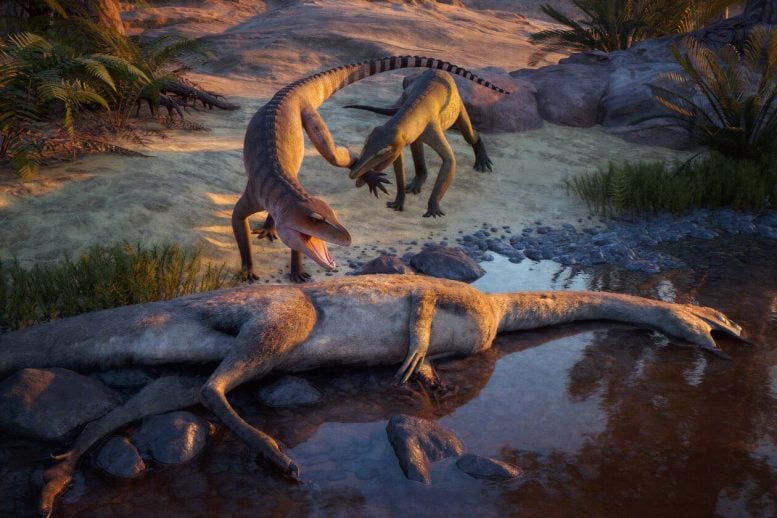
A newly described fossil from Ghost Ranch, New Mexico, belongs to the crocodile family tree, but unlike most crocodile-line archosaurs, it walked on two legs, had small arms, and a toothless beak.
The Triassic period, which took place about 252 to 201 million years ago, was a time of accelerated evolutionary change. Many major animal lineages began to vary during this period, leading to a range of unusual forms. Along with shuvosaurs, this period saw the rise of lagerpetids, bipedal relatives of dinosaurs whose lineage eventually gave rise to pterosaurs, and Drepanosaurus, a tree-dwelling reptile with a sloth-like claw and a tail that could grasp surroundings. Labrujasuchus lived among this diverse group of animals.
“We see a lot of the successful strategies for modern animals and non-avian dinosaurs first arise in the Triassic, and shuvosaurs are a great example of that convergent evolution,” said Dr. Alan Turner, lead author on the paper. “Bipedalism is certainly a unique path for crocodile relatives to take, but it’s a path well-trod by dinosaurs and later birds. It obviously worked for these animals.”
The Expected Discovery
The name Labrujasuchus expectatus reflects both the location and the circumstances of its discovery. The genus name comes from ‘Ranchos de los Brujos,’ the old Spanish name for Ghost Ranch, combined with the Greek word suchus for ‘crocodile.’ The species name expectatus is Latin for ‘expected,’ referring to the expectation that this specimen would be found in this area.
Previous discoveries at Ghost Ranch included similar species from both earlier and later Triassic periods. The presence of an evolutionary link between them was expected, and L. expectatus helps fill a gap in the fossil record.
“Finding one shuvosaur from earlier in the Triassic and one from later meant that we paleontologists knew there were probably more from in-between waiting to be discovered and described,” said Dr. Nate Smith, Gretchen Augustyn Director and Curator of the NHMLAC Dinosaur Institute. “We wanted to highlight how the fossil record works.”
Smith also explained the “haunted” history behind the site’s name. Local legend holds that ranchers called the land ‘Ranch of the Witches’ to discourage visitors and protect the cattle operations of the Archuleta brothers. The researchers chose to honor this aspect of regional history with the name they chose.
20 Years at Ghost Ranch
This discovery marks a milestone for the ongoing excavation project at Ghost Ranch, which enters its twentieth year this summer. The site, known internationally through Georgia O’Keeffe’s paintings of its red and ochre badlands, contains four active quarries and has produced some of the most well-preserved Triassic fossils. In 1947, paleontologist Edwin H. Colbert documented more than a thousand well-preserved skeletons of a small Triassic dinosaur known as Coelophysis at this location.
The excavation at Hayden Quarry, where L. expectatus was found, is part of this ongoing project. Each summer, teams of paleontologists and volunteers excavate the site, and each season brings new discoveries, sometimes confirming what researchers already anticipated. The researchers note that long gaps in the species fossil record indicate much of the group’s evolutionary history is still unknown. More “Witch Crocs” may still be out there.
Austin Burgess is a writer and researcher with a background in sales, marketing, and data analytics. He holds an MBA, a Bachelor of Science in Business Administration, and a data analytics certification. His work focuses on breaking scientific developments, with an emphasis on emerging biology, cognitive neuroscience, and archaeological discoveries.
A recent fossil discovery in Canada is reshaping scientists’ understanding of early animal evolution.
Deep in the Canadian Northwest Territories, researchers from the American Museum of Natural History and Dartmouth College have uncovered more than 100 fossils belonging to the Ediacaran biota, a group of soft-bodied organisms that lived over 500 million years ago.
The new finding suggests evolutionary developments such as movement, sexual reproduction, and complex body structures appeared millions of years earlier than previously thought.
The Ediacaran Period, which lasted from about 635 to 538 million years ago, marks an important stage in Earth’s history when multicellular life first became widespread. Before then, life mainly consisted of microscopic organisms.
The newly discovered fossils give scientists a closer look at this complex transition from simple microbial life to large, complex marine animals.
Found in the Mackenzie Mountains (traditional lands of the Sahtú Dene and Métis peoples), scientists researching the area discovered fossils belonging to the White Sea assemblage, a group of Ediacaran organisms previously found only in Europe, Asia, and Australia.
A First-of-Its-Kind Discovery in North America
What makes the discovery even more impressive is the age of the fossils. Some scientists estimate the specimens are about 567 million years old, making them 5–10 million years older than any previously known White Sea fossils. The time overlap with the Avalon assemblage points to communities that existed earlier than researchers suggested.
Among the most important fossils found was Dickinsonia, a flat, oval-shaped organism believed to move across the seafloor while feeding on bacteria and algae. Scientists consider it one of the earliest animals capable of movement. Another fossil, Funisia, provides the oldest known evidence of sexual reproduction. This is a tubular organism that releases sperm and eggs into the water during reproduction.
A fossil of Dickinsonia, a flat organism that moved around on the sea floor, lacking a mouth and instead absorbing bacteria and algae through its entire bottom surface
“For 3 billion years, life on Earth was dominated by microbes,” said the study’s lead author, Scott Evans, in a statement. “Then, all the sudden, we get these strange-looking marine animals big enough to see and capable of behaviors we would find familiar today.”
Evans, who is the assistant curator of invertebrate paleontology at the American Museum of Natural History, also emphasized the site’s importance in advancing understanding of the changes organisms were undergoing during this period in our planet’s deep history.
“If we want to understand this transition, when life first became large, complex and unmistakenly animal, this new site has tremendous potential,” Evans said.
Researchers also uncovered Kimberella, an organism thought to be an early relative of mollusks. It has a muscular foot used for scraping food from the ocean floor and could be the oldest known bilaterian. Another interesting fossil is the Eoandromeda, which may be an ancient comb jelly with eight spiral arms.
“Not only is this new site highly diverse, but also it is from a part of the rock succession where we have previously lacked fossil remains,” said study co-author Justin Strauss, an associate professor of Earth and Planetary Sciences from Dartmouth. “This is really exciting. Given our understanding of the regional geology in northwestern Canada, there is great potential here to revisit our understanding of Ediacaran Earth history.”
The fossils also challenge assumptions about where early animals first evolved. Scientists had previously believed shallow coastal waters were the main environment for early animal life. However, the Canadian fossils suggest otherwise, indicating that these organisms lived in deeper marine settings.
Evans believes the results “suggest a pattern where evolutionary innovation begins in deeper environments and later spreads toward the coast.”
“We think of the deep ocean as a dark, inhospitable place, but it is also relatively stable, with few fluctuations in things like temperature and oxygen essential to most animal life,” Evans said. “This stability may have provided key opportunities to support early animal life.”
Chrissy Newton is a PR professional and the founder of VOCAB Communications. She currently appears on The Discovery Channel and Max and hosts the Rebelliously Curious podcast, which can be found on YouTube and on all audio podcast streaming platforms. Follow her on X: @ChrissyNewton, Instagram: @BeingChrissyNewton, and chrissynewton.com. To contact Chrissy with a story, please email chrissy @ thedebrief.org.
A newly identified prehistoric crocodile relative, Eosphorosuchus lacrimosa, was discovered alongside another croc species in New Mexico fossils dating back 210 million years. Around 210 million years ago, two crocodile relatives about the size of modern jackals stood together along a humid riverbank in what is now northern New Mexico. One of them, Hesperosuchus agilis, [...]
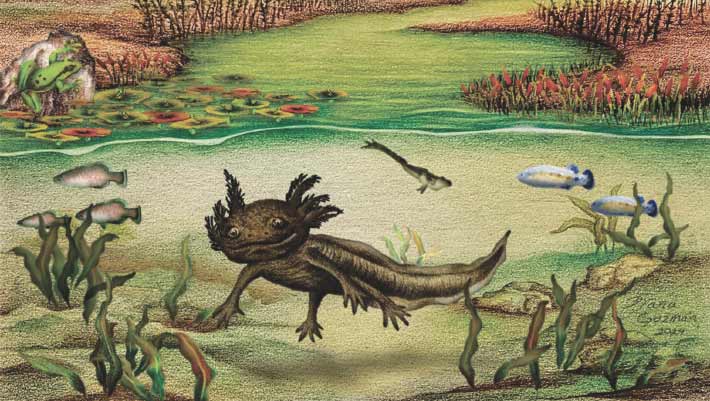
Paleontologists have identified a new species of the axolotl genus Ambystoma from several fossilized specimens found deep in the rocky outcrops of the Mexican state of Hidalgo.

 Login
Login