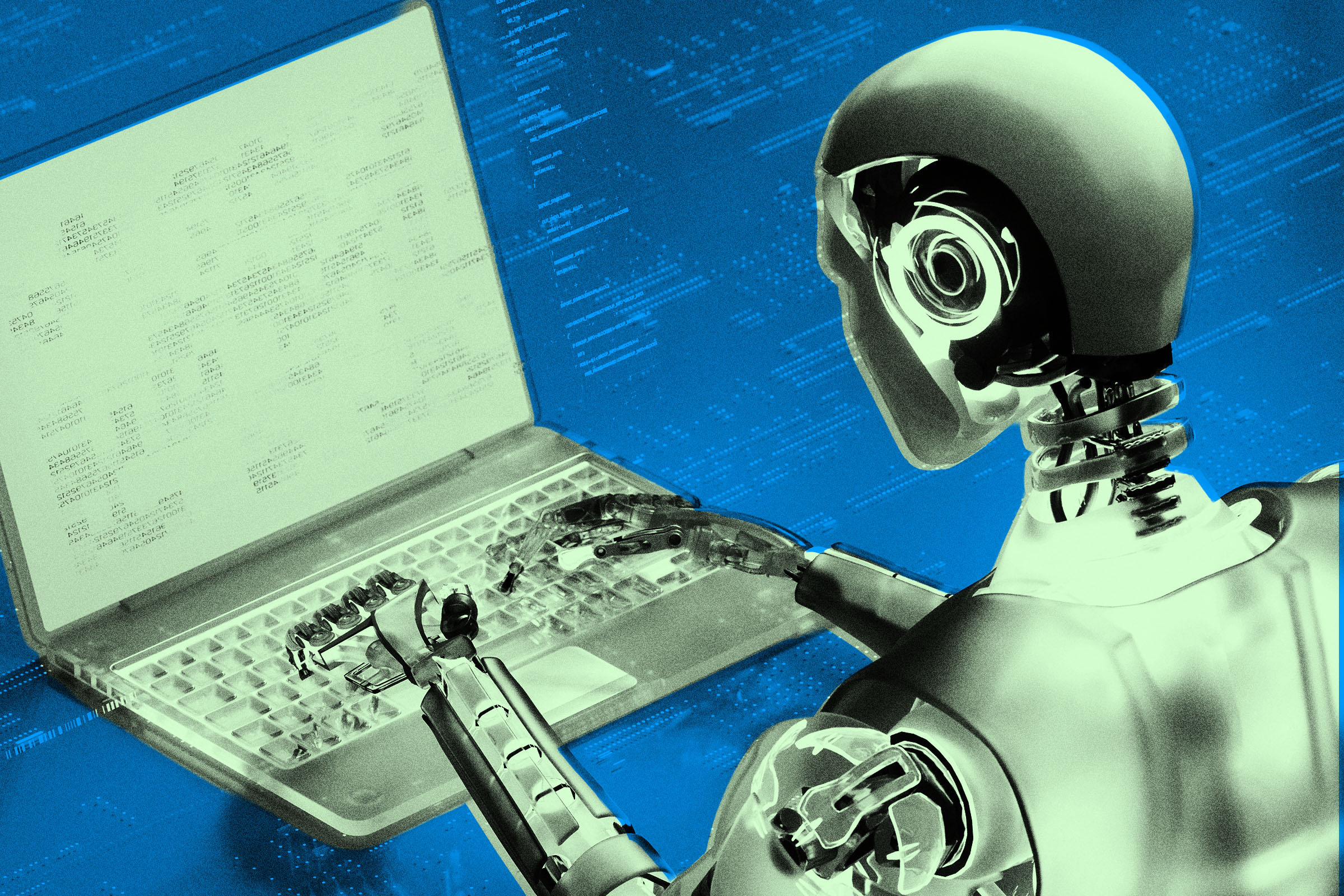
Angry parents aren’t the only ones railing against the proliferation of AI in schools. The American Federation of Teachers, the second-largest teacher’s union in the United States, has now launched a major campaign calling on schools to keep AI and hardware like iPads out of elementary classrooms.
In a buzzy speech at the National Press Club on Wednesday, AFT president Randi Weingarten unveiled ten demands centered around reaffirming human-led instruction. One of the key requests: an immediate ban on AI systems in elementary school classrooms.
The AFT’s action points also included a screen ban for students in pre-kindergarten through second grade, as well as a prohibition on companion chatbots for students under 16, which schools haveadopted at an alarming rate.
“If we don’t find a way to call this out from an education perspective, I fear that we will lose a generation of kids,” Weingarten told the New York Times in an interview. “The work of teaching and learning in the earliest grades should be done without AI.”
In her speech, Weingarten caveated that the AFT’s campaign isn’t some fanatical Butlerian Jihad. She is “not calling for a total ban on AI or a Chromebook bonfire,” but for “getting the balance right to harness the benefits of technology while mitigating the harms.”
Whether the AFT is successful at achieving its demands could make a crucial difference in millions of kids’ educational journey. As tech giants push schools to adopt all kinds of AI systems, a growing body of research is showing that the risks far outweigh any benefits.
As one year-long study conducted by the Brookings Institution’s Center for Universal Education found, AI in education comes with major risk of harm to children’s cognitive and social development — a horrifying thought as an ever-growing number of kids substitute real-life friends with AI chatbots.
When it comes to AI’s place in the classroom — and its role in education broadly — some professors are at the end of their rope. The not quite all-knowing but incredibly adept at bullsh*tting chatbots let lazy students churn out entire essays, solve math problems, and cobble together passable answers for most questions. Needless to say, none of that leaves much room for actual learning.
Such desperate times call for Draconian measures. In a roundup of instructor testimonials on the AI’s impact on their profession from The New Yorker, one pedagogue is taking no prisoners when it comes to punishing pupils who surrender their brains to the tech.
“I tell students that ChatGPT is disallowed from their writing process, that I can immediately tell when ChatGPT has been used, and that I will fail the student on this assignment if it is used — and, potentially, for the entire course, if we go through a formal appeals process,” Neal Hebert, a theatre professor at Grambling State University, wrote to the magazine.
Hebert has an even more merciless warning for theater majors.
“I tell my theatre majors, ‘I get paid the same whether I pass you or fail you,'” he wrote. “‘But what you’ve just done is told me and everyone else in our department that you are so lazy you would rather outsource your collaboration to an app than risk being an artist.'”
Tough love is not something Hebert undertakes with glee, but the overwhelming tide of AI cheating in his introductory classes has left him no choice, he feels.
“I’ve stopped being a collaborator in these intro courses and started being a plagiarism cop, and I do resent that a bit,” he lamented. “I wanted to be the kind of professor my professors were for me.”
Some professors try a different tack, allowing moderate experimentation with AI, and more forgiving forms of chastisement. Daniel Silver, a professor of sociology at the University of Toronto, Scarborough, framed it as a learning opportunity — for the instructors.
“AI has fundamentally changed how I teach, and it demands basic reflection about what we are trying to accomplish,” Silver told The New Yorker.
Silver said he spent a lot of time this academic year coming up with new types of assignments that call for more creative uses of AI, such as creating and experimenting with AI agents that represent famous thinkers like Adam Smith.
“Beyond that, students still would use AI in a thoughtless way, as a replacement for their thought and judgment,” Silver wrote in his testimonial. “So I made a point to just call them on it, and make them meet with me personally.”
After talking with the students, Silver would give them a zero on the offending assignment but also a chance to redo it. “They usually improved, but not always,” he said. To drive the point home, he would show them AI-generated assignments to demonstrate how the “they all kind of look the same.”
AI caused him a lot of “emotional upheaval,” Silver admitted, “but I do feel we all, including the students, are learning how to live with it, and we’ll come out better on the other side.”
Hebert is less optimistic. Whatever ounce of good-feeling he still possessed was shot down when he read his student’s papers on “Fences,” a Pulitzer-winning 1985 play by August Wilson.
“Out of forty students, the vast majority chose similar words, phrasing, and concepts, and most papers were written in that inimitable ChatGPT style: ‘This isn’t a simple story about injustice — it’s a clarion call for a positive understanding of justice,'” he wrote, comparing LLM’s prose to “elevator muzak, but in words.”
Rather than integrating AI, he’s fortifying his classroom against it. The assignment is now based on plays too obscure for ChatGPT and other AI models to know about.
“If ChatGPT is used on these assignments now, it hallucinates characters, plotlines — it just makes sh*t up, since it has nothing to go on,” Hebert told the magazine.
Still, this hasn’t completely discouraged AI cheating, even in Hebert’s upper level courses. And it’s causing him to have nightmares of what the tech’s long term implications for theater as an artform will be, if students “can’t be bothered to read and think about the plays they are performing in.”
“Can you imagine AI Performing Arts Slop? The theatrical equivalent of the images ChatGPT and its competitors spit out, soulless and inert, arriving on stage stillborn?” he asked. “I can.”
If you were paranoid about digital tracking before, you might want to think twice about reading any further.
New research out of Germany’s Karlsruhe Institute of Technology found that the types of Wi-Fi routers we all have in our homes come with a major privacy vulnerability that can be used to identify any human body that comes within their range.
The study, flagged by Gizmodo, used machine learning systems to identify individuals with an accuracy rate of 99.5 percent. To do so, the researchers exploited a vulnerability in a process known as beamforming feedback information (BFI), which was introduced to allow routers to focus Wi-Fi signals on connected devices, as opposed to the older approach, which is to blanket an entire area in coverage.
While BFI is great for network connectivity, it has a major downsides for privacy. For starters, devices connected to a router using beamforming need to send constant feedback in order to be found. As routers send out and receive network feedback, the signal is inevitably impacted by real world factors like pets, walls, and people.
That gap, between the signals routers expect to receive and the distorted feedback they actually get, allowed researchers to extrapolate the identities of 161 individual participants based on BFI data which inadvertently mapped their physical characteristics. Even when individuals changed their gait or carried objects like backpacks and crates, the system registered an accuracy rate between 50 to 60 percent, the KIT team wrote.
“This works similar to a normal camera, the difference being that in our case, radio waves instead of light waves are used for the recognition,” study coauthors Thorsten Strufe said in a press release.
Making matters worse is the fact that this data is basically wide open for anyone to grab — not only is that feedback data unencrypted, it can also be accessed without ever connecting directly to the router.
“We have shown robust identity inference with common-of-the-shelf hardware which is already in widespread adoption in many homes and public areas,” the team wrote in their paper. “With this hardware making its way into millions of homes, the privacy concerns are severe.”
The KIT findings contrast to other Wi-Fi tracking systems, like one developed by researchers at the Sapienza University of Rome. That method, called “WhoFi,” uses channel state information, which is much harder to access on consumer hardware, but can still identify people through walls with an alarmingly high accuracy rate.
That WhoFi study made a point to highlight the anonymity factor: the idea that the sensing system can detect people’s presence, but not identify them. The KIT team refutes that framing outright, arguing that Wi-Fi-sensing technology poses major privacy risks regardless.
“While there maybe legitimate use-cases, we explicitly consider identity inference via Wi-Fi sensing a privacy attack,” they write. “This view reflects the serious risks associated with the ubiquity of Wi-Fi networks, their ability to sense through walls and in non-line-of-sight scenarios, and the fact that this would likely happen without explicit consent.”
While more research will be needed, the researchers don’t mince words about the implications of their initial findings. In their conclusion, the KIT team writes that regulators and companies moving to standardize Wi-Fi sensing should “strongly consider adding effective privacy protection,” or else “abandon beamforming entirely.”
These days, it’s nearly impossible to traverse the web without leaving some trace of your activity. That’s thanks to a panopticon of cookies, keystroke loggers, fingerprinting, tracking pixels, and probably some other horrors that haven’t even come to light. Maybe that sounds paranoid, but it’s exactly what researchers in Austria uncovered in bombshell new cybersecurity research.
According to the recently released paper, first spotted by Ars Technica, researchers have uncovered a type of no-interaction attack that websites can easily run to access data stored in your computer.
It’s called FROST, which stands for “fingerprinting remotely using OPFS-based SSD timing.” It’s a mouthful for sure, but it basically allows malicious websites to spy on your computer activity, all without installing any software or tricking you into clicking sketchy email links.
Per the researchers, it works by taking advantage of your computer’s solid state drive (SSD), the internal storage devices which have largely taken over from magnetic hard drives on the consumer market. Whenever you visit a site, your computer’s SSD starts buzzing with activity, allowing webpages to store temporary files for your browsing pleasure.
FROST attacks take advantage of this by creating a massive file — we’re talking several gigabytes — which functionally blocks your computer from moving what it sees as temporary web data out of the SSD. While that mammoth file is being processed, however, the malicious website is able to probe the timing of incoming data from other sites, generating data which can then be analyzed through a machine learning model to predict what else you’re doing online.
While “predict” suggests the attacker is guessing, the FROST method is scary good at identifying what a victim’s doing on their computer. Researchers write that by using this technique, their machine learning model was able to predict which sites a user would access with an accuracy rate of 88.95 percent, and could accurately predict accessed applications 95.83 percent of the time.
Worse, the whole thing works regardless of what browser you use — because it works through your SSD, an attacker can theoretically track your web browsing on Firefox based on a website accessed via Google Chrome. Researchers only experimented with the technique on Mac and Linux devices, but caveated that Windows devices are not immune.
“In principle, it would be possible to train a model on any system activity that reliably generates SSD accesses,” the study’s lead author, Hannes Weissteiner, told Ars.
While FROST represents the kind of vulnerability that probably needs to be patched by web developers, Ars notes that you can mitigate the risks by closing website tabs as soon as you’re done with them. It isn’t much, but it could prevent you from becoming the next victim of a scary new kind of cyberattack.
Last month, OpenAI CEO Sam Altman’s unsettling blockchain-based side gig seemingly got its Mars all confused.
Let’s back up. The company, previously called Worldcoin and now simply called World, is developing software designed to verify the “humannesss” of people by scanning their eyeballs, a bizarre venture that has already been caught up in its fair share of controversies, from allegations of insider token trading and fraud to exploiting people in impoverished countries. Several countries have banned the company outright.
In April, the firm announced that World was teaming up with another Altman-founded company, called Tools for Humanity, to sell the first tickets to global music sensation Bruno Mars’ upcoming world tour, via a new product called Concert Kit.
The company was forced to eat its words after Bruno Mars’ team shot back that it had nothing to do with the venture. Tools for Humanity soon admitted that it actually meant Thirty Seconds to Mars, another act with “Mars” in its name. Another relevant fact about the band: it’s fronted by actor Jared Leto — who happens to have been hit with a startling number of sex abuse allegations, piling onto World’s existing controversies.
The eyebrow-raising pairup is hoping to tackle an actual problem: ticket scalpers. Concert Kit was designed to cut reseller bots out of the equation by having Leto fans scan their eyeballs for a so-called “Humans Only Concert,” a volunteering effort to be awarded with a special two-for-one ticket offer.
Almost 1,000 verified humans managed to snag tickets for April 17 event, with Tools for Humanity claiming that it had successfully stopped more than 100,000 bots from snapping up tickets, as The San Francisco Standard reported last week.
It’s true that anybody who’s attempted to buy tickets for a hotly anticipated concert within the last few years knows how miserable scalpers and bots have made the experience, with resale tickets often being sold for ludicrous amounts of money.
But handing over highly sensitive biometric data to a shady Altman-founded company with a dubious track record doesn’t exactly sound like a perfect solution.
And that’s without getting into Leto’s connection to the project. The actor was accused by nine women last year of sexual impropriety, The Guardian reported, with one of them calling the behavior — which she says started when she was underage — “predatory, terrifying and unacceptable.”
Yet with a net worth in the nine-digit range, Johnson — who was an early investor in Futurism, though his involvement ended years ago —didn’t exactly get ahead by sharing, a fact one woman was keen to call him out on during a meeting on Surrounded, a debate show hosted by Jubilee Media.
During the face-off between Johnson and an unnamed skeptic, the biohacker argued that “ending death” should be humanity’s main priority.
“I think that a lot of people would change their opinion and want to exist [forever] if the conditions of society were not so brutal,” Johnson said, referring to the fact that most people don’t take his ideas on longevity seriously. “It’s not fair.”
The skeptic immediately hits back with a burning question: “what have you done to change those brutal conditions in society?”
“You’re a person who has literally hundreds of millions of dollars and you spend $2 million every year trying to look younger,” she continued. “And honestly, you look your age.”
The contrarian’s slam is as gutsy as it is compelling: with an estimated net worth around $400 million, Johnson’s vast fortune could easily be spent allaying the worst excesses of poverty, a leading cause of death in the United States and around the world.
What does he spend his riches on instead? A squad of private medical staff to measure his “biomarkers,” a constant battery of blood tests, ultrasound, and MRIs, and bizarre longevity experiments like his hyperbaric office pod. That in mind, the skeptic has a point: what’s the use ofliving forever if you only live for yourself?
It turns out not even the people building Tesla’s self-driving tech trust Elon Musk’s extravagant claims about the company’s autonomous vehicles.
New reporting by Reuters interviewed nine former data labelers and a former self-driving engineer about their take on Tesla’s Full Self-Driving mode. The results were overwhelmingly negative, with seven of the data specialists admitting they wouldn’t ride in a Tesla in FSD.
“We have all seen it fail,” one Tesla insider told Reuters. “Definitely don’t trust Elon on this,” the self-driving engineer concurred, referencing Musks’ declaration that the the vehicles are ready for “safe unsupervised” rides.
One erstwhile worker told the publication they wouldn’t ride in a Tesla robotaxi “if you f**king paid me.”
At least five data labelers, whose job was to comb through hours of FSD footage to train the vehicle’s software to avoid past mistakes, told Reuters they routinely saw clips of Teslas driving above the speed limit, an issue which engineers and managers treated like a low-priority compared to edge-case issues.
Those glowing recommendations come amidst concerns that Tesla’s FSD mode may never be truly safe enough for public roads.
In recent months, Tesla operating on FSD move have driven riders into lakes, off bridges, and even into the path of oncoming trains — and those are just the incidents that get media exposure. Given these insiders’ direct access to terabytes’ worth of proprietary FSD footage, we’re inclined to take their word on it.
As the Australian software firm WiseTech lays off thousands of employees in a pivot to AI, its CEO Zubin Appoo has become the target of violent threats, the company says.
Richard White, WiseTech’s founder, revealed the news in an email to the company’s staff on Sunday, the Financial Review reported.
White said the company had already been facing “several serious and deeply concerning incidents involving personal attacks.”
But “in the past week, this escalated into a handwritten threat of violence made against our CEO, Zubin Appoo, containing personal information and offensive comments directed at members of his family,” White wrote in the email to staff, per the Financial Review.
Security was ramped up at the company’s Sydney office “because of the serious nature of the threat,” he added, and the threat was reported to police.
The threats come after a dragged out layoff-saga at WiseTech which has left employees frustrated and confused. In February, the company stunned the rank and file by announcing that it was firing 2,000 staff, or about a third of its entire workforce. But who was getting the axe was unclear, leaving employees in agonizing suspense. For months, they waited to hear if they were part of the cuts, but never got clarification.
The agony was amplified Monday, when staff received messages in the morning saying their role was “impacted,” before getting another communication two hours later asking for their personal email address for further communication, according to the Financial Review. Except this was followed by another twist, when the emails were deleted from employee inboxes by WiseTech’s IT administrator, and succeeded by a similar email that gave only a fifteen minute deadline to submit information.
Rubbing salt in the wound, the one thing WiseTech leadership was sure to communicate was their love for AI. Appoo told investors that he was expecting “further efficiency gains” over time as AI capabilities improved. And White, even more blithely, boasted that AI agents could complete training in mere minutes that would take humans weeks.
“It doesn’t take much effort to convince people, in the end, that they’re stupid to be paying $100 for labour when you can pay $2 for the AI,” White said at an investment conference earlier this month, per the Financial Review.
Harbingering the new paradigm, White also revealed an “AI agent credo” for the company, stating: “Capacity is no longer constrained by people or time.”
With job cuts looming and AI being waved in their faces, morale at WiseTech has plummeted.
“People are being told to keep delivering as usual, while also helping roll out the AI tools that are supposedly meant to replace them,” one employee told The Guardian earlier this month. “All of this while everyone’s left waiting to find out if they’re in the 50 percent.”
The alleged threat illustrates how tensions around AI layoffs are running high across myriad industries. Earlier this month, Standard Chartered CEO Bill Winters sparked a storm of controversy after calling the employees he planned to replace with AI “lower-value human capital,” forcing him to not only issue an internal memo clarifying his remarks but, after that apparently didn’t go over well, even make a public apology.
More and more wealthy individualsare buying up luxurious underground shelters to survive the apocalypse, whether it’s in the form of a nuclear conflict that turns the Earth’s surface into a radioactive wasteland, or a devastating pandemic that decimates the global population.
But even long before the emergence of total societal collapse, communities buying up underground condos in sprawling prepper developments in the US are already starting to turn on each other, as the Wall Street Journal reports.
Much like the petty grievances plaguing often overbearing homeowners’ associations, investors of a purportedly “five-star” bunker in rural South Dakota called Vivos xPoint are already at each others’ throats — an ironic development, given their shared motivation to survive the end of the world.
The structure was designed to protect 1,000 people from a “coming life-extinction event,” the company behind the development claims on its website.
Only a third of the individual properties — which can be bought for up to $55,000 plus rent and service fees — are occupied at the moment, according to the WSJ. However, altercations and even lawsuits are starting to rack up, long before owners are forced to take shelter in case of an actual “extinction event.”
Disputes are piling up, per the newspaper, from lawsuits over filled septic systems to complaints over off-leash dogs biting residents. During one particularly hairy incident, a man who moved into one of the units with his wife, his daughter, and her four children, pulled a gun on a Vivos contractor who had pulled up with a front-end loader to his bunker.
The resident eventually shot the contractor, injuring him. However, South Dakota’s stand-your-ground law led to a grand jury declining to indict him.
Another lawsuit, filed in September by more than 100 tenants, argued that Vivos had failed to provide them with livable dwellings and properly maintain them. Vivos also promised to build out a gym, restaurant, and general store, among other lavish amenities, none of which have been completed.
In short, the irony of a group of individuals looking to survive the apocalypse melting down over existing rules and petty grievances — long before the actual end of the world — is hard to ignore. And doubly so that they’re seeking redress in the courts, which presumably wouldn’t exist anymore in their fantasy of a post-apocalyptic society.
If this is really the best of humanity that will weather the storm, we could be doomed after all.
Given their increasing hold on the levers of political power, in other words, it’s likely that the world’s richest would get advance news of a civilization-threatening event. Kyle McDonald, a programmer and artist from Los Angeles, has developed a new jet tracker with exactly that dynamic in mind. Called the Apocalypse Early Warning System, the vibecoded website is meant to warn of impending doom based on how many private jets are in the air at any one time.
The mechanics are complicated, but the concept itself is rather simple: is the number of private jets in the air unusual for a given time? If so, it could indicate that the ultra rich have advanced knowledge of a world-ending emergency, and are scrambling for their privatecompounds while they still can.
Basically, the AEWS is designed to map private aircraft signals from around the world, which it then compares against typical numbers. Based on the difference, it assigns a score between 1 and 5, with 1 being completely normal, and 5 signalling that the level of private jet activity is higher than it’s been over the previous year.
McDonald caveats that the score is not a guarantee of apocalypse, but “should be read alongside other public signals.” A level 5 can be triggered by holidays or major political events, for example, so it’s important to view the data in context.
Still, McDonald told Business Insider, the tool has already mapped some surprising trends. For example, the AEWS’ highest spike so far came on April 6, the day when Iran launched a massive offensive barrage on US and Israeli targets in retaliation for earlier attacks.
“That freaked me out,” McDonald wrote. “I remember thinking, ‘oh my God, it’s real.'”
The programmer-activist has also worked on a few other public-information tools that have helped reveal useful facts hidden under piles of noisy data. One app he worked on with friends, meant to track the Los Angeles Police Department’s infamously aggressive helicopters, helped uncover the fact that the agency was frequently disabling or manipulating their transponder signals to avoid detection by the public.
How useful the information will actually be if disaster strikes is anyone’s guess. In the meantime, it’ll be fascinating to see whether the programmer identifies more trends in the flight data as regional wars and climate disasters continue roiling the globe.
With inflation out of control amidst a low-fire, low-hire economy, the amount of private debt in the United States is at an all time high. That’s a grim milestone for any country, let alone one as technically rich as the US — and it’s leading to a massive rise in late payments and credit delinquency.
But as more and more lenders come looking for their payments, it’s increasingly AI — rather than humans — doing the collecting.
New reporting by Wired details the rise of AI agents for hounding debtors. As one Seattle man identified as Ben told the publication, autonomous bots are even making erroneous calls on old debts that have already been settled.
During a call regarding a $266 dispute with a past landlord, Ben said he was hounded by Eve, an obviously artificial voice agent sent by the company ProCollect.
“Would you like to resolve it today by card or bank transfer?” the AI agent asked.
Knowing that he had already settled the dispute, Ben poked and prodded, trying to test its limits after it refused to connect him to a human. “I figured it was just going to kick me over to a person when I asked about repayment structure or anything more technical,” he told Wired.
In the end, he got the bot to engage in some quasi-sexual roleplay, where he was “just a little guy” and his debt was a sultry giantess. After a few minutes of this, Ben says he was unceremoniously whisked away to a human, who confirmed the debt had been settled.
As cofounder of AI call center startup Altur Pedro Fernández told Wired, debt collectors are some of his sector’s “best early adopters.” Altur, for example, places over 2.5 million debt calls a month with AI agents.
It’s not surprising they get things wrong, either. Debt collection is based on massive webs of data, spreadsheets which are essentially sold down the line from the original creditors to second-hand buyers, a sloppy and frustrating system at best.
For all their faults, humans are infinitely more reasonable when it comes to resolving discrepancies that turn up in the shuffle. While nobody likes a debt collector, human or otherwise, at least you can argue back to a fleshbag.
Monstrous defeats keep coming for Mike Lindell, the notorious entrepreneur behind the MyPillow brand and one-time advisor to Donald Trump.
According to Straight Arrow News, a clique of hackers known as “Play” is claiming to have accessed a huge chunk of private data from MyPillow, which it’s now holding hostage. Per the outlet, which viewed a communique from the gang, the hackers now have access to “private and personal confidential data, clients’ documents, budget, payroll, IDs, taxes, finance information and etc.”
Lindell’s company has been given until Friday, May 29 to respond — or else its data will be published online, the hackers threatened. The amount they’re trying to extort hasn’t been disclosed, and neither the hackers nor MyPillow responded to Straight Arrow‘s requests for comment.
Play first appeared in 2022, when it orchestrated cyber attacks throughout the US, Brazil, Germany, and Switzerland, among others. Their targets tend to be those associated with government functionaries, like the Argentinian judiciary, and an IT firm contracted by the Swiss Federal Department of Finance.
In that vein, a successful attack on Lindell would be a major trophy. The entrepreneur first met Trump in the run-up to the 2016 presidential election, a relationship which blossomed as the would-be president ferried the increasingly crankish Lindell around rallies across the country.
Now in 2026, the MyPillow founder is once again running for governor of Minnesota, having filed all the corresponding paperwork — which is more than he did last election cycle. That said, the hack comes as his finances and personal life are now under perhaps more scrutiny than they’ve ever been. Given his ties to Trump, who appears to be backing him again in the 2026 election, there could conceivably be some fascinating details lurking in the MyPillow archives.
Whether Lindell can pony up to keep them hidden remains to be seen: in April of 2025 he admitted that he didn’t even have “5 cents” to his name, owing to an avalanche of civil suits and federal investigations stemming from his political antics.
Rest easy, paranoid gamers. Riot Games says its Vanguard anti-cheat tool won’t “brick” the computers of hackers ruining everyone’s fun in its multiplayer games. And that’s too bad, since cheaters deserve to suffer at least twice as much as the beleaguered gamers that willingly subject themselves to grinding MMR in one of the company’s titles already do.
The brouhaha stems from a Vanguard update the “Valorant” and “League of Legends” maker released last week that targets notoriously hard to detect direct memory access (DMA) cheats, which bypass security measures by using an external device to write directly to a computer’s RAM.
Responding to another post about its new anti-cheat measure, the Riot social media account tweeted a picture of a bunch of rounded-up computer hardware that was reminiscent of a drug bust haul. It was appended with a provocative caption: “congrats to the owners of a brand new $6k paperweight.”
This turned out to be a PR landmine. The tongue-in-cheek post was interpreted as Riot bragging that it now had the ability to remotely brick your computer, creating an explosion of angry posts so overwhelming that the company scrambled to propitiate the mob banging on its gates.
“There’s been a wave of claims by cheaters about Vanguard ‘bricking’ their PCs, so let’s clear that up: Vanguard does not damage hardware or disable your devices,” it wrote in a lengthy X statement less than a day later.
“The photo we posted is a picture of cheat hardware devices that are sold explicitly for cheating in VALORANT (not normal PCs or PC components),” it added. “Through our latest updates, Vanguard now makes those devices worthless for VAL, but does not in any way brick PCs or PC components or PC software.”
The backlash is a reflection of how controversial Riot’s Vanguard software remains years after it was first released in 2020. A so-called kernel-level anti-cheat, it requires gaining the highest level of access to a part of the operating system where its most crucial processes run, a privilege that most software does not ask for.
While this makes Vanguard adept at rooting out cheats running on someone’s system, it also in the eyes of critics makes it alarmingly invasive. And beyond potential privacy concerns, many users have complained that Vanguard causes all sorts of technical glitches on their machines, though it’s impossible to corroborate all those claims.
Unfortunately for Riot, those critiques aren’t about to die down after its latest DMA update and accompanying disastrous post. And unfortunately for the Vanguard-skeptical, Riot is sticking to its kernel-level guns.
“We’ll keep investing in anti-cheat to protect competitive integrity, and we’ll keep being as transparent as possible about how those systems work,” the company said in its statement.
That’s more less Nintendo’s approach to AI, and the market is rewarding the Japanese video game maker for it, in Bloomberg’s analysis.
For the record, Nintendo is not a stellar stock. Investor uncertainty over its cheap Switch 2 pricing, which didn’t budge even as memory costs soared, helped cap off five straight months of decline, the longest loss streak sustained by the company in a decade.
But earlier this week, it showed some signs of life. On Tuesday, shares climbed as much as 6.8 percent in Tokyo for three days in a row, joining a broader rally of Japanese video game stocks, per the reporting.
It’s less a reflection on Nintendo, however, and more on shifting investor attitudes towards AI.
“This is all part of the rotation out of AI tech and into beaten-up names,” Amir Anvarzadeh, Japan equity strategist at Asymmetric Advisors Pte, told Bloomberg. Tuesday’s climb “underline the growing caution about the market — massive gains in AI tech which cannot be sustainable.”
Tomo Kinoshita, global market strategist at Invesco Asset Management Japan, speculated that it was a sign of investors hedging their bets ahead of Nvidia’s quarterly earnings, which were released Wednesday.
“Nvidia often fails to live up to the market’s sky-high expectations, and AI stocks can suffer as a result,” he said. “I expect many investors are temporarily selling AI stocks in preparation, which is driving the rotation.”
That prediction seems to have been vindicated. Despite clinching another record quarter, Nvidia’s numbers were less impressive than investors hoped, sending shares tumbling by a few percent. Its profits literally doubling from the same period a year ago was apparently not enough.
Imagine this scenario: your algorithm has pulled up a background YouTube video, or maybe a podcast. Unbeknownst to you, hackers have embedded inaudible sounds in it, designed to hijack your smart speaker or phone’s AI assistant — meaning the cybercriminals can now access your private photos, bank accounts, or any other personal information you’ve hooked up to your AI system.
It sounds like an also-ran episode of “Black Mirror,” but it’s exactly what researchers have shown is possible in new research being presented this week at the IEEE Symposium on Security and Privacy.
Basically, a team of researchers in China and Singapore found that they can construct “adversarial audio,” completely undetectable to the human ear, that tricks voice AI models into doing things they shouldn’t. Then it’s a breeze to hide it in innocent-sounding audio — a song, a movie, or anything else that unsuspecting targets might play in the background — and lay in wait for users to accidentally compromise their digital lives.
“It takes just half an hour to train this signal, and then, because this signal is context-agnostic, you can use it to attack the target model whenever you want, no matter what the user says,” lead author Meng Chen, a PhD candidate at China’s Zhejiang University, told IEEESpectrum of the work. “These single-point defenses struggle to resist our attack because we found it’s very hard for these models to distinguish the normal user intent and our adversary attack.”
One catch, at least for now: the technique required the hackers to have access to the full weights of the AI model they’re targeting, meaning they were only able to attack open source models. But because many commercial AI systems are built on open source models, that meant that their exploit was effective against mainstream products by Microsoft and Mistral.
Mistral didn’t respond to IEEE‘s request for comment, but Microsoft issued a statement that should probably give anyone pause before connecting any important information whatsoever to one of the company’s voice AI models.
“We appreciate the researchers’ work to advance understanding of this type of technique,” it read. “This study evaluates model resilience through controlled, direct interactions with the model itself, which helps inform our approach to building model resiliency. In practice, AI models are often integrated into user applications, and we offer developers tools and guidance they can use to implement additional layers of protection that help safeguard users.”
If you needed any more evidence that Americans have lost any semblance of a shared reality, just take a peek at the average Fox News broadcast.
During an appearance on Fox to discuss the US-Iran war, retired US Central Command (Centcom) deputy commander Robert Harward insisted that Donald Trump holds all the cards as the two sides negotiate for an end to hostilities. Outlandish as that idea might be — the Iranian Revolutionary Guard Corps currently has the world oil economy in a stranglehold — it was Harward’s peculiar appearance that caught everybody’s attention.
Down near where the top of Harward’s undershirt meets his collarbone was a bizarre flap of skin that appeared to move along with his head, but separately from the bottom of his neck.
It isn’t abundantly clear whether it was excess skin or a weird trick of the studio lights, but conservative social media was soon abuzz with conspiracies that he was wearing a “Mission Impossible”-style skin mask during the taping.
“Holy sh*t why is this man on Fox News wearing a literal CIA mask,” conservative influencer Blaire White shared to over 700,000 followers on X-formerly-Twitter.
“Mr Harward has been kidnapped and they are using this mask to show someone how powerful they are,” one woman suggested in the comments, adding that “something is fishy.”
“Remember. Whoever designed the system doesn’t make mistakes,” another poster hypothesized, whatever that’s supposed to mean. “If you’ve seen it, it’s cuz you were supposed to see it.”
Even nominally reputable commentators were put off by Haward’s unsettling visage. Journalist Seth Abramson said he was “hereby boycotting any further activities of any kind in my life” until someone “explains to me like I am a 5 year-old exactly what in the B-horror-movie hell I just saw.”
“Seriously, just shutting my life down until this is resolved,” Abramson wrote.
Whatever’s behind the strange appearance on the live news program remains to be seen. It certainly isn’t the first time Fox has been accused of faking an expert to juice up a live broadcast.
Back in 2025, rumors swirled that the network’s masked “Antifa whistleblower” and “Mexican Mafia hitman” interviewees were really played by Hollywood crank Michael Rapaport.
In both cases, it’s impossible to say for sure, but it’s clear that any semblance of trust in the media — even a network as notorious as Fox News — has been fractured beyond repair.
The rise of AI is many things: technological, sociological, political, even teleological.
But perhaps above all, it’s financial. When OpenAI released ChatGPT back in late 2022, it quick picked up enormous user traction — and moneymen across the tech industry immediately started scheming about how to cash in from the rush of interest.
The model they coalesced around hinges on gigantic investments in computing infrastructure to power the tech. It’s high risk and high reward: in their telling, the investments will pay off massively as the tech matures to automate huge swathes of the labor market, but some critics fear it’ll never generate enough revenue to justify the incredible spending.
Nobody is more exposed than the Japanese investment company SoftBank, which has poured an eye-watering $60 billion into OpenAI over the past few years.
According to explosive new reporting by Bloomberg, even certain insiders at the company are rattled. Viziers of founder Masayoshi Son have privately questioned what will happen if the Sam Altman-led company can’t pull off its grand promises — and Son’s reaction has apparently been so “brusque,” in the publication’s wording, that they eventually gave up.
What’s clear from the reporting is that Altman has done what he does best: turned Son into a true believer in his vision of computer superintelligence that causes profound shifts for the entire course of civilization.
Habib Imam, a former SoftBank insider who’s now at Menlo Park Capital, told Bloomberg that it’s fundamentally a “bet on a worldview about AGI,” adding that “you can’t hedge a worldview.”
The reality is that Son’s track record is dodgy. He made a series of canny bets during the company’s early history, then bet big on the Chinese retailer Alibaba, netting immense returns. But in recent years, the company is probably best known for Son’s dogged financial support of WeWork, the would-be coworking space startup with an Altman-like charismatic founder named Adam Neuman — and which imploded in spectacular fashion in 2019.
The question essentially comes down to a Rorschach test: is Altman a visionary ushering in a new world order, or is he a con man taking Son — and many other financial luminaries around the world — for a wild ride that’ll soon come crashing back to reality?
No matter how remote the chances, the consequences of the latter scenario could be catastrophic. SoftBank has already sold top assets, including shares in fellow AI company Nvidia, to pay for its OpenAI commitment. And insiders are reportedly jittery about signs that OpenAI is losing ground, with its defectors who jumped ship and started Anthropic now attracting the most buzz in the industry.
For their part, both companies downplayed Bloomberg‘s reporting.
“SoftBank and OpenAI have built a strong strategic partnership grounded in a shared view of where AI is headed and what it will require at global scale,” Softbank told the outlet. OpenAI said the two companies have a “great relationship” and are “among each other’s closest collaborators.”
AI is reportedly making inroads in a famously tech-cautious community: the Amish.
According to a fascinating story by New York Magazine, the men of Holmes County, Ohio’s Amish community — the area with the largest concentration of Amish people in the country — have embraced generative AI as a new tool to do things like write emails, draft contracts, create spreadsheets, and otherwise manage their oft-family-run businesses in fields like manufacturing, construction, and agriculture.
“I started using it soon after it came out, more or less testing it,” Ian Wengerd, an Amish father-of-six who owns a metal-fabrication company, told NY Mag. “The more I used it, the more I thought this could actually be a good thing.”
Wengerd, whose business employs about 30 staffers, explained to the magazine that his business gets “involved in some state work, federal work, private work.” In other words, he’s busy — and he says that without tech, chatbots included, he and his many employees would be out of a job.
“For us to try to do business with just a fax machine and a voicemail,” said Ian, “I’d have to shut my doors.”
Not all Amish folk enjoy access to the internet, and when they do, it’s generally quite limited. (One expert, historian Marcus Yoder, told NY Mag that he believes that fewer than half of Holmes County’s Amish population is online, and of that population, he estimates that under 10 percent have given AI a whirl.)
Not a single person NY Mag spoke with uses a smartphone; they either use zhuzh-ed up “dumb phones” or flip phones. Their digital life is also heavily filtered through Christian censoring services and almost entirely restricted to the workplace. But media censorship aside, that stark line between the workplace and the home, interestingly, seems to make for some healthy technological boundaries.
“I can’t lay in bed for half an hour asking Chat stuff. So the times when I’m vulnerable it’s not at my fingertips,” Ian’s cousin John Wengerd, a 19-year-old chicken salesman and property manager, told the magazine. “When I go home, I’m riding a horse or feeding chickens.”
“I don’t want to paint a picture that we’re pushing for new technology and we don’t have respect for our traditions and our values,” business owner and minister Daniel Wengerd — indeed, another cousin — told NY Mag. “We’re not just opening the door to anything.” That said, according to the piece, Daniel did use ChatGPT to write his wife a Valentine’s note.
Longtime Cybertruck watchers might remember a peculiar day back before the brutalist pickup was even released, when Tesla CEO Elon Musk randomly tweeted that the vehicle would function as a rudimentary flotation device.
“It will even float for a while,” he wrote at the time.
It wasn’t a one-off claim. Musk later boasted that the vehicle would be able to “traverse at least 100m [330 feet] of water as a boat.”
“Mostly just need to upgrade cabin door seals,” he claimed, writing at another point that the “Cybertruck will be waterproof enough to serve briefly as a boat, so it can cross rivers, lakes and even seas that aren’t too choppy.”
Unsurprisingly, all Musk’s bluster about the truck serving as a makeshift schooner turned out to be flimflam. In fact, it quickly emerged that just getting wet in a car wash could brick the thing.
To muddy the waters further, the company ended up adding what it calls “Wade Mode” to the vehicles, which sets the truck’s ride height to the highest level, ostensibly so it can ford creeks and streams.
All that mixed messaging clearly got jumbled for a Texas man, though, who activated Wade Mode and drove his Cybertruck into a lake. Unsurprisingly, things didn’t go well for him.
“Yesterday, [Grapevine Police Department] and [Grapevine Fire Department] were dispatched to Grapevine Lake, where a Tesla Cybertruck was stranded in the water,” police in Grapevine, Texas, wrote on X-formerly-Twitter. “The driver drove into the lake to use the ‘Wade Mode’ feature when the vehicle became disabled.”
Not only is the man’s vehicle swamped — as the cops showed in an amazing attached photo — but he’s in legal trouble as well.
“The passengers abandoned the vehicle and the driver was arrested,” they wrote.
If you’ve been running headfirst into verification prompts seemingly everywhere you go online, you aren’t alone.
Whether you’re jumping through hoops to satisfy a CAPTCHA or checking boxes to verify your identity, these brief interruptions are becoming hard to ignore. The reason behind it? Look no further than AI. As Swinburne University of Technology computer science professor Yang Xiang writes for The Conversation, the sheer number of AI bots on the internet is now reason enough for some websites to require verification. On top of this, the public has become acutely aware of developers using their data to train their bots, and that fear is growing.
Previous research has already found that AI bots shouldn’t be trained with any old data. In fact, using brain rot material — think of the last low-effort meme you saw — can decrease an AI model’s contextual understanding and reasoning skills. For this reason, developers are deploying more AI crawlers to gather the realistic information they need for training purposes, inundating innocent sites with non-human traffic.
Compounding the problem, AI is rapidly becoming clever enough to outsmart traditional CAPTCHAs. Alarming footage recently captured a ChatGPT Agent casually clicking a “I am not a robot” button. That’s why you’re seeing so many grueling image CAPTCHAs that ask you to identify buses and handbags, but AI is increasingly able to solve those too. Fingerprint recognition and voice patterns are tempting, but they raise a slew of questions about privacy and biometrics; in an era when flawed facial recognition software is still resulting in false convictions, it may be hard to convince skeptics that the tech is the key to future user verification.
In other words, the whole thing is a festering mess — and if there’s one core takeaway, it’s that the internet doesn’t belong exclusively to humans anymore.

 Login
Login