❌

Reading view

Cellular Stress Hubs Help Oral Cancer Spread, Study Finds

Inside every stressed cell, a quiet emergency response unfolds. When oxygen runs low, toxins accumulate, or nutrients grow scarce, mammalian cells assemble temporary structures known as stress granules, non-membranous aggregates of proteins and RNA that condense in the cytoplasm. In healthy tissue, these assemblies act as a protective pause button, halting protein production so the cell can weather the storm and resume normal function once conditions improve. But a new study suggests that in oral squamous cell carcinoma, one of the most common and disfiguring malignancies of the head and neck, this ancient survival machinery may be hijacked to serve a darker purpose: helping tumors grow and spread.

The research, conducted by a team at Kangwon National University in South Korea and published in Cell Death Discovery, examined how stress granule formation influences tumor progression and metastasis in oral squamous cell carcinoma, or OSCC. The findings point to a specific molecular switch, the phosphorylation of a protein called eIF2α, as a central driver of the process. When that switch is suppressed, the study reports, stress granule formation drops, and with it the growth and metastatic burden of tumors in mouse models. The work adds oral cancer to a growing list of malignancies in which the integrated stress response appears to fuel, rather than restrain, disease.

To understand why this matters, it helps to consider what stress granules actually do. Under stress, cells activate kinases that phosphorylate eIF2α, the alpha subunit of a translation initiation factor. Phosphorylated eIF2α dampens global protein synthesis, and the messenger RNAs that would otherwise be translated are instead sequestered, along with RNA-binding proteins, into dense cytoplasmic droplets. Key markers of these structures include G3BP1, TIAR, and PABP, proteins that researchers use to identify stress granules under the microscope. In normal cells, this translational arrest conserves energy and prevents the accumulation of damaged or misfolded proteins. The system is meant to be reversible: when the stress passes, the granules dissolve and translation restarts.

Cancer cells, however, live in a state of chronic stress. Tumors outgrow their blood supply, creating regions of hypoxia, low oxygen tension that would kill most normal cells. They also face nutrient deprivation, acidic microenvironments, and assault from chemotherapy and radiation. In this context, the stress response can become a liability for the patient rather than a safeguard for the cell. Previous work in other cancers has implicated stress granules in tumor progression and metastasis, partly through their interactions with key signaling pathways, but their role in oral squamous cell carcinoma had remained poorly understood, despite growing scientific interest in the topic.

The Korean team began by comparing human tumor tissue with adjacent normal tissue. They found that markers of stress granules, including G3BP1, eIF2α, TIAR, and PABP, were significantly overexpressed in OSCC tissues compared with their normal counterparts. This observation established that the stress granule machinery is not merely present in oral cancer but is amplified, suggesting that tumor cells may rely on it more heavily than the healthy cells around them. Overexpression of these markers alone does not prove causation, but it set the stage for the functional experiments that followed.

Those experiments turned to mouse models built from OSCC cells that had been preconditioned with hypoxia, deliberately exposing the cells to low oxygen before implantation. The logic was to mimic the stressful conditions tumor cells encounter in a real growing tumor and to ask whether cells that had already mounted a stress response behaved differently afterward. In parallel, the researchers used a compound called ISRIB, an inhibitor of the integrated stress response that acts downstream of eIF2α phosphorylation, in mice subjected to sodium arsenite-induced stress. Sodium arsenite is a classic laboratory trigger of oxidative stress and a reliable inducer of stress granule formation, making it a useful tool for probing the pathway.

The results were striking. In both experimental settings, suppression of eIF2α phosphorylation was associated with reduced stress granule formation, reduced tumor growth, and a reduced metastatic burden. In other words, when the researchers blocked the molecular event that nucleates stress granules, the tumors not only grew more slowly but also spread less aggressively. Conversely, the study found that stress granule formation was elevated during hypoxia-induced stress, underscoring a stress-responsive regulatory mechanism in which the harsh conditions of the tumor microenvironment actively promote the assembly of these granules. Together, the data sketch a coherent chain of causation: hypoxia and other stresses trigger eIF2α phosphorylation, phosphorylation drives stress granule assembly, and the granules support the cellular programs that allow OSCC cells to proliferate and colonize distant sites.

Why would a structure designed to protect cells become an engine of metastasis? The authors and other researchers in the field point to the selective nature of stress granules. While global translation is arrested, certain messenger RNAs are preferentially stored within the granules and protected from degradation. Among the transcripts sheltered this way are often those encoding proteins that promote survival, invasion, and epithelial-to-mesenchymal transition, the process by which stationary epithelial cancer cells acquire the motility needed to invade surrounding tissue and enter the bloodstream. By acting as temporary warehouses for pro-metastatic messages, stress granules may allow tumor cells to stockpile the tools of aggression, releasing them for translation once the acute stress subsides. In this view, the granule is not merely a damage-control structure but a staging ground for the next phase of tumor progression.

The therapeutic implications are considerable. Oral squamous cell carcinoma is frequently diagnosed at advanced stages, and metastasis to cervical lymph nodes is one of the strongest predictors of poor outcome. Existing treatments, surgery, radiation, and chemotherapy, remain limited in their ability to control disseminated disease. If stress granule formation genuinely drives metastatic behavior, then the pathway offers a new target. ISRIB, the compound used in the mouse experiments, has attracted attention in recent years for its ability to blunt the integrated stress response, and the new findings suggest that agents with a similar mechanism could be explored as anti-metastatic therapies in oral cancer. The authors conclude that stress granules promote OSCC progression via eIF2α phosphorylation and might serve as a novel therapeutic target, a formulation that is deliberately cautious but clinically suggestive.

As with any preclinical study, important caveats apply. The evidence comes from human tissue comparisons and mouse models, and translating these findings into patients will require further work to confirm that the same mechanism operates in human tumors in real time, to identify which patient subsets have the highest stress granule activity, and to develop inhibitors with acceptable safety profiles. Suppressing a fundamental cellular stress pathway carries risks, since normal tissues also rely on the integrated stress response during injury and inflammation. Still, the study fills a genuine gap in the literature by connecting a well-characterized cellular stress mechanism to one of the most clinically feared behaviors of oral cancer. It also adds to a broader shift in cancer biology: the recognition that tumors are not just collections of mutated genes but ecosystems shaped by physical and chemical stress, and that the survival programs cells use to endure hardship can be turned against the organism that hosts them. For patients with oral squamous cell carcinoma, whose disease too often spreads before it can be stopped, the humble stress granule may prove to be an unexpected and consequential adversary.

Subject of Research: The role of stress-induced eIF2α phosphorylation and stress granule formation in promoting metastasis of oral squamous cell carcinoma

Article Title: Stress-induced eIF2α phosphorylation promotes tumor metastasis in oral squamous cell carcinoma

Article References: Kim, S., Park, S., Lee, Y., Park, G., & Choi, J. (2026). Stress-induced eIF2α phosphorylation promotes tumor metastasis in oral squamous cell carcinoma. Cell Death Discovery. https://doi.org/10.1038/s41420-026-03412-4

Image Credits: AI Generated

DOI: 10.1038/s41420-026-03412-4

Keywords: stress granules, eIF2α phosphorylation, oral squamous cell carcinoma, metastasis, integrated stress response, ISRIB, hypoxia, G3BP1, tumor progression, translational arrest, cancer biology, therapeutic target


  •  

Um ataque automatizado varreu 1,8 milhões de APKs Android à procura de credenciais expostas

Um grupo ligado ao ecossistema ShinyHunters usou infraestruturas na nuvem e ferramentas de scanning para caçar segredos codificados em aplicações (APK) para Android, obtendo acesso a sistemas empresariais em poucas horas.

The post Um ataque automatizado varreu 1,8 milhões de APKs Android à procura de credenciais expostas appeared first on Tek Notícias.

  •  

The Download: AI’s trillion-dollar gamble and OpenAI’s biology data bid

This is today’s edition of The Download, our weekday newsletter that provides a daily dose of what’s going on in the world of technology.

What’s at stake in AI’s trillion-dollar gamble

When Jessica Wachter, a finance professor at the University of Pennsylvania, wanted to assess AI’s impact on the economy over the next few years, she faced a long list of uncertainties. So she started with a “remarkable fact” that is not in question: a handful of so-called hyperscalers are investing huge amounts of money to build AI data centers.

Instead of trying to predict how widely deployed AI models will be, Wachter asked how fast the hyperscalers’ earnings will need to grow to justify their spending through 2027, when expenditures are expected to reach nearly $1.1 trillion.

The results are eye-opening. AI companies will need to achieve an extraordinary increase in productivity just to break even by 2030.

Take a closer look at what it will take for the AI buildout to pay off.

—David Rotman

AI models need more data about biology, and OpenAI is paying to create it

AI needs much more information to make important breakthroughs in curing disease. So last year Ruxandra Teslo, a policy analyst, posted an idea for supercharging medical AI systems: use data from failed biotech companies. By bidding at bankruptcy proceedings, she argued, it might be possible to obtain detailed regulatory filings, manufacturing strategies and safety data, creating what she called “biotech’s lost archive.” 

The OpenAI Foundation, the nonprofit parent of OpenAI, announced this week that it will fund her idea, paying to create “high-quality scientific datasets.”

Learn more about their new effort.

—Antonio Regalado

Our Roundables on AI’s extinction threat is now available on demand

As frontier models become more capable, warnings about AI extinction have become widespread in Silicon Valley. But are the threats really as dangerous as they’re presented?

In the latest MIT Technology Review Roundtable, executive editor Niall Firth, senior AI editor Will Douglas Heaven and AI reporter Grace Huckins took a closer look at the arguments behind those warnings. They discussed what AI extinction could actually mean, how seriously we should take the risks and what, if anything, can be done to reduce them.

Subscribers can now watch an exclusive recording of the discussion.

Want to join the next conversation? Subscribe to MIT Technology Review for exclusive access to all our future Roundtables, and recordings of previous ones.

MIT Technology Review Narrated: a startup claims it’s found a drug to make your blood young

Generation Lab says its new rejuvenation treatment “blocks the systemic spread of aging in the bloodstream, reawakens the body’s own repair mechanism, and restores health and youth to multiple tissues.”

The approach is based on research by the company’s scientific founder, Irina Conboy. She found that joining the circulatory systems of old and young mice improved the old animals’ ability to heal from injury.

Conboy now says she has found a combination of two existing drugs that can produce youthful effects without the need for any bodily fluid exchange. But there’s a snag: Generation Lab won’t reveal what the drugs are.

This is our latest
story to become an MIT Technology Review Narrated podcast, which we publish each week on Spotify and Apple Podcasts. Just navigate to MIT Technology Review Narrated on either platform, and follow us to get all our new content as it’s released.

The must-reads

I’ve combed the internet to find you today’s most fun/important/scary/fascinating stories about technology.

1 Nvidia and Meta CEOs have rejected calls for a coordinated AI slowdown
Jensen Huang and Mark Zuckerberg pushed back on the proposals. (FT $)
+ Huang says new AI safety laws are unnecessary. (Axios)
+ Zuckerberg claimed competition will push AI labs toward safety. (Reuters $)
+ What’s next for AI after its doomer turn? (MIT Technology Review)

2 The FTC chair has warned against giving AI companies antitrust waivers
His comments follow Anthropic’s call for a safety exemption. (Reuters $)
+ Nvidia’s CEO also slammed the calls for new antitrust laws. (CNBC)
+ The US is divided over AI regulation. (MIT Technology Review)

3 A Chinese hacking firm has used AI to analyze stolen secret
Its tools turn hacked government data into intelligence reports. (WSJ $)

4 “Smart” nanoparticles delivered mRNA to tumors in a cancer study
The treatment reprogrammed cells to attack tumors in mice. (Wired $)
+ Federal health agencies are abandoning mRNA. (MIT Technology Review)

5 A digital fly brain is taking on an extraordinary range of tasks online
People have taught it to drive, trade bitcoin, and play Doom. (NYT $)
+ The simulated brain is a map of a fruit fly’s 166,000 neurons. (404 Media)

6 The Senate has blocked new crypto rules amid a fight over Trump
It demanded tougher ethics rules around Trump’s crypto holdings. (AP)
+ The move is a major blow to the crypto industry. (NYT $)

7 Chinese firms allegedly used Binance to launder Iranian oil money
Prosecutors say they laundered more than $1.5 billion. (Quartz)
+ Hackers are selling tools to bypass banks’ facial checks. (MIT Technology Review)

8 An AI agent platform is reinventing spam to flood inboxes worldwide
iLand says its agents have sent 1.6 million messages. (404 Media)

9 ByteDance founder Zhang Yiming has become Asia’s richest person
His fortune has risen above $105 billion as AI booms. (Bloomberg $)

10 A fully AI-generated sitcom has arrived—and it’s terrible
A reviewer called the characters “dead-eyed waxworks.” (Guardian)

Quote of the day

“The only institution that Americans might trust less than Washington these days is Silicon Valley.”

—Patrick Hillman, the chief operating officer of Logical Intelligence, a San Francisco–based startup chaired by Yann LeCun, says in a statement that people have little faith in tech companies to act in the public interest.

One more thing


Why Trump’s “golden dome” missile defense idea is another ripped straight from the movies

In 1940, a fresh-faced Ronald Reagan starred in Murder in the Air, a movie centered on a “superweapon” that could stop enemy aircraft. More than 40 years later, the concept became a real-life centerpiece of Reagan’s presidency with the Strategic Defense Initiative (SDI), better known as “Star Wars.” Now Donald Trump has revived the dream.

In 2024, Trump announced plans to build the “Golden Dome,” a system of sensors and interceptors on the ground, in the air and in space. It’s often compared to SDI for its futuristic sheen, its aggressive form of protection and the idea that an impenetrable shield is the cheat code to global peace.

The dream of a missile shield is animated by its sheer cinematic allure. But do cinematic spectacles actually enhance national security?

See what happens when the fantasy of missile defense meets reality.

—Becky Ferreira

We can still have nice things

A place for comfort, fun, and distraction to brighten up your day. (Got any ideas? Drop me a line.)

+ A once blind cockatoo just saw for the first time in 10 years.
+ Bingebrowse is a virtual video store stocked with films and shows from streaming services.
+ An amateur engineer has used a tree trunk to build Donkey Kong’s coconut gun as a real weapon.
+ A wildlife photographer has captured the first-ever images of the elusive and rare Cozumel dwarf fox.

  •  

De 1959 a una app que analiza cómo conduces: esta marca transforma casi 70 años de seguridad en sensores, datos y software para intentar anticiparse a los accidentes

Volvo Safety Coach representa un cambio profundo en la seguridad del automóvil. Desde el cinturón de tres puntos de 1959 hasta sensores, software y datos de conducción, la protección pasa de actuar durante el accidente a intentar anticiparse al riesgo.
  •  

Como desativar a interrupção de respostas no Gemini Live [iPhone e iPad]

O Gemini Live permite que os usuários do aplicativo do Gemini para iPhones e iPads tenham uma conversa contínua e mais natural com a inteligência artificial — podendo inclusive interrompê-la quando precisar, bastando começar a falar enquanto ela responde em voz alta.

Porém, você pode simplesmente desativar esse comportamento, impedindo que o Gemini seja interrompido quando você fala algo em voz alta.

Veja como é fácil! 📱

  1. Abra o app do Gemini no seu iPhone ou iPad;
  2. Toque na sua foto ou iniciais, no canto superior direito;
  3. Selecione “Configurações”;
  4. Desmarque a opção “Interromper respostas da conversa Live”.

  •  

Todos los caminos no llevaban a Roma: descubren que la ciudad que de verdad vertebraba las carreteras del Imperio era Bizancio

El refrán es tan viejo como conocido: todos los caminos llevan a Roma. Los autores del estudio, liderados por Adam Pažout, investigador de la Universitat Autònoma de Barcelona, acaban de comprobar con datos que la frase no se sostiene del todo. Según el análisis, ciudades como Antioquía, Ancira (la actual Ankara), Bizancio o Corinto ocupaban […]

  •  

Mais apps são atualizados com suporte ao iOS 27, à Siri AI e mais

Falamos aqui ontem sobre um punhado de aplicativos que foram atualizados com suporte às novidades do iOS 27, incluindo (e especialmente) o suporte à Siri AI.

Fato é que alguns outros apps também receberam atualizações com essa mesma proposta — além, é claro, de incluir outras novidades. Vamos conferi-los a seguir.

Tripsy

Além de suporte ao iOS 27, o Tripsy — que apareceu na keynote da Apple, diga-se — foi atualizado com algumas outras novidades e melhorias que estão disponíveis como parte dos recursos do Tripsy Pro, entre elas:

  • Smart Import: importe atividades, locais e reservas de qualquer URL ou documento usando o analisador baseado em IA.
  • Smart Insights: utilizando os Apple Foundation Models, o aplicativo analisa e compreende o conteúdo de documentos, anexos e emails relacionados às atividades, extraindo apenas as informações relevantes e úteis para apresentá-las aos usuários.

Falando de melhorias, agora é possível encontrar todos os hotéis da sua viagem nas sugestões de localização e dispensar sugestões de partida de aeroportos de que não precisa mais. Ademais, foram aprimoradas as estatísticas de viagem, a estabilidade do mapa e os layouts de importação no Mac.

Por fim, também foi adicionado suporte ao widget extragrande no iPhone para uma melhor visualização do itinerário.

Loop

O player de podcasts Loop ganhou, na sua atualização mais recente, suporte à Siri e aos Atalhos, bem como ao recurso gestos de cabeça dos AirPods compatíveis para pular capítulos de episódios mesmo com o app em segundo plano.

Outras novidades incluem:

  • Personalidades do Loop: nas configurações (em “Sobre mim”), agora é possível definir as personalidades que o Loop usará ao gerar o texto da seção “Para você”.
  • Métricas e estatísticas de escuta: três anéis para você acompanhar seus objetivos de escuta diários e mensais, acompanhando quantos episódios foram finalizados no mês, tempo de escuta diário e variedade de podcasts escutados.
  • Novos widgets: agora é possível ver o texto da seção “Para você” na Tela de Início em dois tamanhos de widgets (pequeno e médio) além de também ser possível ver seus anéis das métricas de escuta nas Telas de Início e Bloqueada.
  • O que ouvir em seguida: seção onde novos episódios dos podcasts que você marcou como favoritos e fixados são mostrados para fácil acesso.

O app também recebeu diversas melhorias em áreas como reprodutor de podcasts, busca e episódios baixados, além de uma melhor performance com o app em segundo plano, consumindo muito menos processamento e bateria.

FitWoody

Mais do que o suporte à Siri AI, que possibilita registrar dados por voz com ajuda da assistente, o app de saúde FitWoody agora também permite encontrar informações facilmente com o Spotlight e conta com suporte ampliado ao Handoff. O app também ganhou uma versão nativa para o macOS.

Integração do FitWoody com a Siri
FitWoody no Mac
Divulgação/FitWoody

Quanto às melhorias, agora o FitWoody abre diretamente na própria tela, bem como sua pontuação do sono responde a cada noite à medida que ela acontece, de modo que a tela inicial já está completa logo pela manhã.

Steady

O aplicativo de treino Steady chegou à versão 3.0, que tem como destaque o recurso Importação Mágica — de modo que uma foto da ficha da academia, um PDF ou uma mensagem vira um programa de treino editável. Esse recurso usa os novos modelos de IA da Apple em iPhones compatíveis com Apple Intelligence e iOS 27, sem exigir o Steady Pro.

Além disso, o app ganhou planejamento de programas mais inteligente, navegador de programas, recuperação do treino, entre outros recursos.

Update do Steady
Divulgação/Steady

A atualização também traz drop sets e deixa o app do Apple Watch mais completo, com lista de exercícios, registro de esforço pela Digital Crown e resumo do treino, reduzindo a necessidade de pegar o iPhone enquanto ele permanece por perto.

Ulysses

Já o popular aplicativo de escrita Ulysses ganhou, graças às capacidades da Siri AI, reconhecimento de contexto na tela e um botão dedicado na barra de ferramentas do macOS que abre a nova interface da assistente para escrever, reescrever, revisar e realizar outras tarefas com texto.

Ainda com relação à barra de ferramentas do aplicativo, agora é possível que os usuários a personalizem totalmente com botões de navegação, blocos, espaços, sugestões e muito mais.

We just released a very nice update across all platforms. The new version is ready for OS 27, features support for Siri AI, and introduces a fully customizable toolbar on macOS.

The update is available now. You can find the release notes on our website.https://t.co/TO7PFbVjGt

— Ulysses Help (@ulyssesapp) September 15, 2026

A atualização também inclui novos ícones de grupo com pictogramas e aprimora o suporte à acessibilidade “ao editar condições de filtro e ícones de grupo”. Por fim, o app recebeu ajustes visuais para melhor alinhar ao visual do iOS 27 e do macOS Golden Gate 27.

  •  

Apple Details How Reference Image Proves a Photo is Real

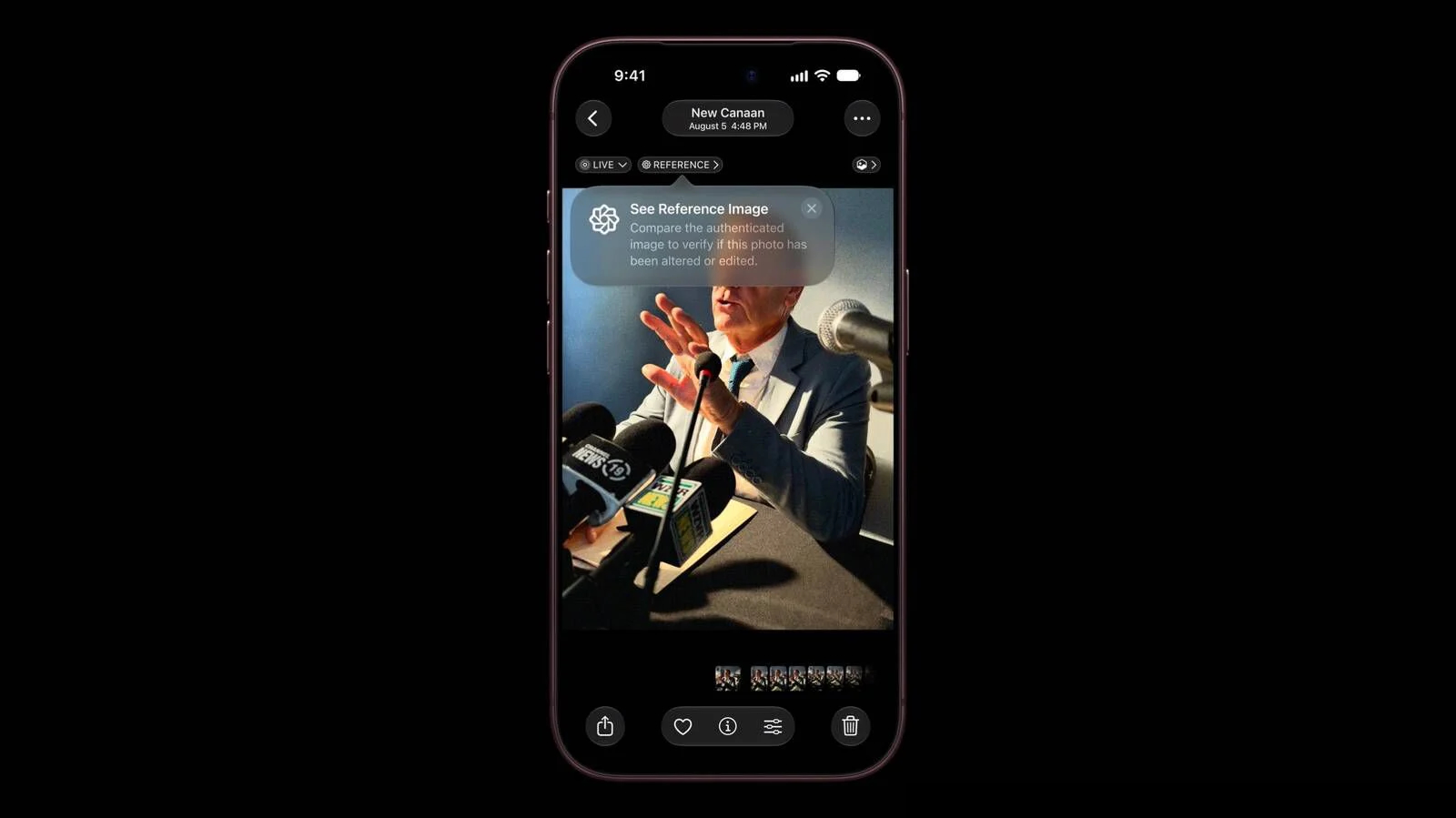
The iPhone 18 Pro models support Apple Reference Image, a way to verify that a photo was taken with an iPhone and hasn't been edited. Apple says it's a method to prove that something actually happened and wasn't AI-generated, likening the feature to a digital film negative.


Apple Reference Image offers a trustworthy, scalable guarantee that a reference image is what it claims to be: a real photograph, captured by a real sensor in an iPhone camera, at a specific time. It sets a new standard for verifiable digital photography.

Apple introduced Apple Reference Image when debuting the ‌iPhone 18 Pro‌ and Pro Max, and today the company shared more information on how the feature works on its Security Research blog.

Apple Reference Image boots the camera sensor into a specialized reference mode. The mode instructs the sensor to cryptographically sign pixel data immediately after capture, and the sensor firmware is prevented from modifying the data. Other authentication systems don't sign images until the end of the software processing pipeline, which Apple says leaves images vulnerable to tampering attacks.

Apple Reference Image creates a "secure digital negative" protected from software compromise alongside a standard editable photo. The negative is stored on-device and includes pixel data, sensor metadata, and cryptographic timestamps with lower and upper bounds. When a user decides to "develop" the negative for verification, it is sent unprocessed to Private Cloud Compute. Private Cloud Compute runs the steps needed to render the image in a secure, private, and verifiable environment.

Apple says the feature resists data injection attacks, compromised operating systems, hardware attacks, and cryptographic attacks. Apple believes Apple Reference Image is the only image provenance system with quantum-secure defenses. In case the system is breached, there is a revocation option. Private Cloud Compute calculates a confidence score for each image, and Apple can revoke individual photos or an entire sensor if fraud is detected.

To safeguard photographers, Apple Reference Image avoids using an explicit, public credential for photographers, and it prevents public association between different photos taken by the same sensor. The confidentiality of the image is protected, including from Apple.

Apple Reference Image is opt-in and is limited to the Main camera sensor.

More information on the ins and outs of Apple Reference Image can be found in Apple's full blog post.
This article, "Apple Details How Reference Image Proves a Photo is Real" first appeared on MacRumors.com

Discuss this article in our forums

  •  

Farwave é um app para descobrir estações de rádio ao redor do mundo

Aplicativos que utilizam uma premissa simples e a transformam em uma experiência interessante são, particularmente, meus favoritos. Exemplo disso é o Farwave, um app para iPhone e iPad desenvolvido pelo brasileiro Fernando Bunn que permite encontrar estações de rádio de todo o mundo girando um globo 3D até uma determinada região e tocando em uma estação.

A interação baseia-se na localização geográfica, e não em pesquisas por texto. Ou seja, os usuários giram o globo, selecionam uma região e tocam em uma estação, tudo pela mesma interface.

App Farwave
Divulgação/Farwave

Há, ainda, um botão chamado “Take me anywhere” (“Leve-me a qualquer lugar”, em tradução direta) que seleciona uma opção aleatória para ouvintes que não querem procurar um local específico; além disso, o aplicativo salva o histórico de reprodução para que as pessoas possam retornar a uma estação mais tarde.

Além do rádio, o app também organiza podcasts e músicas utilizando a mesma metáfora do globo. Diferentemente das estações de rádio, assinantes Pro podem pesquisar programas ou adicionar manualmente um feed RSS. O aplicativo também oferece suporte a filas de reprodução, velocidade de reprodução ajustável e downloads para ouvir offline.

Assinantes do plano Pro também podem importar seus próprios arquivos de áudio de um computador ou do aplicativo Arquivos. Cada artista aparece como um “sinal” próprio, e as faixas importadas permanecem no dispositivo para reprodução offline.

App Farwave
Divulgação/Farwave

O Farwave está disponível gratuitamente na App Store, mas alguns recursos (como supracitado) exigem o Farwave Pro, que custa R$20/mês ou R$100/ano.

via 9to5Mac

  •  

Where’s Siri AI in iOS 27 / MacOS 27? Here’s How to Enable It, If You Can

If you recently installed iOS 27 on iPhone, iPadOS 27 on iPad, or MacOS 27 Golden Gate, you might be wondering where the widely hyped new Siri AI set of features are on your device; a dedicated Siri app, a much smarter Siri AI with chatbot like experience, custom voices, and more. These are all ... Read More

The post Where’s Siri AI in iOS 27 / MacOS 27? Here’s How to Enable It, If You Can appeared first on OS X Daily.

  •  

Promoções na App Store: Planet of Lana, Little Nightmares, Smart Calculator: All In One e mais!

Nesta terça-feira, confira, aproveite e economize com a nossa seleção de promoções na App Store!

Planet of Lana é uma bela aventura, desenvolvida pelo Wishfully Studios e publicada nas plataformas móveis pela Playdigious, e nosso destaque do dia.

O jogo nos conquista primeiro pelos olhos: cada cenário parece uma pintura em movimento, com cores vibrantes, que transforma o planeta alienígena em algo ao mesmo tempo acolhedor e misterioso.

A jornada de Lana e seu companheiro Mui se destaca pela atmosfera contemplativa, criando uma experiência com um tom esperançoso. O design dos puzzles é intuitivo e nos incentiva a observar o ambiente e experimentar soluções criativas.

Confira um vídeo:

Um jogo cuja história passeia pelo equilíbrio, natureza e conexão. Uma oferta imperdível! 🥹


Abaixo outros jogos/apps que, juntos, somam quase R$130 em descontos:

Jogos

Jogo de aventura.

Jogo de cartas.

Diversão matemática.

Aplicativos

Calculadora.

Utilitário para códigos QR.

Fotos panorâmicas.


Aproveite as ofertas e até amanhã! Lembrando que elas são sempre por tempo limitado, então é bom correr. ✈️

  •  

Apple’s next wave: touch-screen MacBooks, a smart-home hub, and 14 more products

Apple Logo

Apple has barely finished unveiling the iPhone Duo, iPhone 18 Pro lineup, AirPods 5, and new Apple Watches, but the company already has a much larger pipeline queued up for late 2026 and the first half of 2027, according to Bloomberg News‘ Mark Gurman.

The coming products are part of what new CEO John Ternus has internally described as Apple’s most ambitious product road map yet. Many of the devices are designed to spread Siri AI more widely across the lineup and close some of the gap with rivals in artificial intelligence. As always, dates can slip and products can be delayed or canceled.

Later this yearGurman reports that Apple is preparing several updates before year-end:

• HomePod mini with Siri AI — Same familiar design as the 2020 model, but with a new chip to power the overhauled assistant.

• Apple TV with Siri AI — Another look-alike refresh, this time with a faster chip for navigation and the new Siri experience.

• Smart-home hub — A square display that can sit on a speaker base or mount on a wall. It will run a new operating system, support video calls, and use facial recognition to personalize what it shows. Apple had considered showing it at last week’s event and is now aiming as early as October, though the timeline remains fluid after repeated delays.

• Touch-screen MacBooks — The biggest MacBook Pro change since 2021, adding OLED panels and touch screens for the first time, with M5 Pro and M5 Max chips.

• Entry-level 14-inch MacBook Pro — Current design, updated with the M6 chip.

• iMac — New colors and an M6 processor.

• iPad mini — One of the line’s biggest upgrades, adding an OLED display.

The HomePod mini and Apple TV are already being tested with iOS 27. The new Macs are running macOS 27.1 internally, and the iPad mini is on iPadOS 27.1. Both of those software updates are expected late next month.

First half of 2027

The spring and early summer slate is heavier on refresh cycles than radical redesigns:

• MacBook Air — Same 13-inch and 15-inch designs, moving to the M6 chip.

• MacBook Neo — Follow-up model with an A19 Pro chip and more memory.

• Entry-level iPad — Faster chip so the cheaper tablet can run Apple Intelligence and Siri AI.

• iPad Pro — Chip upgrade plus vapor-chamber cooling similar to the iPhone 18 Pro.

• iPad Air — First OLED screens in that line, plus a new chip.

• iPhone 18 — Largely an A20 chip upgrade, with the notable change that the standard model is shifting from fall to spring.

• iPhone 18e — Another chip-focused update; Apple will need to make clear how it differs from the regular iPhone 18.

• iPhone Air 2 — More substantial: a 2-nanometer A20 Pro chip, better battery life, and a second rear camera for ultrawide shots.

• Apple Pencils — New Pencil Pro and USB-C models timed with the iPads; the iPhone Duo will support the stylus as well.

Looking further ahead

The second half of 2027 is expected to get more ambitious still, Gurman writes, with M7 updates to MacBooks, smart glasses, camera-equipped AirPods, a home security system, a redesigned Apple Watch, Twentieth Anniversary iPhones, and a second-generation foldable iPhone Duo.
‎
MacDailyNews Take: Taken together, the road map suggests Apple is trying to do two things at once: push Siri AI onto more affordable and living-room devices, and finally refresh categories that have languished for years. Whether October brings a full event or quieter waves of launches, the next 12 months look unusually crowded with product launces!


‎
Please help support MacDailyNews — and enjoy subscriber-only articles, comments, chat, and more — by subscribing to our Substack: macdailynews.substack.com. Thank you!

Support MacDailyNews at no extra cost to you by using this link to shop at Amazon.

The post Apple’s next wave: touch-screen MacBooks, a smart-home hub, and 14 more products appeared first on MacDailyNews.

  •  
❌