The latest semi-annual release of LibreOffice, the cross-platform FOSS office suite, is out – and it’s gleefully throwing some shade. The Document Foundation released LibreOffice 26.8 – and sent The Register a press pack before it did so. We’re not going to go through it in great depth: it’s a mature suite, and most Linux distros bundle it by default, even some of the slightly strange ones. We do like some of the sly notes in the launch materials, though, starting with the headline: “LibreOffice 26.8 brings professional typography, deeper support for the world’s writing systems, and no artificial intelligence” No artificial intelligence. In 2026, this is a bold position statement, but it is merited. In the last six months, we have reported on The Document Foundation distancing itself from Collabora. We spoke to some representatives of TDF – and Collabora – at considerable length about this, but we came away unconvinced by TDF’s arguments. Collabora developers contribute much of the code in LibreOffice. For instance, the last time we covered a new release of LibreOffice, we mentioned its rich Markdown support. Collabora told us that its engineers developed this. And yet, TDF decided to restart development of its own cloud-based office suite, in direct competition with Collabora Office. Later we covered the release of Collabora CODE 26.04 – which is Collabora’s local office suite, based on LibreOffice FOSS code, but rendered inside the browser using web technologies. Collabora’s announcement places AI integration front and centre. That caused us some dismay, and we told the company’s representatives that. They replied that Collabora’s partners and users were requesting this, and it felt it had to comply. As such, we are pleased by TDF’s stance with LibreOffice. It is a native app, with separate ports for Windows, and Linux, and macOS. All run as native local apps, they do so entirely on your machine, and they do not attempt to save anything into “cloud storage” for you. Your software, your data, on your computer, on your premises. For us, that is how it should be. As The Register has also reported recently, TDF is also firmly against using MS Office file formats by default. We do see its point here, but there are pragmatic reasons for this. Despite this strong ideological stance, the LibreOffice 26.8 press kit included both LibreOffice’s native .ODT files, and also MS Office .DOCX files. We do keep a decade-old and unsupported copy of MS Word around on our Mac, although we rarely use it. So, from curiosity, we opened both – and this is what it looked like. In our personal subjective judgement, the MS Word version looks a lot better. Our copy of LibreOffice 26.02 was configured with a Microsoft-style Ribbon, and to be fair, the screenshot shows that older version, before we upgraded. It doesn’t look much different in the newer version, though. We like and recommend LibreOffice. There are alternatives for Linux users: we compared OnlyOffice and WPS Office a few years ago. WPS Office is freeware, rather than FOSS, but it works. The Chinese edition of Ubuntu Kylin included it in place of LibreOffice. OnlyOffice is based on cloud tech, but you can run it locally… and for cloud-based stuff, as well as OnlyOffice and Collabora Online, there’s the new EuroOffice from Nextcloud. If you don’t mind paying, or if you’d prefer a European-made office suite, then there’s Softmaker Office. But LibreOffice is right here, it’s completely free, and it works well. We like the local-first stance and we like the AI-free stance. Version 26.8 has multiple improvements: improved internationalization, and support for different alphabets and writing systems. It’s available in 120 different languages. It has better paragraph and formatting handling, ARIA support for better screen-reader handling to improve accessibility, and much more. It really is all good. We regularly write that it’s a very good idea for Microsoft Office users to keep it installed just in case – it is much better at recovering damaged Word, Excel, and Powerpoint files than their native apps. As we also regularly point out, anyone who still has OpenOffice installed should remove it and replace it with LibreOffice as soon as possible. OpenOffice is still available, but as Dedoimedo found on 26.8’s day of release, you really should not use it any more. Saying that, we’re concerned about TDF positioning itself as a rival to Collabora, rather than – well – collaborating with the company which provides more LibreOffice developers than any other external contributor. TDF has long offered two branches of LibreOffice: an older stable branch, for business users, and the current version, which gets relatively frequent minor updates. For us, the pragmatic position would have been for TDF to offer the current version, and direct business users to Collabora for the slower-moving stable release… but when we suggested this idea to TDF’s representatives, they treated the idea with scorn. The future remains uncertain. In a business world embracing “AI”, focusing on cloud apps, plus the lucrative new sovereign cloud movement, LibreOffice looks a bit old and dowdy. But it’s a vital tool.Traditional local-first tools like LibreOffice aid reusing old computers rather than replacing them. Ignore the “thought leaders” – the world needs LibreOffice more than ever. ®
Apple’s latest financial results drive a discussion about record iPhone, Mac, Services, subscription, and R&D numbers, along with the market’s negative reaction and stock volatility. The MacVoices Live! panel also examines leadership changes under new CEO John Ternus, including the return of a retired engineering executive, before debating Apple’s planned clipboard sharing between iPhones and Windows PCs, its implications for users, and whether it introduces meaningful security concerns.
Google’s $4.1 billion EU Android fine launches a debate over technology regulation, encryption backdoors, age verification, app-store mandates, and the political tension between the United States and Europe. Chuck Joiner, David Ginsburg, Eric Bolden, Jim Rea, and Marty Jencius also explores an unusual national time capsule, compares Evernote, Apple Notes, GoodNotes, Notion, and Notability, discusses vibe coding, and considers JustWatch as TV Time shuts down.
The MacVoices Live! panel starts with a discussion about Apple'’s new AI-powered creative tools, including possible benefits for Final Cut users and the subscription value question. Chuck Joiner, David Ginsburg, Brian Flanigan-Arthurs, Ben Roethig, Eric Bolden, Marty Jencius, Jeff Gamet, Norbert Frassa, Jim Rea, and Web Bixby also examine Apple’s Supreme Court appeal in the Epic case, then digs into urgent security patches, AI-assisted vulnerability discovery, automatic updates, enterprise risk, and how users should rethink update habits.
This Road to Macstock features a discussion with Brian Hensen about his evolving role as the event's master of ceremonies. From speaker wrangler to stage host. Brian previews how this year’s Macstock will let him spotlight the people who inspire him, comments on the event’s welcoming Apple community, and reflects on the value of shared learning, speaker preparation, podcasting, and personal connections that are at the core of the Macstock experience.
From the Flip the Script event in San Francisco, Dmytro Melnyk, Chief Product Officer for MacPaw, discusses his role and the importance of the company’s careful approach to adding AI across products, from both the developer and customer viewpoints.. He explains why some users want frictionless AI while others resist it over privacy, cost, and complexity, and outlines Eney's goal of combining many Mac utility tasks into one assistant with a pay-as-you-go model.
The MacVoices Live! panel examines Spotify adopting Apple-backed video podcast technology, Instagram’s disappearing posts and why anyone would want them, and Microsoft expanding Copilot everywhere, whether it is a good idea or not. Chuck Joiner, David Ginsburg, Jeff Gamet, Guy Serle, Web Bixby, Eric Bolden, Marty Jencius, and Jim Rea also look at the risks of putting AI mini data centers in homes, and Plex’s major lifetime Pass price hike.
On the Road to Macstock, Jill McKinley previews her third year’s presentation, focused on making Apple devices support daily habits through Focus modes, shortcuts, customized screens, and intentional setup. She explains how iPhone, iPad, Mac, and Apple Watch can work together to reduce distractions, surface useful tools, and help users shape technology around real life instead of default settings.
MacPaw's Maria Polishchuk, Head of Business Development and and Product Manager Pavlo Haidamak, discuss Setapp's new expansion beyond its traditional subscription model. They explain new individual app purchases, developer subscription options, AI Gateway integration, app review standards, and support for indie and vibe-coded apps. The discussion covers developer challenges such as discovery, monetization, security, and how Setapp aims to help with those factors as well as giving customers more software choices.
In the Riverside booth at NAB in Las Vegas, Danielle Baxter, Business Development Representative, explains how the platform supports podcasting, video interviews, webinars, testimonials, and live streams. She covers options like local recording, separate audio and video tracks, browser-based guest access, built-in editing, branding, captions, producer mode, and flexible plans for solo creators and businesses.
Joe Kissell introduces Take Control Live: Taming Big Tech, a four-session interactive course designed to help users understand privacy, security, subscriptions, ads, platform lock-in, and practical alternatives to major tech services. Rather than urging an all-or-nothing break from companies like Google, Meta, Amazon, Microsoft, or Apple, Joe will focus on realistic steps, live demos, Q&A, […]
The WHO and the World Bank want $31 billion a year for pandemic preparedness – but a new Leeds University study says the financial case is built on dubious assumptions and false accounting.
Earlier this week, researchers outlined an attack that used a secret input provided by Microsoft 365 Copilot for enterprise to cause the AI assistant to exfiltrate a password present in the user’s inbox. Now, a separate team has devised a similar attack against Grok. The new data theft hack employs a deceptively simple trick to force the Elon Musk-owned large language model to steal user chats and other personal information. At the time this post went live, the assistant continued to cough up the data, despite xAI being informed of it in June.
The lesson from both this week’s episodes—and the countless other ones that have come before it—is that LLMs are incapable of solving the root causes for prompt injections, the most severe vulnerability classes they’re most prone to. That leaves AI developers with no other option but to build a guardrail that steers the model away from the harmful actions. As I noted in Tuesday’s story, the approach is tantamount to a road traffic safety engineer erecting a protective rail around a dangerous bend rather than banking the curve.
Cryptographic Context Injection in the house
Prompt injections exploit LLMs' training to comply with user requests whenever possible. Attackers can capitalize on the predilection by smuggling harmful instructions into emails or webpages the assistant is instructed to summarize. Because LLMs can’t reliably distinguish between content in an email sent by an untrusted party and user instructions entered directly into a prompt, the overly solicitous LLM faithfully follows them. To date, Grok and other LLMs' only recourse is to create guardrails that flag suspicious instructions and forbid them from being executed.
It’s very much a real-life doco version of ‘The Lion King’, with Jon Favreau executive producing, and music from Hans Zimmer echoing themes from the Disney classic. It took Disney+ and BBC Studios’...
In 2006, geneticist Bryan Sykes, Professor of Human Genetics at the University of Oxford, published the results of a study that had taken him a decade to complete. His team had collected and analyzed the mitochondrial DNA and Y chromosome of 10,000 volunteers from England, Scotland, Wales, and Ireland, with the aim of reconstructing the […]
A small object made of dark stone, carved with astonishing precision almost 3,500 years ago, has provided researchers with one of the clearest windows yet into the religion of ancient Crete. It is the inscription known as IO Za 2, engraved on a tiny libation table made of dark green serpentinite, measuring just 4.3 centimeters […]
The glacier-capped Snæfellsjökull volcano is the defining feature of Iceland’s Snæfellsnes peninsula, shown in this image acquired with the OLI (Operational Land Imager) on Landsat 9 on July 25, 2026.
NASA Earth Observatory/Michala Garrison
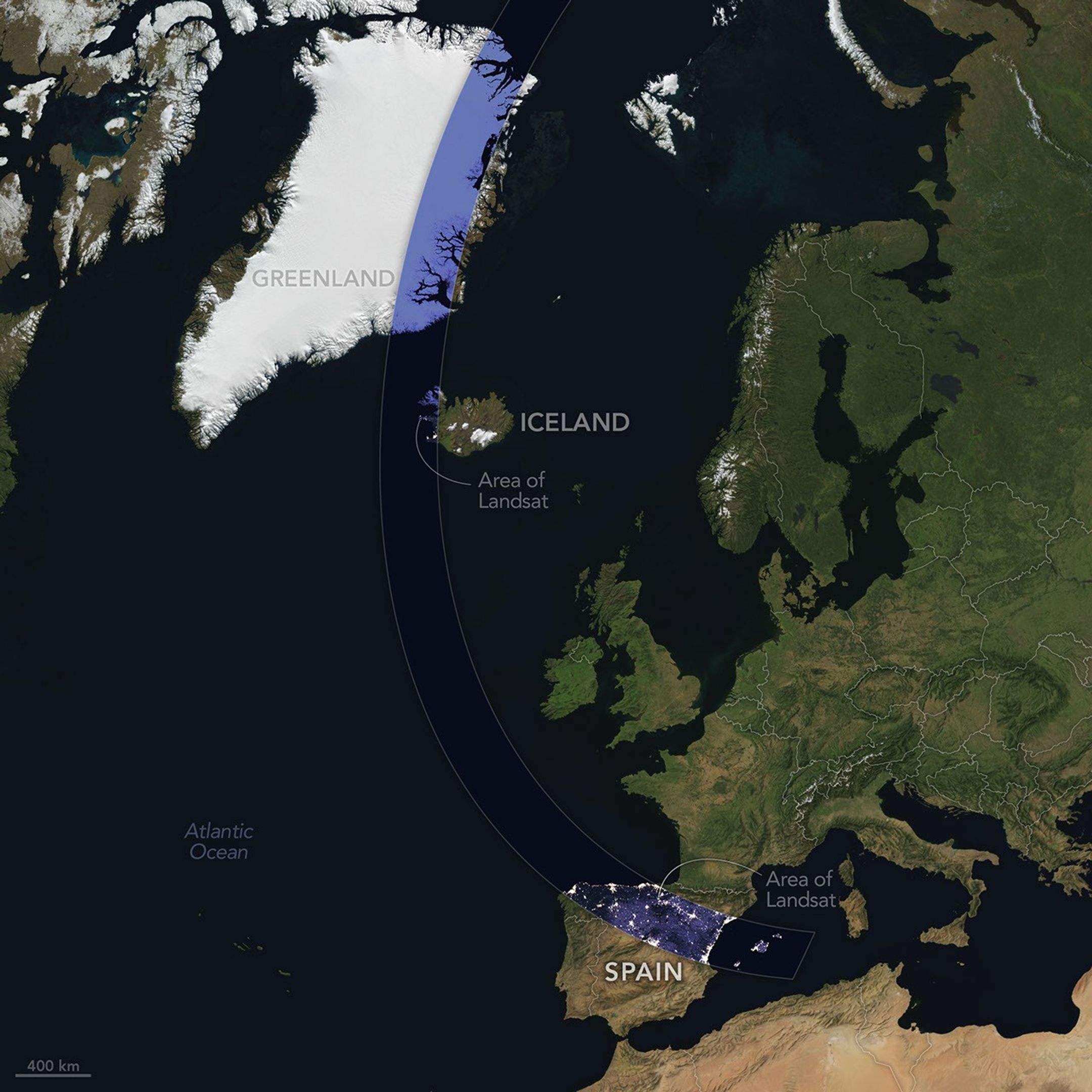
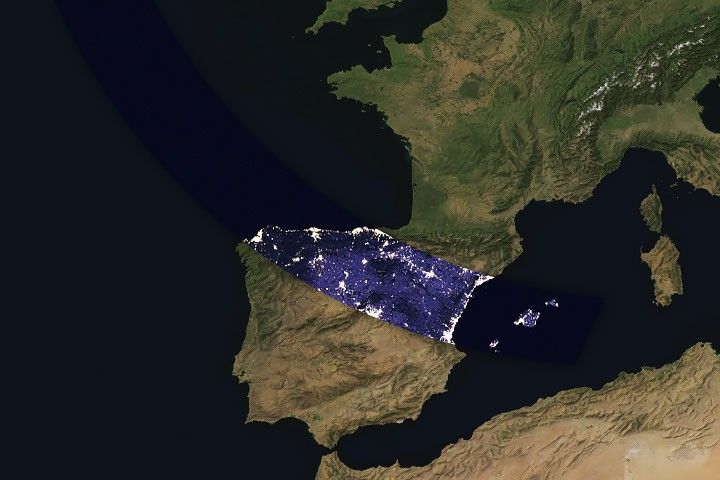
The Sun, Moon, and Earth align on August 12, 2026, to produce a total solar eclipse. When this celestial event last occurred, on April 8, 2024, the path of totality stretched across North America, giving millions the chance to glimpse the Sun’s corona. In 2026, the viewing locales are more limited; only a handful of land areas in the Northern Hemisphere, including parts of Iceland and Spain, fall within the path of totality.
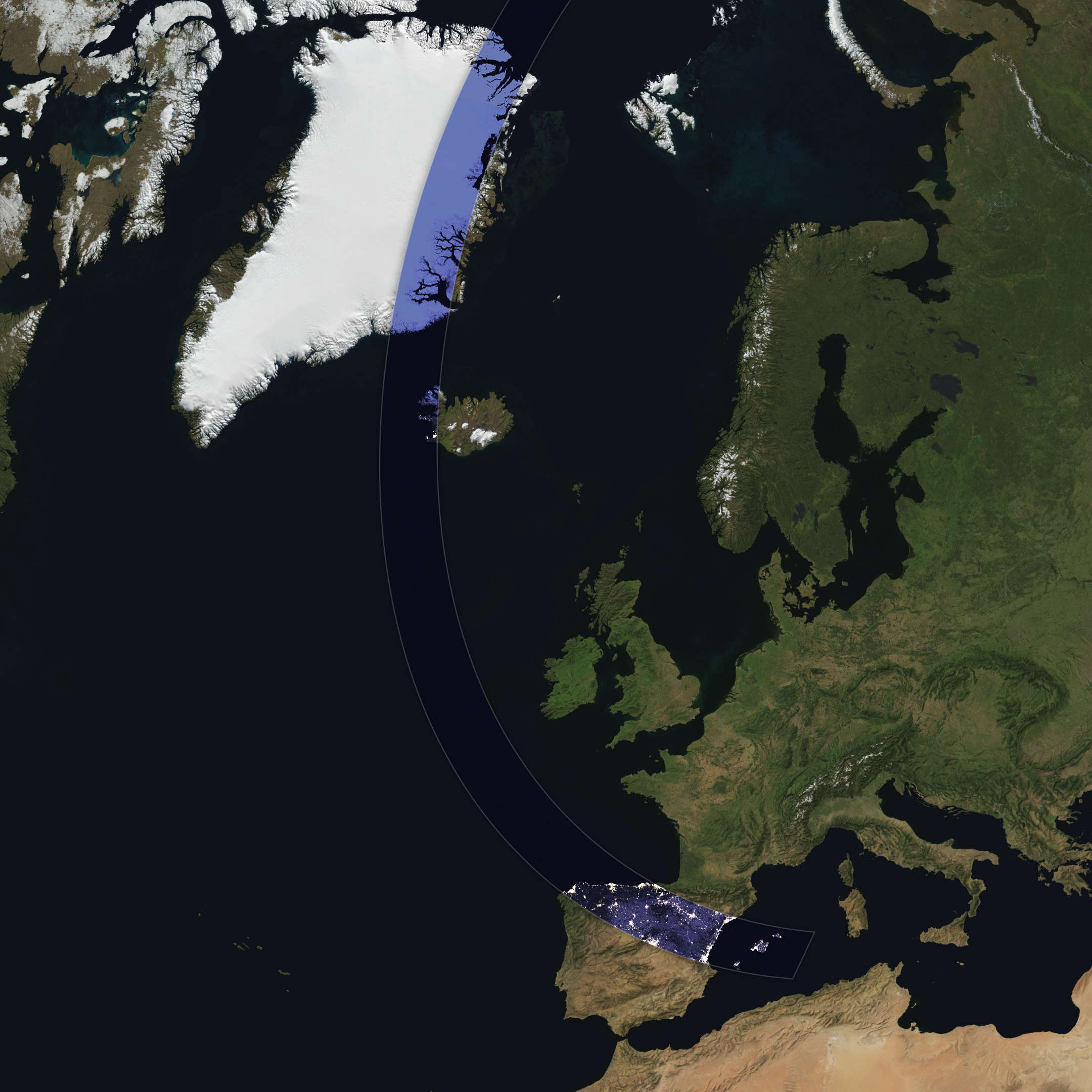
On August 12, the Moon’s shadow will first cross over the Arctic Circle from northern Russia and then track along the eastern side of Greenland. At about 5:45 p.m. local time in Iceland (17:45 Universal Time), the country’s western fringes—including the Snæfellsnes peninsula, shown in the Landsat image above—will begin to experience totality. The greatest eclipse will occur near this sparsely populated peninsula when the Moon appears the largest and covers more of the Sun.
The path of totality of the solar eclipse on August 12, 2026, spans Greenland, Iceland, and Spain. The base imagery for the map comes from Blue Marble: Next Generation, with data from Black Marble shown in the path of totality. Blue Marble is built from scenes captured by MODIS (Moderate Resolution Imaging Spectroradiometer), while Black Marble is based on observations by the VIIRS (Visible Infrared Imaging Radiometer Suite) day-night band.
NASA Earth Observatory/Michala Garrison
The Snæfellsjökull volcano on the western end of the peninsula is covered in ice and last erupted about 1,800 years ago. It is the highlight of a national park of the same name, where people are expected to visit to view the eclipse. The stratovolcano even has a literary claim to fame: in Jules Verne’s A Journey to the Center of the Earth, characters venture underground through its crater, later emerging in an eruption of Stromboli, in Italy. In 2025, a broader area of the peninsula was designated a UNESCO biosphere reserve, containing over 70 percent of Iceland’s flora and an agglomeration of volcanic landscapes, wetlands, and grasslands.
From Iceland, the eclipse shadow, or umbra, progresses across the North Atlantic and reaches northern Spain shortly before sunset. It runs east-southeast across the country, much like the Ebro River (Río Ebro), seen in the Landsat image below.
The Ebro River, meandering across northern Spain in this image acquired with the OLI (Operational Land Imager) on Landsat 8 on July 21, 2026, is in the path of totality of the August 2026 solar eclipse.
NASA Earth Observatory/Michala Garrison
The upper Ebro emerges from rugged terrain in Parque Natural de Montes Obarenes-San Zadornil, where it carves canyons and gorges through the eastern foothills of the Cantabrian Mountains. It then meanders through La Rioja, a region known for its vineyards. About 400 kilometers (250 miles) away, the river reaches a delta on the Mediterranean coast between Barcelona and Valencia.
Based on satellite measurements of cloud cover in August over several decades, viewers in Spain have a higher likelihood than those in Iceland of getting a clear look at the eclipse. And despite limited viewing opportunities in the path of totality, the rest of Europe, parts of Africa, Canada, and the northern and northeastern U.S. will experience a partial eclipse.
The fully-integrated LEMS (Lunar Environment Monitoring Station) ready for environmental testing. A small suitcase-size instrument suite built at NASA Goddard, LEMS is designed to carry out continuous, long-term monitoring of the seismic environment at the Moon, including surface motion caused by moonquakes and meteorite impacts in the lunar south polar region.
NASA Goddard/Mike Guinto
NASA has declared “wrenches down” on the first completed payload designed for Artemis astronauts to deploy on the Moon’s surface. Engineers working on NASA’s Lunar Environment Monitoring Station, or LEMS, have completed hardware development and testing and the payload is ready for its permanent home near the lunar South Pole. With the hardware complete, LEMS is ready to support one of the Artemis program’s core goals: enabling sustained lunar science and exploration.
The LEMS instrument package contains two highly sensitive seismometers that will monitor ground vibrations from moonquakes and meteorite impacts, providing scientists with insights into the Moon’s interior and the seismic hazards astronauts might encounter at the surface. Its modular design allows the system to be adapted or expanded to host new instruments in the future, creating a reusable platform that can evolve as scientific priorities grow.
The payload will remain in a clean room at NASA’s Goddard Space Flight Center in Greenbelt, Maryland, where it was built, until it is assigned to an Artemis mission for deployment to the lunar surface.
“The completion of the LEMS scientific instrument is a major step in a new era of lunar surface science. Innovative science experiments will uncover, measure, and reveal the Moon’s secrets while astronauts open new frontiers for discovery,” said Joel Kearns, deputy associate administrator for exploration, Science Mission Directorate, NASA Headquarters in Washington. “And, behind the scenes, countless teams across NASA and our partners are pushing the boundaries of what surface instruments can do, building the tools that will make future exploration possible and safer.”
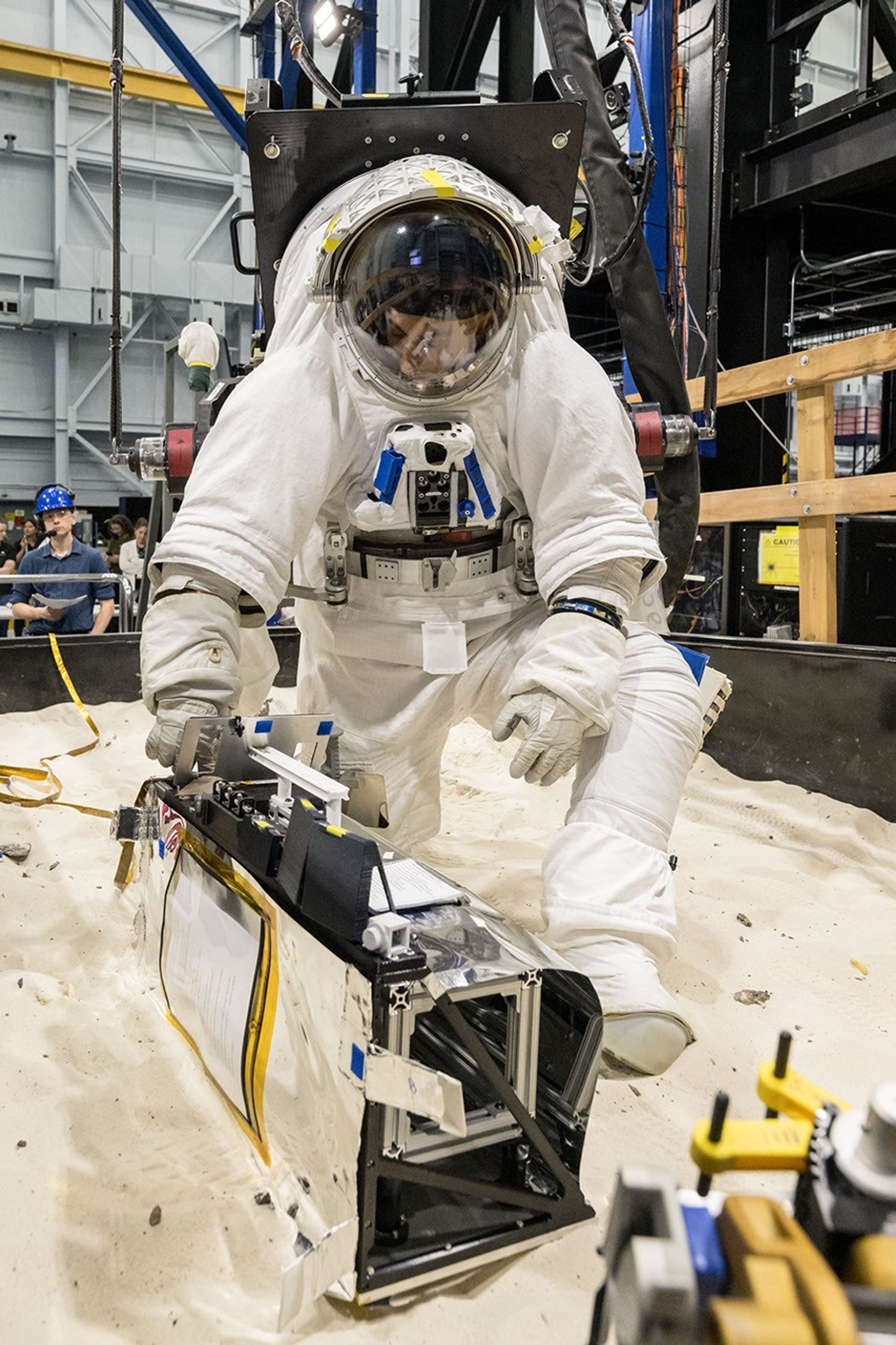
A scientist wearing NASA’s xEMU prototype space suit is testing the handling of a mockup version of NASA’s Lunar Environment Monitoring Station, or LEMS. The testing took place at the Active Response Gravity Offload System, a simulated reduced gravity environment at NASA’s Johnson Space Center in Houston.
NASA Johnson
The LEMS payload builds on a legacy of lunar seismic tracking. Apollo astronauts deployed a network of seismometers on the Moon’s nearside equatorial region between 1969 and 1972. Those instruments operated until 1977, recording about 13,000 moonquakes and other ground vibrations that helped scientists begin to understand the composition of the Moon’s interior. For decades, researchers have hoped to spread more seismometers, updated with new technologies, across the lunar surface.
Now, LEMS will carry the first seismometers to be deployed by future astronauts to listen for faint ground vibrations, collecting new clues to the Moon’s internal structure and ongoing seismic activity. The sensors will be the most compact, sensitive, and energy-efficient seismometers ever built for planetary exploration.
LEMS itself is about the size of a small suitcase, weighing 11 pounds in the Moon’s low-gravity environment. It will carry not just these seismic sensors, but everything it needs to function independently of humans after deployment. LEMS is built to manage its own power production via a lightweight, flexible solar array that conforms to the shape of the LEMS unit. It also will manage its operational activities to ensure continuous data collection based on a preset plan, and monthly data transmission to Earth. The payload will do all this while maintaining a stable internal temperature throughout the massive day-to-night temperature swings of the South Pole region.
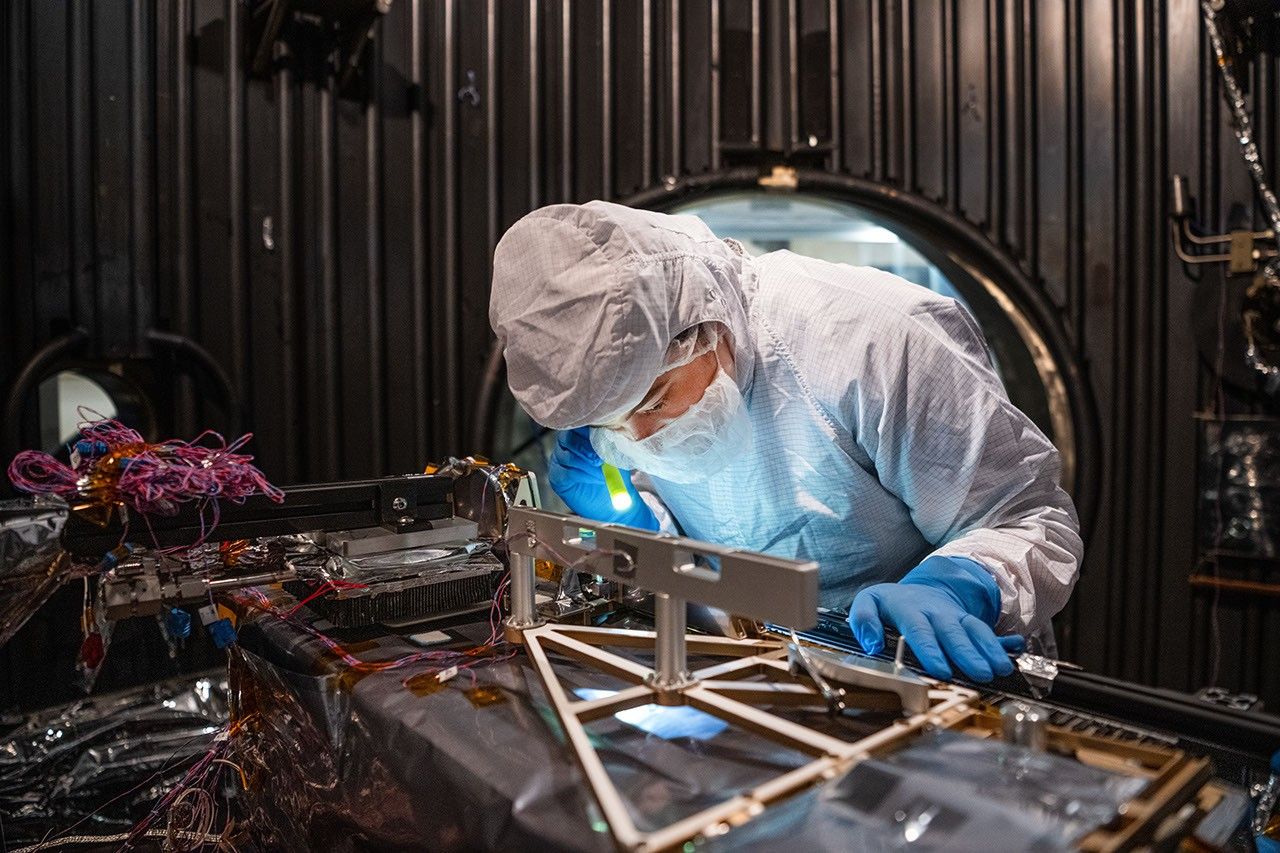
Mechanical Engineer Brie Ludwig inspects the Lunar Environment Monitoring Station (LEMS) in preparation for testing in a thermal vacuum chamber at Goddard Space Flight Center in Greenbelt, Maryland, on March 31, 2026. LEMS is a compact, autonomous, and self-sustaining seismometer suite designed to carry out continuous, long-term monitoring of the lunar seismic environment at the South Polar region.
NASA/Denny Henry
“When we conceived of LEMS, we weren’t just thinking about the next mission, we were thinking about the next generation of lunar exploration,” said Mehdi Benna, a University of Maryland Baltimore County scientist who leads LEMS from NASA Goddard. “Our vision was to create a scientific buoy for the Moon. Like an ocean buoy on Earth, LEMS is designed to be easy to build, adaptable to different scientific objectives, and capable of operating independently for years.”
Before any surface science could happen, Benna and his team had to ensure that LEMS could survive the trip to the Moon and the harsh environment of its surface. Over the past five months, LEMS and its components have been subjected to a demanding series of environmental and operational tests. Engineers verified LEMS can endure the violent shaking of launch, the journey to the lunar surface, and the Moon’s temperature and radiation environment. The team also showed that the instrument package’s mechanical and electrical design is safe for astronaut handling.
The LEMS payload was built to operate through the lunar night, which lasts two Earth weeks, without external power assistance or a heat source. Past lunar surface instruments relied on radioisotope heaters for warmth and power. But LEMS instead will withstand temperatures that dip to minus 400 degrees Fahrenheit in some areas by using advanced insulation materials, low-thermal-conductivity cables that minimize heat loss, and a thermal regulator that conducts heat away during the day to prevent overheating and helps retain heat at night.
These innovations reduce mass and power needs, setting the stage for lighter, energy-efficient instruments that can operate continuously at future Artemis landing sites and the NASA-led Moon Base.
The LEMS payload is led by University of Maryland Baltimore County and University of Maryland College Park. Technical implementation is led by NASA Goddard. The University of Arizona, in partnership with Silicon Audio, Inc., supplied LEMS’ two state-of-the-art seismometers. Morehead State University in Kentucky provided LEMS’ telecommunication system and will operate the instrument on the surface. Washington University in St. Louis will manage the instrument’s data processing and dissemination to the larger scientific community.

 Login