❌

Reading view

NASA Astronaut Mike Fincke Leaves NASA, Career Includes 4 Spaceflights
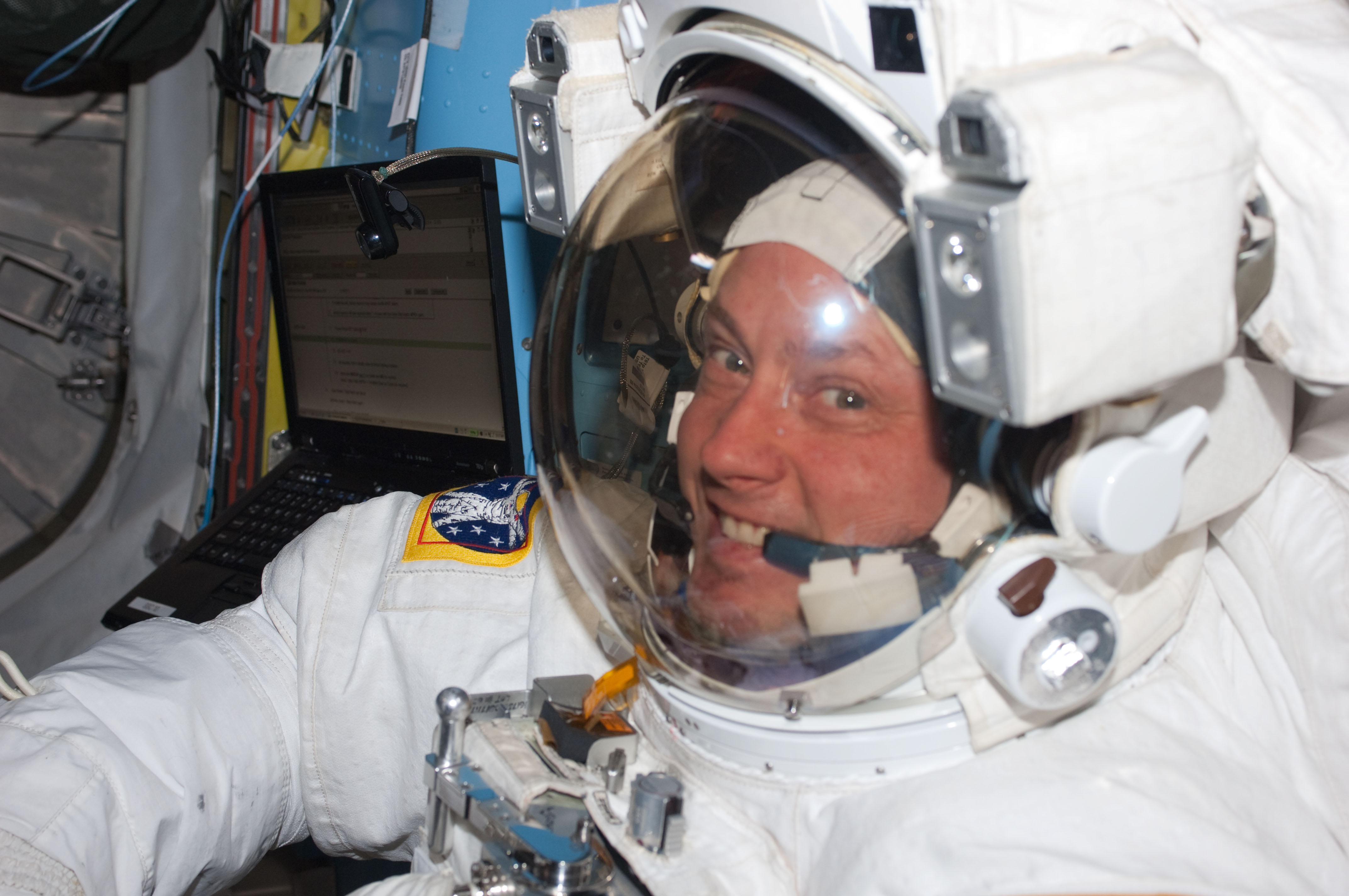
NASA astronaut Mike Fincke is pictured inside the International Space Station’s Quest airlock prior to the start of the third spacewalk for the STS-134 mission.
Credit: NASA

NASA astronaut Mike Fincke is departing the agency on Wednesday after 30 years of service. Throughout his career, he flew four missions, spent 549 days in space, and completed nine spacewalks in support of the International Space Station.

“Few people have had the opportunity to shape as many chapters of NASA’s history as Mike Fincke,” said NASA Administrator Jared Isaacman. “Over a remarkable career, Mike served our nation as a pilot, engineer, astronaut, and mentor. From long-duration missions aboard the International Space Station to helping prepare the Artemis generation, his contributions have helped position NASA for what comes next. The success we’re building on today is possible because of people like Mike, who dedicated their careers to moving our space program forward and preparing the next generation to carry the mission even further. I’d like to congratulate Mike on an incredible career and thank him for his decades of service to NASA, our nation, and the countless people who had the opportunity to learn from and fly alongside him.”

He ranks fourth among NASA astronauts in accumulated time in space, and his spacewalks total 48 hours and 37 minutes. Most recently, Fincke piloted NASA’s SpaceX Crew‑11 mission, which launched in August 2025 and returned in January. During the mission, he served as a flight engineer for International Space Station Expedition 73 and commander of Expedition 74.

Fincke joined NASA’s 16th astronaut class in 1996 and first flew to space in 2004 aboard Soyuz TMA‑4 in support of the space station’s Expedition 9. Serving as a science officer and flight engineer, he helped maintain station systems and performed four spacewalks. He returned to space in 2008 on Soyuz TMA‑13 as commander of Expedition 18, preparing the space station for its transition to six‑person crews at the time and completing two more spacewalks.

In 2011, Fincke flew on STS‑134, the final flight of space shuttle Endeavour. As mission specialist and robotic arm operator, he completed three spacewalks and helped deliver and install the Alpha Magnetic Spectrometer.

“Mike’s remarkable career reflects three decades of dedication to NASA’s mission and the advancement of human spaceflight,” said Vanessa Wyche, director of NASA’s Johnson Space Center in Houston. “From his time aboard the International Space Station to his commitment to mentoring the next generation, Mike has made an immense impact across our agency. His legacy of service, mentorship, and dedication to exploration will continue to inspire the generations to come.”

Throughout his career, Fincke bridged spacecraft development, flight testing, and mission operations. Early in the International Space Station Program, he helped test and integrate several of the station’s initial modules before launch. His flight experience spanned multiple generations of human spacecraft, including two missions aboard Soyuz, one aboard the space shuttle, and later piloting the SpaceX Dragon.

Fincke was a foundational contributor to NASA’s Commercial Crew Program. As chief of the Astronaut Office’s Commercial Crew Branch, he worked to ensure astronaut needs, crew safety, and human spaceflight experience informed development of the nation’s next generation of crewed spacecraft. He spent five years supporting Boeing’s Crew Flight Test program training as a crew member and backup pilot, contributing to flight software, systems integration, integrated testing, and spacecraft interfaces.

Fincke also supported station operations from the ground as a crew test support team member in Russia, a capsule communicator, or capcom, and crew procedures team lead. He helped translate complex engineering and operational requirements into clear instructions for crews working in orbit. His continuity across development, integration, mission support, and long‑duration flight gave him an end‑to‑end perspective on space station assembly and operation.

“Mike approached every assignment with experience, humility, and an unwavering focus on the mission,” said Scott Tingle, chief of the Astronaut Office at NASA Johnson. “Whether flying aboard the station, supporting crews from the ground, or helping shape the spacecraft that future crews will rely on, he consistently strengthened our team. His legacy is woven into the way we fly today.”

A native of Emsworth, Pennsylvania, Fincke holds bachelor’s degrees in aeronautics and astronautics and in Earth, atmospheric, and planetary sciences from the Massachusetts Institute of Technology, where he also studied in the Soviet Union through an exchange program with the Moscow Aviation Institute. He earned master’s degrees in aeronautics and astronautics from Stanford University and in planetary geology from the University of Houston, Clear Lake.

Fincke is a retired U.S. Air Force colonel and distinguished graduate of the U.S. Air Force Test Pilot School. He served as a space systems engineer and flight test engineer at Edwards and Eglin Air Force Bases and later as the U.S. flight test liaison to the Japanese‑U.S. XF‑2 fighter program at Gifu Air Base in Japan. He accumulated more than 2,000 flight hours in more than 30 aircraft types.

“After exactly 30 years, I am departing NASA, but I remain deeply committed to the work of exploration.” Fincke said. “NASA gave me the extraordinary privilege of serving alongside remarkable people, flying and helping develop spacecraft, and contributing to the International Space Station from its earliest days through command in orbit. I am profoundly grateful to my crewmates, the teams on the ground, our international partners, and the families who make this work possible. I am excited to carry those lessons forward and help prepare the next generation of engineers, explorers, and leaders. Together, we will return humanity to the Moon, travel to Mars, journey outward to the planets and moons beyond Earth, and someday reach for the stars – all while caring for Earth, the most beautiful planet in our solar system.”

To learn more about NASA’s astronauts and space exploration, visit:

https://www.nasa.gov/astronauts

-end-

Jimi Russell
Headquarters, Washington
202-358-1100
james.j.russell@nasa.gov

Anna Schneider
Johnson Space Center, Houston
281-483-5111
anna.c.schneider@nasa.gov
Share

Details

Last Updated
Aug 12, 2026
  •  

Pursuing a Dream of Working for NASA

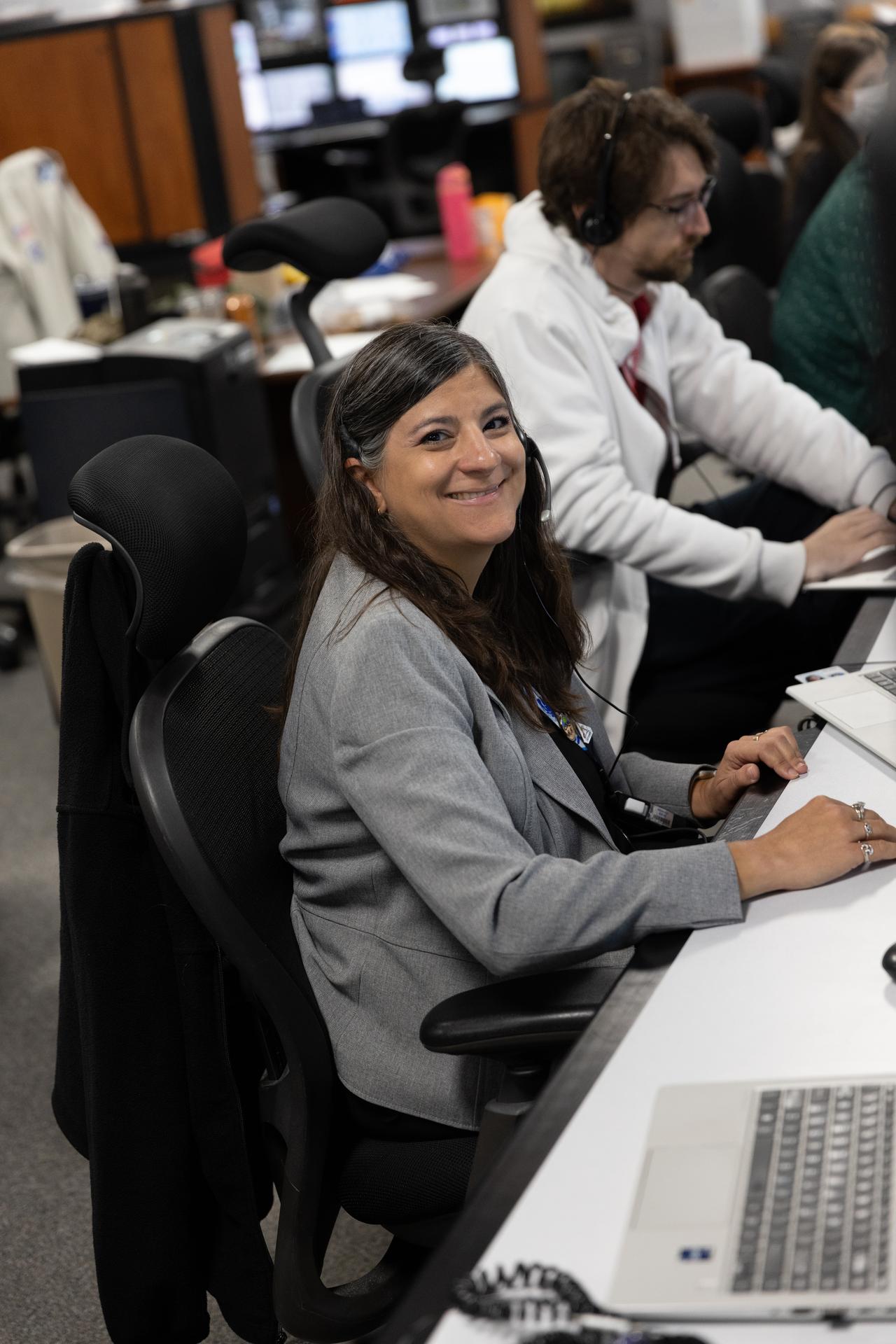
A women with dark brown hair smiles at the camera for a photograph. The woman is wearing a grey jacket and a headset while she sits at the desk with a computer;
Lindsey Waitt, engineer with NASA’s Exploration Ground Systems Program, participates in a terminal countdown simulation for Artemis III on Thursday, Aug. 6, 2026, inside Firing Room 1 of the Rocco A. Petrone Launch Control Center at NASA’s Kennedy Space Center in Florida.
NASA/Clayton Rougelot

As a young girl raised in Worcester, Massachusetts, Lindsey Waitt dreamed of working for NASA. Her dream is now a reality as she embarks on her role as a NASA test project engineer with the Artemis launch team – an integral part of the agency’s missions that will enable humans to return to the surface of the Moon after launching from NASA’s Kennedy Space Center in Florida.

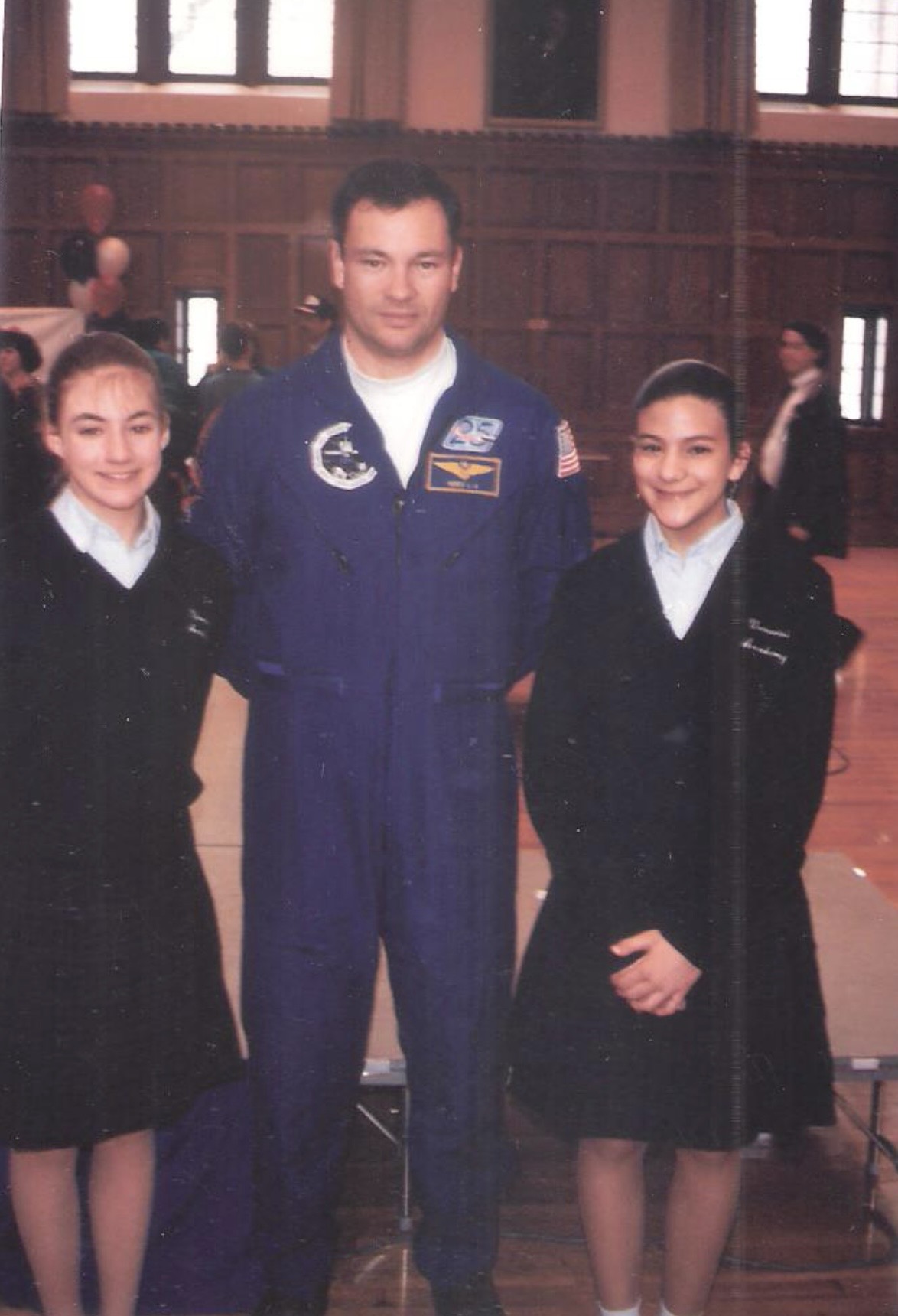
When she was in middle school in the late 1990’s, Waitt recalls meeting NASA Space Shuttle astronauts Michael Lopez-Alegria and Albert Sacco, Jr., a former professor at the college, during a visit to Worcester Polytechnic Institute (WPI) in Worcester, Massachusetts. She was inspired while listening to them recount their spaceflight experiences including an experiment on conducting research for growing cells on the Moon. She even posed for a picture and got their autographs. Little did young Waitt know, these would not be the only astronauts she would meet.

The photo features two young ladies in black dresses posing for a photograph with a NASA astronaut Michael Lopez-Alegria standing in the middle between the two young ladies.
Lindsey Waitt (far right), poses for a photograph with NASA astronaut Michael Lopez-Alegria and her cousin at Worcester Polytechnic Institute in Massachusetts.
Photo credit: NASA/Lindsey Waitt

Her passion for learning about all things space and engineering led Waitt back to WPI where she studied engineering, absorbing different disciplines. She received her Bachelor of Science degree in Mechanical Engineering with a concentration in aerospace engineering and she left the school fueled by her passion to be a part of America’s space agency.

After graduation, she worked as a systems engineer on radar flight test missions for a defense contractor, and while excelling in her role, she realized it wasn’t the aerospace engineering field that she desired.

“It was an exciting program, and it was meaningful to be a part of a project focused on protecting the country from enemy attacks. But it wasn’t space,” Waitt said.

As the wife of a now retired sergeant first class officer in the United States Army, Waitt and her family traveled around the world during her husband’s enlistment, and she continued to follow NASA missions from around the globe. While Waitt was dedicated to raising her three young boys, she simultaneously pursued her master’s degree in Space Operations from the University of Colorado in Colorado Springs. Twelve years later, she made the courageous decision to fully return to her first career passion – working for NASA – despite nay-sayers suggesting too much time had passed for her to return to the industry.

The sky is not the limit, it's wide open now. The universe is the limit.

Lindsey waitt

Lindsey waitt

Test project engineer

Waitt vividly remembers watching NASA astronauts Doug Hurley and Bob Behnken soar skyward during NASA’s first commercial crew mission to the International Space Station in 2020. Watching alongside her family, she even set up a rocket-shaped tent, and she and her children pretended to blast off from their yard as they cheered excitedly as the astronauts lifted off from what would be her future place of work.

After moving to Florida in 2022 to work at a small satellite company in Cape Canaveral, as a systems engineer and program manager, she continued to search for opportunities to work for the agency. Waitt vividly remembers watching Artemis I with her family. They had just moved to the Sunshine State, and she woke up in the early hours of the morning to watch the historic launch, having no idea she would be working on the next Artemis mission – the first time NASA sent humans around the Moon in over 50 years!

In 2024, Waitt began her career at Kennedy working for a contractor as a test project engineer during the Artemis II launch. As “problem-solvers,” test project engineers are the main hub of experts for technical tests and launch activities and they work to coordinate resolutions across the different subsystems that may arise during the dynamic operations associated with a rocket launch. Leading up to the Artemis II launch in April, Waitt quickly became certified to sit on the launch console during the dynamic pre and post-launch operations for the massive SLS (Space Launch System) rocket and Orion spacecraft and she eagerly watched from outside Kennedy’s Launch Control Center as the four crew members lifted off the launch pad towards the Moon.

When NASA announced its insourcing initiative earlier this year, Waitt seized the opportunity to fully realize her dream. She applied for a position and is now a NASA civil servant supporting the Artemis launch team as a test project engineer for NASA– a core position for the agency’s launch team. With Artemis III in front of her, Lindsey will see the buildup of launch operations from start to finish.

As the only female of the 14 test project engineers who work on the Artemis launch team, Waitt said she was fully embraced by the colleagues she stands beside.

“Everybody’s very open and welcoming,” Waitt said. “I’ve worked on teams before, but it’s never been like this. Everyone is so passionate about the mission, and everybody is working together to get things done quickly, but safely – that’s always first priority.  We Are Going.”

This opportunity didn’t happen by chance. Waitt is embracing life’s journey and focused on making her dream come true, one launch at a time. “The sky is not the limit – it’s wide open now,” Waitt said. “The universe is the limit.”

  •  

APOD: 2026 August 12 – Perseids over a Little Planet

APOD

Astronomy Picture of the Day

Discover the cosmos! Each day a different image or photograph of our fascinating universe is featured, along with a brief explanation written by a professional astronomer.

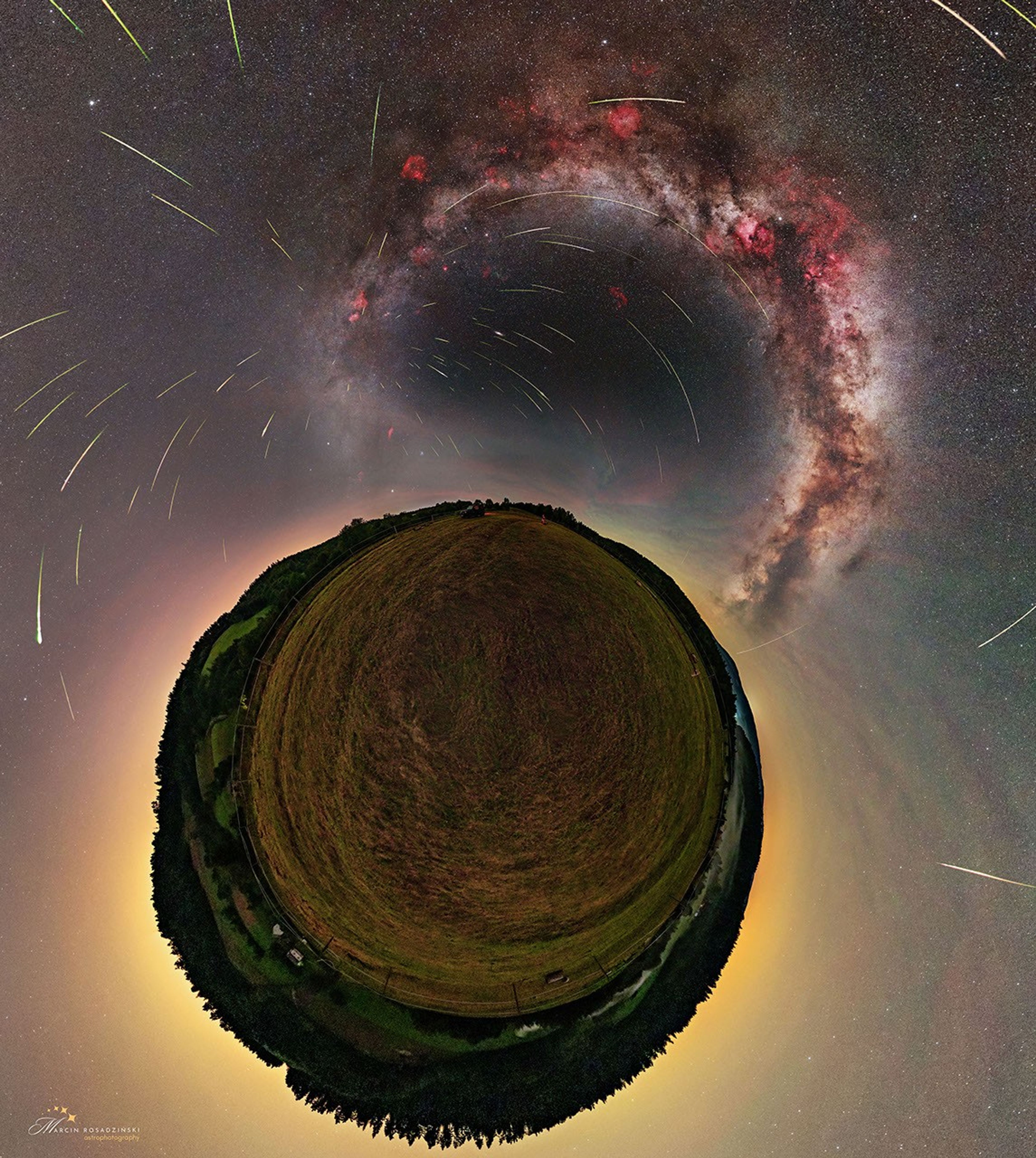
The ground is shown in a little planet perspective, surrounded by the sky with a diffuse glow. The Milky Way is visible in the sky, as well as some nebulae in red and over a hundred meteors. Most of them appear to come from the same point.

Perseids over a Little Planet

Explanation: It looks like a view from the Little Prince‘s planet. The featured image is a throwback to the 2024 Perseid meteor shower, surrounded in this projection by the Bieszczady Mountains in Poland. Visible in the sky is the arch of the Milky Way, along with several nebulas in red and over a hundred meteors pointing to the radiant. The Perseids are easily visible and quite popular in the Northern Hemisphere summer. (Watching meteor showers in the winter is less convenient for a good reason). This year they are expected to offer an even more dazzling spectacle than usual, because the peak coincides with a new moon. The 2026 Perseid meteor shower will peak tonight with as many as 50-100 meteors per hour, when the Earth’s path crosses through debris left behind by Comet Swift-Tuttle. Typically, the best times for seeing the meteors are between midnight and pre-dawn. You won’t need binoculars to see the meteors, but a lawn chair and a dark sky location help.

NASA Stream: August 12 Total Solar Eclipse.
Tomorrow’s picture: pixels in space

Date August 12, 2026
Credit & Copyright: Marcin Rosadziński
Authors & editors: Cecilia Chirenti, Jerry Bonnell, Robert Nemiroff, Keighley Rockcliffe
A service of: ASD at NASA / GSFC,
NASA Science Activation & Michigan Tech. U.
  •  

Quality Assessment Report Evaluates Polar Geospatial Center EarthDEM Elevation Products

A new quality assessment report from NASA’s Commercial Satellite Data Acquisition (CSDA) program evaluates data from the Polar Geospatial Center’s (PGC) EarthDEM product. The results of the evaluation help inform NASA program management and the user community about the quality of commercial Digital Elevation Models (DEMs) for use in NASA science.

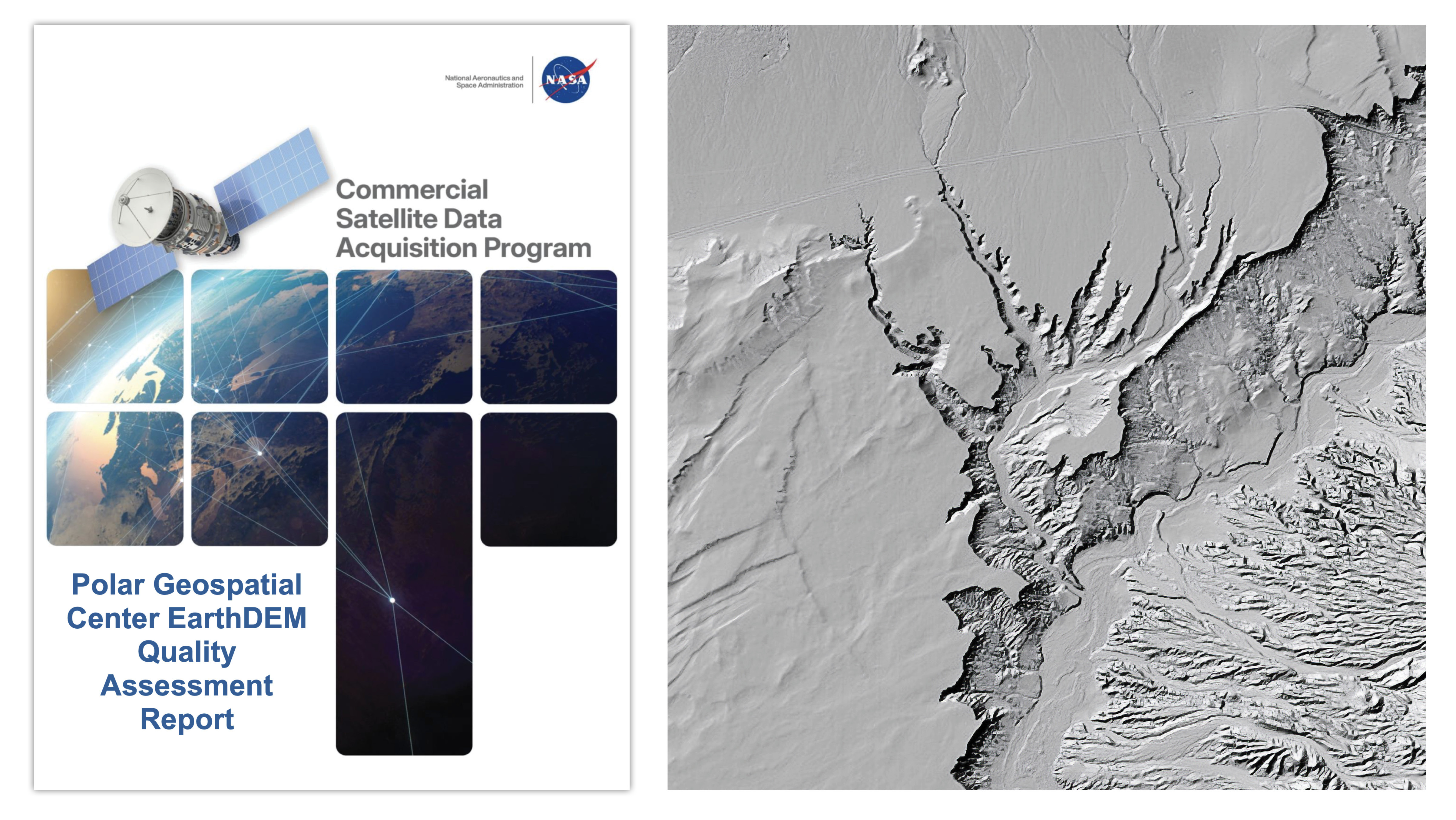
At left, the cover of the rogram recently released Polar Geospatial Center EarthDEM Quality Assessment Report, which features an image of a satellite on a white field over an image of Earth from space that divided into squares. Shaded relief rendering of EarthDEM data showing the Virgin River, Nevada. DEM derived from Vantor imagery. Credit: EarthDEM Project.
At left, the cover of the Commercial Satellite Data Acquisition programs’s recently released Polar Geospatial Center EarthDEM Quality Assessment Report. At right, a shaded relief rendering of EarthDEM data showing the Virgin River in Nevada. DEM derived from Vantor imagery.
Credit: NASA CSDA program/EarthDEM Project

Issued August 8, 2026, the CSDA  Polar Geospatial Center EarthDEM Quality Assessment Reportwas conducted by NASA Digital Elevation Model (DEM) subject matter experts (SMEs) enlisted to evaluate the horizontal and vertical accuracy of two PGC EarthDEM1 (i.e., Digital Elevation Model) products: the center’s “Mosaic Tile” and “Strip” Digital Surface Models (DSMs).

To assess the vertical and horizontal accuracy of the EarthDEM Strip DSM and Mosaic Tile products over a variety of surface characteristics, the SMEs compared them to airborne lidar data samples from across the United States and Senegal. They found the horizontal accuracy of the EarthDEM products (Strip DSM: 0.5-meter (m) Root Mean Square Error Horizontal (RMSEH); Mosaic Tile: 0.3 m RMSEH) agreed with the specifications provided by the PGC and graded them “Excellent.”  The vertical accuracy results of the EarthDEM Strip DSM (5.6 m Root Mean Square Error Vertical (RMSEV)) and the Mosaic Tile (4.9 m RMSEV) products varied by land cover type, with all land cover types exceeding the specification provided by the PGC (0.5 m RMSEV). Strip DSM vertical accuracy was found to vary from 4.6-6.8 m RMSEV depending on the cloud cover metadata field generated by the PGC. Given this variation, the vertical accuracy compliance for the EarthDEM products was graded as “Basic.”

Overall, the assessment report supports the use of EarthDEM data for NASA Earth science research and applications, as long as the data characteristics (e.g., vertical accuracy, poor cloud masking, missing surface features, data voids, etc.) are compatible with the specific science objectives and use cases.

The report also provides a Data Provider Documentation Review for the EarthDEM product that evaluated information from the PGC website, as well as a series of peer-reviewed publications by researchers at The Ohio State University’s Byrd Polar and Climate Research Center. (Only documents listed in this report were considered in the evaluation.) The report’s authors found that, overall, the EarthDEM product is “well documented,” with most information present within the product User Guide, a series of peer reviewed papers, or the PGC GitHub repository.

About the CSDA Program

The CSDA program was established to identify, evaluate, and acquire data from commercial sources that support the NASA Earth science research and application goals. NASA’s Earth Science Division recognizes the potential impact commercial satellite constellations may have in encouraging/enabling efficient approaches to advancing Earth System Science and applications development for societal benefit. Commercially acquired data may also provide a cost-effective means to augment and/or complement the suite of Earth observations acquired by NASA, other U.S. government agencies, and international partners.

To read the reports in full, see the links under “Evaluation” heading on the Polar Geospatial Center vendor page on the CSDA website.

Notes:

1. According the authors of the report, “it should be noted that the PGC EarthDEM product is not technically a commercial product…. EarthDEM is a digital elevation dataset derived from imagery collected from the Vantor (formerly Maxar) fleet of optical satellites.”

  •  

Stops Along the Path of Totality

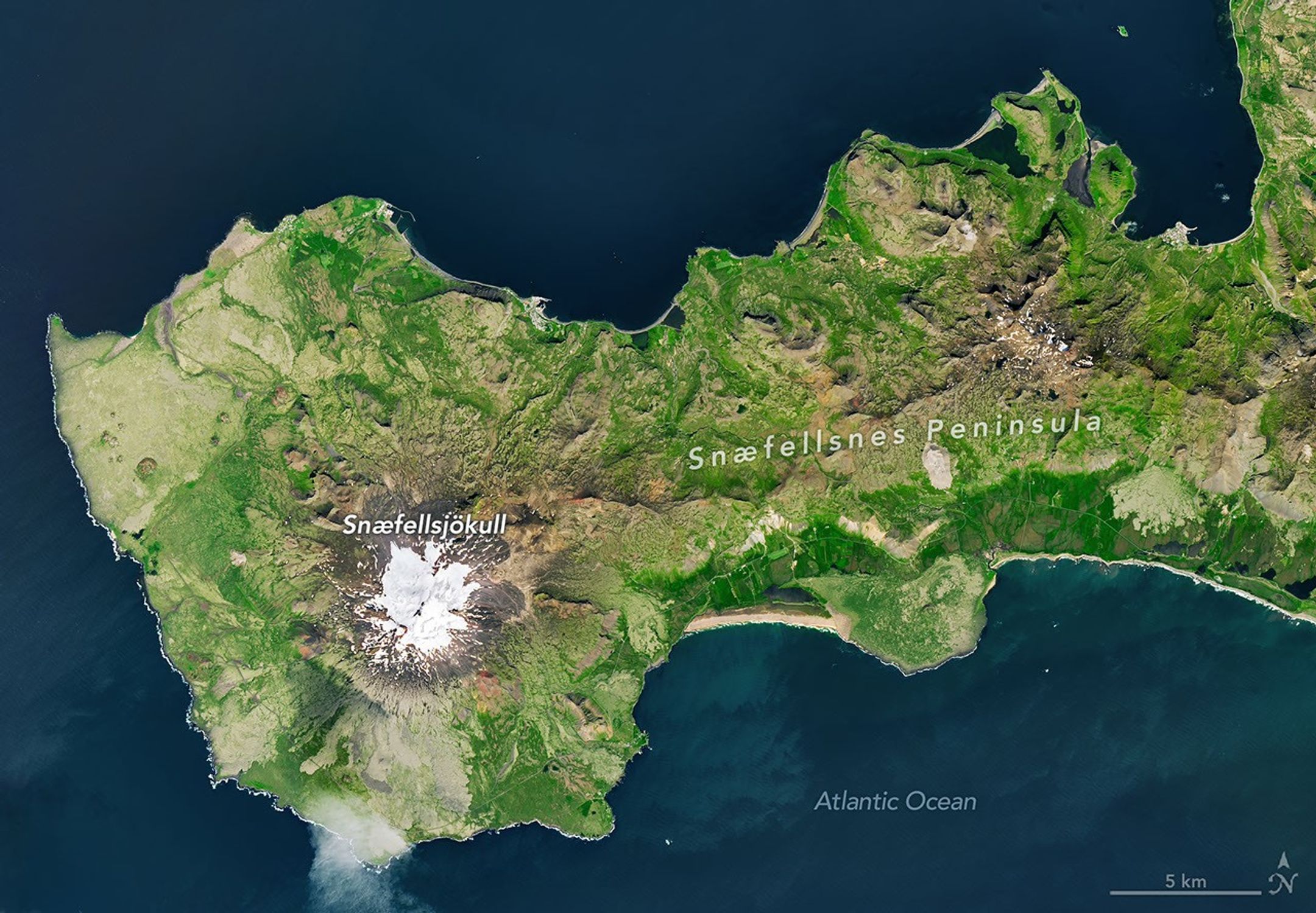
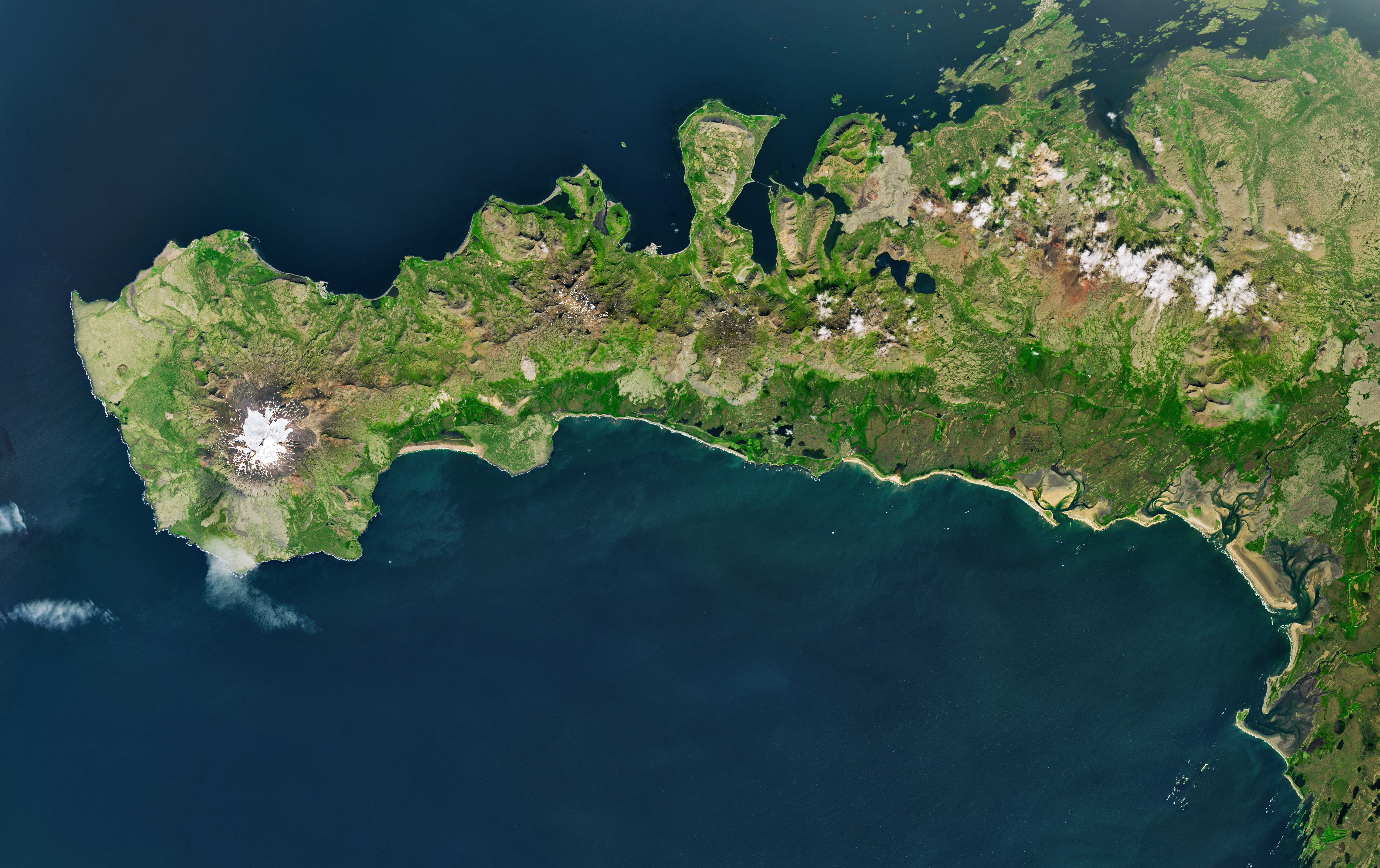
A peninsula in Iceland stretches across the image to the left. A prominent glacier-capped volcano sits near its western end.
The glacier-capped Snæfellsjökull volcano is the defining feature of Iceland’s Snæfellsnes peninsula, shown in this image acquired with the OLI (Operational Land Imager) on Landsat 9 on July 25, 2026.
NASA Earth Observatory/Michala Garrison

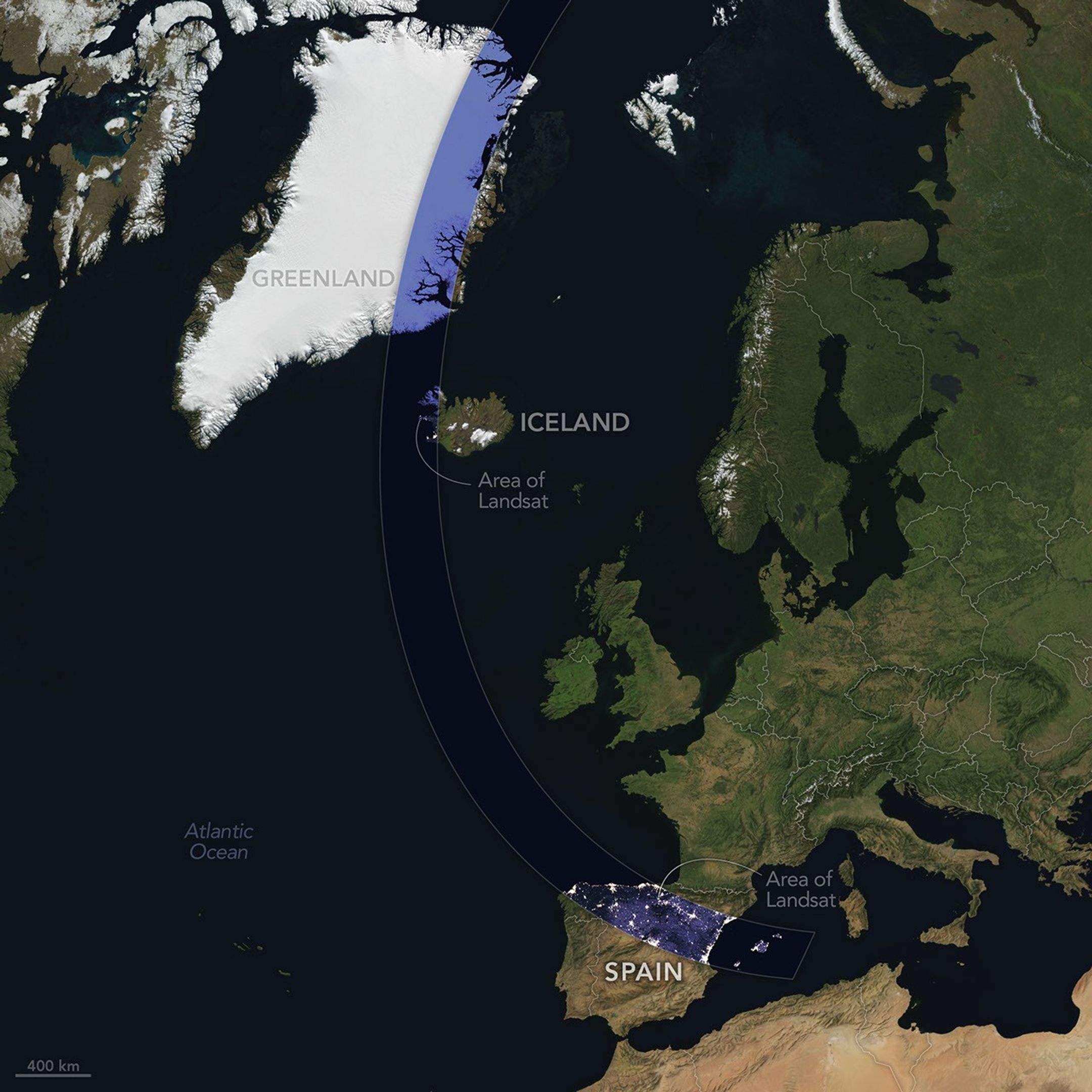
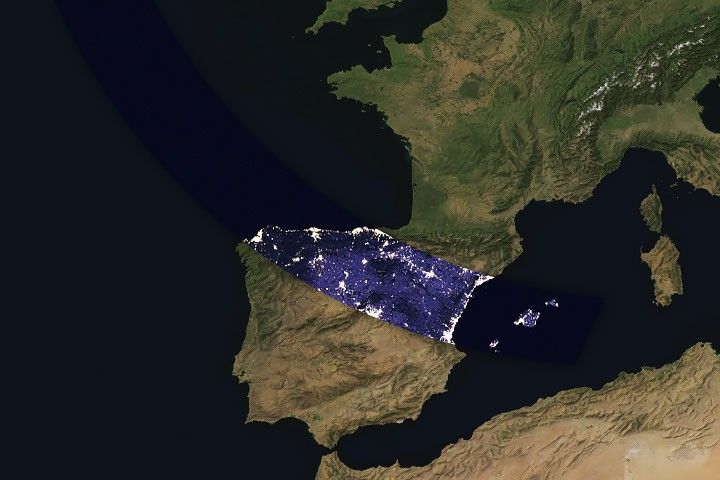
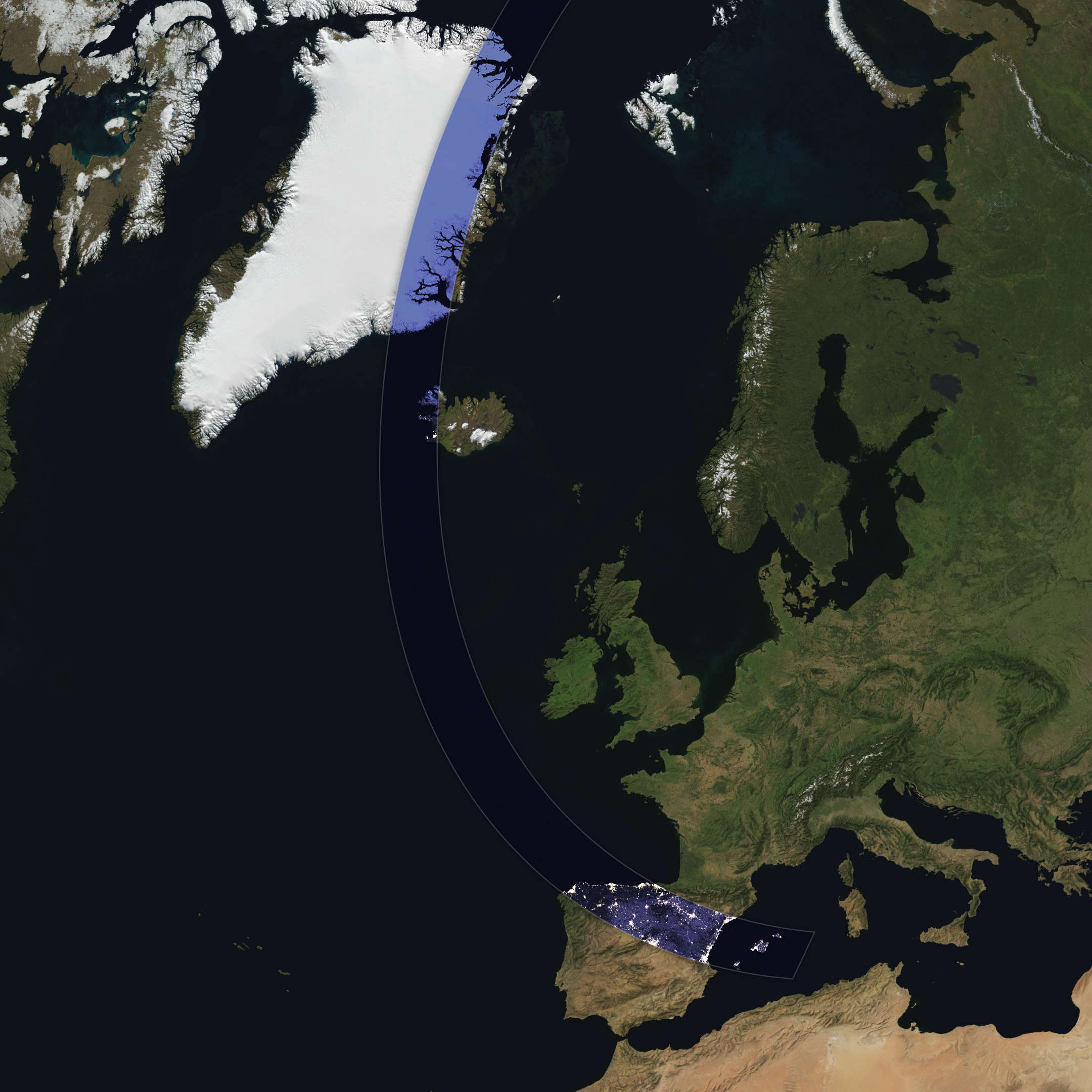
The Sun, Moon, and Earth align on August 12, 2026, to produce a total solar eclipse. When this celestial event last occurred, on April 8, 2024, the path of totality stretched across North America, giving millions the chance to glimpse the Sun’s corona. In 2026, the viewing locales are more limited; only a handful of land areas in the Northern Hemisphere, including parts of Iceland and Spain, fall within the path of totality.

On August 12, the Moon’s shadow will first cross over the Arctic Circle from northern Russia and then track along the eastern side of Greenland. At about 5:45 p.m. local time in Iceland (17:45 Universal Time), the country’s western fringes—including the Snæfellsnes peninsula, shown in the Landsat image above—will begin to experience totality. The greatest eclipse will occur near this sparsely populated peninsula when the Moon appears the largest and covers more of the Sun.

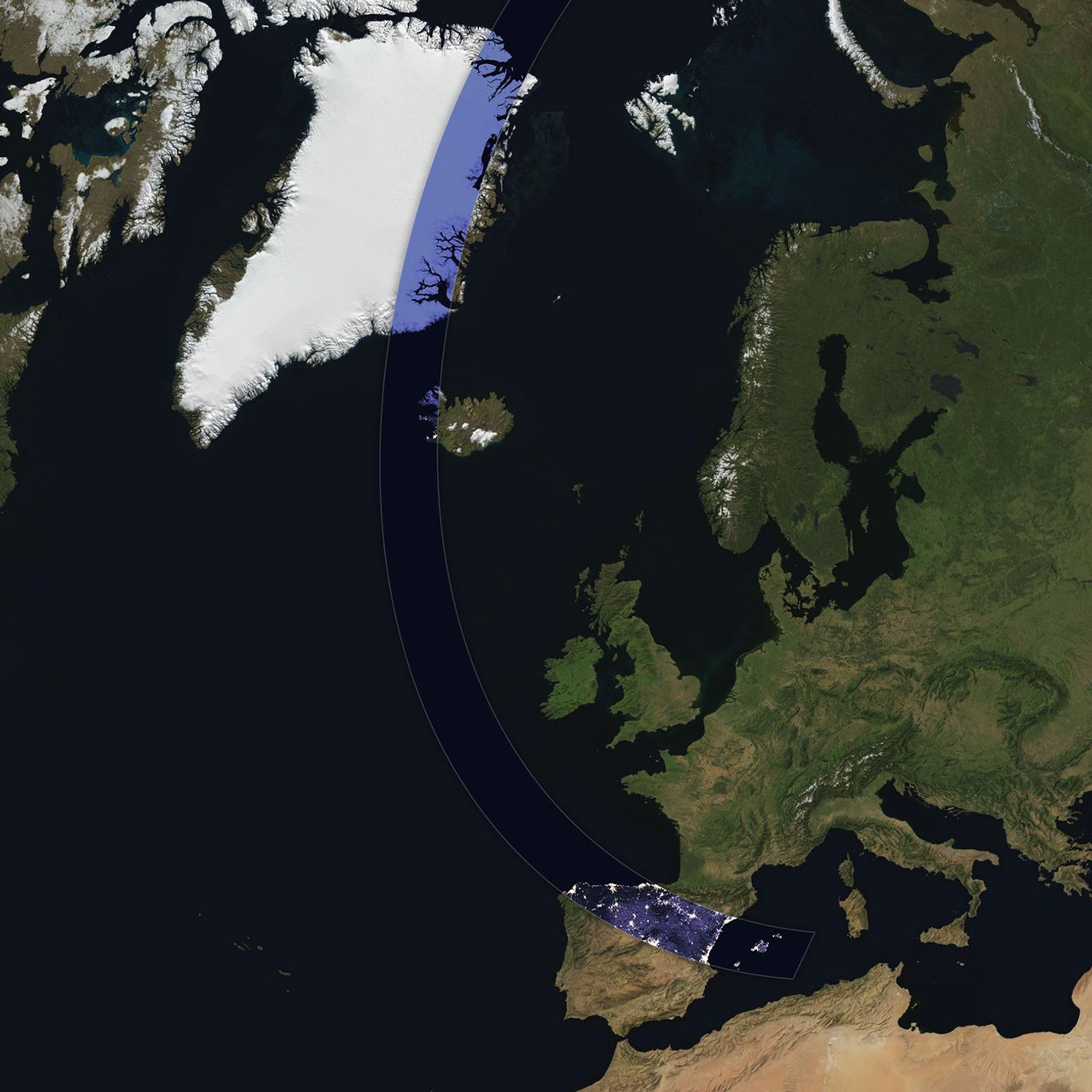
A map shows the path of totality of the solar eclipse on August 12, 2026, arcing across Greenland, Iceland, the North Atlantic, and Spain.
The path of totality of the solar eclipse on August 12, 2026, spans Greenland, Iceland, and Spain. The base imagery for the map comes from Blue Marble: Next Generation, with data from Black Marble shown in the path of totality. Blue Marble is built from scenes captured by MODIS (Moderate Resolution Imaging Spectroradiometer), while Black Marble is based on observations by the VIIRS (Visible Infrared Imaging Radiometer Suite) day-night band.
NASA Earth Observatory/Michala Garrison

The Snæfellsjökull volcano on the western end of the peninsula is covered in ice and last erupted about 1,800 years ago. It is the highlight of a national park of the same name, where people are expected to visit to view the eclipse. The stratovolcano even has a literary claim to fame: in Jules Verne’s A Journey to the Center of the Earth, characters venture underground through its crater, later emerging in an eruption of Stromboli, in Italy. In 2025, a broader area of the peninsula was designated a UNESCO biosphere reserve, containing over 70 percent of Iceland’s flora and an agglomeration of volcanic landscapes, wetlands, and grasslands.

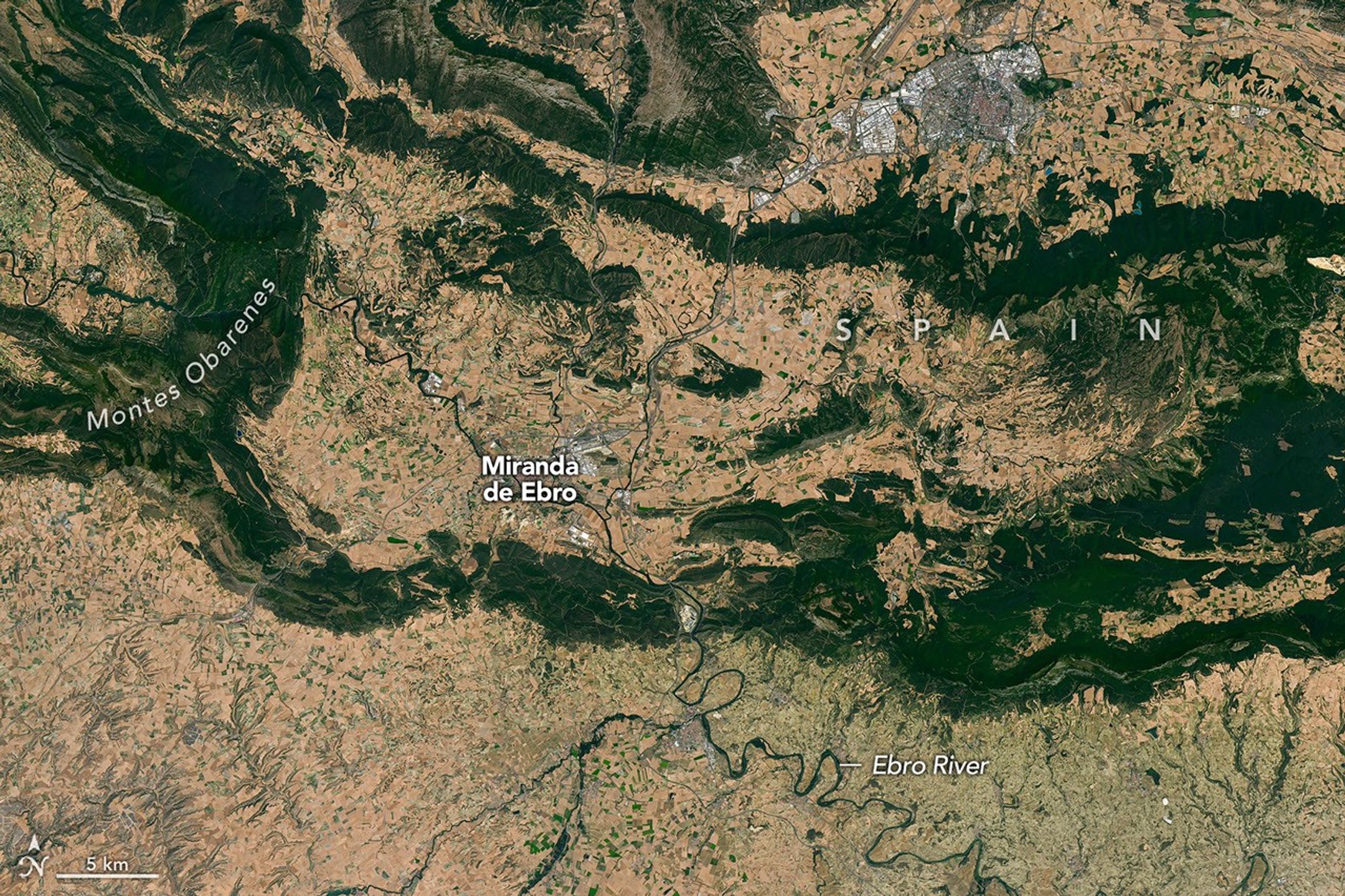
From Iceland, the eclipse shadow, or umbra, progresses across the North Atlantic and reaches northern Spain shortly before sunset. It runs east-southeast across the country, much like the Ebro River (Río Ebro), seen in the Landsat image below.

Meandering rivers cut through dark green mountain ridges, across agricultural land, and near several developed areas in northern Spain.

The Ebro River, meandering across northern Spain in this image acquired with the OLI (Operational Land Imager) on Landsat 8 on July 21, 2026, is in the path of totality of the August 2026 solar eclipse.
NASA Earth Observatory/Michala Garrison

The upper Ebro emerges from rugged terrain in Parque Natural de Montes Obarenes-San Zadornil, where it carves canyons and gorges through the eastern foothills of the Cantabrian Mountains. It then meanders through La Rioja, a region known for its vineyards. About 400 kilometers (250 miles) away, the river reaches a delta on the Mediterranean coast between Barcelona and Valencia.

Based on satellite measurements of cloud cover in August over several decades, viewers in Spain have a higher likelihood than those in Iceland of getting a clear look at the eclipse. And despite limited viewing opportunities in the path of totality, the rest of Europe, parts of Africa, Canada, and the northern and northeastern U.S. will experience a partial eclipse.

NASA Earth Observatory images and map by Michala Garrison, using Landsat data from the U.S. Geological Survey, base imagery from Blue Marble: Next Generation and Black Marble, and eclipse path data from Xavier Jubier. Story by Lindsey Doermann.

Downloads

A peninsula in Iceland stretches across the image to the left. A prominent glacier-capped volcano sits near its western end.

July 25, 2026

JPEG (14.69 MB)

A map shows the path of totality of the solar eclipse on August 12, 2026, arcing across Greenland, Iceland, the North Atlantic, and Spain.

August 12, 2026

JPEG (1.92 MB)

Meandering rivers cut through dark green mountain ridges, across agricultural land, and near several developed areas in northern Spain.


July 21, 2026

JPEG (34.46 MB)

References & Resources

You may also be interested in:

Stay up-to-date with the latest content from NASA as we explore the universe and discover more about our home planet.

Colonial National Historical Park

2 min read

The colonial communities of “America’s historic triangle” played defining roles in the road to American independence.

Article

Minute Man National Historical Park

3 min read

Sites relevant to the start of the American Revolutionary War are interspersed throughout the modern-day Boston metropolitan region.

Article

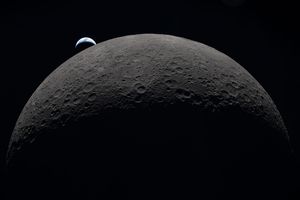
Earthset From the Lunar Far Side

2 min read

The crew of NASA’s Artemis II mission captured extraordinary images of our home planet during their journey around the far…

Article
  •  

What Is the Nancy Grace Roman Space Telescope? (Grades 5-8)

6 min read

Preparations for Next Moonwalk Simulations Underway (and Underwater)

This article is for students grades 5-8.

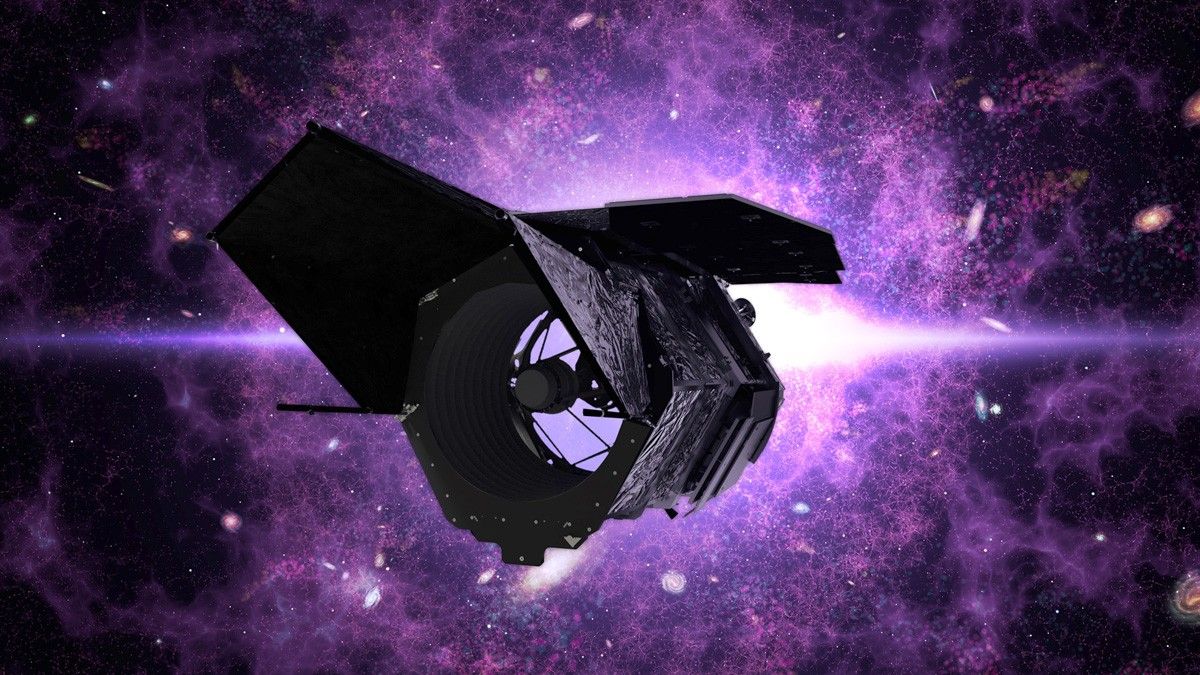
The Nancy Grace Roman Space Telescope is NASA’s newest astrophysics observatory. The telescope will scan large sections of space. Roman will help astronomers answer questions about dark energy, dark matter, exoplanets, and more.

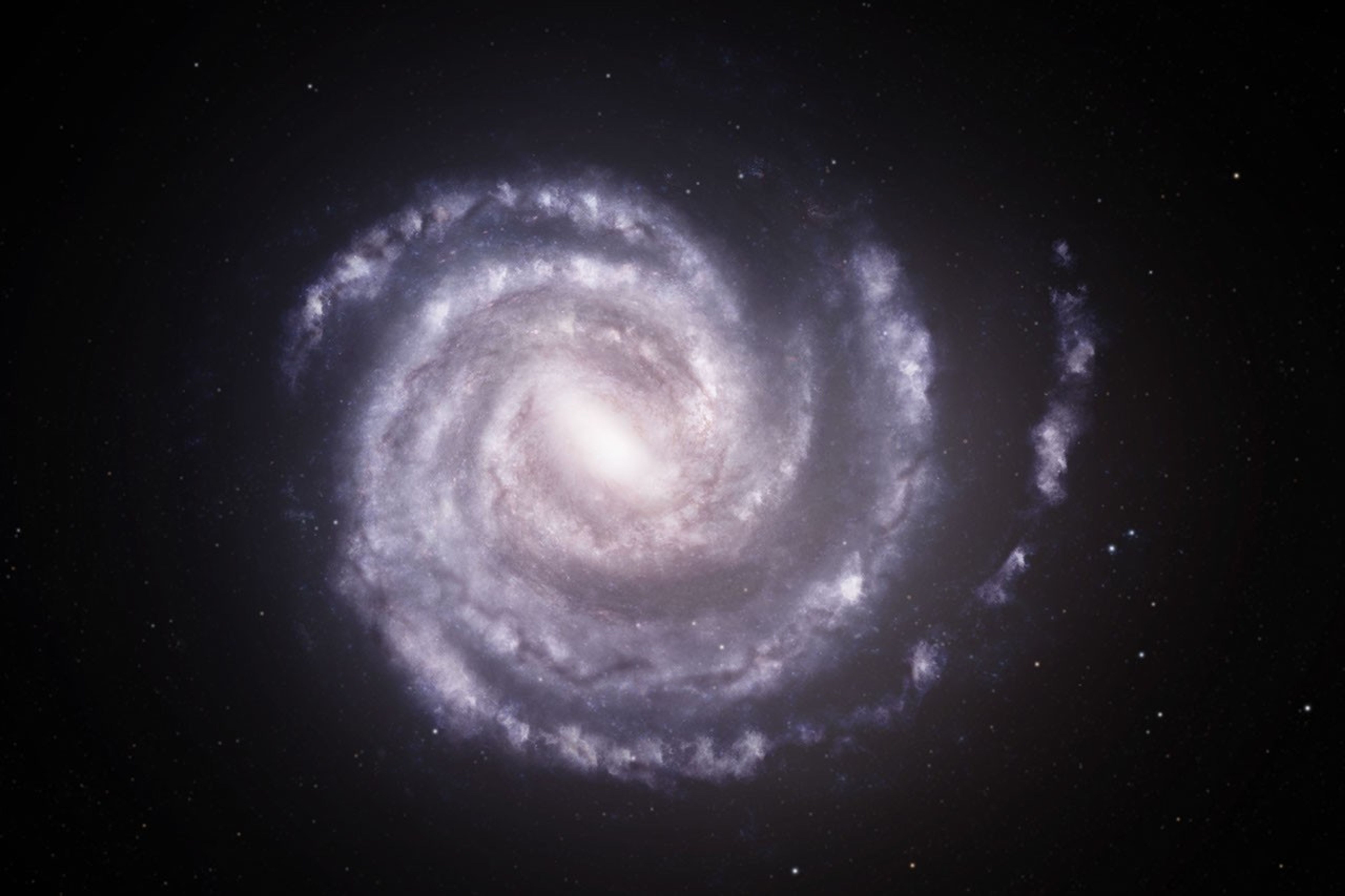
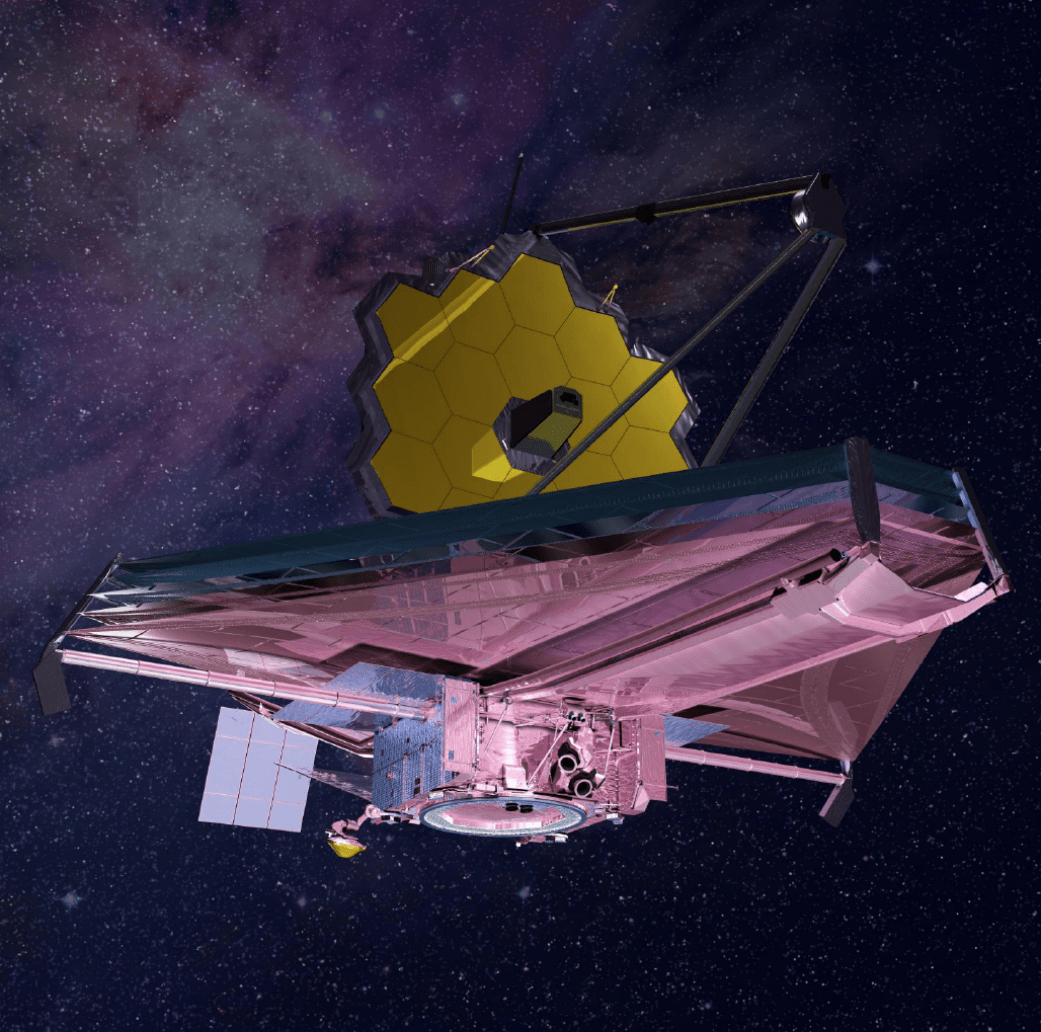
Image shows an illustration of the Nancy Grace Roman Space Telescope with a galaxy illustration in the background. Formerly known as WFIRST, is an upcoming space telescope designed to perform wide-field imaging and spectroscopy of the infrared sky.
The Nancy Grace Roman Space Telescope is NASA’s newest space telescope that will study dark energy, exoplanets, and astrophysics.
NASA’s Goddard Space Flight Center

______________________________________________________________________

Words to Know

Astrophysics: a branch of space science that applies physics and mathematics to study the universe.

Lagrange point: a position in space where the gravitational forces of a two-body system, such as the Sun and Earth, are balanced. This point creates an “orbital parking spot” where minimal fuel is needed to maintain a spacecraft’s position.

Infrared light: light that is completely invisible to the human eye but can be felt as heat. It’s the area on the electromagnetic spectrum where wavelengths are longer than visible red light, but shorter than microwaves.

Dark energy: the mysterious force that is causing the universe to expand at an accelerated rate.

Exoplanet: a planet outside of our solar system.

Dark matter: the mysterious gravitational “glue” that holds cosmic structures together.

______________________________________________________________________

When and Where Will the Nancy Grace Roman Space Telescope Launch?

The Nancy Grace Roman Space Telescope is scheduled to launch Aug. 30, 2026. It will launch aboard a SpaceX Falcon Heavy rocket. Liftoff will take place from Launch Complex 39A at NASA’s Kennedy Space Center in Florida.

Where Will the Nancy Grace Roman Space Telescope Go in Space?

The Nancy Grace Roman Space Telescope will orbit about 930,000 miles (1.5 million kilometers) away from Earth. It will orbit around a special place in space called the second Sun-Earth Lagrange point, or L2. This gravitational sweet spot is perfect for unobstructed views of the universe.

What Instruments Does the Nancy Grace Roman Space Telescope Have?

The Nancy Grace Roman Space Telescope will peer through dust and across vast stretches of space using infrared light. Roman’s primary mirror is 7.9 feet (2.4 meters) across. The large surface of the telescope mirror gathers lots of light. More light equals finer details.

The primary mirror will send light to Roman’s two science instruments: the Wide Field Instrument and the Coronagraph Instrument.

The Wide Field Instrument is a 300-megapixel infrared camera. It allows scientists to look very far back in time because the light captured by the camera has been traveling for billions of years before reaching the instrument. Seeing the universe in its early stages will help unravel how it has expanded throughout its history. This will give scientists hints about how the universe may continue to evolve.

The Coronagraph Instrument uses technology that blocks the glare from a star. This lets astronomers see planets in orbit around it. This instrument is the most powerful coronagraph ever flown in space. It will allow astronomers to see planets that are almost a billion times fainter than their host star.

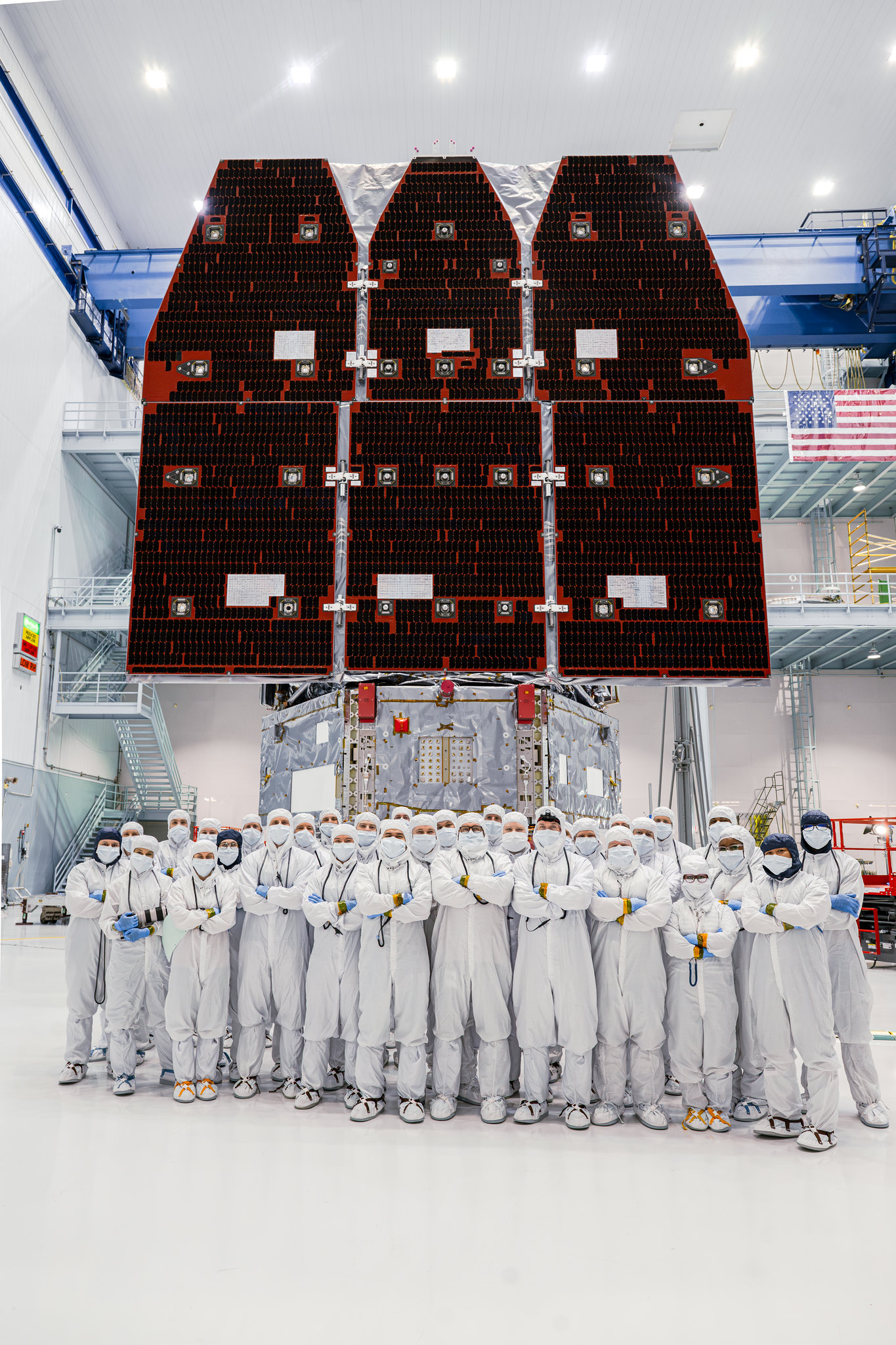
A large group of technicians in white
On Nov. 25, 2025, technicians joined the inner and outer segments together and the observatory was complete.
NASA / Sydney Rohde

What Will Scientists Study With the Nancy Grace Roman Space Telescope?

Scientists using the Nancy Grace Roman Space Telescope will focus on three main topic areas: dark energy, exoplanets, and dark matter.

Dark energy is a mysterious part of the universe. Scientists aren’t sure what it is, but it makes up about 68% of the universe’s total contents. It is believed to be responsible for the accelerating rate at which our universe is expanding. But recent observations seem to show that the pressure from dark energy is shifting over time. Scientists hope to use the Roman Space Telescope to help solve the mystery of dark energy’s true nature.

Exoplanets are planets outside of our solar system. Scientists have discovered more than 6,000 exoplanets. But they believe that billions could exist. Most of the exoplanets detected so far are wildly different than the planets in our solar system. Scientists expect Roman to find more unusual exoplanets. It will also allow astronomers to find planets in the habitable zone of their stars. This will be key to finding planets similar to Earth.

Dark matter is the invisible glue that holds the universe together. Scientists aren’t sure what dark matter is made of. Roman will allow scientists to peer back in time to trace how galaxies and galaxy clusters formed. If dark matter consists of heavy, sluggish particles, it would clump together readily and Roman should see galaxy formation early in cosmic history. If dark matter is made up of lighter, faster-moving particles, it should take longer to settle into clumps and for large-scale structures to develop. If astronomers can narrow down the candidates for dark matter particles, we’ll be one step closer to finally detecting them directly in experiments on Earth.

Who Was Nancy Grace Roman?

Nancy Grace Roman was NASA’s first chief astronomer and the first female executive at the agency. Roman championed the making of the first space-based telescope — the Hubble Space Telescope. She was involved in every crucial decision about the telescope from its funding to where it was built to the details of its instruments. Her vital role in making the project a reality led her to be known as “the mother of the Hubble Space Telescope.”

Roman was born May 16, 1925, in Nashville, Tennessee. She died Dec. 25, 2018.

Portrait of astronomer Nancy Grace Roman holding papers and looking up at a board with information on it
Nancy Grace Roman was NASA’s first chief astronomer. She is knows as “the mother of the Hubble Space Telescope.”
NASA

Career Corner

More than a thousand technicians and engineers assembled Roman from millions of individual components. Here are a few examples of the careers that shaped NASA’s newest space telescope:

Instrument technician: These experts install, calibrate, and maintain sensors and control systems. They troubleshoot issues that might come up with delicate systems and equipment. This career path often starts with an apprenticeship or hands-on training alongside experienced technicians. An associate’s degree is often required.

Mechanical engineer: This branch of engineering focuses on complex machines and engines. Mechanical engineers design, build, test, and improve mechanical systems. They play an essential role in making a complex observatory like the Roman Space Telescope a reality. A career in engineering demands a strong understanding of math and complex problem-solving and usually requires an advanced college degree.

Astrophysicist: These scientists study the physics of the universe. They are interested in learning how the universe began, how it is evolving, and how it works. Becoming an astrophysicist requires advanced college degrees.

NASA also needs people who work in photography, management, social media, videography, and much more. Learn about some of the people who have made the Roman mission possible here!

More About the Nancy Grace Roman Space Telescope

Mission Website: Nancy Grace Roman Space Telescope

Video Game: Roman Space Observer

Roman Space Telescope Education and Outreach Materials

  •  

NASA Completes Astronaut-Deployed Science Instrument for Lunar Surface

Rectangular box-shaped device resting on a metal table. The front face is covered with a grid of many small black rectangular panels bordered in white. Metal components, brackets, and small box units are mounted along the top. The background shows a large windowed wall with a blurred American flag and an Artemis flag visible behind the device.
The fully-integrated LEMS (Lunar Environment Monitoring Station) ready for environmental testing. A small suitcase-size instrument suite built at NASA Goddard, LEMS is designed to carry out continuous, long-term monitoring of the seismic environment at the Moon, including surface motion caused by moonquakes and meteorite impacts in the lunar south polar region.
NASA Goddard/Mike Guinto

NASA has declared “wrenches down” on the first completed payload designed for Artemis astronauts to deploy on the Moon’s surface. Engineers working on NASA’s Lunar Environment Monitoring Station, or LEMS, have completed hardware development and testing and the payload is ready for its permanent home near the lunar South Pole. With the hardware complete, LEMS is ready to support one of the Artemis program’s core goals: enabling sustained lunar science and exploration.

The LEMS instrument package contains two highly sensitive seismometers that will monitor ground vibrations from moonquakes and meteorite impacts, providing scientists with insights into the Moon’s interior and the seismic hazards astronauts might encounter at the surface. Its modular design allows the system to be adapted or expanded to host new instruments in the future, creating a reusable platform that can evolve as scientific priorities grow.

The payload will remain in a clean room at NASA’s Goddard Space Flight Center in Greenbelt, Maryland, where it was built, until it is assigned to an Artemis mission for deployment to the lunar surface.

“The completion of the LEMS scientific instrument is a major step in a new era of lunar surface science. Innovative science experiments will uncover, measure, and reveal the Moon’s secrets while astronauts open new frontiers for discovery,” said Joel Kearns, deputy associate administrator for exploration, Science Mission Directorate, NASA Headquarters in Washington. “And, behind the scenes, countless teams across NASA and our partners are pushing the boundaries of what surface instruments can do, building the tools that will make future exploration possible and safer.”

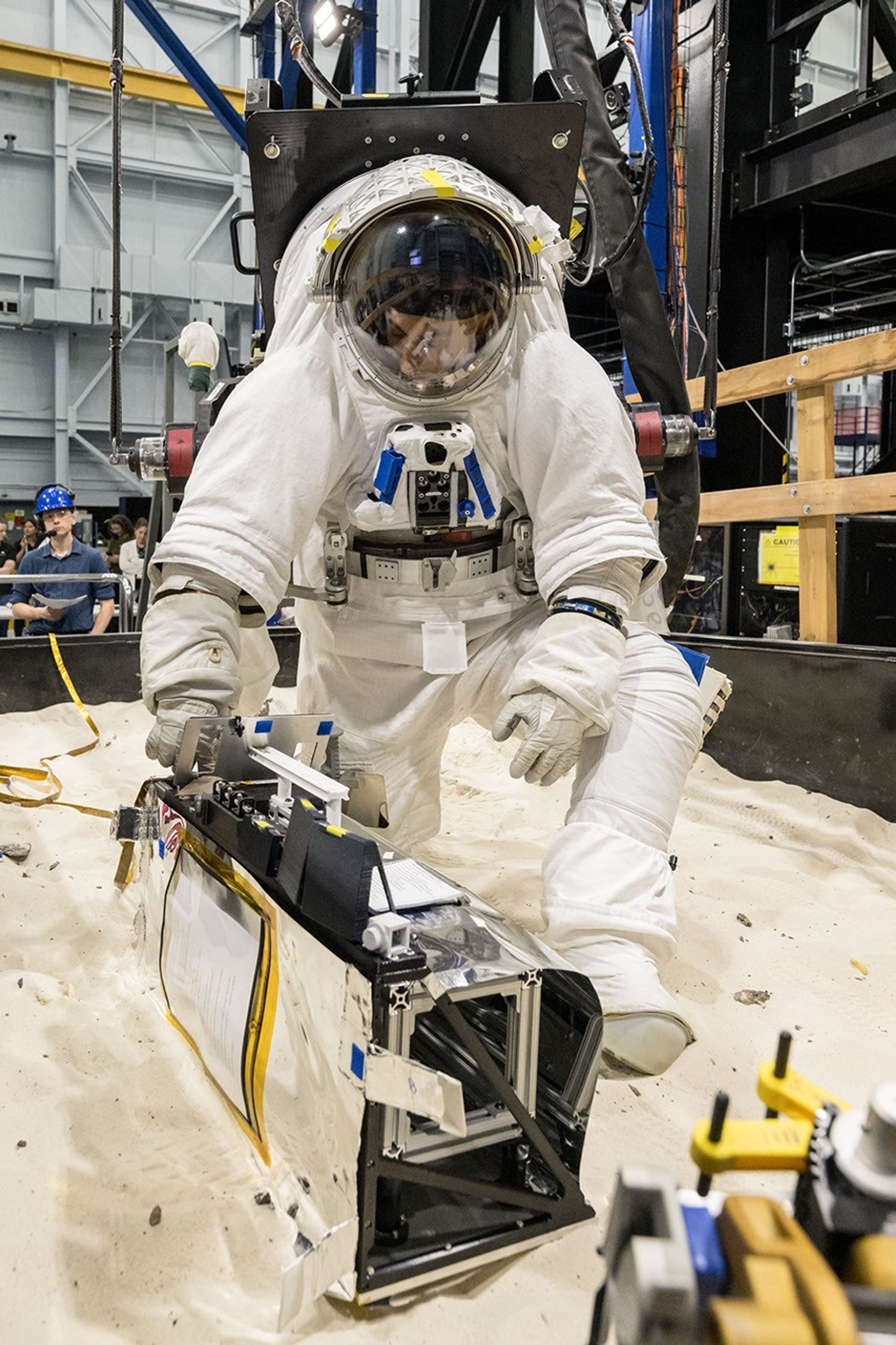
An astronaut in a white spacesuit kneels in simulated lunar soil while working with scientific equipment in a large testing facility. Staff members and support structures are visible in the background.
A scientist wearing NASA’s xEMU prototype space suit is testing the handling of a mockup version of NASA’s Lunar Environment Monitoring Station, or LEMS. The testing took place at the Active Response Gravity Offload System, a simulated reduced gravity environment at NASA’s Johnson Space Center in Houston.
NASA Johnson

The LEMS payload builds on a legacy of lunar seismic tracking. Apollo astronauts deployed a network of seismometers on the Moon’s nearside equatorial region between 1969 and 1972. Those instruments operated until 1977, recording about 13,000 moonquakes and other ground vibrations that helped scientists begin to understand the composition of the Moon’s interior. For decades, researchers have hoped to spread more seismometers, updated with new technologies, across the lunar surface.

Now, LEMS will carry the first seismometers to be deployed by future astronauts to listen for faint ground vibrations, collecting new clues to the Moon’s internal structure and ongoing seismic activity. The sensors will be the most compact, sensitive, and energy-efficient seismometers ever built for planetary exploration.

LEMS itself is about the size of a small suitcase, weighing 11 pounds in the Moon’s low-gravity environment. It will carry not just these seismic sensors, but everything it needs to function independently of humans after deployment. LEMS is built to manage its own power production via a lightweight, flexible solar array that conforms to the shape of the LEMS unit. It also will manage its operational activities to ensure continuous data collection based on a preset plan, and monthly data transmission to Earth. The payload will do all this while maintaining a stable internal temperature throughout the massive day-to-night temperature swings of the South Pole region.

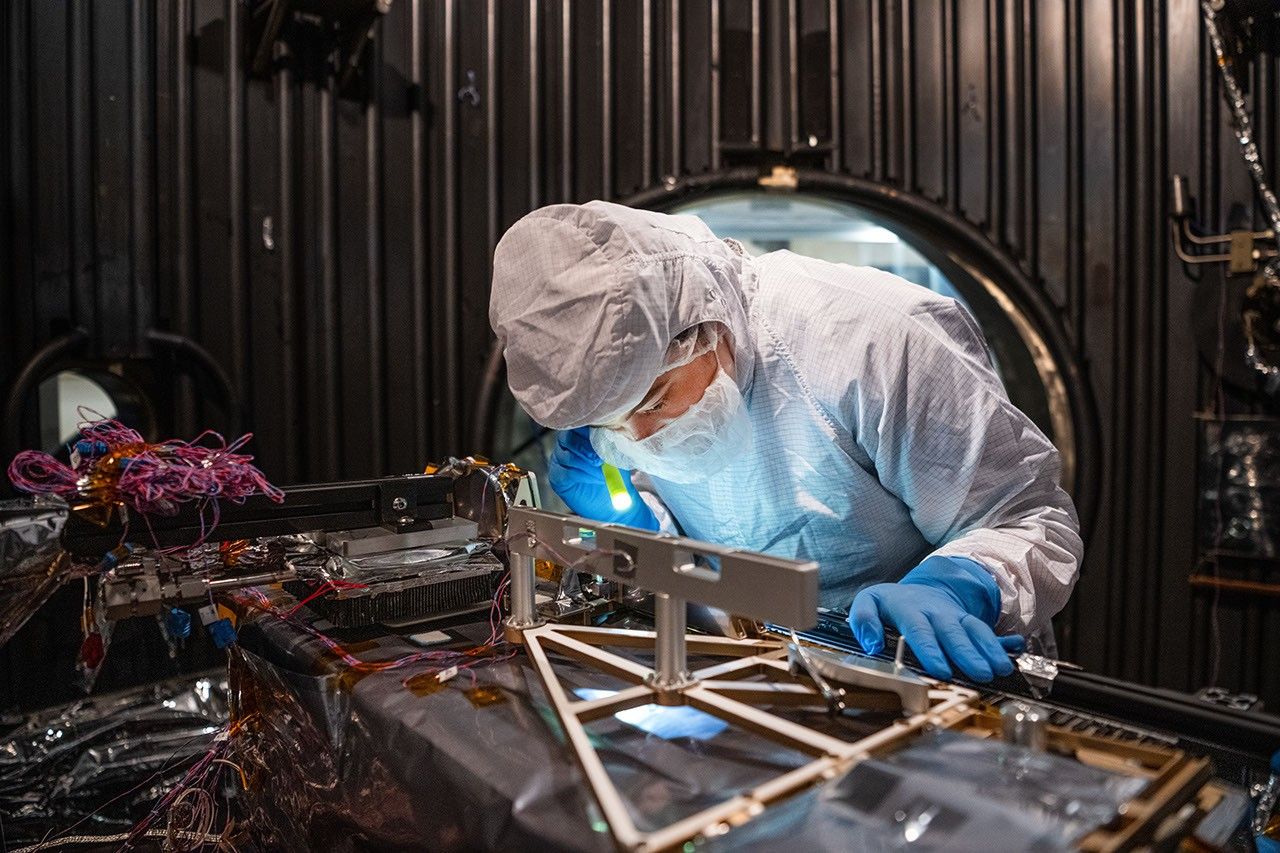
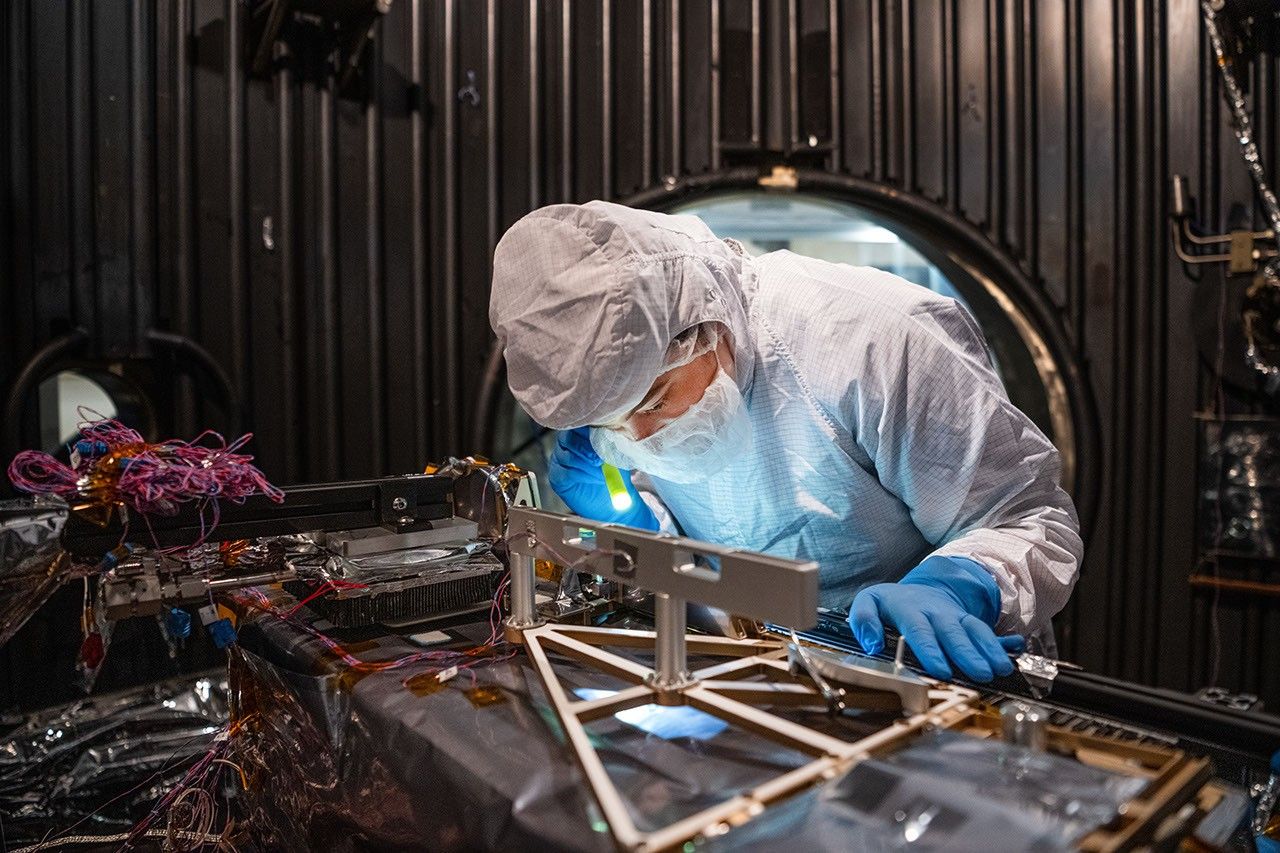
A technician in a white clean-room suit and blue gloves uses a small flashlight to inspect a spacecraft instrument inside a dark testing chamber. Colorful wires and metallic components surround the instrument.
Mechanical Engineer Brie Ludwig inspects the Lunar Environment Monitoring Station (LEMS) in preparation for testing in a thermal vacuum chamber at Goddard Space Flight Center in Greenbelt, Maryland, on March 31, 2026. LEMS is a compact, autonomous, and self-sustaining seismometer suite designed to carry out continuous, long-term monitoring of the lunar seismic environment at the South Polar region.
NASA/Denny Henry

“When we conceived of LEMS, we weren’t just thinking about the next mission, we were thinking about the next generation of lunar exploration,” said Mehdi Benna, a University of Maryland Baltimore County scientist who leads LEMS from NASA Goddard. “Our vision was to create a scientific buoy for the Moon. Like an ocean buoy on Earth, LEMS is designed to be easy to build, adaptable to different scientific objectives, and capable of operating independently for years.”

Before any surface science could happen, Benna and his team had to ensure that LEMS could survive the trip to the Moon and the harsh environment of its surface. Over the past five months, LEMS and its components have been subjected to a demanding series of environmental and operational tests. Engineers verified LEMS can endure the violent shaking of launch, the journey to the lunar surface, and the Moon’s temperature and radiation environment. The team also showed that the instrument package’s mechanical and electrical design is safe for astronaut handling.

The LEMS payload was built to operate through the lunar night, which lasts two Earth weeks, without external power assistance or a heat source. Past lunar surface instruments relied on radioisotope heaters for warmth and power. But LEMS instead will withstand temperatures that dip to minus 400 degrees Fahrenheit in some areas by using advanced insulation materials, low-thermal-conductivity cables that minimize heat loss, and a thermal regulator that conducts heat away during the day to prevent overheating and helps retain heat at night.

These innovations reduce mass and power needs, setting the stage for lighter, energy-efficient instruments that can operate continuously at future Artemis landing sites and the NASA-led Moon Base.

The LEMS payload is led by University of Maryland Baltimore County and University of Maryland College Park. Technical implementation is led by NASA Goddard. The University of Arizona, in partnership with Silicon Audio, Inc., supplied LEMS’ two state-of-the-art seismometers. Morehead State University in Kentucky provided LEMS’ telecommunication system and will operate the instrument on the surface. Washington University in St. Louis will manage the instrument’s data processing and dissemination to the larger scientific community.

  •  

Lion Nebula Roars in Webb’s Sights

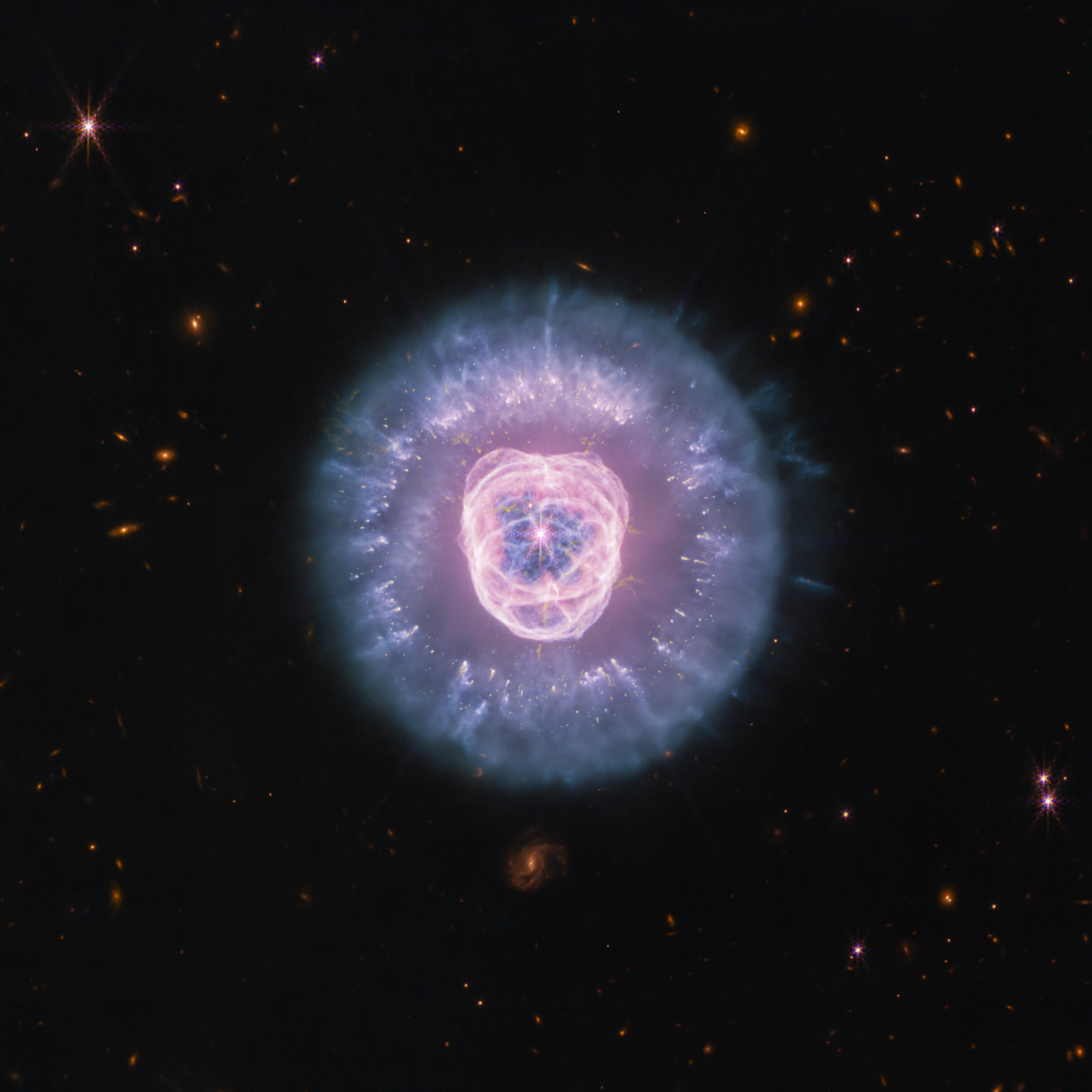
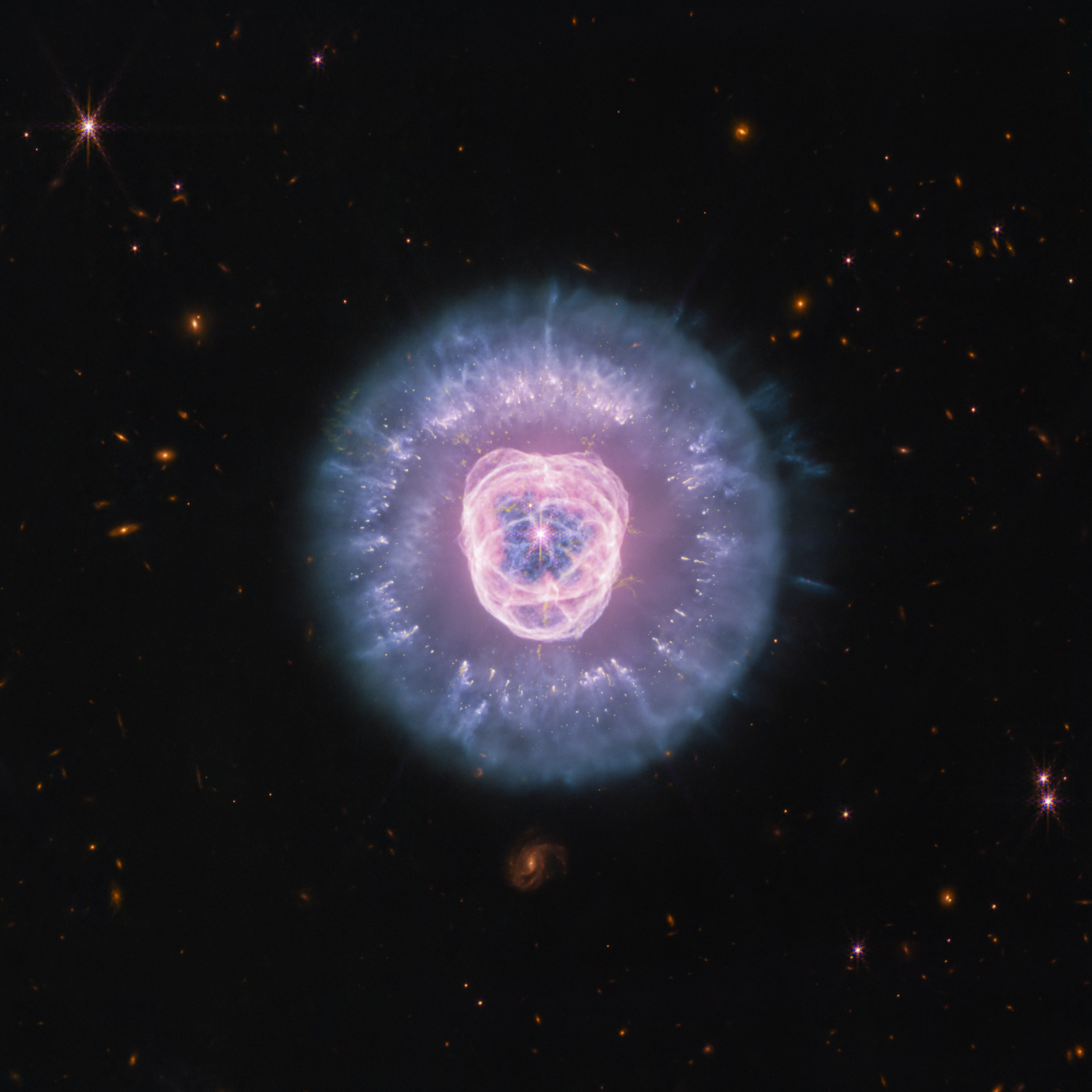
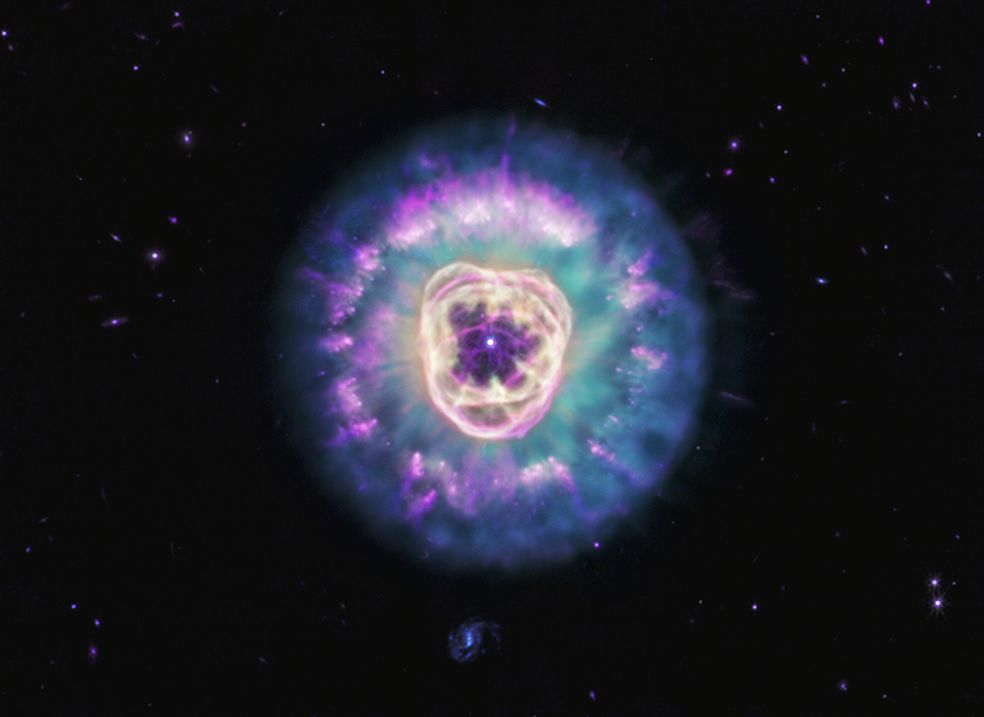
JWST’s Near Infrared Camera and Mid Infrared Instrument combined image of planetary nebula NGC 2392, the Lion Nebula, against the black background of space. The nebula is at center, circular in shape, and looks like a male lion’s head. In the center is a small, pinkish-white circle with eight-point diffraction spikes, a white dwarf star. Surrounding the star are purple-pink cavernous bubbles and shell-like rings. The bubbles and shells collectively form an oval with two small, wide arcs near the top, reminiscent of a lion’s face and its ears. What appears to be extended outward from the lion’s face is a thick ring of purple-blue material. The width of the ring is consistent throughout and resembles a mane. The area closest to the lion’s face looks cloudy, while the edges of the mane look like there are clumps of dust with comet-like tails. In the background are distant galaxies and stars. Some galaxies are yellow and orange points of light and others have spiral structures. Some stars have diffraction spikes.
NASA’s James Webb Space Telescope imaged the planetary nebula NGC 2392, the Lion Nebula, using the observatory’s NIRCam and MIRI instruments. The central star’s remains are responsible for the nebula’s structure, including a lion face-shaped bubble of ionized gas and dust “mane.”
Image: NASA, ESA, CSA, STScI; Image Processing: Alyssa Pagan (STScI)

Observing across the starry “plains” of space, NASA’s James Webb Space Telescope has taken new images of NGC 2392, nicknamed the Lion Nebula. The nebula’s “mane” is clear and detailed in this image released on Aug. 10, 2026, due to Webb’s high-resolution imaging.

See more images of the Lion Nebula from Webb.

Image: NASA, ESA, CSA, STScI; Image Processing: Alyssa Pagan (STScI)

  •  

NASA Telescopes Create Colorful ‘Craft’ From Nearby Nebula

4 Min Read

NASA Telescopes Create Colorful ‘Craft’ From Nearby Nebula

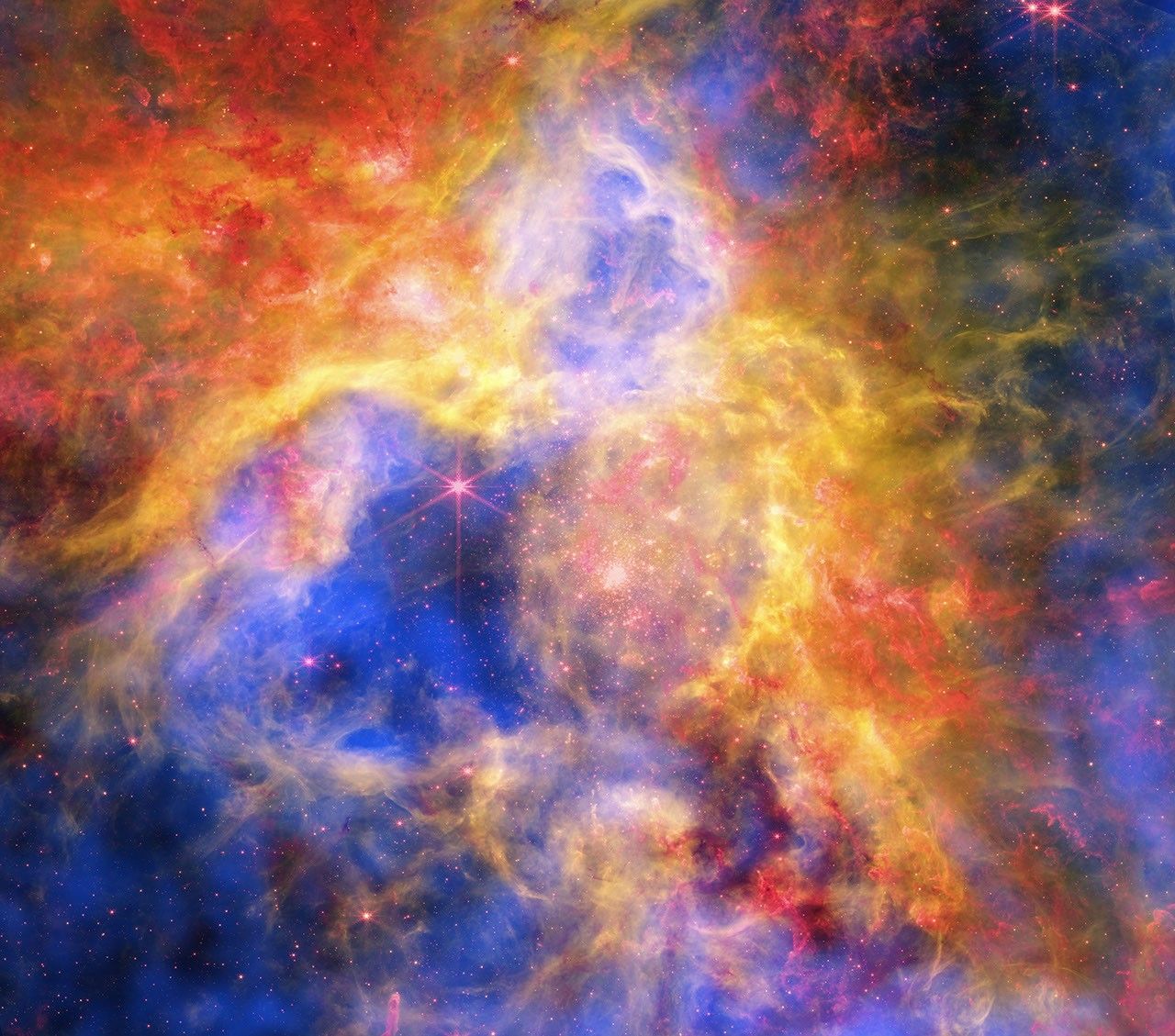
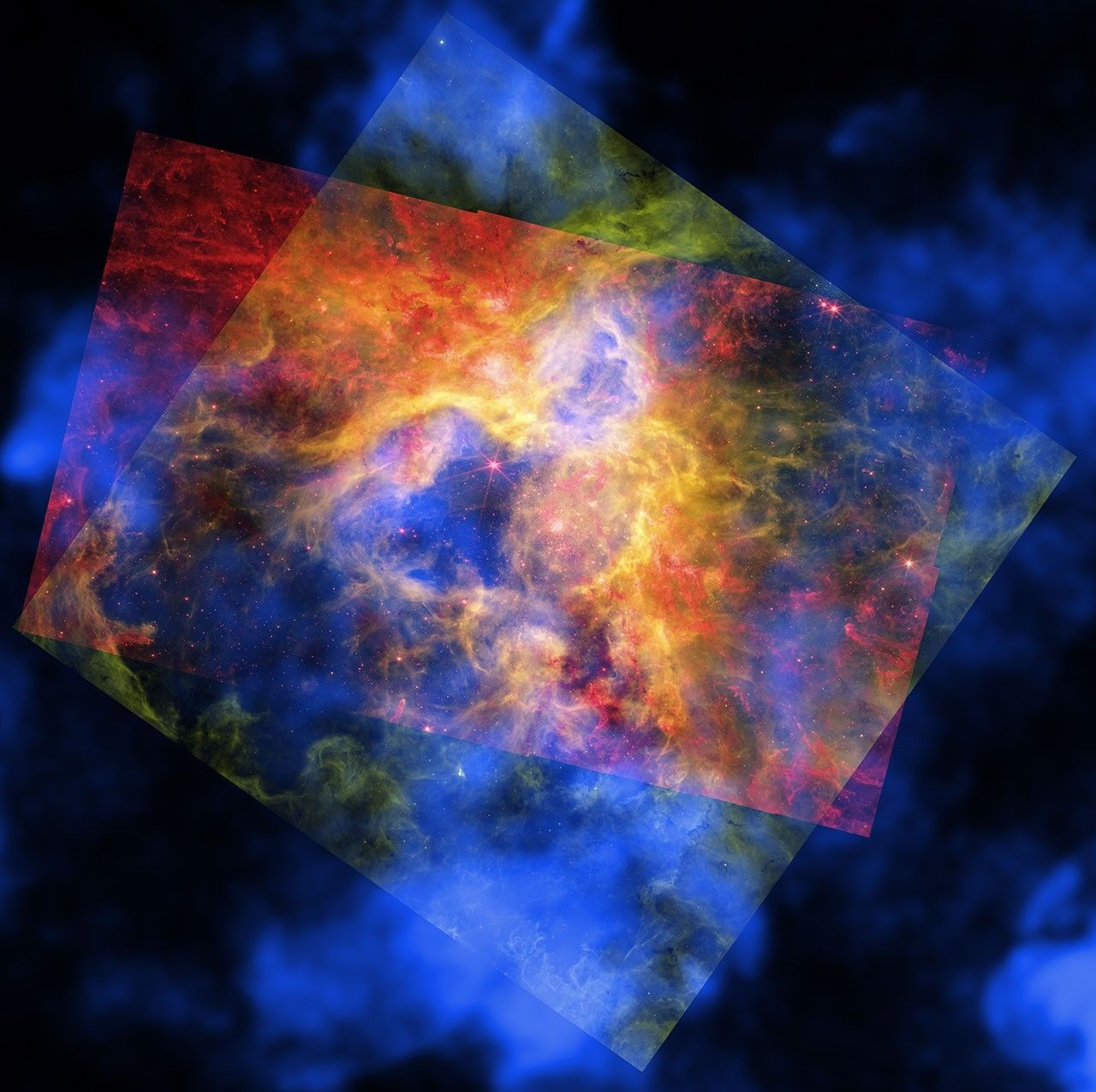
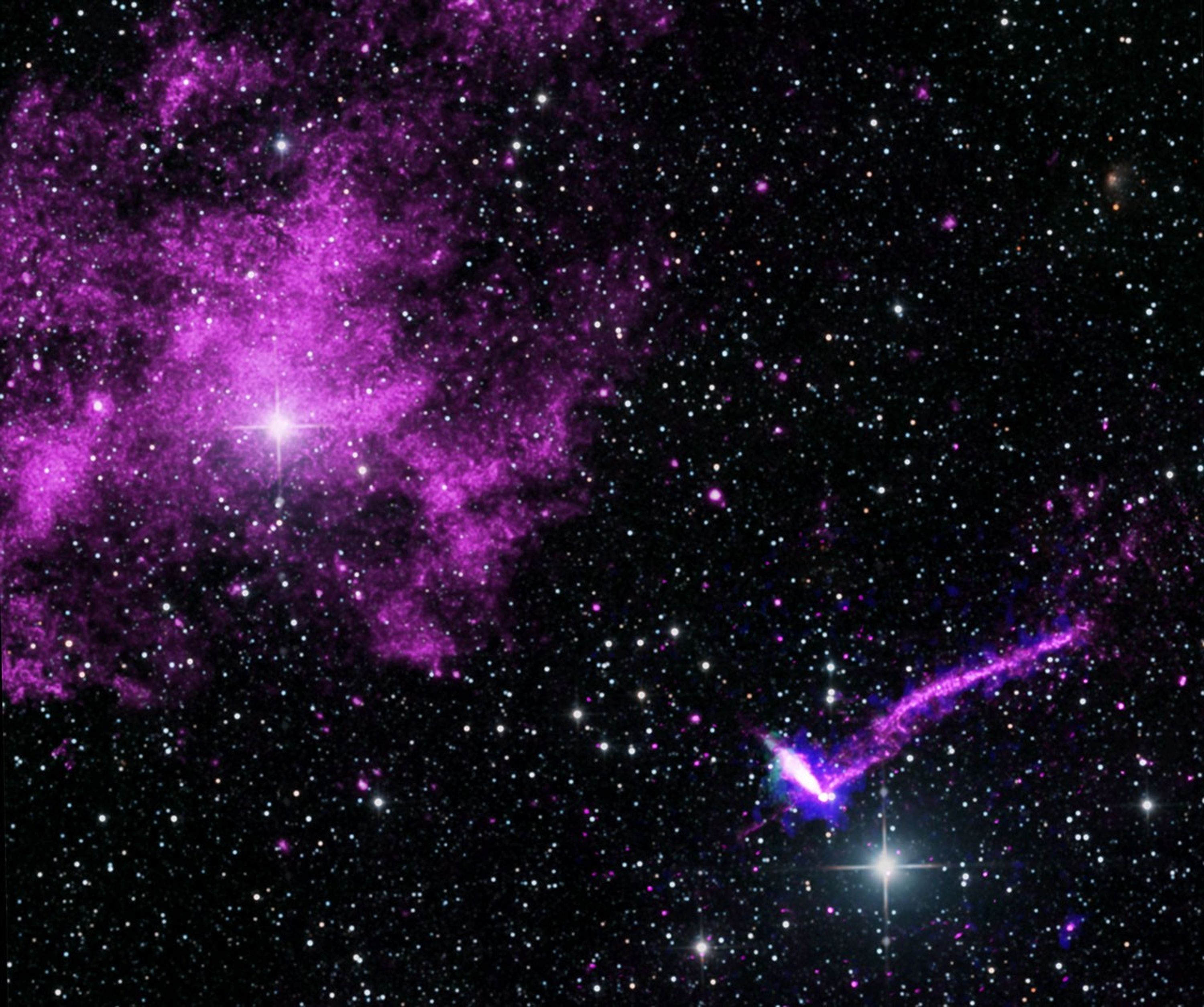
This multiwavelength image of the Tarantula Nebula, one of the brightest and largest regions of star formation to Earth, shows X-rays from Chandra that reveal gas that has been blown away in winds from the surfaces of young, massive stars and heated to millions of degrees by shock waves, like sonic booms from supersonic jets. The infrared data from Webb shows thousands of young stars, plus swaths of cool dust that will provide the ingredients to one day form new stars and planets. Hubble optical data uncovers hydrogen gas that is warmer than seen with Webb, as well as some individual stars through the nebula.

Like a collage made of layered sheets of colored cellophane, a vibrant new image layers observations of a famous star-forming nebula from NASA space telescopes. The resulting cosmic “craft” reveals new details about the star formation region known as 30 Doradus, or the Tarantula Nebula.

Located in the Large Magellanic Cloud, a small neighbor galaxy to the Milky Way about 160,000 light-years from Earth, the Tarantula has thousands of young stars embedded in a vibrant honeycomb-like structure of gas and dust.

This multiwavelength image of the Tarantula Nebula, one of the brightest and largest regions of star formation to Earth, shows X-rays from Chandra that reveal gas that has been blown away in winds from the surfaces of young, massive stars and heated to millions of degrees by shock waves, like sonic booms from supersonic jets. The infrared data from Webb shows thousands of young stars, plus swaths of cool dust that will provide the ingredients to one day form new stars and planets. Hubble optical data uncovers hydrogen gas that is warmer than seen with Webb, as well as some individual stars through the nebula.
X-ray: NASA/CXC/Ohio State Univ./J. Rodriguez et al; Infrared: NASA/ESA/CSA/STScI; Optical: NASA/ESA/STScI; Image Processing: NASA/CXC/SAO/P. Edmonds

Like a collage made of layered sheets of colored cellophane, a vibrant new image layers observations of a famous star-forming nebula from NASA space telescopes. The resulting cosmic “craft” reveals new details about the star formation region known as 30 Doradus, or the Tarantula Nebula.

Located in the Large Magellanic Cloud, a small neighbor galaxy to the Milky Way about 160,000 light-years from Earth, the Tarantula has thousands of young stars embedded in a vibrant honeycomb-like structure of gas and dust.

The new composite image contains X-rays from NASA’s Chandra X-ray Observatory, which has repeatedly observed the Tarantula Nebula over the course of its mission, in the layer that appears in blue. The X-ray data reveals gas blown away by winds from the surfaces of young, massive stars and heated to millions of degrees by shock waves, like sonic booms from supersonic jets.

The red represents infrared data from NASA’s James Webb Space Telescope showing thousands of young stars, plus swaths of cool dust that will provide the ingredients to form new stars and planets. Optical data in the green layer from NASA’s Hubble Space Telescope uncovers hydrogen gas that is warmer than seen with Webb, as well as some individual stars through the nebula.

The composite image shows the full Hubble and Webb images of this region, as well as a large section of the Chandra image, all recently published in a research paper in the Astrophysical Journal. In some regions the blue Chandra layer stands alone, and in others it combines with either the red Webb data or the green Hubble data. In the middle region all three images overlap to provide a holistic view in red, orange, yellow, green, and blue.

Previously, astronomers had studied the amount and the impact of energy produced by winds from young, massive stars in the Tarantula Nebula. Scientists expect that much of this energy should heat gas so that it produces X-rays. However, the research paper shows that there is much less X-ray-emitting gas in the nebula than expected. This led researchers to ask: Where has this energy gone and what tamed the Tarantula Nebula?

By studying the data from Chandra, Hubble, and Webb, combined with data from NASA’s retired Spitzer Space Telescope, the team concluded the Tarantula may be losing energy from several sources.

First, up to half of the hot gas is leaking through the shell walls of the gas and dust structures and escaping the nebula. Next, there is stirring and mixing between the cold gas near the shell walls and some of the hot gas, lowering the overall temperature of the gas. Finally, comparisons with computer simulations suggest the Tarantula may be losing energy through conduction. This involves direct physical contact between hot and cooler material, like with a frying pan on a burner, causing the hot and cooler material to equalize in temperature. In the case of the Tarantula Nebula, the hot gas would be conducting heat by being in direct contact with the cooler gas in the shells, especially in the densest regions. This scenario does not necessarily involve mixing the hot and cooler gas.

The combination of these three channels for losing large amounts of energy leads to this colorful and complex display revealed by NASA’s telescopes working together.

This multiwavelength image of the Tarantula Nebula, one of the brightest and largest regions of star formation to Earth, shows X-rays from Chandra that reveal gas that has been blown away in winds from the surfaces of young, massive stars and heated to millions of degrees by shock waves, like sonic booms from supersonic jets. The infrared data from Webb shows thousands of young stars, plus swaths of cool dust that will provide the ingredients to one day form new stars and planets. Hubble optical data uncovers hydrogen gas that is warmer than seen with Webb, as well as some individual stars through the nebula.
Tarantula Nebula / 30 Doradus, cropped version.
X-ray: NASA/CXC/Ohio State Univ./J. Rodriguez et al; Infrared: NASA/ESA/CSA/STScI; Optical: NASA/ESA/STScI; Image Processing: NASA/CXC/SAO/P. Edmonds

The paper describing these results was led by Jennifer Rodriguez of The Ohio State University in Columbus. Additional authors on the paper include Laura Lopez, Ohio State; Lachlan Lancaster, Columbia University in New York City; Anna Rosen, San Diego State University; Omnaraynai Nayak, Space Telescope Science Institute in Baltimore; Sebastian Lopez, Ohio State; Tyler Holland-Ashford, NASA’s Goddard Space Flight Center in Greenbelt, Maryland; and Trinity Webb, Ohio State.

NASA’s Marshall Space Flight Center in Huntsville, Alabama, manages the Chandra program. The Smithsonian Astrophysical Observatory’s Chandra X-ray Center controls science operations from Cambridge, Massachusetts, and flight operations from Burlington, Massachusetts.

To learn more about Chandra, visit:

https://nasa.gov/chandra

About the Author

Megan Watzke

Share

Details

Last Updated
Aug 12, 2026
Editor
Lee Mohon
Contact
Megan Watzke
Location
Marshall Space Flight Center
  •  

Building the Moon Base: NASA Stories at the Ion  

4 Min Read

Building the Moon Base: NASA Stories at the Ion  

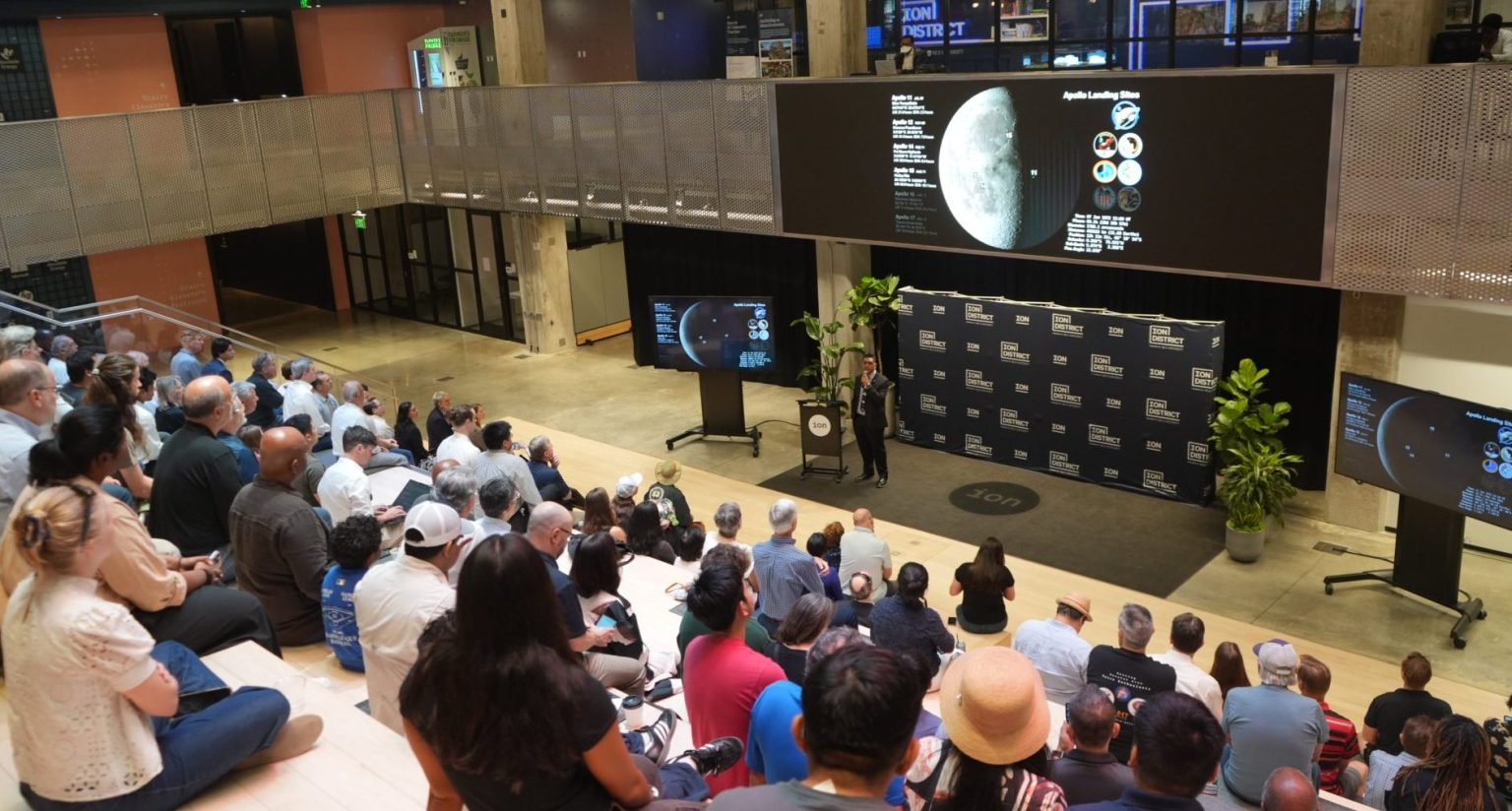
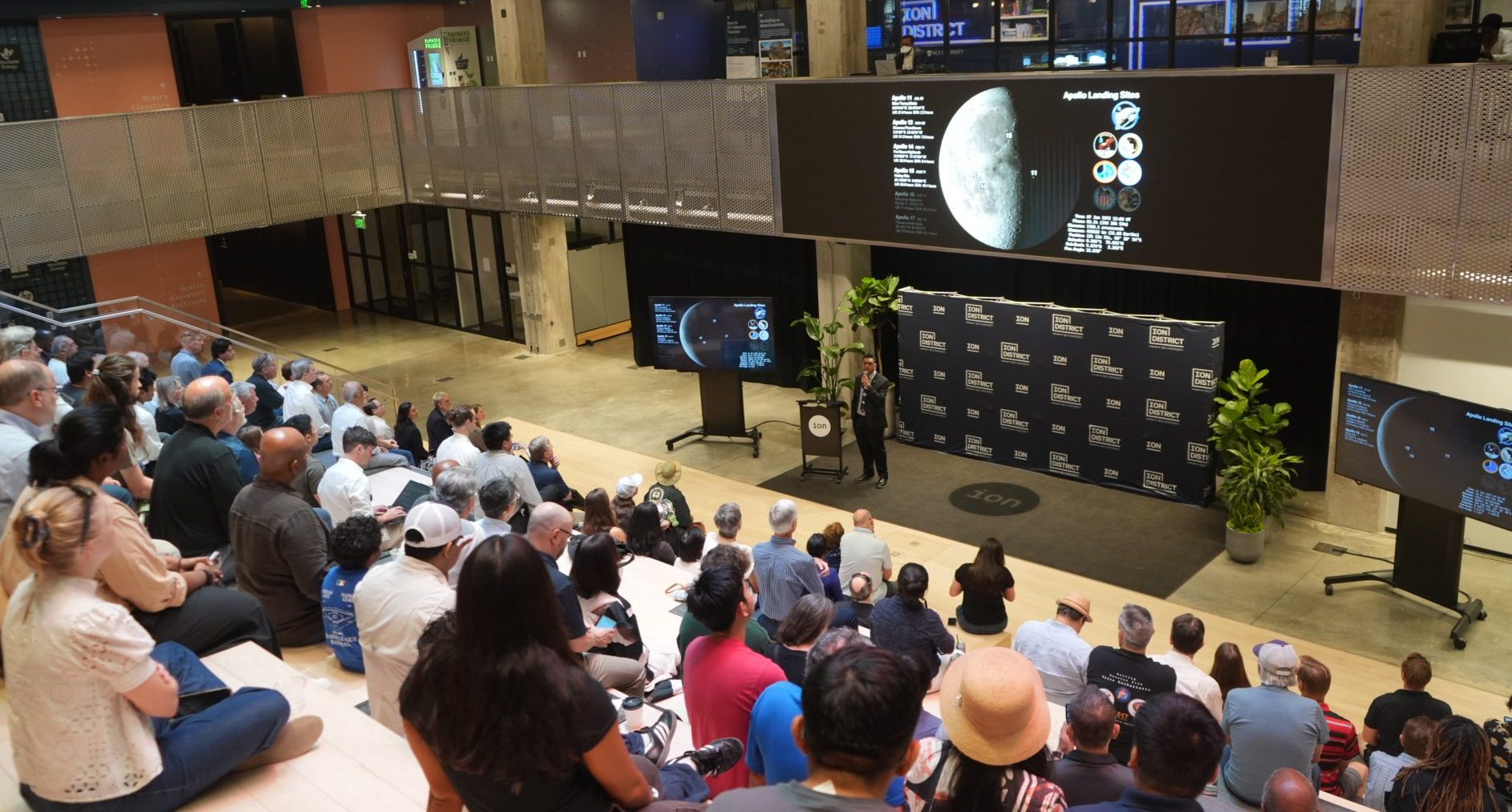
Shatel Bhakta, principal systems engineer for NASA’s Moon Base Program, gives a presentation during NASA Stories at the Ion in Houston on July 30, 2026.
Credits: NASA/Sumer Loggins
Shatel Bhakta, principal systems engineer for NASA’s Moon Base Program, gives a presentation during NASA Stories at the Ion in Houston on July 30, 2026.
NASA/Sumer Loggins

As NASA prepares to return astronauts to the lunar surface for longer stays and increasingly complex operations, building the Moon Base will require new ideas, advanced technologies, and expertise across many fields. 

During NASA Stories at the Ion on July 30, Shatel Bhakta, principal systems engineer for NASA’s Moon Base Program, presented “Building the Moon Base: Challenges and Opportunities at the Lunar South Pole.” He discussed the work required to establish a sustained human presence at the Moon. 

Through its growing partnership with Rice University and the Ion, NASA’s Johnson Space Center in Houston hosts recurring talks connecting agency experts with entrepreneurs, researchers, students, and industry leaders. The series gives Houston’s innovation community a closer look at the people and ideas shaping the future of exploration.  

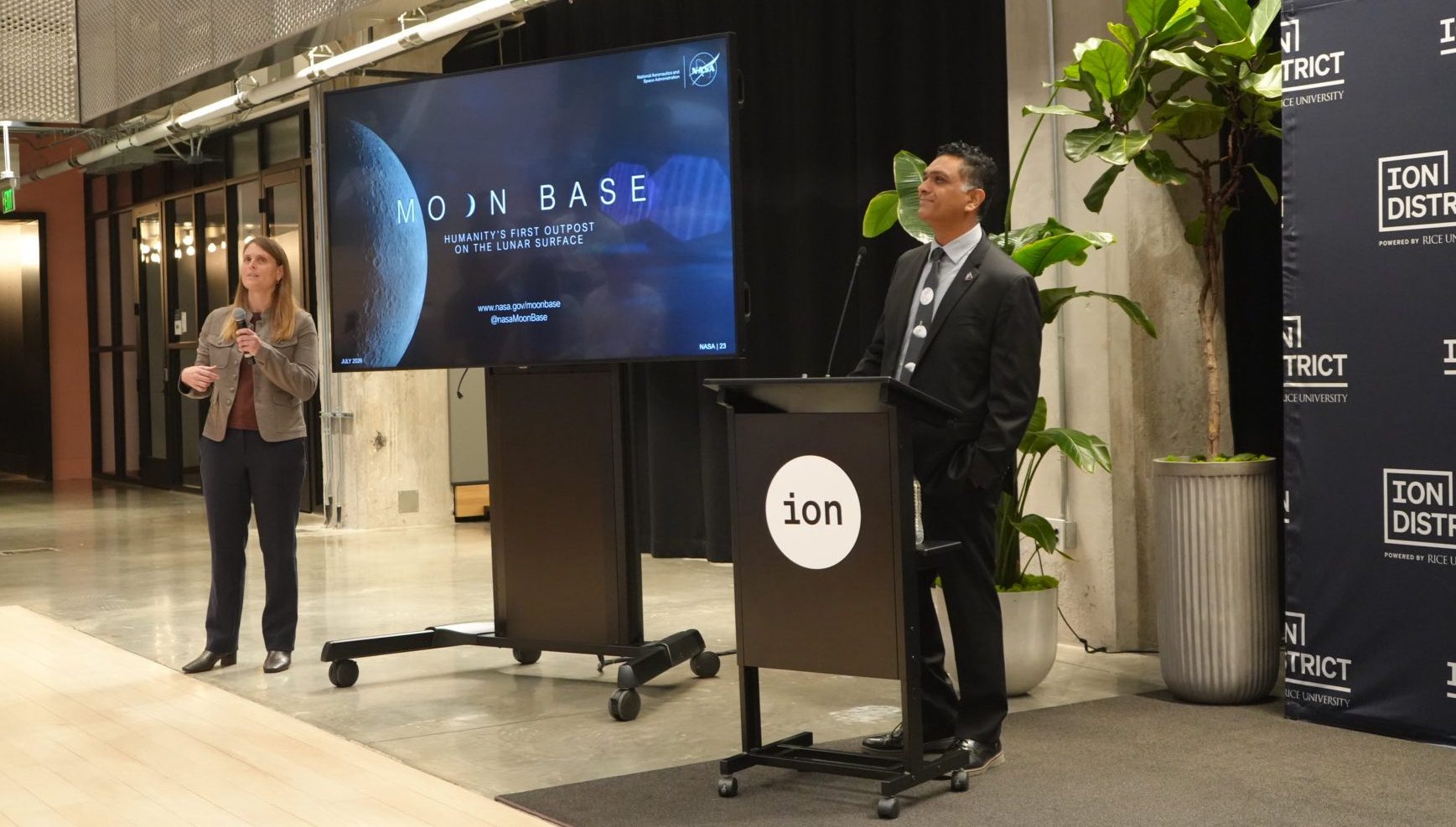
Shatel Bhakta, principal systems engineer for NASA’s Moon Base Program, presents during NASA Stories at the Ion. At left is Laura Neder, head of platform for the Rice Alliance for Technology and Entrepreneurship and the Ion District. 
NASA/Sumer Loggins

Laura Neder, head of platform for the Rice Alliance for Technology and Entrepreneurship and the Ion District, welcomed attendees and introduced Monte Goforth, acting director of Business Development and Technology Integration at Johnson. Goforth delivered opening remarks on the value of sharing NASA’s work beyond the agency and bringing people together to support future exploration before introducing Bhakta. 

Bhakta outlined how NASA is working toward long-duration human exploration of the lunar South Pole through the agency’s Moon Base Program. 

As part of that effort, NASA is taking a step-by-step approach to Moon Base development. Early robotic missions and technology demonstrations will help NASA gather data about the lunar environment, test systems, and reduce risks before expanding infrastructure and human operations.  

“This is probably going to be the most challenging endeavor NASA has ever undertaken,” Bhakta said.  

Meeting that challenge will require collaboration between NASA and its commercial and international partners to develop solutions for operating in extreme environmental conditions.  

Unlike the Apollo landing sites, areas near the lunar South Pole contain steep slopes, deep craters, and lighting conditions that change throughout the year. The Sun remains low on the horizon, creating shifting shadows that can complicate navigation and leave solar panels without sunlight for extended periods, increasing the need for energy storage and other power sources. 

Because of the region’s rugged terrain, crews, rovers, and other surface systems may not always have a clear line of sight to Earth. NASA will need communications infrastructure to relay signals across the lunar South Pole. 

Bhakta explained that Moon Base may not be a single cluster of connected structures. Terrain, lighting, power, and landing constraints could require habitats and other systems to be distributed across the lunar surface. 

Attendees listen as Shatel Bhakta, principal systems engineer for NASA’s Moon Base Program, discusses the challenges of establishing a sustained human presence at the Moon.
NASA/Sumer Loggins

Lunar regolith, or Moon dust, remains one of the greatest challenges. Without mitigation, the sharp and clingy substance could damage equipment and spacesuits while posing health risks to astronauts. Its electrostatic properties can also change depending on lighting and environmental conditions. 

Understanding how lunar regolith behaves will be essential to ensuring crews can safely live and work on the lunar surface. 

Some permanently shadowed regions near the lunar South Pole may not have received direct sunlight for billions of years and may contain water ice and other volatile materials. These resources could support future exploration, but using them will require new mobility, power, and processing systems. 

The Moon will also serve as a proving ground for missions farther into the solar system. Operating on the lunar surface will help NASA learn how crews, equipment, and infrastructure perform away from Earth before future human missions to Mars. 

As NASA develops these capabilities, Bhakta explained that keeping the Moon Base architecture adaptable will require understanding how individual systems connect and work together. 

“Don’t deal with the technology directly,” Bhakta said. “Deal with the interfaces.” 

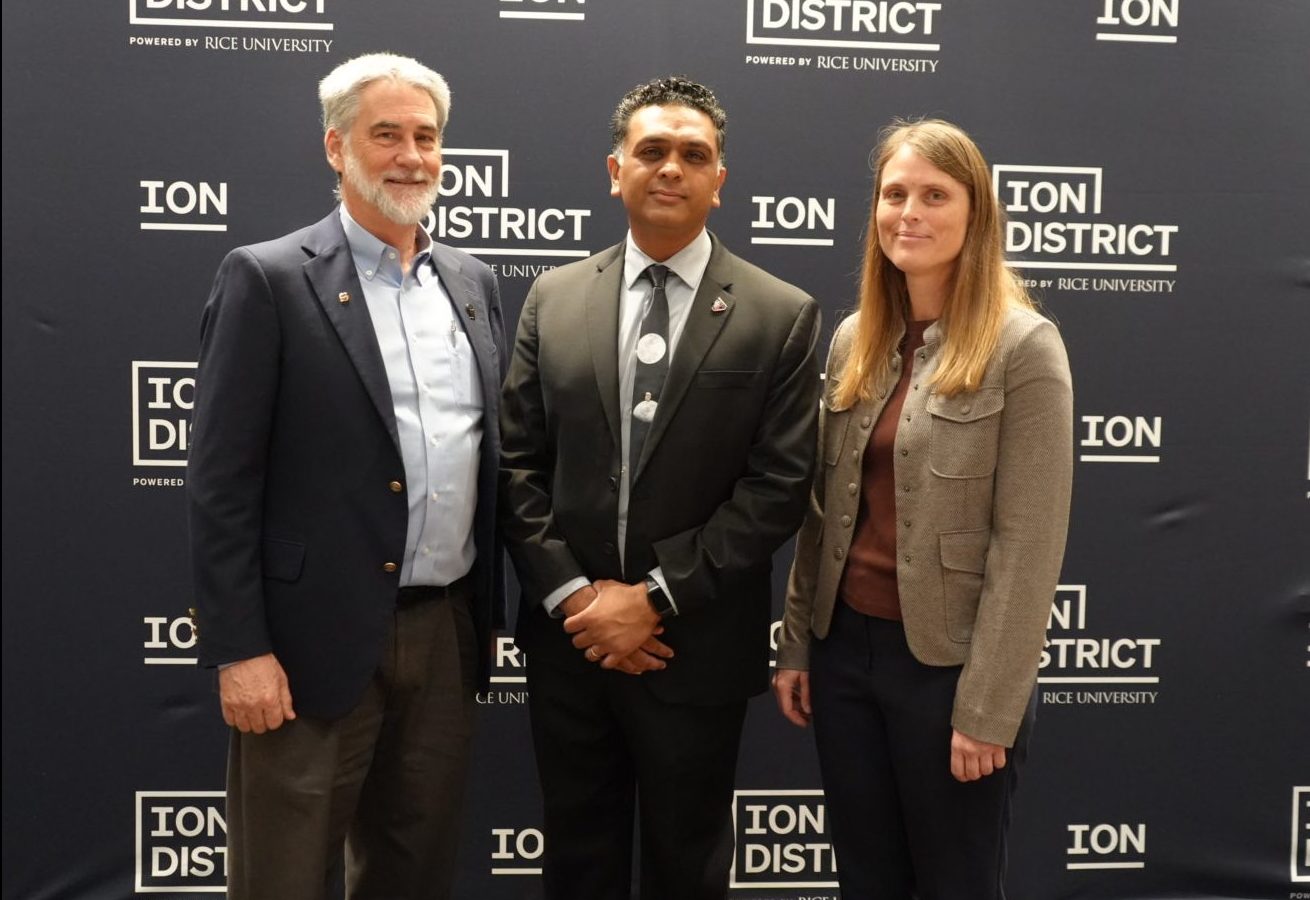
From left, Monte Goforth, acting director of Business Development and Technology Integration at NASA’s Johnson Space Center; Shatel Bhakta, principal systems engineer for NASA’s Moon Base Program; and Laura Neder, head of platform for the Rice Alliance for Technology and Entrepreneurship and the Ion District, pose during NASA Stories at the Ion.
NASA/Sumer Loggins

Building the Moon Base will take more than engineers and scientists. NASA will need communicators, business professionals, researchers, and people from many other fields to help solve problems and share the agency’s work. 

“There are many ways to contribute,” Bhakta said. “Don’t be afraid that your skill set does not fit in.” 

Moon Base build-up will offer multiple entry points for industry and international collaborators to participate, innovate, and contribute. From early demonstrations to long-term surface operations, there are multiple solicitations currently open.  

Find more information at:

www.nasa.gov/moonbase-solicitations

About the Author

Sumer Loggins

Sumer Loggins

Share

Details

Last Updated
Aug 11, 2026
Keep Exploring

Discover More Topics From NASA

  •  

Curiosity Blog, Sols 4968-4974: Rock Climbing Towards the Discontinuity

3 min read

Curiosity Blog, Sols 4968-4974: Rock Climbing Towards the Discontinuity

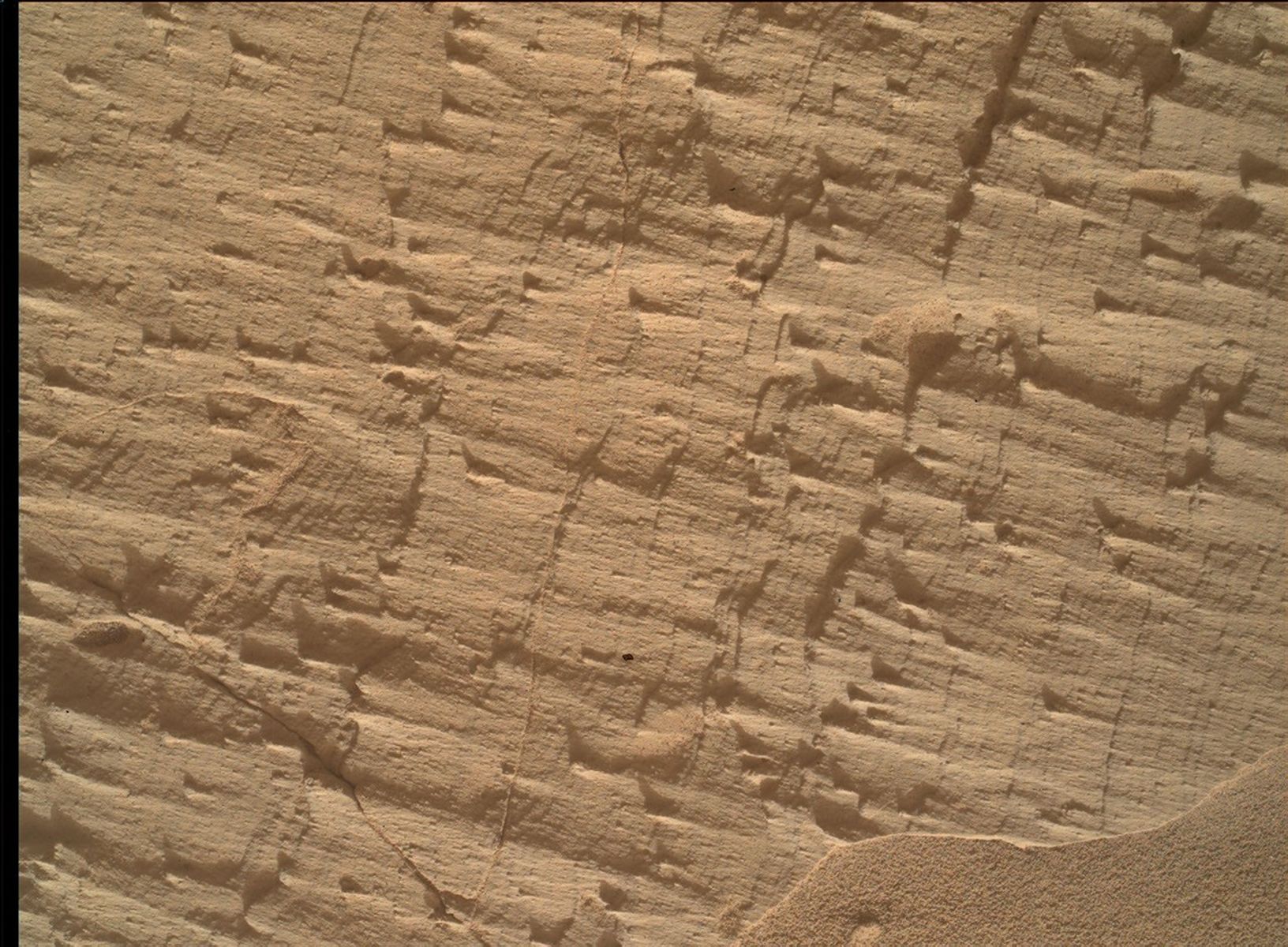
A close-up color photograph taken by the Curiosity rover showing a rough, tan-colored rock surface on Mars. The rock is highly textured, covered in fine parallel layers, small raised ridges, and thin cracks that cast tiny shadows. In the bottom right corner, a small drift of smooth, fine sand rests against the jagged rock.
NASA’s Mars rover Curiosity acquired this image, a frame of the “Longquimay” mosaic showing fine-scale sedimentary textures in a bedrock block near the supersurface, using its Mars Hand Lens Imager (MAHLI), located on the turret at the end of the rover’s robotic arm. Curiosity acquired the image on Aug. 1, 2026 — Sol 4972, or Martian day 4,972 of the Mars Science Laboratory mission — at 23:35:43 UTC.
NASA/JPL-Caltech/MSSS

Written by Lucy Lim, Planetary Scientist at NASA’s Goddard Space Flight Center

Earth planning date: Friday, July 31, 2026

As mentioned in the previous blog, Curiosity has been exploring a large-scale feature in Gale’s sedimentary record suspected to be an “erosional supersurface.” The “supersurface” represents a period in time when a net depositional environment changed to a net erosional one before returning to a depositional regime, thus producing a discontinuity in the rock record. The erosion can involve wind, water, or both. Sometimes there are clues about these environmental changes in the layers below and above the supersurface. So far we’ve been seeing some patterns that look like aeolian features and also some “lens” deposits that sometimes appear consistent with fluvial origins. We need higher-resolution imaging of these features.

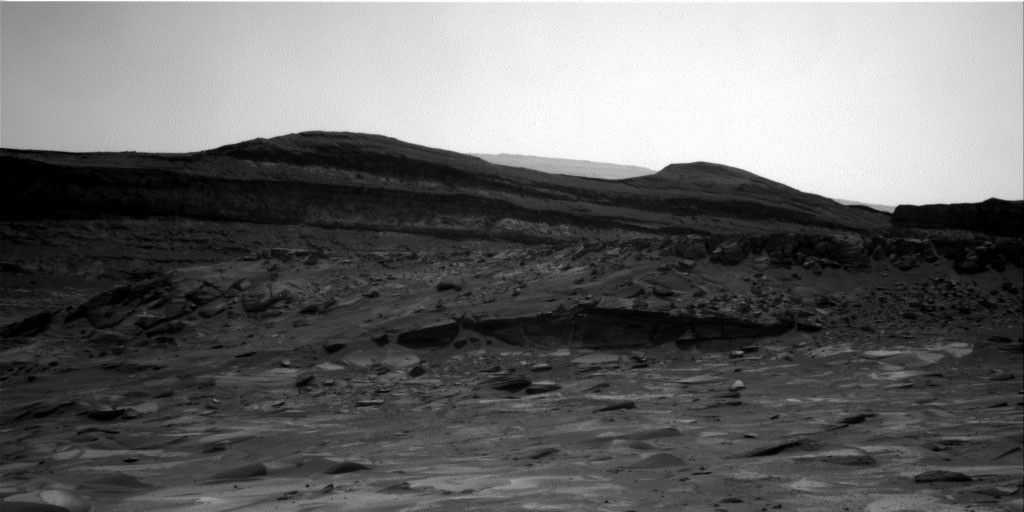
This week Curiosity came within detailed imaging range of a section of the “Cerro Paine Grande” vertical exposure just below the candidate supersurface before climbing on top of it. Mastcam was the star of the show on both planning days this week, capturing large stereo mosaics of the vertical face of the outcrop and a 360-degree panorama after the rover climbed on top of it.

A black-and-white photograph taken by the Curiosity rover on Mars. The rover's mechanical arm extends from the left side of the frame toward the center, revealing a complex cluster of scientific instruments at its end. Below the arm, the Martian terrain consists of large, flat slabs of cracked, textured bedrock. The background is filled with scattered, lighter-colored rocks and patches of dark sand with small wind ripples.
NASA’s Mars rover Curiosity acquired this image, showing the rover arm in action in the “Longquimay” workspace at the top of a steep climb. Curiosity captured the image using its Right Navigation Camera on Aug. 2, 2026 — Sol 4972, or Martian day 4,972 of the Mars Science Laboratory mission — at 00:49:52 UTC.
NASA/JPL-Caltech

Roving to the top took full advantage of Curiosity’s climbing capabilities, leaving the rover at an approximate 24-degree tilt in its final parking spot. The rover planners managed to reach the right posture for contact science at the same time — quite a feat, and one that approached the mission’s contact science tilt record of 27 degrees!

Meanwhile, MAHLI and our geochemical instruments provided detailed characterization of the rock layers beneath the discontinuity. I was the Geology and Mineralogy Theme Lead for the Sol 4968 (Monday) planning cycle, during which “Puyehue” in the light-toned bedrock block of the workspace was co-targeted with APXS, MAHLI, and ChemCam LIBS. The other two targeted LIBS observations in the plan went to a similar-looking nearby bedrock block (“Lago Palena”) and an intriguing layered block off to the side of the workspace (“Piedras Juntas”). Another APXS measurement went to a sand target, “Cormudesi,” which will help us assess the consistency of sand compositions along the rover’s traverse.

In the Sol 4972 workspace atop the slope, the bedrock was sharply divided between a smooth bedding-parallel surface on the local top of the outcrop and the darker-toned, rougher, angled exposure of the same rocks. The light-toned top surface was measured by MAHLI, APXS, and the LIBS at target “Sierra de Sangre,” whereas the darker-toned laminated face was targeted by APXS and MAHLI at “Laguna del Laja.” The fine-scale sedimentary structures in the textured material were also documented by a MAHLI mosaic (“Longquimay”) supported by Mastcam M100 imaging.

Rounding out the week’s science observations were several long-distance ChemCam RMI mosaics on more distant targets such as sedimentary structures above the rover’s current stratigraphic position, and finally our regular cadence measurements of the modern Martian environment, including atmospheric opacity and a ChemCam passive-sky survey to monitor abundances of minor atmospheric gases.

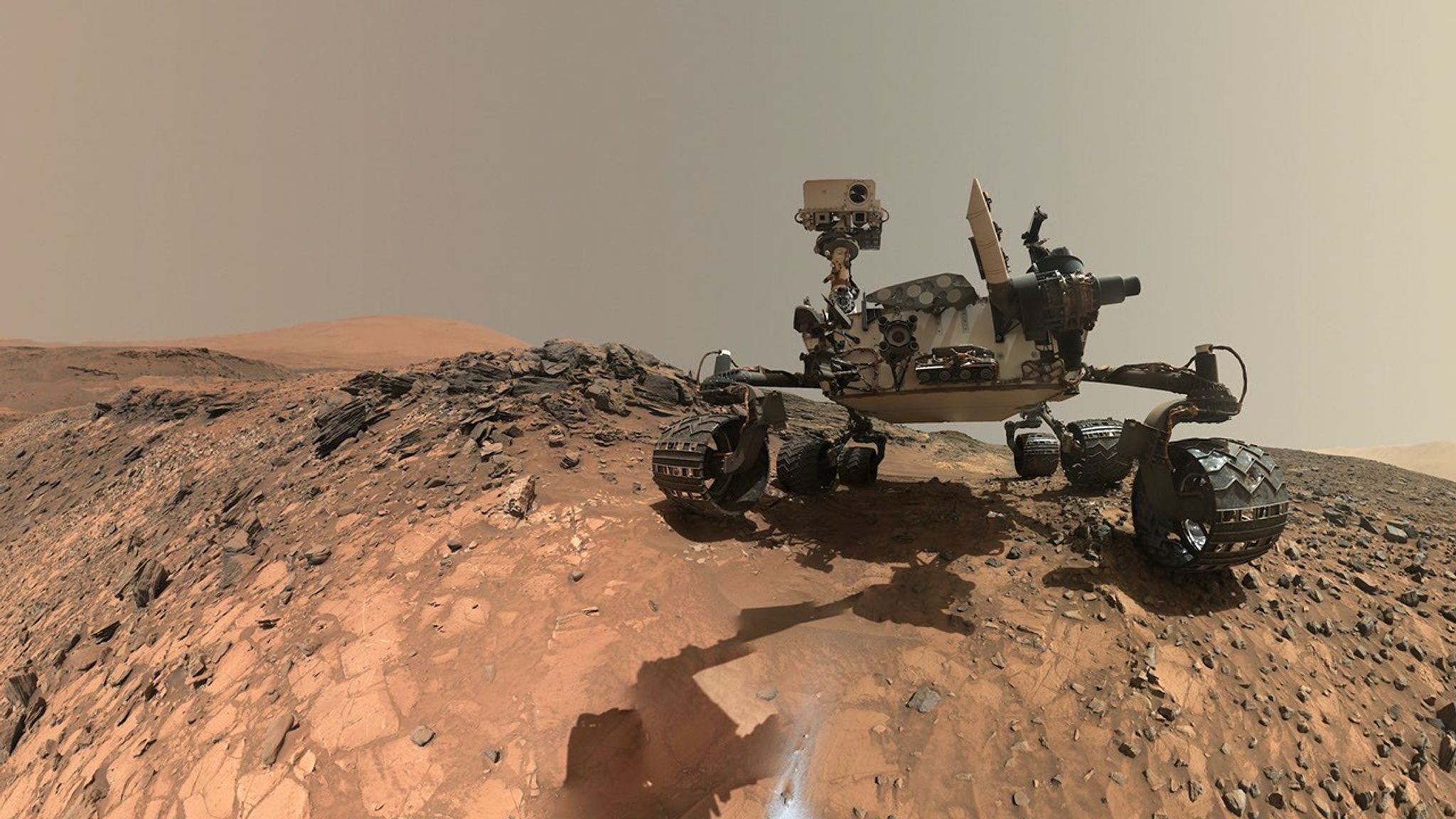
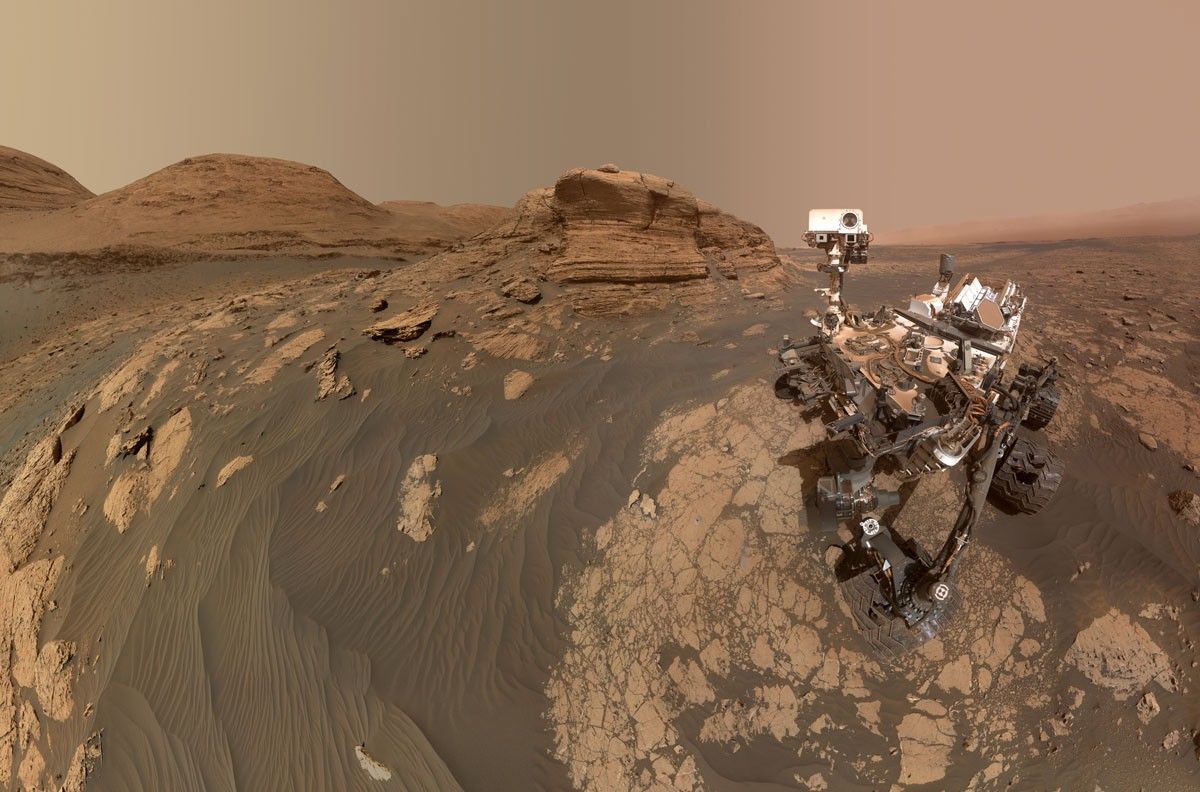
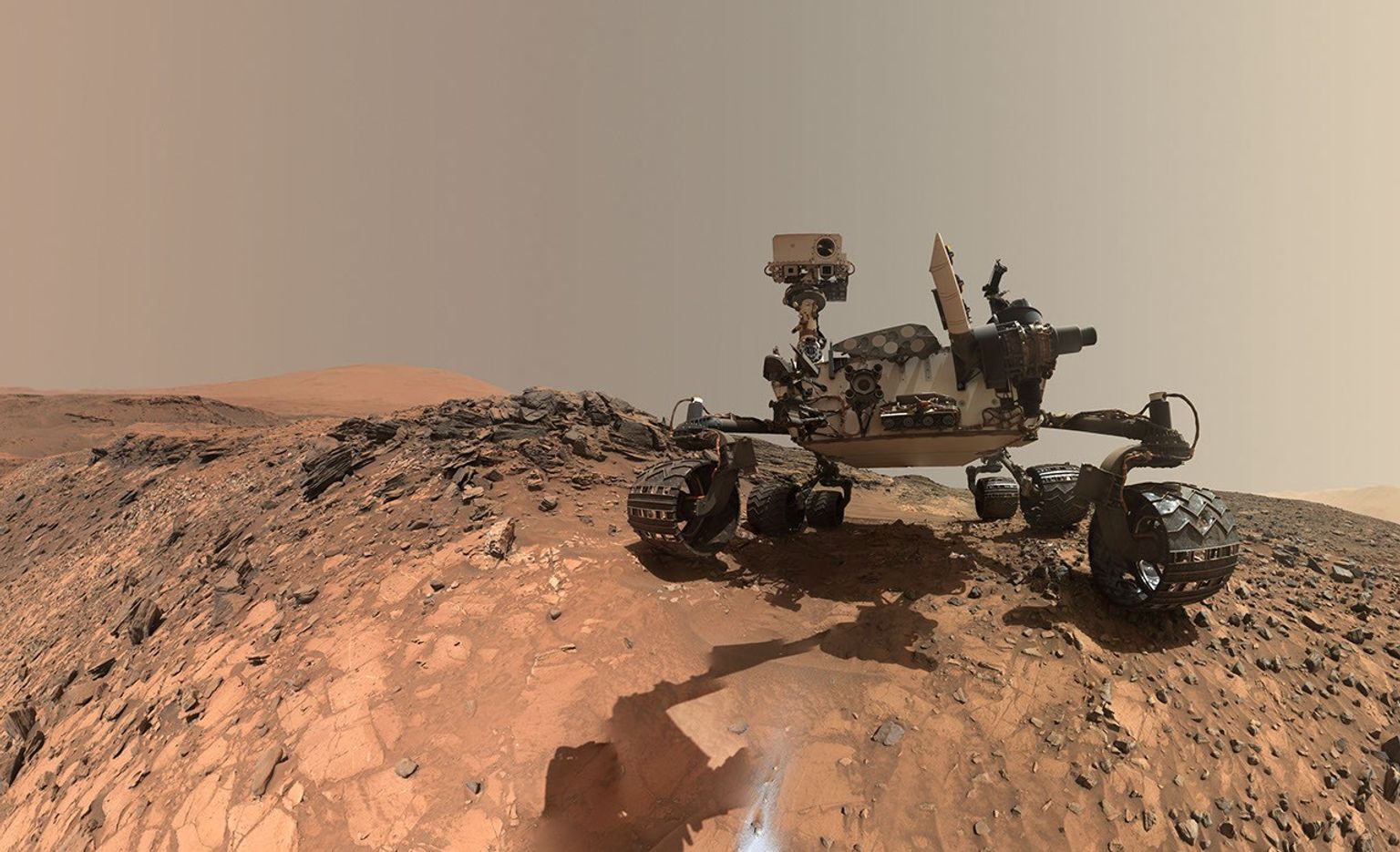
A rover sits on the hilly, orange Martian surface beneath a flat grey sky, surrounded by chunks of rock.
NASA’s Curiosity rover at the base of Mount Sharp
NASA/JPL-Caltech/MSSS

Share

Details

Last Updated
Aug 11, 2026

Related Terms

  •  

APOD: 2026 August 11 – Six Moons of Saturn

APOD

Astronomy Picture of the Day

Discover the cosmos! Each day a different image or photograph of our fascinating universe is featured, along with a brief explanation written by a professional astronomer.

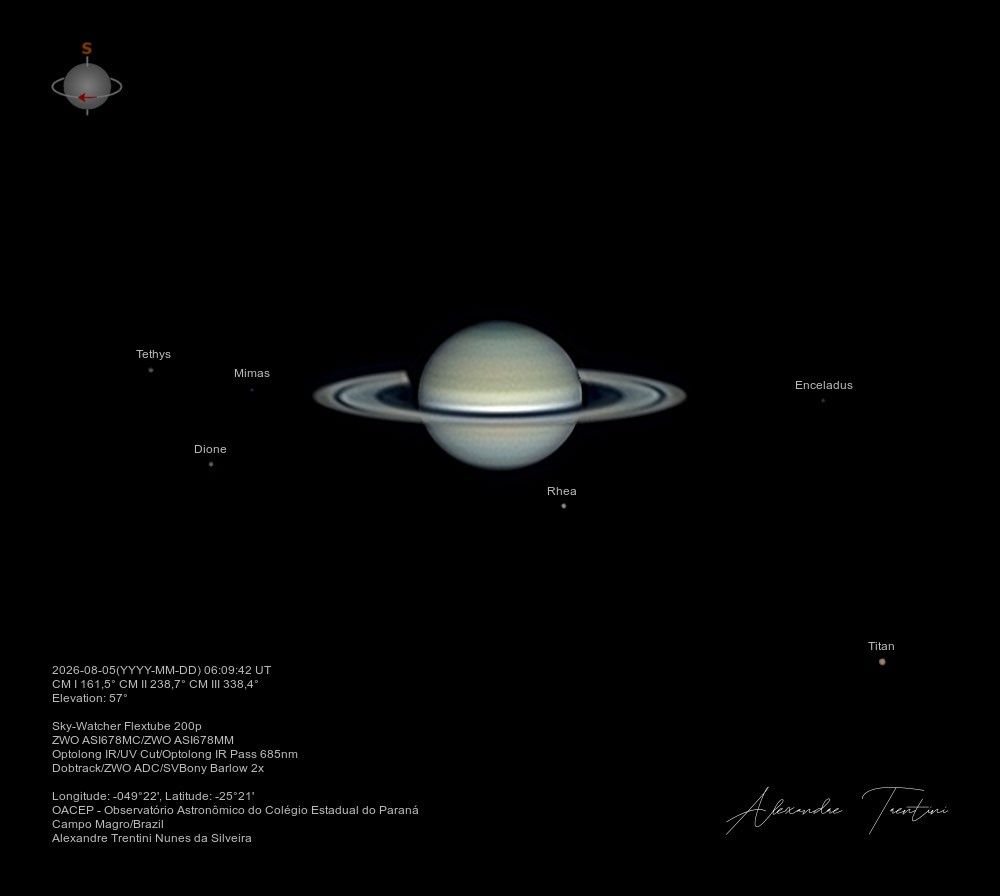
A telescopic image of Saturn with rings and six moons.

Six Moons of Saturn

Explanation: How many moons does Saturn have? While the total will likely continue to grow, as of June 2026 the ringed gas giant had 293 confirmed moons. That’s easily more than any other planet of the Solar System, including ruling gas giant Jupiter with a mere 115 confirmed moons. Most of Saturn’s known moons are small, irregular satellites. Many are only few kilometers to a fraction of a kilometer across and grouped in tilted outer orbits. Six of its largest satellites can be seen here, though, in this sharp telescopic Saturnian family portrait taken on August 5. Larger than Earth’s Moon and even slightly larger than inner planet Mercury, Titan, with a diameter of 5,150 kilometers, is at lower right. You can also spot icy major moons Mimas, Tethys, Enceladus, Dione, and Rhea in the frame. Saturn’s first known natural satellite, Titan was discovered in 1655 by Dutch astronomer Christiaan Huygens. During the space age Voyager and Cassini discoveries have added to the swelling ranks of Saturnian moons.

NASA Stream: August 12 Total Solar Eclipse.
Tomorrow’s picture: pixels in space

Date August 11, 2026
Credit & Copyright: Alexandre Trentini
Authors & editors: Jerry Bonnell, Cecilia Chirenti, Robert Nemiroff, Keighley Rockcliffe
A service of: ASD at NASA / GSFC,
NASA Science Activation & Michigan Tech. U.
  •  

Bountiful Roebuck Bay 

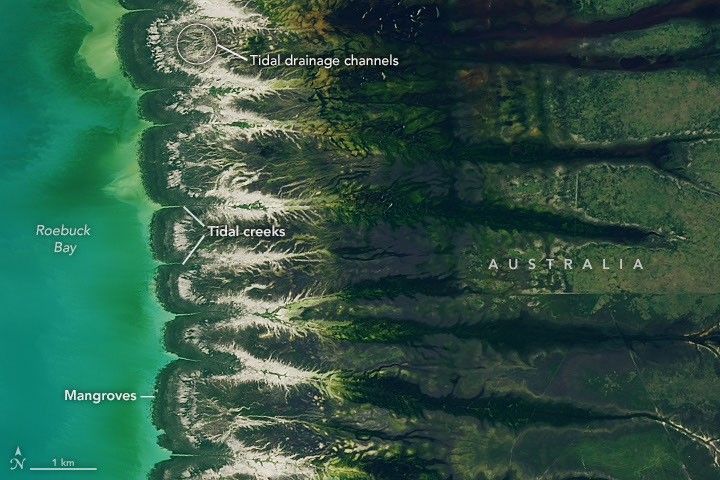
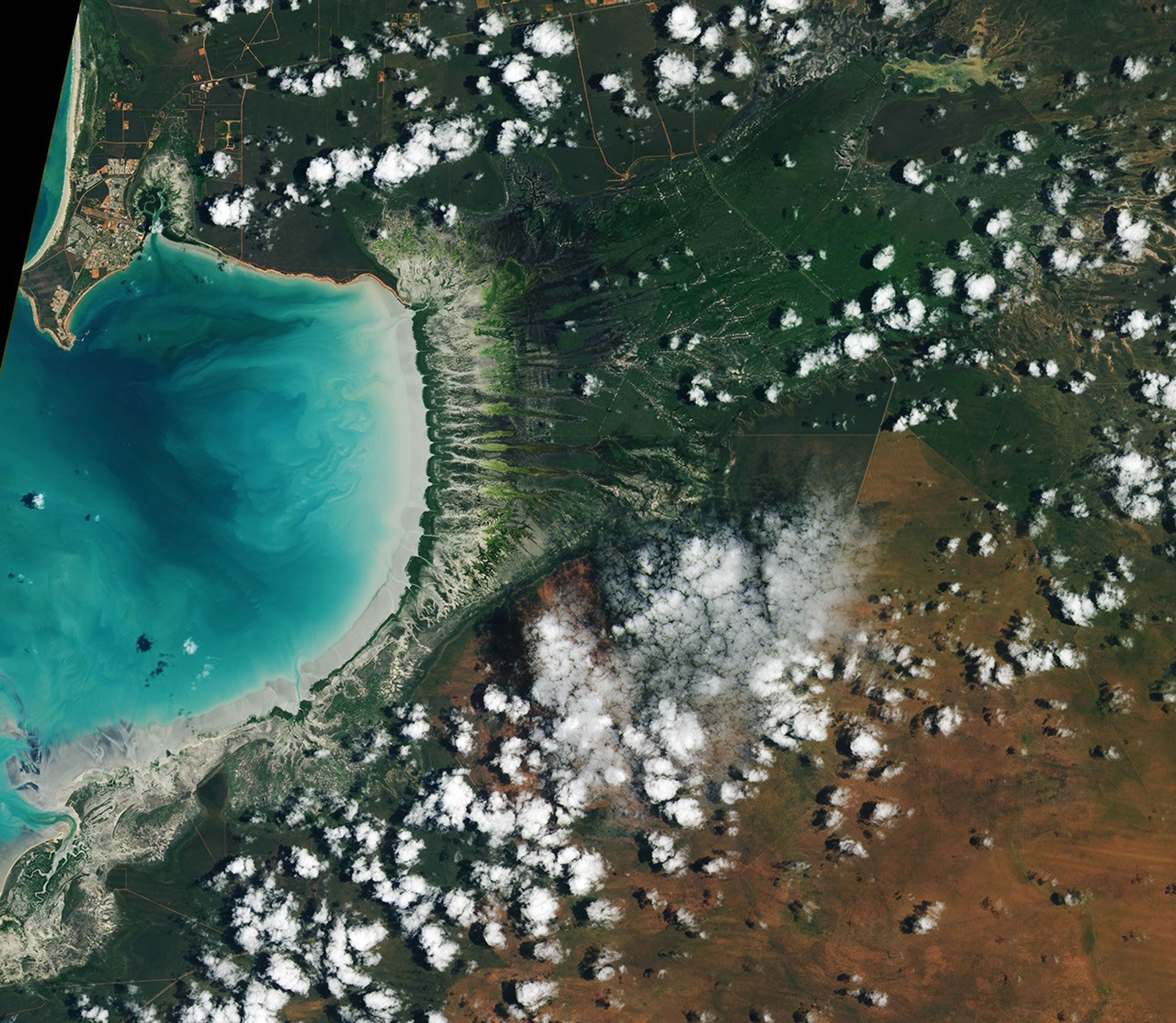
Blue coastal waters border a fringe of dark green mangroves with branching, linear tidal creeks and pale tidal flats and drainage channels visible to the east.
Water covers intertidal mudflats around Roebuck Bay in Western Australia, as seen in this image captured by the OLI (Operational Land Imager) on Landsat 8 on March 18, 2026.
NASA Earth Observatory / Lauren Dauphin

Editor’s Note: Today’s story is the answer to the August Puzzler.

Tides are among the clearest signs of the Moon’s pull on Earth. Just 239,000 miles (385,000 kilometers) away, the Moon’s gravity pulls on Earth’s oceans and solid crust, subtly distorting them into a more oblong shape with bulges roughly extending toward and away from the Moon.

High tides happen throughout Earth’s oceans, but in some places they leave an unusually strong fingerprint on the landscape. Among those places is Roebuck Bay, a crescent-shaped feature in the Kimberley region of Western Australia.

Roebuck Bay’s tidal range can reach a remarkable 9 meters (30 feet). Rising and falling tides repeatedly inundate and expose expansive mudflats, flood broad mangrove forests and salt marshes, and feed branching networks of tidal drainage channels. Many parts of Australia have tidal ranges of 2 meters or less. But the large range at Roebuck Bay is mostly a consequence of northwestern Australia’s unusually wide, shallow continental shelf, which helps amplify tides as they approach the coast.

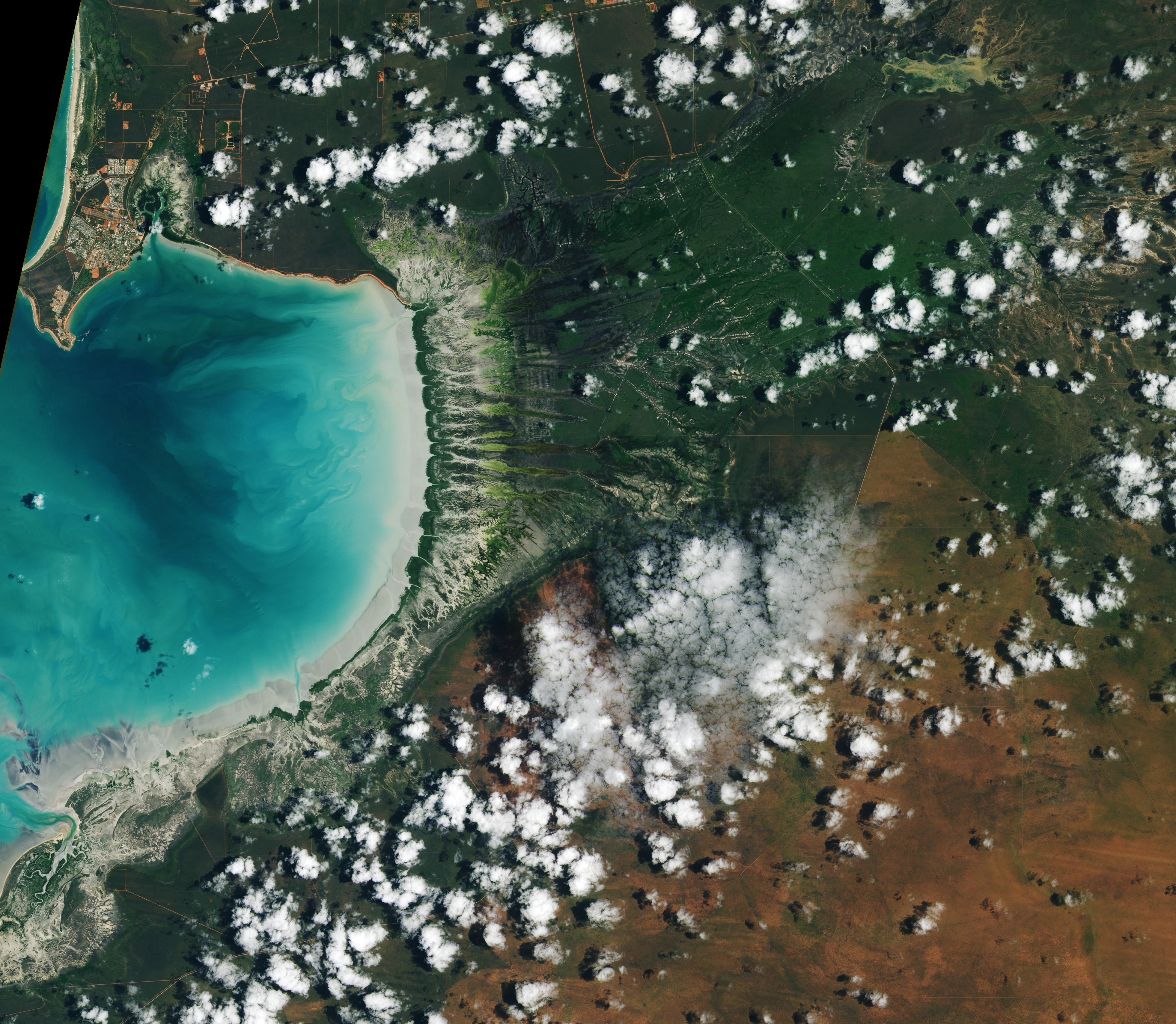
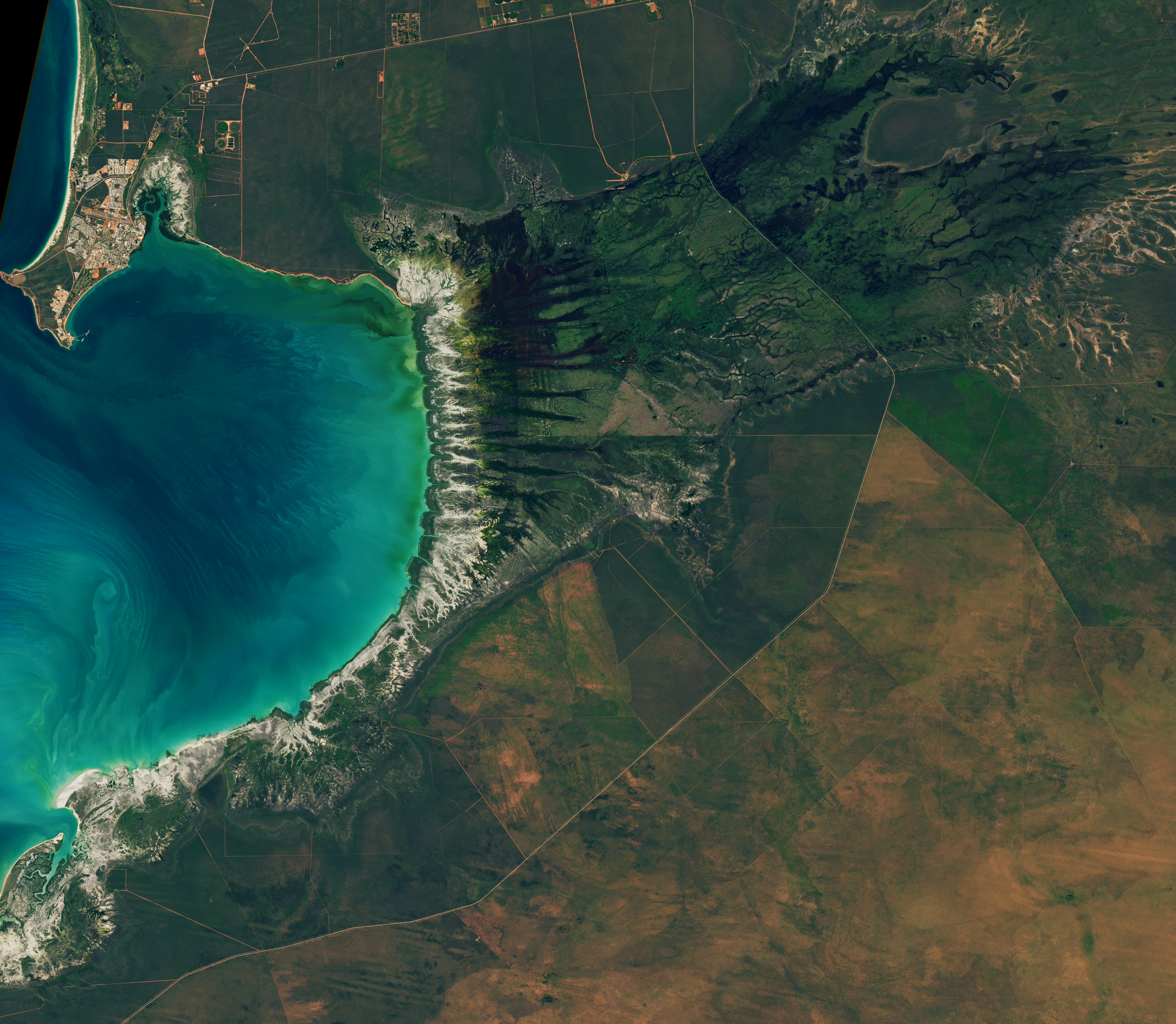
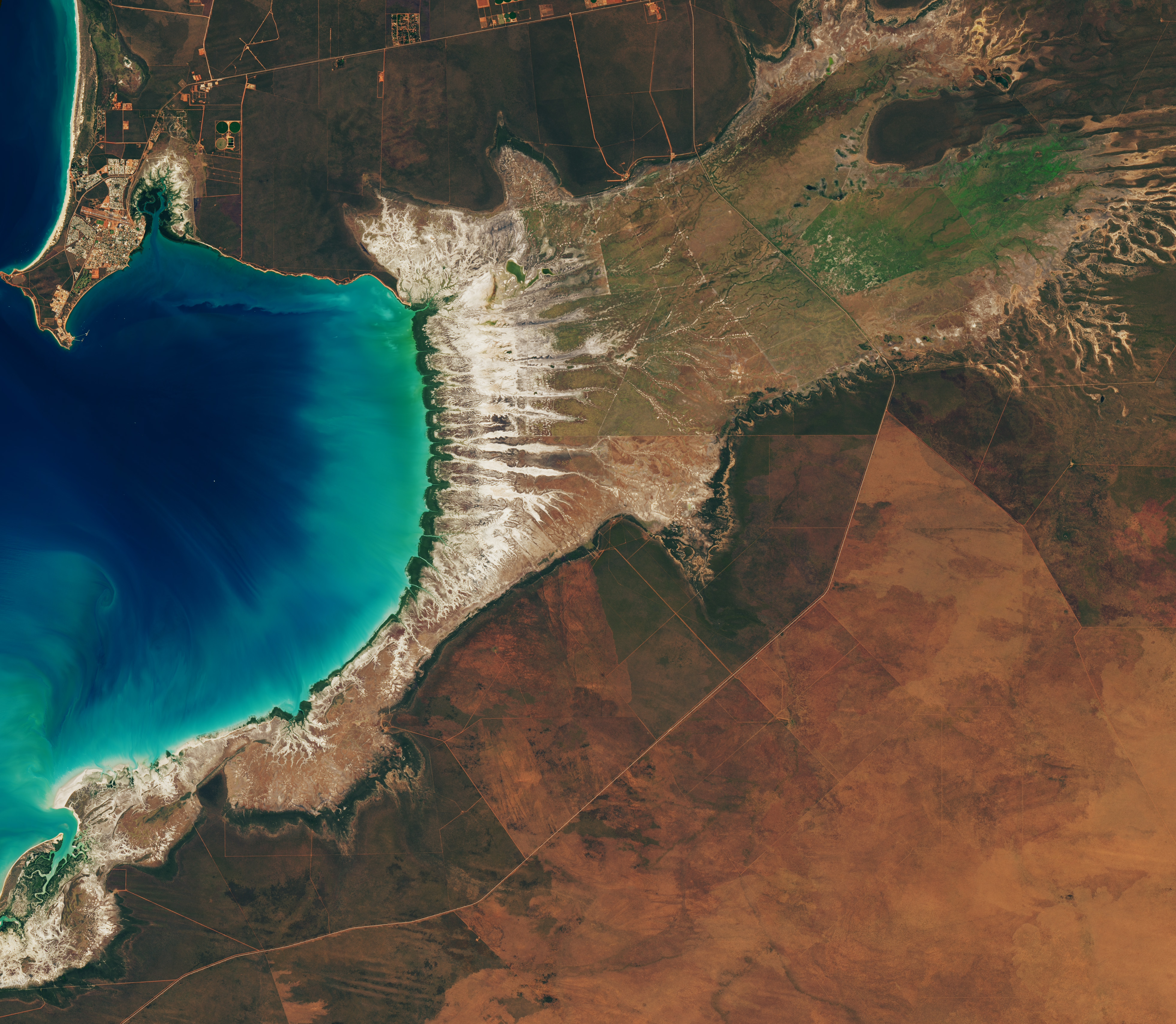
The image at the top of the page shows the bay on March 18, 2026, when water levels were high. Green mangrove forests grow thickly along the shoreline and line the mouths of a network of evenly spaced, linear tidal creeks. These mangrove forests are dynamic. Analysis of decades of Landsat observations shows them expanding westward by nearly 2 meters per year as sediment from the waterways to the east accumulates in the sheltered bay.

Farther inland, branching networks of tidal drainage channels connect with the tidal creeks, giving the bay its feathered appearance. These channels, partially obscured by thick vegetation in March, were more visible earlier and later in the year, when vegetation was thinner.

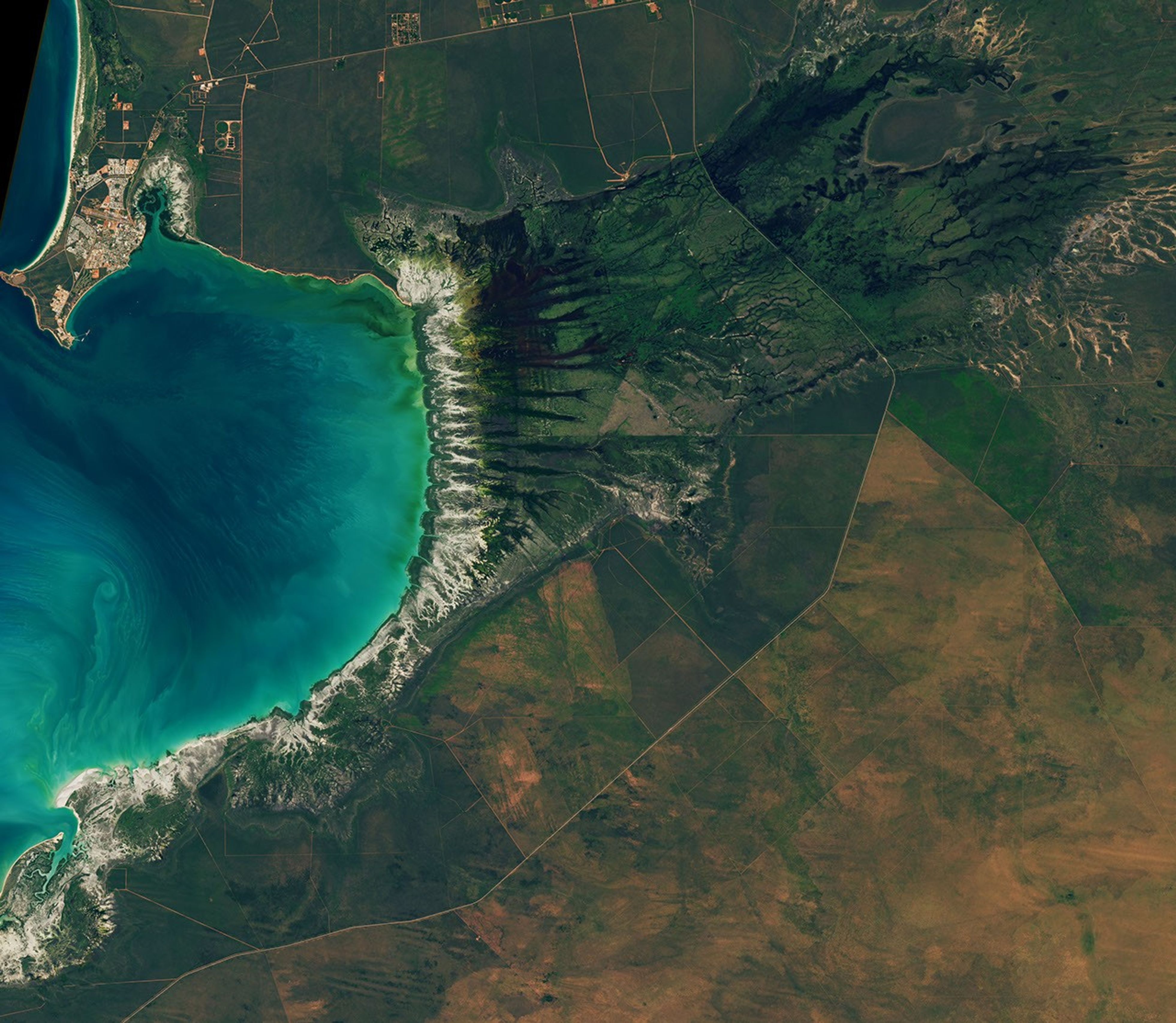
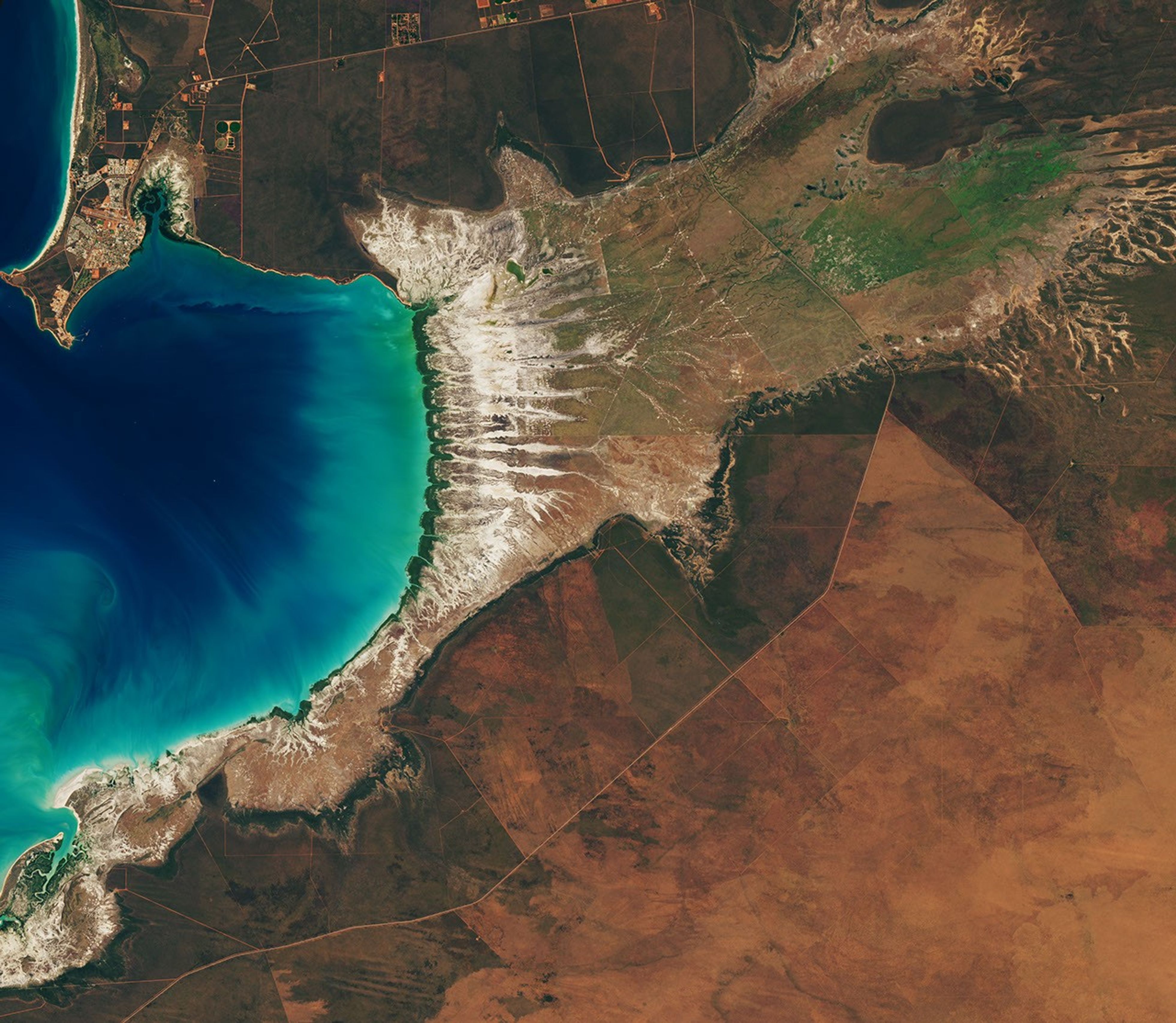
Landsat images from January 29 (left), March 18 (center), and June 30 (right) show seasonal changes. The tide was lower in the January image, exposing tan mudflats along the shoreline.
Around Roebuck Bay, inland vegetation greens after monsoon rains, peaking in March, and turns brown and dry by June. The Landsat 8 and 9 satellites captured these images throughout 2026.
NASA Earth Observatory / Lauren Dauphin

Monsoonal rains, typically falling between December and March, transform the landscape around the bay into lush grasslands and seasonal wetlands. As the rains fade in May and June and the dry season takes hold, these ephemeral grasses and sedge ecosystems die back, turning the landscape shades of gold and brown. The consistent spacing of the tidal creeks is likely not a tidal effect; it appears to be influenced by the regular spacing of linear dunes in the broader region, as seen in the plains to the east.

The bay’s dramatic tidal and seasonal changes are striking from above, and they also support a bounty of life on the ground. The mangroves serve as nurseries for crustaceans and fish, and the mudflats teem with dozens of types of invertebrates, including snails, worms, crabs, clams, and cockles. Shells and snails can reach an abundance of 2,500 per square meter, according to the Australian government.

This bounty of marine life is a major draw for birds. The bay, one of the most important sites for migratory birds in Australia and a key stop on the East Asian-Australasian Flyway, regularly hosts hundreds of thousands of birds, including plovers, godwits, and knots.

NASA Earth Observatory images by Lauren Dauphin, using Landsat data from the U.S. Geological Survey. Story by Adam Voiland.

Downloads

Tidal and seasonal shifts leave their mark on this crescent-shaped, productive bay in Western Australia's Kimberley region.

January 29, 2026

JPEG (3.65 MB)

Tidal and seasonal shifts leave their mark on this crescent-shaped, productive bay in Western Australia's Kimberley region.

March 18, 2026

JPEG (3.41 MB)

Tidal and seasonal shifts leave their mark on this crescent-shaped, productive bay in Western Australia's Kimberley region.

June 20, 2026

JPEG (3.61 MB)

References & Resources

You may also be interested in:

Stay up-to-date with the latest content from NASA as we explore the universe and discover more about our home planet.

Contours of the James Bay Lowlands

3 min read

After the Laurentide Ice Sheet retreated from present-day Hudson Bay, rebounding land has revealed striking nearshore topography.

Article

Why Maine’s Sandy Shorelines Turn Jagged

4 min read

Differences in the underlying bedrock and how rivers distribute sediment make the coastlines west of Portland look unlike those northeast…

Article

San Francisco’s Metropolitan Mosaic

3 min read

Urban development, green spaces, and maritime activity converge in this Northern California city.

Article
  •  

Community College Instructors Bring Astronomy Textbook Into 21st Century

2 min read

Community College Instructors Bring Astronomy Textbook Into 21st Century

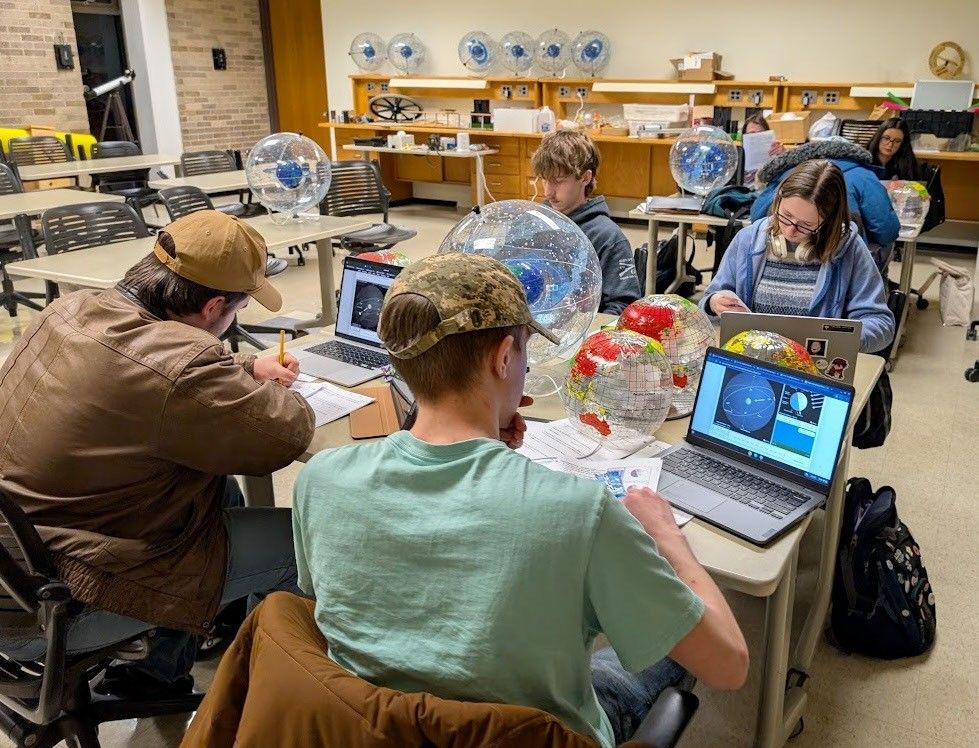
Classroom with seven students sitting at desks. They have their laptops open showing images of the celestial sphere. On the desks between the students are Earth globes and model celestial spheres.
Students studying the celestial sphere at Jackson College, Michigan.
Credit: Steven Tuckey

Teaching the beautiful and inspirational science of astronomy using only the conceptual framework offered by a traditional textbook – without incorporating the wealth of incredible resources, images and activities from NASA – falls short of the more modern, active learning experience that could better serve students evolving learning strategies. Three project teams from the NASA Science Activation (SciAct) program – NASA Community College Network (NCCN, led by the SETI Institute) and five of their expert community college instructors; Infiniscope (led by Arizona State University, ASU); and NASA Treks – set out to address this challenge. 

In June 2026, these teams gathered for a virtual workshop to lay the groundwork for incorporating active learning components drawn from NASA’s extensive education and visualization resource pool and the widely used but traditionally structured OpenStax Astronomy 101 textbook into Relevant Engaging Active Learning (REAL) courseware for introductory Astronomy, while preserving the core content and clear explanatory narrative of the text. 

Over the following two weeks, the instructors each adopted one of the opening five chapters of OpenStax, enhancing the content with active learning modules with an emphasis on materials developed by SciAct project teams, such as NASA Treks, Universe of Learning, and Cosmic Data Stories, to name a few. The results of their efforts were presented in a wrap-up presentation in July and will be field-tested in community college classrooms in Fall 2026.

This workshop served as a proof of concept for exploring whether an existing textbook can be effectively adapted into an active learning tool that will enhance students’ understanding of fundamental astronomical concepts. Next steps will include expanding the program and diving back into OpenStax to systematically reimagine the material into an active learning tool that covers the entire book – and therefore, the entire Universe! Importantly, this effort highlights new and highly impactful possibilities for the dissemination of NASA SciAct resources.

Special thanks to the five community college instructors and their invaluable wisdom, experience, and skills: Carver Bierson (Scottsdale Community College, Scottsdale Arizona), Dan Chase (Modesto Community College, Modesto, California), Dennis Just (Pima Community College, Pima, Arizona), Steve Tuckey (Jackson College, Jackson, Michigan) and Sally Watt (Glendale Community College, Glendale, Arizona).

NCCN, Infiniscope, NASA Treks, and many of the projects that contributed learning materials are supported by NASA cooperative agreement awards and are part of the NASA Science Activation Program portfolio, which connects learners with authentic NASA science experiences through partnerships with educators and community organizations.

Share

Details

Last Updated
Aug 10, 2026
Editor
NASA Science Editorial Team
  •  

NASA+ Debuts on discovery+, Coming Soon to HBO Max

Credit: NASA

As NASA+ continues its expansion across multiple streaming platforms to bring space closer to home, NASA announced Monday programming is next heading to discovery+ and HBO Max. A continuous live feed of NASA+ programming is streaming on discovery+ live channels, while HBO Max will stream NASA’s special events, including the Artemis III mission in 2027.

Viewers on those platforms can stream NASA+ content in Dolby Vision on supported devices, which will bring space exploration to life with vivid colors, sharper contrast, brighter imagery, and richer detail. This enhanced streaming experience will help viewers experience space coverage in a uniquely immersive way.

Future programming may include science mission launches, a test flight for rendezvous and docking with human landing systems, robotic lunar deliveries, the first crewed mission to the Moon under Artemis, and more. As always, NASA+ also remains available for free, with no ads, through the NASA app and on the agency’s website.

“The National Aeronautics and Space Act of 1958 calls on us to share our story of space exploration with the broadest possible audience and we continue to honor that commitment,” said Rebecca Sirmons, general manager of NASA+ at the agency’s Headquarters in Washington. “Artemis II captured the hearts and minds of viewers globally, inspiring the Artemis generation. As we return to the Moon to stay, our goal is to provide transparent, engaging content coverage every step of the way.”

Earlier this year during its Ignition event, NASA shared plans for a bold path forward for the agency, including increasing its cadence of Artemis missions to the lunar surface, and building the first Moon Base, among other agency priorities. These continuous streaming agreements strengthen NASA’s promise to public engagement, making the agency’s mission and educational content available on multiple devices for viewers on their preferred channels

For more about NASA’s missions, visit:

https://www.nasa.gov

-end-

Jennifer Dooren / Lauren Low
Headquarters, Washington
202-358-1600
jennifer.m.dooren@nasa.gov / lauren.e.low@nasa.gov
Share

Details

Last Updated
Aug 10, 2026
  •  

Lion Nebula Roars to Life With NASA’s Webb

 
4 Min Read

Lion Nebula Roars to Life With NASA’s Webb

JWST’s Near Infrared Camera and Mid Infrared Instrument combined image of planetary nebula NGC 2392, the Lion Nebula, against the black background of space. The nebula is at center, circular in shape, and looks like a male lion’s head. In the center is a small, pinkish-white circle with eight-point diffraction spikes, a white dwarf star. Surrounding the star are purple-pink cavernous bubbles and shell-like rings. The bubbles and shells collectively form an oval with two small, wide arcs near the top, reminiscent of a lion’s face and its ears. What appears to be extended outward from the lion’s face is a thick ring of purple-blue material. The width of the ring is consistent throughout and resembles a mane. The area closest to the lion’s face looks cloudy, while the edges of the mane look like there are clumps of dust with comet-like tails. In the background are distant galaxies and stars. Some galaxies are yellow and orange points of light and others have spiral structures. Some stars have diffraction spikes.
NASA’s James Webb Space Telescope imaged the planetary nebula NGC 2392, the Lion Nebula, using the observatory’s NIRCam and MIRI instruments. The central star’s remains are responsible for the nebula’s structure, including a lion face-shaped bubble of ionized gas and dust “mane.”
Credits:
Image: NASA, ESA, CSA, STScI; Image Processing: Alyssa Pagan (STScI)

Observing across the starry “plains” of space, NASA’s James Webb Space Telescope has taken new images of NGC 2392, nicknamed the Lion Nebula. NASA’s Hubble Space Telescope previously viewed this planetary nebula in 2000, imaging the lion face-shaped target in visible light and revealing features such as the “mane” of hazy, comet-shaped objects. Now Webb has captured a clearer, more detailed view of the Lion Nebula due to its high-resolution imaging.

Lion Nebula (NIRCam and MIRI Image)

JWSTu2019s Near Infrared Camera and Mid Infrared Instrument combined image of planetary nebula NGC 2392, the Lion Nebula, against the black background of space. The nebula is at center, circular in shape, and looks like a male lionu2019s head. In the center is a small, pinkish-white circle with eight-point diffraction spikes, a white dwarf star. Surrounding the star are purple-pink cavernous bubbles and shell-like rings. The bubbles and shells collectively form an oval with two small, wide arcs near the top, reminiscent of a lionu2019s face and its ears. What appears to be extended outward from the lionu2019s face is a thick ring of purple-blue material. The width of the ring is consistent throughout and resembles a mane. The area closest to the lionu2019s face looks cloudy, while the edges of the mane look like there are clumps of dust with comet-like tails. In the background are distant galaxies and stars. Some galaxies are yellow and orange points of light and others have spiral structures. Some stars have diffraction spikes.
NASA’s James Webb Space Telescope imaged the planetary nebula NGC 2392, the Lion Nebula, using the observatory’s NIRCam and MIRI instruments. The central star’s remains are responsible for the nebula’s structure, including a lion face-shaped bubble of ionized gas and dust “mane.”
Image: NASA, ESA, CSA, STScI; Image Processing: Alyssa Pagan (STScI)

At first glance the nebula’s overall structure in Webb’s infrared images, with both the NIRCam (Near Infrared Camera) and MIRI (Mid Infrared Instrument) instruments, may look quite similar to Hubble’s earlier visible-light view. However, Webb’s infrared vision highlights features like compact clumps of dust and a haze of ionized gas. It’s taken several thousand years for this collection of gas and dust to reach its current shape, and the nebula’s components continue to be altered.

The source of these constant changes and the reason for the Lion Nebula’s distinct appearance is located at the center: the remains of a dying star. Though it looks like the button nose of the lion, its energy and radiation are powering the intricate structures seen here.

Lion Nebula (MIRI Image)

Planetary nebula NGC 2392, also called the Lion Nebula, against the black background of space. The nebula is in the center, circular in shape, and looks like a male lion’s head. In the very center is a small, bluish-white circle with eight-point diffraction spikes, a white dwarf star. Surrounding the star are light purple-red cavernous bubbles and shell-like rings. The bubbles and shells collectively form an oval with two small, wide arcs near the top, reminiscent of a lion’s face and its ears. What appears to be extended outward from the lion’s face is a thick ring of cyan material. The width of the ring is consistent throughout and resembles a mane. The area closest to the lion’s face looks cloudy, while the edges of the mane look like there are purple clumps of dust with comet-like tails and strands. In the background are distant galaxies and stars. Some galaxies appear as small purple points of light and others with visible blue spiral structures. A couple of the stars have diffraction spikes.
NASA’s James Webb Space Telescope’s mid-infrared image of planetary nebula NGC 2392, nicknamed the Lion Nebula, highlights the varying dust structures. Some dust is being destroyed by the dying central star’s radiation, while some dust filaments manage to survive.
Image: NASA, ESA, CSA, STScI; Image Processing: Alyssa Pagan (STScI)

Massive stars undergo supernova explosions at the end of their lives, but these kinds of events are few and far in between. Most of the universe’s stars have lower masses, like the one belonging to NGC 2392. When a lower-mass star can no longer sustain itself with nuclear reactions in its core, the star becomes unstable and pulsates, losing its mass by shedding its outer layers, which then turn into shells of gas and dust called a planetary nebula. (Stars at this life stage are responsible for producing much of the universe’s observable dust.) The star’s radiation drives the ejected material away, leaving behind the very hot stellar core, also known as a white dwarf.

In the Lion Nebula’s case, the death of the oxygen-rich central star has left behind a white dwarf that is “cooking” everything from the inside and producing a bubble of ionized gas as it does. The gas bubble, which forms the lion’s face, is expanding over time and destroying dust that is in its path. Understanding why the swept-up gas has a complex structure of rings and shells, a common feature in planetary nebulae, is an ongoing endeavor.

The mane of the lion is the interior of a dust shell that is being illuminated by the white dwarf at the center. The tufts of hair, which look like cometary tails of material, are compact clumps of dust that have survived the stellar core’s radiation and protect the material that lies behind them.

Webb’s imagery “freezes” this planetary nebula in time, though the star’s death, and its tumultuous effects, go on. NGC 2392 will continue to undergo changes as its gas and dust migrate away from the stellar core. Astronomers estimate the lion will eventually disperse in approximately 10,000 years — a relatively short period in astronomical terms.

The James Webb Space Telescope is the world’s premier space science observatory. Webb is solving mysteries in our solar system, looking beyond to distant worlds around other stars, and probing the mysterious structures and origins of our universe and our place in it. Webb is an international program led by NASA with its partners, ESA (European Space Agency) and CSA (Canadian Space Agency).

To learn more about Webb, visit:

https://science.nasa.gov/webb

Downloads & Related Information

The following sections contain links to download this article’s images and videos in all available resolutions followed by related information links, media contacts, and if available, research paper and Spanish translation links.

Related Images & Videos

JWSTu2019s Near Infrared Camera and Mid Infrared Instrument combined image of planetary nebula NGC 2392, the Lion Nebula, against the black background of space. The nebula is at center, circular in shape, and looks like a male lionu2019s head. In the center is a small, pinkish-white circle with eight-point diffraction spikes, a white dwarf star. Surrounding the star are purple-pink cavernous bubbles and shell-like rings. The bubbles and shells collectively form an oval with two small, wide arcs near the top, reminiscent of a lionu2019s face and its ears. What appears to be extended outward from the lionu2019s face is a thick ring of purple-blue material. The width of the ring is consistent throughout and resembles a mane. The area closest to the lionu2019s face looks cloudy, while the edges of the mane look like there are clumps of dust with comet-like tails. In the background are distant galaxies and stars. Some galaxies are yellow and orange points of light and others have spiral structures. Some stars have diffraction spikes.

Lion Nebula (NIRCam and MIRI Image)

NASA’s James Webb Space Telescope imaged the planetary nebula NGC 2392, the Lion Nebula, using the observatory’s NIRCam and MIRI instruments. The central star’s remains are responsible for the nebula’s structure, including a lion face-shaped bubble of ionized gas and dust “mane.”

Planetary nebula NGC 2392, also called the Lion Nebula, against the black background of space. The nebula is in the center, circular in shape, and looks like a male lionu2019s head. In the very center is a small, bluish-white circle with eight-point diffraction spikes, a white dwarf star. Surrounding the star are light purple-red cavernous bubbles and shell-like rings. The bubbles and shells collectively form an oval with two small, wide arcs near the top, reminiscent of a lionu2019s face and its ears. What appears to be extended outward from the lionu2019s face is a thick ring of cyan material. The width of the ring is consistent throughout and resembles a mane. The area closest to the lionu2019s face looks cloudy, while the edges of the mane look like there are purple clumps of dust with comet-like tails and strands. In the background are distant galaxies and stars. Some galaxies appear as small purple points of light and others with visible blue spiral structures. A couple of the stars have diffraction spikes.

Lion Nebula (MIRI Image)

NASA’s James Webb Space Telescope’s mid-infrared image of planetary nebula NGC 2392, nicknamed the Lion Nebula, highlights the varying dust structures. Some dust is being destroyed by the dying central star’s radiation, while some dust filaments manage to survive.

Related Links

Explore more: Sonification of NGC 2392

View more: Hubble Image of NGC 2392

View more: Chandra X-ray Observatory Image of NGC 2392

More Webb: News | Images | Science | Home Page


Share

Details

Last Updated
Aug 10, 2026

Contact
Media

Laura Betz
NASA’s Goddard Space Flight Center
Greenbelt, Maryland
laura.e.betz@nasa.gov
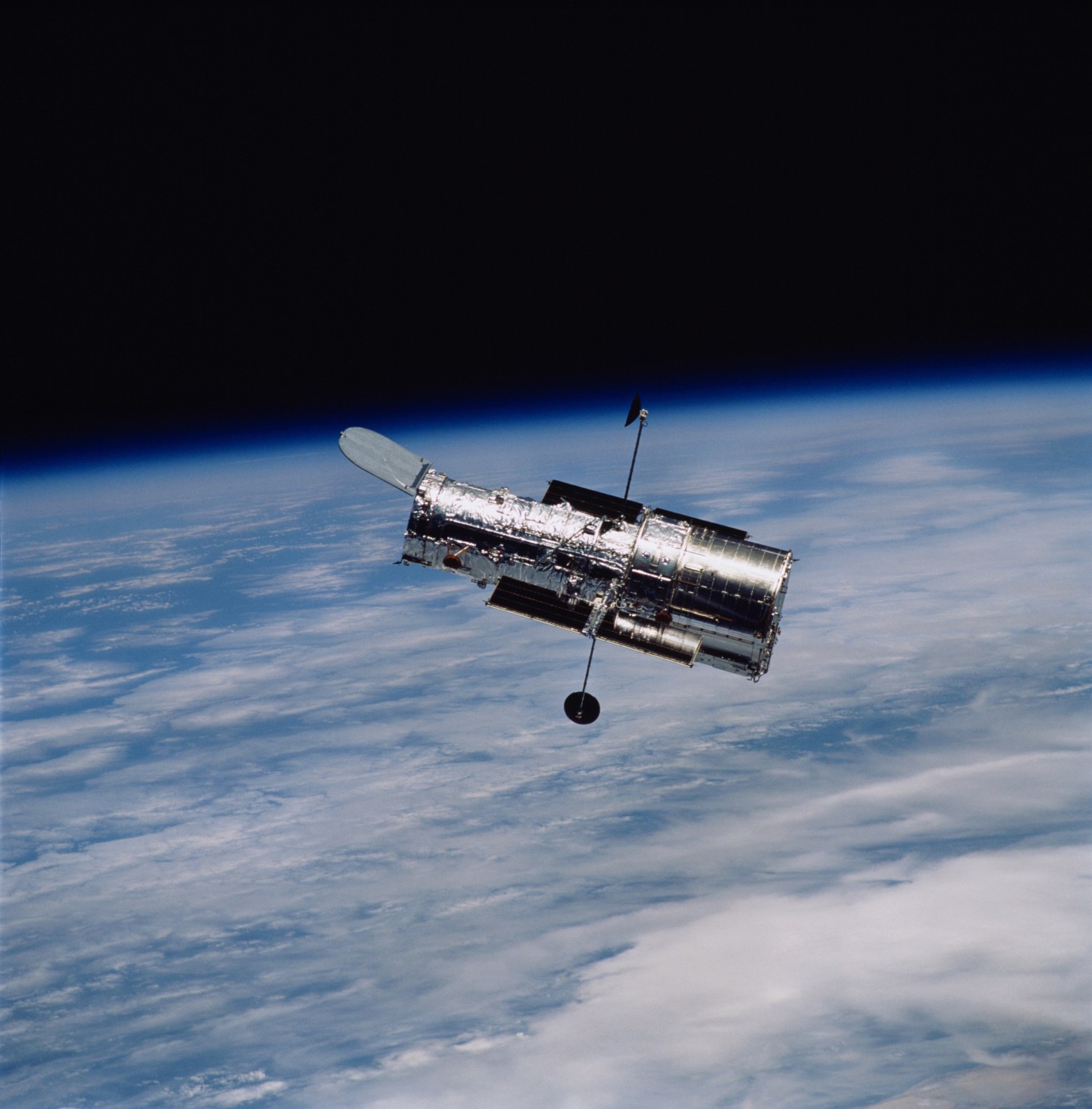
Abigail Major
Space Telescope Science Institute
Baltimore, Maryland

Christine Pulliam
Space Telescope Science Institute
Baltimore, Maryland

  •  

Launch Into a New School Year With NASA

4 Min Read

Launch Into a New School Year With NASA

An illustration of two astronauts inside a spacecraft, looking at a screen that says "Back to School with NASA"

A new school year brings fresh opportunities to get involved with NASA. Whether you’re curious about space or eager to build real STEM skills, NASA offers a world of experiences putting you close to the action. As we enter a new golden age of exploration, there’s no better time to jump in, try something bold, and see where your curiosity takes you.

Gain Hands-On NASA Experience

NASA opens the door to authentic mission experiences through internships and student challenges. As members of the NASA team, interns work on genuine agency projects and gain industry-ready skills, all with the guidance of NASA mentors. Visit NASA’s internships website to learn more about current vacancies, deadlines, eligibility requirements, and more.

Through NASA’s student challenges and competitions, student teams tackle some of the critical technical hurdles facing mission planners. Flex your innovative muscles and sharpen your collaborative and problem-solving skills while developing, prototyping, and testing your team’s designs. Check out the full list of NASA STEM challenges and opportunities, choose one that fits your interests, and assemble your team.

More than 500 students with 75 teams from around the world participated in the 31st year of NASA’s Human Exploration Rover Challenge (HERC) on April 11 and April 12, 2025, near NASA’s Marshall Space Flight Center in Huntsville, Alabama. Participating teams represented 35 colleges and universities, 38 high schools, and two middle schools from 20 states, Puerto Rico, and 16 other nations. NASA expanded the 2025 challenge to include a remote-control division - named Remote-Operated Vehicular Research - and invited middle school students to participate. Teams were awarded points based on navigating a half-mile obstacle course, conducting mission-specific task challenges, and completing multiple safety and design reviews with NASA engineers.
Students cross the finish line in their human-powered rover during the 2025 Human Exploration Rover Challenge at NASA’s Marshall Space Flight Center in Huntsville, Alabama
USSRC/Emily Riddle

Discover Technical Careers at NASA

The future of aerospace depends on a steady pipeline of skilled technical experts ready to make missions and ideas a reality. NASA invites students in high school, community college, and career technical education programs to join in-person and virtual events to explore these important career paths.
 
NASA Career Technical Education Days bring students on-site to meet NASA skilled technical workers who share what their jobs are like, how they built their careers, and the skills, training, and certifications that have helped them succeed. During NASA’s Next Gen STEM Virtual Career Connections , students interact live with technical experts supporting the agency’s missions. Students and teachers can learn more on the Next Gen STEM for Careers website.

A technician performs welding on a spacecraft transporter at NASA’s Kennedy Space Center in Florida.
NASA/Ben Smegelsky

Contribute to NASA Science as a Citizen Scientist

NASA’s Science Mission Directorate invites you to help make real discoveries through science projects powered by volunteers. Join from anywhere, whenever it fits your schedule, and start working with authentic mission data. Help identify comets and asteroids, hunt for binary star systems, and more. Find the project that’s right for you on the list of current citizen science projects.

Keep Up With NASA Missions and Discoveries

Don’t miss out on NASA’s biggest mission milestones this school year! Up first is the Nancy Grace Roman Space Telescope, scheduled to launch no earlier than 7:20 a.m. EDT on Sunday, Aug. 30. This powerful new observatory has a field of view at least 100 times larger than the Hubble Space Telescope. Be a virtual guest for launch and learn more about the telescope with fun activities provided by NASA’s Science Mission Directorate. You can also sign up to be a virtual guest for NASA’s next crewed launch to the International Space Station, SpaceX Crew-13, set to launch in September.

And be sure to follow NASA’s continuing crew training and hardware preparations for Artemis III. Set to launch into Earth orbit in 2027, the flight will test rendezvous and docking capabilities with commercial human landing systems – landers that will carry astronauts to the lunar surface on Artemis IV and future missions to the Moon.

NASA astronauts Jack Hathaway and Jessica Meir, both Expedition 74 flight engineers, answer questions inside the International Space Station’s Kibo laboratory module during a live downlink event with Connecticut Public Radio. Hathaway is a native of South Windsor, Connecticut, while Meir is from Caribou, Maine.
NASA astronauts Jack Hathaway and Jessica Meir answer questions inside the International Space Station’s Kibo laboratory module during a live downlink event in May 2026.
NASA

Stay Engaged With NASA

Schools, classrooms, and community-based student groups have further options to engage with NASA and its people. Through In-Flight STEM Downlinks, students have their pre-recorded questions answered live by astronauts aboard the International Space Station, demonstrating how STEM careers reach far beyond Earth. Additionally, the NASA Engages public outreach program connects agency experts with student audiences to share mission and science updates, helping people discover how NASA’s work unfolds and how they can be part of the journey.

This school year, whether you’re interested in aerospace jobs or eager to dive into authentic STEM challenges, you’ll find an array of activities and career exploration tools on NASA’s Learning Resources website. Explore exciting NASA student opportunities and subscribe to the weekly NASA EXPRESS email newsletter for the latest NASA STEM opportunities and updates!

  •  

APOD: 2026 August 10 – Three Galaxy Pairs

APOD

APOD: 2026 August 10 – Three Galaxy Pairs

Discover the cosmos! Each day a different image or photograph of our fascinating universe is featured, along with a brief explanation written by a professional astronomer.

Three galaxy pairs are arranged vertically in the same field of view..Three galaxy pairs are arranged vertically in the same field of view..

Three Galaxy Pairs

Explanation: Each of these pairs of galaxies is different. The two galaxies at the top are likely not interacting, at least presently. However, the top galaxy with the blue stripe, NGC 4650A, is a polar ring galaxy and may be the result of a past galaxy collision. The two galaxies in the middle of the featured image appear like they could be interacting gravitationally — but their relative speeds make this unlikely. Of these two, the larger galaxy, NGC 4650, is a spiral galaxy with a bright bar of stars across its center. The two galaxies at the bottom are actively interacting. Possibly in a billion years or so, NGC 4622A and NGC 4622B will merge and become one single galaxy. All of these galaxies are likely members of the larger Centaurus Galaxy Cluster.

Tomorrow’s picture: many moons

Date: August 10, 2026
Credit & Copyright: Rafael Sampaio
Authors & editors: Robert Nemiroff, Jerry Bonnell, Cecilia Chirenti, Keighley Rockcliffe
A service of: ASD at NASA / GSFC,
NASA Science Activation & Michigan Tech. U.
  •  

El Niño Alters Marine Life in the Pacific


june 2025
june 2026

A global map centered on the Pacific Ocean shows a band of green across the equatorial region, indicating the presence of chlorophyll in surface waters.
NASA Earth Observatory/Michala Garrison

A global map centered on the Pacific Ocean shows a narrow band of green in the eastern equatorial region, indicating the presence of chlorophyll in surface waters. The central equatorial Pacific appears blue, meaning chlorophyll concentrations are low.
NASA Earth Observatory/Michala Garrison

A global map centered on the Pacific Ocean shows a band of green across the equatorial region, indicating the presence of chlorophyll in surface waters.
NASA Earth Observatory/Michala Garrison
A global map centered on the Pacific Ocean shows a narrow band of green in the eastern equatorial region, indicating the presence of chlorophyll in surface waters. The central equatorial Pacific appears blue, meaning chlorophyll concentrations are low.
NASA Earth Observatory/Michala Garrison

june 2025

june 2026


Concentrations of chlorophyll in the equatorial Pacific deviate from normal during El Niño events. These maps depict monthly average chlorophyll concentrations for June 2025 (left), under neutral conditions, and June 2026 (right), as El Niño was strengthening. Data come from the OCI (Ocean Color Instrument) on NASA’s PACE (Plankton, Aerosol, Cloud, ocean Ecosystem) satellite and are based on measurements of green and blue light from the ocean reflected back to the sensor. NASA Earth Observatory images by Michala Garrison.

As of June 2026, El Niño has officially arrived. This naturally recurring phenomenon is characterized by warmer-than-normal water temperatures in parts of the equatorial Pacific along with changes to atmospheric and oceanic circulation patterns. Its regional effects range from desert floods to delayed monsoons to shifts in where tropical cyclones are more likely to form.

NOAA’s Climate Prediction Center expects the current El Niño to continue to strengthen through the end of 2026, with a 97 percent chance of lasting through early Northern Hemisphere spring 2027. Even during El Niño’s early stages, satellites have observed characteristic changes along the equatorial Pacific, such as warmer-than-normal sea surface temperatures and higher-than-normal sea surface height.

Among the first ecological downstream effects are changes to the marine food web. The maps above show chlorophyll-a concentrations—the pigment present in most phytoplankton—as observed by the OCI (Ocean Color Instrument) on NASA’s PACE (Plankton, Aerosol, Cloud, ocean Ecosystem) satellite. In June 2025 (left), conditions were neutral, while in June 2026 (right), El Niño was strengthening.

The most noticeable difference appears in the central Pacific, around the equator due north of New Zealand: chlorophyll concentrations, an indication of phytoplankton abundance, are substantially lower in 2026. This change is expected, said Matthew Kehrli and Graham Trolley, oceanographers in the Ocean Ecology Laboratory at NASA’s Goddard Space Flight Center. That’s because during an El Niño, easterly equatorial trade winds weaken, the warm surface layer of the ocean extends deeper, and the upwelling of cool, nutrient-rich water that typically fuels phytoplankton growth is suppressed.  

As the El Niño progresses, the scientists anticipate the differences in the central Pacific will become more pronounced. “This may manifest as a greater difference in values across the current region, as a broadening region of reduced surface chlorophyll-a concentration, or both, depending on the behavior of the equatorial trade winds,” they said.

Reductions in phytoplankton have ripple effects through the marine food web, including in coastal regions. Less food is available for zooplankton, as well as for fish, seabirds, and marine mammals. Peru’s anchovy fisheries have seen profound declines in catch during past El Niños, driven similarly by warmer surface waters, reduced upwelling, and lower phytoplankton abundance. In 2026, Peru’s Ministry of Production repeatedly suspended the fishery to safeguard the country’s main fishing resource. Pelicans have been seen venturing into Peruvian ports and urban areas in search of food.

Although the disruptions to marine life can be severe, a post-El Niño “chlorophyll rebound,” with higher-than-normal concentrations in the equatorial Pacific, can occur. Research suggests that higher iron concentrations delivered in ocean currents, as well as dust arriving from drier land in parts of Central and South America, help fuel the resurgence—a rebound that doesn’t require a follow-on La Niña. La Niña, which often follows El Niño events, can also produce elevated chlorophyll concentrations. A strong La Niña in 1998–1999 set off a large phytoplankton bloom in the eastern Pacific and a dramatic increase in fish populations.

Scientists have new tools available for studying this sort of variability. The PACE mission launched in February 2024, making this the first complete El Niño event for which the satellite will gather global, near-daily hyperspectral measurements. “The scientific community will be able to observe the 2026 El Niño with data across more wavelengths of light than ever before,” Kehrli and Trolley said.

To better understand effects on life in the ocean, researchers hope to use PACE data to gauge the responses of specific phytoplankton communities to El Niño. And the possibilities extend beyond the marine realm, the scientists note. PACE’s sensors can measure plant pigment composition on land and clouds and aerosols in the atmosphere, all of which are influenced by El Niño.

NASA Earth Observatory images by Michala Garrison, using PACE data from the NASA Ocean Biology Distributed Active Archive Center OB.DAAC and processed by Matthew Kehrli. Story by Lindsey Doermann.

Downloads

A global map centered on the Pacific Ocean shows a band of green across the equatorial region, indicating the presence of chlorophyll in surface waters.

June 2025

JPEG (1.40 MB)

A global map centered on the Pacific Ocean shows a narrow band of green in the eastern equatorial region, indicating the presence of chlorophyll in surface waters. The central equatorial Pacific appears blue, meaning chlorophyll concentrations are low.

June 2026

JPEG (1.37 MB)

A global map centered on the Pacific Ocean shows a narrow band of green in the eastern equatorial region, indicating the presence of chlorophyll in surface waters. The central equatorial Pacific appears blue, meaning chlorophyll concentrations are low.

June 2025 + June 2026

JPEG (2.85 MB)

References & Resources

You may also be interested in:

Stay up-to-date with the latest content from NASA as we explore the universe and discover more about our home planet.

El Niño Is Underway

4 min read

Satellite observations of sea surface height indicated that the 2026 event continued to strengthen in early June.

Article

Color Off the Mid-Atlantic Coast

4 min read

Something is brewing in shallow waters offshore of Delaware, New Jersey, Maryland, and Virginia.

Article

Sizing Up the Sargassum Belt

6 min read

Seaweed composing the Great Atlantic Sargassum Belt hit near-record levels in June 2026, with the Caribbean Sea and Gulf of…

Article
  •  

APOD: 2026 August 9 – Contemplating the Sun

APOD

Astronomy Picture of the Day

Discover the cosmos! Each day a different image or photograph of our fascinating universe is featured, along with a brief explanation written by a professional astronomer.

Contemplating the Sun

Explanation: Have you contemplated your home star recently? Featured here, a Sun partially eclipsed on the top left by the Moon is also seen eclipsed by earthlings contemplating the eclipse below. This spectacular menagerie of silhouettes was taken in 2012 from the Glen Canyon National Recreation Area near Page, Arizona, USA, where park rangers and astronomers expounded on the unusual event to interested gatherers. Also, faintly visible on the Sun’s disk, just to the lower right of the dark Moon’s disk, is a group of sunspots. A new solar eclipse will occur this week and give many people in northeastern North America, Europe, and northwestern Africa a new chance to contemplate a partially eclipsed Sun. A thin swath of Earth from Greenland to Portugal will further experience a total solar eclipse. An open question is whether any meteors from the peaking Perseids will be visible during totality.

Date August 9, 2026
Credit & Copyright Steven Gilbert
Authors & editors: Robert Nemiroff, Jerry Bonnell, Cecilia Chirenti, Keighley Rockcliffe
A service of: ASD at NASA / GSFC,
NASA Science Activation & Michigan Tech. U.
  •  
❌