Login
RNA droplets may have helped start life on Earth. A new study explains why they form
11 September 2026 at 08:30
A tiny chemical difference helps make RNA better than DNA at condensing into liquid-like droplets under high temperatures


Indian scientists searching for clues to the oldest signs of life on Earth have discovered evidence of organic matter in a 3.5-billion-year-old sample of Paleoarchean volcanic–hydrothermal chert.
If confirmed, the team said the ancient chert would represent one of the oldest signs of life emerging on Earth, less than a billion years after the planet’s formation.
According to a press release announcing the discovery, some of the earliest known traces of life on Earth have typically been preserved as carbonaceous matter. Although many have been discovered in marine and hydrothermal vents, others have been unearthed in black cherts and volcanic-sedimentary rock formations.
“Kerogen, insoluble organic matter preserved in sediments, represents some of the earliest known terrestrial biosignatures which have provided important insights into the origin of life and planetary habitability,” the researchers write.
However, they also note, directly dating these ancient materials is often complicated by a lack of “suitable geochronometers.” Instead, dating ancient cherts and other early traces of life on Earth has relied on indirect constraints from surrounding materials. These include dating the ages of cross-cutting lithologies.
To date, the newly discovered 3.5-billion-year-old chert, T. Mark Harrison, Trisrota Chaudhuri, and colleagues examined samples of “banded” cherts collected from the Singhbhum Craton in eastern India. Under microscopic analysis, the team found that the cherts contained “submillimeter-scale layers” alternating between carbonaceous matter and quartz-rich sedimentary material.
“The chert exhibits micron-scale alternating layers of carbonaceous and siliceous materials,” the study authors explained.

To date the material, the team analyzed a specific combination of zircon grain characteristics. This analysis indicated that the grains were “emplaced” as part of a ‘tuff.’ The team said a tuff is a volcanic ashfall “that settled on the sediments at the time of their deposition.”
Next, they tested the lead isotopes found within the zircon crystals. The team said this analysis of the material in the banded cherts suggested the organic cherts formed about 3.497 billion years ago. This date places them in the Paleoarchean Eon.
“Here, we report a 3.5-billion-year-old carbonaceous chert from eastern India containing what are interpreted to be contemporaneous tuffaceous zircons,” they write.
The team said the carbon isotope analysis yielded a value “consistent with a biological origin of relatively sophisticated metabolism.”
“Isotope data of carbonaceous matter (CM) together with stratigraphic relationships indicate a biogenic origin of the kerogen, marking this, to our knowledge, as the oldest directly dated rock with a confirmed biosignature,” they write.
When discussing the significance of the findings, the team said the ancient Indian cherts “count among the earliest known occurrences of biologically generated organic matter.”
The research team also noted that the findings suggest Archaean-age cherts “may contain records of early life and further suggest that key biological processes were active on Earth by around 3.5 billion years ago.”
The study “Direct dating of 3.5 Ga biogenic carbon in a microbial mat remnant, Singhbhum Craton, India,” by Trisrota Chaudhuri et al. was published in the Proceedings of the National Academy of Sciences.
Christopher Plain is a Science Fiction and Fantasy novelist and has spent the last six years as Associate News Editor and Head Science Writer at The Debrief. Follow and connect with him on X, learn about his books at plainfiction.com, or email him at christopher@thedebrief.org
As of June 2026, El Niño has officially arrived. This naturally recurring phenomenon is characterized by warmer-than-normal water temperatures in parts of the equatorial Pacific along with changes to atmospheric and oceanic circulation patterns. Its regional effects range from desert floods to delayed monsoons to shifts in where tropical cyclones are more likely to form.
NOAA’s Climate Prediction Center expects the current El Niño to continue to strengthen through the end of 2026, with a 97 percent chance of lasting through early Northern Hemisphere spring 2027. Even during El Niño’s early stages, satellites have observed characteristic changes along the equatorial Pacific, such as warmer-than-normal sea surface temperatures and higher-than-normal sea surface height.
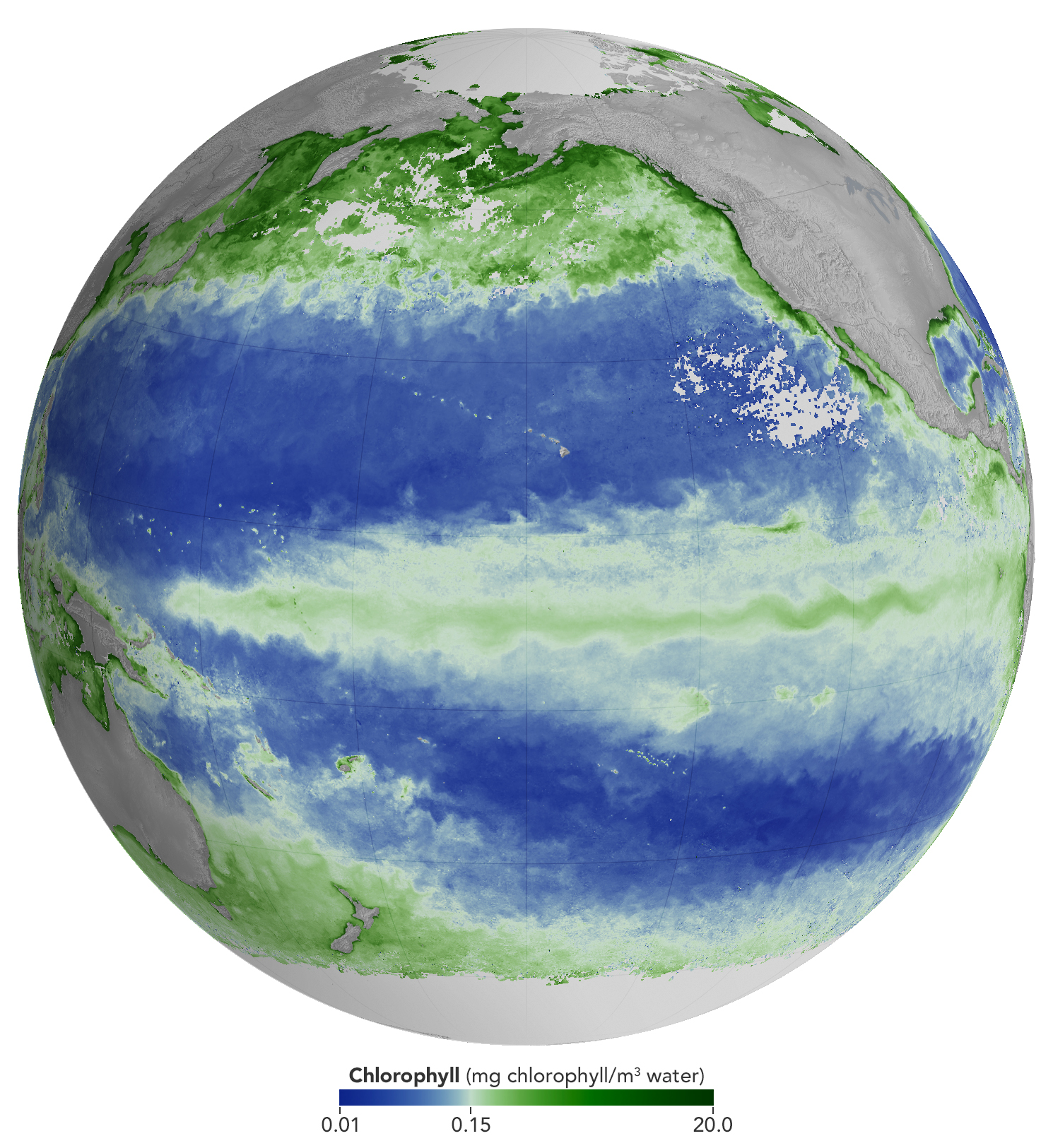
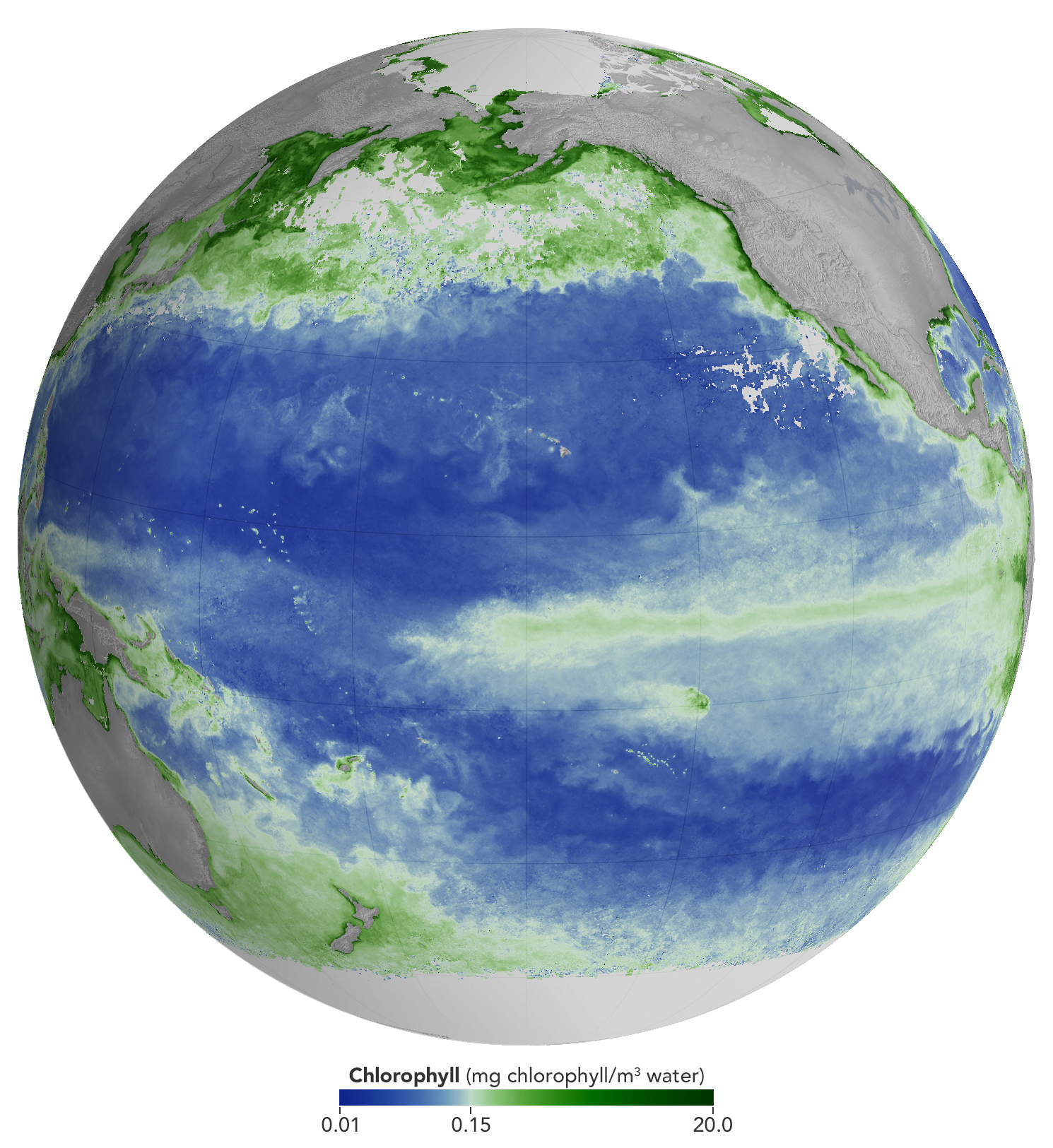
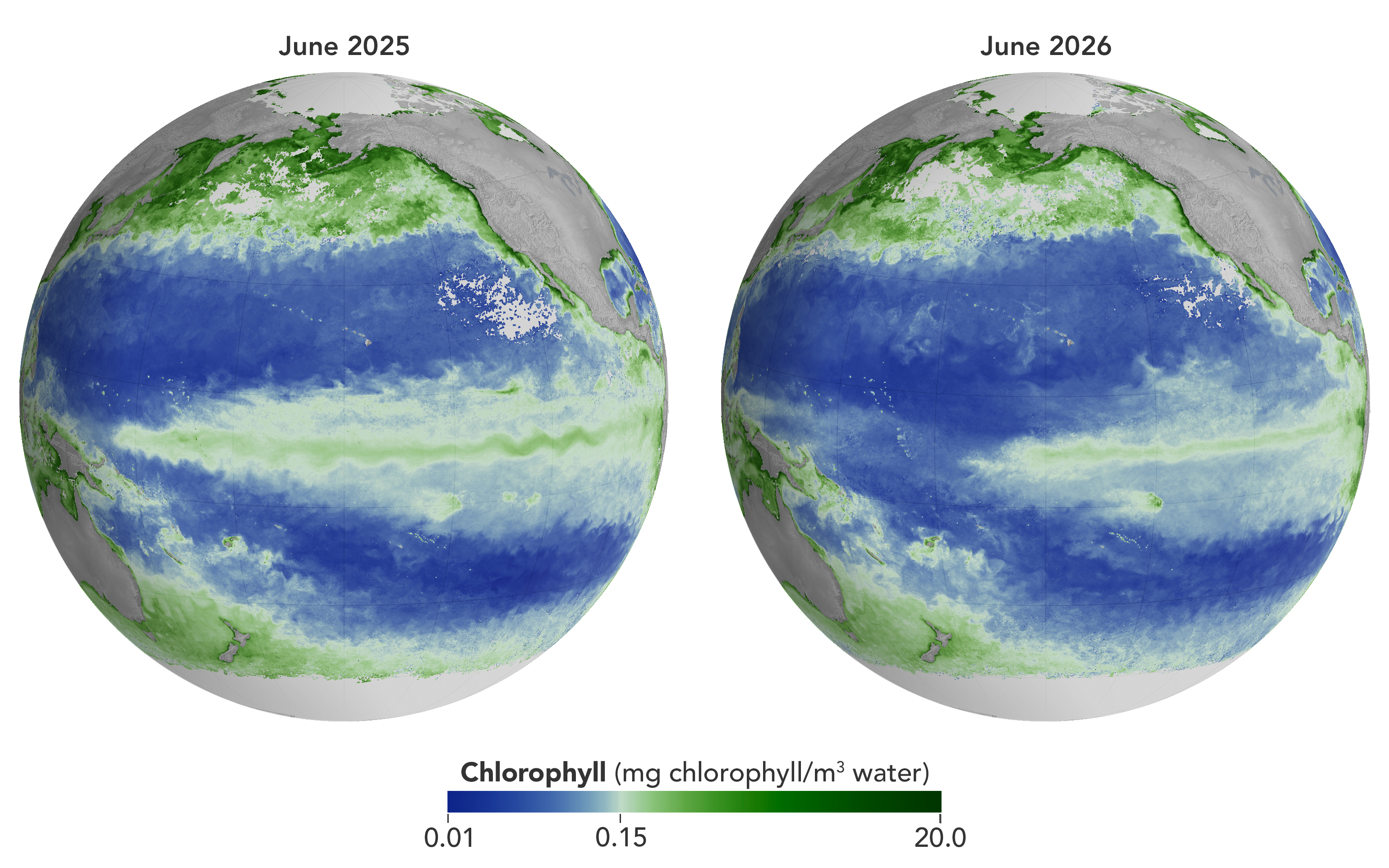
Among the first ecological downstream effects are changes to the marine food web. The maps above show chlorophyll-a concentrations—the pigment present in most phytoplankton—as observed by the OCI (Ocean Color Instrument) on NASA’s PACE (Plankton, Aerosol, Cloud, ocean Ecosystem) satellite. In June 2025 (left), conditions were neutral, while in June 2026 (right), El Niño was strengthening.
The most noticeable difference appears in the central Pacific, around the equator due north of New Zealand: chlorophyll concentrations, an indication of phytoplankton abundance, are substantially lower in 2026. This change is expected, said Matthew Kehrli and Graham Trolley, oceanographers in the Ocean Ecology Laboratory at NASA’s Goddard Space Flight Center. That’s because during an El Niño, easterly equatorial trade winds weaken, the warm surface layer of the ocean extends deeper, and the upwelling of cool, nutrient-rich water that typically fuels phytoplankton growth is suppressed.
As the El Niño progresses, the scientists anticipate the differences in the central Pacific will become more pronounced. “This may manifest as a greater difference in values across the current region, as a broadening region of reduced surface chlorophyll-a concentration, or both, depending on the behavior of the equatorial trade winds,” they said.
Reductions in phytoplankton have ripple effects through the marine food web, including in coastal regions. Less food is available for zooplankton, as well as for fish, seabirds, and marine mammals. Peru’s anchovy fisheries have seen profound declines in catch during past El Niños, driven similarly by warmer surface waters, reduced upwelling, and lower phytoplankton abundance. In 2026, Peru’s Ministry of Production repeatedly suspended the fishery to safeguard the country’s main fishing resource. Pelicans have been seen venturing into Peruvian ports and urban areas in search of food.
Although the disruptions to marine life can be severe, a post-El Niño “chlorophyll rebound,” with higher-than-normal concentrations in the equatorial Pacific, can occur. Research suggests that higher iron concentrations delivered in ocean currents, as well as dust arriving from drier land in parts of Central and South America, help fuel the resurgence—a rebound that doesn’t require a follow-on La Niña. La Niña, which often follows El Niño events, can also produce elevated chlorophyll concentrations. A strong La Niña in 1998–1999 set off a large phytoplankton bloom in the eastern Pacific and a dramatic increase in fish populations.
Scientists have new tools available for studying this sort of variability. The PACE mission launched in February 2024, making this the first complete El Niño event for which the satellite will gather global, near-daily hyperspectral measurements. “The scientific community will be able to observe the 2026 El Niño with data across more wavelengths of light than ever before,” Kehrli and Trolley said.
To better understand effects on life in the ocean, researchers hope to use PACE data to gauge the responses of specific phytoplankton communities to El Niño. And the possibilities extend beyond the marine realm, the scientists note. PACE’s sensors can measure plant pigment composition on land and clouds and aerosols in the atmosphere, all of which are influenced by El Niño.
NASA Earth Observatory images by Michala Garrison, using PACE data from the NASA Ocean Biology Distributed Active Archive Center OB.DAAC and processed by Matthew Kehrli. Story by Lindsey Doermann.
Stay up-to-date with the latest content from NASA as we explore the universe and discover more about our home planet.
Satellite observations of sea surface height indicated that the 2026 event continued to strengthen in early June.
Something is brewing in shallow waters offshore of Delaware, New Jersey, Maryland, and Virginia.
Seaweed composing the Great Atlantic Sargassum Belt hit near-record levels in June 2026, with the Caribbean Sea and Gulf of…
Subscribe to the Earth Observatory and get the Earth in your inbox.
NASA’s Earth Observatory brings you the Earth, every day, with in-depth stories and stunning imagery.
Explore Earth Science
Open access to NASA’s archive of Earth science data
An international research team has uncovered how LUCA, the last common ancestor of all life on Earth, split into the first two branches of organisms—bacteria and archaea—allowinglife to thrive innew conditions and spread to other biomes.
Scientists from the Institute of Molecular Evolution at Heinrich Heine University Düsseldorf (HHU) led the research, revealing their findings in a recent paper published in Science Advances, investigating these early cells’ metabolisms.
The team discovered that the chemical reactions and energy sources behind these two types of cells told unique stories of separate evolutions, in new work that sheds light on the primordial processes that gave rise to some of Earth’s first free-living cells.
Roughly four billion years ago, life on Earth emerged as the first cells formed, most likely at hydrothermal vents, before evolving to explore new biomes.
“We would see two very different kinds of cells emerging, pioneer bacteria and pioneer archaea, making their first attempts at life outside the confines of a hydrothermal vent,” said lead author Natalia Mrnjavac, a biologist at the University of Düsseldorf.
The new study investigated protein structures, chemical reactions, and genomes involved in the evolution of these early free-living cells.
“These comparisons are giving us unprecedented insights into the phase of evolution when metabolism catalysed by enzymes was arising from spontaneous reactions catalysed by metals in the Earth’s crust,” said senior author William Martin, a Düsseldorf biologist.
Among the new work’s major findings is a consideration of the entire set of 420 chemical reactions involved in metabolism that produce amino acids, RNA bases, and vitamins from the raw materials of hydrogen, ammonia, and carbon dioxide.
These reactions are preserved for modern researchers inside the genetic code, allowing the team to make a surprising discovery: about half of LUCA’s reactions were catalyzed by environmental metals instead of enzymes produced by the organism itself.
“Metals that naturally occur in hydrothermal vents can replace a surprisingly large number of enzymes in metabolism,” said co-author Harun Tüysüz, an inorganic chemist from the Max-Planck-Institut für Kohlenforschung and the IMDEA Materials Institute in Madrid.
In this study, the team reconstructed catalysis evolution from metal-only to a metal-enzyme hybrid present in LUCA, and finally to the divergence of the bacterial and archaeal lineages. This evolution helped life move on from the hydrothermal vents inhabited by the first cells by replacing the inorganic catalysts provided by that environment with new enzymes.
“We can see cases where the ancestors of bacteria and archaea independently evolved structurally distinct enzymes to catalyse the same essential metabolic reaction,” Mrnjavac explained, adding that “such parallel inventions could have paved the way to the independent emergence of free-living bacteria and archaea.”
A primary question involves what supplied the energy driving metabolic reactions in early life on Earth. A compound named ATP is the primary metabolic driver in most organisms today, but it comes from enzymes and is not present in hydrothermal vents. The researchers identified a new energy source in palladium, a natural catalyst used by chemists and also plentiful in hydrothermal vents.
“When we react phosphite, a form of phosphorus that naturally occurs in hydrothermal vents, with organic compounds, we get metabolic phosphorylation reactions overnight in water. Phosphite and palladium replace ATP and enzymes; it’s amazing, and it makes early evolution a lot easier to grasp,” Schlikker said.
Understanding the interconnection between so many reactions presents a significant mathematical challenge. For this reason, the team included not just biologists, but network scientists tasked with ordering the reactions by their complexity, which the researchers hoped would indicate the sequence in which they evolved. Using a machine learning algorithm, the team discovered that a clear order did appear to exist.
“The new data leave only one conclusion,” Martin concluded. “The bacteria and archaeal lineages made the transition to the free-living state independently. Only free-living cells are alive.”
“Let’s call it by name,” Martin added. “We are looking at one origin of the genetic code, but two origins of life.”
The paper, “Intermediate Stages in the Origin of Metabolism at a Phosphorylating Hydrothermal Vent,” appeared in Science Advances on August 5, 2026.
Ryan Whalen covers science and technology for The Debrief. He holds an MA in History and a Master of Library and Information Science with a certificate in Data Science. He can be contacted at ryan@thedebrief.org.
The ancient history of our planet’s impact events is coming into focus, thanks to researchers who have triangulated similarly aged impacts on Earth, the Moon, and the asteroid 4 Vesta in a new study.
The lunar meteorite NWA 12593 correlates not only with impact events observed across three locations in our solar system but also contains evidence of three separate impact events that occurred at different times.
The findings, revealed in a recent paper published in Geology, show that scientists are using this new impact data to fill in the volatile early-Earth period when life began.
The Archean period, roughly 4 to 2.5 billion years ago, was a consequential time from which our earliest fossil records date, corresponding to around 3.5 billion years ago. Researchers believe that life likely first arose at this time, yet it may have faced adversity from bombardment by space rocks between 3.2 and 3.5 billion years ago, although scientists disagree on how intense this impact activity was.
Our planet’s geological activity eventually destroys evidence of the ancient past through erosion, subduction, and burial, continually reshaping the surface. Yet those early years are essential to understanding the origins of water, atmospheres, and life on Earth.
“On Earth, the first fossil evidence of life shows up around 3.5 billion years ago, meaning that life is emerging and evolving before then. The question that we often have, even going back further, is what was the impact record when life was emerging?” said lead author Carolyn Crow, a planetary scientist at the University of Colorado Boulder.
“It is important for understanding how life is taking hold, how life is emerging,” Crow added. “The cadence of these catastrophic events is an important part of the equation.”
While Earth’s surface is constantly renewed by geological processes, our nearest significant neighbor, the Moon, is much more stable, retaining its geological record for longer periods. Because of this, lunar meteorites provide a resource for scientists to understand the impact of Earth and the inner solar system by matching them to known impacts on our planet and in the asteroid belt.
For the recent study, the team focused on a lunar meteorite discovered in northwest Africa, designated NWA 12593, and identified three separate impact events in a single sample.
Radiometric dating traced the oldest to 3.5 million years ago, intriguingly close to the time of the earliest known fossils. Extraordinary in power, this impact produced the mineral zirconia by melting the lunar surface into a lava-like flow. Without the precise laboratory conditions required to produce stable cubic zirconia, only traces of mineral remained in the sample.
According to the team, the first impact aligns with previously known impact events on Earth, and the fourth-largest object in the asteroid belt, 4 Vesta. It’s extremely rare to find such corresponding evidence between three bodies, providing important data on this time of frequent collisions.
“It’s not very common, which is why we’re very excited about it,” says Crow. “It’s pretty rare to have all three records line up like this.”
Evidence of later impacts included breccia composed of large, angular, broken mineral fragments cemented together. The team believes the breccia resulted from a second impact that struck the melt sheet formed by the first.
“Breccias are similar to what you would see if you went and chipped out a chunk of concrete. You would see all these little rocks, and then it’s fused together by the cement,” says Crow. “But the meteorite is fused together by the impact process. You get all these chunks of different kinds of rocks that the impact hit into. These all get mixed up, and then it gets fused together like your concrete sidewalk.”
As for the third impact, the evidence for this is the meteorite’s mere presence on Earth; an event that occurred some time after the first would have ejected the lunar breccia, the researchers say, allowing it to eventually land on our planet.
In total, the sample reveals an intriguing impact history, preserving a record of bombardment that provides solid evidence for a flurry of activity in the inner solar system during a violent chapter in the early history of our Solar System.
The paper, “Three-Body Evidence of Ca. 3.7 Ga to 3.2 Ga Bombardment Across the Inner Solar System,” appeared in Geology on May 12, 2026.
Ryan Whalen covers science and technology for The Debrief. He holds an MA in History and a Master of Library and Information Science with a certificate in Data Science. He can be contacted at ryan@thedebrief.org, and follow him on Twitter @mdntwvlf.
Earth has many unique features for a planet, such as a magnetic field, a large moon, and plate tectonics. It’s also the only planet we know of that harbors life. These facts form the basis of the Rare Earth hypothesis, which posits that we haven’t found aliens because other planets in the Galaxy probably don’t have all the right conditions for life.
Another characteristic of Earth is that about 30% of its surface is land and about 70% is ocean. Recently, Columbia University Assistant Professor David Kipping investigated whether the proportion of Earth’s surface covered by dry land versus ocean, or its land fraction, is another reason Earth is habitable not only for simple single-celled organisms, but also for intelligent species like humans.
To test this hypothesis, Kipping created 4 statistical models of planets with different land fractions that intelligent aliens could potentially evolve on. First, he created an equation to describe the likelihood that a planet in its star’s habitable zone has a particular land fraction, known as a probability distribution. Kipping weighted this probability distribution toward the extreme ends, making it more likely that a planet would be covered by a single huge landmass or a single vast ocean than by a mix of both, as on Earth.
Kipping then incorporated this land fraction probability distribution into his statistical models to calculate the probability that a random planet will have that land fraction and host intelligent life. The 4 scenarios Kipping tested were: 1) that intelligent life is more likely to emerge on land-dominated planets, 2) that it’s more likely to emerge on ocean-dominated planets, 3) that it’s more likely to emerge on planets with roughly equal amounts of land and ocean, and 4) that its emergence is independent of a planet’s land fraction.
As a first step in determining the kinds of planets intelligent aliens would tend to emerge on, Kipping used each model to predict the probability that intelligent life would emerge on a planet with the same land fraction as Earth. He then compared these probabilities by calculating the ratios between each value. Because Earth is the only known planet with intelligent life, a model that predicted a greater probability for humanity’s existence on Earth would be more likely to reflect reality.
Kipping considered it strong evidence that a given model was more realistic than another if the ratio between 2 of them was greater than 10, meaning one model was 10 times more likely to predict the existence of Earth and humanity. Kipping found that no comparison of any 2 models passed this threshold. However, the models assuming that intelligent life prefers ocean-dominated planets or planets with a land-ocean balance were 2.5 and 3 times more likely to predict the existence of humanity than the model assuming that intelligent life prefers land-dominated planets. Additionally, the model assuming that intelligent life prefers a land-ocean balance was always more likely to predict humanity than any other model, though marginally.
Kipping also addressed whether finding more planets with intelligent life would affect which model was deemed most realistic, for example, if scientists discovered conclusive evidence of life on Mars in its distant past. Here, Kipping identified 2 complications. First, it’s uncertain how much of Mars’s surface was once covered by water – some estimate it had a land fraction as high as 81%, while others estimate it was as low as 25%. Second, proving that Mars once had life would not prove it once had intelligent life.
Regardless, Kipping reran the models assuming that ancient Mars had a land fraction comparable to Earth’s. Adding this second data point produced ratios similar to those in the earlier Earth-only calculations, meaning it still didn’t make any single model 10 times more likely to predict the existence of humans and Martians, respectively.
Kipping then took the 10-times threshold and reversed the calculations to find what conditions would exceed it. In doing so, he calculated that astronomers would need to find 14 other planets with intelligent life and known land fractions to robustly determine whether intelligent life is more likely to occur on desert planets, ocean planets, balanced planets, or without bias.
Kipping concluded that he can’t yet definitively state whether there is something special about Earth’s land fraction when it comes to producing intelligent species. However, Earth’s existence would suggest that intelligent life is unlikely to favor extreme desert planets, so the Milky Way probably isn’t filled with Tatooines and Jakkus. And while his analysis doesn’t debunk the Rare Earth hypothesis, it does undermine the argument that Earth’s ocean size explains why Earth is rare.
The post Is Earth’s water why intelligent life evolved here? appeared first on Sciworthy.