Last month, the U.S. House passed the AM Radio for Every Vehicle Act, reports the Chicago Sun-Times. They call it "a bipartisan effort to require AM radio in new vehicles," adding that the bill now "awaits action in the Senate, where a companion measure has already garnered support, according to public records."
Broadcasters said AM radio remains a critical source of information, offering news and weather alerts, particularly when cell networks and internet service are disrupted or unreliable... "AM radio — all radio — has always been about connection, and in Chicago, especially, the connection is incredibly strong," Mary Sandberg Boyle, vice president and general manager of WGN-AM 720, said. "You don't need a subscription. You don't need a data plan or an app. You turn on the radio, and it's there..." Boyle said the accessibility of radio becomes especially important during severe weather and breaking news situations. "That's when local radio is really more important because we have the ability to stay live, pivot our content and what we're covering, and we can access a large amount of audience members very quickly and keep everybody safe," she said. Boyle also serves on the board of directors of the National Association of Broadcasters, which has argued that preserving AM radio access is an access issue rather than a matter of nostalgia.
The legislation emerged after several automakers removed AM radio from certain electric vehicle models, citing interference from electric power systems. Companies including Tesla, Rivian, Volvo and others have either eliminated or limited AM radio in some EVs. The Alliance for Automotive Innovation, which represents most major automakers, has opposed the requirement. In congressional testimony last year, President and CEO John Bozzella argued that "analog AM radio does not contribute to motor vehicle safety" and requiring it as standard equipment "is not necessary to ensure public safety."
Under the bill, the U.S. Department of Transportation would be required to develop regulations ensuring AM radio remains available in new vehicles sold in the U.S. The measure would also bar automakers from charging consumers separately for AM radio access... While public discussion around the legislation has largely focused on emergency alerts and news access, some scholars say preserving AM radio also has implications for media diversity... "I think the media landscape is really overwhelmingly homogenized right now, and AM radio is important in many markets," [said Zachary McDowell, associate professor of communications at the University of Illinois Chicago]. "It's a space that still allows for all sorts of different voices that is still open and accessible."
The article also includes this quote from Rodney Gibbs, executive director of Heartland Signal, which operates a local talk radio station. "Despite the kind of shiny objects that digital media is, AM radio still has a viable and durable audience. It's a daily, unscripted, authentic conversation between the host and the listeners. You don't get that from broadcast television. You don't get that from digital media."
La Côte d’Ivoire a lancé, le 1er septembre, sa campagne 2026-2027 de commercialisation du cacao, avec de nouvelles obligations de traçabilité. Premier produit d’exportation du pays, le cacao occupe une place centrale dans l’économie ivoirienne. Au-delà de la production de fèves, le gouvernement...
Pendant près de deux millénaires, une question a résisté aux historiens. Jules César avait-il décrit fidèlement la Lutèce gauloise, ou son récit avait-il brouillé les pistes ? Sous l’Hôtel-Dieu, sur l’île de la Cité, à Paris, une découverte pourrait faire basculer ce vieux débat.
Across the stories today, a common thread emerges: the planet is speaking in signals — some subtle, some deafening — and the question is whether our institutions can listen fast enough to act.
Start with the signals themselves. El Niño has surged to record strength weeks ahead of schedule, and its fingerprints are already visible — from Hurricane Polo’s explosive intensification in the Pacific to the climate volatility rippling through global weather systems. In the UK, an aphid outbreak wiped out 30 million lettuce heads almost overnight, a small but telling example of how shifting conditions can upend food systems in ways no one budgets for. In Malawi, an unexplained weed overgrowth has choked Chia Lagoon, stranding farmers and fishers in flooded fields nearly seven months after the rains should have drained. These aren’t isolated oddities. They’re the planet’s early warning system, written in crop yields and clogged waterways.
Then there’s the human response — uneven, but not absent. Germany’s landmark pledge to phase out fossil fuels by 2045 marks a rare moment of policy catching up to urgency, moving beyond vague “carbon neutrality” language toward something more concrete. The UK’s decision to declassify a once-suppressed intelligence report — warning that climate breakdown is a direct threat to global security — suggests governments are quietly acknowledging what scientists have said for years, even if political will lags behind. And at UN climate talks in New York, amid what The Guardian describes as a genuinely grim mood, solar power’s continued growth offered rare, tangible hope. As Al Gore noted twenty years after An Inconvenient Truth, he’s surprised by the ferocity of fossil fuel pushback — but still believes, cautiously, that the fight can be won.
Behind the numbers are real communities adapting in real time. In the Andes, villagers near Villa de Arma are turning to ancient wetland systems as glaciers they once walked across vanish into bare rock. In Guam, resident Leevin Camacho learned his family’s water contained a pesticide banned since 1987 — a stark reminder that militarization and environmental cost are often intertwined, especially in the Pacific. And in Sarawak, Indigenous communities are still reckoning with displacement from the Bakun megadam three decades later, a cautionary tale as the world races toward a “clean” energy future that doesn’t always ask who pays for it.
It’s a reminder that progress and pressure often arrive together. Endangered birds on South Australia’s Eyre Peninsula won last-minute protection from a rocket launch site — a genuine conservation victory — even as a Norfolk Broads housing levy was quietly slashed, raising fears that environmental safeguards elsewhere are eroding. Meanwhile, olive ridley sea turtles nesting for the first time ever on California beaches offer something rarer: wonder. A signal, too, but one that invites curiosity rather than alarm — proof that the natural world is still capable of surprising us.
As the week unfolds, all eyes will be on whether momentum from Climate Week — bolstered even by a monster from Sesame Street reminding children it’s okay to feel both fear and courage — translates into follow-through. The data, the disasters, and the small human stories all point the same direction: the era of asking “if” is over. What remains is the harder work of “how fast,” and “for whom.”
L’intelligence artificielle commence à entrer dans les salles de contrôle du ciel américain. Baptisé Smart, ce système doit anticiper les embouteillages aériens, les effets de la météo et les conflits de trajectoires. Cette révolution technologique n’est pas tout à fait du goût des contrôleurs...
Meta a du mal à faire décoller ses IA, alors la firme a pensé autrement avec sa nouvelle application Muse. Plutôt que de proposer un chatbot, le groupe de Mark Zuckerberg mise sur une autre bataille : celle des agents capables d’agir à la place de l’utilisateur. Et les premiers chiffres montrent...
After nearly two decades, America's war on CO2 is being brought to a well-deserved end, with Lee Zeldin, the head of Trump's EPA, scrapping Biden-era green power plant rules, says Tilak Doshi.
Archaeologists rarely identify a settlement from one object. They combine buildings, hearths, tools, food remains, activity areas, and patterns of rebuilding to understand a site.
Nearly 1,000 bones and teeth from three Granada caves show that Neolithic cannibalism was not one practice or one event. The dates and traces point to different stories.
The Nyrius Phoenix Home is a new wireless HDMI adapter with 500ft line-of-sight range, 75ft through walls or floors
Delivers 4K resolution with Dolby Atmos, DTS and 7.1-channel surround support
Launches for $199.99 for the basic transmitter and receiver
The Nyrius Phoenix Home is a true 4K wireless streamer that takes an HDMI source such as your games console, Apple TV 4K or Blu-ray player (or any combination through an AV receiver) and sends it to your TV, projector or desktop monitor.
It's designed to be simple, so there's one HDMI input on the transmitter and one HDMI output on the receiver — and it promises a 500-foot range in plain air, or 75 feet through walls and floors.
This means it could be used as part of a home theater setup, beaming video from your source to your projector or TV across the room without cables, or it could be used as an alternative to running and HDMI cable through your walls so you can send video to other parts of the house.
This isn't the first such streamer by any means, but it's very aggressively priced for a 4K wireless HDMI adapter and delivers an impressive specification for its relatively low price.
(Image credit: Nyrius)
Nyrius Phoenix Home: key features and specifications
With the Phoenix Home's 500-foot line-of-sight range, I'm thinking it could be good for movies or sporting events with friends outdoors with a projector or outdoor TV.
Transmitting up to 75 feet through walls and floors means you can use it to stream from a computer in one room to a TV in another, provided the computer has an HDMI output or an HDMI adapter: the Phoenix Home only supports HDMI input.
The Phoenix Home also features USB-C that you can use to remotely control a computer by connecting it to the transmitter and using a keyboard and mouse with the receiver. There's also an IR extender for remote controllers.
The Phoenix Home transmits up to 4K resolution at up to 60fps, and it supports DTS, Dolby Atmos and 7.1-channel surround.
I think there are multiple applications for this kind of device at home as well as in business or educational spaces: it's a good solution for renters who can't start drilling cable runs everywhere, and for rooms that weren't made with AV systems in mind.
A few TV companies have been thinking about rooms where you want to mount the TV above the fireplace or another feature and have your AV receiver, consoles or other home theater gear somewhere else. If you saw Samsung's Wireless One Connect Box or LG's Zero Connect and wished you too could have a wire-free TV, you don't need to splash your cash on one of this year's best TVs to cut the cables: this will provide a similar option for $199.
Our one worry would be what the latency is like for gaming, which we'd have to test to be sure about. But if you're looking to cut the cables for making it easy to move movies around the home, this looks like a very affordable and effective way to do it, and is available now.
Thinking of buying a new TV?
Try our TV size and model finder! You tell it how far you sit from your TV, we'll tell you what size to buy based on viewing angle advice from image quality experts, and we'll recommend our three top TVs at that size for different prices.
Panasonic launches new DMR-4X10¹⁰ 4K Blu-ray player in Japan
Also includes 4K tuners, 10TB of local storage for recordings, Blu-ray recording, and support for cloud storage
About $2,800 / £2,080 / AU$3,930
Blu-ray fans should be feeling blessed this month: with new players decidedly thin on the ground, September has brought us news of not one but two 4K Blu-ray players — though neither is really aimed at the average movie enthusiast.
The new Panasonic DMR-4X10¹⁰ is a flagship 4K player with a bunch of other neat tricks up its sleeve, and while it's likely to stay as a Japan-only release, we're still happy to see new players being made.
A 434,500 yen, which works out at about $2,800 / £2,080 / AU$3,930, it's a fair bit cheaper than this month's other new Blu-ray player, the Magnetar Ultima: that costs a cool $12,000 (about £8,895 / AU$16,687).
(Image credit: Panasonic)
Panasonic DMR-4X10¹⁰: key features
The Panasonic DMR-4X10¹⁰ not plays 4K Blu-rays, regular Blu-rays and DVDs, it also features 4K broadcast tuners and includes a giant 10TB hard drive for recording shows and movies. There's also the option of cloud recording of up to 10TB via Google Drive or Microsoft OneDrive, so you can access recordings on your phone or store Blu-ray disc images in the cloud.
It even records to BD-R/RE discs of up to 100GB, if you prefer. Recording from live broadcast isn't that popular worldwide, but evidently it's popular enough in Japan to make this the ultimate 'own your copies' machine.
The player uses an AVC encoder for high-definition recording, and Panasonic says the encoder can compress 24Mbps signals to around 1.6Mbps to maximize recording space… though, again, it does come with 10 terabytes.
The DMR-4X10¹⁰ also works with Panasonic's AI Viera system, which can automatically adjust the picture quality to fit the scene — so bright and vivid if you're watching sports, and richer contrast if you're watching a noir movie. AI can also adjust the audio to make it more immersive.
The new player launches through authorized dealers on October 22, 2026, and exclusively to the Japanese market.
But the release of this model and the Magnetar show that companies aren't blind to the desire for new options — I just hope we might get something more affordable and mainstream than these at some point.
Screen Time has received one of its most substantial parental-control updates with iOS 27, iPadOS 27, and macOS 27, adding new ways for parents to manage how long children use categories of apps, which websites they can visit, and what content reaches them through Messages and FaceTime.
The features were previewed at WWDC in June and are now available as part of Apple’s latest operating-system releases. Rather than relying only on fixed app limits, the redesigned Screen Time gives parents a more flexible set of controls that can change throughout the day and adapt as a child gains access to more apps and services.
Among the additions are Time Allowances, Ask to Browse, a simpler child-device setup process, expanded Communication Safety protections, and faster controls for temporarily pausing or extending access.
Apple is also working with the American Academy of Pediatrics to adapt the organization’s Family Media Plan into guidance parents can reference when setting up devices and Screen Time.
Screen Time introduces Time Allowances by app category
Time Allowances give parents a daily amount of time that can apply across categories including Entertainment, Games, and Social Media.
That differs from managing each application individually. Parents can set time allowances for categories such as Entertainment, Games, and Social Media, then adjust those settings based on the needs of their household.
Apple provides suggested starting points based on a child’s age and guidance informed by clinical and child-development research. Those recommendations are optional, with parents able to change them based on their own household and the individual child.
The updated Screen Time also supports schedules that control which apps remain available at different periods of the day. Parents can therefore create separate access patterns around school, homework, evenings, and weekends rather than relying on one universal daily restriction.
Temporary adjustments have been made easier as well. Parents can quickly limit access to apps and the web during periods such as meals, then restore access without rebuilding their existing restrictions. When a child reaches a limit, they can request additional time from a parent to complete an activity or finish a conversation.
The redesigned interface puts device usage and the most frequently used applications closer to the front, reducing the amount of navigation required to understand how a child is spending time on a device.
Image Credit: Apple Inc.
Ask to Browse extends parental approval into Safari
Ask to Browse brings a permission model already familiar from app downloads to the web.
When the feature is active, a child who attempts to visit a new website in Safari can be required to request permission first. The parent receives the request through Messages and can review it before allowing access.
The feature is available across iPhone, iPad, and Mac and works alongside existing web-content restrictions.
It complements Ask to Buy, which requires children to obtain permission before downloading or purchasing an app or making an in-app purchase. Apple has also expanded the initial setup process so a parent configuring a personal device for a child can choose which apps are available from the beginning.
Setup Assistant offers the option to provide only essential apps, use a recommended group, or manually choose which ones are permitted. More applications can then be introduced later as the parent decides the child is ready for them.
The approach gives parents a way to begin with a comparatively limited device instead of configuring a full standard account and removing unwanted access afterward.
Communication Safety expands beyond detected nudity
Communication Safety now intervenes when it detects gore or violent imagery in shared photos and videos, expanding protections that previously centered on nudity.
Apple says the feature works with content shared through areas including Messages and FaceTime, with the new protection also extending to live FaceTime calls.
Communication Safety is designed to intervene before a child views or shares detected sensitive material. Apple has previously built these protections around on-device analysis, allowing the system to identify content without requiring Apple to receive the underlying images.
Parents can also continue controlling who children communicate with. Contact-management settings can require approval before a child adds someone new and then communicates through Phone, Messages, or FaceTime.
Child Accounts remain the foundation for these controls. Apple generally requires Child Accounts for children under 13, although the applicable age can vary by state, country, or region. Child Accounts remain available for family members up to age 18.
The accounts automatically activate age-based safeguards and connect parental controls through Family Sharing.
Image Credit: Apple Inc.
iOS 27 requires the family’s devices to stay in sync
The new Screen Time controls arrive with one practical requirement: devices participating in the same Family Sharing setup need current software.
Apple says all devices in the Family Sharing group must be updated to the corresponding 27-generation releases — iOS 27, iPadOS 27, macOS 27, watchOS 27, and visionOS 27 — before the updated Screen Time controls can be used consistently across the family.
The family organizer, parent, or guardian must also update the parental-control configuration after the software upgrades.
That requirement is worth checking before troubleshooting a missing setting on one child’s device. If every device in the group cannot be updated, Apple says the family can continue using the previous version of Screen Time and its parental controls, but the new controls will not be available consistently across the group.
The features themselves also vary by platform. Ask to Browse and Time Allowances are available on iPhone, iPad, and Mac, while some Family Sharing and communication features extend to other devices.
Apple has launched a dedicated Child Safety site alongside the software release, collecting setup instructions, explanations of Child Accounts, Screen Time controls, communication protections, App Store age tools, Find My, and Apple Watch options for families.
The updated Screen Time controls are available now with iOS 27, iPadOS 27, and macOS 27, although individual features can vary by region, language, and hardware. For families upgrading several devices at once, checking every device in the Family Sharing group for its corresponding version 27 update is the most useful place to start.
Amazon has announced the dates for its second Prime Day sale, taking place on October 6 and 7 this year, and the retailer has also released early deals, including some of our top-rated models.
While tech prices have risen this past year because of the global RAM and component crises, TVs haven't been affected yet. That means you can find record-low prices on a range of best-selling models from brands like Samsung, LG, TCL, and Hisense.
Shop more of Amazon's early Prime Day TV deals below and keep in mind that unlike Prime Day, today's discounts are for everyone - no Prime membership required.
Amazon's 9 best early Prime Day TV deals
40-inch 2-Series HD Fire TV: was $249.99 now $209.99 If you're looking for a cheap set for an extra bedroom, Amazon's best-selling 40-inch 2-Series HD smart TV is $209.99. While the Amazon 2-Series TV lacks 4K resolution, it offers smart capabilities through the Fire TV experience and Amazon Alexa, providing hands-free control.View Deal
50-inch F50 Series HD 4K Smart Fire TV: was $299.99 now $179.99 If you're looking for a budget TV, this 50-inch Insignia display is an incredible deal at just $179.99. The Insignia F50 Series TV features 4K HD resolution, DTS Studio Sound, smart capabilities with the Fire TV operating system, and a voice remote with hands-free Alexa, so you can use your voice to control your TV.View Deal
55-inch Select Series 4K QLED Smart TV: was $499.99 now $378 Amazon has Roku's best-selling 55-inch 4K QLED smart TV for $378. For that price, you get an impressive picture thanks to its 4K resolution and QLED display, plus an enhanced voice remote and Roku's excellent smart TV interface.View Deal
55-inch S90H OLED TV: was $1997.99 now $1497.99 The S90H is Samsung's mid-range OLED TV in its 2026 lineup. It supports 165Hz and features advanced AI upscaling, but it uses a slightly lower-end WRGB OLED panel. During our hands-on testing, we praised this model's anti-glare technology and overall picture quality. If you're looking for a strong alternative to the LG C6, this is a solid competitor. View Deal
65-inch C6 OLED TV: was $2699.99 now $1599.99 The LG C6 is the successor to our best-rated TV, LG's C5 OLED, and the 65-inch model is on sale for $1,599.99, thanks to a whopping $1,100 discount. The 2026 OLED TV delivers more accurate, brighter colors than the C5 with powerful contrast thanks to its new Alpha 11 AI processor. The C6 also includes impressive gaming features and LG's intuitive smart TV platform.
65-inch U7 Mini-LED QLED TV: was $1499.99 now $847.99 This Hisense U7 Series delivers top TV tech for the money in a reasonably sized display, including a bright, vibrant QLED panel with excellent contrast and a high 165Hz refresh rate for smooth images. It will excel as a TV for watching sports, streaming all your favorite shows and movies, and playing the latest games.View Deal
75-inch Omni QLED 4K Fire TV: was $1199.99 now $1049.99 The latest Amazon Omni QLED is a brilliant budget TV that delivers solid picture quality and strong gaming features, including 4K 60Hz, Dolby Vision, and HDR10+, at an affordable price. This early Prime Day discount brings the 75-inch model to $1,049.99, which is an incredible price for a QLED display of this size.View Deal
65-inch QM6K Series Mini LED QLED TV: was $799.99 now $664.79 Here is an Amazon exclusive deal on a massive display. You can get TCL's 85-inch QM6K Series for $1,056.68, which is an incredible price for a TV of this size. A truly great budget mini-LED TV, the TCL QM6K delivers vibrant picture quality and solid gaming features for a price that won't break the bank.View Deal
In this teacher’s magnetism activity guide, “Exploring Magnetism,” students are given the opportunity to act as scientists discovering magnetic fields and electromagnetism through inquiry and measurement.
Included at the beginning of each session is a summary of the session, a list of national education standards that the session covers, and a list of materials required for the session. Each session is broken into several activities, with each activity outlined for the teacher. In the Background Material section, you can find science background for the lessons. A glossary can be found after the background section, and at the very end we recommend different resources finding materials to purchase and for learning more about magnetism.
The activities in this guide are meant as primers for supplementary guides that allow students to learn about the importance of magnetic fields in space science, which are studied by NASA scientists. For example, in Exploring Magnetism in the Solar Wind, students learn about the stream of charged particles emanating from the Sun—called the Solar Wind— and how NASA scientists are designing a mission called STEREO to study it and its magnetic field. The other guides, Exploring Magnetism in Solar Flares and Exploring Magnetism in the Aurorae, allow students to learn about magnetism in the Sun-Earth System with more hands-on lessons.
A zoomed-in view of the Moon made from images from NASA’s Lunar Reconnaissance Orbiter Camera. (More information at the bottom of article.)
Credits: NASA Goddard/Intuitive Machines/Robert Wagner
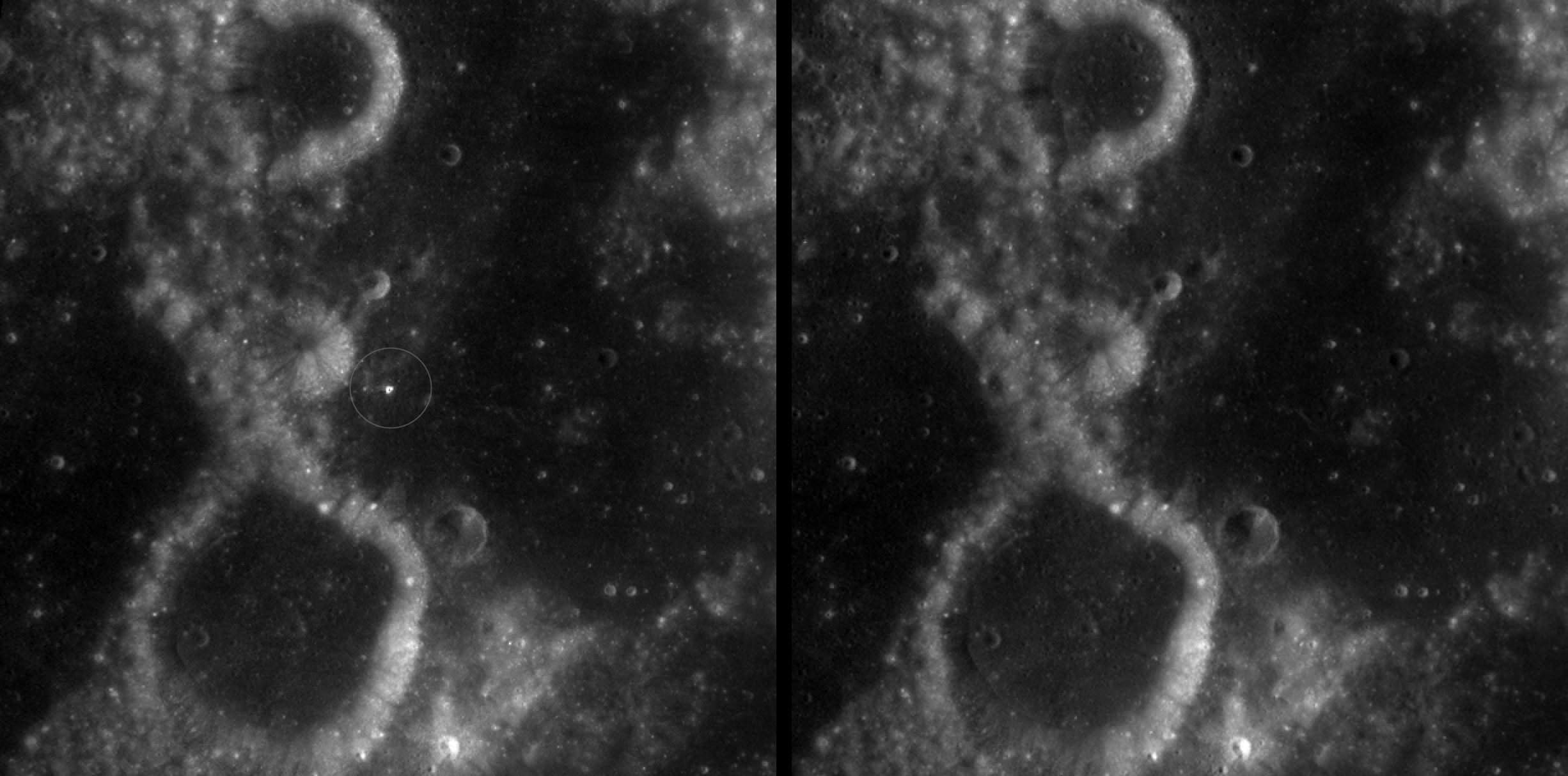
It started as a routine data-quality check. But as Robert Wagner, a scientist with NASA’s Lunar Reconnaissance Orbiter (LRO), scanned a giant Moon map on his computer screen, an unusually large bright spot circled by a dark halo caught his eye, as it implied that surface material in that area had been shaken up.
“I just stopped, dropped everything, and started looking into what that spot was,” said Wagner, an image-processing specialist from Intuitive Machines who works with data from the Lunar Reconnaissance Orbiter Camera (LROC) system.
By comparing before and after images of the Moon, Wagner realized he had discovered the largest, newly formed crater ever found in the solar system, as scientists reported Wednesday in Science Advances. This discovery highlights the value of NASA’s Moon orbiter data in studying a dynamic landscape as the agency advances a sustained human presence and expanded scientific and commercial activity on the Moon.
A zoomed-in view of McGetchin crater, circled on the left, next to a “before” image on the right. The panel on the left is made from images captured by NASA’s Lunar Reconnaissance Orbiter Wide-Angle Camera in summer 2025; the right panel was made from images taken in spring 2011. The white spot is not the crater itself, but rather material flung out of the crater, which formed when a rock, possibly this size of a three- to six‑story building, crashed into the Moon between April 11 and May 22, 2024 – a once-in-a-century event, as scientists reported on Sept. 15, 2026, in a pair of papers in Science Advances. The area shown in the images is 38 miles wide.
NASA Goddard/Intuitive Machines/Robert Wagner
Officially named McGetchin after pioneering lunar scientist Tom McGetchin, the crater formed on the Moon’s eastern edge sometime between April 11 and May 22, 2024, after a comet or asteroid the size of a three- to six-story building hit the surface.
The crash left a crater, 728 feet wide, that spans the length of two football fields. And at 141 feet deep, the crater could fit three vertically stacked yellow school buses.
Scientists estimate that an impact of this magnitude happens on the Moon about once in a century or even longer.
Moon takes some hits
For more than 17 years, LRO has been circling the Moon and using its seven instruments to map the topography, surface composition, temperature, and radiation environment there. The spacecraft’s team has identified at least 1,000 new impact craters throughout the mission and flagged 100,000 more surface changes from an object smashing into the Moon or from the debris that flung out after.
With no atmosphere to slow them or burn them up, space rocks and other objects easily reach the lunar surface. Most are much smaller compared to the object that carved out McGetchin crater. The smallest craters scientists can distinguish from LRO images are about 30 feet wide, the length of a three-story building laid on its side, made by rocks about 43 inches wide, the size of a monster-truck tire. Scientists estimate that impacts of this scale produce about 140 new craters across the Moon each year. But most new ones are made by microscopic projectiles that leave holes too small to identify in orbital images.
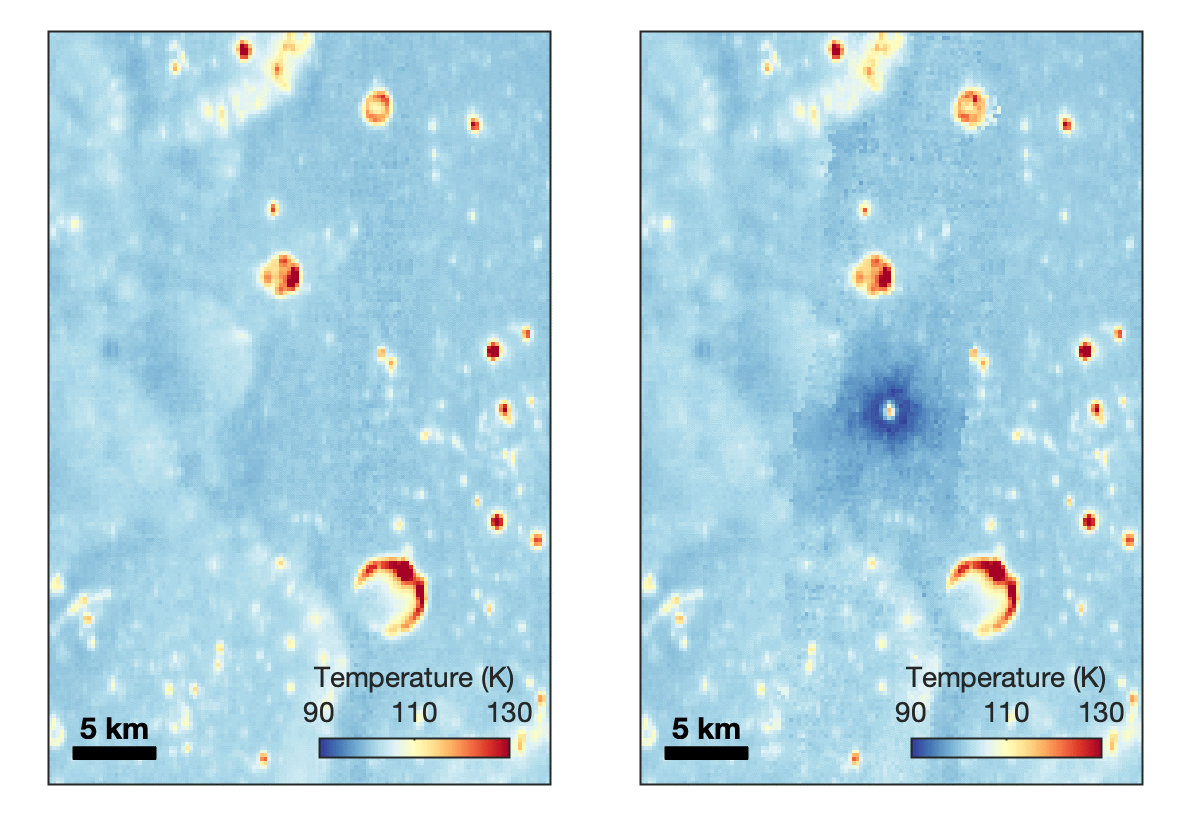
With its numerous instruments, the spacecraft can observe changes to the lunar surface that aren’t apparent in the LROC images alone. After the crater was discovered, scientists working with LRO’s thermal instrument, Diviner, made follow-up observations of the site. They found a 4-mile-wide area around the crater that is about 16 degrees Fahrenheit cooler at night than its surroundings.
This animated image set shows an area on the eastern limb of the Moon before and after McGetchin crater formed there sometime between April 11 and May 22, 2024. The post-impact image was constructed using data taken by NASA’s Lunar Reconnaissance Orbiter (LRO) thermal instrument, Diviner, between Nov. 15, 2025, and Feb. 18, 2026, after scientists discovered the crater in visible-light images taken by LRO’s Wide-Angle Camera. Pre-impact temperatures are from the Diviner Global High-Resolution Mosaics (GHRM). The crater formed on the Moon after a comet or asteroid, possibly the size of a six-story building, hit the surface in a rare, once-in-a-century collision. The dark blue strip that flashes into view reveals a 4-mile-wide “cold spot” around the crater that is about 16 degrees Fahrenheit cooler at night than its surroundings. This cooling happens because an impact fluffs up regolith around a crater, making it less dense and therefore less able to retain heat. Scientists on the Diviner team reported this finding in a paper published on Sept. 16, 2026, in Science Advances. The red and yellow spots indicate areas typically associated with rocks excavated by long-ago impacts which, though still at cryogenic temperatures like their surroundings, remain slightly warmer at night.
NASA Goddard/UCLA/JHU APL
Reporting in a second paper Wednesday in the same journal, researchers say that the cooling happens because the impact fluffs up the regolith around the crater, making it less dense and therefore less able to retain heat.
The large extent of this “cold spot” is striking, scientists say, because it shows that impacts can modify the Moon’s surface far beyond the crater itself. These physical changes could affect how rover wheels interact with the surface, for instance.
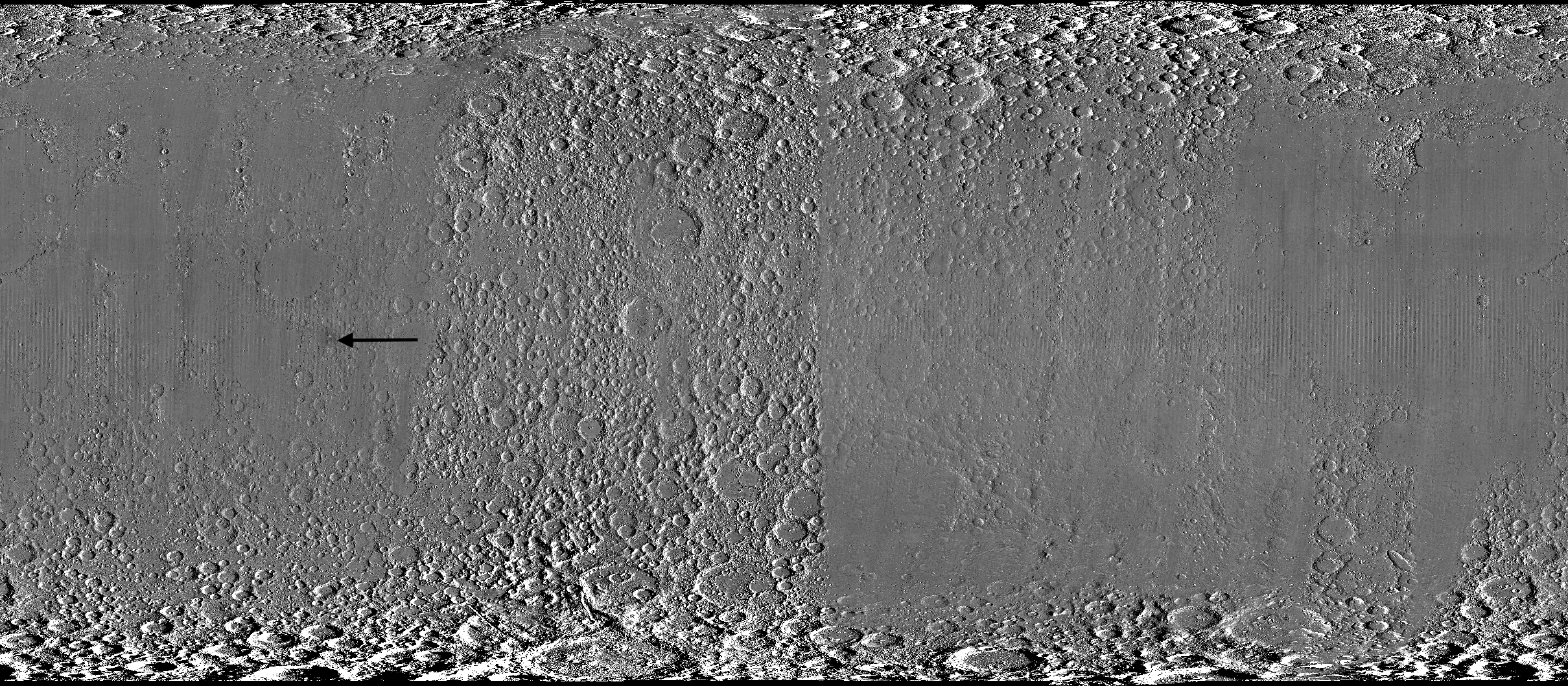
A global view of the Moon made by stitching together hundreds of images from the Wide-Angle Camera aboard NASA’s Lunar Reconnaissance Orbiter (LRO). Robert Wagner, image processing specialist for LRO, made this map using two sets of mages taken several years apart. He used a software designed to highlight any changes between the two sets. Anything that stayed the same turned gray; anything different showed up as bright or dark patches. A black arrow just left of center points to McGetchin crater.
NASA Goddard/Intuitive Machines/Robert Wagner
Road to discovery
The LROC system collects images from about 60 miles above the Moon as LRO loops from pole to pole. The system includes two cameras that capture high‑resolution black‑and‑white images and one camera for moderate‑resolution multispectral images. Over the years and thousands of passes, scientists have built maps detailed enough to spot not only new craters, but also landslides, landers, seismic faults, and even hints of lava tubes.
LROC scientists regularly analyze close-up images of small portions of the Moon’s surface taken by the Narrow-Angle Camera. Using these images, they look for changes that are typically less than 30 feet across. But every few years the team searches for large (wider than 150 feet) features by creating global Moon maps and comparing them to older versions.
An overhead, close-up view of McGetchin crater that was taken on Dec. 5, 2025, by NASA’s Lunar Reconnaissance Orbiter (LRO) Narrow-Angle Camera (NAC). After the crater was discovered on Oct. 24, 2025, in global images from LRO’s Wide-Angle Camera, which captures broad views with pixels the size of American football fields, scientists turned to the NAC, which takes much sharper views at about 3 feet per pixel. The NAC images, taken as LRO flew over the impact site again, revealed the crater size, shape, and how the surrounding terrain was affected by the impact that carved McGetchin. The image covers an area that’s ¾ mile wide.
NASA Goddard/Intuitive Machines
This view from the side (55° away from straight down) towards the east, covers an area of the Moon that’s about 1.5 miles wide. It was taken by NASA’s Lunar Reconnaissance Orbiter Narrow-Angle Camera on March 3, 2026.
NASA Goddard/Intuitive Machines
That’s what Wagner was doing on Oct. 24, 2025, when he came across McGetchin. Using images from LROC’s Wide-Angle Camera, which captures broad views with pixels the size of football fields, he stacked hundreds of “before” and “after” frames with software designed to highlight change. Anything that stayed the same turned gray while anything different showed up as bright or dark patches.
While the process sounds straightforward, spotting real craters requires a lot of manual work. The software flags every tiny shift in lighting or shadow, generating hundreds of false alarms. For this reason, Wagner typically verifies the software, looking for small fuzzy halos around pixel‑wide bright points, which indicate splashes of regolith around a new crater.
Spanning hundreds of pixels, McGetchin stood out immediately. “It was by far the most obvious impact debris pattern I’ve ever seen in one of these images,” Wagner said.
After his discovery, scientists turned to the Narrow-Angle Camera, which takes much sharper views at about 3 feet per pixel. This camera’s close-up images, taken as LRO flew over the impact site again, revealed the crater size, shape, and how the surrounding terrain was affected. These images also helped researchers estimate the size and force of the rock fragment that formed the new crater, details that are expected to appear in a future paper.
Banner image caption: A zoomed-in view of the Moon, with debris around McGetchin crater visible as a white spot circled by a dark halo just right of center of the image (marked with black arrows). This is the view that Robert Wagner saw on Oct. 24, 2025, during a routine data-quality check. Wagner is an image processing specialist for NASA’s Lunar Reconnaissance Orbiter Camera, a system of three cameras. Using images from the Wide-Angle Camera (WAC), which captures broad views with pixels the size of American football fields, he stacked hundreds of images captured by WAC over the last several years with software designed to highlight change. Anything that stayed the same is gray; anything that changed showed up as bright or dark patches. The stripes in the image are due to slight changes in lighting between the older and newer images. This image composite shows an area of the Moon approximately 900 miles across.
About the Author
Lonnie Shekhtman
Senior Science Writer
Shekhtman helps communicate NASA planetary science to the world through news and feature stories on NASA.gov, videos for NASA+ and YouTube, and by working with the media. She reports on lunar and Mars science and exploration; NASA's search for life; missions to Venus, Titan, and Jupiter's Trojan asteroids; and many other topics related to NASA's exploration of our solar system and beyond.
Scientists discovered a crater on the Moon that formed sometime between April 11 and May 22, 2024, after a comet or asteroid the size of a three- to six-story building hit the surface.
The crash left a crater, 728 feet wide, that spans the length of two football fields. And at 141 feet deep, the crater could fit three vertically stacked yellow school buses.
A zoomed-in view of the Moon made from images from NASA’s Lunar Reconnaissance Orbiter Camera. (More information at the bottom of article.)
Credits: NASA Goddard/Intuitive Machines/Robert Wagner
It started as a routine data-quality check. But as Robert Wagner, a scientist with NASA’s Lunar Reconnaissance Orbiter (LRO), scanned a giant Moon map on his computer screen, an unusually large bright spot circled by a dark halo caught his eye, as it implied that surface material in that area had been shaken up.
“I just stopped, dropped everything, and started looking into what that spot was,” said Wagner, an image-processing specialist from Intuitive Machines who works with data from the Lunar Reconnaissance Orbiter Camera (LROC) system.
By comparing before and after images of the Moon, Wagner realized he had discovered the largest, newly formed crater ever found in the solar system, as scientists reported Wednesday in Science Advances. This discovery highlights the value of NASA’s Moon orbiter data in studying a dynamic landscape as the agency advances a sustained human presence and expanded scientific and commercial activity on the Moon.
A zoomed-in view of McGetchin crater, circled on the left, next to a “before” image on the right. The panel on the left is made from images captured by NASA’s Lunar Reconnaissance Orbiter Wide-Angle Camera in summer 2025; the right panel was made from images taken in spring 2011. The white spot is not the crater itself, but rather material flung out of the crater, which formed when a rock, possibly this size of a three- to six‑story building, crashed into the Moon between April 11 and May 22, 2024 – a once-in-a-century event, as scientists reported on Sept. 15, 2026, in a pair of papers in Science Advances. The area shown in the images is 38 miles wide.
NASA Goddard/Intuitive Machines/Robert Wagner
Officially named McGetchin after pioneering lunar scientist Tom McGetchin, the crater formed on the Moon’s eastern edge sometime between April 11 and May 22, 2024, after a comet or asteroid the size of a three- to six-story building hit the surface.
The crash left a crater, 728 feet wide, that spans the length of two football fields. And at 141 feet deep, the crater could fit three vertically stacked yellow school buses.
Scientists estimate that an impact of this magnitude happens on the Moon about once in a century or even longer.
Moon takes some hits
For more than 17 years, LRO has been circling the Moon and using its seven instruments to map the topography, surface composition, temperature, and radiation environment there. The spacecraft’s team has identified at least 1,000 new impact craters throughout the mission and flagged 100,000 more surface changes from an object smashing into the Moon or from the debris that flung out after.
With no atmosphere to slow them or burn them up, space rocks and other objects easily reach the lunar surface. Most are much smaller compared to the object that carved out McGetchin crater. The smallest craters scientists can distinguish from LRO images are about 30 feet wide, the length of a three-story building laid on its side, made by rocks about 43 inches wide, the size of a monster-truck tire. Scientists estimate that impacts of this scale produce about 140 new craters across the Moon each year. But most new ones are made by microscopic projectiles that leave holes too small to identify in orbital images.
With its numerous instruments, the spacecraft can observe changes to the lunar surface that aren’t apparent in the LROC images alone. After the crater was discovered, scientists working with LRO’s thermal instrument, Diviner, made follow-up observations of the site. They found a 4-mile-wide area around the crater that is about 16 degrees Fahrenheit cooler at night than its surroundings.
This animated image set shows an area on the eastern limb of the Moon before and after McGetchin crater formed there sometime between April 11 and May 22, 2024. The post-impact image was constructed using data taken by NASA’s Lunar Reconnaissance Orbiter (LRO) thermal instrument, Diviner, between Nov. 15, 2025, and Feb. 18, 2026, after scientists discovered the crater in visible-light images taken by LRO’s Wide-Angle Camera. Pre-impact temperatures are from the Diviner Global High-Resolution Mosaics (GHRM). The crater formed on the Moon after a comet or asteroid, possibly the size of a six-story building, hit the surface in a rare, once-in-a-century collision. The dark blue strip that flashes into view reveals a 4-mile-wide “cold spot” around the crater that is about 16 degrees Fahrenheit cooler at night than its surroundings. This cooling happens because an impact fluffs up regolith around a crater, making it less dense and therefore less able to retain heat. Scientists on the Diviner team reported this finding in a paper published on Sept. 16, 2026, in Science Advances. The red and yellow spots indicate areas typically associated with rocks excavated by long-ago impacts which, though still at cryogenic temperatures like their surroundings, remain slightly warmer at night.
NASA Goddard/UCLA/JHU APL
Reporting in a second paper Wednesday in the same journal, researchers say that the cooling happens because the impact fluffs up the regolith around the crater, making it less dense and therefore less able to retain heat.
The large extent of this “cold spot” is striking, scientists say, because it shows that impacts can modify the Moon’s surface far beyond the crater itself. These physical changes could affect how rover wheels interact with the surface, for instance.
A global view of the Moon made by stitching together hundreds of images from the Wide-Angle Camera aboard NASA’s Lunar Reconnaissance Orbiter (LRO). Robert Wagner, image processing specialist for LRO, made this map using two sets of mages taken several years apart. He used a software designed to highlight any changes between the two sets. Anything that stayed the same turned gray; anything different showed up as bright or dark patches. A black arrow just left of center points to McGetchin crater.
NASA Goddard/Intuitive Machines/Robert Wagner
Road to discovery
The LROC system collects images from about 60 miles above the Moon as LRO loops from pole to pole. The system includes two cameras that capture high‑resolution black‑and‑white images and one camera for moderate‑resolution multispectral images. Over the years and thousands of passes, scientists have built maps detailed enough to spot not only new craters, but also landslides, landers, seismic faults, and even hints of lava tubes.
LROC scientists regularly analyze close-up images of small portions of the Moon’s surface taken by the Narrow-Angle Camera. Using these images, they look for changes that are typically less than 30 feet across. But every few years the team searches for large (wider than 150 feet) features by creating global Moon maps and comparing them to older versions.
An overhead, close-up view of McGetchin crater that was taken on Dec. 5, 2025, by NASA’s Lunar Reconnaissance Orbiter (LRO) Narrow-Angle Camera (NAC). After the crater was discovered on Oct. 24, 2025, in global images from LRO’s Wide-Angle Camera, which captures broad views with pixels the size of American football fields, scientists turned to the NAC, which takes much sharper views at about 3 feet per pixel. The NAC images, taken as LRO flew over the impact site again, revealed the crater size, shape, and how the surrounding terrain was affected by the impact that carved McGetchin. The image covers an area that’s ¾ mile wide.
NASA Goddard/Intuitive Machines
This view from the side (55° away from straight down) towards the east, covers an area of the Moon that’s about 1.5 miles wide. It was taken by NASA’s Lunar Reconnaissance Orbiter Narrow-Angle Camera on March 3, 2026.
NASA Goddard/Intuitive Machines
That’s what Wagner was doing on Oct. 24, 2025, when he came across McGetchin. Using images from LROC’s Wide-Angle Camera, which captures broad views with pixels the size of football fields, he stacked hundreds of “before” and “after” frames with software designed to highlight change. Anything that stayed the same turned gray while anything different showed up as bright or dark patches.
While the process sounds straightforward, spotting real craters requires a lot of manual work. The software flags every tiny shift in lighting or shadow, generating hundreds of false alarms. For this reason, Wagner typically verifies the software, looking for small fuzzy halos around pixel‑wide bright points, which indicate splashes of regolith around a new crater.
Spanning hundreds of pixels, McGetchin stood out immediately. “It was by far the most obvious impact debris pattern I’ve ever seen in one of these images,” Wagner said.
After his discovery, scientists turned to the Narrow-Angle Camera, which takes much sharper views at about 3 feet per pixel. This camera’s close-up images, taken as LRO flew over the impact site again, revealed the crater size, shape, and how the surrounding terrain was affected. These images also helped researchers estimate the size and force of the rock fragment that formed the new crater, details that are expected to appear in a future paper.
Banner image caption: A zoomed-in view of the Moon, with debris around McGetchin crater visible as a white spot circled by a dark halo just right of center of the image (marked with black arrows). This is the view that Robert Wagner saw on Oct. 24, 2025, during a routine data-quality check. Wagner is an image processing specialist for NASA’s Lunar Reconnaissance Orbiter Camera, a system of three cameras. Using images from the Wide-Angle Camera (WAC), which captures broad views with pixels the size of American football fields, he stacked hundreds of images captured by WAC over the last several years with software designed to highlight change. Anything that stayed the same is gray; anything that changed showed up as bright or dark patches. The stripes in the image are due to slight changes in lighting between the older and newer images. This image composite shows an area of the Moon approximately 900 miles across.
About the Author
Lonnie Shekhtman
Senior Science Writer
Shekhtman helps communicate NASA planetary science to the world through news and feature stories on NASA.gov, videos for NASA+ and YouTube, and by working with the media. She reports on lunar and Mars science and exploration; NASA’s search for life; missions to Venus, Titan, and Jupiter’s Trojan asteroids; and many other topics related to NASA’s exploration of our solar system and beyond.
Scientists discovered a crater on the Moon that formed sometime between April 11 and May 22, 2024, after a comet or asteroid the size of a three- to six-story building hit the surface.
The crash left a crater, 728 feet wide, that spans the length of two football fields. And at 141 feet deep, the crater could fit three vertically stacked yellow school buses.
Yamaha unveils a new compact budget soundbar: the B200A
It's a 2.1-channel soundbar, but with virtualized Dolby Atmos support
Available for just $250 in the US in November 2026, with international availability looking likely to follow
Yamaha is on a tech announcement roll (which would be a great pun if we were talking about its motorbikes, but alas). Just two weeks after unveiling new compact streamers for the home, and a few months after its cool new active speakers, it has another audio release: a new Dolby Atmos-enabled soundbar that's relatively affordable.
This is the Yahama B200A, which gives you a much more affordable alternative to the likes of the Yamaha True X Surround 90A it released earlier this year.
The soundbar is set to go on sale for $249.99 in November (that's about £200, AU$400, but we're waiting for international availability. Yamaha's international sites have landing pages for the soundbar, so global releases seem likely, but we don't know when).
Most of the best Dolby Atmos soundbars sell for a lot more than that. In fact our favorite 'cheap' pick, the Sony HT-S2000, is about twice the price in the US (though is cheaper internationally, and is discounted regularly in the US).
What do you want from the 'bar?
(Image credit: Yamaha)
Yamaha is positioning the B200A as a compact soundbar — in fact, it's the only product labelled as such on the brand's website. It weighs 1.8kg and measures 23-5/8 x 2-1/2 x 3-3/4 inches (60 x 10.2 x 6.4cm), and promo images show people using it connected to computers as well as TVs.
Specs-wise, you're looking at dual 1.8-inch 20W cones for left and right sound, and a built-in three-inch 30W subwoofer, making it a clean 2.1-channel system.
What draws me to the soundbar is its connection options. You've got eARC, of course, and also optical and 3.5mm ports, plus Bluetooth 5.3. Yamaha's Sound Bar Remote app is used for wireless control.
But it's not just about specs and ports; Yahama wants you to know about its features (and not just Dolby Atmos). The soundbar has a Clear Voice feature which makes voices easier to hear, and a Game Sound Mode which emphasizes often-quiet audio cues like footsteps, incoming attacks or power-up sounds. There are also four EQ modes: Standard, Movie, Stereo and Game.
It's a fun range of features for a soundbar which won't cost that much; I see this thing doing gangbusters for people who want great specs without a high price, especially during sales seasons, given Yamaha's usual audio quality.
On Sept. 10, 2026, NASA commemorated the completed repairs of the Guam Remote Station’s central antenna with a ribbon-cutting ceremony.
Members of NASA, the Governor’s Office of Guam, military personnel, and family members gathered to celebrate the Guam Remote Station’s return to operations.
NASA
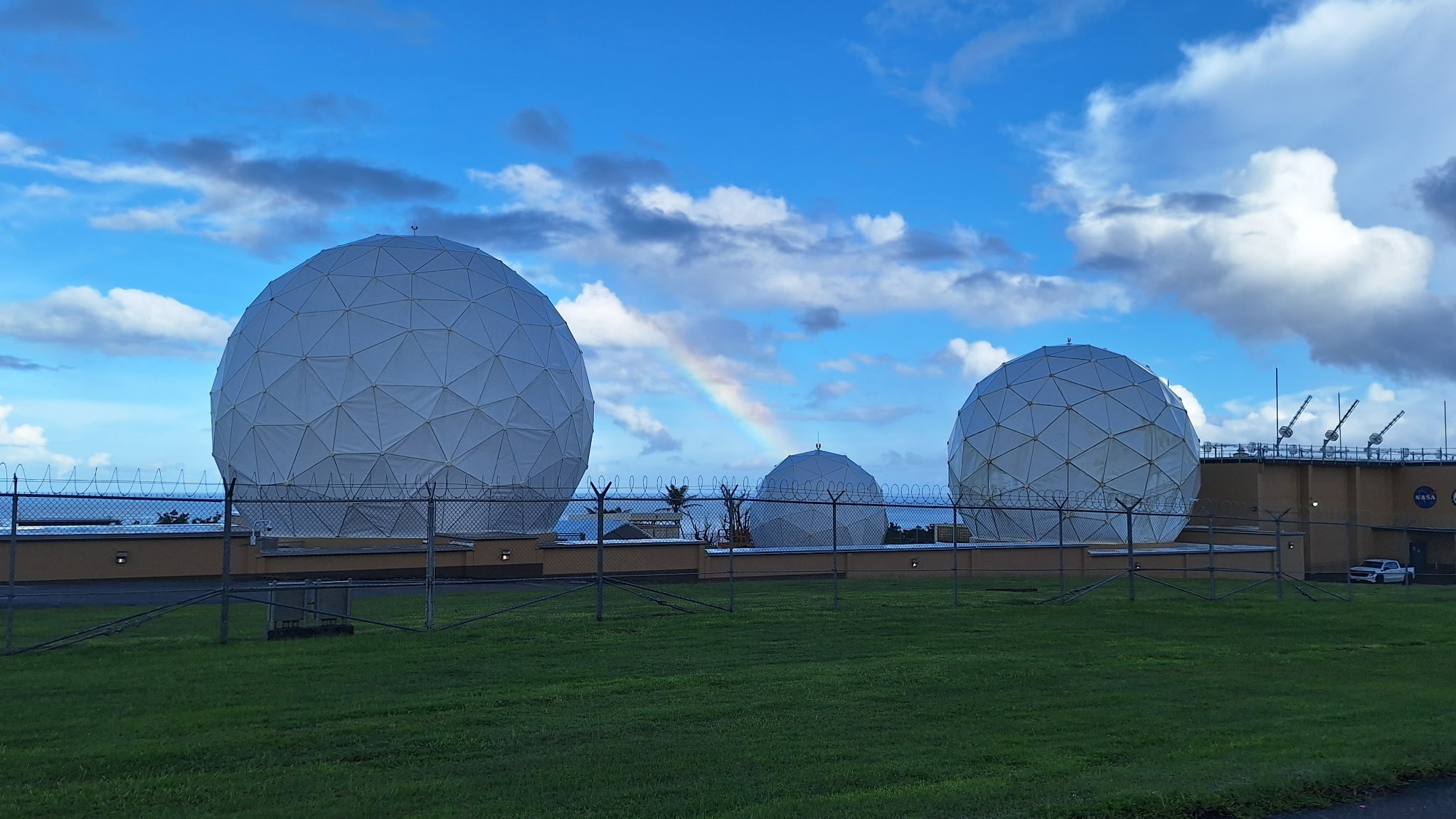
The ribbon-cutting event was held in front of the repaired central antenna. As of 2026, the newly hardened station has withstood two super typhoons more powerful than Mawar with minimal damage.
SCaN Deputy Manager for Network Operations Jena Garrahy addresses members of the Guam Remote Station ribbon-cutting event.
NASA
Guam Remote Station Site Manager Kristopher Copple was among those recognized during the ceremony.
Jena Garrahy (right), SCaN Deputy Manager for Network Operations, presents a certificate of recognition to Guam Remote Station Site Manager Kristopher Copple (left).
NASA
NASA’s Guam Remote Station is key to the Tracking and Data Relay Satellite (TDRS) constellation maintaining continuous communications with the International Space Station.
An artist’s concept of the International Space Station using NASA’s Tracking and Data Relay Satellite (TDRS) fleet to transmit data to Earth.
NASA
A 2023 aerial photo of the Guam Remote Station prior to Super Typhoon Mawar landing on the island.
Satellite image of NASA remote ground terminal located in Dededo area, Guam, released by U.S. commercial satellite company MAXAR.
MAXAR
An aerial photo of the Guam Remote Station immediately after Super Typhoon Mawar struck the station. of the station’s three ground antennas were demolished.
Satellite image of NASA remote ground terminal located in Dededo area, Guam, released by U.S. commercial satellite company MAXAR.
MAXAR
NASA celebrated the full restoration of its Guam Remote Station with a ribbon-cutting on Sept. 10, closing out more than three years of recovery after Super Typhoon Mawar devastated the site in 2023. Engineers from across the agency completed the final and most complex step of the rebuild on July 1, when they returned the station’s central antenna to service.
A rainbow arcs over the newly repaired Guam Remote Station antennas.
NASA
For nearly three decades, the Guam Remote Station has been one of three ground stations supporting NASA’s Tracking and Data Relay Satellites, or TDRS, a critical part of the Near Space Network. From 22,000 miles above Earth, the relays link spacecraft in low Earth orbit with the ground, allowing flight controllers to communicate with astronauts, command spacecraft, and receive mission data. The Guam station alone closes the “Zone of Exclusion,” a stretch of orbit beyond the relays’ line of sight. Without it, the International Space Station can lose contact with Earth for up to 20 minutes of every 90-minute orbit, an unacceptable risk for crewed missions.
On May 24, 2023, the Category 4 super typhoon struck Guam with 185 mph winds and more than 28 inches of rain, destroying two 16.5-meter antennas and damaging an 11-meter north antenna and the Inter Facility Link building at NASA’s station. The Zone of Exclusion reopened for the first time since 1998, cutting TDRS coverage to about 85% of a spacecraft’s orbit.
NASA made emergency repairs to the least-damaged antenna and borrowed two mobile terminals from the U.S. Army to expand coverage. The patchwork restored partial service within months, in time for a November 2023 spacewalk.
In early 2025, Congress dedicated disaster-relief funding to rebuild the ground station and harden the network against future storms. Construction began that summer and finished in summer 2026, when the rebuilt central antenna rejoined TDRS operations and the Zone of Exclusion closed once more. The same appropriation funded critical upgrades at three additional Near Space Network ground stations.
The return to service of the Guam Remote Station’s central antenna represents far more than the restoration of a critical piece of infrastructure — it is a testament to the dedication, resilience, and ingenuity of the people who made it possible.
Jena Garrahy
SCaN Deputy Program Manager for Network Operations
At the ribbon-cutting, representatives from NASA’s SCaN (Space Communications and Navigation) Division joined the station’s workforce and local leaders to mark the central antenna’s return to service. The Guam team, which led debris removal, site security, and on-island recovery, was recognized for its work to keep NASA connected to its missions through the outage and rebuild. A companion ceremony at NASA’s White Sands Complex in Las Cruces, New Mexico, honored the engineers and specialists across SCaN who supported the recovery off island.
“The return to service of the Guam Remote Station’s central antenna represents far more than the restoration of a critical piece of infrastructure — it is a testament to the dedication, resilience, and ingenuity of the people who made it possible,” said Jena Garrahy, Deputy Program Manager for Network Operations. “Through long days, challenging conditions, and unexpected obstacles, this team remained focused on the missions that depend on these critical assets every day.”
The Near Space Network is funded by SCaN, a division of NASA’s Research and Technology Mission Directorate, at the agency’s Headquarters in Washington. The network is operated out of NASA’s Goddard Space Flight Center in Greenbelt, Maryland. Repairs of the Guam Remote Station were managed out of NASA’s Glenn Research Center in Cleveland.
About the Author
Korine Powers
Lead Writer and Communications Strategist
Korine Powers, Ph.D. is a writer for NASA's SCaN (Space Communications and Navigation) Program office and covers emerging technologies, commercialization efforts, exploration activities, and more.

 Login