❌

Normal view

NASA’s Moon Orbiter Spots New, ‘Once-in-Century’ Moon Crater

16 September 2026 at 19:06
6 Min Read

NASA’s Moon Orbiter Spots New, ‘Once-in-Century’ Moon Crater

Black-and-white image of a textured, cratered surface. Two black arrows near the center point inward toward a small, dark, circular feature.
A zoomed-in view of the Moon made from images from NASA’s Lunar Reconnaissance Orbiter Camera. (More information at the bottom of article.)
Credits: NASA Goddard/Intuitive Machines/Robert Wagner

It started as a routine data-quality check. But as Robert Wagner, a scientist with NASA’s Lunar Reconnaissance Orbiter (LRO), scanned a giant Moon map on his computer screen, an unusually large bright spot circled by a dark halo caught his eye, as it implied that surface material in that area had been shaken up.

“I just stopped, dropped everything, and started looking into what that spot was,” said Wagner, an image-processing specialist from Intuitive Machines who works with data from the Lunar Reconnaissance Orbiter Camera (LROC) system.

By comparing before and after images of the Moon, Wagner realized he had discovered the largest, newly formed crater ever found in the solar system, as scientists reported Wednesday in Science Advances. This discovery highlights the value of NASA’s Moon orbiter data in studying a dynamic landscape as the agency advances a sustained human presence and expanded scientific and commercial activity on the Moon.
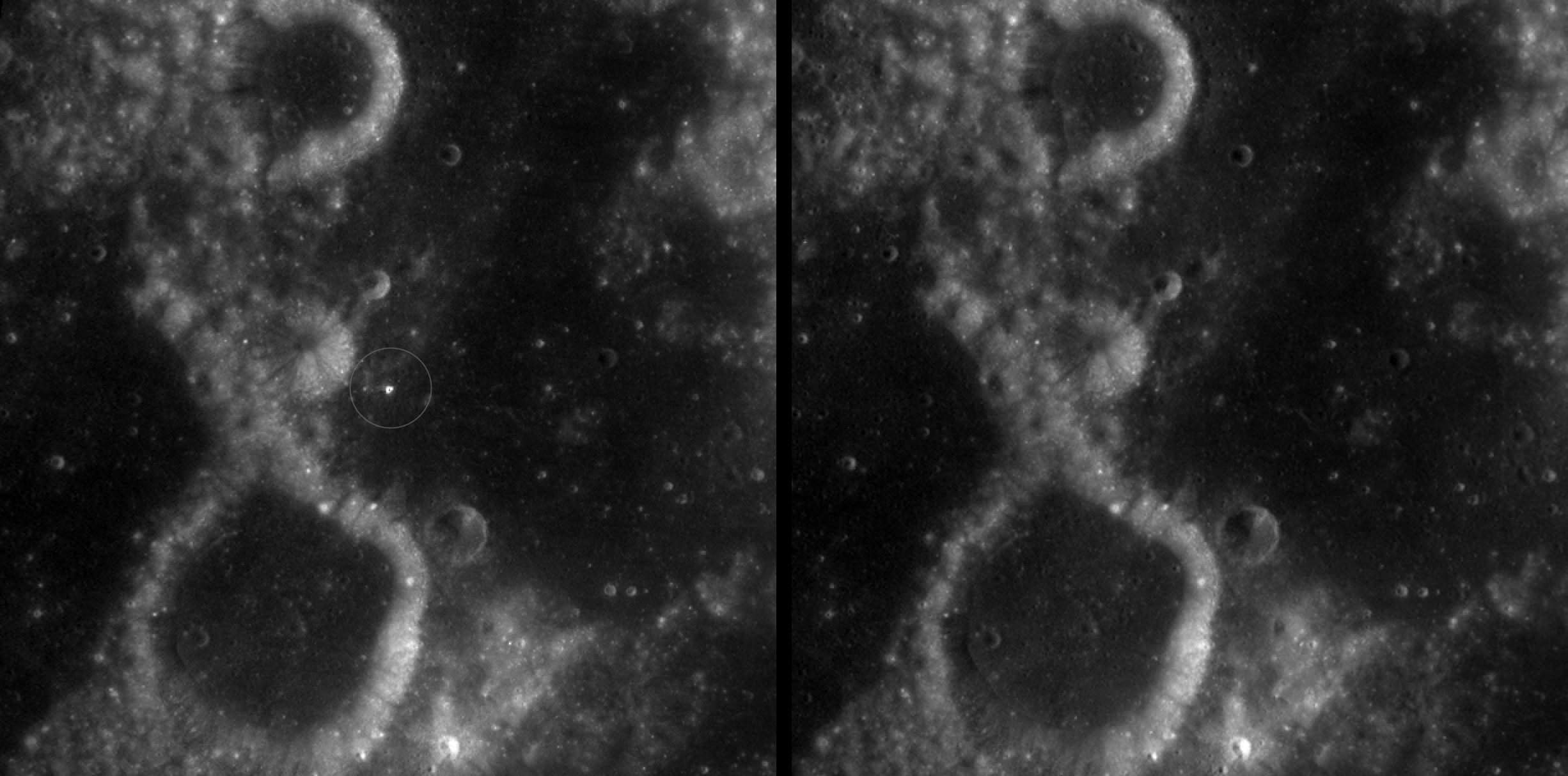
Two nearly identical black-and-white images appear side by side, separated by a vertical black line. Each shows a dark, uneven surface with scattered small circular depressions and several larger round formations with bright, raised rims. In the left image, a thin white circle marks a small, white spot near the center; there is no circled, white spot in the the corresponding area in the right image.
A zoomed-in view of McGetchin crater, circled on the left, next to a “before” image on the right. The panel on the left is made from images captured by NASA’s Lunar Reconnaissance Orbiter Wide-Angle Camera in summer 2025; the right panel was made from images taken in spring 2011. The white spot is not the crater itself, but rather material flung out of the crater, which formed when a rock, possibly this size of a three- to six‑story building, crashed into the Moon between April 11 and May 22, 2024 – a once-in-a-century event, as scientists reported on Sept. 15, 2026, in a pair of papers in Science Advances. The area shown in the images is 38 miles wide.
NASA Goddard/Intuitive Machines/Robert Wagner

Officially named McGetchin after pioneering lunar scientist Tom McGetchin, the crater formed on the Moon’s eastern edge sometime between April 11 and May 22, 2024, after a comet or asteroid the size of a three- to six-story building hit the surface.
 
The crash left a crater, 728 feet wide, that spans the length of two football fields. And at 141 feet deep, the crater could fit three vertically stacked yellow school buses.
 
Scientists estimate that an impact of this magnitude happens on the Moon about once in a century or even longer.

Moon takes some hits

For more than 17 years, LRO has been circling the Moon and using its seven instruments to map the topography, surface composition, temperature, and radiation environment there. The spacecraft’s team has identified at least 1,000 new impact craters throughout the mission and flagged 100,000 more surface changes from an object smashing into the Moon or from the debris that flung out after.

With no atmosphere to slow them or burn them up, space rocks and other objects easily reach the lunar surface. Most are much smaller compared to the object that carved out McGetchin crater. The smallest craters scientists can distinguish from LRO images are about 30 feet wide, the length of a three-story building laid on its side, made by rocks about 43 inches wide, the size of a monster-truck tire. Scientists estimate that impacts of this scale produce about 140 new craters across the Moon each year. But most new ones are made by microscopic projectiles that leave holes too small to identify in orbital images.

With its numerous instruments, the spacecraft can observe changes to the lunar surface that aren’t apparent in the LROC images alone. After the crater was discovered, scientists working with LRO’s thermal instrument, Diviner, made follow-up observations of the site. They found a 4-mile-wide area around the crater that is about 16 degrees Fahrenheit cooler at night than its surroundings.
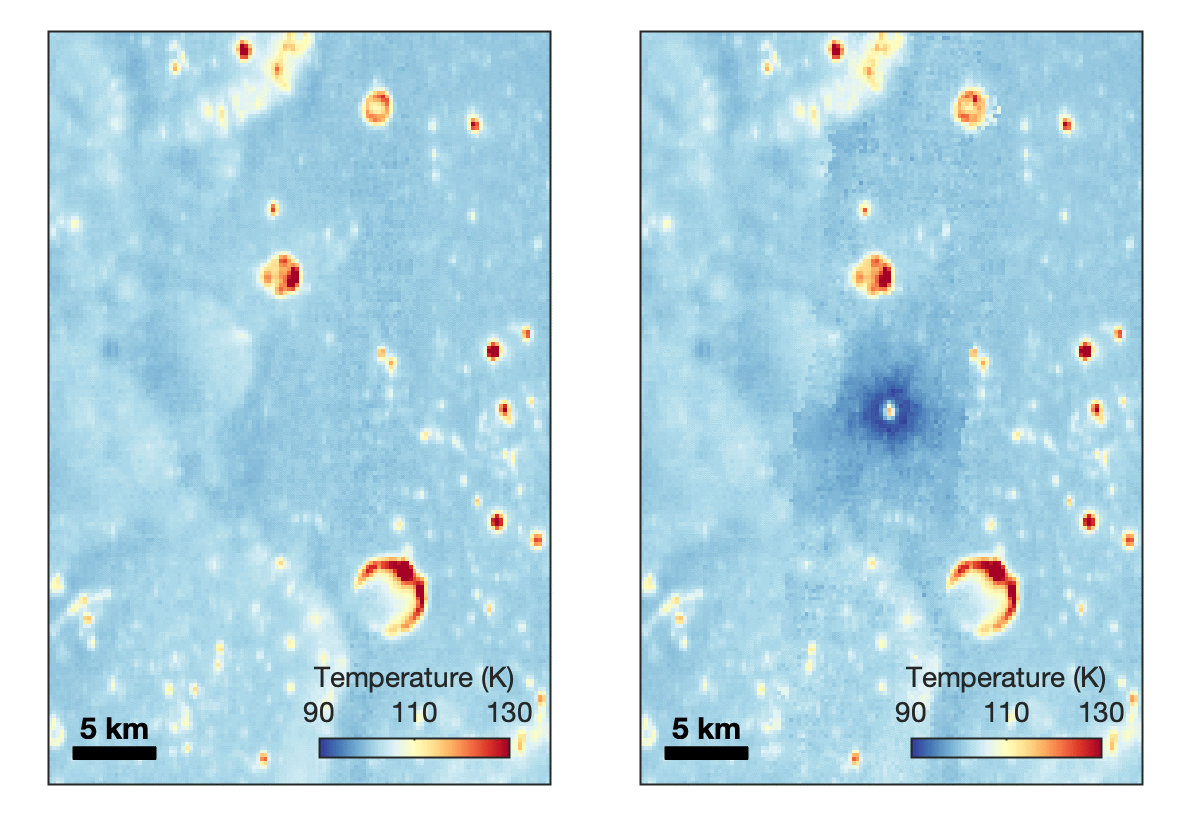
Animated temperature map that alternates between two images. A vertical strip through the center blinks on and off, revealing a dark blue circular area surrounding a small white spot near the middle. The pale blue map also contains scattered yellow, orange, and red spots and rings, including a large, curved red-and-yellow feature near the lower center. A 5-kilometer scale bar appears at lower left, and a color key ranges from 90 kelvin in dark blue to 130 kelvin in dark red.
This animated image set shows an area on the eastern limb of the Moon before and after McGetchin crater formed there sometime between April 11 and May 22, 2024. The post-impact image was constructed using data taken by NASA’s Lunar Reconnaissance Orbiter (LRO) thermal instrument, Diviner, between Nov. 15, 2025, and Feb. 18, 2026, after scientists discovered the crater in visible-light images taken by LRO’s Wide-Angle Camera. Pre-impact temperatures are from the Diviner Global High-Resolution Mosaics (GHRM). The crater formed on the Moon after a comet or asteroid, possibly the size of a six-story building, hit the surface in a rare, once-in-a-century collision. The dark blue strip that flashes into view reveals a 4-mile-wide “cold spot” around the crater that is about 16 degrees Fahrenheit cooler at night than its surroundings. This cooling happens because an impact fluffs up regolith around a crater, making it less dense and therefore less able to retain heat. Scientists on the Diviner team reported this finding in a paper published on Sept. 16, 2026, in Science Advances. The red and yellow spots indicate areas typically associated with rocks excavated by long-ago impacts which, though still at cryogenic temperatures like their surroundings, remain slightly warmer at night.
NASA Goddard/UCLA/JHU APL

Reporting in a second paper Wednesday in the same journal, researchers say that the cooling happens because the impact fluffs up the regolith around the crater, making it less dense and therefore less able to retain heat.

The large extent of this “cold spot” is striking, scientists say, because it shows that impacts can modify the Moon’s surface far beyond the crater itself. These physical changes could affect how rover wheels interact with the surface, for instance.
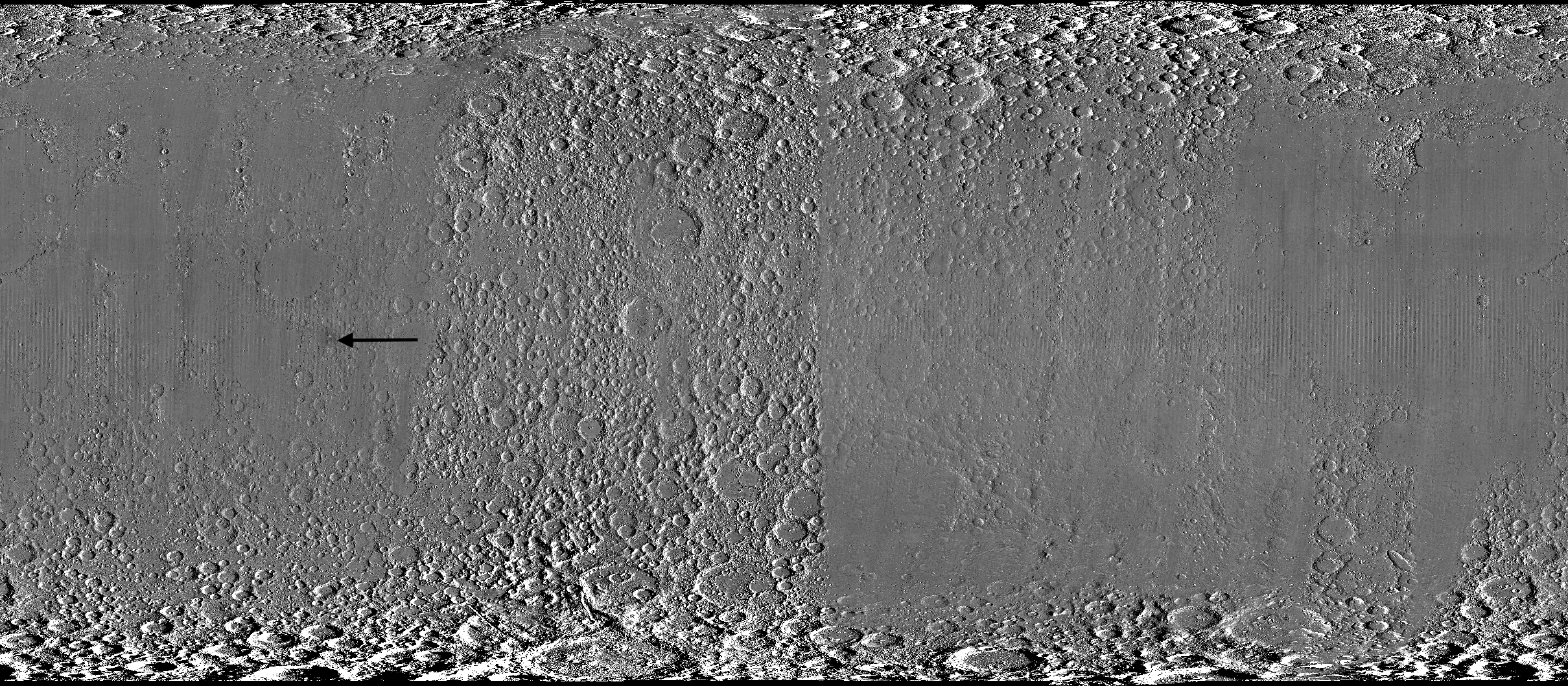
Wide black-and-white image of a rough, uneven surface densely covered with circular depressions and raised areas. The upper and lower edges are especially rugged, while the center is smoother and divided by subtle vertical bands. A black arrow left of center points toward a faint, narrow vertical mark.
A global view of the Moon made by stitching together hundreds of images from the Wide-Angle Camera aboard NASA’s Lunar Reconnaissance Orbiter (LRO). Robert Wagner, image processing specialist for LRO, made this map using two sets of mages taken several years apart. He used a software designed to highlight any changes between the two sets. Anything that stayed the same turned gray; anything different showed up as bright or dark patches. A black arrow just left of center points to McGetchin crater.
NASA Goddard/Intuitive Machines/Robert Wagner

Road to discovery

The LROC system collects images from about 60 miles above the Moon as LRO loops from pole to pole. The system includes two cameras that capture high‑resolution black‑and‑white images and one camera for moderate‑resolution multispectral images. Over the years and thousands of passes, scientists have built maps detailed enough to spot not only new craters, but also landslides, landers, seismic faults, and even hints of lava tubes.

LROC scientists regularly analyze close-up images of small portions of the Moon’s surface taken by the Narrow-Angle Camera. Using these images, they look for changes that are typically less than 30 feet across. But every few years the team searches for large (wider than 150 feet) features by creating global Moon maps and comparing them to older versions.

Square black-and-white image of a dark, uneven surface. At the center is a dark, roughly circular depression surrounded by a bright irregular area, with long streaks of lighter material radiating outward in all directions.
An overhead, close-up view of McGetchin crater that was taken on Dec. 5, 2025, by NASA’s Lunar Reconnaissance Orbiter (LRO) Narrow-Angle Camera (NAC). After the crater was discovered on Oct. 24, 2025, in global images from LRO’s Wide-Angle Camera, which captures broad views with pixels the size of American football fields, scientists turned to the NAC, which takes much sharper views at about 3 feet per pixel. The NAC images, taken as LRO flew over the impact site again, revealed the crater size, shape, and how the surrounding terrain was affected by the impact that carved McGetchin. The image covers an area that’s ¾ mile wide.
NASA Goddard/Intuitive Machines
Square black-and-white image of a dark, gently uneven surface scattered with small circular depressions. Near the center is a small oval crater with a bright raised rim and dark interior. Fine, bright streaks radiate outward from the crater across the surrounding surface.
This view from the side (55° away from straight down) towards the east, covers an area of the Moon that’s about 1.5 miles wide. It was taken by NASA’s Lunar Reconnaissance Orbiter Narrow-Angle Camera on March 3, 2026.
NASA Goddard/Intuitive Machines

That’s what Wagner was doing on Oct. 24, 2025, when he came across McGetchin. Using images from LROC’s Wide-Angle Camera, which captures broad views with pixels the size of football fields, he stacked hundreds of “before” and “after” frames with software designed to highlight change. Anything that stayed the same turned gray while anything different showed up as bright or dark patches.

While the process sounds straightforward, spotting real craters requires a lot of manual work. The software flags every tiny shift in lighting or shadow, generating hundreds of false alarms. For this reason, Wagner typically verifies the software, looking for small fuzzy halos around pixel‑wide bright points, which indicate splashes of regolith around a new crater.

Spanning hundreds of pixels, McGetchin stood out immediately. “It was by far the most obvious impact debris pattern I’ve ever seen in one of these images,” Wagner said.

After his discovery, scientists turned to the Narrow-Angle Camera, which takes much sharper views at about 3 feet per pixel. This camera’s close-up images, taken as LRO flew over the impact site again, revealed the crater size, shape, and how the surrounding terrain was affected. These images also helped researchers estimate the size and force of the rock fragment that formed the new crater, details that are expected to appear in a future paper.

Banner image caption: A zoomed-in view of the Moon, with debris around McGetchin crater visible as a white spot circled by a dark halo just right of center of the image (marked with black arrows). This is the view that Robert Wagner saw on Oct. 24, 2025, during a routine data-quality check. Wagner is an image processing specialist for NASA’s Lunar Reconnaissance Orbiter Camera, a system of three cameras. Using images from the Wide-Angle Camera (WAC), which captures broad views with pixels the size of American football fields, he stacked hundreds of images captured by WAC over the last several years with software designed to highlight change. Anything that stayed the same is gray; anything that changed showed up as bright or dark patches. The stripes in the image are due to slight changes in lighting between the older and newer images. This image composite shows an area of the Moon approximately 900 miles across.

About the Author

Lonnie Shekhtman

Lonnie Shekhtman

Senior Science Writer

Shekhtman helps communicate NASA planetary science to the world through news and feature stories on NASA.gov, videos for NASA+ and YouTube, and by working with the media. She reports on lunar and Mars science and exploration; NASA's search for life; missions to Venus, Titan, and Jupiter's Trojan asteroids; and many other topics related to NASA's exploration of our solar system and beyond.

Keep Exploring

Discover More Topics From NASA

Simplified Summary

Scientists discovered a crater on the Moon that formed sometime between April 11 and May 22, 2024, after a comet or asteroid the size of a three- to six-story building hit the surface.   The crash left a crater, 728 feet wide, that spans the length of two football fields. And at 141 feet deep, the crater could fit three vertically stacked yellow school buses.

The post NASA’s Moon Orbiter Spots New, ‘Once-in-Century’ Moon Crater appeared first on NASA Science.

NASA’s Moon Orbiter Spots New, ‘Once-in-Century’ Moon Crater

16 September 2026 at 19:06
6 Min Read

NASA’s Moon Orbiter Spots New, ‘Once-in-Century’ Moon Crater

Black-and-white image of a textured, cratered surface. Two black arrows near the center point inward toward a small, dark, circular feature.
A zoomed-in view of the Moon made from images from NASA’s Lunar Reconnaissance Orbiter Camera. (More information at the bottom of article.)
Credits:
NASA Goddard/Intuitive Machines/Robert Wagner

It started as a routine data-quality check. But as Robert Wagner, a scientist with NASA’s Lunar Reconnaissance Orbiter (LRO), scanned a giant Moon map on his computer screen, an unusually large bright spot circled by a dark halo caught his eye, as it implied that surface material in that area had been shaken up.

“I just stopped, dropped everything, and started looking into what that spot was,” said Wagner, an image-processing specialist from Intuitive Machines who works with data from the Lunar Reconnaissance Orbiter Camera (LROC) system.

By comparing before and after images of the Moon, Wagner realized he had discovered the largest, newly formed crater ever found in the solar system, as scientists reported Wednesday in Science Advances. This discovery highlights the value of NASA’s Moon orbiter data in studying a dynamic landscape as the agency advances a sustained human presence and expanded scientific and commercial activity on the Moon.

Two nearly identical black-and-white images appear side by side, separated by a vertical black line. Each shows a dark, uneven surface with scattered small circular depressions and several larger round formations with bright, raised rims. In the left image, a thin white circle marks a small, white spot near the center; there is no circled, white spot in the the corresponding area in the right image.
A zoomed-in view of McGetchin crater, circled on the left, next to a “before” image on the right. The panel on the left is made from images captured by NASA’s Lunar Reconnaissance Orbiter Wide-Angle Camera in summer 2025; the right panel was made from images taken in spring 2011. The white spot is not the crater itself, but rather material flung out of the crater, which formed when a rock, possibly this size of a three- to six‑story building, crashed into the Moon between April 11 and May 22, 2024 – a once-in-a-century event, as scientists reported on Sept. 15, 2026, in a pair of papers in Science Advances. The area shown in the images is 38 miles wide.
NASA Goddard/Intuitive Machines/Robert Wagner

Officially named McGetchin after pioneering lunar scientist Tom McGetchin, the crater formed on the Moon’s eastern edge sometime between April 11 and May 22, 2024, after a comet or asteroid the size of a three- to six-story building hit the surface.
 
The crash left a crater, 728 feet wide, that spans the length of two football fields. And at 141 feet deep, the crater could fit three vertically stacked yellow school buses.
 
Scientists estimate that an impact of this magnitude happens on the Moon about once in a century or even longer.

Moon takes some hits

For more than 17 years, LRO has been circling the Moon and using its seven instruments to map the topography, surface composition, temperature, and radiation environment there. The spacecraft’s team has identified at least 1,000 new impact craters throughout the mission and flagged 100,000 more surface changes from an object smashing into the Moon or from the debris that flung out after.

With no atmosphere to slow them or burn them up, space rocks and other objects easily reach the lunar surface. Most are much smaller compared to the object that carved out McGetchin crater. The smallest craters scientists can distinguish from LRO images are about 30 feet wide, the length of a three-story building laid on its side, made by rocks about 43 inches wide, the size of a monster-truck tire. Scientists estimate that impacts of this scale produce about 140 new craters across the Moon each year. But most new ones are made by microscopic projectiles that leave holes too small to identify in orbital images.

With its numerous instruments, the spacecraft can observe changes to the lunar surface that aren’t apparent in the LROC images alone. After the crater was discovered, scientists working with LRO’s thermal instrument, Diviner, made follow-up observations of the site. They found a 4-mile-wide area around the crater that is about 16 degrees Fahrenheit cooler at night than its surroundings.

Animated temperature map that alternates between two images. A vertical strip through the center blinks on and off, revealing a dark blue circular area surrounding a small white spot near the middle. The pale blue map also contains scattered yellow, orange, and red spots and rings, including a large, curved red-and-yellow feature near the lower center. A 5-kilometer scale bar appears at lower left, and a color key ranges from 90 kelvin in dark blue to 130 kelvin in dark red.
This animated image set shows an area on the eastern limb of the Moon before and after McGetchin crater formed there sometime between April 11 and May 22, 2024. The post-impact image was constructed using data taken by NASA’s Lunar Reconnaissance Orbiter (LRO) thermal instrument, Diviner, between Nov. 15, 2025, and Feb. 18, 2026, after scientists discovered the crater in visible-light images taken by LRO’s Wide-Angle Camera. Pre-impact temperatures are from the Diviner Global High-Resolution Mosaics (GHRM). The crater formed on the Moon after a comet or asteroid, possibly the size of a six-story building, hit the surface in a rare, once-in-a-century collision. The dark blue strip that flashes into view reveals a 4-mile-wide “cold spot” around the crater that is about 16 degrees Fahrenheit cooler at night than its surroundings. This cooling happens because an impact fluffs up regolith around a crater, making it less dense and therefore less able to retain heat. Scientists on the Diviner team reported this finding in a paper published on Sept. 16, 2026, in Science Advances. The red and yellow spots indicate areas typically associated with rocks excavated by long-ago impacts which, though still at cryogenic temperatures like their surroundings, remain slightly warmer at night.
NASA Goddard/UCLA/JHU APL

Reporting in a second paper Wednesday in the same journal, researchers say that the cooling happens because the impact fluffs up the regolith around the crater, making it less dense and therefore less able to retain heat.

The large extent of this “cold spot” is striking, scientists say, because it shows that impacts can modify the Moon’s surface far beyond the crater itself. These physical changes could affect how rover wheels interact with the surface, for instance.

Wide black-and-white image of a rough, uneven surface densely covered with circular depressions and raised areas. The upper and lower edges are especially rugged, while the center is smoother and divided by subtle vertical bands. A black arrow left of center points toward a faint, narrow vertical mark.
A global view of the Moon made by stitching together hundreds of images from the Wide-Angle Camera aboard NASA’s Lunar Reconnaissance Orbiter (LRO). Robert Wagner, image processing specialist for LRO, made this map using two sets of mages taken several years apart. He used a software designed to highlight any changes between the two sets. Anything that stayed the same turned gray; anything different showed up as bright or dark patches. A black arrow just left of center points to McGetchin crater.
NASA Goddard/Intuitive Machines/Robert Wagner

Road to discovery

The LROC system collects images from about 60 miles above the Moon as LRO loops from pole to pole. The system includes two cameras that capture high‑resolution black‑and‑white images and one camera for moderate‑resolution multispectral images. Over the years and thousands of passes, scientists have built maps detailed enough to spot not only new craters, but also landslides, landers, seismic faults, and even hints of lava tubes.

LROC scientists regularly analyze close-up images of small portions of the Moon’s surface taken by the Narrow-Angle Camera. Using these images, they look for changes that are typically less than 30 feet across. But every few years the team searches for large (wider than 150 feet) features by creating global Moon maps and comparing them to older versions.

Square black-and-white image of a dark, uneven surface. At the center is a dark, roughly circular depression surrounded by a bright irregular area, with long streaks of lighter material radiating outward in all directions.
An overhead, close-up view of McGetchin crater that was taken on Dec. 5, 2025, by NASA’s Lunar Reconnaissance Orbiter (LRO) Narrow-Angle Camera (NAC). After the crater was discovered on Oct. 24, 2025, in global images from LRO’s Wide-Angle Camera, which captures broad views with pixels the size of American football fields, scientists turned to the NAC, which takes much sharper views at about 3 feet per pixel. The NAC images, taken as LRO flew over the impact site again, revealed the crater size, shape, and how the surrounding terrain was affected by the impact that carved McGetchin. The image covers an area that’s ¾ mile wide.
NASA Goddard/Intuitive Machines
Square black-and-white image of a dark, gently uneven surface scattered with small circular depressions. Near the center is a small oval crater with a bright raised rim and dark interior. Fine, bright streaks radiate outward from the crater across the surrounding surface.
This view from the side (55° away from straight down) towards the east, covers an area of the Moon that’s about 1.5 miles wide. It was taken by NASA’s Lunar Reconnaissance Orbiter Narrow-Angle Camera on March 3, 2026.
NASA Goddard/Intuitive Machines

That’s what Wagner was doing on Oct. 24, 2025, when he came across McGetchin. Using images from LROC’s Wide-Angle Camera, which captures broad views with pixels the size of football fields, he stacked hundreds of “before” and “after” frames with software designed to highlight change. Anything that stayed the same turned gray while anything different showed up as bright or dark patches.

While the process sounds straightforward, spotting real craters requires a lot of manual work. The software flags every tiny shift in lighting or shadow, generating hundreds of false alarms. For this reason, Wagner typically verifies the software, looking for small fuzzy halos around pixel‑wide bright points, which indicate splashes of regolith around a new crater.

Spanning hundreds of pixels, McGetchin stood out immediately. “It was by far the most obvious impact debris pattern I’ve ever seen in one of these images,” Wagner said.

After his discovery, scientists turned to the Narrow-Angle Camera, which takes much sharper views at about 3 feet per pixel. This camera’s close-up images, taken as LRO flew over the impact site again, revealed the crater size, shape, and how the surrounding terrain was affected. These images also helped researchers estimate the size and force of the rock fragment that formed the new crater, details that are expected to appear in a future paper.

Banner image caption: A zoomed-in view of the Moon, with debris around McGetchin crater visible as a white spot circled by a dark halo just right of center of the image (marked with black arrows). This is the view that Robert Wagner saw on Oct. 24, 2025, during a routine data-quality check. Wagner is an image processing specialist for NASA’s Lunar Reconnaissance Orbiter Camera, a system of three cameras. Using images from the Wide-Angle Camera (WAC), which captures broad views with pixels the size of American football fields, he stacked hundreds of images captured by WAC over the last several years with software designed to highlight change. Anything that stayed the same is gray; anything that changed showed up as bright or dark patches. The stripes in the image are due to slight changes in lighting between the older and newer images. This image composite shows an area of the Moon approximately 900 miles across.

About the Author

Lonnie Shekhtman

Lonnie Shekhtman

Senior Science Writer

Shekhtman helps communicate NASA planetary science to the world through news and feature stories on NASA.gov, videos for NASA+ and YouTube, and by working with the media. She reports on lunar and Mars science and exploration; NASA’s search for life; missions to Venus, Titan, and Jupiter’s Trojan asteroids; and many other topics related to NASA’s exploration of our solar system and beyond.

Keep Exploring

Discover More Topics From NASA

Simplified Summary

Scientists discovered a crater on the Moon that formed sometime between April 11 and May 22, 2024, after a comet or asteroid the size of a three- to six-story building hit the surface.
 
The crash left a crater, 728 feet wide, that spans the length of two football fields. And at 141 feet deep, the crater could fit three vertically stacked yellow school buses.

Celebrate International Observe the Moon Night with NASA

15 September 2026 at 17:15

In April, the world watched as four humans circled the Moon for the first time in over 50 years with NASA’s Artemis II mission. On Saturday, Sept. 19, the public is invited to look up again with NASA events across the country, including the International Observe the Moon Night celebration held at NASA’s Goddard Space Flight Center Visitor Center in Greenbelt, Maryland.

Graphic advertising International Observe the Moon Night.
This year, NASA will celebrate International Observe the Moon Night with people around the world on Sept. 19.
NASA/Vi Nguyen

International Observe the Moon Night is an annual celebration that brings people together to learn about the Moon and explore our connection to Earth’s nearest celestial neighbor. Since the program began in 2010, people around the world have participated through lunar observations, hands-on activities, artwork, music, and more.
 
At NASA Goddard, this year’s celebration will highlight the agency’s ongoing exploration of the Moon, including the historic Artemis II mission. Visitors can peer behind the scenes to learn more about what it took to make Artemis II’s journey around the Moon a success and discover how Goddard scientists and engineers are helping advance our understanding of the Moon, solar system, and beyond.
 
The event will run from 6 p.m. to 9 p.m. EDT.
 
Throughout the event at NASA Goddard, visitors can take part in interactive hands-on activities, create artwork and crafts, and capture selfies at a photo kiosk. Telescopes will also be set up outside (depending on weather), giving attendees an opportunity to observe the Moon and other astronomical objects up close. Inside the Visitor Center, guests can even see a real Apollo 14 Moon rock on display.

  • At 6:30 p.m., Dr. Amanda Nahm, planetary scientist at NASA Headquarters, will explore the lunar science and Moon joy from Artemis II.
  • At 7:30 p.m., Ernie Wright, scientific visualizer at NASA Goddard, will offer a more technical look at how scientists use real data to create videos and visualizations of the Moon.
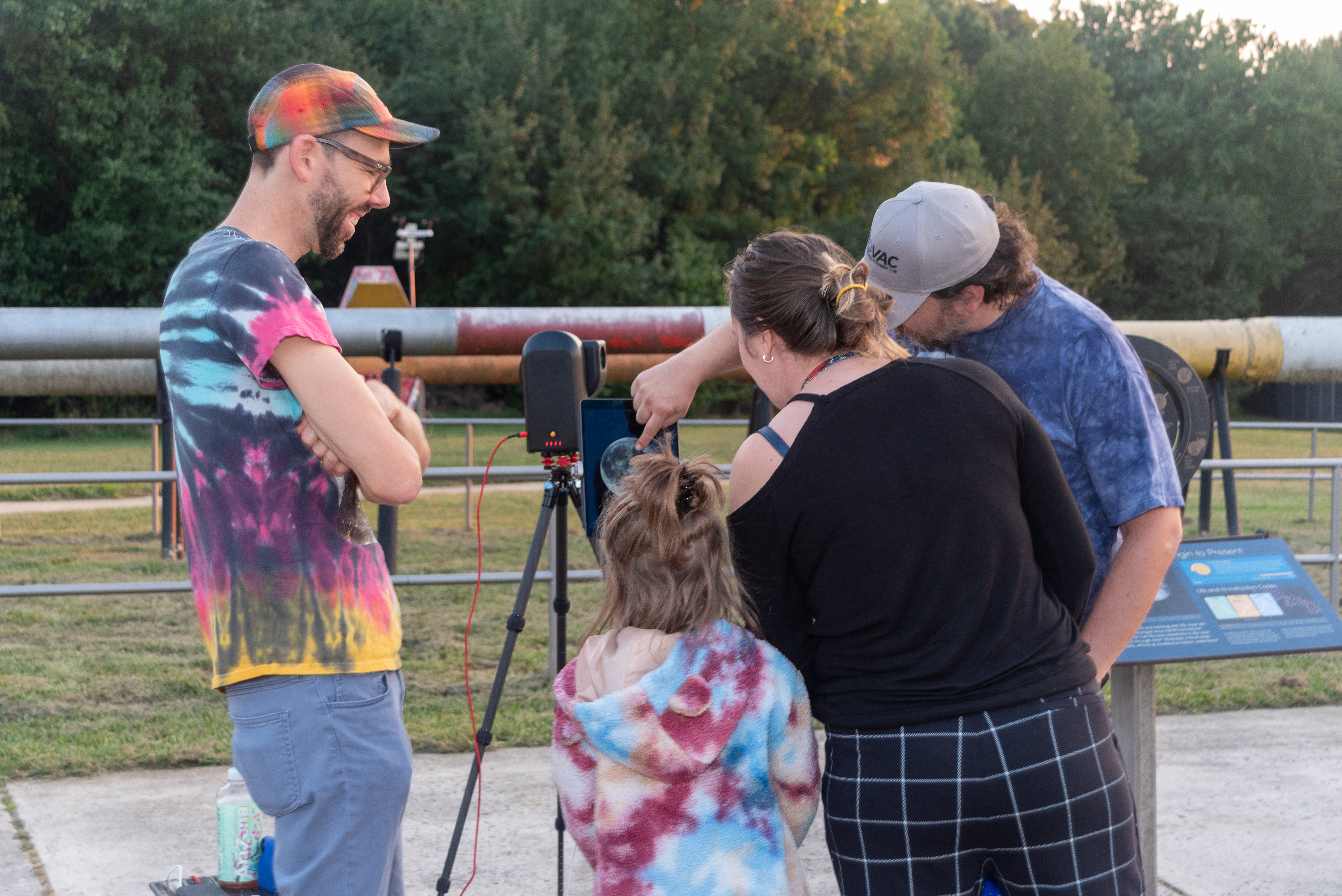
A child and two adults look at a tablet screen with a telescope’s display showing the full Moon. Another person stands to the left, smiling and looking on.
A family observes the Moon through a telescope at NASA’s Goddard Space Flight Center in Greenbelt, Md. during the International Observe the Moon Night celebration on Saturday, Sept. 14, 2024.
NASA/Britt Griswold

The event will also offer a chance to learn more about the groundbreaking research happening at NASA Goddard as scientists work to unlock the secrets of the Moon with missions like the Lunar Reconnaissance Orbiter (LRO) and explore our solar system and the universe beyond.
 
International Observe the Moon Night at Goddard is free and family friendly. Registration is not required, although registering in advance will help the Visitor Center team plan for the event. The event will take place rain or shine, and free parking is available at the Visitor Center.
 
Additional event details, including registration, accessibility and other logistics: https://www.nasa.gov/goddard/visitor-center/events-and-programs/.
 
For people who cannot travel to Greenbelt, there are opportunities to participate in International Observe the Moon Night from all around the planet. Join lunar observers around the world by observing the Moon with friends and family, attending a virtual event or finding an event in your area. Learn more and register your participation at go.nasa.gov/ObserveTheMoon.
 
International Observe the Moon Night is sponsored by NASA’s LRO mission and the Solar System Exploration Division of NASA’s Goddard Space Flight Center, with support from many partners. The celebration is a way for people to pause and look up at our future destination, as NASA prepares for deep space missions to the Moon and beyond.
 
To learn about NASA’s Artemis program, visit:
https://www.nasa.gov/artemis
 
To learn about LRO, visit:
https://www.nasa.gov/lro

Share

Details

Last Updated
Sep 15, 2026

Dr. Delia Santiago-Materese

9 September 2026 at 15:00
Dr. Delia Santiago-Materese in her office. A model of Jupiter and the Juno spacecraft rest on a shelf on the left.

Dr. Delia Santiago-Materese

Program Scientist

Dr. Delia Santiago-Materese wants things to get complex

From terrestrial animals to experiments in microgravity and Martian clouds, this NASA program scientist’s career path links diverse challenges. Today, she supports a mission to Saturn’s moon Titan, a world teeming with organic molecules that could hold valuable clues about the origin of life.

When novelty is your hobby, you already have a large part of the recipe for a career full of challenges. That is why Dr. Delia Santiago-Materese describes her path within NASA as “meandering.” Her diverse roles have taken her to low Earth orbit, to the clouds of Mars, and to the surroundings of Jupiter. Now, they are also bringing her closer to the surface of Titan, an intriguing moon of Saturn. Woven together by her exploring spirit and a perennial curiosity, all these experiences have one point in common: life.

Today, Santiago-Materese is part of the Planetary Science Division at NASA Headquarters in Washington. The main decoration in her office is a model of Jupiter, larger than a basketball, resting next to a scale model of the spacecraft exploring it, Juno. Small black and red pins with the inscription “Dragonfly” rest in the center of a round table. Several framed diplomas cover a wall. From here, Santiago-Materese does “a little bit of everything” on any given workday as a program scientist for the Juno and Dragonfly missions, and for the Discovery program, which features a portfolio of several missions in our cosmic neighborhood.

This medley of roles is no coincidence. Santiago-Materese describes herself as someone who does not pursue a single goal, but rather diverse interests that she discovers along the way. “I am always looking for something new to add to my experiences,” she says, “because I think I also get bored easily.”

Dr. Delia Santiago-Materese outside of her office, holding a model of Jupiter.
Santiago-Materese holds her model of Jupiter, just outside her office. As a program scientist for Juno—a mission studying this planet—for Dragonfly, and for the Discovery program, she guides these projects by promoting leadership based on kindness and respect: “Every person brings something unique.”
NASA/Noelia González

The daughter of a military family, Santiago-Materese was born in Spain by coincidence. Her roots are actually on another continent: her mother is Mexican-American and her father is Puerto Rican. From her time in Spain, she only keeps some baby photos; she lived part of her life in Texas and then in California, which she considers her home—despite having spent her childhood summers in San Sebastián, Puerto Rico. It was in the Golden State where she first imagined herself as a veterinarian and decided to study Biological Sciences. And it was during her studies at Stanford University, “just around the corner” from NASA’s Ames Research Center in California’s Silicon Valley, that Santiago-Materese discovered astrobiology.

This elective course brought her closer to a discipline that, to some extent, was in its infancy. Today, NASA’s Astrobiology Program investigates life in the universe on many levels: how it began, how it evolved here on Earth, and where it might exist elsewhere. And that was how Santiago-Materese realized that biology and space were not two isolated things, she recounts.

Rodents, Insects, and Martian Clouds

After finishing her studies, Santiago-Materese completed a one-year internship at the San Francisco Zoo. But the unknown that astrobiology presents continued to intrigue her, so she went back to one of her professors to inquire more about it. She asked around and found someone at Lockheed Martin, a company that often contracts with NASA on space projects. They were looking for people for a new project studying the nutrition of the food bars for rodents traveling to space aboard the space shuttle.

Santiago-Materese has applied that formula ever since: identifying what truly interests her and finding the right person to ask questions. If people “don’t know what you’re interested in, they can’t help you,” she explains. After experience with the Space Shuttle Program, including managing databases for science payloads aboard the space shuttle, she went on to work with the International Space Station, which was then beginning its legacy of over 25 years in Earth orbit. She supported the development of biological experiments in microgravity, this time with fruit flies. But Santiago-Materese wanted to keep moving farther from Earth and investigate future space destinations.

This curiosity led her to the Martian sky. As part of her graduate studies at the University of California, Santa Cruz, Santiago-Materese investigated the Martian atmosphere, focusing on ice in the clouds and the development of climate models for the Red Planet. She earned her master’s degree and would later return to complete her doctorate under the NASA Pathways program, which is one of the agency’s primary early-career hiring pathways. She would defend her thesis six months after giving birth to her first daughter (one of the achievements she is most proud of, she says). That is why, although she loves the “weird” planets of the outer solar system, she is “more of a Mars person,” by training.

Dr. Santiago-Materese on a rocky surface in Hawaii.
During her NASA career, Santiago-Materese traveled to Hawaii to investigate a planetary analog, a type of terrestrial environment that has very similar characteristics to those we might find on other worlds.
Image credit: Delia Santiago-Materese

At NASA Ames, Santiago-Materese held various roles, ranging from social media and open science to lunar sciences. She then became a program officer for the Solar System Workings program in the Planetary Science Division at NASA Headquarters as part of a detail, or temporary assignment. And then, she took off for Maryland along with her family.

Enabling Science

Santiago-Materese sums up her current role as a program scientist as the “science liaison” between NASA Headquarters and a mission. “When you do program scientist work, you might not be specialized or an expert in the exact science, but you need to be able to understand it and talk about it, to understand its importance,” she explains. “In general, we are supporting other people so they can do science.” In this endeavor, being someone who “gets more energy from working with people” is useful… and necessary: “You are having conversations all day long” with colleagues from different disciplines— from science and engineering to finance.

The Juno mission, in orbit around Jupiter since 2016, and Dragonfly, which is scheduled to launch no earlier than July 2028, are part of NASA’s New Frontiers program. Santiago-Materese also oversees the array of missions in the Discovery program, which includes ongoing science missions like Psyche and Lucy—heading to different asteroids—and future missions to Venus.

For Santiago-Materese, sharing her unconventional path can be valuable for students and youth in general, especially those who are unsure of what they want to do. “Your dream job,” she says, “you might not know it exists, or maybe it doesn’t exist today.” Beyond that, this zigzagging path has led her to accumulate experiences and relationships with different people, which she treasures even as she sets off for her next destination.

An Alien World

About two years out from Dragonfly’s launch, it is no surprise that this robotic mission takes up much of Santiago-Materese’s time. “Dragonfly feels like a combination of all my different experiences over time,” she reflects. And it signifies, to some extent, a return to her roots: it is an astrobiology mission. Although not designed to detect life, Dragonfly will investigate prebiotic chemistry: the chemical processes that could have led to the emergence of life on Earth.

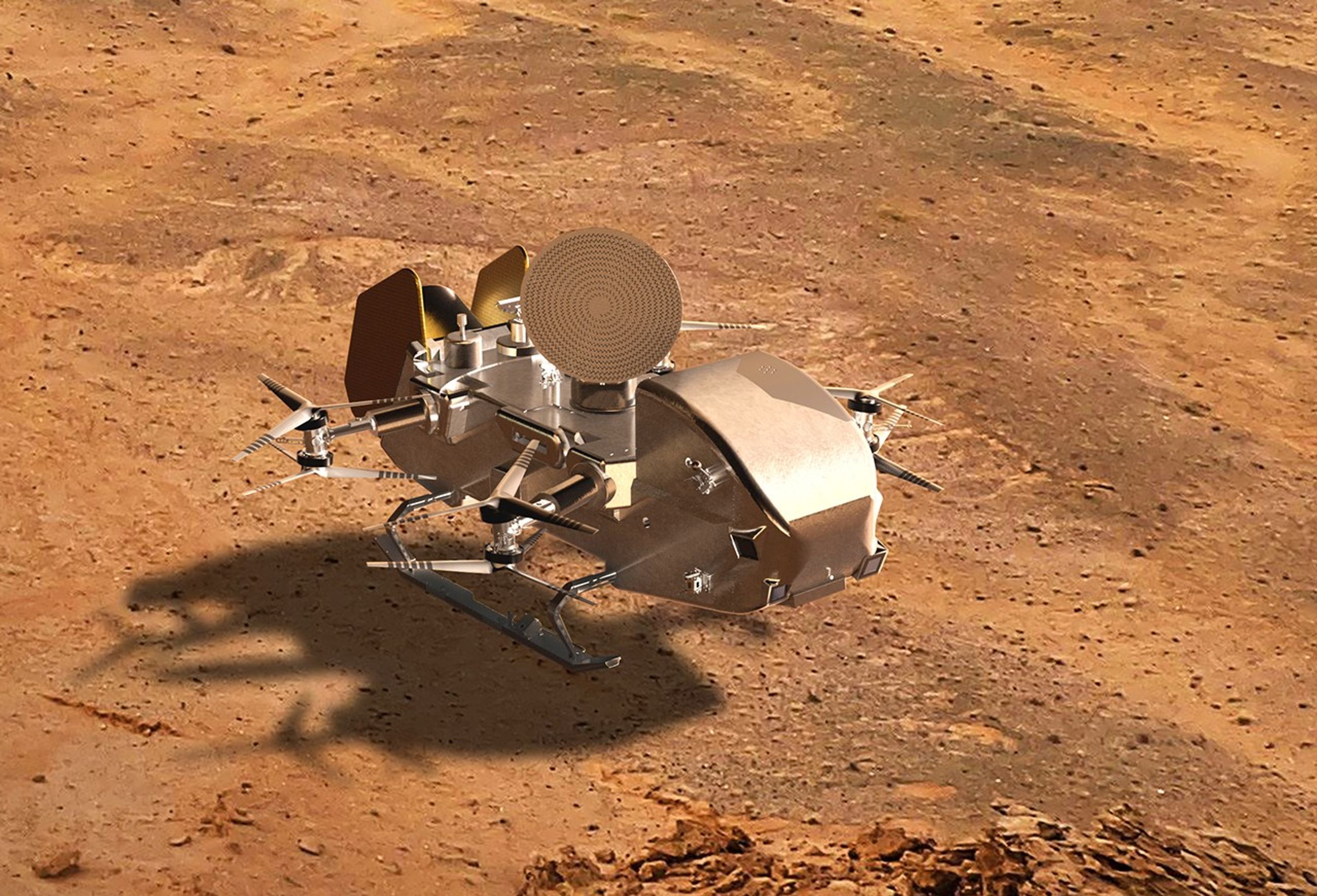
Artist's concept of NASA's Dragonfly on the surface of Saturn's moon Titan.
Digital concept of NASA’s Dragonfly lander on the surface of Saturn’s moon Titan.
NASA/Johns Hopkins APL/Steve Gribben

Dragonfly will embark on a journey of about six years to the surface of Titan. The spacecraft will carry an array of science instruments and will be the first NASA science mission to explore another world by flying from location to location. This car-sized rotorcraft will touch down at various geological sites of interest to analyze the moon’s composition and its habitability potential.

When it arrives at Titan, it will encounter a landscape that is strange and familiar at the same time: it could be a window into Earth’s remote past. This frozen world has a thick atmosphere and clouds drifting across the sky; dunes, lakes, rivers, canyons and mountains. Titan even has a process equivalent to our water cycle. However, on Titan, it is not water that flows but hydrocarbons, primarily methane and ethane. “It’s a more methane-based chemistry, so it is very alien, and that is what I really love about Titan,” says Santiago-Materese. And on this moon, organic molecules abound.

These molecules contain carbon and are used by all known forms of life. They are fundamental to understanding the origin of life, as they can be produced by both biological and non-biological processes. On Titan, these organic molecules fall to the surface and form dense deposits over its bedrock of water ice. Scientists believe that the complex chemistry precursor to life could be triggered there if provided with a little liquid water, such as that generated by an asteroid impact.

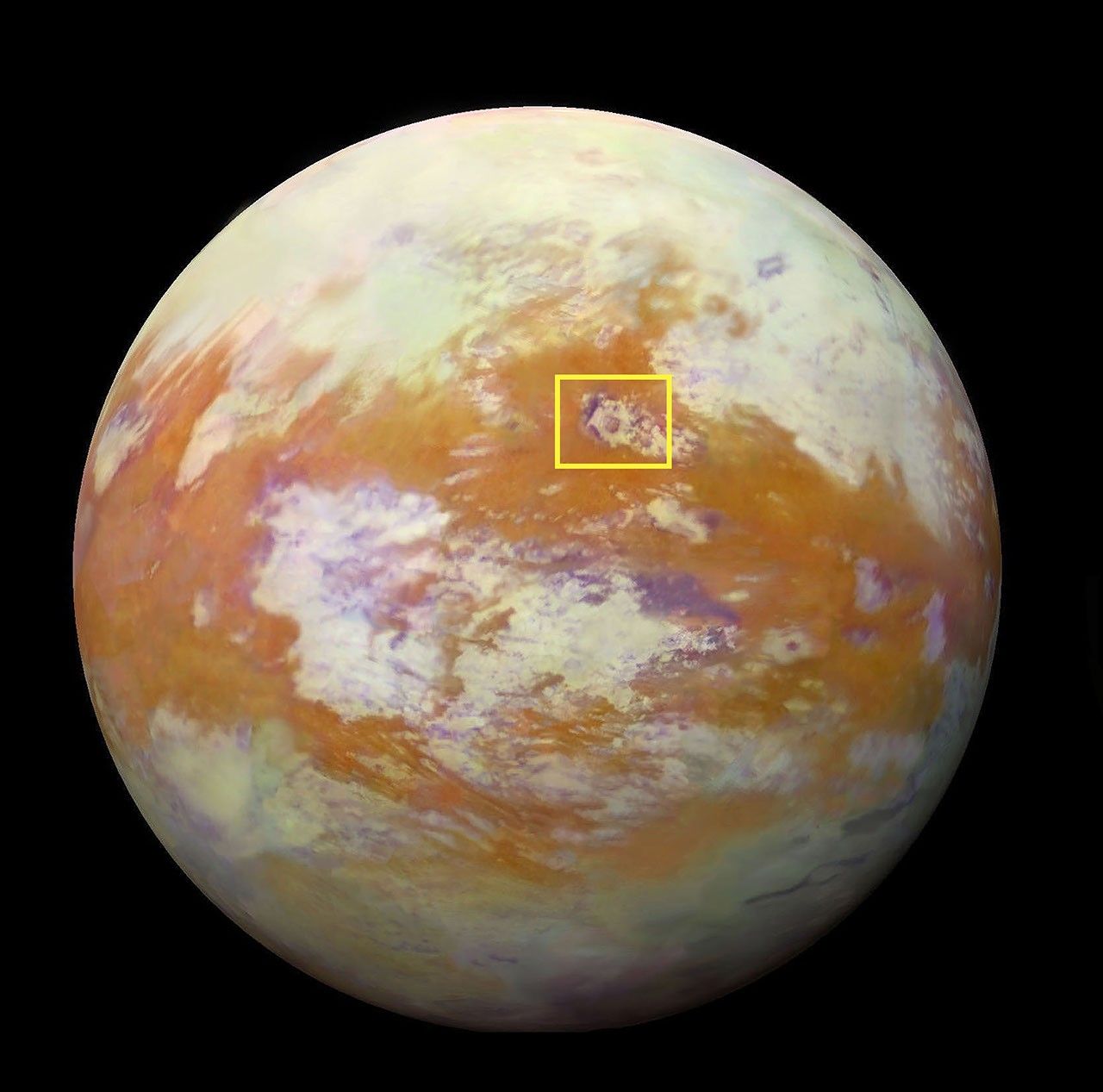
Selk crater, a 50-mile-wide impact site highlighted on this infrared image of Titan.
Selk Crater, an 80-kilometer (50-mile) diameter impact site highlighted in this infrared image of Titan, is a key destination for Dragonfly. The rotorcraft will touch down near Selk and explore various sites, analyzing the surface chemistry to investigate the frozen remains of what could have been prebiotic chemistry in development.
NASA/JPL-Caltech/University of Nantes/University of Arizona

Santiago-Materese is especially excited about what the Dragonfly Mass Spectrometer (DraMS) instrument will help discover. DraMS, designed and built at NASA’s Goddard Space Flight Center in Greenbelt, Maryland, will analyze samples from Titan’s surface. “The more complex things get, the more interesting things happen,” she says. “So I’m curious: just how complex do the molecules get? Will we find any interesting patterns?”

But in science, every time you ask a question, a new one arises. Dragonfly will try to answer several of them. “When you have a planet with complex chemistry but not life, what happens? What is there before life?” the program scientist wonders.

Titan, a valuable natural laboratory, “is going to completely change our understanding of what another world can be like,” she anticipates. In addition to what the scientific community expects to discover thanks to Dragonfly, Santiago-Materese is interested in the potential unexpected findings. “There are very defined science goals, but a lot of it is exploratory work,” she explains. “It is kind of nice to know that there is a big range [of possibilities], that we could be very surprised.”

By Noelia González, NASA’s Goddard Space Flight Center, Greenbelt, Maryland

Lee esta historia en español aquí.

The post Dr. Delia Santiago-Materese appeared first on NASA Science.
What’s Up: August 2026 Skywatching Tips from NASA

31 July 2026 at 23:35

A solar eclipse, the Perseids, bright Venus after sunset, and a deep partial lunar eclipse highlight August’s skywatching.

Skywatching Highlights

  • Aug. 5: Last Quarter Moon
  • Aug. 12: Total solar eclipse across northern Russia, Greenland, Iceland, northern Spain, and part of Portugal; partial eclipse in parts of the U.S.; New Moon
  • Aug. 12-13: Perseid meteor shower peak under dark skies
  • Aug. 14-16: Venus reaches greatest eastern elongation and shines low in the west after sunset
  • Aug. 27-28: Partial lunar eclipse visible from much of North and South America and parts of Europe and Africa

Transcript

A solar eclipse, one of the year’s best meteor showers, Venus at its brightest in the evening sky, and a lunar eclipse to close out the month.

That’s “What’s Up” for August.

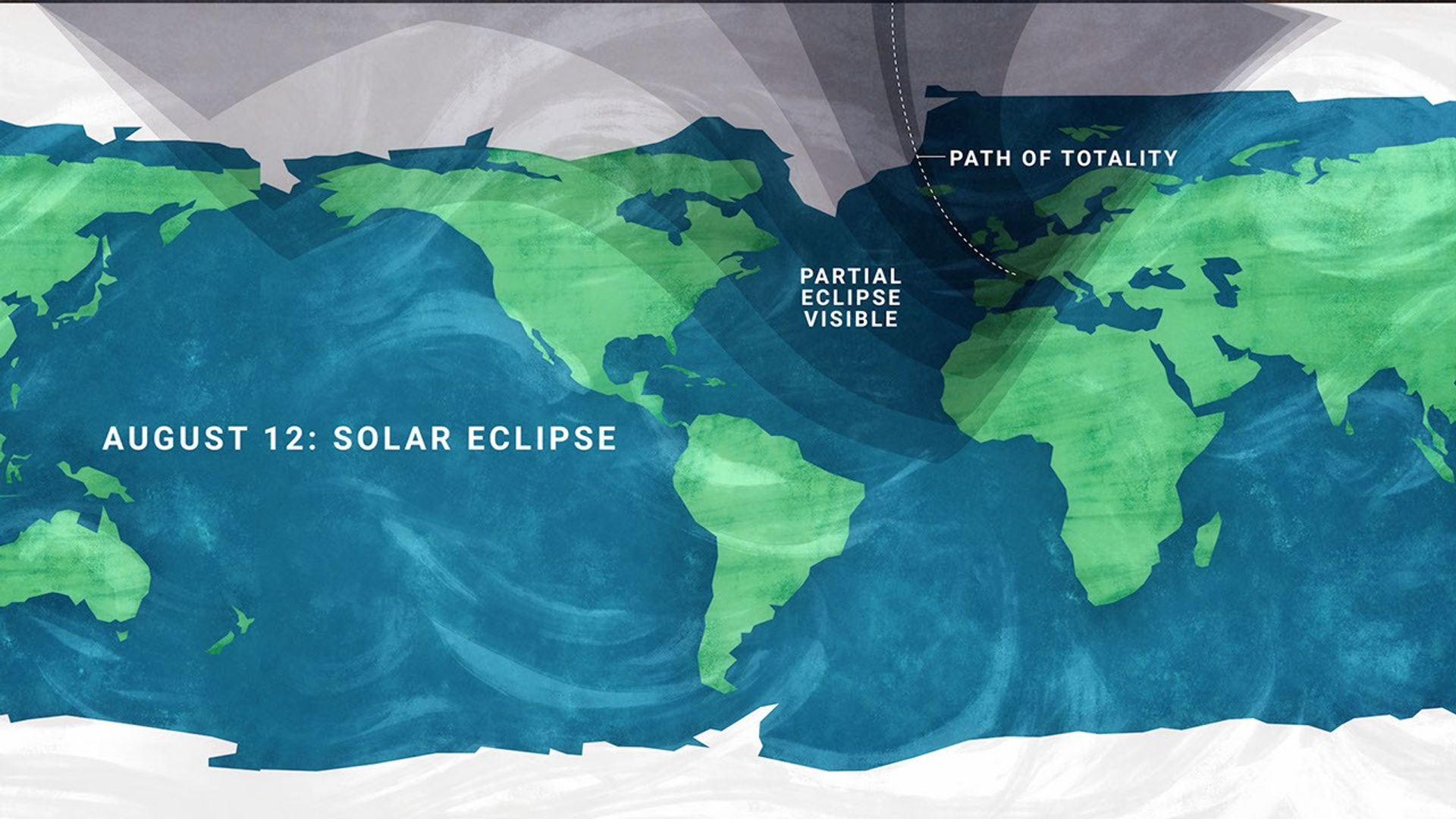
On Aug. 12, a total solar eclipse crosses northern Russia, Greenland, Iceland, and northern Spain, with a small corner of Portugal inside the path of totality.

In parts of the United States, from Alaska to North Carolina, the eclipse is partial. The Moon will take only a small bite out of the Sun, and the amount of coverage will vary with location.

A stylized flat map of the Earth indicating the viewing areas for a solar eclipse, with text on the left reading 'AUGUST 12: SOLAR ECLIPSE'. A semi-transparent dark shadow covers the northern portion of the globe, fanning out from the top edge. Within this shadow, a thin dotted line arcs down from the Arctic, crossing near Greenland and Iceland, passing over the Iberian Peninsula (Spain and Portugal), and ending near the Mediterranean Sea; this line is labeled 'PATH OF TOTALITY'. The broader shaded region surrounding this line is labeled 'PARTIAL ECLIPSE VISIBLE', and it covers northern North America, the Arctic, all of Europe, northern Africa, and northern and western Asia. The unshaded regions covering the rest of the map, including most of the United States, South America, central and southern Africa, and Australia, indicate areas where the eclipse will not be visible.
A map showing viewing areas of the August 2026 total solar eclipse.
NASA/JPL-Caltech

Remember to watch safely. Use certified eclipse glasses or a safe solar viewer any time any part of the Sun is visible. Regular sunglasses are not safe. And never use binoculars, a telescope, or a camera without a solar filter made for the front of the optics.

Later that same night, the Perseid meteor shower will light up the sky, peaking the evening of Aug. 12 into the early morning hours of the 13th. And with a New Moon arriving on the 12th, the skies will be ideally dark.

The Perseids happen every year when Earth passes through a debris stream left behind by Comet Swift-Tuttle. As those tiny bits of comet dust hit our atmosphere at high speed, they burn up as bright streaks of light.

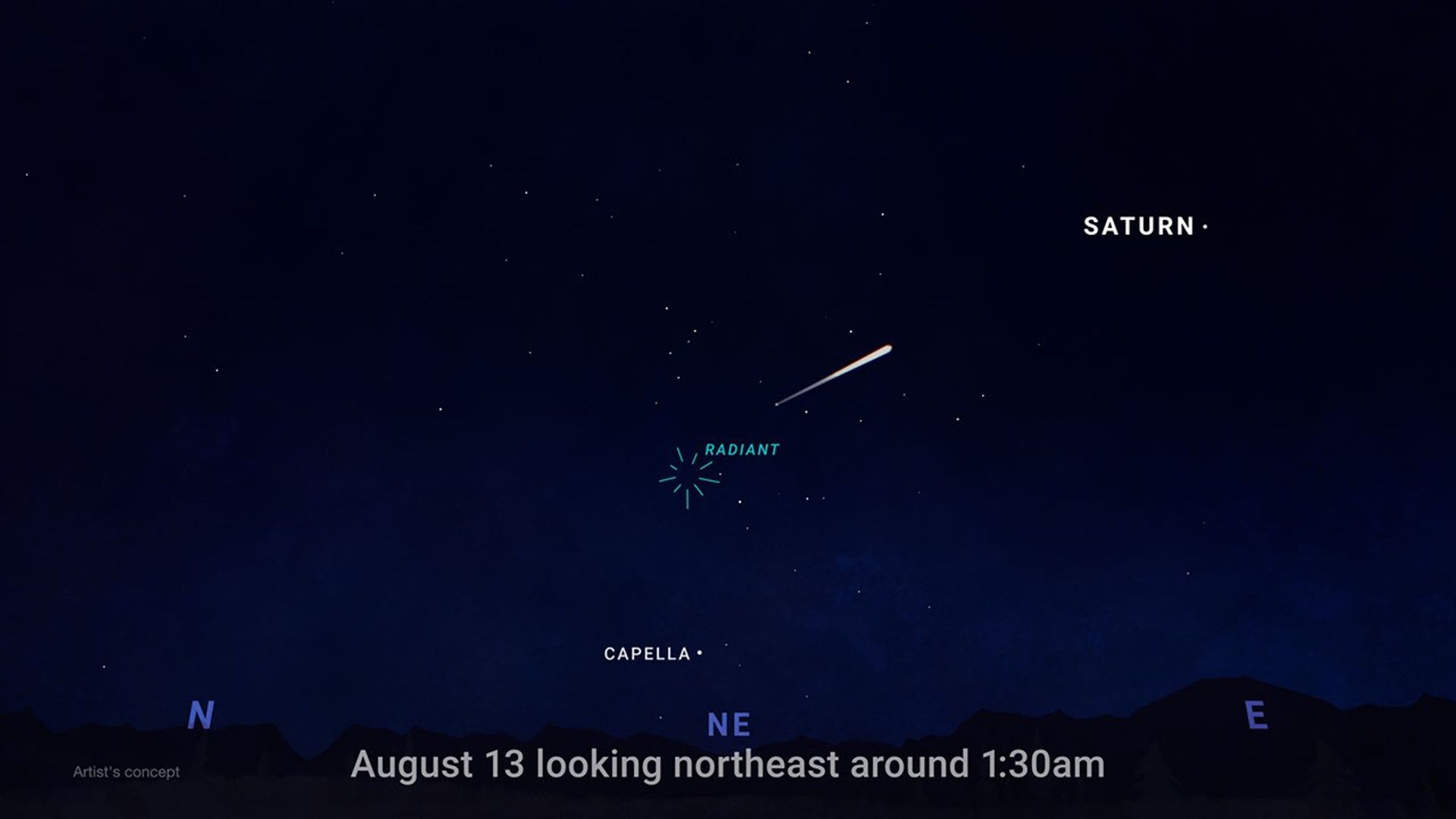
To view this meteor shower, look toward the northeast once it’s fully dark and watch for the constellation Perseus to clear the horizon. This is where the meteors originate, but let your eyes wander, because they can flash across any part of the sky.

For the best view, stay out late as the stars climb higher, find a dark open spot, and give your eyes 30 minutes to adjust.

An illustration of the night sky showing where to look for meteors, with text at the bottom reading 'August 13 looking northeast around 1:30am.' The bottom of the image shows a dark, silhouetted horizon of hills, marked with blue compass directions N (North), NE (Northeast), and E (East). In the center of the sky above NE is a teal burst icon labeled 'RADIANT,' indicating the point from which meteors appear to originate. A bright, white meteor streaks across the dark, starry sky, pointing back toward the radiant. Two other bright celestial objects are labeled: the star 'CAPELLA' is situated low in the sky below the radiant, and the planet 'SATURN' is positioned high up in the upper right corner. Small text in the bottom left corner reads 'Artist's concept.'
This illustration shows where in the night sky to look for the Perseid meteor shower.
NASA/JPL-Caltech

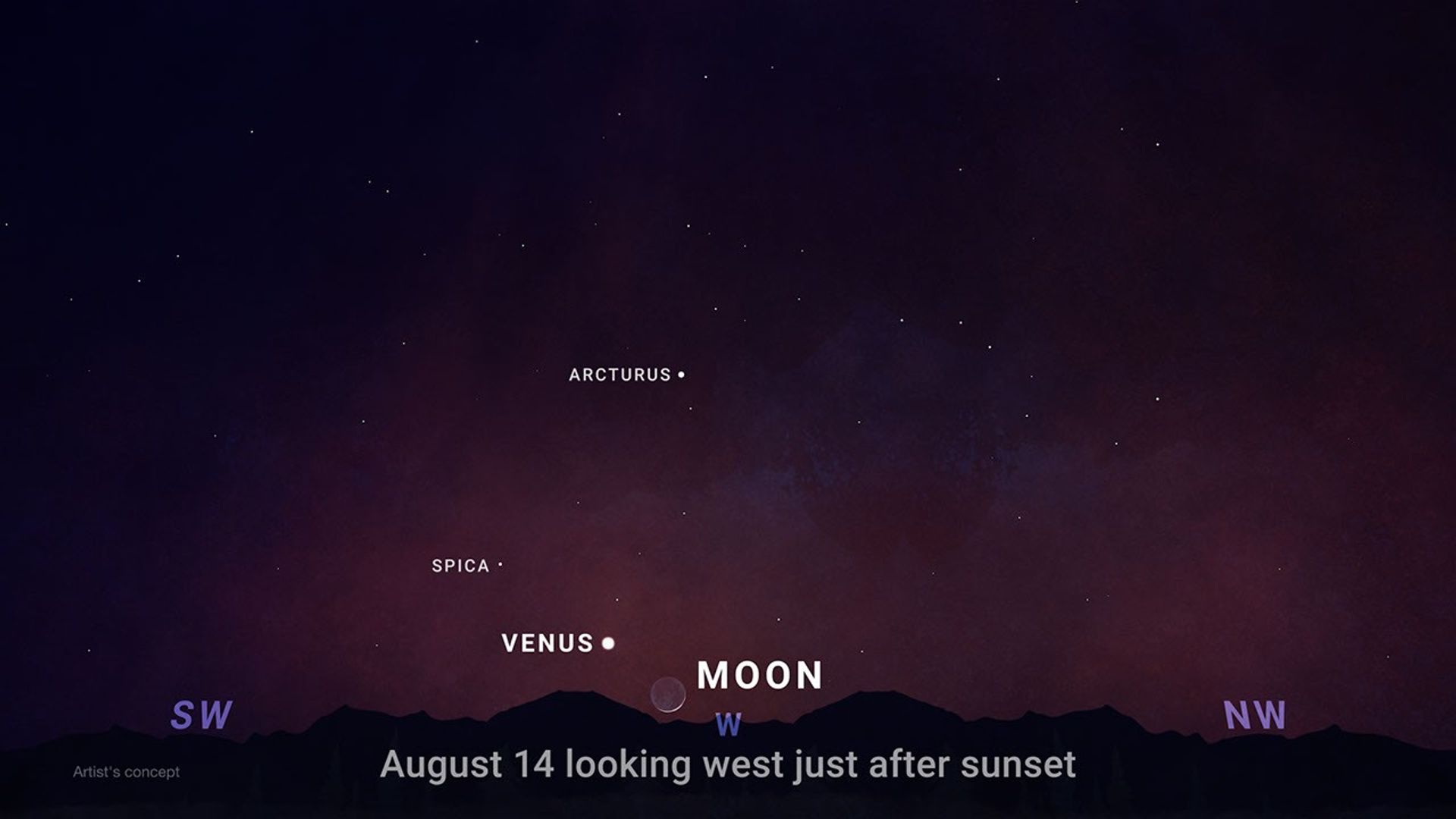
Aug. 14-16, Venus reaches its greatest eastern elongation, which is its widest apparent separation from the Sun during this evening appearance.

Look low in the western sky shortly after sunset for the bright object that will outshine every star around it. Through a telescope after sunset, Venus will look close to half lit, like a tiny lunar phase.

An illustration of the evening sky shortly after sunset, showing the positions of celestial objects. Text at the bottom center reads 'August 14 looking west just after sunset'. The bottom edge features a silhouetted, dark horizon of hills or mountains. Above the horizon, compass directions are indicated in purple: 'SW' (Southwest) on the left, 'W' (West) in the center, and 'NW' (Northwest) on the right. In the center, sitting very low on the horizon, is a faint crescent moon, labeled 'MOON'. Just to the left and slightly above the moon is a bright, white dot labeled 'VENUS'. Higher up and to the left of Venus is a smaller white dot labeled 'SPICA'. Above and to the right of Spica, towards the center of the image, is another labeled star, 'ARCTURUS'. The sky transitions from a deep reddish-purple near the horizon to dark blue at the top, sprinkled with numerous faint stars. In the bottom left corner, small text reads 'Artist's concept.'
This illustration shows where to observe Venus after sunset in August.
NASA/JPL-Caltech

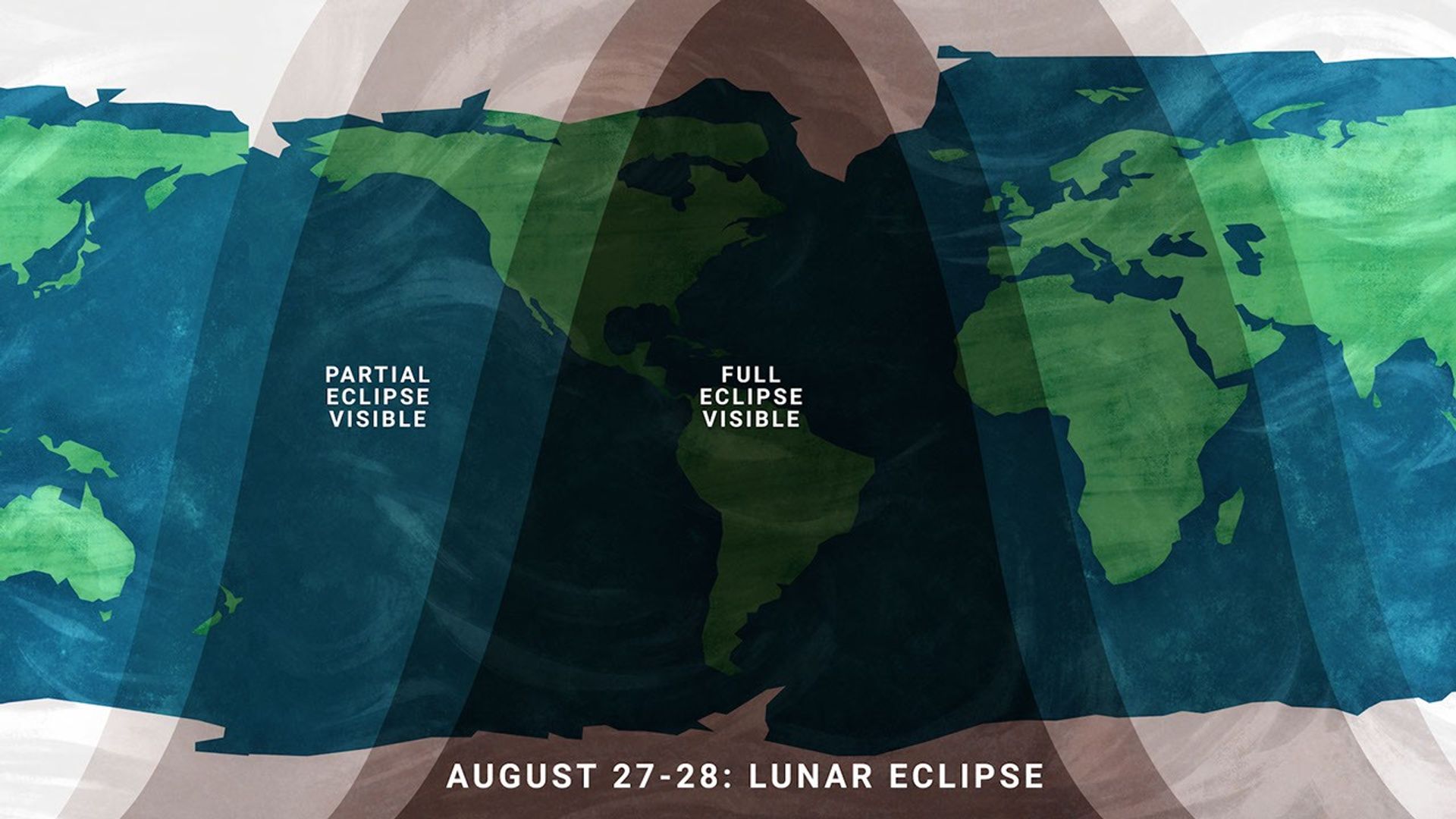
On the night of Aug. 27, continuing into Aug. 28 for some time zones, the Full Moon slips through Earth’s shadow, resulting in a partial lunar eclipse. It will be visible from much of North and South America and parts of Europe and Africa.

A stylized flat map of the Earth indicating the viewing areas for a lunar eclipse, with text at the bottom reading 'AUGUST 27-28: LUNAR ECLIPSE'. Large, semi-transparent dark bands arch across the map to represent visibility zones. The darkest central band, labeled 'FULL ECLIPSE VISIBLE', covers all of North America and South America, as well as the eastern Pacific Ocean and western Atlantic Ocean. Flanking this central region on the left and right are lighter shaded bands labeled 'PARTIAL ECLIPSE VISIBLE'. The western partial eclipse band covers the western Pacific Ocean and New Zealand, while the eastern partial eclipse band covers Europe and Africa. The unshaded outer regions of the map, including most of Asia and Australia, are areas where the eclipse will not be visible.
Viewing areas for the August 2026 lunar eclipse.
NASA/JPL-Caltech

At maximum eclipse, about 93% of the Moon’s diameter will be inside Earth’s dark central shadow, called the umbra. The Moon will not be completely covered, but it can look dramatically darkened, with a rusty, coppery tint along the covered edge.

Unlike a solar eclipse, a lunar eclipse is safe to watch with just your eyes. Binoculars or a small telescope can give you a closer view of Earth’s curved shadow moving across the Moon.

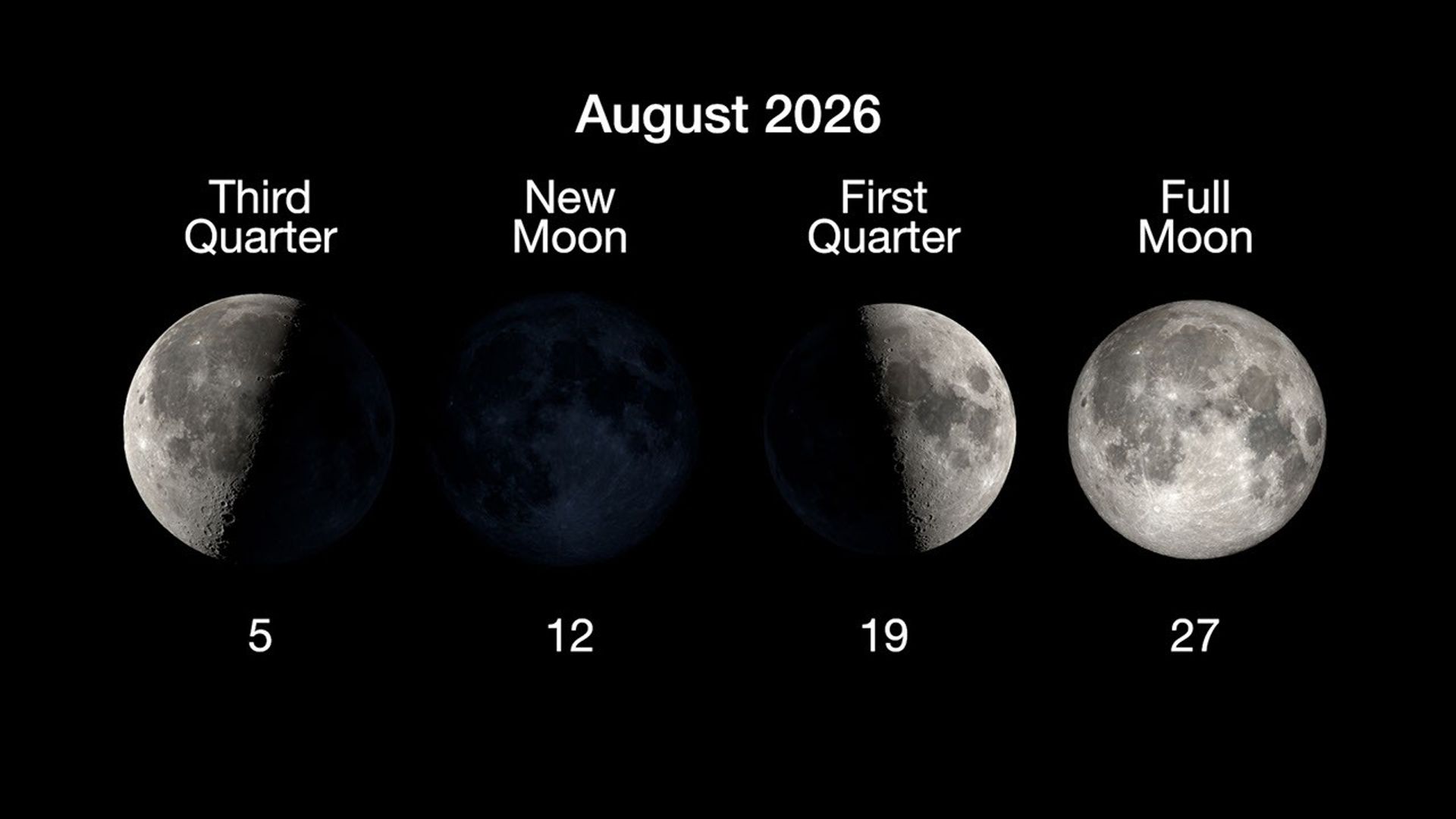
Here are the phases of the Moon for August.

An infographic on a black background titled 'August 2026' showing four primary phases of the Moon arranged in a horizontal row. Each phase features an image of the Moon with text above indicating the phase name and a number below indicating the date in August. From left to right:  'Third Quarter' on the 5th, showing the left half of the Moon illuminated. 'New Moon' on the 12th, showing the Moon's face completely in shadow. 'First Quarter' on the 19th, showing the right half of the Moon illuminated. 'Full Moon' on the 27th, showing the entire face of the Moon illuminated.
NASA/JPL-Caltech

You can stay up to date on all of NASA’s missions exploring the solar system and beyond at science.nasa.gov. I’m Raquel Villanueva from NASA’s Jet Propulsion Laboratory, and that’s What’s Up for this month.

Keep Exploring

Discover More Topics From NASA

The post What’s Up: August 2026 Skywatching Tips from NASA appeared first on NASA Science.
💾

A solar eclipse, one of the year's best meteor showers, Venus at its brightest in the evening sky, and a partial lunar eclipse to close out the month.On Augu...

What’s Up: August 2026 Skywatching Tips from NASA

31 July 2026 at 23:35

A solar eclipse, the Perseids, bright Venus after sunset, and a deep partial lunar eclipse highlight August’s skywatching.

Skywatching Highlights

  • Aug. 5: Last Quarter Moon
  • Aug. 12: Total solar eclipse across northern Russia, Greenland, Iceland, northern Spain, and part of Portugal; partial eclipse in parts of the U.S.; New Moon
  • Aug. 12-13: Perseid meteor shower peak under dark skies
  • Aug. 14-16: Venus reaches greatest eastern elongation and shines low in the west after sunset
  • Aug. 27-28: Partial lunar eclipse visible from much of North and South America and parts of Europe and Africa

Transcript

A solar eclipse, one of the year’s best meteor showers, Venus at its brightest in the evening sky, and a lunar eclipse to close out the month.

That’s “What’s Up” for August.

On Aug. 12, a total solar eclipse crosses northern Russia, Greenland, Iceland, and northern Spain, with a small corner of Portugal inside the path of totality.

In parts of the United States, from Alaska to North Carolina, the eclipse is partial. The Moon will take only a small bite out of the Sun, and the amount of coverage will vary with location.

A stylized flat map of the Earth indicating the viewing areas for a solar eclipse, with text on the left reading 'AUGUST 12: SOLAR ECLIPSE'. A semi-transparent dark shadow covers the northern portion of the globe, fanning out from the top edge. Within this shadow, a thin dotted line arcs down from the Arctic, crossing near Greenland and Iceland, passing over the Iberian Peninsula (Spain and Portugal), and ending near the Mediterranean Sea; this line is labeled 'PATH OF TOTALITY'. The broader shaded region surrounding this line is labeled 'PARTIAL ECLIPSE VISIBLE', and it covers northern North America, the Arctic, all of Europe, northern Africa, and northern and western Asia. The unshaded regions covering the rest of the map, including most of the United States, South America, central and southern Africa, and Australia, indicate areas where the eclipse will not be visible.
A map showing viewing areas of the August 2026 total solar eclipse.
NASA/JPL-Caltech

Remember to watch safely. Use certified eclipse glasses or a safe solar viewer any time any part of the Sun is visible. Regular sunglasses are not safe. And never use binoculars, a telescope, or a camera without a solar filter made for the front of the optics.

Later that same night, the Perseid meteor shower will light up the sky, peaking the evening of Aug. 12 into the early morning hours of the 13th. And with a New Moon arriving on the 12th, the skies will be ideally dark.

The Perseids happen every year when Earth passes through a debris stream left behind by Comet Swift-Tuttle. As those tiny bits of comet dust hit our atmosphere at high speed, they burn up as bright streaks of light.

To view this meteor shower, look toward the northeast once it’s fully dark and watch for the constellation Perseus to clear the horizon. This is where the meteors originate, but let your eyes wander, because they can flash across any part of the sky.

For the best view, stay out late as the stars climb higher, find a dark open spot, and give your eyes 30 minutes to adjust.

An illustration of the night sky showing where to look for meteors, with text at the bottom reading 'August 13 looking northeast around 1:30am.' The bottom of the image shows a dark, silhouetted horizon of hills, marked with blue compass directions N (North), NE (Northeast), and E (East). In the center of the sky above NE is a teal burst icon labeled 'RADIANT,' indicating the point from which meteors appear to originate. A bright, white meteor streaks across the dark, starry sky, pointing back toward the radiant. Two other bright celestial objects are labeled: the star 'CAPELLA' is situated low in the sky below the radiant, and the planet 'SATURN' is positioned high up in the upper right corner. Small text in the bottom left corner reads 'Artist's concept.'
This illustration shows where in the night sky to look for the Perseid meteor shower.
NASA/JPL-Caltech

Aug. 14-16, Venus reaches its greatest eastern elongation, which is its widest apparent separation from the Sun during this evening appearance.

Look low in the western sky shortly after sunset for the bright object that will outshine every star around it. Through a telescope after sunset, Venus will look close to half lit, like a tiny lunar phase.

An illustration of the evening sky shortly after sunset, showing the positions of celestial objects. Text at the bottom center reads 'August 14 looking west just after sunset'. The bottom edge features a silhouetted, dark horizon of hills or mountains. Above the horizon, compass directions are indicated in purple: 'SW' (Southwest) on the left, 'W' (West) in the center, and 'NW' (Northwest) on the right. In the center, sitting very low on the horizon, is a faint crescent moon, labeled 'MOON'. Just to the left and slightly above the moon is a bright, white dot labeled 'VENUS'. Higher up and to the left of Venus is a smaller white dot labeled 'SPICA'. Above and to the right of Spica, towards the center of the image, is another labeled star, 'ARCTURUS'. The sky transitions from a deep reddish-purple near the horizon to dark blue at the top, sprinkled with numerous faint stars. In the bottom left corner, small text reads 'Artist's concept.'
This illustration shows where to observe Venus after sunset in August.
NASA/JPL-Caltech

On the night of Aug. 27, continuing into Aug. 28 for some time zones, the Full Moon slips through Earth’s shadow, resulting in a partial lunar eclipse. It will be visible from much of North and South America and parts of Europe and Africa.

A stylized flat map of the Earth indicating the viewing areas for a lunar eclipse, with text at the bottom reading 'AUGUST 27-28: LUNAR ECLIPSE'. Large, semi-transparent dark bands arch across the map to represent visibility zones. The darkest central band, labeled 'FULL ECLIPSE VISIBLE', covers all of North America and South America, as well as the eastern Pacific Ocean and western Atlantic Ocean. Flanking this central region on the left and right are lighter shaded bands labeled 'PARTIAL ECLIPSE VISIBLE'. The western partial eclipse band covers the western Pacific Ocean and New Zealand, while the eastern partial eclipse band covers Europe and Africa. The unshaded outer regions of the map, including most of Asia and Australia, are areas where the eclipse will not be visible.
Viewing areas for the August 2026 lunar eclipse.
NASA/JPL-Caltech

At maximum eclipse, about 93% of the Moon’s diameter will be inside Earth’s dark central shadow, called the umbra. The Moon will not be completely covered, but it can look dramatically darkened, with a rusty, coppery tint along the covered edge.

Unlike a solar eclipse, a lunar eclipse is safe to watch with just your eyes. Binoculars or a small telescope can give you a closer view of Earth’s curved shadow moving across the Moon.

Here are the phases of the Moon for August.

An infographic on a black background titled 'August 2026' showing four primary phases of the Moon arranged in a horizontal row. Each phase features an image of the Moon with text above indicating the phase name and a number below indicating the date in August. From left to right:  'Third Quarter' on the 5th, showing the left half of the Moon illuminated. 'New Moon' on the 12th, showing the Moon's face completely in shadow. 'First Quarter' on the 19th, showing the right half of the Moon illuminated. 'Full Moon' on the 27th, showing the entire face of the Moon illuminated.
NASA/JPL-Caltech

You can stay up to date on all of NASA’s missions exploring the solar system and beyond at science.nasa.gov. I’m Raquel Villanueva from NASA’s Jet Propulsion Laboratory, and that’s What’s Up for this month.

Keep Exploring

Discover More Topics From NASA

July 25, 1920: The birth of Chushiro Hayashi

25 July 2026 at 14:00

Born on July 25, 1920, Chushiro Hayashi graduated from the University of Tokyo with a degree in physics in 1942. After World War II service in the navy, he returned to school, finishing his doctorate in 1954 and becoming a professor at Kyoto University in 1957. An innovator, he applied fundamental physics to astronomy andContinue reading "July 25, 1920: The birth of Chushiro Hayashi"

The post July 25, 1920: The birth of Chushiro Hayashi appeared first on Astronomy Magazine.

NASA’s MAVEN Illuminates New Understanding of Auroras at Mars

23 July 2026 at 16:19

This illustration depicts charged particles from a solar storm stripping away charged particles of Mars' atmosphere, one of the processes of Martian atmosphere loss studied by NASA's MAVEN mission, beginning in 2014.
This illustration depicts charged particles from a solar storm stripping away charged particles of Mars’ atmosphere, one of the processes of Martian atmosphere loss studied by NASA’s MAVEN mission.
NASA/GSFC

NASA MAVEN (Mars Atmosphere and Volatile Evolution) mission scientists have uncovered a key puzzle piece in understanding certain types of auroras on Mars, finding that they form in a similar way to Earth-based auroras.
 
Results published Thursday in Nature Communications show the same mechanism that circulates and catapults charged particles into Earth’s atmosphere is happening at Mars on much smaller scales because of differences in the two planets’ magnetic fields.
 
The MAVEN spacecraft, in orbit around Mars, experienced a loss of signal with ground stations on Earth on Dec. 6, 2025. On June 3, NASA declared the mission had concluded after finding the spacecraft to be unrecoverable. However, data from the mission is still being used to inform NASA science and future missions to Mars.
 
When the Sun’s magnetic field lines get close to Earth’s magnetosphere, the large magnetic bubble protecting the planet, they can reconnect and inject energy and mass throughout Earth’s magnetosphere and magnetotail, ultimately firing electrons back into the atmosphere to generate Earth’s auroras. This process, called the Dungey cycle, drives electrical currents, accelerates charged particles that create auroras, and controls the circulation of plasma in Earth’s magnetosphere and ionosphere.
 
This new study shows that a miniature version of the Dungey cycle is happening over Mars’ strong crustal magnetic fields, which gives scientists a better look into the physics of Martian auroras.
 
“We knew that magnetic reconnection was happening at Mars but did not expect it to be like the Dungey cycle,” said Shaosui Xu, lead author of the study and associate research physicist at the Space Sciences Laboratory at the University of California, Berkeley.
 
Mars does not have a global magnetic field like Earth. Earth’s magnetic field is created by our planet’s churning core, while Mars has numerous miniature magnetospheres that arise from intensely magnetized crust scattered around the planet.  These regions were formed around 4 billion years ago when lava cooled in the presence of Mars’ ancient global magnetic field, which has since disappeared due to intense solar wind stripping the planet’s atmosphere.
 
The MAVEN mission has observed highly localized auroras over these crustal fields, similar to Earth’s auroras at the poles, but it wasn’t until now that scientists could fully understand the physics of how they form. The study used several instruments aboard the MAVEN spacecraft to build up a picture of the Dungey-like behavior: the Magnetometer and Solar Wind Electron Analyzer instruments, which were used to determine the magnetic configuration and derive electrical currents, and the STATIC (Suprathermal and Thermal Ion Composition) instrument, which was used to measure plasma flows in the ionosphere.
 
“We really pushed the limit of STATIC to get the data we needed,” said Xu. “It was the final piece to the puzzle in understanding these localized auroras.”
 
The realization that a Dungey-like cycle was happening within these crustal magnetic fields answered the question of how the electrons were being energized to create the auroras. It also shows that a Dungey-like mechanism can happen on both large and small scales, giving more insight into where in the solar system this process could be taking place.
 
“This is a remarkable result that changes how we think of Martian auroras and is another important step toward understanding why Mars and Earth have evolved so differently despite being governed by the same underlying physics.” said Shannon Curry, MAVEN’s principal investigator and a research scientist at the Laboratory for Atmospheric and Space Physics at the University of Colorado Boulder. “I am incredibly proud of our team’s work on this discovery and excited to uncover new insights into the Red Planet and its evolution.”
 
By finding out more about this process, scientists also are gaining a better understanding of how the solar environment interacts with the Red Planet as a whole, which is essential for future robotic and crewed missions.
 
“I remember in graduate school discussing with my advisor how the cycling of crustal magnetic fields could work at Mars,” said Xu. “It’s incredible to be part of the team that found the answer to that question.”
 
The MAVEN mission is part of NASA’s Mars Exploration Program portfolio. The mission’s principal investigator is based at the Laboratory for Atmospheric and Space Physics at the University of Colorado Boulder, which also is responsible for managing science operations and public outreach and communications. NASA’s Goddard Space Flight Center in Greenbelt, Maryland, manages the MAVEN mission. Lockheed Martin Space built the spacecraft and is responsible for mission operations. NASA’s Jet Propulsion Laboratory in Southern California provides navigation and Deep Space Network support.
 
For more information on NASA’s MAVEN mission, visit:
 
https://science.nasa.gov/mission/maven/
 
Karen Fox / Alana Johnson
Headquarters, Washington
240-285-5155 / 202-672-4780
karen.c.fox@nasa.gov / alana.r.johnson@nasa.gov
 
Lonnie Shekhtman
NASA’s Goddard Space Flight Center, Greenbelt, Md.
lonnie.shekhtman@nasa.gov


NASA’s Lucy Reveals Wobbling, Peanut-Shaped Asteroid

18 June 2026 at 19:04

Even small asteroids lead complex lives. During its flyby of the asteroid Donaldjohanson last year, NASA’s Lucy spacecraft revealed the asteroid to be a wobbly, peanut-shaped body that has undergone a lot of activity in its relatively short history. Formed as fragments coalesced after a violent collision 155 million years ago, the asteroid was transformed by the small but inexorable force of the Sun’s radiation, all while retaining signs of the brief presence of liquid water in its distant past.

Zooming through the main asteroid belt toward one of the Jupiter Trojan asteroid groups, the Lucy spacecraft collected the first close-up images and other data at Donaldjohanson on April 20, 2025, as it passed 650 miles away from the asteroid. The data revealed that, instead of spinning simply around one axis like most other asteroids and planets, Donaldjohanson has a more complicated two-axis rotation. Scientists also saw Donaldjohanson’s peanut shape and the craters and ridges on its surface.

A timelapse video made from images taken by NASA’s Lucy spacecraft as it approached the asteroid Donaldjohanson on April 20, 2025. The L’LORRI (Lucy Long Range Reconnaissance Imager) instrument, the spacecraft’s high-resolution black-and-white imager, collected these images over two hours as the spacecraft rapidly closed in on the asteroid from an initial separation of more than 58,000 miles (93,000 km), until the spacecraft passed a mere 650 miles (1000 km) from the 5-mile- (8 km-) wide asteroid.
NASA/Goddard/SwRI/JHU-APL

Lucy’s encounter with the asteroid was planned as a dress rehearsal for the spacecraft and mission team before its primary asteroid encounters, which begin with Lucy’s flyby of the Trojan asteroid Eurybates on Aug. 12, 2027. The instruments performed as expected, and, as a bonus, scientists got a rare opportunity to study a previously unexplored asteroid up close and to compare it to two asteroids with similar compositions but different histories: Bennu, the target of NASA’s OSIRIS-REx sample-return mission, and Ryugu, the site of JAXA’s (Japan Aerospace Exploration Agency) Hayabusa2 sample-return mission.

Here’s what Lucy’s science team has learned so far from Lucy’s encounter with Donaldjohanson, as reported on June 18 in the journal Science.

Wobbling rotation

With Earth-based telescopes, observers saw fluctuations in the light Donaldjohanson reflects, regular patterns of peaks and valleys, typical of an elongated object rotating once every 10.5 Earth days. But Lucy’s data revealed another pattern: Donaldjohanson appears to be rotating like a wobbly top. Paper authors reported that the asteroid rotates end-over-end once every 10.5 Earth days, and wobbles back and forth around its long axis once every 26.5 days.

The asteroid Donaldjohanson is shown slowly rotating in a tumbling, non-principal axis motion, with its angular momentum vector and rotation axes indicated. The surface is colored by gravity slope, which measures the angle between the local surface and the direction of gravity. Higher values (warmer colors) indicate steeper terrain relative to the local gravitational pull. Regions with limited stereo image coverage have been masked out where the shape model is less well constrained.
Kel Elkins/NASA’s Science Visualization Studio/DLR

Peanut shape

While the Earth-based observations hinted at Donaldjohanson’s elongated shape, the Lucy flyby revealed a “bilobate” structure: two lobes connected by a neck, like a peanut. These lobes are likely two fragments from an asteroid collision that gently came together afterward by their mutual gravity.

Donaldjohanson likely rotated at least 10 times faster when it formed, having slowed to its current rate in the last 20 to 60 million years, the team estimates. As it slowed, the balance between the centrifugal force pushing things apart and gravity pulling things together changed and loose rocky material slid down slopes creating the worn-down appearance of many craters, as the flyby images showed.

The paper’s authors say that the asteroid’s slowing rotation is likely caused by a subtle consequence of solar heating known as the YORP effect. Each part of the asteroid’s Sun-warmed surface radiates heat away as infrared light, and that radiation imparts a tiny recoil force to the surface. Because the asteroid’s shape isn’t symmetric, this results in a net torque, or twist, that can change the asteroid’s rotation. Thus, YORP can slow asteroid spins down or speed them up, as in the case of Bennu (once every four hours) and Ryugu (once about every seven hours), which both likely used to rotate much slower than they do today.

Fleeting water

As it passed by Donaldjohanson at 30,000 mph, Lucy recorded the signatures of iron-rich clay minerals on the surface. These clays must have formed in the distant past with the help of liquid water. However, the exposure must have been brief, Lucy scientists concluded, because iron in clays tends to be replaced with other elements, such as magnesium, as water lingers.

Indeed, scientists saw magnesium-rich clays at Bennu and Ryugu, which suggested prolonged water exposure, perhaps lasting millions of years, when they were still part of larger asteroids.

This difference in water exposure history, and other characteristics, may mean that the parent bodies of these asteroids formed at different times or in different regions of the solar system before relocating to the main belt.

Compare, contrast

Donaldjohanson is thought to be made from rocky remnants of a larger, carbon- and water-rich asteroid that collided with another object in the main asteroid belt. Bennu and Ryugu are thought to have formed in the same way and in the same region.

But Donaldjohanson is different. At 155 million years old, it is much younger than Bennu and Ryugu, which formed 1 to 2 billion years ago. Donaldjohanson also has remained in the asteroid belt since birth, while its wandering cousins migrated into orbits around the Sun that bring them close to Earth’s orbit about once a year (which made them perfect close targets for sample return missions).

Black background graphic with a large white title at top. Upper left shows a gray, pea-nut-shaped, rock-like object. Upper right shows a rectangular inset image of a dark textured rock fragment. Near the center are a mission patch logo and a small globe with Antarctica highlighted. Lower half contains two side-by-side charts with axes, tick marks, and blue and green plotted lines with scattered blue data points. Additional white, blue, and green labels appear throughout the graphic.
During its April 20, 2025, encounter with the main-belt asteroid Donaldjohanson, NASA’s Lucy spacecraft discovered evidence for iron-rich clays on the surface using its infrared spectrometer. These clays, which are similar to those found in carbon-rich meteorites such as QUE 97990, indicate that water was briefly present in the asteroid during the distant past.
NASA/Goddard/SwRI/Dan Gallagher

“It’s helpful for scientists to compare Donaldjohanson with asteroids like Bennu and Ryugu, which are seemingly similar asteroids, because every subtle difference is another clue to our origin story,” said Simone Marchi, Lucy deputy principal investigator and lead author of the study at the Boulder, Colorado, office of the Southwest Research Institute.

“Once we start learning more about the Trojans, a completely different population of space rocks with very different histories, our understanding of solar system formation is destined to be challenged,” said Marchi.

Named after a fossilized skeleton of a human ancestor discovered in Ethiopia in 1974, NASA’s Lucy will be the first mission to explore Jupiter’s Trojan asteroids, a population of well-preserved space rocks that formed early in our solar system’s history and could help scientists understand how the planets formed and moved around before settling in their current configuration.

Download story graphics from NASA’s Scientific Visualization Studio.

About Lucy:

Lucy’s principal investigator is based out of the Boulder, Colorado, branch of Southwest Research Institute, headquartered in San Antonio. NASA’s Goddard Space Flight Center in Greenbelt, Maryland, provides overall mission management, systems engineering, and safety and mission assurance. Lockheed Martin Space in Littleton, Colorado, built the spacecraft. Lucy is the 13th mission in NASA’s Discovery Program. NASA’s Marshall Space Flight Center in Huntsville, Alabama, manages the Discovery Program for the agency’s Science Mission Directorate in Washington.

For more information on NASA’s Lucy mission, visit:

By Lonnie Shekhtman

NASA’s Goddard Space Flight Center, Greenbelt, Md.

and

Katherine Kretke

Southwest Research Institute, Boulder, Colo.

Media Contacts:

Karen Fox / Molly Wasser

Headquarters, Washington
240-285-5155 / 240-419-1732
karen.c.fox@nasa.gov / molly.l.wasser@nasa.gov

Sarah Frazier

NASA’s Goddard Space Flight Center, Greenbelt, Md.
202-853-7191
sarah.frazier@nasa.gov

Simplified Summary

Zooming through the main asteroid belt toward one of the Jupiter Trojan asteroid groups, the Lucy spacecraft collected the first close-up images and other data at Donaldjohanson on April 20, 2025, as it passed 650 miles away from the asteroid. The data revealed that, instead of spinning simply around one axis like most other asteroids and planets, Donaldjohanson has a more complicated two-axis rotation. Scientists also saw Donaldjohanson’s peanut shape and the craters and ridges on its surface.

The post NASA’s Lucy Reveals Wobbling, Peanut-Shaped Asteroid appeared first on NASA Science.
NASA’s Lucy Reveals Wobbling, Peanut-Shaped Asteroid

18 June 2026 at 19:04

Even small asteroids lead complex lives. During its flyby of the asteroid Donaldjohanson last year, NASA’s Lucy spacecraft revealed the asteroid to be a wobbly, peanut-shaped body that has undergone a lot of activity in its relatively short history. Formed as fragments coalesced after a violent collision 155 million years ago, the asteroid was transformed by the small but inexorable force of the Sun’s radiation, all while retaining signs of the brief presence of liquid water in its distant past.

Zooming through the main asteroid belt toward one of the Jupiter Trojan asteroid groups, the Lucy spacecraft collected the first close-up images and other data at Donaldjohanson on April 20, 2025, as it passed 650 miles away from the asteroid. The data revealed that, instead of spinning simply around one axis like most other asteroids and planets, Donaldjohanson has a more complicated two-axis rotation. Scientists also saw Donaldjohanson’s peanut shape and the craters and ridges on its surface.

A timelapse video made from images taken by NASA’s Lucy spacecraft as it approached the asteroid Donaldjohanson on April 20, 2025. The L’LORRI (Lucy Long Range Reconnaissance Imager) instrument, the spacecraft’s high-resolution black-and-white imager, collected these images over two hours as the spacecraft rapidly closed in on the asteroid from an initial separation of more than 58,000 miles (93,000 km), until the spacecraft passed a mere 650 miles (1000 km) from the 5-mile- (8 km-) wide asteroid.
NASA/Goddard/SwRI/JHU-APL

Lucy’s encounter with the asteroid was planned as a dress rehearsal for the spacecraft and mission team before its primary asteroid encounters, which begin with Lucy’s flyby of the Trojan asteroid Eurybates on Aug. 12, 2027. The instruments performed as expected, and, as a bonus, scientists got a rare opportunity to study a previously unexplored asteroid up close and to compare it to two asteroids with similar compositions but different histories: Bennu, the target of NASA’s OSIRIS-REx sample-return mission, and Ryugu, the site of JAXA’s (Japan Aerospace Exploration Agency) Hayabusa2 sample-return mission.

Here’s what Lucy’s science team has learned so far from Lucy’s encounter with Donaldjohanson, as reported on June 18 in the journal Science.

Wobbling rotation

With Earth-based telescopes, observers saw fluctuations in the light Donaldjohanson reflects, regular patterns of peaks and valleys, typical of an elongated object rotating once every 10.5 Earth days. But Lucy’s data revealed another pattern: Donaldjohanson appears to be rotating like a wobbly top. Paper authors reported that the asteroid rotates end-over-end once every 10.5 Earth days, and wobbles back and forth around its long axis once every 26.5 days.

The asteroid Donaldjohanson is shown slowly rotating in a tumbling, non-principal axis motion, with its angular momentum vector and rotation axes indicated. The surface is colored by gravity slope, which measures the angle between the local surface and the direction of gravity. Higher values (warmer colors) indicate steeper terrain relative to the local gravitational pull. Regions with limited stereo image coverage have been masked out where the shape model is less well constrained.
Kel Elkins/NASA’s Science Visualization Studio/DLR

Peanut shape

While the Earth-based observations hinted at Donaldjohanson’s elongated shape, the Lucy flyby revealed a “bilobate” structure: two lobes connected by a neck, like a peanut. These lobes are likely two fragments from an asteroid collision that gently came together afterward by their mutual gravity.

Donaldjohanson likely rotated at least 10 times faster when it formed, having slowed to its current rate in the last 20 to 60 million years, the team estimates. As it slowed, the balance between the centrifugal force pushing things apart and gravity pulling things together changed and loose rocky material slid down slopes creating the worn-down appearance of many craters, as the flyby images showed.

The paper’s authors say that the asteroid’s slowing rotation is likely caused by a subtle consequence of solar heating known as the YORP effect. Each part of the asteroid’s Sun-warmed surface radiates heat away as infrared light, and that radiation imparts a tiny recoil force to the surface. Because the asteroid’s shape isn’t symmetric, this results in a net torque, or twist, that can change the asteroid’s rotation. Thus, YORP can slow asteroid spins down or speed them up, as in the case of Bennu (once every four hours) and Ryugu (once about every seven hours), which both likely used to rotate much slower than they do today.

Fleeting water

As it passed by Donaldjohanson at 30,000 mph, Lucy recorded the signatures of iron-rich clay minerals on the surface. These clays must have formed in the distant past with the help of liquid water. However, the exposure must have been brief, Lucy scientists concluded, because iron in clays tends to be replaced with other elements, such as magnesium, as water lingers.

Indeed, scientists saw magnesium-rich clays at Bennu and Ryugu, which suggested prolonged water exposure, perhaps lasting millions of years, when they were still part of larger asteroids.

This difference in water exposure history, and other characteristics, may mean that the parent bodies of these asteroids formed at different times or in different regions of the solar system before relocating to the main belt.

Compare, contrast

Donaldjohanson is thought to be made from rocky remnants of a larger, carbon- and water-rich asteroid that collided with another object in the main asteroid belt. Bennu and Ryugu are thought to have formed in the same way and in the same region.

But Donaldjohanson is different. At 155 million years old, it is much younger than Bennu and Ryugu, which formed 1 to 2 billion years ago. Donaldjohanson also has remained in the asteroid belt since birth, while its wandering cousins migrated into orbits around the Sun that bring them close to Earth’s orbit about once a year (which made them perfect close targets for sample return missions).

Black background graphic with a large white title at top. Upper left shows a gray, pea-nut-shaped, rock-like object. Upper right shows a rectangular inset image of a dark textured rock fragment. Near the center are a mission patch logo and a small globe with Antarctica highlighted. Lower half contains two side-by-side charts with axes, tick marks, and blue and green plotted lines with scattered blue data points. Additional white, blue, and green labels appear throughout the graphic.
During its April 20, 2025, encounter with the main-belt asteroid Donaldjohanson, NASA’s Lucy spacecraft discovered evidence for iron-rich clays on the surface using its infrared spectrometer. These clays, which are similar to those found in carbon-rich meteorites such as QUE 97990, indicate that water was briefly present in the asteroid during the distant past.
NASA/Goddard/SwRI/Dan Gallagher

“It’s helpful for scientists to compare Donaldjohanson with asteroids like Bennu and Ryugu, which are seemingly similar asteroids, because every subtle difference is another clue to our origin story,” said Simone Marchi, Lucy deputy principal investigator and lead author of the study at the Boulder, Colorado, office of the Southwest Research Institute.

“Once we start learning more about the Trojans, a completely different population of space rocks with very different histories, our understanding of solar system formation is destined to be challenged,” said Marchi.

Named after a fossilized skeleton of a human ancestor discovered in Ethiopia in 1974, NASA’s Lucy will be the first mission to explore Jupiter’s Trojan asteroids, a population of well-preserved space rocks that formed early in our solar system’s history and could help scientists understand how the planets formed and moved around before settling in their current configuration.

Download story graphics from NASA’s Scientific Visualization Studio.

About Lucy:

Lucy’s principal investigator is based out of the Boulder, Colorado, branch of Southwest Research Institute, headquartered in San Antonio. NASA’s Goddard Space Flight Center in Greenbelt, Maryland, provides overall mission management, systems engineering, and safety and mission assurance. Lockheed Martin Space in Littleton, Colorado, built the spacecraft. Lucy is the 13th mission in NASA’s Discovery Program. NASA’s Marshall Space Flight Center in Huntsville, Alabama, manages the Discovery Program for the agency’s Science Mission Directorate in Washington.

For more information on NASA’s Lucy mission, visit:

By Lonnie Shekhtman

NASA’s Goddard Space Flight Center, Greenbelt, Md.

and

Katherine Kretke

Southwest Research Institute, Boulder, Colo.

Media Contacts:

Karen Fox / Molly Wasser

Headquarters, Washington
240-285-5155 / 240-419-1732
karen.c.fox@nasa.gov / molly.l.wasser@nasa.gov

Sarah Frazier

NASA’s Goddard Space Flight Center, Greenbelt, Md.
202-853-7191
sarah.frazier@nasa.gov

Simplified Summary

Zooming through the main asteroid belt toward one of the Jupiter Trojan asteroid groups, the Lucy spacecraft collected the first close-up images and other data at Donaldjohanson on April 20, 2025, as it passed 650 miles away from the asteroid. The data revealed that, instead of spinning simply around one axis like most other asteroids and planets, Donaldjohanson has a more complicated two-axis rotation. Scientists also saw Donaldjohanson’s peanut shape and the craters and ridges on its surface.

❌