Scanner occasional connection fail
The scanner is about 3M [10'] away so is the distance an issue?
![]()
This image, which combines a background view from the Dark Energy Camera Legacy Survey with two inset images from the Very Large Telescope, shows an unusual pair of galaxies in the Fornax Cluster. The galaxies FCC 224 and FCC 240 are under scrutiny because they may have formed via a high-velocity collision between dwarf galaxies — the so-called “bullet-dwarf” model. Using new spectroscopy from the Very Large Telescope, Maria Luísa Buzzo (Yale University) and collaborators analyzed the ages and kinematics of the galaxies’ stars as well as the unusually bright globular clusters swirling around each galaxy. These data suggest that both galaxies are deficient in dark matter, and their stellar populations and globular clusters are all roughly 10 billion years old. The lack of dark matter and the uniform stellar ages are both consistent with the bullet-dwarf model, in which the collision strips away dark matter and ignites a burst of star formation. Since this type of collision can create more than two remnants, the team suggests searching along the trajectory defined by FCC 224 and FCC 240 for more fragments from the collision, some of which may contain the galaxies’ lost dark matter. To learn more about these galaxies and what they might mean for the bullet-dwarf mechanism, be sure to check out the full research article linked below.
“Dark-Matter-Deficient Twins: FCC 224 and FCC 240 as Possible Analogs of NGC 1052-DF2 and DF4,” Maria Luísa Buzzo et al 2026 ApJ 1005 15. doi:10.3847/1538-4357/ae7349
The post Featured Image: A Rare Pair of Galaxies Lacking Dark Matter appeared first on AAS Nova.
![]()
The Bullet Cluster is best known for being considered a “smoking gun” for the existence of dark matter, but even a famous galaxy cluster like this one has its secrets. For more than two decades, different measurements of the merging clusters’ dynamical mass ratio have yielded vastly different results. In a recent research article, Boseong Young Cho (Yonsei University) and collaborators used data from JWST and the Dark Energy Camera to revisit the Bullet Cluster and measure its mass ratio using new data. The image above shows a near-infrared view of the Bullet Cluster from JWST, with an overlay of mass contours derived from gravitational-lensing measurements. The team’s analysis assigned a mass of 1.5 quadrillion solar masses for the main cluster (on the left side of the image above), and a mass of 150 trillion solar masses for the subcluster. This suggests a mass ratio of roughly 10, which matches the value supported by hydrodynamical simulations and cements the event as a minor merger. The team also identified three distinct cluster halos (two in the main cluster and one in the subcluster), providing an important constraint on the cluster configuration for future modeling. To learn more about this investigation of the Bullet Cluster, be sure to check out the full research article linked below!
“Joint JWST–DECam Lensing Reveals that the Bullet Cluster Is a Minor Merger,” Boseong Young Cho et al 2026 ApJ 1005 28. doi:10.3847/1538-4357/ae6a90
The post Featured Image: A Mass Mystery in the Bullet Cluster appeared first on AAS Nova.
Annual SharkFest gets up close with hammerheads Shark fans are warming up for their annual ‘SharkFest’ courtesy of National Geographic, now in its 14th year, and kicking off on July 5 with the...
The post Annual SharkFest gets up close with hammerheads first appeared on Science Illustrated.
In the realm of modern ophthalmology, Optical Coherence Tomography (OCT) has revolutionized the way eye diseases are diagnosed and monitored. This non-invasive imaging technology allows clinicians to peer through the layers of the retina, producing detailed cross-sectional images that reveal the structural integrity of this delicate tissue without the need for surgical intervention. However, despite OCT’s widespread adoption and profound clinical impact, the technology is inherently limited by physical constraints that occasionally obscure or degrade the crucial information contained within these images. The newly developed Spatio-Temporal Optical Coherence Tomography (STOC-T) promises to address these limitations by fundamentally altering data acquisition methods, thereby enhancing image quality and diagnostic precision at the earliest possible stage.
OCT functions by directing light into the eye and interpreting the backscattered photons to construct images of internal structures like the retina and choroid. But the journey of photons through tissue is fraught with challenges. When light encounters complex biological matrices, it scatters unpredictably, producing signals that blend with those carrying useful information. This phenomenon, known scientifically as “optical crosstalk,” causes image blur and loss of contrast, making it difficult to discern fine detail that could be critical for early disease detection. Optical crosstalk is essentially a breakdown of coherence within the returning light, as photons from a single spatial point arrive dispersed across multiple detector pixels. For ophthalmologists and patients alike, this translates to potentially missed or delayed diagnosis of conditions where subtle changes herald disease onset.
The breakthrough reported by Professor Maciej Wojtkowski and his team from the International Centre for Translational Eye Research (ICTER) introduces STOC-T, an innovative approach that goes beyond conventional image enhancement techniques. Unlike software filters applied post-hoc to clean up images, STOC-T reforms the optics of data collection itself—imposing controlled, repetitive phase modulations onto the illuminating light during scanning. By employing distinct spatial phase masks that alter the wavefront of the illuminating beam, the system captures a series of images, each with a differently patterned illumination. Scattered photons, which respond chaotically to these phase shifts, become decorrelated and diminish upon averaging multiple frames. Conversely, photons faithfully reflecting true tissue architecture maintain coherent behavior, thus strengthening their visibility in the final reconstructed image.
This methodology can be likened to differentiating a single voice in a bustling crowd. Just as a consistent voice can be isolated amid random background chatter using adaptive recording strategies, STOC-T distinguishes meaningful optical signals from noise in real-time. This preemptive discrimination obviates the need for computational post-processing to “clean” images after data acquisition, which historically cannot fully recover information lost to scattering. Defensive design of the imaging process ensures that interfering signals are suppressed from the outset, preserving delicate cellular-level details of the retina and choroid that are indispensable for early diagnosis.
STOC-T’s performance has been rigorously tested both in laboratory settings and on living tissue. In one compelling demonstration, a standard imaging target obscured by a highly scattering artificial medium and even by rat skin rendered virtually invisible under conventional OCT. Upon integrating STOC-T’s phase modulation technique, the obscured structural features resurfaced with remarkable clarity. This experiment underscores the scale of the optical crosstalk problem and the potency of STOC-T, since the objects remained physically present but were previously hidden by noise.
The true clinical significance comes from STOC-T’s application to human retinal imaging, where it achieves a lateral resolution near five micrometers—a scale sufficiently fine to resolve individual photoreceptors and ganglion cells as well as intricate vasculature within the choroid. This extraordinary level of detail enables prospective monitoring of microscopic disease processes with an acuity far surpassing existing OCT methods. Additionally, STOC-T provides new insights through optoretinography (ORG), capturing functional responses of photoreceptors to flickering light stimuli at frequencies up to 45 Hz. These functional measurements resemble electrophysiological studies conducted via invasive patch-clamp techniques, suggesting that STOC-T could non-invasively monitor cellular function—a significant leap for early detection of retinal dysfunction before structural damage occurs.
The potential clinical impact of this technology cannot be overstated. Visual impairment affects more than 2.2 billion individuals worldwide, with over a billion cases attributable to conditions amenable to early diagnosis and intervention. Diseases such as glaucoma, diabetic retinopathy, and age-related macular degeneration often become irreversibly severe due to delayed detection. STOC-T’s capacity to enhance diagnostic accuracy at the cellular and functional levels augments the ophthalmologist’s ability to initiate timely therapies, potentially halting or reversing vision loss before clinical symptoms manifest.
Despite these promises, STOC-T remains an experimental technique, currently limited by technical demands. The system requires cutting-edge hardware, including a high-speed CMOS camera capable of capturing quarter-million frames per second and a tunable near-infrared laser source spanning 800 to 870 nanometers in wavelength. The immense data volume generated—exceeding 8.5 gigabytes per acquisition—also presents significant computational challenges for real-time processing and analysis. These hurdles explain why STOC-T is not yet in widespread clinical use, although ongoing advances in photonic hardware and data science are likely to mitigate these barriers.
Looking forward, the research team envisions enhancing the system’s flexibility using multimode optical fibers for phase modulation. Such fibers, with diameters around 50 micrometers and lengths extending to hundreds of meters, support hundreds of propagation modes. They offer the theoretical potential to reduce optical crosstalk noise by a factor approaching 30 without complex electronic controls, simplifying implementation while preserving image quality improvements.
Professor Wojtkowski emphasizes that STOC-T represents a transformative conceptual advance rather than a final product. The roadmap to widespread application involves optimizing speed, minimizing data volume, refining phase encoding strategies, and automating image reconstruction workflows. The foundational principle—shaping the acquisition process to preempt noise contamination—opens avenues not only for ophthalmology but also for diverse biomedical imaging fields where light scattering impairs image fidelity. This innovation exemplifies how deep physical understanding combined with technical ingenuity can reshape diagnostic imaging, making previously invisible biological details accessible and advancing patient care.
In summary, STOC-T addresses a critical bottleneck in OCT imaging by employing spatio-temporal phase modulation to separate meaningful tissue signals from scattered noise at the data collection stage. This technique enhances resolution, contrast, and functional imaging capability, holding significant promise for earlier and more accurate diagnosis of a broad spectrum of vision-threatening diseases. Although currently laboratory-bound due to technical demands, STOC-T’s theoretical and experimental foundations herald a new era in optical imaging, where noise is never blindly accepted but actively prevented from degrading our view of living tissue.
Subject of Research: Human tissue samples
Article Title: Spatio-temporal optical coherence imaging and tomography for in vivo applications
News Publication Date: 25-May-2026
Web References: DOI: 10.1117/1.JBO.31.11.113504
Image Credits: Optica
Optical coherence tomography, STOC-T, ophthalmology, retinal imaging, optical crosstalk, phase modulation, optoretinography, photoreceptors, biomedical optics, imaging noise reduction, high-resolution microscopy, optical imaging innovations

![]()
The image above shows a newly discovered molecular cloud. This cloud was discovered through the Milky Way Imaging Scroll Painting project, which uses a 13.7-meter millimeter telescope to survey molecular clouds in our galaxy. Xuepeng Chen (Purple Mountain Observatory; University of Science and Technology of China) and collaborators came upon this cloud in survey data from a region of the Milky Way opposite the galactic center. The newfound cloud is roughly 5,400 light-years away, spans an area of 245 by 294 light-years, and contains an estimated 80,000 solar masses. The most remarkable feature of the cloud is its structure: it appears to have a central cavity, an elliptical disk-like body, and spiral arms. Chen’s team has suggested that the cloud owes its surprising structure to density wave theory — the same process thought to govern the formation of spiral arms in galaxies — but other possibilities such as collisions between molecular clouds can’t yet be ruled out. To learn more about the properties of this unusual molecular cloud, be sure to check out the full research article linked below.
“Discovery of a Giant Spiral Molecular Cloud in the Galactic Anticenter,” Xuepeng Chen et al 2026 AJ 172 4. doi:10.3847/1538-3881/ae6800
The post Featured Image: A Spiral Cloud in the Milky Way appeared first on AAS Nova.
A new 3D image projection system from researchers at the UCLA Samueli School of Engineering and the California NanoSystems Institute (CNSI) marks a major step toward overcoming a longstanding problem for holographic technology.
Professor Aydogan Ozcan led the work reported in a recent paper published in Light Science and Applications, which describes the team’s new snapshot 3D image projection system, solving one of the technology’s most daunting issues.
“These results establish the diffractive 3D display system as a compact and scalable framework for depth-resolved snapshot 3D image projection, with potential applications in holographic displays, AR/VR interfaces, and volumetric optical computing,” the authors write.
While 3D films viewed wearing special glasses were popular a decade ago, this type of 3D image projection is something more akin to the holodeck on Star Trek, projecting sophisticated, real-time images. While advances have been made in bringing such technology to life, many obstacles remain to creating convincing three-dimensional projections.
The snapshot 3D image projection system described in the paper combines a digital encoder with a passive optical decoder and uses a deep learning algorithm that operates end-to-end to overcome one of holography’s greatest challenges.
Interplane cross-talk is one of the main issues associated with 3D image projection. As 3D objects are sliced up and images projected at various depths, elements from one image can leak through to the image in front of it, destroying the illusion of a solid object existing in three-dimensional space.
In the new system, an image first enters the encoder, which uses a Fourier-based neural network to separate spatial and frequency features into a stack of images. It then analyzes the positions where the images will be projected to simultaneously generate a 3D visual. Then the images are decoded and projected onto structurally optimized surfaces, where the depth-dependent field programming occurs as the light propagates.
The deep learning algorithm, building on recent advances in combining machine learning and 3D projection, optically routes the image slice to its correct depth while adjusting for in-plane leakage.
Together, this system creates a compact, high-fidelity display in a single shot, combining closely spaced axial planes to create the illusion of a three-dimensional object from projected light. These improvements provide for a more natural depth perception and increase visual comfort for the viewer.
Advancing 3D imaging technology is essential for a variety of emerging applications, including augmented reality, virtual reality, holography, and immersive visualization. The rapid degradation of image fidelity caused by light bleed has been one of the primary issues impeding progress in these fields.
So far, the researchers have demonstrated their multi-plane snapshot image projection with a model of volumetric scenes comprising 28 axial slices. They also constructed a simpler real-world prototype to validate the model, made of only two planes. Experiments with the prototype corroborated the model’s results, producing outputs that matched the simulated numbers and achieved a similar image quality. Additionally, when the team ran their prototype against a projection without a diffractive decoder, their device exhibited considerably superior performance.
Between the simulations and laboratory tests on a physical prototype, the team has demonstrated that their work is scalable yet compact, enabling a 3D display with high axial resolution. In their current form, the researchers see near-eye displays, microscopy, and volumetric optical computing as the primary use cases, but continued development could open possibilities for multi-perspective holography and energy-efficient 3D systems.
The paper, “Snapshot 3D Image Projection Using a Diffractive Decoder,” appeared in Light Science and Applications on June 10, 2026.
Ryan Whalen covers science and technology for The Debrief. He holds an MA in History and a Master of Library and Information Science with a certificate in Data Science. He can be contacted at ryan@thedebrief.org, and follow him on Twitter @mdntwvlf.

![]()
The Antennae galaxies are a nearby pair of interacting galaxies, shown in optical light from the Hubble Space Telescope (left) and in infrared light from JWST (right) in the image above. Between the two galaxies’ bright nuclei, there is a vast and dusty molecular cloud complex that harbors a large number of massive young star clusters — and in a recent article led by Rupali Chandar (University of Toledo), researchers have worked to pin down exactly how many clusters are embedded within the dusty whorls of the Antennae galaxies. The team used JWST to search for emission from star clusters too thickly blanketed with dust to be visible in previous observations by Hubble. They ultimately identified 45 sources, 40 of which were seen for the first time in this study. These star clusters mostly inhabit the overlap region between the two galaxies, are less than 2.5 million years old, and each contain roughly 104–106 solar masses. To learn more about how JWST’s infrared capabilities unveiled young star clusters in these interacting galaxies, be sure to check out the full article linked below.
“Nowhere Left to Hide: Uncovering All of the Massive Young Embedded Star Clusters in the Antennae with JWST,” Rupali Chandar et al 2026 ApJ 1002 64. doi:10.3847/1538-4357/ae56e8
The post Featured Image: Massive Young Star Clusters, Revealed appeared first on AAS Nova.
![]()
The outer solar system is inhabited by swarms of small objects that are challenging to observe and characterize. When one of these objects travels in front of a star, from our perspective, the passage provides a brief chance to study these distant, icy denizens of our solar system. In a recent article, Estela Fernández-Valenzuela (University of Central Florida) and coauthors described how they predicted and observed stellar crossings by Weywot, the largest moon of the dwarf planet Quaoar, which lies roughly 44 au from the Sun. In the image above, the black dashed lines indicate the areas where Weywot was predicted to briefly blot out the light from a star, and the blue lines show the updated regions based on Hubble Space Telescope observations. In each panel, the green squares and red circles show where the occultation was and was not detected, respectively. There were five successful detections of Weywot’s passage across a star, allowing the team to constrain Weywot’s diameter to 116–172 km. The team also found that Weywot is much darker than the body it orbits, which has important implications for how the system formed. To learn more about the planning process for and results of these observations, be sure to check out the full research article linked below.
“Weywot, an Unusually Low-Albedo Satellite in the Trans-Neptunian Region,” Estela Fernández-Valenzuela et al 2026 ApJL 1002 L37. doi:10.3847/2041-8213/ae6076
The post Featured Image: Chasing Weywot’s Shadow appeared first on AAS Nova.
![]()
How does environment shape a galaxy’s growth and evolution? This is the question explored in a recent study led by Gissel Montaguth (University of São Paulo). Montaguth’s team examined nearly 4,000 galaxies in low-mass, high-mass, and compact galaxy groups, as well as galaxies adrift in the field without belonging to a group. The sampled galaxies were classified as early-type, late-type, transition (generally disk galaxies with quenched star formation), or other (generally elliptical but with lingering star formation). The image above shows six transition galaxies from the sample, three of which show signs of past disturbances (top row). The team found that early-type and “other” galaxies were resilient to changes in environment, but late-type and transition galaxies could be affected by life in close groups. Late-type galaxies in compact groups tended to be somewhat smaller than their loosely grouped or field galaxy counterparts, while transition galaxies showed a significantly steeper stellar mass–size relation in group environments and smaller sizes in groups than in the field. This suggests that transition galaxies are strongly influenced by interactions, mergers, and processes like disk truncation. To learn more about the impact of environment on galaxy properties, be sure to check out the full article linked below.
“Galaxies Caught in Transition: The Role of Group Environment in Shaping the Mass–Size Relation in the Local Universe,” Gissel P. Montaguth et al 2026 ApJ 999 160. doi:10.3847/1538-4357/ae42ca
The post Featured Image: Galaxies Caught in Transition appeared first on AAS Nova.
![]()
Notice anything unusual about these galaxies? Each of the scenes above is crafted from observations from the Hubble Arp Galaxy Survey, which turned the talents of the Hubble Space Telescope toward 216 targets in the Arp and Arp–Madore catalogs. These catalogs contain galaxies that are visibly out of equilibrium, either caught in the middle of an interaction with another galaxy, sporting strange structures, or illuminated by brilliant starbursts. Julianne Dalcanton (Flatiron Institute; University of Washington), Meredith Durbin (University of Washington; University of California, Berkeley), and Benjamin Williams (University of Washington) designed the survey to create an archive of previously unobserved sources in these catalogs of peculiar galaxies. In addition to providing a new high-resolution view of these sources, the team hopes that the survey will serve as a launchpad for new investigations and complementary observations from facilities like JWST and the Atacama Large Millimeter/submillimeter Array. To learn more about the Hubble Arp Galaxy Survey and see more of the new images, be sure to check out the full article linked below.
“The Hubble Arp Galaxy Survey,” Julianne J. Dalcanton et al 2026 ApJS 283 25. doi:10.3847/1538-4365/adfc67
The post Featured Image: Disequilibrium on Display appeared first on AAS Nova.
![]()
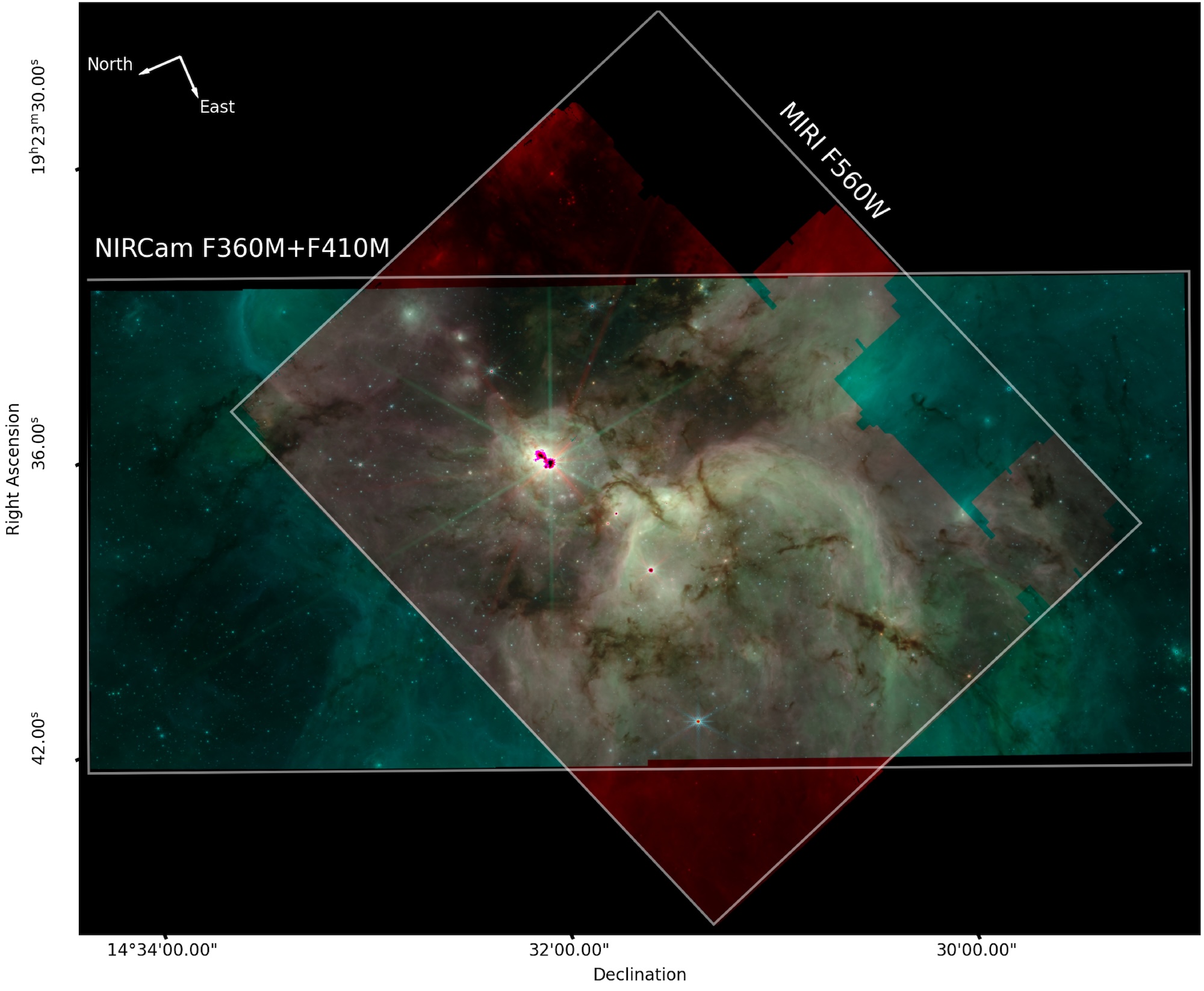
“A JWST NIRCam/MIRI View of the W51A High-Mass Star-Forming Region,” Taehwa Yoo et al 2026 AJ 171 208. doi:10.3847/1538-3881/ae40b7
The post Featured Image: Massive Stars in the Making appeared first on AAS Nova.
![]()
This image from JWST shows the galaxy cluster XLSSU J021744.1-034536. The cluster is at a redshift of z = 1.98, placing it at cosmic noon, when the universe’s star formation was at its peak. To study the formation and evolution of this cluster, Zachary Scofield (Yonsei University) and collaborators collected wide-ranging clues, including signs of weak gravitational lensing, the glow of gas in between the galaxies of the cluster, and an analysis of the cluster members. The image above (click for the full view) indicates the galaxies that are members of the cluster. The brightest galaxy in the cluster is marked with a yellow square, and the remaining cluster members are circled, with the color indicating whether the galaxy’s cluster membership was assigned photometrically (magenta) or spectroscopically (green). Combining all available lines of evidence, Scofield’s team found that XLSSU J021744.1-034536 is undergoing a merger, giving a rare glimpse into this stage of cluster formation. To learn more about this work and what it tells us about galaxy clusters at cosmic noon, be sure to check out the full article linked below.
“An Active Galaxy Cluster Merger at Cosmic Noon Revealed by JWST Weak Lensing and Multiwavelength Probes,” Zachary P. Scofield et al 2026 ApJL 999 L1. doi:10.3847/2041-8213/ae447a
The post Featured Image: An Active Galaxy Cluster Merger at Cosmic Noon appeared first on AAS Nova.
![]()
The seemingly warped and stretched galaxies in the image above show the work of gravitational lensing, in which the powerful gravitational pull of galaxies or galaxy clusters bends the light from background objects. Xiaosheng Huang (University of San Francisco and Lawrence Berkeley National Laboratory) and coauthors have used a neural network to amass a sample of 3,500 gravitational lensing candidates in data from the Dark Energy Spectroscopic Instrument (DESI) Legacy Surveys. Now, the team has used the Hubble Space Telescope to confirm some of the most promising candidates. Four of the newly confirmed systems are presented in the image above, with the DESI data shown in color and the higher-resolution Hubble data in black and white. Huang and collaborators also demonstrated the ability of their forward-modeling pipeline, GIGA-Lens, to constrain lens properties rapidly, even for large images like those from Hubble. Ultimately, Huang and coauthors hope to identify lensing systems that can be used to search for low-mass dark matter halos and test our theories of cosmology, as well as those that can be monitored for signs of lensed supernovae — providing a way to measure the expansion rate of the universe. To learn more about this sample of gravitational lenses and what the team plans to do next, be sure to check out the full research article linked below.
“DESI Strong Lens Foundry. I. HST Observations and Modeling with GIGA-Lens,” Xiaosheng Huang et al 2026 ApJ 998 69. doi:10.3847/1538-4357/ae22d2
The post Featured Image: A Treasure Trove of Strong Lenses appeared first on AAS Nova.
![]()
Giant low-surface-brightness galaxies are rare and unusual members of the galactic menagerie. They host the largest galactic disks currently known, have baryonic masses of order 100 billion solar masses, and sport narrow, tightly wound spiral structures. The origins of these vast galaxies — they can be up to 10 times larger than the Milky Way — are unknown, though various theories involving mergers, accretion, and strange dark matter halos exist. Research also suggests that there may be a connection between these galaxies and compact ellipticals, which are small, dense, and contain old stars. In a recent article, a team led by Anna Saburova (Sternberg Astronomical Institute) investigated two giant low-surface-brightness galaxies with compact elliptical companions. In the image above, the colored circles represent the oxygen abundance at each location in AGC 192040 (left) and UGC 1382 (right). The red arrows point to the compact elliptical companions. Using the chemical abundance information to investigate possible formation mechanisms, Saburova and collaborators found that the two galaxies likely formed in different ways. UGC 1382 appears to be the result of multiple mergers, while AGC 192040 may have accreted gas from its halo or a galactic filament before undergoing a merger of its own. To learn more about this study of two rare galaxies, be sure to check out the full research article linked below!
“MUSE Study of Two Giant Low-Surface-Brightness Galaxies with Compact Satellites,” Anna S. Saburova et al 2026 ApJ 998 19. doi:10.3847/1538-4357/ae3139
The post Featured Image: Rare Giant Galaxies appeared first on AAS Nova.
![]()
In 1999–2000, the Hubble Space Telescope captured what was then the most detailed image ever taken of the Crab Nebula. In the quarter-century since the release of that image, the nebula — the remnant of a star observed to explode as a supernova in July 1054 — has been slowly unfurling and changing as the ejected stellar material expands into space. Now, as reported in a research article by William Blair (Johns Hopkins University) and collaborators, astronomers have turned Hubble’s inquisitive eye toward the Crab Nebula once again. One of the new images is shown above (click for the full view!). By comparing the new and old Hubble images, Blair’s team uncovered dramatic changes in the nebula’s intricate filamentary structure. These changes are due to the nebula’s three-dimensional expansion as well as evolution in the density of its knots and filaments. To learn more about the new Hubble portrait of the Crab Nebula, be sure to check out the full article linked below.
“The Crab Nebula Revisited Using HST/WFC3,” William P. Blair et al 2026 ApJ 997 81. doi:10.3847/1538-4357/ae2adc
The post Featured Image: Hubble Revisits the Crab Nebula appeared first on AAS Nova.
![]()
“Hubble Reveals Complex Multiscale Structure in the Edge-On Protoplanetary Disk IRAS23077+6707,” Kristina Monsch et al 2026 ApJ 996 45. doi:10.3847/1538-4357/ae247f
The post Featured Image: Hubble Samples a Dusty Cosmic Sandwich appeared first on AAS Nova.