Human eyes don’t register the infrared portion of the light spectrum because infrared photons don't carry enough energy to trigger the signaling pathway inside our light-sensing cells. But we’ve been able to make devices that give us a visual representation of what’s happening in the infrared.
A team at the Beijing Institute of Technology, led by Xin Tang and Ge Mu, has now built a device that lets people see infrared in a new way. Instead of just translating it to visible shades of green as it’s done in standard night-vision goggles, it translates different infrared wavelengths into distinct parts of the visual spectrum, giving the eye something closer to natural vision.
Researchers achieved that by combining mercury telluride colloidal quantum dots, which absorb infrared light, and a dual-layer OLED, which converts that absorbed energy into visible color. Stacked together with the right internal wiring, they make incoming infrared radiation come out the other side as an ordinary-looking, full-color image.
NASA’s Hubble Shows Star Formation in Andromeda Galaxy Winding Down
NASA Hubble’s view of part of the Andromeda galaxy.
Credits: Image: NASA, ESA, Benjamin Williams (UWashington), Zhuo Chen (UWashington), L. Clifton Johnson (Northwestern); Image Processing: Joseph DePasquale (STScI)
A new study using data from NASA’s Hubble Space Telescope finds that star formation in the nearby Andromeda galaxy has undergone a 500-million-year decline, with an even steeper drop in the last 40 million years. Andromeda, a spiral galaxy comparable in size to our Milky Way, is close enough to be seen with the unaided eye from areas with dark skies. Located about 2.5 million light-years from Earth, practically our cosmic backyard, Andromeda offers an opportunity for astronomers to examine its stellar populations in detail, leading to better understanding of the past of galaxies like our own.
To reach this conclusion, the researchers combined data from two Hubble surveys: the Panchromatic Hubble Andromeda Treasury and the Panchromatic Hubble Andromeda Southern Treasury. Together, these two surveys mapped two-thirds of the disk of Andromeda in ultra-sharp detail. In total, the team measured about 200 million individual stars across the galaxy, giving them a detailed picture of Andromeda’s past activity.
“We need to measure the individual stars because they are the fossil record of the galaxy’s formation. Hubble is the only telescope that can give you high enough spatial resolution over a large enough area to be able to do that in Andromeda,” said Ben Williams, astronomer at the University of Washington and a co-author on the study.
Massive stars are bluer and short-lived, while less massive stars are redder and longer-lived. As a result, areas that have experienced recent star formation tend to have a larger fraction of blue stars, while areas with less recent star formation typically have a redder population. The team divided the Andromeda images into thousands of squares, spanning 300 light-years on each side of the square, and determined the history of star formation within each parcel to gain a comprehensive view of the galaxy’s past.
NASA’s Hubble Space Telescope has provided a detailed view of millions of stars in the Andromeda galaxy. Regions that have experienced recent star formation (1) appear significantly bluer than regions with less recent star formation (2).
NASA, ESA, Benjamin Williams (UWashington), Zhuo Chen (UWashington), L. Clifton Johnson (Northwestern); Image Processing: Joseph DePasquale (STScI)
Steady decline
Previous research showed the Andromeda galaxy experienced a dramatic burst of star formation about 2 billion years ago, likely due to a past interaction or merger with another galaxy. Since that time, star formation has been steadily declining.
Astronomers measure the rate of star formation in terms of the mass, or amount of gas and dust, converted into stars per year. The researchers calculated that, 500 million years ago, Andromeda formed stars at a rate of about one solar mass per year. However, the formation rate dropped to about half that by 40 million years ago. The current rate has plummeted even farther, to about one-fifth the mass of our Sun per year.
The team also examined whether that decline was consistent across the galaxy or concentrated in certain areas. They found that much of the recent star formation has occurred in a star-forming ring located about 32,000 light-years from the galaxy’s center. As a result, much of the decline they measure is driven by decreasing activity within that ring.
Rather than being the result of reduced material from which new stars can form, the decline is more likely to be a natural winding down from its previous, more active state.
“It’s just like after running a marathon, sometimes you’ve got to take a bit of a breather,” said Tobin Wainer, lead author, University of Washington.
Likely suspect
The team also investigated whether there was any connection between the decrease of activity in Andromeda and its proximity to satellite galaxy M32 (Messier 32). The M32 galaxy is separated from Andromeda by about 16,000 light-years in the plane of the sky; however, its 3D location in space is uncertain. As a result, astronomers are unsure if or when it might have interacted with Andromeda in the past.
“One of the major motivations for this program was to probe potential interactions between M32 and Andromeda’s disk,” said Zhuo Chen, co-author, University of Washington.
Survey data from the Panchromatic Hubble Andromeda Southern Treasury allowed the team to study the history of star formation in Andromeda near M32. They found that this area showed signs of decreased star formation compared with other regions. The timing of this decrease, which this study finds began roughly 60 million years ago, could help constrain when the M32 galaxy interacted with Andromeda’s disk.
“We can’t explicitly say that we are seeing a decrease in star formation because of M32. But it’s right there, and it’s definitely the most likely suspect,” said Wainer.
This movie, created from an analysis of data from NASA’s Hubble Space Telescope, demonstrates how the rate of star formation in the Andromeda galaxy has declined over the past 500 million years. Brighter colors indicate where star formation was highest during a given time.
Visualization: Tobin Wainer (UWashington); Image Processing: Joseph DePasquale (STScI); Video: NASA, ESA, STScI, Gregory Bacon (STScI)
The team plans to continue analyzing the Hubble data and combine it with data from ground-based observatories to gain additional insights into the history of Andromeda.
“There’s a strong scientific value to this archival data. Andromeda is important because it’s a neighbor that is close enough that we can see it in great detail while also getting a global perspective,” said Raja GuhaThakurta, co-author, University of California Santa Cruz.
An even greater global perspective is likely to come from NASA’s Nancy Grace Roman Space Telescope after it launches as early as Sunday, Aug. 30. Roman’s gigantic field of view can cover at least 100 times as much area as Hubble at near-infrared wavelengths in a single observation. A newly approved Roman observing program will image the entirety of Andromeda’s disk and areas of its surrounding halo, allowing astronomers to measure hundreds of millions of stars and enabling groundbreaking new science.
The Hubble Space Telescope has been operating for more than three decades and continues to make ground-breaking discoveries that shape our fundamental understanding of the universe. Hubble is a project of international cooperation between NASA and ESA (European Space Agency). NASA’s Goddard Space Flight Center in Greenbelt, Maryland, manages the telescope and mission operations. Lockheed Martin Space also supports mission operations at Goddard. The Space Telescope Science Institute in Baltimore, which is operated by the Association of Universities for Research in Astronomy, conducts Hubble science operations for NASA.
NASA’s Hubble Space Telescope has provided a detailed view of millions of stars in the Andromeda galaxy.
Star Formation Rate in Andromeda Over Time
This movie, created from an analysis of data from NASA’s Hubble Space Telescope, demonstrates how the rate of star formation in the Andromeda galaxy has declined over the past 500 million years.
In addition to model development, the Mars Climate Modeling Center (MCMC) conducts cutting-edge scientific research on the past and present atmosphere and climate of Mars.
The Mars Climate Modeling Center (MCMC) conducts atmospheric and climate science research using the NASA Ames Mars Global Climate Models (MGCMs), advancing our understanding of Mars’ climate today, in its ancient past, and as a target for future exploration.
Mars’ climate is governed by three interacting cycles — dust, water, and carbon dioxide (CO₂) — that vary across seasons and from year to year. MCMC scientists use the MGCMs to study these cycles and the processes that drive them, including:
Dust storms and dust transport – Investigating the mechanisms that lift, transport, and remove dust in the Martian atmosphere, including the onset and evolution of regional and global-scale dust storms.
Water and CO₂ cycles – Studying the seasonal exchange of water and CO₂ between the atmosphere, polar caps, and surface, and the clouds that form as a result.
Atmospheric dynamics – Examining circulation patterns, wave-mean flow interactions, and the extension of the MGCM into the middle atmosphere to better connect the lower and upper atmosphere.
Ancient Mars and habitability – Reconstructing past climate states, including the role of asteroid and comet impacts, to assess when and where conditions may have supported liquid water and habitability.
Mission support – Applying model results to landing site selection and characterization, atmospheric entry planning, and interpretation of data from current and past Mars missions.
This research is carried out by a team of civil servant and contractor scientists, postdoctoral researchers, and students, often in collaboration with universities and other NASA centers. You can read more about individual MCMC team members and their science on the Group Members page. A full list of MCMC research papers, conference presentations, and technical reports is available on the Publications page.
The Last Person on Earth will bring a different kind of dating experiment to Apple TV, pairing people who appear fundamentally incompatible before sending them to some of the world most romantic and isolated destinations.
Apple announced the eight-episode documentary series with Esther Perel, the bestselling author, psychotherapist and relationship expert known for examining desire, intimacy, infidelity and the tensions inside modern partnerships.
Perel will work with a team of matchmakers and therapists to create pairings that challenge the usual assumptions surrounding compatibility. Rather than finding contestants who share the same interests, routines and preferences, the series will deliberately bring together people who may initially see each other as the last person they would ever choose.
The central question is whether attraction can develop when familiar dating checklists are removed. Apple describes the series as an exploration of whether an unexpected partner can become the person someone ultimately cannot imagine living without.
No premiere date, contestant list or filming locations have been announced.
Image Credit: AppleMagazine
The Last Person on Earth Challenges Compatibility
The Last Person on Earth enters a crowded dating television market with a premise that rejects one of the most common promises made by matchmaking services: that compatibility can be predicted through similarity.
Dating apps routinely organize potential relationships through age, location, interests, lifestyle preferences, political beliefs and other personal filters. The process can help users avoid obvious conflicts, but it can also create increasingly narrow definitions of who deserves consideration.
Perel has frequently argued that desire does not always emerge from familiarity. Attraction can depend on difference, curiosity and the discovery of qualities that were not included on a checklist.
The Apple TV series turns that idea into a structured experiment. Participants will meet someone who appears to contradict their expectations before traveling together to a remote setting where ordinary distractions and familiar support systems may be limited.
That environment creates immediate dramatic possibilities. A beautiful destination can make a first connection feel unusually intense, but isolation can also expose differences that would remain hidden during short dates in familiar surroundings.
The presence of therapists and matchmakers suggests that the series will examine those reactions rather than presenting every disagreement as entertainment. Perel can help participants distinguish between genuine incompatibility, defensive habits and discomfort created by encountering someone outside their usual pattern.
The experiment does not promise that every opposite pairing will succeed. Difference can produce curiosity, but it can also reveal conflicts involving values, communication, life goals or emotional availability.
The more revealing outcome may be whether participants leave with a broader understanding of attraction, even when the relationship itself does not continue.
Esther Perel Brings a Different Voice to Dating TV
Perel gives the series a more analytical foundation than the competition-driven structure used by many dating programs.
Her books Mating in Captivity and The State of Affairs examine the contradictions surrounding commitment, desire and personal freedom. She also hosts the podcasts Where Should We Begin? and How Work, presenting conversations that explore relationships without reducing complicated behavior to simple villains and heroes.
That background may help The Last Person on Earth avoid familiar reality television shortcuts. Dating shows often depend on rapid attraction, artificial scarcity and public rejection. Contestants compete for one person, choose partners through brief impressions or make long-term commitments before they have experienced ordinary life together.
The new series begins with a different source of tension. Participants are not being told that a seemingly perfect match has been selected. They are being asked to question why someone who appears wrong may deserve a closer look.
Perel describes the project as an invitation to move beyond what feels familiar or safe. Her involvement also raises expectations that the series will explore how participants construct their preferences.
A person may insist on dating only someone with a certain career, personality or social style without understanding where that requirement originated. Some preferences protect legitimate needs. Others may repeat an old relationship pattern or prevent vulnerability by eliminating anyone capable of creating uncertainty.
The matchmakers and therapists can examine those distinctions before, during and after the trip. Their role could become particularly valuable when participants confuse immediate comfort with long-term suitability or mistake tension for romantic chemistry.
Apple has not explained how long each pairing will remain together, whether several couples will appear in each episode or how the experiment will determine its final outcomes.
Image Source: Google
Remote Destinations Change the Dating Environment
Sending couples to romantic and remote destinations adds more than scenery.
Modern dating frequently develops through phones, messaging, social media profiles and quick meetings fitted around work schedules. Participants may arrive with established habits for checking other options, retreating into digital distractions or ending contact before uncertainty has time to become meaningful.
A remote journey removes part of that structure. Two people must spend sustained time together, make decisions and respond to unfamiliar situations without immediately returning to separate routines.
Travel can accelerate intimacy because it creates shared memories and reveals behavior under pressure. Delays, unfamiliar environments, fatigue and practical disagreements may show more than a polished restaurant conversation.
The destinations may also create a misleading sense of closeness. A relationship formed in an exceptional setting still needs to survive ordinary responsibilities, geography, work and family expectations after the trip ends.
The documentary format gives Apple an opportunity to follow that transition rather than ending with a dramatic choice at the destination. Whether the series continues documenting the couples after they return home has not been disclosed.
The title adds another layer to the concept. The “last person” can mean the least expected match, but it also reflects the anxiety surrounding modern dating. A growing number of people describe exhaustion with apps, repeated disappointment and the feeling that suitable partners are disappearing.
Apple links the experiment to rising social isolation and polarization. People increasingly sort themselves into cultural, political and lifestyle groups, while digital systems learn to reinforce existing preferences.
A relationship series built around difference can test whether those divisions remain as rigid when two people encounter each other as individuals rather than profiles representing opposing categories.
Unscripted Relationships
The eight-episode order gives the production enough space to develop several pairings without extending the experiment indefinitely. Its success will depend on whether the participants receive room to behave naturally or are pushed toward the exaggerated conflict expected from conventional dating television.
Perel provides the series with a promising tension: lasting relationships require genuine compatibility, yet attraction can disappear when every element feels predictable. The challenge is not proving that opposites always belong together. It is discovering which differences create possibility and which ones should remain deal-breakers.
The Mars Climate Modeling Center (MCMC) presents the webserver, a website for interactive plotting and downloading Mars Global Climate Model (MGCM) output.
The model visualization tool offers the most accessible introduction to Mars Global Climate Model (MGCM) data. It is an online dashboard that allows users to interactively plot, explore, and download model output stored on the NAS Data Portal (see the MGCM Output tab for more information).
GCM analysis tools
MGCM Webserver
You can explore, plot, and download the MGCM output through our user-friendly web interface.
On July 3, one of NASA’s two Mars-destined ESCAPADE (Escape and Plasma Acceleration and Dynamics Explorers) spacecraft captured photos of Earth and the Moon in visible and thermal infrared light. At the time, the spacecraft was 363,250 miles (584,600 kilometers) from Earth and 115,600 miles (186,100 kilometers) from the Moon, making the Moon appear relatively large.
Taken with the Sun only partly illuminating Earth and the Moon, the visible light image shows the two bodies as crescents, with only around 8% of each face sunlit. Yet in the thermal infrared image, the shadowed hemisphere of Earth is illuminated by its own heat from both the atmosphere and surface, glowing at minus 10 to minus 44 degrees Fahrenheit (250 to 280 kelvins). Without the insulating blankets of oceans and atmospheres, the Moon’s far side remains at a much cooler minus 280 degrees Fahrenheit (100 kelvins).
visible light
thermal infrared light
Caption: In these images from NASA’s ESCAPADE mission, Earth (left) and Moon (right) can be seen. The image to the left of the slider shows visible light reflected by the Sun while the infrared image to the right shows the bodies’ emitted energy. White rings have been added in the thermal image to show the actual size of Earth and the Moon. Credit: NASA/UCB-SSL/NAU-Radiant/Lucint
NASA/UCB-SSL/NAU-Radiant/Lucint
In these images from NASA’s ESCAPADE mission, Earth (left) and Moon (right) can be seen. The image to the left of the slider shows visible light reflected by the Sun while the infrared image to the right shows the bodies’ emitted energy. White rings have been added in the thermal image to show the actual size of Earth and the Moon.
NASA/UCB-SSL/NAU-Radiant/Lucint
visible light
thermal infrared light
ESCAPADE Photos of Earth and Moon
July 3, 2026
In these images from NASA’s ESCAPADE mission, Earth (left) and Moon (right) can be seen. The image to the left of the slider shows visible light reflected by the Sun while the infrared image to the right shows the bodies’ emitted energy. White rings have been added in the thermal image to show the actual size of Earth and the Moon. Credit: NASA/UCB-SSL/NAU-Radiant/Lucint
The ESCAPADE mission used its Visible and Infrared Observation System cameras, provided by Northern Arizona University in Flagstaff, to capture the images, which are more than just road trip photo album snaps.
“We are thrilled that ESCAPADE was able to accommodate these excellent space-qualified cameras which will search for visible Martian aurora and investigate thermal properties of the Martian surface and atmosphere,” said Rob Lillis, the mission’s principal investigator at the University of California, Berkeley. “Since Earth and the Moon are well-known targets, imaging them provides an important calibration check for ESCAPADE’s cameras.”
The ESCAPADE spacecraft, which were built by Rocket Lab, are currently in a “loiter” orbit around Lagrange point 2, a location in space about a million miles from Earth. In November 2026, the spacecraft will fly by Earth to use the planet’s gravity to slingshot their way to Mars. When the spacecraft arrive in September 2027, they will study how a million-mile-per-hour stream of material flowing from the Sun, known as solar wind, interacts with the Martian environment and how that drives atmospheric loss at the Red Planet.
The ESCAPADE mission is funded by NASA’s Heliophysics Division and is part of the NASA Small Innovative Missions for Planetary Exploration program. The UC Berkeley’s Space Sciences Laboratory leads the mission with key partners Rocket Lab; NASA’s Goddard Space Flight Center in Greenbelt, Maryland; Embry-Riddle Aeronautical University; Advanced Space; and Blue Origin.
By Mara Johnson-Groh NASA’s Goddard Space Flight Center, Greenbelt, Md.
The Morning Show Season 5 will officially conclude one of the longest-running and most recognizable dramas on Apple TV when it premieres in 2027.
Apple confirmed that the fifth season will be the last, allowing Jennifer Aniston, Reese Witherspoon and the creative team to complete the stories of Alex Levy, Bradley Jackson and the troubled journalists surrounding their fictional television network.
Aniston and Witherspoon will return as stars and executive producers. Both indicated that the ending was planned while the season was being developed, giving the writers an opportunity to create a deliberate conclusion rather than leaving the characters suspended after an unexpected cancellation.
Apple has not announced a specific premiere date or episode schedule. The company has released first-look images featuring Aniston and Witherspoon together, confirming that production on the final chapter is moving forward for a 2027 arrival.
Image Credit: Apple Inc.
The Morning Show Season 5 Brings a Planned Ending
The Morning Show Season 5 was originally announced in September 2025, shortly before the fourth season premiered. At the time, Apple presented the renewal as another chapter for an established global hit without indicating that it would end the series.
The decision to identify it as the final season changes the expectations surrounding every storyline. Rather than creating another crisis that could lead into a sixth season, the writers can determine where the central characters belong after years of professional upheaval, corporate conflict and personal compromise.
Showrunner Charlotte Stoudt suggested that the final episodes will examine what the journalists ultimately choose for themselves. That direction fits a series in which success has rarely provided its characters with stability or satisfaction.
Alex and Bradley began the drama from sharply different positions. Alex was an established television personality attempting to protect her career during a public scandal, while Bradley entered the network as an unpredictable outsider. Their relationship developed through rivalry, loyalty, separation and repeated confrontations with the institutions employing them.
The final season can now treat those ambitions as completed journeys rather than temporary stages. Alex must decide what remains worth defending after years of negotiating with executives, billionaires and political interests. Bradley must determine whether pursuing the story at any personal cost remains sustainable.
Season four moved the drama into a media environment shaped by deepfakes, conspiracy theories, corporate influence and uncertainty over what audiences can trust. Its story continued examining how journalism operates when the network reporting the news is also affected by commercial priorities and internal power struggles.
Apple has not disclosed the central subject of Season 5. The first-look images concentrate on Aniston and Witherspoon, placing their complicated partnership back at the center after a fourth season that separated the characters through an international crisis.
A Flagship Series That Grew With Apple TV
The Morning Show debuted on November 1, 2019, the same day Apple launched its streaming service.
Its position in the original lineup made the series more than another drama acquisition. Apple needed recognizable performers and an ambitious production capable of signaling that the new platform intended to compete for major television audiences and awards.
Aniston and Witherspoon provided immediate visibility, while the newsroom setting allowed the series to respond to current debates involving workplace misconduct, corporate accountability, political polarization and the influence of television journalism.
The first season began after allegations against morning-show anchor Mitch Kessler, played by Steve Carell, forced the network to restructure its leading program. Alex attempted to retain control while Bradley was selected as an unconventional replacement capable of changing the tone of the broadcast.
Later seasons expanded far beyond the original scandal. The drama incorporated the COVID-19 pandemic, a technology billionaire attempting to acquire the network, the merger of UBA and NBN, artificial intelligence, misinformation and international political pressure.
The willingness to move quickly into recognizable real-world subjects became part of the identity of The Morning Show. Its fictional network frequently operated only a short distance from controversies affecting actual media companies, public figures and technology platforms.
The approach sometimes pushed the series toward heightened melodrama, but that excess also distinguished it from a conventional workplace production. Executive decisions, personal betrayals and breaking-news events could carry the intensity of a political thriller.
Billy Crudup became one of its most acclaimed performers as Cory Ellison, the charismatic executive whose enthusiasm for disruption regularly concealed more complicated motives. Crudup won two Emmy Awards for the role and will return for the final season.
Apple executives have described the production as a defining part of the streaming service. Ending it after five seasons closes a direct connection to the original Apple TV launch lineup while allowing the platform to preserve the series as a completed story.
Image Credit: Apple Inc.
The Final Cast Adds More High-Profile Names
The final season will bring back Aniston, Witherspoon, Crudup, Mark Duplass, Nicole Beharie, Nestor Carbonell, Karen Pittman and Jon Hamm.
Hamm joined the series as Paul Marks, a technology billionaire whose business ambitions and relationship with Alex reshaped the third season. His continued presence indicates that the consequences of his involvement with the network have not been fully resolved.
Several new performers will enter the drama for its last run. Apple has assembled additions including Jeff Daniels, Reneé Rapp, Jesse Williams, Sean Hayes and Lizzy Caplan, although complete character details remain limited.
Daniels brings a particularly appropriate history to the production after starring as news anchor Will McAvoy in The Newsroom. His presence creates an immediate association with another television drama concerned with journalism, newsroom ethics and the conflict between ratings and public responsibility.
Rapp returns to a major television role after building her music career and appearing in projects including The Sex Lives of College Girls and Mean Girls. Williams previously spent more than a decade on Grey’s Anatomy, while Hayes is best known for Will & Grace and has expanded into dramatic work.
Caplan has moved between comedy, drama and thrillers through projects including Masters of Sex, Fleishman Is in Trouble and Fatal Attraction. The scale of the additions suggests that the final season will introduce another major institutional or professional conflict rather than concentrating exclusively on farewell scenes.
Stoudt remains showrunner and executive producer. Mimi Leder continues as director and executive producer, while Media Res, Echo Films and Hello Sunshine remain behind the production.
Aniston described the opportunity to finish the story knowingly as a way to honor the characters with intention. Witherspoon emphasized that the series was never only about the personalities appearing on television, but also about the role of journalism and the people responsible for protecting the press.
That theme gives the final season a defined destination. The Morning Show began by asking whether a television institution could survive the misconduct it had protected. Its last episodes can decide whether the journalists inside that institution changed it, escaped it or became part of the machinery they once believed they could challenge.
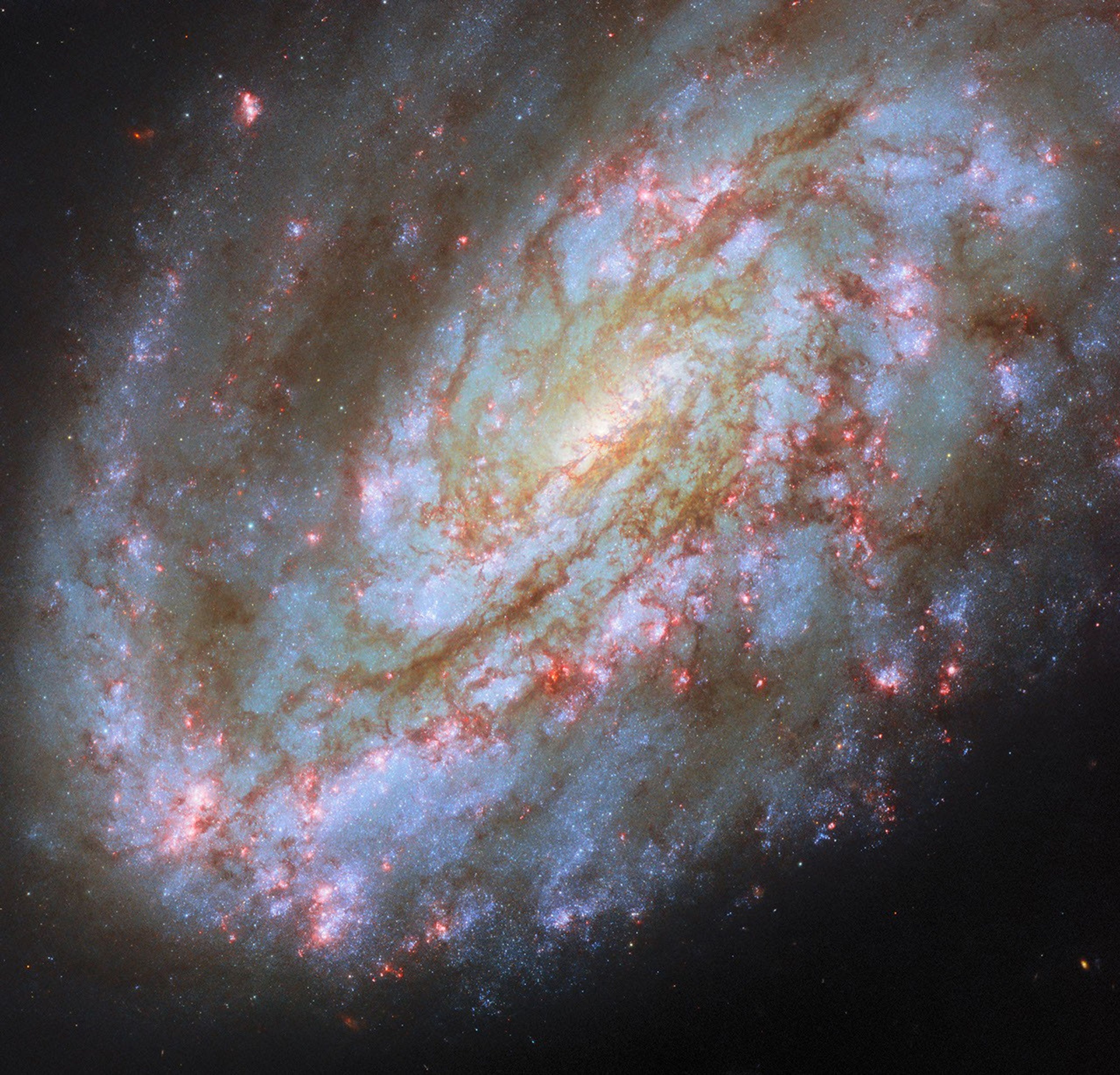
This NASA/ESA Hubble Space Telescope image features the spiral galaxy NGC 4654, located 72 million light-years away in the constellation Virgo (the Maiden).
NASA, ESA/Hubble, D. Thilker, J. Lee, and the PHANGS-HST Team
The subject of this NASA/ESA Hubble Space Telescope image is a spiral galaxy struggling against titanic forces that appear on galactic scales in space. This is NGC 4654, an intermediate spiral galaxy in the constellation Virgo (the Maiden). It is classified as an “intermediate” because its overall shape lies between spiral galaxies that have a bar across their centers and those that don’t. NGC 4654 has a weak bar structure at its center and is located 72 million light-years from Earth in the Virgo Cluster, a particularly massive and populous galaxy cluster.
NGC 4654 is particularly asymmetric, with a rounded and clearly-defined edge on one side and a long tail of gas stretching out from the opposite side — outside the field of view captured in this image. This gaseous tail is the result of ram pressure stripping, a force that galaxies can experience as they plow through space. NGC 4654 moves with such high velocity that it sweeps up and rams through the hot, rarefied gas filling the space between the Virgo Cluster’s galaxies. This intracluster medium in turn exerts a “ram pressure” on the galaxy, compressing the galaxy’s leading edge and dragging its gas behind the galaxy, creating the elongated tail.
It’s not just the galaxy’s gas that is unevenly distributed: its stars are too, and this is more unusual for a spiral galaxy. While the spiral arm on its leading edge is rich with stars and gas, the opposite arm noticeably lacks stars, influencing the galaxy’s lopsided spiral shape. Astronomers think that ram pressure alone is unlikely to cause this effect. Rather, NGC 4654 was also subjected to the gravitational force of fellow Virgo Cluster galaxy NGC 4639. While the two galaxies are far apart now, it’s thought that a fly-by interaction between them around 500 million years ago ripped away NGC 4654’s gas along one side, limiting star formation there and creating the asymmetry in its shape.
Many galaxies that undergo ram pressure stripping suffer reduced star formation rates as the cold gas that collapses to form their stars is pulled away and lost. NGC 4654, however, is still forming nearly two Suns’ worth of stars every year, a rate comparable to other galaxies of similar size. The active star formation is visible in the latest Hubble data included in this image. The data picks up on a wavelength of red light emitted by the clouds of energized gas where newborn stars lurk. The bright pink bubbles that appear across NGC 4654 — from its forward spiral arm, to around its weak bar, and out to the edge of its disk — are areas where these newborn stars shine.
The data used in this image came from two observing programs (#15654, #17502) that aim to link the gas in galaxies with star formation. By observing many prominent galaxies in the vicinity of our own, researchers hope to better understand how gas moves in galaxies, where and when it collapses to form stars and star clusters, and what effect those new stars have on the gas around them.
This illustration depicts charged particles from a solar storm stripping away charged particles of Mars’ atmosphere, one of the processes of Martian atmosphere loss studied by NASA’s MAVEN mission.
NASA/GSFC
NASA MAVEN (Mars Atmosphere and Volatile Evolution) mission scientists have uncovered a key puzzle piece in understanding certain types of auroras on Mars, finding that they form in a similar way to Earth-based auroras.
Results published Thursday in Nature Communications show the same mechanism that circulates and catapults charged particles into Earth’s atmosphere is happening at Mars on much smaller scales because of differences in the two planets’ magnetic fields.
The MAVEN spacecraft, in orbit around Mars, experienced a loss of signal with ground stations on Earth on Dec. 6, 2025. On June 3, NASA declared the mission had concluded after finding the spacecraft to be unrecoverable. However, data from the mission is still being used to inform NASA science and future missions to Mars.
When the Sun’s magnetic field lines get close to Earth’s magnetosphere, the large magnetic bubble protecting the planet, they can reconnect and inject energy and mass throughout Earth’s magnetosphere and magnetotail, ultimately firing electrons back into the atmosphere to generate Earth’s auroras. This process, called the Dungey cycle, drives electrical currents, accelerates charged particles that create auroras, and controls the circulation of plasma in Earth’s magnetosphere and ionosphere.
This new study shows that a miniature version of the Dungey cycle is happening over Mars’ strong crustal magnetic fields, which gives scientists a better look into the physics of Martian auroras.
“We knew that magnetic reconnection was happening at Mars but did not expect it to be like the Dungey cycle,” said Shaosui Xu, lead author of the study and associate research physicist at the Space Sciences Laboratory at the University of California, Berkeley.
Mars does not have a global magnetic field like Earth. Earth’s magnetic field is created by our planet’s churning core, while Mars has numerous miniature magnetospheres that arise from intensely magnetized crust scattered around the planet. These regions were formed around 4 billion years ago when lava cooled in the presence of Mars’ ancient global magnetic field, which has since disappeared due to intense solar wind stripping the planet’s atmosphere.
The MAVEN mission has observed highly localized auroras over these crustal fields, similar to Earth’s auroras at the poles, but it wasn’t until now that scientists could fully understand the physics of how they form. The study used several instruments aboard the MAVEN spacecraft to build up a picture of the Dungey-like behavior: the Magnetometer and Solar Wind Electron Analyzer instruments, which were used to determine the magnetic configuration and derive electrical currents, and the STATIC (Suprathermal and Thermal Ion Composition) instrument, which was used to measure plasma flows in the ionosphere.
“We really pushed the limit of STATIC to get the data we needed,” said Xu. “It was the final piece to the puzzle in understanding these localized auroras.”
The realization that a Dungey-like cycle was happening within these crustal magnetic fields answered the question of how the electrons were being energized to create the auroras. It also shows that a Dungey-like mechanism can happen on both large and small scales, giving more insight into where in the solar system this process could be taking place.
“This is a remarkable result that changes how we think of Martian auroras and is another important step toward understanding why Mars and Earth have evolved so differently despite being governed by the same underlying physics.” said Shannon Curry, MAVEN’s principal investigator and a research scientist at the Laboratory for Atmospheric and Space Physics at the University of Colorado Boulder. “I am incredibly proud of our team’s work on this discovery and excited to uncover new insights into the Red Planet and its evolution.”
By finding out more about this process, scientists also are gaining a better understanding of how the solar environment interacts with the Red Planet as a whole, which is essential for future robotic and crewed missions.
“I remember in graduate school discussing with my advisor how the cycling of crustal magnetic fields could work at Mars,” said Xu. “It’s incredible to be part of the team that found the answer to that question.”
The MAVEN mission is part of NASA’s Mars Exploration Program portfolio. The mission’s principal investigator is based at the Laboratory for Atmospheric and Space Physics at the University of Colorado Boulder, which also is responsible for managing science operations and public outreach and communications. NASA’s Goddard Space Flight Center in Greenbelt, Maryland, manages the MAVEN mission. Lockheed Martin Space built the spacecraft and is responsible for mission operations. NASA’s Jet Propulsion Laboratory in Southern California provides navigation and Deep Space Network support.
For more information on NASA’s MAVEN mission, visit:
The NASA Earth Action Water Resources program area advances the use of Earth science data to support sustainable and adaptable water resources management. Through collaboration with partners, the program area works to enhance water use efficiency, advance water quality monitoring and modeling, and strengthen water resilience. These efforts empower informed decision-making and address critical challenges in water resources.
The NASA Earth Action Health and Air Quality program area encourages the use of Earth observations in air quality management and public health, including environmental health and infectious diseases. The program area helps public health and air quality managers, policymakers, and the public manage health-related decisions and minimize disease risk.
 Login