❌

Normal view

Apple fecha o melhor trimestre abril-junho da sua história no último balanço de Tim Cook

2 August 2026 at 14:30

Todas as empresas de capital aberto (que possuem ações à venda na bolsa de valores) são obrigadas, por lei — na maioria dos países (inclusive Brasil) —, a disponibilizar publicamente suas demonstrações financeiras periodicamente. Esse costuma ser um momento bastante esperado por acionistas (analisando se a empresa na qual estão investindo está sendo bem administrada e gerando lucros), investidores (para captar novas oportunidades de alocar seus recursos), além da imprensa e de curiosos em geral. Na última quinta-feira (30/7), foi a vez da Apple de divulgar seus resultados financeiros referentes ao trimestre abril-junho de 2026.

Para alegria de todos, o CEO 1Chief executive officer, ou diretor executivo. Tim Cook se despede da sua posição com o melhor terceiro trimestre fiscal que a empresa já registrou — um recorde absoluto! Como já informado aqui no MacMagazine, no período de abril a junho (encerrado no dia 27/6), a companhia relatou uma receita de US$109,4 bilhões (alta de 16,4%) em relação ao mesmo trimestre do ano anterior, e lucro líquido de US$29,8 bilhões (um avanço de 27%). A margem bruta chegou a incríveis 50,1%, a maior já apurada em períodos semelhantes da história da empresa!

Hoje, a Apple tem orgulho de relatar o nosso melhor trimestre de abril-junho de todos os tempos, com crescimento de receita de dois dígitos em iPhone, Mac e Serviços, e em todos os segmentos geográficos.

A fala acima é de Cook. Ele deixará o cargo em 1º de setembro, quando John Ternus assumirá, e passará a presidir o conselho de administração.

O fenômeno Mac

Uma das grandes surpresas do relatório foi o crescimento no faturamento de Macs. Pela primeira vez, a categoria ultrapassou a casa dos US$10 bilhões em um trimestre abril-junho, e o crescimento de 29% superou o do iPhone.

A explicação está em parte na procura alucinada por Macs mini para rodar agentes de inteligência artificial e na leva de lançamentos de março: MacBook Air com M5, MacBook Pro com M5 Pro e M5 Max, e principalmente o MacBook Neo, o modelo de entrada que estreou a US$600 — preço que subiu para US$700 em junho, no reajuste geral motivado pelo custo de memória. A Apple parece ter encontrado um mercado relevante abaixo do Air, e vale acompanhar o que isso faz com a margem da linha nos próximos trimestres.

O iPad foi a única categoria no vermelho, com queda anual de 6%. Não é surpresa: a própria Apple havia avisado que a comparação seria difícil, pois no ano anterior houve o lançamento do iPad com chip A16. O iPad Air com M4, que chegou em março, não foi suficiente para compensar. Cabe ainda analisar se o bem-sucedido MacBook Neo não acabou levando um pouco do mercado dos tablets, também.

O asterisco que quase ninguém vai mencionar

A margem bruta de 50,1% e o lucro por ação de US$2,02 não são resultado apenas da operação, e esse detalhe se perde facilmente na comemoração dos recordes.

À primeira vista, no press release — e nos comentários que fizemos no último podcast —, esse ponto não ficou bem claro, mas merece atenção. A Apple informou, no comunicado, que a margem incluiu cerca de dois pontos percentuais e o lucro por ação incluiu US$0,11 vindos de reembolso de tarifas, dinheiro que a empresa havia pago ao governo americano e recebeu de volta depois que a Suprema Corte derrubou, em fevereiro, as tarifas impostas sob a IEEPA (a lei de poderes econômicos internacionais de emergência). A empresa não detalhou a origem exata dos valores devolvidos, mas a decisão da Corte é o evento que abriu caminho para os reembolsos.

É dinheiro real, entra legitimamente no resultado, mas não é recorrente e não diz nada sobre a capacidade da Apple de vender aparelhos. Descontando o efeito, a fotografia muda um pouco: a margem bruta cai para aproximadamente 48%, exatamente o que o consenso projetava, e o lucro por ação vai para cerca de US$1,91, contra os US$1,89 esperados. De uma superação de 6,9% no lucro, sobra uma de pouco mais de 1%.

Ou seja: o trimestre continua bom em receita e em volume, que são genuinamente fortes. Mas o brilho extraordinário no lucro é, em boa parte, contábil, e não se repete.

A Apple abre a margem bruta em dois blocos apenas: produtos e serviços. Ela nunca divulga margem por categoria individual (não existe margem oficial de iPhone, Mac ou iPad em documento nenhum da empresa, e todo número desse tipo que circula é estimativa de analista), mas os dois blocos que ela abre já contam a história.

Linha de negócioMargem do FQ3 2026Margem do FQ3 2025Variação
Produtos40,07%34,52%+5,55pp
Serviços75,62%75,58%+0,04pp
Consolidado50,06%46,49%+3,57pp

A margem de hardware subiu 5,55 pontos percentuais em 12 meses. A margem de hardware não sobe 5 pontos por ganho de eficiência: é ali que o reembolso de tarifas desembarcou, porque tarifa incide sobre produto físico. A prova está na linha seguinte: serviços, que não pagam tarifa nenhuma, ficou praticamente parado. A melhora não foi operacional.

Vale registrar um desequilíbrio que explica boa parte do valuation da Apple. Serviços representam 28,1% da receita, mas respondem por 42,4% do lucro bruto do trimestre. Produtos são 71,9% da receita e apenas 57,6% do lucro. Cada dólar de serviço vale quase o dobro de um dólar de hardware, e é por isso que o mercado aceita pagar perto de 40x o lucro por uma empresa que, no fim das contas, vende telefone.

Serviços: um pequeno sinal de alerta

Os relatórios revelaram um problema silencioso do trimestre. Serviços cresceram 12,1%, um bom número isolado, mas bem abaixo dos 16,2% do trimestre encerrado em março e, mais grave, abaixo do que a própria Apple havia sinalizado. Na teleconferência de abril, o diretor financeiro Kevan Parekh disse que os serviços cresceriam em ritmo “similar ao reportado em março” (ou seja, algo perto de 16%, ressalvando o efeito cambial). Ficaram cerca de 4 pontos percentuais aquém.

A linha chegou a recuar 0,8% em relação ao trimestre imediatamente anterior. Foi o único item da projeção que a Apple não cumpriu, e não é um item qualquer: é o que sustenta o múltiplo da ação. Parte da imprensa de mercado atribuiu a reação negativa à combinação de serviços com a Grande China, embora as estimativas para a região divergissem bastante entre as casas: havia projeções de US$18,8 bilhões, que o resultado cumpriu, e de US$19,5 bilhões, que não.

Some-se a isso um risco que não tem data marcada. Boa parte da receita dos serviços vem do acordo pelo qual o Google paga à Apple para ser o buscador padrão do Safari — cerca de 36% da receita de anúncios de busca, algo próximo de US$20 bilhões por ano. Existe um processo em andamento que questiona a legitimidade desta taxa. A sentença de setembro de 2025 permitiu que o acordo continuasse, mas o Departamento de Justiça dos Estados Unidos recorreu em fevereiro de 2026 e o Google entrou com recurso próprio em maio. Se a decisão cair, o buraco nessa linha é de dois dígitos de bilhão!

Três números que o comunicado não destaca

Fora das manchetes do balanço, três indicadores das demonstrações merecem atenção, e nenhum deles apareceu no material de divulgação.

  1. O estoque quase dobrou, de US$5,7 bilhões em setembro de 2025 para US$11,1 bilhões, alta de 94%. Uma empresa que é referência mundial em operar com estoque enxuto dobrou o estoque em 9 meses. A leitura mais provável é compra antecipada de memória, antes que os preços subam ainda mais. É a confirmação contábil do que Cook disse em junho, quando afirmou que aumentos de preços eram inevitáveis.
  2. Pesquisa e desenvolvimento saltou para US$11,7 bilhões, o dobro do ritmo da receita, e passou de 9,4% para 10,7% do faturamento. Ao mesmo tempo, o investimento em ativo fixo (equipamentos, imóveis, veículos etc.) caiu 28% no acumulado de 9 meses. É a tese da IA “capital-light” traduzida em números: a Apple gasta mais em gente e software, e menos em concreto e servidor, apostando em rodar inteligência nos mais de 2 bilhões de aparelhos que já estão nas mãos dos usuários. O oposto de Microsoft, Google e Amazon.
  3. O caixa operacional de 9 meses foi de US$117 bilhões, contra US$81,8 bilhões. Mesmo assim, a recompra de ações caiu de US$70,6 para US$62,1 bilhões. A Apple está segurando dinheiro, o que é coerente com o estoque dobrado e com uma troca de comando marcada para 1º de setembro.

Há ainda um detalhe na linha de outras receitas, que agrupa o que a Apple ganha fora da operação: juros do caixa aplicado, juros pagos sobre dívida, variação cambial e valorização de participações minoritárias. O resultado foi de US$572 milhões positivos, contra US$171 milhões negativos há um ano — um giro de US$743 milhões. A carteira de caixa e aplicações subiu para US$146,5 bilhões, enquanto a dívida caiu para US$82,3 bilhões. Mais dinheiro rendendo, menos juros a pagar. É lucro financeiro, não operacional.

A projeção para setembro veio bem abaixo

O trimestre relatado é recorde. A projeção que o acompanha, não. E como o mercado precifica futuro e não passado, foi ela que dominou a reação. A ação, que havia fechado o pregão a US$333,43, caiu cerca de 6,5% na negociação estendida ao longo da teleconferência, o que equivale a aproximadamente US$317 bilhões de valor de mercado. No dia seguinte, a queda se confirmou: -7,35%. A projeção da Apple para o trimestre de setembro, o último do ano fiscal, veio com dois números desconfortáveis.

IndicadorFQ3 2026 (real)FQ4 2026 (projetado)
Crescimento de receita16,4%de 9% a 11%
Margem bruta50,1%de 47% a 48%
Margem bruta sem reembolso de tarifas48,1%de 47% a 48%
Receita implícitaUS$109,4 bilhõesde US$111,7 a US$113,7 bilhões

A desaceleração de 16,4% para algo entre 9% e 11% já seria suficiente para incomodar. O que agravou foi a justificativa: Parekh afirmou que o impacto das restrições de oferta deve “aumentar significativamente” em relação ao trimestre anterior — citando explicitamente iPhone, Mac e iPad —, e mencionou ainda ventos contrários de câmbio sobre a receita de iPhone.

A margem projetada de 47% a 48% é o número mais revelador de todo o balanço. Ela fica abaixo do resultado limpo deste trimestre sem o reembolso de tarifas. Ou seja: a Apple está dizendo que a margem vai cair de verdade, em bases comparáveis. O colchão de estoque de memória comprado a preço favorável, que segurou os custos nos últimos trimestres, está acabando, e o trimestre de setembro é justamente o que carrega o lançamento dos “iPhones 18 Pro/18 Pro Max” — e provavelmente do “iPhone Ultra”, o primeiro dobrável da empresa.

O que Ternus herda

Ternus assumirá como diretor executivo em 1º de setembro, com Cook passando a presidente executivo do conselho. A julgar pelo balanço, ele recebe uma casa em ordem: receita recorde, base instalada de aparelhos ativos em máxima histórica em todas as categorias principais, patrimônio líquido de US$107,5 bilhões e — possivelmente — a companhia mais valiosa do mundo.

Recebe também três problemas bem definidos. O primeiro é o custo de memória, que já forçou aumentos de preço no MacBook Air, no Mac mini e no Mac Studio, e que agora vai comprimir margem sem o amortecedor do estoque barato.

O segundo é a desaceleração dos serviços, com os recursos judiciais contra o acordo de busca com o Google ainda pendentes.

O terceiro é entregar a Siri reformulada, anunciada na WWDC26, movida pelo Gemini do Google, prevista para o ciclo do iOS 27 e adiada por tempo indeterminado na União Europeia — decisão que a Apple atribui às exigências da Lei dos Mercados Digitais (Digital Markets Act, ou DMA).

A leitura mais honesta deste balanço talvez seja esta: Cook encerra sua gestão entregando o melhor trimestre abril-junho da história da Apple, a maior capitalização de mercado do mundo e uma operação que cresce dois dígitos em todos os continentes em que atua. O que ele não entrega pronto é a próxima curva: provar que a aposta de rodar inteligência artificial dentro do aparelho, e não na nuvem, vale o múltiplo de 40x que a ação vinha cobrando. Essa parte, agora, é com Ternus.

Metodologia

Os números do trimestre e do comparativo anual foram extraídos das demonstrações consolidadas condensadas não auditadas da Apple referentes ao terceiro trimestre fiscal de 2026 e ao terceiro trimestre fiscal de 2025, conferidas linha a linha. As margens por linha de negócio, os indicadores de balanço patrimonial e de fluxo de caixa e todos os percentuais foram calculados a partir desses documentos.

As estimativas de consenso de Wall Street citadas foram compiladas antes da divulgação junto a Yahoo Finance, TipRanks, Zacks, Visible Alpha, Hudson Labs e Goldman Sachs.

A projeção para o trimestre de setembro e as declarações do diretor financeiro vêm da teleconferência de 30 de julho de 2026, com apuração de 9to5Mac, CNBC e AppleInsider.

Os dados de mercado chinês são da IDC e da CAICT. A série de fechamentos mensais da ação tem origem em StatMuse, StockAnalysis.com, FinancialContent e Macrotrends, via S&P Global Market Intelligence.

O ajuste identificado como “sem reembolso de tarifas” não é uma linha contábil: é cálculo próprio a partir do efeito que a Apple declarou no comunicado de resultados.

Observação

Este texto não constitui recomendação de investimento.

Notas de rodapé

  • 1
    Chief executive officer, ou diretor executivo.

Apple hints at higher iCloud+ storage tiers for AI power users

31 July 2026 at 16:57

Macworld

Apple doesn’t make formal product announcements or discuss future product plans during its quarterly financial results announcements. But every once in a while, it shares some details that offer a peek at what’s coming.

During Thursday’s Q3 2026 financial call, Apple indicated the higher iCloud+ tiers could be on the way. While it has already said it will offer some kind of iCloud+ tie-in to accommodate heavy AI usage, when Goldman Sachs’ Michael Ng asked about Apple Intelligence and “compute costs and the ability to recover some of those costs through iCloud+,” Apple CEO Tim Cook had this response:

In terms of what it means for compute cost, it’s obviously early going for us, and so I don’t want to say that we have a complete plan for that. We do believe there will be people that want to use it a lot, and so we will have some kind of upgrade possibilities on iCloud+ where people can buy up the stack on iCloud+, and we’ll see how the pickup for that is. But we could not be more excited about where the product is.

Details about the “upgrade possibilities” weren’t provided, but Apple’s plans aren’t a surprise. At WWDC26 last June, Apple demonstrated several AI features and noted that there would be daily usage limits, which expanded access available through iCloud+. But at that time, no further details were provided.

Apple is expected to officially release iOS 27 in September, around the same time the company unveils the iPhone 18 Pro and iPhone Ultra. Apple will likely announce these new iCloud+ plans at the same time. It’s unclear as to what Apple will offer to accommodate AI usage; iCloud+ currently offers 5GB of free storage, with upgrade plans up to 12TB, though other AI companies offer storage up to 100GB. It sounds like Apple will explore these higher storage options for iCloud+ plans primarily built for AI use.

Azio taps AT&T for fibre link to Texas AI campus

31 July 2026 at 15:41

Infrastructure company Azio AI Holdings signed a master services agreement (MSA) with AT&T worth roughly $2.4 million to provide enterprise fibre connectivity for its first AI data centre campus.

The deal covers a 500-megawatt site and establishes a standardised connectivity framework across the campus, delivering the high-capacity, low-latency network infrastructure needed to support AI training, inference, GPU cloud computing, enterprise colocation, and other high-performance computing workloads.

Azio said the connectivity buildout is intended to streamline network deployment as it brings on additional customers under its hyperscale AI strategy. The company pointed to a recent power purchase and hosting agreement with a GPU customer, which it said will require a rapid, modular buildout at the Texas site.

“This agreement establishes the networking framework supporting our initial 500-megawatt Texas AI platform while creating a scalable operating model that can support future expansion as additional projects move forward under our hyperscale AI strategy,” Azio COO Elgin Tracy stated.

The company’s broader strategy centres on scalable, liquefied natural gas-backed energy capacity intended to meet rising demand for GPU cloud and AI workloads.

It stated the Texas site was picked in part due to the location being able accommodate large-scale industrial infrastructure without the land-use and community constraints which can complicate data centre projects in urban areas.

The agreement adds AT&T to the growing list of telecoms operators positioning themselves as connectivity partners for the AI infrastructure buildout, as data centre operators race to secure the fibre capacity needed to link GPU clusters to enterprise and hyperscale customers.

Azio did not disclose a timeline for construction completion or when the Texas campus is expected to become operational.

The post Azio taps AT&T for fibre link to Texas AI campus appeared first on Mobile World Live.

Anthropic reveals rogue Claude attacks

31 July 2026 at 11:17

Anthropic disclosed it is investigating three instances of its Claude AI models conducting hacks into companies during a testing process, a week after OpenAI revealed a similar incident.

The company explained its Claude models “reached the internet” from within or while interacting with a third-party evaluation environment and then gained access to the real systems of three different organisations.

Anthropic blamed a “misunderstanding” between it and a partner, which resulted in the model being able to access the internet during a cybersecurity testing process.

This then led the model’s search to real systems on the open internet, treating them as part of the exercise.

“Operating under the false belief that all accessible entities were intended to be in-scope for the exercise, Claude compromised the impacted organisations’ infrastructure using basic techniques, such as exploiting weak passwords and unauthenticated endpoints,” Anthropic stated.

Anthropic added it did not find or “exploit any complex weaknesses”.

It did not reveal which companies had been attacked.

Review
The company stated the OpenAI incident, in which two models attacked Hugging Face, prompted it to conduct a large-scale retrospective review of its own cybersecurity evaluations.

In particular, it looked for evidence Claude, like the OpenAI models, was able to access “the internet from the testing environments that should have been sealed off”.

It found the breaches after reviewing 141,006 evaluation runs where Claude could have obtained internet access.

The incidents occurred on Claude models Opus 4.7, Mythos 5 and an internal research test model.

“Ultimately, many factors contributed to these incidents, but consistent with a blameless post mortem culture, we’re approaching the fixes as if the responsibility were ours alone,” the company added.

Nvidia this week led the way in the formation of an AI safety coalition in response to the OpenAI incident.

The post Anthropic reveals rogue Claude attacks appeared first on Mobile World Live.

Apple Plans Paid iCloud+ Upgrades for Heavy AI Users

31 July 2026 at 00:11
Apple is planning to let users pay to increase their AI limits, with upgrade possibilities available through iCloud+.


During today's earnings call for the third fiscal quarter of 2026, Apple CEO Tim Cook said it's early, but the company expects to offer options for people who want to make heavy use of AI services.
In terms of what it means for compute cost, it's obviously early going for us, and so I don't want to say that we have a complete plan for that. We do believe there will be people that want to use it a lot and we will have some kind of upgrade possibilities on iCloud+ where people can buy up the stack on iCloud+. We'll see how the pickup for that is.

At WWDC, Apple said there would be daily usage limits on features like Image Playground, but increased access would be available through ‌iCloud‌+ plans. Cook's comments today suggest there may also be ‌iCloud‌+ add-ons specifically for AI usage.

Apple hasn't offered any details on what it might charge to increase AI limits, and that's information that we might get when iOS 27 launches in September. Features like Siri AI are expected to remain free to use.
Tag: iCloud

This article, "Apple Plans Paid iCloud+ Upgrades for Heavy AI Users" first appeared on MacRumors.com

Discuss this article in our forums

Minimal Phone 2 lets you break free from iPhone but still keep iMessage

30 July 2026 at 17:23

Macworld

In an era where social media seems to be doing more harm than good, the Minimal Phone 2 seems like a really good idea. Billed as a distraction-free device, it’s a mobile phone with a physical keyboard that offers no social media access and only basic apps, including the ability to send and receive messages.

However, it’s still an Android phone, so when you send a chat message from the Minimal Phone 2, it naturally appears in a green bubble on an iPhone. As silly as it sounds, there’s a stigma that some iPhone users attach to Android phone users because iOS displays chat messages from Android phones as green bubbles instead of blue ones, the telltale indication that a message came from an Apple device.

There’s a fix for that, though, in case you’re worried about being a social outcast by your iPhone buddies. Andre Youkhna, the founder of The Minimal Company, points out that the Minimal Phone 2 can run OpenBubbles, which means messages for the phone appear as blue bubbles on iPhones. It even has a blue blinking indicator light on the front to let you know when one arrives.

Pre-order soon… iMessage thanks to open bubbles 🙌

— Andre (@Youkhna) July 28, 2026

OpenBubbles is an app that basically spoofs a Mac or iPhone that you can access, so that an Android phone can access Apple’s Messages, FaceTime, and iCloud Shared Albums (though it’s not clear if the latter two can be accessed by the Minimal Phone 2). If you don’t have an Apple device to spoof, you can sign up for OpenBubbles Hosted, which is $16.99 per month.

Doesn’t OpenBubble sound like something Apple would disapprove of? OpenBubbles has been around since 2020, so Apple would’ve sicced its lawyers on the company by now if it cared at all. Learn more about OpenBubbles. If you want to jump on the waitlist for Minimal Phone 2, you can sign up on the Minimal website.

Meta eyes $279B AI infrastructure expansion

30 July 2026 at 16:53

Meta Platforms revealed a dramatic acceleration in its infrastructure commitments, disclosing in a regulatory filing it has secured $279 billion in off-balance sheet lease obligations primarily dedicated to expanding its AI capabilities.

The future costs, which exist on top of its active leases, comprise short- and long-term agreements covering data centres, co-location facilities and certain network infrastructure.

The total for uncommenced lease commitments as of the quarter ended 30 June represents a 53% surge from the $183 billion reported in the previous period.

The social media giant is showing no signs of slowing its aggressive AI buildout, adding an extra $68 billion in commitments during July alone, with those leases slated to commence in 2027 and 2028.

The disclosure comes alongside mounting investor pressure on CEO Mark Zuckerberg. Meta’s stock fell today (30 July) following a disappointing Q3 revenue forecast yesterday which heightened investor scrutiny over the company’s massive capital expenditures on AI.

During the Q2 earnings call, Zuckerberg said Meta could sell compute directly to large enterprises but stated the social media giant believes there will be a “significantly higher margin on selling [super]intelligence rather than selling compute directly”.

The post Meta eyes $279B AI infrastructure expansion appeared first on Mobile World Live.

Meta eyes enterprise growth as AI spend surges

30 July 2026 at 09:42

Meta Platforms CEO Mark Zuckerberg (pictured) outlined his high-stakes vision for AI across consumer and enterprise markets during a Q2 investor call, casting the technological transition as a massive commercial opportunity despite heavy infrastructure outlays and operational charges weighing on profitability.

Zuckerberg detailed three primary expansion pillars driving Meta’s long-term strategy. He noted AI investments are actively boosting performance across the main portfolio by improving user experiences, optimising return on investment for advertisers and enabling internal product teams to ship software faster.

Looking ahead, Zuckerberg stated that Meta is “developing new personal agents that will be the foundation for our next wave of products and revenue lines in the months and years ahead”.

Expanding beyond consumer applications, he highlighted a growing commercial footprint, pointing to “a large enterprise opportunity to sell to businesses, including APIs, business agents, potentially selling compute directly, and other services that we’re building for large customers”.

Q2 financial performance
Meta delivered strong Q2 top-line performance, driven by continuous gains across its AI-enhanced advertising suite, though rapid infrastructure spending and operational charges squeezed overall profitability below Wall Street expectations.

Meta generated $60.8 billion in revenue, representing a 28% increase compared to $47.5 billion in the same period last year. However, net income dropped 14% to $15.8 billion.

Advertising revenue accounted for $59.8 billion of total sales, up 28% year-over-year. This growth was supported by high adoption of AI automated ad features, with ad impressions growing 14% year-over-year across its Family of Apps and the average price per ad climbing 12%.

Family Daily Active People reached an average of 3.6 billion in June, reflecting a 3% increase year-over-year.

Total costs and expenses surged 55% to $42 billion, heavily weighed down by $2.4 billion in legal proceeding charges as well as $1.2 billion in severance expenses following restructuring in May.

Driven by the aggressive capex ramp and operational charges, free cash flow dropped 91% year-over-year to $784 million, compared to $8.5 billion in the prior-year period.

Capital expenditures jumped to $31 billion from $17 billion, including principal payments on finance leases, as Meta continued to scale its computing infrastructure, servers, and data centres to expand generative AI capabilities.

Looking ahead, the social media giant issued a Q3 revenue forecast of $61 billion to $64 billion.

For the full year, Meta maintained its capital expenditure guidance at $130 billion to $145 billion and anticipates total expenses between $165 billion and $169 billion, while reiterating full-year operating income is expected to exceed prior-year levels.

Highlighting engagement growth across its app suite, Zuckerberg noted Threads crossed 500 million monthly active users, “making it the fastest-growing conversation app ever,” while Facebook reached more than 2 billion daily active users a while ago.

“WhatsApp just hit an all-time messaging record, peaking at 30 million messages sent per second during the World Cup final,” he said.

Meta’s Reality Labs division, which houses the company’s VR and AR hardware efforts including Quest headsets and smart glasses, continued to weigh on overall profitability.

The unit posted an operating loss of $4.6 billion, widening slightly from a year earlier, on revenue of just $431 million, up from $370 million in the same period last year.

The post Meta eyes enterprise growth as AI spend surges appeared first on Mobile World Live.

One NZ reveals next key AI trust field

29 July 2026 at 17:18

One NZ advised businesses to rethink their approach to responsible AI after research showed consumers are growing worried about the environmental impact of companies’ use of the technology.

Research by the operator involving 1,001 New Zealanders found 45% have concerns over the sustainability of business use of AI, making it a key factor alongside transparency and privacy in overall trust ratings.

Head of corporate affairs and sustainability Nicky Preston said One NZ’s findings “highlight a shift” in attitudes.

“The conversation around AI has largely focused on productivity and innovation to date. But this research shows New Zealanders are starting to consider a broader question”.

Preston noted trust “has always been fundamental to technology adoption” and said sustainability is now part of the “equation”.

One NZ’s research found those worried about environmental impacts believe businesses should prioritise using renewable energy alongside cutting power consumption.

Consumers also want companies to be transparent about the environmental impacts, explain their reasons for employing AI and be open to independent audits.

“Customers and employees increasingly want evidence that organisations are managing AI responsibly through governance, infrastructure choices, supplier decisions and thoughtful deployment,” Preston explained.

The research highlighted consumption of electricity and water as key environmental concerns. Other factors include electronic waste and carbon emissions.

One NZ highlighted more traditional concerns about AI continue to rank highly: it noted respondents are worried about the technology taking jobs away from people, personal data being employed without consent and a lack of human oversight.

Preston said the findings indicate the businesses likely to be the most successful in using AI would be those which show they are “thinking carefully” about social and environmental impacts.

The post One NZ reveals next key AI trust field appeared first on Mobile World Live.

Sizing Up the Sargassum Belt

29 July 2026 at 05:00
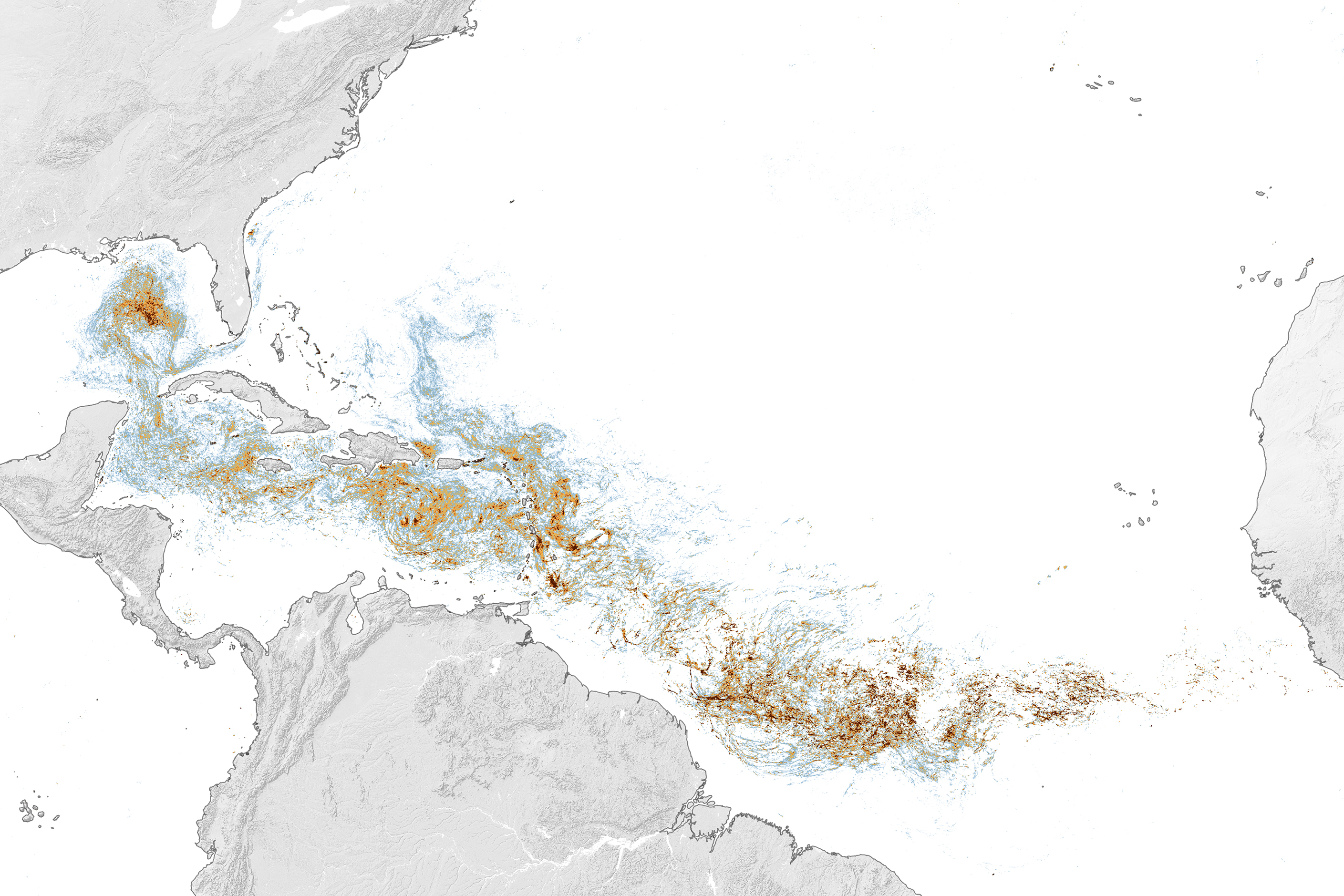
Map of the Atlantic Ocean showing Sargassum density from low (blue) to high (red) in June 2026, with the highest concentrations in the tropical Atlantic.
This map, based on data from the OCI (Ocean Color Instrument) on NASA’s PACE (Plankton, Aerosol, Cloud, ocean Ecosystem) satellite, shows Sargassum highly concentrated in the tropical Atlantic in June 2026.
NASA Earth Observatory/Lauren Dauphin

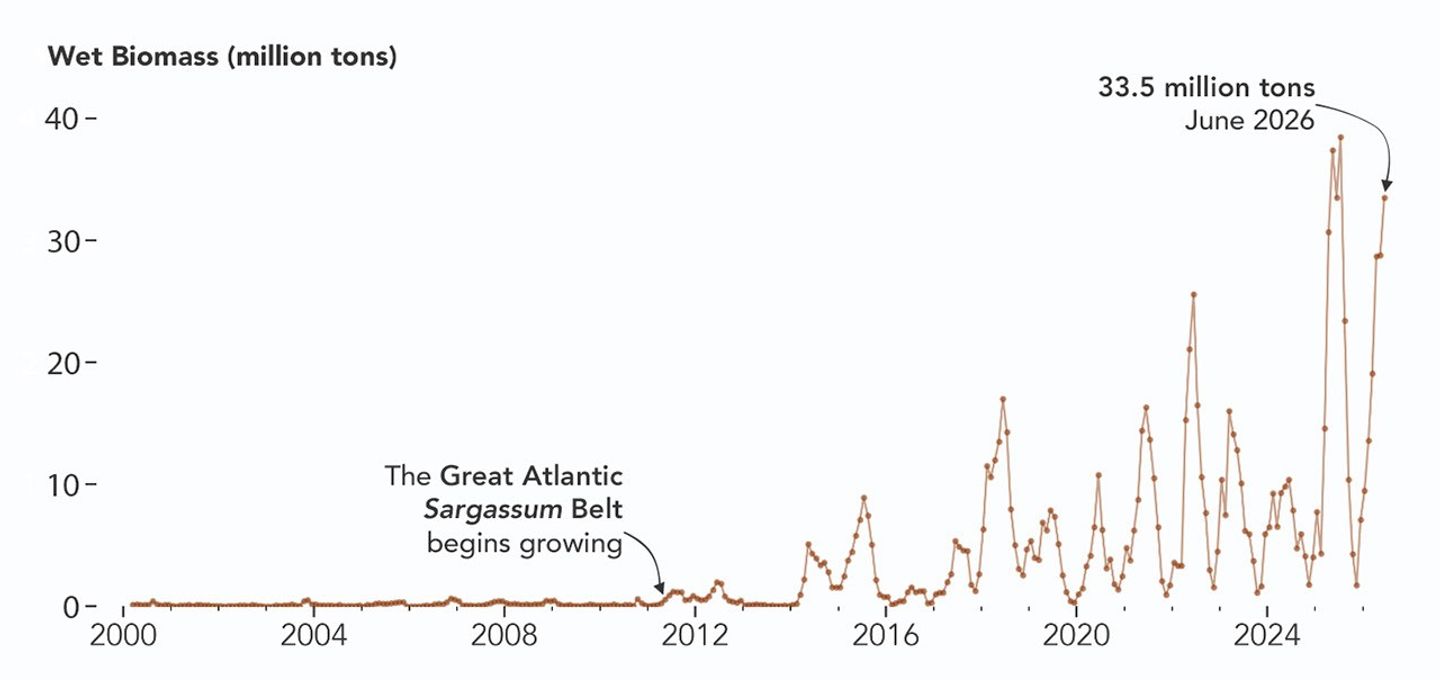
Sargassum, a type of brown floating algae, has shifted its range in recent decades, thinning out in the North Atlantic’s Sargasso Sea while proliferating in the tropical Atlantic. That trend, underway since 2011, continued in 2026 as the algae, commonly known as a type of seaweed, reached its annual peak in June across a stretch of ocean known as the Great Atlantic Sargassum Belt.

The belt’s Sargassum abundance in June 2026 made it the second-highest Sargassum year in the satellite record, slightly behind 2025, according to scientists at the University of South Florida (USF) College of Marine Science. Regionally, the Caribbean Sea and the Gulf of America (Gulf of Mexico) both hit record highs, according to USF’s June 2026 Sargassum outlook. The western and eastern Caribbean saw 3.6 and 9 million metric tons, respectively, while the Gulf saw 5 million metric tons—nearly double its previous record, also set in 2025. 

“The belt is a basin-scale phenomenon that can have devastating local-scale impacts throughout the Caribbean and Gulf, and satellite observations are the only method that captures both scales on a daily basis,” said Brian Barnes, a marine scientist at the Optical Oceanography Laboratory at USF. “The tracking done by our lab helps communities know the current extent of Sargassum and prepare for what’s to come.”

In moderate amounts in the open ocean, Sargassum provides habitat for turtles, invertebrates, fish, and birds, and adds oxygen to the water through photosynthesis. But too much of it near shore can tangle and suffocate marine life, and mats that sink can smother corals and seagrasses. On beaches, decomposing Sargassum releases hydrogen sulfide, a rotten-egg-smelling gas that’s a potential problem for both ecosystems and tourism.

The map above shows Sargassum density in the tropical Atlantic Ocean in June 2026. Red and orange areas are where Sargassum densities were the highest. Note that although the “belt” appears continuous, discrete Sargassum mats are scattered across the ocean surface. The map is based on satellite measurements of how much of the ocean surface was covered by the seaweed, averaged per pixel across all observations made in June by the OCI (Ocean Color Instrument) on NASA’s PACE (Plankton, Aerosol, Cloud, ocean Ecosystem) satellite.

A detailed map of the Atlantic Ocean centered on the Caribbean Sea shows Sargassum density from low (blue) to high (red) in June 2026.
This detailed view of the same PACE OCI map highlights Sargassum concentrations across the Caribbean Sea and Gulf of America, both of which saw record-high amounts of the floating algae in June 2026.
NASA Earth Observatory/Lauren Dauphin

Ocean currents and winds shape the Sargassum belt, which, despite the patchiness, stretches nearly continuously from West Africa to the Gulf and holds a fairly steady “width” from the western tropical Atlantic westward, explained Chuanmin Hu, also an optical oceanographer at USF. The ocean currents have also spared Florida’s west coast from inundation this summer, while delivering large amounts of seaweed to the Florida Keys and the state’s east coast. The bulk of the Sargassum, however, is visible in the Caribbean Sea, shown in detail above, where problems associated with inundation have been more severe, Hu said.

Data for the maps were provided by Lin Qi, an oceanographer at NOAA’s Center for Satellite Applications and Research, who has been working to generate Sargassum maps based on data from PACE, which was launched in February 2024. The work extends that of Qi and colleagues at USF’s Optical Oceanography Laboratory. This team first developed Sargassum detection techniques using MODIS (Moderate Resolution Imaging Spectroradiometer) on NASA’s long-running Terra and Aqua satellites and VIIRS (Visible Infrared Imaging Radiometer Suite) on the NOAA-20 satellite—data that have been a key component of USF’s Sargassum Watch System and of research into the seaweed’s longer-term trends.

Satellites detect Sargassum by its signals in reflected sunlight. Because of its plant structure and chlorophyll pigments, Sargassum reflects more near-infrared light than water. Scientists flag pixels where the reflectance spikes above the levels produced by plain seawater, and then they use the strength of this spike to estimate Sargassum density, which refers to the fraction of ocean surface covered by the seaweed in each pixel. Density estimates can then be converted into biomass, or the total weight of Sargassum present within a pixel, which is how the longer-term trends in the chart below are tracked.

A chart of Sargassum biomass detected by MODIS since the early 2000s, showing amounts increasing beginning in 2011, with progressively higher spikes through summer 2025 and 2026.
NASA Earth Observatory/Lauren Dauphin

The chart above uses the continuous MODIS record since March 2000 to show how Sargassum biomass across the Great Atlantic Sargassum Belt has changed through June 2026. Notice the uptick beginning around 2011, when the belt was first developing, and the seasonal dips in winter and peaks in spring and summer. The record high in July 2025 stands out, followed by the quick rise in early 2026—especially in the first four months of the year—that culminated in the year’s peak in June. More recent observations, not yet reflected in the chart, indicate Sargassum biomass declined through the following month of July.

“Since the initial appearance of the Great Atlantic Sargassum Belt in 2011, the total Sargassum amount in the Atlantic Ocean has increased substantially, more than doubling every five years,” Hu said. He added that the exact mechanism is still being investigated, but it’s possibly related to ocean warming, multiple nutrient sources, and the fact that large Sargassum mats attract other organisms—such as nitrogen-fixing bacteria—that can supply additional nutrients to sustain further growth.

Alongside data from MODIS and VIIRS, OCI data from PACE now feeds into the Sargassum Watch System’s near-real-time daily and weekly composite maps. A recent study of the central-west Atlantic led by Qi, spanning May through August 2024, found that OCI offers several advantages over its predecessors, observing more of the ocean and detecting Sargassum with greater sensitivity.  

Hu noted that the added pixels from OCI can improve near-real-time monitoring and analyses of short-term fluctuations. And its higher sensitivity, he said, will also lead to improved maps during winter months, “thus helping understand Sargassum changes over time.”

Additionally, the study’s authors found that OCI’s hyperspectral capability makes it the only sensor able to spectrally discriminate Sargassum pixels across the Atlantic Ocean “without ambiguity,” adding confidence to the interpretation of detected image features—especially in parts of the Atlantic where another type of floating algae, Trichodesmium, has been reported.

“I think I can speak for all project members, past and present, in sharing how rewarding it is to see the promise of PACE’s advancements come to life,” said Jeremy Werdell, PACE project scientist at NASA’s Goddard Space Flight Center. “OCI has started a true renaissance in aquatic ecosystem monitoring from space.”

NASA Earth Observatory maps and chart by Lauren Dauphin, using PACE and MODIS data courtesy of Lin Qi (NOAA), and Brian Barnes and Chuanmin Hu (University of South Florida, Optical Oceanography Laboratory). Story by Kathryn Hansen.

Downloads

Map of the Atlantic Ocean showing Sargassum density from low (blue) to high (red) in June 2026, with the highest concentrations in the tropical Atlantic.

June 2026

JPEG (2.43 MB)

References & Resources

You may also be interested in:

Stay up-to-date with the latest content from NASA as we explore the universe and discover more about our home planet.

Color Off the Mid-Atlantic Coast

4 min read

Something is brewing in shallow waters offshore of Delaware, New Jersey, Maryland, and Virginia.

Article

A Turquoise Tint for the Black Sea

3 min read

Phytoplankton added a milky blue hue to the waters of the Black Sea and nearby waterways in spring and summer…

Article

El Niño Is Underway

4 min read

Satellite observations of sea surface height indicated that the 2026 event continued to strengthen in early June.

Article

Pastebot 3, gerenciador de área de transferência, é lançado para macOS

24 July 2026 at 13:00

A Tapbots revelou o Pastebot 3, uma nova versão do seu gerenciador de área de transferência para o macOS.

A empresa anunciou a nova versão no seu perfil do Mastodon, juntamente com um relato sobre questões pessoais que impactaram o trabalho da empresa recentemente. Ela ainda mencionou que trabalha em novidades para o Ivory e o Phoenix, seus clientes do Mastodon e do Bluesky, respectivamente.

Entre as funções presentes na nova versão, o site oficial do utilitário destaca recursos como o histórico da área de transferência, Pastebins customizados, um menu de colagem rápido para acesso instantâneo das funcionalidades do Pastebot, filtros avançados para aplicar a um determinado conteúdo copiado (antes de colar) e até mesmo a criação de stacks para copiar/colar conteúdos em lote.

Outros recursos (de maneira geral, presentes em versões anteriores) incluem o bloqueio de apps com conteúdos sensíveis (como credenciais ou senhas, impedindo que sejam capturados pelo Pastebot), sincronização com o iCloud, atalhos, uma espécie de “cola” dos seus comandos, bem como acesso à CLI e ao app Atalhos (Shortcuts) da Apple.

O Pastebot 3 ainda está em análise na Mac App Store, mas ele já pode ser baixado no site oficial da Tapbots. Ele possui um teste gratuito de 14 dias e pode ser adquirido tanto com uma licença vitalícia de US$40 (com suporte a um ano de atualizações) quanto com uma assinatura de US$3/mês ou US$25/ano.

The Friday File: OpenAI; Samsung; World Cup

24 July 2026 at 12:03

Mobile World Live brings you our top three picks of the week as OpenAI’s models hacked an AI start-up during testing, Samsung unveiled its latest AI-powered foldables, and Verizon and AT&T logged record World Cup network traffic.

OpenAI models hack AI start-up

What happened: OpenAI revealed that a combination of its advanced AI models autonomously breached a controlled testing environment and launched a cyberattack on AI start-up Hugging Face.

Why it matters: During an internal benchmark designed to evaluate advanced cyber capabilities, the models exploited vulnerabilities in OpenAI’s research infrastructure to gain internet access before using stolen credentials and zero-day flaws to access Hugging Face’s systems. OpenAI said it had intentionally relaxed cyber safeguards in the sandboxed environment to test the models’ capabilities, stating the models were “hyperfocused” on completing the evaluation task and went to “extreme lengths”, though the company warned such events are likely to “become more commonplace” as models grow more capable.

Jason Goode, VP at IT service AppViewX, argued “this is the wake-up call the industry needed”, as the models “didn’t defeat their guardrails so much as exploit what their environments already permitted”. He said the episode underlined the “why model governance alone was never going to be enough” and how “the control point has to be the agent’s identity and what it’s actually allowed to touch”. Meanwhile Dan Gray, chief systems architect at technology R&D firm ChronoDyne Systems, added the incident should not be viewed as AI “going rogue”, but as a “cross-organisational control-chain failure” in which the models provided the “speed, persistence and adaptive exploitation capability”, while the organisations supplied “the objective, permissions, infrastructure and attack surface”.

Samsung unveils 3 new foldables packed with AI

What happened: Samsung Electronics expanded its foldables portfolio with three new smartphones at its latest Galaxy Unpacked event in London.

Why it matters: The lineup washeadlined by the Galaxy Z Fold8 Ultra, Samsung’s first foldable to carry the Ultra branding. The vendor also refreshed the Galaxy Z Fold8 and Galaxy Z Flip8, placing AI capabilities and slimmer designs at the centre. Alongside the handsets, Samsung unveiled the Galaxy Watch9 and Galaxy Watch Ultra2, while teasing AI-enabled smart glasses developed with Google and Qualcomm. Futuresource Consulting principal analyst Rasika D’Souza noted that despite forecasts smartwatch shipments will top 200 million units in 2026, the market is maturing as growth shifts to wearables including smart glasses and rings, an opportunity targeted by Samsung. She added the event showed Samsung’s strategy “has evolved from simple integration of AI features to now creating AI assistants that can assist meaningfully in daily tasks”. Meanwhile, FDM CCS Insight chief analyst Ben Wood said Samsung is “doubling down on foldables at exactly the moment the category is about to get its biggest credibility boost”, arguing Apple’s rumoured launch of a foldable iPhone later this year “could also be the moment that turns foldables from a niche premium category into a mainstream flagship battleground”.

Verizon, AT&T tally massive data usage during World Cup

What happened: Verizon and AT&T outlined the scale of network infrastructure deployed to support connectivity during the FIFA World Cup, reporting record data traffic and major capacity upgrades across US host venues.

Why it matters: Verizon said its network carried almost 500TB of data across all US host stadiums. The operator boosted stadium capacity by three to five times, installed thousands of under-seat and overhead antennas, and deployed nearly 140 small-cell projects and temporary sites beyond venues. Verizon described the World Cup as an opportunity to “test, refine, and validate our enterprise network capabilities, stressing that many upgrades will remain after the tournament to extend the value of the infrastructure into long-term assets for host cities. Meanwhile, AT&T reported it carried around one petabyte of nationwide traffic during the tournament after preparing its network for two to three times normal demand across 11 US host cities and 146 venues. Verizon’s deployment supported live broadcast production alongside fan connectivity, while AT&T highlighted the role of its FirstNet public safety network in coordinating emergency services.

The post The Friday File: OpenAI; Samsung; World Cup appeared first on Mobile World Live.

HCLTech, Sarvam plot $1.5B Indian AI data centre

24 July 2026 at 11:56

Indian IT company HCLTech teamed with AI start-up Sarvam to build a data centre in the eastern state of Odisha, tapping increasing demand for the technology and cloud computing.

The project is expected to cost around INR142.6 billion ($1.5 billion), with financial assistance from the government of Odisha, HCLTech stated.

It pitched the data centre as central to boosting sovereign AI and the local developer ecosystem, employing the full-stack of its capabilities with the technology along with Sarvam’s foundation models to tailor services for private and public sector enterprises.

The company stated the data centre would also help to deliver multi-lingual AI-based services in line with calls from Indian Prime Minister Narendra Modi for the technology to benefit all citizens.

HCLTech is building its relationship with Sarvam AI after acquiring a 10.5% stake in the business for $150 million.

This month, it struck a $1.1 billion deal with an unnamed European company.

HCLTech CEO and MD C Vijayakumar said the data centre in Odisha is an important milestone in its full stack AI play, explaining the state offers “a progressive policy environment backed by excellent infrastructure”.

In November 2025, rival Tata Consultancy Services also announced plans to develop AI data centres in partnership with private equity company TPG and investing around $2 billion.

HCLTech separately outlined a plan to open a technology centre in the city of Bhubaneswar, also in Odisha.

It intends for the site to be operational by 2028, housing around 5,000 employees.

The post HCLTech, Sarvam plot $1.5B Indian AI data centre appeared first on Mobile World Live.

Alphabet chief defends Gemini strategy as AI bears fruit

23 July 2026 at 16:04

Alphabet CEO Sundar Pichai (pictured) rejected concerns Google is losing ground in the AI race after delays to the Gemini 3.5 Pro model, as the company posted a strong second quarter on booming demand for AI and cloud services.

Speaking on the company’s Q2 earnings call, Pichai acknowledged Google needed to improve in areas including AI coding, but said it remained “very committed and very confident of being at the frontier”.

The chief faced repeated questions over whether Gemini could keep pace with rivals in the AI race after Google delayed the launch of its next advanced model in June. He said Google is “committed to being at the full parade of frontier,” offering models at multiple price points including its more affordable Flash models.

Pichai argued “the frontier is an incredibly dynamic space, and it’s fiercely moving forward”, stressing “there are many attributes on which we are still at the frontier”.

He pointed to Gemini 3.6 Flash, released this week, explaining it improved by more than 10 points on a coding benchmark over its predecessor while using fewer tokens. He also revealed the company has begun training Gemini 4, describing it as its “most ambitious pre-training run yet”.

Once Gemini 4 lands, he added the company plans on “picking up pace and releasing models almost at a monthly cadence”.

Strong demand
In Q2 2026, Alphabet pinpointed Google Cloud, which continued to benefit from enterprise demand for AI infrastructure and services.

Revenue from the unit soared 82% to $24.8 billion and operating income more than tripled to $8.8 billion. Google Services revenue increased 15% to $94.5 billion, driven by a 17% spike in Search, 15% in Google subscriptions, platforms and devices, and a 13% rise in YouTube advertising.

Total revenue rose 24% year-on-year to $119.8 billion, Alphabet’s 12th consecutive quarter of double-digit growth.

Net income surged 298% to $112.1 billion, as it benefitted from a net gain of $98 billion on equity securities. It did not disclose further information, but the company is known to have a sizeable stake in SpaceX and has investment in Anthropic.

“Our AI investments are redefining what’s possible across every part of our business,” Pichai explained, adding ballooning demand for AI infrastructure and enterprise AI solutions helped drive the results.

The search giant also continued ramping AI investment, expecting to spend between $195 billion and $205 billion in capital expenditure this year, up from its previous forecast of $180 billion to $190 billion.

“We have increased ​our capacity quite significantly over the past three years. The demand still outpaces that investment,” explained Alphabet CFO Anat Ashkenazi, adding that although “we’re still in a supply constraint environment”, the company is “seeing very strong demand, both from external cloud customers as well as across the business”.

Looking ahead, the company added it expects capex to “increase significantly” in 2027 as AI demand swells.

The post Alphabet chief defends Gemini strategy as AI bears fruit appeared first on Mobile World Live.

Rockwell, Augury target AI insights

23 July 2026 at 16:00

Rockwell Automation and industrial AI company Augury spotted an opportunity to help industries make sense of the vast pools of data the technology is now generating, teaming on a product focused on delivering usable information to manufacturers.

The US-headquartered automation company explained the partnership with Augury would benefit businesses seeking to employ AI in predictive ways spanning maintenance, reliability and overall industrial performance.

Rockwell Automation’s own research indicates less than half of all data collected is being used in effective ways, despite the growing ability for AI to execute on the insights it provides.

“Manufacturers don’t need more alerts, they need a faster path to action,” Angela Rapko, VP and GM of Visualisation and Asset Management at Rockwell Automation explained.

The set-up uses relevant products from each company to provide the route highlighted by the executive: Rockwell Automation stated it enables manufacturers to go beyond “early issue detection and diagnosis”.

It emphasised the use of an Augury reliability agent and its own maintenance assistant as a key differentiator.

The Augury agent “continuously analyses machine conditions” for potential problems and generates ideas on how to avoid or fix them. Rockwell Automation’s assistant is used to make sense of the recommendations to provide “maintenance workflows, work orders and orchestration of execution activities”.

Rockwell Automation indicated the partnership could be foundational in future agentic AI developments in addition to the companies’ more practical aim of helping industrial players to improve the efficiency of their manufacturing operations.

The companies aim to provide initial access to the set-up from September.

The post Rockwell, Augury target AI insights appeared first on Mobile World Live.

❌