Ontem, falamos aqui sobre o rumor de que a Apple estaria prestes a lançar, nos Estados Unidos, um programa de assinatura de iPhones, iPads, Macs e Apple Watches, dando aos consumidores mais formas de acessar seus dispositivos.
Logo depois, o 9to5Mac encontrou, no código da beta do iOS 27, menções a um novo framework que serviria para gerenciar dispositivos alugados por meio de assinaturas como essa.
Chamado App Managed Features, ele permitirá, ao que tudo indica, que um aplicativo autorizado de financiamento ou de prestação de serviços — e não apenas o “Apple Upgrade”, como a solução proprietária está sendo chamada — registre um iPhone e realize verificações contínuas de status.
Caso haja algum problema com o registro (como pagamentos atrasados), o iPhone será colocado automaticamente em um estado intitulado “Restricted Mode” (“Modo Restrito”, em tradução livre), que bloqueia o acesso a uma série de apps do iOS, incluindo:
Leitor de Acessibilidade (Accessibility Reader)
App Store
Saúde (Health)
Lupa (Magnifier)
Telefone (Phone)
Relógio (Clock)
Ajustes (Settings)
Carteira (Wallet)
Senhas (Passwords)
A interface do “Restricted Mode” em si
Como é possível notar, alguns apps mais “críticos”, como o Mensagens (Messages) e o Casa (Home), poderão continuar disponíveis mesmo quando esse bloqueio estiver ativo. Segundo o 9to5Mac, no entanto, o provedor do aparelho será capaz de escolher quais apps ficarão (ou não) de fora dessa lista.
Embora restrinja o acesso aos apps do aparelho, o recurso não parece modificar assinaturas da App Store, o que significa que o usuário continuará sendo cobrado pelos seus apps e serviços mesmo após ter sido colocado no “Restricted Mode”.
Além disso, o código do iOS 27 não lista um número limite de pagamentos atrasados como condição para o bloqueio dos apps, o que significa que ficará a cargo dos serviços de assinatura decidir quando impor essas restrições de acordo com os seus termos e condições.
Há, no entanto, menções a um novo tipo de Bloqueio de Ativação (Activation Lock) chamado “Partner Finance Lock”, criado com o objetivo de impedir que usuários apaguem, vendam ou desmontem um aparelho alugado para revender suas peças.
Ainda segundo as informações, o App Managed Features faz parte do app Buscar (Find My), embora o provedor não tenha acesso à localização do dispositivo. Ao que tudo indica, essa integração existe apenas para garantir que o bloqueio continue de pé mesmo que o usuário apague ou redefina o aparelho.
Embora essas referências não tenham sido encontradas na versão Release Candidate (RC) do iOS 26.6, é possível que elas sejam adicionadas à versão final do sistema, já que, segundo a Bloomberg, o “Apple Upgrade” será anunciado na semana que vem.
Safari Notify Me gives Apple’s browser a useful new role in online shopping: watching a product page after the shopper has closed it. Instead of repeatedly returning to check whether an item is available or whether its price has changed, users can ask Safari to monitor the page and send an alert when the requested update appears.
The feature arrives as online shopping becomes increasingly fragmented. Prices can change several times during a promotion, popular items disappear within minutes and retailers often require shoppers to join separate mailing lists for availability alerts. Dedicated tracking apps can help, but each adds another account, extension or subscription.
Safari Notify Me places the monitoring tool inside the browser already being used to view the product. It is simple enough for occasional purchases while potentially useful for expensive electronics, limited releases, event registrations and products that move in and out of stock.
Safari Notify Me Watches the Page for You
Safari Notify Me is designed to monitor changes on a specific webpage. The user identifies what should be watched, such as a lower price, a product returning to stock or registration becoming available. Safari then checks the page and sends a notification after detecting the relevant change.
Apple has presented price changes and product restocks as central examples, though the feature is not restricted to shopping. It may also help with reservations, ticket availability, enrollment openings or other pages where one detail changes over time.
For shopping, the advantage is immediate. A customer can leave the product page without relying on memory, leaving dozens of tabs open or refreshing the site throughout the day.
The browser becomes temporarily responsible for the follow-up.
This differs from a retailer’s own email alert. Store notifications usually depend on the business offering the feature, and they may focus only on inventory. Safari can monitor the page according to the user’s request, potentially covering price and availability without requiring another marketing subscription.
Image Credit: Pond5
How Safari Price Alerts Help
Online prices are rarely as stable as the label suggests. Retailers adjust discounts, respond to competitors, launch short promotions and change prices according to stock levels.
A shopper interested in a Mac accessory, appliance or expensive display may not want to purchase immediately at the listed price. Checking the page every day is inefficient, while joining a store mailing list can produce far more promotional email than useful information.
Safari price alerts create a quieter alternative. The user can identify the product and wait for the browser to report a meaningful change.
The feature does not replace price history. Safari may detect that the amount has dropped, but that does not necessarily prove the new price is the lowest offered during the year. Dedicated price-tracking services may still provide charts, comparisons and retailer-specific history.
Safari Notify Me is better understood as a page-change assistant. It tells the shopper that something requested has happened. The decision to purchase remains with the user.
Restock Alerts May Be Even More Useful
Restock monitoring may become the feature’s strongest shopping use. Limited products can return without warning and sell out before a retailer’s email reaches every subscriber.
This often happens with game consoles, graphics hardware, collectibles, seasonal products, concert merchandise and popular configurations of newly released devices. Size and color variations can also return separately, making a general product alert less useful.
Safari restock alerts can focus on the page the user is already viewing. A notification provides a reason to return without requiring the tab to remain open.
The browser cannot reserve the item or guarantee that inventory will remain available. A notification may also arrive after other buyers have begun ordering. Safari removes the repeated checking, but it does not control the retailer’s inventory system.
That limitation is reasonable. Notify Me helps users notice the opportunity; it does not turn Safari into an automated purchasing bot.
Using Safari Notify Me
The feature is intended to require little setup. Users begin on the relevant product or registration page and tell Safari which change they want it to watch.
To create a Safari Notify Me alert:
Open the webpage in Safari > Select Notify Me > Describe the price, availability or page change to monitor > Allow Safari notifications when requested
The exact options shown may depend on the device, webpage and software version. Apple is introducing the feature with its new operating-system releases, and availability may vary by language or region.
A useful request should be specific. Asking Safari to report when the item returns to stock is more actionable than asking for any page change. For price monitoring, the user may request a reduction or watch for a particular target when the page supports enough information.
Once the alert is active, there is no need to keep the product page open. Safari sends a notification after detecting the requested update, allowing the user to return directly to the page.
A Better Use for Apple Intelligence
Safari Notify Me is a practical example of Apple Intelligence operating as an assistant rather than a writing tool. It interprets what the user wants, watches for a future condition and reports back when that condition appears.
The feature does not need to generate a long answer or place a chatbot beside every shopping page. Its value comes from removing a repetitive task.
That restrained approach fits Safari. The browser already manages passwords, private browsing, tab organization, Reader and tracking protections. Monitoring a page extends that utility without turning Safari into a retailer or shopping marketplace.
It may also reduce the need for third-party extensions among casual users. Someone who occasionally watches one product does not necessarily need a dedicated deal platform with wish lists, affiliate links and account registration.
Specialized services will remain useful for serious bargain hunting. Safari covers the simpler request: tell me when this exact page changes in the way I care about.
Image Credit: Apple Inc.
Notifications Need Restraint
Any feature built around alerts can become noisy when used too freely. Monitoring every product considered during casual browsing could fill Notification Center with price changes and restocks that no longer feel relevant.
Safari Notify Me works better when reserved for purchases with genuine intent. A few focused alerts are easier to understand and act upon than dozens of loosely defined page watches.
Users should also remove alerts after buying the item or losing interest. A notification for a product purchased weeks earlier adds clutter without saving time.
Safari notifications can be managed through the device’s normal notification settings. Disabling all Safari alerts may also silence other useful browser notifications, so reviewing individual watches inside Safari is preferable when available.
Price Is Not the Only Shopping Decision
A lower price can encourage a quick purchase, but shoppers should still review the seller, return policy, warranty and delivery estimate. Notify Me reports a page change; it does not evaluate whether the store is reliable or whether the offer has hidden conditions.
A product may return through a third-party marketplace seller at a higher price. A discount may apply only after a membership, coupon or trade-in. Limited inventory can also create pressure to buy before reading the terms.
Safari’s privacy protections and fraud warnings remain relevant, but users should confirm that the page belongs to the intended retailer before entering payment information.
The alert is a starting signal, not an endorsement.
Safari Becomes More Useful After the Tab Closes
Browsers traditionally stop being helpful once users leave a page. Safari Notify Me changes that relationship by allowing selected pages to remain useful without remaining visible.
For shoppers, that means fewer repeated searches, fewer forgotten products and less dependence on promotional email. Price and restock alerts can operate quietly until there is a reason to return.
The feature will not replace advanced shopping trackers, and it cannot guarantee inventory. Its appeal is that most users do not need those larger systems for every purchase.
Sometimes the entire shopping problem is waiting for one price to fall or one button to change from unavailable to buy. Safari Notify Me allows the browser to handle that wait.
EU tech regulation, Digital Markets Act, Apple Europe sales, Apple regulation, European Union, Siri AI, iPhone features, device interoperability, App Store changes, alternative marketplaces, iPhone Mirroring, AirPods translation, Apple privacy, iPhone security, app sideloading, platform competition, DMA compliance, Apple Intelligence, European technology, government control
EU tech regulation is no longer limited to App Store payment rules or competition disputes hidden from ordinary consumers. It is beginning to determine which features reach European devices, how quickly they arrive and how deeply third-party companies can interact with the iPhone, iPad and Mac.
The Digital Markets Act was designed to reduce the control of large technology platforms over software distribution, payments, browsers, digital assistants and connected hardware. For Apple, compliance has already produced alternative app marketplaces, web distribution, third-party payment options, additional default-app controls and expanded access to iPhone technologies.
The next phase reaches much deeper into the operating system. European regulators want competing accessories, cloud services and AI assistants to receive access to capabilities traditionally reserved for Apple’s own products.
Apple argues that some of those demands could weaken privacy and security. The European Commission says the company is responsible for creating compliant systems that preserve both competition and user protection.
Between those positions sits a large and commercially significant group of customers. Europe generated $28.06 billion in Apple sales during the quarter ending March 28, 2026, up from $24.45 billion one year earlier. Six-month European sales reached $66.20 billion, compared with $58.32 billion during the same period of fiscal 2025.
Europe therefore represented more than one-quarter of Apple’s latest quarterly revenue. It is too valuable to leave behind, but increasingly difficult to serve with the same software experience available elsewhere.
EU Tech Regulation Is Splitting Feature Availability
Regional differences once centered mainly on language support, licensing agreements or local services. EU tech regulation is creating a more structural divide.
Apple has blamed Digital Markets Act requirements for delaying Siri AI across the European Union. The company says regulators expect competing AI assistants to receive extensive access to personal information, apps and device actions before Apple can reserve those capabilities for its own assistant.
The disagreement concerns more than answering questions. Siri AI is designed to read personal context, understand onscreen information and complete actions across apps. That may include finding messages, accessing files, making purchases or sending information on the user’s behalf.
Opening those capabilities to outside AI systems requires new permission structures, technical interfaces and safeguards. Apple says it cannot release its assistant first and add competing access later without risking regulatory action. The Commission says Apple had sufficient time to design an interoperable solution.
Other delayed European features have included iPhone Mirroring on Mac, Live Translation through AirPods and certain location-based Maps capabilities. Each feature touches a different part of the ecosystem, but all depend on privileged communication between Apple devices, software and services.
The consequence is becoming visible at purchase. Two customers can buy the same iPhone model at similar prices and receive different capabilities because one lives inside the European Union.
Image Credit: Apple Inc.
Feature Adoption Becomes Slower and Less Predictable
Delayed availability can weaken the adoption of new hardware features even when the devices themselves continue selling well.
Siri AI is intended to become a central part of newer iPhones, iPads and Macs. Buyers who cannot access it lose part of the justification for newer chips, additional memory and on-device AI processing. Developers also face a smaller addressable audience for apps built around the new assistant.
AirPods Live Translation presents a similar problem. A feature designed to demonstrate the combination of iPhone processing, microphones and wearable audio becomes unavailable in a region built around dozens of languages and frequent cross-border travel.
iPhone Mirroring affects the relationship between iPhone and Mac. Users outside the EU can interact with the phone from macOS, while European users may receive notifications without gaining the complete experience.
These differences do not necessarily stop hardware sales. Apple’s newest results show strong European demand despite years of regulatory conflict. They can, however, reduce the speed at which customers use the ecosystem’s newest capabilities.
The effect may grow as software becomes a larger part of hardware differentiation. A faster processor has limited emotional value when the feature designed to demonstrate it is unavailable.
Apple Sales Show Why Europe Cannot Be Ignored
Apple does not report European Union revenue separately. Its Europe segment also includes countries outside the bloc, along with India, the Middle East and Africa. The official segment remains the best regularly published measure of the region’s commercial weight.
European sales rose approximately 15% year over year in Apple’s latest reported quarter. During the first six months of fiscal 2026, the segment expanded by roughly 14%.
Those figures weaken the argument that regulation is already driving customers away from Apple hardware. Demand remains strong, supported by the iPhone 17 family, Mac sales, services and the company’s installed base.
The financial risk is more gradual. Regional software fragmentation can raise engineering costs, delay launches and make European devices less competitive against products able to offer complete feature sets.
Apple must maintain separate distribution rules, payment systems, browser options and eligibility checks. Developers must decide whether alternative stores, external payments or EU-specific business terms justify additional work. Support teams must explain why features differ between countries using the same operating-system version.
A market responsible for more than $28 billion in one quarter can absorb considerable compliance expense. It can also influence Apple’s global product decisions when regulators demand interfaces that cannot be restricted to Europe easily.
A Slow Transfer of Ecosystem Control
The escalating regulatory environment also creates a more fundamental concern: control over complex technology ecosystems can gradually move away from the companies that designed them and toward government committees, regulatory bodies and administrative processes.
That transfer rarely happens through one dramatic order. It develops through repeated obligations covering app distribution, payment systems, browser engines, digital assistants, hardware access, data portability and interoperability. Each requirement may appear narrow when considered alone. Together, they can redefine who determines how the ecosystem operates.
Apple built its platform around tight integration between hardware, software, services and security. Regulators increasingly treat parts of that integration as market power that must be opened to competitors. The danger is that an ecosystem designed as one coordinated environment becomes subject to decisions made by committees that do not carry direct responsibility for product quality, reliability or long-term maintenance.
This can become a slow trap. Once a platform is required to expose one layer, regulators may use that access as the basis for demanding another. A payment exception can be followed by alternative app stores. Alternative stores can lead to broader installation rights. Device interoperability can expand into access for AI assistants, personal data and system actions.
The boundaries of the platform are then set less by engineering judgment and more by regulatory negotiation.
Government agencies have legitimate authority to address competition and consumer harm. The concern appears when regulation shifts from preventing abusive conduct to directing product architecture. At that point, public authorities begin influencing feature design, release timing, software permissions and the relationship between first-party and third-party services.
That creates consequences beyond Apple. Any company considering a tightly integrated product may decide that deep integration invites intervention. Businesses could avoid building ambitious ecosystems if successful coordination later becomes grounds for forced access.
Innovation then becomes shaped by what regulators are likely to permit rather than by what engineers believe will produce the safest or most coherent experience.
Image Credit: Ink Drop / Alamy Stock Photo
Competition Gains Come With Real Consumer Choices
EU policy has produced benefits that Apple rarely emphasizes. Users can install apps through alternative marketplaces or directly from authorized developers. Developers can offer external payment methods, promote different prices and avoid relying entirely on Apple’s distribution system.
Alternative browser engines can compete with WebKit, while users have more control over default apps. Contactless payment access has expanded beyond Apple Pay, allowing competing wallet providers to use the iPhone’s NFC technology under approved conditions.
Interoperability requirements could also improve third-party accessories. Smartwatches, headphones and other devices may gain better notification access, background connectivity and proximity pairing with the iPhone.
These changes can increase competition and reduce the advantage Apple gives its own services and accessories. A third-party smartwatch should not become artificially less useful simply because it was not made in Cupertino.
The difficulty is separating legitimate platform access from unlimited access. A notification interface is one thing. An autonomous AI assistant capable of reading messages, accessing files and acting across apps introduces a different level of sensitivity.
Privacy and Security Risks Are Not Theoretical
Alternative app distribution increases user choice, but it also moves some responsibility away from the App Store. Apple continues to notarize apps distributed through approved alternative channels, checking for known malware and severe fraud. That process is narrower than a complete App Store review.
Purchases made outside Apple’s payment system also fall outside its normal refund and billing support. Users may need to resolve disputes directly with the developer or payment provider.
A malicious marketplace, deceptive payment page or compromised developer account can create opportunities for fraud. Enterprise users face additional concerns when employees install software from sources their organization has not approved.
The AI question reaches further. A third-party assistant may need permission to access messages, photos, calendars, documents and app controls. Even a reputable provider can collect more information than the user expects or introduce vulnerabilities through poorly designed integrations.
Apple can build permission prompts, app isolation and revocation controls, but technical access always creates some exposure. Security depends on how narrowly permissions are defined, how visibly they are used and whether the operating system can stop unauthorized actions.
The Commission maintains that interoperability and privacy can coexist. Apple maintains that regulators are demanding access before adequate protections are ready. Both positions contain a legitimate concern: dominant platforms should not block competition, and competition should not require users to surrender control of personal data.
When regulators require a company to alter its architecture, responsibility can become blurred.
Apple remains the company customers blame when an iPhone feature fails, a third-party marketplace distributes a harmful app or an outside assistant misuses personal data. Regulators may have required the access, but they do not operate the device, provide technical support or repair the damage to the platform’s reputation.
This creates an accountability gap. Government committees can mandate openness without assuming the commercial and security consequences of that openness. Apple must comply, maintain the system and explain the outcome to users.
The same problem applies to delayed features. Regulators may argue that Apple chose not to release a service, while Apple may argue that the required conditions made the launch unsafe or technically impractical. Customers are left with less functionality and no simple way to determine who caused the delay.
Over time, the ecosystem can become a negotiated compromise rather than a product with one coherent direction. That may satisfy formal compliance while producing a weaker experience for everyone involved.
The risk is not that governments will literally operate Apple’s software. It is that committees increasingly define the conditions under which Apple can design, connect and release its own features. Control shifts through constraints.
The Industry Will Follow Europe’s Experiment
The consequences extend beyond one company. Google, Meta, Microsoft, Amazon and other platform operators face related European obligations. Hardware makers must consider whether ecosystem advantages can survive when core services are required to support rivals.
Smaller developers may gain new distribution and payment choices, but they may also inherit more compliance, customer-service and security responsibilities. Accessory companies could compete more effectively while becoming accountable for handling sensitive device data.
Other governments are watching. Rules introduced in Europe can influence legislation elsewhere, particularly when companies decide that maintaining one global technical framework is easier than operating several regional versions.
Apple is unlikely to abandon Europe or stop adapting its products. Its sales provide too much evidence of the region’s importance. The company will continue negotiating, appealing decisions and building compliance systems while withholding features it considers unsafe under current demands.
European customers may receive more app stores, payment choices and accessory compatibility. They may also wait longer for headline features included with the same hardware elsewhere.
The deeper consequence may be a technology industry that becomes more cautious about building tightly integrated products. Companies may design around anticipated regulatory demands from the beginning, limiting exclusive features, reducing private-system integration or avoiding innovations that depend on controlled access.
EU tech regulation began as an effort to constrain dominant platforms. Its long-term effect may be to transfer part of the power to shape those platforms from companies and users to regulatory institutions.
That shift deserves scrutiny equal to the market power it is intended to correct. Competition rules can restrain abuse. They can also become a slow mechanism for placing product design, security choices and ecosystem evolution under government supervision.
Shady Control and Bureaucracy
The danger grows when regulatory discretion becomes buried beneath permits, approvals, negotiations and technical committees that operate beyond meaningful public scrutiny.
The more power officials hold over which features, contracts or technologies may proceed—and when—the greater the opportunity for lobbying, favoritism and selective enforcement to influence outcomes. What begins as oversight can gradually become a system in which delay itself is leverage, while responsibility disappears inside layers of administration.
For the technology industry, that risks replacing transparent product decisions with political access, negotiated exceptions and regulatory influence exercised far from the consumers expected to live with the consequences.
The iconic disks of spiral galaxies are well known across the local universe and now far beyond. A recent study looks at the Milky Way to determine when its own disk emerged.
Spinning into Spirals
The Milky Way, a grand spiral galaxy with stars and gas rotating in a disk, did not always look this way. Galaxies begin as chaotic clumps of gas and stars inside a knot of dark matter, and at some point in time, spiral galaxies must transform into the flat rotating disks we observe them as today. Recent JWST observations have uncovered disk galaxies emerging much earlier in the universe than previously thought, shifting our understanding of how quickly spiral galaxies come together and settle into disks. While we cannot study the detailed assembly history of these very distant galaxies, we can dissect galaxies in the local universe to build a better timeline of galaxy evolution.
Looking as close to home as possible, astronomers have used the kinematics and chemical makeup of stars in our own Milky Way to trace the moment when the galaxy started to host a rotating stellar disk. This period, known as the “spin-up,” marks when the bulk kinematic signature of the galaxy transitioned from one dominated by random motions to one dominated by a rotating disk.
Stars hold on to the kinematic and chemical information they are born with, so stars of different ages and metallicities across the galaxy should trace the development of the disk. Because stellar ages have been difficult to constrain observationally, studies of galactic spin-up have typically relied on readily available metallicity measurements as a proxy for age; however, metallicity is not a clear-cut age indicator, making it difficult to truly distinguish different stellar populations across the Milky Way’s disk. Luckily, new major surveys have recently provided stellar databases adding the stellar age measurements necessary to pin down when the Milky Way spun up.
Dawn of the Galactic Disk
Plots showing stellar age and rotational velocity (Vϕ) versus metallicity, [Fe/H]. The metallicity range where the age–[Fe/H] relation stalls coincides with the point when the Vϕ–[Fe/H] relation rapidly increases, indicating the age of the spin-up in the Milky Way. Click to enlarge. [Modified from Feltzing et al 2026]
Sofia Feltzing (Lund Observatory) and collaborators used a catalog of over 300,000 subgiant stars from the Large Sky Area Multi-Object Fiber Spectroscopic Telescope with metallicities, kinematics, and crucial stellar ages to determine when the Milky Way began to host a stellar disk. After making quality cuts to ensure they included only the most robustly measured stars, the authors divided the sample into two distinct stellar populations that settled into the Milky Way’s disk differently: older stars with a high abundance of α elements (like oxygen, magnesium, and silicon) relative to iron and younger stars with low α-element abundances.
With these star samples, Feltzing and team analyzed how both stellar rotational velocity and age varied with metallicity to determine when the Milky Way spun up. They found that high-α stars clearly move from having random motions to being rotationally supported over a short range of metallicities about 12.5 billion years ago, while the low-α stars seem to begin in a rotating disk and stay there. When varying their selection criteria and looking at the full sample, the authors determined that the Milky Way spin-up happened between 12.1 to 12.5 billion years ago — the first time Milky Way spin-up has been age-dated in this way.
These results imply a rapid chemical evolution and change in kinematic properties as stars went from randomly orbiting to rotating in an ordered disk in the Milky Way. The authors suggest that future studies should focus on lower-metallicity stars to better disentangle stars in the disk from stars in the halo, which will lead to a more precise determination of the Milky Way’s spin-up. Upcoming large-scale surveys will make this possible and allow astronomers to build a better picture of galaxy formation in the early universe.
Citation
“Dawn of the Milky Way Disk: Determination of When a Rotationally Supported Disk Appears and Dating the Spin-up of the Disk,” Sofia Feltzing et al 2026 ApJL 1004 L28. doi:10.3847/2041-8213/ae6f14
When Lucid introduced the Air electric sedan in late 2021, the first Air Dream Edition I tested packed over 1,100 hp (820 kW) and carried a $180,000-plus window sticker. It's easily the most powerful street car I've tested; the only vehicle I've driven with more power was a purebred race car with a third the mass, and it was on a proper track. Its combustion engine was also about 1,000 times louder than the Air, helping to remind us that "combustion" really does mean explosion after explosion.
For Lucid's second act, the company debuted the Gravity electric SUV last year, and I've just tested the 2026 Gravity Touring, which starts at about $82,000 in the US, including the required destination charge.
My test model carried a bevy of options, including a 22-speaker audio system, the Comfort and Convenience package, third-row seating, a Dynamic Handling package (combining rear-wheel steering and three-chamber air suspension), a luxury seating package (bundling Nappa leather and massaging and ventilated front seats), and special metallic paint.
White dwarfs often show signs of metals in their spectra, providing evidence that these evolved stars have accreted planetary material. Could white dwarf spectra also provide evidence for technological activity in these star systems?
A Record of Planets Past
When a Sun-like star reaches the end of its hydrogen-burning lifetime, it first puffs up into a red giant before exposing its white-hot core, which evolves into a white dwarf. This dramatic transition shakes up any planets that happened to be orbiting the star, and some close-in planets may end up crumbling apart, their rubbly remains peppering the surface of the white dwarf.
So far, astronomers have found hundreds of white dwarfs that appear to be polluted with heavy elements from their destroyed planets. These observations provide a valuable look into the bulk compositions of planetary materials outside our solar system. They may also provide a way to detect patterns of chemical abundances that are not natural, resulting from technological processes like industrial refining or the creation of alloys — in other words, a technosignature that is evidence of not just life, but technologically advanced life.
Seeking Signs of Technology
Representation of the chemical abundances of meteorites (pink, orange, and green) and white dwarfs (gray). Most white dwarf abundances overlap with the parameter space defined by the meteorite sample. Click to enlarge. [Huang et al. 2026]
A team led by Bo-Lun Huang (黄博伦) from Beijing Normal University recently investigated whether there is evidence for chemical technosignatures in the current sample of polluted white dwarfs. Huang and collaborators began their investigation with a catalog containing 697 measurements of white dwarfs with metals in their spectra. They applied Bayesian statistical methods to weigh the hypothesis that the chemical makeup of these white dwarfs is entirely natural against the possibility that they contain a blend of natural and technologically altered material.
The team used thousands of chemical abundance measurements from meteorites as a reference for the natural bulk composition of planetary material. For the mixture of natural and processed material, they combined the meteorite reference material with a template that is metal-rich and silicate-poor, with enhanced amounts of iron, nickel, chromium, and manganese.
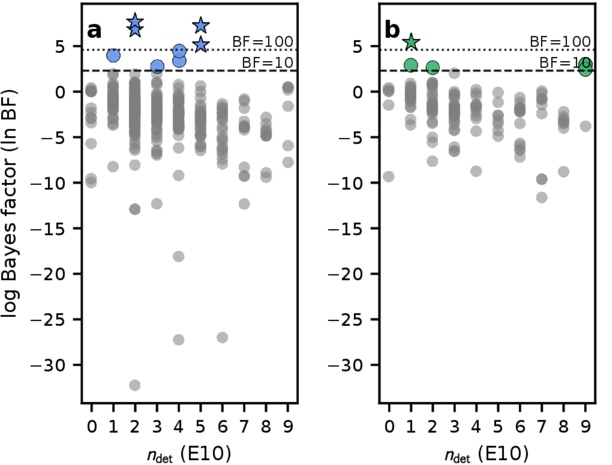
Evidence for a model including technologically processed material relative to a purely natural model, as a function of the number of elements detected in the white dwarf. ndet = 0 indicates that only upper limits were obtained on elemental abundances. Higher Bayes factors indicate stronger evidence. The left-hand plot is based on abundances measured from the white dwarfs’ photospheres, while the right-hand plot uses abundances adjusted for diffusion within the white dwarf. Click to enlarge. [Adapted from Huang et al. 2026]
No Strong Evidence, but a Path Forward
Ultimately, Huang’s team found that strong statistical support for the existence of technological processes was uncommon, though there were certain measurements in their sample of white dwarfs that were difficult to reconcile with a solely natural model.
Perhaps unsurprisingly, the team also found that the quality of the chemical abundance measurements affected the constraining power of the observation; some white dwarfs had upper limits for just a few elements, while others had definitive detections of many elements. They found that the most discerning observations recorded iron, magnesium, chromium, and titanium, plus either nickel, silicon, or sodium.
While this work didn’t dredge up firm evidence for technological activity, it provides a jumping-off point for future searches. The handful of white dwarfs in this sample that were fit poorly by a purely natural model could be compared against other technosignature models or targeted with high-resolution spectroscopy. Future measurements of iron and magnesium in polluted white dwarfs may be useful as a preliminary screening tool, helping to pick out intriguing targets for follow-up observations.
Citation
“A Calibrated Bayesian Search for Potential Chemical Technosignatures in Polluted White Dwarfs,” Bo-Lun Huang et al 2026 ApJ1006 9. doi:10.3847/1538-4357/ae742c
SpaceX has pinned the bulk of its future value on orbital data centers. Not rockets. Not spacecraft.
Instead, it envisions launching and maintaining a constellation of 1 million satellites capable of generating 120 GW to power tens of millions—and potentially up to 100 million—frontier-class GPUs for data center services.
The company's founder, Elon Musk, revealed plans for this massive constellation months ago, but until recently, the scope of the individual satellites was largely unknown. That changed in June, when Musk and Ian Dahl, director of satellite engineering for SpaceX, spoke in a promotional video about the company's plans to develop the first iteration of an orbital data center, called an AI1 satellite. The video finally provided the company's numbers about the satellite's size and power capabilities.
Deep within the world’s remaining equatorial forests, the last uncontacted Indigenous peoples continue to live in near-total isolation. They represent humanity’s final societies that have consciously chosen to remain beyond the reach of the modern world. Their existence is extraordinary not only because of who they are, but because of what their survival reveals about ourselves.
For decades, however, governments found it politically and economically convenient to pretend that many of these people did not exist.
That chapter is, thankfully, drawing to a close. Today, Peru, Brazil, and other South American nations officially recognize the existence of Indigenous peoples living in voluntary isolation. Yet the history of denying their existence remains one of the most revealing episodes in the modern relationship between development, politics, and human rights. It reminds us that before forests are exploited, the people living within them are often rendered politically invisible.
The lesson extends far beyond the Amazon.
Throughout history, governments have rarely denied the existence of people simply because evidence was lacking. In colonial times, the existence of indigenous societies and cultures had no bearing on European immigrant expansion. Their cultures were considered primitive, and civility and religion would be the great benefits of settler expansion. In the 20th and 21st centuries, denial served a more practical purpose. If no one officially occupied a forest, there were no communities whose rights required protection. No Indigenous reserves needed to be established. Logging concessions could be issued, roads extended, mines approved, and oil exploration expanded with fewer legal obstacles. Recognition would carry consequences.
Once governments acknowledge uncontacted peoples, they assume obligations under national constitutions, international human rights law, the United Nations Declaration on the Rights of Indigenous Peoples (UNDRIP), and, in many countries, ILO Convention 169. Suddenly, economic development must coexist with human rights.
For years, this tension played out repeatedly in the Peruvian Amazon.
As proposals emerged to establish reserves for Indigenous peoples living in voluntary isolation, regional politicians and government officials questioned whether these communities existed at all. They argued there was insufficient evidence despite decades of documentation by anthropologists, Indigenous organizations, and conservation scientists. Shelters, cultivated gardens, footprints, arrows, abandoned camps, aerial observations, and repeated eyewitness accounts painted an increasingly compelling picture. Yet recognition often lagged precisely where logging, oil, gas, or mining interests sought access.
In retrospect, this was never simply an anthropological debate. It was an economic one.
The existence of uncontacted peoples transformed forests from potential commercial assets into protected Indigenous territories. Recognition restricted extraction. Denial facilitated it.
Fortunately, much of that official denial has now ended. Governments increasingly recognize that uncontacted peoples do exist and deserve legal protection. Yet the episode leaves behind an important lesson: political narratives often reflect competing economic interests as much as objective evidence. The question is no longer whether uncontacted peoples exist. The question is whether governments possess the political will to protect them.
The irony is profound. The same territories that some once wished to portray as empty are now recognized as among the most important ecosystems on Earth.
Study after study demonstrates that Indigenous territories, particularly those occupied by peoples living in voluntary isolation, experience significantly lower rates of deforestation than surrounding forests. These landscapes contain extraordinary biodiversity, protect countless species yet to be documented by science, regulate regional rainfall, and store immense quantities of carbon essential to moderating global climate change.
Protecting uncontacted peoples, therefore, serves two inseparable purposes.
It safeguards fundamental human rights while simultaneously protecting some of humanity’s greatest environmental assets. In the western Amazon, where I have spent time working, these realities become impossible to separate.
This region contains the greatest concentration of uncontacted peoples anywhere on Earth. It is also among the richest expressions of biological diversity on the planet. Yet it remains under relentless pressure from illegal logging, mining, expanding road networks, narcotics trafficking, and land speculation. While Peru and Brazil have established large protected Indigenous territories, enforcement has weakened in many areas as criminal organizations and commercial interests increasingly penetrate previously inaccessible forests.
Every encounter between outsiders and uncontacted peoples carries enormous risk.
Centuries of violence, exploitation, and disease can be compressed into a single unexpected meeting. Illegal miners, loggers, and land invaders increasingly enter territories occupied by isolated peoples, provoking confrontations that neither side seeks. Fatal encounters have occurred involving both Indigenous defenders protecting their ancestral lands and outsiders venturing into territories they had no right to enter.
I experienced something that profoundly altered my appreciation of this reality.
On a recent expedition, I awoke before dawn to a river wrapped in mist beneath a pale orange sky. Overnight storms had left the air heavy with humidity as I walked along a stretch of exposed sand. Through the haze stood a man. Barely clothed, carrying what appeared to be a weapon of some form, he remained motionless for only a few seconds before silently disappearing back into the forest.
The encounter was brief, but penetrating. Ten thousand years faded away.
We were outside any officially protected Indigenous territory and had taken every precaution to avoid contact. Yet there he was, undeniably real. His footprints remained impressed in the wet sand long after he disappeared.
They reminded me that debates over whether isolated peoples exist are ultimately settled not by ideology, but by reality itself. These communities continue to live within forests that many outsiders still view primarily through the lens of economic opportunity.
Throughout the Americas, first contact repeatedly brought catastrophic epidemics, displacement, exploitation, and cultural destruction. Peoples living in voluntary isolation possess little immunity to common infectious diseases carried unknowingly by outsiders. Even a well-intentioned contact can prove devastating.
Some argue that continued isolation is no longer realistic—that climate change, expanding infrastructure, and globalization make eventual integration inevitable.
I believe this misunderstands both ethics and history.
It assumes that outside society possesses the right to determine other people’s future. It repeats the paternalism that has accompanied Indigenous dispossession for centuries. Respect requires something more difficult. It requires restraint.
The greatest lesson we should draw from the period when governments denied the existence of uncontacted peoples is not simply that denial was wrong. It is that economic convenience can shape political reality in dangerous ways. When forests are viewed primarily as timber, minerals, or agricultural land, it becomes remarkably easy to overlook the people who stand in the way of exploitation.
Today, official denial has largely given way to official recognition. That represents genuine progress. But recognition alone is insufficient if protections exist only on paper while illegal logging, mining, and organized crime continue to erode Indigenous territories on the ground.
Over the years, I have seen echoes of this same struggle elsewhere. In the highlands of Papua New Guinea, where stone tools were still in use, communities sought to preserve traditions against an advancing modern world. On India’s Andaman Islands, members of the Jarawa halted a military convoy I was travelling with, bows drawn, defending the integrity of their homeland. Across continents, the underlying question remains remarkably consistent: can modern societies respect the right of other cultures not to become like us?
The uncontacted peoples of this world challenge our assumptions about progress itself. Their existence reminds us that development is not the only measure of a society, and that autonomy sometimes means choosing a different path altogether.
Their territories also remind us that some of the world’s most effective conservationists have never described themselves as environmentalists. By simply defending their lives and territory, they have preserved ecosystems that benefit every person on Earth.
The people governments once pretended did not exist have become some of the planet’s important guardians. Protecting them is no longer only about correcting historical injustice. It is about recognizing that human rights, biodiversity, and climate stability are inseparable. Their silence in the forest is not absence. It is sovereignty.
Yet the story of the uncontacted has another, profound consideration for our era that extends far beyond remote forests. The history of the uncontacted tells us that for years, some governments denied the existence of people who were demonstrably there because acknowledging them carried political and economic costs. As we search for life beyond Earth, humility demands that we distinguish between what has not yet been confirmed and what may simply remain beyond our present ability—or willingness—to acknowledge.
History repeatedly warns against confusing the limits of our knowledge with the limits of reality.
Kerry Bowman, PhD, is a Canadian bioethicist and environmentalist. An instructor at the University of Toronto, he currently holds an academic appointment in the Faculty of Medicine and School of the Environment. Bowman’s recent work includes two major conservation projects in the Western Amazon and the Eastern Congo, focusing on the intersection of human health with factors such as deforestation, biodiversity loss, and emerging zoonotic diseases.
Many observations of solar flares suffer from saturation and blooming, causing crucial information to be lost. Researchers recently validated a technique for retrieving information from saturated flare images, unlocking a treasure trove of powerful solar flares for examination.
Solutions for Saturation
Since 2010, the Atmospheric Imaging Assembly (AIA) on the Solar Dynamics Observatory (SDO) has been capturing nearly continuous extreme-ultraviolet images of the Sun’s disk, revealing our star’s dramatic high-energy behavior. Though SDO/AIA’s observations have transformed our understanding of the Sun’s activity, they have limitations: powerful solar flares can saturate the detector, spilling charge into nearby pixels.
This saturation and overflow compromises our ability to study the most energetic solar flares — but the “lost” information may actually be recoverable. When light from an intense flare enters SDO’s instruments, not all of it pools in the saturated region of the detector: some of the light is diffracted by the optics, and by mathematically inverting this pattern of diffracted light, researchers can attempt to extract the encoded information about the saturated region. Researchers have used this technique for more than a decade, but options for validating the results were limited until now.
Solar Orbiter Lends a Hand
Launched almost 10 years to the day after SDO, the Solar Orbiter spacecraft provides an excellent opportunity to test inversion techniques for recovering information from saturated solar images. Solar Orbiter’s Extreme Ultraviolet Imager snaps brief photos of the Sun at a rapid cadence, and its images remain unsaturated even when faced with energetic solar flares.
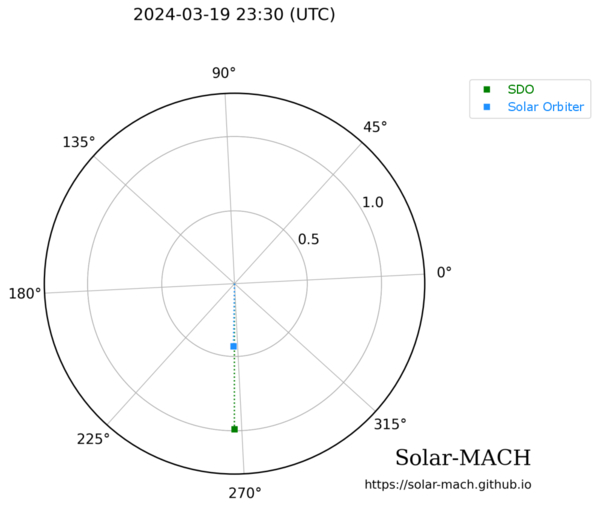
Positions of SDO (green) and Solar Orbiter (blue) during a solar flare on 19 March 2024. Click to enlarge. [Guastavino et al. 2026]
As described in a recent research article by Sabrina Guastavino (University of Genoa; Italian National Institute for Astrophysics) and collaborators, the ideal setup for testing the inversion technique arose on 19 March 2024, when SDO and Solar Orbiter both viewed a solar flare while separated by just 1 degree in longitude.
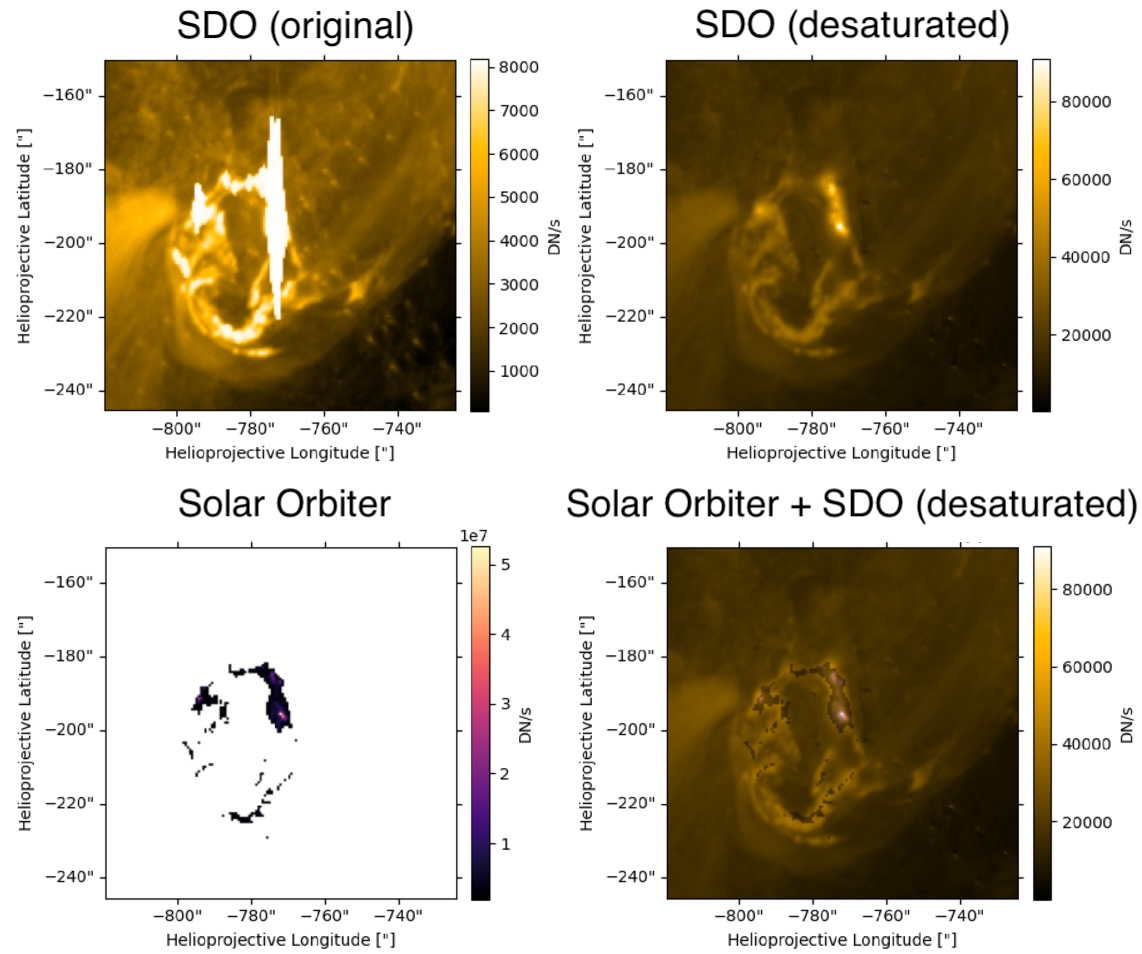
Guastavino’s team aligned and reprojected the data, accounting for the slightly different viewing angles of the two spacecraft, then applied an algorithm called Adaptive SE-DESAT to reconstruct the flux within the saturated portion of the SDO image. The team compared the desaturated SDO images to the unsaturated Solar Orbiter images over the course of the flare, finding the same flare morphology and similar time evolution between the two data sets.
Example of unprocessed SDO data (top left), desaturated SDO data (top right), Solar Orbiter data (bottom left), and a combination of the two data sources (bottom right). Note that the Solar Orbiter observations have been clipped so that only the highest flare intensities were recorded. Click to enlarge. [Adapted from Guastavino et al. 2026]
A Treasure Trove of Desaturated Data
Overall, these results demonstrate the effectiveness of the inversion technique, though Guastavino and coauthors noted that improvements could be made during the impulsive phase of the flare, when the emission is increasing. The team identified several reasons why the results may not match during this phase, including rapid evolution of the flare during individual exposures.
Despite these areas that require further attention, the validation of this technique unlocks 16 years of solar flare observations from SDO. This especially enhances our sample of powerful solar flares, increasing the available records of the most energetic solar flares by orders of magnitude.
Citation
“Validation of an Extreme-Ultraviolet Desaturation Technique for the Atmospheric Imaging Assembly on Board the Solar Dynamics Observatory Using Observations from the Extreme Ultraviolet Imager on Board Solar Orbiter,” Sabrina Guastavino et al 2026 ApJL1005 L50. doi:10.3847/2041-8213/ae7d2e
NASA is once again sending scientific missions to the Moon. But under the new commercial framework for getting there, researchers need to invent a new method for how to pick where to land.
A New Process for Picking Sites
NASA’s Commercial Lunar Payload Services program is a bold innovation in organizing robotic missions to the Moon. Under this model, rather than keeping the mission process entirely in-house, the agency selects the scientific mission they want to support then simply buys a ride to the lunar surface from a commercial vendor. But, how do you pick a landing site before you know exactly how you’re getting there?
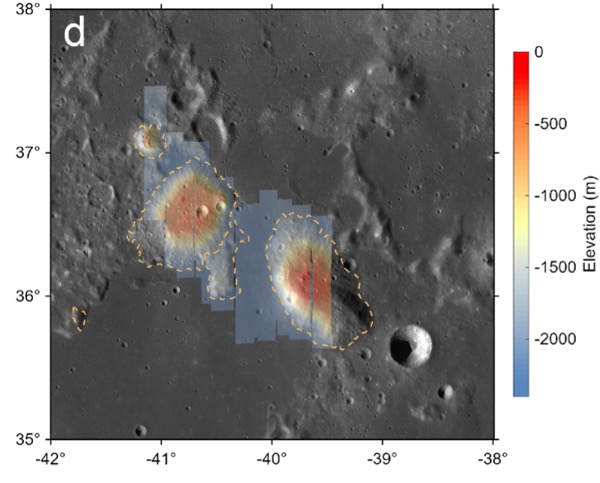
The Gruithuisen domes region, the broad area the Lunar-VISE team searched for potential landing sites. Click to enlarge. [Adapted from Williams et al. 2026]
The Lunar Vulkan Imaging and Spectroscopy Explorer (Lunar-VISE) mission, set to launch in mid-2028, was one of the first programs to go through this new landing site selection process. After being officially selected in 2022, the team had just nine months to nail down exactly where their mission should touch down. A recent article led by Jean-Pierre Williams (University of California, Los Angeles) detailed exactly how the team accomplished this task and presented some lessons they learned along the way.
No Parking Lots on the Moon
Picking a landing site is no small task: for context, selecting the landing sites for each of the most recent Mars rovers took five years and multiple community workshops. The Lunar-VISE team therefore took a streamlined and logic-driven approach. They started by explicitly laying out their science objectives: Lunar-VISE’s purpose is to investigate some strangely silicate-rich volcanic formations called the Gruithuisen domes, so they had to land either on or near those. They also had to have access to boulders that were excavated from deep within the domes during a crater formation event, so they had to pick a spot with boulders relatively nearby.
In addition to objectives, they also laid out a slew of constraints. Although they needed boulders nearby, they couldn’t have too many boulders, or any particularly large boulders, since those could pose hazards for landing. There also couldn’t be any steep slopes in the field. Most of the area had to maintain a line of sight with a supporting orbiter for communications, so they couldn’t set down near any ridges. Also, they had to consider how the terrain would cast shadows as the lunar day progressed, since they didn’t want their mission cut short by freezing temperatures and a lack of solar power. As the team quipped, “many interesting, high-science value locations on the Moon may not be in proverbial ‘parking lots.'”
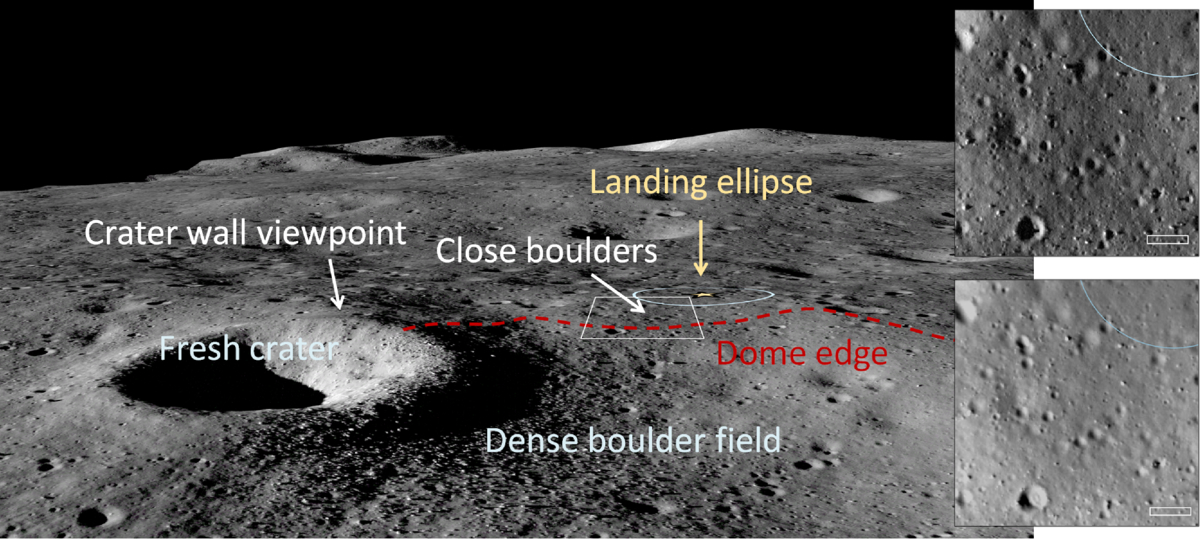
An image from the Lunar Reconnaissance Orbiter overlaid onto a terrain model of the final landing site. Click to enlarge. [Williams et al. 2026]
By combing through archival data and working with the team that operates the Lunar Reconnaissance Orbiter Camera, a key asset for making detailed maps of the Moon, the researchers found the perfect spot: alongside a 190-meter-diameter crater named Mareta. This feature is named after Mareta West, one of the first female planetary geologists at the United States Geological Survey and the scientist who selected the landing site for Apollo 11’s historic touchdown.
In addition to presenting their landing site, the researchers offered a handful of lessons to others who may someday be in the fortunate and thrilling position of needing to pick a landing spot on the Moon. For one, they urged teams to coordinate with the Lunar Reconnaissance Orbiter specialists as early as possible, since processing the imaging data for lander-quality maps is a specialized and intensive task. For another, they recommended that all of the software tools used be made publicly available so that future missions don’t need to duplicate their work.
As this article laid out, the Commercial Lunar Payload Services program and Lunar-VISE take us one step closer to making missions to the Moon routine — but we’re still figuring out exactly how to do that.
Citation
“Lunar-VISE Landing Site Selection and Characterization at Mons Gruithuisen Gamma,” Jean-Pierre Williams et al 2026 Planet. Sci. J.7 161. doi:10.3847/PSJ/ae7d2c
It wasn't easy to find anyone outside of SpaceX clamoring for a rocket like Starship just 10 years ago. Today, the space industry can't wait for Starship to finally deliver.
With a payload capacity of more than 100 metric tons (220,000 pounds) to low-Earth orbit, SpaceX's new rocket is changing the thinking of just about everyone in the space industry. With the unrealized but potentially game-changing benefits of refueling, Starship could carry the same amount of payload to higher orbits, the Moon, or Mars.
It's important to note that Starship is still very much in its experimental phase, far from proving Elon Musk's loftiest claims about what it can do. Still, NASA and the US military are considering novel ways to use Starship to fly to the Moon or transport cargo to far-flung war zones. Scientists are eager to use its enormous volume to launch giant space telescopes. Competitors are taking notice. China, the strongest strategic adversary America has ever faced, is looking for its own Starship. Now, some US satellite manufacturers are adapting for the substantial capacity of the world's most powerful rocket.
Do all star-forming regions birth stars with the same distribution of masses? Theory suggests that they do not, but researchers often assume they do for simplicity. Now, ultra-precise observations from Gaia have demonstrated that the initial mass function varies across star clusters in the Milky Way.
When a molecular cloud fragments, collapses, and births a star cluster, how many stars form, and what are their masses? The answer to that question is what astronomers term the initial mass function, or IMF: the distribution of masses of stars born in a cluster.
The IMF is important in many areas of astronomy, and it’s relied on especially heavily in studies of distant galaxies. The light from these galaxies is dominated by high-mass stars, with the emission from lower-mass stars lost in the glare, so astronomers must use the IMF to reconstruct the stellar populations of these far-off locales.
Though theory suggests that the IMF should vary with factors like temperature and metallicity, demonstrating these variations has been difficult, even within our own galaxy. Because of this, researchers often adopt a universal IMF drawn from observations of star clusters in the Milky Way. But is the IMF truly universal?
The More the Slope Changes, the More the Break Mass Stays the Same
Determining whether the IMF is universal is more complicated than simply comparing the stars in one cluster to those in another. That’s because what astronomers measure in present-day star clusters is not the initial mass function, but a version of the IMF that has been skewed by millions to billions of years of evolution; over time, high-mass stars die and low-mass stars get ejected, warping the shape of the mass function.
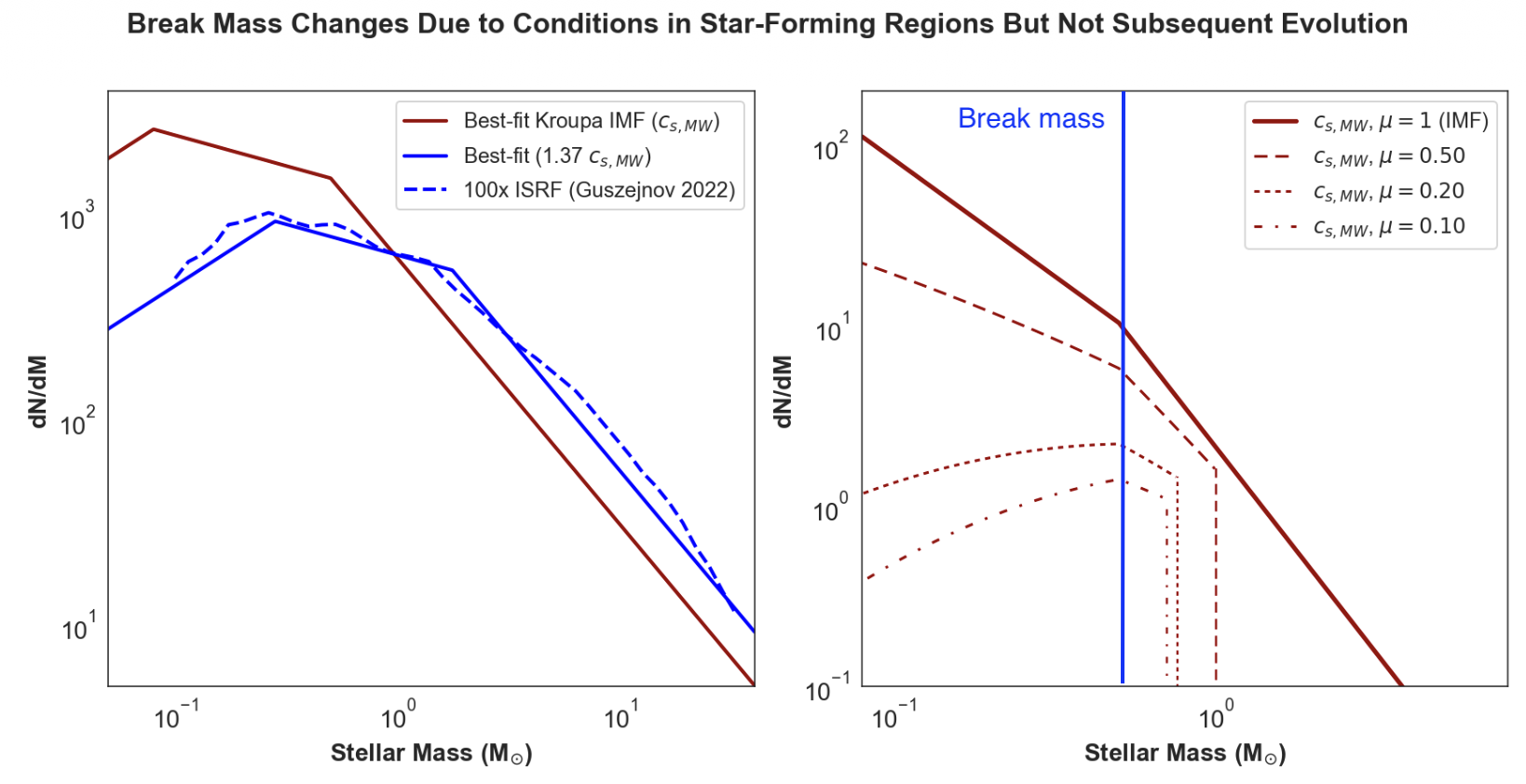
Left: Different break masses arise for different properties (here, the sound speed) of a given star-forming cloud. Right: Evolution of the mass function over time for a single star cluster. Over time, high-mass stars die and low-mass stars are ejected from the cluster, resulting in a decrease in the remaining mass fraction, μ, from 1 to 0.1. The slopes change, but the break mass does not. Click to enlarge. [Adapted from Steinhardt et al. 2026]
However, as demonstrated in a recent research article led by Charles L. Steinhardt (University of Missouri), certain aspects of the IMF may remain unchanged as clusters evolve. When the mass function of a star cluster is described using a broken power law (commonly called a “Kroupa-like” IMF in reference to work by Pavel Kroupa), the slopes of the power-law segments are affected by stellar evolution and dynamical interactions. Crucially, these effects appear not to alter the break mass — the mass at which the IMF transitions from one slope to another. Therefore, differences in the break mass from cluster to cluster reflect differences in the underlying IMF rather than the stellar and dynamical evolution of the clusters.
Insights from Gaia
Thanks to the Gaia spacecraft, which made precise observations of more than 2 billion stars in the Milky Way and beyond, it’s now possible to measure and compare the break masses of individual star clusters. Out of an initial catalog of 7,167 Milky Way clusters observed with Gaia, Steinhardt’s team selected just 110 that were of high enough quality and contained a sufficient number of stars to measure cluster break masses accurately.
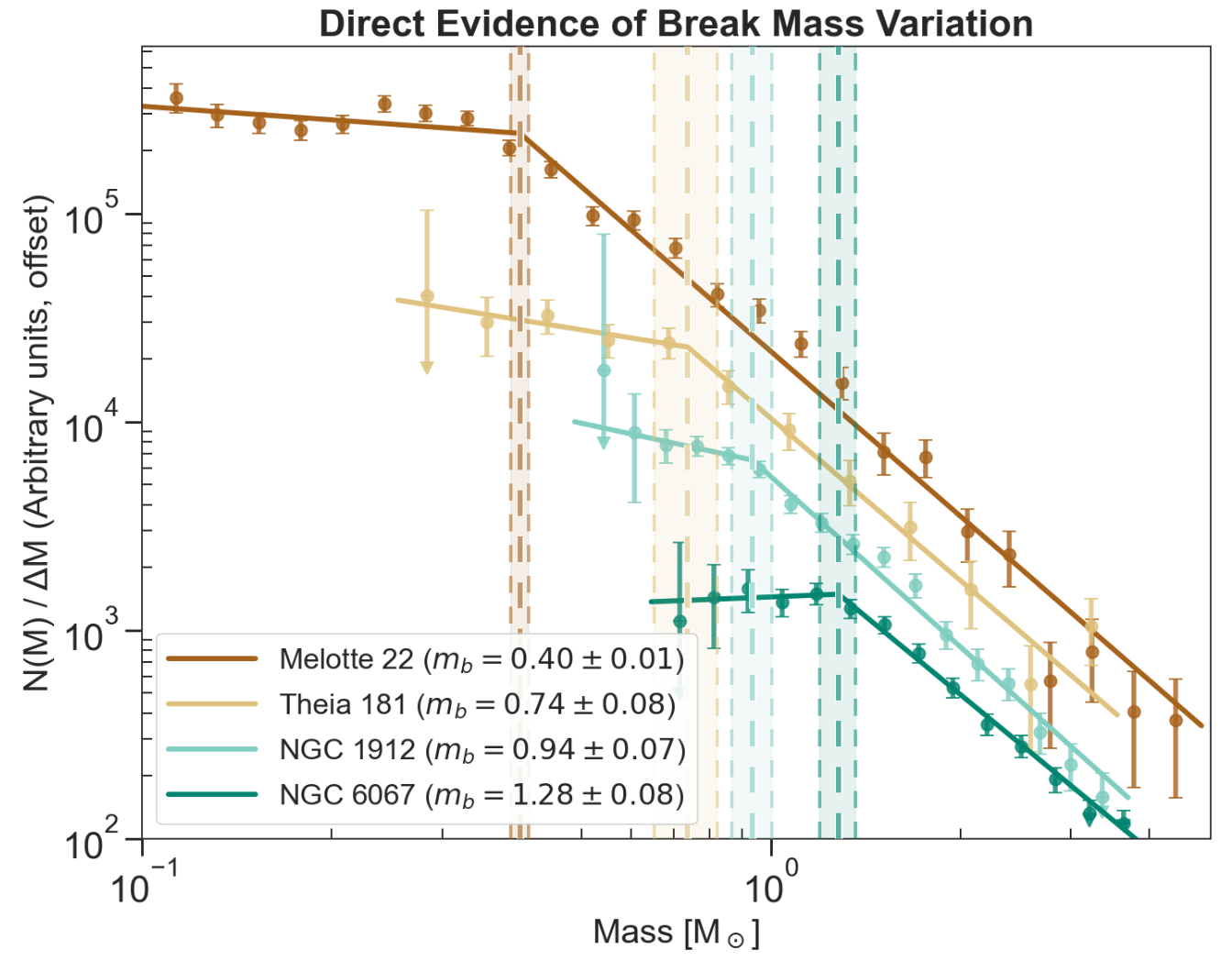
Observed mass functions of four Milky Way star clusters. The break masses are clearly different, showing that the IMF must vary from cluster to cluster. Click to enlarge. [Steinhardt et al. 2026]
The team found that the break mass differs considerably between the clusters in their sample, showing that the IMF is not universal. The observed variety of break masses appears to be linked to the age of the cluster, but instead of reflecting the impact of stellar and dynamical evolution — which have no effect on the break mass — these differences reflect the properties of the clouds in which the clusters were born. This implies that the properties of star-forming clouds in the Milky Way have, on average, changed over cosmic time. Thus, a star cluster that formed billions of years ago would have had a different IMF than one forming today.
This finding has implications for studies of high-redshift galaxies, where the properties of star-forming clouds are markedly different from those in the Milky Way. Going forward, Steinhardt and coauthors recommend developing a flexible parameterization of the IMF to capture how this critical function behaves in environments vastly different from our own.
Citation
“Direct Evidence for Stellar Initial Mass Function Variation in the Milky Way,” Charles L. Steinhardt et al 2026 ApJL1005 L40. doi:10.3847/2041-8213/ae7444
In the brief history of AI security, the prompt injection has quickly become the top threat. Large language models are inherently unable to distinguish between legitimate instructions provided by users and malicious ones sneaked into emails, source code, and other third-party content the models are processing. This makes it trivial to surreptitiously inject malicious commands that the LLM readily follows.
With no way to enforce this crucial boundary between trusted and untrusted sources, AI engine developers are left to erect elaborate guardrails designed to mitigate the damage rather than solve the root cause.
To date, most prompt injections have fallen into a class known as push, in which each potential victim is targeted. For example, the adversary injects malicious instructions into an individual email or calendar invitation. Because the injection must then be sent (or pushed) to each specific target, the scale of the attack is limited, hampering mass exploits that hit the Internet at large.
Stellar rotation is a crucial aspect of not only stellar evolution but also exoplanet science, and a recent study has built the largest catalog of stellar rotation periods to date.
Stellar Opportunities with TESS
Since its launch in 2018, the Transiting Exoplanet Survey Satellite (TESS) has scoured the sky, searching for the signature recurring dip in starlight caused by planetary companions. While the primary goal of TESS is to discover exoplanets, the satellite’s mapping of the entire sky has created a rich database of high-quality photometry for millions of stars. These observations offer ample opportunity for scientists to study stellar properties and behavior across the Milky Way.
In particular, stellar rotation is a key property that traces a star’s age, magnetic activity, and internal structure. For exoplanet science, stellar rotation is both a help and a hindrance: it allows us to study how exoplanets may evolve over time with their host stars, but stellar activity can mimic or drown out planet signals, making them harder to detect. A few studies have investigated stellar rotation periods with TESS, looking at specific star clusters and known planet hosts. To date, however, no existing study has produced a larger catalog of TESS rotation periods — a product that would provide a wealth of information for both exoplanet and stellar evolution science.
Creating a Catalog
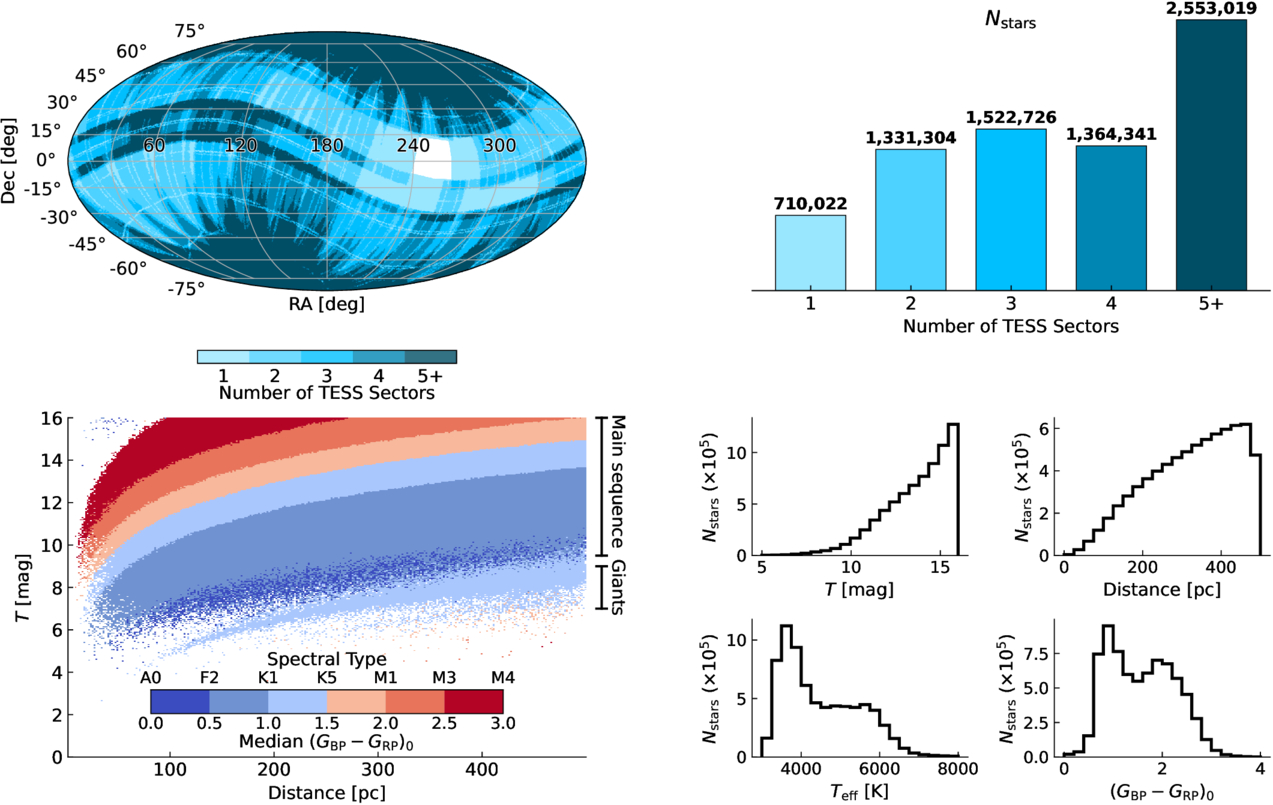
Target sample summary showing the TESS sky coverage (top left), histogram of number of TESS observations per star (top right), TESS magnitude as a function of distance to the star (bottom left), and histograms of magnitude, distance, temperature, and color across the sample (bottom right). Click to enlarge. [Boyle et al 2026]
Seeking to build a flux- and distance-limited catalog of TESS rotation periods, Andrew W. Boyle (The University of North Carolina at Chapel Hill) and collaborators used TESS full-frame images to survey the local neighborhood for stellar variability. To measure reliable stellar rotation periods for as large and diverse a sample as possible, the authors made selection cuts in brightness, distance, and data availability to build a target sample of 7,481,412 stars. They generated light curves for each observation of each star and searched them for periodicity, or repeated variation in brightness.
Not all brightness variations present in a star’s light curve are due to stellar variability — instrumental systematics and artifacts from the spacecraft’s orbital period can produce periodic variability. To combat this, the authors created a classification algorithm to select sources whose periodicity is most likely due to true stellar variability rather than instrumental or observational effects. Pairing this classification with some additional validation criteria, the authors built the TESS All-Sky Rotation Survey (TARS), a catalog of periods for 1,046,317 stars within about 1,600 light-years of our Sun.
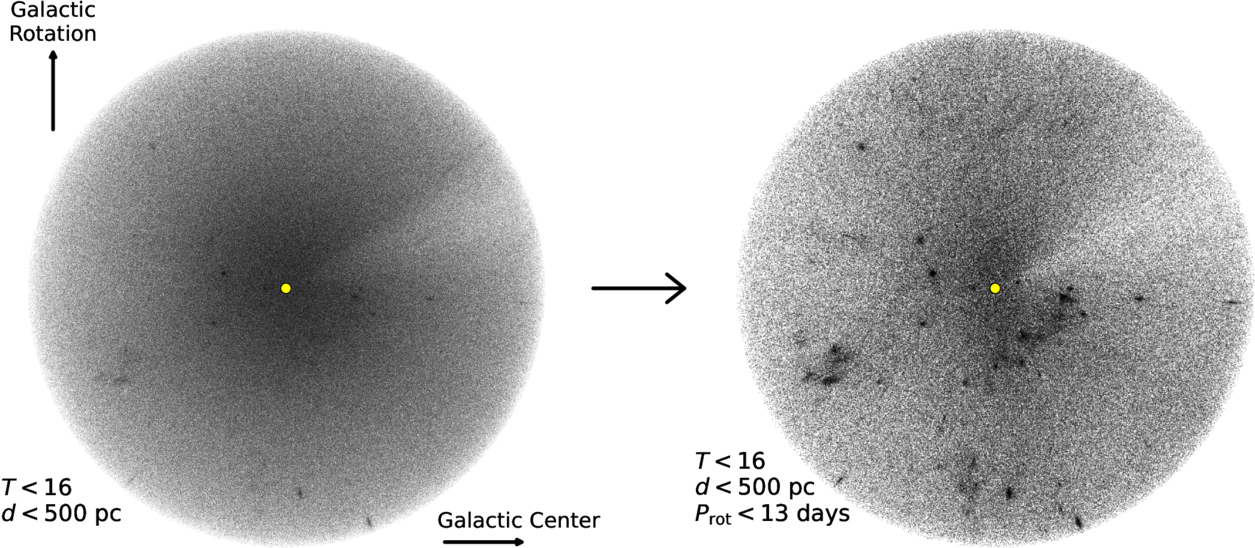
Map of all TARS stars within about 1,600 light-years of the Sun (left) and only the fast-rotating stars in the survey, highlighting clustered populations (right). Click to enlarge. [Boyle et al 2026]
Implications of TARS
Looking more finely at the TARS catalog, the authors provided additional quality cuts to remove other potential sources of stellar variability like binary companions or pulsations. The authors estimated that roughly 93% of their measured periods are due to stellar rotation, which expands the number of stars with known rotation periods by a factor of 2.3 within about 325 light-years and by a factor of 4.0 within about 1,600 light-years. As the largest homogeneous catalog of stellar rotation periods to date, TARS lays the groundwork for studies of stellar evolution, exoplanet discovery and evolution, and even Milky Way structure. For example, the authors found that when mapping the fast-rotating, typically younger stars in TARS, the location of young stellar associations in the local neighborhood became significantly clearer. This underscores the importance of this catalog for a range of science goals, and future work will only improve upon the data provided by TARS.
Citation
“The TESS All-Sky Rotation Survey: Periods for 1,046,317 Stars within 500 pc,” Andrew W. Boyle et al 2026 ApJS 284 75. doi:10.3847/1538-4365/ae6657
One of the biggest discoveries from JWST’s tenure is a population of compact reddish objects nicknamed “little red dots.” Numerous theories have been proposed to explain the small sizes, high luminosities, and characteristic “V”-shaped spectra of these objects, and today we’ll examine two recent research articles that have explored the identity of the universe’s most mysterious inhabitants.
Red Dot, Blue Dot
You can tell a lot about a person by looking at their friends — and the same might be true for little red dots. A team led by Josephine Baggen (Yale University) examined a sample of 83 little red dots imaged with JWST. They found that 43% of the little red dots in this sample had a little blue companion: an ultraviolet-bright object within a projected separation of 1,630–16,300 light-years. The brightest little red dots were even more likely to have a blue companion; 80% of the brightest objects in the sample were paired up.
Baggen’s team set out to test the hypothesis that these red–blue pairs are fundamentally linked rather than coincidental. Under this hypothesis, the ultraviolet-bright blue companions were assembled first. The ultraviolet radiation from these objects suppressed the cooling of molecular hydrogen in pristine gas clouds in the early universe, causing the gas to skip the usual star-forming process and instead form a massive compact object such as a black hole star, supermassive star, or quasi-star — which we see as a little red dot.
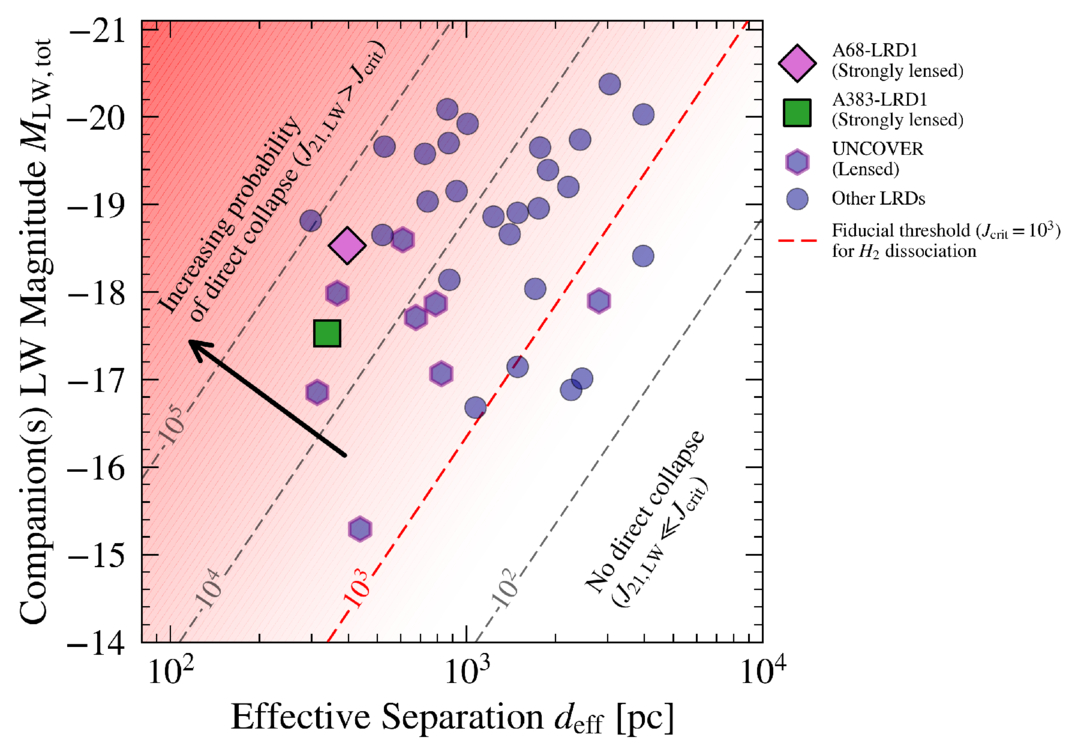
The companion’s mean flux density from 91.2 to 111 nm versus projected separation between the blue companion and the little red dot. The red dashed line shows the estimated values necessary for gas clouds to collapse. Click to enlarge. [Baggen et al. 2026]
Baggen and coauthors investigated whether the ultraviolet radiation from the blue companions is strong enough to have triggered this transformation. The team used spectral energy distribution modeling to determine the luminosities of the blue companions from 91.2 to 111 nanometers. This analysis showed that the radiation from the blue companions is equal to or greater than the threshold necessary to encourage the direct collapse of a gas cloud into a massive compact object.
If little red dots form thanks to their little blue companions, that would imply that every little red dot has or had such a companion. Though little blue companions weren’t so universal in the sample used in this work, the team noted that their analysis techniques, combined with observational limitations and other factors, likely yielded a smaller number of blue companions than are actually present. Further simulations exploring the collapse of pristine gas clouds into massive compact objects and high-resolution spectroscopic observations of little red dots can illuminate the potential link between these objects.
John Chisholm (The University of Texas at Austin) and collaborators hypothesized that little red dots represent a brief phase in the formation of globular clusters. In this hypothesis, the rest-frame ultraviolet emission of little red dots comes from the hot young stars of the newborn cluster, while the rest-frame optical emission comes from a single supermassive star at the cluster’s heart. Thus, in this framework, the little red dot phase lasts only as long as the fleeting lifespan of the supermassive star.
Chisholm’s team first showed that the spectrum of a young globular cluster with a supermassive star at its center is similar to the observed spectrum of a little red dot. But showing that the emission properties of globular clusters in formation and little red dots are similar is not enough — it’s also necessary to investigate whether the numbers and masses of these objects line up.
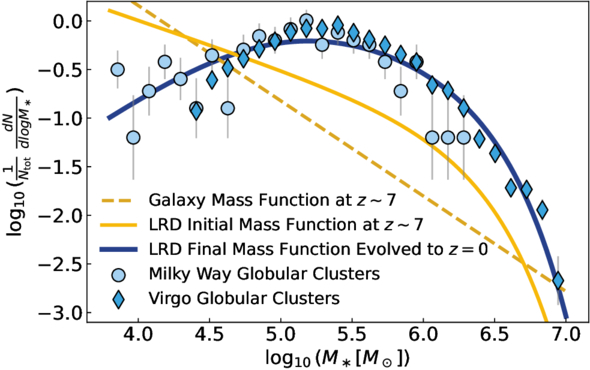
Comparison of the mass functions of little red dots evolved forward to the present day (blue line) and globular clusters in the Milky Way and Virgo (blue symbols). The results for both populations have been normalized to emphasize the shape of the distributions. Click to enlarge. [Chisholm et al. 2026]
To do this, the team propagated the observed mass function of little red dots at a redshift of z = 7 forward in time to z = 0. This process accounted for the rapid evolution of the supermassive star into a black hole, as well as the evolution of and feedback from the massive stars in the cluster. Comparing the resulting mass function to the population of present-day globular clusters, the team found that the mass functions had very similar shapes, and the number densities of little red dots and globular clusters in the present day are estimated to be of the same order of magnitude: 0.1–0.3 Mpc-3 and 0.8 Mpc-3, respectively.
In addition to describing how the properties of globular clusters in formation match those of little red dots, Chisholm’s team outlined some testable predictions for this scenario, including formation timescales and chemical abundance patterns. If this hypothesis withstands further scrutiny, little red dots may provide a valuable look at the early years of some of our universe’s oldest star clusters.
Citation
“Connecting the Dots: UV-Bright Companions of Little Red Dots as Lyman–Werner Sources Enabling Direct-Collapse Black Hole Formation,” Josephine F. W. Baggen et al 2026 ApJL1002 L4. doi:10.3847/2041-8213/ae58a5
“Little Red Dots as Globular Clusters in Formation,” John Chisholm et al 2026 ApJL1004 L4. doi:10.3847/2041-8213/ae6dae
Microlensing surveys have discovered plenty of regular exoplanets, but more surprisingly, they’ve also turned up many solo Neptunes with no star nearby. New research suggests that first impressions might be deceiving, however, and that at least some of these planets might not be so alone: they just have a complicated family history.
An Abundance of Exo-Neptunes
There are simply too many Neptune-like exoplanets in our galaxy. Or at least that’s the current feeling astronomers get from gravitational microlensing surveys, which look for exoplanets during short-lived magnification events caused by chance alignments between stars. These surveys have now found about a dozen so-called “free-floating” planets, and while this doesn’t sound like that many, running the numbers reveals that this tiny sample implies that there are about two free-floating Neptune-size planets for every star in the galaxy.
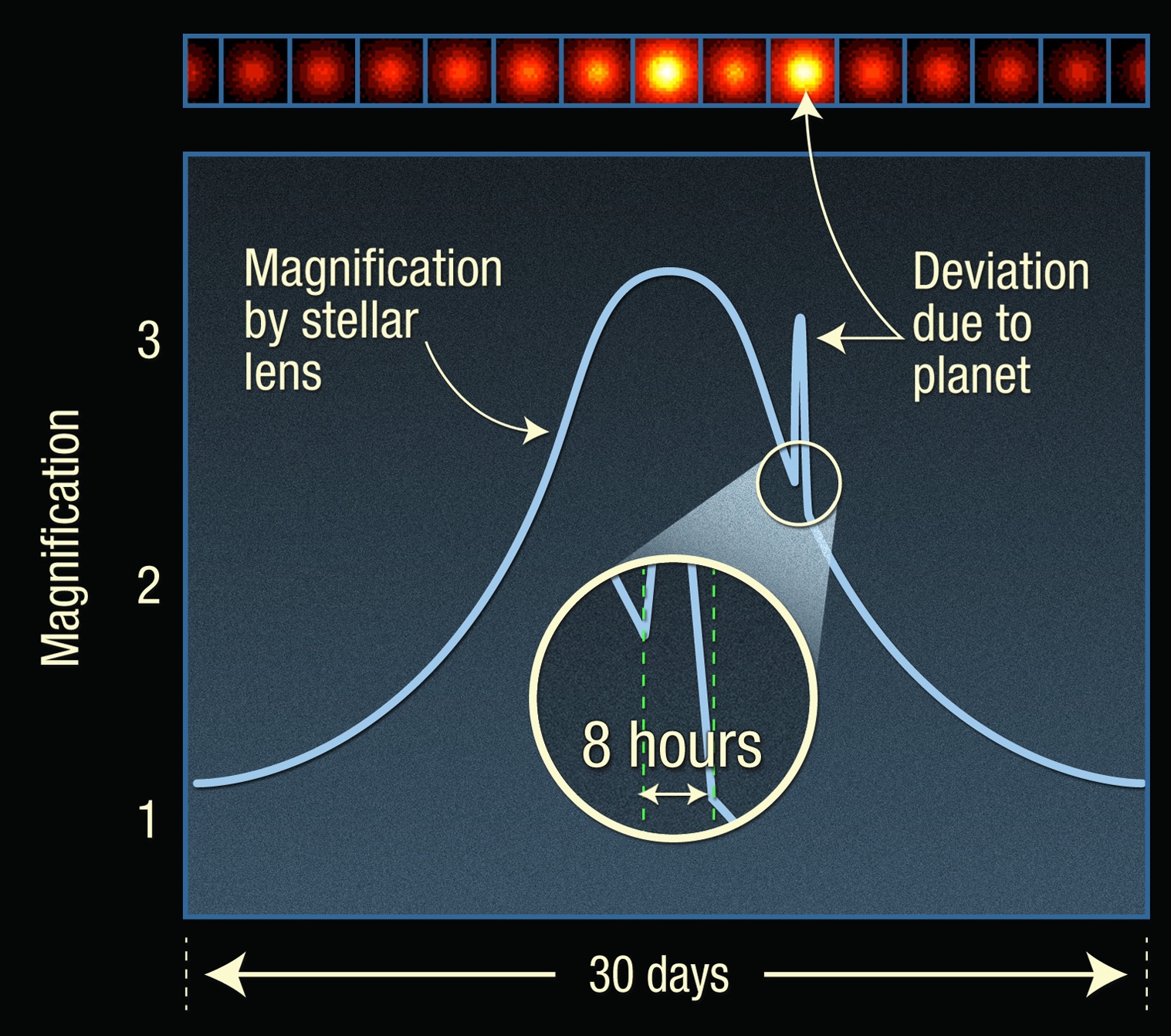
An illustration of how exoplanets are found via microlensing. The broad first bump is caused by the host star magnifying the light from a background star; the narrow second bump is caused by the planet acting as a lens as well. “Free-floating” planets create only one bump. [Adapted from NASA, ESA, and A. Feild (STScI)]
The idea that there are more free-ranging Neptunes than stars is unsettling, and astronomers aren’t yet sure how this many planets ended up so isolated. It’s possible that these objects simply formed disconnected from any planetary system, but it’s unclear how something so small could collapse from the interstellar clouds that usually produce stellar-mass objects. It’s also possible that the planets formed around stars in the usual way, only to be later kicked out by some violent dynamical process — but this would either require too much time or too many giant planets capable of ejecting the lower-mass ones.
However, new research by Sam Hadden (Canadian Institute for Theoretical Astrophysics) and Yanqin Wu (University of Toronto) presents an alternative idea: what if at least some of these free-floating planets aren’t fully on their own, but instead remain estranged but weakly bound to their parent stars?
Simulated Scattering
Two celestial objects need to align nearly perfectly in order to create a microlensing pulse that we can detect. For an exoplanet orbiting a star, we should observe two of these pulses: one when the host star drifts in and out of alignment with a background star, and one when the nearby bound planet does the same. In the case of a free-floating planet, there’s only one pulse, and we therefore assume that there is no host star. Hadden and Wu noticed that since the alignment has to be so precise for microlensing to occur, it’s possible that a seemingly free-floating planet is simply widely separated from its host star, and the star managed to dodge the magnification effect. In other words, these planets might not be free floating at all, just on wide and eccentric orbits.
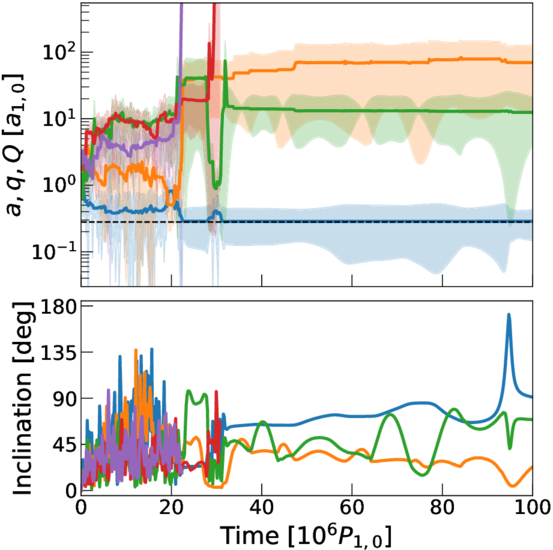
The orbital evolution of a five-planet system that undergoes planet–planet scattering. Each line represents one planet; note that in the end two are ejected, two end up on wide detached orbits, and the fifth ends up on a tightly bound inner orbit. Click to enlarge. [Hadden & Yu 2026]
The researchers decided to test whether it’s possible to create these kinds of orbits via a known dynamical process called planet–planet scattering. As the name implies, during this process, planets that begin on orderly orbits around their parent star undergo a dramatic rearrangement as they jostle each other around through gravitational interactions. The researchers created two types of simulations: one with a collection of equal-mass planets, and another in which one planet dominates over a brood of smaller ones. After setting up the systems, they let the “dynamical havoc” proceed for a few hundred million years, then surveyed the aftermath.
They found that both types of simulations readily created the “detached” objects needed to mimic free-floating planets. In fact, the most common outcome was for two or three planets to be bullied into far-out orbits by a planet that then plunges onto a tight inner orbit extremely close to the star.
Though the authors caution that this process likely doesn’t explain all of the free-floating planets observed to date, this is an exciting model that would dramatically lower our estimates of the number of Neptunes roaming alone between the stars.
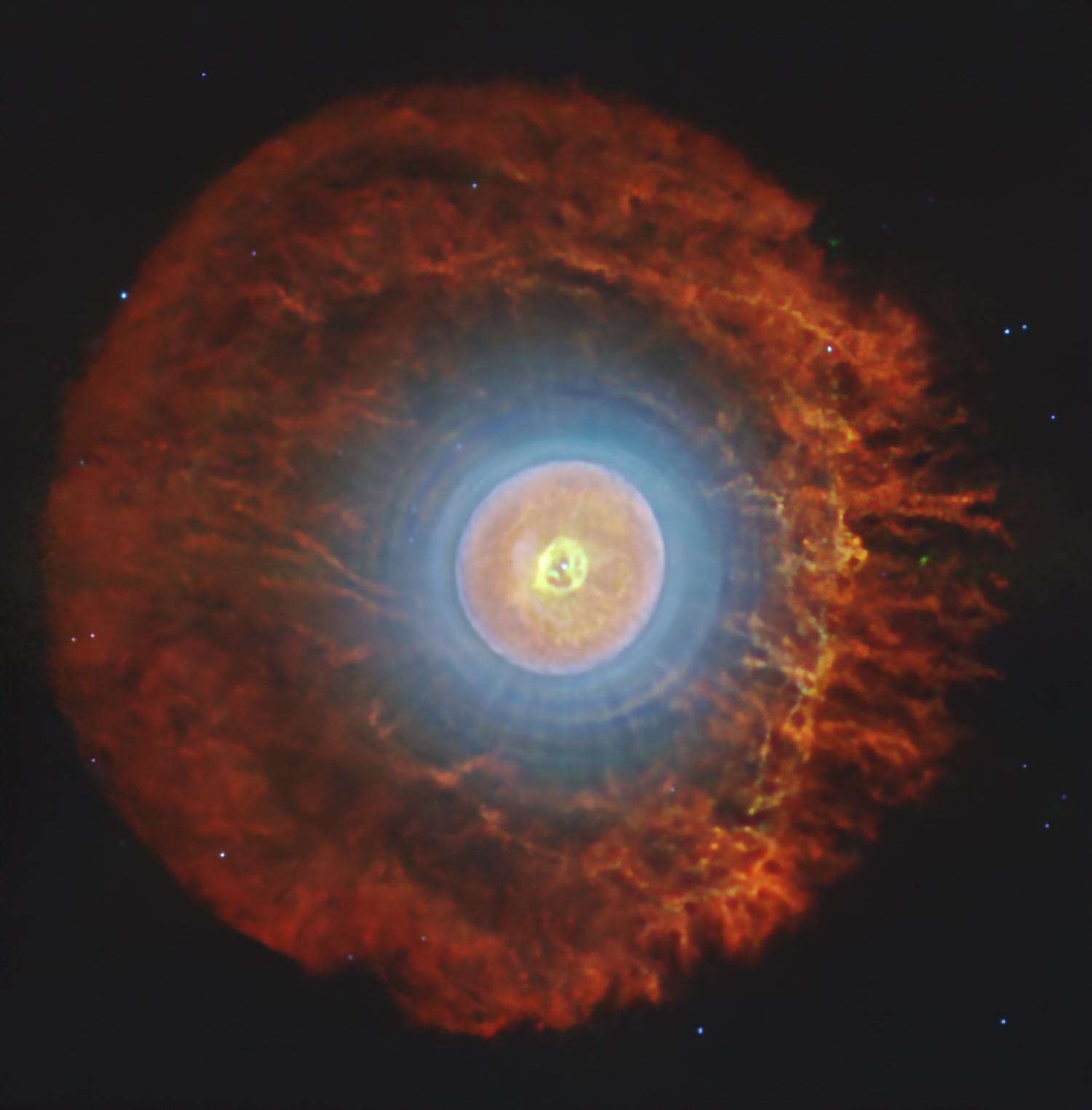
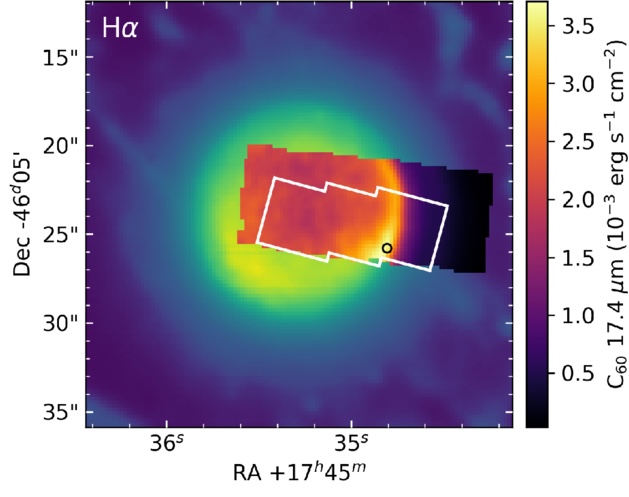
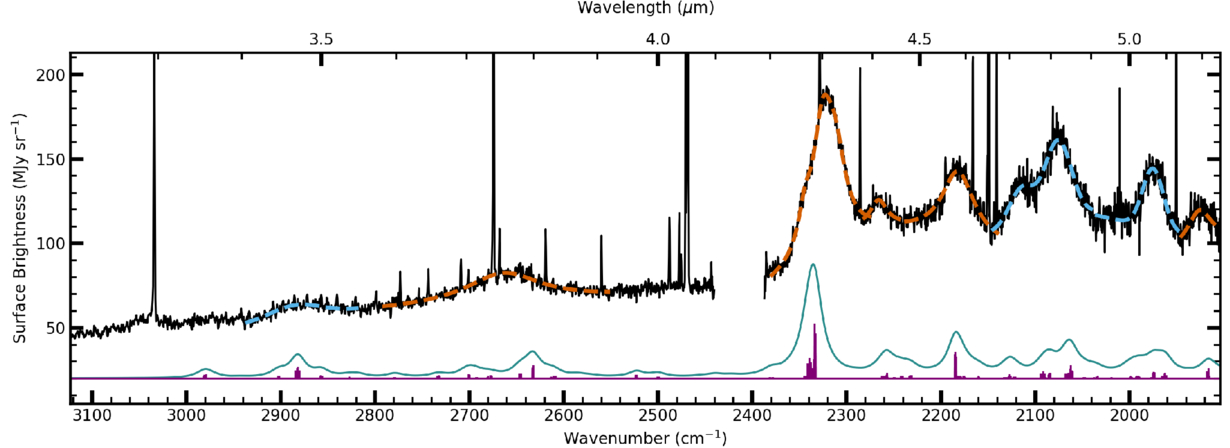
Fullerenes — a class of molecules composed entirely of interconnected carbon atoms — are the largest molecules definitively detected in space. Researchers using JWST to study a planetary nebula have found new spectral features from a fullerene composed of 60 carbon atoms, offering another way to study how these molecules form and survive in space.
The planetary nebula Tc 1 holds special significance in the field of astrochemistry. More than a decade ago, researchers using the Spitzer Space Telescope studied this wispy nebula illuminated by the core of a dead star. These observations led to the first confident identification of molecules called fullerenes in space. Fullerenes are large molecules constructed from interconnected rings of carbon atoms, forming hollow spheres, rugby-ball shapes, and long tubes. Spheroidal fullerenes, especially C60, are commonly referred to as buckyballs.
Since that discovery, Tc 1 has been a hot spot for studies of buckyballs. However, researchers are still puzzling over how these large molecules form and survive in harsh space environments.
A closeup of the center of Tc 1, showing the region observed with JWST’s Mid-Infrared Instrument (black-to-yellow color scale) and Near-Infrared Spectrograph (white outline). The background color scale shows the nebula’s H-alpha emission as seen by the Very Large Telescope. [Adapted from Giese et al. 2026]
From Spitzer to JWST
Morgan Giese (The University of Western Ontario) and collaborators recently reported on the results of a JWST observing program that aimed to understand how fullerenes respond to changes in their environment. The team mapped the distribution of C60 molecules at varying distances from the powerful ionizing radiation of Tc 1’s central star.
The team successfully spotted the emission features from the fullerene C60 seen in earlier observations, but they also turned up something unexpected: a handful of prominent emission features from 3.5 to 5.2 microns that had not been reported previously.
Feature Presentation
What’s the source of these emission features? The distribution of the emission provides a strong clue: known spectral features from fullerenes C60 and C70 are concentrated in a narrow, bright ring around the center of the nebula, with diffuse emission suffusing the rest of the nebula — and the newfound spectral features follow the same distribution.
JWST spectrum of Tc 1 (black line) extracted from the area indicated by a black circle in the previous image. The orange and blue dashed lines show fits to the newfound emission bands, and the results of the anharmonic calculations are shown as the teal line below the JWST spectrum. Click to enlarge. [Giese et al. 2026]
This evidence hints that C60 or C70 is the source of these new features, but Giese’s team took the investigation a step further. Using anharmonic quantum chemical calculations, they computed the spectrum of C60‘s combination bands, which arise when multiple vibrational modes are excited at the same time. This is the first time this type of spectrum has been calculated for C60, and the authors found good agreement between their computed spectrum and the JWST spectrum, providing further evidence that C60 is the source of these bands.
Giese and coauthors found that 17% of the energy emitted by the C60 molecules in Tc 1 is released in these combination bands, suggesting that these features must be taken into account when modeling the cooling of C60 molecules. The discovery of new fullerene spectral features also has implications for future studies of these molecules: since these features appear in a wavelength range where features from other complex molecules like polycyclic aromatic hydrocarbons are weak, these newly identified bands provide a promising way to spot and study fullerenes across space environments.
Citation
“Detection of C60 Combination Bands in the Near-IR Spectrum of Tc 1,” Morgan M. Giese et al 2026 ApJL1004 L32. doi:10.3847/2041-8213/ae76d5
Doctorow doesn't actually enjoy talking about AI, but he's constantly being asked to comment on it. "I made the tactical error of being sick of talking about AI," Doctorow told Ars. "So I wrote a book about why I think it's a dumb thing to keep asking people to talk about, and now I have to talk about it." Reverse Centaur is Doctorow's attempt to "sort out the bullshit from the material reality."
In automation theory, per Doctorow, a "centaur" describes a human augmented with a technology, like machine learning, or even just driving a car or using autocomplete. A reverse centaur "is a machine head on a human body, a person who is serving as a squishy meat appendage for an uncaring machine," Doctorow said in a speech last December. He gave the example of an Amazon delivery driver, surrounded by AI cameras monitoring their driving, who essentially serves as a peripheral to the delivery van.

 Login