For the fifth time, pumpkin legend Travis Gienger won the Safeway World Championship Pumpkin Weigh Off today in Half Moon Bay, California. The gigantic gourd named Rocky weighed 2,389 pounds. It could be baked into approximately 1,194 pumpkin pies, and weighs about the same as an American bison (Bison bison) or a 2015 Chevy Spark.
The biggest gourd from this event tipped the scales 2,749 pounds and was grown by Gienger in 2023. On October 10, a new world record was set at the Southern New England Giant Pumpkin Growers Weigh-Off. Ron Wallace of Greene, Rhode Island’s pumpkin weighed 3,156 pounds, beating the previous record-holder by about 300 pounds.
As champion, Geigner will earn $9 per pound in prize money, so $21,900 total. He also will receive a Pumpkin King Champion Ring, the Mel Mello Sr. Grand Champion Growers Jacket, and other honors.
The 53rd annual event also featured a special appearance and carving by legendary pumpkin carver and farmer Mike Valladao. Affectionately called the “Picasso of Pumpkin Carvers,” the gourd artist commemorated his 40 years at the Half Moon Bay Art & Pumpkin Festival.
The pumpkin that Mike Vallado carved during the festivities. Image: Safeway World Championship Pumpkin Weigh Offvia Facebook.
The event began in 1974 as a friendly challenge between Half Moon Bay, California, and Circleville, Ohio, to see who could grow the biggest pumpkin. Half Moon Bay won that first showdown with a pumpkin weighing only 132 pounds. Today’s mega gourds can weigh more than 20 times as much. The event has also become an annual pilgrimage for the pumpkin growers who spend months nurturing their enormous Atlantic giants (Cucurbita maxima). These jumbo gourds sometimes gain dozens of pounds in a single day during peak growing season (August through September).
The event is an officially sanctioned Great Pumpkin Commonwealth competition, with weighing and inspection officiated by the GPC and San Mateo County Department of Agriculture Office of Weights and Measures.
Anyone who’s seen the 1986 musical comedy, Little Shop of Horrors, is familiar with Audrey II. Audrey II looks like a towering, blood-eating Venus flytrap plant, even mimicking the jaw-like, snapping pod of real carnivorous plants. But while Venus flytraps consume insects, Audrey II feeds on humans.
On the other hand, plants that trap and digest bugs and, on occasion, small rodents are not only real, but actually quite diverse. Popular Science turned to Coogan to find out why some plants are carnivorous, while others simply soak up their necessary nutrients straight from the soil. We also asked Coogan to dig into all the details behind what makes these plants deadly, at least to birds and other small animals.
What are carnivorous plants?
Carnivorous plants are predatory flowering plants that attract, catch, and absorb animals for their nutrients. They’re both autotrophs, which are organisms that make their own food using light or chemical energy, and heterotrophs. This means that they also have to eat animal prey to survive.
“Carnivorous plants photosynthesize,” says Coogan. “They can use the sun to convert carbon dioxide and water into sugar,” he says, for substance. “They’re just getting some extra minerals or nutrients from the bugs or the organisms that they eat.”
In the 1986 film Little Shop of Horrors, a giant Venus flytrap-like plant proves deadly. Video: Little Shop of Horrors 4K | Seymour’s TV Interview Goes Horribly Wrong, Warner Bros. Entertainment
Meat-eating plants exist on every continent save Antarctica, and grow in sun-filled places with extremely poor, acidic, and nutrient-free soil. For instance, the bogs, swamps, and marshes of North Carolina and Florida, with their unique combination of sunlight and wetlands, allow these uniquely adapted flora to thrive. This includes Venus flytraps, which are native only to the U.S. Carolinas, and Tracy’s sundew, with its long, thread-like leaves that grow in spirals. It’s often seen blooming alongsidecarnivorous pitcher plants in the Florida Panhandle.
“Carnivory is primarily an adaptation for plants to get nutrients in low nutrient environments,” says Coogan. Carnivorous plants feed on insects to obtain the nitrogen, phosphorus, and other organic nutrients they need to survive, but are unable to absorb from the soil.
This isn’t to say that all plants that grow within poor-soil wetlands are carnivores. Take wiregrass, which is quite prominent in the southeast. “It has really heavy root systems,” says Coogan, which have formed a symbiotic or long-term relationship with mycorrhizal fungi. These fungi attach to the wiregrass roots and help them form nutrients from the region’s poor, sandy soils.
“There’s only a certain number of niches to be filled in an ecosystem, so some plants went one way,” meaning they became carnivores, “and then some plants went the other way.”
How did carnivorous plants evolve?
There are an estimated 800 to 860 species of carnivorous plants worldwide, with new species constantly being discovered. In fact, in the more than 140 million years that flowering plants have been around, carnivory has evolved independently at least a dozen times.
Carnivory is not inherited from a single meat-eating plant ancestor. Instead, carnivorous plants’ highly adapted leaf structures, which include sticky traps, snap traps, and pitfall traps for catching insects, have evolved and diversified more recently, largely between eight and 72 million years ago.
Carnivorous plants are a classic example of convergent evolution. This means that unrelated lineages have all developed similar traits separate from one another to adapt to their sunny, waterlogged, and nutrient-poor environments.
For example, “There are many different kinds of pitcher plants,” carnivorous plants that have hollowed-out pitcher-shaped leaves that act as pitfalls, says Coogan, and they’re completely unrelated. You’ve got low-growing Australian pitcher plants, which are evolutionarily closer to roses, beans, and broccoli, Asian pitcher plants that hang from tropical vines, and upright, trumpet-like North American pitcher plants. Despite their completely different DNA, they’ve all evolved the exact same, tube-shaped “pitfall trap,” says Coogan, to catch and digest insects.
Through convergent evolution, unrelated carnivorous plants like Venus flytraps, sundews, and pitcher plants have also independently repurposed ancient self-defense genes into ingenious digestive tools. While noncarnivorous plants have long used enzymes, called chitinases, to fight off fungal infections, carnivorous plants do the opposite. They use chitinases to break down the tough, chitin-rich exoskeletons of trapped insects. This then allows them to absorb vital nutrients like nitrogen and phosphorus, transforming what were originally passive, protective enzymes into active weaponry.
Are carnivorous plants harmful to larger organisms?
“I would say ‘no,’’ says Coogan. Almost all carnivorous plants feed exclusively on small insects like flies, mosquitoes, and spiders.
While there are some, like giant pitcher plants, that grow large enough to trap and digest small animals like rats and shrews, “the relationship is more mutualistic,” meaning both species benefit from each other.
This type of pitcher plant are the largest in the world and often consume small mammals. Image: Austin American-Statesman/Hearst Newspapers / Contributor / Getty Images Sara Diggins
Basically giant pitcher plant species produce a sweet, aromatic nectar on the underside of their pitcher lids that attracts small mammals. These mammals “sit on the lid of the pitcher plant to drink the exudate, which is a thick nectar-like substance,” says Coogan.
They’ll often defecate into the plant while feeding, and the giant pitcher absorbs nutrient-rich nitrogen and phosphorus directly from the droppings. It’s a win-win for both parties. “And one of many examples of mutualism in carnivorous plants.” If a small animal accidently falls in, the pitcher plant will then use its acidic digestive enzymes to consume it.
Some incredible carnivorous plants
Coogan’s favorite carnivorous plants run the gamut from small, semi-aquatic Genlisea, commonly known as corkscrew plants, to bladderwort, tiny, bladder-shaped traps that catch small, aquatic creatures and often resemble orchids.
“There are over 200 species of them,” he says, “and they come in three different habitat types. You have fully aquatic bladderwort that are floating in water. You have terrestrial ones that live in kind of soggy soils, and then you also have epiphytic ones that are living in trees and in moss.” They all use ultra-quick, vacuum-driven suction traps to capture prey.
In fact, bladderwort is one of the fastest predatory plants on Earth, and can suck in its prey in less than one millisecond. “The real reason I like them is because they are proliferous, meaning they flower en masse.”
Also popular: butterwarts. “Especially the Mexican butterworts or Pinguicula,” says Coogan. “The reason is that they’re excellent house plants. They look like succulents, but their leaves are sticky and they eat fruit flies and fungus gnats.” They act as a natural form of pest control.
What’s the largest carnivorous plant?
The world’s largest carnivorous plant by trap volume is the giant montane pitcher plant. It’s endemic to Malaysian Borneo and features massive urn-shaped traps that can grow up to 16 inches tall and eight inches wide. While lizards, frogs, and birds do occasionally fall victim to the plant’s digestive enzymes and acids, most wildlife is in the clear.
Humans can also count themselves safe, Audrey II aside.
In Ask Us Anything, Popular Science answers your most outlandish, mind-burning questions, from the everyday things you’ve always wondered to the bizarre things you never thought to ask. Have something you’ve always wanted to know? Ask us.
Some medieval books can’t be read by anyone, and one of them has become almost a trademark of the genre: the Voynich manuscript, kept at Yale University and dated to the 15th century. It has inspired novels and theories of every kind. Specialists often place another volume right behind it on the list of enigmas, […]
So you’re at a family gathering and a distant, well-educated relative comes over to talk about physics. Despite being a non-scientist, this person knows quite a lot about your field. You must be disappointed, the relative says, because dark matter, your life’s work, is proven not to exist. Furthermore, you’re told your field is crammed with dishonest people who are only in it for the money.
This is what happened to Dan Hooper, a physicist and cosmologist at the University of Wisconsin, Madison, who specializes in dark matter himself. It was the first time he’d encountered what Hooper calls a “new narrative” about physics, though other colleagues told him that they also had heard it. Some believers in this narrative, Hooper found, were so angry about the state of physics that they threatened him and his colleagues with violence.
So who exactly are the critics? Hooper mentions several podcasters and YouTubers who use their “wealth and fame” to make “sensationalist” claims about modern physics that, he says, amount to “little more than noise”.
Other critics have no scientific credentials at all. There is, for example, the actor Terrance Howard who villainizes the scientific community, promotes his own loopy theory called “Terryology”, and even thinks 1 × 1 = 2.
Still others have “scientific credentials”, such as Sabine Hossenfelder. A former academic theoretical physicist, she’s now a YouTuber who accuses scientists working in supersymmetry as guilty of scientific malpractice and who makes other claims about that field that “have little to do with reality”.
Another of Hooper’s targets is the venture capitalist Eric Weinstein. Weinstein does have a PhD in mathematics but uses his popular tabloid podcasts to attack contemporary theoretical physics and promote an evidence-free “theory of everything” that he calls “Geometric Unity”.
These and other influencers, according to Hooper, claim that theoretical physics is stagnant and riven with “many blind spots, biases, and misaligned incentives” created by “the dishonesty and opportunistic behaviour of the scientists pursuing this research”.
The attacks, Hooper goes on to say, are amplified by “social media, videos, and podcasts” and amount to “carefully orchestrated and highly effective campaigns of science populism” reaching increasingly large audiences. Most of Hossenfelder’s videos on YouTube, for instance, have hundreds of thousands of views.
What’s new about these attacks on science, Hooper writes, is that they are directed not against specific theories but against “the scientists and institutions of science” that develop these theories. Hooper labels it “populist physics” and calls it a global threat not only to physics but to expertise and rational behaviour.
So is populist physics being peddled by only a few contrarians? Or is there really a growing, culture-wide anti-science movement? You can’t really tell from Hooper’s book. What is most interesting about the book, in my view, is how Hooper respondsto the critics.
I can imagine three types of response. One is to ignore or laugh. That, I think, is the attitude of most physicists. I knew a physicist at Brookhaven National Laboratory who, when asked by a neighbour if the lab was studying a crashed UFO, responded, “I wouldn’t be surprised”. It was just easiest, he told me, and he didn’t want to get into a fight with a neighbour.
Physicists aren’t trained to deal with gullible people, so why bother? However, ignoring people with exaggerated and wrongheaded opinions encourages them and can be read as implicitly admitting guilt. Ignoring the attacks, too, tolerates and may even promote scientific illiteracy in ways that can ultimately affect political support and thus the field itself.
A second response is to engage the opponents on their own epistemological and rhetorical turf, becoming as aggressive and polemical as they are. If you haven’t yet seen the British broadcaster Piers Morgan’s podcast in which the theoretical physicist Sean Carroll brawls with Weinstein, you must. The encounter lives up to its billing as a “fight club”. It evokes the advice that one should never wrestle with pigs: you get dirty, you never win, and the pig likes it.
But it’s inspiring to see Carroll willing to get into the pen and stand his ground. It makes us wish that we, too, had the guts and demeanour to be as wicked and witty while at the same time calm, cool and collected. Most of us are not, unfortunately, and if you lose in that pen you lose big.
A third response is to sigh and give an earnest account of what you are doing and why, as well as what you’ve accomplished and didn’t. This aims to counter criticism by emphasizing the integrity of the profession. Hooper’s book takes this route.
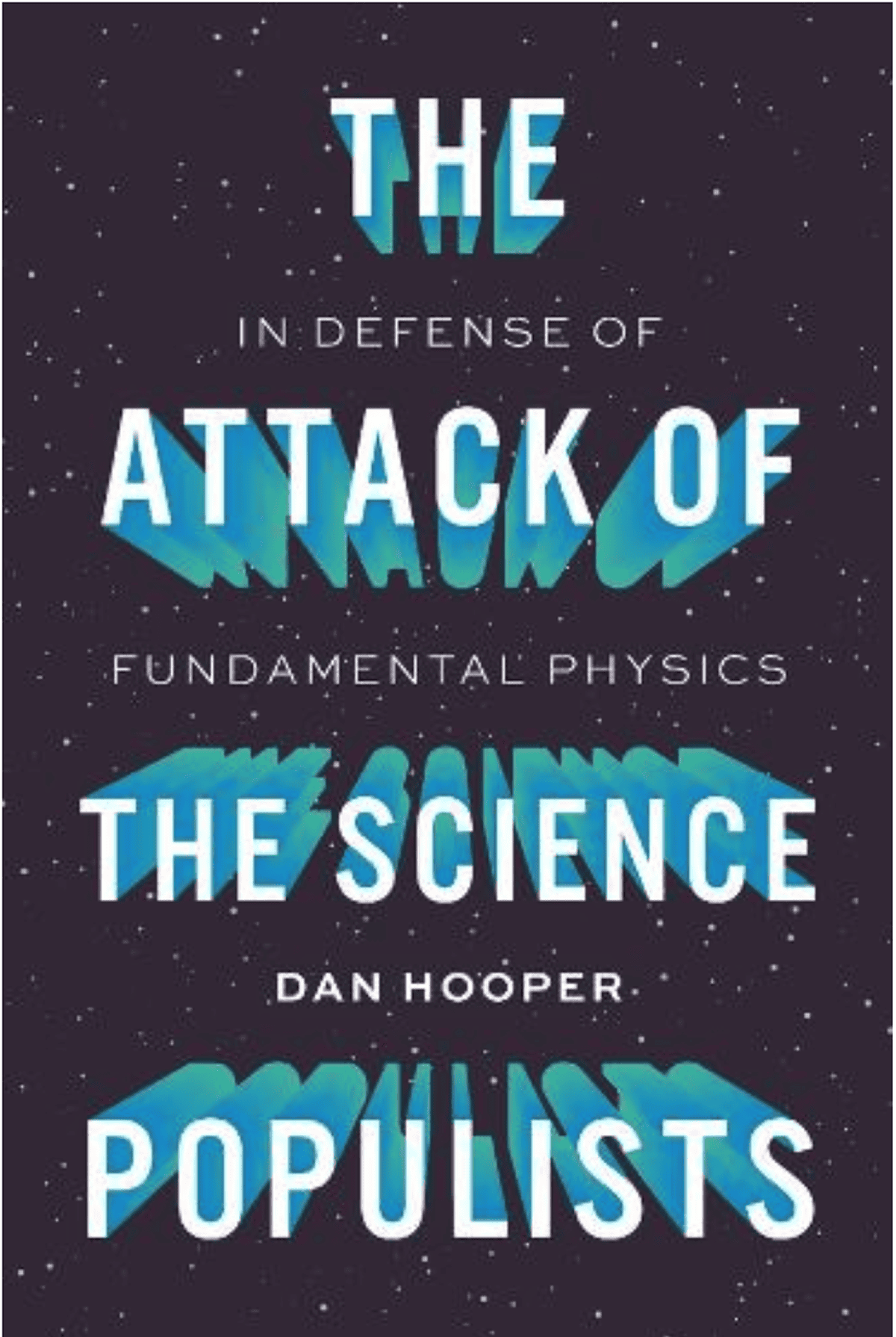
Action, reaction Dan Hooper’s book, due out in early 2027, is a staunch defence of science. (Courtesy: Harvard University Press)
Despite its title, The Attack of the Science Populists is in fact a popular-science book and a very good one at that. It distinguishes itself from other popular-science books by not only explaining contemporary physics but also emphasizing its failures.
Physicists hoped for great things from the Large Hadron Collider (LHC), Hooper writes (he’s aiming his book at readers who don’t know what the LHC is). But while it has made amazing discoveries, such as the Higgs particle, Hooper also describes the fundamental things that it was expected to find but didn’t, such as supersymmetry particles that might have explained why the Higgs has the mass it does.
In another chapter he writes that string theory seemed like a good bet because it is able to handle quantum gravity, but that “this bet has not paid off”. Hooper explains in clear language the aims and disappointments of the LIGO gravitational-wave detector, Modified Newtonian Dynamics (MOND), the Standard Model of particle physics, supersymmetry, the multiverse and other theories. But he also makes clear how their flaws relate to the boldness of their ambitions.
If your friends ask for popular books summarizing the current state of theoretical physics, include Hooper’s on the list.
The critical point
I think “populism” is the wrong word here. To me, the term suggests widespread and genuine if incompletely articulated grievances, whether it’s about the need for cheaper homes, more jobs or better healthcare. But is Hooper really talking about the masses? What does Terryology have in common with Geometric Unity? In the Venn diagram of Howard, Hossenfelder and Weinstein, how big is the audience overlap?
Many of the field’s assailants seem not to be motivated by widely shared grievances but more like individual self-aggrandizing types who say, “Pay attention to my theory!” Even Hooper calls them “fringe” and “outsider mavericks” who make for a good story. It’s not populism or conspiracy when a bunch of glam narcissists stand out only because of their large social media following.
So what would genuine “populist physics” be? It would, I think, be a shared concern and insistence by non-scientists that the billions of dollars spent on physics, on the hundreds of thousands of professional physicists, and on all their labs are used in ways that return something to the people who are paying for it.
Such a return doesn’t necessarily have to result in improving our material ways of life, but might involve providing answers to questions that we all have at one time or another about the origin, nature and future of the universe. Populist physics therefore would arise in opposition to wealthy influencers who dominate social media to promote merely sensationalist and self-interested claims.
In this sense, what Hooper is doing with his new book is seeking to reassure readers that populist physics is what his field has been up to all along.
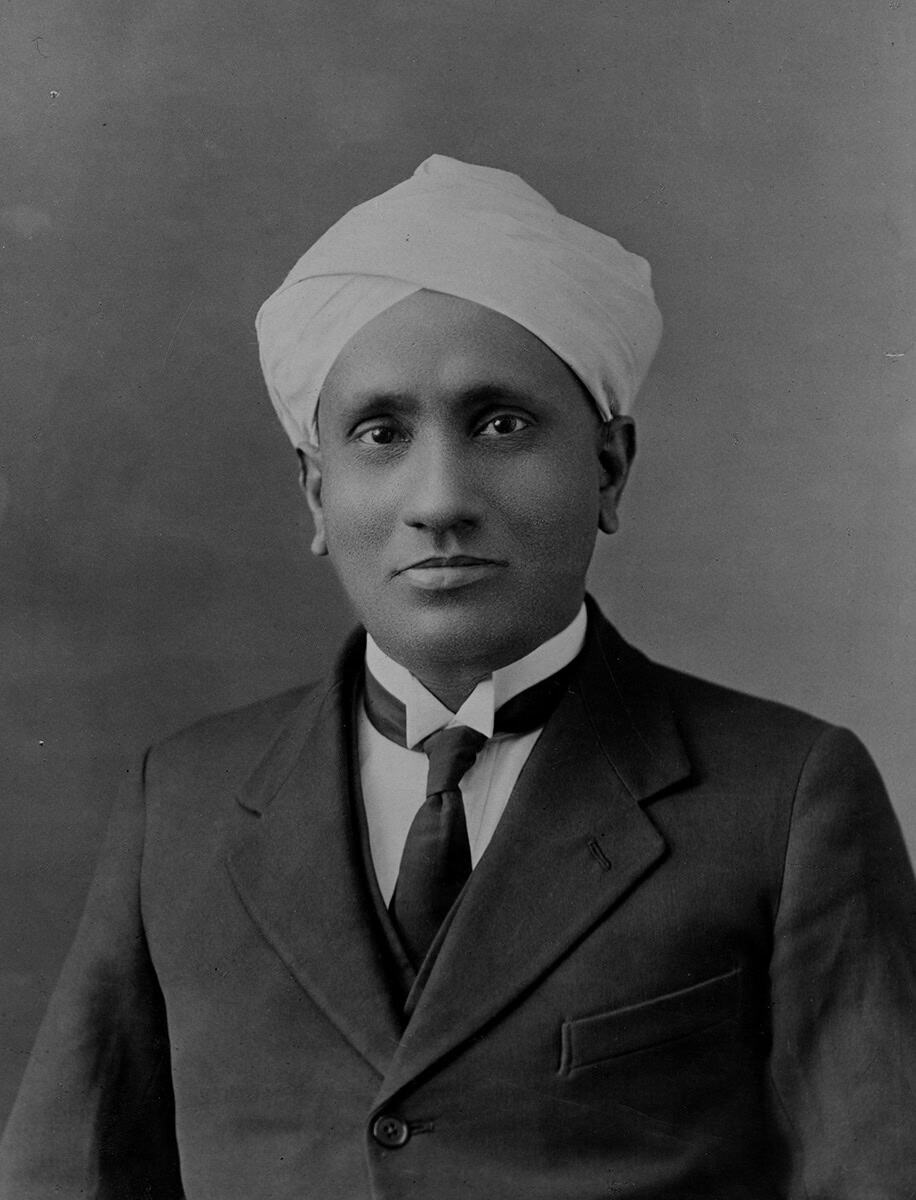
Cocksure and confident C V Raman sailed to Stockholm in 1930 convinced he’d win that year’s Nobel Prize in Physics. (Photograph by A Bortzells Tryckeri, courtesy of AIP Emilio Segrè Visual Archives, W F Meggers Gallery of Nobel Laureates Collection)
How confident, or perhaps delusional, do you have to be to travel to Stockholm because you’re so certain you’ll be awarded a Nobel prize? Most of us wouldn’t have the time, money or self-belief to go to Sweden and hang out at the Royal Swedish Academy of Sciences on the off-chance that we might win. But one person who did just that was the Indian physicist Chandrasekhara Venkata (C V) Raman in 1930.
Back in those days, travelling from India to Sweden wasn’t a case of jumping on a jet plane, but involved a long, two-month journey by sea. So if he wanted to arrive in Stockholm in time for the award ceremony on 10 December 1930, Raman knew he couldn’t wait until the prize was formally announced in mid-November to set sail. In July 1930 he therefore booked passage for himself and his wife, the couple arriving in Stockholm on 9 December of that year.
Raman’s audacity, belief and the arduous journey paid off. He was duly awarded the 1930 Nobel Prize in Physics “for his work on the scattering of light and for the discovery of the effect named after him”, namely Raman scattering. In doing so, Raman became the first person from India to win a scientific Nobel prize – the poet, playwright and musician Rabindranath Tagore having previously won the 1913 Nobel Prize in Literature.
Obsessive nature
Born on 7 November 1888 in the city of Thiruchchirappalli in Tamil Nadu, Raman was a child prodigy, who at 16 came top in physics at the University of Madras and published his first research paper aged just 18. Appointed a professor of physics at the University of Calcutta in 1913, Raman had a long obsession with winning a Nobel prize. In 1924, upon being elected a fellow of the Royal Society, he was asked during the award ceremony what was next in line for him. “The Nobel prize of course!” he replied.
The discovery that bagged Raman the coveted prize in fact began on another sea voyage
The discovery that bagged him the coveted prize in fact began on another sea voyage. In 1921 Raman was travelling back from Southampton to Bombay (now Mumbai) on the SS Narkunda, having taken part in the Second Congress of the Universities of the Empire in Oxford. Rather than lounging on the sun deck or drinking in the bar, Raman spent the 15-day journey examining and analysing the deep blue colours of the Mediterranean, Red and Arabian seas with his pocket Nicol prisms, a small telescope and a diffraction grating.
In fact, Raman did more than just take data. While on board, he wrote up his findings in a short letter that he mailed to the journal Nature while the ship was docked at Aden in Yemen. Published on 20 October 1921, it gives Raman’s address as “SS Narkunda, near Aden” (Nature108 242). He then wrote another paper to Nature (108 367) titled “The colour of the sea”, this time with the byline “SS Narkunda, Bombay Harbour”.
The spectrum of blue colours of the vast sea fascinated Raman and made him question the previous belief, primarily from the work by Lord Rayleigh, that the colour is simply due to the reflection of the sky – and has nothing to do with the colour of the water itself. Raman challenged this notion in his follow-up Nature paper, which was published on 17 November 1921.
Natural fascination C V Raman was awarded the 1930 Nobel Prize in Physics for discovering that light can change colour when passing through a material because some photons scatter inelastically off it. Now known as “Raman scattering”, he came up with the idea while sailing from the UK to India in 1921 and taking measurements of the deep blue colour of the sea. (Courtesy: iStock/Ciuvelic Razvan)
“It was abundantly clear from the observations,” he writes, “that the blue colour of the deep sea is a distinct phenomenon in itself.” Raman believed that light diffracts as it passes through the water and concluded: “An interesting possibility that should be considered is that the diffracting particles may, at least in part, be the molecules of the water themselves.”
This curiosity led him to a series of experiments over the next few years, primarily carried out by his students at Calcutta University, culminating in the discovery that light changes its wavelength and energy when it passes through any material. The change in wavelength and energy, in fact, is a fingerprint of the material itself.
His discovery of what became known as the Raman effect is what eventually won him his most cherished recognition – the 1930 Nobel Prize in Physics. One of the many applications of Raman’s discovery is Raman spectroscopy, which uses the scattering of laser light to establish the chemical make-up of a material and forms the basis of airport security scanners.
Indian impact
Raman’s Nobel prize was significant not just for the scientific advancements that his discovery enabled, but also for the far-reaching impact it engendered in India, where opposition to the British Raj was gathering speed. In fact, he won the award less than a year after the declaration of Purna Swaraj – complete independence – on 26 January 1930 in a session of the Indian National Congress in Lahore.
For a country reeling under colonial rule and fighting for its identity, Raman’s Nobel prize could not have come at a better time to instil hope and aspirations to millions of people around the country. In fact, he holds the honour of being the first physicist outside western Europe or the US to win the Nobel Prize in Physics.
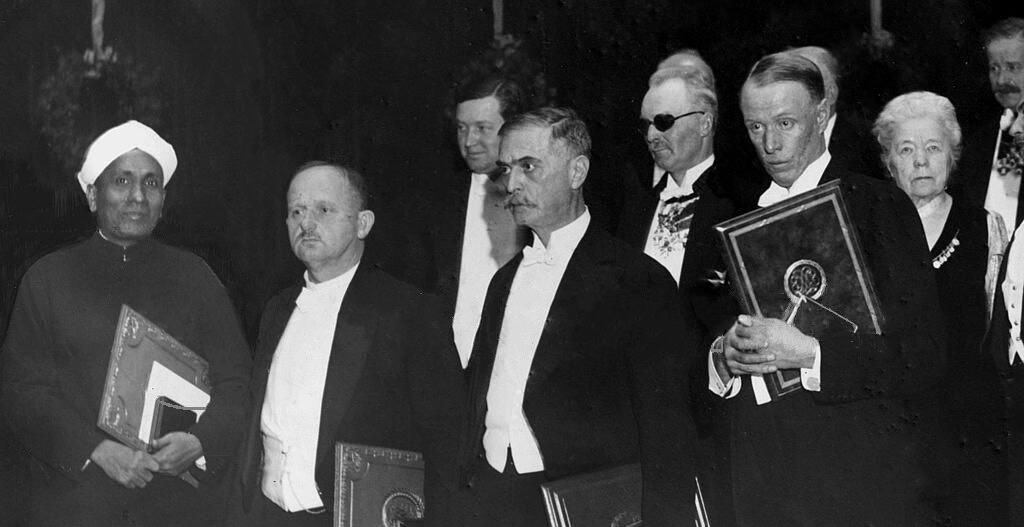
Dream trip C V Raman (far left) picking up the 1930 Nobel Prize in Physics in Stockholm alongside (from left to right) fellow winners Hans Fischer (chemistry), Karl Landsteiner (medicine) and Sinclair Lewis (literature). (No known copyright restrictions, photographer unknown. Source: Wikimedia Commons)
Raman was fully aware of the impact that the prize would have in India, where research was far less developed than that enjoyed by his counterparts in, say, Cambridge, Göttingen or Copenhagen. In 1929 he therefore hesitantly wrote a letter to the Danish Nobel-prize-winner Niels Bohr, asking for his “influential support” for the 1930 Nobel prize. The request of such “personal character”, he explained, was only because he believed that Bohr would “sympathize with the scientific aspirations of India”.
Unbeknownst to Raman, Bohr had already nominated him for a Nobel prize in 1929 – that year’s prize going to Louis de Broglie for wave–particle duality – and he did so again in 1930. We now know a total of 10 different people nominated Raman for that year’s prize, including de Broglie as well as Ernest Rutherford and Charles Wilson.
Raman’s research and notoriety led to many students being attracted to Calcutta, with the physics department becoming a centre of world-class research
Raman’s research and notoriety led to many students being attracted to Calcutta (now Kolkata), with the physics department becoming a centre of world-class research despite its small size and the lack of an established scientific culture and infrastructure in India. Other leading physicists to have worked there include the astrophysicist Meghnad Saha and the theorist Satyendra Nath Bose in what some have touted as a “golden era” for Indian science.
Sadly, it ended prematurely a few years after Raman’s Nobel prize due to conflicts between these three leading scientists. This was partly due to parochialism and partly, as his biographer, the condensed-matter physicist Ganeshan Venkataraman famously put it, Raman’s “Himalayan ego and sharp tongue”.
Moving on
In 1933 Raman left Calcutta, becoming the first Indian director of the Indian Institute of Science (IISc, earlier the Tata Institute of Science) in Bangalore (now Bengaluru). Rutherford, when asked by the institute’s council as to who should replace the outgoing director Martin Forster, had made it clear there was no need to seek directors in Britain when India had a “distinguished candidate in the shape of Raman”.
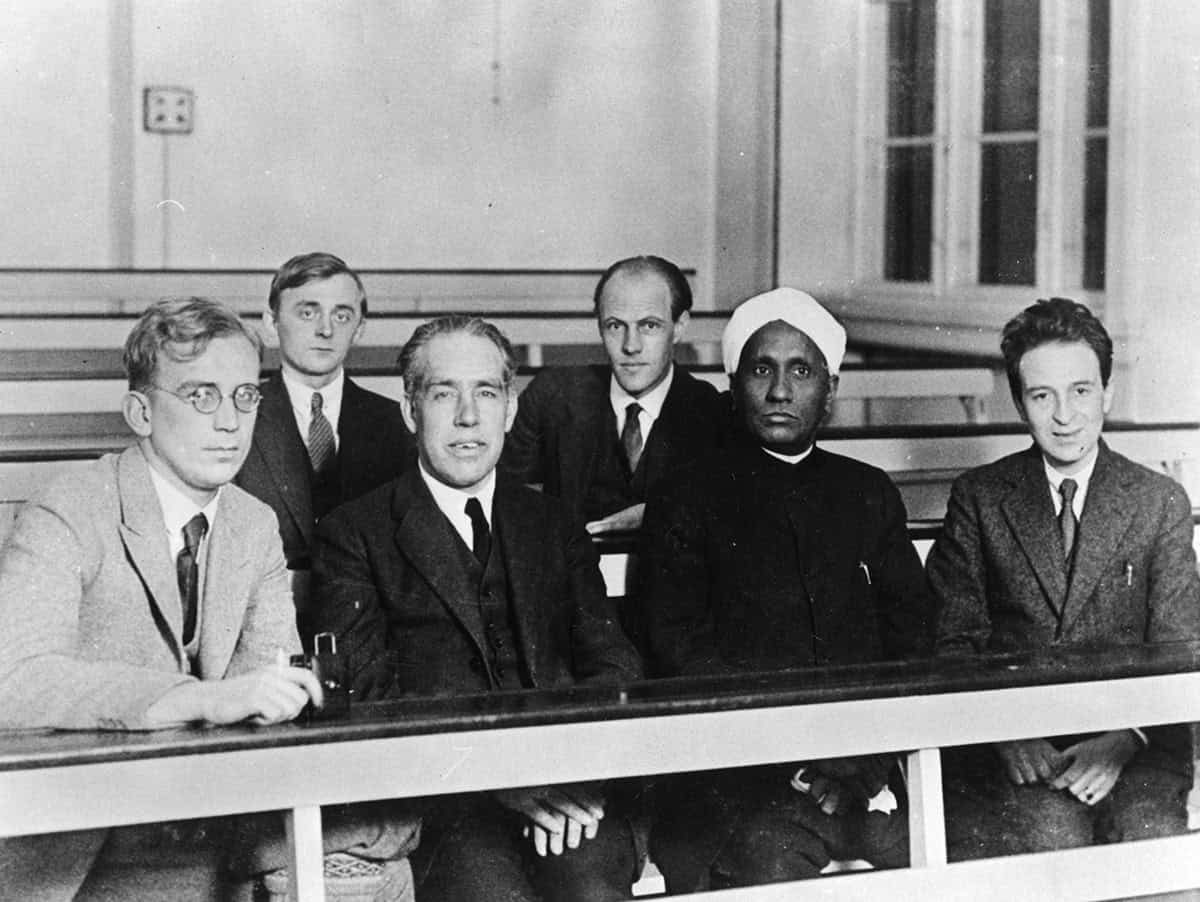
Mixing of minds C V Raman (second right) personally wrote to Niels Bohr (second left) for his support for the 1930 Nobel prize. The pair are shown here at the Niels Bohr Institute, Copenhagen, alongside George Gamow (far left) and Oskar Klein (far right) and Charles (back row, left) and Ebbe Rasmussen (back row, right). (Courtesy: AIP Emilio Segrè Visual Archives, Margrethe Bohr Collection)
In 1934 he went on to found the Indian Academy of Science, which was significant in that it provided a way for researchers across the country to communicate and discuss research findings. Just as important, however, was the fact that membership of the academy was reserved exclusively for Indian scientists, effectively signalling an act of rebellion against the British.
Raman’s time at the IISc was controversial. On one occasion, he turned down the application for a research fellowship by a female student – the biochemist Kamala Sohonie – because he believed women were not competent to conduct research. Raman reversed his decision, albeit with humiliating conditions, after Sohonie staged a Gandhian-style protest (Satyagraha) outside his office.
Within three years, Raman was forced to resign from the directorship following a fallout with the council, primarily for allegations of bias towards physics research and overshadowing other areas of research of the institute. He remained a professor at the IISc until retiring in 1948. Later that year, he founded the Raman Research Institute with which he was actively involved until his death in 1970 at the age of 82.
Raman’s legacy
Despite his controversial past, Raman is still the flag-bearer of Indian physics, owing to the Nobel prize and the global recognition he enjoyed. India holds a National Science Day every year on 28 February to mark the occasion in 1928 when Raman and his associate Kariamanickam Srinivasa Krishnan announced their discovery of Raman scattering to the media. The work was reported in newspapers on 29 February and was formally published on 31 March 1928 in a paper entitled “A new type of secondary radiation” (Nature121 502 ).
Almost a century on from his success, however, India has not yet produced another home-grown Nobel-prize-winning physicist. Raman’s nephew Subrahmanyan Chandrasekhar did share the 1983 Nobel Prize in Physics with William Fowler for his work on the evolution of stars, but he was based in the UK and then the US when the work for which he was recognized was carried out.
Raman’s divisive personality and sharp opinions turned more people against him than his ingenuity and scientific legacy ever won over
Sadly, Raman’s divisive personality and sharp opinions turned more people against him than his ingenuity and scientific legacy ever won over. His obsession with global recognition can be sensed from his reaction upon first receiving news of his Nobel prize, which came while he was en route to Stockholm. Learning of the award from his Calcutta collaborator Suri Bhagavantam, Raman’s first reaction was to ask if he was the sole awardee or whether he was to “share the bed with other strangers”.
Given his “Himalayan ego”, it should perhaps come as no surprise that Raman decided to travel to Stockholm on a whim. We do not have any documentation about what he thought or did on that two-month voyage. But for him, at least, it was a journey that was not wasted.
Find out more from Preetish Kakoty about C V Raman’s life on the Physics World Weekly podcast.
SmarAct proudly supports Physics World‘s Nobel Prize coverage, advancing breakthroughs in science and technology through high-precision positioning, metrology and automation. Discover how SmarAct shapes the future of innovation at smaract.com.
Next Tuesday the winner(s) of the Nobel Prize in Physics will be announced. To celebrate that most famous of prizes this episode of the Physics World Weekly podcast looks at a few fun aspects of past awards.
I’m joined by my Physics World colleague Matin Durrani to make a few predictions for next week. We also talk about our latest Nobel infographic – which looks at the time it took for countries to claim their first Nobel laureate.
Then I am joined by the Indian engineer Preetish Kakoty to talk about CV Raman, who was India’s first physics laureate. We chat about two ocean voyages that Raman took – journeys that reveal much about his devotion to science and his strong self-belief.
This podcast is supported by American Elements, the world’s leading manufacturer of engineered and advanced materials. The company’s ability to scale laboratory breakthroughs to industrial production has contributed to many of the most significant technological advancements since 1990 – including LED lighting, smartphones, and electric vehicles.
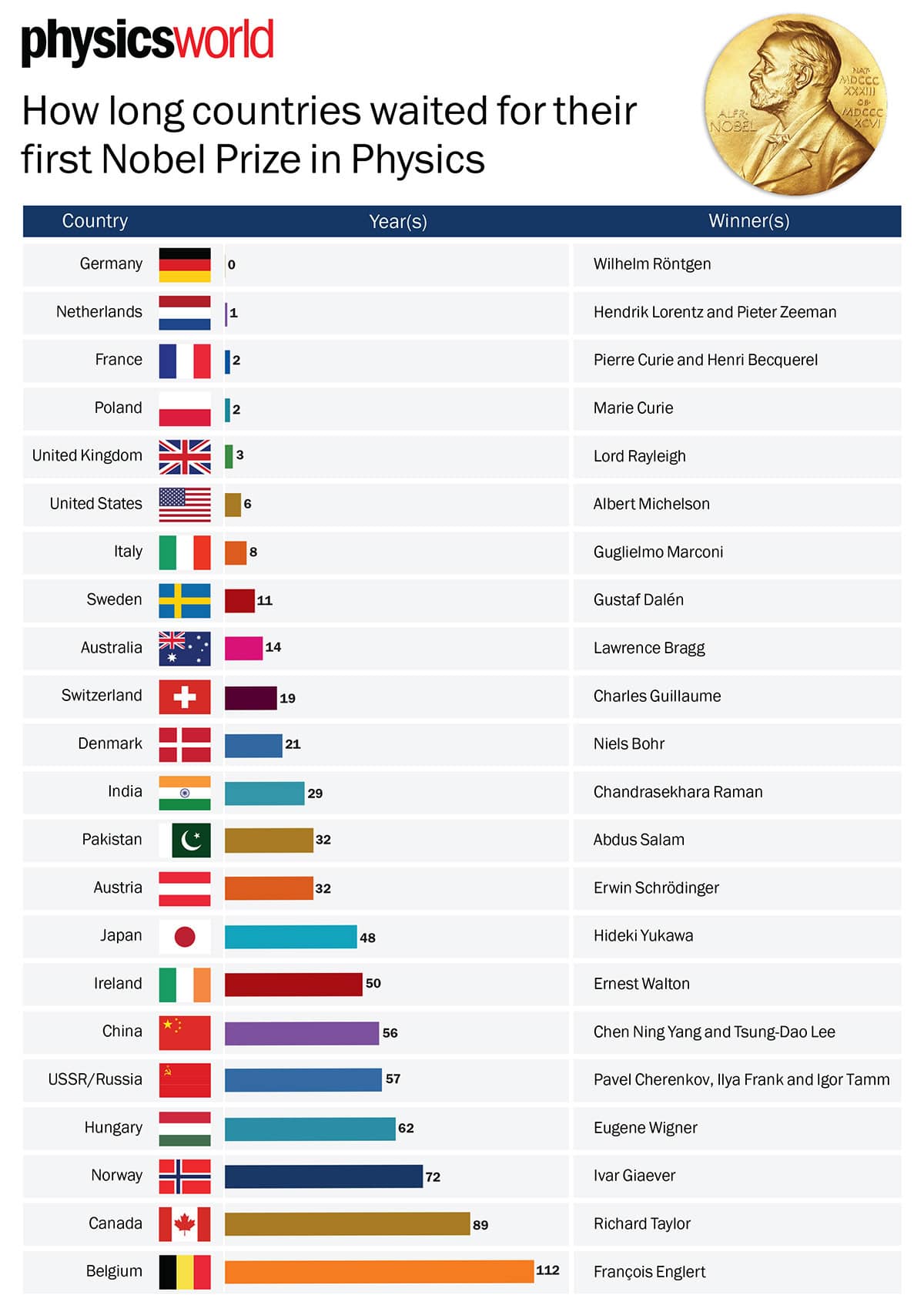
Waiting game Germany was the first nation to win a Nobel Prize in Physics, with Belgium the most recent. Click the image to expand. (Courtesy: Alison Tovey/IOPP)
How long did it take for your country to claim a physics Nobel laureate? Or perhaps you live in one of the 170 or so countries that has yet to produce a Nobel prize winner?
The aim of our latest infographic (see figure) is to answer that question by exploring the geographical evolution of laureates. Creating it, however, quickly became an exercise in the history of the past two centuries.
Map-changing wars in Europe, the demise of colonialism, and immigration made it surprising difficult to ascribe some laureates to specific countries and led to at least one debate amongst Physics World colleagues. I will get into some of these idiosyncrasies after I take a general look at the infographic.
What is obvious is the early Nobel physics laureates come from what many call the west. Germany is considered by many to be the birthplace of modern physics, so it is not surprising that the country had the shortest wait – with Wilhelm Röntgen bagging the first prize (in 1901) for his discovery of X-rays.
Until 1930, when the Indian physicist CV Raman won the prize for his eponymous scattering effect, the prize was only awarded to people from western countries. Indeed, of the 22 countries that can claim laureates (by our measures), only five are not in the west. These are India, Pakistan, Japan, Soviet Union/Russia and China. So far, there have been no laureates from Africa, Latin America or much of Asia and Oceania.
While much of this is down to better access to education and research resources in the west, increasing global mobility means that students and researchers from all over the world are working in the west – and wealthy countries like China, South Korea and Japan. So why aren’t they bagging Nobel firsts for their home countries?
Indeed, only three laureates in the infographic who took that route are China’s Chen Ning Yang and Tsung-Dao Lee – who did their prize-winning work in the US – and Abdus Salam, who did much of his prize-winning work in the UK and Italy. Hopefully, this year’s crop of winners will include someone who is not from one of those 22 countries. While it’s likely that they will be working in the west, wouldn’t it be great if they won for work done in their home country.
Established nations
So how did we decide where a laureate is from? To work this out we considered where that person was born, where that place is today and – in some cases – what we know about a laureate’s view on their own nationality.
A case in point is Ernest Walton, who we consider to be the first Irish laureate. He was born in 1903 in Dungarvan, which is on the south-east coast of the Republic of Ireland. At the time of his birth, however, his birthplace was in the United Kingdom of Great Britain and Ireland – as all of Ireland was then a constituent nation of the UK. So Walton was born a British subject.
However, we consider him Irish for several reasons. First, although Ireland was not a sovereign country in 1903, it was a well-established national entity that was on the road to independence before Walton reached adulthood. Second, although Walton did his award-winning research in England, he spent most of his life in Ireland. Third, there is no evidence that he was a unionist – someone who opposes Irish independence and considers themselves British.
The above might upset readers in Scotland and Wales because both of those nations have spawned physics laureates who don’t appear in our infographic. But unlike in international football, rugby and cricket, Scotland and Wales will have to wait for independence from the UK before they get their own laureate teams in our infographic.
Similarly, Marie Curie was born in Poland when it was a part of the Russian Empire. But Poland was identifiable as a country in 1867 and it gained independence during Curie’s lifetime. Indeed, Curie was clearly a proud Pole, because she named the element polonium after her homeland in the hope that Poland would become unified and independent.
We have included Lawrence Bragg as the first Australian to win a Nobel prize. He was born in Adelaide in 1890, when the Australian colonies began the journey to independence from the UK. While Bragg is often considered British, we have decided he is Australian because he left the country for the UK in 1908 – seven years after Federation created the Commonwealth of Australia, which was independent from the UK for domestic issues.
Dealing with decolonization
I mentioned that there are no laureates from Africa in our infographic, but three physics Nobel prize winners were born on the continent. These are Claude Cohen-Tannoudji (born in Algeria), Serge Haroche (born in Morocco) and Pierre Agostini (born in Tunisia). However, all were born when these countries were French colonies and they all left for France when they gained independence.
Some readers might be scratching their heads over how we have dealt with the time Pakistan had to wait for its first Nobel prize. Salam bagged that prize in 1979 – so a 78-year wait from 1901, when the first prize was awarded. So why have we calculated the wait as just 32 years?
The reason is that unlike Ireland, Poland or Australia, the concept of Pakistan didn’t exist when Salam was born in Lahore in the British Raj in 1926. The word Pakistan is thought to have originated in 1933 and the call for a Muslim homeland crystalized in 1940 with the Lahore Resolution. So, we have decided to start the clock for Salam in 1947.
Other laureates who merited scrutiny include Albert Michelson, who was born in Poland but arrived in the US age two. As a result, we consider him to be the first American laureate. Indeed, Michelson wouldn’t appear in the infographic if we considered him a Pole because he was pipped at the post by Marie Curie.
Similarly, Gabriel Lippmann was born Luxembourg to French parents and moved to France age three, so we consider him French and not the first laureate from Luxembourg. However, we are a big fan of Lippmann here at Physics World because of the nature of his award – which was for a still-obscure colour-photography technique.
Indeed, my colleague Margaret Harris bagged an award of her own from Association of British Science Writers for her feature article that explores Lippmann’s prize, and that of Gustaf Dalén – the first Swede to win a physics Nobel prize. That article is called “The physics Nobel prizes you’ve never heard of”.
SmarAct proudly supports Physics World‘s Nobel Prize coverage, advancing breakthroughs in science and technology through high-precision positioning, metrology and automation. Discover how SmarAct shapes the future of innovation at smaract.com.
Here at Physics World we have had some luck with predicting who is going to win a Nobel Prize in Physics. One successful strategy is to identify top physicists and just keep predicting that they will win – and eventually they do!
For example, we picked Anton Zeilinger for the 2009, 2013, 2014, 2015 and 2019 prizes – and he won in 2022. Clearly, it was a mistake to give up on him in 2020.
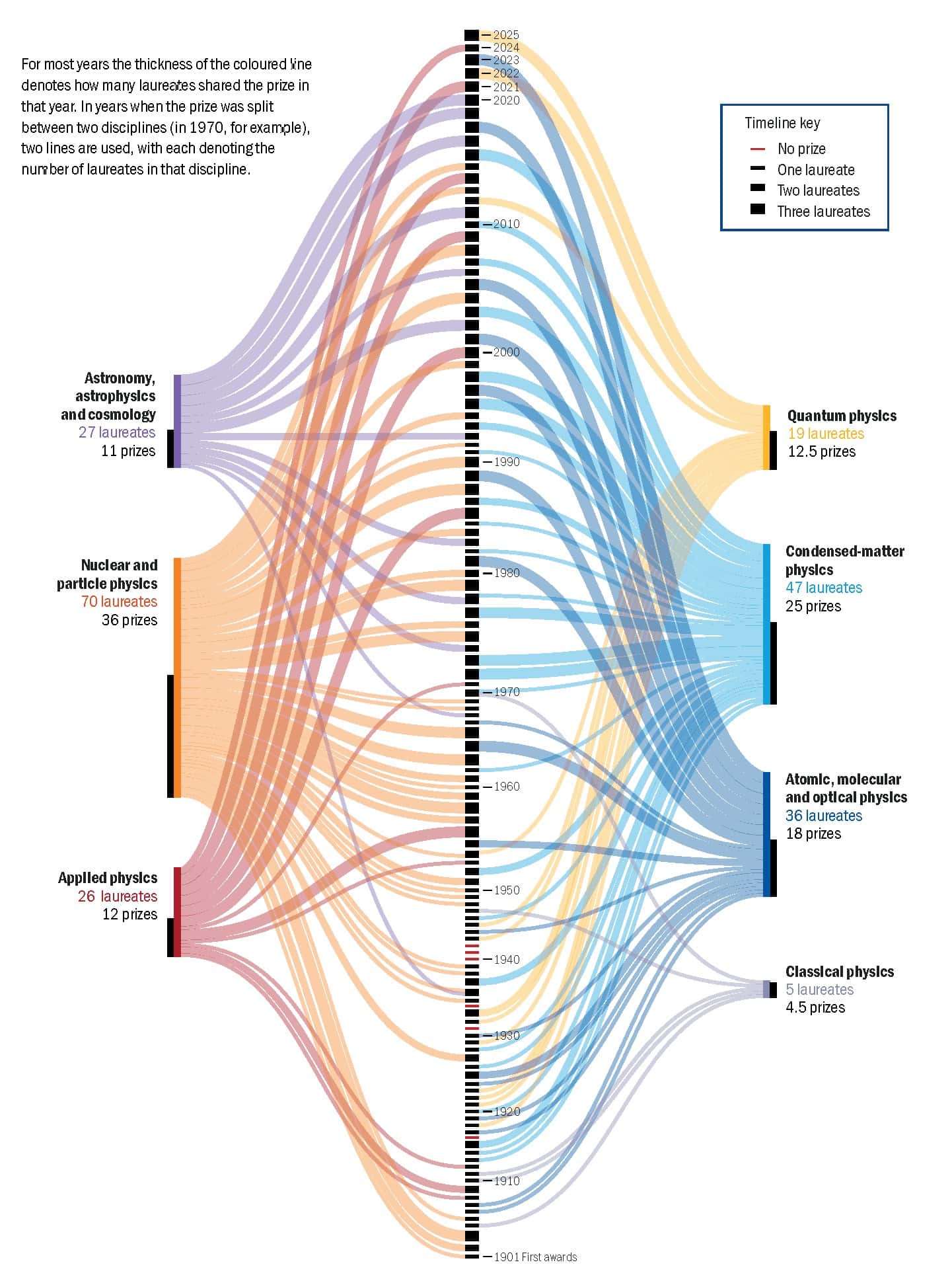
In making our predictions we sometimes rely on an infographic that we have been updating for a decade or so. It shows the chronological progression of Nobel prizes in terms of fields of endeavour – such as condensed matter, particle and nuclear, quantum and more (see figure).
By staring at the infographic for far too long, we have convinced ourselves that there is a regular pattern of gaps between prizes in specific fields. Looking at the latest version of the infographic it appears that both condensed-matter physics, and particle and nuclear physics are due a prize.
I have really struggled to think of a particle and nuclear breakthrough that could bag the 2026 Nobel – but I believe I have come up with one or two contenders. One is a prize for physicists working on CERN’s ATHENA and ALPHA collaborations, who were the first to trap cold antihydrogen atoms and then study them in detail. One laureate would surely be the Denmark-based American physicist Jeffrey Hangst, who is a founder of both collaborations. Making extremely precise comparisons of the properties of antihydrogen and hydrogen could reveal why there appears to be much more matter than antimatter in the universe – an important mystery in physics.
But alas, these and other antimatter experiments have yet to find any significant deviations from the Standard Model description of antihydrogen, so that might preclude a Nobel prize for Hansgt and one or two of his colleagues. And another caveat is one could easily argue that many of the innovations at ATHENA and ALPHA are in the field of atomic and molecular physics, not particle and nuclear physics – so there would be much debate here at Physics World if we had to update our infographic with an antihydrogen prize.
Another potential prize in particle and nuclear physics is for the the creation of the quark–gluon plasma (QGP). This is a state of matter that occurs very briefly when large nuclei (such as lead or gold) are collided at high energies. The result is a soup of quarks and gluons that is thought to resemble the early universe shortly after the Big Bang. Studying the QGP is a fascinating and important area of physics, but because the experimental work has been done by large collaborations at both CERN in Switzerland and at Brookhaven National Laboratory in the US it would be difficult to select just three people as Nobel winners. The fact that scientific breakthroughs in particle and nuclear physics are often made by large collaborations has led some to call for the three-person limit on prize winners to be lifted.
The field of condensed matter is much more fruitful when it comes to potential Nobel prizes. The analytics company Clarivate has released its “Citation laureates 2026 in physics”, which predicts Nobel winners based on the citation impact of their published research. Clarivate (and its predecessor Thomson Reuters) has a reasonably good record of picking winners and this year all three of its predictions are in condensed matter physics.
Organic LEDs
One prediction is a prize to Chihaya Adachi, Stephen Forrest and Mark Thompson for work leading to the development of ultrahigh-efficiency organic light-emitting diodes. The second is to Nicola Spaldin for her theoretical work on room-temperature magnetoelectric multiferroics, which Clarivate says are enabling new energy-efficient device paradigms. The third prediction is to Qikun Xue “for experimental observation of the quantum anomalous Hall Effect”. What all three of these awards have in common is a relatively immediate connection of the development of new technologies.
Spaldin was profiled in Physics World back in 2023 and she talks about the joy that she gets from her research, which combines blue-sky research with the design of real materials.
Other prestigious awards are also a good place to look for potential Nobel winners. The 2026 Kavli Prize in Nanoscience went to the physicists Eva Andrei, Pablo Jarillo-Herrero and Allan MacDonald for their pioneering work on twistronics. This is a burgeoning field that involves rotating the relative angle between two sheets of 2D material such as graphene. Rotations create moiré superlattices with a wide range of electronic properties including superconductivity.
I am also keen on an award for the applied physicist Federico Capasso. As well as developing a wide range of semiconductor technologies – including the quantum cascade laser – Capasso has done seminal work on optical metamaterials. An award for such metamaterials could be shared with John Pendry (a 2024 Kavli nanoscience laureate), who has developed a mathematical framework for designing optical metamaterials. These days prizes are usually awarded to trios, so potential partners for Capasso and Pendry are David Smith – a pioneer in creating metamaterials that operate at microwave frequencies – and Andrea Alù who is a prolific researcher in photonic metamaterials. Other possible winners in this field are Ulf Leohardt, Nader Engheta, George Eleftheriades and Vladimir Shalaev.
Wavelet theory
Finally, a potential prize that I find intriguing is inspired by “Clarivate’s Citation laureates 2025 in physics”. This proposes Ingrid Daubechies, Stéphane Mallat and Yves Meyer “for advancing wavelet theory, a revolution in mathematics and physics with practical applications including image processing”. Such an award would be difficult to shoehorn into a category in our infographic. I think applied physics would be the best fit.
The 2026 Nobel Prize in Physics will be announced on Tuesday 6 October at 10:45 a.m. BST at the earliest.
SmarAct proudly supports Physics World‘s Nobel Prize coverage, advancing breakthroughs in science and technology through high-precision positioning, metrology and automation. Discover how SmarAct shapes the future of innovation at smaract.com.
Frost is one of the most punishing adversaries of tea cultivation. A single cold snap can scorch tender leaves, derail an entire season’s harvest, and degrade the delicate chemistry that gives tea its value. For growers and breeders, however, judging how badly a field has been damaged has long been a stubbornly subjective exercise: visual ratings lump continuous injury into crude categories, and laboratory assays destroy the very tissue they measure. A new study published in Plant Methods by Zhengtong He of Shihezi University, Zhiwei Chen of the Tea Research Institute of Shandong Academy of Agricultural Sciences, and colleagues offers a way out, pairing hyperspectral imaging with a purpose-built deep learning model to read frost damage directly from the way leaves reflect light.
The core problem the team confronted is that frost injury is not a binary event but a continuum. Leaves exposed to sub-zero temperatures suffer a cascade of overlapping stresses: photosynthetic pigments degrade, the machinery of photosynthesis falters, and cell membranes and walls break down. Any single measurement captures only a sliver of that cascade. To capture the whole picture, the researchers collected hyperspectral data together with eight key physicochemical indicators from tea plants growing across natural frost damage gradients in the field, rather than in the artificial conditions of a growth chamber. From these multidimensional physiological responses they constructed a composite measure, the tea cold stress response index, or TCSRI, which expresses frost damage severity as a continuous value instead of a coarse visual class.
Building TCSRI is a meaningful advance in itself. Traditional frost assessment often relies on ordinal scales, where an observer assigns a score of mild, moderate, or severe. Such scales throw away information and make it difficult to track recovery or compare cultivars with fine precision. By integrating several physiological dimensions into one index, the team created a target variable that reflects the plant’s actual internal state. The challenge then became predicting that index, and the individual chemical indicators behind it, from spectral data alone, without touching or destroying a single leaf.
Hyperspectral sensing is well suited to this task in principle. Across hundreds of narrow wavelength bands, plant leaves encode a wealth of information: chlorophyll absorption in the visible range, water and structural features in the near infrared. But the data are high-dimensional, with far more spectral channels than samples, a regime that invites overfitting, especially in field studies where collecting ground-truth measurements is laborious. Conventional chemometric approaches, from partial least squares regression to standard machine learning pipelines, often struggle to separate genuine physiological signals from noise, sensor drift, and the confounding effects of leaf surface properties and illumination variation.
The researchers’ answer is a model they call STAMPformer, short for spectral-prior-guided multi-view attention pooling. Its architecture reflects a deliberate design philosophy: rather than letting a neural network rediscover everything from scratch, the model is steered by what spectroscopists already know about how plants respond to stress. At its front end, a parameter-free attention convolution extraction module jointly models both the raw reflectance spectra and their first-order derivatives. Derivative spectra are a classic spectral prior: they accentuate subtle local features such as absorption peaks and shoulders that are easily drowned out in raw reflectance, while suppressing broad baseline drift and noise. By processing both views together, the module sharpens the local spectral signatures that carry physiological meaning.
On top of this extraction stage sits the second innovation, a multi-view attention pooling module. Deep networks processing spectral sequences produce long streams of features, but not all wavelengths matter equally for a given prediction. The pooling module adaptively aggregates sequence features drawn from different feature subspaces, learning to amplify the responses that are most diagnostic of cold stress and to down-weight the rest. This attention mechanism acts like a learned spotlight, and because it operates across multiple subspaces, it can capture complementary patterns that a single attention head might miss. The result is a compact representation tailored to the prediction task at hand, whether that is estimating a specific chemical indicator or the composite TCSRI.
The performance numbers are striking. Across all nine prediction tasks, spanning the eight physicochemical indicators and the TCSRI itself, STAMPformer achieved coefficients of determination above 0.87 and ratios of performance to deviation above 2.80, thresholds generally regarded as indicating reliable quantitative prediction. In other words, from a leaf’s reflectance fingerprint alone, the model could reconstruct the plant’s internal frost-stress state with an accuracy that approaches laboratory measurement, while remaining entirely non-destructive. The team did not stop at headline metrics. Ablation experiments systematically removed each proposed module to confirm that both the attention convolution extraction and the multi-view pooling contributed measurably to the gains, and paired statistical tests across multiple random seeds ensured the improvements were not artifacts of a lucky initialization.
Interpretability was a further priority, and here the study delivers something rarer than raw accuracy. Applying SHAP analysis, a technique that attributes each prediction to the contributions of individual input features, the researchers identified the wavelengths the model relied on most heavily. These key spectral regions correspond to physiologically meaningful processes: pigment degradation, photosynthetic impairment, and the disruption of cellular structure. That alignment between machine attention and plant biology matters on two fronts. It gives spectroscopists confidence that the model has learned genuine stress signatures rather than spurious correlations, and it hands plant physiologists a data-driven map of which parts of the spectrum track which facets of cold injury, potentially guiding future sensor design and breeding assays.
Crucially, the model also proved itself on data it had never seen. Independent external validation, using samples not involved in training, demonstrated that STAMPformer’s predictive ability generalizes beyond its original dataset, addressing one of the most common failure modes of machine learning in agricultural sensing. For a field where models are often tuned and tested on the same plots, this external check is an important credibility marker, suggesting the framework could be deployed across different farms, seasons, and frost events rather than remaining a laboratory curiosity.
The practical implications reach well beyond tea. An accurate, non-destructive, continuous measure of cold damage opens the door to rapid post-frost field surveys, letting growers quantify losses within hours instead of waiting for symptoms to develop or sending samples to a lab. For breeders screening for cold-tolerant germplasm, a spectral readout of TCSRI could accelerate the evaluation of hundreds of candidate lines without destructive sampling. And in the emerging vision of the smart tea garden, where drones and handheld spectrometers roam the rows, a model like STAMPformer could feed real-time frost maps into irrigation, shading, and recovery-management decisions. The authors frame their work as supporting frost monitoring, cold-tolerant germplasm evaluation, and intelligent garden management, and the architecture’s reliance on general spectral priors rather than tea-specific tricks suggests the approach could be adapted to other crops facing abiotic stress. As climate variability makes late-season frosts increasingly erratic, tools that turn light reflected from a leaf into a precise physiological diagnosis may become as essential to the tea garden as the thermometer.
Subject of Research: Hyperspectral deep learning prediction of continuous frost damage severity in tea plants
Article Title: STAMPformer: spectral-prior-guided multi-view attention learning for hyperspectral prediction of continuous frost damage severity in field-grown tea plants
Article References: He, Z., Chen, Z., Ding, Z., Wang, Z., Zhang, F., Zhao, Y., & Dong, C. (2026). STAMPformer: spectral-prior-guided multi-view attention learning for hyperspectral prediction of continuous frost damage severity in field-grown tea plants. Plant Methods. https://doi.org/10.1186/s13007-026-01597-4
La Côte d’Ivoire a lancé, le 1er septembre, sa campagne 2026-2027 de commercialisation du cacao, avec de nouvelles obligations de traçabilité. Premier produit d’exportation du pays, le cacao occupe une place centrale dans l’économie ivoirienne. Au-delà de la production de fèves, le gouvernement...
New research published in the Journal of Experimental Botany reveals that wheat crops are more sensitive to grain yield losses from heat waves that occur before reaching their flowering stage than those occurring later. However, exposure to heat waves early in the growing season may reduce yield losses during additional heat waves through a protective "priming" effect.
Growing leys—grass and clover—is nothing new in Swedish agriculture. But in the arable farming regions dominated by cereal production, leys are less common. One reason is that there needs to be a market for what is harvested.
Lionsgate has released an action-packed trailer for The Hunger Games: Sunrise on the Reaping—a sequel to 2023’s Ballad of Songbirds and Snakes and a prequel leading into the events of the first film, The Hunger Games (2012). In addition, Laika Studios released a trailer for its highly anticipated stop-motion animated feature, Wildwood.
(Some spoilers for The Hunger Games below.)
The main protagonist is a young Haymitch Abernathy, future District 12 mentor to Katniss (Jennifer Lawrence) and Peeta (Josh Hutcherson). Woody Harrelson’s older Haymitch is a fan favorite who later becomes a jaded, drunken (yet secretly hopeful) cynic. Per the official synopsis:
Les banques de semences sont censées préserver une partie de notre patrimoine agricole pendant des décennies, voire bien davantage. Mais combien de temps ces graines peuvent-elles réellement rester capables de germer ? Une vaste analyse menée en Australie apporte une réponse moins rassurante...
The first console I ever bought, it was hyped as a threat to the PlayStation, then mocked as a flop. But now, as it marks its 25th anniversary, it’s looked back on with misty-eyed reverence
This week marks the 25th anniversary of the Nintendo GameCube, the first console I ever bought with my own money. I vividly remember getting on the bus after school with a year’s worth of savings safely zipped into the pocket of my bag and going to a branch of Currys, where I dumped a bunch of notes, coins and vouchers on the counter to collect my pre-order. (It turned out that some of the vouchers from the previous Christmas had expired, but the guy at the checkout clearly felt so sorry for me that he redeemed them anyway. If you’re out there, Currys guy: thank you for taking pity on a desperate 13-year-old.)
If it hadn’t been for the ill-fated Wii U console, whose failure to take off in 2012 resulted in the first unprofitable periods in Nintendo’s game-making history, the GameCube would be remembered as the company’s biggest flop aside from the infamous Virtual Boy, from 1995. Released in Japan this week in 2001 (and in May 2002 in Europe), this surprisingly powerful purple cube sold less than the Xbox and the PlayStation 2. With its squat, colourful form and unusual controller, arranged around a big traffic-light-green A button and small analogue sticks designed for small hands, it had a hint of Fisher-Price about it.

 Login