Nature. It’s beautiful. It’s awe-inspiring. And it’s really scary. The new book Nature is Metal: It’s A Life-Eats-Life World features full-color photographs and vivid descriptions of the physical features, survival adaptations, and hunting skills innate to 75 of nature’s most metal plants, animals, and natural phenomena.
Browse through some of these raw and real images in the gallery below. (Click to expand images to full screen.)
A golden eagle (Aquila chrysaetos) eating the remains of a bison. They are hypercarnivores whose diets are at least 70 percent meat. Image: Natasha Mace.Stoats (Mustela erminea) may look pretty cute, but these short-tailed weasels are known for opportunistic and frenzied killing. Image: Grayson Smith/UWSFWS. A giant otter (Pteronura brasiliensis) holds a swamp eel in its powerful grip. Image: Parks Marilla.Polar bears (Ursus maritimus) have been known to eat cubs when food is extremely scarce. Image: Jacob Zoller Jake ZollerLeopard seals (Hydrurga leptonyx) may look like cats, but they hunt their prey like sharks. They are at the top of the food chain in the seas around Antarctica. Images: Kristian Gillies.A great blue heron (Ardea herodias) eating a banded water snake. Image: Marcos Rodriguez. Stygian owls (Asio stygius) are found across Latin America and the Caribbean and called coruja-diabo or “devil’s owl” in Brazil. Image: Eigi Iwasaki. Red-tailed hawks (Buteo jamaicensis) help keep small rodent populations in check. Image: Alexander Collyer.
Ettore R. Paolucci(Rick) is the founder of Nature Is Metal, the viral phenomenon with 7.5M subscribers on Instagram (@natureismetal) and 1.23M on YouTube (@natureism3tal). A self-taught storyteller with a sharp eye for viral content, he’s created his own unique voice that’s defined a new way of seeing nature online.
Hans Aschim is a writer and creative director based in Vancouver, BC. When he’s not at his desk, he’s trail running in the Coast Mountains—always with bear spray.
iPhone 18 Pro is at the center of What Holds Us, a new photography exhibition built around three very different approaches to image-making. Alex Prager, Jack Davison, and Jimmy Chin shot the entire project on Apple’s latest Pro iPhone, using the device in environments ranging from a Los Angeles soundstage to a London warehouse and the high-altitude terrain of British Columbia.
Curated by Kathy Ryan, the former longtime director of photography for The New York Times Magazine, the exhibition examines connection through touch, shared experience, physical environments, and human relationships.
It also gives Apple a more ambitious showcase for the iPhone 18 Pro camera than a conventional product demonstration. Rather than presenting standardized comparisons or individual sample images. What Holds Us asks three established photographers to work within their own visual languages while using the phone as their sole camera.
The exhibition opens in New York City on September 18 and runs through September 20 before traveling to London and Shanghai in the coming months.
Image Credit: Apple Inc.
iPhone 18 Pro takes three very different photographic approaches
The project works partly because the three photographers have little stylistically in common.
Jimmy Chin took iPhone 18 Pro into the Bugaboo Mountains of southeastern British Columbia, working around snow, ice, steep climbing terrain, and winds reaching as high as 70 miles per hour.
His series focuses on trust and connection within climbing, with veteran mountaineer Conrad Anker appearing throughout the photographs. Some images place Anker as a small figure against vast mountain landscapes, while others move much closer to rock, snow, and glacial textures.
Chin used both the 48MP Fusion Ultra Wide and Telephoto cameras to shift between those extremes. The practical appeal was also straightforward: carrying a phone instead of a full conventional camera setup reduced the equipment required in an environment where weight and mobility affect every decision.
Jack Davison took almost the opposite approach. Shooting inside a former sugar warehouse in London, he created intimate portraits built around people interacting with clay and chalk.
Davison is known for high-contrast black-and-white imagery, and his contribution emphasizes texture, shadows, highlights, skin, and physical contact with the material. Some subjects appear partly covered in clay, while others manipulate it directly, leaving fingerprints and marks across the compositions.
For Davison, the smaller camera changed the relationship between photographer and subject. Without a large camera constantly positioned in front of his face, he could maintain more eye contact and work at closer range.
His use of slower shutter speeds, RAW capture, and multiple lenses also illustrates how Apple increasingly wants the Pro iPhone camera to function as a configurable photographic tool rather than simply a computational point-and-shoot system.
Alex Prager pushes the phone into large-scale production
Alex Prager’s section places iPhone 18 Pro inside a much more elaborate production environment.
Working on a Los Angeles soundstage, Prager created color-heavy scenes filled with crowds, confetti, staged city elements, costumes, and loosely choreographed movement. Some images use high viewpoints to turn groups of people into a continuous visual pattern, while tighter photographs isolate individual figures within the same constructed world.
The visual approach resembles film production more than spontaneous mobile photography, which gives the project another test for the phone. The camera has to preserve detail across numerous faces, costumes, props, highlights, and areas of movement while operating within scenes deliberately designed for large-format presentation.
Prager also treated the camera’s immediacy as part of the creative process rather than simply a convenience. The ease of moving between perspectives and capturing repeated moments allowed the scenes to evolve through improvisation instead of being locked into a single carefully prepared frame.
That approach aligns with a recurring theme across the exhibition: the phone becomes less intrusive without requiring the photographers to abandon their existing visual standards.
For Apple, it is a useful distinction. Professional photography campaigns built around smartphones can easily become exercises in technical proof, where the central question is whether a phone can imitate equipment already available to photographers. What Holds Us is more interested in how a smaller camera changes the way an artist works.
Image Credit: Apple Inc.
Variable aperture gives the project a new technical foundation
The exhibition arrives alongside one of Apple’s most significant physical camera changes in years.
iPhone 18 Pro introduces variable aperture on its 48MP Fusion Main camera. The lens can operate at ƒ/1.48, ƒ/1.8, ƒ/2.8, or ƒ/4.0, changing both light intake and depth of field.
A wider ƒ/1.48 aperture is designed for stronger low-light performance, while narrower settings can retain more detail across different planes of an image. Apple also lets photographers select aperture settings manually through new Pro controls in the Camera app.
Those controls extend to shutter speed and white balance, with a histogram available for monitoring exposure. ProRAW remains available for photographers who want greater flexibility during post-production.
The rear camera system also includes 48MP Fusion Ultra Wide and 48MP Fusion Telephoto cameras, providing focal lengths from 13mm at the wide end through an optical-quality 8x option.
What Holds Us does not reduce the exhibition to those specifications, but the technical changes help explain why Apple chose photography, rather than video, for this particular campaign. Variable aperture affects choices that photographers traditionally make during capture, especially around available light and how much of a scene remains in focus.
What Holds Us extends the Shot on iPhone idea
Apple has spent years using Shot on iPhone campaigns to demonstrate camera quality through finished work rather than charts and controlled tests. What Holds Us pushes that format closer to a conventional curated exhibition.
Ryan connects the three bodies of work through the idea of human presence, but each artist interprets it differently. Chin finds it through dependence between climbers in hostile landscapes. Davison uses physical contact between people and clay. Prager builds populated fictional environments in which individual expressions emerge from larger crowds.
The images therefore function as an exhibition first and a hardware showcase second, even though the production is closely tied to the launch of iPhone 18 Pro.
That balance may be the most effective part of the campaign. Apple does not need to demonstrate that a modern iPhone can produce a technically competent photograph. The more interesting challenge is showing where its smaller size, computational processing, lens flexibility, RAW workflow, and new manual controls can alter the photographer’s decisions.
New York visitors will get the first opportunity to see how those images hold up away from a phone or computer display when What Holds Us opens September 18. After its three-day New York run, Apple says the exhibition will continue to London and Shanghai, giving the iPhone 18 Pro photography project a physical life beyond the launch campaign.
Our solution hinges on splitting the Apple Reference Image process into two phases: creating a secure digital negative, and developing that negative into a reference image. Each phase receives our strongest protections.
[…]
Apple Reference Image provides both a lower bound and an upper bound on capture time from Apple’s cryptographic timestamp service, and we guarantee the photo was taken between the two bounds. On a regular heartbeat, the device requests a cryptographic timestamp token, and retains the most recent one it has received. Globally this happens on average every 15 minutes, though the interval depends on local network conditions. This provides a proven lower bound timestamp for the photographic capture. After capture, the device requests a second timestamp to use as an upper bound, and both timestamps are embedded and signed with the sensor data.
[…]
When the user chooses to create a reference image, the device uploads the digital negative to PCC, which runs the processing steps needed to render the image — including demosaicing, tone mapping, and compression — in a highly secure, private, and verifiable environment. Experts can verify that PCC doesn’t alter a digital negative during development: they can examine the software that does the work.
[…]
Finally, as no security system is perfect, we created a revocation system that can revoke individual photos, as well as all photos from a specific sensor.
[…]
We built Apple Reference Image to avoid using an explicit, public credential for photographers, and to avoid even implicit public association between different photos taken by the same sensor. The final reference image is instead signed by Apple’s signing service, after validation by PCC.
Apple today announced "What Holds Us," a photography exhibition featuring work shot exclusively on the iPhone 18 Pro by Alex Prager, Jack Davison, and Jimmy Chin. Curated by Kathy Ryan, the exhibition explores human connection through crowd scenes, portraits involving clay, and mountain photography.
The exhibition will be on display in New York City from September 18 to 20, before traveling to London and Shanghai over the coming months. You can see many of the exhibition's images in Apple's Newsroom post.
iPhone 18 Pro arrives with Apple concentrating its biggest changes in three areas: camera control, sustained performance, and battery life. The new Pro models retain familiar 6.3-inch and 6.9-inch display sizes, but introduce a variable-aperture main camera, the 2-nanometer A20 Pro chip, redesigned thermal hardware, and a smaller Dynamic Island.
The lineup consists of iPhone 18 Pro and iPhone 18 Pro Max, starting at $1,199 and $1,299 in the U.S., respectively. Both begin with 256GB of storage and are available in black, silver, glacier, and a new burgundy finish. Preorders opened September 12, with retail availability beginning September 18 in more than 65 countries and regions.
Rather than treating the Pro models as a cosmetic update, Apple has focused on changes that become more noticeable during demanding use, particularly photography, video work, gaming, AI processing, and long sessions away from a charger.
iPhone 18 Pro brings variable aperture to the main camera
The centerpiece is a new 48MP Fusion Main camera with a physical variable aperture, a first for the iPhone.
Six laser-cut aperture blades can adjust the amount of light reaching the sensor while also changing depth of field. The camera supports four aperture settings: ƒ/1.48, ƒ/1.8, ƒ/2.8, and ƒ/4.0.
At the wider end, the camera can gather more light in darker scenes. A narrower aperture can keep more people or background detail in focus, giving photographers another tool beyond computational depth effects and Portrait mode.
Apple also gives users direct access to those settings through new Pro controls in the Camera app. Aperture, shutter speed, and white balance can be adjusted manually, while a histogram provides a more conventional way to monitor exposure.
The feature is paired with a new main-camera sensor and updated computational imaging pipeline. Apple says the combination improves low-light performance and detail, while Photographic Styles gain texture and grain controls for additional control over an image’s appearance.
Video receives several additions as well. Cinematic effects can now be applied after recording to footage captured at up to 60 frames per second, while Time-lapse can record in 4K with Dolby Vision HDR. Audio Mix has also been updated with improved voice processing and the ability to isolate music.
For photographers who want more evidence of how an image originated, Apple is introducing Apple Reference Image. In Reference mode, the main camera signs sensor data, which Private Cloud Compute uses to create an unalterable reference version that can be compared with an edited image in Photos. Apple is also preparing support for the SynthID standard as another way of identifying AI-generated or altered content.
Image Credit: Apple Inc.
iPhone 18 Pro uses A20 Pro and a redesigned vapor chamber
A20 Pro is built using a 2-nanometer manufacturing process and contains a six-core CPU, seven-core GPU, and dual 16-core Neural Engine.
Apple says memory bandwidth is 50% higher than on A19 Pro, while GPU performance can be up to 40% faster. The Neural Engine provides 32 cores in total, doubling the AI processing capability of the previous Pro chip.
The silicon change is closely tied to a redesigned cooling system. Apple has rearranged the chip package so that the silicon die sits beside the memory rather than beneath it in the thermal path, allowing A20 Pro to connect more directly to a next-generation vapor chamber.
That vapor chamber has three times the surface area of the previous generation and uses new materials to move heat away from the processor more effectively. Apple claims the design can deliver up to a 40% gain in sustained performance compared with iPhone 17 Pro.
That distinction is more relevant than peak benchmark numbers for workloads such as extended gaming sessions, video editing, computational photography, and local AI models, where heat can force a phone to reduce performance over time.
Connectivity has also moved further toward Apple-designed silicon. The N1 wireless chip supports Wi-Fi 7, Bluetooth 6, and Thread, while the new C2 modem succeeds C1X. Apple says C2 uses 15% less energy while offering faster uploads and adds mmWave support in the U.S.
Image Credit: Apple Inc.
iPhone 18 Pro Max reaches 45 hours of video playback
Battery improvements are another major part of the new hardware.
Apple rates eSIM-only versions of iPhone 18 Pro for up to 36 hours of video playback, while iPhone 18 Pro Max reaches as much as 45 hours. Apple says Pro Max receives the largest battery-life increase ever delivered in an iPhone.
Some of that gain comes from using the space previously occupied by a physical SIM tray. In markets receiving eSIM-only models, including the U.S., Canada, Japan, Mexico, Saudi Arabia, and the UAE, the larger internal battery provides an additional two hours of rated video playback.
Charging has accelerated as well. iPhone 18 Pro can reach 50% charge in approximately 15 minutes using a supported wired setup, while wireless charging reaches 50% in around 30 minutes. Apple says five minutes of wired charging on iPhone 18 Pro Max can provide roughly seven hours of video playback.
Both devices use aluminum unibody construction with Ceramic Shield 2 on the front and Ceramic Shield on the back. Storage options run from 256GB through 2TB.
The iPhone 18 Pro weighs 211 grams, while iPhone 18 Pro Max weighs 249 grams. Display sizes remain 6.3 inches and 6.9 inches, respectively.
Image Credit: Apple Inc.
iOS 27 brings Siri AI and new Apple Intelligence tools
The hardware launches alongside iOS 27, which places Apple Intelligence and the new Siri AI more prominently across the system.
Siri AI can use personal context from information stored across apps, respond to onscreen content, perform actions in supported apps, and handle more open-ended questions. A new Siri mode in Camera lets users ask questions and take action based on objects or information visible through the viewfinder.
Photo tools include Spatial Reframing, Extend, and an upgraded Clean Up feature, while Safari can monitor selected webpages for changes such as a product restock or price adjustment.
The Dynamic Island has also been physically reduced and redesigned. It can display up to three Live Activities simultaneously while continuing to support Face ID.
Apple released iOS 27 on September 14, while Siri AI is rolling out initially as a beta in English, with additional language support planned. iPhone 18 Pro and iPhone 18 Pro Max reach stores September 18, giving Apple a Pro lineup whose most substantial additions are less about a new exterior shape and more about physical camera control, heat management, and how long the hardware can sustain demanding workloads.
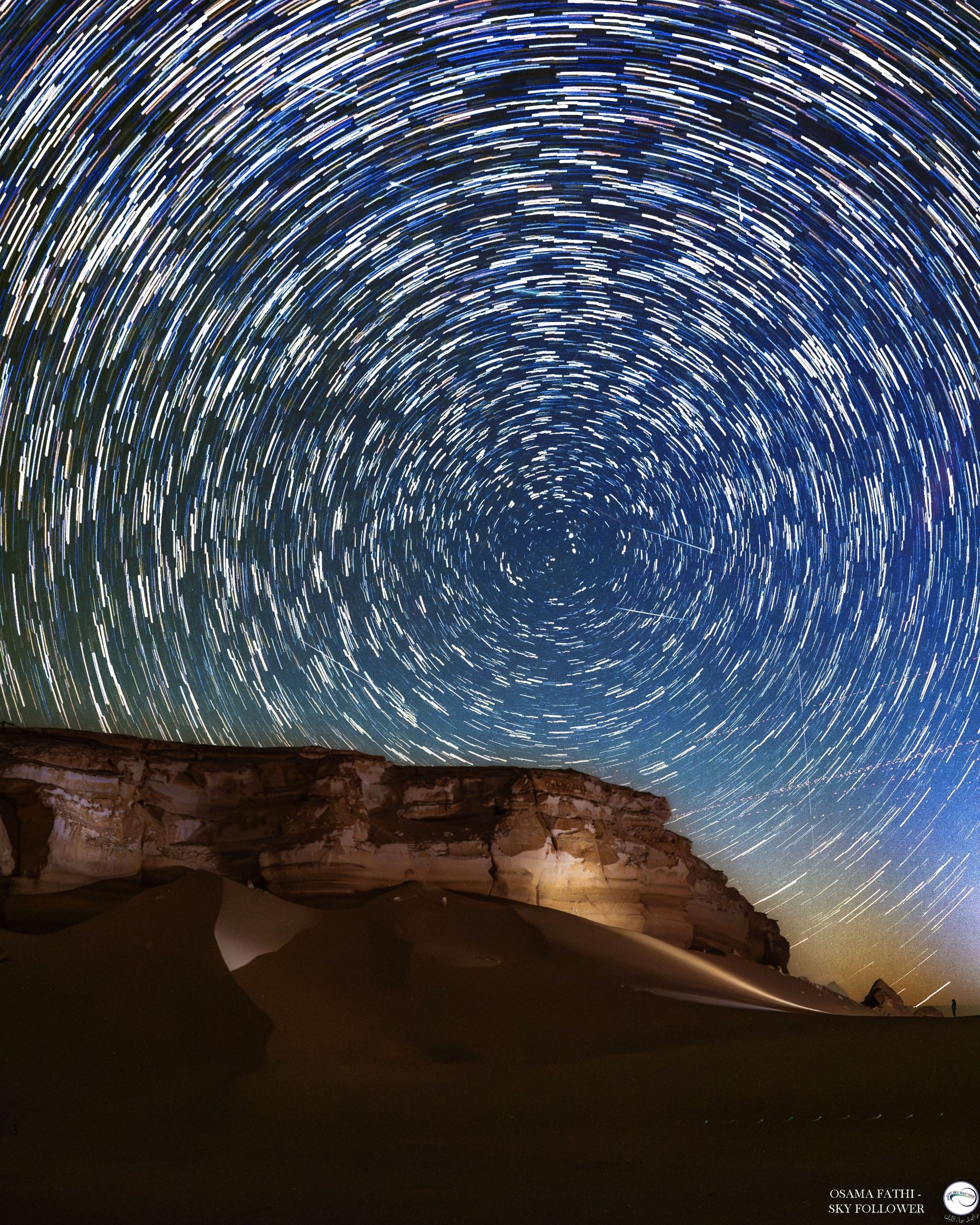
Astrophotographer Osama Fathi created this incredible view of Perseid meteors streaking through circling star trails above Egypt's Western Desert on Aug. 13-14, the night following the shower's peak under dark new-moon skies.
Fathi imaged the star trails in 240 consecutive 25-second exposures, which captured the apparent motion of the stars in Earth's sky as they seemed to circle the celestial north pole and the North Star Polaris. The length of each trail reveals how far the stars appeared to move as Fathi captured their ancient light with his Sony A7 III camera and a 16-35 mm lens during the 100-minute shoot.
But Fathi wasn't alone beneath the desert skies as he captured the scene.
"Capturing this photo in Egypt's Western Desert during the Perseids was an unforgettable experience," Fathi told Space.com in an email. "The night was exceptionally clear and I was surrounded by around 200 fellow astronomy enthusiasts sharing stories, stargazing and photographing the sky."
Perseid meteors and satellites intersect star trails in the skies over Egypt. (Image credit: Osama Fathi)
Perseid meteors appear as unbroken streaks of light, captured in a single exposure as tiny particles — often no larger than a grain of sand — burn up in Earth's atmosphere in the blink of an eye.
Dotted trails closer to the horizon depict the trajectories of satellites as they passed silently through the skies over Egypt's Western Desert. Fathi captured the landscape and starscape separately before combining, or stacking, the images into a mesmerizing image.
The result is a gorgeous nightscape that highlights the beauty of the natural landscape, the rotation of Earth and the natural light show of the Perseid meteor shower that we experience as Earth passes through the trail of debris shed by comet 109P/Swift-Tuttle.
Editor's Note: If you would like to share your photos of the night sky with Space.com's readers, then please send your photo(s), comments, name and location to spacephotos@space.com.
ⓘWe may earn a commission when you buy through our links. This helps support MacSources and keeps our content free. Thank you!
The RISION Magic brings detailed thermal imaging to your smartphone in a compact, affordable package, although its software still needs some refinement.
As a product tester, one of the biggest things I run into is people asking about how hot a device gets with standard use. Typically, I will use infrared thermometers to get temperature readings but I would much rather use a thermal imager so that the device can actually be seen and users can visualize where hot spots are. Some thermal imagers are too large to use conveniently, which is why I was excited about the RISION Magic being released.
About the RISION Magic
The RISION Magic is a compact USB-C thermal camera designed to turn a compatible smartphone, tablet, or Windows PC into a portable thermal imaging tool. At just 24 grams and without its own battery, the Magic draws power from the connected device, making it easy to carry and use without another device to charge. RISION offers support for iOS, Android, and Windows, along with free mobile and desktop versions of its RISION View app.
The Magic uses a native 160 × 120 thermal sensor and RISION’s QuadIR™ technology to produce a 320 × 240 super-resolved image. It also uses AI BiSpectrix™ to combine thermal and visible-light imagery in real time, helping users connect temperature differences with the physical objects or areas responsible for them.
RISION designed the Magic primarily for everyday troubleshooting and home maintenance. It can be used to look for energy loss around doors and windows, identify HVAC issues, find potential moisture problems, and spot overheating electrical connections without having to touch hot surfaces or exposed wiring. The RISION View app also provides temperature measurements, real-time waveform monitoring, customizable temperature thresholds, multiple measurement zones, thermal image and video capture, and automated PDF reporting.
Features & Specs
Thermal resolution: 160 × 120 native
Super resolution: 320 × 240 with QuadIR™ processing
Thermal sensitivity: ≤40 mK NETD
Refresh rate: 25 Hz
Temperature range: -4°F to 1,112°F (-20°C to 600°C)
Temperature accuracy: ±2% / ±2°C
Thermal/visible fusion: AI BiSpectrix™ dual-light fusion
Connection: USB-C
Power: Draws power directly from the connected device
Power consumption: 0.32W
Battery: No built-in battery
Continuous use: Approximately 5–8 hours, depending on the connected device
Compatibility: iOS, Android, and Windows PCs
App: RISION View mobile and desktop applications
Color palettes: 12, with adjustable text color and size
Temperature monitoring: Up to five points, five lines, and five areas simultaneously
Analysis: Real-time temperature waveform monitoring and customizable temperature thresholds
Image capture: Thermal photographs with temperature data
Video: Thermal video recording with temperature data
Reporting: Automated PDF reports
Documentation: Custom watermarks and GPS location information
Cloud: Cloud synchronization and multi-device access
Housing: Aerospace-grade alloy
Weight: 24 grams
Warranty: 24 months
Return period: 30 days
Thermal Image of Keyboard
Pricing & Availability
The RISION Magic has an MSRP of $139, although RISION is currently offering it for $119 through its website. The camera includes free shipping, a 24-month warranty, and a 30-day return period. It can be ordered through rision.com and Amazon.
User Experience
I tested the RISION Magic with my iPhone 16 Pro, and getting started was very easy. After downloading the RISION View app, I plugged the Magic into the phone’s USB-C port, and the app recognized it immediately. I was able to start taking thermal measurements very quickly.
The camera itself is a good size for carrying around. It is compact without being so small that I feel like I am going to lose it. The included carrying case works well for protecting the camera, although I think it could be smaller to better match the compact size of the Magic.
The RISION View app is generally easy to use, but I did run into some software issues during testing. A few settings also weren’t located where I expected them to be. For example, I had to go into my Profile to change the temperature unit from Celsius to Fahrenheit rather than finding that option under Settings. More importantly, the app locked up a few times. If my phone went to sleep while the camera was connected, I sometimes had to disconnect and reconnect the Magic before the app would work again.
Thermal Image of Me Standing in front of a sliding glass door.
The thermal images were the highlight of my testing. They looked very good, with enough detail that it was easy to identify the objects I was looking at. I used the Magic to check a variety of things around the house, including my coffee before and after adding fresh coffee, an air conditioning vent, my keyboard, and our dog. It was interesting to see the differences in temperature across these everyday objects.
I also compared the Magic’s temperature readings with a handheld infrared thermometer. The readings were reasonably close, although the infrared thermometer consistently measured approximately 4 degrees higher. For the type of general-purpose troubleshooting the Magic is designed for, I found the readings accurate enough to be useful.
Close Up of our Dog
I did run into another software issue when I tried the reporting feature. Creating a report requires signing up for a RISION account, but I couldn’t complete the registration. After entering the requested information and verification code, the Sign Up button remained disabled. That meant I wasn’t able to test the PDF reporting feature.
Overall, my experience with the Magic was a little mixed. The hardware is compact, easy to use, and produces surprisingly detailed thermal images, but the software still feels like it needs some refinement. I encountered several issues during testing, although none prevented me from using the camera after reconnecting it. Based on the image quality alone, I would recommend the RISION Magic at its $119 price, particularly for homeowners and DIY users who want an easy way to add thermal imaging to a smartphone.
Coffee before refilling it.Coffee as I refilled itCoffee after refill.
Conclusion
The RISION Magic is an interesting addition to my testing setup because it gives me something an infrared thermometer can’t: a visual representation of where heat is coming from. Being able to see hot spots across a device or identify temperature differences around the house makes thermal imaging much more useful than simply getting a single temperature reading.
The hardware does what I want it to do, and the thermal images are detailed enough to make the camera genuinely useful. If RISION can address some of the software bugs, the Magic would be an even stronger recommendation. For now, I think it is a good option for anyone looking to add thermal imaging to their smartphone without spending a lot of money.
Apple’s iPhone 18 Pro and Pro Max pair the faster A20 Pro chip with a variable-aperture Fusion Main camera, a smaller, more capable Dynamic Island, longer battery life, and higher prices, while otherwise changing surprisingly little from last year.
Apple’s 'Surprise and Shine' event sparks a lively debate over the new iPhone Duo and iPhone 18 Pro lineup. The panel weighs the Duo’s foldable design, large display, durability, price, and potential to replace an iPad against the Pro Max’s camera improvements. From immediate buying decisions to first-generation caution, everyone has a different take on Apple’s latest hardware.
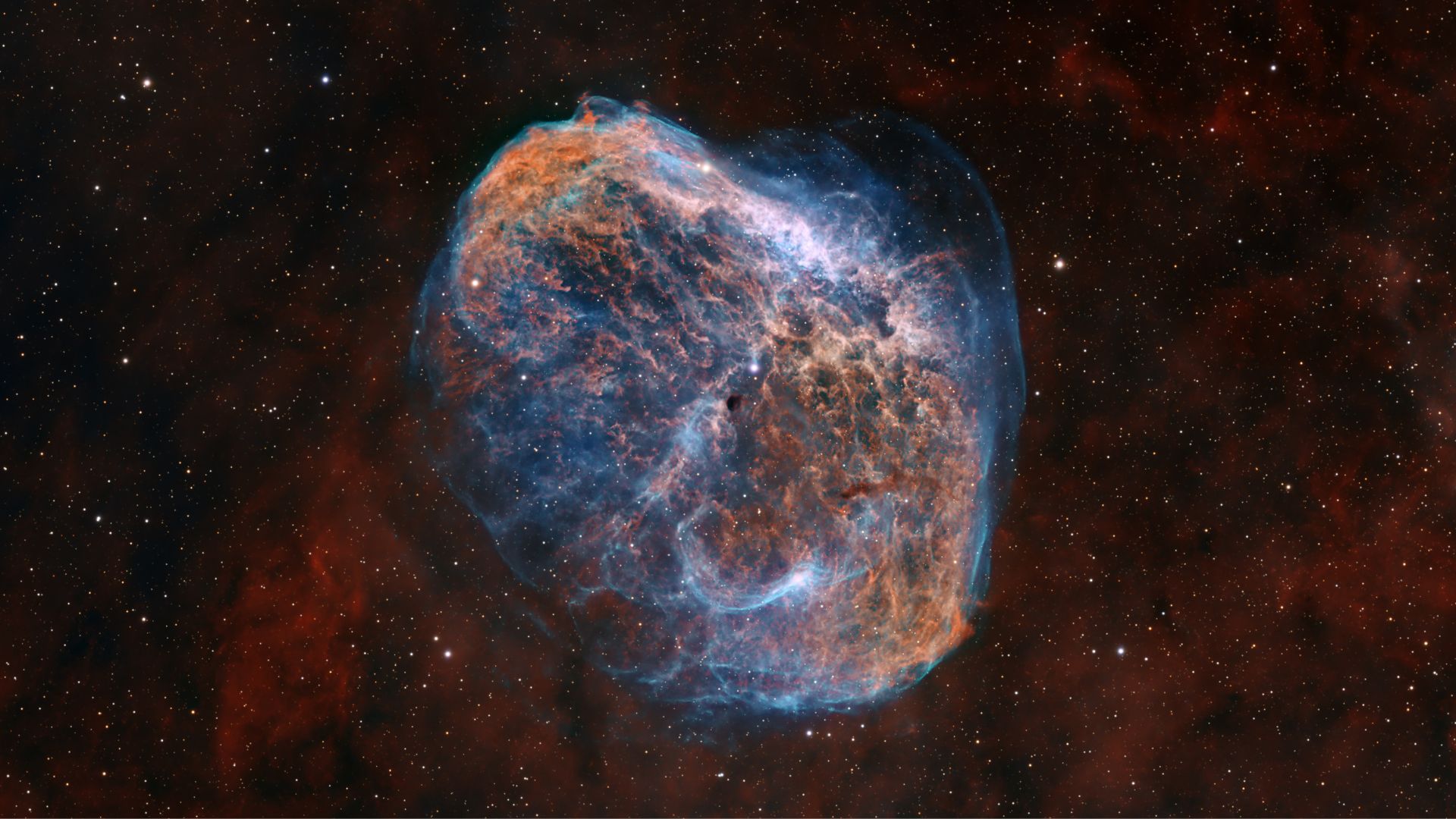
The Crescent Nebula shines in the constellation Cygnus. (Image credit: Kevin Boardman)
Astrophotographer Kevin Boardman captured this spectacular view of the Crescent Nebula, revealing intricate filaments of gas surrounding a massive star nearing the end of its life some 4,700 light-years from Earth in the constellation Cygnus.
Boardman's image represents a turbulent chapter in the life of the colossal Wolf-Rayet star WR 136 (HD 192163), which, visible as a blue point of light at the center of the image, is expected to end its life in a dramatic supernova explosion in about 100,000 years.
The 25-light-year-wide bubble is formed from stellar material cast off by WR 136 during its transformation into a red giant star, according to NASA. Repeated impacts by fast-moving stellar winds later send shockwaves through the outer shell, creating the complex filaments we see today.
ZWO ASI533MC Pro
(Image credit: Amazon)
The ZWO ASI533MC Pro camera is the best dedicated astro camera out there, in our opinion. It features zero amp glow, 80% quantum efficiency and a 20FPS frame rate. It also features a 9MP sensor and you can check out our ZWO ASI533MC Pro review for a more in-depth look.
Catalogued as NGC 6888, or Caldwell 27, the Crescent Nebula, gets its nickname from its crescent-moon like appearance when observed in certain wavelengths of light. Boardman revealed spectacular detail in the nebula by imaging it with a set of narrowband filters over 16 hours and 18 minutes spread across five nights in late July.
"In the image, orange-red H-alpha reveals the tangled filaments while blue-cyan [O III] outlines emission from doubly ionized oxygen around the shell," Boardman told Space.com in an email. Each filter isolates specific wavelengths of light emitted by ionized gases, allowing different structures within the nebula to stand out.
Boardman collected roughly 12 hours of narrowband data from the nebula itself, along with four hours and 20 minutes of data capturing the surrounding stars, before combining exposures using the astronomy software PixInsight during post-processing.
The Crescent Nebula is too faint to be spotted with the naked eye, but can be seen with a moderate-to-large telescope equipped with a light pollution filter throughout September.
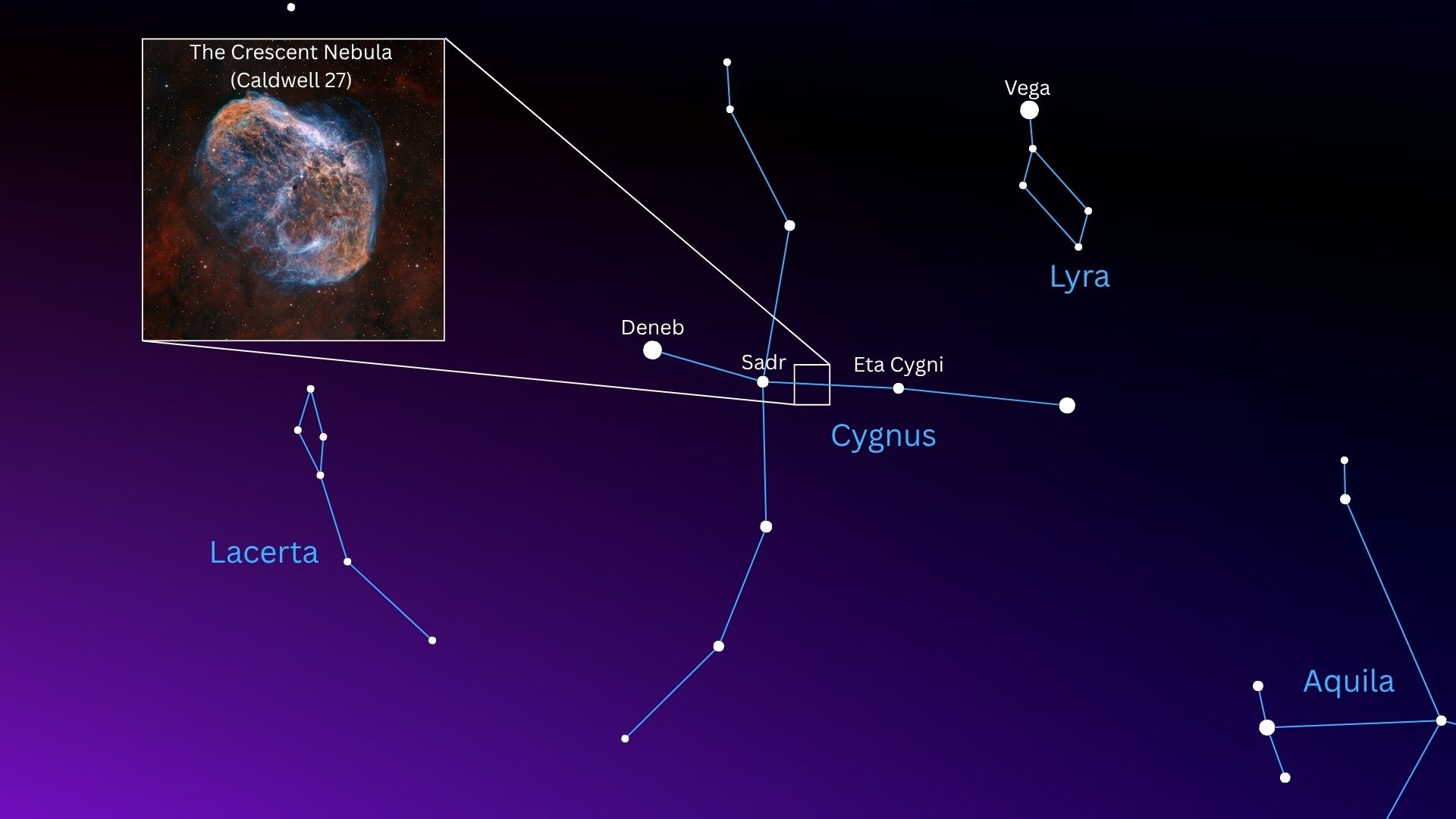
How to find the Crescent Nebula among the stars of the constellation Cygnus. (Image credit: Inset image: Kevin Boardman, created by Anthony Wood in Canva.)
First, locate the magnitude +2.34 star Sadr at the center of the cross-shaped constellation Cygnus, which appears high overhead for Northern Hemisphere observers in late summer.
Next, locate the dimmer magnitude +4.03 star Eta Cygni using the simplified star chart above, or with the aid of a smartphone astronomy app. The Crescent Nebula lies directly between these two bright stars and is best seen on the dark nights surrounding this month's new moon phase on Sept. 10-11.
Editor's Note: If you would like to share your astrophotography with Space.com's readers, then please send your photo(s), comments, and your name and location to spacephotos@space.com.
This MacVoices Briefing compares the Insta360 Snap Selfie Screen with Light and SmallRig Phone Vlog Selfie Monitor, two solutions for framing shots while using an iPhone’s best camera. Factors in choosing include MagSafe mounting, wired versus Wi-Fi connections, screen size, touch controls, lighting, battery life, compatibility, portability, pricing, and flexibility. Chuck talks about how to determine help which monitor is best for your different shooting needs, and how he solved the choice question.
Macbook Pro, 15", 2017
Mac OS Monterey, Version 12.6
iPhone 13 Pro Max
IOS 16.0
For managing Pictures in the Photo Application between my MacBook and iPhone - I want to be able to delete pictures from the iPhone but they always come back from the MacBook Pro?
How can I keep pictures from always coming back?
Apologies for not using correct nomenclature / terms - I am not much of a chiphead.
Is there a good resource for using Photo Application for both the Laptop and...

 Login