Researchers in China have cross-calibrated radiation detectors on 25 navigation satellites. Data from two decades of measurements have been combined to create a record of the flux of relativistic electrons that impinges on Earth’s atmosphere. The technique can be applied to other satellite data, and could boost our understanding of the threat that this radiation poses to satellites and shed light on the solar processes that generate the electron flux.
The Global Positioning System (GPS) uses signals from a constellation of satellites to locate the position of receivers on the Earth’s surface to within several metres. There are currently 32 GPS satellites orbiting about 20,000 km above the Earth and each of them carries a radiation detector. These detectors allow scientists to observe changes in radiation levels in space. Much of this radiation comes in the form of high-energy electrons from the Sun, which can disrupt the operation of satellites and even damage them.
The electron flux rises and falls with the solar cycle. This has a period of about 11 years and involves the waxing and waning of sunspots, solar flares and coronal mass ejections.
For those who design and operate satellites, it is crucial to understand this electron flux. However, it has proven difficult to make full use of the data generated by these detectors because the instruments had not been cross calibrated. Indeed, measurement values of high-energy electrons can vary between satellites by several orders of magnitude when the flux is low. One important issue is that not all satellites use the same detectors – with two different instruments having been deployed.
Cross calibration
Now, researchers in China have done a cross-calibration of the particle detectors on 25 GPS satellites. The result is a calibrated dataset of relativistic-electron flux that spans two complete solar cycles (2000–2020).
To do this, the team looked at two different measurements made by the detectors. One is the differential electron flux at 2 MeV arriving from one specific direction. The other is the integral electron flux electrons arriving from all directions at energies greater than 2 MeV.
Because electron flux is affected by Earth’s magnetic field, the team had to consider its effect on measurements. This was done using a concept called magnetic local time, which accounts for the fact that Earth’s magnetic poles are offset from our planet’s axis of rotation.
The team used a satellite called NS59 as the reference for their study because its detector has produced a consistent set of data from 2004 – overlapping in time all other satellites in the study. By doing several statistical analyses, the team was able incorporate data from 24 of the 25 satellites. One detector, however, remained problematic and the researchers recommend that data from this satellite not be used.
The team says that their technique can now be used to cross-calibrate the detectors at other energies – there are 14 differential and 29 integral channels that can be also be analysed. They have already used the same techniques to cross-calibrate the GPS data with measurements made by satellites in China’s BeiDou positioning system and observations made by NASA’s two Van Allen Probes.
Join us for an in‑depth conversation with Simon Cherry, former editor‑in‑chief of Physics in Medicine & Biology (PMB), as he shares his expert perspective on the evolving landscape of medical physics research, molecular imaging, and non-invasive imaging technologies. Drawing on decades of leadership in biomedical imaging and academic publishing, Simon will reflect on major advances shaping the field, define the characteristics of high‑impact imaging research, and highlight how PMB continues to support rigorous, influential scientific work through its editorial standards and peer‑review practices.
This session will additionally spotlight the research of Xinchen (Alison) Deng, a finalist of the PMB 2024 Early Career Award. Attendees will gain insights into her contributions to the advanced medical imaging community, such as photon-counting CT for clinical applications and how her work supports broader advances in medical physics and X-ray/CT imaging research.
Simon will also discuss what makes early‑career research stand out and share strategies for researchers aiming to increase the visibility, reach, and long‑term impact of their publications within competitive scientific journals.
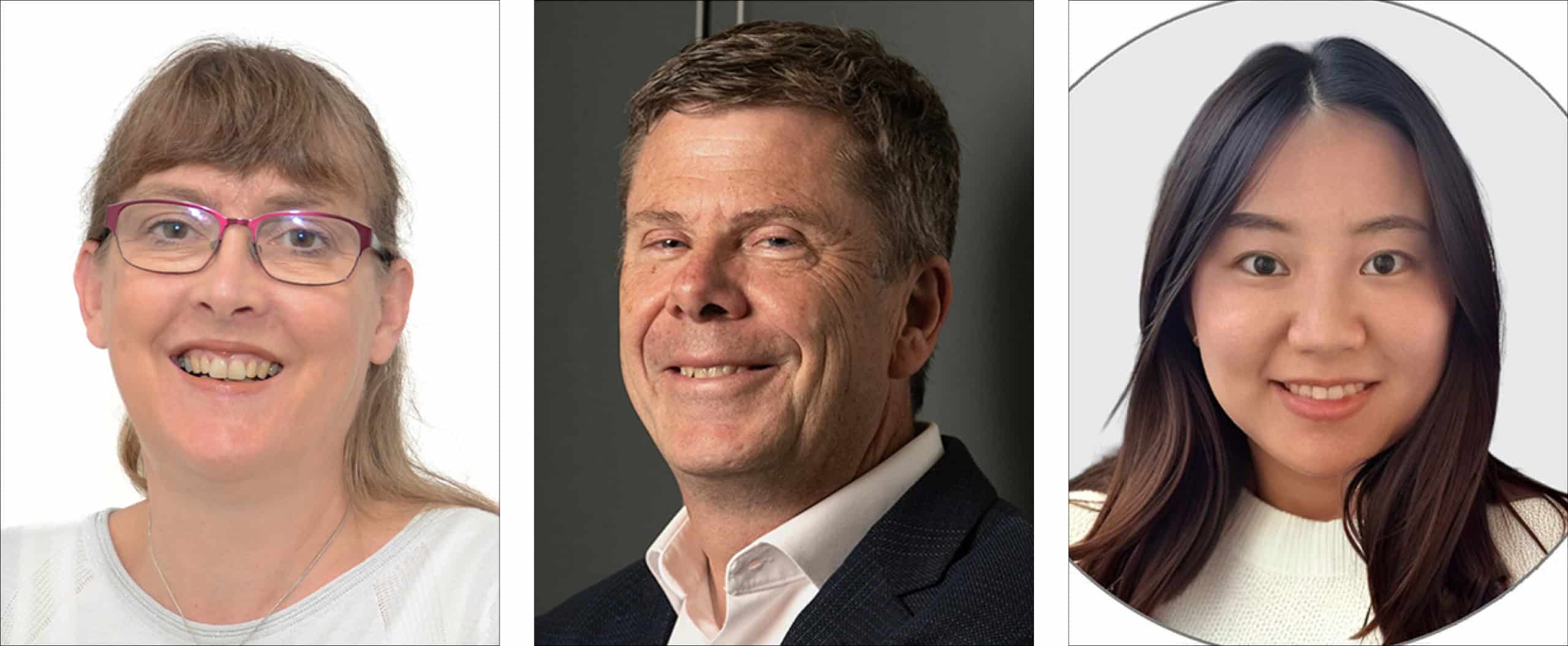
Left to right: Carol Clark, Simon Cherry, Xinchen (Alison) Deng
Moderator
Carol Clark, Publisher,Physics in Medicine & Biology
Speakers
Simon R Cherry, PhD received his BSc (Hons) in physics with astronomy from University College London in 1986 and a PhD in medical physics from the Institute of Cancer Research, University of London in 1989. Simon is currently Distinguished Research Professor in the Departments of Biomedical Engineering and Radiology at UC Davis and Professor of Total-Body Imaging at King’s College London. Simon’s research interests centre around biomedical imaging. His major contributions have been in developing systems for positron emission tomography (PET), including designing the microPET scanner for small-animal imaging, the earliest examples of simultaneous PET and MRI studies and co-leading the EXPLORER consortium that developed the world’s first total-body PET scanner. Simon is a Fellow of the Royal Society and Member of the U.S. National Academy of Engineering and National Academy of Inventors. He has received several international awards including the Society of Nuclear Medicine and Molecular Imaging Cassen Prize in 2022. He served as editor-in-chief of the journal Physics in Medicine & Biology from 2011–2020. Simon is the author of more than 350 peer-reviewed journal articles, review articles and book chapters in the field of biomedical imaging. He is also lead author of the widely-used textbook Physics in Nuclear Medicine.
Xinchen (Alison) Deng, PhD, is a diagnostic imaging physics resident at The Ohio State University. Her research focuses on advancing photon-counting CT for clinical applications, including multi-contrast imaging, early disease detection, detector optimization, and AI-based improvements in image quality. Before beginning the residency, Xinchen (Alison) was a postdoctoral fellow in medical physics at the University of Victoria, where she worked with Magdalena Bazalova-Carter and collaborated with Redlen Technologies on the optimization of photon-counting detectors and the clinical applications of spectral CT. She received her PhD in medical physics from the University of British Columbia, where she applied Raman spectroscopy, machine learning, and explainable AI to study radiation treatment response in cancer cells and tissues. Her broader research background spans photon-counting CT, spectral X-ray imaging, Raman spectroscopy, radiotherapy response assessment, and AI-driven image and data analysis. Her photon-counting CT research has been featured in the Physics in Medicine & Biology Early Career Researcher Focus Collection. She is a finalist for the PMB Early Career Researcher Award.
About this journal
Physics in Medicine & Biology. The international journal of biomedical physics and engineering, published by IOP Publishing on behalf of the Institute of Physics and Engineering in Medicine (IPEM)
Simulating quantum systems is something that classical computers struggle with. Not surprisingly, quantum computers are expected to do a much better job – particularly when a quantum-computer’s architecture is designed to solve a specific type of physics problem.
My guest in this episode of the Physics World Weekly podcast is Ross Jenkinson of the UK’s University of Manchester. He talks about the challenges and rewards of using quantum computers in particle physics – a field where classical supercomputers can struggle to simulate simple systems.
We also explore how quantum information theory is being combined with Einstein’s general theory of relativity to shed light on the nature of space and time.
This podcast is supported by American Elements, the world’s leading manufacturer of engineered and advanced materials. The company’s ability to scale laboratory breakthroughs to industrial production has contributed to many of the most significant technological advancements since 1990 – including LED lighting, smartphones, and electric vehicles.
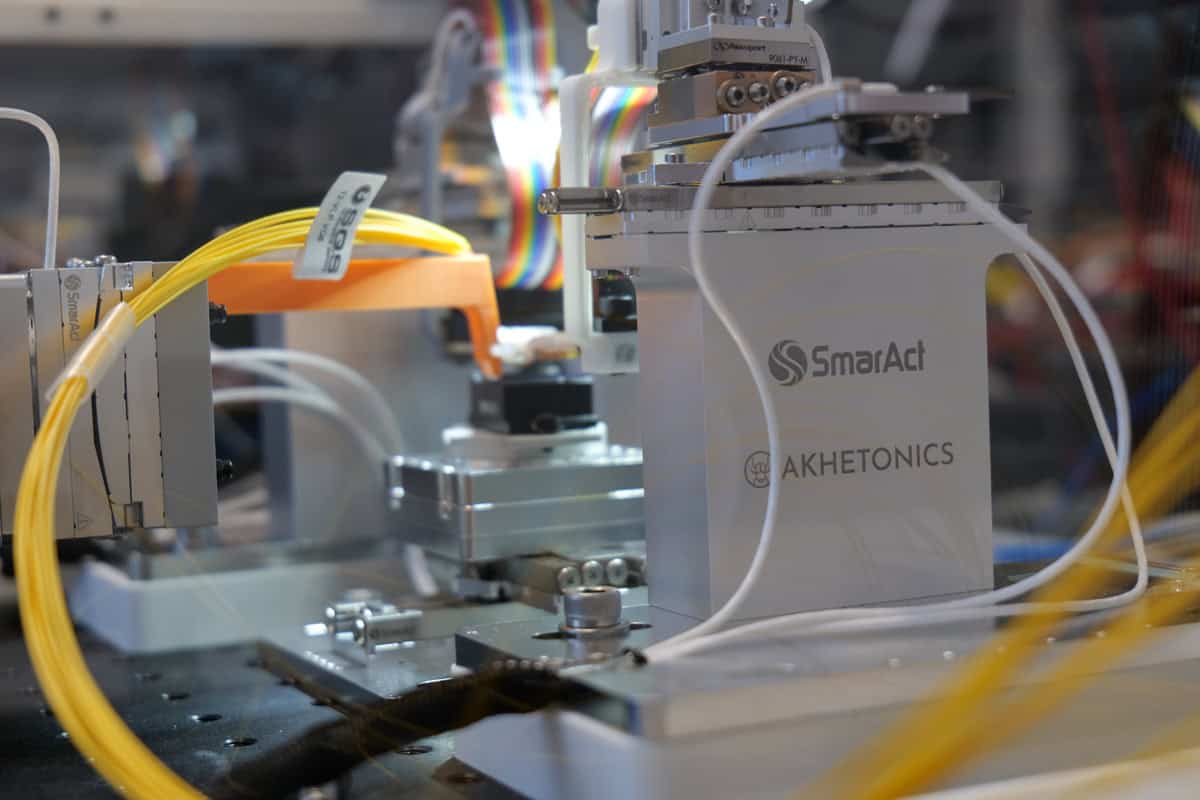
Photonics reimagined SmarAct and Akhetonics worked together to build a versatile optical test set-up to characterize next-generation photonic integrated circuits (PICs). SmarAct’s nanopositioning systems form the precision-motion core of the test workstation, while the positional reproducibility allows Akhetonics to map the full optical chip and evaluate large grids of test components rapidly and reliably. (Courtesy: Akhetonics)
German technology start-up Akhetonics is reimagining the future of high-performance computing (HPC), deploying its proprietary know-how in photonic-design automation and photonic integrated circuits (PICs) to realize the first all-optical digital computation devices. The end-game: an all-optical digital processor – what Akhetonics calls its reasoning processing unit (RPU) – that will fundamentally transform the way that data is processed, transmitted and stored at every level of the HPC stack.
While the anticipated upsides of photonic computing are compelling – think bandwidth scaling, energy-efficiency and reduced latency – the translation of Akhetonics’ R&D effort and early-stage PIC designs into at-scale implementation is still in its infancy. What’s evident even now, though, is that the start-up’s progress is being accelerated by collaboration, interdisciplinary expertise and innovation spanning photonic system design and precision-motion and control technologies.
Collaboration, co-development, customization
A case study in this regard is Akhetonics’ partnership with SmarAct, a German manufacturer and developer of specialist products for nano- and picometre-precise positioning, metrology and automated assembly. Both companies are shaping the future of photonics, albeit along complementary tracks: Akhetonics with its vision of a full-stack photonic computing architecture; SmarAct with a portfolio of enabling technologies that’s helping to make next-generation optical computing a practical proposition.
The two vendors began working together after an initial meeting four years ago at the European Conference on Optical Communication (ECOC 22) in Basel, Switzerland. Top of the Akhetonics shopping list: a versatile optical test system to characterize its advanced PICs.
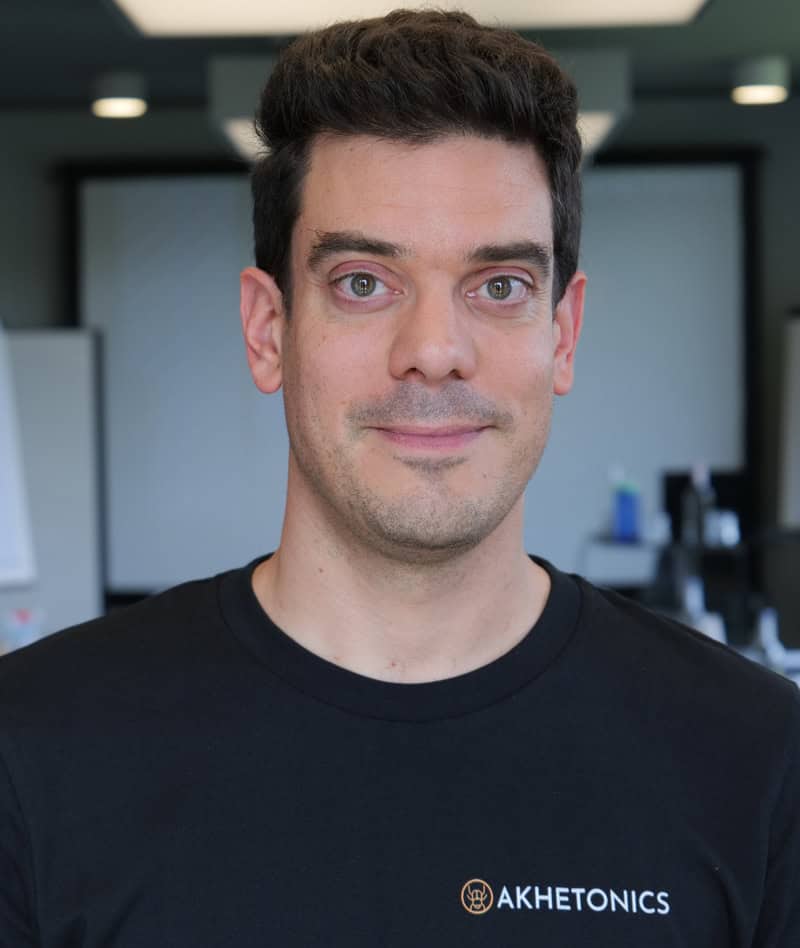
Versatility is the key Leonardo Del Bino, Akhetonics’ CTO. (Courtesy: Akhetonics)
“There are off-the-shelf PIC characterization systems on the market, but they all impose constraints on our design options,” explains Leonardo Del Bino, co-founder and chief technology officer (CTO) at Akhetonics. “Instead, we teamed up with SmarAct to co-develop a compact and modular test architecture built to our exacting specifications. The resulting set-up gives us the flexibility to evaluate and optimize all sorts of innovative PIC designs.”
At the heart of the Akhetonics optical testing workstation sit two discrete nanopositioning subsystems: an XY-Rz chip platform (itself comprising three nanopositioning stages offering horizontal translation along the X and Y axes and rotation limited to the Z axis) and a Z-Rx-Ry “pivot” for an optical probe (where translation occurs only along the Z axis, with simultaneous angular rotation around the X and Y axes). The test set-up (which also incorporates a digital microscope for PIC inspection and alignment) can be used without restriction in every degree of freedom, with the two subsystems working in tandem to ensure precise multi-axis positioning for optical coupling and electro-optic characterization tasks.
On a more granular level, each nanopositioning subsystem is based on SmarAct positioners equipped with integrated optical encoders (SmarAct’s METIRIO® sensors with a resolution of 1 nm) along all six axes of motion. The first subsystem provides three degrees of freedom for lateral alignment (with 49 mm travel in both X and Y, 360° rotation around Rz and a unidirectional positional repeatability of ±40 nm per linear axis). The second subsystem provides vertical and angular alignment (with 31 mm travel in Z, ±5° tilt around Ry, ±45° rotation around Rz and a unidirectional positional repeatability of ±40 nm for the linear Z axis).
To evaluate new PIC designs, Akhetonics’ optical test routines focus primarily on measuring and minimizing insertion losses between input/output fibres and on-chip planar waveguides. Typical measurements include wavelength- and polarization-dependent coupling losses (for example, when a fibre array couples laser light into a series of on-chip grating couplers or when light is coupled from a planar waveguide back into an optical fibre). The subsequent integration of electrical probes into the test system (using two separate XYZ probe towers) supports electro-optic characterization of key on-chip building blocks like optical modulators and photodetectors.
“The requirements for the electro-optical testing are nothing crazy,” says Del Bino. On-chip electrical contacts are in the ballpark of 100 μm x 100 μm, so Akhetonics engineers need positional and alignment precision an order-of-magnitude better than that for their electrical probes. “On-chip optical testing is a different story,” he adds. “A fibre-waveguide mismatch of 1 μm means significant coupling losses, so we need positional accuracy and repeatability of tens of nm or less.”
The rewards of reciprocity
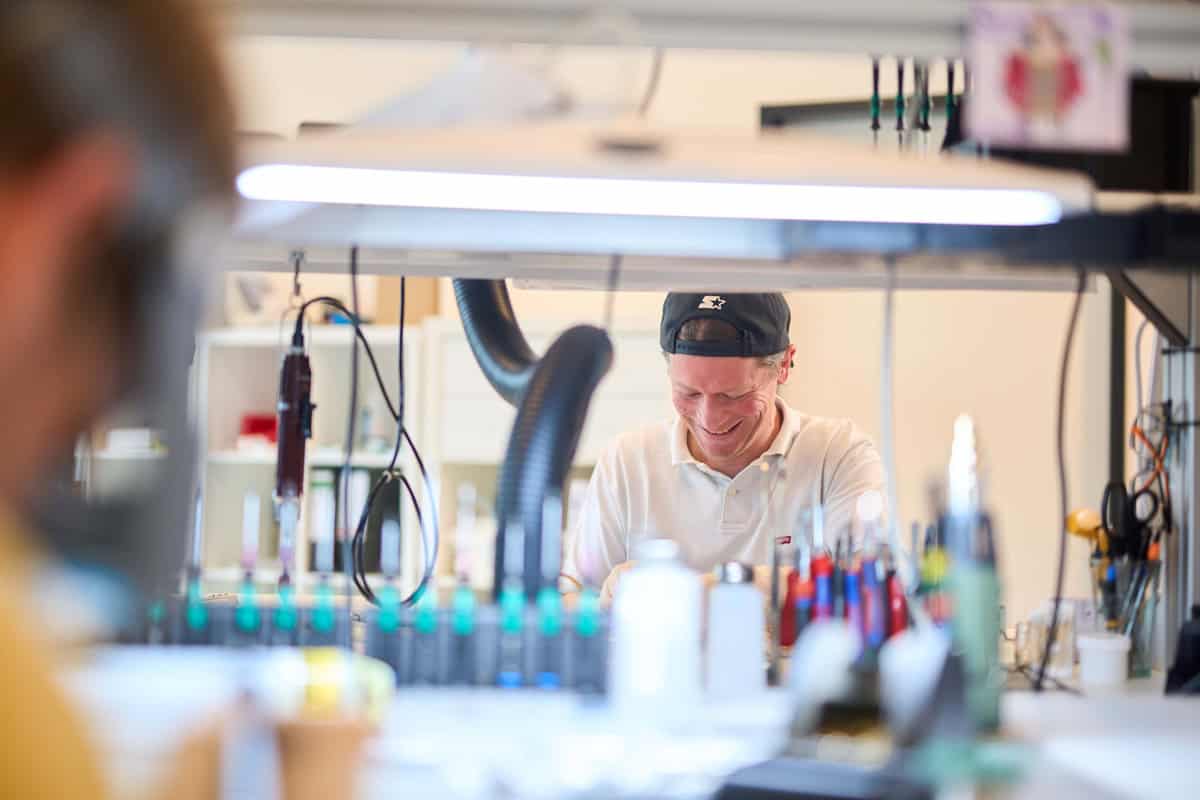
Operationally, the custom test system is the result of ongoing collaboration between the engineering team at Akhetonics and the product development team at SmarAct. After firming up performance requirements, the two vendors iterated back-and-forth with 3D CAD drawings before converging on a final agreed system design.
Line-of-sight Max Trippel, SmarAct’s business development manager for photonic applications. (Courtesy: SmarAct)
“We supplied the nanopositioning stages that form the precision-motion core of the workstation,” explains Max Trippel, SmarAct’s business development manager for photonic applications. Akhetonics then integrated these modules into its own test environment, including the fibre and fibre-array-unit holders; the required optical and electrical measurement equipment; and the software routines for photonic characterization. “This approach gives Akhetonics the flexibility to build exactly the test workflow it needs, while relying on a stable and repeatable positioning platform,” Trippel adds.
Crucially, the SmarAct software “ecosystem” and Python interface make it easy to integrate the nanopositioning stages within Akhetonics’ PIC test routines. That software application platform, known as the SmarAct Control and Process Environment (SCoPE), also creates opportunities for continuous process improvement and product innovation (for example, the ability to develop custom routines for fast calibration and alignment on all axes).
In this way, SCoPE will be a natural fit as Akhetonics transitions its PIC testing programme from an R&D setting through small-batch production runs and, ultimately, to volume manufacturing capability (see “SCoPE in brief”, below). “Our goal with SCoPE is to provide customers with easy access for system development, whether that’s for the testing or assembly of photonic components,” says Trippel. “SCoPE is a living platform and we’re constantly integrating novel functionalities and application-specific plug-ins as well as features to facilitate control of third-party devices.”
Strategically, the SmarAct-Akhetonics partnership is shaping up as a win-win for the long term, with the latter’s growth trajectory and evolving platform technologies feeding into SmarAct’s product development roadmap. “Our customers’ success is our success,” Trippel concludes. “Working in this way with Akhetonics and its peers means we have line-of-sight on ‘what’s next’ in photonic computing. Watch this space: the last word has not been spoken.”
SCoPE in brief
The SmarAct Control and Process Environment (SCoPE) is a modular and extensible software application platform that combines visual process modelling, Python scripting and hardware integration. SCoPE enables customers to develop, control and run automated processes in a unified environment that offers…
Reciprocal benefits The custom test system is the result of an ongoing collaboration between the engineering team at Akhetonics and the product development team at SmarAct. (Courtesy: SmarAct)
Process modelling and automation: visual drag-and-drop process editor enables intuitive creation, control and execution of automation workflows. Live process display gives users direct feedback during execution.
Python scripting backend: integrated Python scripting allows developers to extend workflows with custom logic, algorithms and third-party devices to create advanced automation scenarios. Package and dependency management are built-in.
Device control and hardware integration: native support for SmarAct hardware such as positioning systems, controllers, grippers and interferometers through specialized plug-ins.
Custom user interfaces: flexible Qt widget integration makes it possible to build tailored graphical user interfaces for specific applications.
Data visualization and imaging: configurable plotting widgets, real-time data visualization, process messaging and an integrated image processing pipeline support instant process feedback and image-based automation tasks.
Plug-in architecture: the modular plug-in system enables SmarAct and third parties to extend SCoPE with additional functions, algorithms, hardware integrations or communication interfaces.
I am writing from Argentina as a researcher working within the country’s national scientific system. While discussions about science funding are often framed in terms of budgets and economic indicators, the reality is experienced in laboratories, offices and research facilities where scientific knowledge is produced.
Today, many of us in Argentina are witnessing a progressive deterioration of Argentine science, both in terms of infrastructure and human capital.
The impact became tangible when my colleague Paula Alderete, an experienced electron microscope specialist, lost her position. Alderete, who has published two papers with me, was responsible not only for operating a highly specialized instrument, but also for maintaining it and supporting dozens of research projects.
Without Paula Alderete’s expertise, our lab’s electron microscope has become largely unusable. It is a quiet reminder that scientific infrastructure depends as much on people as on expensive equipment.
Faramarz S Gard
Without her expertise, the microscope has become largely unusable. Every morning I pass her empty desk on my way to the laboratory. It has become a quiet reminder that scientific infrastructure depends as much on people as on expensive equipment.
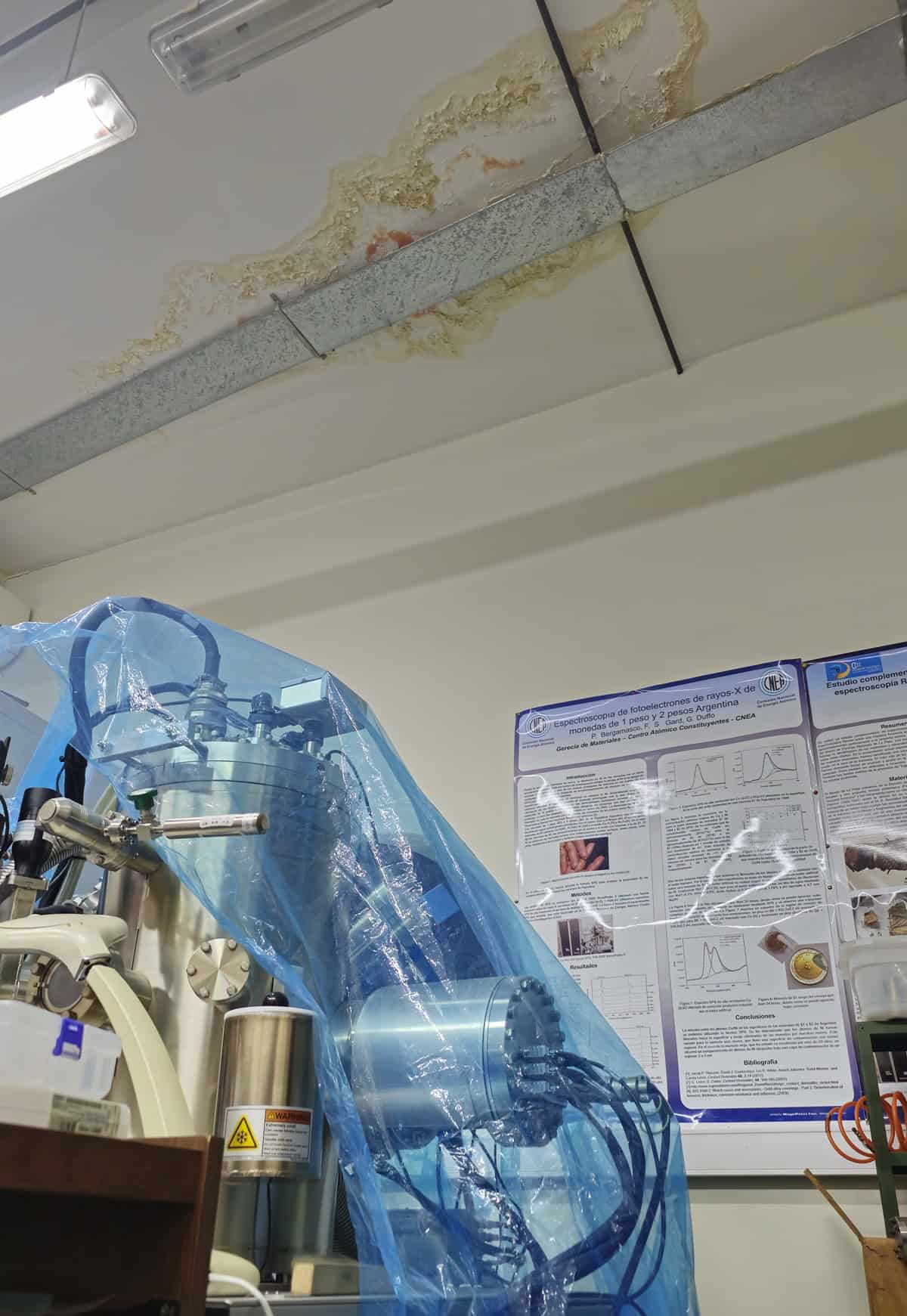
The deterioration extends beyond personnel. In my laboratory, an X-ray photoelectron spectroscopy (XPS) instrument worth more than $1m must sometimes be protected with plastic sheets because rainwater leaks through the roof.
Equipment designed to operate under tightly controlled environmental conditions is now exposed to circumstances that threaten its long-term reliability. Similar situations are becoming increasingly common across Argentina’s universities and research institutes as maintenance budgets shrink and infrastructure ages.
Argentina has a scientific tradition that reaches far beyond its borders. The country has produced five Nobel laureates, including three in the sciences, and has made internationally recognized contributions to nuclear technology, medicine, agriculture, astronomy and materials science. Institutions such as CNEA, CONICET (Argentina’s national research council) and the national universities have trained generations of researchers whose work has strengthened international collaborations and advanced scientific knowledge worldwide.
Scientific systems rarely collapse through a single dramatic event. They decline incrementally: one technician dismissed, one laboratory left unrepaired, one instrument taken out of service, one young scientist deciding to build a career elsewhere. These individual losses accumulate into a weakening of scientific capacity that may take decades to rebuild.
When a country loses the expertise required to operate advanced laboratories or maintain unique scientific infrastructure, the consequences extend beyond national borders.
Faramarz S Gard
This should concern more than Argentina. Modern science depends on international networks of researchers, shared facilities and long-term collaboration. When a country loses the expertise required to operate advanced laboratories or maintain unique scientific infrastructure, the consequences extend beyond national borders.
Damaged goods This X-ray photoelectron spectrometer at the author’s lab has to be protected from water leaking through the ceiling. (Courtesy: Faramarz S Gard)
Knowledge is lost, collaborations weaken, and opportunities for discovery diminish.scientific infrastructure is more than buildings and instruments; it is the people whose expertise gives those resources value. Once that expertise disappears, replacing it is far more difficult than preserving it.
The empty desk of a single scientist may seem insignificant, but multiplied across laboratories and institutions, it becomes a warning of how a research system is quietly dismantled. Argentina’s experience is therefore not only a national concern but also a reminder that scientific capacity, wherever it exists, is a global resource that is remarkably difficult to rebuild once lost.
I write this letter not only to describe a difficult situation but also to call attention to the broader consequences of sustained disinvestment in science. The international scientific community should recognize that the erosion of research systems in countries such as Argentina represents a loss not only for those nations but for global science itself.
Science is built by people, sustained by institutions, and enabled by infrastructure. Today, all three are under increasing strain in Argentina.
A possible “exosatellite” has been discovered 73 light years away. Bizarrely, it is roughly the size of Jupiter and orbiting a failed star called a brown dwarf, which in turn is orbiting the red dwarf star CD-35 2722.
This huge alien “moon” was found by the Very Large Telescope’s CRIRES+ spectroscopic instrument, which measured the Doppler shift in the brown dwarf’s light as the exosatellite gravitationally tugged on it. This is the same method used to discover the first known exoplanet around a Sun-like star, namely 51 Pegasi b, in 1995.
Only a handful of exosatellite candidates have been discovered thus far, with none being particularly convincing. This newly detected satellite, reported in Nature, is possibly the best of the bunch. The brown dwarf, known as CD-35 2722b, has a mass about 37 times greater than Jupiter and its exosatellite has a minimum mass of 90% that of Jupiter.
Moon, satellite or planet?
Planetary mass objects around brown dwarfs have been discovered before. Take the example of 2M1207b, which is an object up to six times more massive than Jupiter orbiting a brown dwarf, discovered in 2005 by the Very Large Telescope. Such objects have not been referred to previously as moons or satellites, so why now?
“This system is meaningfully different from 2M1207 because of the mass ratios and separations involved in CD-35 2722,” says Kevin Hoy, a PhD candidate at the European Southern Observatory and the Instituto de Estudios Astrofísicos in Chile, who led the discovery.
Whereas 2M1207b is approximately a quarter of the mass of its host brown dwarf and on a very wide orbit, possibly as long as 20,000 years, CD-35 2722b’s satellite has about 2.5% of the mass of its host brown dwarf and is on a much closer 170-day orbit.
There’s also the hierarchy of the system to consider. In the 2M1207 system, the brown dwarf doesn’t orbit anything, but in CD-35 2722 the brown dwarf is on a 5000-year-long orbit around its companion star. The candidate exosatellite therefore orbits something that orbits a star, just as a given moon in our Solar System orbits a planet that orbits a star. Since our Solar System has nothing like this brown dwarf–satellite combination, the language that we use to describe such objects is seemingly inadequate.
Mary Anne Limbach of the University of Michigan, who was not involved in this study, agrees that our nomenclature is increasingly ill-suited to the bizarre objects that we are discovering beyond our Solar System.
“Most people in the astronomical community would probably hesitate to call this an exomoon,” she tells Physics World. “But I think ‘exosatellite’ is appropriate. The field needs language for companions that do not neatly fit into the traditional categories of planets and moons, and ‘satellite’ seems to be the broader term that the field is gravitating towards.”
Forming exosatellites
Definitions are important, adds Limbach, because they allow us to distinguish between how otherwise similar objects formed.
The moons in our Solar System formed from debris discs encircling their parent planets. Material in the discs clumped together, forming cores that were then able to sweep up the remainder of the material. Astronomers refer to this as core accretion formation.
“If I had to put money on it, I would doubt that the CD-35 2722b satellite formed via core accretion for several reasons,” says Hoy. These reasons include the size of the disc required to build such a massive satellite, the speed with which it would have done so (it is only 150 million years old) and its eccentric orbit. Moons born in situ around their parent typically adopt a more circular orbit.
Instead, Hoy suspects that the brown dwarf and its satellite collapsed directly out of a gas cloud in much the same way that stars do. “That would be my best guess,” he says.
The formation mechanism makes all the difference to Limbach, who opines that, “an object can reasonably be called a moon if it formed through a process analogous to the formation of the moons around the Solar System’s planets.”
Limbach cautions that since we only know the satellite’s minimum mass, we cannot yet rule out this being a binary system of two brown dwarfs. Either way, Limbach sees the system as being close to that of a binary giant planet. Our understanding of how giant planetary bodies and low-mass brown dwarfs form tells us that binary giant planets should be rare, “but the first emerging examples hint that they may not be,” says Limbach. These include about 40 pairs of rogue binary giant planets, called Jupiter Mass Binary Objects (JuMBOs), found by the James Webb Space Telescope in the Orion Nebula’s Trapezium star cluster.
Tip of the iceberg
Another unanswered question is how far down does CD-35 2722’s hierarchy go? Could the exosatellite have moons of its own?
“I think it’s definitely possible,” says Hoy, so long as they are on tight orbits so that gravitational tides cannot destabilize them. “Unfortunately such an object is likely impossible to detect with our current methods.”
However, our current methods could soon learn that CD-35 2722 is just the tip of the iceberg.
“Looking at directly imaged planets and brown dwarfs is the most likely way to yield more exosatellites,” says Hoy, while also citing astrometry (looking for deviations in the motion of a star through space) and microlensing (where the gravity of an otherwise unseen exosatellite creates a temporary gravitational lens) as key techniques that could bring dividends.
Meanwhile, it is hoped that the European Space Agency’s PLATO mission, which will discover exoplanets via transits, will detect significantly large terrestrial moons once the mission launches at the beginning of 2027. All in all, we could be on the cusp of a new era of exomoon and exosatellite discovery.
As I was strolling through Belfast’s Titanic Quarter last summer, I discovered with delight a road called Bell’s Theorem Crescent. It’s named in honour of the Belfast-born physicist John Bell, best known for his eponymous theorem. Despite not being as embedded in popular culture as Schrödinger’s cat, his theorem will certainly ring a bell (forgive the pun) with most physicists.
The story goes back to 1935 when Albert Einstein, Boris Podolsky and Nathan Rosen (EPR) came up with their now-famous thought experiment, which was designed to show that quantum mechanics was, as a description of nature, incomplete. In the EPR scenario, non-local influences can affect the measurement outcomes performed on spatially separated particles.
Given how odd that seemed, some physicists invoked what are known as “hidden variables” to get rid of these non-local correlations and restore local realism. It was in 1964, while working at the CERN particle-physics lab, that Bell showed that no local hidden-variable theory can be compatible with the predictions of quantum mechanics.
This result – Bell’s theorem – is something I was familiar with but I had paid little attention to where it had originally appeared. As I discovered, it was published in a paper called “On the Einstein Podolsky Rosen paradox” in the journal Physics (3 195) in 1964. Also known as Physics Physique Физика, this little-known publication existed only from 1964 to 1968. In fact, Bell’s theorem is the most important result published in it.
The journal was set up by two physicists at Bell Laboratories in the US – Bernd Matthias and future Nobel laureate Philip Anderson. According to A Mind Over Matter– Andrew Zangwill’s 2021 biography of Anderson – they were not too happy with conventional physics journals. “The referees,” Anderson said, “often did a bad job, the editors took too long to make decisions, and too much wrong physics got published.”
Those are complaints you’ll still hear in coffee breaks at most physics conferences today, and they prompted Matthias to contact the media magnate Robert Maxwell, who’d founded Oxford-based publishing house Pergamon Press. Maxwell had figured out that scientific publishing could be a very lucrative business so he helped the two physicists to set up the journal.
A publishing experiment
In their first editorial, Anderson and Matthias called Physics an “experimental journal”, which they hoped would solve the problem of there being “far more good physics written than any physicist can read”. Their solution was to pick only those papers worth the attention of all physicists, which the editors did by reviewing – then accepting or rejecting – every submission themselves. They even paid authors 10 cents a word if their paper appeared in print.
Anderson and Matthias admitted that many physicists had already written to them, criticizing their proposed selection model. They’d been told that their “judgements will be fallible”, that they might be “overimpressed by showiness”, and that they’d end up rejecting excellent work. In response, the pair promised to try their best, accepting they would make mistakes and that their “criteria will be, not better, but different”.
The journal’s criteria clearly succeeded, in that Anderson and Matthias identified the merits of Bell’s paper, which was far from mainstream
These criteria clearly succeeded, in that they identified the merits of Bell’s paper, which was far from mainstream. Keen to find out more about the events surrounding its publication, I contacted Zangwill, who had interviewed Anderson several times for his book. Zangwill shared the following quote, published here for the first time.
“One day,” Anderson recalled, “a paper came in from a guy neither of us had heard of – John Bell. It was about hidden variables in quantum mechanics. Bernd had no clue, but I accepted it with the hope that its publication would spell the death of Bohmian trajectory quantum mechanics. It’s a very famous paper today.”
In 1967 the quantum physicist John Clauser found Bell’s paper after stumbling uponPhysics Physique Физика, attracted by its unusual title. Clauser, who shared the 2022 Nobel Prize in Physics, carried out the first Bell test in 1972 with Stuart Friedmann. Their work triggered a long series of experiments that would deepen our understanding of quantum mechanics and catalyse the development of quantum technologies.
Over its short life, Physics did publish work from other notable physicists including Murray Gell-Mann, Leonard Susskind and Leo Kadanoff. In fact, the journal was ahead of its time, with the model of in-house editorial selection for broad interest returning in the 2000s with the Nature series of journals. The inclusive, multi-language title was also well ahead of its day.
Sadly, Physics Physique Физика was discontinued in 1968 after just three volumes
Sadly, Physics Physique Физика was discontinued in 1968 after just three volumes. According to what Anderson told Zangwill, it stopped “not because it lacked submissions, but because they had promised contributors rapid publication and Maxwell kept increasing the time between the appearances of successive issues”. Maxwell’s aggressive pursuit of profit might also have played a role.
The journal has since been archived by the American Physical Society and is freely accessible online. One can only wonder what might have happened if Anderson and Matthias had picked a different name for their journal.
Intrinsically disordered proteins (IDPs) do not form stable 3D structures. Instead, they remain flexible, adopt many conformations, and can interact with multiple molecules. Although proteins were once thought to require a fixed structure to function, many IDPs play essential cellular roles. Some IDPs can assemble into biomolecular condensates, membrane-less compartments that help organise processes such as gene expression and stress responses.
Many IDPs contain prion-like low complexity domains (PLCDs), which have defined sequence features known as molecular grammas. These IDPs are multivalent and can form hierarchies of interactions with one another. These interactions promote clustering and, under the right conditions, phase separation into a protein-rich condensate and a surrounding dilute phase. Dysregulation of condensates has been linked to disease.
In this study, researchers used computer simulations to investigate the PLCD known as A1-LCD. Their aims were to accurately identify the critical point where phase separation ceases, map the full phase diagram, and assess methods used to estimate the theta temperature (Tθ), a measure related to solvent quality and protein interactions.
The simulations revealed three distinct phase-separation regimes: a dilute phase containing mostly isolated proteins, an intermediate regime where clusters form before large condensates appear, and a regime near the critical point characterised by system-spanning networks. The study also showed that condensates behave as percolated networks of interconnected proteins. Importantly, the authors found that commonly used methods for estimating theta temperature may be inaccurate for these systems.
Overall, this work provides new insights into the phase behaviour of condensate-forming proteins and highlights the need for more reliable approaches to assessing solvent quality. These findings could improve future studies of biomolecular condensates and their roles in health and disease.
“Comparative assessments of driving forces for phase separation requires knowledge of IDP-specific critical points. Our application of rigorous finite size scaling methods pioneered by Kurt Binder helped us delineate the critical and mean field regimes and demonstrate how the critical point can be converged upon for realistic approximations of IDPs. This revealed several surprises regarding the complex nature of the coexisting dilute phase. Additionally, we found that calculation of the two-body interaction coefficient provides a computationally tractable approach to compute comparative, sequence-encoded driving forces for phase separation of IDPs. This is directly relevant to inferring how changes to molecular grammars influence phase behaviors driven by homotypic associations.” – Rohit V. Pappu, Washington University in St. Louis
According to band theory, materials with partially filled energy bands and unpaired electrons should conduct electricity, but in Mott insulators this rule is broken. In these materials, the repulsion between electrons is so strong that they cannot move freely and become localized. When sufficient energy is supplied (for example by light), electrons can form a doublon (two electrons on one site) and a hole (an empty site). These excitations can move, enabling electrical conductivity.
A key question for Mott insulators is how these charge carriers are created and what controls their production. Traditionally, two regimes were known: multiphoton absorption, where several photons combine their energy, and tunnelling, where a strong electric field drives electrons across the gap.
In this work, the authors show that there are actually four regimes: multiphoton, tunnelling, a cooperative regime where the two processes work together, and an incoherent regime where weak fields and scattering dominate. They also show that the energy gap (the cost to create a doubloon-hole pair) is not fixed, but changes during the process because the generated carriers modify the system. This creates a feedback loop, making the dynamics nonlinear and time-dependent. As a result, carrier production can either slow down or suddenly speed up, even making the system more efficient without changing the driving field.
The behaviour depends on field strength, frequency, dissipation, and time, and each mechanism can be identified by its distinct momentum pattern. By tuning laser parameters, the system’s properties can be controlled in real time. Overall, this work shows that light can be used to dynamically reshape and control strongly interacting materials, opening possibilities for ultrafast, light-driven technologies.
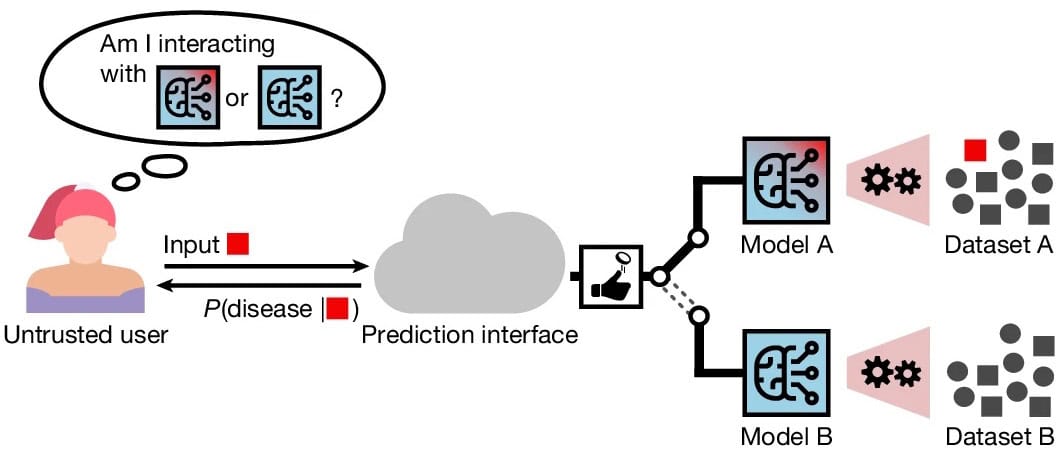
Membership inference attack An untrusted user aims to infer whether a specific target record was part of the training dataset, by observing the predictions of a model. The attack is successful if they can reliably distinguish between models A and B, which are identical except for the inclusion or exclusion of the target record in the respective training dataset. (Courtesy: CC BY 4.0/Nature 10.1038/s41586-026-10688-0)
A new study has revealed that sensitive health information about individual patients can be extracted from medical artificial intelligence (AI) models more effectively than previous research had indicated.
Diagnostic AI models are used to determine whether some given health data belong to a specific class – for example if an X-ray image shows evidence of pneumonia – and offer huge promise for improving patient outcomes. Earlier studies showed that membership inference attacks (MIAs), which determine whether a particular person’s data was used to train an AI model, yielded results no better than random chance. But these previous studies only evaluated the average risk across all patients in a training dataset.
By contrast, in this latest work doctoral student Moritz Knolle and his supervisor Daniel Rückert at the Technical University of Munich (TUM), together with collaborators at Imperial College London and Georg Kaissis from the Hasso Plattner Institute (HPI), examined the privacy risk for an individual patient. “Privacy that only works on average has little meaning. So I asked myself: would I contribute my data to train a medical AI model?” says Knolle.
Investigating the risks A team led by Daniel Rückert (pictured) at TUM and Georg Kaissis from HPI found that medical AI is more vulnerable to certain attacks than previously thought. (Courtesy: Juli Eberle/TUM)
As detailed in their recent Nature paper, the researchers attacked AI models based on seven different types of real-life medical datasets, including one comprising 21,799 electrocardiograms and another of 377,110 chest radiographs.
“If a model sees a specific data point during training, it usually becomes more confident at predicting it. So in these MIA attacks I compare the predictive probability number for this data point outputted by the medical AI model with the predictive probability number obtained from my model which has not seen that data point,” explains Knolle, adding that the attack is essentially a statistical test to distinguish between the two models.
Their results revealed that the privacy risk for an individual was far greater than the average risk. The team also found that privacy risk is not equally distributed among subgroups.
“We found that patients from minority groups that are under-represented in the training dataset tend to be over-represented among the 99 percentile of extreme [privacy] risk,” Knolle tells Physics World, warning that as medical AI models become larger and more sophisticated the privacy risk is amplified because their deep analysis creates the small changes in predictive probability that MIAs are good at finding.
While an MIA that reveals someone is a UK citizen poses little security risk, discovering that an individual has received a specific type of cancer treatment reveals personal information that could, for instance, adversely affect their medical insurance premiums. “The more specific the training cohort is, the larger the privacy risk,” states Knolle, crediting his medical doctor parents with inspiring his desire to improve healthcare AI.
Countermeasures include differential privacy (DP), in which a small amount of Gaussian random white noise is added in alongside the data during training, thereby reducing the effectiveness of MIAs while maintaining the model’s diagnostic accuracy. “This gives a mathematically provable upper bound for how much privacy risk any individual in this dataset could face, by limiting the information content that flows to the AI model,” explains Knolle.
He notes that, unfortunately, such DP tools have not been widely adopted by hospitals or clinics. This, he fears, could undermine patients’ confidence in sharing their data, and thereby not only reduce AI’s ability to help combat rare diseases, but also compound AI discrimination that occurs when there is too little data from minority groups included in training datasets.
“So we are hoping to inspire the medical AI community to do risk assessments before deploying AI models, and use verifiable strategies such as DP or limiting access to the AI model, so that as an individual you have a statistical guarantee that no harm would come to you by being part of a dataset,” concludes Knolle, who now plans to investigate the privacy risks posed by generative AI models for healthcare.
Environmental Research: Climatewas launched in 2022, with the aim of uniting multidisciplinary communities. With a scope that is intentionally broad, the mission of the journal is to publish innovative research examining the causes, consequences, and solutions of climate variability and change. Since our launch, we have published more than 270 articles covering physical and biogeochemical processes that shape Earth’s climate across spatial and temporal scales; the human and ecological dimensions that shape climate-related risks and impacts; and the design, analysis and evaluation of climate mitigation, adaptation, and risk-management strategies and solutions. This webinar will explore the current state of climate research, including changes in the field over the last five years since the launch of the journal, and direct us toward the future.
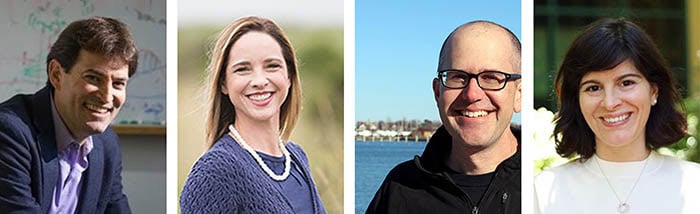
Left to right: Noah Diffenbaugh, Katharine Mach, Andrew Pershing, Inês Azevedo
Moderator: Noah Diffenbaugh, Stanford University
Noah Diffenbaugh is the William Wrigley Professor and Kimmelman Family Senior Fellow in Stanford’s Doerr School of Sustainability, and the Olivier Nomellini Family University Fellow in Undergraduate Education. His research is focused on understanding what aspects of the climate system most directly and acutely impact people and ecosystems. Noah has served as a Lead Author for the Intergovernmental Panel on Climate Change (IPCC), and as editor-in-chief of the peer-review journals Geophysical Research Letters and Environmental Research: Climate. He has provided testimony and scientific expertise to federal, state and local officials. Noah is an elected Fellow of the American Geophysical Union (AGU), a recipient of the James R. Holton Award and William Kaula Award from the AGU, and has been recognized as a Kavli Fellow by the U.S. National Academy of Sciences.
Katharine Mach, University of Miami
Katharine Mach is professor and chair of the Department of Environmental Science and Policy at the University of Miami Rosenstiel School of Marine, Atmospheric, & Earth Science. During spring 2025, she was the Coleman P. Burke Distinguished Visiting Professor at the Yale School of Environment. Her research assesses climate-related risks and response options to address increased flooding, extreme heat, wildfire and other hazards. Through innovative approaches to integrating evidence, she informs effective adaptations to the risks.
Katharine was the 2020 recipient of the Piers Sellers Prize for world-leading contribution to solution-focused climate research. She has served as a chapter author or lead in the Fourth through Sixth US National Climate Assessments and the IPCC Sixth Assessment Report and as a member of the National Academies Climate Security Roundtable. She serves as co-editor-in-chief for Climate Risk Management, an editorial board member for Oxford Open Climate Change and Environmental Research: Climate, and an advisory committee member for the Aspen Global Change Institute. Across all of her research projects, she engages in relevant policy processes and explores and discusses climate risk and adaptation with the media, the private sector, nongovernmental organizations and communities.
Andrew Pershing, Climate Central
As chief programme officer, Andrew Pershing, PhD, leads Climate Central’s climate science activity. His role includes bridging primary research and media analysis to amplify critical work on climate change and climate impacts and make it accessible to audiences around the world. As the director of attribution science and climate fingerprinting, Andrew is developing tools like the Climate Shift Index to quantify how climate change has increased the likelihood or severity of conditions in the atmosphere and ocean. He works closely with communications experts at Climate Central and our partners to help the media and others to incorporate this information into their content.
Andrew has led interdisciplinary research teams to study the impact of global warming on marine ecosystems in the northwest Atlantic. More recently, his work has focused on how climate trends interact with decisions that people make and on how marine ecosystems store and process carbon. As a communicator, Andrew has deep experience working with journalists to present climate science on air and in print.
Inês Azevedo, Stanford University
Inês M Lima Azevedo is a professor in the Energy Science & Engineering department at Stanford University. She is a senior fellow at both Stanford Woods Institute for the Environment and for Precourt Institute for Energy. She has a BSc in environmental engineering (2004) and a MSc in engineering policy and management of technology from IST-Portugal, and a PhD in engineering and public policy from Carnegie Mellon University (2009). Inês is passionate about solving problems that include environmental, technical, economic and policy issues, where traditional engineering approaches play an important role but cannot provide a complete answer. In particular, she is interested in assessing how energy systems are likely to evolve, which requires comprehensive knowledge of the technologies that can address future energy needs and the decision-making process followed by various agents in the economy.
About this journal
Environmental Research: Climate explores the causes, consequences, and solutions of climate variability and change, by uniting research communities across the entire spectrum of the climate system.
Editor-in-chief: Noah Diffenbaugh Stanford University, USA
Sugars are a vital ingredient in the recipe for life, responsible for a range of biological processes and a key component of nucleic acids such as DNA and RNA. The question of how these essential biomolecules were produced on primitive Earth is a pressing concern for origin-of-life researchers, with laboratory experiments suggesting that primordial conditions would not yield sufficient quantities.
In a study led by Izaskun Jiménez-Serra at the Centro de Astrobiología (CAB, CSIC-INTA) in Spain, researchers have observed a four-carbon sugar, erythrulose, in the interstellar medium for the first time. Such sugar could have contributed to the resources available for early biological processes, providing insight into how life began on Earth.
Sugars in space
Based on studies of asteroid samples, researchers suggest that key building blocks for life may have had an extraterrestrial origin. Previous analysis of samples from the asteroid Bennu has demonstrated the presence of the sugar glucose, a primary energy source for biological processes, and ribose, a sugar that contributes to the development of nucleic acids.
The idea is that meteorites and comets containing these important chemical components impacted Earth and contributed to the resources available to develop life. This latest research looks backwards in this process to question whether these molecules may have formed in the clouds of dust and gas that parent these astronomical bodies.
Detailed in Nature Astronomy, this first observation of sugar in the interstellar medium suggests that the ingredients for life may indeed form in dust clouds as previously proposed.
Detecting erythrulose
To detect these molecules, Jiménez-Serra and colleagues used the Yebes 40 m and IRAM 30 m telescopes in Spain. Ultrasensitive, broadband spectral surveys allowed them to identify the signature of erythrulose inside G+0.693−0.027, a cloud of gas close to the centre of the Milky Way.
The team had to overcome various challenges, including the spectral signatures of different molecules overlapping and blending into one another. To ensure the validity of their observations, they identified over 180 molecular species to better understand any possible interference with the emission of erythrulose. This extensive characterization allowed the researchers to obtain very high levels of confidence in their observations, they say.
The team also analysed how the erythrulose may have been formed in the extreme low temperatures and vacuum conditions of interstellar space. The abundance of erythrulose is eight times that of three-carbon sugars which are currently undetected by these incredibly sensitive observations. This led the team to model the formation of erythrulose from simpler and more readily available two-carbon aldehydes and alcohols – a process that occurs on the surface of grains of dust in space, with the potential to then contribute to chemical systems on Earth.
Extraterrestrial building blocks
On Earth, erythrulose is found in fruits such as melons and raspberries. In aqueous environments, such as bodies of water on Earth, erythrulose easily changes its configuration into the sugar threose. Similar to ribose in RNA, threose appears in threose nucleic acid (TNA). One of the simplest nucleic acids, TNA may be one of the first involved in the early development of life.
According to Jiménez-Serra: “The discovery of erythrulose in the interstellar medium opens up the possibility for these key organic compounds to form in other molecular clouds in the Galaxy where stars and planets are forming”.
The team’s future plans include searching for larger sugars such as the five-carbon ribose found in RNA. “By combining astronomical observations with laboratory experiments and theoretical calculations, we will explore the chemistry of these sugars and of their related compounds, which could have played a key role in the origin of life,” shared Jiménez-Serra.
The work is being completed as part of the ERC consolidator grant OPENS. This highly interdisciplinary project draws from a range of research methods and scientific fields to approach the question of how life begun on earth. By continuing this research, the team hopes to learn more about the very earliest stage of our journey on this planet.
By controlling a type of polarized light widely used in quantum optics, researchers have transformed subtle optical patterns in our peripheral vision into vibrant, easily perceptible shapes. Led by Dusan Sarenac at the University of Waterloo, Canada, the team showed for the first time that the “Boehm’s brushes” perceived by participants can be altered by adjusting the topology of spin-orbit coupled light. Their results, reported in Proceedings of the National Academy of Sciences, could lead to promising new techniques for checking our eye health.
For the most part, human eyes are incapable of detecting polarization in visible light. But in some rare cases, structures inside the eye itself can scatter light in different ways depending on its polarization, creating subtle yet perceivable “entoptic” patterns. Perhaps the best-known examples of these are “Haidinger’s brushes”: hourglass-shaped patterns that can form in our central vision, but only when viewing linearly polarized light at blue wavelengths.
In 1940, Swiss biophysicist Gundo Boehm discovered another example: a two-lobed, bowtie-shaped entoptic pattern that forms when viewing linearly polarized light in the peripheral vision as it scatters from subcellular structures in the inner retina. Unlike Haidinger’s brushes, this lesser-known effect is driven by angular variations in scattering strength relative to the polarization direction.
But as Sarenac explains, these ethereal shapes are more than just a curiosity. “Because retinal disease may alter a person’s ability to perceive the pattern, researchers have long considered whether Boehm’s brushes could serve as a biomarker of retinal health,” he says. “However, their weak visibility has limited practical use.”
Whereas previous studies simply asked participants to passively observe the effect, Sarenac’s team considered what would happen if the light’s polarization was constantly varied. To explore this possibility, the researchers created a beam of spin-orbit coupled light, in which polarization is linked to the light’s orbital angular momentum – a property describing how the wavefront twists as the beam travels – so that the polarization direction rotates steadily across the beam.
In quantum optics, these structured waveforms are already being widely explored for their possibilities in imaging, communication and information processing. But for the first time, Sarenac’s team considered how our eyes could actually perceive this light. “We engineered the spatial polarization of the light to match the symmetry of the retinal scattering response,” Sarenac describes. “This allowed many weak local contributions to reinforce one another.”
The researchers then projected this structured light through a ring-shaped aperture, targeting specific regions in the periphery of participants’ retinas, which could also be adjusted to target varying distances from the centre of vision. Using an automated test, they measured how much contrast participants needed to reliably distinguish a Boehm’s brush from the background at these varying distances.
Based on the subject’s responses, Sarenac’s team determined that the use of spin-orbit coupled light not only made Boehm’s brushes appear far more vivid to the participants, it also transformed the bowtie shape into a multi-lobed pattern, with the number of lobes varying depending on the topology of the light’s twisting polarization.
“Across 11 participants, detection thresholds improved exponentially away from the centre of vision, and the pattern became robustly visible at approximately one degree of retinal angular distance,” Sarenac describes. These results reveal a fascinating link between human vision and quantum mechanics, which the team hope could be harnessed in practical healthcare. With further studies involving patients with retinal disease, they now envisage eye tests where retinal conditions could be diagnosed in people who can’t clearly perceive vibrant, multi-lobed Boehm’s brushes in their peripheral vision.
“In the longer term, these patterns may provide a non-invasive functional probe of retinal integrity because their shape and visibility can be measured across different retinal locations,” Sarenac says.
What happens when a cosmologist points their tools at the dinner plate instead of the night sky? One person who has done just that is Sarah Bridle, who studied natural sciences at the University of Cambridge in the UK and then stayed on to do a PhD in cosmology, graduating in 2000. Having spent two decades mapping dark matter and building large collaborations around open data, Bridle is now chair in food, climate and society at the University of York, applying that same quantitative, physics based mindset to food.
Food manufacturing is a huge sector: in the UK, it employs 400,000 people and contributes £28bn to the economy. Physics underpins much in the field – everything from productivity, food safety and food security to health and nutrition, waste reduction and environmental impact. Bridle talks to Gleb Yakubov, a food physicist at the University of Leeds, about what inspired their switch from cosmology to food physics and tips for those looking to follow suit. Yakubov is a committee member of the food physics group of the Institute of Physics (IOP), which bridges industry and academia, raises the profile of physics in food, and represents the community to policymakers.
What attracted you to food physics?
It began when I heard that the late David MacKay, who was working at the University of Cambridge, was ill. He worked on error-correction codes, education and artificial intelligence, before pivoting to sustainability and became chief scientific adviser to the UK energy department. I started thinking hard about why we do what we do, and what would happen without him doing the fantastic work he led on energy and climate.
I began watching his talks and learning about climate change – something I hadn’t really engaged with while immersed in astrophysics. In one of his penultimate presentations, he highlighted food as having huge potential to influence climate change through diets and how we produce food. From that moment on I wanted to understand this area – it was compelling, timely and I got obsessed.
You’ve called land use the “dark matter” of climate solutions – what do you mean by this?
Most people aren’t aware that food is responsible for up to a third of global greenhouse gas emissions and, in the UK, about 70% of land is used for agriculture. Many climate solutions involve land – forests for sequestration, biofuels, solar – and people often say “we can’t spare land, we need it for food”. But the way we use land for food can be extremely inefficient, which blocks those climate solutions. That’s a huge, underappreciated lever.
When you started working in food, what surprised you most?
As a data geek, I expected it to be all about technical solutions but what surprised me was how dominant social and cultural factors are too. You see versions of the so-called “Jevons paradox”: introduce an efficient technology and people just use more of it, cancelling the gains. Unless, that is, you pair it with social and cultural change. Food systems aren’t just complicated; they’re a complex mix of people, incentives, norms and feedback loops.
How did you shift that approach, given that people don’t always behave rationally?
I don’t think people are random; they just use different decision criteria than many models assume. For example, if you raise the price of meat to reduce consumption, some people may see it as more of a luxury and desire it more. You can get perverse responses unless you understand the social context. On top of that, my recent work looks at the potential for civil unrest and even societal collapse – uncertainties we wouldn’t have anticipated five years ago. It pushes us to combine quantitative modelling with deeper social insight.
Can you share an example where astrophysics tools didn’t work in a food context?
Early on I tried to repurpose multispectral satellite-imaging techniques to detect blackgrass in UK wheat fields. Blackgrass is a serious weed that hits yields and this felt like a neat transfer – I’d been analysing astronomical imaging, so why not fields? But it turned out to be too difficult with satellite data alone. Variables like soil moisture, rockiness and other field conditions confounded the signals. That experience nudged me away from a pure imaging approach toward broader system modelling – and, later, back to data with more contextual integration.
Tell us about your “future food calculator”?
About five years ago we started building a quantitative model of the food system to compare interventions on a common footing: on-farm practices such as fertiliser, irrigation, crop management; consumer dietary shifts; and land-use choices. We turned it into a web-based dashboard inspired by MacKay’s energy calculator. Users can move sliders, explore UK production and consumption, greenhouse gas emissions, self-sufficiency and land use, and ask, “Do these choices get us to net zero, and with what trade-offs?”
How do you handle the “people” side – demographics and messaging – in such models and outreach?
You have to meet people where they are. Older generations, on average, are more focused on health than climate. Children and younger people tend to feel invincible about health but are very concerned about climate. If you’re trying to encourage dietary change, those differences matter for messaging and for assumptions in models.
What have you learned about information versus behaviour change?
From obesity research we know that giving people information often doesn’t change behaviour. But it does increase receptiveness to policy. You couldn’t have a sugary drinks tax without enough people accepting that sugary drinks contribute to type 2 diabetes and put pressure on the National Health Service.
I think the same is true for climate and food: we need systemic changes that make sustainable choices easy by default, and public understanding helps make those changes legitimate. Reformulation and choice architecture are good examples – you can reduce beef content in a lasagne by adding pulses, or put low-impact options first in canteens. Many people won’t even notice, but outcomes improve.
While space has an intrinsic “wow” factor, how do you create that for the food industry?
For many people there’s a complete disconnect between food and how it’s produced. Experience helps more than pictures so community garden projects, for example, let people see how hard it is to grow food and how weather drives yields. That fosters respect for food, reduces waste, increases interest in the natural world and builds practical resilience.
Balancing act Food production is responsible for up to a third of global greenhouse gas emissions. (Courtesy: iStock/Stephen Meese)
You’ve also advised on environmental labelling – what should a good label do?
People already face a lot of labels, and shopping may not be when they’re most receptive. Studies show labels don’t shift individual purchasing as much as you might expect. But labels do change production. In pilot programmes, adding climate labels led operators to change what they offered once they saw the differences. In Canada, when authorities announced a tighter threshold for “red” sugar labels, manufacturers reformulated to avoid red. So the big impact is upstream – on what gets produced.
What’s inside the “digital twin” of UK food you’re building and what can it tell policymakers?
We take UK production and consumption, feed use and losses, and then we test interventions and see how they affect greenhouse-gas emissions and self-sufficiency. An example is soil carbon management practices such as how to reduce tillage – the mechanical manipulation of soil to prepare seedbeds – manage crop residues and control weeds. Another is dietary and consumer preference shifts, such as reducing red meat consumption. The twin helps interrogate trade-offs and unintended consequences, and assess whether a bundle of changes can hit net-zero targets while maintaining resilience.
Herbicides like glyphosate illustrate those trade-offs. How do you manage that complexity?
Exactly. No-till – an agricultural technique that plants crops without disturbing the soil through traditional ploughing or tilling – can reduce emissions but may increase reliance on herbicides if weed pressure rises. The point is to quantify those interactions at the system level and compare pathways transparently, rather than assuming any single intervention is universally better in isolation.
How do the field’s data practices compare with astrophysics – and what would you change tomorrow?
Food physics feels like astrophysics did 20–30 years ago. In astrophysics today everybody codes, collaborations are large and data and code are open. When we released Python code on GitHub for food-system models and invited contributions, basically no-one engaged because the skills weren’t there. Many models live in Excel rather than in transparent, version-controlled code.
We need standards, shared datasets, open code and co-ordinated efforts
Sarah Bridle
Even at the policy interface there are gaps: you might get a major report with spreadsheets but not the underlying code or assumptions, which we then have to reverse-engineer. With a problem as urgent as climate change, that level of opacity isn’t defensible. We need standards, shared datasets, open code and co-ordinated efforts.
What advice do you have for physicists or mathematicians who want to follow in your footsteps?
Quantitative modelling, open-source practices and Python-based tooling are highly sought after right now. Help build transparent models and shared datasets, and join or create collaborative efforts that mirror modern astrophysics consortia. Also, find your people. The best advice I got was to “adopt your own mentors”. I worked with a career coach and asked people for 30-minute calls. Many were lukewarm, but a few were transformative and became long-term collaborators. It was painful but made all the difference.
What is a concrete step someone could take now?
One is to bring open-science habits to food-system work: publish code and assumptions, contribute quantitative skills to cross-disciplinary teams, help build shared datasets and reproducible models, and translate findings into accessible tools – like interactive calculators – for policymakers and the public.
What motivates you now?
My motivation is about doing what I can to help with the crisis we’re walking into. It’s a way to channel worries about the future into practical improvements.
Looking a decade ahead, what would success look like for the UK food system?
Success would mean that UK production and consumption are aligned with net-zero targets and that land is used more efficiently so other climate solutions can scale. Through product reformulation and choice, I hope we can make low-impact diets easy by default. I also hope that self-sufficiency and resilience improve – and that open, quantitative modelling with transparent code and assumptions is embedded in policymaking.
“Solar towers” that convert sunlight into heat could play a useful role in the renewable energy transition, but high installation costs and complex requirements limit their attractiveness to commercial operators. A team of researchers from Germany’s Karlsruher Institut für Technologie (KIT) and the German Aerospace Center (DLR) is now taking steps to change that. By creating a freely accessible database of information about how these plants work, they aim to accelerate research on solar thermal energy and drive improvements that could allow the technology to be more widely deployed in the future.
Unlike photovoltaic panels, concentrating solar power (CSP) plants do not convert sunlight directly into electricity. Instead, they generate heat by using an array of movable mirrors called heliostats to funnel sunlight onto a receiver located at the top of a tower. This heat can be used to drive a turbine to produce electricity immediately, but it can also be stored and used to generate electricity at night or on cloudy days. Depending on the plant’s location and setup, the heat could even be used directly for industrial applications and district heating.
The problem, explains study leader Kaleb Phipps, is that operating solar power tower plants safely and efficiently is a complex and expensive task. “CSP technologies have the potential to help the transition to a renewable energy system,” says Phipps, a research fellow at KIT’s Scientific Computing Center. “However, they are still not financially viable and there are operating challenges associated with them.”
Before researchers can develop and reliably test new, improved processes, Phipps explains that they need access to real-world operational CSP data. “We believe that modern data-driven machine learning methods like ours can help solve a lot of these problems,” he says.
849 gigabytes of operational data
To construct their database, which is known as PAINT, researchers collected data from the CSP tower near Jülich, Germany. These data include the exact positions of the tower’s 2014 mirrors, their dimensions, how they are warped and the way they rotate and tilt. The team also obtained fine-grained weather data for the entire 2021-2024 period under study, plus a further 218 000 images to help determine whether the mirrors were efficiently directing sunlight precisely to the top of the tower.
All in all, the PAINT database contains 849 gigabytes of operational data organized using the SpatioTemporal Asset Catalog (STAC) standard. To make these data FAIR (findable, accessible, interoperable and reusable), the researchers developed software to simplify access to the database and then published the data in a way that is freely available to all users.
Their goal, they say, is for other researchers to use this FAIR database to develop “digital twins”, or virtual replicas, of real-world CSP plants. When combined with machine-learning models, such twins can be used to answer questions such as whether the mirrors are aligned for maximal light absorption (one of the most important parameters for efficient operation) in near real time.
Community reaction
“The fact that we are receiving many positive responses regarding the data and that people seem to appreciate it is our biggest success,” Phipps says. Such responses are especially gratifying, he adds, because constructing databases like PAINT can be an arduous task.
“The main difficulties were about collecting the data, cleaning and unifying it into standard formats and parsing and organising all the metadata, which was originally complete chaos,” Phipps recalls. “We therefore put a lot of time and effort into creating standardized and automated workflows so that the process is as transparent as possible and can be reused for future data.”
The team also faced challenges when trying to convince peers that this work counted as “research”, he adds. “The fact that the data itself didn’t directly result in a new algorithm or method meant that lots of people didn’t believe we would be able to publish the results or achieve anything with them,” says Phipps. “Luckily, we were able to prove the doubters wrong.”
While the PAINT database currently contains data from only one CSP, the KIT researchers, who report their work in Nature Energy, are hoping to expand it. “We really need contributions from other CSP power plants around the world to transform the database into a truly international and diverse source for researchers,” Phipps says. “As data from different facilities is added in the future, it will be possible to develop a common standard for open operational data in solar tower research. This would speed up the development and promote a widespread adoption of this technology.”
Astronomers have raised concerns over a decision by the Federal Communications Commission (FCC) to permit the launch of a private satellite that can reflect sunlight onto the Earth’s surface after dark. Astronomers, however, fear that the mirror, and the several thousand that could follow it, will negatively impact both optical and radio astronomy.
The proposal by the Californian company Reflect Orbital involves putting a mirror-carrying-satellite – Eärendil-1 – into low-Earth orbit. Reflect Orbital aims to use the craft to test technology intended to deliver sunlight to solar farms after sunset, thus expanding the production of solar power at a time of peak demand for electricity.
In orbit, the satellite will unfold an 18 × 18 m aluminiumized Mylar reflector that can deliver a roughly 5 km circular spot of light to the ground with about the brightness of a full Moon.
In addition to providing solar power after dark, the company sees its technology as potentially effective for response to disasters, construction work and outdoor events at night.
Assuming Eärendil-1’s flight proves successful, the company plans to launch 1000 larger satellites in 2028, which would be able to reflect as much light as 100 full Moons with 5000 more satellites two years later.
The FCC has approved only the radio operations of “a single demonstration satellite [that is] an example of a potentially groundbreaking technology”. Other aspects of Eärendil-1, however, do not require official authorization.
Ben Nowak, chief executive and co-founder of Reflect Orbital, sees the licence as “the first step toward rigorously testing our technology’s efficacy and the safeguards we have developed”.
Flash points
Orbiting satellites’ impact on astronomy is hardly a new phenomenon. Their burgeoning number has already reduced observing times for optical astronomers, particularly after sunset.
Following the approval, the American Astronomical Society (AAS) has expressed “dismay” at the FCC’s decision. [Eärendil-1] carries the potential for significant harm to our members and the broader community of those who depend on a dark night sky,” the association says in a statement. “[This] could include damage to sensitive research equipment, potential flash-blinding of pilots and drivers, and potential permanent eye damage to anyone looking through a mid-sized telescope.”
While some satellite owners have been open to working with astronomers to reduce the impact on astronomy, astronomer Marcel Agüeros from Columbia University, who is also president of the AAS, told Physics World that Reflect Orbital “has been far less open” to discussing its plans. “We know nothing about the satellite’s orbit, for example,” adds Agüeros.
DarkSky International, a nonprofit organization that aims to preserve and protect the nighttime environment, has now called on the company to commission a “comprehensive, independent environmental impact assessment conducted by qualified experts”.
“The burden of proof rests with the operator to demonstrate that their system will not cause environmental or public harm, and a full, independent assessment is the necessary first step,” notes DarkSky International.
That move is backed by Agüeros, who adds that there doesn’t seem to have been much thought about the consequences of the FCC’s decision. “When you start to mess with the nighttime, there should be a very high bar you have to clear,” he adds. “We’re losing our ability to experience a dark sky – an experience that gives you a sense of your place in the universe that is pretty much unmatched.”
Reflect Orbital spokesperson Christopher Buscombe told Physics World that the company “care deeply” about the night sky and that they “want to preserve astronomical observation”.
“We’re also working with the National Science Foundation to develop a coordination agreement on these questions and look forward to their input,” adds Buscombe.
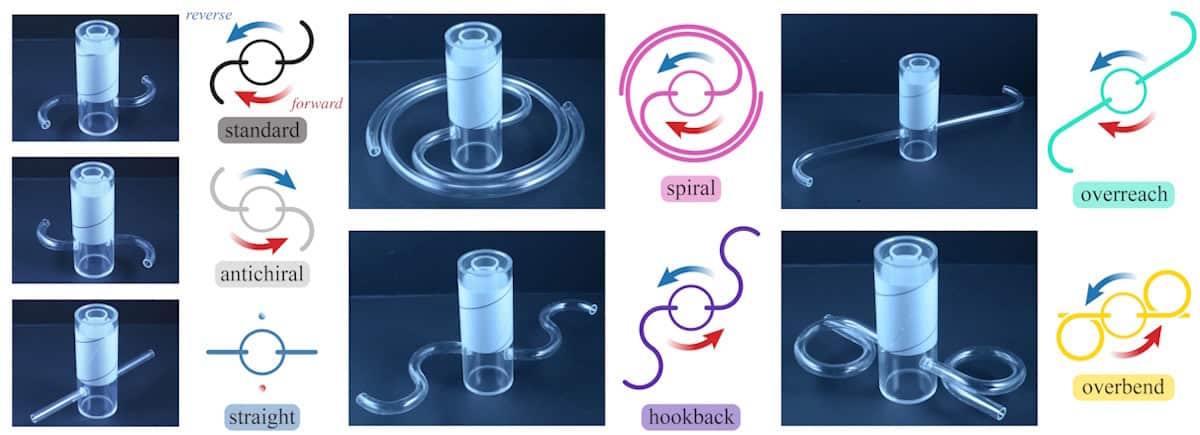
New insights into the “reverse sprinkler” problem popularized by Richard Feynman have been provided by US researchers using modified rotary sprinklers. The results, which indicate that the reverse sprinkler is driven by the angular momentum induced at its centre by water being drawn in, could shed light on the fluid dynamics of open systems.
Rotary lawn sprinklers are ubiquitous devices that eject water at an angle to the head, thereby generating the torque to rotate and water a 360° area. The puzzle is how – or whether – sprinklers rotate if the problem is inverted and they suck the fluid in rather than blowing it out. A lawn sprinkler will, of course, draw in air, but Feynman conducted experiments with a submerged sprinkler that sucked water in and arrived at conflicting results.
Applied mathematician Leif Ristroph of New York University says that the asymmetry of the problem is not in itself surprising. “You can blow out a candle but you can’t suck it out,” he points out. “When you blow out a fluid through an orifice at a high enough flow rate, it forms a concentrated jet…When you reverse the system and pull in fluid at the same flow rate, the flow does not reverse – it pulls in fluid from all directions. That comes from the irreversibility of the Navier-Stokes equation.”
The correct way to model the system, however, is less clear. Some researchers have argued that the problem should be best solved by considering the total angular momentum of the system. Others focused on the torque exerted on the outside of the structure as fluid enters the nozzles, or the angular momentum that builds up at the centre due to the fluid that flows in from the outside of the arms.
Attempting to disentangle these explanations, Ristroph and colleagues constructed a set of specially designed sprinklers. They submerged the devices before either drawing water out of the centre of each one or feeding it in. Each device’s geometry was designed either to amplify or nullify one of the effects previously proposed to determine the torque and thereby the rotation rate. For example, they tested the impact of the overall angular momentum by comparing devices with “spiral” arms (in which water travelled 360° before escaping) to those with S-shaped “hookback” arms (in which it doubled back). This did not explain the observed results.
Sprinkler geometries The studied sprinkler designs, with the observed rotation direction in the forward (red arrow) and reverse (blue) modes. (Courtesy: NYU’s Applied Mathematics Laboratory)
There was one factor, however, that correlated with torque and rotation rate irrespective of the geometry of the arms. “If you measure the angular momentum flux from any one of these designs it’s quantitatively one-to-one with the torque on the solid [in the forward case],” says Ristroph. “The beautiful thing is the same thing works in the reverse case, except now you should look at the centre where these arms begin, and there are very subtle asymmetries that inject angular momentum to the core of the device…That’s the common unifying principle: in all cases there are jets generated, but in the reverse case those jets are pointing in.” The lower torque at the centre makes the sprinkler much slower in reverse.
Mechanical engineer Earl Dowell of Duke University says that “the study in the paper is largely experimental,” although he acknowledges that “the experiments appear to have been carried out competently and the results presented in a well-organized manner”.
“What the authors call theories are notional ideas based upon highly simplified concepts that tend to be favoured by some physicists,” Dowell adds. “An expert in fluid mechanics…would attack this problem with well-established computational models for the flow field and rigid body dynamics for the sprinkler per se.” He believes that this is not, to his knowledge, being done because neither experiments nor computational simulations are expected to reveal any fundamental new concepts in fluid mechanics.
“I have a hard time thinking this going to generate a practical device,” concedes Ristroph. However, he says that entirely new methods were needed to conduct these experiments and the researchers are now developing new computer simulations of fluid dynamics, in which fluids enter and escape from the system, to apply to it. “This is a beautiful problem to test your experimental methods, your computational methods, modelling, theory…This is a place to give it the best test it can possibly have.”

 Login