❌

Normal view

Hofstadter’s butterfly turns 50: a fractal hiding in quantum matter

5 October 2026 at 14:00

In the mid-1970s a graduate student wrestling with a deceptively simple quantum problem uncovered one of the most haunting images in modern physics. The pattern seemed almost impossibly intricate: delicate wings assembled from infinitely nested bands and gaps, a self-similar pattern born from the motion of electrons in a crystal under a magnetic field. First published in 1976 (Phys. Rev. B 14 2239), it came to be known as Hofstadter’s butterfly, after its discoverer Douglas Hofstadter.

Half a century later, the butterfly has not faded into scientific nostalgia. If anything, it has become even more important – reappearing in new materials, new experiments and in places no-one imagined when it was first plotted. Recent research by Kazuki Ikeda from the University of Massachusetts and Yaron Oz at Stony Brook University suggests that related patterns may even surface in the physics of black holes (J. High Energy Phys. 2026 38).

Each new realization adds another chapter to a story that is not really about a single graph, or even a single discovery, but about the unity of patterns across the physical world. A structure first seen in a simple model has become a symbol of how richness can emerge from basic rules, how beauty can arise from constraint, and how the quantum world still harbours forms strange enough to surprise us.

How the butterfly got its wings

What makes Hofstadter’s butterfly so compelling is the remarkable story of its birth and, more importantly, how far it has travelled from its original birthplace. Like many scientific breakthroughs, its discovery was fairly obscure initially and owed a great deal to luck. In 1974 Hofstadter – son of the 1961 Nobel-prize-winning nuclear physicist Robert Hofstadter – had just dropped out of graduate school at Stanford University in the US and was “in despair” according to friend and physicist Francisco Claro.

Having just completed a PhD with the renowned solid-state physicist Gregory Wannier at the University of Oregon, Claro suggested that Hofstadter should approach Wannier as well. As it happened, Wannier had been struggling with a problem that had puzzled him for years: he could not obtain an analytical solution to Harper’s equation, which describes the motion of electrons on a 2D crystal lattice subjected to a perpendicular magnetic field.

Named after P G Harper, who was a graduate student of Rudolf Peierls at the University of Birmingham, UK, this classic “magnetic problem” displayed a mysterious sensitivity to whether the magnetic flux was a rational or irrational number. It was a feature that immediately captured Hofstadter’s imagination and, with the rational–irrational dichotomy echoing in his mind, Hofstadter began his PhD studies at Oregon by immersing himself in solving the problem.

But he soon found himself equally stuck. Frustrated by the analytical approaches often discussed at the time, he pursued a different path: numerical computation. Using a programmable Hewlett Packard desktop calculator that by today’s standards looks laughably primitive, he displayed the numerical solutions graphically as the energy of electrons versus magnetic flux Φ per unit cell of the lattice. At that moment, he became convinced that he had uncovered the true structure of the problem. “All at once my eyes were opened,” Hofstadter recalls.
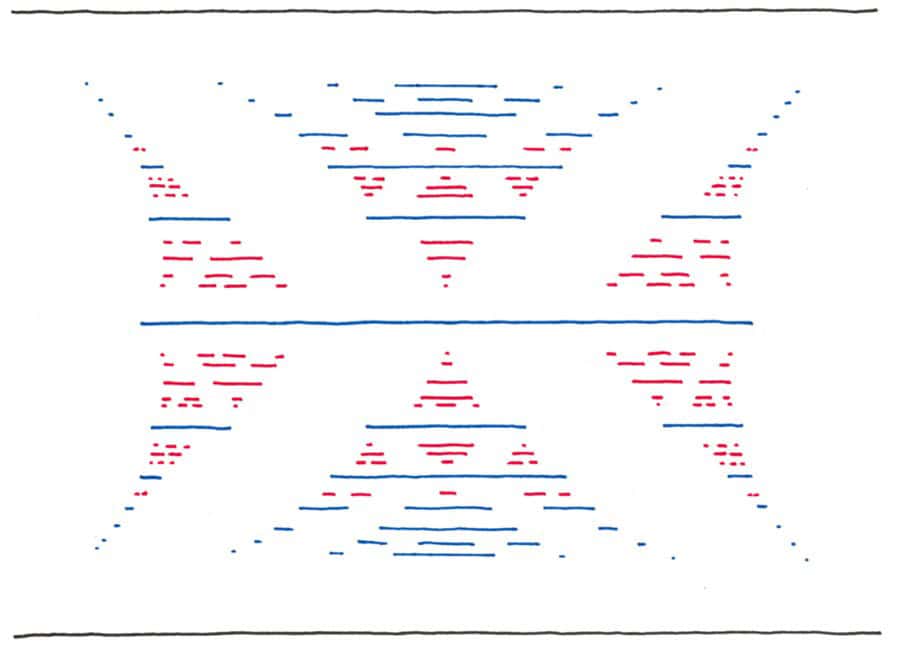
Hand-drawn Hofstadter’s butterfly
Beautiful beginning Hofstadter’s butterfly dates back to November 1974 when Douglas Hofstadter, who was then a PhD student at the University of Oregon, was trying to describe the motion of electrons in a 2D crystal lattice under an applied magnetic field. His work led him to produce a primitive, hand-drawn diagram – dubbed “Gplot” – that looked like a butterfly. The original diagram has been lost so Hofstadter created this reconstruction in 2016. (Courtesy: Indu Satija. Permission granted by Douglas Hofstadter)

What he found was a complex recursive shape (or fractal in today’s terminology) hidden within the energy spectrum of electrons in a magnetic field. Resembling a butterfly, Hofstadter brought his hand-plotted diagram, which he codenamed “Gplot”, to Wannier, who was not impressed. According to Hofstadter, Wannier dismissed the result as “numerology” and even threatened to withdraw the PhD student’s funding.

But after nearly a year, Wannier came to recognize the validity and significance of Hofstadter’s work, ultimately awarding Hofstadter his PhD and accepting the butterfly as a legitimate description of the energy spectrum of electrons moving on a 2D lattice in a magnetic field. Wannier even added to the butterfly’s story with a paper titled “A result not dependent on rationality for Bloch electrons in a magnetic field (Phys. Status Solidi b 88 757). This work, along with further studies with Claro, introduced a set of integers uniquely labelling every gap in the graph, providing a simplified description of the spectrum (Phys. Rev. B 19 6068).

Douglas Hofstadter: in his own words

Three people wearing matching T-shirts with colourful Hofstadter's butterfly artwork
Ruby celebration Douglas Hofstadter (right) pictured in 2016 with colleagues Indu Satija (centre) and Francisco Claro (left) all wearing T-shirts emblazoned with Hofstadter’s butterfly to celebrate its 40th anniversary. (Courtesy: Indu Satija)

Born in 1945, Douglas Hofstadter discovered his eponymous butterfly while a PhD student at the University of Oregon in 1975, using computational modelling to make his breakthrough (see main text). Four years later Hofstadter published his Pulitzer-prize-winning popular-science book Gödel, Escher, Bach, which tackles cognition, mathematics and symmetry.

Currently a professor of cognitive science and comparative literature at Indiana University in Bloomington, US, Hofstadter is still active as a researcher and wrote a follow-up book I Am a Strange Loop in 2007. On the golden jubilee of the now-famous butterfly named after him, Hofstadter provided the following comment to Physics World.

“This graph was first computed using a programmable desktop calculator and was first plotted by hand using coloured felt-tip pens. I was just extremely relieved that by showing that my ‘Gplot’ graph was made of distorted copies of itself, I would at last be able to get a PhD thesis. I had no idea that Gplot would go on to become well known as the Hofstadter butterfly, and that variations on the theme would proliferate like wildfire over the coming decades.”

“As the years have gone by,” he continues, “articles about Hofstadter’s butterfly have grown more and more numerous and harder and harder for me to follow. For better or for worse, these theories are all way beyond me, but remembering the first wingbeats of the butterfly’s flight cheers me up.”

Statements about states

Hofstadter’s butterfly is more than a beautiful graph. It is a map of what happens when quantum particles are caught between two competing kinds of order: the regular periodicity of a crystal lattice and the circular orbits of a magnetic field. When these two scales contend with one another, the energy spectrum does something extraordinary. Instead of varying smoothly, it fragments into a hierarchy of allowed and forbidden energies, referred to as bands and gaps, respectively.

Zoom in on one region and new structures emerge. Zoom in again and the pattern repeats, endlessly varied yet ruled by strict mathematical order. It is one of the rare instances in which fractal geometry appears not only in abstract mathematics or artistic imagination, but in the measurable behaviour of matter itself.

The deep connection between this theoretical pattern and real-world matter became clear through an exotic quantum phenomenon known as the integer quantum Hall effect. It was discovered experimentally by Klaus von Klitzing at the Max Planck Institute for Solid-State Physics in 1980 – a breakthrough that earned him the Nobel Prize in Physics five years later.

The classical Hall effect is what happens when a voltage is produced in a bulk conductor at right angles to an applied magnetic field. Similarly, the quantum Hall effect is the appearance of a voltage across opposite faces of a thin 2D semiconductor when a current is passed along the plane of the material and a magnetic field applied perpendicularly it. But there is one big difference in the quantum version.

If you slowly increase the power of the magnet, the transverse electrical conductance does not grow steadily. Instead, it jumps up sharply, with plateaus in between like steps on a staircase. In other words, it assumes quantized values given by integer multiples of the fundamental constant e2/h, where h is Planck’s constant and e is the charge on an electron.

In 1982 the British physicist David Thouless and his collaborators at the University of Washington, Seattle, made another remarkable discovery: the effect, they found, is topological. Topology is the study of the global properties of objects and topological invariants are those properties that do not change regardless of how much you try to deform a given object.

Thouless and colleagues found that the integers underlying the quantum Hall effect are topological invariants arising from the global topology of the electronic wave functions. This seminal work, which was published in 1982 (Phys. Rev. Lett. 49 405), significantly contributed to Thouless earning the 2016 Nobel Prize in Physics, which he shared with Duncan Haldane and Michael Kosterlitz for their work on “topological phase transitions and topological phases of matter”.

1 Butterfly behaviour
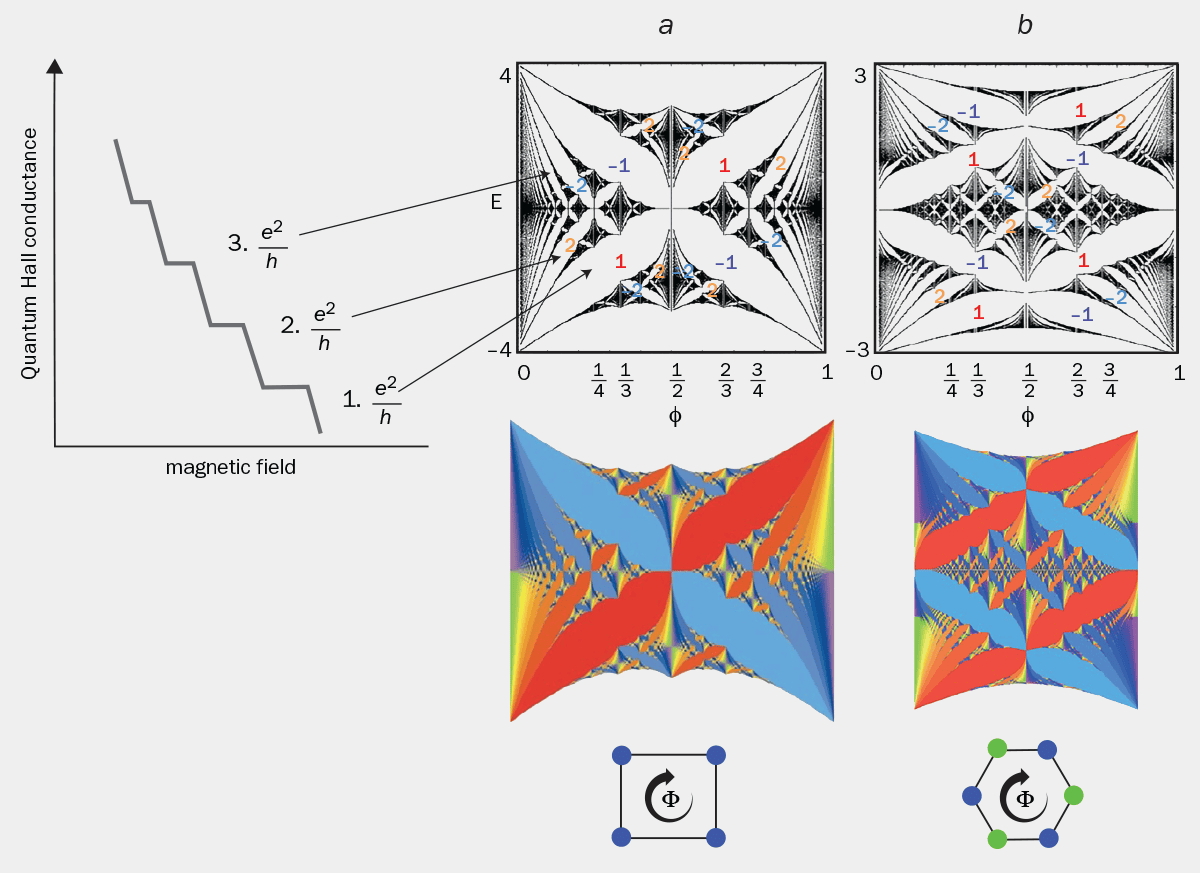
Figure showing how a butterfly shape is derived from graphs of electron energy plotted against magnetic flux
(Courtesy: Indu Satija; CC BY 3.0 New J. Phys. 18 103023; J. Stat. Phys. 156 417. Reused with permission from Springer Nature)

Hofstadter’s butterfly, in its original form, refers to the behaviour of electrons in 2D lattices subject to an applied magnetic field. (a and b) Shown here (top row) are graphs of the electrons’ energy (E) plotted against the magnetic flux (Φ) per unit cell for square and honeycomb lattices (bottom row). The relation between the quantum Hall effect (displayed in the staircase-like graph, left) and Hofstadter’s butterfly is shown via the arrows. The colours on the “butterfly graphs” (middle row) correspond to the quantum numbers of the Hall conductivity. Some of these integer labels are shown (colour coded) in the top row.

How all of this relates to Hofstadter’s butterfly is simple: the butterfly model describes all integer quantum Hall states, where the integers of Hall conductivity label the gaps in Hofstadter’s butterfly – the exact same integers that Wannier and Claro introduced in the butterfly spectrum (figure 1). In other words, the butterfly is not merely a chart of recursively split energy levels; it is also a coded map of topology in quantum matter under a magnetic field.

A pattern repeating across physics

That connection places it squarely within one of the central themes of modern condensed-matter physics, namely the realization that certain physical properties are protected not by local details, but by global features of the quantum state. But what is fascinating is that in the 50 years since Hofstadter’s butterfly was discovered, physicists have found that the same spectral architecture in it can also arise in a remarkable range of settings. It has appeared, for example, in other lattice geometries, in engineered semiconductor devices and in so-called moiré materials.

The butterfly’s migration into moiré systems has been especially fruitful. Such materials are created by stacking two atomically thin materials onto each other with a slight twist, creating a moiré pattern with different properties from the individual layers. Utilizing moiré materials, in research that began in 2013 led by Philip Kim of Columbia University (Nature 497 598) and continues apace with a team led by Ali Yazdani of Princeton University (Nature 639 60), the butterfly structure can now be tuned, probed and in some cases directly imaged on modern quantum platforms.

Over the last 50 years, the butterfly itself has also evolved into other forms. For instance, in some systems, the butterfly emerges without an external magnetic field. As a team of researchers led by Xu-Tao Wan from East China Normal University showed in 2025 (Phys. Rev. Lett. 136 033401), the fractal pattern can be controlled by twist angle – that is, by geometry alone.

Each time physicists add a new layer of realism – spin, interactions, periodic driving or lattice complexity – the butterfly adapts, and re-emerges in new forms, so long as it is not overwhelmed by strong interactions, disorder or thermal effects

In other realistic systems, electron spin – the particle’s intrinsic magnetic orientation, absent from the original simplified model – becomes an essential part of the physics. Even when a magnetic field splits the system into spin-up and spin-down states via Zeeman splitting, the butterfly spectrum survives. More striking still, the butterfly can emerge independently for each spin state, as Xiaomeng Liu and Zhida Liu of Cornell University discovered in 2025 (Nature Phys. 21 1873).

This persistence of the fractal structure, despite the added complexity introduced by spin, highlights the extraordinary robustness and universality of the underlying quantum phenomenon. More generally, what these new iterations of Hofstadter’s butterfly reveal is that what once looked like a specialized theoretical curiosity now seems more like a recurring motif in quantum matter.

Indeed, this is part of its enduring fascination: each time physicists add a new layer of realism – spin, interactions, periodic driving or lattice complexity – the butterfly adapts, and re-emerges in new forms, so long as it is not overwhelmed by strong interactions, disorder or thermal effects. This durability prompted a friend to once joke that whenever he undergoes an MRI scan, he cannot help wondering what kind of butterfly his body might be producing.

Beauty from simplicity

As my friend’s joke reveals, there is something unmistakably human about the butterfly’s appeal. Physicists are drawn to it not only for its usefulness, but for its beauty. It belongs to that rare class of scientific objects whose visual grace seems to gesture toward deeper truths. And yet its deepest charm may lie in the fact that its immense complexity grows from remarkable simplicity.

2 Baby butterflies
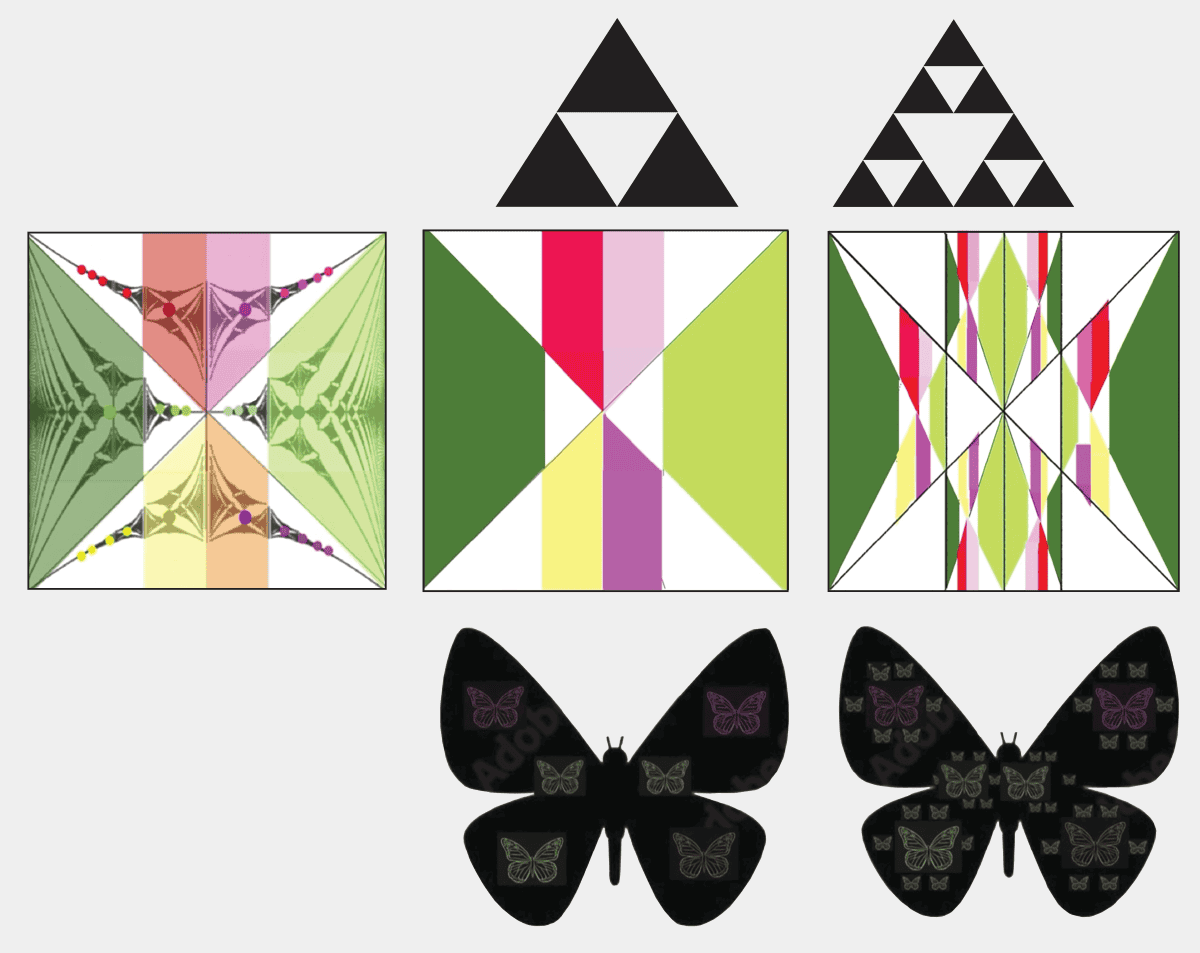
Figure illustrating the relationship between tesselated trapezoids and complex butterfly shapes
(Courtesy: Indu Satija)

A simplified representation of Hofstadter’s butterfly, commonly known as the butterfly skeleton, interpreted as a 2D tessellation of trapezoids and triangles. It is shown in parallel with the “Sierpiński gasket” (top), which is made entirely from triangles. The iterative construction underlying this fractal consists of a parent butterfly generating six “baby” butterflies, represented by the six colour-coded trapezoids. Each baby butterfly is accompanied by a tail – an infinite chain of progressively smaller butterflies, indicated schematically by dots in the corresponding colour. The two butterflies at the bottom provide a schematic illustration of the hierarchical organization of the structure.

Beneath the intricate pattern are integers, recursion relations and number-theoretic structures that connect it to fairly simple geometric patterns, including the Farey tree, the tree of Pythagorean triplets and fractal packings such as the Apollonian gasket. In fact, this complicated quantum fractal admits a surprisingly simple geometric description: the butterfly landscape can be organized as a hierarchical lattice of trapezoids, bringing it into close parallel with geometric fractals such as the Sierpiński gasket (figure 2). It is extraordinary to think that this geometric harmony underlies such a complex and beautiful graph.

Fifty years on, Hofstadter’s butterfly remains exactly what great scientific ideas are supposed to be: elegant, prolific and unfinished. That interplay of beauty, mathematics and physical reality is what keeps the butterfly alive. Its evolution under interactions, spin effects and new forms of engineered geometry continues to reveal unexpected physics. And with each turn, the butterfly reminds us of something rare and precious in science: that the universe can hide immense complexity within simple forms, and that sometimes, if we are lucky, those forms are beautiful enough to be unforgettable.

The post Hofstadter’s butterfly turns 50: a fractal hiding in quantum matter appeared first on Physics World.
DNA computer settles in thermodynamic equilibrium

29 September 2026 at 16:00

A DNA computer that calculates as it settles into thermal equilibrium has been unveiled in Ireland. Drawing together several earlier lines of research, Damien Woods and colleagues at Maynooth University created a DNA-based system that ran calculations far more quickly than they expected, and which could be easily implemented and reused with a relatively simple setup.

Much like a living organism, a computer runs far from thermal equilibrium. It expends energy to maintain encoded bits of information, and to switch between them quickly and reliably as it executes algorithms.

However, in the 1970s physicist Charles Bennett showed that any computation can, in principle, be modified to have reversible dynamics. Such a computer could operate close to thermal equilibrium, slashing its demand for energy.

Taking Bennett’s ideas a step further, others suggested that the output of an algorithm could be delivered in a system’s equilibrium state itself. Starting from a given set of inputs, the computer would then naturally drift towards the solution as it settles into its most stable state.

Multiple challenges

“The idea presents multiple challenges that include finding a physical implementation that is computationally expressive and programmable, has easily prepared initial states and has a controllable energy landscape for rapid navigation to target outputs with high probability,” Woods explains.

One promising platform is the DNA computer, which was first introduced in the 1990s. It replaces silicon chips and electrical currents with DNA strands and biochemical reactions.

Until now, much of the work on DNA computers has involved out-of-equilibrium systems, which are either driven by molecular fuel, or require carefully prepared initial states and tightly controlled experimental conditions. But because DNA strands bind to each other according to simple, predictable rules, researchers could engineer the energy landscape directly. Incorrectly bound strands would then detach and be replaced by better-fitting ones, until the system settles into its most stable state.

To build such a system, Woods’ team was inspired by “DNA origami”. In a 2006, US-based Paul Rothemund showed how a long, single-stranded DNA scaffold could bind to a chosen set of shorter strands. Depending on the strands chosen, the scaffold could fold into a wide array of shapes as it settled into thermal equilibrium.

Tile calculations

Applying these ideas to DNA computing, Woods’ team designed a DNA scaffold carrying an engineered sequence of binding domains, which they mixed into a solution of shorter DNA strands. Dubbed tiles by the researchers, these strands represent the possible values at each step of a calculation. They were also inspired by the notion of tiles competing to bind to each other, a form of molecular computing first devised by US-based Erik Winfree in the 1990s.

After mixing, the tiles compete with each other to bind to the scaffold. At each binding domain, the “winning” tile is the one that binds most favourably to both the scaffold and its neighbouring tiles. In this way, the role of bits in a conventional computer is played by the specific strands that win each position.

“Eventually, the system settles down into its energetically preferred state which encodes the answer to the computation: a sequence of tiles each bound to the scaffold and to neighbouring tiles on its left and right,” Woods describes. “The competitive process of binding executes the computation.”

Altogether, the team demonstrated 10 different programs with their DNA computer, across more than 700 individual computations: including addition, multiplication, and division. Simple computations took as little as a minute to complete, though larger ones took considerably longer.

Just add water

“The same molecular computer can be reused to perform new calculations, running the same program up to 25 times on different inputs,” explains Maynooth’s Abeer Eshra. In one case, the team repeated an experiment after 15 months, simply adding water to a setup that had partially dried out, and still obtained correct answers.

“Our system uses just a handful of different kinds of molecules, never really following an organized process of steps, never making irreversible steps, and yet ending up with the right answer,” adds Maynooth’s Constantine Evans. “When thinking about computation at a molecular level, reliably making even those seemingly simple computations is very hard.”

The programs turned out to be surprisingly fast and easy to implement. To run a computation, the researchers simply mixed all the strands together, heated the solution, and let it cool as the system settled towards equilibrium, without any need for molecular fuel or specially prepared initial states. Remarkably, the team created what is arguably one of the most complex DNA computers built to date, paving the way for a whole host of new directions.

“Although we optimized some aspects of the design, there remain many ways it could be improved and generalized,” Woods says. “The work opens the door to new ways of thinking about computation in a wet environment, and about energy use in computation overall.”

The computer is described in Nature.

The post DNA computer settles in thermodynamic equilibrium appeared first on Physics World.

Word wave puzzle no.8

27 August 2026 at 14:30

Here’s how the game works:

    1. Enter a word guess – in this game the word has six letters.
    2. After submitting your guess, each letter in the guessed word is coloured to provide feedback:
      • Green: The letter is correct and is in the correct position in the target word.
      • Yellow: The letter is correct but is in the wrong position in the target word.
      • Grey: The letter is not in the target word at all.
    3. Using this colour feedback, refine your next guess.
    4. Continue guessing until you correctly identify the hidden word(s) or run out of attempts.

If you want a clue to the answer, read the article here.

Fancy some more? Check out our puzzles page.

The post Word wave puzzle no.8 appeared first on Physics World.

The physics of novel computation: beyond bits and chips to spikes and spins

19 August 2026 at 15:30

Modern computation ranks among the great technical achievements of the 20th and 21st centuries and touches nearly every area of human activity. Today digital computing uses billions of transistors etched onto semiconducting silicon chips to work as tiny switches that represent binary 0 or 1. The technology underlies personal phones and laptop computers, and extends to supercomputers that perform nearly one quintillion operations per second (1018 floating point operations per second, or FLOPS) and manipulate up to 100 petabytes of data.

Supercomputers can simulate otherwise intractable problems in science, from climate and weather patterns to protein folding and even black-hole interactions. However, further progress in scientific and general computation is approaching saturation because of fundamental limits, while the explosion in artificial intelligence (AI) based on large language models (LLMs) is clearly showing where computation needs to be improved. Physics is essential for this effort.

Nearing the physical limits

Back in 1965, Intel co-founder Gordon Moore famously predicted that the number of transistors we could fit onto a silicon chip would increase exponentially. He later forecasted that the number would double roughly every two years. Moore’s law has held for decades, albeit at a lower rate since the mid-2010s. More transistors meant increased computing power per chip, as well as faster computing.

That’s because smaller transistors switched between binary states more quickly, and higher transistor densities reduced the distance signals had to travel. These factors made it possible to increase “clock speed” – the frequency at which a computer’s central processing unit (CPU) synchronizes its internal operations – which helps determine computational speed. That frequency grew from tens to hundreds of megahertz in the 1970s–1990s until it reached gigahertz levels.

But by the early 2000s, the increase in clock speed with density of transistors no longer held. Transistors that switched more frequently used more power, generating heat beyond what could easily be dissipated. Essentially, clock frequencies have stagnated at 3–5 GHz.

Within this limitation, the strategy for faster computing has been to design chips for parallel processing. Modern CPUs contain “cores”, which are separate processing units on a chip that independently read and execute instructions. In a CPU with four cores, each operates at the clock rate of 5 GHz, say; but since they operate in parallel, the throughput can approach a fourfold increase.

Another, more specialized form of parallel processing was introduced in graphics processing units (GPUs). While a CPU typically has between four and 32 powerful cores that have been optimized for flexibility in carrying out different tasks, a GPU has hundreds to thousands of simpler cores, designed to deal with many data elements for such tasks as rendering images or multiplying large matrices.

GPUs have become essential for supercomputers, but they also face limits. Trouble is, not all computational tasks can be broken into parallel operations, while adding more transistors to a chip still requires more power and generates yet more heat.

Large scales and rising costs

Supercomputer-level capabilities, however, are needed to support the rising use of LLMs such as ChatGPT, which are trained on huge data-sets and can create content based on natural language. Other LLMs followed, and by 2025 up to a billion individuals, corporations and governments were using AIs globally. This enormous scale of usage is highly demanding of computational and electrical power.

LLMs need two kinds of computation. First there is training computation, which analyses massive amounts of text from books, articles and websites containing trillions of tokens – words or parts of words. The training’s aim is for the model to learn statistical patterns in a given language, and estimate the probabilities for the next token in a given sequence.

Training the largest LLMs can take up to 100,000 GPUs using tens to hundreds of megawatts, comparable to the biggest supercomputers. A few dozen of these centralized installations are estimated to be operating around the world, concentrated in the US and China.

The second type of computation is inference, where an already trained model responds to user prompts. Inference processing needs less computational and electrical power, but runs continuously to serve users. It must also respond with little latency, the time delay between request and response, so inference infrastructure is geographically distributed, not centralized.

Of about 12,000 general data centres operating globally, hundreds to a few thousand now support a large AI cluster for inference, with the number rapidly growing. With this scale of continuous operation, inference is expected to dominate long-term AI energy use.

By 2030, global data centres, driven largely by AI, are expected to consume some 1000 TWh per year, corresponding to an average load of roughly 100 GW. This is a few percent of global electricity use and the resulting waste heat must be removed, requiring millions of gallons of water for some facilities. This heat discharge, along with the necessary additional electricity generation, will have a significant impact on the environment.

That’s provoked reactions to AI infrastructure, both from communities objecting to local data centres and governments concerned about national power grids. Scaling today’s relatively few specialized supercomputers to many large AI centres around the world carries significant costs, not to mention AI’s uncertain societal impact. As AI stretches resources, researchers are keen to rethink the very nature of computation.

Building a better bit

The use of electronic circuits to carry out binary logic, which defines modern computation, was mathematically formalized by the US mathematician Claude Shannon. In 1937 he showed that on/off electrical switches, arranged in what we now call a “logic gate” (based on the true/false logic George Boole invented in the 19th century), can carry out arithmetic as well as logical decision-making.

This approach has been embodied in computers, first using electromechanical relays, then vacuum tubes, followed by discrete transistors, and finally CMOS (complementary metal-oxide-semiconductors) integrated circuits. Each succeeding generation has slashed the energy required for a single binary switching event – for example, from nanojoules for an older discrete transistor to femtojoules for a transistor in a modern CMOS chip.

But this gain has been far outstripped by the rapidly growing volume of computation. Despite improved energy efficiency, our increasingly computerized world demands more electrical energy. Fortunately, there are other, more efficient ways to encode binary information using physical systems that support two stable states: the horizontal or vertical polarization of a photon; the up or down orientation of the spin magnetic moment of an electron; or persistent superconducting currents circulating in opposite directions.

Each approach has its own advantages and drawbacks. Photon-based computing offers high speed and reduced resistive heating; but it is difficult to store photons. Superconducting currents offer high speed, and require low energy per operation. But the energy cost for cryogenic cooling at 4 kelvin, hundreds of watts per one watt of heat removed, diminishes or wipes out the energy advantage.

“Spintronics” technology, however, has been the most successful of the three. Its basic device is the magnetic tunnel junction (MTJ), where a thin insulating barrier separates a “reference” and a “free” magnetic layer. The device’s electrical resistance depends on whether the magnetizations of the layers are parallel or antiparallel.

Magnetoresistive random-access memory (MRAM) chip
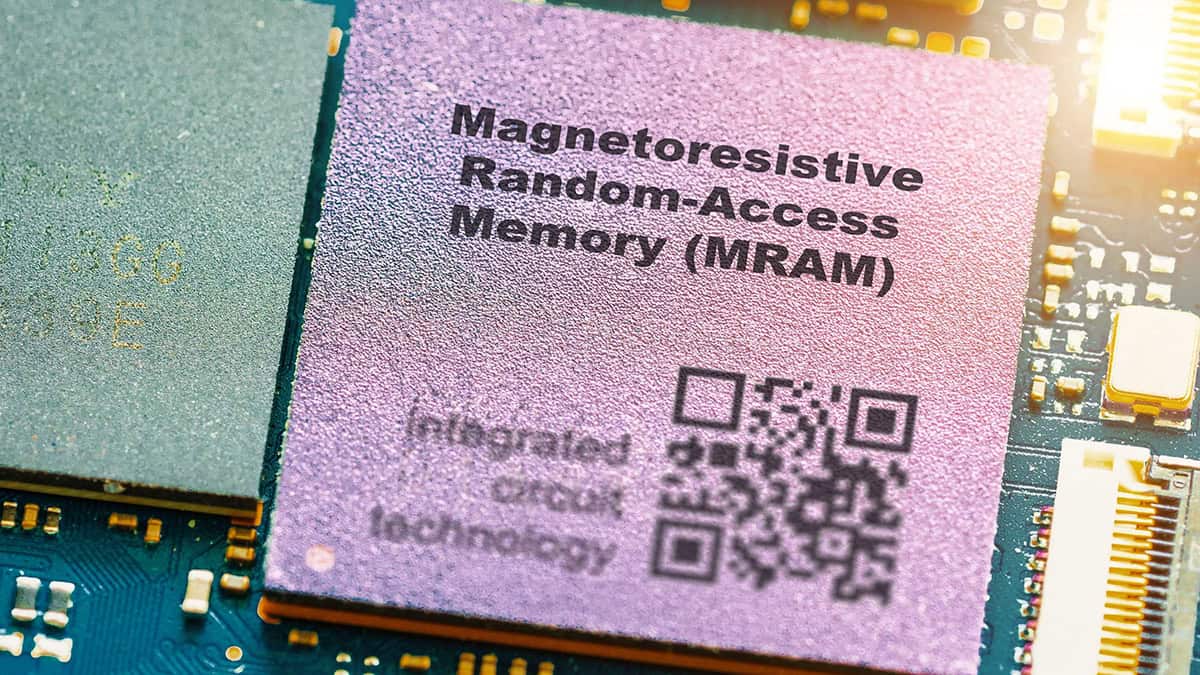
Universal memory Magnetoresistive random-access memory (MRAM) stores data in magnetic domains. Its main benefit is that it can retain data even when the power is turned off. (Courtesy: Shutterstock/luchschenF)

MTJs exist in hard disk drives and can also serve as read-write units in a magnetoresistive random-access memory (MRAM). To read, a small current is passed through the MTJ, and the resulting voltage shows the state of the bit. To write, a larger current is applied. The fixed layer polarizes the spin of the electrons, which carry angular momentum as they tunnel into the free layer.

This flips that layer’s magnetization, switching the magnetic bit, whose state survives even without power. That’s a key advantage of MRAMs compared to volatile CMOS RAMs, which require power and lose their stored data without it. MRAMs are not yet competitive with CMOS RAMs, but are already used in automotive, aerospace and other applications where their non-volatile nature is essential to reduce power needs and maintain their data under extreme conditions.

Along with this benefit, new possibilities for spintronics are emerging. In 2024 Nuh Gedik at the Massachussetts Institute of Technology (MIT) and colleagues reported that they had rapidly induced magnetism in iron phosphorus trisulfide with light (Nature 636 609). FePS₃ is an antiferromagnet where atomic spins in opposite directions result in little or no net magnetic field. The researchers found that picosecond pulses of terahertz light produced magnetic states that persisted for milliseconds – far longer than any other reported light-induced magnetism (see box below).

Metastable magnetization

Illustration of the experimental set-up to produce a long-lasting, light-driven magnetic state in a material
(Courtesy: Ilyas, B, Luo, T, von Hoegen, A et al. “Terahertz field-induced metastable magnetization near criticality in FePS3” Nature 636 609 (2024) Springer Nature)

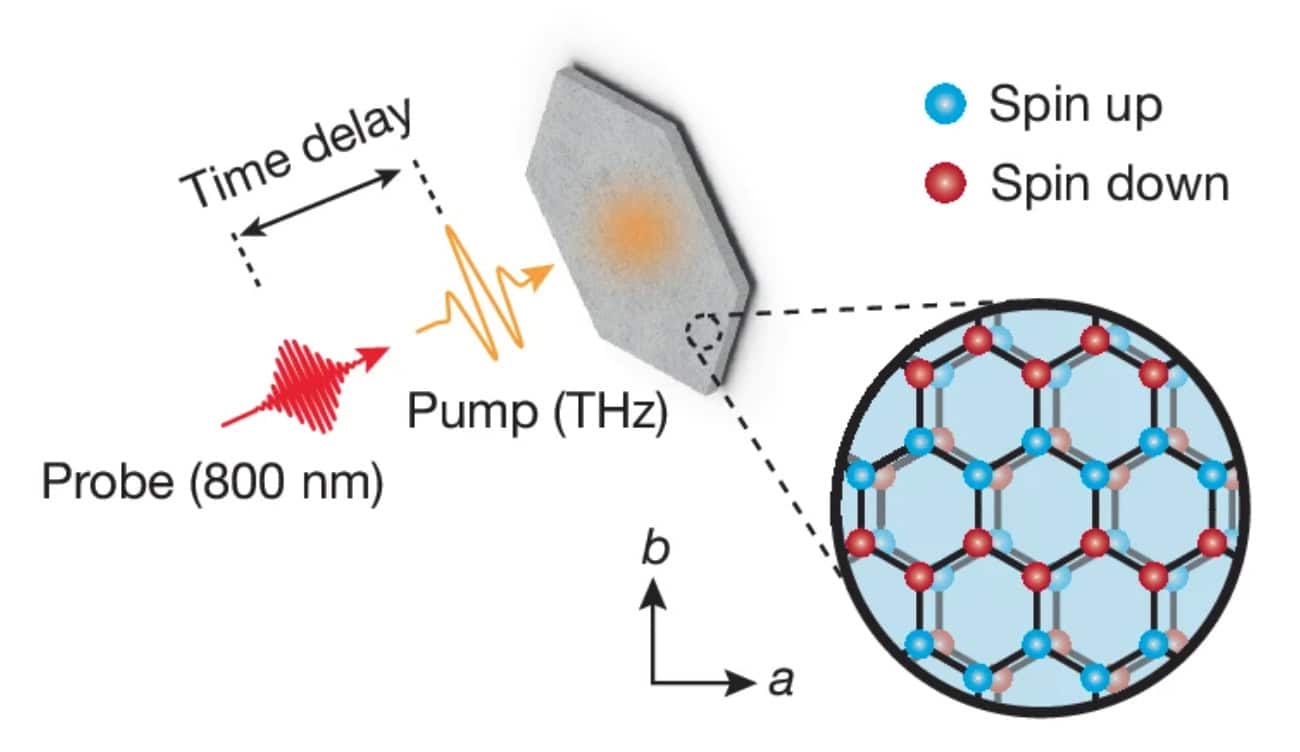
Shown here is the experimental set-up that an international team of physicists use to produce a long-lasting, light-driven magnetic state in a material such as iron phosphorus trisulfide (FePS3), which becomes antiferromagnetic when cooled below about 118 K. They used an intense terahertz-frequency (THz) pulse (orange) to drive low-energy collective excitations, which induce transient changes in optical properties that can be probed with an 800 nm probe pulse (red). Fe2+ ions form a hexagonal lattice and their spins arrange ferromagnetically along the zig-zag chain (a-axis) and antiferromagnetically between the adjacent chains (the structure in the circle). The magnetic coupling between the layers is antiferromagnetic together with a small interlayer shear distortion along the a-axis. The THz pulses put the material in a metastable magnetic state that lasts for more than 2.5 milliseconds even after the light source is switched off.

Earlier this year, researchers at Beijing Normal University in China found that light-induced magnetic transitions consume little energy (ACS Nano 20 9051). If magnetic bits become competitive with electrical ones – activated by light or otherwise – they would unite working memory and long-term storage in one computational stage rather than two as we now have. Magnetic bits could also play a role in a bigger change in computer structure. 

Bringing it all together

A novel form of computer architecture could also remove a famous bottleneck in computing that dates back to the influential 1945 proposal by the mathematician John von Neumann for a general computational design. He suggested using separate processing and memory (first put forth in 1837 by Charles Babbage for his mechanical “Analytical Engine”) but added the idea of the stored program.

By holding the instructions for computer operations in memory along with data, a computer program makes computation more flexible but has one big drawback. Data and instructions have to shuttle between processor and memory along the same channel, reducing computing throughput and using more energy than processing – the “von Neumann bottleneck”.

Novel computing: liquids, soft solids and deuterium

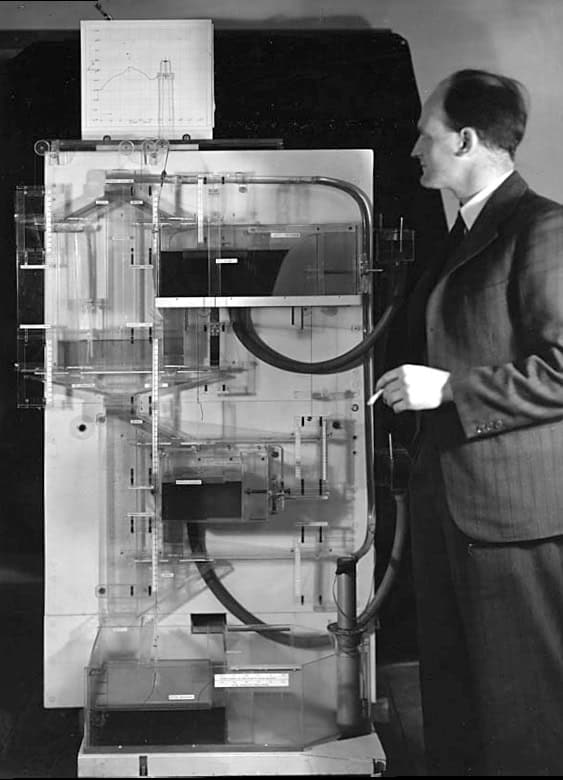
MONIAC machine
Financial flows London School of Economics economist AWH (Bill) Phillips with his eponymous machine, also known as the MONIAC analog computer, that modelled economic theory with water flows. (No known copyright restrictions, LSE Library archive)

At the heart of modern computing technology are ultra-pure silicon wafers. These nearly perfect regular crystalline solids form the substrates for integrated circuits, making it all the more surprising that less ordered materials – such as liquids and soft solids – have their own history in computation.

In 1949, for example, the UK-built Monetary National Income Analogue Computer (MONIAC) simulated the flow of money within a national economy using coloured water moving through transparent tubes under gravity. Water levels representing economic conditions were set by pumps and valves. As the water negotiated the system, it dynamically illustrated how parameters such as tax rate affect an entire economy, eventually settling into equilibrium.

Another liquid – mercury – also appeared in the early days of electronic computing. The first commercial unit in the US, UNIVAC I (1951), stored nine kilobytes of data as sound pulses continually recirculating in tubes filled with liquid mercury acting as delay lines. The units, which were bulky and heavy, provided serial rather than random access because the pulses travelled in sequence. Timing was crucial, and the mercury was held at a constant 40 °C to keep the speed of sound stable. Another early computer, EDVAC, also stored data in liquid mercury.

Since the 2000s researchers have shown that tiny droplets of oil, moving through small channels filled with water, can implement binary logic. If a droplet blocks a channel, a second droplet arriving behind it is diverted into another channel, representing a “decision”. Proper design can emulate the Boolean logic that underlies conventional computing. With channels only 100–200 µm across, microfluidic logic could route and process small samples, providing a lab on a chip for chemical analysis, biological research or medical diagnostics.

Yet another liquid – one more exotic than mercury – and a soft solid were apparently at least considered for computation in the same era as UNIVAC 1. According to Iain Dey and Douglas Buck’s 2017 biography The Cryotron Files: the Strange Death of a Pioneering Cold War Computer Scientist, the MIT scientist Dudley Buck once worked on a data storage system using magnetic pulses in liquid deuterium held at cryogenic temperature. In that Cold War era, US government money was available for any research that might help America and the authors describe how some of it also went on studies into a soft, wobbly foodstuff, lemon Jell-O as well as the viscous semi-liquid hair preparation Wildroot Creme Oil, which might also support sound waves in a memory unit. None of this Cold War research panned out, although at least the Jell-O experiments could treat the entire lab team to dessert.

One solution is to carry out processing and memory functions in the same physical element, potentially using a new type of electric circuit element originally proposed in 1971 by the US electrical engineer and computer scientist Leon Chua. Its resistance depends on the accumulated charge and, since charge is the time integral of current, therefore carries a memory of the device’s past electrical activity.

Chua dubbed his new element a memory resistor or “memristor” – and the concept can be used when a read-write MTJ holds a memory of past electrical activity as a magnetic bit. In 2026 Shahar Kvatinsky at the Israel Institute of Technology and colleagues showed that small MRAMs formed from MTJs can perform logical operations inside memory (Adv. Electron. Mater. 12 e00348).

In principle, therefore, this could also provide arithmetic processing inside memory, thereby removing the von Neumann bottleneck. The non-volatile memory would also save energy relative to CMOS memory. Problems remain though, such as reducing noise and producing large-scale MRAMs – but the ability to merge memory and computation within MRAMs has been established at small scales.

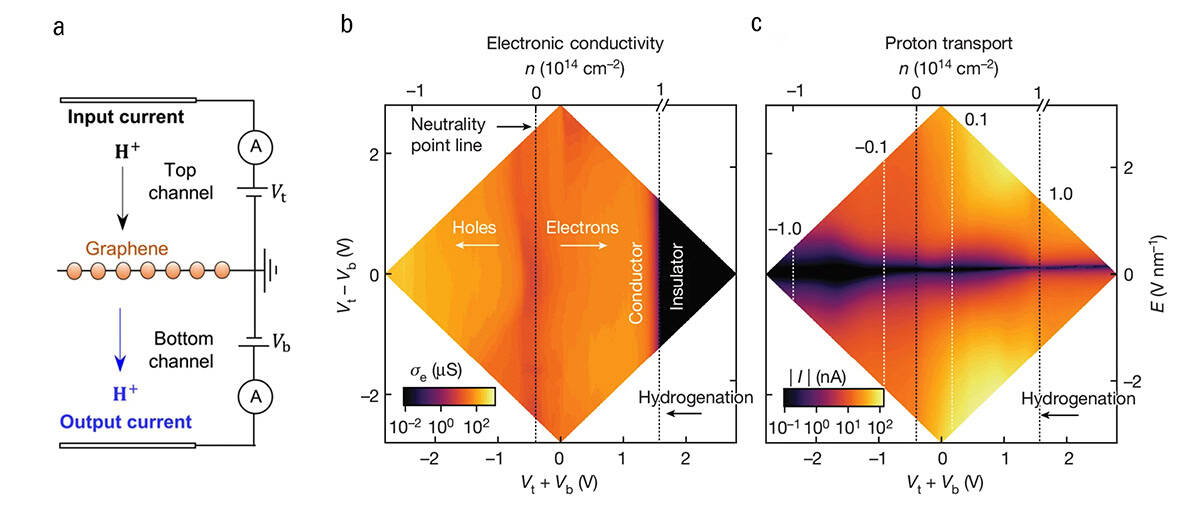
Certain material structures can also play a dual function. The wonder-material graphene – a 2D hexagonal lattice of carbon atoms – is electrically conductive when a voltage is applied in its plane, driving the electrons. If the graphene sheet is also placed between proton-conducting electrolytes, a second voltage applied across the sandwich produces a proton current (a flow of positive charge) perpendicular to the plane.

In 2024 Marcelo Lozada-Hidalgo at the University of Manchester and colleagues found that certain values of electron density in this structure make the graphene an insulator (Nature 630 619), producing a reversible change from conducting to insulating that forms a non-volatile two-state memory. Their set-up allowed the researchers to perform logic and memory operations in a single device for the first time.

As graphene, MRAMs, and other approaches are under study for in-memory computing, another method emulates a natural process – and is perhaps the biggest departure from conventional computing.

Dual purpose

Proton and electron transport with independent control of field and charge density
(Courtesy: M Lozada-Hidalgo, Nature 630 619. CC BY 4.0)

(a) Graphene is well known to be a good electrical conductor, but in 2024 an international team of researchers used the 2D substance to make a new electrically-controlled switching device that supports both memory and logic functions. The device exploits graphene’s ability to conduct protons as well as electrons. The team showed that placing a sheet of it between proton-conducting electrolytes also produces a proton current perpendicular to the plane, with the proton and electron transport allowing independent control of field and charge density. Shown here are the top and bottom voltages and the direction of electron and proton flow. (b) Map of in-plane electronic conductance, σe, as a function of electric field E and charge density n. The left and bottom axes show that these variables are controlled by the difference and sum of the top and bottom electron voltages, respectively). (c) Map of proton transport current, I, as a function of E and n.

Copying biology

In the 1980s, Carver Mead – a Caltech physicist and engineer who had been instrumental in developing integrated circuits and deeply understood the physics of computing – made a radical proposal. Instead of building computers around centralized digital logic, we should instead design them to imitate the strategies that make the human brain highly efficient. He coined the term “neuromorphic” computing for this approach and is widely considered its founder.

Using specific biological and biophysical features, the brain performs its cognitive and sensory tasks at the modest power of 20 watts. Its 86 billion neurons do not constantly use energy, but act sparsely in response to events, firing brief electrical spikes at definite timings and rates. A system like this can be expected to save energy compared to a conventional computer, which steadily consumes energy at the CPU clock rate.

Also, there is no von Neumann bottleneck in the brain. Information is stored as changes in synapses: the ~1014–1015 connections among neurons that control signal flow. As a spike arrives, a synapse immediately applies its stored information. The modified signal is passed on to neurons that repeat the cycle. Storage and processing occur together within this closely linked 3D network, which also operates in a massively parallel manner.

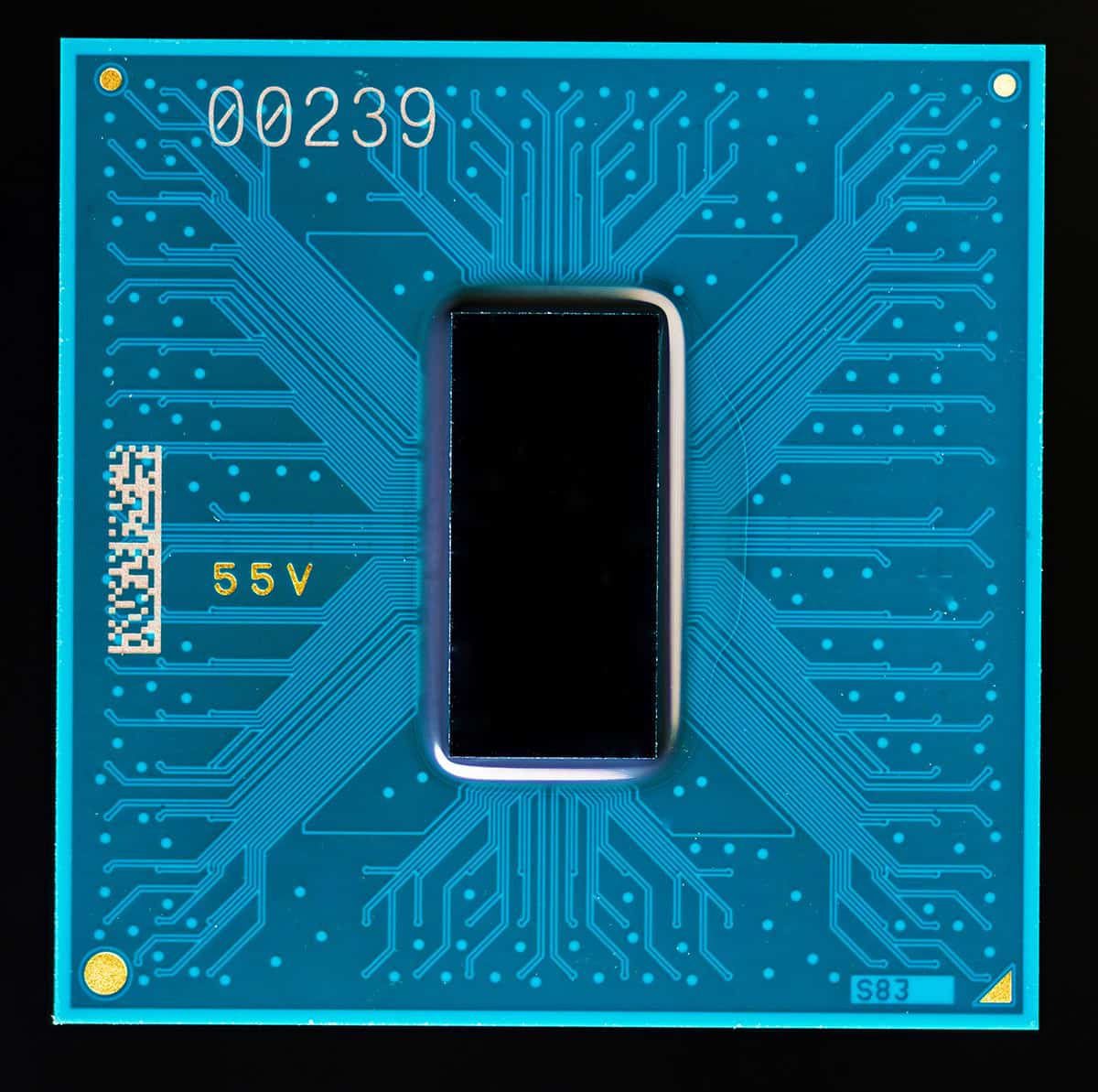
Mead had envisioned an analogue neuromorphic design, but in practice the biological features are expressed digitally to match CMOS technology. For example, in 2017 Intel introduced its Loihi chip with event-driven spiking and closely connected computation and memory. A later model was reported in 2025 (arXiv:2503.18002) that trebled the throughput for matrix multiplication – the main computationally-intensive operation needed to train an LLM – with half the energy a standard GPU chip uses.

Similarly, in 2014 IBM built and tested a chip that emulated spiking behaviour, while a later version, dubbed NorthPole, does not use spiking. In 2025, meanwhile, IBM researchers reported that 288 linked NorthPole chips could carry out AI inference on certain sizes of language models at favourable speeds and power usage.

Loihi 2 is Intel's second-generation neuromorphic research chip.
Chip off the old block Intel’s Loihi 2 chip is an example of a neuromorphic chip, based on how the human brain functions. With linked computation and memory, it can carry out AI inferencing considerably faster than standard chips, making it more energy efficient. (Courtesy: Walden Kirsch/Intel Corporation)

The future of computing and AI

Most of the novel approaches are in the proof-of-principle or pre-commercial phase and may never reach wide use, for both economic and engineering reasons. The investment in CMOS technology and the associated computer architecture is enormous. Any overall change would be a massive undertaking. Although a neuromorphic chip might be more efficient, it would require huge investment to be formally adopted by today’s markets and chip-making industry.

Even so, there are valuable lessons to be learned from the research into novel approaches – such as better integration of memory and computation. There is also a consensus that hybrid solutions can yield immediate benefits. An accelerator unit, such as a bank of neuromorphic chips, integrated with CMOS technology, could increase speed and decrease power use for the critical matrix multiplication stage. Upgrades like these can be included as new supercomputers and AI centres are being built, improving general and AI computation and reducing their energy costs.

We should also think of the problem from the other end: yes, we can now produce a form of AI based on LLMs. But this is ultimately a brute-force approach that demands a great deal of time, money and resources. It should continue to be refined, but there should also be space for bold ideas that may lead to better and more sustainable forms of AI, and of the computation it requires.

The post The physics of novel computation: beyond bits and chips to spikes and spins appeared first on Physics World.

Knowing through uncertainty: probability and the evolution of our cosmos

12 August 2026 at 15:00
Abstract space geometric pattern
(Courtesy: Shutterstock/svekloid)

All scientific inquiry involves some kind of uncertainty, but the uncertainties in cosmology are particularly daunting. As well as being complex and difficult to describe, the systems cosmologists investigate are almost by definition out of reach. In these conditions of uncertainty, how confident can we be in the models we’ve built? How can we come to know how galaxies form, how the universe began or how much dark matter it contains?

In The Random Universe: How Models and Probability Help us Make Sense of the Cosmos, cosmologist and astrophysicist Andrew Jaffe offers a masterful and refreshing take on these questions. As the director of the Centre for Inference and Cosmology at Imperial College London, UK, and a past co-investigator on ESA’s Planck satellite that provided us with so much new information about the cosmos, Jaffe is well-equipped to walk readers through the tools that allow us to learn about the world despite its uncertainties. Anchoring his insights in beautifully narrated episodes from the history of physics, astrophysics and cosmology, he sheds light on how our theories of the universe evolved into our current best cosmological model – which nonetheless still has limitations.

Jaffe is particularly good at recounting how we refined, revised and even replaced some of our assumptions in light of incoming evidence such as the first measurements of stellar distance; the discovery of galaxies beyond our own; and precise measurements of cosmological parameters. Throughout this journey, he engages thoughtfully with a rich philosophical tradition that runs from David Hume in the 18th century through Willard Van Orman Quine, Imre Lakatos and Paul Feyerabend in the 20th.

Bayes’ theorem is important because it tells us how to update our degree of belief in light of new evidence

The book’s main protagonist, though, is the mathematician Thomas Bayes. For Jaffe, Bayesian probability is key to dealing with uncertainty, and even to solving Hume’s notorious problem of induction: how do we justify inferences from a finite set of observations to generalizations that go beyond them? Bayes’ theorem is important, Jaffe argues, because it tells us how to update our degree of belief in light of new evidence. It shows us why and how, even in an uncertain world, “the more observations we make, the surer we become”.

Of course, before we can use probability to deal with uncertainty, we first need a model. As Jaffe puts it, “Absent a model, I can’t assign a probability, and absent a probability, I can’t quantify my uncertainty about the world.” So, what exactly is a model? I found Jaffe’s answer to be one of the most captivating elements of the book. As the title of a subsection of chapter five puts it, “a model is a story about the world”. Without models, Jaffe tells us, our world would be an unexplained series of unrelated events. Models are also what allow us to take a finite set of data and use it to create something new. Without this leap, Jaffe suggests, we cannot learn anything about the world, because “you can’t make sense of an experimental result unless you have some model to interpret it”.

Of course, if the way we interpret data depends on our model, then different people may well obtain different interpretations depending on which model and which prior probability they choose. This charge of subjectivity is a longstanding accusation against Bayesians, but Jaffe offers at least a partial solution: “If you and I agree on the model, we should assign the same probability.” This, Jaffe argues, is where objectivity emerges, writing that “we come to the same conclusions if we start from the same premises”.

Models allow us to understand the world by bridging subjectivity with objectivity, and the personal with the collective

Many contemporary philosophers are at odds with the idealized view of science as an objective and linear enterprise that produces theories from a God’s-eye view. Instead, they strive to portray it as something that is social and human, but reliable nonetheless. Jaffe’s own views seem to align with this endeavour; as he puts it, “the scientific coupling of models and observations is a living, breathing, subjective endeavour, simultaneously collective and personal”. Through their interplay with data, he argues, models allow us to understand the world by bridging subjectivity with objectivity, and the personal with the collective.

Not everyone will agree with Jaffe that Bayesian probability offers a solution to Hume’s problem of induction. Personally, I (or perhaps the hardcore rationalist in me) was not convinced. Nevertheless, I found the book’s thesis – that uncertainty is not a hindrance to knowledge, but an opportunity to learn (and learn more) about the world – simultaneously liberating, humbling and empowering. I recommend The Random Universe to scientists, philosophers and anyone interested in better understanding the role of probability in science; the philosophical problems with how we handle uncertainty; and how our standard cosmological model came to be. I also hope it will encourage more collaborations between philosophers and scientists. There are many questions we can explore further if we work together.

  • 2025 Yale University Press, £25hb, 288pp

The post Knowing through uncertainty: probability and the evolution of our cosmos appeared first on Physics World.

Word wave puzzle no.6

24 July 2026 at 14:00

Here’s how the game works:

    1. Enter a word guess – in this game the word has six letters.
    2. After submitting your guess, each letter in the guessed word is coloured to provide feedback:
      • Green: The letter is correct and is in the correct position in the target word.
      • Yellow: The letter is correct but is in the wrong position in the target word.
      • Grey: The letter is not in the target word at all.
    3. Using this colour feedback, refine your next guess.
    4. Continue guessing until you correctly identify the hidden word(s) or run out of attempts.

If you want a clue to the answer, read the article here.

Fancy some more? Check out our puzzles page.

The post Word wave puzzle no.6 appeared first on Physics World.

Physicists create mechanical memory device from slap-bracelet-like structures

1 June 2026 at 16:24

In today’s technologies, mechanical mechanisms generally provide the brawn while electronics supplies the brains. This is partly because it is challenging to write information into mechanical memories without resetting each bit individually. However, that could change as researchers led by Pedro Reis at École Polytechnique Fédérale de Lausanne in Switzerland and Martin van Hecke at AMOLF in the Netherlands have now found a practical means of writing mechanical bits. Their technique, which they describe in Science Advances, uses structures that resemble children’s slap bracelets placed on a rotating turntable. While they acknowledge it is unlikely to replace electronic memories, they argue that it could have specialist applications and might produce insights that translate into electronic innovations.

“The framework we propose could be very useful, for example, in the domain of physical intelligence, where you provide hardware with capabilities that don’t require essentially a brain or an electronic control system to do individual tasks,” Reis says.

Mechanics for memory

Reis and van Hecke’s interest in mechanical memory stems from their research on metamaterials, which are materials that are defined not just by their composition, but also by the structures within them. Mechanical systems offer a tangible means of getting to grips with the complex behaviour of these metamaterials. “Often, all sorts of things that we do rely on nonlinear responses,” van Hecke notes, adding that such responses are much easier to study in mechanical systems than in optical devices.

A metamaterial made up of an array of switchable mechanical elements could function as a form of mechanical memory. However, to be practical, it needs to be possible to flip the states of individual mechanical bits using global controls, as opposed to addressing them individually. Otherwise, writing data will be very fiddly.

A solution emerged from Reis’ interest in rotating platforms, which he describes as “a very versatile way of loading mechanical systems”. While the pair had been friends for more than two decades, they had been working independently until, during a visit, the penny dropped and they realized that placing the metamaterial array on a rotating platform could provide the control they needed.

Because the angular velocity of the platform sends its momentum outwards, each mechanical object experiences a force in the radial direction, known as the centrifugal force. If this angular velocity is not constant, the object will experience an additional force in the orthogonal azimuthal direction, known as the Euler force. “So you have a complex force and bi-directional field that is highly tuneable,” says Reis. “And this tuneability is what we realized is very powerful.”

A rotating array

To construct their array, the researchers used clamped beams with two stable mechanical states – a little like a slap bracelet can be coiled up or flat, except these beams could either curve to the right or to the left. To individually address different beams, they ensured that each beam was unique in its width, the angle it was clamped at, and so on, all of which affect how much force is needed for a beam to ping into the opposite state. By tuning the parameters of each clamped beam and the angular acceleration of the rotating platform, they could engineer the applied force to switch (or not switch) specific beams, thereby writing data into the array purely by rotating the platform.

Doing this accurately requires a level of precision in acceleration control that surpasses what standard lab motors can achieve. However, the researchers say they were able to team up with a local company that had designed high-spec rotating platforms for its high throughput silicon chip production process. By programming platforms with five tailored clamped beams and the right rotation functions, they showed they could write the letters of the alphabet in ASCII script.

“This is a significant advance because it points toward future smart devices and robots that can be reprogrammed remotely without complex wiring or electronics, using only carefully designed motion‑based signals driven by a sole dynamic driving strategy,” explains Damiano Pasini of McGill University, Canada, who studies systems for mechanical computing but was not involved with this work directly.

Reis says he is excited about the scalability of the approach and its potential in high throughput experiments. Meanwhile, van Hecke is looking into how the idea might transfer to other systems, such as applying engineered force functions to crumpling sheets of complex glasses. “It just opens up possibilities for both studies, really fundamental studies of complex systems, but also real applications where you use this dynamic idea,” he tells Physics World.

The post Physicists create mechanical memory device from slap-bracelet-like structures appeared first on Physics World.

❌