In September 1976 physicist Masao Doi, then working at Tokyo Metropolitan University, published two groundbreaking papers. The work – published in Journal of Physics A – cast classical stochastic many-body problems in the mathematical language samiliar to that of quantum-field theory (9 1465 and 9 1479).
Although this happened at a time when theoretical field methods in statistical mechanics were getting into full swing, this gem of deep scientific insight remained hidden for many years.
Indeed, it was reinvented several times, most notably in 1980 by Peter Grassberger and Martin Scheunert from the University of Wuppertal, who also highlighted the many applications for the theory.
Following conversations with Grassberger at a meeting organised by the Centre Européen de Calcul Atomique et Moléculaire in September 1985, Luca Peliti from the University of Rome went about putting Doi’s theory into a path integral formalism, thus making it amenable to renormalisation.
That same year he published a letter on the renormalisation group treatment of a reaction-diffusion process, using the framework that was named Doi-Peliti field theory (J. Phys. France46 1469).
The works by Doi and Peliti quickly became viewed as fundamental building blocks to calculate not only asymptotics but also systematic approximations of observables in reaction-diffusion processes.
Theoretical physicist John Cardy from the University of Oxford, used Doi-Peliti theory as a work-horse for reaction-diffusion processes.
In the 2000s, Cardy and colleagues produced not only a string of renormalisation group treatments of reaction-diffusion processes, but also reviews and tutorials at different levels of technicality, which made Doi-Peliti field theory accessible to many of us.
Key insights
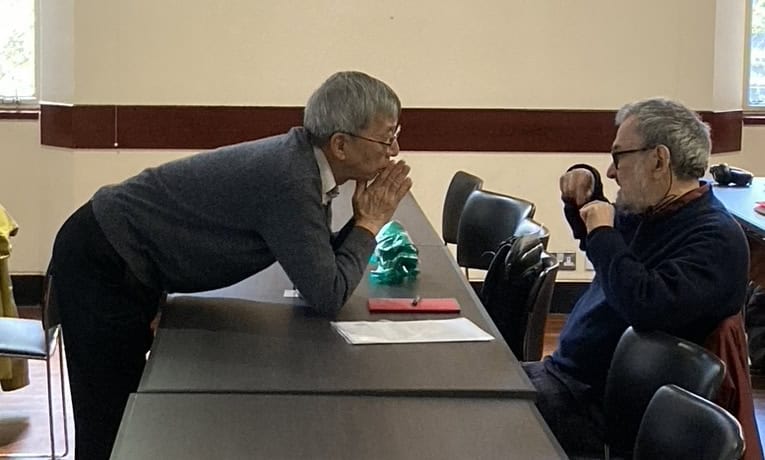
Eye to eye: Doi (left) and Peliti met for the first time at the event in Cambridge (courtesy: Gunnar Pruessner)
In 2018 Doi became chief scientist at the Wenzhou Institute of the University of Chinese Academy of Sciences and was well-known for his work in polymer and soft-matter physics.
Yet when my former PhD student Ziluo Zhang joined the Wenzhou Institute as a postdoc in 2023, he found that Doi was unaware that the field theory bears his name and the many developments since its inception.
In a relaxed atmosphere, some of the key players explained how their insights came about.
Doi-Peliti field theory is a brilliant concept conceived by brilliant minds. One might be tempted to speculate how many more theories have been spun off and developed that are attributed – or even unattributed – to the pair without them ever knowing.
An upcoming special issue of Journal of Physics A will be dedicated to the Doi-Peliti field theory.
Abdus Salam shared the 1979 Nobel Prize in Physics with Sheldon Glashow and Steven Weinberg for “their contributions to the theory of the unified weak and electromagnetic interaction between elementary particles, including, inter alia, the prediction of the weak neutral current”.
What Salam had done was to incorporate the Higgs mechanism – co-discovered by his colleague at Imperial College London Tom Kibble – into electroweak theory, which unifies the electromagnetic and weak forces.
As the Imperial theorist Claudia de Rham said in a 2024 interview with Physics World, Salam’s work “changed the way we see the world by underlining the importance of symmetry and by showing how some forces – which may appear different – are actually linked”.
But Salam, who died in 1996 after suffering from a cruel neurodegnerative disease, did more than unify the weak and electromagnetic interactions. He also became the first – and so far the only – person from Pakistan to win a science-related Nobel prize, yet for a long time remained overlooked in his homeland.
Great minds
Salam was born on 29 January 1926 in the Punjabi city of Jhang in what was then British India. A child genius, he studied mathematics at Government College, Lahore, completing his master’s degree in 1946 with record marks (getting 765/850 or 90%).
Later that year Salam moved to the UK after winning a scholarship to study at St John’s College, Cambridge, studying initially mathematics and then physics, gaining a double first-class honours in 1949.
Back home, India was in turmoil, with a growing demand for independence from the British, and the Muslims seeking a homeland for themselves.
As a Muslim himself, Salam would no doubt have celebrated when Pakistan was created during the partition of India, with the country coming into existence at the stroke of midnight (0.00 a.m.) on 14 August 1947.
After completing his PhD in quantum electrodynamics at Cambridge in 1951, Salam returned to Pakistan, taking up a teaching post at Government College, keen to establish a research base in the fledgling country. But lacking journals, colleagues or any proper scientific infrastructure in Pakistan, Salam realized he would have to go abroad again.
“Either I must leave my country or leave physics,” he said. “And with great anguish I choose to leave my country.”
Upon winning a Nobel prize in 1979, Pakistan had existed for only 32 years, meaning it, along with Austria, is the joint 13th quickest nation to win a Nobel Prize in Physics, according to our Physics World infographic.
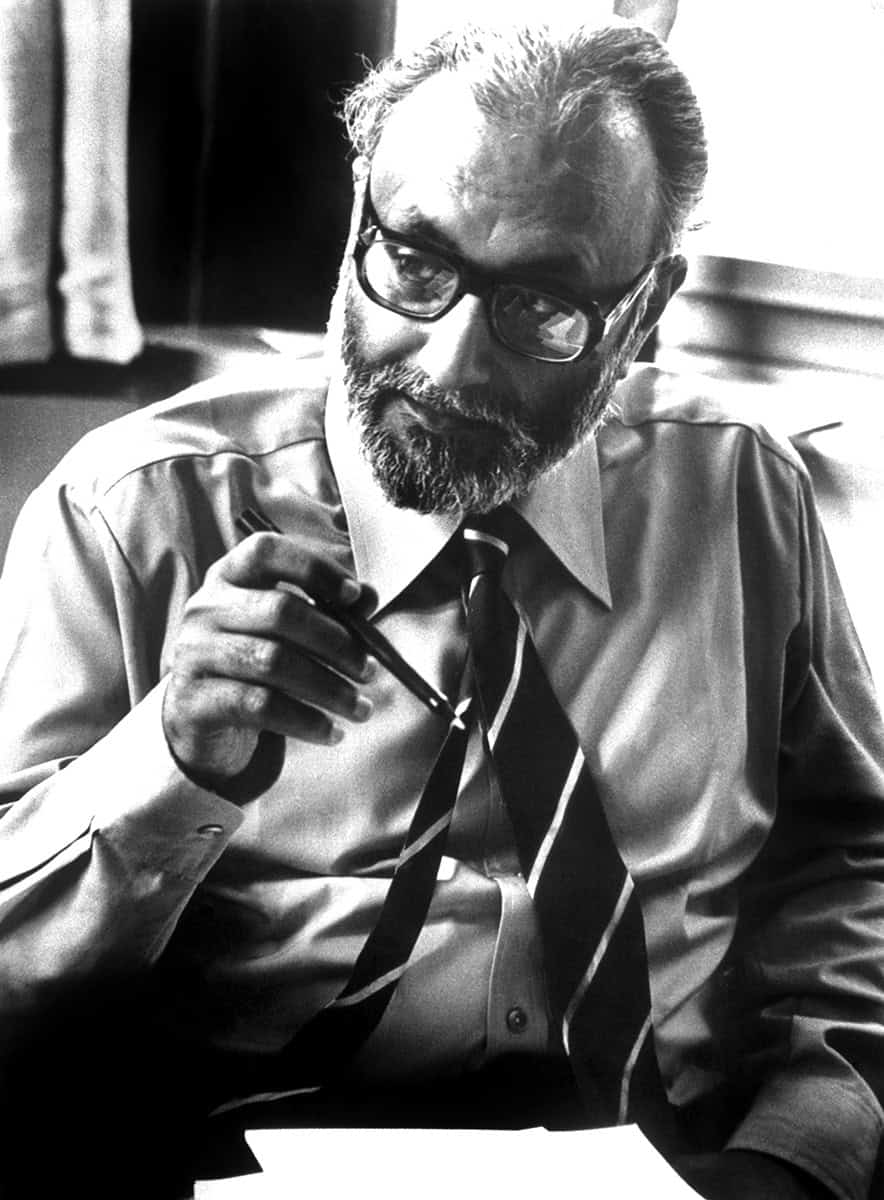
Genius in action A portrait of Abdus Salam taken in 1979. (Courtesy: Giovanni Montenero, ICTP Photo Archives)
At the official Nobel banquet in Stockholm on 10 December 1979, Salam thanked the Nobel Foundation and the Royal Swedish Academy of Sciences. “Pakistan,” he declared, “is deeply indebted to you for this.”
Yet back home, little was made of Salam’s impressive award. Most Pakistanis are Sunnis but Salam was an Ahmadi, part of a minor Islamic movement founded in the late 19th century by the religious leader Mirzā Ghulām Ahmad (1835–1908).
Such was the opposition in Pakistan to the Ahmadis that in 1974 the country’s parliament declared them non-Muslims – heretics essentially – and the constitution was altered to reflect that fact.
Pakistan’s decision to outcast the Ahmadis profoundly affected Salam. As he wrote in his diary: “Declared non Muslim. Cannot cope.” Having previously been largely a “cultural Muslim”, Salam now saw his religious beliefs re-awakened.
Belatedly, Pakistan did offer some formal recognition in the form of a two rupee stamp in 1998, but it is surprising the country has not done much more. In 2016 Physics World reported that then Pakistani prime minister Nawaz Sharif was going to rename the National Centre for Physics at Quaid-i-Azam University in Islamabad as the Professor Abdus Salam Centre for Physics – but, as far as I can tell, that has not taken place.
A few years ago Zakir Thaver and Omar Vandal produced a wonderful documentary film called Salam: the First ****** Nobel Laureate. Directed by the physicist Anand Kamalakar, it explores in detail the strange relationship between Salam and Pakistan, which surely should have done more to honour its greatest physicist.
I can’t imagine other countries doing so little for their first Nobel prize winners as Pakistan has for Salam.
SmarAct proudly supports Physics World‘s Nobel Prize coverage, advancing breakthroughs in science and technology through high-precision positioning, metrology and automation. Discover how SmarAct shapes the future of innovation at smaract.com.
Back when I used to commute to Physics World’s Bristol, UK offices every day, I heard a lot of excuses explanations for why my train was delayed. Missing crew members. Road vehicles colliding with bridges. Even, on one memorable occasion, a herd of cows blocking the tracks.
One explanation I never heard, though, was the one proposed for a train that supposedly left the south-west English city of Exeter at 10.05 p.m. on 18 October 1841. According to an anonymous correspondent in Nature some 30 years later, this 10.05 train was delayed by 16 minutes because of “a very intense magnetic disturbance” that made it “impossible to ascertain if the line was clear”. This disturbance, the correspondent argued, was due to “the magnetic and auroral storms that have of late excited some attention and discussion in these pages”.
Such storms are now known as space weather, and in 2013 Trey Cade, a physicist who leads the Space Weather Research Lab at Baylor University in the US, made an intriguing suggestion: was this supposed 1841 delay the first recorded example of space weather affecting human technology?
An auroral detective story
According to the latest research, the answer is firmly in line with Betteridge’s law, which states that any headline that ends in a question mark can be answered by the word “no”. Although space weather was (and is) capable of delaying trains, it couldn’t have delayed the 10.05 from Exeter in 1841 for a very simple reason: the railway line in that part of England didn’t open until 1846.
That, however, raises a further question. Assuming Nature’s correspondent wasn’t making up the story of the aurora-delayed train, was he perhaps misremembering the date of a different, later storm?
To find out, a broad group of experts led by Lancaster University’s Jim Wild, and including personnel from the British Geological Survey, Natural Resources Canada, Nature, RMIT University in Australia and STFC RAL Space in the UK as well as Cade himself – dug into the data. By combining evidence from railway timetables, historical newspapers, records of solar observations, reports of aurorae and digitized geomagnetic records, they concluded that Nature’s correspondent – whom they tentatively identified as an electrical engineer called Nathaniel John Holmes – was probably thinking of a storm that took place on 18 October 1848, not 1841.
Historical insights: Brett Carter of RMIT University (pictured at Melbourne Central Station in Australia) was part of the international team of experts who collaborated on the mystery of the delayed 10.05 from Exeter. (Courtesy: Michael Quin, RMIT University)
Having debunked the 1841 hypothesis, the authors of the new research, which is published in Space Weather, say that the earliest known example of space weather impacting human technology is now an incident involving telegraph systems on England’s Midland Railway in March 1847. If that still sounds rather early, Wild says that’s the point. “Society has been experiencing the effects of space weather on technology for almost as long as electrical technologies have existed,” he says. “The technologies affected have evolved from railway telegraphs to satellites…but the challenge remains the same: understanding the risk and ensuring society is resilient to its impacts.”
Raising awareness
According to Lasse Clausen, who studies space weather at the University of Oslo, Norway, but was not involved in the 10.05 from Exeter study, the biggest barrier to this understanding is a shortage of data about what’s going on in the Earth’s ionosphere, where space weather occurs. Although our ability to detect space weather has improved since the 1840s, he says that when it comes to predicting it, we’re roughly where conventional weather forecasting was in the 1920s. “Essentially, we can look out the window and say whether it’s raining or not,” he says.
Changing that will require additional funding, and for that, Clausen thinks raising awareness is essential. “The ionosphere is useful, but it’s not very sexy,” he tells me. The new study, he adds, is “a nice piece of detective work” that “firmly belongs in the ‘awareness raising’ category”.
One does not simply walk into the Trinity test site. Although the radioactivity from the world’s first atomic explosion has mostly dissipated over the past 81 years, the gates to this real-life Mordor are still guarded by military police, and the US Army continues to use it as a missile range.
Members of the public are allowed in just once a year, on the third Saturday in October, between 8 a.m. and 3.30 p.m. Apart from these tightly controlled “open house” events, the site where Manhattan Project participants gathered on 16 July 1945 to witness the dawn of the nuclear age is strictly off-limits.
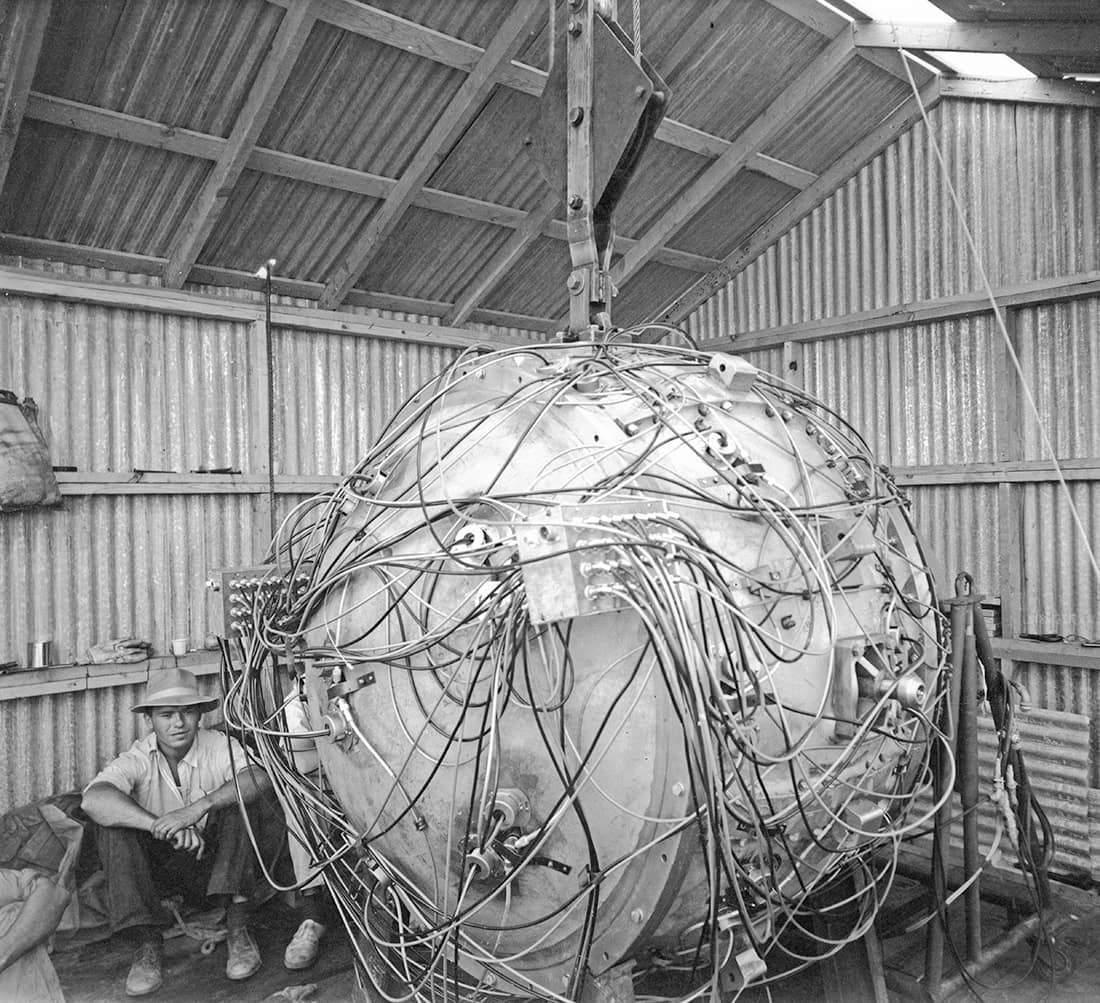
As the book makes clear, there is not much to see at Trinity nowadays. A few dilapidated buildings; a commemorative obelisk; a fragment of a half-million-pound steel tank – these are all that remain of the once-bustling site where the first atomic device, known as the Gadget, was assembled and tested.
Trinity’s great achievement is to turn back the clock and make both the site and the individuals who worked there come alive. Using more than 200 photos from the test’s official archive and other sources, Seyl and her colleagues have created an important public record of a period that is fast receding from living memory and a place that is still veiled in secrecy. The result is a book that is by turns illuminating, beautiful and disturbing.
A fresh look at familiar history
Let’s start with the illuminating part. As an undergraduate intern at Los Alamos, I read Richard Rhodes’ seminal book The Making of the Atomic Bomb. Since then, I’ve read (andoccasionallyreviewed for this magazine) numerous other works of atomic history, from Ray Monk’s 800-page biography of the Manhattan Project’s scientific leader, J Robert Oppenheimer, to Denise Kiernan’s The Girls of Atomic City and Kate Brown’s Plutopia, both of which focus on less well-known figures.
That steel tank, for example. Its name is Jumbo, it cost $12m in 1940s money, and it was originally designed to withstand the conventional explosives that imploded the Gadget’s plutonium core. If the explosives worked, but the chain reaction didn’t (a definite possibility – hence the need to test the Gadget’s design before deploying it in a bomb), the idea was that Jumbo would prevent plutonium from spraying all over the site.
So far, so sensible. In early 1944, Manhattan Project engineers duly drew up specifications for a containment vessel. An Ohio-based manufacturer, Babcock & Wilcox, agreed to build it, though for security reasons no-one told them what this mysterious “accumulator” was for. The finished Jumbo was then transported, under wraps, to New Mexico by heavy-duty freight train, offloaded onto a specially built carriage and wheeled to a location 800 yards from the intended ground zero.
Which is where it stayed. By the time it arrived in spring 1945, scientists working at the Manhattan Project’s nerve centre in Los Alamos, nine hours’ drive north of Trinity, had grown confident enough in the Gadget that Jumbo was deemed surplus to requirements, more likely to confuse diagnostic tests than to provide any useful safety function.
The fact that technicians had spent days hauling Jumbo across the desert is an excellent example of how the Manhattan Project combined herculean effort and ingenious engineering with tremendous cost and institutionally stupid bureaucracy
The fact that their technician colleagues had spent days hauling it across the desert is thus an excellent example of how the Manhattan Project combined herculean effort and ingenious engineering with tremendous cost and institutionally stupid bureaucracy. Despite this, I do not recall reading about Jumbo before. It’s to Seyl’s credit that she and her NSRC managers granted this potentially embarrassing episode so many pages of gorgeous black-and-white photos.
Because make no mistake, Trinity is gorgeous. I love the New Mexico desert, but you don’t need to be a fan of this austere landscape to appreciate these photographs of the people who toiled there and the machines they built. Though Oppenheimer and other well-known physicists appear in several photos, much of the book focuses on the contributions of relative unknowns such as Jack Aeby, a technician in the Army’s Special Engineer Detachment.
This organization existed to divert soldiers with technical training away from battlefields and into atomic grunt work, and Aeby, an amateur photographer, asked his group leader (the physicist Emilio Segrè) if he could document the explosion with his personal camera. Due to technical problems with the official Kodak cameras, Aeby’s snapshot is now the only decent colour image we have of the Trinity test.
What was he thinking? Donald Hornig with the Gadget just before the first atomic test. (Courtesy: Los Alamos National Laboratory)
My favourite photo in the book is of a chemist called Donald Hornig. As the inventor of the X unit – a heavy-duty switch that triggered the Gadget’s detonators – Hornig had the unenviable job of arming this switch a few hours before the test, with a summer lightning storm flickering all around him. He thus became the last person to see the Gadget intact, and his expression as he slumps next to it is hard to read. Is he smiling? Proud? Or merely exhausted and wishing the photographer would leave him alone?
The final pages of Trinity depict events that followed the test, including the atomic bombings of Hiroshima and Nagasaki. Only five photos are known to exist of the immediate aftermath in Hiroshima, and the book reproduces three of them. Taken by Yoshito Matsushige, a staff photographer at the regional newspaper Chugoku Shimbun, they are far more disturbing for what they don’t show than for what they do. Although Matsushige later explained that he felt a professional duty to document the bombing, he found himself unable to press the shutter on most of what he witnessed. It was simply too horrible.
Beauty and horror make an unsettling combination. Despite Trinity’s quality, it is hard to see it appealing to a broad audience; in one of the book’s two forewords, Jim Eckles, who used to work in the missile range’s public affairs office, suggests it will “make a great memento for visitors to the site”. This unambitious statement is probably correct, but I hope that some physicists – weaponeers, disarmament campaigners and everyone in between – will also find space for it on their shelves. Our atomic age may yet end with a whimper, but it began with a bang, and it is worth remembering that bang in all its complicated majesty.
2026 University of Chicago Press $39.00/£32.00hb 344pp
Author: José Luis Granados Mateo is a postdoctoral researcher in the Department of Philosophy at the University of the Basque Country (EHU) and a member of the Integrated History and Philosophy of Science (iHPS) research group. His work focuses on history and philosophy of science, science and values, and the epistemology of scientific practices.
Water is H₂O. Few scientific formulas look more familiar, more compact, or more final. Two atoms of hydrogen, one of oxygen: the phrase seems to say what water really is beneath the shifting appearances of ice, vapour, rain, rivers and the liquid in a glass.
Yet that little subscript was not easy to earn.
By the early nineteenth century, chemists had good reasons to treat water as a compound of hydrogen and oxygen. The old idea of water as a simple element had lost its authority, as we saw in Is Water H₂O? (1) From Element to Compound. Electrolysis then gave that claim a new experimental force, making hydrogen and oxygen appear under electrical action, although not without raising puzzles of its own, as discussed in Is Water H₂O? (2) The Puzzle of Water Electrolysis. What remained unsettled was a more delicate question. Not whether water had constituents, but how many of each entered one molecule.
Was water HO? H₂O? Something else?
Today the answer feels almost automatic. In the first decades of atomic chemistry, it was not. Dalton’s atomic theory made HO the natural formula: one atom of hydrogen, one atom of oxygen. Avogadro proposed something much closer to the modern answer very early, but his proposal did not settle the matter. For more than half a century, some of the best chemists in Europe disagreed over the formula of one of the most ordinary substances in the world.
The confusion was public enough to become comic. In the 1860s, when agreement was finally beginning to form, an author identifying himself as a certified lunatic at Hanwell Asylum wrote to Chemical News mocking the chemists’ inability to agree even about water. One could contemplate the bewildering variety of formulas, he suggested, until the brain first became confused, then swam, and finally softened.
The joke had bite because the embarrassment was real. Chemical tables were full of combining weights, volumes, radicals, equivalents and atomic symbols. Water had long ceased to be elementary. Yet the old difficulty remained: to know the formula, chemists had to count atoms; to count atoms, they would have had to see them. And they could not.
Liebig put the matter painfully in 1851. Chemists possessed no direct means of ascertaining the number of atoms even in the simplest compound, because that would require seeing and counting them. Atomic chemistry needed numbers for entities no one could inspect.
So the problem was not that the answer lay beyond all reach. It lay beyond direct reach. Chemists had to learn to count invisible things by making them answer to operations that could be performed.
A number, and two worlds
The difficulty begins with a ratio.
Hydrogen and oxygen combine in fixed proportions by weight. In round modern numbers, water contains one part hydrogen for eight parts oxygen. Chemists could establish the ratio; the difficulty began when that ratio had to be translated into atoms.
Suppose water is HO. One atom of hydrogen combines with one atom of oxygen. Since the oxygen contribution weighs eight times as much as the hydrogen contribution, the oxygen atom must weigh eight times as much as the hydrogen atom.
Now suppose water is H₂O. Two atoms of hydrogen combine with one atom of oxygen. The same measured ratio now yields a different atomic weight: oxygen must weigh sixteen times as much as hydrogen.
The laboratory ratio has not changed. The invisible architecture has.
That was the circular trap. Molecular formulas required atomic weights; atomic weights required molecular formulas. Measurement gave combining proportions, not little labelled particles waiting to be counted. A consistent chemistry could be built with HO and oxygen as 8. Another could be built with H₂O and oxygen as 16. Once the difficulty spread across many compounds, chemists were no longer facing a local uncertainty about water. They were choosing among possible atomic worlds.
The difficulty appeared at the worst possible place: the point where atomic chemistry had to begin producing reliable numbers.
Dalton’s necessary guess
Dalton knew that atomic theory needed a starting point.
He approached water from within a broader problem. Chemical substances combined in fixed proportions; in some cases, the same elements combined again in different but still simple ratios. Atomic theory offered a machinery for these regularities. If matter consisted of particles with definite weights, then chemical combination could be understood as their joining in determinate numbers, and the arithmetic of chemistry began to point towards an unseen order. What it still failed to provide was the count itself: the number of atoms entering each compound.
Dalton therefore introduced rules of simplicity. They were not decorative assumptions added to an otherwise complete theory. They were what allowed the theory to produce numbers at all. When only one compound of two elements was known, Dalton assumed the simplest possible atomic constitution: one atom of each. Since water was the known compound of hydrogen and oxygen, its formula became HO. Hydrogen could be assigned atomic weight 1, oxygen 8, and the system could begin to move.
Judged from later chemistry, Dalton’s rule has an air of innocence. It was a methodological expedient rather than an experimental result, a way of allowing atomic theory to proceed when direct counting was unavailable. Dalton was not looking into water molecules and counting badly; he was working with weights, tables and regularities, in a period before spectroscopy, quantum theory or a settled molecular chemistry had made atoms answerable in other ways.
HO was wrong. It was not random. It belonged to a method that could bring order to combining weights before chemistry had better ways of counting atoms.
Figure 1. Dalton’s atomic symbols, from A New System of Chemical Philosophy (1808), Plate IV. Dalton’s table did not merely decorate atomic theory; it made atoms calculable through symbols, weights and simple combinations. In this scheme, water or steam appears as a binary compound of one atom of oxygen and one atom of hydrogen. Source: Wikimedia Commons, public domain.
What gas volumes seemed to promise
Another route opened through gases.
Volumes could be measured, and gases combined with a striking regularity. Gay-Lussac showed that gases entered reactions in simple volume ratios. Two volumes of hydrogen combine with one volume of oxygen to form water vapour; other gases display similarly neat relations. To anyone looking for a way to count invisible particles, this was tempting.
If equal volumes of gases contained equal numbers of particles, volume could become a counting device. It would not show atoms individually, but it might give chemists a way to infer how many particles were involved.
Avogadro made that move. Equal volumes of gases, under the same conditions, contain equal numbers of molecules. Grant that, and the formation of water vapour changes shape. Two volumes of hydrogen and one volume of oxygen produce two volumes of water vapour. The arithmetic works if hydrogen and oxygen gases are themselves molecular, H₂ and O₂, and if water is H₂O:
2H₂ + O₂ → 2H₂O
Figure 2. Opening page of Avogadro’s 1811 essay on the relative masses of elementary molecules. Avogadro’s hypothesis made gas volume into a possible way of counting molecules: equal volumes of gases, under the same conditions, could be treated as containing equal numbers of molecules. The proposal pointed towards H₂O, but it did not immediately command the field. Source: Amedeo Avogadro, ‘Essai d’une manière de déterminer les masses relatives des molécules élémentaires des corps…’, Journal de Physique, 73, 1811; Wellcome Collection / Classic Chemistry.
There it is, almost modern chemistry.
Yet the hypothesis did not conquer the field. The reasons were not merely psychological, nor reducible to conservatism. Avogadro solved one problem while creating others that looked serious at the time. Dalton saw no obvious reason why atoms of the same element should join into stable pairs. In his picture, atoms were surrounded by repulsive atmospheres of caloric; piling like atoms together was hardly the natural assumption. For electrochemical dualists, the difficulty sharpened further. Like atoms ought to have like electrical characters, and like electrical characters ought to repel. Why should oxygen atoms pair with oxygen atoms? Why should hydrogen atoms pair with hydrogen atoms? Why stop at pairs?
The hypothesis also asked chemists to treat elementary gases as molecules containing several atoms of the same element, and to imagine those molecules splitting during chemical combination. To those who trusted weights more readily than invisible gas particles, this was a large demand.
Even sympathetic chemists found the route uneven. Dumas tried, for a time, to develop Avogadro’s approach, but vapour-density results did not behave with perfect neatness. Mercury, phosphorus and sulphur made it hard to treat every elementary vapour on the model of hydrogen or oxygen.
Avogadro had offered a powerful clue. It was not yet the common language of chemistry. Water could have been H₂O in 1811; historically, that was not enough.
Atoms with handles
Behind the disagreement over water lay a larger problem. Nineteenth-century chemists were learning how to handle atoms at all: as weights, as volumes, as equivalents, as electrical units, as radicals, as centres of substitution.
For some, atoms were bearers of weight. For others, units in an electrochemical opposition. In Avogadro’s programme, gases offered a way of counting particles by volume. In organic chemistry, atoms and radicals became things that could be moved, exchanged and followed through reactions. Later structural chemistry would give them positions and patterns of connection.
Atoms entered chemistry through these practices unevenly: as things to be weighed, counted, exchanged, classified or connected.
A formula could be useful in one setting and awkward in another. Atomic weights could seem natural when derived from one class of operations and arbitrary when forced into another. Equivalents worked well for neutralisation and replacement. Volumes worked well for gases, though not without trouble. Substitution worked powerfully in organic chemistry. Electrochemical dualism arranged substances by polarity and affinity.
No single practice simply revealed atoms as they were. Each gave atoms a handle.
That is why the history of H₂O is not just a story about choosing the correct formula. The formula became convincing when atoms could be made to enter operations: weighed in one context, counted in another, substituted in a third, arranged elsewhere by their capacities for connection. Seeing was unavailable; work had to do the job of sight.
The caution of equivalents
One response to the circular trap was to avoid stepping fully into it.
Many chemists were cautious about atoms. Atomic language sounded metaphysical, or at least more speculative than the discipline required. Equivalent weights appeared safer. One substance could neutralise, replace or combine with another in a definite proportion, and those relations could be measured without deciding what atoms really were or how many of them sat inside a molecule.
Equivalents allowed calculation while holding invisible architecture at arm’s length. A chemist could say how much of one substance answered to another in reaction, without committing to a microscopic count.
This caution was productive. It helped chemists calculate, compare and classify. It also preserved ambiguity. In practice, an equivalent could behave rather like an atomic weight, even when chemists insisted that they were avoiding speculative atomism.
Water once again exposed the difficulty. If oxygen’s equivalent was 8 relative to hydrogen, HO looked natural. If oxygen’s atomic weight was 16, H₂O became natural. The issue depended on the passage from observable combining relations to invisible atomic units.
The appeal to equivalents allowed chemists to postpone bolder claims about atoms, while leaving a theoretical judgment embedded in the passage from measurable reactions to invisible units.
The detour through organic chemistry
The decisive work did not come from staring harder at water.
That is one of the surprises in this history. H₂O gained its strength elsewhere: in the movement of radicals, in substitutions, in families of organic compounds. Organic chemistry gave chemists a way to manipulate groups of atoms and to follow their replacements through reactions.
The key idea was the water type.
If water is H₂O, oxygen can be treated as holding two units together. In water, the two units are hydrogens. In alcohols and ethers, one or both hydrogens can be replaced by organic radicals. Water, alcohols and ethers could therefore be seen as members of a family, built around oxygen’s capacity to connect two branches.
At first this sounds like a tidy diagram. It became much more than that.
Williamson’s work on etherification gave the water type experimental substance. The older Liebig-Dumas view treated etherification largely as a removal of water from alcohol under the dehydrating action of sulphuric acid. Williamson rewrote the process as a traffic of groups. Sulphuric acid took an ethyl group from alcohol, leaving water behind; the resulting sulphovinic acid then handed that ethyl group to another alcohol molecule, taking hydrogen in return. Sulphuric acid was regenerated, and ether was produced.
The formula was doing work. It allowed chemists to follow the movement of groups through a sequence of transformations instead of merely recording elemental proportions at the beginning and the end.
Then came the sharper test. If the water-type picture was right, oxygen could hold two different radicals at once. Williamson therefore contrived ethers containing different combinations of methyl, ethyl and amyl groups. These were mixed ethers, not mere mixtures of symmetrical ethers. Under the rival Liebig-Dumas scheme, such mixed ethers should not have appeared as distinct compounds at all; at most, the experiments should have produced mixtures of symmetrical ethers.
Their production gave the water type operational force.
Figure 3. A modern schematic representation of the Williamson ether synthesis. The diagram is not a reproduction of Williamson’s nineteenth-century notation, but it captures the substitutional logic that made his work so important: ethers could be produced by replacing hydrogen in alcohols with organic radicals. This helped make the “water type” experimentally powerful, since water, alcohols and ethers could be understood as related compounds organised around oxygen’s twofold combining capacity. Source: Wikimedia Commons, CC0.
H₂O gained strength because it travelled. It helped chemists understand not only water, but alcohols, ethers and families of organic compounds. It made substitutions intelligible. It made room for oxygen as an atom with a definite combining capacity.
The problem had widened. Water was no longer an isolated substance to be analysed, but the simplest expression of oxygen’s capacity to bind, exchange and organise chemical groups.
Counting by substitution
Substitution reactions gave atoms a kind of experimental visibility.
No one saw oxygen holding two hydrogens. No one watched radicals attach themselves like beads on a wire. But chemists could replace one group with another and see what sort of compound resulted. If an atom or radical could be substituted without the molecule falling apart, that said something about the architecture of the compound. If replacing a central atom broke the molecule into two products, that said something else.
Here the language of valency began to acquire force. Oxygen and sulphur behaved as if they could bind two units. Chlorine behaved differently, as if it had only one hand. The metaphor is crude, but useful; later it would be disciplined into valency.
Water became the simplest member of a larger argument. If oxygen could connect two radicals in ethers, then the two hydrogens in water no longer looked like an arbitrary doubling. They were the simplest expression of oxygen’s twofold combining capacity.
The older picture of a central binding atom would later lose its privileged status. What remained was more durable: a number attached to an element’s capacity for combination.
This was a different kind of counting from Dalton’s simplicity rule or Avogadro’s gas volumes. Dalton counted by assuming the simplest combination. Avogadro counted through equal volumes. Organic chemists counted through substitutions, replacements and families of compounds. None of these methods made atoms visible. Each made them usable in a different way.
H₂O became embedded in a network of operations in which oxygen’s twofold capacity could be tested across many compounds. The formula began to earn its keep.
Cannizzaro and the story we like to tell
There is a familiar heroic version of the story. Avogadro discovered the key; chemists forgot it; Cannizzaro revived it at Karlsruhe in 1860; the fog lifted; H₂O won.
There is some truth in this. Not enough.
Cannizzaro’s intervention mattered. His presentation of atomic and molecular weights was clear, forceful and timely. By using Avogadro’s ideas, he gave chemists a way to distinguish atoms from molecules, molecular weights from atomic weights, formulas from combining proportions. His pamphlet circulated after Karlsruhe and influenced younger chemists who were looking for order in a confusing field.
The achievement was real. It was not miraculous.
By the time of Karlsruhe, many of the crucial battles had already been fought elsewhere. Organic chemistry had done a great deal of the work. Substitution, types, radicals and valency had given chemists practical ways to count and sort atoms. Cannizzaro clarified and spread a system that was already becoming workable; he did not unlock the problem by himself.
Nor did his account contain the strongest organic side of the story. Williamson, types, radicals and substitution had already made H₂O useful in ways that a purely Avogadrian argument could not.
Consensus emerged because several practices began to reinforce one another. Volumes, atomic weights, substitution patterns, organic structures and valencies gradually pulled in the same direction. H₂O did not win because an old hypothesis was finally remembered. It won because chemists had learned to make the formula work across a widening range of operations.
A formula becomes harder to doubt when it begins to do work elsewhere.
When H₂O became workable
By the 1860s, H₂O was no longer an isolated claim about water. It belonged to a broader chemical world.
Hydrogen was monovalent. Oxygen was divalent. Water belonged to a family of compounds in which oxygen could connect two units. Gas volumes supported the distinction between atoms and molecules. Organic substitutions gave chemists ways to test combining capacities. Atomic weights and molecular formulas could now be adjusted together with less arbitrariness than before.
Agreement on H₂O did not mean agreement on the reality of formulas. Some chemists treated them as useful instruments; others took them as claims about molecular architecture; many occupied positions somewhere between those poles. Chemical atomism became operationally secure before philosophical realism about atoms became uncontested.
The settlement also did not turn chemistry into a single perfectly unified language. Equivalent weights, atomic weights, empirical formulas, structural formulas and physical atomism did not collapse into one view. The field was rearranged. H₂O became stable within that rearrangement, not because every older tension disappeared, but because enough practices now supported the same count.
Once that happened, HO no longer looked like a reasonable simplification. It looked wrong. But it looked wrong from inside a later practice.
What H₂O hides
H₂O looks almost weightless on the page. Three symbols, one subscript, a formula learnt so early that it seems to have no history at all.
It has a long one.
Before chemists could write that subscript with confidence, water had to lose its ancient simplicity, acquire hydrogen and oxygen as constituents, and then submit to a harder demand. Its invisible parts had to be counted.
That last demand was the strangest. Weights could be measured, gases collected, volumes compared, substances replaced, compounds arranged into families. Yet no one could open a molecule and inspect its furniture. The number two had to come from elsewhere.
It came from operations. From volumes that made gases countable; from equivalents that allowed calculation; from substitutions that let radicals change places; from families of compounds in which oxygen repeatedly behaved as a twofold centre of combination. A count that no eye could read became stable through chemical work.
This is what the formula now conceals. H₂O is neither a convention nor a snapshot of an invisible object. It is a compressed history of practices, a small sign in which balances, gases, paper formulas, ethers, substitutions and valencies have disappeared into familiarity.
Water is H₂O. The difficulty lies in remembering how much chemistry had to be invented before that sentence could become obvious.
References
Avogadro, A. (1811). ‘Essai d’une manière de déterminer les masses relatives des molécules élémentaires des corps, et les proportions selon lesquelles elles entrent dans ces combinaisons’. Journal de physique, de chimie, d’histoire naturelle et des arts, 73, pp. 58–76.
Cannizzaro, S. ([1858] 1910). Sketch of a Course of Chemical Philosophy. Alembic Club Reprints, no. 18. Edinburgh: The Alembic Club.
Chang, H. (2012). Is Water H₂O? Evidence, Realism and Pluralism. Dordrecht: Springer. DOI 10.1007/978-94-007-3932-1.
Dalton, J. (1808). A New System of Chemical Philosophy, Part I. Manchester: Printed by S. Russell, for R. Bickerstaff, Strand, London.
Gay-Lussac, J. L. (1809). ‘Mémoire sur la combinaison des substances gazeuses, les unes avec les autres’. Mémoires de physique et de chimie de la Société d’Arcueil, 2, pp. 207–234.
Klein, U. (2003). Experiments, Models, Paper Tools: Cultures of Organic Chemistry in the Nineteenth Century. Stanford: Stanford University Press.
Liebig, J. von. (1851). Familiar Letters on Chemistry, in Its Relations to Physiology, Dietetics, Agriculture, Commerce, and Political Economy. 3rd ed. London: Taylor, Walton, & Maberly.
Rocke, A. J. (1984). Chemical Atomism in the Nineteenth Century: From Dalton to Cannizzaro. Columbus: Ohio State University Press.
Rocke, A. J. (2010). Image and Reality: Kekulé, Kopp, and the Scientific Imagination. Chicago: University of Chicago Press.
Williamson, A. W. (1850). ‘Theory of Ætherification’. The London, Edinburgh, and Dublin Philosophical Magazine and Journal of Science, 3rd series, 37(251), pp. 350–356.
Williamson, A. W. (1852). ‘On Etherification’. Quarterly Journal of the Chemical Society of London, 4, pp. 229–239. DOI 10.1039/QJ8520400229.
Trump’s toga | Reform UK donations | Ben Delo | Word watch | Andy Burnham | The name game
Octavian (later Emperor Augustus), following his victorious battles of Illyricum and Actium, announced he would give 400 sesterces to adult male citizens. Will we see the US president wearing an emperor’s purple and gold toga soon (Trump promise of $5,000 for US citizens after midterms decried as ‘bribery’, 10 September)? David Shannon Ashton under Hill, Worcestershire
• Can we assume that the donations to Reform UK from the billionaires Christopher Harborne and Ben Delo (Report, 12 September) will be followed by some sort of cash offer for every adult in the UK should Mr Farage win the next election? Phil Thomas Frodsham, Cheshire
For decades, the painted tombs of Tarquinia, Italy, have been viewed as artwork depicting scenes of music, feasting, processions, and the afterlife that date back to the first millennium BCE.
A recent study took a different approach to interpreting these paintings by examining how the physical characteristics of these tombs might have affected the senses of the ancient people who visited them. Archaeologists Maurizio Forte of Duke University and Jacqueline Ortoleva of the University of Oxford used AI-assisted visual analysis, 3D architectural modeling, and acoustic surveys to reconstruct the physical experience of entering two tombs over 2,400 years old.
The researchers propose that these tombs not only served as burial sites but also as spaces that could shape visitors’ sensory experiences. Their findings, published in the Journal of Archaeological Method and Theory, indicate that the two chambers could have produced contrasting sensory effects.
Modeling What Ancient Visitors Would Have Felt
Forte and Ortoleva prepared detailed three-dimensional models of both tombs and conducted acoustic surveys in order to gain an understanding of the sensory experience. To do this, they played recorded handclaps at different locations within each chamber and measured how the sound decayed and propagated through the space. The results indicated that low-frequency sounds under 1,000 Hz were particularly important in this environment. Forte and Ortoleva stated that people not only hear these sounds but also feel them in the body, where they can cause vibration, disorientation, and possibly alterations in cognitive state.
The team used AI models to identify features that may have attracted attention and to determine where rituals may have taken place. Lighting relied on candlelight, as torches would have produced unsafe amounts of smoke in these confined spaces.
A Calming Experience
Built between 450 and 400 BCE, the smaller Tomba del Gallo offers a striking contrast to the larger tomb. A steep stairway measuring 3.31 meters long and 2.5 meters wide descends to a burial chamber. The artists painted a banquet scene on one wall of the stairway corridor and musicians playing pipe instruments on the opposite wall.. This stairway leads directly into the main chamber.
In the main chamber, visitors naturally focus on the paintings and on points where the architecture changes. Areas of high curvature where the chamber walls meet function as visual focal points. Visitors may have used these areas for ritual offerings or performed ritual gestures there.
The acoustics in the Tomba del Gallo also suggest this function. The reverberation in the chamber is short and doesn’t allow sound to build up. Instead, it rises and moves away from the space. The researchers’ simulations link the combination of clear sightlines and short reverberation to alpha-band brain activity, often associated with relaxed alertness and focused visual attention. The researchers describe the result as a comparatively calm, focused experience that lets visitors concentrate on the paintings.
A Disorienting Descent Into the Afterlife
The second tomb, Tomba dei Demoni Azzurri, dates to the same period, between 450 and 420 BCE. The burial chamber is much larger, measuring 6.2 by 6.1 meters, almost four times as large as that of Tomba del Gallo.
One image in the tomb depicts a group of demons with a small boat carrying a woman and a smaller man. Etruscan iconography often associated demons with the afterlife.
Compared with the Tomba del Gallo, the acoustics in this chamber are considerably more intense. The reverberation is greater and lasts longer, particularly in the area near the banquet scene, and sound passes easily between the tomb and the outside area. Forte and Ortoleva state that the variety of reverberation times means both low-frequency sounds, such as drumbeats or handclaps, and high-frequency sounds such as voices would have echoed throughout the space, thus producing a far more powerful sonic environment than in the smaller tomb.
“Visual saliency analysis identifies the blue demon on the right wall as an extreme attentional attractor,” Forte and Ortoleva write. “The demon’s chromatic qualities, combined with its aggressive posture and spatial prominence in the center of the burial chamber’s right wall, produce an element of visual surprise. The visual gaze is arrested and attention seems to be forcibly captured. This is paralleled by the acoustics of the tomb.”
The combination of low-frequency vibration, loss of spatial orientation, and increasingly unintelligible speech may have left visitors feeling disembodied and disoriented. The team’s simulations link these effects to beta-band activity and transient gamma bursts, which are associated with heightened alertness and threat detection.
An Open Question
Together, the two tombs suggest that Etruscan mourners moved through carefully arranged environments of candlelight, painted figures, and resonant sound, with each tomb offering a distinct sensory experience. It remains unclear whether the tomb builders intentionally designed these effects or if they simply resulted from the available architecture and materials.
Austin Burgess is a writer and researcher with a background in sales, marketing, and data analytics. He holds an MBA, a Bachelor of Science in Business Administration, and a data analytics certification. His work focuses on breaking scientific developments, with an emphasis on emerging biology, cognitive neuroscience, and archaeological discoveries.
 Login