❌

Normal view

NASA Pushes New Wing Design to Find Structural Limits

18 July 2026 at 00:08
3 Min Read

NASA Pushes New Wing Design to Find Structural Limits

A wide view of a test structure in a laboratory shows a full test assembly secured inside a steel rig. Hydraulic lines, sensors, and support equipment surround the structure, with additional lab equipment visible in the background.
The 15-foot Structural Wing Experiment Evaluating Truss-bracing test article is fully installed in the Flight Loads Laboratory at NASA’s Armstrong Flight Research Center in Edwards, California, on Wednesday, May 20, 2026. The model is part of NASA’s research to develop technologies for future ultra-efficient aircraft.
Credits: NASA/Carla Escamilla

NASA researchers recently put a new wing design, appearing long and thin with a lightweight structural design, through a series of grueling tests to find its structural limits. What they found left them encouraged about the wing’s potential, even when they pushed it past its intended limits.

The 15-foot Structural Wing Experiment Evaluating Truss-bracing (SWEET-15) test article is part of NASA’s research to develop future ultra-efficient aircraft. The design incorporates a long wing supported by an aerodynamic strut, based on NASA’s earlier Transonic Truss‑Braced Wing concept.

The research team is working to understand whether SWEET-15’s design and its new lightweight structural designs could help commercial airliners save fuel. But first, they need to understand how it behaves under the kinds of force wings experience in flight.
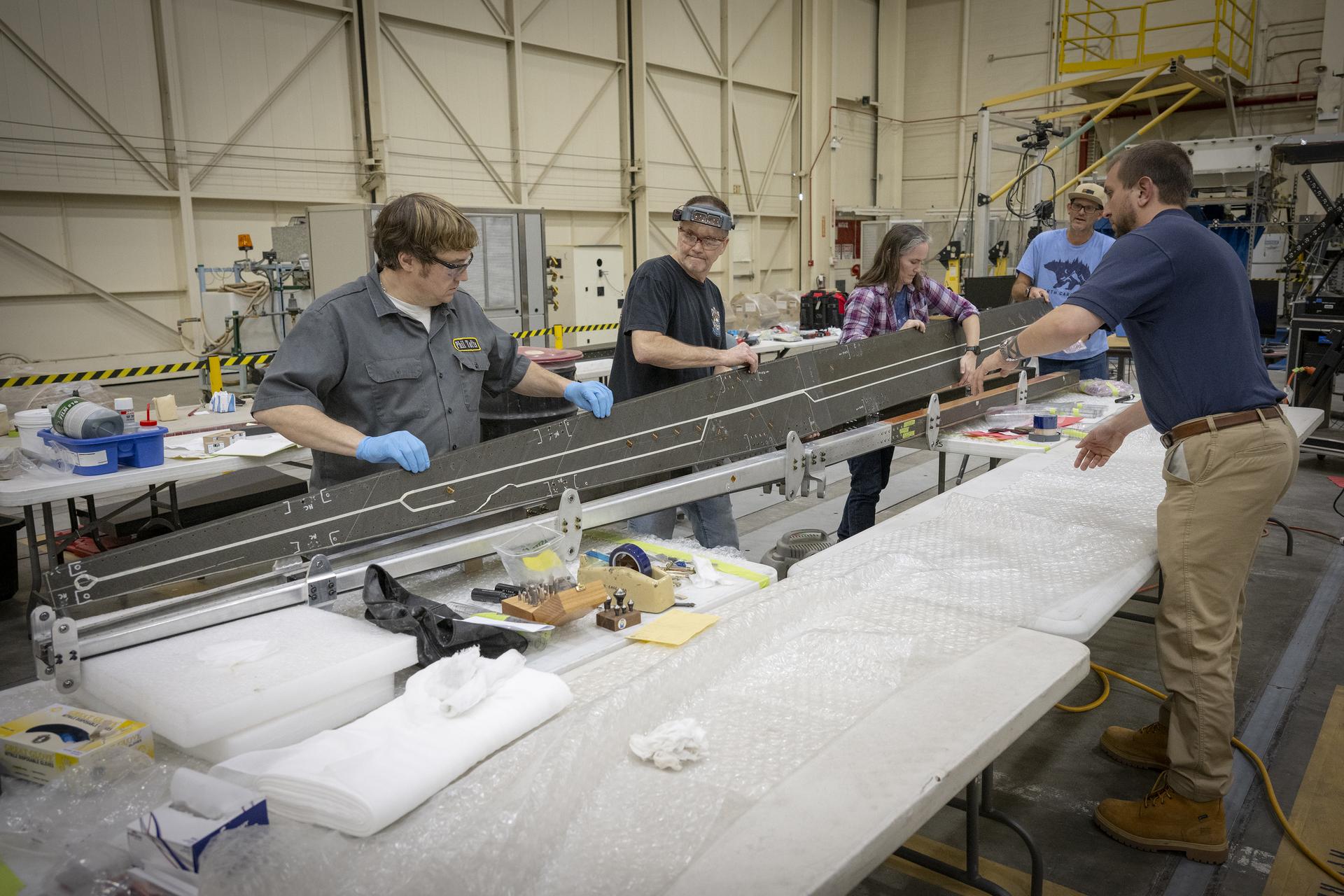
A group of people work together in a large workshop, handling and inspecting a long metallic structure laid across padded tables. Tools, materials, and protective equipment are spread across the workspace.
Lab technicians Phil Tofts, Chris McLain, and Jeff Howell and NASA engineers Erin Anderson and Richard Larson prepare the 15-foot Structural Wing Experiment Evaluating Truss-bracing model in the Flight Loads Laboratory at NASA’s Armstrong Flight Research Center in Edwards, California, on Thursday, Dec. 11, 2025. The model is part of NASA’s research to develop technologies for future ultra-efficient aircraft. 
NASA/Christopher LC Clark

The SWEET-15 design originated with combining five different advanced composite manufacturing and assembly technologies that enabled the novel structural design. The 15-foot-long test article was then designed and fabricated at NASA’s Langley Research Center in Hampton, Virginia, before traveling to NASA’s Armstrong Flight Research Center in Edwards, California, for testing.

Over several months, NASA engineers intentionally bent the test wing in the Flight Loads Laboratory at NASA Armstrong. Numerous strain and load sensors, including fiber-optic strain sensors, were placed throughout the structure to track how the wing responded as forces increased.

The data from the sensors confirmed the predictions made by NASA’s computer models. According to initial findings, the wing withstood the anticipated in-flight forces without issue. The results provided the team with confidence in the new manufacturing approaches and methods for connecting wing parts used in SWEET-15, which could support future efficient aircraft designs. The manufacturing approach, developed at NASA Langley used the Integrated Structural Assembly of Advanced Composites robot, aims to produce lighter and stronger composite structures for aerospace vehicles.
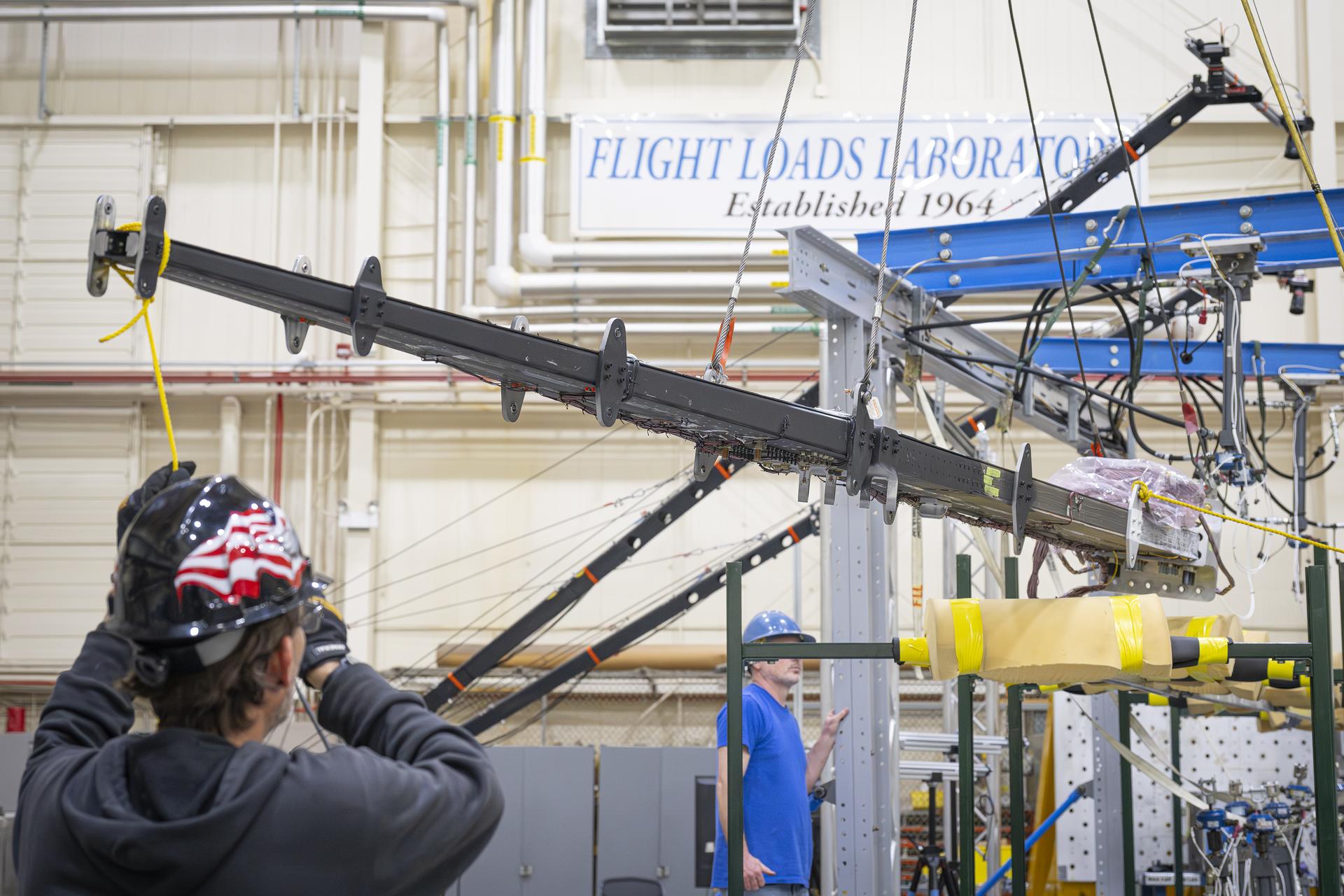
A long beam is suspended in a laboratory while personnel observe and guide its placement. Overhead support equipment, cables, and lab infrastructure surround the test area.
Lab technicians Jeff Howell, left and Chris Mount install the 15-foot Structural Wing Experiment Evaluating Truss-bracing model in the Flight Loads Lab at NASA’s Armstrong Flight Research Center in Edwards, California, Wednesday, February 11, 2026. The model is part of NASA’s research to develop technologies for future ultra-efficient aircraft.
NASA/Christopher LC Clark

The test concluded with a deliberate test-to-failure, where engineers increased loads beyond the wing’s design limits to determine how and where it would fail. The structure ultimately failed at roughly 127% of its design limit load, with visible damage appearing near the back edge of the wing and in the upper wing cover. This element of testing provided valuable insight into how the joints connecting the wing to its main strut and a secondary one, called a jury strut, behave under forces beyond the expected flight envelope.

This marks the first time a representative composite truss-braced wing configuration has undergone this type of structural evaluation.  It was made possible only through NASA collaboration across centers and projects, with researchers utilizing agency resources such as the Fiber Optic Sensing System developed to gather data on both aircraft and spacecraft.
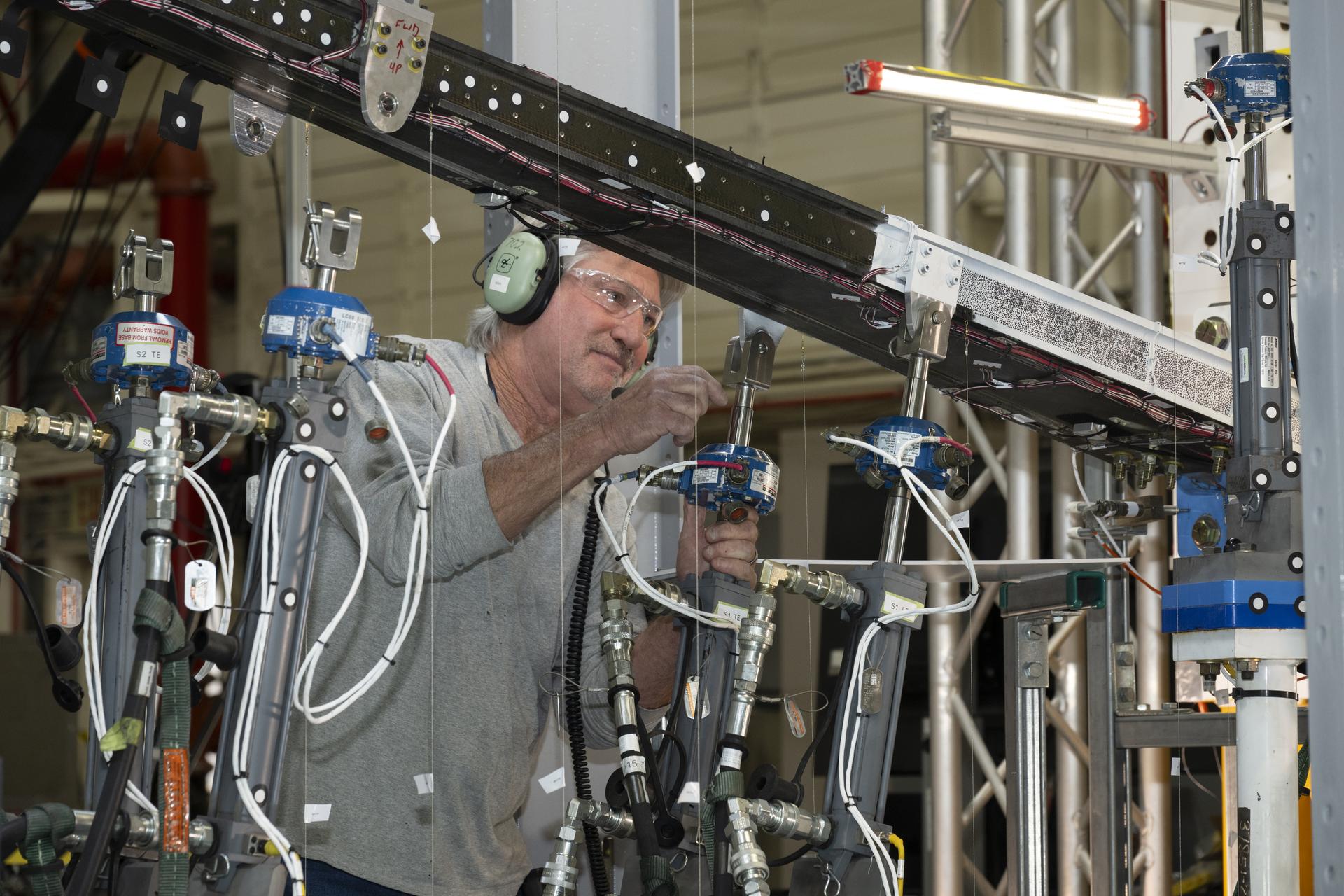
A man wearing ear protection works closely with multiple hydraulic and instrumentation units connected to a large beam mounted on a test structure. Numerous cables, hoses, and measurement devices extend from the setup.
NASA research engineer Walter Hargis regulates the 15-foot Structural Wing Experiment Evaluating Truss-bracing model in the Flight Loads Laboratory at NASA’s Armstrong Flight Research Center in Edwards, California, on Tuesday, March 31, 2026. The model is part of NASA’s research to develop technologies for future ultra-efficient aircraft. 
NASA/Ryan Kline

To prepare for the testing, engineers at NASA Langley designed, analyzed, and manufactured the wing and completed safety preparations and lab setup.

Researchers will now analyze the data collected during testing to inform future airframe designs and support NASA’s ongoing efforts to develop more efficient aviation technologies.

The work is being conducted through NASA’s Subsonic Flight Demonstrator project in the agency’s Research Technology Mission Directorate. The successful testing of multiple innovative components marks a milestone in NASA’s aeronautics research.

To learn more, visit:

https://www.nasa.gov/aeronautics/

The post NASA Pushes New Wing Design to Find Structural Limits appeared first on NASA Science.
The Growing Crescent of Mars as NASA’s Psyche Mission Approaches

17 July 2026 at 23:32
1 Min Read

The Growing Crescent of Mars as NASA’s Psyche Mission Approaches

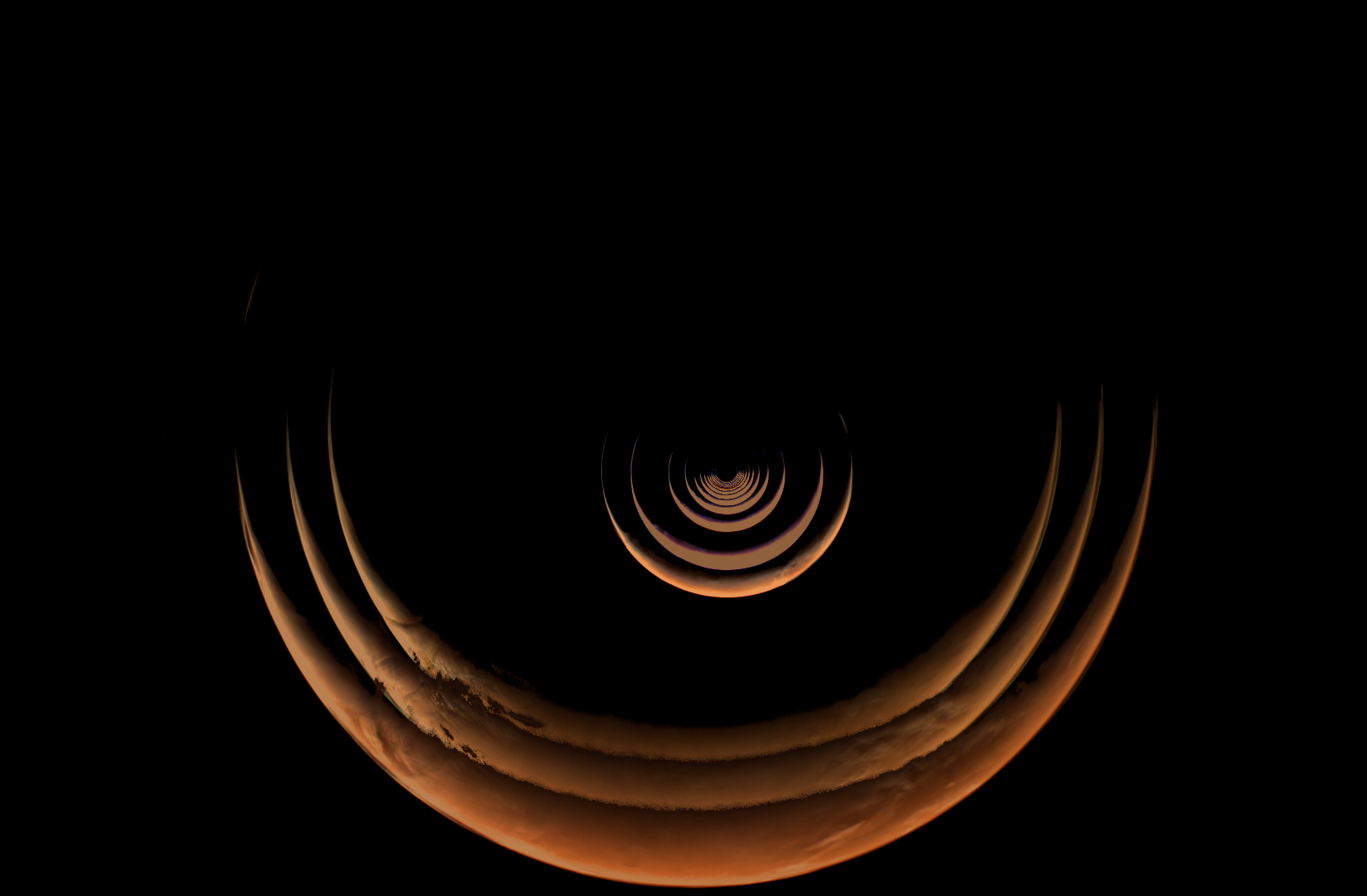
A time-lapse composite against a black background shows a series of concentric, glowing orange crescent planetary horizons that expand outward from a small central point, illustrating a spacecraft's approach during a Mars flyby.
PIA26586
Credits: NASA/JPL-Caltech/ASU

Downloads

The Growing Crescent of Mars as NASA’s Psyche Mission Approaches

PNG (3.48 MB)

Description

This composite of images taken by NASA’s Psyche mission shows the crescent of Mars grow as the spacecraft approached the planet for a gravity assist from May 2 to May 15, 2026. The series begins with the smallest crescent at the center of the of the image as Mars is farthest from the spacecraft, and progressively grows as the spacecraft gets closer. After these views were captured by the spacecraft’s multispectral imager instrument, Mars began to overfill the field of view as Psyche made close approach with the planet and captured a series of high-resolution images of the surface.

Because Psyche approached Mars from a high phase angle, the planet appeared as a thin crescent in the days running up to the close approach, lit by sunlight reflecting off its surface. Using these views of the approach, close approach, and departure from Mars, the Psyche team compiled a stunning time-lapse of its entire Mars encounter.

For more information about NASA’s Psyche mission, visit:

https://science.nasa.gov/mission/psyche/

The post The Growing Crescent of Mars as NASA’s Psyche Mission Approaches appeared first on NASA Science.

Establishing a VTE Risk Score for Astronauts Algorithm

17 July 2026 at 22:01
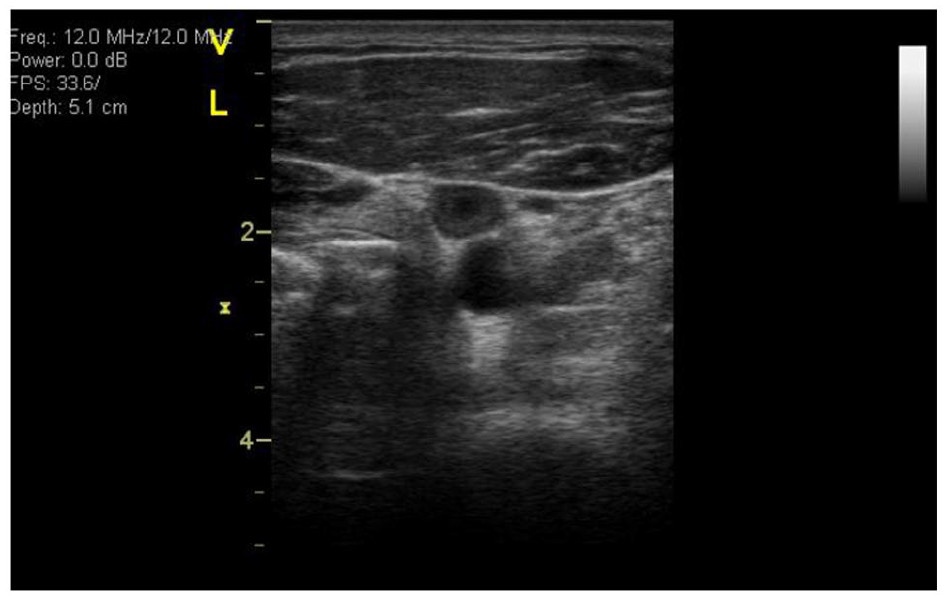
Spontaneous echo contrast (SEC) grade 3 with peripheral echogenicity.
NASA/Pavela

In April 2026, NASA’s Office of the Chief Health and Medical Officer (OCHMO) initiated a working group to review updated VTE case information, additional data gathered revealing altered blood flow status within a cohort of astronauts, and discuss progress of research and clinical activities intended to mitigate the risk of VTE during spaceflight with new evidence-based clinical practice recommendations.

Recommendations

The following is a summary of the working group’s recommendations:

  • The working group’s conclusions emphasized that stasis in the left internal jugular vein (IJV) is consistently viewed as a dominant risk factor for VTE in microgravity, though there is active debate regarding the relative contributions of slow qualitative flow, endothelial factors and/or retrograde flow.
  • Limitations of current in-flight ultrasound capabilities to accurately measure stasis/slow flow was cited as a concern, especially if using only stasis as a factor for indicating the need for prophylaxis.
  • Additional review of assessing stasis with ultrasound in-flight was recommended.
  • After reviewing the risk factors, additional discussions following the working group led to the majority of the panel agreeing that stasis and retrograde flow warranted use of prophylaxis.
  • The working group also recommended assessing all other risk factors other than stasis to also determine when prophylaxis is warranted.
  • Based on a literature review and summary of the panel contributions, a VTE Risk Score for Astronauts Algorithm was developed, which includes providing anticoagulation prophylaxis for stasis alone, or a combination of other thrombosis risk factors that are weighted by terrestrial literature.

Risk of Venous Thromboembolism During Spaceflight

NASA initially formed a working group in October 2024 after diagnosing venous thromboembolisms (VTEs) in astronauts during ISS missions. Experts reviewed case data, updated Clinical Practice Guidelines, and examined possible causes.

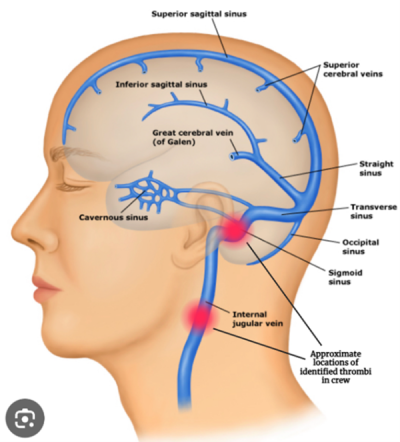
Approximate location of identified thrombi in crewmembers.
Source: Modified from Cerebral Sinus Venous Thrombosis – University of Colorado Denver

The post Establishing a VTE Risk Score for Astronauts Algorithm appeared first on NASA Science.
NASA Awards Facilities Support Services Contract for Ames Research Center 

17 July 2026 at 21:34

CONTRACT RELEASE

NASA has selected Chugach Intelligence Solutions LLC to provide comprehensive operations, maintenance, and repair services for NASA’s Ames Research Center in California’s Silicon Valley. 

The Ames Facilities Support Services II contract ensures that the center’s historic and specialized facilities are properly maintained, fully operational, and capable of supporting the agency’s missions and tenant partners in the NASA Research Park. 

The hybrid contract has a five-year period of performance, consisting of a 12-month base period and four 12-month option periods, with the possibility of a six-month extension. The performance period is expected to begin Thursday, Aug. 13. The contract includes cost-plus-award-fee core requirements, firm-fixed-price phase-in, and indefinite-delivery/indefinite-quantity task orders, providing flexibility to address both routine and emergent facility needs. The award has a maximum potential value of approximately $158 million, inclusive of all options and total indefinite-delivery/indefinite-quantity ceiling value. 

For more information about NASA and its missions, visit: 

https://www.nasa.gov

-end- 

Jeanne Neal
Ames Research Center, Silicon Valley, Calif.
650-604-4789
jeanne.c.neal@nasa.gov

The post NASA Awards Facilities Support Services Contract for Ames Research Center  appeared first on NASA Science.

NASA’s Chandra and IXPE Study Pulsar in Lighthouse Nebula

17 July 2026 at 21:05
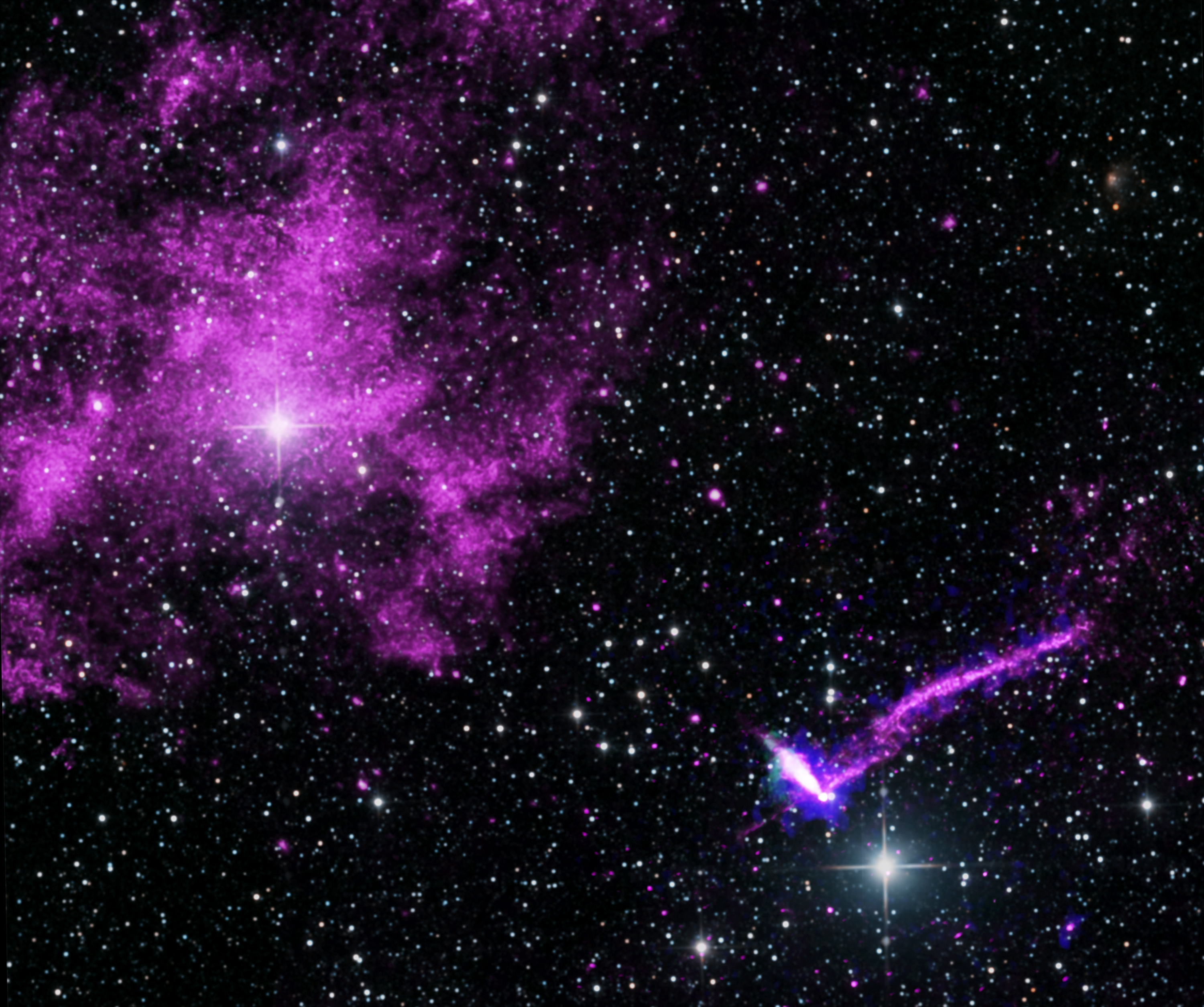
This composite multiwavelength image captures the turbulent environment surrounding the Lighthouse pulsar, set against a vast, black background speckled with twinkling white and faint green stars. In the upper-left quadrant, a massive, cloud-like nebula glows in a textured, vibrant purple hue, anchored by a prominent four-pointed star shining brightly near its center. Moving toward the lower-right quadrant, the pulsar itself is located at the lower tip of a concentrated, brilliant whitish-blue elongated point of light. Extending outward from its core is a long, narrow, and slightly curved jet of purple and blue emission that streaks upward and to the right. This jet represents a massive 37-light-year tail of high-energy particles trailing behind the rapidly spinning star as it plow through interstellar space. This composite image contains X-ray data from NASA's Chandra X-ray Observatory in purple, additional X-ray from NASA's IXPE in blue, and radio data from CSIRO in green. The starfield is optical data from the 2MASS survey.
Scientists using NASA’s IXPE (Imaging X-ray Polarimetry Explorer) directly measured the magnetic fields of PSR J1101−6101, a pulsar located within what is often referred to as the “Lighthouse” Nebula, for the first time.
X-ray: Chandra: NASA/CXC/Stanford Univ./J. Dinsmore et al.; IXPE: NASA/MSFC/J. Dinsmore et al., Radio: CSIRO/ATNF/ATCA; Optical: 2MASS/UMass/IPAC-Caltech/NASA/NSF; Image processing: NASA/CXC/SAO/L. Frattare

This composite image, released on July 9, 2026, shows the region around a pulsar – a neutron star with a strong magnetic field that spins incredibly fast – within the Lighthouse nebula. The image contains X-ray data from NASA’s Chandra X-ray Observatory in purple, X-rays from NASA’s IXPE (Imaging X-ray Polarimetry Explorer) in blue, and radio emission captured by the Australia Compact Telescope Array in green.

Scientists used IXPE – for the first time ever – to directly measure the magnetic fields of the pulsar. The results provide new insight into the structure of some of the most extreme objects in the cosmos, as NASA continues to explore the secrets of how the universe works. A paper describing the results published July 9 in the Astrophysical Journal.

Read more about this novel use of IXPE.

Image credit: X-ray: Chandra: NASA/CXC/Stanford Univ./J. Dinsmore et al.; IXPE: NASA/MSFC/J. Dinsmore et al., Radio: CSIRO/ATNF/ATCA; Optical: 2MASS/UMass/IPAC-Caltech/NASA/NSF; Image processing: NASA/CXC/SAO/L. Frattare

The post NASA’s Chandra and IXPE Study Pulsar in Lighthouse Nebula appeared first on NASA Science.

La NASA invita a los medios de comunicación al lanzamiento del telescopio espacial Roman

17 July 2026 at 20:27
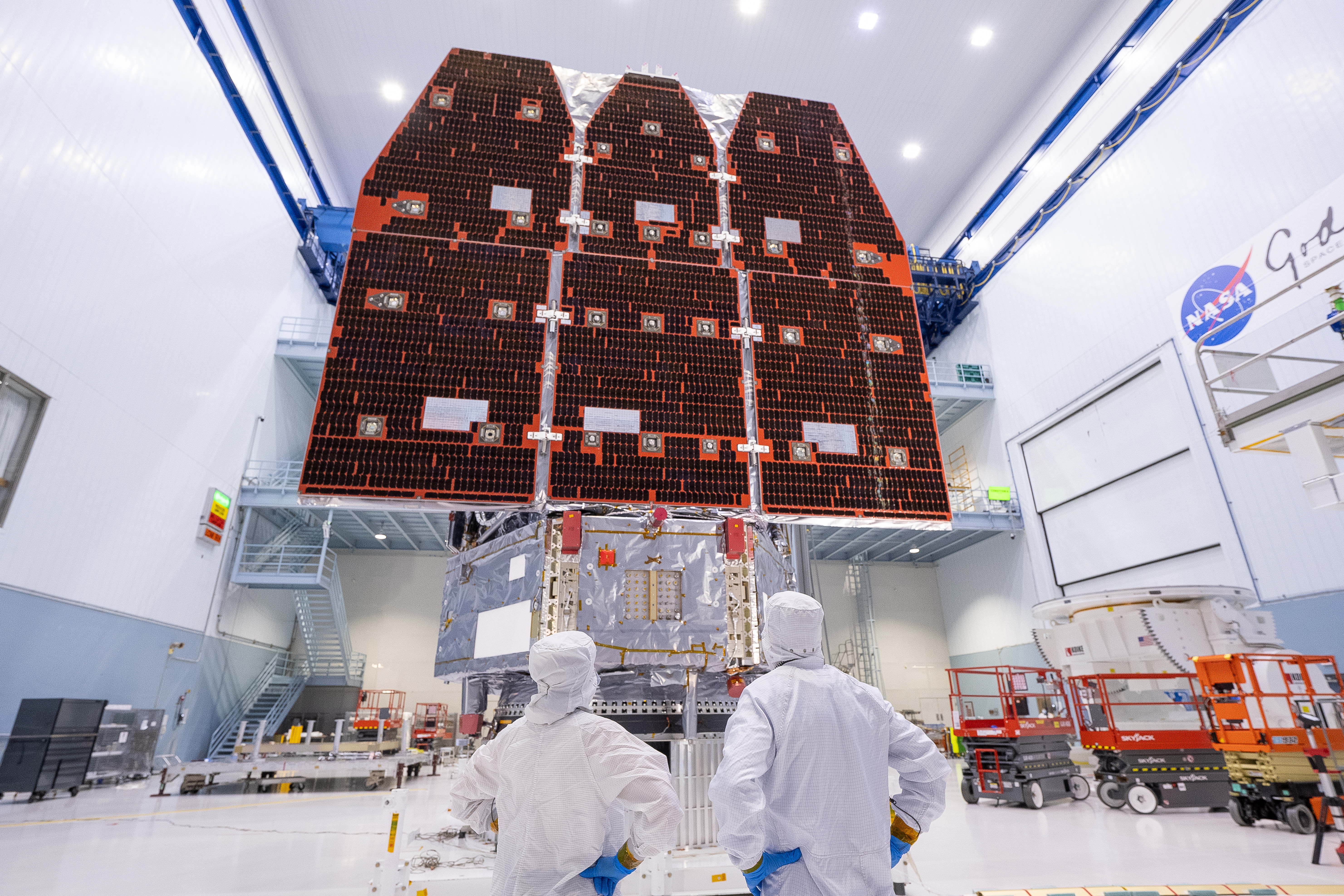
Aquí puede verse el telescopio espacial Nancy Grace Roman de la NASA en la sala limpia del Centro de Vuelo Espacial Goddard de la agencia en Greenbelt, Maryland, donde este observatorio fue construido y sometido a pruebas. Los amplios y profundos sondeos de Roman explorarán la materia oscura, la energía oscura, los exoplanetas y prácticamente cualquier objeto celeste, desde nuestro propio sistema solar hasta galaxias situadas en los confines del universo observable.
Crédito: NASA/Jolearra Tshiteya

Read this release in English here.

Ya está abierto el plazo de acreditación de los medios de comunicación para el lanzamiento de la misión del telescopio espacial Nancy Grace Roman de la NASA.

El lanzamiento del telescopio Roman está programado para no antes de las 7:20 a.m. (hora del este) del domingo 30 de agosto, a bordo de un cohete Falcon Heavy de SpaceX, desde el Complejo de Lanzamiento 39A en el Centro Espacial Kennedy de la NASA en Florida. Este observatorio, que lleva el nombre de la primera astrónoma jefa de la NASA, ofrecerá una visión profunda y panorámica del cosmos, generando imágenes nunca antes vistas que revolucionarán nuestra comprensión del universo.

Los medios interesados en asistir al lanzamiento deben presentar su solicitud antes de los siguientes plazos:

  • Los representantes de medios de comunicación internacionales sin ciudadanía estadounidense deben presentar su solicitud antes de las 11:59 p.m. del domingo 26 de julio.
  • Los medios de comunicación de Estados Unidos y los ciudadanos estadounidenses que representen a organizaciones de medios internacionales deben presentar su solicitud antes de las 11:59 p.m. del jueves 30 de julio.•

Todas las solicitudes de acreditación deben ser enviadas en línea a través del sitio web:

https://media.ksc.nasa.gov

La política de acreditación de medios de la NASA está disponible en línea. Para consultas sobre la acreditación o para solicitudes logísticas especiales, envíe un correo electrónico a: ksc-media-accreditat@mail.nasa.gov.

Para otras consultas, comuníquese con la sala de prensa del Centro Espacial Kennedy de la NASA al teléfono: 321-867-2468.

Para obtener más información sobre esta misión, visite el sitio:

https://www.ciencia.nasa.gov/roman

-fin-

Alise Fisher / María José Viñas
Sede central de la NASA, Washington
202-385-1287
alise.m.fisher@nasa.gov / maria-jose.vinasgarcia@nasa.gov

Leejay Lockhart
Centro Espacial Kennedy, Florida
321-747-8310
leejay.lockhart@nasa.gov

Claire Andreoli
Centro de Vuelo Espacial Goddard de la NASA, Greenbelt, Maryland
301-286-1940
claire.andreoli@nasa.gov

Share

Details

Last Updated
Jul 17, 2026

Related Terms

The post La NASA invita a los medios de comunicación al lanzamiento del telescopio espacial Roman appeared first on NASA Science.

Water Resources 

17 July 2026 at 19:12

Water Resources

A photograph taken from a rocky shoreline along the Iola Basin show mats of green growth coating the surface of the water.

The NASA Earth Action Water Resources program area advances the use of Earth science data to support sustainable and adaptable water resources management. Through collaboration with partners, the program area works to enhance water use efficiency, advance water quality monitoring and modeling, and strengthen water resilience. These efforts empower informed decision-making and address critical challenges in water resources.  

Program Manager: Erin Urquhart 

See examples of recent Water Resources grants. Example 1 & Example 2

The post Water Resources  appeared first on NASA Science.

Health and Air Quality 

17 July 2026 at 19:12

Health and Air Quality

Haze Sweeps Over the Mediterranean

The NASA Earth Action Health and Air Quality program area encourages the use of Earth observations in air quality management and public health, including environmental health and infectious diseases. The program area helps public health and air quality managers, policymakers, and the public manage health-related decisions and minimize disease risk. 

Program Manager: John Haynes 

Visit the Health and Air Quality Applied Sciences Team (HAQAST) page. 

The post Health and Air Quality  appeared first on NASA Science.

Energy and Infrastructure 

17 July 2026 at 19:12

Energy and Infrastructure 

American flag in the breeze over a blue steel bridge over a large river at sunset.

The Energy and Infrastructure program area provides solar, meteorological, and other types of Earth information to aid decision-making related to energy production and management, power systems planning, building energy efficiency and sustainability, and resilient infrastructure. Two major projects are: Prediction Of Worldwide Energy Resources (POWER), which curates satellite and modeling data in free web platforms, and Risk Analysis and Solutions Innovators (RASI), which tailors meteorological and other Earth information to support infrastructure resilience for U.S. communities, especially those surrounding NASA Centers.  

Program Manager: Shanna Combley 

Learn more about POWER and RASI. 

The post Energy and Infrastructure  appeared first on NASA Science.

AGN SIG Spotlight Series, 21 July 2026

16 July 2026 at 11:47

AGN SIG Spotlight Series

Active Galactic Nuclei Science Interest Group

AGN SIG about AGN SIG Spotlight Series

Location

Virtual

Dates

21 July 2026
1:00pm ET / 10:00am PT

Community

AGN SIG

Type

Seminar

Spin Signatures in Horizon-Resolved Images of LLAGN

Speaker

Dr. Daniel Palumbo, Harvard University

Abstract

With the advent of the Event Horizon Telescope (EHT), near-horizon black hole imaging with sub-mm very-long-baseline interferometry (VLBI) is now routine for the two sources for which terrestrial VLBI is sufficient to resolve the black hole shadow: Messier 87* and Sagittarius A*. Since the first images of M87*, the theoretical analysis of these images has advanced a broad class of black hole spin tracers in horizon-resolving observations, all of which have complex interplay with the astrophysical conditions near the horizon. Meanwhile, space VLBI mission concepts such as the Black Hole Explorer aim to drastically improve the angular resolution available via sub-mm VLBI, resolving out the primary accretion disk image to isolate the strongly lensed “photon ring,” which more robustly exposes black hole mass, spin, and viewing inclination to distant observers. In this talk, I will detail the spin signatures in both of these angular resolution regimes, and how they work together to build a “robustness ladder” for spin measurement with which the spins of many more low-luminosity AGN will soon become accessible as sub-mm VLBI sensitivity, frequency coverage, angular resolution improves. The resulting local “spin census” will help fill in missing pieces of the history of accretion and merging in the broader AGN population.

Coupling Driven H2 Excitation in Seyferts: GATOS JWST/MRS

Speaker

Daniel Delaney, University of Alaska

Abstract 

We utilize James Webb Space Telescope/Mid Infrared Instrument (JWST/MIRI) Integral Field Unit observations from the Galaxy Activity, Torus and Outflow Survey to investigate the diverse range of ionized outflow rates of obscured active galactic nuclei (AGN) with similar bolometric luminosity and explore potential associations with AGN feedback. We explore spatial correlations between ionized emission potentially associated with fast shocks ([Fe II]5.34μm) and the excitation of H2. We further constrain our investigation to the inner 400 pc (the nuclear and circumnuclear regions r < 200 pc), and estimate the excitation temperature and column density of H2 assuming local thermodynamic equilibrium and using the S(1)–S(8) rotational H2 emission lines visible to JWST/MIRI spectroscopy. We report the molecular gas temperature of the deprojected 400 pc nuclear region to correlate with the ionized mass outflow rate. We also observe a stronger degree of spatial correlation between [Fe II]5.34μm emission and H2 gas temperature. We observe regions of enhanced [Fe II]5.34μm/[Ar II]6.99μm spatially coincident with the ionization cones of objects with higher ionized outflow rates and [Fe II]5.34μm/[Ar II]6.99μm in the deprojected 400 pc nuclear region to scale positively with both the ionized outflow rate and the estimated molecular gas temperature. We do not observe the estimated jet cavity power within the central 400 pc as strongly correlated with the ionized mass outflow rate or molecular gas temperature of the nuclear region. We take the preceding observations to suggest a higher degree of interaction between AGN outflows and the circumnuclear disk.

Seminar Connection

Zoom Registration (note this is a new registration link), you will receive connection details by email after registration: 

https://alaska.zoom.us/meeting/register/V1okit8uSk2ql97gegbdzg

News Straight to Your Inbox

Subscribe to your community email news list

We will never share your email address.

Privacy Policy

Sign Up
Angled from the upper left corner to the lower right corner is a cone-shaped orange-red cloud known as Herbig-Haro 49/50. This feature takes up about three-fourths of the length of this angle. The upper left end of this feature has a translucent, rounded end. The conical feature widens slightly from the rounded end at the upper right down to the lower right. Along the cone there are additional rounded edges, like edges of a wave, and intricate foamy-like details, as well as a clearer view of the black background of space. In the upper left, overlapping with the rounded end of Herbig-Haro 49/50, is a background spiral galaxy with a concentrated blue center that fades outward to blend with red spiral arms. The background of space is speckled with some white stars and smaller, more numerous, fainter white galaxies throughout.

The post AGN SIG Spotlight Series, 21 July 2026 appeared first on NASA Science.

DGCE SIG Seminar, 23 July 2026

16 July 2026 at 11:46

DGCE SIG Seminar

Diffuse Gas in Cosmic Ecosystems Science Interest Group

DGCE SIG about DGCE SIG Seminar

Location

Virtual

Dates

23 July 2026
4:00pm ET / 1:00pm PT

Community

DGCE SIG

Type

Seminar

From Micro to Macro: Connecting the Physics of Galaxy Formation Across Scales

Speaker

Drummond Fielding, New York University

Abstract

Galaxy formation is controlled by the cycling of diffuse gas through the ISM, CGM, and larger-scale environment, but predictive models remain limited by unresolved microphysics. I will discuss how sub-pc processes—including cosmic-ray transport, magnetic reconnection, and turbulent mixing—regulate multiphase structure, energy and momentum transport, and the launching of galactic winds. I will then describe how simulations, analytic models, and new multi-scale numerical methods can connect these processes to kpc-scale feedback and Mpc-scale galaxy evolution. The aim is to build physically grounded models of gas cycling that can sharpen our interpretation of observations and move galaxy formation theory beyond phenomenological feedback prescriptions.

Seminar Connection

Join the Seminar

News Straight to Your Inbox

Subscribe to your community email news list

We will never share your email address.

Privacy Policy

Sign Up
Angled from the upper left corner to the lower right corner is a cone-shaped orange-red cloud known as Herbig-Haro 49/50. This feature takes up about three-fourths of the length of this angle. The upper left end of this feature has a translucent, rounded end. The conical feature widens slightly from the rounded end at the upper right down to the lower right. Along the cone there are additional rounded edges, like edges of a wave, and intricate foamy-like details, as well as a clearer view of the black background of space. In the upper left, overlapping with the rounded end of Herbig-Haro 49/50, is a background spiral galaxy with a concentrated blue center that fades outward to blend with red spiral arms. The background of space is speckled with some white stars and smaller, more numerous, fainter white galaxies throughout.

The post DGCE SIG Seminar, 23 July 2026 appeared first on NASA Science.

HWO SIG Seminar, 12 August 2026

16 July 2026 at 11:45

HWO SIG Seminar

Habitable Worlds Observatory Science Interest Group

HWO SIG about HWO SIG Seminar

Location

Virtual

Dates

12 August 2026

Community

HWO SIG

Type

Seminar

Title TBA

Speaker

TBA

Seminar Connection

Join the Seminar

News Straight to Your Inbox

Subscribe to your community email news list

We will never share your email address.

Privacy Policy

Sign Up
Angled from the upper left corner to the lower right corner is a cone-shaped orange-red cloud known as Herbig-Haro 49/50. This feature takes up about three-fourths of the length of this angle. The upper left end of this feature has a translucent, rounded end. The conical feature widens slightly from the rounded end at the upper right down to the lower right. Along the cone there are additional rounded edges, like edges of a wave, and intricate foamy-like details, as well as a clearer view of the black background of space. In the upper left, overlapping with the rounded end of Herbig-Haro 49/50, is a background spiral galaxy with a concentrated blue center that fades outward to blend with red spiral arms. The background of space is speckled with some white stars and smaller, more numerous, fainter white galaxies throughout.

The post HWO SIG Seminar, 12 August 2026 appeared first on NASA Science.

GW SIG Seminar, 23 July 2026

16 July 2026 at 11:42

GW SIG Seminar

Gravitational Wave Science Interest Group

GW SIG about GW SIG Seminar

Location

Virtual

Dates

23 July 2026
10:00am – 11:15am ET

Community

GW SIG

Type

Seminar

LISA Preparatory Science and LISA Science Gaps

Details TBA

Seminar Connection

Join the Seminar

News Straight to Your Inbox

Subscribe to your community email news list

We will never share your email address.

Privacy Policy

Sign Up
This cropped horizontal image has layers of semi-opaque rusty red colored gas and dust that starts at the bottom right and goes toward the top left. There are three prominent pillars rising toward the top left. The left pillar is the largest and widest. The peaks of the second and third pillars are set off in darker shades of brown and have red outlines.

The post GW SIG Seminar, 23 July 2026 appeared first on NASA Science.

Habitable Worlds Observatory SIG Seminar, 12 Aug 2026

16 July 2026 at 11:41

Habitable Worlds Observatory SIG Seminar

Habitable Worlds Observatory Science Interest Group

HWO SIG about Habitable Worlds Observatory SIG Seminar

Location

Virtual

Dates

12 August 2026

Community

HWO SIG

Type

Seminar

Title TBA

Speaker

TBA

Seminar Connection

Join the Seminar

News Straight to Your Inbox

Subscribe to your community email news list

We will never share your email address.

Privacy Policy

Sign Up
This cropped horizontal image has layers of semi-opaque rusty red colored gas and dust that starts at the bottom right and goes toward the top left. There are three prominent pillars rising toward the top left. The left pillar is the largest and widest. The peaks of the second and third pillars are set off in darker shades of brown and have red outlines.

The post Habitable Worlds Observatory SIG Seminar, 12 Aug 2026 appeared first on NASA Science.

Ontario Wildfire Smoke Moves East

16 July 2026 at 05:00
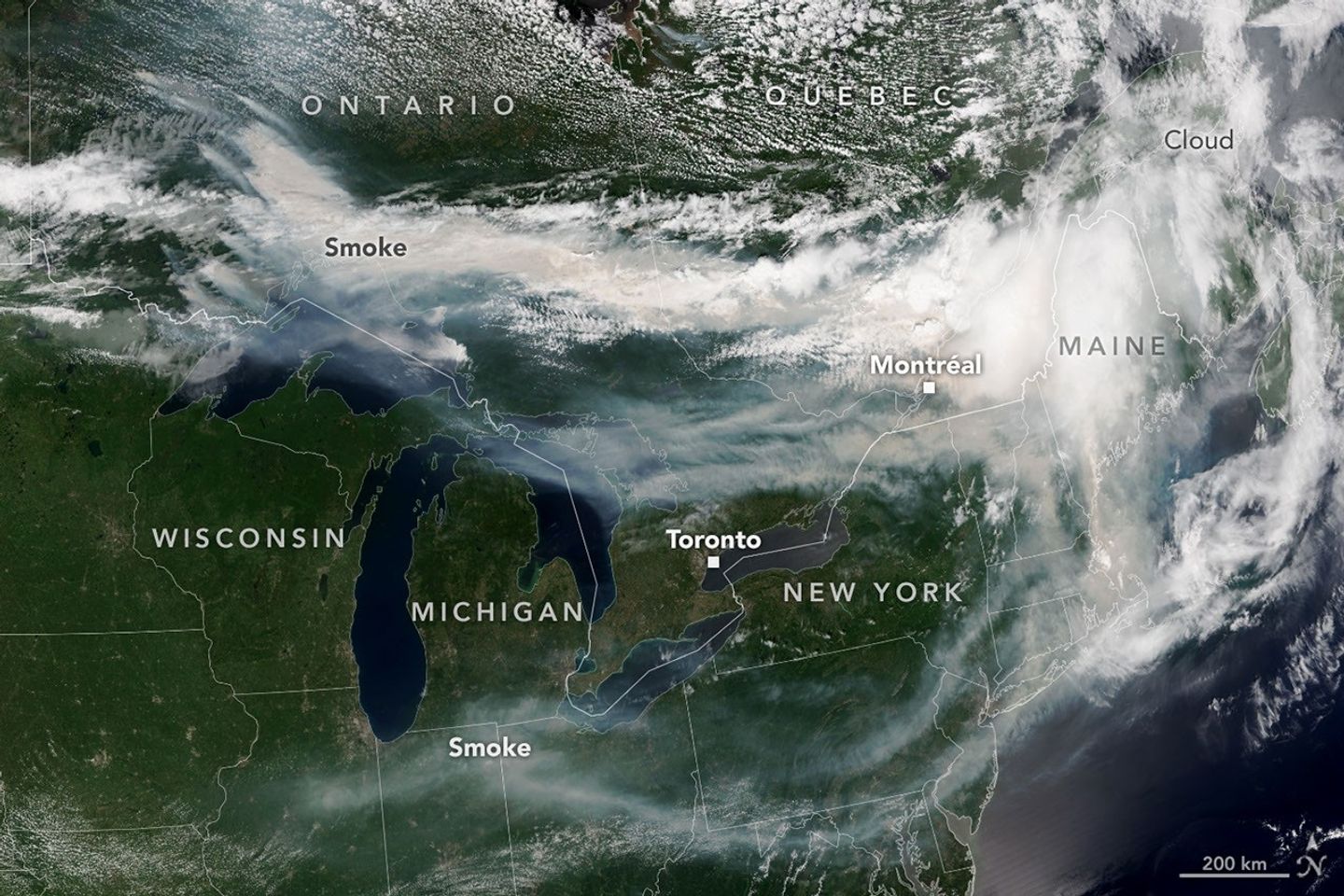
A satellite image shows brown smoke from wildfires in Ontario, Canada, streaming east across parts of Canada and the U.S. Areas of white clouds are mixed in with the smoke.
Smoke from wildland fires pours eastward over Canada and the U.S. in an image captured on the afternoon of July 14, 2026, by the VIIRS (Visible Infrared Imaging Radiometer Suite) on the NOAA-21 satellite.
NASA Earth Observatory/Lauren Dauphin

After a slow start to Canada’s 2026 fire season, activity picked up by the end of June amid dry, warm conditions and returned closer to the 25-year average. By mid-July, almost 850 fires were actively burning across the country, according to the Canadian Interagency Forest Fire Centre. More than 180 of those were burning in Ontario.

This NOAA-21 image, acquired on the afternoon of July 14, 2026, shows smoke billowing from the Ontario fires. Winds carried the smoke primarily southeast over much of the southern part of the province, as well as parts of Quebec and the U.S. Midwest and Northeast, tinting the sky shades of gray and yellow and the Sun orange in many areas.

The smoke’s impact on air quality varied, depending largely on altitude. In areas where smoke was high in the atmosphere, air quality impacts were negligible; where it drifted closer to the ground, conditions worsened. Air quality in Toronto, for instance, reached unhealthy levels, according to AirNow. People in the southern parts of the province were also grappling with a heat wave, compounding the health risks.

Much of the smoke came from fires in Northwestern Ontario, where eight blazes saw significant growth on July 13 and 14. The fires prompted officials to issue evacuation orders for several communities in this part of the province, according to news reports.

As of July 14, fires across Canada have burned 1.9 million hectares (4.7 million acres) since the start of the year—still well below the season totals from the extreme fire years of 2023 and 2025. How the rest of the season plays out remains to be seen. A seasonal fire outlook—compiled by wildland fire experts from the U.S., Canada, and Mexico—shows where fire conditions are more or less likely through July, August, and September.

NASA Earth Observatory image by Lauren Dauphin, using VIIRS data from NASA EOSDIS LANCE , GIBS/Worldview , and the Joint Polar Satellite System (JPSS). Story by Kathryn Hansen.

Downloads

A satellite image shows brown smoke from wildfires in Ontario, Canada, streaming east across parts of Canada and the U.S. Areas of white clouds are mixed in with the smoke.

July 14, 2026

JPEG (3.96 MB)

References & Resources

You may also be interested in:

Stay up-to-date with the latest content from NASA as we explore the universe and discover more about our home planet.

Fighting Fire With Fire
3 min read

In fire-prone ecosystems in Australia’s Northern Territory, prescribed burns are lit to minimize the severity of fires later in the…

Article
Fires Tear Through Nebraska Grasslands
3 min read

Dry, warm, and windy conditions across the U.S. Great Plains led to extreme fire activity in March 2026.

Article
Cottonwood Fire Chars Utah
5 min read

The blaze burned more than 150 square miles and swept through parts of a ski resort.

Article

The post Ontario Wildfire Smoke Moves East appeared first on NASA Science.

NASA Uses Subscale Aircraft to Accelerate Flight Innovation

15 July 2026 at 22:56
4 Min Read

NASA Uses Subscale Aircraft to Accelerate Flight Innovation

A white, blue, and red probe attached to a rotor with four blades flies in the blue sky, just above the Moon.
An atmospheric probe model attached upside down to a quad rotor remotely piloted aircraft ascends with the Moon visible on Oct. 22, 2024. The quad rotor aircraft released the probe above Rogers Dry Lake, a flight area adjacent NASA’s Armstrong Flight Research Center in Edwards, California. The probe was designed and built at the center.
Credits: NASA/Steve Freeman

Testing new aerospace concepts in flight remains one of NASA’s most effective ways to advance knowledge and reduce risk.

The Dale Reed Subscale Flight Research Laboratory at NASA’s Armstrong Flight Research Center in Edwards, California, supports this mission by using small, remotely piloted and autonomous aircraft as cost‑effective platforms to mature innovative ideas, accelerate learning, and enable smoother transitions to full‑scale flight.

When experiments require a flight platform, several NASA remotely piloted aircraft are available: the Alta‑X quadrotor; the Dryden Remotely Operated Integrated Drone (DROID) with its 10‑foot wingspan; and the Multi‑Use Cub, a 14‑foot‑span fixed‑wing aircraft with an expandable payload capacity for flight experiments. For electric vertical takeoff and landing testing, the HQ‑90 quadrotor provides an additional option.

Once aircraft and experiments are cleared for operations, laboratory pilots support the mission, including ground operations and flight activities.

One man manages engine speed with a hand-held controller, while another firmly holds the subscale aircraft in place.
Justin Link, left, holds the subscale aircraft in place, while Justin Hall manages engine speed during preliminary engine tests on Friday, Sept. 12, 2025, at NASA’s Armstong Flight Research Center in Edwards, California. Link is a pilot for small uncrewed aircraft systems at the center’s Dale Reed Subscale Flight Research Laboratory and Hall is the chief pilot.
NASA/Christopher LC Clark

Flight expertise

Each staff member serves as an experienced and certified subscale aircraft pilot and is prepared to fly unique one-of-a-kind or modified commercial aircraft wherever the mission requires.

NASA’s FireSense project conducted flights in the Geneva State Forest, located about 100 miles south of Montgomery, Alabama. NASA Armstrong flight research staff integrated the instrument onto an Alta-X drone and tested the system before deployment. Two team members then transported the drone and sensor to the forest, prepared the vehicle for flight, and operated it during the mission. The NASA sensor was flown on the drone to demonstrate how remotely piloted aircraft can gather localized weather data that influences smoke movement and fire behavior. This information may help operational agencies improve wildfire decision-making and better allocate firefighters and resources.

Other missions occur closer to NASA Armstrong, such as the Enhancing Parachutes by Instrumenting the Canopy (EPIC) project. EPIC involved air‑launching a capsule containing a parachute and flexible sensor from the Alta‑X. Laboratory staff piloted the flights, supported flight operations, and worked with the EPIC team to design and integrate the parachute‑drop mechanism and safety system into the aircraft.

These tests demonstrated that a flexible sensor could help researchers study supersonic parachutes. Continuation of this work can help fill gaps in computer models, making supersonic parachutes safer and more reliable for delivering science instruments and payloads to Mars.

Two men integrate instruments onto a drone.
Justin Link, left, pilot for small uncrewed aircraft systems, and Justin Hall, chief pilot for small uncrewed aircraft systems, install weather instruments on NASA’s Alta X drone at the agency’s Armstrong Flight Research Center in Edwards, California. Members of the center’s Dale Reed Subscale Flight Research Laboratory used the Alta X to support the agency’s FireSense project in March 2025 for a prescribed burn in Geneva State Forest, which is about 100 miles south of Montgomery, Alabama.
NASA/Steve Freeman

Advancing challenging research

The Dale Reed Subscale Flight Research Laboratory uses rapid design and testing capabilities to help small aircraft fly big ideas. These concepts could lead to future breakthroughs that support NASA’s missions across aeronautics, science, and exploration.

For decades, NASA and its partners have advanced Automatic Collision Avoidance Technology. The research demonstrated an autopilot could detect and recover from an imminent ground collision – a capability now helping save lives in high‑performance U.S. military jets. NASA Armstrong had key roles in that work and developed a simplified version, the Automatic Ground Collision Avoidance System, which was installed on the DROID for testing.

The system demonstrated on the DROID — developed to assist general aviation pilots as well as remotely piloted and autonomous aircraft — performed well and led to further research toward a version that provides alerts and steering cues. The NASA Armstrong Technology Transfer Office is working to license the technology for U.S. businesses to develop the system as a commercial product.

The Prandtl‑D (Preliminary Research Aerodynamic Design to Lower Drag) flying‑wing glider was also designed, fabricated, and flown at NASA Armstrong. Researchers found that its twisted wing design could reduce drag and generate thrust at the wingtips, advancing concepts that may support greater fuel economy for future aircraft. The original Prandtl‑D is now part of the Smithsonian National Air and Space Museum collection in Washington, and the Prandtl-D3 is at the California Science Center in Los Angeles. Researchers continue developing the next generation of the design in the laboratory.

A wide range of capabilities in the laboratory help transform promising concepts into flight-ready test structures. These include rapid prototyping using traditional and advanced 3D manufacturing techniques, as well as composite and conventional fabrication processes. The team of engineers and technicians also provides custom component design and specialized fabrication to meet unique research needs.

The laboratory supports electrical and mechanical design, hardware and software integration, and the safety and flight-readiness processes required for successful missions. Additional technical facilities, such as the Experimental Fabrication Branch and the Environmental Laboratory at NASA Armstrong, further enhance these capabilities. Together, they support development, testing, and validation activities that advance NASA’s aeronautics and exploration goals.

Deborah Jackson, Al Bowers and Abbigail Waddell successfully launch the subscale Prandtl-D 3C glider.
NASA

Share

Details

Last Updated
Jul 15, 2026
Editor
Dede Dinius
Contact

The post NASA Uses Subscale Aircraft to Accelerate Flight Innovation appeared first on NASA Science.

GW SIG Seminar, 29 June 2026

24 June 2026 at 14:59

GW SIG Seminar

Gravitational Wave Science Interest Group

GW SIG about GW SIG Seminar

Location

Virtual

Dates

29 June 2026
1:00pm ET

Community

GW SIG

Type

Seminar

Laser Interferometer Lunar Antenna: a Sub-Hertz GW Detector on the Moon

Speaker

Volker Quetschke, University of Texas Rio Grande Valley

Abstract

The moon offers unique opportunities and challenges to realize interferometric gravitational wave detectors that are sensitive over a range of frequencies that are currently not covered. Compared with Earth-based detectors, the moon’s reduced gravity and lower seismic activity allow us to shift the sensitivity to lower frequencies.

An update on the Laser Interferometer Lunar Antenna (LILA) project—a next generation gravitational-wave detector on the surface of the Moon—will be presented. The LILA detector will have unique access to sub-Hertz frequencies of gravitational waves. This frequency range of waves cannot be measured by any ongoing or upcoming experiment on the Earth or in space, thus fundamentally changing the landscape of multi-messenger astrophysics that otherwise cannot be achieved. LILA will provide early warnings prior to mergers of black holes and neutron stars. Measurements in the deci-Hertz regime can vastly improve measurements of the Hubble constant, the equation of state of neutron stars, and tests of General Relativity. Furthermore, LILA will uniquely observe phenomena like white dwarf mergers as Type Ia supernovae progenitors, tidal disruption around intermediate mass black holes, and novel dark matter probes.

A preliminary design for the LILA project and the planned future development stages will be shown: the LILA Autonomous Interferometry Technology Demonstration (LILA-AITD), the Initial LILA (iLILA) strainmeter and the full, operational LILA Observatory.

Seminar Connection

Join the Seminar

News Straight to Your Inbox

Subscribe to your community email news list

We will never share your email address.

Privacy Policy

Sign Up
This cropped horizontal image has layers of semi-opaque rusty red colored gas and dust that starts at the bottom right and goes toward the top left. There are three prominent pillars rising toward the top left. The left pillar is the largest and widest. The peaks of the second and third pillars are set off in darker shades of brown and have red outlines.

The post GW SIG Seminar, 29 June 2026 appeared first on NASA Science.

AMMB STIG Seminar, 1 July 2026

24 June 2026 at 14:59

AMMB STIG Seminar

Astrophysics from the Moon, Mars, and Beyond Science and Technology Interest Group

AMMB STIG about AMMB STIG Seminar

Location

Virtual

Dates

1 July 2026
2:00pm -3:00pm ET
11:00am – 12:00 pm PT

Community

Physics of the Cosmos

Type

Seminar

Why and Where Do We Want to Put Telescopes on the Moon?

Speaker

Nivedita Mahesh, CU Boulder

Abstract

The Moon is emerging as a uniquely valuable platform for astrophysics, enabling observations that neither Earth nor free-flying spacecraft can support. This talk surveys the scientific motivation across four complementary regimes. At low radio frequencies, the radio-quiet lunar farside opens a window onto the cosmological Dark Ages and the magnetospheres of exoplanets. In the mid-band gravitational-wave regime, the Moon’s low seismic activity bridges the sensitivity gap between terrestrial and space-based detectors. At ultraviolet wavelengths, its natural vacuum and long coherence times allow high-resolution stellar imaging beyond what is possible on Earth. And in the far-infrared, the cold, stable conditions of permanently shadowed regions offer a naturally cryogenic, absorption-free site for probing star and planet formation and the obscured Universe.

For each regime, I will share updates from the mission concept leads on the efforts now developing within the Astrophysics from the Moon, Mars & Beyond (AMMB) Science Interest Group. Together, these cases point to a paradigm shift: astrophysics from the Moon is becoming not just desirable but necessary.

Seminar Connection

Join the Seminar

News Straight to Your Inbox

Subscribe to your community email news list

We will never share your email address.

Privacy Policy

Sign Up
This cropped horizontal image has layers of semi-opaque rusty red colored gas and dust that starts at the bottom right and goes toward the top left. There are three prominent pillars rising toward the top left. The left pillar is the largest and widest. The peaks of the second and third pillars are set off in darker shades of brown and have red outlines.

The post AMMB STIG Seminar, 1 July 2026 appeared first on NASA Science.

Cosmic Structure SIG Seminar, 17 July 2026

24 June 2026 at 14:57

Cosmic Structure SIG Seminar

Cosmic Structure Science Interest Group

CoS SIG about Cosmic Structure SIG Seminar

Location

Virtual

Dates

17 July 2026
10:00am PT / 1:00pm ET

Community

CoS SIG

Type

Seminar

Constraints on Dynamical Dark Energy from the Full Dark Energy Survey

Speaker

Sujeong Lee, Ohio University

Abstract

The nature of dark energy remains one of the central open questions in cosmology, and recent analyses have reported a weak but intriguing preference for an evolving equation of state. I will present constraints on the w0-wa parameterization from the full six-year Dark Energy Survey (DES) dataset, combining growth and geometric probes — supernovae, BAO, and weak lensing and galaxy clustering (3x2pt) — within a single survey. The DES-only combination yields the tightest such constraints using multiple probes from any single survey, and adding external CMB and DESI BAO data gives a 3.0-sigma deviation from a cosmological constant, with the best-fit always favoring w0 > -1, wa < 0. Because DES relies on different probes and systematics than DESI, this provides an independent cross-check on the recent hints for dynamical dark energy. I will discuss how to interpret these results, and what they imply for Stage IV surveys. This work realizes the multi-probe dark energy program envisioned at the inception of DES.

Seminar Connection

Join the Seminar

News Straight to Your Inbox

Subscribe to your community email news list

We will never share your email address.

Privacy Policy

Sign Up
This cropped horizontal image has layers of semi-opaque rusty red colored gas and dust that starts at the bottom right and goes toward the top left. There are three prominent pillars rising toward the top left. The left pillar is the largest and widest. The peaks of the second and third pillars are set off in darker shades of brown and have red outlines.

The post Cosmic Structure SIG Seminar, 17 July 2026 appeared first on NASA Science.

❌