Normal view

Something Revealed Itself by Bending the Light of a Distant Star in 2019—Now Astronomers Are Racing to Find Out What It Was

29 May 2026 at 13:43

For just an hour in late 2019, a cosmic mystery revealed itself to astronomers in an unprecedented way: by bending the light of a star as it passed between Earth and a distant galaxy.

The odd event unfolded on the evening of December 18, 2019, as a star in the Large Magellanic Cloud suddenly—and only for a short time—appeared to become brighter. But what could cause an ordinary star to randomly illuminate in this way, becoming a cosmic beacon for only an hour?

Astronomers considered a few possibilities, the most likely being that some kind of object—and one possessing a significant amount of mass—passed in front of the star, warping its light toward Earth through gravitational microlensing.

Now, the curious object that captured the star’s light for an hour in 2019 has been given a name: Phoebe. Unraveling the mystery as to what it actually was constitutes an intriguing question for astronomers, one which has now been tackled in a recent paper.

Gravitational Microlensing

One of the most fascinating phenomena in modern astrophysics is an effect predicted by Einstein, where gravity itself can act like a lens. The result can often produce beautiful and mysterious cosmic features, which include what astronomers call “Einstein rings” as light from a distant object is warped around a nearer, extremely massive object, taking on a circular or ring-like shape.

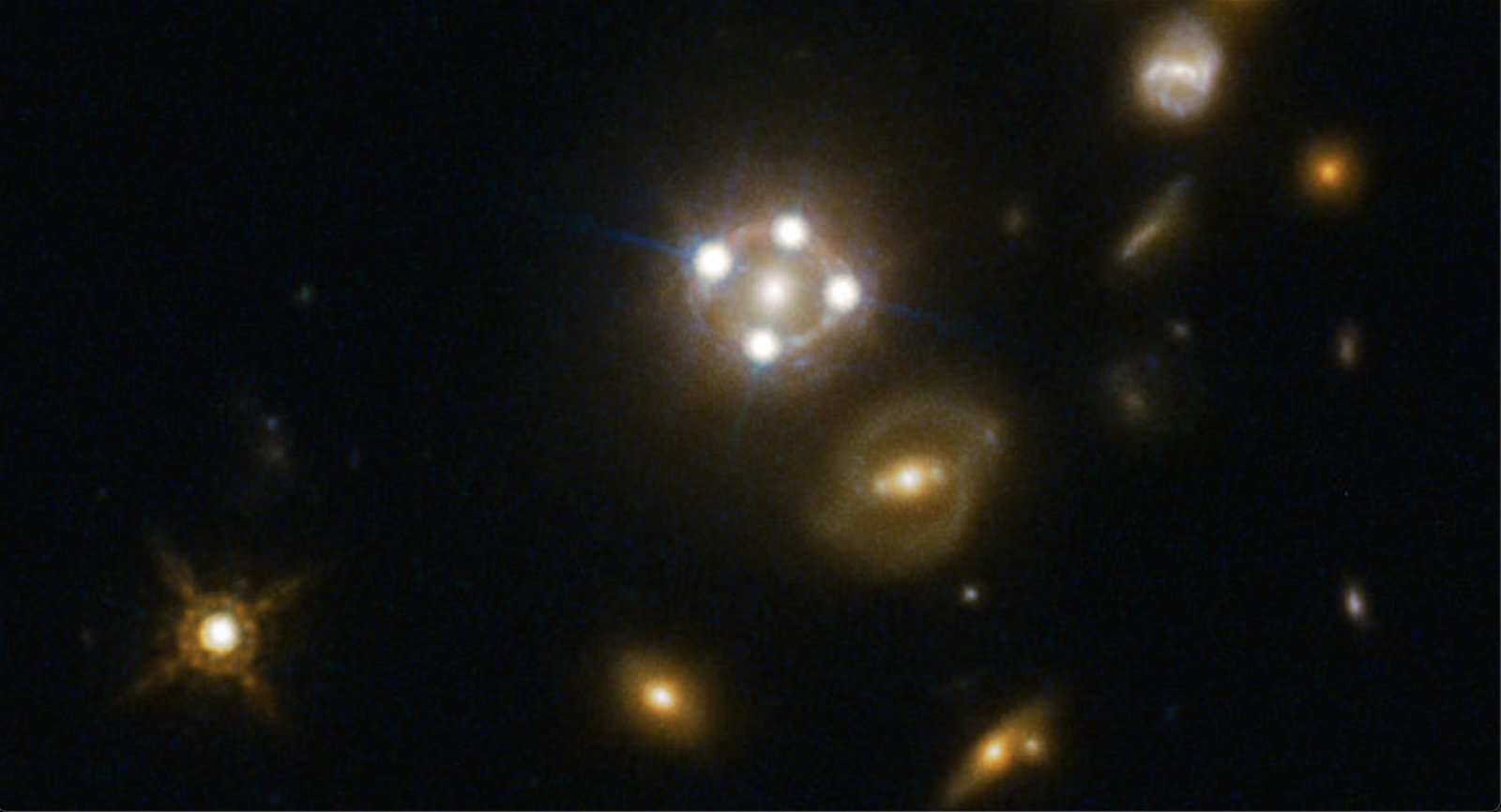
A similar effect, known as an “Einstein cross,” produced the even more unusual appearance of multiple objects surrounding a nearer, massive source of lensing.

Einstein Crosses
An example of an Einstein cross produced by gravitational lensing (Image Credit: ESA/Hubble, NASA, Suyu et al.)

Under most conditions, these objects remain static and can be observed indefinitely. However, in 2019, something very different happened. The light from the star observed in the Large Magellanic Cloud was apparently only subjected to lensing for a short amount of time, meaning that whatever the massive “Phoebe” object was that caused the effect had been in transit.

Possible Explanations

The discovery was revealed as astronomers from Swinburne University in Melbourne spotted Phoebe in the data for a high cadence survey being conducted of the satellite galaxy in question. Now, in a new paper, they propose three possibilities for the mystery object.

One involves a free-floating planet somewhere within the Milky Way, something astronomers also occasionally call “rogue planets.” These cosmic loners come to exist when a planet is ejected from its host system, leaving them to drift through space as lonely planetary wanderers.

Another possibility the team proposes is that the same thing could be going on within the Large Magellanic Cloud itself: a rogue planet originating from that galaxy might have passed in front of the star. If this were ever confirmed, it would mark a notable first, as it would confirm the only extragalactic microlensing planet ever observed by astronomers.

However, a third possibility involves something more unusual: the presence of a primordial black hole, whose origins could go all the way back to the moments immediately after the Big Bang.

Searching for Clues

A major clue to solving the mystery involves the fact that the event took place over just one hour. Given the short duration, it seems most likely that the object was relatively small and therefore able to complete its transit in a short amount of time.

Such a short duration presents challenges for astronomers, since it rests at the threshold of detectability, although the team was able to extract enough information that they could calculate the rough mass of the object, which they believe to have been roughly four times the mass of the moon.

So whatever the object was, it was probably also too small to have been a planet, and also far too small for a normal black hole—the kind produced as a result of stellar collapse—to qualify.

The same couldn’t be said for a primordial black hole, however. Based on additional calculations, the team was also able to demonstrate that Phoebe most likely represents a dark matter object, by around five orders of magnitude greater than other possibilities they looked at.

Overall, this reveals that Phoebe could potentially be one of the oldest objects astronomers have ever spotted, since if its identity as a primordial black hole holds, that would mean its origins go all the way back to the genesis of our universe as we know it.

So based on the team’s work, a star’s mysterious brightening for just one hour in late 2019 might have been even more than an unusual astronomical one-off event: it may have offered us a glimpse at one of the oldest objects in the universe.

The team’s paper, “AMPM II. A Lunar-Mass Primordial Black Hole Microlensing Candidate in the Milky Way Halo,” appeared on the preprint server arXiv.org on May 19, 2026.

Micah Hanks is the Editor-in-Chief and Co-Founder of The Debrief. A longtime reporter on science, defense, and technology with a focus on space and astronomy, he can be reached at micah@thedebrief.org. Follow him on X @MicahHanks, and at micahhanks.com.

Scientists Reveal a Bizarre Space-Time Structural Phenomenon That Could Be Creating Baby Black Holes

25 May 2026 at 12:55

The space-time oddities of modern physics may have just been taken to a new level of odd, as researchers have revealed that space and time can be used to form a variety of structures that may then be able to become tiny black holes.

The unusual discovery, reported by researchers from Vienna and Frankfurt, presents a new formula for this unusual effect, which they claim can be used to create a crystal-like structure resulting from spacetime self-organization due to a process physicists call critical collapse.

The findings, now reported in Physical Review Letters, reveal the first successful description of this bizarre phenomenon using a novel mathematical trick, which allowed researchers to derive a precise formula for the phenomenon.

Baby Black Holes

Although black holes are often envisaged as large physical structures that result from the powerful conditions involving stellar deaths, not all of them are so monstrous.

In theory, tiny black holes can also exist, emerging from very minuscule critical states where only the smallest amount of energy is introduced. These states, according to physicists, are believed to have once existed immediately after the genesis of our universe, known as the Big Bang, at which time a disorderly blend of particles persisted in the newborn cosmos—conditions that would have been ripe for the creation of what are known as primordial black holes.

These structures are already theoretically verified through computer simulations, although in their recent research, the Goethe University Frankfurt and TU Wien collaboration has now taken the study of these tiny cosmic monsters to a new level by deriving a mathematical formula to confirm longstanding theories about these tiny black holes.

Curving Spacetime at Smaller Scale

According to Professor Daniel Grumiller, a researcher at TU Wien, even the smallest events can sometimes trigger major changes.

“Take liquid water at zero degrees Celsius, for example,” Grumiller recently said in a statement. “A very small change is enough to make the water freeze. The water molecules then spontaneously arrange themselves into a regular pattern and form an ice crystal,” he says.

Why is this significant? A primary reason involves Einstein’s revolutionary ideas about gravity, in which a similar effect occurs, albeit involving space and time. Specifically, Einstein’s theory holds that particles that change locations can cause changes to the surrounding spacetime.

Christian Ecker of the Institute for Theoretical Physics at Goethe University Frankfurt observes that spacetime is warped more strongly in proportion to the size of objects (in other words, those possessing greater mass).

“Large objects such as stars curve spacetime strongly,” Ecker notes. “For example, we can observe this when light rays are deflected by massive stars.” However, massive celestial objects aren’t the only ones that can curve spacetime.

“Smaller masses also produce spacetime curvature, just to a lesser extent,” Ecker explains.

space time crystals
In the image above, a spacetime-crystal structure is shown on the left, while to the right, a cubic crystal structure is displayed (Image Credit: Vienna University of Technology).

Patterns in Space and Time

According to the researchers, repeating patterns emerge in space and time because of spacetime curvature, in which spacetime can self-organize into a regular, repetitive structure.

This structural form, which they liken to being a sort of “spacetime crystal,” results from a process known as critical collapse.

Grumiller calls the resulting spacetime “crystal,” a “very peculiar and fascinating object,” which he says can be thought of as “a kind of intermediate state, an unstable point that can evolve in two different directions.” Following its formation, Grumiller says that the crystal may then simply dissipate, “leaving behind ordinary spacetime filled with freely moving particles.”

That is, unless an energy input is introduced.

“If a tiny amount of energy is added, the evolution takes a completely different path,” Grumiller says, whereby “the inconspicuous spacetime crystal turns into a black hole.”

Simulating Primordial Black Holes

According to Grumiller and his colleague, Christian Ecker, deriving accurate formulas for such phenomena has proven especially difficult over the years. However, Ecker says they were able to overcome this challenge by instituting a novel trick of mathematics.

“Our universe has four dimensions—three dimensions of space and one dimension of time,” Ecker recently said. “But in principle, nothing prevents us from writing down physical equations for a larger number of dimensions—five dimensions, forty-two dimensions, or even infinitely many.”

Despite the expectation that such conditions might cause theoretical interpretations to become very complicated, the team was able to show that the opposite can be the case, with some questions physicists would normally deem to be extremely complex actually being reduced to relatively simple outcomes.

The team says they hope to explore the possibility that their mathematical formula might be reinterpreted for contexts involving fewer dimensions, which would allow the current models, which relate to the possibility of an infinite number of dimensions, to be scaled back to four-dimensional applications.

So far, doing so has allowed the team to explore four-dimensional universal qualities by taking what one might liken to being a shortcut through a sort of theoretical universe consisting of many dimensions. However, for now, the team’s findings are already proving very promising.

“Our technique turns out to be remarkably stable,” according to Florian Ecker, also with TU Wien.

“Depending on the desired precision, we can systematically improve our formulas using additional approximation methods,” Ecker added. “This gives us a new method for studying black-hole-related phenomena that could previously not be analyzed analytically.”

The team’s recent paper, “Analytic Discrete Self-Similar Solutions of Einstein-Klein-Gordon at Large 𝐷,” appeared in Physical Review Letters on May 12, 2026.

Micah Hanks is the Editor-in-Chief and Co-Founder of The Debrief. A longtime reporter on science, defense, and technology with a focus on space and astronomy, he can be reached at micah@thedebrief.org. Follow him on X @MicahHanks, and at micahhanks.com.

Scientists May Have Found a New Way to Detect Dark Matter—By Listening to Black Holes

21 May 2026 at 13:03


Scientists looking for dark matter have looked almost everywhere they could imagine: deep underground detectors, powerful particle colliders, precision telescopes, and maps of the universe itself. Yet, despite making up most of the matter in the cosmic realm, dark matter remained frustratingly invisible.

Now, researchers think they may have found a profoundly different way to look for it: by listening to black holes collide.

A new study published in Physical Review Letters suggests that gravitational waves—the tiny ripples in spacetime generated when black holes merge—may carry subtle fingerprints of dark matter if those black holes happen to collide within dense concentrations of the mysterious substance.

More intriguingly, when researchers applied their method to real gravitational-wave observations, one previously recorded event appeared to show a tentative preference for exactly that kind of hidden environment.

The results do not amount to a discovery of dark matter. Researchers repeatedly stress that alternative explanations are possible and that additional observations will be required. Still, the work opens a new observational front in one of modern physics’ longest-running mysteries.

“We know that dark matter is around us. It just has to be dense enough for us to see its effects,” co-author and MIT postdoc research fellow, Dr. Josu Aurrekoetxea, said in a press release. “Black holes provide a mechanism to enhance this density, which we can now search for by analyzing the gravitational waves emitted when they merge.”

Dark matter is believed to account for roughly 85 percent of all matter in the universe, yet it has never been directly detected. Scientists infer its existence because galaxies rotate too quickly and large-scale cosmic structures behave as though far more mass exists than telescopes can see.

Unlike ordinary matter, dark matter appears to interact almost exclusively through gravity, making it extraordinarily difficult to detect using conventional techniques.

That challenge motivated researchers to pose a different question. Instead of trying to see dark matter directly, could scientists detect its influence on something else?

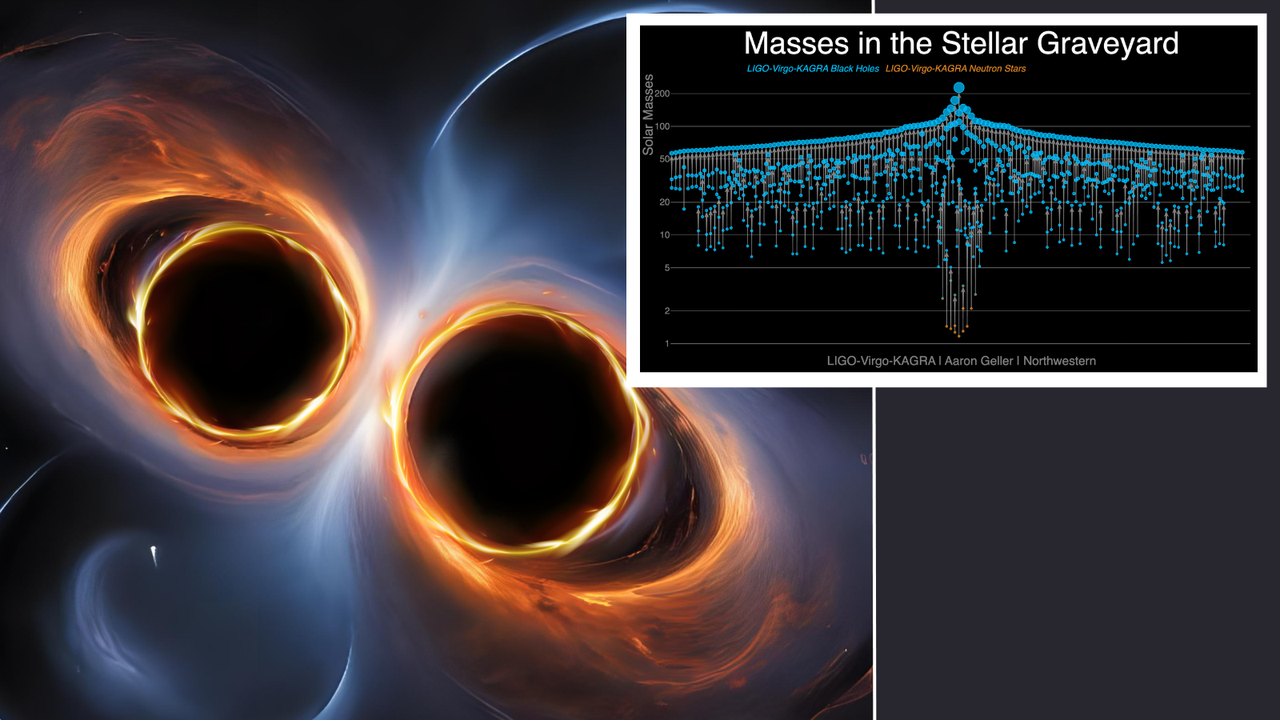
The researchers’ answer focused on gravitational waves. These are disturbances in spacetime first directly detected in 2015 by the Laser Interferometer Gravitational-Wave Observatory (LIGO). Since then, the international LIGO–Virgo–KAGRA collaboration has cataloged dozens of black hole mergers and transformed gravitational-wave astronomy into one of the fastest-moving areas of astrophysics.

Traditionally, those signals have been treated as extraordinarily clean probes of the black holes themselves. However, in this recent study, researchers argue that the environment around merging black holes may matter more than previously thought.

The study centers on a class of hypothetical dark matter candidates called ultralight scalar particles. These represent exotic fields that appear naturally in many extensions of the Standard Model of particle physics and have long been considered viable dark matter candidates.

Under the right conditions, ultralight scalar particles could accumulate around spinning black holes, forming extremely dense clouds. Moreover, some of those clouds could become astonishingly concentrated.

According to researchers, a process called superradiance may allow rapidly spinning black holes to transfer rotational energy into surrounding ultralight particles, dramatically amplifying them.

In some scenarios, those dark matter structures could reach densities more than 30 orders of magnitude greater than the average dark matter density in our galaxy. If a pair of black holes then spiraled together inside one of these environments, the surrounding scalar field would slightly alter their orbital motion.

That change would be subtle but measurable.

Rather than producing the gravitational-wave “chirp” expected from two black holes merging in empty space, the waves would show tiny distortions in timing and phase evolution, essentially arriving with an altered rhythm.

To test the idea, researchers developed a new semi-analytic waveform model capable of predicting how black hole mergers should appear embedded within environments of scalar dark matter. They then validated those predictions using full numerical relativistic simulations that model black hole mergers inside dense scalar fields.

The simulations showed that dark matter-like scalar structures could survive the violent inspiral process better than many earlier models had suggested.

Previous thinking often assumed equal-mass black hole binaries would destroy surrounding dark matter structures before merger. However, the new simulations suggest the opposite may sometimes occur. Portions of those structures can persist and potentially leave observable signatures in gravitational waves.

Armed with their model, the researchers turned to reality.

The team analyzed 28 gravitational-wave events from the publicly available GWTC-3 catalog collected by LIGO, Virgo, and KAGRA. Most events behaved exactly as expected.

Twenty-seven appeared consistent with black holes merging in a vacuum. But one event—GW190728, detected in 2019—stood out.

When analyzed under assumptions tied to superradiance, the signal showed what researchers describe as tentative evidence for a scalar environment surrounding the merger. The statistical preference reached a Bayes factor of approximately ln(B) ≈ 3.5—enough to attract attention but well below the standard required for a discovery claim.

If that interpretation ultimately proves correct, the data would point toward an ultralight scalar particle with a mass around 10^-12 electron volts.

That would place it in an area already discussed in theoretical dark matter research, although the authors acknowledge existing black hole spin measurements create some tension with portions of that parameter space.

Importantly, the researchers emphasize that they cannot rule out more ordinary explanations.

Environmental effects, parameter indeterminacies, or constraints in current waveform models could potentially mimic some of the observed behavior. Researchers carefully examined possibilities, including orbital eccentricity and line-of-sight acceleration, and found no strong evidence that those effects explain the signal, but warn that confirmation will require future observations.

“The statistical significance of this is not high enough to claim a detection of dark matter, and further checks should be performed by independent groups,” Dr. Aurrekoetxea said. “What we think is important to highlight is that without waveform models like ours, we could be detecting black hole mergers in dark matter environments, but systematically classifying them as having occurred in vacuum.”

That said, further checks of the researcher’s theory may arrive sooner than expected.

Current gravitational-wave observatories continue collecting data, and next-generation instruments such as the Einstein Telescope and Cosmic Explorer are expected to detect mergers with far greater sensitivity and over longer durations. That improvement could make tiny environmental signatures easier to isolate from ordinary black hole physics.

For now, the result remains an intriguing hint, but not yet proof.

Nevertheless, after decades of dark matter remaining elusive through light, particles, and laboratory experiments, researchers are beginning to explore the possibility that the universe’s missing mass may announce itself in an entirely different way. Not by being seen. But by changing the sound of spacetime itself.

“We now have the potential to discover dark matter around black holes as the LVK detectors keep collecting data in the coming years,” co-author and physicist at the Center for Cosmology in Belgium, Dr. Soumen Roy, said. “It is an exciting time to search for new physics using gravitational waves.”

Tim McMillan is a retired law enforcement executive, investigative reporter and co-founder of The Debrief. His writing typically focuses on defense, national security, the Intelligence Community and topics related to psychology. You can follow Tim on Twitter: @LtTimMcMillan.  Tim can be reached by email: tim@thedebrief.org or through encrypted email: LtTimMcMillan@protonmail.com 

Supermassive black holes are pointing jets of plasma directly at Earth — and a population of them may have produced the highest-energy neutrino ever recorded

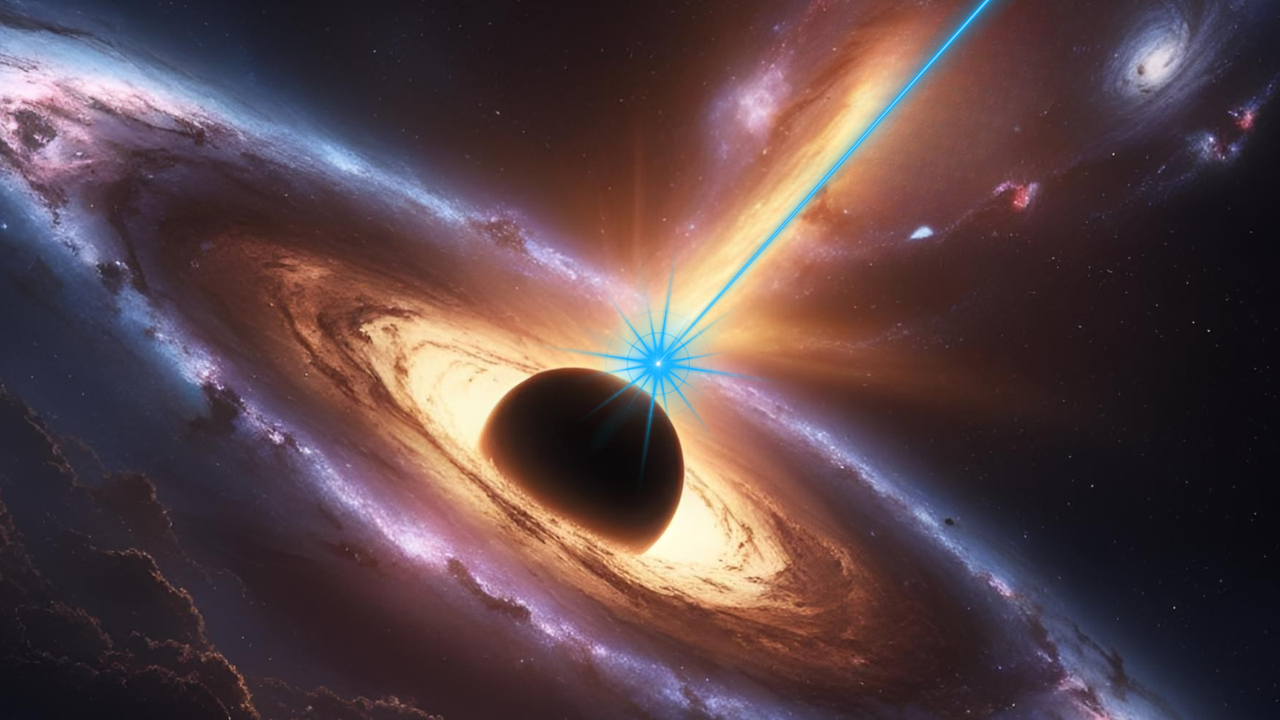
At the centre of most large galaxies sits a supermassive black hole. When that black hole is actively consuming surrounding material, it becomes what astronomers call an active galactic nucleus. The infalling matter forms a disc, heats to extreme temperatures, and generates powerful jets of plasma that fire outward from the poles at close to the speed of light. When those jets happen to point toward Earth, the object is classified as a blazar. The orientation changes nothing about the physics; it changes what we see. A jet aimed at us delivers an intensity of radiation and particle flux that a sideways-on jet does not, making blazars among the most energetically extreme objects observable in the sky.

This matters for the story of KM3-230213A, the neutrino detected at 01:16 UTC on 13 February 2023 by the KM3NeT/ARCA detector at the bottom of the Mediterranean, roughly 3,450 metres below the surface off the coast of Sicily. With an estimated energy of approximately 220 petaelectronvolts, it remains the most energetic neutrino ever recorded. The previous record, from IceCube’s dataset, sat near 10 PeV. The gap between them is roughly a factor of twenty.

Where that neutrino came from has not been settled. Several candidate explanations have been put forward over the past year. A paper published in the Physical Review Letters in February 2026 argues that a population of blazars is a plausible origin. It is, as the authors are explicit in stating, one hypothesis among several. It has not been confirmed.

How neutrinos are produced in blazars

Inside a blazar jet, protons can be accelerated to extreme energies. When those protons interact with photons or other matter inside the jet, they produce pions, and those pions decay into neutrinos and gamma rays. This mechanism, broadly called hadronic production, is why high-energy neutrino detections and high-energy gamma-ray observations are connected: both are products of the same underlying process.

The connection also gives the hypothesis a testable constraint. Any model that invokes blazars as neutrino sources must not produce more gamma rays than have actually been observed. The extragalactic gamma-ray background has been measured carefully by the Fermi Gamma-ray Space Telescope, and a proposed blazar population cannot exceed it. This is one of the key tests the Bendahman paper applies.

The team used an open-source modelling tool called AM3 to simulate a realistic population of blazars, fixing parameters like magnetic field strength and emission region size to values established by independent observations. They then varied two quantities: the baryonic loading, which governs how much energy is carried by protons relative to electrons and therefore how many neutrinos can be produced; and the proton spectral index, which determines how the energy is distributed across the proton population. For each combination of these parameters, they calculated the expected diffuse neutrino flux and the corresponding gamma-ray output, then compared both against actual measurements from KM3NeT, IceCube, and Fermi.

They found a region of parameter space in which the blazar population could account for an event like KM3-230213A while remaining consistent with the gamma-ray constraints. The result positions blazars as physically viable. It does not identify a specific blazar source for this specific neutrino. The paper’s conclusion is that the scenario is plausible and merits further investigation, not that the question has been answered.

Why the absence of a counterpart complicates things

When a high-energy neutrino is detected, the standard follow-up procedure involves searching for an electromagnetic counterpart, a signal in radio, optical, X-ray, or gamma-ray light arriving from the same direction at approximately the same time. For KM3-230213A, no such counterpart was found. The KM3NeT collaboration conducted searches for correlations with known Galactic and extragalactic sources in the direction of the event (right ascension 94.3 degrees, declination minus 7.8 degrees) and found nothing significant.

The absence of a counterpart rules out some source scenarios more cleanly than others. A single dramatic event, a flare or an outburst from one identified object, would generally be expected to produce an accompanying electromagnetic signal. Its absence is one reason Bendahman and colleagues lean toward a diffuse origin: if the neutrino comes not from one spectacular burst but from the accumulated flux of many blazars integrated across large distances, there may be no single object to point to and no associated flare to find.

As Bendahman noted in the EurekAlert press release accompanying the paper, this reasoning does not completely exclude a point-like source. It does shift the prior toward a diffuse population explanation, which the blazar model provides.

The IceCube constraint and what it requires of any model

The IceCube Neutrino Observatory at the South Pole has been collecting data since 2010 with a larger effective detection volume than KM3NeT had at the time of the event. It has not observed any neutrino comparable to KM3-230213A. This non-detection is not a minor footnote: it imposes a real constraint on the expected rate of ultra-high-energy neutrino events, and any proposed source population must be consistent with it.

The tension between KM3NeT’s detection and IceCube’s non-detection has been estimated at between two and three-and-a-half sigma across several analyses, depending on assumptions about the source spectrum and angular region. That sits below the conventional threshold for claiming a significant discrepancy, but it is not easily waved away either.

The Bendahman paper addresses this directly. Their blazar population model is tested not just against the KM3NeT observation but against IceCube’s upper limits as well. They find a scenario in which blazars can produce a neutrino flux consistent with the KM3NeT detection while the IceCube non-detection remains statistically unremarkable. The model threads the needle, but only within a specific parameter range, and only as a statistical argument about expected rates, not as a demonstrated resolution of the IceCube tension.

What other explanations are on the table

The blazar population hypothesis is the most recent well-developed proposal from the KM3NeT collaboration itself, but it is not the only one circulating in the literature.

The cosmogenic neutrino scenario holds that KM3-230213A was produced not at an astrophysical source but in transit, when an ultra-high-energy cosmic ray collided with a photon from the cosmic microwave background. This process, expected to produce neutrinos in a broadly similar energy range, was analysed in a companion paper to the original Nature publication. The cosmogenic explanation has the advantage of not requiring a specific identified source, but the IceCube non-detection makes any steady, isotropic source harder to sustain without careful tuning.

Separate analyses have examined whether specific known objects could be the source. One paper by researchers at Peking University and Chongqing University investigated associations with gamma-ray bursts, searching a broader region around the event’s coordinates while allowing for possible Lorentz invariance violations that might have delayed the neutrino relative to any accompanying photons. No definitive association was found. Another paper pointed to a specific blazar, PKS 0605-085, as a candidate point source, based on its proximity to the reconstructed direction. The angular uncertainty of KM3-230213A is currently around 1.5 degrees, which leaves a sizeable search cone, and PKS 0605-085 has not been confirmed as the source.

A paper published in Physical Review Letters in March 2026, by Vedran Brdar and Dibya S. Chattopadhyay, takes a different approach entirely, focusing not on where the neutrino came from but on what may have happened during its journey. Their proposal involves sterile neutrinos, hypothetical particles that do not interact via the standard weak force, oscillating into active neutrinos over the 147-kilometre path through rock and seawater to the KM3NeT detector. The same transformation would be far less likely over the 14-kilometre path to IceCube from the same sky position, potentially explaining the discrepancy between detectors. This scenario requires physics beyond the Standard Model and remains speculative. The authors describe it as a possible resolution, not a demonstrated one.

A more exotic proposal, published separately in Physical Review Letters, suggested the event could have originated in the final evaporation of a primordial black hole. This hypothesis is not supported by independent evidence and has not been taken up broadly in the follow-up literature.

What the next data should resolve

KM3NeT/ARCA was operating with 21 detection strings at the time of the event, roughly ten per cent of its planned final configuration. Construction has continued since. The completed detector will cover approximately one cubic kilometre of deep water with around 200,000 photomultiplier tubes, and an online alert system is being developed to notify other observatories within seconds of a candidate high-energy event, enabling the kind of rapid multi-wavelength follow-up that might finally attach a counterpart to the next event of this kind.

The collaboration also expects a positioning system upgrade to tighten the directional reconstruction from the current 1.5 degrees to a target of around 0.1 degrees. That improvement, applied retroactively to KM3-230213A as well as to future detections, would substantially shrink the search cone and either implicate or exclude several of the current candidate sources.

The post Supermassive black holes are pointing jets of plasma directly at Earth — and a population of them may have produced the highest-energy neutrino ever recorded appeared first on Space Daily.

Characterizing galaxies at “cosmic noon”

18 May 2026 at 12:00

The universe is around 14 billion years old, but scientists theorize that no stars formed for the first several hundred million years, during an era known as the cosmic dark ages. They refer to the first billion years or so after this, when stars formed, as the cosmic dawn. At that time, the very oldest galaxies first assembled from collections of gas and plasma. 

As these galaxies assembled and more material became available, the number of stars formed each year increased. Around 2 to 3 billion years after the Big Bang, galaxies grew faster than they ever would, producing stars at the highest rate in the universe’s history. This era is called cosmic noon.

Researchers from the Netherlands recently investigated 3 distant galaxies whose light began its journey to Earth during cosmic noon. They selected targets from a set of ancient star-forming galaxies identified in the ALMA – Archival Large Program to Advance Kinematic Analysis or ALMA-ALPAKA project. Of these, they chose to study 3 galaxies labeled ID1, ID3, and ID13.

They combined 2 different types of data to produce a detailed description of these galaxies. First, they collected data from an enormous telescope comprising 66 antennas in Chile, known as the Atacama Large Millimeter/submillimeter Array or ALMA. They used ALMA to detect radio-wave emissions from carbon monoxide and elemental carbon in these galaxies. The researchers stated that studying these chemicals in distant galaxies could reveal how their free-floating gas clouds move. They also used publicly available data from JWST’s Near Infrared Camera, or NIRCam, to determine how much light the galaxies’ stars emitted. By analyzing cosmic noon galaxies in multiple different ways, the team aimed to measure their masses and the relative contributions of regular matter and dark matter.

They used a computer program developed by other astronomers to interpret the JWST data as a series of maps showing the distribution of stars across each galaxy. They used this light-emission data to estimate the total mass of all the stars in these galaxies. Then they developed an original computer program to map the distribution of gas through each galaxy using the ALMA data. The team used these maps to create plots, known as rotation curves, which show how fast particles orbit each galaxy’s center as a function of their distance from it. 

The astronomers used these rotation curves to estimate the amount of dark matter in each galaxy. They explained that this method works because dark matter is totally invisible, but it still exerts a gravitational pull. Its gravitational pull causes visible material like stars and gas closer to the edges of these galaxies to move faster than they would in galaxies without dark matter. 

The team found that these galaxies had between 39 and 80 billion times the mass of our sun, or solar masses, in stars. They had between 4 billion and nearly 16 billion solar masses worth of free-floating gas. And they had from 1 trillion to 31 trillion solar masses of dark matter.

However, when the team compared the light-emission data with the rotation curves, they found a discrepancy. Typically, dark matter resides in a shell or halo surrounding a galaxy, meaning it should mostly affect material near the galaxy’s outer edge. Since astronomers don’t usually have to account for dark matter near a galaxy’s center, they can calculate the total mass of center material based on the amount of gas and stars they see there. But near the centers of these galaxies, the team found that the masses they derived from the light emissions were less than what they calculated from the rotation curves. 

They proposed multiple potential explanations for this discrepancy. First, they suggested that the halo shape might not be a good model for the dark matter distribution in all galaxies, meaning that cosmic noon galaxies could contain dark matter near their centers. Second, they suggested that stars could be packed tightly in the center of these galaxies, blocking each other’s light emissions. Third, they suggested that galaxy ID1 could have a supermassive black hole as big as 1.5% its total stellar mass at its center.

The team concluded that they now have a detailed picture of the mass distribution in these cosmic noon galaxies, but the reason for their center mass discrepancies remains elusive. They suggested that a complex relationship exists between the dark matter halos and the rest of the material within these galaxies. They indicated that future astronomers could adapt their methods to study the distribution of material in other distant galaxies studied by ALMA-ALPAKA and forthcoming galactic surveys.

The post Characterizing galaxies at “cosmic noon” appeared first on Sciworthy.

❌