Researchers say the isolated white dwarfs Gandalf and Moon-Sized define a new class of stellar remnant because they share five traits, including X-ray emission. Across the immense scale of the Universe, a single unusual object can prompt astronomers to look for others like it, sometimes leading to the recognition of an entirely new class of [...]
A new method could improve cosmology research by analyzing supernovae together with the galaxies that host them. An international collaboration led by scientists at the Institute of Cosmos Sciences of the University of Barcelona (ICCUB) has created a new approach that may sharpen what researchers can learn about how the Universe expands and what dark [...]
Scientists have achieved a first in studying lanthanum superhydrides, a class of materials that could help unlock superconductivity at much higher temperatures. The dream of transmitting electricity without energy loss has driven decades of superconductivity research. Some of the most promising candidates yet are superhydrides, hydrogen-rich materials that, under immense pressures, have exhibited superconducting behavior [...]
Astronomers have spotted a “planet factory” in space that could explain the origins of bizarre meteorites scattered across the Earth.
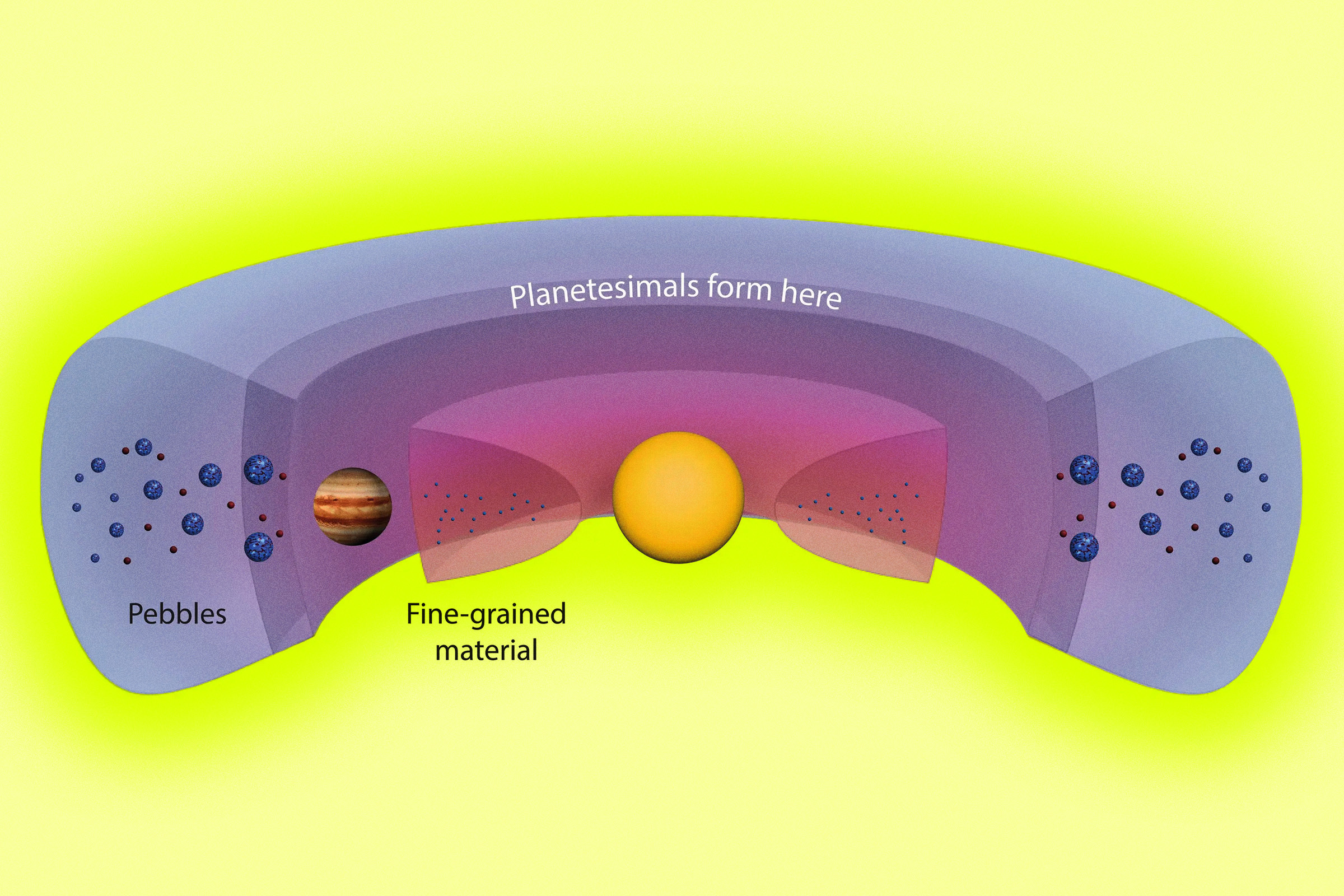
Lurking beyond Jupiter’s orbit, the ring-shaped region is packed with gas and dust that may have allowed it to serve as a breeding ground for so-called planetesimals, mile-length solid masses that can become the building blocks planets, when the solar system was in its infancy.
But that’s not all. In computer simulations described in a new study published in The Astrophysical Journals, the team found that the region also produced planetesimals of different compositions, perhaps making it one of the most influential planet-forming regions in our star’s domain.
“Different types of planetesimals apparently formed in the same region of the early dust and gas disk, only at different times. The region just outside Jupiter’s orbit offered excellent conditions for this,” study coauthor Joanna Drążkowska, an astrophysicist at the Max Planck Institute for Solar System Research, said in a statement about the work.
The mystery stems from a class of planetesimals called carbonaceous chondrites that formed around two to four million years after the solar system first came together. Though most planetesimals are thought to have been ejected as the solar system matured, traces of these survive as meteorite fragments that frequently bombard our planet, and it’s the rarer and unusually carbon heavy ones — our aforementioned chondrites — that prove most intriguing. They’re composed of distinct dust grains, but the proportion of these grains varies dramatically over time, with one generation made of notably crumbly grains, and others sturdier grains. What region could’ve formed such a medley of planetesimals in a short window was unknown.
A so-called “dust trap” just beyond Jupiter provides a tidy explanation, the researchers found. When the Sun was young, it was encircled by a huge disk of material in which the planets eventually formed. When Jupiter came along with its incredible mass, it sucked up most of the planet-forming material around its orbit, creating a gap in the so-called protoplanetary disk. A knock-on effect of this was that it also created a ring of higher pressure gas outside the neighborhood it cleared, trapping dust grains that clumped together into pebbles, which could eventually birth planetesimals.
In simulations modeling both microscopic particle collisions and large-scale movements in the protoplanetary disk, the researchers demonstrated that some particles could become trapped in certain regions, like the one near Jupiter. Further underscoring the planet’s role, they also found that it acted as a barrier for larger, more sturdy particles than smaller ones. This was all occurring as already-forming planetesimals sucked up some of the free-floating material. Over time, these dueling processes helped create planetesimals of two distinct generations. In the first 500,000 years, the abundance of crumbly grains dropped before rising over the next million years.
These findings, if borne out, could have broader implications for our understanding of the solar system’s evolution.
“There is strong evidence that dust traps were the preferred birthplace of planetesimals in our solar system,” Drążkowska said.
“For the first time, we have succeeded in accurately reproducing the results of laboratory studies of meteorites using computer simulations of the early solar system,” added coauthor Thorsten Kleine, Max Planck cosmochemist. “The meteorites serve, so to speak, as a touchstone for theories of planetary formation.”
The James Webb Space Telescope (JWST) was designed to give us the ability to look at one of the earliest periods in the evolution of the Universe, a time when some of the earliest stars were putting out enough light to ionize the hydrogen that accounted for almost all of the normal matter present at the time. There were lots of ideas about what we might see, but the Universe is full of surprises.
One of the first surprises was the existence of what picked up the moniker "little red dots," which are exactly what their name suggests. After some initial arguments, it became clear that these were early versions of the supermassive black holes that presently sit at the center of almost every galaxy. Now, gravitational lensing has allowed astronomers to confirm that a little red dot is little more than a supermassive black hole without much in the way of a galaxy around it.
Making a little red dot bigger
The little red dot in question is called Abell 2744−QSO1, and gravitational lensing has both magnified it and caused it to appear three times in the vicinity of the galaxy cluster that did the lensing. Based on details in its spectrum, we're looking at the object as it appeared just 700 million years after the Big Bang.
There are more opportunities to access space than ever, thanks to a bevy of commercial rockets, some with reusable boosters, led by SpaceX's workhorse Falcon 9. So why is NASA launching fewer telescopes and planetary science missions than it did a quarter-century ago?
The answer is complex. It is not necessarily the money. The space agency's science budget this year is $7.25 billion, roughly the same as it was in 2000, adjusted for inflation. This is despite attempts by the Trump administration to drastically reduce NASA science funding.
In the early months of his tenure, NASA Administrator Jared Isaacman's focus has been on human spaceflight and the Moon. This isn't terribly surprising given NASA's wildly successful Artemis II mission carrying four astronauts around the Moon last month. Since taking office in December, Isaacman has announced an overhaul of the Artemis program, canceling a space station to be built in orbit around the Moon in favor of construction of a base on the lunar surface.
For nearly 30 years, scientists have believed that a mysterious force called dark energy is causing the universe to expand faster and faster. But a new mathematical study suggests that dark energy may not be needed at all. Researchers from the University of California, Davis have published a paper in Proceedings of the Royal Society […]
Mathematicians from University College London and the University of California, Davis, have published a mathematical proof that the Universe’s accelerating expansion can be explained without dark energy, dealing a serious blow to the Lambda-cold dark matter model.
The sun is one of the most studied objects in the history of science. The ancient Babylonians and Chinese tracked sunspots and solar eclipses, etching their observations into clay tablets; these records would outlast their civilizations. When the telescope arrived in the early 1600s, astronomers such as Galileo Galilei, Christoph Scheiner, and Johannes Fabricius turned these instruments toward…
A marine biologist studying the photophores of a bioluminescent fish species found needle-shaped guanine crystals that scatter and redirect light instead of merely reflecting it, a discovery that could inspire more efficient biomedical and optical devices.
The James Webb Space Telescope (JWST) was designed to give us the ability to look at one of the earliest periods in the evolution of the Universe, a time when some of the earliest stars were putting out enough light to ionize the hydrogen that accounted for almost all of the normal matter present at the time. There were lots of ideas about what we might see, but the Universe is full of surprises.
One of the first surprises was the existence of what picked up the moniker "little red dots," which are exactly what their name suggests. After some initial arguments, it became clear that these were early versions of the supermassive black holes that presently sit at the center of almost every galaxy. Now, gravitational lensing has allowed astronomers to confirm that a little red dot is little more than a supermassive black hole without much in the way of a galaxy around it.
Making a little red dot bigger
The little red dot in question is called Abell 2744−QSO1, and gravitational lensing has both magnified it and caused it to appear three times in the vicinity of the galaxy cluster that did the lensing. Based on details in its spectrum, we're looking at the object as it appeared just 700 million years after the Big Bang.
A successful clean‑energy transition depends on understanding how to balance variable renewable power with the growing electricity demands of transport, heating, and industry. A key challenge is capturing how renewable energy sources like wind and solar fluctuate hour by hour, but this variability also creates new opportunities to align supply with increasingly flexible forms of demand, such as electric vehicles, heat pumps, and other electrified services. Alongside these short‑term dynamics, it is equally important to determine the long‑term infrastructure needed to support a fully decarbonised energy system.
In this research, two powerful models (REMIND and PyPSA‑Eur) are linked and allowed to exchange information repeatedly to determine both what infrastructure should be built and how it would operate each hour of the year. REMIND is a global energy and climate model that looks decades ahead, analysing investments, technology choices, and pathways to net‑zero. PyPSA‑Eur is a detailed model of the European electricity system that simulates real‑time grid behaviour. By combining a model that excels at long‑term planning with one that captures hourly power system dynamics, the researchers create a much more realistic tool for answering these complex questions.
They then test this approach on a Germany case study under two conditions: one with demand‑side flexibility (where electricity use can shift to cheaper hours, such as smart‑charging electric vehicles) and one without flexibility. Their findings show that a fully renewable energy system is technically and economically achievable, that flexible systems perform far better than inflexible ones, and that even with flexibility, electricity prices can vary significantly between sectors, creating political challenges around fair pricing. Both scenarios of the German case study reach net-zero emissions by 2045.
This research gives policymakers a clearer way to design reliable, affordable, fully renewable energy systems by showing how to integrate renewables, manage electrification, use flexibility to reduce costs, understand sectoral price differences, and build markets.
“Models used to inform climate policy have always faced a fundamental trade-off: they either capture the long-term perspective needed for investment decisions, or the hourly detail needed for power system planning, but not both. Our coupling of REMIND and PyPSA-Eur is a first step towards resolving this trade-off for an increasingly electric future energy system.” – Dr Adrian Odenweller, Potsdam Institute for Climate Impact Research
Earthquakes occur when tectonic plates rub against each other, become temporarily stuck, and then suddenly release accumulated stress as they slip. Although earthquakes have been studied for decades, the microscopic mechanics that cause faults to stick, slip, and generate friction are still not fully understood.
In this research, scientists use a granite-on-granite system to investigate these processes. Granite is common in continental crust and mechanically similar to many fault rocks, making it a strong laboratory analogue. The researchers used three complementary approaches. First, they performed controlled experiments measuring friction, wear, and surface roughness as two granite surfaces slid past each other, including tests with water, different temperatures, and different sliding speeds. Second, they ran molecular dynamics simulations of a silica (amorphous SiO₂) tip sliding on quartz (crystalline SiO₂), the dominant mineral in granite, to observe how atomic bonds break, phases transform, heat builds up, and friction emerges. Third, they applied theoretical models of contact mechanics (how surfaces actually touch through tiny asperities) and flash heating (how much local heating occurs and whether it weakens the material).
Traditionally, earthquake models assume that friction comes from mechanical processes such as asperity interlocking (high points locking together), plowing (hard grains digging into the opposite surface), and gouge grinding (crushed particles resisting motion). However, this study shows the opposite of what those models predict: more wear leads to less friction, and less wear leads to more friction. Instead of friction coming from grains digging or grinding, it arises from tiny asperities that plastically flatten, cold‑weld together, and resist sliding because their welded atomic bonds must be broken. This represents a major shift in how fault friction is understood.
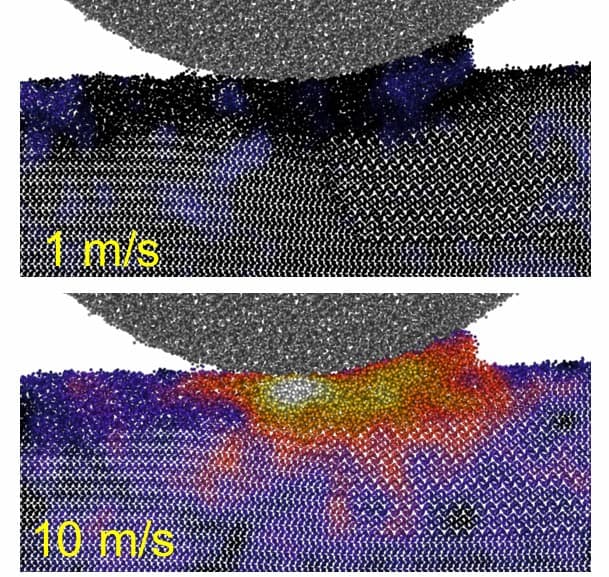
Rigid tip sliding over quartz at two velocities. Brighter colours indicate higher temperatures. (Courtesy: Bo Persson/ Chinese Academy of Sciences)
The study also finds that friction is largely insensitive to temperature, sliding speed, and hold time, suggesting that classic rate-state friction laws may not scale to real faults. The simulations identify three main energy dissipation mechanisms which are bond breaking, plastic deformation, and stress‑induced phase changes. This shows that flash heating at laboratory speeds is too small to weaken quartz, whereas earthquake level slip speeds would generate much stronger thermal weakening. They also reveal that certain quartz polymorphs can form purely from stress, meaning their presence in natural faults does not necessarily indicate high temperatures.
Taken together, these results suggest that fault friction is dominated by adhesive bonding at asperities rather than mechanical grinding, and that tectonic motion may be governed more by creep‑slip than classic stick‑slip behaviour.
An absolutely maximally entangled (AME) state is one in which every possible division of a many-body system into two groups is as entangled as quantum mechanics allows. This makes AME states uniquely valuable as benchmarks for quantum theory and as resources for quantum technologies. Yet basic questions about their existence, structure and classification have remained unresolved, even after two decades of study.
In a new work, dedicated to Ryszard Horodecki, this field has been advanced in several important ways. First, the authors provided a comprehensive and up to date overview of known methods for constructing AME states, going beyond traditional approaches based on stabilizer and graph states. The authors showed how recent ideas from combinatorics, matrix and group theory generate entirely new families of highly entangled states that were previously unknown.
They also went on to study how entanglement behaves when particles are removed from an AME system. This reveals how robust these extreme states are to loss and noise, an essential consideration for real quantum technologies.
One highlight is a solution to the quantum version of Euler’s famous “36 officers” problem. This puzzle asks whether 36 officers from six ranks and six regiments can be arranged in a 6 x 6 grid so that no row or column repeats a rank or regiment. Classical mathematics proves this is impossible.
The paper shows however, that quantum mechanics can bypass this restriction altogether. By using an absolutely maximally entangled quantum state, the researchers constructed a quantum version of the puzzle in which all constraints are satisfied simultaneously. The solution relies on superposition and quantum entanglement rather than fixed arrangements, illustrating how quantum theory enables outcomes forbidden in classical mathematics.
By mapping the limits of multipartite entanglement, this work connects abstract theory with practical goals such as quantum error correction, secure communication, and benchmarking future quantum computers.
Jonas Preine, a recently minted Ph.D. from the University of Hamburg, squinted at a computer screen in the lab of a ship as it bobbed in the North Atlantic near Iceland. The image before him just didn’t make sense. It was June 2024, and Preine was among a crew of scientists who had set off from Reykjavik under slate-colored skies, trading their regular lives — family, friends…
Two years ago, the ESTRO 2024 meeting in Glasgow dedicated a conference session to the discussion of upright radiotherapy. In particular, the speakers pondered whether this emerging technique – in which patients are treated sitting up rather than lying down – offers hope of increasing access to advanced radiotherapy, or whether it’s merely hype.
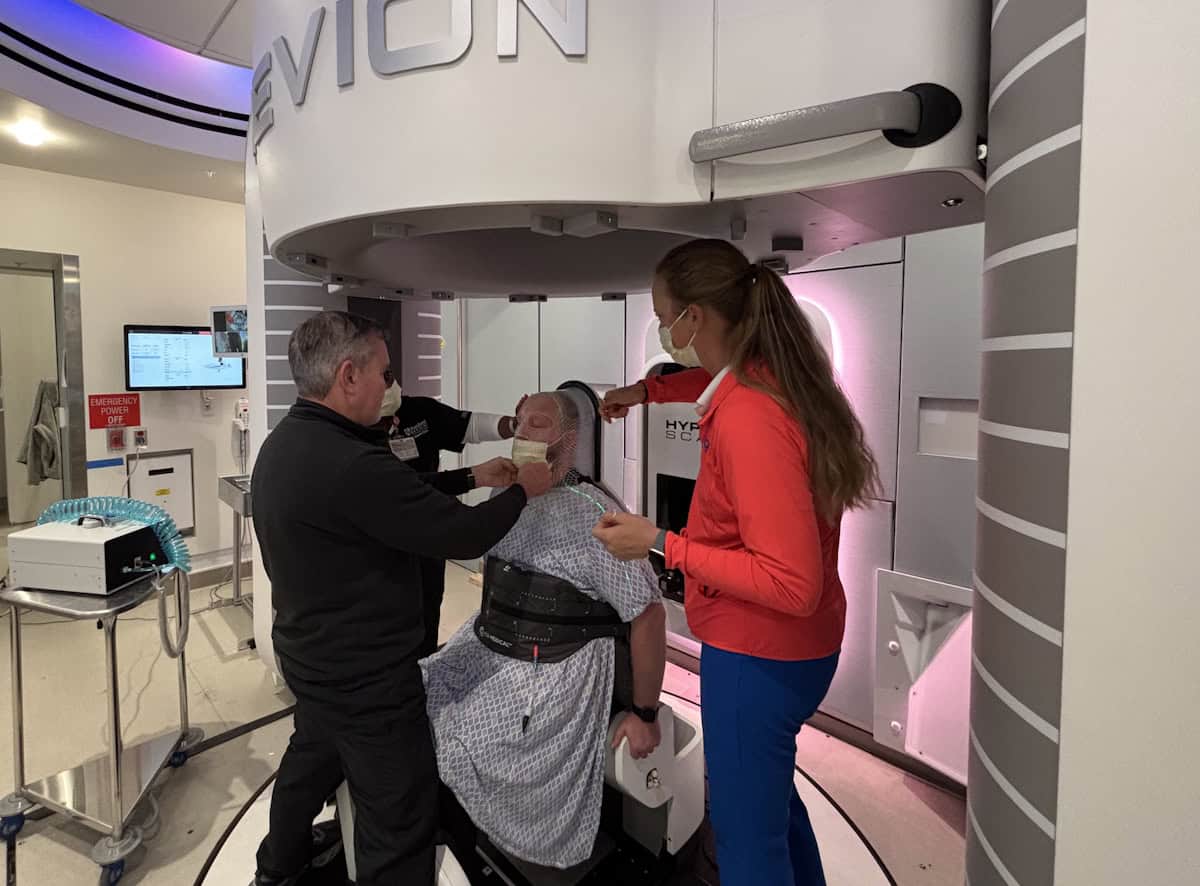
Things have moved on since then. Leo Cancer Care introduced its upright photon therapy system, Grace, and received commercial approval in the US and (just last week) Europe for its Marie upright positioning and CT system. Stanford Medicine recently unveiled the world’s first ultracompact proton therapy facility, pairing Mevion Medical Systems’ compact S250-FIT proton therapy system with the Marie platform. Meanwhile, the body of published research on the feasibility and patient experience of upright treatments continues to grow.
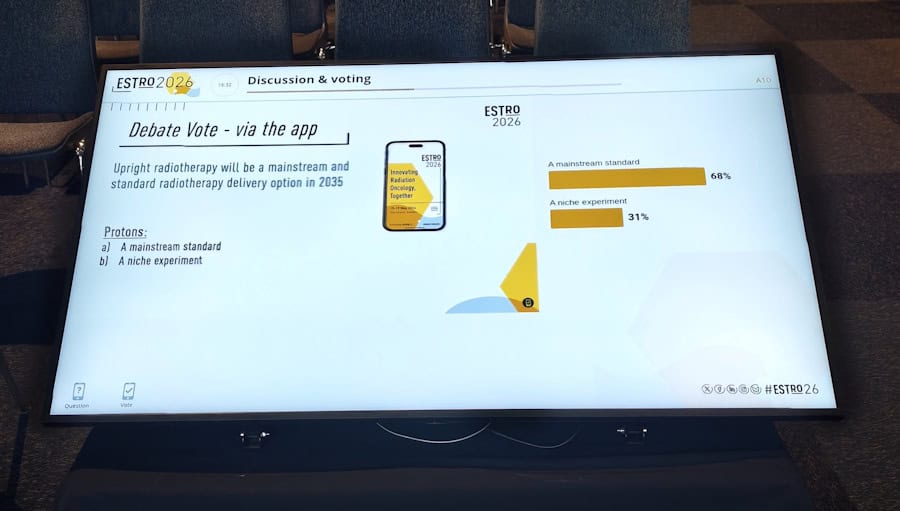
At this year’s ESTRO 2026 meeting in Stockholm, the theme was revisited by four experts in the field, who debated the motion that “Upright radiotherapy will be a mainstream and standard radiotherapy delivery option in 2035”.
The customary pre-debate vote revealed that just one quarter of the audience thought that photon-based upright radiotherapy would become mainstream, with the remainder believing that it would remain a niche technique. When it came to upright proton therapy, however, the vote was split roughly 50:50. So could the speakers persuade the attendees to change their minds?
Patient-centred care
The debate began with Tomas Kron from the Peter MacCallum Cancer Centre in Australia arguing the case for upright X-ray radiotherapy. He pointed out that upright positioning is not a new idea. “Historically, photons and upright have been around for a very long time. It has been, if not standard practice, widely used. But what role will it play in 2035?”
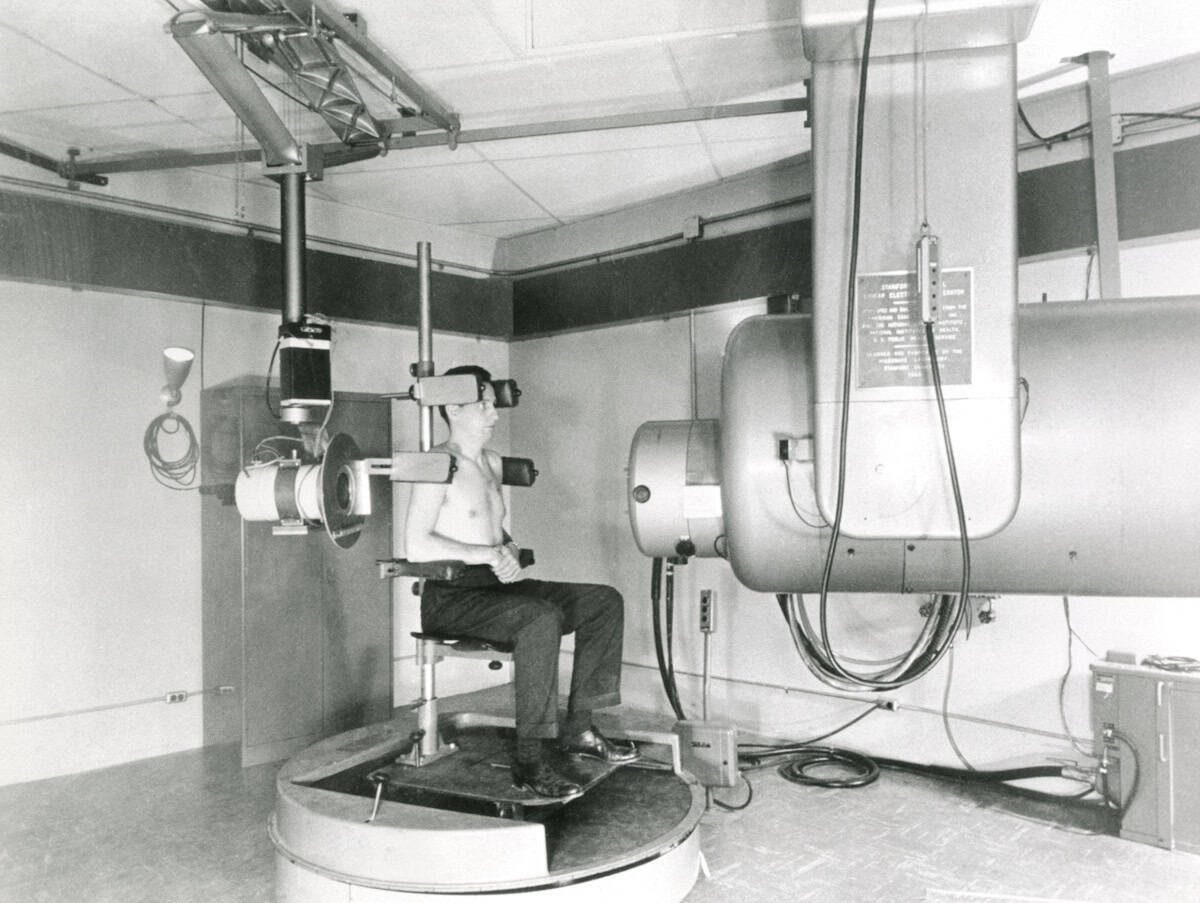
Not a new idea The first high-energy linear accelerator for medical use, known as LA-1, was developed at Stanford in the 1950s. Patients with head-and-neck or lung cancer could sit on an isocentrically mounted chair for treatment. The machine was decommissioned in 1972 and now resides in the Smithsonian Institution. (Courtesy: Stanford Medicine)
Kron described a clinical imaging trial underway at Peter Mac investigating upright cone-beam CT for planning lung cancer radiotherapy. The study showed that image quality was good enough for adaptive treatment planning, and that the lung was expanded and moved less in the upright position. Kron noted that patient setup and imaging was “really, really easy”, taking just a few minutes.
But what’s more important, he emphasized, is the patient experience. Patients treated while sitting up can maintain eye contact with the doctors throughout, they feel more involved and empowered, with one patient commenting: “My breathing was strong, I felt comfortable, the band around my chest was giving me a bear hug.”
“It’s really all about patient-centred care. Physical comfort and emotional wellbeing are top priorities,” Kron said. “Clearly, in an upright scenario this is much more likely to be the case.”
Upright radiotherapy offers many other unique features, including anatomical advantages and the ability to customize the chair, for example, for bariatric or paediatric patients. An upright treatment system is also more compact than a couch-based machine, requiring a smaller bunker. It could also be used as a mobile radiotherapy unit, said Kron – reducing the need for patient travel.
Kron’s team found that 80–90% of their patients could be treated just as well with upright radiotherapy as supine (lying down). “There are anatomical advantages with upright, there are patient preferences, there are economic benefits. What’s not to like,” he concluded.
The myth of mainstream
“Upright radiotherapy will not be mainstream and standard,” declared the second speaker, Livia Marrazzo from the University of Florence in Italy.
“Mainstream means widely adopted, used across the majority of radiotherapy centres, the default in clinical practice … and standard is even stronger, backed by clinical evidence, guideline-endorsed, reproducible and validated,” Marrazzo told the delegates. “It’s not ‘it works in some centres, is technically feasible, has early adopters, may have advantages for some patients’. But that is where we are with upright radiotherapy.”
The art of persuasion Livia Marrazzo argued that upright radiotherapy will not be mainstream by 2035. (Courtesy: Icro Meattini)
From a practical standpoint, most of the roughly 16,000 radiotherapy systems worldwide are linac-based recumbent machines with a typical lifecycle of 10 to15 years. Many were recently replaced with supine systems optimized for intensity-modulated and image-guided radiotherapy. “The installed base is locked into supine geometry for another full cycle,” Marrazzo explained.
She refuted many of the advantages proposed by Kron. “We have limited clinical evidence supporting comfort advantages,” she said. “It may benefit specific patient groups and conditions, but this doesn’t mean mainstream.” Overall, clinical experience is limited, with no comprehensive evaluations of plan quality and no comparative clinical studies.
She highlighted the particular challenges of breast cancer treatments, which account for 25-30% of cases in her radiotherapy department. “When we place a breast cancer patient upright, we lose the natural breast separation, so have much more difficulty in hitting the target and avoiding the contralateral breast,” she explained. “This exemplifies how upright is not a plug-and-play replacement for a conventional supine workflow.”
“Are we sure we would like to have upright as the standard radiotherapy delivery option by 2035 or do we want to push our efforts somewhere else?” Marrazzo concluded. She would prefer a focus on introducing technologies such as AI-driven planning and contouring, fully adaptive workflows, ultra-hypofractionation or biology-guided treatment adaptation. “These are all solutions that can be software-driven, scalable and compatible with existing supine infrastructure.”
The motion for protons
With half of the audience already agreeing that upright proton therapy will become mainstream, Petra Trnkova from Czech Technical University had perhaps a slightly easier task as she presented the case for upright protons. Nevertheless, she began by suggesting that her opponents are simply “scared of progress and won’t accept that, even without evidence, we can move forward in radiotherapy”.
Trnkova reiterated the benefits of upright radiotherapy cited by Kron: favourable patient anatomy, lower installation cost, improved sustainability, and patient-centric management. “For proton therapy, these improvements are much more significant,” she noted.
For starters, upright systems could help address the massive disparity in access to proton therapy around the globe. Sharing a map showing how proton therapy facilities are mostly distributed in wealthy countries, Trnkova noted: “My opponents may tell you that it’s not possible to do this by 2035, but when you look at this map, I ask you, can we wait any longer?”
Saving space The compact S250-FIT proton therapy system is small enough to fit in a standard linac vault. (Courtesy: Stanford Medicine)
Increasing access to proton facilities is enabled by the extreme size reduction when eliminating the need for a large rotating gantry, enabling proton therapy systems small enough to fit in a standard linac vault. Upright proton therapy can also reduce machine complexity, increase rotation speed and lower energy consumption – reducing costs, improving system upgradeability and increasing environmental sustainability.
“Another consequence of smaller facilities is we can really have patient-centred care,” Trnkova added. Recalling the 10 to 15 year linac lifetime mentioned by Marrazzo, she suggested another option: “You can replace your linac with proton therapy. Then you can have the full set of treatments available for each patient”.
Upright proton therapy could also ease the introduction of new treatment techniques, such as proton arc therapy, which offers dosimetric benefits over intensity-modulated proton therapy, but it is difficult to deliver with a gantry. It could also enable in vivo dosimetry, using shoot-through protons for range verification, or mixed-beam delivery of protons and photons.
“Upright positioning offers many opportunities, it’s the only way towards the democratization of proton therapy,” Trnkova concluded. “Stop asking what opportunities upright radiotherapy brings, start asking what you can do to bring it faster to clinical practice.”
The reality check
The final speaker, Carles Gomà from Clinic Barcelona in Spain, reflected upon what makes a good radiotherapy system. “In my view, it’s a three-legged stool: beam delivery, imaging and immobilization,” he said. “And progress comes with a combination of the three.”
For example, focusing too heavily on beam delivery and imaging can lead to immobilization being forgotten. “Immobilization means comfort, and if we are comfortable, we are still,” Gomà explained. “I cannot care less how many papers say patients are more comfortable in an upright position,” he added, pointing out that people will pay five times more to fly in business class where they can lie down.
The other reason cited for moving to upright proton therapy is its lower cost. “But is proton therapy expensive?” Gomà asked. He described the situation in Catalonia, which has a population of eight million and in 2018 spent Euro 42.2M on external-beam radiotherapy. “This is exactly the same cost as one immunotherapy drug for the same population,” he pointed out. “Proton therapy is not expensive; photon therapy is ridiculously cheap.”
Gomà also considered whether “suboptimal protons” are better than photons. “I’m going to answer no,” he said, describing two recent phase III, randomized trials comparing photons with protons for oropharyngeal cancer. The US trial concluded that proton therapy provides a new standard-of-care option, but the UK trial reported no difference between the two modalities.
“Let’s learn from history and not repeat the same mistakes,” he concluded. “True progress is improvement without compromise. If we want to make the stool higher, we have to work on all three legs at the same time.”
The final vote At the end of the debate, the ESTRO delegates strongly supported upright proton therapy. (Courtesy: Ye Zhang)
The debate concluded with decisive a final vote: while support for upright photon therapy reduced a little, over two-thirds of the audience believed that upright proton therapy will indeed become mainstream and standard by 2035.
Writing on LinkedIn, session co-chair Ye Zhang from the Paul Scherrer Institut noted: “The debate sparked an inspiring shift in perspective, with final voting showing slightly increased scepticism toward mainstream upright photon therapy (dropping from 23% to 18% support), but a dramatic surge in favour of upright proton therapy, which jumped from 47% to a 69% majority.”
Nigeria is Africa’s most populous country and one of its largest economies, which puts enormous pressure on its electricity system. At the same time, the country has committed to reaching net‑zero emissions between 2050 and 2070. Today, Nigeria’s power sector is underpowered, unreliable for many citizens, and heavily dependent on fossil fuels and diesel generators, which are costly and polluting.
This study explores pathways for Nigeria to reach net‑zero emissions by 2050, 2060, and 2070, focusing on which technologies would be required. Across all scenarios, solar power becomes the backbone of the system, providing 37–55% of electricity by 2050 and remaining central in the two longer term scenarios. Nuclear power also plays a major role when allowed, but faces barriers such as high upfront costs, regulatory capacity, and public safety concerns. If nuclear is excluded, Nigeria must rely even more on solar and on gas with carbon capture and storage (gas-CCS).
Although transitioning to net‑zero requires significant upfront investment, the study finds that a clean electricity system is cheaper overall than continuing with fossil fuels, and earlier transitions do not significantly increase total costs.
The authors conclude that Nigeria should build a balanced clean‑energy mix (solar, hydro, nuclear, gas‑CCS), rapidly scale up solar deployment, strengthen institutions, mobilise international and private financing, and coordinate regionally to ensure a reliable, affordable, and achievable transition.
“Nigeria’s electricity transition is not only a climate challenge; it is also a development and reliability challenge. Our analysis shows that solar power will be central to any net-zero pathway, but achieving an affordable and dependable electricity system will require a diversified mix of clean technologies, stronger institutions, and sustained investment in the grid and supporting infrastructure.” – Dr Michael Dioha, Clean Air Task Force
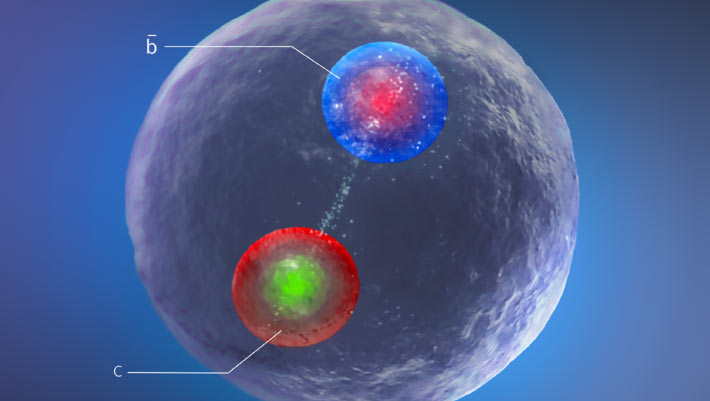
Physicists with the ATLAS Collaboration at CERN’s Large Hadron Collider (LHC) have observed the Bc*+ meson, an excited version of the Bc+ meson -- both consist of a charm quark and a bottom antiquark.

 Login
Login
 Researchers say the isolated white dwarfs Gandalf and Moon-Sized define a new class of stellar remnant because they share five traits, including X-ray emission. Across the immense scale of the Universe, a single unusual object can prompt astronomers to look for others like it, sometimes leading to the recognition of an entirely new class of [...]