My biblical creation model of the solar system expects the presence of icy materials forming the outer planets and celestial bodies. Recent findings of water and ice in bodies like Ceres, and moons of Jupiter and Saturn support this theory, confirming the Genesis account of creation.
Anthropic expanded the reach of its Mythos AI model to an additional 150 companies across 15 countries but stated each will need to meet its security requirements before they gain access.
Anthropic introduced its Claude Mythos model on 7 April, under the auspices of its Project Glasswing to a limited number of technology companies including Amazon Web Services, Apple, T-Mobile US, AT&T, Nvidia and Google, instead of making it publicly available.
The company stated the new cohort features industries which were underrepresented in the first batch. It now includes power grids, water systems, healthcare networks, communications providers, and hardware manufacturers.
Anthropic stated for most of the Project Glasswing partners, a successful cyberattack on their codebases could affect more than 100 million people.
It also noted many of the new partners are vendors, companies or nonprofits that maintain codebases which are relied upon by numerous organisations around the world, including governments.
The company expects within six-to-12 months, many other AI developers will have models comparable to Mythos Preview and stated, “they could release them without safeguards that prevent misuse”.
Results from the first cohort are already in. Project Glasswing partners have collectively surfaced more than 10,000 high-or critical-severity security vulnerabilities in the first few weeks.
The AI player stated the bottleneck in cybersecurity is now verifying, disclosing, and patching the large numbers of vulnerabilities which Mythos-class models can surface.
It noted many of Project Glasswing’s partners now use the model to write patches, as well as for pre-release checks which prevent vulnerabilities from appearing in the first place.
The expansion came a day after the Anthropic stated it will start offering Mythos access to the European Union’s cybersecurity division.
It also confidentially filed its initial public offering prospectus with the US Securities and Exchange Commission ahead of rival OpenAI.
For just an hour in late 2019, a cosmic mystery revealed itself to astronomers in an unprecedented way: by bending the light of a star as it passed between Earth and a distant galaxy.
The odd event unfolded on the evening of December 18, 2019, as a star in the Large Magellanic Cloud suddenly—and only for a short time—appeared to become brighter. But what could cause an ordinary star to randomly illuminate in this way, becoming a cosmic beacon for only an hour?
Astronomers considered a few possibilities, the most likely being that some kind of object—and one possessing a significant amount of mass—passed in front of the star, warping its light toward Earth through gravitational microlensing.
Now, the curious object that captured the star’s light for an hour in 2019 has been given a name: Phoebe. Unraveling the mystery as to what it actually was constitutes an intriguing question for astronomers, one which has now been tackled in a recent paper.
Gravitational Microlensing
One of the most fascinating phenomena in modern astrophysics is an effect predicted by Einstein, where gravity itself can act like a lens. The result can often produce beautiful and mysterious cosmic features, which include what astronomers call “Einstein rings” as light from a distant object is warped around a nearer, extremely massive object, taking on a circular or ring-like shape.
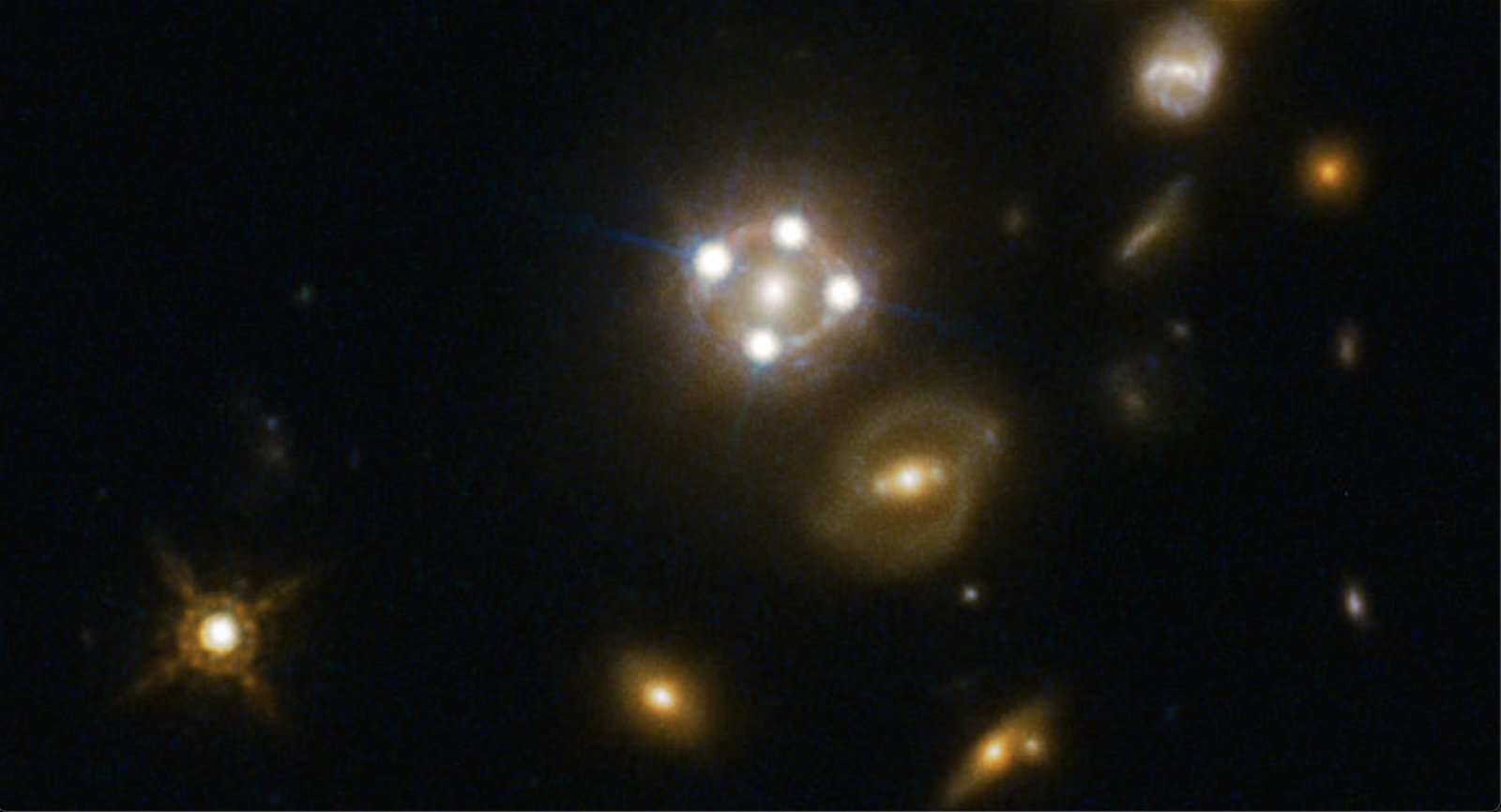
A similar effect, known as an “Einstein cross,” produced the even more unusual appearance of multiple objects surrounding a nearer, massive source of lensing.
An example of an Einstein cross produced by gravitational lensing (Image Credit: ESA/Hubble, NASA, Suyu et al.)
Under most conditions, these objects remain static and can be observed indefinitely. However, in 2019, something very different happened. The light from the star observed in the Large Magellanic Cloud was apparently only subjected to lensing for a short amount of time, meaning that whatever the massive “Phoebe” object was that caused the effect had been in transit.
Possible Explanations
The discovery was revealed as astronomers from Swinburne University in Melbourne spotted Phoebe in the data for a high cadence survey being conducted of the satellite galaxy in question. Now, in a new paper, they propose three possibilities for the mystery object.
One involves a free-floating planet somewhere within the Milky Way, something astronomers also occasionally call “rogue planets.” These cosmic loners come to exist when a planet is ejected from its host system, leaving them to drift through space as lonely planetary wanderers.
Another possibility the team proposes is that the same thing could be going on within the Large Magellanic Cloud itself: a rogue planet originating from that galaxy might have passed in front of the star. If this were ever confirmed, it would mark a notable first, as it would confirm the only extragalactic microlensing planet ever observed by astronomers.
However, a third possibility involves something more unusual: the presence of a primordial black hole, whose origins could go all the way back to the moments immediately after the Big Bang.
Searching for Clues
A major clue to solving the mystery involves the fact that the event took place over just one hour. Given the short duration, it seems most likely that the object was relatively small and therefore able to complete its transit in a short amount of time.
Such a short duration presents challenges for astronomers, since it rests at the threshold of detectability, although the team was able to extract enough information that they could calculate the rough mass of the object, which they believe to have been roughly four times the mass of the moon.
So whatever the object was, it was probably also too small to have been a planet, and also far too small for a normal black hole—the kind produced as a result of stellar collapse—to qualify.
The same couldn’t be said for a primordial black hole, however. Based on additional calculations, the team was also able to demonstrate that Phoebe most likely represents a dark matter object, by around five orders of magnitude greater than other possibilities they looked at.
Overall, this reveals that Phoebe could potentially be one of the oldest objects astronomers have ever spotted, since if its identity as a primordial black hole holds, that would mean its origins go all the way back to the genesis of our universe as we know it.
So based on the team’s work, a star’s mysterious brightening for just one hour in late 2019 might have been even more than an unusual astronomical one-off event: it may have offered us a glimpse at one of the oldest objects in the universe.
Micah Hanks is the Editor-in-Chief and Co-Founder of The Debrief. A longtime reporter on science, defense, and technology with a focus on space and astronomy, he can be reached atmicah@thedebrief.org. Follow him on X @MicahHanks, and at micahhanks.com.
Deep below Antarctica, clues to an ancient puzzle with cosmic origins have remained trapped in the southernmost continent’s ice for tens of thousands of years—until now.
Researchers have unearthed new evidence of the presence of iron-60, a rare radioactive isotope of iron linked to stellar explosions, captured in Antarctic ice estimated to be up to 80,000 years old.
Fortunately, this radioactive cosmic messenger, which has a half-life of around 2.6 million years, can be preserved following such large-scale cosmic events, becoming entombed in deep-sea sediments and in ice covering the surface of Antarctica.
The result is what scientists liken to the ancient cosmic “fingerprints” of past stellar cataclysms that can be traced all the way to Earth. The discovery was reported in a paper published in Physical Review Letters.
Fingerprints of the Cosmos in Antarctic Ice
Despite being one of the least-mapped surfaces in the entire Solar System by some estimates, over the last 35-million years, the accumulation of ice on Antarctica’s surface has slowly preserved a veritable “time capsule” of information about our planet’s geological past.
Accessing this deep geological history is as simple as drilling cores deep into Antarctica’s ice, which formed the basis of research led by German astrophysicist Dominik Koll, a researcher with the Helmholtz-Zentrum Dresden-Rossendorf, a Dresden-based research laboratory, which began in 2019.
Researchers preparing to drill ice cores at Alan Hills, Antarctica, in 2022 (Image Credit: Peter Neff/COLDEX).
However, the initial discoveries that prompted this research required no drilling at all—initial examination of fresh snow in Antarctica had already revealed the presence of iron-60, prompting a deeper search for past accumulations of this rare-Earth isotope.
Based on ice core analysis, additional signatures associated with stellar explosions have now been discovered deeper in our planet’s icy Antarctic archives, dating back to periods between around 40,000 and 81,000 years ago.
Interstellar Isotopes Below the Ice
Koll and his colleagues relied on samples collected in association with a research effort called the European Project for Ice Coring in Antarctica, or EPICA, in which portions of the ice cores were melted to reveal the presence of iron-60, which they counted atom-for-atom.
As they had hoped to find, a greater number of iron-60 atoms was present than would be expected based solely on background sources, meaning the rest is almost certainly of cosmic origin.
Intriguingly, the fact that far lower concentrations of iron-60 appeared to be present in ice from Earth’s long distant past, when compared to samples like those from fresh snow obtained by Koll and his team beginning in 2019, suggest that the region of space our Solar System is currently traversing, known as the Local Interstellar Cloud (LIC), is effectively “a cosmic archive for supernova-produced [iron-60].”
Based on this, Koll and his colleagues report that the imprinted iron-60 profile over time points to strong evidence for changes in the local interstellar environment over the last 80,000 years, as represented in the EPICA ice samples.
Mysterious Origins of the Local Interstellar Cloud
Presently, astronomers are uncertain about the origins of the LIC, although the new findings suggest it has undergone significant changes over the last 100,000 years or so.
One thing that seems evident, based on the changes in the abundance of iron-60 throughout time, is that the LIC appears to have regions that possess more of it than others—very likely leftover from past stellar explosions.
Fundamentally, Koll and his colleagues say their recent findings align well with a supernova origin for the samples they uncovered, offering a unique opportunity to probe the ongoing mysteries of the LIC using relatively easily accessible ice cores from our planet’s southern continent.
Micah Hanks is the Editor-in-Chief and Co-Founder of The Debrief. A longtime reporter on science, defense, and technology with a focus on space and astronomy, he can be reached atmicah@thedebrief.org. Follow him on X @MicahHanks, and at micahhanks.com.
Integrada no Cloud and AI Development Act, que deverá ser apresentado esta quarta-feira, uma nova proposta da Comissão Europeia prevê um conjunto de critérios obrigatórios para a seleção de fornecedores de serviços na nuvem em contratos públicos considerados críticos.
AI player Anthropic confidentially submitted paperwork for its proposed initial public listing ahead of rival OpenAI, while also giving the European Union’s cybersecurity body preliminary access to its Mythos AI tool.
The draft registration statement submitted to the US Securities and Exchange Commission gives the company the option to go public after the agency completes its review.
Anthropic stated the number of shares to be offered and the price have not yet been set.
News of the IPO move came the same day (1 June) Bloomberg reported Anthropic will give ENISA, the European Union’s cybersecurity agency, access to Mythos through Project Glasswing, an initiative which allows organisations to test Mythos’ capabilities before a wider release.
There are growing concerns among governments over the security implications of Mythos, which Anthropic released to some private companies in April.
Anthropic communicated the decision to the European Commission over the weekend.
EC spokesperson Thomas Regnier confirmed the development to Mobile World Live (MWL) followed several weeks of productive discussions.
“We welcome the latest developments on potential future access,” he said. “This is the result of the Commission’s strong bilateral cooperation and engagement with Anthropic, a leading frontier AI company.”
The EC was careful to frame the moment not as a resolution but as a starting point to work with the US administration, Anthropic and additional AI companies such as OpenAI.
“This is a shared challenge, and we are intensifying our discussions with like-minded partners, including the United States,” Regnier said.
The plan is for ENISA to join Project Glasswing, the coalition Anthropic announced in April which includes Amazon, Apple, AT&T, T-Mobile US, Microsoft, Google, CrowdStrike, Nvidia and Palo Alto Networks, among others.

 Login
Login