Normal view
- NYT - Energy & Environment

- Democrats Pledge to Fight Trump’s Termination of Ocean Monitoring Observatories
Democrats Pledge to Fight Trump’s Termination of Ocean Monitoring Observatories

© National Science Foundation Ocean Observatories Initiative
The WEF’s Endgame | Total Control of Your Life


What’s Your Carbon Footprint?


Massive Iron Ore Discovery and Global Warming

- Bible Science Forum

- Before the Industrial Revolution the Atmospheric CO2 was Higher than the Claimed 280 ppm
Before the Industrial Revolution the Atmospheric CO2 was Higher than the Claimed 280 ppm


Earth’s Albedo: The Mechanism Behind Global Warming


Greenhouses Gases Trapping Heat in Earth’s Atmosphere is the New Phlogiston


Control Global Energy, Food and Money and You Control All Humans


- Bible Science Forum

- God’s Promise to All Mankind: Earth Will Never Again Be Globally Covered by Water
God’s Promise to All Mankind: Earth Will Never Again Be Globally Covered by Water


The mystery of Alaska’s orange rivers is finally solved
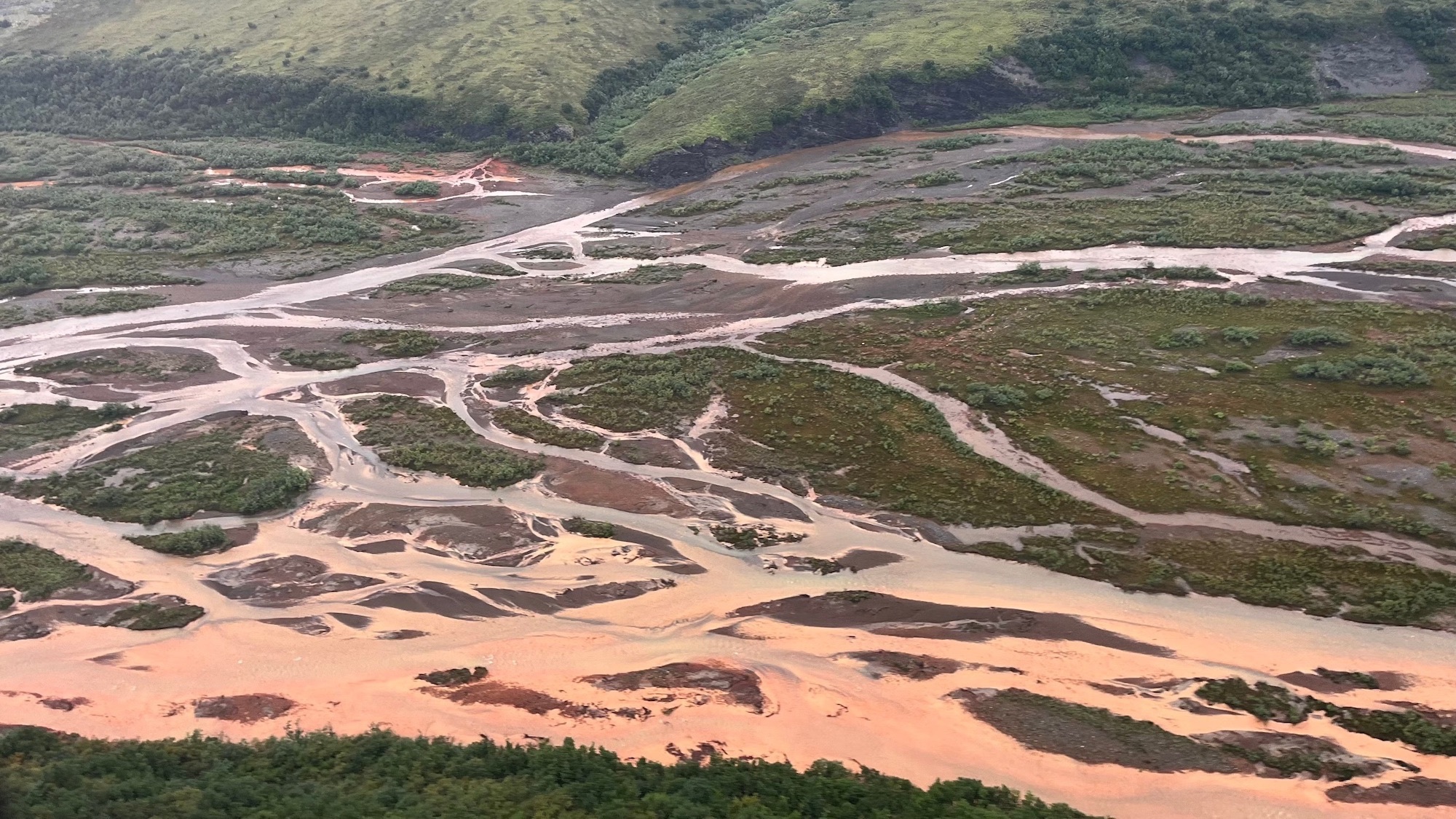
Alaska’s Arctic rivers have a big, orange problem. Previously clear rivers are turning a cloudy orange color due to iron particles, and it’s more than unsightly. The particles can suffocate fish and choke insects, threatening the food web and ecosystem as a whole.
Scientists have long pointed to previously frozen soil beginning to thaw as the potential culprit behind the contamination of rivers in northern Alaska’s remote Brooks Range, and a study recently published in the Communications Earth & Environment proves it. The research also shows two distinct ways that this thawing soil is rusting the rivers and can help scientists predict where the damage is likely to spread next.
“You’d think if any ecosystem could hide from the effects of warming and big human footprints, it’d be this one. But it’s not so,” Tim Lyons, a study co-author and biogeochemist at the University of California, Riverside, said in a statement. “There is no safe place.”

From thawing permafrost to orange water
Permafrost is rock or soil that contains ice that has been frozen for two or more years. Alaska is warming two to three times faster than the global average, melting some of the permafrost that has been frozen for thousands of years. That thawing permafrost is already threatening the Tracy Arm Fjord, a popular destination for Alaskan cruises.
As the ice-filled permafrost begins to thaw due to climate change, it can turn into mud that can’t support the weight of the soil or vegetation above it. This can threaten human-built infrastructure such as homes, pipes, and roads. It can also expose iron particles from rocks that turn rivers orange, a process called rusting.
Rusting has severe ecological consequences. The fine iron particles can stay suspended in water for over 60 miles, smothering algae, disrupting insect populations, and clogging fish gills. These changes may already be affecting salmon in Alaska and Canada who rely on the gravel riverbeds for spawning and rely on algae as food during early life stages.
A top-down, fool’s gold problem
For this new study, the team looked at a wide regional view of the roughly 600-mile Brooks Range. They then zoomed in on a specific river system, followed by an even closer look at one creek. This top-down approach helped them to connect the bigger regional patterns to specific, on-the-ground processes.
“At middle, more heavily forested elevations, there isn’t much going on. But at the higher and lower elevations we could see distinctly different phenomena,” said Roman Dial, a study co-author math and biology professor emeritus at Alaska Pacific University.
At the higher elevations, the problem begins in the rocky ground containing pyrite, aka fool’s gold. Since the ground was frozen for many years, water and air didn’t affect the pyrite. Yet the rising temperatures have started to melt the ground, kicking off a process called acid rock drainage. The minerals and rocks are exposed to oxygen and water and degrade the water quality.
“When pyrite meets water, it comes apart. It breaks down into iron and sulfur, creating sulfuric acid as well as sulfate and other toxic metals,” said Lyons. “When the iron-rich water mixes with more oxygen, the iron turns into rust-like particles that color the water and stain the bottom sediments orange.”
It’s an entirely different story at the lower elevations. The landscape is covered with wetlands that are changing shape and expanding downward as the permafrost melts. In these more soggy places, the soils are low in oxygen. So instead of breathing in oxygen, the microbes in the water (mostly bacteria) are taking in iron.
“When we breathe, oxygen goes in and gets converted to the carbon dioxide that we exhale,” Dial said. “Similarly, microbes are consuming iron in the lowland soils and converting it into a water-soluble form that seeps into streams and results in rusting as it meets oxygenated surface water.”
Taken together, both acid rock drainage and microbes breathing in more iron help explain why orange waters are appearing across such large and remote regions across northern Alaska, closely tracking to areas where permafrost is thawing.

The direct link
The team also found a delayed effect that could help predict future contamination. During the summer, the active, top layer of soil thaws to its deepest point. It then refreezes before the winter. The iron released during one summer thaw can become trapped and then flushed into rivers the following year.
By studying long-term ground temperature data and stream chemistry, this lag can be used to anticipate increases in metal levels.
“That means we can use ground temperatures to help predict water quality in the future,” added study co-author and University of Alaska ecologist Paddy Sullivan. In 2019, Sullivan first noticed the dramatic river changes that looked “like sewage” during fieldwork in the region.
Since mines typically control the waters near them to minimize pollution, the team partnered with scientists at the Red Dog zinc mine in northwest Alaska. The scientists there have long-term temperature records from boreholes that are drilled deeply into the earth and from chemistry sampling in stream water. Linking the underground measurements with changes in the stream’s chemistry directly connected the thawing permafrost to the rusting rivers.
While this problem is difficult to contain and manage, predicting where the contamination may pop up next could help pinpoint and protect critical habitats. This forecasting is especially important for communities that depend on these waters and the fishing living there for food and cultural practices.
“There’s no fixing this once it starts,” Lyons said. “But we can give people downstream a heads up and work hard to protect the places that are still safe and less vulnerable to the rusting.”
The post The mystery of Alaska’s orange rivers is finally solved appeared first on Popular Science.

- The Debrief
- These ‘Three Horsemen’ of Antarctic Instability Could Transform the Oceans into a Driver of Climate Change by 2030
These ‘Three Horsemen’ of Antarctic Instability Could Transform the Oceans into a Driver of Climate Change by 2030
Antarctica has been impacted by three major events, which researchers have identified as a “perfect storm” that could finally initiate major melting on the icy continent, with major implications for exacerbating climate change.
According to new University of Southampton research, these events have begun a spiral that could move the global oceans from a hedge against climate change, to one of its primary drivers.
In a recent paper published in Science Advances, the team behind the study used satellite data to identify the root causes of record-low sea ice in the Antarctic and the potential future effects on the global climate.
The Resilient Antarctic
While other parts of the world have been feeling the effects of global climate change for some time, it was only about a decade ago, in 2015, that Antarctic sea levels stopped rising and began retreating. The reason for this sudden reversal perplexed scientists until the University of Southampton team finally identified a series of Southern Ocean events that snowballed into a major climate concern, as they pulled up warm, salty water from below the surface.
By 2023, this chain of events had destroyed enough ice to cover Greenland, pushing the lows ever further.
“Antarctic sea ice in the Southern Ocean helps drive the planet’s ocean overturning circulation,” said lead author Dr. Aditya Narayanan, an oceanographer from the University of Southampton. “However, since 2015, the region has undergone a huge transformation, with extreme ice loss around the continent.”
“What started as a slow build-up of deep-sea heat under the Antarctic sea ice was followed by a violent mixing of water, ending in a vicious cycle where it’s too warm to let ice recover,” Dr. Narayanan says. “It’s concerning because massive loss of sea ice destabilizes the world’s ocean current systems, warming our planet far quicker than expected.”
Observing a Climate Crisis
The team used an advanced ice-measuring program that combined two approaches to identify three specific events responsible for the cascading ice loss.
“We use a combination of satellite observations and computer models — both of which are part of long-running international efforts,” Dr. Narayanan told The Debrief in an email. “The satellite data come from the National Snow and Ice Data Center (NSIDC), which compiles and distributes global sea ice records.”
“These measurements rely on instruments such as the Advanced Microwave Scanning Radiometer 2 (AMSR2), operated by the Japan Aerospace Exploration Agency (JAXA),” Dr. Narayanan added. “These sensors can ‘see’ through clouds and darkness, allowing us to track sea ice year-round.”
The Southampton team then ran this data through the Southern Ocean State Estimate, an advanced computer model created at the Scripps Institution of Oceanography.
“This is not just a standalone simulation—it combines the laws of physics with real-world observations, such as temperature, salinity, and sea ice data,” Dr. Narayanan said. You can think of it as a model that is constantly guided by observations, so it stays close to what is actually happening in the ocean.”
‘Three Horsemen’ of the Antarctic
The issues began around 2013, when strong winds raised Circumpolar Deep Water, a warm, salty solution from the deep. Then, in 2015, stronger winds mixed that water directly into the surface layer, producing the rapid ice loss observed at the time, concentrated in the east. By 2018, surface water had reached a threshold at which so much warm, salty water had surfaced that ice formation became difficult, reinforcing the cycle.
The team discovered that this oceanic ice loss is primarily occurring in the East Antarctic, where the deepwater upsurge is primarily occurring. The West is not in the clear, though, as intense cloud cover over the subtropics has now heated the ocean, leading to major ice melt between 2016 and 2019.
“More recent observations, including near-real-time data from the National Snow and Ice Data Center(NSIDC), show that parts of West Antarctica, especially near the Antarctic Peninsula, are again experiencing low sea ice in certain seasons,” Dr. Narayanan told The Debrief. “Without carrying out a specific study, it is difficult to pinpoint a single cause for these recent changes.”
“Most likely, they reflect a combination of atmospheric conditions, such as clouds and winds, and heat being delivered by the ocean,” Narayanan said.
The Future of the Antarctic Climate
“This isn’t just a regional problem, Antarctic sea ice acts as Earth’s mirror, reflecting solar radiation back into space,” said co-author Dr. Alessandro Silvano, also from the University of Southampton. “Its loss could destabilize the currents that store heat and carbon in the ocean, accelerating global warming, and also destabilize ice shelves that prevent glaciers from sliding into the sea, raising global sea levels.”
The researchers warn that anthropogenic climate change is fueling the warm winds driving these events in the Antarctic.
“Were these trends to persist, the planet could experience a ‘prolonged low sea-ice state,’” said co-author Professor Alberto Naveira Garabato from the University of Southampton.
“If the low sea-ice coverage prevails into 2030 and beyond, the ocean may transition from a stabilizer of the world’s climate to a powerful new driver of global warming,” Garabato added.
The paper, “Compound Drivers of Antarctic Sea Ice Loss and Southern Ocean Destratification,” appeared in Science Advances on May 8, 2026.
Ryan Whalen covers science and technology for The Debrief. He holds an MA in History and a Master of Library and Information Science with a certificate in Data Science. He can be contacted at ryan@thedebrief.org, and follow him on Twitter @mdntwvlf.

- The Debrief
- This Violent Volcanic Eruption May Have Revealed a Hidden “Emergency Brake” for Climate Change
This Violent Volcanic Eruption May Have Revealed a Hidden “Emergency Brake” for Climate Change
A massive underwater volcanic eruption in the South Pacific, climaxing in January 2022, is offering new hope for an “emergency brake” on climate change, after it surprisingly cleaned up its own methane release.
The volcano Hunga Tonga–Hunga Ha’apai lies 40 miles north of the Kingdom of Tonga’s main island, which was hard hit by a tsunami resulting from the 2022 eruption. Now, in a recent paper published in Nature Communications, researchers have identified an unexpected process where the eruption removed methane from the atmosphere, offering a possible tool to slow climate change.
Volcanic Evidence
Satellite data on the massive 2022 volcanic eruption provided researchers with important new information, revealing the presence of formaldehyde in the plume. This was noteworthy because formaldehyde results from intermediate stages of methane destruction, suggesting that the material was breaking down at an extremely rapid rate.
“When we analysed the satellite images, we were surprised to see a cloud with a record-high concentration of formaldehyde,” said first author Dr. Maarten van Herpen from Acacia Impact Innovation BV. “We were able to track the cloud for 10 days, all the way to South America. Because formaldehyde only exists for a few hours, this showed that the cloud must have been destroying methane continuously for more than a week.”
While prior research identified methane emissions during volcanic eruptions, never before has one been observed cleaning up its own mess. This could offer an important new technique to mitigate anthropogenic climate change.
Reviewing the Climate Change Data
The process at play here is a recent discovery, only coming to light in 2023, during analyses of Saharan dust storms. That research identified how dust blown from the Sahara would mix with salt as it drifted over the Atlantic Ocean, producing iron salt aerosols, which then converted into chlorine atoms when impacted by sunlight.
That airborne chlorine, in turn, would break down atmospheric methane, a surprising chain of events that restructured scientists’ understanding of tropospheric chemistry.
“What is new—and completely surprising—is that the same mechanism appears to occur in a volcanic plume high up in the stratosphere, where the physical conditions are entirely different,” said Professor Matthew Johnson from the Department of Chemistry at the University of Copenhagen, who worked on both discoveries.
The Hunga Tonga–Hunga Ha’apai event mirrored this, but instead of dust drifting over the ocean, the event’s force pushed large amounts of saltwater into the atmosphere alongside volcanic ash. Again, sunlight piercing the ash plume produced chlorine, which broke down the methane, as evidenced by the formaldehyde detections.
Halting Climate Change
While methane is far more potent than CO2, the leading cause of climate change, it breaks down much more rapidly—in just about a decade. In this balance, methane accounts for roughly a third of all global warming.
Given its short lifespan, reducing methane emissions would have a more immediate effect on climate change than reducing CO2, which persists longer. While CO2 reduction is a long-term goal, the relatively quick results have led some researchers to dub methane reductions as an “emergency brake” on climate change. The team says their findings could be an essential key to this new field of methane reduction research, although more work remains to quantify the rate of removal.
“How do you prove that methane has been removed from the atmosphere? How do you know your method works? It’s very difficult, said senior author Dr. Jos de Laat from the Royal Netherlands Meteorological Institute. “But here we address that problem by showing that methane breakdown can in fact be observed using satellites.”
“It’s an obvious idea for industry to try to replicate this natural phenomenon—but only if it can be proven to be safe and effective, “Johnson concluded. “Our satellite method could offer a way to help figure out how humans might slow global warming.”
The paper, “Satellite Quantification of Enhanced Methane Oxidation Applied to the Stratospheric Plume Following Hunga Tonga-Hunga Ha’apai Eruption,” appeared in Nature Communications on May 7, 2026.
Ryan Whalen covers science and technology for The Debrief. He holds an MA in History and a Master of Library and Information Science with a certificate in Data Science. He can be contacted at ryan@thedebrief.org, and follow him on Twitter @mdntwvlf.
Neighbors Horrified by Data Center Twice the Size of Manhattan
TV personality and businessman Kevin O’Leary is looking to construct a mammoth data center facility more than twice the size of Manhattan in Utah’s broader Salt Lake City region.
As Slate reports, the megalomaniac plans for the “Stratos Hyperscale Data Center” would see dozens of data center buildings, research facilities, and even worker housing be constructed across 40,000 acres of unincorporated land in Box Elder County, which is home to over 60,000 residents.
Given the widespread backlash to data centers across the entire country, it shouldn’t come as a surprise that many of these residents are now rushing to council meetings to forcefully refute the plans. After all, they’ve watched as other areas that welcome the facilities struggle with rising electricity prices, stressed water systems, and noise pollution.
Worse yet, the Great Salt Lake is already in crisis: it’s rapidly disappearing amid devastating droughts across the state. An extremely resource-intensive data center could place a massive new strain on it, regardless of the many reassurances from developers.
Despite initially setting aside a vote on the Stratos construction project, county commissioners eventually pushed forward, arguing that they had the “obligation” to start building, as Slate reports.
The debate drew thousands of negative comments, with hundreds of angry residents piling into a May 4 commission meeting, an all-too-familiar sight as countless Americans are desperately trying to publicly denounce plans for similar data centers in their counties.
Behind closed doors, Box Elder County commissioners eventually approved the data center, triggering an even louder outcry. Meanwhile, county attorneys argue that voters don’t have a legal say in the matter, rejecting a push for a referendum. As the Salt Lake Tribune reported last week, opponents said they were looking to take legal action after being shut out of the approval process.
“To me, and to other people I’ve talked to, it felt like it was done in the dark: backroom deals and assurances made with no transparency or government accountability,” Salt Lake City resident Larry Curtis told Slate.
Stratos remains adamant that the data center will be a boon for the region, creating 2,000 permanent jobs. Critics, though, say that figure is far too small for the sheer scale of the operation.
It’d be a fraught debate anywhere, but the backdrop here is grim: residents have been watching as the Great Salt Lake continues to shrink, with snow and rain becoming extremely sparse.
“In the past, one thing I could’ve agreed with [Utah governor Spencer Cox] on was that we need to save the lake,” resident Stephen Otterstrom told Slate. “Now this puts into question whether there is any sincerity in that.”
Yet the tides could soon start to change as the public blowback grows. The outcry has been loud enough for local politicians to backpedal after initially supporting the data center, as they realize it’s a major liability that could endanger their chances of being reelected.
More on data centers: You’ll Never Guess Trade Unions’ Position on AI Data Centers
The post Neighbors Horrified by Data Center Twice the Size of Manhattan appeared first on Futurism.

Trump Administration to Dismantle the Ocean Observatories Initiative

© Rebecca Travis/WHOI