In today’s technologies, mechanical mechanisms generally provide the brawn while electronics supplies the brains. This is partly because it is challenging to write information into mechanical memories without resetting each bit individually. However, that could change as researchers led by Pedro Reis at École Polytechnique Fédérale de Lausanne in Switzerland and Martin van Hecke at AMOLF in the Netherlands have now found a practical means of writing mechanical bits. Their technique, which they describe in Science Advances, uses structures that resemble children’s slap bracelets placed on a rotating turntable. While they acknowledge it is unlikely to replace electronic memories, they argue that it could have specialist applications and might produce insights that translate into electronic innovations.
“The framework we propose could be very useful, for example, in the domain of physical intelligence, where you provide hardware with capabilities that don’t require essentially a brain or an electronic control system to do individual tasks,” Reis says.
Mechanics for memory
Reis and van Hecke’s interest in mechanical memory stems from their research on metamaterials, which are materials that are defined not just by their composition, but also by the structures within them. Mechanical systems offer a tangible means of getting to grips with the complex behaviour of these metamaterials. “Often, all sorts of things that we do rely on nonlinear responses,” van Hecke notes, adding that such responses are much easier to study in mechanical systems than in optical devices.
A metamaterial made up of an array of switchable mechanical elements could function as a form of mechanical memory. However, to be practical, it needs to be possible to flip the states of individual mechanical bits using global controls, as opposed to addressing them individually. Otherwise, writing data will be very fiddly.
A solution emerged from Reis’ interest in rotating platforms, which he describes as “a very versatile way of loading mechanical systems”. While the pair had been friends for more than two decades, they had been working independently until, during a visit, the penny dropped and they realized that placing the metamaterial array on a rotating platform could provide the control they needed.
Because the angular velocity of the platform sends its momentum outwards, each mechanical object experiences a force in the radial direction, known as the centrifugal force. If this angular velocity is not constant, the object will experience an additional force in the orthogonal azimuthal direction, known as the Euler force. “So you have a complex force and bi-directional field that is highly tuneable,” says Reis. “And this tuneability is what we realized is very powerful.”
A rotating array
To construct their array, the researchers used clamped beams with two stable mechanical states – a little like a slap bracelet can be coiled up or flat, except these beams could either curve to the right or to the left. To individually address different beams, they ensured that each beam was unique in its width, the angle it was clamped at, and so on, all of which affect how much force is needed for a beam to ping into the opposite state. By tuning the parameters of each clamped beam and the angular acceleration of the rotating platform, they could engineer the applied force to switch (or not switch) specific beams, thereby writing data into the array purely by rotating the platform.
Doing this accurately requires a level of precision in acceleration control that surpasses what standard lab motors can achieve. However, the researchers say they were able to team up with a local company that had designed high-spec rotating platforms for its high throughput silicon chip production process. By programming platforms with five tailored clamped beams and the right rotation functions, they showed they could write the letters of the alphabet in ASCII script.
“This is a significant advance because it points toward future smart devices and robots that can be reprogrammed remotely without complex wiring or electronics, using only carefully designed motion‑based signals driven by a sole dynamic driving strategy,” explains Damiano Pasini of McGill University, Canada, who studies systems for mechanical computing but was not involved with this work directly.
Reis says he is excited about the scalability of the approach and its potential in high throughput experiments. Meanwhile, van Hecke is looking into how the idea might transfer to other systems, such as applying engineered force functions to crumpling sheets of complex glasses. “It just opens up possibilities for both studies, really fundamental studies of complex systems, but also real applications where you use this dynamic idea,” he tells Physics World.
High‑voltage transmission systems are a key part of power grids, transporting electricity from where it is generated to where it is used. Electricity is moved at high voltage and low current to reduce losses and improve efficiency. These systems are essential for grid stability, integrating renewable energy, and enabling long‑distance power transfer. There are two main high‑voltage direct current (HVDC) technologies: line‑commutated converters (LCC) and voltage‑source converters (VSC). LCCs are an older technology that use high‑power semiconductor switches called thyristors and are suited to very large power transfers. VSCs are a newer technology that use insulated‑gate bipolar transistors (IGBTs), allowing faster control of power flow, better stability, and more compact converter stations.
In this study, the researchers interviewed thirteen leading experts to understand which HVDC technology is likely to dominate in the future, how semiconductor devices may evolve, and what cost or supply issues might arise. The experts agreed that thyristors used in LCCs are a mature technology with limited room for improvement, and that demand for LCC systems is declining in North America and Europe, though they will remain important in regions requiring very high‑capacity transmission such as China and India. In contrast, IGBTs used in VSC systems are expected to continue improving, particularly in reliability, packaging, and voltage capability, reflecting the growing use of VSCs in Europe and North America. Some experts even suggested that VSC converter stations may now be comparable in cost to, or cheaper than, LCC stations, and that further improvements in IGBT cost and performance could reduce VSC system costs further.
There was debate about whether silicon‑carbide (SiC) MOSFETs could eventually replace IGBTs in VSC systems. While SiC devices offer advantages in high‑frequency applications, they currently cannot handle the very high currents required for HVDC, and challenges remain in packaging and long‑term reliability. Experts also noted that although global demand for power electronics is rising, this is unlikely to constrain HVDC development; instead, shortages of other components, particularly high‑voltage transformers, may pose greater risks. Overall, this research clarifies which power‑electronic technologies are poised to shape the next generation of HVDC systems and highlights why future grids are expected to rely increasingly on VSC converters and advanced semiconductor devices.
For Keamogetswe Ramonaheng, physics was never just about equations – it was about clarity. “From a young age, I was attracted to mathematics and science as a way of understanding complex phenomena through a structured approach,” she says. “Physics was the area that spoke to me the most because it is the foundation for the fundamental principles that govern the natural world.”
Ramonaheng’s academic journey began at the University of the Free State (UFS), where she completed her undergraduate and honours studies before starting an internship at Universitas Academic Hospital in Bloemfontein. There she saw how a rigorous physics training can lead to tangible, clinical benefits. “The ability to comprehend and harness the interaction between radiation and matter in the human body demonstrated the power and relevance of scientific inquiry,” she recalls.
In many ways, nuclear medicine found me
Keamogetswe Ramonaheng
Thanks to a fellowship from the International Atomic Energy Agency (IAEA), Ramonaheng completed a clinical placement at Royal North Shore Hospital in Sydney, Australia. She later continued her postgraduate studies at UFS, becoming the first Black South African woman to earn a PhD in medical physics for nuclear medicine. “In many ways, nuclear medicine found me,” says Ramonaheng, who is grateful to the encouragement of various senior staff members who saw her potential and guided her into the field.
Multifaceted role
Following a spell as an independent medical physicist and manager at Universitas Academic Hospital and lecturer at UFS, Ramonaheng joined NuMeRI in 2024 and the University of Pretoria. Along with the team of scientists she leads, Ramonaheng oversees the safe and effective use of ionizing radiation at NuMeRI used to treat and diagnose disease in a safe and effective manner.
It’s a varied role, which stretches from providing patient-focused clinical services to carrying out applied research. “We integrate research with operations,” says Ramonaheng. “That requires careful planning and rigorous quality assurance, ensuring that innovation does not compromise safety.”
Among her duties, Ramonaheng carries out dosimetry calculations for innovative radiopharmaceuticals, works on new forms of quantitative imaging, and helps to develop novel radionuclide therapies, including using alpha particles to treat cancer. She also uses gamma-ray cameras equipped with highly sensitive cadmium-zinc-telluride detectors, which allow radiopharmaceuticals to be quantified and imaged more precisely.
Ramonaheng is particularly interested in “theranostics” – a form of “precision medicine” that combines therapy with diagnostics. It involves giving a patient a tumour-targeting molecule labelled with a radionuclide. This allows the tumour to be visualized using techniques such as positron emission tomography (PET) or single-photon emission computerized tomography (SPECT). The same molecule – or one similar to it – is then used to deliver a therapeutic radionuclide directly to the tumour.
Daily challenges
For Ramonaheng, a typical day is fast-paced. Mornings often begin with her overseeing radiation-safety protocols and ensuring that radiation imaging and counting equipment are working as well as possible, such that they meet quality assurance standards. Through the day, Ramonaheng also oversees all operational medical-physics activities and carries out her duties as chair of NuMeRI’s radiation protection committee.
As the day progresses, she might find herself reviewing clinical theranostics dosimetry workflows to carrying out patient-specific dose calculations or evaluating quantitative imaging metrics from SPECT/CT and PET/CT systems. Other tasks include reviewing research protocols for cancer theranostics, mentoring postgraduate students at the University of Pretoria, and examining clinical trials.
Innovation accelerates when silos are dismantled
Keamogetswe Ramonaheng
Ramonaheng works in a highly interdisciplinary environment, collaborating with radiographers, nurses, radiochemists, radiopharmacists, medical physicists and clinicians to address live issues in real time. “Innovation accelerates when silos are dismantled,” she says.
The work is not without its challenges. Funding for postgraduate training is a persistent concern. Clinical physics is also a highly specialized field, which means it can be hard to recruit people with the right skills, who might be drawn to better-paid industry jobs. In addition, NuMeRI is an operationally complex mix of advanced imaging systems, radiopharmaceuticals and clinical regulations, which requires good project-management and planning skills.
But Ramonaheng, who recently won two awards at the 8th Theranostics World Congress in Cape Town, feels the benefits outweigh the challenges. “It is very fulfilling to see the translation of research into clinical application,” she says. Just as gratifying, she adds, is watching her students move from their studies to publications and clinical applications. “You see the entire process of scientific advancement.”
A more promising future
Looking ahead, Ramonaheng envisages a growing use of artificial intelligence (AI) in her work. She also collaborates with national and international partners to automate workflows and enhance efficiency, precision and patient-centred care. Another ambition for Ramonaheng is to further strengthen NuMeRI as an Africa-wide hub for research, clinical service and training – a vision reinforced by the IAEA recently naming NuMeRI as one of 18 global “anchor centres” for its work in radiotherapy and medical imaging.
Ramonaheng believes medical physics will grow rapidly in Africa over the next 10 years, fuelled by an expansion of theranostics and precision medicine. Her hope is to guide this growth through mentorship and leadership, ensuring that Africa develops its own talent pool of medical physicists who can address the continent’s unique healthcare needs.
Africa suffers, for example, from limited access to advanced imaging and targeted therapies. Ramonaheng’s aim is to optimize personalized and precision medicine for cancer patients, ultimately improving treatment outcomes and quality of life. Eventually, she hopes, medical physics will be recognized as a profession across the continent. “We are building not only research outputs but human capital.”
Leadership is not only about the creation of paths, but the creation of paths where there were no paths previously.
Keamogetswe Ramonaheng
Being a pioneer in the field has required resilience on her part. “Competence must be coupled with confidence,” says Ramonaheng, who has had to learn the unwritten rules of a world dominated by men. As a mentor, her guiding principle is the African concept of motho ke motho ka batho babang – a person is a person only through others. “Leadership is not only about the creation of paths,” she says, “but the creation of paths where there were no paths previously.”
Her message to young physicists – particularly women and those from other underrepresented groups – is clear. “Medical physics is a dynamic and impactful field at the intersection of physics, medicine and technology,” she says. “ It allows you to see the direct translation of science to patients.” Medical physics requires resilience, curiosity and commitment, but for Ramonaheng its beauty is that equations don’t stay on paper – they become a tool for healing.
With a PhD in nuclear physics, Paul Howarth has had a long career in the nuclear sector, working on the European Fusion Programme and at British Nuclear Fuels, as well as co-founding the Dalton Nuclear Institute at the University of Manchester. He was a non-executive board director of the National Physical Laboratory and served as chief executive officer of the National Nuclear Laboratory.
Howarth became president-elect of the Institute of Physics (IOP) in September 2025. In February he became IOP president after space physicist Michele Dougherty stepped aside from the role to avoid any conflicts of interest given her position as executive chair of the Science and Technology Facilities Council. Howarth is set to be IOP president until 2029. Physics World recently caught up with Howarth to find out more about his career and vision for physics.
What originally sparked your interest in physics?
I think it probably came from my father. He was a research chemist. We lived in Cheshire near the Jodrell Bank Observatory and its iconic Lovell Telescope. I was fascinated by that and it captivated my interest in astronomy and so I did a degree in physics and astrophysics at the University of Birmingham.
You stayed at Birmingham to do a PhD in nuclear fusion. What attracted you to that field?
It goes back to my interest in astronomy and the ability to use mathematics to describe the universe. Yet by the end of the degree, I was fascinated by nuclear fusion as an energy source and a sustainable means of clean energy for society. During my PhD, I got to work on the JET tokamak in Oxfordshire, which was wonderful. It was when JET was doing its first deuterium-tritium plasma shot, which was an exciting time.
After your PhD, you worked for British Nuclear Fuels. Why did you make that move and what appealed about the commercial side of physics?
In the 1990s there was quite a bit of uncertainty about the direction of nuclear fusion, but I’d always been fascinated by the huge monolith structures of nuclear power stations. So I didn’t hesitate when an opportunity arose to work at Sellafield – a huge site in north-west England with more than 200 nuclear facilities – on understanding the physics of plutonium.
You then served as chief executive officer of the UK’s National Nuclear Laboratory. How did that come about?
At British Nuclear Fuels I was working to build the case for the next generation of nuclear power plants. But in the early 2000s it was less clear that nuclear was going to be part of the UK’s energy policy. So British Nuclear Fuels was broken up into organizations such as the Nuclear Decommissioning Authority. But I was determined to continue to make the case for new nuclear build and ended up helping the UK government create a National Nuclear Laboratory to maintain sovereign nuclear capability, becoming chief executive officer in 2011.
What did that role involve?
We had contracts to support all aspects of the UK’s nuclear programme as well as build the case for future nuclear. We worked on the front end of the fuel cycle, on reactor technology, on future reactors, on legacy waste management and decommissioning. I had the responsibility for running about £2–3bn of critical nuclear real estate and infrastructure.
Many countries, not just the UK, are showing a renewed enthusiasm for nuclear – what do you attribute that to?
Yes, it’s a fascinating time for nuclear. I think things are heading now towards small modular reactors and advanced reactor systems. Larger nuclear plants are more efficient but it is possible to trade that off for smaller plants. This opens up the opportunity for others to potentially invest in nuclear. So we see, for example, individuals like Bill Gates and others who are looking at nuclear power.
That’s the challenge – to effectively support all aspects of physics. I don’t want to be in a position where we are pitching one area against another
Paul Howarth
Do you see parallels with the fusion industry and how that has grown in the past decade?
Absolutely. I think a very similar thing has happened. Of course, there’s still the engineering challenges associated with scaling up fusion but good progress is being made. And other players and entities, like Tokamak Energy and First Light Fusion, are looking at entering the market, which is great.
Having retired from the NNL in 2025, what drew you to the role of IOP president?
It was the opportunity to give something back to physics. Physics is such an important discipline that is needed across all aspects of society and through my time working in physics, I’ve seen the benefits that it brings.
What things excite you as you take up this position?
When we look across society, the impact that physics is having is massive – whether that is in data centres, artificial intelligence, net zero, medicine or even food supplies. One of the things I would like to achieve during my presidency is to qualify and quantify that impact. The role that physics can play is going to be fascinating and to be part of that journey is exciting.
What are your priorities as president?
One is to nudge the dial on getting physics recognized in society as a really valuable and important discipline. This includes making sure that schools are properly equipped and resourced for teaching physics as well as having more teachers with a physics background. This would then hopefully translate into more people studying the subject at A-level and degree level.
Machine learning The IOP’s Physics and AI Impact Pathfinder report highlighted the role of physics as both enabler and beneficiary of AI. (Courtesy: iStock/metamorworks)
Yes, it’s a challenging time at the moment. We’ve been working hard to ensure that the impact is properly assessed and that we are doing what we can to champion and support some of these critical disciplines in physics. I can understand the direction of travel from UKRI, which is the importance that the investment underpins and supports economic growth. And there are some key critical disciplines such as quantum computing, autonomous system robotics and fusion that continue to be supported and where funding has actually increased. But what we are concerned about is the potential adverse or detrimental effects of a reprioritization that may move funding away from some critical areas in physics, such as particle physics, astronomy and nuclear physics. That is a concern because they are fundamentally important disciplines.
Could there be an impact on people wanting to go into these areas?
What I worry about is the negative impact on university physics departments that work in those areas. It’s also those areas of physics that really captivate people to study the subject. But there is a knock-on effect on other areas too because many people who study physics go into engineering, which is crucial for other industry sectors – whether it’s around detectors, data systems, data acquisition, electronics, power systems, automotive, aerospace, defence or nuclear energy. So I worry that the reprioritization is not properly assessing the impact and the benefit the subjects have.
How is the IOP tackling this issue?
We need to ensure that we fight the case for those areas of physics, because they are so important. We need to find a path that ensures we maintain these critical areas but also ensure that investment is being made to support economic growth as a whole.
How do you strike that balance between being vocal about the cuts, but also needing to support emerging areas of physics?
I think that’s the challenge – to effectively support all aspects of physics. I don’t want to be in a position where we are pitching one area against another. It’s the totality of the capability, and that’s all aspects of physics and the interrelationship between those disciplines too. We should celebrate where there is growth in new and exciting areas. But equally, we must protect those areas that are fundamental pillars of physics.
Are there any opportunities even in this difficult situation?
As we continue to engage government and other stakeholders on these funding changes, there is an opportunity to define physics’ impact as a benefit to society as well as big opportunities for science-driven growth arising from increased investment in key areas. I believe that a developed nation like the UK, which has a very good international standing, should continue to invest in all aspects of the discipline.
What other challenges lie ahead?
It is really important that we remain an inclusive discipline and we also need to get our heads around the impact of AI on physics. The IOP has already done some work with the community in this area with the Physics and AI Impact Pathfinder report, which highlighted the role of physics as both enabler and beneficiary of AI, and also explored the discipline-specific views physicists hold regarding AI in science and society. I am interested in us understanding more about what AI means for physics and being a physicist, how we embed AI in the training of physicists so physicists can use it and become better physicists. I would be keen for the IOP to carry out more work to understand the impact it’s clearly going to have.
How do you see the subject evolving over the coming decade?
I think that society is embracing what science and technology, and in particular physics, can do. We need to help ensure that the next generation of physicists are being appropriately trained to become good physicists. In fundamental physics, there are some fascinating things developing like bringing together cosmology and quantum physics, understanding quantum gravity, the nature of time and what’s happening down at the particle physics level. It feels as if something’s coming together. I’d love to be around when physics can finally pull all of that together and go “we’ve got it – the light bulb’s gone on”.
Researchers in Japan have succeeded in measuring the temperature inside living cells with high precision using a new class of biocompatible quantum nanosensor – something that has been difficult to do until now even. If improved, the nanosensor could be used to characterize a wide range of biological phenomena and so help in disease diagnosis, they say.
Recent years have seen the advent of a new generation of nanoscale quantum sensors that can detect the tiny magnetic fields of biological systems. Some of these sensors rely on photons and others on electrons or spin defects – typically diamond specially engineered with nitrogen–vacancy (NV) defects. This material is made by removing two carbon atoms from the diamond lattice and replacing one with a nitrogen atom. The other “hole” is left empty, thereby creating a vacancy or defect. The spin state of the defect is influenced by the local magnetic field that can be “read out” from the way it fluoresces.
While a powerful tool, and biocompatible, this type of quantum sensor does suffer from certain limits. For one, it can be structurally inhomogeneous, which affects how it detects temperature and other physical or chemical parameters inside biological cells.
A more homogenous structure
Even though the new molecular quantum nanosensor (MoQN) works in the same way as these conventional devices, it does not suffer from this problem, explain Nobuhiro Yanai of the University of Tokyo and Hitoshi Ishiwata of the National Institutes for Quantum Science and Technology (QST), who led this research effort. This is because it has a more homogenous structure and does not contain any defects. Instead, it is made by embedding molecular spin qubits, in this case fabricated from pentacene, in nanocrystals of para-terphenyl. This design makes the structure uniform on a molecular scale and preserves the quantum coherence of the spin qubits. It is then coated with Pluronic F127, which is a biocompatible surfactant.
By detecting the spin direction of the “excited triplet state” of the pentacene qubits using a technique known as optically detected magnetic resonance (OMDR), the researchers can precisely determine the temperature of the qubits’ surroundings from the OMDR peak position. When they tested their method inside the cytoplasm of cancer cells in vivo, they found that the intracellular temperature was consistently higher than the surrounding medium.
Yanai says he embarked on this study after reading about the work of Sam Bayliss’ group at the UK’s University of Glasgow, and Ashok Ajoy’s group at the University of California, Berkeley in the US on OMDR in pentacene-doped para-terphenyl crystals. He says he immediately got the idea that nanocrystals of this material could be used for quantum sensing inside cells. This was because his group had already developed such nanocrystals for a different purpose in previous research.
Ensuring biocompatibility
“I then spoke with Hitoshi Ishiwata, who is an expert in quantum sensing using NV centres,” he recalls. “While many molecular qubits have been developed to date, there had been no examples demonstrating their sensing ability within living cells.”
The project required materials science expertise, he tells Physics World, and in particular, finding out how to reduce the material to the nanoscale and ensuring it was biocompatible.
“We already knew that nanodiamonds are good quantum sensors for temperature measurements, but I had noticed a practical limitation: their ODMR spectra often vary significantly from particle to particle,” he says. “This spectral dispersion can introduce errors, especially when trying to perform precise measurements at the single-particle level.”
Replacing hydrogen with deuterium
The researchers thought they had overcome this problem during the first run of their experiments because they found that different particles showed identical OMDR spectra. However, their joy quickly waned when they observed that the spectra were still broadened by hyperfine interactions between the pentacene-doped para-terphenyl molecules’ electron spins and hydrogen nuclear spins.
To improve the spectral resolution, Ishiwata says he suggested chemically modifying the molecule by replacing the hydrogen in it with deuterium. And the technique worked: “the hyperfine broadening was strongly suppressed, allowing us to determine the OMDR spectra much more precisely.”
These findings, which are detailed in Science Advances, show that MoQNs are a chemically versatile platform for quantum sensing in living cells and that they can operate directly inside them while maintaining the precision needed for absolute thermometry, he says. Their appeal also lies in in the fact that their structures can be easily modified.
It will not all be plain sailing, however, adds Yanai. MoQNs cannot yet target specific organelles within cells, so endowing them with this targeting capability is an important future challenge. “What is more, their size has been limited to around 200 nm so far, so creating smaller MoQN particles will be crucial,” he says.
News that large language models (LLM) have made major advances in solving Erdős problems – a set of problems formulated by the renowned 20th-century mathematician Paul Erdős – has created an amalgamation of uproar and interest among mathematicians. The past month alone has seen two significant LLM-generated solutions. The first relates to prime sets, a generalization of prime numbers, and was solved after Liam Price, an amateur mathematician from the US, fed the problem statement into GPT-5.4 Pro without other information. The second came last week when the company behind ChatGPT, OpenAI, announced that it had used artificial intelligence to disprove Erdős’ planar unit distance conjecture.
LLMs have solved Erdős problems before, but the one Price chose wasn’t just any Erdős problem. It was one that human mathematicians had worked on for 60 years without success. The nature of the solution was also unusual. While previous LLM solutions to Erdős problems used standard techniques, this one took an entirely different approach. Rather than starting from Erdős’ original probability-theory-based framing of the problem, as human mathematicians had, the LLM found an alternative route – one that led naturally, in less than a page, to a correct proof.
“Paul Erdős had a concept of ‘Proofs from The Book’, meaning that the argument is so compact and elegant that this is the proof God would’ve written down in ‘The Book’,” Jared Lichtman, a mathematician at Stanford University in the US, wrote on the social media site X after the proof was announced. “After reading the GPT5.4 proof of Erdős #1196, I would say this is a Book Proof of the result.”
The planar unit distance conjecture, meanwhile, concerns a deceptively simple question: if you have n points in a plane, how many pairs of points can be exactly one distance unit apart? Erdős thought the limit was n1+C/log log(n) where C is a positive constant, but OpenAI’s model identified a higher bound. What’s more, the company claims it did so not by rehashing prior work, but by “bring[ing] unexpected, sophisticated ideas from algebraic number theory to bear on an elementary geometric question”.
Some members of the mathematics community have greeted these proofs, and the advent of AI in mathematics in general, with enthusiasm. OpenAI’s announcement quotes Arul Shankar, a number theorist at the University of Toronto, Canada, as saying that the new proof “demonstrates that current AI models go beyond just helpers to human mathematicians – they are capable of having original ingenious ideas, and then carrying them out to fruition”.
Others, however, are more cautious. David Bessis, a mathematician-turned-science writer who previously worked on algebra, geometry and topology, claims that even such apparent successes stem from a misconception of mathematics as a logically direct process of churning out theorems, given some rules. Writing in his Substack newsletter, Bessis argues that the method used to verify AI-generated proofs, which involves a computer program called Lean, may reduce the benefit the mathematics community gains from proofs. Notably, proofs that are verifiable in Lean are not always parse-able by humans, which detracts from (and in certain cases removes) the insights researchers typically get from new proofs.
How AI is being used in mathematics…
To evaluate the merits of these arguments, it’s useful to understand how AI is currently used within mathematics research. The first strategy is the one Price used to solve Erdős #1196: directly prompting an LLM. “Large language models have proven their worth at literature search: finding similar instances of a problem, or a proof, in past literature,” notes François Charton, an AI engineer at the California-based start-up AxiomMath, which is using AI to accelerate mathematics research.
The second strategy is to use AI models trained on other types of data. According to Charton, these models are especially good at spotting “weak signals and correlations” and thereby uncovering patterns in data that might be too laborious or convoluted for humans to identify.
Both methods have shown promise for generating new results, but they are not universal – at least, not yet. “It [AI] seems to do a lot better at certain types of maths than others,” says Thomas Bloom, a mathematician at the University of Manchester, UK, who maintains a webpage that tracks solutions to Erdős problems. In particular, Bloom says that to the best of his knowledge, AI “hasn’t done anything interesting in category theory” – a field whose reputation for abstraction is only matched by its track record of bridging supposedly distinct areas of mathematics.
Monumental thinker: The grave of Paul Erdős (Erdős Pál) in Budapest, Hungary. (Courtesy: Varga József, CC-BY-SA 3.0)
Another challenge is that with AI systems churning out new proofs at scale, there are simply not enough people with the skills needed to check them. A process called autoformalization could solve this problem by turning human proofs into what Bessis calls “bulletproof, machine-verifiable logical derivations” expressed in Lean or other specialized languages. At that point, AI-generated proofs could be checked automatically. The question is, what knowledge will humans gain in the process?
For doubters like Bessis, who refers to autoformalization (at least as practiced by certain firms) as “AI slop”, the answer is very little. But within the broader mathematics community, there is considerable interest in autoformalization, if done correctly. “I see autoformalization as the bridge in both directions, as important as proving itself,” Charton argues. “We can use Lean to translate between these two languages so that a Lean proof can be reverse-translated into a sketch, lemmas or natural language a human mathematician can engage with. That bidirectional translation preserves and extends mathematical knowledge at scale.”
…and how it isn’t
In the 18th century, when Leonhard Euler began arranging the logical thought processes of mathematics into theorems, definitions and proofs, mathematicians were primarily interested in solving problems with underpinnings in the physical world: questions of volume and distance, and, more generally, geometry and counting. Since then, though, mathematics has become a discipline that is at least as concerned with coming up with interesting problems as it is with solving them.
Two aspects of this change seem relevant to debates over AI’s utility. The first is that posing problems requires a broader skillset than solving them. The second is that solving posed problems sometimes requires mathematicians to invent new structures, tools or objects. Fermat’s Last Theorem, which posits that there are no three positive integers a, b, and c that satisfy the equation an + bn = cn for any integer value of n greater than 2, is a good example. At face value, this nearly 400-year-old theorem seems simple. However, proving it was the life’s work of a modern mathematician, Andrew Wiles, who won the Abel Prize in 2016 for developing the numerous new tools required, as well as for the proof itself.
Coming up with such tools – or indeed whole new frameworks – is a challenging and hugely creative endeavour. There are no rules as to the kinds of objects you are allowed to create, and unlike a proof (which is either correct or incorrect), there is no finality, either. If the new framework is a good one, it will crop up frequently and naturally in various branches of mathematics, and other mathematicians will incorporate it into their own work. If it isn’t, they won’t.
Currently, not even AI enthusiasts like Charton think machines are capable of such leaps. “Theory building is completely out of reach right now,” he tells Physics World. “Models, especially generative models, can provide a mathematician with interesting examples, or discover surprising relations that may bring a theoretical breakthrough, but the breakthrough still depends on the mathematician. I believe this will remain the case for some time.”
A new tool for scientists and mathematicians alike
In many areas of science, AI works in a way that is entirely distinct from human thinking. In physics, for example, machine learning algorithms are trained to analyse large amounts of data, find patterns and use them to infer underlying laws. This strategy could advance our understanding of some of the most fundamental questions in physics, but it is very different from how a human scientist would do it, and therefore perhaps more likely to be seen as a welcome new tool.
On the theorem-proving side of mathematics, the distinction between methods a human might use and those an algorithm might use is more blurred. Yet in some ways, Bloom thinks incorporating AI into mathematics could bring the field closer to other sciences. In particle physics, for example, “you don’t go in and take these individual recordings [of data]. It’s all automated,” he tells Physics World. “Until now, there has been no equivalent for maths. It takes time and attention to prove theorems, and maybe this had been a bottleneck.”
AxiomMath’s Charton agrees. “Every new math tool in history has automated something that used to be the work of a human mathematician – from the abacus all the way to symbolic algebra,” he says. “With each new tool, the role of the mathematician evolved rather than disappeared. Tasks got automated, and problems that felt impossible became trivial – but mathematicians just keep moving up the stack to the next set of questions. I see AI as the latest shift rather than a categorical break from history.”
Data are at the core of science, but traditional journal articles normally deliver a distillation of the raw data gathered by the authors. While the movement towards open access to data is widely supported by researchers and funding agencies, a 2024 study by IOP Publishing revealed that many scientists still encounter a wide range of practical, ethical and technical barriers when it comes to sharing their data.
As a result, the publisher has launched a free online course that aims to give early-career researchers the practical skills and confidence they need to share and manage research data effectively.
To talk about the course and IOP Publishing’s open data policy I am joined by Laura Feetham-Walker, who is head of publishing strategy and performance at IOP Publishing.
IOP Publishing is a wholly owned subsidiary of the Institute of Physics and it publishes Physics World.
John Hill has become director of the Brookhaven National Laboratory in Long Island, New York, after serving as interim lab director since September. Hill will now oversee Brookhaven’s 3000-strong team of scientists, engineers and technicians as well as manage the lab’s annual $900m budget.
Brookhaven opened in 1947 as one of the first three US national labs, the others being Argonne and Oak Ridge. Brookhaven carries out a wide range of research in the physical, biomedical and environmental sciences and is home to seven Nobel-prize-winning discoveries.
Brookhaven operated the Relativistic Heavy Ion Collider (RHIC) until it shut down in February. RHIC collided heavy nuclei such as gold and copper to produce a quark-gluon plasma – a state of matter thought to have been present in the very early universe.
In 2020, Brookhaven was chosen to host the next-generation Electron-Ion Collider (EIC). Costing about $2bn, the EIC will smash together electrons and protons to probe the strong nuclear force and the role of gluons in nucleons and nuclei.
Building the EIC involves revamping the RHIC accelerator as well as adding an electron ring and other components with the first experiments starting the 2030s.
As well as RHIC and the EIC, Brookhaven is also home to other big-science projects including the National Synchrotron Light Source II, which opened in 2015 at a cost of $912m.
A Brookhaven career
With a PhD in physics from the Massachusetts Institute of Technology, Hill joined Brookhaven as a postdoc in 1992 before leading the lab’s X-ray scattering group from 2001 to 2013.
He then became deputy associate laboratory director for energy and photon sciences until becoming the lab’s deputy director for science and technology from 2023 to 2025.
In September 2025 he became interim director following the resignation of the theoretical physicist JoAnne Hewitt.
In the role, Hill will also become president of Brookhaven Science Associates – a partnership between Stony Brook University and the science and tech firm Battelle – that manage and operate Brookhaven on behalf of the US Department of Energy.
Hill notes that he is “very excited” to lead the lab in the coming years. “Brookhaven is entering a defining decade, and I’m honoured to take on this role at this time,” he says. “The vision we have for our future is a powerful one, including delivering the nation’s next particle collider and advancing science across a range of critical areas.”
Pollinating insects form a vital part of any ecosystem, enabling the biodiversity that we see on Earth today. However, biodiversity is in rapid decline around the world, and monitoring insect species is a difficult task that often requires some insects to be killed. To support the conservation of biodiversity, which is critical to ensure the sustainability of human civilization, more robust monitoring is required. In a study published in PNAS Nexus, researchers have developed a new method to identify and classify individual insects, based on radar imaging and machine learning.
Radar has long been used to study migrating insects that fly at high altitudes and in large numbers, but such systems typically perform wide-area, long-range monitoring. However, thanks to a combination of millimetre-wave radar and machine learning, narrow focused identification is now possible, by detecting changes in the radar reflection of insects caused by the flapping of their wings.
“Having a background in antenna engineering, there was always the question of whether this technology can be used to address some of the environmental challenges that we’re facing,” says co-lead author Adam Narbudowicz from the Technical University of Denmark. “Some five or six years ago, we started talking with [co-author] Ian [Donohue] about those possibilities, and eventually the idea of micro-Doppler emerged, which seemed feasible from an engineering point of view and could provide some useful data on biodiversity.”
The approach taken in this study doesn’t focus on morphological features of the insects, as these are difficult to detect with radar. Instead, it uses the harmonic patterns generated by the micro-Doppler effect of an insect beating its wings as a detection strategy. Millimetre-wave radar can provide insight into biomechanical characteristics not visible with cameras, and these characteristics are encoded in the harmonic patterns of the wingbeat.
The team used machine learning to improve the accuracy of the identification and incorporated a SHAP (SHapley Additive exPlanations) analysis – an explainable AI tool that interprets and explains key outputs and prioritizes key features – to identify which signal features are the most critical for differentiating insect species. The SHAP analysed each insect across the full spectrum of micro-Doppler harmonics, extracting key features including fundamental wingbeat frequency, energy distributions, cepstral coefficients (sound signals) and how quickly an insect’s wing movement change. These data were then used to train the machine learning model.
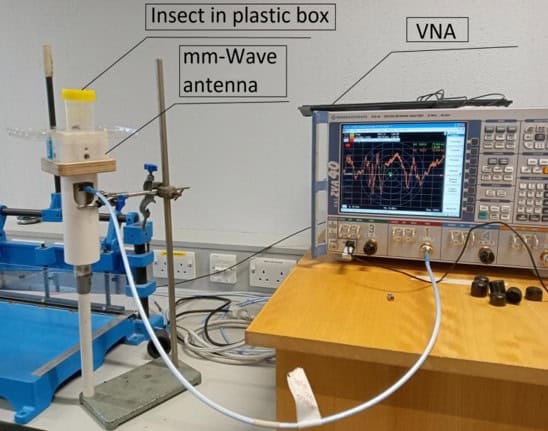
Training the model The radar system used to collect data from insects. (Courtesy: Linta Antony)
The actual process of obtaining this data from the insects involved capturing insects at the Trinity College Dublin campus and placing them in a plastic box on top of a millimetre-wave antenna that recorded their radar signatures. The researchers then released the insects back into the wild. After data capture, the relevant micro-Doppler features were extracted from the data for model training.
The model allowed non-invasive monitoring of different insects and could distinguish between bees and wasps with 96% accuracy. The model also classified five key pollinating insect species – red-tailed bumblebee, buff-tailed bumblebee, moss carder bumblebee, western honeybee and common wasp – with an accuracy of 85%.
“I think the most impressive thing is that we can detect and classify them with such an accuracy. From a biological point of view, it’s impressive how different species beat their wings in different manner, and from an engineering point of view it’s fascinating how different wingbeats affect harmonics of radar micro-Doppler reflections,” says Narbudowicz. “Those differences are of course impossible to see just by looking at spectrograms, but it appears that a sufficiently trained machine learning algorithm can see them.”
Narbudowicz points out that the current study used precise lab-grade transceivers and a relatively controlled set-up, and that the natural next step is to move this technology to outdoor field deployment. “This requires a number of steps,” he explains. “Firstly, the device needs to be miniaturized, and battery operated; the transceiver will be less accurate than the one used in the lab, but a big problem is the ground truth verification, since in the field it can be difficult to verify exactly which species flew over the sensor.”
Despite the greater challenge with deploying the technology in the field today, the researchers suggest that this radar reflection approach could be utilized in the future in a fly-through device, which would make it much easier and cheaper to achieve non-lethal monitoring of insect biodiversity in different environments.
Colliding oxygen nuclei could briefly recreate one of the most extreme states of matter in the universe – according to evidence gathered by physicists working on the CMS Collaboration at the Large Hadron Collider at CERN. Their analysis suggests that when smashed together, even relatively small atomic nuclei can produce a tiny droplet of quark–gluon plasma (QGP). This is a superhot “soup” of elementary particles that is believed to have filled the universe just after the Big Bang.
Under normal conditions, quarks – the particles that make up protons and neutrons – are tightly bound together by gluons, which carry the strong nuclear force. But at extremely high temperatures, matter changes into a radically different form in which quarks and gluons move freely in a dense fluid-like state called a QGP.
Scientists believe the entire universe existed in this form for a tiny fraction of a second after the Big Bang. To recreate it here on Earth, physicists smash atomic nuclei together at nearly the speed of light.
One of the main ways researchers study this strange state of matter is by observing the fast-moving particle sprays created during the collision. In the absence of a QGP these energetic particles would travel outward freely. But if they pass through QGP, they lose energy, somewhat like a bullet slowing down in water. Physicists call this effect jet quenching.
“Jet quenching is one of the main tools we use to study the QGP,” explains Jiangyong Jia of Stony Brook University in the US, who was not involved in the CMS study. “When a high-energy collision produces a QGP droplet, energetic quarks and gluons created in the same collision have to travel through it, and they lose energy along the way.”
For many years, this energy-loss effect had only been clearly observed in collisions involving very heavy nuclei such as lead or gold. Lower mass systems, including collisions between protons and heavier nuclei, showed hints of unusual behaviour but no convincing evidence that particle jets were being slowed down.
A clear signal
The new CMS study examined collisions between oxygen nuclei, which are much smaller than lead nuclei. Oxygen contains just 16 protons and neutrons, compared with 208 in lead. This allowed researchers to investigate how small a droplet of QGP can become while still affecting energetic particles passing through it.
The collisions were performed in 2025 at an energy of about 5 TeV – the highest energy ever for oxygen ions. The CMS Collaboration measured how many high-energy particles emerged from the collisions. This was compared to simpler proton–proton collisions, which are not expected to result in jet quenching.
The physicists found a clear reduction in the number of energetic particles produced. At some energies, the suppression reached about 30%, far beyond what could be explained by random statistical fluctuations. The pattern looked remarkably similar to what researchers had previously observed in much larger lead–ion collisions, although the effect was weaker overall.
“Oxygen-16 has only 16 nucleons compared to 208 in lead, but it appears to produce a medium that absorbs jet energy in a qualitatively similar way to much heavier systems,” Jia explains. “The shape of the suppression curve in oxygen–oxygen collisions resembles what is seen in lead–lead, which suggests the underlying physics is the same.”
Understanding fireballs
The team compared its measurements with several theoretical models. Models that included energy loss caused by QGP generally matched the data better than models without it. Still, some uncertainty remains. Part of the observed effect may come not from a QGP itself, but from differences in how quarks and gluons are distributed inside oxygen nuclei before the collision even occurs.
“The main limitation right now is the nuclear parton distribution functions,” Jia says. These describe how quarks and gluons are arranged inside atomic nuclei. According to Jia, uncertainties in these distributions “can account for roughly half of the observed suppression on their own”.
Future experiments involving proton–oxygen collisions are expected to help clarify the picture. The findings may also reshape how physicists think about the minimum size needed to create QGP.
“It shows that QGP formation is not limited to heavy nuclei,” Jia says. “It can occur in collisions of nuclei as light as oxygen.”
Researchers now hope to compare oxygen with other light nuclei such as neon to understand how the properties of QGP change as the colliding systems become larger or smaller. The work could eventually help physicists build a more complete picture of how ordinary matter behaved in the universe’s earliest moments – and how the strong nuclear force operates under the most extreme conditions known in nature.
Displayed in a sealed case at the National Archives Museum in Washington DC, the US Declaration of Independence is – alongside the Constitution, the Emancipation Proclamation and the Gettysburg Address – one of America’s most sacred documents. Just a single sheet of parchment, it was signed on 4 July 1776 by 56 representatives of 13 colonies, declaring themselves free of British rule. Even though years of fighting followed and Britain did not officially recognize the colonies’ independence until 1783, America dates its birth to that signing.
For many American citizens, the Declaration of Independence is greatly revered. I remember my grandfather had a copy mounted in the entryway to his home, and when I was 10 years old offered me $1 if I memorized it. I had no trouble with the start, for the document’s first sentence is arresting. “When in the Course of human events, it becomes necessary for one people to dissolve the political bands which have connected them with another”, decency requires that “they should declare the causes which impel them to the separation”.
The second sentence is equally exhilarating and unforgettable: “We hold these truths to be self-evident, that all men are created equal…”. I didn’t discover until years later that this evidently didn’t include women, slaves, or the people referred to as “merciless Indian Savages”. Four truths later, the signatories zoomed in. When a government destroys “life, liberty and the pursuit of happiness” it is the “Right of the People to alter or abolish it”.
King George III was doing just that, they claimed, and the signatories followed with a laundry list of appalling grievances that amounted to tyranny. These included: obstructing justice, bending judges to his will, sending agents to harass and murder people, giving amnesty to those agents, transporting people overseas, cutting off trade with the rest of the world, making the military responsive to himself alone, and on and on.
Current US President Donald Trump claims that the Declaration of Independence led to “the greatest political journey in human history”. The document, he adds, set an example for the world. “The Story of America Makes Everyone Free,” he writes on an official website that has been counting down the days, hours, minutes and seconds to the 250th anniversary of the signing.
Destroyers of Earth
The enormous attention that the US administration is paying to this anniversary has made me wonder, however, whether a government today could destroy life, liberty and the pursuit of happiness badly enough to make it necessary to alter or abolish it. The answer was staring me in the face. What if it destroyed science enough to make citizens vulnerable to natural threats?
I’ve therefore been trying to imagine a revised declaration. Among the self-evident truths, I think, is that human beings are endowed with the right to protection against nature, that the purpose of science is to understand nature and its threats, and that a sovereign’s duty is therefore to foster science and act appropriately on its findings. A no-brainer, right?
These truths are more important than ever in the 21st century, I envision the document saying. Until recently in human history, nature could be treated as an inert stage for human activity. But human activity can now interact with nature in a destructive way to threaten human life, liberty and the pursuit of happiness.
We experience such destruction in the degradation of the Earth’s atmosphere, in rising sea levels, in the spread of infectious diseases, in the increasing pollution of land, sea and air, and in coastal floods and water shortages. The current US administration, I’d continue, is not only doing nothing to prevent this destruction, but also actively campaigning against people who are fighting it and trying to make the world safer.
Human freedom and independence require developing science to understand and cope with nature’s threats. When science is ignored, nature rules.
The administration claims that stopping these attempts increases the freedom of US citizens. It does not, however, and instead enslaves us to nature. Human freedom and independence require developing science to understand and cope with nature’s threats. When science is ignored, nature rules.
Yet the current US sovereign, a wannabe King, has made unprecedented attacks on science. His ignorance, denials and repudiations have unleashed untold damage and destruction to the health, welfare and safety of citizens. His actions threaten not only our lives but human lives elsewhere. His actions even threaten the global conditions that make human life possible at all.
Our grievances
My revised declaration would follow with a long and easily verifiable list of modern-day grievances. These would include the fact that Trump has declared that threats whose existence is scientifically well-established are hoaxes, scams and have “no basis in fact”. He has prevented agencies from investigating these threats and from developing technologies to use against them.
He has fired people who study these threats and installed political appointees to oversee funding of research. Despite publicly denying and ridiculing findings about climate change and rising seas, he has admitted their truth when it comes to protecting his own golf course.
The US administration has also declared, contrary to scientific findings, that claims of outbreaks of disease have been “fabricated” and that vaccines do not work. It has cancelled grants to develop vaccines, attacked vaccine makers, revoked recommendations that children be vaccinated, fired experts in vaccines, and damaged the process of vaccine development.
The US administration has sought to gut or close the most important US science agencies. He has withdrawn the US from international agencies that track and address the most important threats to human life and health. He has invented false facts about nature and forced US agencies to agree with him. And he has damaged and extorted America’s top universities by trying to dictate their research, hiring, admissions, courses and curricula.
The critical point
My document would reach a rousing conclusion.
A people, it would say, are only truly free and independent when they and their offspring are able to live in a safe environment, not stalked by disease, and educated freely without government interference. A sovereign who ignores and damages science is unfit to be a ruler by exposing the people to the enslavement of nature. Citizens in a democracy have the right to a leader who does not enslave them to nature.
The final sentence of the document would be: “Let us take those rights back.”
Like the Declaration of Independence 250 years ago, my imagined one may seem revolutionary but only expresses what Thomas Jefferson, the author of the original, called “the common sense of the subject.”
A successful clean‑energy transition depends on understanding how to balance variable renewable power with the growing electricity demands of transport, heating, and industry. A key challenge is capturing how renewable energy sources like wind and solar fluctuate hour by hour, but this variability also creates new opportunities to align supply with increasingly flexible forms of demand, such as electric vehicles, heat pumps, and other electrified services. Alongside these short‑term dynamics, it is equally important to determine the long‑term infrastructure needed to support a fully decarbonised energy system.
In this research, two powerful models (REMIND and PyPSA‑Eur) are linked and allowed to exchange information repeatedly to determine both what infrastructure should be built and how it would operate each hour of the year. REMIND is a global energy and climate model that looks decades ahead, analysing investments, technology choices, and pathways to net‑zero. PyPSA‑Eur is a detailed model of the European electricity system that simulates real‑time grid behaviour. By combining a model that excels at long‑term planning with one that captures hourly power system dynamics, the researchers create a much more realistic tool for answering these complex questions.
They then test this approach on a Germany case study under two conditions: one with demand‑side flexibility (where electricity use can shift to cheaper hours, such as smart‑charging electric vehicles) and one without flexibility. Their findings show that a fully renewable energy system is technically and economically achievable, that flexible systems perform far better than inflexible ones, and that even with flexibility, electricity prices can vary significantly between sectors, creating political challenges around fair pricing. Both scenarios of the German case study reach net-zero emissions by 2045.
This research gives policymakers a clearer way to design reliable, affordable, fully renewable energy systems by showing how to integrate renewables, manage electrification, use flexibility to reduce costs, understand sectoral price differences, and build markets.
“Models used to inform climate policy have always faced a fundamental trade-off: they either capture the long-term perspective needed for investment decisions, or the hourly detail needed for power system planning, but not both. Our coupling of REMIND and PyPSA-Eur is a first step towards resolving this trade-off for an increasingly electric future energy system.” – Dr Adrian Odenweller, Potsdam Institute for Climate Impact Research
Earthquakes occur when tectonic plates rub against each other, become temporarily stuck, and then suddenly release accumulated stress as they slip. Although earthquakes have been studied for decades, the microscopic mechanics that cause faults to stick, slip, and generate friction are still not fully understood.
In this research, scientists use a granite-on-granite system to investigate these processes. Granite is common in continental crust and mechanically similar to many fault rocks, making it a strong laboratory analogue. The researchers used three complementary approaches. First, they performed controlled experiments measuring friction, wear, and surface roughness as two granite surfaces slid past each other, including tests with water, different temperatures, and different sliding speeds. Second, they ran molecular dynamics simulations of a silica (amorphous SiO₂) tip sliding on quartz (crystalline SiO₂), the dominant mineral in granite, to observe how atomic bonds break, phases transform, heat builds up, and friction emerges. Third, they applied theoretical models of contact mechanics (how surfaces actually touch through tiny asperities) and flash heating (how much local heating occurs and whether it weakens the material).
Traditionally, earthquake models assume that friction comes from mechanical processes such as asperity interlocking (high points locking together), plowing (hard grains digging into the opposite surface), and gouge grinding (crushed particles resisting motion). However, this study shows the opposite of what those models predict: more wear leads to less friction, and less wear leads to more friction. Instead of friction coming from grains digging or grinding, it arises from tiny asperities that plastically flatten, cold‑weld together, and resist sliding because their welded atomic bonds must be broken. This represents a major shift in how fault friction is understood.
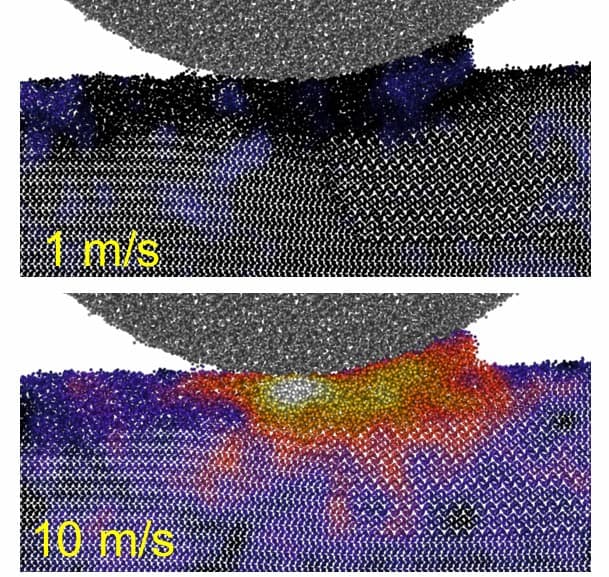
Rigid tip sliding over quartz at two velocities. Brighter colours indicate higher temperatures. (Courtesy: Bo Persson/ Chinese Academy of Sciences)
The study also finds that friction is largely insensitive to temperature, sliding speed, and hold time, suggesting that classic rate-state friction laws may not scale to real faults. The simulations identify three main energy dissipation mechanisms which are bond breaking, plastic deformation, and stress‑induced phase changes. This shows that flash heating at laboratory speeds is too small to weaken quartz, whereas earthquake level slip speeds would generate much stronger thermal weakening. They also reveal that certain quartz polymorphs can form purely from stress, meaning their presence in natural faults does not necessarily indicate high temperatures.
Taken together, these results suggest that fault friction is dominated by adhesive bonding at asperities rather than mechanical grinding, and that tectonic motion may be governed more by creep‑slip than classic stick‑slip behaviour.
An absolutely maximally entangled (AME) state is one in which every possible division of a many-body system into two groups is as entangled as quantum mechanics allows. This makes AME states uniquely valuable as benchmarks for quantum theory and as resources for quantum technologies. Yet basic questions about their existence, structure and classification have remained unresolved, even after two decades of study.
In a new work, dedicated to Ryszard Horodecki, this field has been advanced in several important ways. First, the authors provided a comprehensive and up to date overview of known methods for constructing AME states, going beyond traditional approaches based on stabilizer and graph states. The authors showed how recent ideas from combinatorics, matrix and group theory generate entirely new families of highly entangled states that were previously unknown.
They also went on to study how entanglement behaves when particles are removed from an AME system. This reveals how robust these extreme states are to loss and noise, an essential consideration for real quantum technologies.
One highlight is a solution to the quantum version of Euler’s famous “36 officers” problem. This puzzle asks whether 36 officers from six ranks and six regiments can be arranged in a 6 x 6 grid so that no row or column repeats a rank or regiment. Classical mathematics proves this is impossible.
The paper shows however, that quantum mechanics can bypass this restriction altogether. By using an absolutely maximally entangled quantum state, the researchers constructed a quantum version of the puzzle in which all constraints are satisfied simultaneously. The solution relies on superposition and quantum entanglement rather than fixed arrangements, illustrating how quantum theory enables outcomes forbidden in classical mathematics.
By mapping the limits of multipartite entanglement, this work connects abstract theory with practical goals such as quantum error correction, secure communication, and benchmarking future quantum computers.
Celebrity gossip might break the Internet, but not in the way that quantum computers could. “The advent of quantum computers poses a critical threat, as they could break widely deployed encryption schemes,” warns Lily Chen, a cryptography expert from the US National Institute of Standards and Technology (NIST). Systems at risk include banking encryption, digital signatures, secure messaging, secure shell tunnelling, cryptocurrency and more.
Today’s quantum computers are still too small and error-prone to defeat gold-standard encryption. However, new results from Google Quantum AI and start-up Oratomic suggest that could change, with two widely used cryptographic systems – elliptic curve cryptography (ECC) and the Rivest-Shamir-Adleman (RSA) algorithm – potentially coming under threat sooner than many scientists predicted.
Space–time trade-off
At present, anyone who wants to access encrypted information needs a secret digital key. To obtain this key, an attacker must first solve a difficult mathematics problem. For example, breaking the RSA algorithm boils down to factoring a large number into its prime components. Breaking ECC involves finding a secret number that connects two points on an elliptic curve.
Classical computers might take billions of years to solve these problems. But if an attacker had access to a powerful enough quantum computer, they could solve the problems in mere minutes using an algorithm devised by Peter Shor in 1994.
Several years ago, experts estimated that cracking a typical RSA scheme with 2048-bit keys (RSA-2048) would require tens of millions of physical quantum bits (qubits), which are the building blocks of quantum computers. A year ago, this value dropped to a million. By February 2026 it was down to 100,000. The latest results from California-based Oratomic push the floor even lower, to 10,000 physical qubits. The largest neutral-atom qubit array – realized last year in the lab of Oratomic co-founder Manuel Endres – stands at 6100 qubits. This makes the benchmark of 10,000 feel alarmingly close, though Endres’ array hasn’t yet been used for computation.
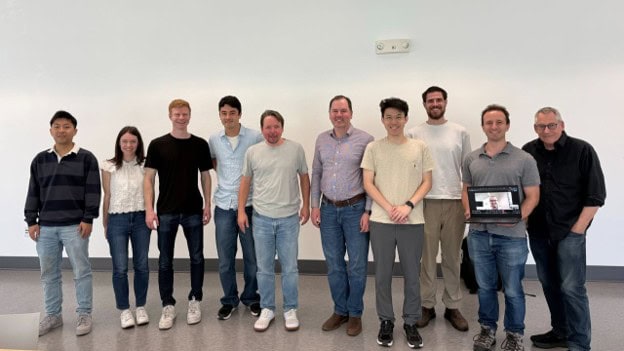
The team: Employees at Oratomic, a new neutral-atom quantum computing start-up. (Courtesy: Oratomic)
There are, however, trade-offs. Quantum computers that use fewer qubits or more space-efficient hardware generally have longer computation times. Oratomic’s proposed 10,000-qubit platform would require three years to crack ECC with 256-bit keys (ECC-256) and 120 years to crack RSA-2048. The company’s predicted time-efficient alternative could solve ECC-256 in 10 days, but that would require 26,000 qubits. Solving RSA-2048 in 97 days would take 100,000 qubits.
Oratomic’s numbers have not yet been peer-reviewed, and outside experts say they depend on different assumptions about future hardware developments. “The space-efficient [architecture] is mostly based on assuming aspects that have been demonstrated to work individually in state-of-the-art academic labs,” explains Maria Violaris, a quantum physicist at Oxford Quantum Circuits, who was not involved in the research. “Meanwhile, the time-efficient one relies on more speculative assumptions that need future innovation.”
A second perspective
On the same day as the Oratomic team posted its findings on the arXiv preprint server, researchers at Google Quantum AI released a white paper with their own updated resource estimates. They report that a computer with 500,000 physical qubits made from superconducting circuits could solve ECC-256 in 18 minutes – and potentially even less (see box). Google’s current state-of-the-art processor, Willow, has 105 physical qubits. However, the researchers warn against assuming gradual and predictable progress because quantum computing developments are driven by overcoming scaling barriers rather than by steady increases in processor size.
The quantum threat to cryptocurrencies
Elliptic curve cryptography (ECC) underpins the security of most blockchain networks, including Bitcoin and Ethereum. Bitcoin transactions take an average of 10 minutes, so if a quantum computer can crack ECC and determine the secret key during that window, the transaction could be intercepted and funds stolen in real time.
While Google Quantum AI’s results predict that it would take 18 minutes to solve ECC on a 500,000-qubit quantum computer, they argue that the run time could be effectively shortened in some circumstances. To understand how, imagine planning a heist in which you need to open a safe. Although you won’t know the exact combination until you get your hands on the safe, if you know the model number in advance, you can prepare some tools to help you crack it faster.
A quantum computer could do something similar. According to the Google Quantum AI researchers, half the ECC algorithm only depends on the elliptic curve and not on the specific transaction. A quantum computer could precompute this half, wait in a primed state until a Bitcoin transaction begins, then quickly solve the second half in only nine minutes, dropping below the 10-minute threshold.
Quantum computing platforms that use superconducting, silicon, and photonic qubits are well-positioned for real-time attacks because they tend to compute faster than neutral-atom and ion-based computers. However, the latter could still pose a serious risk through “at-rest” attacks. Such attacks involve adversaries collecting archived and publicly available data, then decrypting it later with few time constraints.
Which threat arrives first will depend on how different quantum computing architectures mature and scale, a path still marked with considerable uncertainty. “Ultimately, feasibility is difficult to say as it depends on how challenging it will be to increase scale or to take a novel approach by engineering [new] hardware,” notes Maria Violaris of Oxford Quantum Circuits.
The high number of physical qubits required for quantum computation comes from the need to detect and correct errors. Google Quantum AI’s estimate is based on a well-known error-correction method known as the surface code. In this approach, physical qubits are arranged in a rectangular grid and interact with their nearest neighbours. Quantum information is spread redundantly across this grid, allowing errors on one physical qubit to be found and fixed. The entire grid is considered one logical qubit, and the ratio of logical to physical qubits is called the encoding rate.
In the surface code, reducing error amounts to adding more physical qubits per logical qubit, and typical encoding rates range from a few hundred to a few thousand. In contrast, the Oratomic team based its estimates on a newer method of error correction called quantum Low-Density-Parity-Check (qLDPC), which reduces error more efficiently by making the physical qubits interact over large distances. Hengyun (Harry) Zhou, a physicist at the Massachusetts Institute of Technology in the US who was not involved in the research, explains that this longer-range connectivity can significantly increase the encoding rate. For qLDPC codes, a typical rate is around 1 to 10, but rates can now go as high as 1 to 2.
Because neutral atoms are highly reconfigurable, neutral atom platforms like those used by Oratomic (and other companies, including QuEra Computing, Infleqtion, Pasqal, planqc and Atom Computing) are naturally suited to the required long-range connectivity that qLDPC codes require. However, Zhou argues that it’s “not completely out of the question” that superconducting qubit platforms could use these codes too. “There is some additional cost that the lack of reconfigurability in those platforms currently leads to, but I would say if we’re thinking about a beyond-10-year timescale, it’s quite imaginable that things could also change for other platforms as well,” he says.
Responsible disclosure
Google Quantum AI’s white paper may represent a turning point in another respect. Rather than being open about their circuit designs, its authors hid them behind a “zero-knowledge proof”, which provided enough information to verify claims while hiding details that they say could provide bad actors with an “instruction manual”.
Superconducting quantum computing: Google Quantum AI’s Willow processing chip. (Courtesy: Google Quantum AI)
This is a relatively novel approach within the quantum computing community, which has thus far followed the conventional academic practice of publishing results with full transparency. A Google blog post expresses hope that “our approach to responsible disclosure can spur an important conversation among quantum computing researchers and the broader public”.
Certainly, it has already spurred a conversation among experts. “This is the first time I’ve ever seen a new mathematical result actually announced that way,” Scott Aaronson, a quantum physicist at the University of Texas at Austin, US, wrote on his blog. “I’m not sure how much it will actually help, as once other groups know that a smaller circuit exists, it might be only a short time until they’re able to find it as well.”
Zhou echoes this sentiment. “These are the kind of results that could potentially have a lot of general societal safety implications, so you want to make sure that they’re safeguarded responsibly,” he observes. “That being said, I think it is also possible that other people, now that they know what is possible, might come up with related constructions.”
What comes next?
In the long run, protecting against threats likely means migrating away from RSA and ECC and towards new mathematical problems that are difficult for both classical and quantum computers to solve. Google recently introduced 2029 as an internal deadline for migrating major system to so-called post-quantum cryptography (PQC), and many experts believe the migration ought to begin now.
“Migrating to PQC is a massive undertaking that won’t happen overnight. Starting migration today is a necessary risk management strategy,” urges Chen from NIST. She notes that NIST has been instrumental in guiding this migration, beginning with its 2016 call for cryptography experts to design and evaluate new algorithms for PQC, and culminating in its publication of the three most promising ones in 2024.
The Google Quantum AI researchers also outline recommendations to help cryptocurrency communities and policymakers prepare for the PQC era. And while urgency permeates their white paper, ongoing PQC efforts prompted them to end it on a positive note. “These trailblazing projects demonstrate that transition to post-quantum cryptography is realistic and instil hope that it will have been completed before the first [cryptographically relevant quantum computers] come online,” they write.
The most precise calculation of the muon’s anomalous magnetic moment to date has put to rest the possibility of that property revealing new physics beyond the Standard Model – at least for now. The new result, from an international team of physicists, was obtained using a new method to calculate this anomaly that is based on lattice quantum chromodynamics (QCD).
In the Standard Model (SM) of particle physics, which is currently our best theory of the fundamental forces of nature (barring gravity), the muon is an elementary particle. It belongs to the same family (of quarks and leptons) as the electron, but is more than 200 times heavier. The muon interacts with other SM particles via two of the fundamental forces – electromagnetism and the weak force.
Quarks and leptons all possess a magnetic moment that comes from their intrinsic angular momentum, or spin, and quantum theory posits that this magnetic moment is related to the spin by the “g-factor”. This quantity was originally calculated to be equal to exactly two for both the electron and muon.
Experiments over the last 50 years have detected minute deviations from this number, however. This difference, of roughly 0.1 %, is known as the “anomalous g-factor”, aµ = (g – 2)/2, and it comes from so-called radiative corrections – the continuous emission and re-absorption of short-lived “virtual particles” by electrons and muons.
Measuring such discrepancies is very important for physicists because the g-factor could point to the existence of other particles – both known and as-yet undiscovered – so hinting at physics beyond the SM. They can do this thanks to the muon. Since this particle is so heavy compared to the electron, the impact of virtual particles acting on it is significantly greater. This enhanced sensitivity means that measuring the muon g−2 is better for searching for new physics than the electron g−2.
Difficult measurements and calculations
The problem is that such calculations are not easy – all the more so because the muon’s magnetic moment also receives contributions from the strong force as well as the electromagnetic and weak interactions (even though the muon does not itself partake in strong interactions). These strong contributions come from the muon interacting with the photon, which in turn interacts with quarks that then themselves interact via the gluon — the mediator of the strong-force.
The strong force (which is responsible for binding quarks into protons, neutrons and other hadrons) is notoriously difficult to integrate into theoretical calculations, however, because it is so strong.
In the new work, the researchers overcame this problem using lattice QCD of the most uncertain theoretical contribution to the muon g−2 – the “leading-order hadronic vacuum polarization” (LO-HVP), which has been traditionally determined using experimental data. Lattice QCD, they explain, is a computational technique that simulates the strong force on supercomputers by dividing space-time into a fine grid or lattice of small cells. The equations of the strong interaction are then solved on this lattice.
To reach the level of precision required to calculate the muon g−2, the researchers improved on their previous lattice calculation using finer grids and also combined it with experimental data in the very long-distance interaction region. This hybrid approach dramatically reduced errors, so allowing for the most precise value of the muon magnetic moment ever.
“Our result together with the other contributions yields a prediction that combines three interactions (the electromagnetic, weak and strong forces), each of which require vastly different theoretical tools, into a single calculation that differs from the recent experimental measurement of aμ by only 0.5 standard deviations,” says Kalman Szabo of Penn State University in the US, who is a lead researcher on the team. “This provides a notable validation of the Standard Model to 11 digits.”
The original goal in their latest work, he explains, was to have an unambiguous and ab initio pure theoretical work to calculate the magnetic moment of the muon. “When we started, there were very strong signs that there was a tension between experiment and theory in this quantity, which would mean the presence of a new interaction.”
No tension and no new interaction
“Confirming this tension would have been – with some bias from our side – the ‘fundamental discovery of the century’”, he says. “In the end, however, our study shows that there is no tension. Thus, we did not find the new interaction but proved that quantum theory holds with an unprecedented accuracy.”
The result does not mean that new physics has been ruled out, however, he adds. Future experiments and calculations will help clarify the picture, but for now, the Standard Model holds strong.
“We now have a beautiful proof of quantum field theory and this gives credibility to any further work based on this theory,” he tells Physics World. “The accuracy is astonishing, which gives hope to answer other questions related to the strong interaction with similar or even better accuracies.
“Indeed, other groups are now racing to try to validate (or refute) our result, something that can only beneficial for the advance of our field in general.”
Two years ago, the ESTRO 2024 meeting in Glasgow dedicated a conference session to the discussion of upright radiotherapy. In particular, the speakers pondered whether this emerging technique – in which patients are treated sitting up rather than lying down – offers hope of increasing access to advanced radiotherapy, or whether it’s merely hype.
Things have moved on since then. Leo Cancer Care introduced its upright photon therapy system, Grace, and received commercial approval in the US and (just last week) Europe for its Marie upright positioning and CT system. Stanford Medicine recently unveiled the world’s first ultracompact proton therapy facility, pairing Mevion Medical Systems’ compact S250-FIT proton therapy system with the Marie platform. Meanwhile, the body of published research on the feasibility and patient experience of upright treatments continues to grow.
At this year’s ESTRO 2026 meeting in Stockholm, the theme was revisited by four experts in the field, who debated the motion that “Upright radiotherapy will be a mainstream and standard radiotherapy delivery option in 2035”.
The customary pre-debate vote revealed that just one quarter of the audience thought that photon-based upright radiotherapy would become mainstream, with the remainder believing that it would remain a niche technique. When it came to upright proton therapy, however, the vote was split roughly 50:50. So could the speakers persuade the attendees to change their minds?
Patient-centred care
The debate began with Tomas Kron from the Peter MacCallum Cancer Centre in Australia arguing the case for upright X-ray radiotherapy. He pointed out that upright positioning is not a new idea. “Historically, photons and upright have been around for a very long time. It has been, if not standard practice, widely used. But what role will it play in 2035?”
Not a new idea The first high-energy linear accelerator for medical use, known as LA-1, was developed at Stanford in the 1950s. Patients with head-and-neck or lung cancer could sit on an isocentrically mounted chair for treatment. The machine was decommissioned in 1972 and now resides in the Smithsonian Institution. (Courtesy: Stanford Medicine)
Kron described a clinical imaging trial underway at Peter Mac investigating upright cone-beam CT for planning lung cancer radiotherapy. The study showed that image quality was good enough for adaptive treatment planning, and that the lung was expanded and moved less in the upright position. Kron noted that patient setup and imaging was “really, really easy”, taking just a few minutes.
But what’s more important, he emphasized, is the patient experience. Patients treated while sitting up can maintain eye contact with the doctors throughout, they feel more involved and empowered, with one patient commenting: “My breathing was strong, I felt comfortable, the band around my chest was giving me a bear hug.”
“It’s really all about patient-centred care. Physical comfort and emotional wellbeing are top priorities,” Kron said. “Clearly, in an upright scenario this is much more likely to be the case.”
Upright radiotherapy offers many other unique features, including anatomical advantages and the ability to customize the chair, for example, for bariatric or paediatric patients. An upright treatment system is also more compact than a couch-based machine, requiring a smaller bunker. It could also be used as a mobile radiotherapy unit, said Kron – reducing the need for patient travel.
Kron’s team found that 80–90% of their patients could be treated just as well with upright radiotherapy as supine (lying down). “There are anatomical advantages with upright, there are patient preferences, there are economic benefits. What’s not to like,” he concluded.
The myth of mainstream
“Upright radiotherapy will not be mainstream and standard,” declared the second speaker, Livia Marrazzo from the University of Florence in Italy.
“Mainstream means widely adopted, used across the majority of radiotherapy centres, the default in clinical practice … and standard is even stronger, backed by clinical evidence, guideline-endorsed, reproducible and validated,” Marrazzo told the delegates. “It’s not ‘it works in some centres, is technically feasible, has early adopters, may have advantages for some patients’. But that is where we are with upright radiotherapy.”
The art of persuasion Livia Marrazzo argued that upright radiotherapy will not be mainstream by 2035. (Courtesy: Icro Meattini)
From a practical standpoint, most of the roughly 16,000 radiotherapy systems worldwide are linac-based recumbent machines with a typical lifecycle of 10 to15 years. Many were recently replaced with supine systems optimized for intensity-modulated and image-guided radiotherapy. “The installed base is locked into supine geometry for another full cycle,” Marrazzo explained.
She refuted many of the advantages proposed by Kron. “We have limited clinical evidence supporting comfort advantages,” she said. “It may benefit specific patient groups and conditions, but this doesn’t mean mainstream.” Overall, clinical experience is limited, with no comprehensive evaluations of plan quality and no comparative clinical studies.
She highlighted the particular challenges of breast cancer treatments, which account for 25-30% of cases in her radiotherapy department. “When we place a breast cancer patient upright, we lose the natural breast separation, so have much more difficulty in hitting the target and avoiding the contralateral breast,” she explained. “This exemplifies how upright is not a plug-and-play replacement for a conventional supine workflow.”
“Are we sure we would like to have upright as the standard radiotherapy delivery option by 2035 or do we want to push our efforts somewhere else?” Marrazzo concluded. She would prefer a focus on introducing technologies such as AI-driven planning and contouring, fully adaptive workflows, ultra-hypofractionation or biology-guided treatment adaptation. “These are all solutions that can be software-driven, scalable and compatible with existing supine infrastructure.”
The motion for protons
With half of the audience already agreeing that upright proton therapy will become mainstream, Petra Trnkova from Czech Technical University had perhaps a slightly easier task as she presented the case for upright protons. Nevertheless, she began by suggesting that her opponents are simply “scared of progress and won’t accept that, even without evidence, we can move forward in radiotherapy”.
Trnkova reiterated the benefits of upright radiotherapy cited by Kron: favourable patient anatomy, lower installation cost, improved sustainability, and patient-centric management. “For proton therapy, these improvements are much more significant,” she noted.
For starters, upright systems could help address the massive disparity in access to proton therapy around the globe. Sharing a map showing how proton therapy facilities are mostly distributed in wealthy countries, Trnkova noted: “My opponents may tell you that it’s not possible to do this by 2035, but when you look at this map, I ask you, can we wait any longer?”
Saving space The compact S250-FIT proton therapy system is small enough to fit in a standard linac vault. (Courtesy: Stanford Medicine)
Increasing access to proton facilities is enabled by the extreme size reduction when eliminating the need for a large rotating gantry, enabling proton therapy systems small enough to fit in a standard linac vault. Upright proton therapy can also reduce machine complexity, increase rotation speed and lower energy consumption – reducing costs, improving system upgradeability and increasing environmental sustainability.
“Another consequence of smaller facilities is we can really have patient-centred care,” Trnkova added. Recalling the 10 to 15 year linac lifetime mentioned by Marrazzo, she suggested another option: “You can replace your linac with proton therapy. Then you can have the full set of treatments available for each patient”.
Upright proton therapy could also ease the introduction of new treatment techniques, such as proton arc therapy, which offers dosimetric benefits over intensity-modulated proton therapy, but it is difficult to deliver with a gantry. It could also enable in vivo dosimetry, using shoot-through protons for range verification, or mixed-beam delivery of protons and photons.
“Upright positioning offers many opportunities, it’s the only way towards the democratization of proton therapy,” Trnkova concluded. “Stop asking what opportunities upright radiotherapy brings, start asking what you can do to bring it faster to clinical practice.”
The reality check
The final speaker, Carles Gomà from Clinic Barcelona in Spain, reflected upon what makes a good radiotherapy system. “In my view, it’s a three-legged stool: beam delivery, imaging and immobilization,” he said. “And progress comes with a combination of the three.”
For example, focusing too heavily on beam delivery and imaging can lead to immobilization being forgotten. “Immobilization means comfort, and if we are comfortable, we are still,” Gomà explained. “I cannot care less how many papers say patients are more comfortable in an upright position,” he added, pointing out that people will pay five times more to fly in business class where they can lie down.
The other reason cited for moving to upright proton therapy is its lower cost. “But is proton therapy expensive?” Gomà asked. He described the situation in Catalonia, which has a population of eight million and in 2018 spent Euro 42.2M on external-beam radiotherapy. “This is exactly the same cost as one immunotherapy drug for the same population,” he pointed out. “Proton therapy is not expensive; photon therapy is ridiculously cheap.”
Gomà also considered whether “suboptimal protons” are better than photons. “I’m going to answer no,” he said, describing two recent phase III, randomized trials comparing photons with protons for oropharyngeal cancer. The US trial concluded that proton therapy provides a new standard-of-care option, but the UK trial reported no difference between the two modalities.
“Let’s learn from history and not repeat the same mistakes,” he concluded. “True progress is improvement without compromise. If we want to make the stool higher, we have to work on all three legs at the same time.”
The final vote At the end of the debate, the ESTRO delegates strongly supported upright proton therapy. (Courtesy: Ye Zhang)
The debate concluded with decisive a final vote: while support for upright photon therapy reduced a little, over two-thirds of the audience believed that upright proton therapy will indeed become mainstream and standard by 2035.
Writing on LinkedIn, session co-chair Ye Zhang from the Paul Scherrer Institut noted: “The debate sparked an inspiring shift in perspective, with final voting showing slightly increased scepticism toward mainstream upright photon therapy (dropping from 23% to 18% support), but a dramatic surge in favour of upright proton therapy, which jumped from 47% to a 69% majority.”
Nigeria is Africa’s most populous country and one of its largest economies, which puts enormous pressure on its electricity system. At the same time, the country has committed to reaching net‑zero emissions between 2050 and 2070. Today, Nigeria’s power sector is underpowered, unreliable for many citizens, and heavily dependent on fossil fuels and diesel generators, which are costly and polluting.
This study explores pathways for Nigeria to reach net‑zero emissions by 2050, 2060, and 2070, focusing on which technologies would be required. Across all scenarios, solar power becomes the backbone of the system, providing 37–55% of electricity by 2050 and remaining central in the two longer term scenarios. Nuclear power also plays a major role when allowed, but faces barriers such as high upfront costs, regulatory capacity, and public safety concerns. If nuclear is excluded, Nigeria must rely even more on solar and on gas with carbon capture and storage (gas-CCS).
Although transitioning to net‑zero requires significant upfront investment, the study finds that a clean electricity system is cheaper overall than continuing with fossil fuels, and earlier transitions do not significantly increase total costs.
The authors conclude that Nigeria should build a balanced clean‑energy mix (solar, hydro, nuclear, gas‑CCS), rapidly scale up solar deployment, strengthen institutions, mobilise international and private financing, and coordinate regionally to ensure a reliable, affordable, and achievable transition.
“Nigeria’s electricity transition is not only a climate challenge; it is also a development and reliability challenge. Our analysis shows that solar power will be central to any net-zero pathway, but achieving an affordable and dependable electricity system will require a diversified mix of clean technologies, stronger institutions, and sustained investment in the grid and supporting infrastructure.” – Dr Michael Dioha, Clean Air Task Force
The lines between separate scientific disciplines are becoming more blurred. Solving today’s problems often requires teams of scientists from a range of specialisms. But multidisciplinary collaboration also has challenges, in particular the need to “speak the same language”, ask the “right” questions and be familiar with techniques and knowledge that exist in other fields.
To see the importance of finding a common language look no further than the rapid uptake of large language models (LLMs) such as ChatGPT. LLMs can be convenient research aids, but the information provided by them is not always accurate. We can ask LLMs questions about another field, but without existing domain knowledge we cannot always tell if the answers are reliable.
Getting up to speed with a new research field can be tricky – it’s difficult to understand everything fully, but tempting to think that you do. There’s a parallel with sport where it might sound reasonable, say, to assume that mixed martial arts (MMA) fighters can easily become boxers. However, the evidence suggests that MMA fighters often struggle against professional boxers even though fist fighting uses a subset of the skills needed to be successful in MMA.
Back in academia, it’s common to get pushback from “real experts” whenever grant proposals or papers drift too far outside one’s own comfort zone. Nevertheless, discipline mixing is needed more than ever. Today’s problems often straddle different scientific disciplines: how to treat large, complex datasets, for example, is a common challenge in many different fields.
Look up at the stars and not (just) down at your tea
We realized this recently in our work at Queen’s University Belfast, which has been pushing for researchers to share their data analysis strategies with colleagues in other fields. In our case, we had been collaborating with Yicong Li at the Institute for Global Food Security on infrared and ultraviolet-visible spectroscopy and machine-learning models for monitoring the freshness of fish, which required only a few samples for analysis.
However, many food studies need hundreds or thousands of samples to be analysed and class imbalances can quickly arise in which some types of foodstuff have more examples than others. This can then lead to training datasets that do not produce predictive models. One example is tea, which Li has been investigating recently, again via spectroscopy and machine learning, using many samples from all over the world.
Li was trying oversampling, which creates synthetic data to equalize class imbalances. Yet over in the Queen’s physics department, we discovered another strategy was being used to classify problems in astrophysics. Matt Nicholl and PhD student Xinyue Sheng had been working on predicting the classes of energetic cosmic explosions, based on an image of the galaxy where they occurred. They wanted to train their model to find particularly rare classes, so their training set had the same problem: there were only a handful of examples of some classes of interest.
In addition to oversampling, they were also using a “weighted loss function” in their training, in which weights were inversely proportional to the number of examples in a given class. Their approach led to a substantial improvement in their astrophysics application, but it turns out the basic idea is completely general in nature and can be just as easily applied to tea.
Sleeping beauties
Knowledge exchange does not only concern data, but sometimes a whole set of ideas. An interesting study of citation metrics in 2015 by researchers at Indiana University found that there is a class of papers that receive very little attention for years before suddenly shooting skywards with a deluge of citations. Notably, these “sleeping beauty” papers include Albert Einstein, Boris Podolsky and Nathan Rosen’s work in 1935 examining non-locality in quantum mechanics, which led to John Bell’s theorem in 1964 and ignited significant interest in the original “EPR” paper.
Such citation trends can arise because the papers’ findings are adopted by researchers in a different field. Other similar instances include work in the 1930s and 1940s on hydrophobic theory, which describes how certain substances minimise their contact with water. Yet perhaps the sleepiest of sleeping beauties is the principal component analysis (PCA) work by Karl Pearson, which slumbered for over 100 years before “awakening” in the early 2000s.
PCA – a technique that simplifies complex datasets by reducing the number of variables while minimizing information loss – had already been gaining traction during the 1980s and 1990s when matrix calculations became easy for computers alongside the development of statistical software packages and open scripting environments. In research papers published today it would be unusual not to see PCA used as an exploratory tool for multivariate dataset analysis.
As these examples show, it’s crucial that communication channels are open between varying fields. However, too many academic researchers can get siloed. Interdisciplinary science hubs are one way to break down barriers, acting as spaces to exchange ideas between scientists.
One example that we have been involved with is Smart Nano NI, which is a consortium of universities and photonics-based companies in Northern Ireland. It recently released TITAN, a bio-process analysis system based on gold nanostructured chips, for real-time bio-analysis. Smart Nano NI is now moving from benchtop to backpocket, looking to develop fully miniaturized sensing devices by integrating different kinds of photonic components like lasers, filters and detectors, all on the same chip.
Elsewhere, centres for doctoral training – such as the Photonic Integration and Advanced Data Storage programme with the University of Glasgow – bring together groups of PhD students to work on various projects under a common theme. These schemes not only foster new ideas with the student cohort but bring together academics to bridge different parts of research. Either way, we are getting people talking and interested in emerging scientific questions.
So if you are sitting on a problem, there might be a chance that someone in a different field has solved it or at least offered the tools to do so. As our sky-gazing friends might say, “There is nothing new under the Sun.”

 Login
Login