
Normal view

What a modern-day US Declaration of Independence should say

27 May 2026 at 11:00

Displayed in a sealed case at the National Archives Museum in Washington DC, the US Declaration of Independence is – alongside the Constitution, the Emancipation Proclamation and the Gettysburg Address – one of America’s most sacred documents. Just a single sheet of parchment, it was signed on 4 July 1776 by 56 representatives of 13 colonies, declaring themselves free of British rule. Even though years of fighting followed and Britain did not officially recognize the colonies’ independence until 1783, America dates its birth to that signing.

For many American citizens, the Declaration of Independence is greatly revered. I remember my grandfather had a copy mounted in the entryway to his home, and when I was 10 years old offered me $1 if I memorized it. I had no trouble with the start, for the document’s first sentence is arresting. “When in the Course of human events, it becomes necessary for one people to dissolve the political bands which have connected them with another”, decency requires that “they should declare the causes which impel them to the separation”.

The second sentence is equally exhilarating and unforgettable: “We hold these truths to be self-evident, that all men are created equal…”.  I didn’t discover until years later that this evidently didn’t include women, slaves, or the people referred to as “merciless Indian Savages”. Four truths later, the signatories zoomed in. When a government destroys “life, liberty and the pursuit of happiness” it is the “Right of the People to alter or abolish it”.

King George III was doing just that, they claimed, and the signatories followed with a laundry list of appalling grievances that amounted to tyranny. These included: obstructing justice, bending judges to his will, sending agents to harass and murder people, giving amnesty to those agents, transporting people overseas, cutting off trade with the rest of the world, making the military responsive to himself alone, and on and on.

Current US President Donald Trump claims that the Declaration of Independence led to “the greatest political journey in human history”. The document, he adds, set an example for the world. “The Story of America Makes Everyone Free,” he writes on an official website that has been counting down the days, hours, minutes and seconds to the 250th anniversary of the signing.

Destroyers of Earth

The enormous attention that the US administration is paying to this anniversary has made me wonder, however, whether a government today could destroy life, liberty and the pursuit of happiness badly enough to make it necessary to alter or abolish it. The answer was staring me in the face. What if it destroyed science enough to make citizens vulnerable to natural threats?

I’ve therefore been trying to imagine a revised declaration. Among the self-evident truths, I think, is that human beings are endowed with the right to protection against nature, that the purpose of science is to understand nature and its threats, and that a sovereign’s duty is therefore to foster science and act appropriately on its findings. A no-brainer, right?

These truths are more important than ever in the 21st century, I envision the document saying. Until recently in human history, nature could be treated as an inert stage for human activity. But human activity can now interact with nature in a destructive way to threaten human life, liberty and the pursuit of happiness.

We experience such destruction in the degradation of the Earth’s atmosphere, in rising sea levels, in the spread of infectious diseases, in the increasing pollution of land, sea and air, and in coastal floods and water shortages. The current US administration, I’d continue, is not only doing nothing to prevent this destruction, but also actively campaigning against people who are fighting it and trying to make the world safer.

Human freedom and independence require developing science to understand and cope with nature’s threats. When science is ignored, nature rules.

The administration claims that stopping these attempts increases the freedom of US citizens. It does not, however, and instead enslaves us to nature. Human freedom and independence require developing science to understand and cope with nature’s threats. When science is ignored, nature rules.

Yet the current US sovereign, a wannabe King, has made unprecedented attacks on science. His ignorance, denials and repudiations have unleashed untold damage and destruction to the health, welfare and safety of citizens. His actions threaten not only our lives but human lives elsewhere. His actions even threaten the global conditions that make human life possible at all.

Our grievances

My revised declaration would follow with a long and easily verifiable list of modern-day grievances. These would include the fact that Trump has declared that threats whose existence is scientifically well-established are hoaxes, scams and have “no basis in fact”. He has prevented agencies from investigating these threats and from developing technologies to use against them.

He has fired people who study these threats and installed political appointees to oversee funding of research. Despite publicly denying and ridiculing findings about climate change and rising seas, he has admitted their truth when it comes to protecting his own golf course.

The US administration has also declared, contrary to scientific findings, that claims of outbreaks of disease have been “fabricated” and that vaccines do not work. It has cancelled grants to develop vaccines, attacked vaccine makers, revoked recommendations that children be vaccinated, fired experts in vaccines, and damaged the process of vaccine development.

The US administration has sought to gut or close the most important US science agencies. He has withdrawn the US from international agencies that track and address the most important threats to human life and health. He has invented false facts about nature and forced US agencies to agree with him. And he has damaged and extorted America’s top universities by trying to dictate their research, hiring, admissions, courses and curricula.

The critical point

My document would reach a rousing conclusion.

A people, it would say, are only truly free and independent when they and their offspring are able to live in a safe environment, not stalked by disease, and educated freely without government interference. A sovereign who ignores and damages science is unfit to be a ruler by exposing the people to the enslavement of nature. Citizens in a democracy have the right to a leader who does not enslave them to nature.

The final sentence of the document would be: “Let us take those rights back.”

Like the Declaration of Independence 250 years ago, my imagined one may seem revolutionary but only expresses what Thomas Jefferson, the author of the original, called “the common sense of the subject.”

The post What a modern-day US Declaration of Independence should say appeared first on Physics World.
‘Knowledge comes, but wisdom lingers’: how Alfred Tennyson drew science into his poetry

18 May 2026 at 11:00

Alfred Tennyson was “the only poet since the time of Lucretius who has taken the trouble to understand the work and tendency of the men of science” said the English biologist Thomas Huxley on the occasion of Tennyson’s burial in the Poets’ Corner of Westminster Abbey on 12 October 1892. Tennyson’s acquaintance with science and its impact on his poetry is the subject of historian and broadcaster Richard Holmes’s new book The Boundless Deep: Young Tennyson, Science and the Crisis of Belief.

Born in 1809 – the same year as Charles Darwin – Tennyson matured at a time when science was transforming ideas about the universe. “It was stranger and vaster than previously thought,” writes Holmes, “and yet more vulnerable and paradoxically, more temporary. There were no Biblical eternities anymore.”

As a teenager Tennyson looked through telescopes and microscopes, and read books on physics, chemistry, botany and astronomy. In notebooks he interspersed poetic verses with careful observations of plants, birds, animals and other natural phenomena. In one poem he imagined himself on the Moon’s surface, in another as a microscopic creature. His verses expressed both wonder and suspicion. “O suns and spheres and stars … are you realities or semblances?” wrote the 14-year-old poet.

An unbreakable bond

While studying at the University of Cambridge, Tennyson met Arthur H Hallam and the two became inseparable, sharing interests in nature, poetry and science. In 1833 they spent a “science week” in London, visiting the new London Zoo in Regent’s Park, the Gallery of Practical Science in Piccadilly, and displays of magnets, microscopes and steam cannons.

That year several books on astronomy appeared, including one by Tennyson’s Cambridge tutor William Whewell, who coined the term “scientist”. The publications acquainted readers, including Tennyson and Hallam, with newly discovered star systems and “the nature of their formation, their growth over immense and previously inconceivable periods of time, and finally their slow but inevitable extinction”, as Holmes describes. “These ideas of so-called deep time and deep space were gradually transforming the whole notion of the material universe.”

That autumn, at age 22, Hallam unexpectedly died from a brain haemorrhage. It was the most traumatic event of Tennyson’s life, “a particular extinction from which he never recovered”, writes Holmes. Tennyson spent nearly two decades coping by writing In Memoriam A H H, published in 1850. In several sections near the poem’s midpoint, Tennyson seems to invoke nature as a possible source of solace in imagery that has challenged scholars ever since.

“Every evolutionist can cite the line,” wrote the evolutionary biologist Stephen J Gould in his 1995 book Dinosaur in a Haystack. “We would draw and quarter any imposter who couldn’t.” Gould was referring to the line “Nature red in tooth and claw”, a phrase from In Memoriam that many scholars think anticipates Darwinian evolution and consoled Tennyson. But Gould instead finds that the line only reflects the biological and geological catastrophism of Tennyson’s time and adds that Tennyson knew it held no comfort. “Science cannot tell us why a man should die so young,” Gould writes, “or how a grieving lover should resolve his suffering.”

Holmes gives a more nuanced interpretation, saying that Tennyson did not grieve and then seek solace in science. Rather, Tennyson’s grief began with his awareness that scientific truths prevented him from turning to religion; that the “death of an individual”, as Holmes writes, “counted for nothing within the vast and pitiless scale of geological death and extinction”. Tennyson’s grief sprang from his experience of a conflict between science and religion, which put him in a “state of hovering, or trembling, between science and religion, between empirical evidence and traditional faith”.

Life, poetry and science

Holmes has spent his career writing about Romantic poets and their world. For example, one of his previous books was The Age of Wonder: How the Romantic Generation Discovered the Beauty and Terror of Science. Holmes’s vast command of the era shows in his ability to identify the people from whom Tennyson learned what he knew.

He introduces us to Jane Marcet, an innovative scholar and writer whose books about physics and chemistry inspired not only Tennyson but also embarked the geologist Charles Lyell and physicist Michael Faraday on their scientific careers. Marcet would have been elected to the Royal Society, Holmes writes, “except for the slight hindrance that no female Fellow was admitted until 1921”. (Marcet’s husband, a Swiss doctor, made it in.) Meanwhile, the mathematician Mary Somerville – said to be “one of the only six persons in England who understands Laplace” – was a polymath whose books acquainted Tennyson with the entire spectrum of hard sciences.

Science, Holmes shows, is not a privileged knowledge that poets must bow before, nor a set of facts to accept or deny. Rather, its constant development reshapes our experience of the world as much as families and friendships, mentors and myths. The Boundless Deep is as instructive about the science found in Tennyson’s poetry as it is about science in human experience.

  • 2025 William Collins 448 pp; £25.00 hb; £14.99 ebook

The post ‘Knowledge comes, but wisdom lingers’: how Alfred Tennyson drew science into his poetry appeared first on Physics World.

Oppenheimer unfiltered: rare recordings released to the public

29 April 2026 at 14:30

The latest episode of Physics World Stories dives into a remarkable archival release. A series of audio interviews with Robert Oppenheimer, recorded in the 1960s, is now accessible through the American Institute of Physics (AIP). Made available for non-commercial use in collaboration with the Oppenheimer family, these recordings offer a rare chance to hear the physicist’s voice and experience his unfiltered thoughts.

AIP digital archivist Allison Buser guides listeners through the significance of the collection, interspersed with clips. The first interview (1960) captures Oppenheimer reflecting on the lead-up to and aftermath of the Trinity test. A 1963 oral history with science historian Thomas S Kuhn shifts focus to Oppenheimer’s personal journey and his views on quantum and nuclear physics. The final interview (1966), sees him discussing Enrico Fermi’s legacy and the physics community of his era.

Hosted by Andrew Glester, this episode provides a rare glimpse into one of the most consequential scientists of the 20th century. You can find links to the full archive material in the AIP newsletter, along with further context in this article by Allison Buser. You can also hear an interview with Kai Bird, co-author of American Prometheus, the book that inspired the 2023 blockbuster film Oppenheimer.

The post Oppenheimer unfiltered: rare recordings released to the public appeared first on Physics World.

💾

Proteins on manuscript reveal how Renaissance medicines were made

16 April 2026 at 12:35

Gleb Zilberstein is my guest in this episode of the Physics World Weekly podcast. A physicist by training, Zilberstein applies the principles of proteomics to the study of historical objects including Renaissance manuscripts.

He is also a director of Israel-based SpringStyle Tech Design, which has created a special film that lifts proteins from the surfaces of historical objects. Analysis of these proteins provides  important information about how those objects were used.

In a recent paper, Zilberstein and colleagues studied protein residues on a well-thumbed book of medical recipes that was published in Germany in 1531. He explains how their analysis provides a new view into how medical practitioners used the book and what sorts of concoctions they were making. Astonishingly, the team found evidence that European readers had access to ingredients derived from hippopotamuses.

Some papers about the application of proteomics to historical research:

The post Proteins on manuscript reveal how Renaissance medicines were made appeared first on Physics World.

Michael Frayn on Copenhagen: ‘When I wrote it, I didn’t think it would even be staged’

14 April 2026 at 11:10
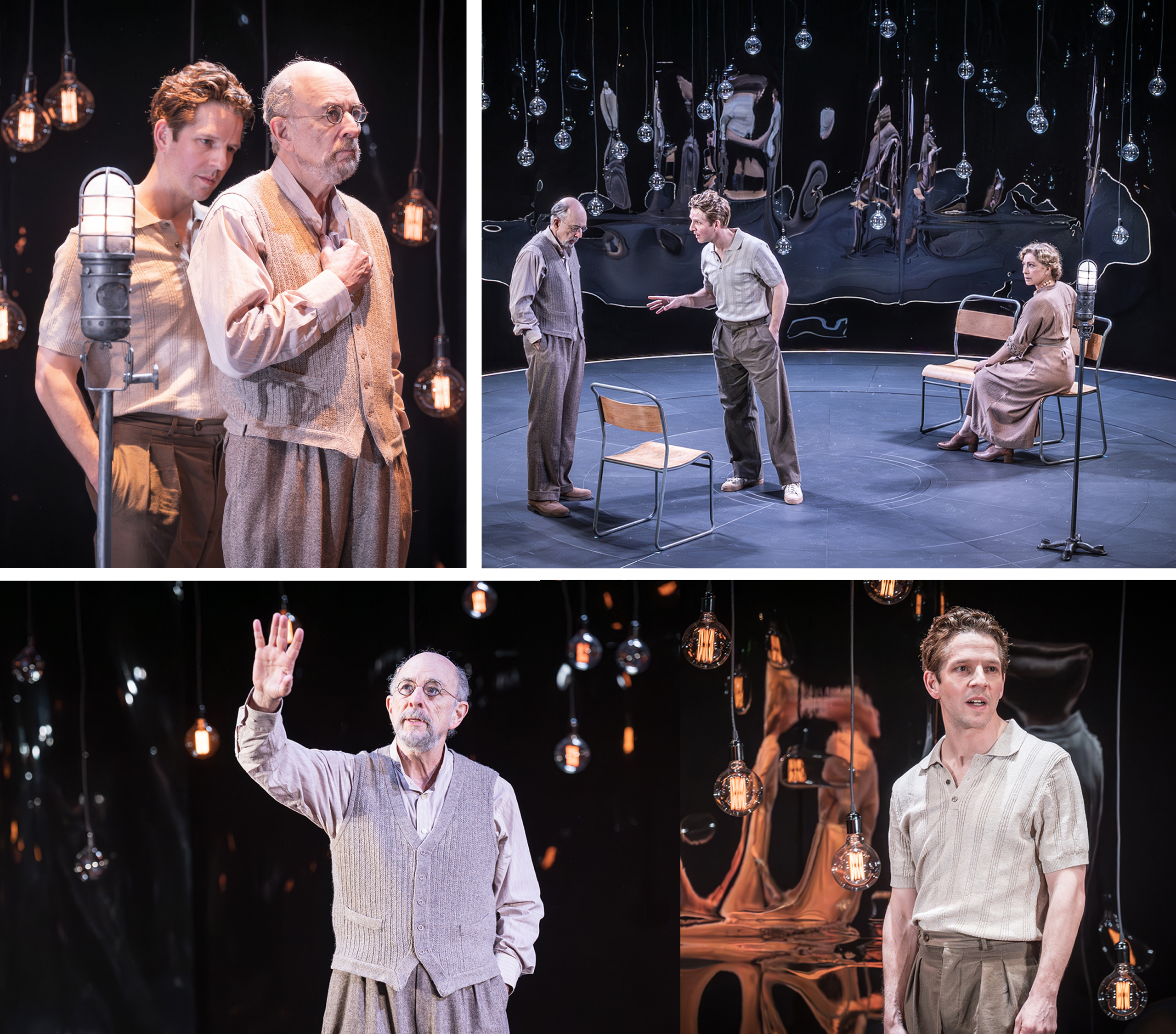
A collection of photos from Michael Frayn’s play Copenhagen at Hampstead Theatre in London
Stage success Damien Molony (as Werner Heisenberg), Richard Schiff (Niels Bohr – with cardigan) and Alex Kingston (Margrethe Bohr) in the revival of Michael Frayn’s Copenhagen at the Hampstead Theatre in London. (Courtesy: Marc Brenner)

When Werner Heisenberg retreated at daybreak to an isolated rock on the island of Helgoland in June 1925 to contemplate his development of quantum physics, he might well have been surprised to know that this moment would be recreated by an actor perched on the back of a chair in a pool of water on a stage over 100 years later.

However, this is exactly what happens in a revival of Michael Frayn’s play Copenhagen, currently at Hampstead Theatre in London.

The play explores Heisenberg’s visit to see Niels Bohr in Nazi-occupied Copenhagen in 1941 and features just three characters, Heisenberg, Bohr and Bohr’s wife Margrethe. The intentions surrounding Heisenberg’s visit have always been unclear, with this uncertainty being central to the play, which was first staged to critical and popular acclaim at the National Theatre, London, in 1998.

The initial success of Copenhagen came even as a surprise to its writer Michael Frayn. “When I wrote it, I didn’t think it would even be staged,” he admitted in an interview with Physics World. Eventually, Copenhagen went on to receive many accolades, including a Tony Award for Best Play and enjoyed over 300 performances in London and New York.

The new production at the Hampstead Theatre is directed by Michael Longhurst, who told me how struck he was by the level of detail in the play.

“While Frayn is super conscious of this as an act of fiction and theoretical imaging, I don’t think I’ve ever worked on a play that feels like it’s been as rigorously researched,” he says.

“I think there’s a real pleasure and opportunity as a director, when you’re staging plays that are tapping into scientific principles. There is a beautiful probing parallel between the uncertainty of intention and Heisenberg’s uncertainty principle.”

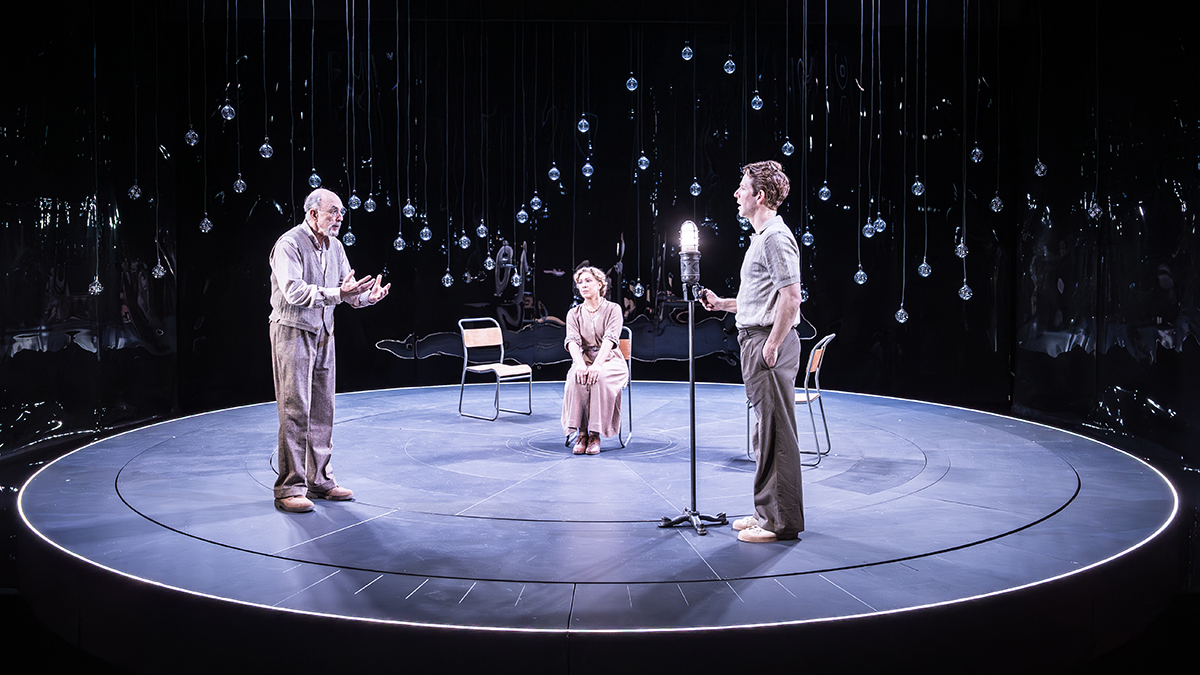
Michael Frayn’s play Copenhagen at the Hampstead Theatre in London
Round and round The revival of Copenhagen, which focuses on the 1941 discussion between Niels Bohr (left) and Werner Heisenberg (right), with Margrethe Bohr looking on. (Courtesy: Marc Brenner)

Heisenberg’s involvement in what became the German nuclear-bomb programme is likely to have been a significant factor in his seeking to meet with Bohr, but the beauty of the play is the uncertainty behind the real motivation for the meeting.

As Frayn told Physics World: “The play is about the elusiveness of human intention, so I don’t claim to have a settled view of Heisenberg’s.”

However, Frayn hints that he is most persuaded by Heisenberg’s own account, which he gave many years later, that he wanted to warn the Allies about Germany’s plan to build a bomb, rather than trying to get information from Bohr to help the Nazi programme.

“Bohr’s confirmation in his unsent letter [in 1957],” says Frayn, “that Heisenberg had in fact overridden all normal obligations of wartime secrecy to tell him that Germany was doing research on a nuclear weapon – and that he now believed it was in theory possible to build one – seems to me to go some way to reinforcing the account that Heisenberg himself gave later of his intentions in seeking the meeting in 1941.”

As for the new revival at Hampstead, Longhurst says it is a chance “to engage with an incredible play that hasn’t been seen in London since that original production”.

“I’m very proud of the cast that we’ve assembled in Damien Molony, Richard Schiff and Alex Kingston, who I think are individually and collectively brilliant. I guess what is thrilling about the play when you see it live, and it is three bodies in a contained space, is watching them shift between prosecutor, witness and judge. That triangle of relationships is constantly shifting. I like to imagine them as three entangled souls with an unanswered question.”

  • Copenhagen runs at Hampstead Theatre, London, UK until 2 May.

The post Michael Frayn on <em>Copenhagen</em>: ‘When I wrote it, I didn’t think it would even be staged’ appeared first on Physics World.

❌