Normal view

Amazon’s AI-Generated Animated Series Canceled After Relentless Derision

3 June 2026 at 15:48

At first, it felt a bit like Emmy-winning writer director Jorge Gutierrez had been living under a rock.

On May 27, Amazon announced that it had ordered an animated series, dubbed “Punky Duck,” as part of its GenAI Creators’ Fund, celebrating it as a “creative breakthrough.” The fund, a collaboration between Amazon’s MGM Studios and its Amazon Web Services, was designed to hand creators “access to professional-grade AI tools and funding” to “produce high-quality cinematic entertainment.”

Gutierrez seemingly couldn’t believe the power he’d been handed.

“The best way I can describe it is, it’s like you have sex, and then someone hands you the baby,” he told a panel during an announcement last week. “It’s pretty crazy.”

However, given the way the conversation surrounding the use of AI in creative industries has been headed, it shouldn’t come as a surprise that reactions to the news were overwhelmingly negative, with Gutierrez swiftly becoming the target of an astonishing amount of online outrage.

His Wikipedia profile was edited to describe him as a “sellout” and early attempts to allow his fans to vent their frustration on his Instagram account didn’t go over well, either, forcing him to delete swaths of posts.

Not all the derision was from the online peanut gallery.

“It is very seductive that something now exists that contains the collective works of millions of artists and wordsmiths all thrown in a blender allowing one to pour out on demand things based on suggestions and prompts,” wrote acclaimed voice actor Billy West. “You become a soul stealer, a grave robber of sorts. You are an artist! God gave you a far greater gift and purpose to share with others. We need your true self!”

The backlash was so extensive, Gutierrez ended up backtracking on the lucrative gig entirely, in one of the clearest signs yet that AI has become toxic sludge to much of the audience Amazon is trying to woo.

“I have decided to drop out of the AI program at Amazon,” he tweeted on May 29, just two days after the company’s announcement. “I will not be making a Punky Duck series. Actions speak louder than words.”

The incident perfectly highlights just how much the AI backlash has grown, with experts warning that the tech is causing cultural stagnation while Hollywood actors panic over being replaced. Some of the biggest names in the industry have publicly spoken out against the use of AI in creative fields, forming a expanding line of resistance.

It apparently wasn’t just angry comments directed at Gutierrez for “selling out.” In a separate tweet, Gutierrez said that “the racist stuff and the attack on my kid were too much,” indicating pundits online had gone to extreme lengths.

Even this attempt to defuse the situation didn’t sit well, with users accusing him of pulling the “racism card,” while others claimed he was “making this up to deflect from your piss poor choices.”

Oddly enough, Gutierrez was once a vocal critic of AI, as the Los Angeles Times reports, posting several memes decrying the tech between 2023 and 2025.

“Threatening the dude and his family is obviously going way too far, but I’m still against major animators using AI, 100 percent,” one Reddit user argued. “I’m still glad he dropped out of it, but I f***ing hate that people threatened the dude.”

“Animation isn’t worth that, the hell is wrong with people?” the user added.

Meanwhile, Gutierrez has tried to get the angry mob back on his side.

“Learning a lot from many of you,” he tweeted. “Thank you. Lots of information that I’m digesting wholeheartedly. I am absolutely understanding the concern of using AI to assist an animation pipeline.”

“For all those showing me grace, I really appreciate it,” Gutierrez added. “I have a lot to think about.”

More on AI backlash: Harvard Graduation Speaker Unloads on AI in Profanity-Loaded Tirade, Prompting Cheers From Students: “I’m Here to Tell You the Mission of Your Generation Is to Destroy AI”

The post Amazon’s AI-Generated Animated Series Canceled After Relentless Derision appeared first on Futurism.


World Cup Will Be Patrolled by Security Robodogs

2 June 2026 at 20:50

The Trump administration’s violent deportations and crackdown on protestors against Immigration and Customs Enforcement have set an ominous tone for the upcoming FIFA World Cup, which is taking across a number of North American host cities this month.

Both human rights and football fan groups have voiced concerns over the militarization of law enforcement and presence of ICE agents during the lead-up to the tournament, which is expected to draw many millions of international visitors.

Vice president JD Vance hasn’t exactly helped the situation, warning foreign visitors in chilling comments last year that they should “go home” after the event, or else “they’ll have to talk to [former secretary of homeland security Kristi] Noem.”

So it shouldn’t come as a surprise then that sightings of Boston Dynamics’ Spot robot dogs at the AT&T Stadium in Arlington, Texas, raised surveillance fears in the state, as Chron reports. Rumors that the robots were using facial scanning technology on passersby spread like wildfire on social media. However, a Boston Dynamics spokesperson told Chron that the robots “do not have facial recognition capabilities” and will be used to “assist security personnel with investigating things like suspicious packages or other potentially hazardous materials.”

The dogs are part of a broader “Security Spot” initiative by Boston Dynamics owner Hyundai. On its website, the company claims it’s “deploying its largest and most advanced mobility fleet to date and, through its collaboration with Boston Dynamics, becoming the first and only official partner to provide robotics for the tournament.”

“As part of this effort, Security Spot, a four-legged patrol robot, will support on-site security operations, helping contribute to a safer tournament environment,” the website reads.

Nonetheless, netizens were left unsettled by the sight, drawing comparisons to the “Black Mirror” episode titled “Metalhead,” which is set in a post-apocalyptic wasteland in which a woman is relentlessly hunted by an advanced, autonomous robot dog.

“Well, that puts a chill down my spine,” one Reddit user responded to a video of a robot dog cocking its head back and forth while glancing at the person filming, giving the impression of scanning their face.

“I can’t get over how they made it dance while it performs techno-authoritarian surveillance,” another user wrote.

Mexico, which is hosting matches across three venues for the World Cup, will also be patrolling grounds using four robot dogs, called “K9-X,” which function as a kind of first responder, as Wired reported earlier this year. (Authorities did not disclose who makes them or other technical details.) Officials told the publication that the robots will intervene in the event of a fight or drunken debauchery to protect officers’ safety — which, given the reputation of soccer fans, probably isn’t unlikely.

More on the cup: Nike’s AI Designed World Cup Jerseys Are a Disaster

The post World Cup Will Be Patrolled by Security Robodogs appeared first on Futurism.

Bernie Sanders Announces Plan to Seize Half of AI Industry for the Public Good

2 June 2026 at 19:03

The hype surrounding generative AI has generated astronomical amounts of value, with tech companies raising tens of billions of dollars and many — including OpenAI and Anthropic — preparing to go public this year at sky-high valuations, in moves that will produce incredible wealth for their stockholders.

Whether the average Joe will ever directly benefit from all of this is looking dubious at best. That’s despite many of these tools relying on AI models that were trained on the creative output of millions of people, copyright be damned, the vast majority of whom have yet to see a single cent. Quite the contrary — many workers are facing a disastrous job market as a result of corporations stretching themselves thin through massive investments in AI.

Meanwhile, concerns continue to grow that the billionaire class is unethically enriching itself through the scheme, while shutting out the democratic process.

To independent senator Bernie Sanders (D-VT), that kind of injustice needs to end. In an essay published by the New York Times, Sanders argued for the creation of an “AI Sovereign Wealth Fund” that would be created through a “one-time 50 percent tax” on the stock of AI companies, including OpenAI, Anthropic, and xAI, to “give the public a direct ownership stake.”

In other words, Sanders is proposing to transfer half of the AI companies’ stock into a public fund — a one-time transfer as opposed to a tax on profits — which the government will manage. Generated revenues could be distributed as “direct payments to the American people.”

While many important details have yet to be ironed out, as Sanders admits, it would represent a massive shift and equity transfer — if his act were to pass, that is.

“The question, then, is not whether AI will change the world,” he wrote. “It will. The question is: Who will own and control that future? Who will benefit from it, and who will be hurt by it?”

Sanders argues such a fund would “give the public a direct role in determining the future of this technology,” while also guaranteeing that the “trillions of dollars potentially generated by AI are used to improve the lives of all of us — not simply to make the richest people in the world even richer.”

While chances of the senator’s idea surviving the Congressional approval process are likely slim — the AI industry holds immense influence over Congress — it’s a creative approach to an increasingly sticky problem. Even tech leaders, who have watched as the backlash to AI continues to grow, have turned their attention to possible solutions to address even greater wealth disparity caused by the emergence of AI.

Jeff Bezos recently argued that the bottom 50 percent of earners shouldn’t pay any taxes, while OpenAI CEO Sam Altman came up with a new concept called “universal basic compute,” which would provide free access to those who can’t afford costly AI tools. Meanwhile, SpaceX founder Elon Musk has called for a new take on universal basic income, uninspiringly dubbed “universal high income.”

Sanders’ sovereign wealth fund takes the idea a step further, giving Americans who don’t happen to be tech billionaires an opportunity to get in on the ground floor. The concept has already been “put into practice right here at home,” Sanders wrote, pointing to an Alaskan sovereign wealth fund that’s allowed residents to receive annual dividends through oil revenues.

“To start, the billions, if not trillions, of dollars generated by this fund would provide direct payments to the American people,” he wrote. “And as the fund generates more and more wealth, the proceeds would be used to ensure that every man, woman and child in our country has a decent and dignified standard of living, including health care, education and housing.”

More on Bernie Sanders: Unions Attack AI for Menacing Human Jobs

The post Bernie Sanders Announces Plan to Seize Half of AI Industry for the Public Good appeared first on Futurism.

Paper Claims the “Asteroid” Japan’s Probe Is Approaching Is Actually a Derelict Spacecraft

2 June 2026 at 17:51

After successfully rendezvousing with near-Earth asteroid Ryugu in June 2018 and sending a sampled cache of rocks back to Earth, Japan’s Hayabusa2 spacecraft is now making its long journey to its next destination, a tiny and rapidly spinning asteroid dubbed 1998 KY26.

The spacecraft is expected to reach the mysterious space rock by July 2031, giving scientists plenty of time to come up with theories as to what it could find once it gets there.

1998 KY26 is an intriguing new candidate for an entirely new class of objects. In 2017, interstellar visitor ‘Oumuamua — the first object from beyond the solar system to have ever been observed — inspired scientists to categorize it as a “dark comet,” a class of asteroids that share some behaviors with comets. (A brief refresher: asteroids are lumps of rock, ice or dust that orbit the Sun but are too small to be classified as planets, while comets are “dirty snowballs” that release gases to form a tail behind them as they pass by the Sun.)

Scientists suggest 1998 KY26 could also be a dark comet, making Hayabusa2’s visit five years from now an intriguing opportunity to get a closer look.

But according to Harvard astronomer Avi Loeb, who has spent years pondering the nature of ‘Oumuamua and its unusual behavior, 1998 KY26 could be something else entirely. As detailed in a yet-to-be-peer-reviewed paper, Loeb and his colleagues suggest the object could instead be a long-lost relic of the Soviet space program.

“In particular, we identify it as potentially a relic of a historical Russian mission to Mars, the Phobos 1 probe, which suffered a failure 2 months after the launch in July 1988, due to upload of a faulty command,” Loeb explained in a blog post this week.

Phobos 1 failed to send back a signal in August 1988 due to what later turned out to be a typo — a missing hyphen — in a command that shut down crucial systems.

In their latest paper, Loeb and his colleagues suggest that the probe’s thruster firings may have put it in a “similar” orbit to 1998 KY26’s, and that the “two orbits converge and are statistically compatible.” The researchers also argue that the defunct spacecraft and dark comet share roughly the same size and a “quite elongated” shape.

Still, the hypothesis is quite a stretch, given the vastness of space. However, in his blog post, Loeb argued that scientists should nonetheless extend their “training data set to include not just rocks and icebergs but also the space objects launched by humans over the past 69 years” just in case.

If 1998 KY26 does turn out to be technological in nature, Loeb argued that the finding could support his controversial theory that ‘Oumuamua may have also been a piece of technology sent to us by an advanced extraterrestrial civilization.

“I wonder whether the mainstream of comet experts will acknowledge that 1I/’Oumuamua may have not been a natural ‘dark comet’ if it becomes clear that their so-called ‘dark comet’ 1998 KY26 is technological in origin, beyond any reasonable doubt,” he pondered.

Nobody knows for sure what Hayabusa2 will find. Besides, thanks to the asteroid’s extremely fast spin, it could prove extremely difficult to land on.

But Loeb and his colleagues argue we should keep an open mind, just in case it turned out to be a long-lost Soviet era spacecraft.

“In anticipation of the Hayabusa2 observations in 2031, which will be decisive in resolving the origin of this object, we encourage further observational, dynamical, and theoretical studies aimed at more tightly constraining the nature and properties of 1998 KY26,” they concluded in their paper.

More on Hayabusa2: Scientist Left “Speechless” After Opening Asteroid Samples

The post Paper Claims the “Asteroid” Japan’s Probe Is Approaching Is Actually a Derelict Spacecraft appeared first on Futurism.

Trump Shovels $4 Billion Directly to Elon Musk, Who Spent a Fortune Getting Him Elected

1 June 2026 at 22:32

Elon Musk spent just shy of $300 million supporting Donald Trump’s reelection in late 2024 — a full-throated financial commitment that appears to be paying off in a big way.

Musk’s space company SpaceX, in particular, has massively benefited from the duo’s on-and-off-again relationship, scoring billion-dollar deals with the government.

Most recently, Reuters reports, SpaceX was awarded a $4.16 billion contract with the US Space Force to develop detection satellites that can track and target airborne threats. Just days earlier, the military arm awarded the company a separate contract, worth $2.29 billion, to build a military communications network in low-Earth orbit to support ground-based operations.

Besides the impossible-to-overlook role of Trump and Musk’s cozy relationship, the timing of the announcement will raise plenty of eyebrows. SpaceX is expected to go public soon at a valuation of north of $1.75 trillion, a blockbuster IPO that could directly benefit from a government partner signing a flashy contract.

The latest threat detection contract is part of the Trump administration’s so-called Golden Dome missile defense system. While plenty of fundamental questions remain over its design, the network could cost well over $1 trillion to build out, according to experts, which would be far than the White House has estimated.

The threat detection satellite contract, called the Space-Based Advanced Moving Target Indicator, will see SpaceX develop what Reuters likens to an “interconnected system-of-systems” that collects and analyzes data from a host of different sources, from space-based sensors, to secure communication links.

Zooming out, cushy government contracts have long played a key role in the flourishing and very survival of Musk’s space venture. According to an analysis by the Washington Post last year, SpaceX had received $38 billion in government contracts, loans, subsidies, and tax credits, as of February 2025.

Given their budding relationship and the latest multibillion-dollar contracts, that number has already grown substantially — and will very likely continue to grow, especially as SpaceX looks to go public.

The company is also set to play a key role in the Trump administration’s efforts to return astronauts to the surface of the Moon, and was awarded a $2.9 billion contract in 2021 to build the requisite lunar lander.

More on SpaceX: SpaceX Announces Plans to Put Billionaire on First Rocket to Mars

The post Trump Shovels $4 Billion Directly to Elon Musk, Who Spent a Fortune Getting Him Elected appeared first on Futurism.

Meta’s AI Support Bot Is Giving Hackers Access to Other People’s Instagram Accounts Just by Asking

1 June 2026 at 21:44

In March, Mark Zuckerberg’s Meta announced a new Meta AI support assistant feature on both Facebook and Instagram, providing users with a way to “resolve account problems” and help in taking down any offending impersonator accounts or scams.

Besides highlighting the tech industry’s seemingly insatiable appetite for automating customer service-level jobs with AI, the new feature appears to have backfired spectacularly. As 404 Media reports, the chatbot happily obliged when hackers asked it for access to high-profile Instagram profiles.

The ruse is shockingly simple: after matching the account owner’s geographic region using a VPN, the hackers asked the support chatbot to change the email address associated with the profile, thereby allowing them to successfully complete two-factor authentication. Worse yet, the vulnerability has been around for several months already, according to Telegram group messages reviewed by 404 Media.

“t’s either the new Meta Accounts Center glitching out or my Instagram account is being targeted in a hacking attempt,” former Meta researcher and self-proclaimed hacker Jane Wong wrote in a Threads post. “It appears that my password has been changed without my knowledge / I was not able to log in using my password.”

The exploit highlights glaring cybersecurity issues that continue to plague AI-powered chatbots. We’ve seen countless instances of large language model based tools being jailbroken, tricked into telling lies, or even hallucinate made-up company policies leading to plenty of confusion and even lawsuits.

Experts have also long warned against handing AI chatbots personal information, citing the risk of data leaks. Meta, in particular, has garnered a reputation for continuously treating user data with little care. In March, for instance, The Information reported that an in-house AI agent had caused a critical security incident at Meta, exposing sensitive user data to people without proper authorization.

While it’s unclear whether they were connected to the latest exploit, the news comes after several high profile Instagram accounts, including former president Barack Obama’s and Space Force chief master John Bentivegna’s, were hacked.

Hackers have been offering access to high-profile accounts in exchange for small amounts of money by using the vulnerability, per 404 Media.

Fortunately, Meta appears to have patched the issue, but considering the exploit was discovered months ago, the damage could be extensive.

More on Meta: Meta Workers Say They’re Seeing Disturbing Things Through Users’ Smart Glasses

The post Meta’s AI Support Bot Is Giving Hackers Access to Other People’s Instagram Accounts Just by Asking appeared first on Futurism.

Scientists Say They’ve Cracked Mystery Behind a Dozen Strange Signals From Deep Space

1 June 2026 at 18:50

Since 2022, astronomers have been tracking highly unusual bursts of radio emissions that repeat at precise intervals, ranging from a few minutes to several hours. Some pulse for more than 30 years, while others wink out after only a couple of days. Scientists have discovered of a dozen of these sources so far, adding to the mystery and prompting plenty of speculation over their possible origins.

In an effort to better understand these “long-period radio transients,” an international team of scientists honed in on ASKAP J1745, a highly polarized repeating radio burst first detected by the Australian Square Kilometre Array Pathfinder (ASKAP) telescope.

As detailed in a new paper published in the journal Nature Astronomy, several different telescopes observed this burst across a broad spectrum of light, including X-ray and radio waves, giving them an opportunity to figure out what’s behind the phenomenon once and for all.

“Bearing the same message in three forms of writing, the famous Rosetta stone once helped scholars decipher ancient Egyptian hieroglyphs,” wrote coauthor and University of Sydney Astrophysics PhD Candidate Kovi Rose in a writeup for The Conversation. “Similarly, this extra information we found about ASKAP J1745 will help astronomers better understand the mystery of all long-period transients.”

They found that long-period transients likely aren’t caused by pulsars, the spinning and highly energized remains of dead stars, which had emerged as a popular theory among researchers. That’s because they repeat far slower than the average pulsar, which repeats every few seconds, as Rose argues.

The team concluded that ASKAP J1745 is likely a “cataclysmic variable” star, or a system made up of a pair of stars, with one of them being a white dwarf — the dense stellar core left over after a relatively low-mass star has exhausted its fuel. Rose and his colleagues believe the radio burst may be caused by the white dwarf accreting material from the other star, a process that generates heat and thereby releases X-ray light.

The pulsed radio light, on the other hand, is “typically caused by energetic particles interacting with strong magnetic fields,” as Rose explains. “Here, we have the perfect combination: two stars with strong magnetic fields (typically thousands of times stronger than an MRI machine), with charged particles flowing towards the white dwarf from the other star.”

“The simultaneous radio and X-ray observations provide an unprecedented view of how magnetic fields, accretion, and orbital motion interact, revealing behavior we had never before observed in a cataclysmic variable,” said coauthor and Institute of Space Studies of Catalonia researcher Nanda Rea in a statement.

In short, the findings shed light on the possible origin story of other long-period transients, with ASKAP J1745 acting as the deciphering Rosetta stone.

“We have spectroscopically confirmed [ASKAP J1745] as an accreting cataclysmic variable, identified through characteristic optical emission lines and an ongoing X-ray outburst,” the team concluded in its paper. “Our results strengthen the link between at least some LPTs and white dwarf binaries.”

Yet the researchers still have plenty of more work left to do to get a full picture of the odd phenomenon. For one, the team can’t rule out that ASKAP J1745, which remains hard to pin down, is unique when it comes to these transient signals.

Nonetheless, it’s an exciting first piece of the puzzle, and the team is hopeful to catch more signals in the act.

“Each new discovery is helping us piece together the bigger picture,” Rose explained in a statement. “We’re only just beginning to understand this new class of cosmic events.”

More on radio bursts: Astronomers Intrigued by 25 Mysterious Repeating Radio Signals From Deep Space

The post Scientists Say They’ve Cracked Mystery Behind a Dozen Strange Signals From Deep Space appeared first on Futurism.

Authorities Alarmed as Mysterious Figures Emerge From Sewers

1 June 2026 at 16:15

City officials were were left scratching their heads following two separate incidents involving mysterious individuals climbing in and out of manholes in Brooklyn.

As local Fox affiliate WPIX reports, at least eleven people entered the sewers in the Gravesend neighborhood in southern Brooklyn late Thursday night, only to reemerge three hours later. A separate group of eight people also climbed into the sewers in Williamsburg — several miles away — mere hours later, leading to even more questions over whether the two incidents were in any way related.

And no, as far as we can tell, the individuals aren’t the Teenage Mutant Ninja Turtles, the beloved fictional gang of anthropomorphic crime-fighting turtle brothers who call the sewers of New York City their home, despite netizens drawing plenty of comparisons.

Surveillance footage obtained by local publication the Flatbush Scoop, shows what appears to be a group of men climbing out of the sewer one by one, removing dirty gear, loading equipment into vehicles, and driving away.

🚨 SHOCKING FOOTAGE – BREAKING STORY IN FLATBUSH: A bizarre and developing situation is unfolding on McDonald Avenue between Kings Highway and Avenue S, near Kosher Corner Supermarket.

Video shows approximately six individuals emerging from a manhole at around 2:00 a.m. after… pic.twitter.com/afm3L7Vfe8

— Moshe Schwartz (@YWNReporter) May 29, 2026

Why anybody would want to spend time inside the city’s sewers, especially at such a late hour, remains a mystery. Were they perhaps trespassing to explore the area and record “urban exploration” videos for social media — or were they possibly hiding contraband?

Police officials have ruled out any apparent links to terrorism, according to CBS News, and no arrests have been made.

The New York City Department of Environmental Protection was not pleased, emphasizing that entering the sewers isn’t just illegal, it’s dangerous as well.

“Sewers can contain numerous hazards, including noxious and potentially deadly gases, unstable surfaces, flooding risks, and confined spaces,” an agency spokesperson told WPIX. “For these reasons, members of the public should never enter a pipe, drain, catch basin, manhole, or outfall.”

There’s precedent to the baffling incidents. Three people who climbed into the sewers in Brooklyn’s Bensonhurst neighborhood in April 2025 were eventually charged with burglary and criminal mischief.

“Last time I heard about this was ‘Ninja Turtles,” local resident Lou Venturelli told CBS at the time.

More on sewers: Explosive Russian Sewage Leak Spurts as High as High-Rise Buildings

The post Authorities Alarmed as Mysterious Figures Emerge From Sewers appeared first on Futurism.

Neighbors Horrified by Data Center Twice the Size of Manhattan

1 June 2026 at 15:49

TV personality and businessman Kevin O’Leary is looking to construct a mammoth data center facility more than twice the size of Manhattan in Utah’s broader Salt Lake City region.

As Slate reports, the megalomaniac plans for the “Stratos Hyperscale Data Center” would see dozens of data center buildings, research facilities, and even worker housing be constructed across 40,000 acres of unincorporated land in Box Elder County, which is home to over 60,000 residents.

Given the widespread backlash to data centers across the entire country, it shouldn’t come as a surprise that many of these residents are now rushing to council meetings to forcefully refute the plans. After all, they’ve watched as other areas that welcome the facilities struggle with rising electricity prices, stressed water systems, and noise pollution.

Worse yet, the Great Salt Lake is already in crisis: it’s rapidly disappearing amid devastating droughts across the state. An extremely resource-intensive data center could place a massive new strain on it, regardless of the many reassurances from developers.

Despite initially setting aside a vote on the Stratos construction project, county commissioners eventually pushed forward, arguing that they had the “obligation” to start building, as Slate reports.

The debate drew thousands of negative comments, with hundreds of angry residents piling into a May 4 commission meeting, an all-too-familiar sight as countless Americans are desperately trying to publicly denounce plans for similar data centers in their counties.

Behind closed doors, Box Elder County commissioners eventually approved the data center, triggering an even louder outcry. Meanwhile, county attorneys argue that voters don’t have a legal say in the matter, rejecting a push for a referendum. As the Salt Lake Tribune reported last week, opponents said they were looking to take legal action after being shut out of the approval process.

“To me, and to other people I’ve talked to, it felt like it was done in the dark: backroom deals and assurances made with no transparency or government accountability,” Salt Lake City resident Larry Curtis told Slate.

Stratos remains adamant that the data center will be a boon for the region, creating 2,000 permanent jobs. Critics, though, say that figure is far too small for the sheer scale of the operation.

It’d be a fraught debate anywhere, but the backdrop here is grim: residents have been watching as the Great Salt Lake continues to shrink, with snow and rain becoming extremely sparse.

“In the past, one thing I could’ve agreed with [Utah governor Spencer Cox] on was that we need to save the lake,” resident Stephen Otterstrom told Slate. “Now this puts into question whether there is any sincerity in that.”

Yet the tides could soon start to change as the public blowback grows. The outcry has been loud enough for local politicians to backpedal after initially supporting the data center, as they realize it’s a major liability that could endanger their chances of being reelected.

More on data centers: You’ll Never Guess Trade Unions’ Position on AI Data Centers

The post Neighbors Horrified by Data Center Twice the Size of Manhattan appeared first on Futurism.

AI Company Paying Random People $2,000 Per Month to Crank the Hog

31 May 2026 at 14:45

AI companies have long relied on armies of data labelers, whose job it is to annotate, tag and classify text, images and videos to train AI models.

It’s not exactly a flashy occupation, with some saying they’re forced to watch privacy-invading footage. Others argue they’re being forced to dig their own graves by training models capable of doing their old jobs.

Other job opportunities in the space could prove more pleasurable. As Business Insider reports, a chatbot companion startup called Joi AI, which offers a NSFW character AI chat service, is hiring ten “mast**bation consultants,” according to a job listing the company posted on social media.

Best of all, chosen candidates will be paid $2,000 a month — not bad for cranking the hog to audio erotica.

These consultants are being asked to spend four weeks writing about their intimate experience while testing the company’s audio feature. Anyone can apply.

Unsurprisingly, Joi AI was quickly drowning in applications, with the company’s head of brand, Julie Levin, telling BI that the company had received over 100,000 applications in a matter of days.

“What are we supposed to do with 100,000 applications?” Levin said. “I should probably call them ‘winners,’ because it’s such a competition.”

It’s an unusual AI gig that will involve chosen candidates delivering weekly reports after completing “daily audio-guided sessions.”

“We expect people to learn something about how mast**bation affects their life in a good way or a bad way,” Levin told BI. “We wanted them to reflect on that.”

Chances are that not everybody signing up was sincerely meaning to help the company fine-tune its new audio feature. In a recent tweet, the company reflected on the types of “cover letter openings” it had received, which ranged from “this is my calling,” to “I’ve been training for this my whole life.” Other openings included “my therapist said I needed a hobby,” and “I applied on behalf of my husband.”

“Time to go pro,” one X user joked. “Ready to contribute extensive data, repeatedly, for science.”

The reality, of course, is that companies offering NSFW chatbot companionship have long been shrouded in controversy, from men creating AI girlfriends and verbally abusing them to teenagers falling in love with their new large language model-powered partners.

Experts also warn that a huge proportion of those with AI companions appear to be more depressed and lonely than those who don’t. Other research has found that people hooked on AI chatbots are more likely to experience profound breaks with reality and higher levels of psychological distress.

More on AI chatbots: Certain Chatbots Vastly Worse For AI Psychosis, Study Finds

The post AI Company Paying Random People $2,000 Per Month to Crank the Hog appeared first on Futurism.

Scientists Say They’ve Found Fungi That Turn Dead Martian Soil Into Fertile Cropland

31 May 2026 at 12:30

Once the first human settlers reach the surface of Mars, they’ll have to get extremely creative to turn the desolate and hostile environment into land that can support a permanent human presence. Like in Andy Weir’s blockbuster sci-fi novel “The Martian,” the local regolith would need plenty of manipulation to allow plants to grow.

But according to recent research, there may be much better alternatives to relying on biofuel and human waste, like the stranded protagonist in “The Martian.” As detailed in a paper published in the journal Frontiers in Astronomy and Space Sciences and spotted by Universe Today, an international team of researchers argue that special fungi could be used to convert the hostile Martian regolith into crop-friendly soil that could even be home to beneficial microbes and other organisms.

On their own, the researchers point out in their paper, regolith on the Moon and Mars aren’t exactly great candidates. They have a high alkaline pH, are riddled with toxic elements like aluminum and manganese, and are devoid of many important nutrients plants need to grow.

However, specific fungal species, such as trichoderma, a prevalent genus in soils here on Earth, have previously been shown to metabolize these toxic elements while also producing phosphates and other nutrients that are key to organic life.

Some extreme fungi, like Cryomyces antarcticus, which researchers have demonstrated can survive the harshness of outer space while strapped to the outside of the International Space Station, could be used to promote plant growth under “abiotic stress,” or negative impacts from environmental factors.

Other mycorrhizal fungi, species that are mutually beneficial to plant roots, can “enhance iron uptake, mitigate oxidative stress, and improve soil structure,” the researchers argue, in “mechanisms that may be applicable to regolith systems.”

Of course, plenty of questions remain whether Martian regolith will prove useful in growing plants on the surface of a hostile planet. We don’t know whether the final crops will be safe to eat or how they will react to radiation exposure, let alone how to validate the concept ahead of time, the researchers point out.

But anything that could sidestep the need to ship soil or other growing media all the way to Mars is worth looking into; it could potentially lower the costs enormously of future efforts to create a permanent presence on Mars.

And there are early positive signs that it may just work. Researchers at the University of Bremen and the German Aerospace Center successfully developed a algae-based fertilizer that can be produced exclusively with Martian resources — bringing us one step closer to growing food on Mars.

More on growing stuff on Mars: Scientists Identify Plant That Could Grow on Mars

The post Scientists Say They’ve Found Fungi That Turn Dead Martian Soil Into Fertile Cropland appeared first on Futurism.

Waymo Pulled Its Cars From the Freeway After One Fled Police With Horrified Couple on Board

30 May 2026 at 17:00

We’ve seen Waymo’s fleet of autonomous taxis cause plenty of mayhem on public streets. They like to ignore bike lanes, drive the wrong way down busy roads, and even rely on remote workers in the Philippines when they get stumped.

Riding them can also quickly turn into a terrifying near-death experience, as one couple in San Francisco found out firsthand. As CBS News reports, the couple was looking to get home in the Mission District only for their Waymo cab to veer off a highway and accelerate to terrifying speeds while driving down a construction lane.

All the while, police vehicles were trying to chase it down with sirens blaring.

“There were construction signs,” resident Elliot Slade told the broadcaster over the weekend. “There were lights going on. Police in the distance and it sped up. That’s when I looked at my fiancée, we’re done.”

“This is it,” he added. “We’re dead. We’re going to die right here in the Waymo.”

The terrifying incident underlines the very real dangers of relying on autonomous vehicles for ride shares, while they still suffer from nagging technical shortcomings that are putting people in danger. It could also further erode public trust in the tech.

In the last two months alone, Waymo’s vehicles have been observed driving through flooded streets and speeding through construction zones, as USA Today reports.

The latest incident also proved scary enough for Waymo to pull its cars from freeways in San Francisco, Los Angeles, Phoenix, and Miami altogether as it works to “integrate recent technical learnings into our software,” according to a statement to CBS.

The offending Waymo vehicle “started freaking out,” Slade recalled, because of a slew of merging lanes, causing cars to be “all over the place.” Smartphone footage Slade recorded shows the dramatic incident from his perspective.

“Holy s***, dude,” Slade can be heard saying in the clip.

After speeding up for around 20 seconds, the Waymo eventually pulled over, with a representative chiming in over the car’s audio system. Understandably, Slade and his partner were desperate to leave and never look back.

“She came on the line and said from what I could see, it seemed like a stressful experience,” Slade told CBS. “What do you want to do next? I was like we want to get out. They’re like do you want to continue the journey; I was like absolutely not.”

Waymo offered the rattled occupant $40 worth of free rides, but understandably, he’s now unsure about climbing back into one of its vehicles.

“It was one of those things, once you lost your autonomy in the car, I don’t want to feel that again,” Slade told CBS. “Like it was a really freaky moment.”

Meanwhile, a spokesperson told the broadcaster that the company expects to resume its freeway routes “soon.”

More on Waymo: Protesters Have Figured Out They Can Block Waymos and Berate Their Passengers While the Cars Are Paralyzed

The post Waymo Pulled Its Cars From the Freeway After One Fled Police With Horrified Couple on Board appeared first on Futurism.

Why Is Sam Altman Teaming Up With Jared Leto, a Creep With Extensive Sex Abuse Allegations?

30 May 2026 at 15:30

Last month, OpenAI CEO Sam Altman’s unsettling blockchain-based side gig seemingly got its Mars all confused.

Let’s back up. The company, previously called Worldcoin and now simply called World, is developing software designed to verify the “humannesss” of people by scanning their eyeballs, a bizarre venture that has already been caught up in its fair share of controversies, from allegations of insider token trading and fraud to exploiting people in impoverished countries. Several countries have banned the company outright.

In April, the firm announced that World was teaming up with another Altman-founded company, called Tools for Humanity, to sell the first tickets to global music sensation Bruno Mars’ upcoming world tour, via a new product called Concert Kit.

The company was forced to eat its words after Bruno Mars’ team shot back that it had nothing to do with the venture. Tools for Humanity soon admitted that it actually meant Thirty Seconds to Mars, another act with “Mars” in its name. Another relevant fact about the band: it’s fronted by actor Jared Leto — who happens to have been hit with a startling number of sex abuse allegations, piling onto World’s existing controversies.

The eyebrow-raising pairup is hoping to tackle an actual problem: ticket scalpers. Concert Kit was designed to cut reseller bots out of the equation by having Leto fans scan their eyeballs for a so-called “Humans Only Concert,” a volunteering effort to be awarded with a special two-for-one ticket offer.

Almost 1,000 verified humans managed to snag tickets for April 17 event, with Tools for Humanity claiming that it had successfully stopped more than 100,000 bots from snapping up tickets, as The San Francisco Standard reported last week.

It’s true that anybody who’s attempted to buy tickets for a hotly anticipated concert within the last few years knows how miserable scalpers and bots have made the experience, with resale tickets often being sold for ludicrous amounts of money.

But handing over highly sensitive biometric data to a shady Altman-founded company with a dubious track record doesn’t exactly sound like a perfect solution.

And that’s without getting into Leto’s connection to the project. The actor was accused by nine women last year of sexual impropriety, The Guardian reported, with one of them calling the behavior — which she says started when she was underage — “predatory, terrifying and unacceptable.”

While Leto has denied the allegations, it’s hard to imagine a less inspiring partner with whom to launch the service — especially because Altman has been accused of sexual misconduct of his own.

More on the incident: Sam Altman Caught in What May Be His Most Spectacular Lie Yet

The post Why Is Sam Altman Teaming Up With Jared Leto, a Creep With Extensive Sex Abuse Allegations? appeared first on Futurism.

Harvard Graduation Speaker Unloads on AI in Profanity-Loaded Tirade, Prompting Cheers From Students: “I’m Here to Tell You the Mission of Your Generation Is to Destroy AI”

30 May 2026 at 14:00

Earlier this month, former Google CEO Eric Schmidt was met with jeers when he brought up AI during his commencement speech at the University of Arizona. Just days earlier, footage of real estate executive Gloria Caulfield being booed at her commencement speech at the University of Central Florida after mentioning AI went viral online.

“What happened?” Caulfield asked the raucous crowd, incredulous. “OK, I struck a chord! May I finish?”

Apart from a complete failure to read the room, the two incidents perfectly highlight massively growing backlash to the controversial tech, with millions of students who are about to enter the workforce becoming fed up of executives celebrating AI and prioritizing investments in the tech that often come at the cost of creating new jobs.

Seemingly tapping into these widespread frustrations, “The Daily Show” host and standup comedian Ronny Chieng sang a dramatically different tune during a profanity-laden commencement speech at Harvard’s Class Day event this week.

“Can I just say f*** AI, f*** AI, f*** AI?” Chieng said, triggering rapturous applause. “I’m glad you agree. It’s so stupid. A lot of other respected graduation speakers at colleges around America are talking about you guys needing to master AI for the future.”

“I’m here to tell you the mission of your generation is to destroy AI,” he told a far more receptive crowd.

Chieng addressed ongoing concerns that AI may lead to atrophying skills, particularly among students, and a broader phenomenon experts have come to call “cognitive surrender,” in which users abandon their own reasoning to adopt the views of an AI model as their own.

“I know someone sitting out here right now who is saying, ‘What about the use of AI to pioneer breakthroughs in medicine and physics?’… If you’re using it for that purpose, you’re not the problem,” Chieng said. “I’m talking about the accumulation of cognitive debt due to excessive use of large language models… This is why you should be scared of AI.”

“Your generation’s upcoming battle won’t be humans against AI; that’s at least two months away,” he added jokingly. “It’s going to be people with substance versus people with shallow knowledge. It’s going to be mastery versus faking it. It’s going to be people with good taste versus tacky.”

To many, Chieng’s speech will likely come as a breath of fresh air. Young people, faced with dire post-graduation job prospects, are continuing to turn against AI in incredible ways, from refusing to use it at work to even intentionally undermining their bosses’ AI initiatives

University students across the country are starting to speak out, arguing that the tech is being hoisted on them against their will while undermining the role of human agency and creativity in society.

Put simply, they refuse to be replaced by machines as executives continue to celebrate AI as the next industrial revolution.

Chieng’s speech took on a more philosophical turn towards the end.

“Creating is the fun part,” he said. “Why would I want AI to take that away from me?”

More on AI backlash: There Are Signs of a Massive AI Backlash

The post Harvard Graduation Speaker Unloads on AI in Profanity-Loaded Tirade, Prompting Cheers From Students: “I’m Here to Tell You the Mission of Your Generation Is to Destroy AI” appeared first on Futurism.
DuckDuckGo Installs Spike as Google Moves to Replace Search With AI

29 May 2026 at 18:08

At its I/O conference last week, Google made it abundantly clear it’s looking to leave behind the Search pages of yore, featuring hyperlinks to online content — and replacing them with a reimagined and AI-powered “intelligent search box.”

Instead of links, Google is looking to push users down an AI chatbot rabbit hole. That’s despite the tech’s glaring shortcomings, which the company has yet to meaningfully address, with the company’s flagship AI Overview feature still suffering from a staggering number of hallucinations.

Even something as simple as googling the word “disregard” sent the feature into a spiral, forcing the company to jump in after a wave of mockery.

Given the scale of the ever-growing backlash to AI, it shouldn’t come as a surprise that reactions to the latest news ranged from frustration to anger.

And many netizens are seemingly ready to call it quits once and for all, with week over week US installs of search alternative DuckDuckGo soaring 30 percent.

“People aren’t just complaining about Google’s AI search overhaul, they’re leaving,” the company’s official X account tweeted on Tuesday. “Momentum is growing. It’s time to Fire Google.”

“Google is force-feeding AI with no way to opt out,” DuckDuckGo founder and CEO Gabriel Weinberg told tech journalist Paul Thurrott. “As a result, their results are getting worse, not better.”

“We want to be the place that puts users in charge and allows them to decide how much or how little AI they want,” he added. “That’s why we’re seeing a spike in people coming to DuckDuckGo this week, it’s as simple as that.”

Underscoring it all, responses to Google’s latest announcement were predominantly negative.

“Nobody asked you to change the box we asked you to fix the results,” one Reddit user wrote.

“Change how people use the Internet, by making them switch to Duck Duck Go,” another user joked.

The development highlights a growing surge in AI backlash, ranging from rural American towns revolting against plans for AI data centers to students jeering at the mere mention of AI during commencement speeches.

That backlash has become particularly apparent in the software world, with Microsoft finding out the hard way that its all-in approach to AI has become immensely unpopular.

Technically speaking, DuckDuckGo does offer its own AI product, called Duck.AI, as TechCrunch points out. However, the company appears to have grown wise to the backlash, offering a specifically AI-free search page — which has also seen traffic surge as of late.

More on Google search: Google Is Making Huge Changes That Are Poised to Decimate What’s Left of Journalism

The post DuckDuckGo Installs Spike as Google Moves to Replace Search With AI appeared first on Futurism.

Scientists Rush to Save One of the World’s Rarest Trees as It Literally Falls Off a Cliff

29 May 2026 at 17:26

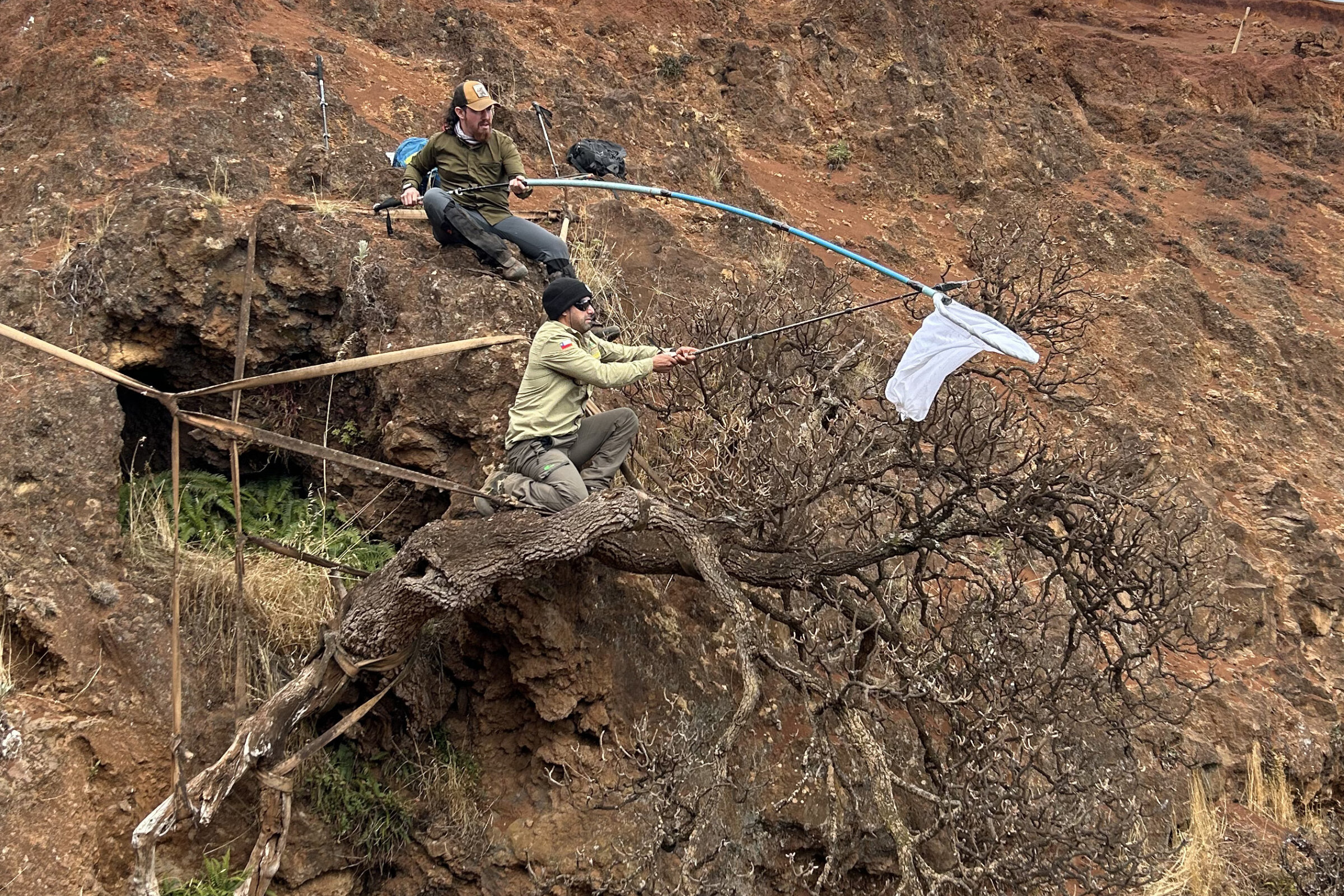
Scientists are desperately racing to save one of the world’s rarest tree species from disappearing — by collecting seeds from the only surviving specimen, which is literally clinging to the side of a cliff on Robinson Crusoe Island, an extremely remote island off the coast of Chile.

A photo shared by the Royal Botanic Gardens in the UK shows conservationists reaching out with a giant net in an attempt to recover seeds from the last known wild specimen of the Dendroseris neriifolia tree, native to Chile’s Juan Fernández Islands.

The action highlights how scientists are going to great lengths to ensure the survival of highly endangered species of plants, a prescient topic as global warming caused by human activity continues to put them at great risk. Scientists have previously found that twice as many plants have gone extinct in the last 250 years as all birds, mammals, and amphibians combined, a devastating and often less-talked-about loss of biodiversity.

The tree species has been heavily affected by habitat loss, encroaching invasive species, and failed attempts to ensure its survival, according to a statement by the Royal Botanic Gardens in Kew, near London, UK.

Twenty-nine seeds were recovered, 25 of which were identified to be potentially viable according to an X-ray analysis by scientists at the Botanic Gardens. Seven seedlings are already establishing, so the last-ditch effort may have a chance of paying off.

It’s not the first time scientists have attempted to ensure the survival of the Dendroseris neriifolia tree. By 1980, only seven surviving wild specimens remained following dramatic population declines. Park rangers attempted to recover the species in the 1990s, and reintroduction efforts in the early 2000s ultimately proved unfruitful.

At this point, there’s not a lot of room for error. Beyond the tree falling off the cliff, just single specimen is currently growing at the VerdeNativo botanic gardens in Chile.

“It is a race against time,” said VerdeNativo botanic gardens scientist Diego Penneckamp in a statement. “This international collaboration to support the last remaining individual could prevent the extinction of a species that represents a unique lineage with its own natural history.”

More on biodiversity: Wildlife Populations Have Shrunk a Shocking Amount in Just 50 Years, Report Finds

The post Scientists Rush to Save One of the World’s Rarest Trees as It Literally Falls Off a Cliff appeared first on Futurism.

Jeff Bezos’ Rocket Explodes Into Mushroom Cloud, Dealing Massive Blow to NASA’s Moon Plans

29 May 2026 at 14:54

In what could turn out to be a huge setback for NASA’s highly ambitious plans to build a permanent Moon base, Jeff Bezos’ latest Blue Origin rocket erupted into a massive mushroom cloud on the launchpad last night.

During a wet dress rehearsal at the Space Force Station in Cape Canaveral on Thursday evening, the company’s New Glenn rocket exploded in dramatic fashion. Footage shows an enormous fireball engulfing the entire launch pad, a sight visible from far away.

It’s the very last thing NASA needed. Just days ago, the space agency announced a slew of “Moon base” missions to build out a permanent presence on the lunar surface — and they hinged on New Glenn rockets launching two of Blue Origin’s Blue Moon lunar landers that are delivering payloads, including rovers, there before the end of this year.

Even before Blue Origin’s latest setback, it was an enormously ambitious timeline. It’s unclear how the New Glenn explosion will affect NASA’s plans going forward, but it certainly doesn’t bode well, given the likely extensive damage to the surrounding pad.

“NASA is aware of the anomaly that occurred tonight at Launch Complex 36 involving Blue Origin’s New Glenn rocket at Cape Canaveral Space Force Station,” NASA’s administrator Jared Isaacman said in a statement. “Spaceflight is unforgiving, and developing new heavy-lift launch capability is extraordinarily difficult.”

“We will work with our partners to support a thorough investigation of this anomaly, assess near-term mission impacts, and get back to launching rockets,” he added. “We will provide information on any impacts to the Artemis and Moon Base programs as it becomes available.”

Bezos appeared distraught following the catastrophe.

“All personnel are accounted for and safe,” he tweeted around 10 pm Eastern on Thursday. “It’s too early to know the root cause but we’re already working to find it.”

“Very rough day, but we’ll rebuild whatever needs rebuilding and get back to flying,” he added. “It’s worth it.”

Even SpaceX CEO Elon Musk, who has a long history of butting heads with Bezos, struck an empathetic pose.

“Most unfortunate,” he tweeted. “Rockets are hard.”

The news comes just over a month after Blue Origin’s New Glenn rocket failed to deliver a communication satellite into a high enough orbit, turning it into nothing more than another piece of space junk.

The rocket and the firm’s Blue Moon lander are one of two options NASA is hoping to use to deliver astronauts to the surface of the Moon, alongside SpaceX’s Starship.

Unfortunately, Musk’s space company is similarly struggling to get its own rocket ready for prime time. Just yesterday, the Federal Aviation Administration announced it was grounding Starship and launching a “mishap investigation” after the company’s Super Heavy booster failed to reignite the majority of its thrusters before splashing down in the Gulf of Mexico on May 22. The second stage similarly erupted in a massive fireball after splashing down in the ocean.

“A return to flight of the Starship Super Heavy vehicle is based on the FAA determining that any system, process, or procedure related to the mishap does not affect public safety,” the regulator wrote in a statement.

More on New Glenn: Jeff Bezos’ Botched Space Launch Was So Bad It Could Threaten NASA’s Entire Moon Program

The post Jeff Bezos’ Rocket Explodes Into Mushroom Cloud, Dealing Massive Blow to NASA’s Moon Plans appeared first on Futurism.

Corporations Reeling From Huge AI Costs With No Clear Benefits

29 May 2026 at 14:04

Companies that fell head over heels for AI are experiencing a rude awakening.

Costs to access powerful AI tools are soaring, forcing company leaders to ask some difficult questions. As Axios reports, the early warning signs are already here, with Microsoft planning to remove its Anthropic Claude Code licenses after opening up access to the tool just six months ago, reportedly for financial reasons.

Uber COO Andrew Macdonald also admitted during a recent podcast appearance that gains in productivity simply weren’t being reflected in the company’s soaring AI-related expenses.

Meanwhile, industry leaders including OpenAI CEO Sam Altman and Anthropic CEO Dario Amodei are walking back their initial claims that AI will lead to a jobs apocalypse, further stoking concerns that the tech may not be all it was initially cracked up to be during the height of the AI hype cycle.

It’s a perfect storm as companies ponder the real-world benefits from their costly investments in AI, if there even are any. That’s particularly true for companies finding that some of their employees are using AI models for meaningless tasks — like checking the weather, as one CTO told Axios, which is an incredibly expensive and roundabout way of getting a meteorological update.

CloudBees CEO Anuj Kapur told the publication that use cases for the tech are limited and that the “reality of AI right now is that it only works for coding.”

Simply put, many are finding that AI just isn’t exactly a money maker. Former Microsoft chief AI officer Sophia Velastegui added that “most people default to automating tasks they dislike rather than tasks most valuable to the company.”

Then there are ongoing concerns over allowing AI agents to run autonomously could open companies up to new risks, such as data leaks.

It’s an uncomfortable predicament to be for an AI industry making trillion-dollar bets on imminent surges in demand and soaring revenues. As the Wall Street Journal reported last month, OpenAI missed its own targets of reaching one billion weekly active users for ChatGPT by the end of 2025, as well as several revenue goals.

In other words, enterprise customers reeling from soaring costs is the very last thing the AI industry needs. Without meaningful use cases and more clarity on a possible return on investment, firms may think twice before spending vast sums on the tech — a harsh reality check for an industry that has long heavily relied on hype and seemingly endless investor enthusiasm.

More on AI prices: Uber Says Its AI Costs Just Aren’t Worth It

The post Corporations Reeling From Huge AI Costs With No Clear Benefits appeared first on Futurism.

Anthropic Customers Creeped Out by Its Newest Models

28 May 2026 at 19:01

Earlier this year, Anthropic started rolling out its latest Mythos AI model to a select number of organizations as part of a deliberately slow and careful launch.

The goal was to give them a fighting chance to address any cybersecurity lapses in their code. Anthropic warned that Mythos was powerful enough to blast holes in their defenses with ease.

Months later, Anthropic cofounder Chris Olah traveled to the Vatican this week to speak at an announcement of Pope Leo’s first encyclical, which happened to be about AI and its associated risks. In remarks, Olah ominously said his team of engineers kept discovering mysterious and even “unsettling” things inside the company’s models.

Add it all up, and the the company’s customers are perturbed. Developers attending recent Claude Code workshops in London last week told Bloomberg‘s Parmy Olson that they were becoming concerned over AI models and agents being given unprecedented levels of autonomy, raising hard-to-ignore questions over accountability in case things were to go south.

Claude Code head of product Cat Wu assured Olson that the system was “incredibly secure” and that it was more of a matter of insufficient communication, not a lack of controls.

But that likely won’t be of much reassurance to developers, who feel like they’re being pushed out of the programming process, relegated to watching an AI tool spit out code over hours, if not days. Others pointed out that the latest iterations of Claude Code were no longer displaying text describing their ongoing chain of thought, further obfuscating their inner workings.

It’s a particularly pertinent subject as Anthropic desperately tries to paint itself as the morally conscious and responsible adult in the room, as perfectly illustrated by Olah’s highly unusual appearance at the Vatican this week.

In many ways, the AI company appears to want it both ways, calling for more oversight and care while also rolling out powerful AI tools that have human developers unsettled.

The potential risks are apparent as ever. With less human oversight, future errors tools like Claude Code may introduce could become increasingly difficult to meaningfully address. Experts have also warned of skill atrophy as programmers start relying more and more on AI coding assistants. As 404 Media reported earlier this month, many developers are alarmed to observe that their peers are quickly losing technical skills due to over-relying on the software.

But not all may be lost. As access to these tools starts to become prohibitively expensive to many as the true costs of AI come into focus, some much-needed human oversight might not be dead quite yet.

More on Anthropic: Anthropic Cofounder Travels to Vatican, Tells Pope They’re Finding “Unsettling” Things Inside AI Models

The post Anthropic Customers Creeped Out by Its Newest Models appeared first on Futurism.

Apocalypse Bunker Fails as Wealthy Residents Turn on Each Other

28 May 2026 at 17:58

More and more wealthy individualsare buying up luxurious underground shelters to survive the apocalypse, whether it’s in the form of a nuclear conflict that turns the Earth’s surface into a radioactive wasteland, or a devastating pandemic that decimates the global population.

But even long before the emergence of total societal collapse, communities buying up underground condos in sprawling prepper developments in the US are already starting to turn on each other, as the Wall Street Journal reports.

Much like the petty grievances plaguing often overbearing homeowners’ associations, investors of a purportedly “five-star” bunker in rural South Dakota called Vivos xPoint are already at each others’ throats — an ironic development, given their shared motivation to survive the end of the world.

The structure was designed to protect 1,000 people from a “coming life-extinction event,” the company behind the development claims on its website.

Only a third of the individual properties — which can be bought for up to $55,000 plus rent and service fees — are occupied at the moment, according to the WSJ. However, altercations and even lawsuits are starting to rack up, long before owners are forced to take shelter in case of an actual “extinction event.”

Disputes are piling up, per the newspaper, from lawsuits over filled septic systems to complaints over off-leash dogs biting residents. During one particularly hairy incident, a man who moved into one of the units with his wife, his daughter, and her four children, pulled a gun on a Vivos contractor who had pulled up with a front-end loader to his bunker.

The resident eventually shot the contractor, injuring him. However, South Dakota’s stand-your-ground law led to a grand jury declining to indict him.

Another lawsuit, filed in September by more than 100 tenants, argued that Vivos had failed to provide them with livable dwellings and properly maintain them. Vivos also promised to build out a gym, restaurant, and general store, among other lavish amenities, none of which have been completed.

In short, the irony of a group of individuals looking to survive the apocalypse melting down over existing rules and petty grievances — long before the actual end of the world — is hard to ignore. And doubly so that they’re seeking redress in the courts, which presumably wouldn’t exist anymore in their fantasy of a post-apocalyptic society.

If this is really the best of humanity that will weather the storm, we could be doomed after all.

More on bunkers: There’s a Major Problem With the Nuclear War Bunkers The Rich Are Buying

The post Apocalypse Bunker Fails as Wealthy Residents Turn on Each Other appeared first on Futurism.

❌