A giant 10-sided wave is emerging around Saturn’s south pole, giving scientists a rare chance to watch a planetary weather pattern take shape. NASA’s Hubble Space Telescope has detected a huge, evolving atmospheric wave with 10 sides wrapped around Saturn’s south pole. It is the first time scientists have seen a large, regular-sided jet pattern [...]
After over 7,000 days in space, the Cassini mission ended on Sept. 15, 2017. Since its Oct. 15, 1997 launch, the spacecraft had returned a wealth of new knowledge and images of Saturn and its moons. Thanks to Cassini’s observations, researchers discovered liquid methane lakes on Titan, the potential habitability of Enceladus and the geysersContinue reading "Sept. 15, 2017, Cassini’s Grand Finale"
Stephen Joseph theatre, Scarborough The playwright explores our relationship with technology, asks if robots have souls and even questions the value of art in this sci-fi courtroom drama
For play number 92, Alan Ayckbourn returns to his preoccupation of exploring where we as a species are heading through a science-fiction lens. He goes back to the future. In The Trial of Romeo Oscar, the playwright famed for his domestic comedies looks to the year 2194 when humans have spread about the galaxy and androids live alongside us. One of them, RSDO83, is on trial for the murder of a teenage girl in his charge.
This is Ayckbourn philosophising about the future of humanity as we sit at an obvious inflection point, asking what this moment in our relationship with technology means and where it will lead us. The questions running through the play are manifold, complex and echo those asked by sci-fi writers for decades: can robots hurt humans? Do they have souls? He is also questioning the value of art and even its purpose.
New Hubble observations have revealed a dramatic, 10-sided jet surrounding Saturn's south pole, and it appears to be evolving before our eyes.
The Hubble Space Telescope recently snapped a high-resolution view of the striking "atmospheric wave," which appears to have begun forming in 2023, archival Hubble images show. Scientists are curious about how this "decagon" popped up so quickly, given that Saturn's other famous multisided wave — a hexagon at the north pole — has been observed on the planet for 40-plus years.
"The question is, why did it suddenly form now when we haven't seen one before?" Amy Simon, a senior scientist at NASA's Goddard Space Flight Center and co-author of a new study describing the observations, said in a statement.
"The northern hexagon has been there every time we've looked for more than 40 years," Simon added. "This feature is different — it appears to be strengthening, giving us the rare opportunity to watch a giant atmospheric pattern develop."
The famous hexagon at Saturn’s north pole. (Image credit: NASA/JPL-Caltech/Space Science Institute)
Scientists can see the wave persisting through several atmospheric layers, which means it extends beyond the cloud tops. The wave is also found in a large jet stream at Saturn. More observations with Hubble and the James Webb Space Telescope (JWST) will be required to see how the wave is generated and what the decagon illustrates about atmospheres in large gas giants like Saturn.
The images were obtained as part of Hubble's Outer Planet Atmospheres Legacy program, which uses some of the telescope's time to image the solar system's outer planets — Jupiter, Saturn, Uranus and Neptune — once a year. The goal is to obtain long-term observations of these worlds, to supplement spacecraft orbiting or flying by.
From Earth's perspective, Saturn is slowly orbiting in its roughly 29-year journey of the sun so that its south pole is visible from our planet, allowing for a good view of the changing decagon. Hubble, in fact, was not the first to see signs of this decagonal shape; it was ground-based observatories that spotted a mysterious undulating band around Saturn’s south pole in 2024.
Agustín Sánchez-Lavega, first author of the study and a researcher in the Department of Applied Physics at the University of the Basque Country, and amateur astronomers Trevor Barry and Jean-Paul Oger first spotted the forming wave. The trio used the university's Planetary Virtual Observatory Laboratory, which brings in observations from around the world, to make the Saturnian discovery.
While more images in 2025 showed the wave starting to move into a decagon structure, Hubble was able to obtain high-resolution images without Earth's atmosphere in the way.
The Cassini spacecraft, which orbited Saturn between 2004 and 2017, didn't see the feature, hinting that it hadn’t started forming yet, according to NASA. "Given Saturn's symmetry in its north-south jet stream system, we have been searching for a counterpart to Saturn's northern hexagon on the south pole in Hubble images since 1990," Sánchez-Lavega said.
Both Hubble and JWST are expected to provide more opportunities to look at the ringed planet's developing decagon in the near future. In the meantime, Saturn isn’t the only solar system planet with perplexing polar features; 2017 images from NASA’s Juno spacecraft showed that Jupiter’s south pole is studded with gigantic, oval-shaped cyclones that echo the chaos of the planet’s famous Great Red Spot.
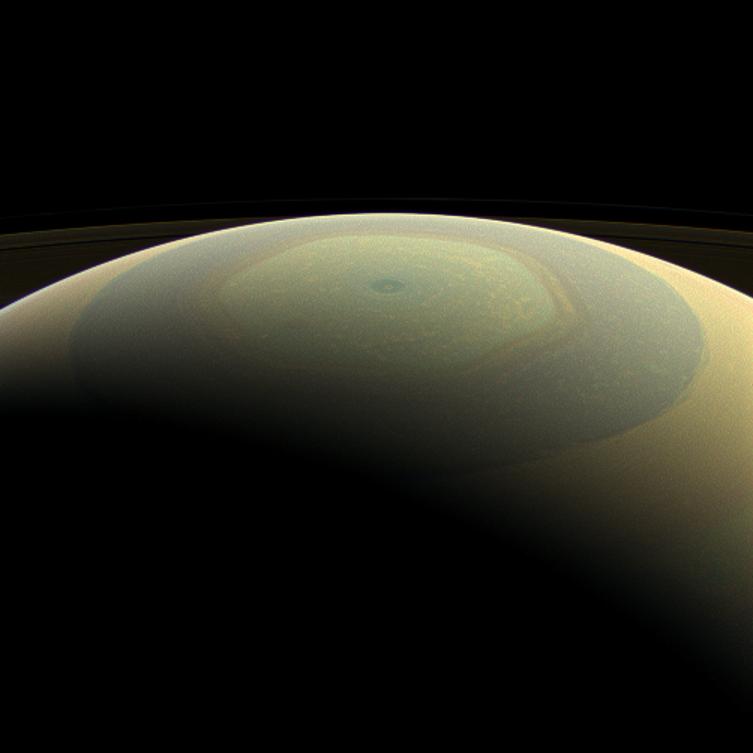
For almost five decades, Saturn’s north pole has been famous for hosting a bizarre, six-sided jet stream known as the hexagon, a feature first spotted by NASA’s Voyager spacecraft in the 1980s and still churning today.
One of planetary defense‘s biggest opportunities will come as the asteroid Apophis makes its tight flyby of our planet on April 13, 2029, allowing international space missions to interact with the near-Earth object. Asteroids this size only approach this close to Earth about once every 7,500 years, making the event a rare opportunity for real-world planetary defense research.
In a new paper published in the journal Space: Science & Technology, a team of researchers analyzes the many opportunities the Apophis flyby will offer for science and planetary defense.
The closest distance between Earth and Apophis during the flyby will be a mere 38,000 kilometers, about one-tenth of the distance from the Earth to the Moon. Coordinating these planetary defense efforts among the Earth’s nations may be one of the biggest challenges as the object comes uncomfortably close.
Apophis Explained
As soon as astronomers first discovered Apophis in 2004, the asteroid’s 340-meter-wide diameter and close pass by Earth immediately made it a concern for scientists. Fortunately, it is expected that on April 13, 2029, it will safely pass our planet at a distance of close to 20,000 miles—closer than some of our weather and communication satellites, but still with no risk of an impact.
Yet the near-Earth asteroid still holds mysteries for scientists. Models of the object depend heavily on assumptions, not hard data, to predict not just its tidal effects but also its composition, size, internal structure, and spin state.
A series of images of the asteroid Apophis captured in March 2021 (Image Credit: NASA/JPL-Caltech and NSF/AUI/GBO)
With so many open questions about the asteroid and the unique opportunity to collect data and test processes for future planetary defense operations, many countries are planning missions to Apophis, but in this new paper, the researchers note that some of these activities require increased international coordination to avoid interference.
Part of the paper synthesizes known data on Apophis, including radar observations, light-curve, and spectral data. From this data, the team then developed new predictions for the asteroid’s dust ejection, orbital and spin changes, internal structural response, and surface material displacement. These projections were crucial in the researchers’ evaluations of the feasibility of various currently proposed or authorized missions and their likely scientific value.
Apophis Missions are Gearing Up
Future Apophis missions fit into four primary categories: rendezvous, flyby sample return, and impactor experiments.
In the recent research, the team found that flyby missions should capture data at very fine scales, down to the centimeter or decimeter for surface changes and hours for changes in spin period. Additionally, these space-borne instruments should be able to measure dust ejection phenomena. Together, this data stream alone could provide important direct evidence for how such rubble-pile asteroids evolve structurally. Relatively low-cost sample return missions could push this even further.
The activities coordinated under the International Asteroid Warning Network constitute the largest multinational asteroid detection and observation effort ever assembled and are its first global joint exercise. The network will build experience responding to potentially deadly space threats in the future.
Earth Interactions
On the other hand, the asteroid’s close approach to Earth will affect Apophis as well. Our planet’s gravity is expected to alter Apophis’s orbit from an Aten-type to an Apollo-type, changing the object’s spin period and orbital uncertainty.
Additionally, roughly 1% of Apophis may experience a surface material disruption, potentially altering the object’s spectral properties by exposing fresh material.
The asteroid’s extremely low gravity may also cause it to lose surface dust to Earth’s magnetosphere, posing an electromagnetic disturbance hazard to spacecraft. Space agencies will need to monitor the situation to protect our increasingly essential space-based communications infrastructure during the event.
While there is no immediate danger to our planet, the researchers say this event is shaping up to be a pivotal moment in international space cooperation and a turning point for organized space defense.
Ryan Whalen covers science and technology for The Debrief. He holds an MA in History and a Master of Library and Information Science with a certificate in Data Science. He can be contacted at ryan@thedebrief.org.
July 20 marked the 50th anniversary of one of the biggest robotic spaceflight achievements in NASA’s history: the landing of the Viking 1 spacecraft on Mars. It was the first […]
The Chinese Tianwen-2 mission has captured the first imagery of a space object that some astronomers are calling Earth’s “quasi-moon.”
The object was captured in images released by the China National Space Administration (CNSA), after its Tianwen-2 spacecraft reached the tiny asteroid 469219 Kamoʻoalewa. Initially discovered in 2016, the asteroid became the target of a sample return mission launched by China on 28 May 2025.
Officially the CNSA’s second mission under its Planetary Exploration of China Program, Tianwen-2 aims to return close to 100 grams of samples from the surface of the small object.
Earth’s Mysterious Quasi-Moons
Quasi-moons are the name astronomers have for small, very distant objects that do not impact our planet’s tides or possess other characteristics associated with our primary moon.
These objects are nonetheless considered moon-like because they remain in our celestial neighborhood for extended periods, providing unique opportunities for studying near-Earth objects (NEOs) like asteroids, and the impact things like solar radiation and gravity have on them.
Although Kamoʻoalewa (also known as asteroid 2016 HO3) is the most well-known of Earth’s quasi-moons, it is one of seven that are currently known to astronomers. Kamoʻoalewa’s orbit is technically also around the Sun, rather than Earth, although its synchronized path keeps it locked closely to Earth’s orbit, thereby justifying its recognition as a “quasi-satellite.”
The object’s size and distance make it an ideal target for studying NEOs, and China leaped at the opportunity with the CNSA’s Tianwen-2 mission.
Approaching a Quasi-Moon
The Tianwen-2 spacecraft is currently nearing 20 kilometers from the 130 to 330-foot space rock, according to a statement CNSA released on Monday.
Along with a mission update, the CNSA also released new images, which are the first to officially document the object’s appearance. According to current mission timelines, Tianwen-2 will remain in the vicinity of 469219 Kamoʻoalewa until next April, and by sometime in November 2027, its return capsule is expected to reach Earth.
After its study of 469219 Kamoʻoalewa, Tianwen-2 will then make its way with the aid of a gravity assist in the direction of the comet 311P/PANSTARRS, arriving in its vicinity by January 2035.
“Going forward, the probe will gradually conduct more detailed scientific explorations to obtain information on the asteroid’s shape, material composition, and internal structure,” read the CNSA’s statement on Monday.
The agency said its ongoing collection of information will help to provide “support for preparations for sampling,” and the spacecraft will spend the next several months conducting reconnaissance of the asteroid before its sample collection begins, which will combine high-speed maneuvers with the deployment of a specialized robotic arm.
Following their collection, the samples will be delivered to a recovery site in the Gobi Desert after dropping into Earth’s atmosphere in November 2027.
Micah Hanks is the Editor-in-Chief and Co-Founder of The Debrief. A longtime reporter on science, defense, and technology with a focus on space and astronomy, he can be reached atmicah@thedebrief.org. Follow him on X @MicahHanks, and at micahhanks.com.
China’s Tianwen-2 spacecraft has carried out a series of small propulsive maneuvers following a main burn June 7, setting up an asteroid rendezvous in July.
Editor’s Note:Astrobites is a graduate-student-run organization that digests astrophysical literature for undergraduate students. As part of the partnership between the AAS and astrobites, we occasionally repost astrobites content here at AAS Nova. We hope you enjoy this post from astrobites; the original can be viewed at astrobites.org.
If you ask anyone what their favourite planet is, the answer you’ll most likely hear is Saturn. Why? Why else than the beautiful and intricate ring system surrounding the gas giant. The other gas and ice giants in our solar system — Jupiter, Uranus, and Neptune — have ring systems themselves but none quite as striking as Saturn’s. Would it surprise you to learn that astronomers’ best models have not yet totally explained why Saturn’s rings look the way they do?
In contrast, it may not surprise you to hear that people have been trying to explain the rings for as long as we have seen them with telescopes. We now know that planetary rings are collections of relatively small particles (think micrometre up to metre sized), most likely having once been the material of a larger body that was disrupted either by collisions or tidal forces. This material, due to the gravity of its local planet, is sculpted into a flat disc where more subtle interactions then lead to substructure forming within the disc such as gaps and ringlets. Many of these substructures are explained by well-understood physics — for example gaps being carved by embedded moonlets or resonances sculpting ring edges — though there remain some outstanding problems in our understanding.
The authors of today’s article set their sights on the problematic inner edge of Saturn’s A ring (Figure 1). They describe some mechanisms — namely the collisions of micrometeoroids within the rings — by which a sharp ring edge can be maintained, but there exists a gap in the understanding of how such an edge can form in the first place. All hope is not lost, though, as today’s authors reintroduce a physical process they call the “eclipse–Yarkovsky” effect, which seems to explain these phenomena.
Figure 1: A horizontally sliced image of Saturn’s rings shows the rich substructure and gaps within the various rings. Saturn, which is not shown here, would be to the left of the image. The authors of today’s article are particularly concerned with the bright and sharp inner (left side) edges of the A and B rings. Click to enlarge. [NASA/JPL/Space Science Institute]
Billions of Rocket-Powered Bumper Cars
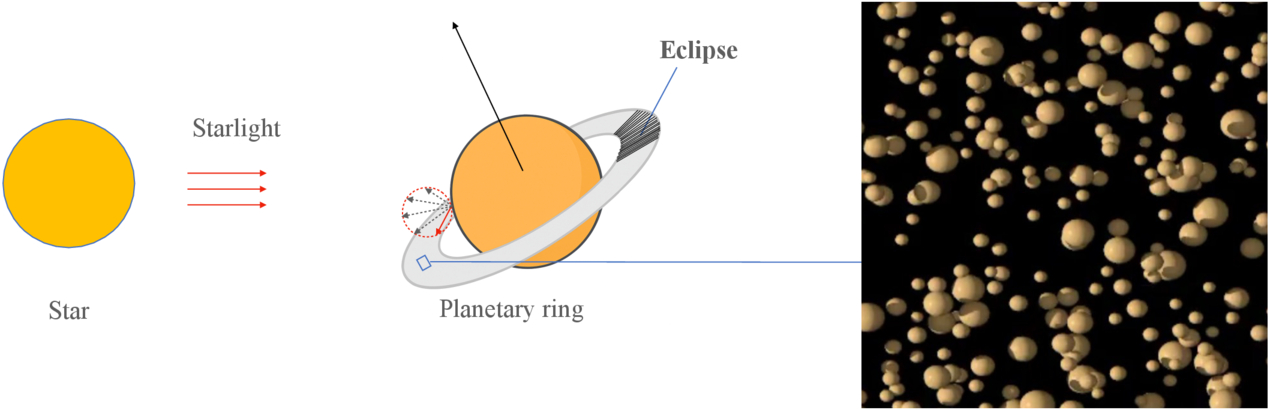
The idea behind this process revolves entirely around light. When sunlight hits a particle within a planetary ring, non-absorbed sunlight imparts a little “bump” onto a particle, ever so slightly altering its trajectory. At the same time, some of the sunlight is absorbed into the particle, which heats it up; light is soon re-emitted via thermal radiation, which, again, can slightly change the trajectory of these tiny particles. From a point on the surface of each ring particle (see rightmost side of Figure 2), the photons from this thermal radiation are all emitted in random directions; however, across the whole surface of the particle there is a net force! These tiny particles are spinning, and so the side just near “sunset” is hottest and emitting the most thermal photons. In this way, the pressure from the sunlight plus the thermal radiation of each particle imparts a net torque on the ring itself which changes the angular momentum of the ring.
Figure 2: Starlight is the main source of light onto the particles that make up a planetary ring (right panel) though reflected light from the planet’s surface hits it too. This light “heats up” the ring and forms an asymmetry as the ring is eclipsed by the planet, which produces a net force. [Zhou et al. 2026]
What we described just then is essentially solar radiation pressure plus the Yarkovsky effect. It turns out that the net force from this process typically averages out to zero as the ring particles orbit around the planet. This assumes, though, that the sunlight is constantly shining on the ring. Stunning imagery of Saturn tells us that this isn’t the case, so what happens when we take into account the shadow cast on the ring from the planet? Today’s authors find that the net effect induces a positive change in angular momentum of the ring particles, which they call the eclipse–Yarkovsky effect.
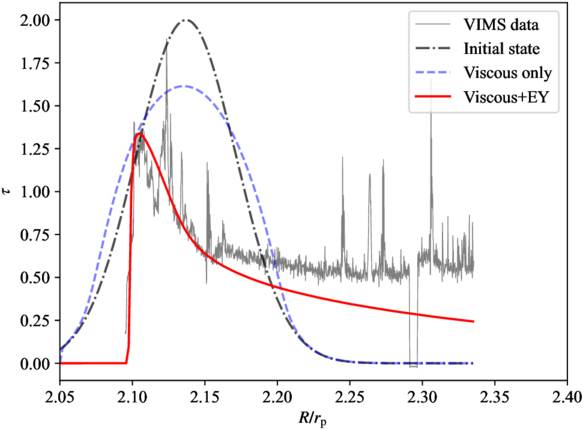
After today’s authors detailed all of the math involved in this process (and there is a lot), they put it into practice to try to help explain Saturn’s curious rings. Including the eclipse–Yarkovsky effect together with other known effects that drive ring evolution allowed them to reproduce the optical depth profile (how thick the ring looks) of Saturn’s A ring better than ever before (notably the sharp inner edge in Figure 3). On top of this, the effect provides another avenue for moonlet formation in the outer edges of ring systems as the positive torque from the effect drives material out toward and away from the Roche limit.
Figure 3: The authors try to explain the current structure of Saturn’s A ring by initialising it with a Gaussian profile of optical thickness versus radius (black dot-dashed line) and evolving it for 81 million years under different effects. When viscous effects are included (blue dashed line), the ring spreads out, but it’s only when the eclipse–Yarkovsky (EY) effect is included (red line) that the model closely matches the observed data (grey line). [Zhou et al. 2026]
Undeniably useful for Saturn, the eclipse–Yarkovsky effect may also explain some other conundra in the solar system. Mars may have once had rings, which are thought to have eventually clumped together to form the inner moon Phobos. This idea is problematic, though, in that current models suggest there should still be some residual ring system around Mars even after Phobos formed. Enter the eclipse–Yarkovsky effect: being 100 times stronger for Mars than Saturn (due to its more intense incident sunlight), the effect may have driven out and dispersed that residual ring altogether. While the authors are currently looking into this possibility, the reintroduction of the eclipse–Yarkovsky effect has already shown great promise for our most beautiful ringed planetary neighbour.
Original astrobite edited by Wasi Naqvi.
About the author, Ryan White:
I am a first-year PhD student at Macquarie University in Australia, working mainly on binary/multiple systems with massive stars (Wolf–Rayets in particular!). Outside of study, I’m probably drinking coffee, baking, reading, or going for a run. You can also find me procrastinating on Bluesky @astroryan.bsky.social.
Giovanni Cassini was born in Perinaldo, in what is now Italy, on June 8, 1625. Early work on Jupiter and Mars’ rotational periods and the positions of Jupiter’s satellites led to an invitation to Paris and the Academie des Sciences by King Louis XIV; he became director of the Observatorie de Paris in 1671, andContinue reading "June 8, 1625: The birth of Giovanni Cassini"
New observatories and spacecraft missions are probing environments in our solar system that could potentially host life but have long remained hidden. Icy moons like Saturn’s Enceladus and Jupiter’s Europa likely contain oceans beneath frozen outer shells. But a layer of ice prohibits space probes from sampling them directly. Exploring these icy moons is almost forensic: Their surfaces keep aContinue reading "Scientists used a method from ecology to identify whether icy moons could hold conditions for life"
Using spectral data from the Near-Infrared Spectrograph (NIRSpec) onboard the NASA/ESA/CSA James Webb Space Telescope, astronomers analyzed the atmosphere of TOI-199b, a distant Saturn-mass world that is neither frozen nor scorching hot.

 Login

 A giant 10-sided wave is emerging around Saturn’s south pole, giving scientists a rare chance to watch a planetary weather pattern take shape. NASA’s Hubble Space Telescope has detected a huge, evolving atmospheric wave with 10 sides wrapped around Saturn’s south pole. It is the first time scientists have seen a large, regular-sided jet pattern [...]